
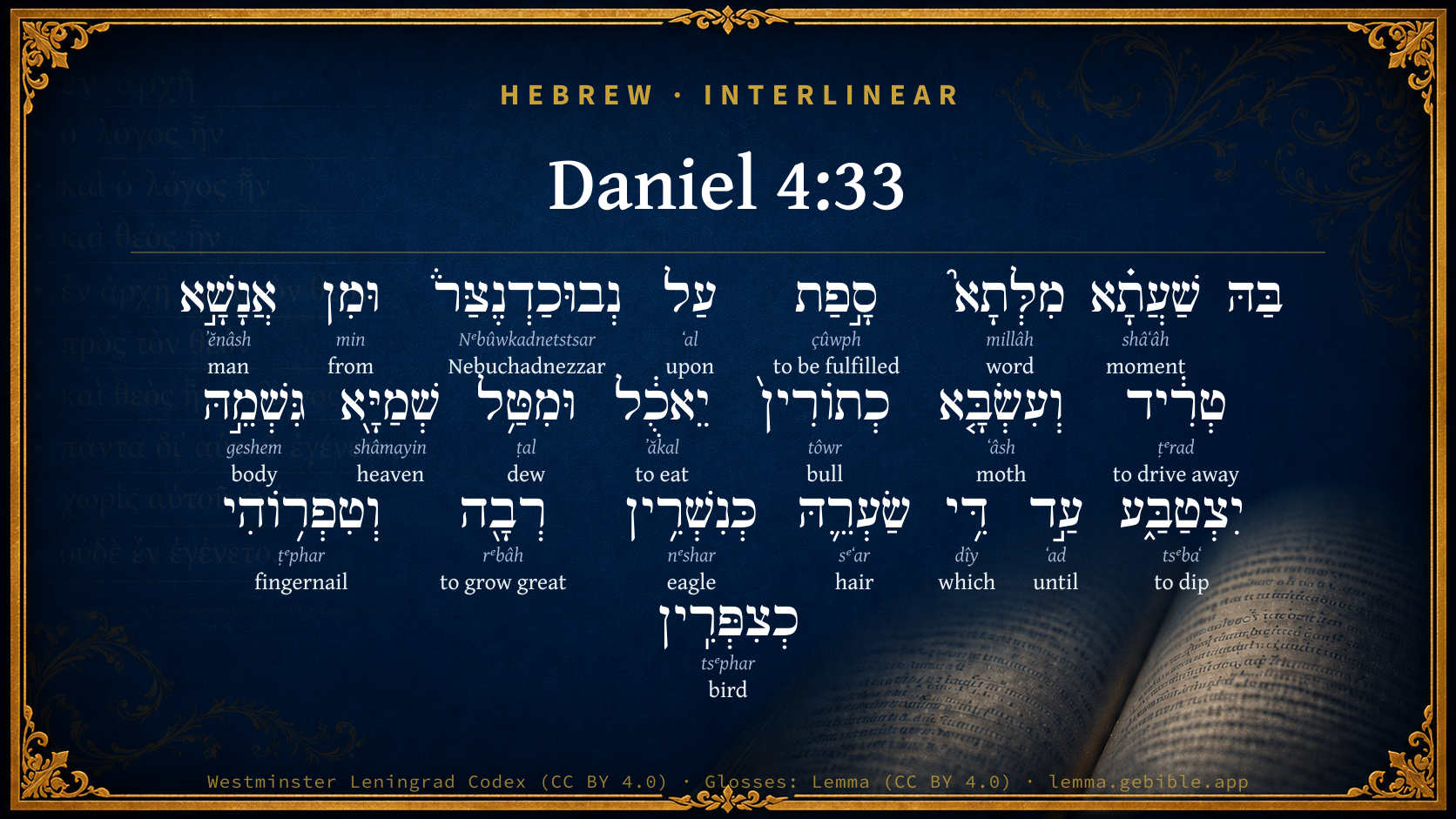
Daniel 4:33

Hebrew (Westminster Leningrad Codex) Daniel 4:33 appears in the Hebrew Old Testament. The text above is from the Westminster Leningrad Codex. Each word links to its Strong’s number, a concise gloss, and parsing drawn from the Open Scriptures Hebrew Bible morphology. Click any word for its full Brown-Driver-Briggs (BDB) entry.
Download image
Cite this verse

Daniel 4:33 (World English Bible). Public Domain. Lemma interlinear Bible study tool, https://lemma.gebible.app/v/daniel/4/33.

Show BibTeX & RIS
BibTeX
RIS
English Translation
The same hour was the thing fulfilled on Nebuchadnezzar: and he was driven from men, and ate grass as oxen, and his body was wet with the dew of the sky, until his hair was grown like eagles' [feathers], and his nails like birds' [claws].
World English Bible · Public Domain
Highlights
  • 2 first appearances in the Hebrew Bible
Full analysis ↓
Download a study sheet

One document with this verse’s original text, its word-by-word gloss line, the meaning frame, cross-references with their text, attributed commentary, and full source and license credits — printable, and it pastes into notes with its structure intact.

This verse Autodidact and up

Study sheet (.html) Plain text (.txt)

A passage Seminary Student

Up to 50 verses in one chapter. A passage sheet keeps up to 6 commentary sources and 12 cross-references per verse, in the order this page ranks them, and says so on the sheet whenever that leaves anything out. Ask for a single verse and you get the Autodidact verse sheet above.

Everything on this page stays free to read, with no account — the sheet is a download of what is already on screen, not access to it.

Want to remove ads? Support Godless Engineer
Compare translations 3

The same verse in 3 English versions, stacked beneath the original-language interlinear above. Click any original word for its lexicon entry.

Each is an independent rendering of the whole verse — the interlinear is not word-aligned to these translations.

Highlighted words mark where these versions differ — a whole-verse word diff, not a word-by-word alignment.

  • World English Bible Public Domain
    The same hour was the thing fulfilled on Nebuchadnezzar: and he was driven from men, and ate grass as oxen, and his body was wet with the dew of the sky, until his hair was grown like eagles' [feathers], and his nails like birds' [claws].
  • King James Version Public Domain
    The same hour was the thing fulfilled upon Nebuchadnezzar: and he was driven from men, and did eat grass as oxen, and his body was wet with the dew of heaven, till his hairs were grown like eagles' feathers, and his nails like birds' claws.
  • unfoldingWord Literal Text CC BY-SA 4.0
    Immediately the word was fulfilled against Nebuchadnezzar. He was driven away from men. He ate grass like an ox, and his body was wet with the dew of heaven until his hair had grown long like the feathers of eagles, and his nails like the claws of birds.

unfoldingWord Literal Text — © unfoldingWord, licensed CC BY-SA 4.0. Word-aligned USFM3 via Door43 (git.door43.org/unfoldingWord/en_ult).

Versions to compare (up to 4)

3 of 4 selected

Show all 18 translations

Every available English version of this verse, each an independent rendering of the whole verse.

  • World English Bible Public Domain
    The same hour was the thing fulfilled on Nebuchadnezzar: and he was driven from men, and ate grass as oxen, and his body was wet with the dew of the sky, until his hair was grown like eagles' [feathers], and his nails like birds' [claws].
  • Berean Standard Bible Public Domain
    At that moment the sentence against Nebuchadnezzar was fulfilled. He was driven away from mankind. He ate grass like an ox, and his body was drenched with the dew of heaven, until his hair grew like the feathers of an eagle and his nails like the claws of a bird.
  • Majority Standard Bible Public Domain
    At that moment the sentence against Nebuchadnezzar was fulfilled. He was driven away from mankind. He ate grass like an ox, and his body was drenched with the dew of heaven, until his hair grew like the feathers of an eagle and his nails like the claws of a bird.
  • King James Version Public Domain
    The same hour was the thing fulfilled upon Nebuchadnezzar: and he was driven from men, and did eat grass as oxen, and his body was wet with the dew of heaven, till his hairs were grown like eagles' feathers, and his nails like birds' claws.
  • American Standard Version (1901) Public Domain
    The same hour was the thing fulfilled upon Nebuchadnezzar: and he was driven from men, and did eat grass as oxen, and his body was wet with the dew of heaven, till his hair was grown like eagles' `feathers', and his nails like birds' `claws'.
  • Revised Version (1885) Public Domain
    The same hour was the thing fulfilled upon Nebuchadnezzar: and he was driven from men, and did eat grass as oxen, and his body was wet with the dew of heaven, till his hair was grown like eagles’ feathers, and his nails like birds’ claws.
  • Geneva Bible (1599) Public Domain
    At the same time was mine vnderstanding restored vnto me, and I returned to the honour of my kingdome: my glory and my beautie was restored vnto me, and my counsellours and my princes sought vnto me, and I was established in my kingdome, and my glory was augmented toward me.
  • Douay-Rheims (1899) Public Domain
    The same hour the word was fulfilled upon Nabuchodonosor, and he was driven away from among men, and did eat grass like an ox, and his body was wet with the dew of heaven: till his hairs grew like the feathers of eagles, and his nails like birds' claws.
  • Young's Literal Translation Public Domain
    `In that hour the thing hath been fulfilled on Nebuchadnezzar, and from men he is driven, and the herb as oxen he eateth, and by the dew of the heavens his body is wet, till that his hair as eagles' hath become great, and his nails as birds.'
  • Literal Standard Version CC BY-SA 4.0
    In that hour the thing has been fulfilled on Nebuchadnezzar, and from men he is driven, and he eats the herb as oxen, and his body is wet by the dew of the heavens, until his hair has become great as eagles, and his nails as birds.
  • Unlocked Literal Bible CC BY-SA 4.0
    This decree against Nebuchadnezzar was carried out immediately. He was driven away from people. He ate grass like an ox, and his body was wet with the dew from the heavens. His hair grew as long as eagles' feathers, and his nails became like birds' claws.
  • unfoldingWord Literal Text CC BY-SA 4.0
    Immediately the word was fulfilled against Nebuchadnezzar. He was driven away from men. He ate grass like an ox, and his body was wet with the dew of heaven until his hair had grown long like the feathers of eagles, and his nails like the claws of birds.
  • Darby Bible Public Domain
    The same hour was the word fulfilled upon Nebuchadnezzar; and he was driven from men, and ate grass as oxen; and his body was bathed with the dew of heaven, till his hair grew like eagles' [feathers], and his nails like birds' [claws].
  • World Messianic Bible Public Domain
    This was fulfilled the same hour on Nebuchadnezzar. He was driven from men and ate grass like oxen; and his body was wet with the dew of the sky until his hair had grown like eagles’ feathers, and his nails like birds’ claws.
  • Webster's Bible Public Domain
    The same hour was the thing fulfilled upon Nebuchadnezzar: and he was driven from men, and ate grass as oxen, and his body was wet with the dew of heaven, till his hairs were grown like eagles' feathers, and his nails like birds' claws.
  • Free Bible Version CC BY-SA 4.0
    Immediately the decree was fulfilled, and Nebuchadnezzar was driven away from human society. He ate grass like the cattle, and his body was soaked with the dew of heaven. His hair grew matted like a vulture, and his nails like bird claws.)
  • Bible in Basic English Public Domain
    That very hour the order about Nebuchadnezzar was put into effect: and he was sent out from among men, and had grass for his food like the oxen, and his body was wet with the dew of heaven, till his hair became long as eagles' feathers and his nails like those of birds.
  • JPS Tanakh (1917) Public Domain
    (4-30) The same hour was the thing fulfilled upon Nebuchadnezzar; and he was driven from men, and did eat grass as oxen, and his body was wet with the dew of heaven, till his hair was grown like eagles' feathers, and his nails like birds' claws.

Literal Standard Version (2020), Covenant Press — licensed CC BY-SA 4.0. Text via the HelloAO Bible API (eBible.org). Unlocked Literal Bible (unfoldingWord) — licensed CC BY-SA 4.0. Text via the HelloAO Bible API (eBible.org). unfoldingWord Literal Text — © unfoldingWord, licensed CC BY-SA 4.0. Word-aligned USFM3 via Door43 (git.door43.org/unfoldingWord/en_ult). Free Bible Version, Dr. Jonathan Gallagher — licensed CC BY-SA 4.0. Text via the HelloAO Bible API (eBible.org).

Word by word

More ways to search: Search by grammar → Find every occurrence → Compare this word →

Practice this passage: Drill this verse → Learn its vocabulary →

סָ֣פַת
çûwph
H5487
“to be fulfilled”
Adjective, V, Plural
Part of Speech
Adjective
Number
Plural
Full BDB Definition

Origin: corresponding to H5486

TWOT: 2888

to be fulfilled, be completed, come to an end - (Peal) to be fulfilled, be completed - (Aphel) to put an end to
  1. שַׁעֲתָ֗א shâʻâh H8160 “moment · the” Adjective, N, Common + Particle, Definite Article
  2. מִלְּתָא֮ millâh H4406 “word · the” Adjective, N, Common + Particle, Definite Article
  3. עַל ʻal H5922 “upon” Adjective, R
  4. נְבוּכַדְנֶצַּר֒ Nᵉbûwkadnetstsar H5020 “Nebuchadnezzar” Adjective, N
  5. וּמִן min H4481 “and · from” Adjective, C + Preposition
  6. אֲנָשָׁ֣א ʼĕnâsh H606 “man · the” Adjective, N, Common + Particle, Definite Article
  7. טְרִ֔יד ṭᵉrad H2957 “to drive away” Adjective, V, Plural
  8. וְעִשְׂבָּ֤א ʻâsh H6211 “and · moth · the” Adjective, C + Noun, Common, Masculine, Singular, Determined + Particle, Definite Article
  9. כְתוֹרִין֙ tôwr H8450 “like/as · bulls” Adjective, R + Noun, Common, Masculine, Plural, Absolute
  10. יֵאכֻ֔ל ʼăkal H399 “to eat” Adjective, V
  11. וּמִטַּ֥ל ṭal H2920 “and · from · dew of” Adjective, C + Preposition + Noun, Common, Masculine, Singular, Construct
  12. שְׁמַיָּ֖א shâmayin H8065 “heaven(s) · the” Adjective, N, Common + Particle, Definite Article
  13. גִּשְׁמֵ֣הּ geshem H1655 “body · his” Adjective, N, Common + Suffix, Personal, 3rd Person, Masculine, Singular
  14. יִצְטַבַּ֑ע tsᵉbaʻ H6647 “to dip” Adjective, V
  15. עַ֣ד ʻad H5705 “until” Adjective, R
  16. דִּ֥י dîy H1768 “which” Adjective, T
  17. שַׂעְרֵ֛הּ sᵉʻar H8177 “hair · his” Adjective, N, Common + Suffix, Personal, 3rd Person, Masculine, Singular
  18. כְּנִשְׁרִ֥ין nᵉshar H5403 “like/as · eagles” Adjective, R + Noun, Common, Masculine, Plural, Absolute
  19. רְבָ֖ה rᵉbâh H7236 “to grow great” Adjective, V, Plural
  20. וְטִפְר֥וֹהִי ṭᵉphar H2953 “and · fingernails · his” Adjective, C + Noun, Common, Feminine, Plural, Construct + Suffix, Personal, 3rd Person, Masculine, Singular
  21. כְצִפְּרִֽין tsᵉphar H6853 “like/as · birds” Adjective, R + Noun, Common, Feminine, Plural, Absolute

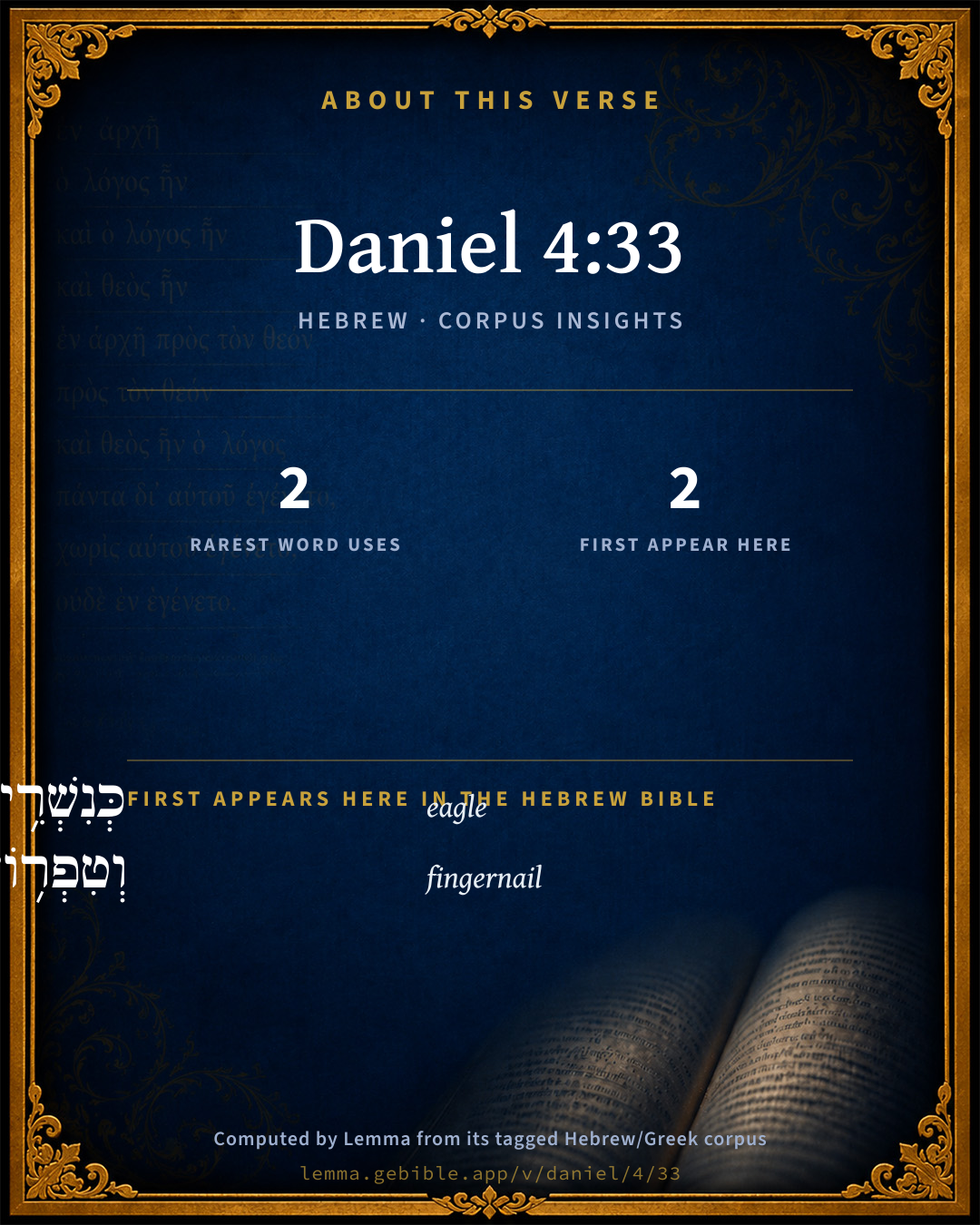
About this verse

These counts appear in no published source. They are computed here, from the morphology-tagged text and Lemma’s own curated glosses. What Lemma adds →

23
words
22
distinct lemmas
Prophets
section

Notable vocabulary

The rarest word here is סָ֣פַת to be fulfilled H5487 — appearing just 2 times in the whole Hebrew Bible.

First appearance in Scripture

These words make their first canonical appearance in the Hebrew Bible here:

  • כְּנִשְׁרִ֥ין eagle H5403
  • וְטִפְר֥וֹהִי fingernail H2953

Shared distinctive vocabulary

סָ֣פַת to be fulfilled H5487 occurs in 2 verses of the Hebrew Bible. Also found in:

Grammatical profile

  • 5 nouns
  • 12 adjectives
  • 1 preposition
  • 5 particles

Hebrew & Septuagint length

In English translation the verse runs 45 words from the Hebrew and 48 from the Septuagint (LXX English) — closely comparable.

A rough comparison of the two English renderings, which tokenize alike — not a word-level alignment.

Word counts can differ between the Hebrew and the Greek without any difference in meaning — e.g. the Hebrew direct-object marker אֵת has no separate Greek word, and Greek often adds the article ὁ.

Cross-references

7

Topical passages linked to Daniel 4:33 in the Treasury of Scripture Knowledge — connected by theme and wording, ordered by reader-vote popularity; previews shown in the World English Bible.

  • Daniel 4:25 that you shall be driven from men, and your dwelling shall be with the animals of the field, and you shall be made to eat grass as oxen, and shall be wet with the dew of the sky, and seven times shall pass over you; until you know that the Most High rules in the kingdom of men, and gives it to whoever he will.
  • Daniel 4:32 and you shall be driven from men; and they dwelling shall be with the animals of the field; you shall be made to eat grass as oxen; and seven times shall pass over you; until you know that the Most High rules in the kingdom of men, and gives it to whoever he will.
  • Job 20:5 That the triumphing of the wicked is short, The joy of the godless but for a moment?
  • Isaiah 30:14 He shall break it as a potter's vessel is broken, breaking it in pieces without sparing; so that there shall not be found among the pieces of it a broken piece with which to take fire from the hearth, or to dip up water out of the cistern."
  • Daniel 5:5 In the same hour came forth the fingers of a man's hand, and wrote over against the lampstand on the plaster of the wall of the king's palace: and the king saw the part of the hand that wrote.
  • Daniel 5:21 and he was driven from the sons of men, and his heart was made like the animals', and his dwelling was with the wild donkeys; he was fed with grass like oxen, and his body was wet with the dew of the sky; until he knew that the Most High God rules in the kingdom of men, and that he sets up over it whoever he will.
  • 1 Thessalonians 5:2 For you yourselves know well that the day of the Lord comes like a thief in the night.

Cross-references courtesy of OpenBible.info (CC BY 4.0).

Hebrew and Greek witnesses Masoretic Hebrew ↔ Greek Septuagint

The same verse in the two great witnesses to the Old Testament, shown verse-for-verse.

These are two independent witnesses, not word-aligned to each other, and the Septuagint is shown in lemma (dictionary) form.

Hebrew Daniel 4:33 Masoretic · Westminster Leningrad Codex

בַּהּ שַׁעֲתָ֗א מִלְּתָא֮ סָ֣פַת עַל נְבוּכַדְנֶצַּר֒ וּמִן אֲנָשָׁ֣א טְרִ֔יד וְעִשְׂבָּ֤א כְתוֹרִין֙ יֵאכֻ֔ל וּמִטַּ֥ל שְׁמַיָּ֖א גִּשְׁמֵ֣הּ יִצְטַבַּ֑ע עַ֣ד דִּ֥י שַׂעְרֵ֛הּ כְּנִשְׁרִ֥ין רְבָ֖ה וְטִפְר֥וֹהִי כְצִפְּרִֽין

The same hour was the thing fulfilled on Nebuchadnezzar: and he was driven from men, and ate grass as oxen, and his body was wet with the dew of the sky, until his hair was grown like eagles' [feathers], and his nails like birds' [claws].

World English Bible · Public Domain

Greek LXX Daniel 4:33 Septuagint · lemma form
At the same time my reason returned to me, and I came to the honor of my kingdom; and my natural form returned to me, and my princes, and my nobles, sought me, and I was established in my kingdom, and more abundant majesty was added to me.

LXX2012 (modern English Septuagint) · Public Domain

On this verse, John Gill's Exposition discusses the Septuagint’s reading. Read the note in Commentary ↓

Hebrew: Westminster Leningrad Codex (CC BY 4.0). Greek: Septuagint (public domain); English from LXX2012 (modern English Septuagint) (Public Domain). How the Septuagint differs from the Hebrew →

Commentary

Notes on Daniel 4:33 from classic Christian and Jewish commentators (each source and its license shown beneath its notes). The classic Christian expositions comment on the surrounding passage and are grouped to its opening verse, so a note may address several verses; the Jewish commentaries on the Tanakh (Rashi and others) are per-verse, so they appear only where the commentator wrote on this verse.

Lemma curates 59 commentaries, every one of them public domain or Creative Commons licensed, each selected and text-cleaned for this edition rather than reprinted as found. About our sources →

Trapp's Complete Commentary

John Trapp

Dan 4:33 The same hour was the thing fulfilled upon Nebuchadnezzar: and he was driven from men, and did eat grass as oxen, and his body was wet with the dew of heaven, till his hairs were grown like eagles’ [feathers], and his nails like birds’ [claws].

Ver. 33. The same hour was the thing fulfilled.] When least expected. The like befell the old world, Sodom, Pharaoh, Julian, &c. See 1Th 5:2-3. As they say of the metal they make glass of, it is nearest melting when it shineth brightest; so are the wicked nearest destruction when at greatest lustre.

And he was driven from men.] By his own courtiers and subjects. In him it well appeared that mortality was but the stage of mutability. The like was to be seen in Nero, and many other Roman and Greek emperors; in Belisarius, Bajazet, our Richard II, and Henry VI, who, having been the most potent monarch for dominions that ever England had, was at last not the master of a mole hill, nor owner of his own liberty. Of Henry Holland, Duke of Exeter, grandchild to John of Gaunt, mention hath been made before. Within our remembrance, in the reign of King James, the Lord Cobham, having been a man of seven thousand pounds a year, and of a personal estate of thirty thousand pounds, came nevertheless to a miserable end; for before his death he was lousey for want of apparel and linen, and had starved, had not a trencher scraper, some time his servant at court, relieved him with scraps, in whose house he died, being so poor a place that he was forced to creep up a ladder through a little hole into his chamber. {a} The like strange change befell Sir Edward Greenill, of Milcot, in Warwickshire, whom I very well knew.

And did eat grass as oxen.] By a singular judgment of Almighty God, who came down from heaven, as it were, to fight a duel with this most proud man, inspectante toto mundo, in the view of all the world. {b}

And his body was wet with the dew of heaven.] Beside the brutish change of his mind, his body was much changed by the inclemency of the air, and by his feeding and living among wild beasts. Yet was he not in truth changed into a beast, as Bodin thinketh, so as that upward he was like an ox, and in his hinder parts like a lion, as others have fabled. The substance of his body was not changed, but only the quality of his substance and of his shape. Rupertus well concludeth that this was the greatest change that is mentioned in Scripture, excepting only that of Lot’s wife, who was changed into a pillar of salt.

Till his hairs were grown like eagles’ feathers.] Thick and black.

And his nails like bird’s claws.] Long and sharp; so that in his shape he came nearer to a wild beast than to a man.

{a} Court of King James, p. 37.

{b} Rollock.

John Trapp, A Commentary or Exposition upon All the Books of the Old and New Testament (1647–1656) — public domain. Text from a community e-Sword module.

The Biblical Illustrator

Joseph S. Exell

Dan_4:33

He was driven from men, and did eat grass as oxen.

Broken Pride

This chapter, which is a rescript to all the provinces of his empire, was written by king Nebuchadnezzar. It is a frank, affecting, and instructive chapter of autobiography.

I. PRIDE WARNED. Success had crowned Nebuchadnezzar, and now he was at rest in his house, flourishing (as a tree) in his palace. But a dream which made him afraid came to him. Astonished to silence stood Daniel before the king. He hears the dream, and he knows the meaning of it. Wonder, pity, sorrow, as for a friend, locked Daniels lips in silence. At last he finds voice, and stammers out the wish that the strange impending doom had been for the kings enemies rather than for the king. The cry of the holy one, Hew down the tree, was to find bitter fulfilment in the kings experience. Strange warning for the ear accustomed to flattery. Daniel is more than a court official. He will be faithful adviser of the man. He would have him escape the coming doom. The cause of the approaching calamity was not physical, but moral. Break off thy sins by righteousness, etc. The Divine threatenings are conditional. If the sinner repent, punishment is averted. Nebuchadnezzar is warned. He has a years grace. Let him use it well.

II. PRIDE EXULTANT. The king was warned in vain. The year of grace left him as it had found him. His heart was lifted up, and his mind hardened in pride. As he walked on his palace roof, which overlooked Babylon, he cried, Is not this great Babylon that I have built for the house of the kingdom, by the might of my power, and for the honour of my majesty? By his own might he has done it all. God is not in all his thoughts. What of us? Pride is not confined to kings houses or bosoms. Of what are men not proud? Are we free from this sin? Let us question ourselves.

III. PRIDE BROKEN. A man, smitten with the melancholy madness known as lycanthropy, he imagined himself an animal, and that animal an ox. This form of insanity is still known to medical science. Insane upon one point, he may have been sane upon every other. With beast imagination, he may still have preserved his consciousness of personal identity. This strange double consciousness! He felt like an ox; he knew he was a man. And so, with beast-heart, he wandered an outcast from his glory. Till seven times (perhaps years) passed over him, he dwelt with beast-heart among the beasts, and then reason returned. He looked up--sign that it had returned. He praised the God he had forgotten. Humbled, he was humble. No proud boasting now. He makes his boast in the Lord. And what have we worth having that we have not received? Let us live in the constant recognition of God as the fountain of all our blessings, and so escape the ingratitude of pride. From this sin, as from every other, only One can save us. In the Almighty, the lowly Saviour, let us find our refuge. He can forgive us for the past. He can aid us to watchfulness for the future. He can--he waits--to aid us to resist this and every sin. (G. T. Coster.)

The Fall or Nebuchadnezzar

After twelve months, saith Daniel, that is, twelve months after God had warned this king by dreams, and by Daniel, to repent his sins, he was strutting in his galleries, and thought what sin should be next, as though he had never heard of dream or prophet. By this computation of sin, wherein the months are observed so exactly, how long Nebuchadnezzar rebelled after he was warned, Daniel shows what reckoning God keeps of our months, and weeks, and days, which He gives us to repent, as He did Nebuchadnezzar, and what an account we shall make of them, as Nebuchadnezzar did. Daniel names there twelve months, as though he would speak of a great matter, and shows how worthy Nebuchadnezzar was to be punished, because he might have reformed his life since he was warned; for there were twelve months between his dreams and his punishment. When dream and Daniel had done what they could, now God calls forth His judgments, and bids them see what they can do, and commands them to chase Nebuchadnezzar, until he have lost his kingdom, until he be driven out of his palace, until he be fled into the wilderness, until he be degenerate like a beast, until his subjects, and servants, and pages make their sport, and gaze and wonder at him, like a fool which goeth unto the stocks, or a trespasser, which is gazed at upon the pillory; so the king was debased, when God heard him but vaunt of his buildings. Therefore, let us take heed and be careful after what sort we speak, and what words slip from us, lest God take us in our lies, or oaths, or slanders, or ribaldry, as he took Nebuchadnezzar when his tongue walked without a bit, for if he had supposed that God had been so near, and that He would have answered him as He did, he would have held his peace, and laid his hand upon his mouth, rather than pay so dear for a vain word, which did him no good when it was spoken. The second note is of the judge, A voice came down from Heaven, the controlling voice came down from Heaven. God is most offended with our sin, for Nebuchadnezzar might have spoken more than this, before any other man; and no man could control him, because he was king, and kings delight in greater vanities than buildings, yet no man saith, Why doest thou so? When the voice from earth spake vainly, the voice from Heaven spake judgment. Here is the King of Heaven against the king of earth; the voice of God against the voice of man; a Divine wrath warring with a human pride; the fire is kindled, woe to the stubble. Now he comes to the arraignment, and calls him to the bar: O king Nebuchadnezzar, to thee be it spoken. Here a king is arraigned in his own kingdom, and no evidence given against him; but as though he had witnessed against himself, as all sinners do, God condemneth him out of his own mouth, and to open his ears, he calleth him by his own name, O king Nebuchadnezzar, as the prisoner is called when he holds up his hand at the bar. How doth this speech differ from Nebuchadnezzars speech. His words were but words, but Gods words were, He spake and it was done. For in the same hour that which was spoken was done, saith Daniel, and whatsoever the voice threatened unto our sins, or unto the sinner, shall be done at first or at last. This voice came from Heaven, and, therefore, it spake home; not like them which glide by the faults of princes, and whisper behind their backs, as though they would reprove them if they durst, but for fear lest the prince, or councillor, or judge, or magistrate should take it as he means it, and think that he aims at them; which makes them speak in parables, as though they would cast a veil over their reproof, and eat their message before they have spoken it. The Holy Ghost teacheth us here to reprove, so that whosoever sinneth may know that thou speakest to him. Now the decree goeth forth that Nebuchadnezzar shall be king no more, Thy kingdom is departed from thee. Now followeth the execution of His judgment, for Daniel saith, The same hour all this was fulfilled. Then was fulfilled, the pride of man shall bring him low. Even in the hour that Nebuchadnezzar advanced himself more than before, in the same hour he was brought under all his subjects, all his servants and pages; so he which setteth up can pull down, he which gave can take, he which made can destroy. Therefore, let no man vaunt, though he were a king, of his house, or land, or farm, or children, but know that he should have nothing, if God did not regard him more than others; and think when thou dost read this story, whether thou be not as proud of thy wealth as Nebuchadnezzar was of his palace, whether thou be not as proud of thy children as Nebuchadnezzar was of his kingdom: whether thou be not as proud of thy parentage as Nebuchadnezzar was of his honour; whether thou be not so proud of thy learning as Nebuchadnezzar was of his train. If thou be so proud, then God doth say no more, O king, to thee be it spoken, but, O subject, to thee be it spoken, these blessings shall be taken from thee. For, hath God taken no mans kingdom from him but Nebuchadnezzars? Now, if any man long to be resolved how this king was changed to a beast, he must not imagine any strange metamorphosis, as though his shape were altered, or his manhood removed, or that he put on horns and hoofs, as poets feign Actaeon; for the voice doth not say that he should become a beast, but that he should dwell with the beasts. Daniel cloth not say that his head, or arms, or legs were transformed; but that the hair of his head, and the nails of his fingers, did grow like eagles feathers, and like birds claws, as every mans hair and nails will do if he do not pare them. Lastly, Nebuchadnezzar saith not that his shape was restored unto him, but that his understanding was restored unto him; all which declare he was not changed in body, but in mind, not in shape, but in quality. A savage mind came on him, like that which drove Cain from the company of men (Gen_4:12), and he became like a satyr, or wild man, which differeth not from a beast but in shape; though he was not turned to a beast, yet this was a strange alteration to be so changed in an hour, that his nobles abhorred him, his subjects despised him, his servants forsook him, none would company with him but the beasts. Consider this, all that advance yourselves against God, and despise His word, as Nebuchadnezzar did. This was to show that God makes no more account of the wicked than of beasts, and, therefore, the Holy Ghost calleth them often by the name of beasts; showing now that sin and pleasure make them like beasts. When they have abused their wits often, and perverted their reason, at last God taketh their understanding from them, and they become like beasts, loathsome to themselves and others. Many such beasts we have still like Nebuchadnezzar, who were fitter to live in the desert among lions, where they might not annoy others, than in towns amongst men, where they infect more than the plague. (H. Smith.)

Nebuchadnezzars Distraction Considered and Improved

The great God, in order to describe his own power, calls upon Job to behold everyone that is proud, and abase him. Look on everyone that is proud and bring him low, and tread down the wicked in their place; then will I confess unto thee, that thine own right hand can save thee (Job_40:11);thereby intimating that it is the prerogative or peculiar glory of God to humble proud oppressors, and that one look of His,ye can bring them down.

I. THE CALAMITY ITSELF. In order to show how awful and remarkable this was, it will be necessary a little to consider the dignity of this monarch, and the state of his affairs. Nebuchadnezzar was king of Babylon, the capital city of the Chaldean empire. He had been engaged in successful wars against the Tyrians, the Jews, and other neighbouring nations. He had overrun almost all Asia, and carried his arms into Africa. He had brought the Chaldean empire to the highest pitch of power and grandeur, and enriched his capital with the plunder of all the neighbouring nations.

II. THE CAUSE OF THE CALAMITY. And that was his pride. This vice provoked God to make him such a miserable spectacle. This unhappy monarch was strutting about contemplating its grandeur, and thinking himself a god, surveying the glories of his own creation, when this mortifying change came upon him. He lived about a year after this restoration, and one would hope he kept in this good mind, and died under the serious impression of these important truths. And it was happy for him to have lost his senses for a time, if it was the means of saving his soul. Having thus viewed this very affecting and miserable spectacle, let us receive instruction from it; and endeavour to enter into the following useful reflections upon this surprising event.

1. Let us reverence the almighty power of God, so illustriously displayed in it. Where the word of a king is, saith Solomon, there is power. Nebuchadnezzars royal word had been accompanied with power to raise the grandeur of Babylon, and to conquer and impoverish whole nations. But when the royal word of the King of kings fell from heaven saying, O king Nebuchadnezzar, the kingdom is departed from thee; the same hour was the thing fulfilled (v. 31). And all his wise counsellors, skilful physicians, and mighty forces, could neither prevent nor remove the affliction. How easily can God bring down the highest! See how easily God can destroy the brightest genius, and confound the most subtle politician. This story is a glorious and everlasting proof of his supremacy and irresistible power. In this view let us consider it, and reverence the Almighty God. Nebuchadnezzar takes pains to inculcate these ideas of God upon all to whom this decree is made known.

2. See bow abominable prides is in the sight of God. It is the observation of a noble writer that this story is one of the finest, most humbling, and most instructive lessons to human vanity that ever was exhibited to it. It shows how detestable pride is in the sight of God, and informs us (they are Nebuchadnezzars own words) that those who walk in pride, God is able to abase. So his royal proclamation concludes; and it is a truth that we should never forget. Pride was not made for man. It is unreasonable and absurd for a creature weak, dependent, and sinful, to be proud, a creature who derives all from God, owes everything to Him, and lives and moves and hath his being in Him. There are other instances of the loss of understanding besides this of Nebuchadnezzar, which are very mortifying to human vanity; instances where the faculties decayed by age, and where there appeared no immediate hand of Providence in them. Are you proud of your wit and sprightly parts? Think of Swift, who, having been generally admired for them, though in some instances he had abused them to vilify human nature, insult our present happy establishment, and ridicule many serious and exemplary Christians, became at last a mere child, had not the sense of a brute to feed himself, and was shown by his servants, for gain, as a curiosity. Are you proud of great learning and profound skill in the sciences? Think of Swisset, a celebrated German mathematician, of whom it was said by his learned contemporaries that his capacities were almost above human. Yet in the advance of life he lost his understanding so far that he could scarce count twenty, and used to weep because he could not understand the arguments and demonstrations which he had published. Are you proud of honour, courage, conduct, and high reputation? Think of the great Duke of Marlborough, who, after he had been for so many years the pride of England, the terror of France, and wonder of Europe, became an idiot, and had not understanding sufficient to perform the common actions of life. Are you proud of wealth and power; your buildings, equipages, and attendants; the numbers who are submissive and obedient to you? Think of Nebuchadnezzar. Amidst such affecting scenes, let not our eyes be lofty, nor our hearts haughty. Let us remember that we hold even reason itself, that ennobling quality, that boasted prerogative and distinguishing perfection of human nature, upon a very precarious tenure; and, as one expresseth it, something with a human shape and voice hath often survived everything human besides. Let us attend to that charge of God by Jeremiah: Thus saith the Lord, Let not the wise man glory in his wisdom, neither let the mighty man glory in his might, neither let the rich man glory in his riches (Jer_9:23). We may learn:

3. How much are they to be pitied who have lost their understanding. After having considered the case of Nebuchadnezzar, let us think with compassion on others, who in this respect resemble him, that they are destitute of reason. This is the ease of those who are naturally idiots, and never discovered any considerable degree of rational thought, or manly actions. It is the case of those who, by violent disorders of body, are become delirious, or so overwhelmed with melancholy, that they think and judge wrong of themselves, and take everything by the worst handle. This is the case of many in the decline of life. Their faculties decay; they outlive even themselves, and become children a second time.

4. How thankful should we be for the continued exercise of our reason. There is a spirit in man, and the inspiration of the Almighty hath giver him understanding. It is Gods constant visitation that preserveth that spirit, and continueth the exercise of our faculties. Whoever seriously considers the intimate connection between the soul and body, and how easily and frequently the faculties of the mind are affected by the disorders and injuries of the body, will see constant cause to magnify the goodness of God, that there are not more persons deprived of their understanding; or who have it weakened to such a degree as to render them useless and burthensome to others. It is really astonishing that there are not more idiots and mad people, considering how tender and delicate the texture of the brain is, which is the seat of the soul and its sensations; considering how many accidents children are liable to, even under the care of the loudest mothers, much more while in the hands of mercenary nurses, from whom tenderness for other persons children can never be expected, after they have put off all tenderness for their own. If our understandings remain, and our spirits are not wounded, we have ten thousand times more reason for thankfulness than complaint.

5. How careful should we be to preserve our reason, to improve it, and employ it to the best purposes! Understanding and knowledge is the highest natural perfection. Reason is the distinguishing glory of men above the brutes; and we should carefully avoid everything that tends to destroy or impair it. In this view I must solemnly warn you against gluttony and drunkenness. Every excess hurts the soul. It was Nebuchadnezzars punishment to have a beasts heart given to him; it is a pity that any rational creatures should make beasts of themselves. There is nothing which is a greater enemy to the understanding than idleness. The faculties of many rust away for want of use or employment. They doze away their senses and become stupid and unprofitable. Finally, let us be careful to improve our understandings continually, by reading and reflection, by conversing with the wise and good, and especially by meditation on Divine things, and daily fervent prayer to the Father of lights and wisdom. Let us employ our faculties in a manner becoming rational creatures. Reason was given us that we might know God and ourselves; that we might contemplate His works and consider His doings; that we might know and practise the duties of our connections and relations in life, and especially study the glorious Gospel, which is able to make us wise unto salvation. (Job Orton.)

Nebuchadnezzars Mania

The mental alienation of Nebuchadnezzar was undoubtedly the form of madness known as lycanthropy, in which the habits of animals are in some form assumed by the insane person. (Lycanthropy means literally the change of a man into a wolf.) Instances of those afflicted in this way eating grass, leaves, twigs, etc., like the great king, are familiar to medical men. Nor is it uncommon for the mind to lose its balance in some direction, in one raised so far above all other men as a mighty despot, and so irresponsible. Many of the Caesars undoubtedly suffered this terrible penalty of solitary greatness, nor are theirs the only instances of the kind in history. That any allusion to such a humiliating calamity should be found recorded in the Babylonian annals is not, however, to be expected. It would be carefully guarded from the knowledge of chroniclers as a state secret. But that some terrible illness seized Nebuchadnezzar is strangely proved by the recent discovery of a bronze doorstep, presented by him to the great temple of El Saggil, at Borsippa, one of the suburbs or divisions of Babylon. It speaks of his having been afflicted, and of his restoration to health, and may well have been a votive offering to the gods on his recovery from the attack mentioned by Daniel. Nor is this at all inconsistent with his recorded homage to Jehovah. Though he honoured the whole of the gods, his inscriptions show that, in a restricted sense, he always worshipped one god especially. While he built temples to various divinities, and acknowledged not only the great gods, but at least thirteen besides, he also speaks constantly of the Chief of the gods, the King of the gods, the God of gods. He might, therefore, have, for a time, transferred to Jehovah, perhaps as another name for Merodach, the homage hitherto rendered to the Babylonian idol. (Cunningham Geikie, D.D.)

A King Eating Grass

1. What an incongruous thing it is for a king to be eating grass. It is good for cattle, but not fit for man. Yet the scene is as common as daylight. When I see a man of regal nature made to rule in realms of thought, capable of all moral elevation, besotting his faculties, attempting out of low sensualities to satisfy his immortal energies, coming down off his throne of power into brutalities, sacrificing his higher nature to his lower nature, coming down, and coming down, until all his influence for good is gone, I cry out, There is a king eating grass like an ox.

2. Conviction is not conversion. Who is this man who makes the boast about Babylon? The very man who, under the revelation of dreams that

Daniel made from Heaven, deeply humbled himself while he confessed that God is a God of gods cad a Lord of lords; yet behold that humbling and arousing did not result in a radical change. Conviction is merely a sight of sin; conversion is a view of pardon. Conviction is the pain, conversion is the messenger that cures it. Thousands have experienced the former who never experienced the latter.

3. Pride is the precursor of overthrow. He who is down cannot fall.

4. What a terrible thing is the loss of reason! In this world of sad sights, the saddest is the idiots stare. Strong drink is the cause of more insanity than anything else.

5. How quickly turns the wheel of fortune, from how high up to how far down went Nebuchadnezzar. Of all fickle people in the world, Fortune is the most fickle.

6. Learn the comforting truth, that afflictions are arrested as soon as they have accomplished their mission; and

7. Connected with the most distressing judgments of God where are displays of Divine mercy. God might justly have left Nebuchadnezzar in the field, but infinite compassion brought him back to the palace. (T. De Witt Talmage, D.D.)

Mental Faculties Suspended

There is no ground for concluding that the king was turned into an ox--that is absurd--or that he was made literally a beast of the earth; but that his reason was taken from him. God laid his finger on the brain, and all its intellectual and moral action was instantly suspended. When we think what a delicate structure the brain is, and what an immensity of things depend upon it, we wonder that it does not give way oftener than it does. The kings last thoughts were connected with his first. I have read somewhere that when persons had lost, or had suspended for a season, the power of reasoning, or had become what is commonly called maniacs, as soon as they are restored by the removal of the pressure that prevents the action of the mind--for it is not the mind but its physical channels that are disordered by mania--the last thought that they had before they were struck with mania is the very first thought that occurs the instant they recover; and that, though a period of years has elapsed, they are utterly unconscious of their flight or number, and refer to old events as recent. I have read of a sailor, a portion of whose brain was carried away by a shot; the part of the brain injured I cannot specify. This man was for years a maniac. After some six years he recovered, and the first words he uttered were, Is the ship ashore? When he was struck the ship was nearly on shore; the orders at the time referred to this, and of this he was speaking. So his last words were the first he uttered on recovering, and he was entirely unconscious that years had elapsed. In Nebuchadnezzars case there was a suspension of the faculties of the mind. (John Cumming, D.D.)

History of Nebuchadnezzar

I. THE LEADING EVENTS IN HIS HISTORY. Nebuchadnezzar was the son of Nabopollassar, and succeeded that monarch in the government of Chaldea in the year of the world 3399. He attacked and overcome Jehoiakim, robbed him of his treasures, and afterwards subdued and destroyed him 2Ki_24:1). He also took Zedekiah captive, put out his eyes, and bound him in chains, arbor having put his sons to death in his presence. He plundered Jerusalem of its riches. The vessels of the temple he placed in the temples of his idols at Babylon.

II. THE MORE STRIKING FEATURES OF HIS PERSONAL CHARACTER.

1. He was a public notorious idolater. Yea, he was a maker and patroniser of idols (Dan_3:1).

2. He was noted for his relentless cruelty. Case of Zedekiah (2Ki_25:7). Also casting into the fiery furnace the Hebrew children (Dan_3:22).

3. He was distinguished for his insatiable ambition.

4. He was also proud, haughty, and impious. Hence his language respecting his gods (Dan_3:14; Dan_4:30).

III. AS THE SUBJECT BOTH OF THE DIVINE JUDGMENT AND MERCY. God brought His judgments upon him. His affliction:

1. Was insanity.

2. Was Divine. God entered into the lists with him.

3. It was severe. Loss of property, of friends, of health, reputation, etc., often distressing.

4. It was singularly appropriate to his crimes. He made himself as God; God made him as a brute. He boasted of his glory; God made him utterly despicable.

5. Limited and followed by Divine mercy. Had it not, he would have been utterly consumed. Gods mercy did not utterly forsake him.

6. Produced reformation. Hence he blessed God; and praised and honoured him that liveth for ever. Learn:

1. The universal government of God.

2. The wickedness of pride.

3. The greatness of Divine mercy.

4. The importance of the Divine favour. (J. Burns.)

The Biblical Illustrator, edited by Joseph S. Exell (c. 1880s–1900s) — public domain. Text from a community e-Sword module.

Tyndale Open Study Notes

Tyndale Open Resources

4:33 This disease, called boanthropy, causes a person to behave like an ox. Several ancient sources lend support to this account, and the king’s annals are notably empty from 582 to 575 BC.

Tyndale Open Study Notes — © Tyndale Open Resources, licensed CC BY-SA 4.0. Text via the HelloAO Bible API.

Geneva Bible (1599)

Geneva Bible translators

By whom it seemeth that he had been put from his kingdom before.

Geneva Bible (1599) marginal notes — public domain. Text via Bolls.life.

Jamieson, Fausset & Brown

Robert Jamieson, A. R. Fausset & David Brown

driven from men--as a maniac fancying himself a wild beast. It is possible, a conspiracy of his nobles may have co-operated towards his having been "driven" forth as an outcast.

hairs . . . eagles' feathers--matted together, as the hair-like, thick plumage of the ossifraga eagle. The "nails," by being left uncut for years, would become like "claws."

Jamieson, Fausset & Brown — Commentary Critical and Explanatory on the Whole Bible (1871) — public domain (CC PDM 1.0). Text via the HelloAO Bible API.

John Calvin's Commentaries

The Prophet concludes what he had said: As soon as the voice had come down from heaven, Nebuchadnezzar was cast out from mankind! Some occasion of expelling him might have preceded this; but since the divination is uncertain, I had rather leave undetermined what the Holy Spirit has not revealed. I only wished to touch upon this point shortly, when he boasted in the foundation of Babylon by the fortitude of his own energy; since his own nobles must have become disgusted when they saw him carried away with such great pride; or he might have spoken in this way when he thought snares were prepared for him, or when he felt some crowds moved against him. Whatever be the meaning, God sent forth his voice, and the same moment he expelled King Nebuchadnezzar from the company of mankind. Hence, in the same hour, says he, the speech was fulfilled If a long period had interposed, it might have been ascribed to either fortune or other inferior means, as a reason; but when such is the connection between the language and its effect, the judgment is too clear to be obscured by the malignity of mankind, tie says, therefore, He was cast forth and fed with herbs, differing in nothing from oxen: his body was soaked in, rain, since he lay out in the open air. We are ourselves often subject to the drenching shower, and in the fields are sure to meet with it, and travelers often reach their inn wet through. But the Prophet speaks of the continuance of God’s judgment, since he had no roof to shelter him, and always lay out in the fields. Hence he says, he was moistened by the dew of heaven until, says he, his nails became claws, and his hair like the wings of eagles This passage confirms what has been said concerning the explanation of the seven times as a long period, for his hair could not have grown so in seven months, nor could such great; deformity arise. Hence this change, thus described by the Prophet, sufficiently shews King Nebuchadnezzar to have suffered his punishment for a length of time, for he could not be so quickly humbled, because pride is not easily tamed in a man of moderate station, how much less then in so great a monarch! It afterwards follows:

John Calvin's Commentaries (1540-1563) — public domain. Text from the Calvin Translation Society English edition (1840s-50s) via the Christian Classics Ethereal Library (ccel.org). Calvin's coverage is partial (roughly two-thirds of the Bible); uncommented books and verses are honest gaps, never fabricated. The 19th-century editor's footnotes and remarks are omitted so the notes are faithfully Calvin's own voice.

Ellicott's Commentary for English Readers

(33) The thing fulfilled.—The malady of Nebuchadnezzar has frequently formed the subject of discussion, and it is now for the most part agreed that it was a form of mania known as lycanthropy. The peculiar features of it mentioned in this verse are partially connected with the life which the sufferer’s delusion forced him to lead. It appears, however, from the account in Daniel, that he retained his consciousness, as “he lifted up his eyes to heaven” (Dan_4:34) before “his understanding” returned to him. Of this sickness nothing is recorded by Berosus, unless the vague statement “Nebuchadnezzar fell sick and died after a reign of forty-three years” be pressed. It is remarkable to observe that an interval is mentioned in his inscription during which he executed no great public works.

A Bible Commentary for English Readers, edited by Charles John Ellicott (1878–1897) — public domain. Text from a community e-Sword module.

The Cambridge Bible for Schools and Colleges

gen. ed. J. J. S. Perowne

33. The same hour] Dan_3:6.

the thing] or, the word, i.e. the announcement of Dan_4:31-32.

did eat … was wet] The tenses express what was habitual (cf. Dan_4:12).

till his hairs were grown, &c.] The delusion under which he was suffering leading him naturally to neglect his person.

The Cambridge Bible for Schools and Colleges (gen. ed. J. J. S. Perowne; Cambridge University Press, 1878–1918) — public domain. Text from a community e-Sword module.

John Gill's Exposition

At the same time my reason returned unto me,.... Or, "my understanding" (q); this he repeats, not only to express the certainty of it, but the sense he had of the greatness of the favour, and of which what he said at this time is a full proof:

and for the glory of my kingdom mine honour and brightness returned unto me: or "form" (r), as the Septuagint; his majestic form, that royal majesty, that appeared in his countenance formerly, returned again; which graced him as a king, and made for the glory of his kingdom, and the administration of his office. Jarchi renders it, "and to the glory of my kingdom I returned"; and to the same purpose the Septuagint, Vulgate Latin, and Arabic versions. This whole clause is wanting in the Syriac version. Jarchi interprets "brightness" of the form of his countenance; and Jacchiades of the light of it, the sparkling lustre and majesty of it. A strange change and alteration this!

And my counsellors and my lords sought unto me; who very likely had the administration of government in their hands during this time; and as the dream, and the interpretation, were publicly known, and they had seen the first part of it fulfilled in the king's madness and miserable state, they had reason to believe the latter part also, and therefore waited for the accomplishment of it at the end of seven years; when they sought for him, and sought unto him, very probably by the direction of Daniel, who was at the head of them; and this may be the reason why another prince was not set upon the throne, because they expected his return to it at the expiration of these years; and in the mean while held the reins of government in their own hands, but now delivered them up to him:

and I was established in my kingdom; as Daniel had told him, in the interpretation of his dream, that his kingdom should be sure to him, Dan 4:26,

and excellent majesty was added unto me; or, more majesty (s); he had more honour and grandeur than he had before; more respect was shown him, and homage paid him: his latter end, like Job's, was greater than his beginning.

(q) "intellectus meus", Cocceius, Michaelis. (r) , Sept.; "forma mea", Tigurine version, "figura mea", Munster. (s) "magnificentia amplior", Pagninus, Montanus; "amplitudo major", Junius & Tremellius; "magnificentia major", Piscator; "majestas amplior seu major", Michaelis.

John Gill's Exposition of the Whole Bible (1746–1763) — public domain (CC PDM 1.0). Text via the HelloAO Bible API.

Albert Barnes' Notes on the Bible

The same hour was the thing fulfilled - On the word hour, see the note at Dan 4:19. The use of the word here would seem to confirm the suggestion there made that it means a brief period of time. The idea is clearly that it was done instantly. The event came suddenly upon him, without any interval, as he was speaking.

Till his hairs were grown like eagles’ feathers - By long neglect and inattention. The Greek version of Theodotion has in this place the word lions instead of eagles: “until his hairs were grown long like that of lions;” and the passage is paraphrased by Jackson thus, “until his hair was grown long and shagged like the mane of a lion.” This would make good sense, but it is not the reading of the Chaldee. The Codex Chisianus reads it, “and my hairs were like the wings of an eagle, and my nails like those of a lion.” The correct idea is, that his hair was neglected until in appearance it resembled the feathers of a bird.

And his nails like birds’ claws - No unnatural thing, if he was driven out and neglected as the insane have been in much later times, and in much more civilized parts of the world. In regard to the probability of the statement here made respecting the treatment of Nebuchadnezzar, and the objection derived from it against the authenticity of the book of Daniel, see Introduction to the chapter, II. (1). In addition to what is said there, the following cases may be referred to as showing that there is no improbability in supposing that what is here stated actually occurred. The extracts are taken from the Second Annual Report of the Prison Discipline Society, and they describe the condition of some of the patients before they were admitted into the insane asylum at Worcester. If these things occurred in the commonwealth of Massachusetts, and in the nineteenth century of the Christian era, there is nothing incredible in supposing that a similar thing may have occurred in ancient pagan Babylon. “No. 1. Had been in prison twenty-eight years when he was brought to the Institution. During seven years he had not felt the influence of fire, and many nights he had not lain down for fear of freezing. He had not been shaved for twenty-eight years, and had been provoked and excited by the introduction of hundreds to see the exhibition of his raving. No. 2. Had been in one prison fourteen years: he was naked - his hair and beard grown long - and his skin so entirely filled with the dust of charcoal as to render it impossible, from its appearance, to discover what nation he was of. He was in the habit of screaming so loud as to annoy the whole neighborhood, and was considered a most dangerous and desperate man. No. 3. An old man of seventy years of age or more; had been chained for twenty-five years, and had his chain taken off but once in that time.

No. 4. A female: had so long been confined with a short chain as wholly to lose the use of her lower limbs. Her health had been materially impaired by confinement, and she was unable to stand, and had not walked for years. No. 8. Had been ten years without clothes: a most inconceivably filthy and degraded being: exceedingly violent and outrageous. No. 9. Another female, exceedingly filthy in her habits, had not worn clothes for two years, during which time she had been confined in a filthy cell, destitute of everything like comfort, tearing everything in pieces that was given her. No. 10. Had been insane eight years: almost the whole of the time in jail and in a cage.”

Albert Barnes' Notes on the Bible (1834–1885) — public domain. Text from a community e-Sword/MySword module.

Haydock's Catholic Bible Commentary

Shape. He had not assumed that of an ox, (Haydock) but had greatly neglected his person, (Calmet) so that he was covered with hair, &c. (ver. 30.) (Haydock)

George Leo Haydock (1774–1849), Haydock's Catholic Family Bible and Commentary, 1859 edition — public domain. Excludes Psalms (Douay-Rheims chapter numbering differs from Protestant) and Deuterocanonical books (Catholic canon only).

Matthew Poole's English Annotations

He was driven from men; being bereft of his understanding, as a man distracted, he fled, and betook himself to the woods; or was thrust and driven out, either by popular tumults, or conspiracy of his nobles, or by his son Evil-merodach. Some think, when he raved, he was bound with chains, and after turned off loose into the woods among beasts.

And his nails like birds claws, which might easily grow in seven years to a prodigious length and deformity.

Matthew Poole's English Annotations on the Holy Bible (1683–1685) — public domain. Text from a community e-Sword/MySword module.

Whedon's Commentary on the Bible

Daniel D. Whedon

33. The king is here represented as driven away into the wilderness by this inward insane compulsion, and permitted to roam there unmolested (note Dan_4:25) until he became as wild in appearance as the creature he thought himself to be; with his hair matted and his nails grown long as the claws of birds. (See note Dan_4:27.)

Daniel D. Whedon (gen. ed.), Commentary on the Old and New Testaments (1874–1909) — public domain. Text from a community e-Sword module.

The Pulpit Commentary

The same hour was the thing fulfilled upon Nebuchadnezzar: and he was driven from men, and did eat grass as oxen, and his body was wet with the dew of heaven, till his hairs were grown like eagles" feathers, and his nails like birds" claws. The verse that is placed as parallel with this in the Septuagint differs very considerably. In the LXX this verse is still part of the proclamation of the angel, Early shall all these things be completed upon thee, Nebuchadnezzar, King of Baby-Ion, and nothing shall be awanting of all these things." This verse is properly without a correspondent in the Massoretic text. The next verse resumes the proclamation, "I Nebuchadnezzar King of Babylon was bound seven years, and they fed me with grass as an ox. I ate from herbs of the earth." Then after a verse which Tischen-doff marks as an interpolation, but which really is a misplaced doublet, we have a continuation of ver. 30 (33 Authorized Version), "And my hairs became like feathers of an eagle, and my nails like those of the lion, and my flesh and my heart were changed, and I walked naked with the beasts of the earth." The fact that this is longer than the Massoretic text is decidedly against it. It seems to be a para-phrastic rendering of a text somewhat similar to the Massoretic. On the other hand, the fact that it retains the first person makes it at least possible that the condensation of the middle portion of this chapter, according to the received text, is not resorted to in this recension. It is to be noted that only a very few words in the Septuagint necessitate any idea of condensation: only in the beginning of ver. 27 Septuagint (28 Aramaic, 31 Authorized Version) is there a change of persons. This verse is rendered by Theodotion in a way much like the Massoretic text. The first portion of the verse is an exact translation of the Aramaic, but at the end the" rendering is, "till his hairs grew like those of lions, and his malls as those of birds." The Peshitta agrees exactly with the Massoretic. One cannot help being suspicious of this assertion of the hair being like eagles" feathers, partly because the eagle is a bird, and "birds" are spoken of in the next clause of the verse, and further there appears to be a pun on the last portion of the king"s name in the word used for "eagle" (nesher). The Jewish scribes were prone to have such plays on names. Early in history it occurs, as when Abigail makes use of it to David in regard to her husband, (1Sa_25:25) "Nabal is his name, and folly is with him." This possibly is the reason for the Hebrew variation in the name given to the Babylonian Nabu-kudur-utzur. Theodotion"s version shows the result of reasoning it is a scribe"s emendation. That matted hair should have an appearance which suggested the feathers of birds, is natural enough, aria the utter inattention to matters of personal cleanliness is an exceedingly common symptom in cases of insanity. This personal neglect would naturally result also in the growth of the nails, and their incurring would give them vaguely the appearance of lions" claws. We can picture the Babylonian monarch that had, like his Ninevite predecessors, been finical about his curled locks and trimmed and jewelled fingers, walking in wild nakedness so far as his shackles permitted him, with hair-matted locks, and his nails misshapen and long.

The Pulpit Commentary (1880–1919), ed. H.D.M. Spence-Jones & Joseph S. Exell — public domain. Text from a community e-Sword module.

John Wesley's Explanatory Notes

Was driven from men - Being bereft of his understanding, as a man distracted he fled, and betook himself to the woods.

John Wesley, Explanatory Notes Upon the Whole Bible (1754–1765) — public domain. Text via the GEBible commentary corpus.

unfoldingWord translationNotes

Door43 World Missions Community

General Information:

Verses 19-33 use the third person to describe the punishment of Nebuchadnezzar. (See: First, Second, or Third Person)

This decree against Nebuchadnezzar was carried out immediately

This can be stated in active form. AT: "This decree against Nebuchadnezzar happened immediately" (See: Active or Passive)

He was driven away from people

This can be stated in active form. AT: "People chased him away from them" (See: Active or Passive)

his nails became like birds' claws

"his fingernails looked like birds' claws"

translationWords

decree

Nebuchadnezzar

people group

cow

heaven

eagle

unfoldingWord translationNotes — © Distant Shores Media and the Door43 World Missions Community, licensed CC BY-SA 4.0. Source: git.door43.org/Door43/en_tn.

Rashi

Rabbi Shlomo Yitzchaki (Rashi)

At that time [as translated,] at that time.

and I returned to the glory of my kingdom [as translated,] and I returned to the glory of my kingdom.

and my splendor the features of my face.

my leaders and my dignitaries were seeking me and My advisers and my princes were seeking me and hoping for my return.

and I was established [as translated,] and I was established.

and excessive greatness was added to me and more greatness than the earlier [kings] was added to me. Our Rabbis said (Shab. 150a) that he rode astride a lion and tied a serpent to its head.

Rashi on the Tanakh — English translations: “The Judaica Press complete Tanach with Rashi, translated by A. J. Rosenberg” (CC BY 4.0); “Pentateuch with Rashi's commentary by M. Rosenbaum and A.M. Silbermann, 1929-1934” (public domain); “The Metsudah Tanach series, Lakewood, N.J” (CC BY 4.0); and “The Book of Joshua, Metsudah Publications, 1997” (CC BY 4.0). Text via Sefaria.

Lesson kit

Teaching starters — assembled from the data on this page, not authored interpretation. Every prompt links to the verse data it draws on. Edit before teaching.

Daniel, in the Prophets, opens this verse with 23 words (22 distinct Hebrew lemmas). Its most distinctive word is çûwph (“to be fulfilled”). A historical commentator’s framing appears above. Read the whole chapter for the surrounding context.

Discussion questions

  1. The word çûwph carries the sense “to be fulfilled.” How does it shape the verse?
  2. 2 words make their first appearance in Scripture here. What does this debut establish?
  3. How does Daniel 2:44, which shares the word «to be fulfilled», read alongside this verse?
  4. These translations render this verse differently. What is at stake in choosing one wording over another?
  5. Compare how Trapp's Complete Commentary and The Biblical Illustrator read this verse. Where do they agree or differ?

Things to notice

Reading settings

Reading text

Shown beneath each verse's original-language words.

Old Testament
Old Testament edition

Read the OT as the Masoretic Hebrew (MT) or the Greek Septuagint (LXX).

English shown for the Greek Septuagint (in the Hebrew ↔ Greek comparison).

Comparing translations? Open the Compare panel on any verse page to stack up to four side by side.