
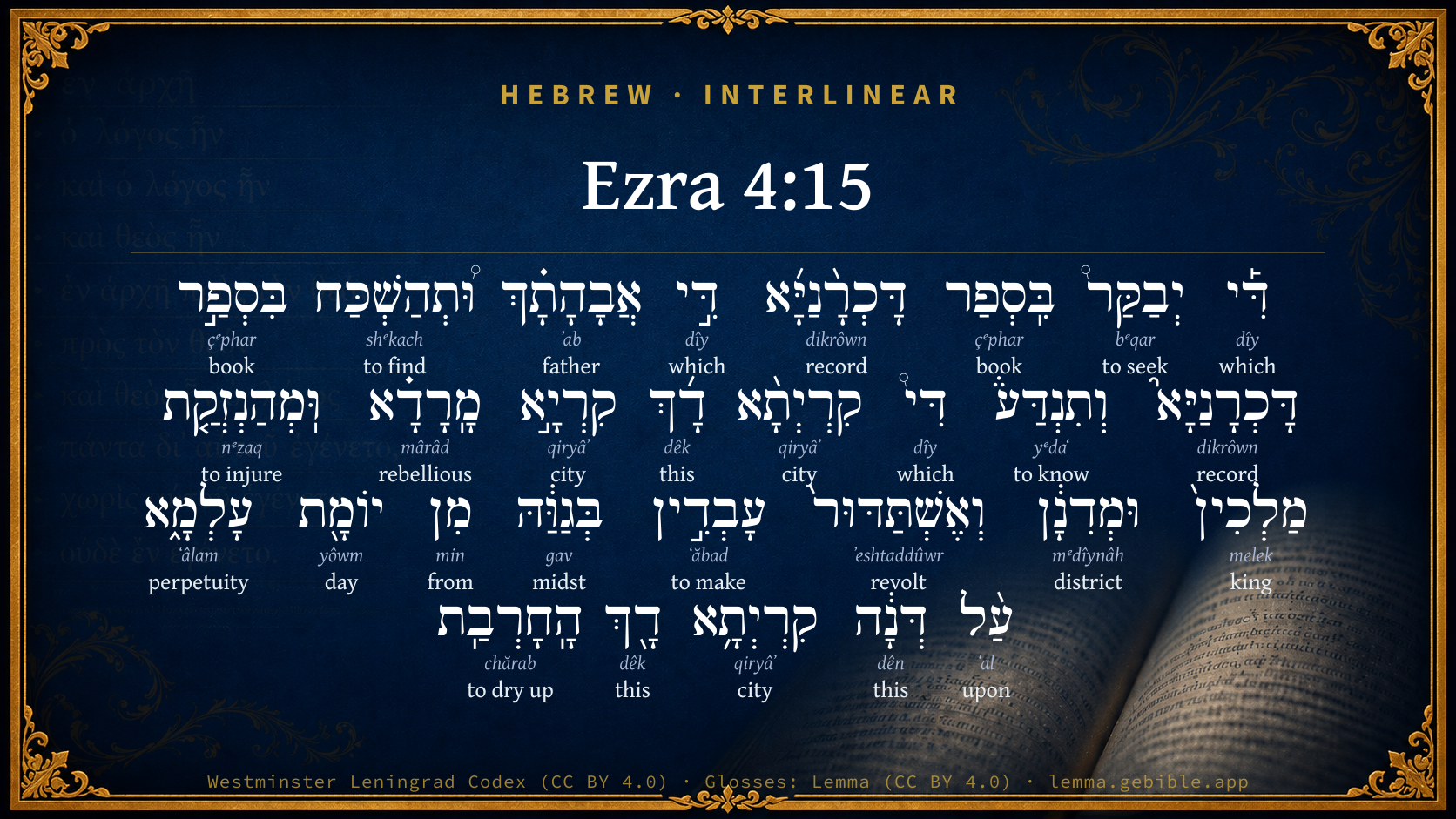
Ezra 4:15

Hebrew (Westminster Leningrad Codex) Ezra 4:15 appears in the Hebrew Old Testament. The text above is from the Westminster Leningrad Codex. Each word links to its Strong’s number, a concise gloss, and parsing drawn from the Open Scriptures Hebrew Bible morphology. Click any word for its full Brown-Driver-Briggs (BDB) entry.
Download image
Cite this verse

Ezra 4:15 (World English Bible). Public Domain. Lemma interlinear Bible study tool, https://lemma.gebible.app/v/ezra/4/15.

Show BibTeX & RIS
BibTeX
RIS
English Translation
that search may be made in the book of the records of your fathers: so shall you find in the book of the records, and know that this city is a rebellious city, and hurtful to kings and provinces, and that they have moved sedition within the same of old time; for which cause was this city laid waste.
World English Bible · Public Domain
Highlights
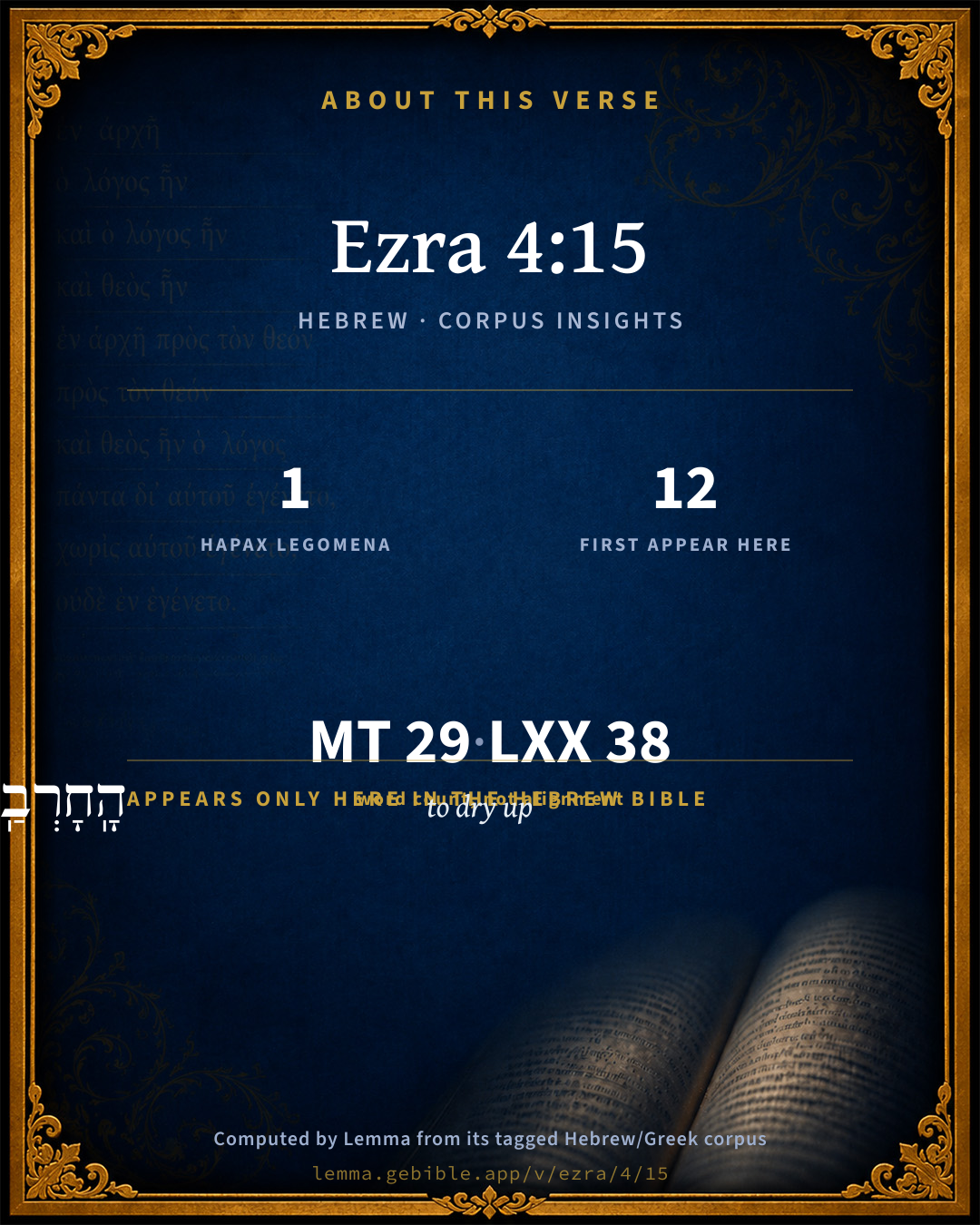
  • 1 hapax legomenon — only here in the Hebrew Bible
  • 12 first appearances in the Hebrew Bible
Full analysis ↓
Download a study sheet

One document with this verse’s original text, its word-by-word gloss line, the meaning frame, cross-references with their text, attributed commentary, and full source and license credits — printable, and it pastes into notes with its structure intact.

This verse Autodidact and up

Study sheet (.html) Plain text (.txt)

A passage Seminary Student

Up to 50 verses in one chapter. A passage sheet keeps up to 6 commentary sources and 12 cross-references per verse, in the order this page ranks them, and says so on the sheet whenever that leaves anything out. Ask for a single verse and you get the Autodidact verse sheet above.

Everything on this page stays free to read, with no account — the sheet is a download of what is already on screen, not access to it.

Want to remove ads? Support Godless Engineer
Compare translations 3

The same verse in 3 English versions, stacked beneath the original-language interlinear above. Click any original word for its lexicon entry.

Each is an independent rendering of the whole verse — the interlinear is not word-aligned to these translations.

Highlighted words mark where these versions differ — a whole-verse word diff, not a word-by-word alignment.

  • World English Bible Public Domain
    that search may be made in the book of the records of your fathers: so shall you find in the book of the records, and know that this city is a rebellious city, and hurtful to kings and provinces, and that they have moved sedition within the same of old time; for which cause was this city laid waste.
  • King James Version Public Domain
    That search may be made in the book of the records of thy fathers: so shalt thou find in the book of the records, and know that this city is a rebellious city, and hurtful unto kings and provinces, and that they have moved sedition within the same of old time: for which cause was this city destroyed.
  • unfoldingWord Literal Text CC BY-SA 4.0
    so that he may search in the book of the records of your fathers. And you will discover in the book of the records and learn that that city is a rebellious city and one that has caused harm to kings and provinces, and they have made revolt in its midst since the ancient days. On account of this, that city was destroyed.

unfoldingWord Literal Text — © unfoldingWord, licensed CC BY-SA 4.0. Word-aligned USFM3 via Door43 (git.door43.org/unfoldingWord/en_ult).

Versions to compare (up to 4)

3 of 4 selected

Show all 18 translations

Every available English version of this verse, each an independent rendering of the whole verse.

  • World English Bible Public Domain
    that search may be made in the book of the records of your fathers: so shall you find in the book of the records, and know that this city is a rebellious city, and hurtful to kings and provinces, and that they have moved sedition within the same of old time; for which cause was this city laid waste.
  • Berean Standard Bible Public Domain
    that a search should be made of the record books of your fathers. In these books you will discover and verify that the city is a rebellious city, harmful to kings and provinces, inciting sedition from ancient times. That is why this city was destroyed.
  • Majority Standard Bible Public Domain
    that a search should be made of the record books of your fathers. In these books you will discover and verify that the city is a rebellious city, harmful to kings and provinces, inciting sedition from ancient times. That is why this city was destroyed.
  • King James Version Public Domain
    That search may be made in the book of the records of thy fathers: so shalt thou find in the book of the records, and know that this city is a rebellious city, and hurtful unto kings and provinces, and that they have moved sedition within the same of old time: for which cause was this city destroyed.
  • American Standard Version (1901) Public Domain
    that search may be made in the book of the records of thy fathers: so shalt thou find in the book of the records, and know that this city is a rebellious city, and hurtful unto kings and provinces, and that they have moved sedition within the same of old time; for which cause was this city laid waste.
  • Revised Version (1885) Public Domain
    that search may be made in the book of the records of thy fathers: so shalt thou find in the book of the records, and know that this city is a rebellious city, and hurtful unto kings and provinces, and that they have moved sedition within the same of old time: for which cause was this city laid waste.
  • Geneva Bible (1599) Public Domain
    That one may searche in the booke of the Chronicles of thy fathers, and thou shalt finde in the booke of the Chronicles, and perceiue that this citie is rebellious and noysome vnto Kings and prouinces, and that they haue moued sedition of olde time, for the which cause this citie was destroyed.
  • Douay-Rheims (1899) Public Domain
    That search may be made in the books of the histories of thy fathers, and thou shalt find written in the records: and shalt know that this city is a rebellious city, and hurtful to the kings and provinces, and that wars were raised therein of old time: for which cause also the city was destroyed.
  • Young's Literal Translation Public Domain
    so that he doth seek in the book of the records of thy fathers, and thou dost find in the book of the records, and dost know, that this city `is' a rebellious city, and causing loss `to' kings and provinces, and makers of sedition `are' in its midst from the days of old, therefore hath this city been wasted.
  • Literal Standard Version CC BY-SA 4.0
    so that he seeks in the scroll of the records of your fathers, and you find in the scroll of the records, and know, that this city [is] a rebellious city, and causing loss [to] kings and provinces, and makers of sedition [are] in its midst from the days of old, therefore this city has been ruined.
  • Unlocked Literal Bible CC BY-SA 4.0
    to search your father's record and to verify that this is a rebellious city that will harm kings and provinces. It has caused many problems to the kings and provinces. It has been a center for rebellion from long ago. It was for this reason that the city was destroyed.
  • unfoldingWord Literal Text CC BY-SA 4.0
    so that he may search in the book of the records of your fathers. And you will discover in the book of the records and learn that that city is a rebellious city and one that has caused harm to kings and provinces, and they have made revolt in its midst since the ancient days. On account of this, that city was destroyed.
  • Darby Bible Public Domain
    that search may be made in the book of the annals of thy fathers: so shalt thou find in the book of the annals and know that this city is a rebellious city, which has done damage to kings and provinces, and that they have raised sedition within the same of old time, for which cause this city was destroyed.
  • World Messianic Bible Public Domain
    that search may be made in the book of the records of your fathers. You will see in the book of the records, and know that this city is a rebellious city, and hurtful to kings and provinces, and that they have started rebellions within it in the past. That is why this city was destroyed.
  • Webster's Bible Public Domain
    That search may be made in the book of the records of thy fathers: so wilt thou find in the book of the records, and know that this city is a rebellious city, and hurtful to kings and provinces, and that they have moved sedition within the same of old time: for which cause was this city destroyed.
  • Free Bible Version CC BY-SA 4.0
    and order a search of the royal archives. You will discover in these records that this is a rebellious city, damaging to kings and countries, having often risen up in revolt in the past. That is what led to this city being destroyed.
  • Bible in Basic English Public Domain
    So that search may be made in the book of the records of your fathers: and you will see in the book of the records that this town has been uncontrolled, and a cause of trouble to kings and countries, and that there were outbursts against authority there in the past: for which reason the town was made waste.
  • JPS Tanakh (1917) Public Domain
    that search may be made in the book of the records of thy fathers; so shalt thou find in the book of the records, and know that this city is a rebellious city, and hurtful unto kings and provinces, and that they have moved sedition within the same of old time; for which cause was this city laid waste.

Literal Standard Version (2020), Covenant Press — licensed CC BY-SA 4.0. Text via the HelloAO Bible API (eBible.org). Unlocked Literal Bible (unfoldingWord) — licensed CC BY-SA 4.0. Text via the HelloAO Bible API (eBible.org). unfoldingWord Literal Text — © unfoldingWord, licensed CC BY-SA 4.0. Word-aligned USFM3 via Door43 (git.door43.org/unfoldingWord/en_ult). Free Bible Version, Dr. Jonathan Gallagher — licensed CC BY-SA 4.0. Text via the HelloAO Bible API (eBible.org).

Word by word

More ways to search: Search by grammar → Find every occurrence → Compare this word →

Practice this passage: Drill this verse → Learn its vocabulary →

הָֽחָרְבַֽת
chărab
H2718
“to dry up”
Adjective, V, Plural
Part of Speech
Adjective
Number
Plural
Full BDB Definition

Origin: a root corresponding to H2717

TWOT: 2741

to dry up, be waste - (Hophal) to be laid waste
  1. דִּ֡י dîy H1768 “which” Adjective, C
  2. יְבַקַּר֩ bᵉqar H1240 “to seek” Adjective, V
  3. בִּֽסְפַר çᵉphar H5609 “in/at · book of” Adjective, R + Noun, Common, Masculine, Singular, Construct
  4. דָּכְרָ֨נַיָּ֜א dikrôwn H1799 “records · the” Adjective, N, Common + Particle, Definite Article
  5. דִּ֣י dîy H1768 “which” Adjective, T
  6. אֲבָהָתָ֗ךְ ʼab H2 “fathers · your” Adjective, N, Common + Suffix, Personal, 2nd Person, Masculine, Singular
  7. וּ֠תְהַשְׁכַּח shᵉkach H7912 “and · to find” Adjective, C + Verb, Hiphil, Imperfect, 2nd Person, Masculine, Singular
  8. בִּסְפַ֣ר çᵉphar H5609 “in/at · book of” Adjective, R + Noun, Common, Masculine, Singular, Construct
  9. דָּכְרָנַיָּא֮ dikrôwn H1799 “records · the” Adjective, N, Common + Particle, Definite Article
  10. וְתִנְדַּע֒ yᵉdaʻ H3046 “and · to know” Adjective, C + Verb, Qal, Imperfect, 2nd Person, Masculine, Singular
  11. דִּי֩ dîy H1768 “which” Adjective, T
  12. קִרְיְתָ֨א qiryâʼ H7149 “city · the” Adjective, N, Common + Particle, Definite Article
  13. דָ֜ךְ dêk H1791 “this” Adjective, P
  14. קִרְיָ֣א qiryâʼ H7149 “city” Adjective, N, Common
  15. מָֽרָדָ֗א mârâd H4779 “rebellious” Adjective, A
  16. וּֽמְהַנְזְקַ֤ת nᵉzaq H5142 “and · injuring” Adjective, C + Verb, Hiphil, Participle Active, Feminine, Singular, Construct
  17. מַלְכִין֙ melek H4430 “kings” Adjective, N, Common
  18. וּמְדִנָ֔ן mᵉdîynâh H4083 “and · districts” Adjective, C + Noun, Common, Feminine, Plural, Absolute
  19. וְאֶשְׁתַּדּוּר֙ ʼeshtaddûwr H849 “and · revolt” Adjective, C + Noun, Common, Masculine, Singular, Absolute
  20. עָבְדִ֣ין ʻăbad H5648 “making” Adjective, V
  21. בְּגַוַּ֔הּ gav H1459 “in/at · midst · her” Adjective, R + Noun, Common, Masculine, Singular, Construct + Suffix, Personal, 3rd Person, Feminine, Singular
  22. מִן min H4481 “from” Adjective, R
  23. יוֹמָ֖ת yôwm H3118 “days of” Adjective, N, Common
  24. עָלְמָ֑א ʻâlam H5957 “perpetuity · the” Adjective, N, Common + Particle, Definite Article
  25. עַ֨ל ʻal H5922 “upon” Adjective, R
  26. דְּנָ֔ה dên H1836 “this” Adjective, P
  27. קִרְיְתָ֥א qiryâʼ H7149 “city · the” Adjective, N, Common + Particle, Definite Article
  28. דָ֖ךְ dêk H1791 “this” Adjective, P

About this verse

These counts appear in no published source. They are computed here, from the morphology-tagged text and Lemma’s own curated glosses. What Lemma adds →

29
words
22
distinct lemmas
Historical
section

Notable vocabulary

1 hapax legomenon — a word that appears only here in the entire Hebrew Bible:

  • הָֽחָרְבַֽת to dry up H2718

First appearance in Scripture

These words make their first canonical appearance in the Hebrew Bible here (12 in total — showing 8):

  • יְבַקַּר֩ to seek H1240
  • בִּֽסְפַר book H5609
  • דָּכְרָ֨נַיָּ֜א record H1799
  • אֲבָהָתָ֗ךְ father H2
  • וּ֠תְהַשְׁכַּח to find H7912
  • וּמְדִנָ֔ן district H4083
  • וְאֶשְׁתַּדּוּר֙ revolt H849
  • עָבְדִ֣ין to make H5648

Shared distinctive vocabulary

מָֽרָדָ֗א rebellious H4779 occurs in 2 verses of the Hebrew Bible. Also found in:

Grammatical profile

  • 3 verbs
  • 5 nouns
  • 16 adjectives
  • 5 particles

Verb forms

  • וּ֠תְהַשְׁכַּח Hiphil · Imperfect
  • וְתִנְדַּע֒ Qal · Imperfect
  • וּֽמְהַנְזְקַ֤ת Hiphil · Participle Active

Repetition

Words recur within this verse — often emphatic in Hebrew:

  • קִרְיְתָ֨א city H7149 ×3
  • בִּֽסְפַר book H5609 ×2
  • דָּכְרָ֨נַיָּ֜א record H1799 ×2
  • דִּ֡י which H1768 ×3
  • דָ֜ךְ this H1791 ×2

Hebrew & Septuagint length

In English translation the verse runs 59 words from the Hebrew and 53 from the Septuagint (LXX English) — closely comparable.

A rough comparison of the two English renderings, which tokenize alike — not a word-level alignment.

Word counts can differ between the Hebrew and the Greek without any difference in meaning — e.g. the Hebrew direct-object marker אֵת has no separate Greek word, and Greek often adds the article ὁ.

In the original languages it is 29 Hebrew tokens and 38 Greek tokens — but the two are counted differently (Hebrew bundles its prefixes and suffixes into one token; the Greek is in lemma form), so that isn’t a like-for-like length.

Cross-references

9

Topical passages linked to Ezra 4:15 in the Treasury of Scripture Knowledge — connected by theme and wording, ordered by reader-vote popularity; previews shown in the World English Bible.

  • Ezra 4:12 Be it known to the king, that the Jews who came up from you are come to us to Jerusalem; they are building the rebellious and the bad city, and have finished the walls, and repaired the foundations.
  • 2 Kings 24:20–25:1 For through the anger of Yahweh did it happen in Jerusalem and Judah, until he had cast them out from his presence. Zedekiah rebelled against the king of Babylon.
  • 2 Kings 25:4 Then a breach was made in the city, and all the men of war [fled] by night by the way of the gate between the two walls, which was by the king's garden (now the Chaldeans were against the city round about); and [the king] went by the way of the Arabah.
  • Nehemiah 2:19 But when Sanballat the Horonite, and Tobiah the servant, the Ammonite, and Geshem the Arabian, heard it, they ridiculed us, and despised us, and said, What is this thing that you do? will you rebel against the king?
  • Nehemiah 6:6 in which was written, It is reported among the nations, and Gashmu says it, that you and the Jews think to rebel; for which cause you are building the wall: and you would be their king, according to these words.
  • Esther 3:5–8 When Haman saw that Mordecai didn't bow down, nor did him reverence, then was Haman full of wrath.
  • Jeremiah 52:3–34 For through the anger of Yahweh did it happen in Jerusalem and Judah, until he had cast them out from his presence. Zedekiah rebelled against the king of Babylon.
  • Daniel 6:4–13 Then the presidents and the satraps sought to find occasion against Daniel as touching the kingdom; but they could find no occasion nor fault, because he was faithful, neither was there any error or fault found in him.
  • Acts 17:6–7 When they didn't find them, they dragged Jason and certain brothers before the rulers of the city, crying, "These who have turned the world upside down have come here also,

Cross-references courtesy of OpenBible.info (CC BY 4.0).

Hebrew and Greek witnesses Masoretic Hebrew ↔ Greek Septuagint

The same verse in the two great witnesses to the Old Testament, shown verse-for-verse.

These are two independent witnesses, not word-aligned to each other, and the Septuagint is shown in lemma (dictionary) form.

Hebrew Ezra 4:15 Masoretic · Westminster Leningrad Codex

דִּ֡י יְבַקַּר֩ בִּֽסְפַר דָּכְרָ֨נַיָּ֜א דִּ֣י אֲבָהָתָ֗ךְ וּ֠תְהַשְׁכַּח בִּסְפַ֣ר דָּכְרָנַיָּא֮ וְתִנְדַּע֒ דִּי֩ קִרְיְתָ֨א דָ֜ךְ קִרְיָ֣א מָֽרָדָ֗א וּֽמְהַנְזְקַ֤ת מַלְכִין֙ וּמְדִנָ֔ן וְאֶשְׁתַּדּוּר֙ עָבְדִ֣ין בְּגַוַּ֔הּ מִן יוֹמָ֖ת עָלְמָ֑א עַ֨ל דְּנָ֔ה קִרְיְתָ֥א דָ֖ךְ הָֽחָרְבַֽת

that search may be made in the book of the records of your fathers: so shall you find in the book of the records, and know that this city is a rebellious city, and hurtful to kings and provinces, and that they have moved sedition within the same of old time; for which cause was this city laid waste.

World English Bible · Public Domain

Greek LXX Ezra 4:15 Septuagint · lemma form

ἵνα ἐπισκέπτομαι ἐν βιβλίον ὑπομνηματισμός ὁ πατήρ σύ καί εὑρίσκω καί γιγνώσκω ὅτι ὁ πόλις ἐκεῖνος πόλις ἀποστάτις καί κακοποιέω βασιλεύς καί χώρα καί φυγάδιον δοῦλος ἐν μέσος αὐτός ἀπό χρόνος αἰών διά οὗτος ὁ πόλις οὗτος ἐρημόω

That examination may be made in your fathers' book of record; and you shall find, and you shall know that city is rebellious, and does harm to kings and countries, and there are in the midst of it from very old time refuges for runaway slaves: therefore this city has been made desolate.

LXX2012 (modern English Septuagint) · Public Domain

In the Septuagint this is one book — Esdras B (2 Esdras): Ezra is chapters 1–10, Nehemiah 11–23.

Hebrew: Westminster Leningrad Codex (CC BY 4.0). Greek: Septuagint (public domain); English from LXX2012 (modern English Septuagint) (Public Domain). How the Septuagint differs from the Hebrew →

Commentary

Notes on Ezra 4:15 from classic Christian and Jewish commentators (each source and its license shown beneath its notes). The classic Christian expositions comment on the surrounding passage and are grouped to its opening verse, so a note may address several verses; the Jewish commentaries on the Tanakh (Rashi and others) are per-verse, so they appear only where the commentator wrote on this verse.

Lemma curates 59 commentaries, every one of them public domain or Creative Commons licensed, each selected and text-cleaned for this edition rather than reprinted as found. About our sources →

Trapp's Complete Commentary

John Trapp

Ezr 4:15 That search may be made in the book of the records of thy fathers: so shalt thou find in the book of the records, and know that this city [is] a rebellious city, and hurtful unto kings and provinces, and that they have moved sedition within the same of old time: for which cause was this city destroyed.

Ver. 15. In the book of the records] Chaldee, of the remembrances, that is, the chronicles usual in all kingdoms.

And know that this city is a rebellious city] {See Trapp on "Ezr 4:1"} {See Trapp on "Ezr 4:2"} Learn, that fidelity to governors is ever both safe and honourable. Zedekiah’s falsifying his oath to the king of Babylon, was the overthrow of that commonwealth. See what God himself saith, not without great indignation, Eze 17:18, "Seeing he" (Zedekiah) "despised the oath by breaking the covenant, when, lo, he had given his hand, and hath done all these things, he shall not escape."

John Trapp, A Commentary or Exposition upon All the Books of the Old and New Testament (1647–1656) — public domain. Text from a community e-Sword module.

The Biblical Illustrator

Joseph S. Exell

Ezr_4:15

That search may be made in the book of the records of thy fathers.

Church registers

in a general view, all human records are interesting, if they are scarcely more than registers of names. Those names are always appended to some act or event, however concisely stated, and thus these mere catalogues serve to show us how they who have gone before us have been occupied, and are the founts and rills which flow into the great stream of human history; or, rather perhaps, to change the metaphor, are among the foundation-stones on which the fabric of human history is reared; they are low and concealed from observation, but are nevertheless essential to the building. Nothing can be apparently more devoid of interest than the pages of a church register; and yet, let us look at it nearly and intently, and with a reference to the principle just intimated, and interest will be found in every column, in every name. Consider--

I. The register of baptisms.

II. The register of marriages.

III. The register of deaths. (F. W. P. Greenwood.)

The Biblical Illustrator, edited by Joseph S. Exell (c. 1880s–1900s) — public domain. Text from a community e-Sword module.

Joseph Benson's Commentary

Ezr 4:15. In the book of the records of thy fathers — That is, thy predecessors, the former emperors of this empire; namely, in the Assyrian and Babylonish records; which, together with the empire, were now in the hands of the Persian kings.

Joseph Benson's Commentary on the Old and New Testaments (1811–1818) — public domain. Text from a community e-Sword module.

Tyndale Open Study Notes

Tyndale Open Resources

4:15-16 The Persians had access to Babylonian records, which described Jerusalem’s revolts against Nebuchadnezzar (see 2 Kgs 24:1-7). • The claim that the Persians would lose the whole province west of the Euphrates was an exaggeration: The Jews actually comprised a small minority in that province.

Tyndale Open Study Notes — © Tyndale Open Resources, licensed CC BY-SA 4.0. Text via the HelloAO Bible API.

Adam Clarke's Commentary

Verse 15. The book of the records of thy fathers] That is, the records of the Chaldeans, to whom the Persians succeeded.

Adam Clarke's Commentary on the Bible (1810–1826) — public domain. Text from a community e-Sword/MySword module.

Ellicott's Commentary for English Readers

(15) The book of the records of thy fathers.—“The book of the records of the Chronicles” which in Est_6:1 is “read before the king.” This extended beyond his own fathers back to the times of the predecessors of the Median dynasty.

Of old time.—From the days of eternity, or time immemorial. The spirit of exaggeration if not of falsehood appears in every word here.

A Bible Commentary for English Readers, edited by Charles John Ellicott (1878–1897) — public domain. Text from a community e-Sword module.

The Cambridge Bible for Schools and Colleges

gen. ed. J. J. S. Perowne

15. that search may be made in the book of the records of thy fathers] Literally, that one may search, i.e. the officials in whose keeping the records were. Perhaps the plural should be read, as in Ezr_4:19.

For this appeal to ‘the book of records’, compare chap. Ezr_6:1-2, and the allusions in the book of Esther to the existence of such an official register recording facts and events of State importance, Est_2:23; Est_6:1; Est_10:2. Rawlinson refers to Diodorus Siculus (II. 32) who speaks of ‘the royal parchments in which the Persians in accordance with some law preserved the record of the deeds of former time’ (ἐκ τῶν βασιλικῶν διφθερῶν, ἐν αἷς οἱ Πέρσαι τὰς παλαιὰς πράξεις κατά τινα νόμον εἶχον συντεταγμένας).

thy fathers] This expression might be adduced to prove that the Artaxerxes addressed could not be Pseudo-Smerdis. But it would be unfair to lay stress upon it. The context shows that the king’s predecessors in the rule of Western Asia are intended, Assyrian and Babylonian no less than Median and Persian.

hurtful] i.e. as a nucleus of revolt.

kings and provinces] i.e. to subject kings as well as to the great king.

‘Provinces’ (cf. the use of the word, Ezr_2:1) applied to the large districts into which the Empire was divided. See Dan_2:48; Dan_3:2; Est_1:22; Est_3:8, &c. They are described as 127 in number in Est_1:1; Est_8:9.

they have moved sedition within the same] i.e. the Jews within the city of Jerusalem; cf. 19.

… of old time: for which cause, &c.] An expression better suited to writers in the days of Artaxerxes than in the reign of Pseudo-Smerdis, only 65 years from the date of the destruction of Jerusalem (586 b.c.).

destroyed] R.V. laid waste.

The Cambridge Bible for Schools and Colleges (gen. ed. J. J. S. Perowne; Cambridge University Press, 1878–1918) — public domain. Text from a community e-Sword module.

John Gill's Exposition

We certify the king, that if this city be builded again, and the walls thereof set up,.... As it formerly was, and now attempted, as they suggest:

by this means thou shalt have no portion on this side the river; the river Euphrates; intimating that the Jews would not only shake off his yoke, and refuse to pay tribute themselves, but would seize on all his dominions on that side the river, and annex them to their own.

John Gill's Exposition of the Whole Bible (1746–1763) — public domain (CC PDM 1.0). Text via the HelloAO Bible API.

Albert Barnes' Notes on the Bible

The book of the records - Compare Est 2:23; Est 6:1; Est 10:2. The existence of such a “book” at the Persian court is attested also by Ctesias.

Of thy fathers - i. e., thy predecessors ripen the throne, Cambyses, Cyrus, etc. If Artaxerxes was the Pseudo-Smerdis (Ezr 4:7 note), these persons were not really his “fathers” or ancestors; but the writers of the letter could not venture to call the king an impostor.

Albert Barnes' Notes on the Bible (1834–1885) — public domain. Text from a community e-Sword/MySword module.

Haydock's Catholic Bible Commentary

Fathers, the preceding emperors, Nabuchodonosor, Salmanasar, &c. (Haydock)

George Leo Haydock (1774–1849), Haydock's Catholic Family Bible and Commentary, 1859 edition — public domain. Excludes Psalms (Douay-Rheims chapter numbering differs from Protestant) and Deuterocanonical books (Catholic canon only).

Matthew Poole's English Annotations

The records of thy fathers; political fathers, i.e. thy predecessors, the former emperors of this empire, namely, in the Assyrian and Babylonish records, which together with the empire were now in the hands of the Persian kings, to be searched or read as the king’s pleasure was, or as the affairs of the empire required.

Matthew Poole's English Annotations on the Holy Bible (1683–1685) — public domain. Text from a community e-Sword/MySword module.

Whedon's Commentary on the Bible

Daniel D. Whedon

15. Book of the records — Public and official annals of the kingdom, and of the acts of its kings, prepared by the scribes and recorders, and deposited for reference and use among the archives of the nation. See Introduction to the Books of Kings, (chapter on the sources.)

Of thy fathers — This word is here used of the king’s predecessors on the throne — records of previous kings and dynasties that had held dominion over all Western Asia. These records contained accounts of the rebellions in different provinces of the empire, and of the efforts that had been made to suppress them; and prominent among them must have been the rebellions and wars of Judah and Jerusalem — the causes of their exile.

Daniel D. Whedon (gen. ed.), Commentary on the Old and New Testaments (1874–1909) — public domain. Text from a community e-Sword module.

The Pulpit Commentary

That search may be made in the book of the records of thy fathers. It was the practice at the Persian court to register all important events in a book, which from time to time was read to the kings. (Est_2:23 Est_6:1) The Samaritans suggest a consultation of this book, which would at any rate contain their own previous accusations against Jerusalem (supra, vers. 5, 6), and might make some mention of the revolts from Babylon (see the comment on ver. 12). For which cause was this city destroyed. This was the great fact on which the Samaritans relied. Nebuchadnezzar had only destroyed Jerusalem in consequence of repeated rebellions. True; but no sufficient indication that there would be revolt from Persia, which was anti-idolatrous, and had proved herself so true a friend to the Jews.

The Pulpit Commentary (1880–1919), ed. H.D.M. Spence-Jones & Joseph S. Exell — public domain. Text from a community e-Sword module.

Rashi

Rabbi Shlomo Yitzchaki (Rashi)

That one should search that a seeker should search and seek in the annals of your fathers, the first kings.

and you will find And you will find in the annals, and you will know that this city is a rebellious city, and it injures the kings and the countries.

and they have made rebellion in its midst And its inhabitants were making rebellion in its midst, for Israel would rebel against the kings of the nations.

since days of yore Aram. מִן יוֹמָת עָלְמָא, from days of yore. Since ancient times, it has been their custom to rebel against the kings of the nations.

because of this Because of this, this city was destroyed.

Rashi on the Tanakh — English translations: “The Judaica Press complete Tanach with Rashi, translated by A. J. Rosenberg” (CC BY 4.0); “Pentateuch with Rashi's commentary by M. Rosenbaum and A.M. Silbermann, 1929-1934” (public domain); “The Metsudah Tanach series, Lakewood, N.J” (CC BY 4.0); and “The Book of Joshua, Metsudah Publications, 1997” (CC BY 4.0). Text via Sefaria.

Lesson kit

Teaching starters — assembled from the data on this page, not authored interpretation. Every prompt links to the verse data it draws on. Edit before teaching.

Ezra, in the Historical, opens this verse with 29 words (22 distinct Hebrew lemmas). Its most distinctive word is chărab (“to dry up”). A historical commentator’s framing appears above. Read the whole chapter for the surrounding context.

Discussion questions

  1. What does “to dry up” (chărab) contribute to the verse as a whole?
  2. This verse holds 1 word here found nowhere else in the Hebrew Bible. What might the rare word draw attention to?
  3. 12 words here appear for the first time in Scripture. What is being introduced at this debut?
  4. Ezra 4:12 shares the word «rebellious» with this verse. How do the two illuminate each other?
  5. “city” occurs 3× in this one verse. What is the effect of the repetition?
  6. These translations render this verse differently; the difference is in the English rendering, not the original. What questions does that raise?
  7. The verb «וּ֠תְהַשְׁכַּח» is Hiphil Imperfect. How does its form color the action?
  8. Reading how Trapp's Complete Commentary and The Biblical Illustrator read this verse, where do the two commentators agree and where do they part?

Things to notice

  • 1 word in this verse appears nowhere else in the Hebrew Bible.
  • 12 words make their first canonical appearance in Scripture here.
  • This verse counts 29 Hebrew ↔ 38 Greek words.
  • These translations choose different wording for 29 words in this verse.
  • “city” occurs 3× in this single verse.

Reading settings

Reading text

Shown beneath each verse's original-language words.

Old Testament
Old Testament edition

Read the OT as the Masoretic Hebrew (MT) or the Greek Septuagint (LXX).

English shown for the Greek Septuagint (in the Hebrew ↔ Greek comparison).

Comparing translations? Open the Compare panel on any verse page to stack up to four side by side.