
Daniel 4:23

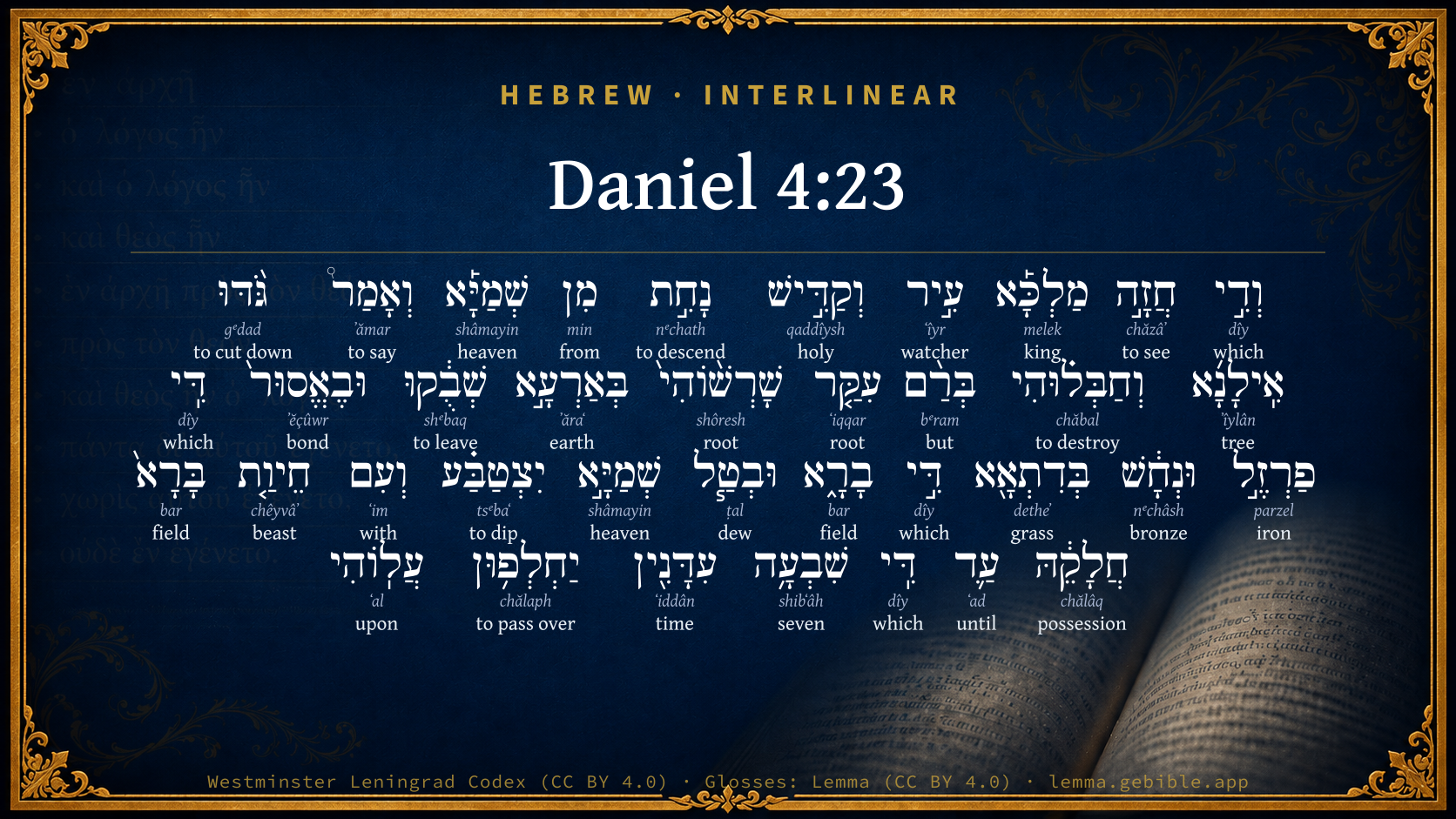
Hebrew (Westminster Leningrad Codex) Daniel 4:23 appears in the Hebrew Old Testament. The text above is from the Westminster Leningrad Codex. Each word links to its Strong’s number, a concise gloss, and parsing drawn from the Open Scriptures Hebrew Bible morphology. Click any word for its full Brown-Driver-Briggs (BDB) entry.
Download image
Cite this verse

Daniel 4:23 (World English Bible). Public Domain. Lemma interlinear Bible study tool, https://lemma.gebible.app/v/daniel/4/23.

Show BibTeX & RIS
BibTeX
RIS
English Translation
Whereas the king saw a watcher and a holy one coming down from the sky, and saying, Hew down the tree, and destroy it; nevertheless leave the stump of the roots of it in the earth, even with a band of iron and brass, in the tender grass of the field, and let it be wet with the dew of the sky: and let his portion be with the animals of the field, until seven times pass over him;
World English Bible · Public Domain
Download a study sheet

One document with this verse’s original text, its word-by-word gloss line, the meaning frame, cross-references with their text, attributed commentary, and full source and license credits — printable, and it pastes into notes with its structure intact.

This verse Autodidact and up

Study sheet (.html) Plain text (.txt)

A passage Seminary Student

Up to 50 verses in one chapter. A passage sheet keeps up to 6 commentary sources and 12 cross-references per verse, in the order this page ranks them, and says so on the sheet whenever that leaves anything out. Ask for a single verse and you get the Autodidact verse sheet above.

Everything on this page stays free to read, with no account — the sheet is a download of what is already on screen, not access to it.

Want to remove ads? Support Godless Engineer
Compare translations 3

The same verse in 3 English versions, stacked beneath the original-language interlinear above. Click any original word for its lexicon entry.

Each is an independent rendering of the whole verse — the interlinear is not word-aligned to these translations.

Highlighted words mark where these versions differ — a whole-verse word diff, not a word-by-word alignment.

  • World English Bible Public Domain
    Whereas the king saw a watcher and a holy one coming down from the sky, and saying, Hew down the tree, and destroy it; nevertheless leave the stump of the roots of it in the earth, even with a band of iron and brass, in the tender grass of the field, and let it be wet with the dew of the sky: and let his portion be with the animals of the field, until seven times pass over him;
  • King James Version Public Domain
    And whereas the king saw a watcher and an holy one coming down from heaven, and saying, Hew the tree down, and destroy it; yet leave the stump of the roots thereof in the earth, even with a band of iron and brass, in the tender grass of the field; and let it be wet with the dew of heaven, and let his portion be with the beasts of the field, till seven times pass over him;
  • unfoldingWord Literal Text CC BY-SA 4.0
    In that the king saw a watcher, a holy one, coming down from heaven and saying, ‘Chop down the tree and destroy it, but leave the stump of its roots in the earth, bound with a band of iron and bronze, in the tender grass of the field, and let him be wet with the dew of heaven, and let his portion be with the animals of the fields until seven periods of time pass over him,’

unfoldingWord Literal Text — © unfoldingWord, licensed CC BY-SA 4.0. Word-aligned USFM3 via Door43 (git.door43.org/unfoldingWord/en_ult).

Versions to compare (up to 4)

3 of 4 selected

Show all 18 translations

Every available English version of this verse, each an independent rendering of the whole verse.

  • World English Bible Public Domain
    Whereas the king saw a watcher and a holy one coming down from the sky, and saying, Hew down the tree, and destroy it; nevertheless leave the stump of the roots of it in the earth, even with a band of iron and brass, in the tender grass of the field, and let it be wet with the dew of the sky: and let his portion be with the animals of the field, until seven times pass over him;
  • Berean Standard Bible Public Domain
    And you, O king, saw a watcher, a holy one, coming down from heaven and saying: ‘Cut down the tree and destroy it, but leave the stump with its roots in the ground, and a band of iron and bronze around it, in the tender grass of the field. Let him be drenched with the dew of heaven, and graze with the beasts of the field till seven times pass him by.’
  • Majority Standard Bible Public Domain
    And you, O king, saw a watcher, a holy one, coming down from heaven and saying: ‘Cut down the tree and destroy it, but leave the stump with its roots in the ground, with a band of iron and bronze around it, in the tender grass of the field. Let him be drenched with the dew of heaven, and graze with the beasts of the field till seven times pass him by.’
  • King James Version Public Domain
    And whereas the king saw a watcher and an holy one coming down from heaven, and saying, Hew the tree down, and destroy it; yet leave the stump of the roots thereof in the earth, even with a band of iron and brass, in the tender grass of the field; and let it be wet with the dew of heaven, and let his portion be with the beasts of the field, till seven times pass over him;
  • American Standard Version (1901) Public Domain
    And whereas the king saw a watcher and a holy one coming down from heaven, and saying, Hew down the tree, and destroy it; nevertheless leave the stump of the roots thereof in the earth, even with a band of iron and brass, in the tender grass of the field, and let it be wet with the dew of heaven: and let his portion be with the beasts of the field, till seven times pass over him;
  • Revised Version (1885) Public Domain
    And whereas the king saw a watcher and an holy one coming down from heaven, and saying, Hew down the tree, and destroy it; nevertheless leave the stump of the roots thereof in the earth, even with a band of iron and brass, in the tender grass of the field; and let it be wet with the dew of heaven, and let his portion be with the beasts of the field, till seven times pass over him;
  • Geneva Bible (1599) Public Domain
    Where as they sayd, that one should leaue the stumpe of the tree rootes, thy kingdome shall remaine vnto thee: after that, thou shalt knowe, that the heauens haue the rule.
  • Douay-Rheims (1899) Public Domain
    And whereas the king saw a watcher, and a holy one come down from heaven, and say: Cut down the tree and destroy it, but leave the stump of the roots thereof in the earth, and let it be bound with iron and brass among the grass without, and let it be sprinkled with the dew of heaven, and let his feeding be with the wild beasts, till seven times pass over him.
  • Young's Literal Translation Public Domain
    and that which the king hath seen -- a sifter, even a holy one, coming down from the heavens, and he hath said, Cut down the tree, and destroy it; but the stump of its roots leave in the earth, even with a band of iron and brass, in the tender grass of the field, and with the dew of the heavens it is wet, and with the beast of the field `is' his portion, till that seven times pass over him.
  • Literal Standard Version CC BY-SA 4.0
    and that which the king has seen—a sifter, even a holy one, coming down from the heavens, and he has said, Cut down the tree, and destroy it; but the stump of its roots leave in the earth, even with a band of iron and bronze, in the tender grass of the field, and with the dew of the heavens it is wet, and with the beast of the field [is] his portion, until seven times pass over him.
  • Unlocked Literal Bible CC BY-SA 4.0
    You, king, saw a holy messenger coming down from heaven and saying, 'Chop down the tree and destroy it, but leave the stump of its roots in the earth, bound with a band of iron and bronze, in the middle of the tender grass of the field. Let it be wet with the dew from the heavens. Let it live with the wild animals in the fields until seven years pass by.'
  • unfoldingWord Literal Text CC BY-SA 4.0
    In that the king saw a watcher, a holy one, coming down from heaven and saying, ‘Chop down the tree and destroy it, but leave the stump of its roots in the earth, bound with a band of iron and bronze, in the tender grass of the field, and let him be wet with the dew of heaven, and let his portion be with the animals of the fields until seven periods of time pass over him,’
  • Darby Bible Public Domain
    And whereas the king saw a watcher and a holy one coming down from the heavens, and saying, Hew the tree down, and destroy it; nevertheless leave the stump of its roots in the earth, even with a band of iron and brass, in the tender grass of the field; and let it be bathed with the dew of heaven, and let his portion be with the beasts of the field, till seven times pass over him:
  • World Messianic Bible Public Domain
    “Whereas the king saw a holy watcher coming down from the sky and saying, ‘Cut down the tree, and destroy it; nevertheless leave the stump of its roots in the earth, even with a band of iron and bronze, in the tender grass of the field, and let it be wet with the dew of the sky. Let his portion be with the animals of the field, until seven times pass over him.’
  • Webster's Bible Public Domain
    And whereas the king saw a watcher and a holy one coming down from heaven, and saying, Hew the tree down, and destroy it; yet leave the stump of its roots in the earth, even with a band of iron and brass, in the tender grass of the field; and let it be wet with the dew of heaven, and let its portion be with the beasts of the field, till seven times shall pass over him;
  • Free Bible Version CC BY-SA 4.0
    Then Your Majesty saw a watcher, a holy one, coming down from heaven who said, ‘Cut down the tree and destroy it, but leave the stump and its roots in the ground, and bind it with iron and bronze, surrounded by the new grass of the field. Let him become soaked with the dew of heaven and let him live with the animals outside in the undergrowth. Let his mind become like that of an animal. Let him be like this for seven times.’
  • Bible in Basic English Public Domain
    And as for the vision which the king saw of a watcher, a holy one, coming down from heaven, saying, Let the tree be cut down and given to destruction;
  • JPS Tanakh (1917) Public Domain
    (4-20) And whereas the king saw a watcher and a holy one coming down from heaven, and saying: Hew down the tree, and destroy it; nevertheless leave the stump of the roots thereof in the earth, even in a band of iron and brass, in the tender grass of the field; and let it be wet with the dew of heaven, and let his portion be with the beasts of the field, till seven times pass over him —

Literal Standard Version (2020), Covenant Press — licensed CC BY-SA 4.0. Text via the HelloAO Bible API (eBible.org). Unlocked Literal Bible (unfoldingWord) — licensed CC BY-SA 4.0. Text via the HelloAO Bible API (eBible.org). unfoldingWord Literal Text — © unfoldingWord, licensed CC BY-SA 4.0. Word-aligned USFM3 via Door43 (git.door43.org/unfoldingWord/en_ult). Free Bible Version, Dr. Jonathan Gallagher — licensed CC BY-SA 4.0. Text via the HelloAO Bible API (eBible.org).

Word by word

More ways to search: Search by grammar → Find every occurrence → Compare this word →

Practice this passage: Drill this verse → Learn its vocabulary →

גֹּ֨דּוּ
gᵉdad
H1414
“cut down”
Adjective, V
Part of Speech
Adjective
Full BDB Definition

Origin: corresponding to H1413

TWOT: 2649

to cut down, hew down
  1. וְדִ֣י dîy H1768 “and · which” Adjective, C + Particle, Relative
  2. חֲזָ֣ה chăzâʼ H2370 “to see” Adjective, V, Plural
  3. מַלְכָּ֡א melek H4430 “king · the” Adjective, N, Common + Particle, Definite Article
  4. עִ֣יר ʻîyr H5894 “watcher” Adjective, N, Common
  5. וְקַדִּ֣ישׁ qaddîysh H6922 “and · holy” Adjective, C + Adjective, Adjective, Masculine, Singular, Absolute
  6. נָחִ֣ת nᵉchath H5182 “descending” Adjective, V
  7. מִן min H4481 “from” Adjective, R
  8. שְׁמַיָּ֡א shâmayin H8065 “heaven(s) · the” Adjective, N, Common + Particle, Definite Article
  9. וְאָמַר֩ ʼămar H560 “and · saying” Adjective, C + Verb, Qal, Participle Active, Masculine, Singular, Absolute
  10. אִֽילָנָ֜א ʼîylân H363 “tree · the” Adjective, N, Common + Particle, Definite Article
  11. וְחַבְּל֗וּהִי chăbal H2255 “and · destroy · him” Adjective, C + Verb, Piel, Imperative, 2nd Person, Masculine, Plural + Suffix, Personal, 3rd Person, Masculine, Singular
  12. בְּרַ֨ם bᵉram H1297 “but” Adjective, C
  13. עִקַּ֤ר ʻiqqar H6136 “root of” Adjective, N, Common
  14. שָׁרְשׁ֨וֹהִי֙ shôresh H8330 “roots · his” Adjective, N, Common + Suffix, Personal, 3rd Person, Masculine, Singular
  15. בְּאַרְעָ֣א ʼăraʻ H772 “in/at · earth · the” Adjective, R + Noun, Common, Feminine, Singular, Determined + Particle, Definite Article
  16. שְׁבֻ֔קוּ shᵉbaq H7662 “leave” Adjective, V
  17. וּבֶאֱסוּר֙ ʼĕçûwr H613 “and · in/at · bond” Adjective, C + Preposition + Noun, Common, Masculine, Singular, Absolute
  18. דִּֽי dîy H1768 “which” Adjective, T
  19. פַרְזֶ֣ל parzel H6523 “iron” Adjective, N, Common
  20. וּנְחָ֔שׁ nᵉchâsh H5174 “and · bronze” Adjective, C + Noun, Common, Masculine, Singular, Absolute
  21. בְּדִתְאָ֖א detheʼ H1883 “in/at · grass · the” Adjective, R + Noun, Common, Masculine, Singular, Determined + Particle, Definite Article
  22. דִּ֣י dîy H1768 “which” Adjective, T
  23. בָרָ֑א bar H1251 “field · the” Adjective, N, Common + Particle, Definite Article
  24. וּבְטַ֧ל ṭal H2920 “and · in/at · dew of” Adjective, C + Preposition + Noun, Common, Masculine, Singular, Construct
  25. שְׁמַיָּ֣א shâmayin H8065 “heaven(s) · the” Adjective, N, Common + Particle, Definite Article
  26. יִצְטַבַּ֗ע tsᵉbaʻ H6647 “to dip” Adjective, V
  27. וְעִם ʻim H5974 “and · with” Adjective, C + Preposition
  28. חֵיוַ֤ת chêyvâʼ H2423 “beast of” Adjective, N, Common
  29. בָּרָא֙ bar H1251 “field · the” Adjective, N, Common + Particle, Definite Article
  30. חֲלָקֵ֔הּ chălâq H2508 “possession · his” Adjective, N, Common + Suffix, Personal, 3rd Person, Masculine, Singular
  31. עַ֛ד ʻad H5705 “until” Adjective, R
  32. דִּֽי dîy H1768 “which” Adjective, T
  33. שִׁבְעָ֥ה shibʻâh H7655 “seven” Adjective, A, Common
  34. עִדָּנִ֖ין ʻiddân H5732 “time” Adjective, A, Common
  35. יַחְלְפ֥וּן chălaph H2499 “to pass over” Adjective, V
  36. עֲלֽוֹהִי ʻal H5922 “upon · him” Adjective, R + Suffix, Personal, 3rd Person, Masculine, Singular

About this verse

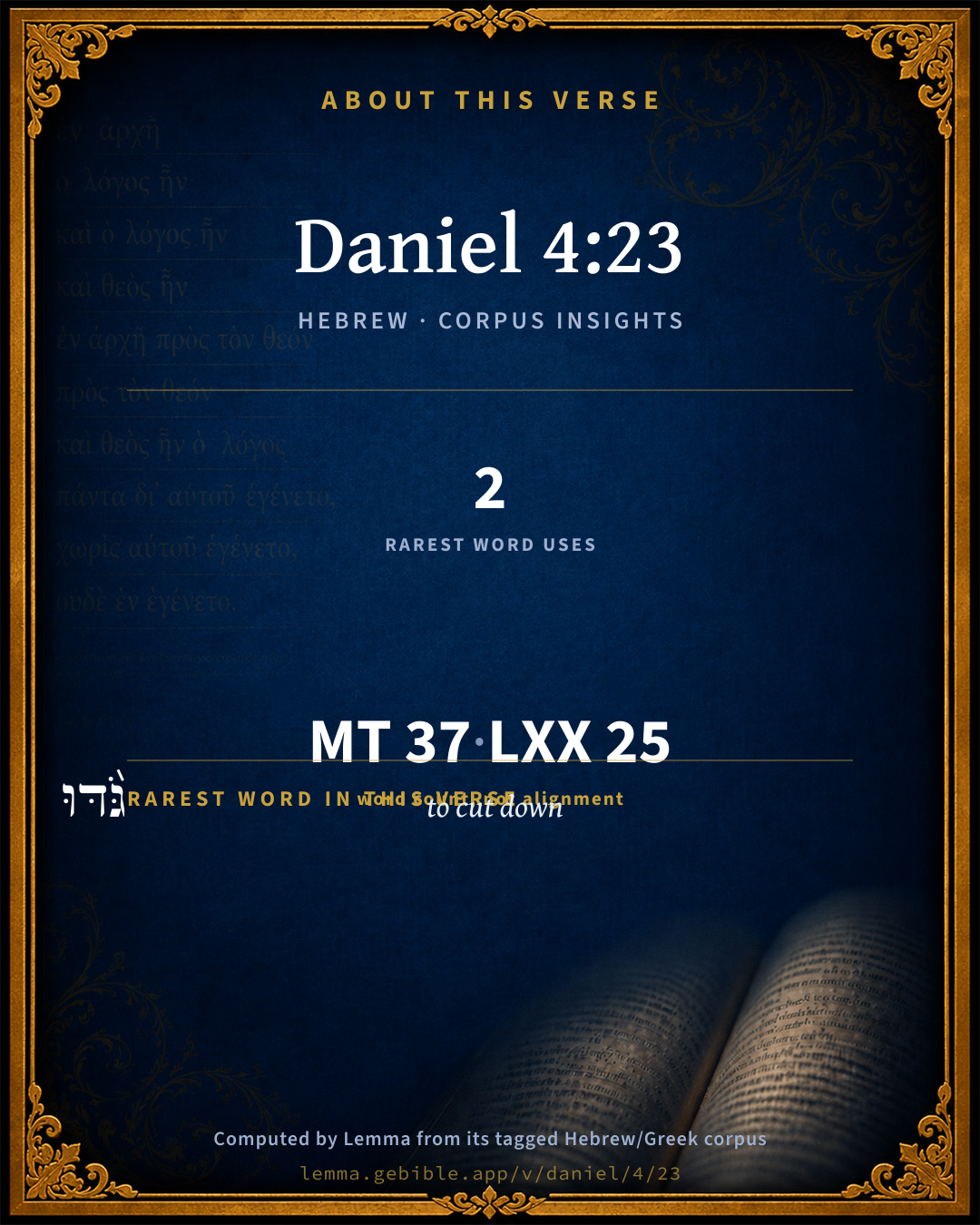
These counts appear in no published source. They are computed here, from the morphology-tagged text and Lemma’s own curated glosses. What Lemma adds →

37
words
32
distinct lemmas
Prophets
section

Notable vocabulary

The rarest word here is גֹּ֨דּוּ to cut down H1414 — appearing just 2 times in the whole Hebrew Bible.

Shared distinctive vocabulary

גֹּ֨דּוּ to cut down H1414 occurs in 2 verses of the Hebrew Bible. Also found in:

Grammatical profile

  • 2 verbs
  • 3 nouns
  • 22 adjectives
  • 1 preposition
  • 9 particles

Verb forms

  • וְאָמַר֩ Qal · Participle Active
  • וְחַבְּל֗וּהִי Piel · Imperative

Repetition

Words recur within this verse — often emphatic in Hebrew:

  • שְׁמַיָּ֡א heaven H8065 ×2
  • בָרָ֑א field H1251 ×2
  • וְדִ֣י which H1768 ×4

Hebrew & Septuagint length

In English translation the verse runs 79 words from the Hebrew and 31 from the Septuagint (LXX English) — the Septuagint runs noticeably shorter here. See the side-by-side →

A rough comparison of the two English renderings, which tokenize alike — not a word-level alignment.

Word counts can differ between the Hebrew and the Greek without any difference in meaning — e.g. the Hebrew direct-object marker אֵת has no separate Greek word, and Greek often adds the article ὁ.

In the original languages it is 37 Hebrew tokens and 25 Greek tokens — but the two are counted differently (Hebrew bundles its prefixes and suffixes into one token; the Greek is in lemma form), so that isn’t a like-for-like length.

Cross-references

2

Topical passages linked to Daniel 4:23 in the Treasury of Scripture Knowledge — connected by theme and wording, ordered by reader-vote popularity; previews shown in the World English Bible.

  • Daniel 5:21 and he was driven from the sons of men, and his heart was made like the animals', and his dwelling was with the wild donkeys; he was fed with grass like oxen, and his body was wet with the dew of the sky; until he knew that the Most High God rules in the kingdom of men, and that he sets up over it whoever he will.
  • Daniel 4:13–16 I saw in the visions of my head on my bed, and, behold, a watcher and a holy one came down from the sky.

Cross-references courtesy of OpenBible.info (CC BY 4.0).

Hebrew and Greek witnesses Masoretic Hebrew ↔ Greek Septuagint

The same verse in the two great witnesses to the Old Testament, shown verse-for-verse.

Here the Septuagint runs noticeably shorter than the Hebrew — LXX2012 (modern English Septuagint) 31 words vs World English Bible 79. A rough length comparison of the two English translations, not a word-level alignment — read both below.

These are two independent witnesses, not word-aligned to each other, and the Septuagint is shown in lemma (dictionary) form.

Hebrew Daniel 4:23 Masoretic · Westminster Leningrad Codex

וְדִ֣י חֲזָ֣ה מַלְכָּ֡א עִ֣יר וְקַדִּ֣ישׁ נָחִ֣ת מִן שְׁמַיָּ֡א וְאָמַר֩ גֹּ֨דּוּ אִֽילָנָ֜א וְחַבְּל֗וּהִי בְּרַ֨ם עִקַּ֤ר שָׁרְשׁ֨וֹהִי֙ בְּאַרְעָ֣א שְׁבֻ֔קוּ וּבֶאֱסוּר֙ דִּֽי פַרְזֶ֣ל וּנְחָ֔שׁ בְּדִתְאָ֖א דִּ֣י בָרָ֑א וּבְטַ֧ל שְׁמַיָּ֣א יִצְטַבַּ֗ע וְעִם חֵיוַ֤ת בָּרָא֙ חֲלָקֵ֔הּ עַ֛ד דִּֽי שִׁבְעָ֥ה עִדָּנִ֖ין יַחְלְפ֥וּן עֲלֽוֹהִי

Whereas the king saw a watcher and a holy one coming down from the sky, and saying, Hew down the tree, and destroy it; nevertheless leave the stump of the roots of it in the earth, even with a band of iron and brass, in the tender grass of the field, and let it be wet with the dew of the sky: and let his portion be with the animals of the field, until seven times pass over him;

World English Bible · Public Domain

Greek LXX Daniel 4:23 Septuagint · lemma form

καί ἀποκρίνω εἶπον οὗτος εἰμί βαβυλών ὁ μέγας ὅς ἐγώ οἰκοδομέω καί οἶκος βασιλεία ἐγώ ἐν ἰσχύς κράτος ἐγώ καλέω εἰς τιμή ὁ δόξα ἐγώ

And whereas they said, Leave the stumps of the roots of the tree; your kingdom abides sure to you from the time that you shall know the power of the heavens.

LXX2012 (modern English Septuagint) · Public Domain

On this verse, The Pulpit Commentary discusses the Septuagint’s reading. Read the note in Commentary ↓

Hebrew: Westminster Leningrad Codex (CC BY 4.0). Greek: Septuagint (public domain); English from LXX2012 (modern English Septuagint) (Public Domain). How the Septuagint differs from the Hebrew →

Commentary

Notes on Daniel 4:23 from classic Christian and Jewish commentators (each source and its license shown beneath its notes). The classic Christian expositions comment on the surrounding passage and are grouped to its opening verse, so a note may address several verses; the Jewish commentaries on the Tanakh (Rashi and others) are per-verse, so they appear only where the commentator wrote on this verse.

Lemma curates 59 commentaries, every one of them public domain or Creative Commons licensed, each selected and text-cleaned for this edition rather than reprinted as found. About our sources →

Trapp's Complete Commentary

John Trapp

Dan 4:23 And whereas the king saw a watcher and an holy one coming down from heaven, and saying, Hew the tree down, and destroy it; yet leave the stump of the roots thereof in the earth, even with a band of iron and brass, in the tender grass of the field; and let it be wet with the dew of heaven, and [let] his portion [be] with the beasts of the field, till seven times pass over him;

Ver. 23. And whereas the king, &c.] See Dan 4:13.

Hew the tree down.] Sin ever endeth tragically.

Yet leave the stump.] Reserve him for a kingly state again, like as he had left a stump in Judah, spared the kingly seed, showed pity to the remnant of the Lord. The least favour that is shown to the godly shall be repaid double. {Jer 34:17}

John Trapp, A Commentary or Exposition upon All the Books of the Old and New Testament (1647–1656) — public domain. Text from a community e-Sword module.

Tyndale Open Study Notes

Tyndale Open Resources

4:23 Cut down the tree: The tree must be cut down because of Nebuchadnezzar’s pride (4:27-30).

Tyndale Open Study Notes — © Tyndale Open Resources, licensed CC BY-SA 4.0. Text via the HelloAO Bible API.

John Calvin's Commentaries

Daniel follows up what he had begun with perseverance, shewing judgment to be overhanging the king of Babylon. He calls him lord, indeed, with cordiality; meanwhile he was the ambassador of the Supreme King, he did not hesitate to elevate his discourse above the king’s command — as all the prophets do who rise up against mountains and hills, as Jeremiah does in Jeremiah 1:10. Thus this sentence is worthy of notice, — “I have appointed thee over kingdoms and peoples, to pluck them up and to plant them, to build and to destroy.” God, therefore, wishes to assert so great a reverence for his Word, because there is nothing in the world so magnificent or splendid which does not yield to it. Daniel, then, as far as concerns human events and political order, confesses the king to be his master; but meanwhile he goes on with the embassy entrusted to him. The king then, says he, saw a watcher descend from heaven, he always speaks of an angel We have stated why Scripture calls angels “watchers,” since they are at hand to perform God’s commands; and we know God executes his decrees by their agency: I said angels always discharge this duty, and keep watch over the faithful. But the name “watcher” is a general one, and implies the promptness with which angels are endued, to enable them to discharge with the utmost celerity whatever God enjoins upon them. Thou hast seen, then, one descend from heaven, who said, Cut down the tree, and scatter it abroad He repeats what he had said before, namely, the time of his punishment was defined here, because God would destroy the king of Babylon and all remembrance of him. An exception is then added, — Until seven times pass over I have said nothing of those times, but their opinion is probable who take it for an indefinite number, meaning, until a long time shall pass away. Others think months denoted; others, years; but I willingly incline to this interpretation, since God wishes for no short time to punish King Nebuchadnezzar. It may not seem customary, indeed, but as he wished to put forth an example for all ages, he desired to prolong his punishment. This, therefore, seems the meaning of the seven years; for we know the number seven years to signify a long time in Scripture, since it denotes perfection.

John Calvin's Commentaries (1540-1563) — public domain. Text from the Calvin Translation Society English edition (1840s-50s) via the Christian Classics Ethereal Library (ccel.org). Calvin's coverage is partial (roughly two-thirds of the Bible); uncommented books and verses are honest gaps, never fabricated. The 19th-century editor's footnotes and remarks are omitted so the notes are faithfully Calvin's own voice.

Ellicott's Commentary for English Readers

(23) Destroy it.—Observe how, in this verse, these words stand for the whole of the latter part of Dan_4:14.

A Bible Commentary for English Readers, edited by Charles John Ellicott (1878–1897) — public domain. Text from a community e-Sword module.

The Cambridge Bible for Schools and Colleges

gen. ed. J. J. S. Perowne

23. Abbreviated from Dan_4:13-16.

The Cambridge Bible for Schools and Colleges (gen. ed. J. J. S. Perowne; Cambridge University Press, 1878–1918) — public domain. Text from a community e-Sword module.

John Gill's Exposition

That they shall drive thee from men,.... From conversation with men, as unfit for it; from his court and palace, from his nobles and princes. Saadiah interprets this of the angels: it may be rendered impersonally or passively, as in Dan 4:33, "thou shalt be driven from men" (r); not by his family, his wife and children; or by his nobles, who are afterwards said to seek him; but by the most high God, and to show his power over him; and it may be by means of his ministering angels; or he was driven by his own fancy and imagination, which was suffered of God to prevail over him, judging himself not a man, but a beast; and so it was most agreeable to him to live with beasts, and not men:

and thy dwelling shall be with the beasts of the field; in the open air, or in some den and cavern, instead of being in his court, and among his nobles; a strange change of condition indeed! and in which he was preserved by divine Providence:

and they shall make thee to eat grass as oxen; imagining himself to be a beast, he should choose this sort of food, and eat it, and feed upon it with a gust, as if he had really been one; and besides, having no other food, would be obliged to eat this, as well as his degenerate and depraved imagination led him to it:

and they shall wet thee with the dew of heaven; strip him of his clothes, and leave him naked; so that he should have nothing to shelter him from the dew and rain, and other inclemencies of the heavens; and this his frenzy might lead him to do of himself:

and seven times shall pass over thee; which some understand of weeks, others of months, others of the seasons of winter and summer; but it is best to interpret it of seven whole years; See Gill on Dan 4:16,

till thou know that the most High ruleth in the kingdom of men, and giveth it to whomsoever he will; this was done, as for the instruction of men in general, so of Nebuchadnezzar in particular; that his proud heart and haughty spirit might be brought down, and be made to acknowledge that there was a God higher than he, that judgeth in the earth, and that rules and overrules, and disposes of all things in it according to his will and pleasure; see Dan 4:17.

(r) "truderis", Michaelis.

John Gill's Exposition of the Whole Bible (1746–1763) — public domain (CC PDM 1.0). Text via the HelloAO Bible API.

Albert Barnes' Notes on the Bible

And whereas the king saw a watcher ... - See the note at Dan 4:13. The recapitulation in this verse is slightly varied from the statement in Dan 4:14-16, still so as not materially to affect the sense. Daniel seems to have designed to recal the principal circumstances in the dream, so as to identify it in the king’s mind, and so as to prepare him for the statement of the fearful events which were to happen to him.

Albert Barnes' Notes on the Bible (1834–1885) — public domain. Text from a community e-Sword/MySword module.

Haydock's Catholic Bible Commentary

Remain. His son and the nobles should act in his name. (ver. 13.)

George Leo Haydock (1774–1849), Haydock's Catholic Family Bible and Commentary, 1859 edition — public domain. Excludes Psalms (Douay-Rheims chapter numbering differs from Protestant) and Deuterocanonical books (Catholic canon only).

The Pulpit Commentary

And whereas the king saw a watcher and a holy one coming down from heaven, and saying, Hew the tree down, and destroy it; yet leave the stump of the roots thereof in the earth, even with a band of iron and brass, in the tender grass of the field; and let it be wet with the dew of heaven, and let his portion be with the beasts of the field, till seven times pass over him. This in the beginning agrees with the text behind the Septuagint Version of ver. 14 (7 LXX, 11 Massoretic). In that verse, instead of the elaborate process of cutting off branches and shaking off leaves, the Septuagint had simply, katafqeirate aujto. This confirms us in our preference of the Septuagint there. In the present instance, the Septuagint is briefer than the Massoretic text; it varies in some points, which may indicate the hand of a redactor, "And the vision which thou sawest, that an angel was sent in strength, and commanded to root the tree up and to cut it down, the judgment of God shall come upon thee." Here, again, there is nothing of "the watcher and the holy one," nothing of the belt of "iron and brass," nor of the "tree having its portion with the beasts of the field," nor that it was to be "wet with the dew of heaven." Some of these features are mentioned in the account of the vision, but are not repeated now. Theodotion agrees with the Massoretic text. The Peshitta carries the repetition yet further, and inserts, "And his heart shall be changed from the heart of "t man, and the heart of a beast shall be given him." In this the process already begun in the text of the Massoretes is carried a little further. The Vulgate agrees with the received text. Daniel rapidly notifies the principal features in the king"s dream, before he proceeds to explain it.

The Pulpit Commentary (1880–1919), ed. H.D.M. Spence-Jones & Joseph S. Exell — public domain. Text from a community e-Sword module.

unfoldingWord translationNotes

Door43 World Missions Community

General Information:

Verses 19-33 use the third person to describe the punishment of Nebuchadnezzar. (See: First, Second, or Third Person)

General Information:

This verse is almost the same as Daniel 4:13-14 and Daniel 4:15-16. See how you translated those verses.

the stump of its roots

This is the part of the tree that is left above ground after a tree is cut down.

in the middle of the tender grass of the field

"surrounded by the tender grass of the field"

dew

the moisture that settles on the ground in the mornings

translationWords

king

holy

messenger

heaven

unfoldingWord translationNotes — © Distant Shores Media and the Door43 World Missions Community, licensed CC BY-SA 4.0. Source: git.door43.org/Door43/en_tn.

Rashi

Rabbi Shlomo Yitzchaki (Rashi)

And what they said, etc. What they said—to leave the roots of the tree—this is the interpretation: מַלְכוּתָךְ, your kingdom—will remain yours. Your kingdom will ultimately be restored to you.

as soon as you know that Heaven rules as soon as you know that the heavenly beings rule over the world.

Rashi on the Tanakh — English translations: “The Judaica Press complete Tanach with Rashi, translated by A. J. Rosenberg” (CC BY 4.0); “Pentateuch with Rashi's commentary by M. Rosenbaum and A.M. Silbermann, 1929-1934” (public domain); “The Metsudah Tanach series, Lakewood, N.J” (CC BY 4.0); and “The Book of Joshua, Metsudah Publications, 1997” (CC BY 4.0). Text via Sefaria.

Lesson kit

Teaching starters — assembled from the data on this page, not authored interpretation. Every prompt links to the verse data it draws on. Edit before teaching.

Daniel, in the Prophets, opens this verse with 37 words (32 distinct Hebrew lemmas). Its most distinctive word is gᵉdad (“to cut down”). The Greek Septuagint runs shorter here. A historical commentator’s framing appears above. Read the whole chapter for the surrounding context.

Discussion questions

  1. How does “to cut down” (gᵉdad) shape what this verse is saying?
  2. Daniel 4:14 shares the word «to cut down» with this verse. How do the two illuminate each other?
  3. “heaven” occurs 2× in this one verse. What is the effect of the repetition?
  4. Compared with the Hebrew, the Septuagint runs shorter here. What questions does that raise?
  5. These translations render this verse differently. What is at stake in choosing one wording over another?
  6. The verb «וְאָמַר֩» is Qal Participle Active. How does its form color the action?
  7. Reading how Trapp's Complete Commentary and Tyndale Open Study Notes read this verse, where do the two commentators agree and where do they part?

Things to notice

Reading settings

Reading text

Shown beneath each verse's original-language words.

Old Testament
Old Testament edition

Read the OT as the Masoretic Hebrew (MT) or the Greek Septuagint (LXX).

English shown for the Greek Septuagint (in the Hebrew ↔ Greek comparison).

Comparing translations? Open the Compare panel on any verse page to stack up to four side by side.