
Daniel 6:23

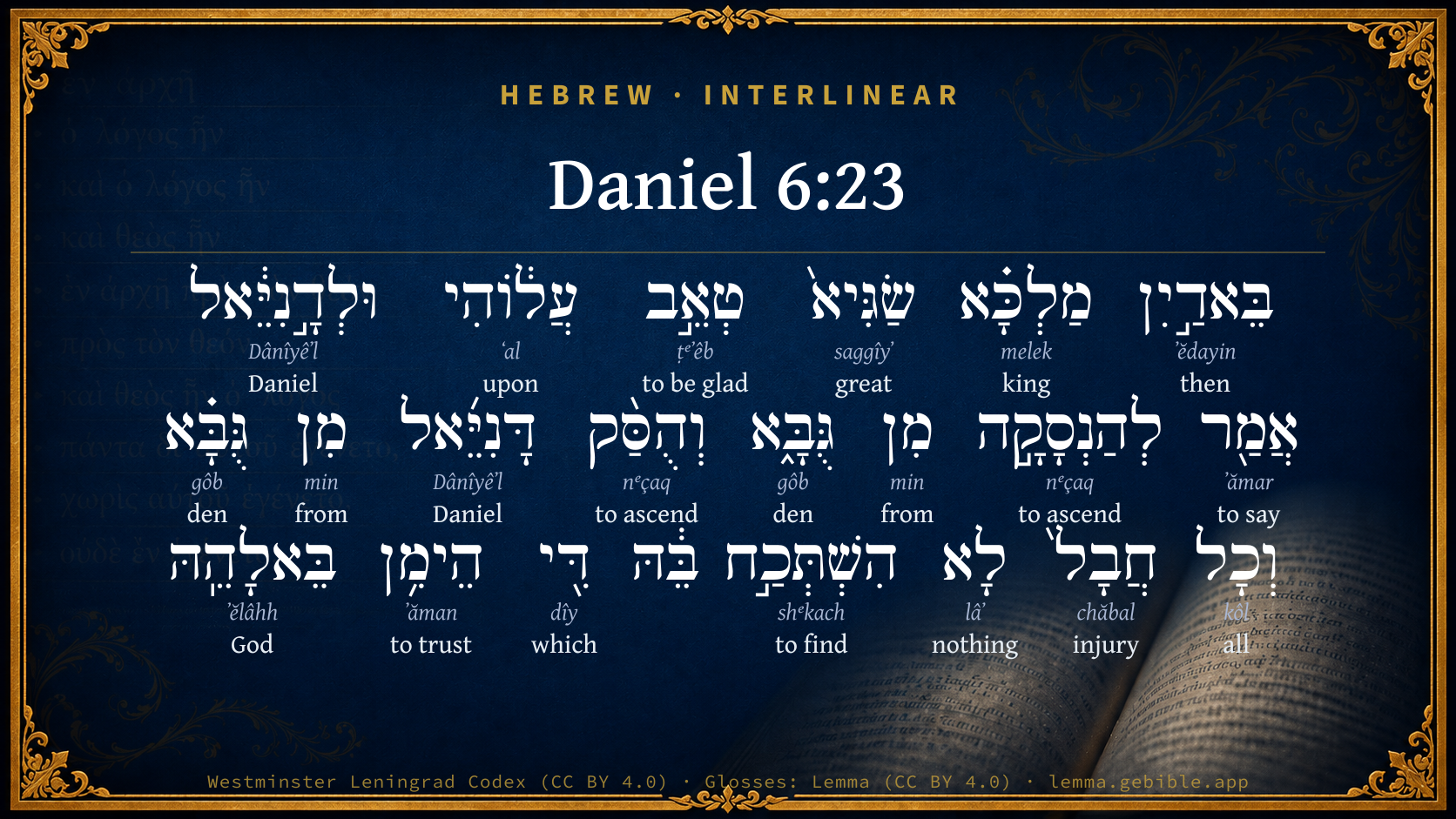
Hebrew (Westminster Leningrad Codex) Daniel 6:23 appears in the Hebrew Old Testament. The text above is from the Westminster Leningrad Codex. Each word links to its Strong’s number, a concise gloss, and parsing drawn from the Open Scriptures Hebrew Bible morphology. Click any word for its full Brown-Driver-Briggs (BDB) entry.
Download image
Cite this verse

Daniel 6:23 (World English Bible). Public Domain. Lemma interlinear Bible study tool, https://lemma.gebible.app/v/daniel/6/23.

Show BibTeX & RIS
BibTeX
RIS
English Translation
Then was the king exceeding glad, and commanded that they should take Daniel up out of the den. So Daniel was taken up out of the den, and no manner of hurt was found on him, because he had trusted in his God.
World English Bible · Public Domain
Highlights
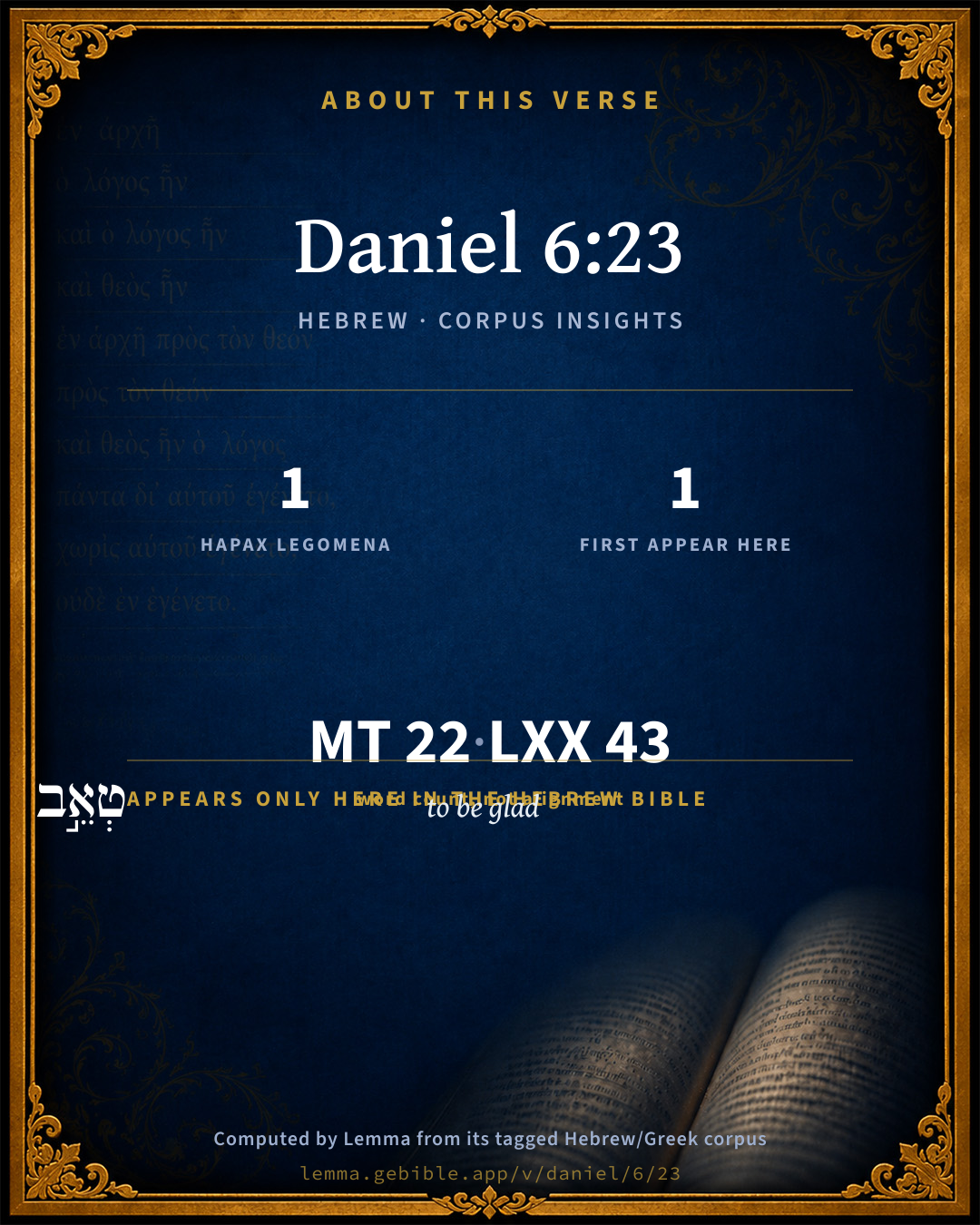
  • 1 hapax legomenon — only here in the Hebrew Bible
  • 1 first appearance in the Hebrew Bible
Full analysis ↓
Download a study sheet

One document with this verse’s original text, its word-by-word gloss line, the meaning frame, cross-references with their text, attributed commentary, and full source and license credits — printable, and it pastes into notes with its structure intact.

This verse Autodidact and up

Study sheet (.html) Plain text (.txt)

A passage Seminary Student

Up to 50 verses in one chapter. A passage sheet keeps up to 6 commentary sources and 12 cross-references per verse, in the order this page ranks them, and says so on the sheet whenever that leaves anything out. Ask for a single verse and you get the Autodidact verse sheet above.

Everything on this page stays free to read, with no account — the sheet is a download of what is already on screen, not access to it.

Want to remove ads? Support Godless Engineer
Compare translations 3

The same verse in 3 English versions, stacked beneath the original-language interlinear above. Click any original word for its lexicon entry.

Each is an independent rendering of the whole verse — the interlinear is not word-aligned to these translations.

Highlighted words mark where these versions differ — a whole-verse word diff, not a word-by-word alignment.

  • World English Bible Public Domain
    Then was the king exceeding glad, and commanded that they should take Daniel up out of the den. So Daniel was taken up out of the den, and no manner of hurt was found on him, because he had trusted in his God.
  • King James Version Public Domain
    Then was the king exceedingly glad for him, and commanded that they should take Daniel up out of the den. So Daniel was taken up out of the den, and no manner of hurt was found upon him, because he believed in his God.
  • unfoldingWord Literal Text CC BY-SA 4.0
    Then the king was exceedingly glad, and gave an order for Daniel to be taken up out of the den. So Daniel was taken up out of the den, and no harm was found on him, because he had trusted in his God.

unfoldingWord Literal Text — © unfoldingWord, licensed CC BY-SA 4.0. Word-aligned USFM3 via Door43 (git.door43.org/unfoldingWord/en_ult).

Versions to compare (up to 4)

3 of 4 selected

Show all 18 translations

Every available English version of this verse, each an independent rendering of the whole verse.

  • World English Bible Public Domain
    Then was the king exceeding glad, and commanded that they should take Daniel up out of the den. So Daniel was taken up out of the den, and no manner of hurt was found on him, because he had trusted in his God.
  • Berean Standard Bible Public Domain
    The king was overjoyed and gave orders to lift Daniel out of the den, and when Daniel was lifted out of the den, no wounds whatsoever were found on him, because he had trusted in his God.
  • Majority Standard Bible Public Domain
    The king was overjoyed and gave orders to lift Daniel out of the den, and when Daniel was lifted out of the den, no wounds whatsoever were found on him, because he had trusted in his God.
  • King James Version Public Domain
    Then was the king exceedingly glad for him, and commanded that they should take Daniel up out of the den. So Daniel was taken up out of the den, and no manner of hurt was found upon him, because he believed in his God.
  • American Standard Version (1901) Public Domain
    Then was the king exceeding glad, and commanded that they should take Daniel up out of the den. So Daniel was taken up out of the den, and no manner of hurt was found upon him, because he had trusted in his God.
  • Revised Version (1885) Public Domain
    Then was the king exceeding glad, and commanded that they should take Daniel up out of the den. So Daniel was taken up out of the den, and no manner of hurt was found upon him, because he had trusted in his God.
  • Geneva Bible (1599) Public Domain
    Then was the King exceeding glad for him, and commanded that they should take Daniel out of the denne: so Daniel was brought out of the denne, and no maner of hurt was found vpon him, because he beleeued in his God.
  • Douay-Rheims (1899) Public Domain
    Then was the king exceeding glad for him, and he commanded that Daniel should be taken out of the den: and Daniel was taken out of the den, and no hurt was found in him, because he believed in his God.
  • Young's Literal Translation Public Domain
    Then was the king very glad for him, and he hath commanded Daniel to be taken up out of the den, and Daniel hath been taken up out of the den, and no injury hath been found in him, because he hath believed in his God.
  • Literal Standard Version CC BY-SA 4.0
    Then was the king very glad for him, and he has commanded Daniel to be taken up out of the den, and Daniel has been taken up out of the den, and no injury has been found in him, because he has believed in his God.
  • Unlocked Literal Bible CC BY-SA 4.0
    Then the king was very happy. He gave an order that they should take Daniel up out of the den. So Daniel was lifted up out of the den. No harm was found on him, because he had trusted in his God.
  • unfoldingWord Literal Text CC BY-SA 4.0
    Then the king was exceedingly glad, and gave an order for Daniel to be taken up out of the den. So Daniel was taken up out of the den, and no harm was found on him, because he had trusted in his God.
  • Darby Bible Public Domain
    Thereupon was the king exceeding glad, and commanded that they should take Daniel up out of the den. So Daniel was taken up out of the den, and no manner of hurt was found upon him, because he believed in his God.
  • World Messianic Bible Public Domain
    Then the king was exceedingly glad, and commanded that they should take Daniel up out of the den. So Daniel was taken up out of the den, and no kind of harm was found on him, because he had trusted in his God.
  • Webster's Bible Public Domain
    \\6:22\\My God hath sent his angel, and hath shut the lions' mouths, that they have not hurt me: forasmuch as before him innocence was found in me; and also before thee, O king, have I done no hurt.
  • Free Bible Version CC BY-SA 4.0
    The king was extremely pleased and ordered Daniel brought up from the den. Daniel was lifted up from the den and he was found to have no injuries at all because he had trusted in his God.
  • Bible in Basic English Public Domain
    My God has sent his angel to keep the lions' mouths shut, and they have done me no damage: because I was seen to be without sin before him; and further, before you, O King, I have done no wrong.
  • JPS Tanakh (1917) Public Domain
    (6-24) Then was the king exceeding glad, and commanded that they should take Daniel up out of the den. So Daniel was taken up out of the den, and no manner of hurt was found upon him, because he had trusted in his God.

Literal Standard Version (2020), Covenant Press — licensed CC BY-SA 4.0. Text via the HelloAO Bible API (eBible.org). Unlocked Literal Bible (unfoldingWord) — licensed CC BY-SA 4.0. Text via the HelloAO Bible API (eBible.org). unfoldingWord Literal Text — © unfoldingWord, licensed CC BY-SA 4.0. Word-aligned USFM3 via Door43 (git.door43.org/unfoldingWord/en_ult). Free Bible Version, Dr. Jonathan Gallagher — licensed CC BY-SA 4.0. Text via the HelloAO Bible API (eBible.org).

Word by word

More ways to search: Search by grammar → Find every occurrence → Compare this word →

Practice this passage: Drill this verse → Learn its vocabulary →

טְאֵ֣ב
ṭᵉʼêb
H2868
“to be glad”
Adjective, V, Plural
Part of Speech
Adjective
Number
Plural
Full BDB Definition

Origin: a primitive root

TWOT: 2750

(Peal) to be glad, be good
  1. בֵּאדַ֣יִן ʼĕdayin H116 “in/at · then” Adjective, R + Adverb
  2. מַלְכָּ֗א melek H4430 “king · the” Adjective, N, Common + Particle, Definite Article
  3. שַׂגִּיא֙ saggîyʼ H7690 “great” Adjective, A
  4. עֲל֔וֹהִי ʻal H5922 “upon · him” Adjective, R + Suffix, Personal, 3rd Person, Masculine, Singular
  5. וּלְדָ֣נִיֵּ֔אל Dânîyêʼl H1841 “and · to/for · Daniel” Adjective, C + Particle, Direct Object + Noun, Proper
  6. אֲמַ֖ר ʼămar H560 “to say” Adjective, V, Plural
  7. לְהַנְסָקָ֣ה nᵉçaq H5267 “to ascend” Adjective, R + Verb, Hiphil, Infinitive Construct
  8. מִן min H4481 “from” Adjective, R
  9. גֻּבָּ֑א gôb H1358 “den · the” Adjective, N, Common + Particle, Definite Article
  10. וְהֻסַּ֨ק nᵉçaq H5267 “and · to ascend” Adjective, C + Verb, Hophal, Perfect, 3rd Person, Masculine, Singular
  11. דָּנִיֵּ֜אל Dânîyêʼl H1841 “Daniel” Adjective, N
  12. מִן min H4481 “from” Adjective, R
  13. גֻּבָּ֗א gôb H1358 “den · the” Adjective, N, Common + Particle, Definite Article
  14. וְכָל kôl H3606 “and · all of” Adjective, C + Noun, Common, Masculine, Singular, Construct
  15. חֲבָל֙ chăbal H2257 “injury” Adjective, N, Common
  16. לָא lâʼ H3809 “nothing” Adjective, T
  17. הִשְׁתְּכַ֣ח shᵉkach H7912 “to find” Adjective, V, Plural
  18. דִּ֖י dîy H1768 “which” Adjective, C
  19. הֵימִ֥ן ʼăman H540 “to trust” Adjective, V, Plural
  20. בֵּאלָהֵֽהּ ʼĕlâhh H426 “in/at · God · his” Adjective, R + Noun, Common, Masculine, Singular, Construct + Suffix, Personal, 3rd Person, Masculine, Singular

About this verse

These counts appear in no published source. They are computed here, from the morphology-tagged text and Lemma’s own curated glosses. What Lemma adds →

22
words
17
distinct lemmas
Prophets
section

Notable vocabulary

1 hapax legomenon — a word that appears only here in the entire Hebrew Bible:

  • טְאֵ֣ב to be glad H2868

First appearance in Scripture

This word makes its first canonical appearance in the Hebrew Bible here:

  • טְאֵ֣ב to be glad H2868

Shared distinctive vocabulary

לְהַנְסָקָ֣ה to ascend H5267 occurs in 2 verses of the Hebrew Bible. Also found in:

Grammatical profile

  • 2 verbs
  • 3 nouns
  • 13 adjectives
  • 1 adverb
  • 3 particles

Verb forms

  • לְהַנְסָקָ֣ה Hiphil · Infinitive Construct
  • וְהֻסַּ֨ק Hophal · Perfect

Repetition

Words recur within this verse — often emphatic in Hebrew:

  • וּלְדָ֣נִיֵּ֔אל Daniel H1841 ×2
  • לְהַנְסָקָ֣ה to ascend H5267 ×2
  • גֻּבָּ֑א den H1358 ×2
  • מִן from H4481 ×2

Hebrew & Septuagint length

In English translation the verse runs 43 words from the Hebrew and 40 from the Septuagint (LXX English) — closely comparable.

A rough comparison of the two English renderings, which tokenize alike — not a word-level alignment.

Word counts can differ between the Hebrew and the Greek without any difference in meaning — e.g. the Hebrew direct-object marker אֵת has no separate Greek word, and Greek often adds the article ὁ.

In the original languages it is 22 Hebrew tokens and 43 Greek tokens — but the two are counted differently (Hebrew bundles its prefixes and suffixes into one token; the Greek is in lemma form), so that isn’t a like-for-like length.

Cross-references

16

Topical passages linked to Daniel 6:23 in the Treasury of Scripture Knowledge — connected by theme and wording, ordered by reader-vote popularity; previews shown in the World English Bible.

  • 1 Chronicles 5:20 They were helped against them, and the Hagrites were delivered into their hand, and all who were with them; for they cried to God in the battle, and he was entreated of them, because they put their trust in him.
  • Daniel 3:25 He answered, Look, I see four men loose, walking in the midst of the fire, and they have no hurt; and the aspect of the fourth is like a son of the gods.
  • Daniel 3:27–28 The satraps, the deputies, and the governors, and the king's counselors, being gathered together, saw these men, that the fire had no power on their bodies, nor was the hair of their head singed, neither were their pants changed, nor had the smell of fire passed on them.
  • Mark 9:23 Jesus said to him, "If you can believe, all things are possible to him who believes."
  • Daniel 6:18 Then the king went to his palace, and passed the night fasting; neither were instruments of music brought before him: and his sleep fled from him.
  • Psalms 37:40 Yahweh helps them, and rescues them. He rescues them from the wicked, and saves them, Because they have taken refuge in him.
  • Proverbs 18:10 The name of Yahweh is a strong tower: The righteous run to him, and are safe.
  • Isaiah 26:3 You will keep [him] in perfect peace, [whose] mind [is] stayed [on you]; because he trusts in you.
  • 2 Chronicles 20:20 They rose early in the morning, and went forth into the wilderness of Tekoa: and as they went forth, Jehoshaphat stood and said, Hear me, Judah, and you inhabitants of Jerusalem: believe in Yahweh your God, so shall you be established; believe his prophets, so shall you prosper.
  • Psalms 118:8–9 It is better to take refuge in Yahweh, Than to put confidence in man.
  • Psalms 146:3–6 Don't put your trust in princes, Each a son of man in whom there is no help.
  • 1 Kings 5:7 It happened, when Hiram heard the words of Solomon, that he rejoiced greatly, and said, Blessed be Yahweh this day, who has given to David a wise son over this great people.
  • 2 Chronicles 2:11–12 Then Huram the king of Tyre answered in writing, which he sent to Solomon, Because Yahweh loves his people, he has made you king over them.
  • Daniel 6:14 Then the king, when he heard these words, was sore displeased, and set his heart on Daniel to deliver him; and he labored until the going down of the sun to rescue him.
  • Hebrews 11:33 who, through faith subdued kingdoms, worked out righteousness, obtained promises, stopped the mouths of lions,
  • Exodus 18:9 Jethro rejoiced for all the goodness which Yahweh had done to Israel, in that he had delivered them out of the hand of the Egyptians.

Cross-references courtesy of OpenBible.info (CC BY 4.0).

Hebrew and Greek witnesses Masoretic Hebrew ↔ Greek Septuagint

The same verse in the two great witnesses to the Old Testament, shown verse-for-verse.

These are two independent witnesses, not word-aligned to each other, and the Septuagint is shown in lemma (dictionary) form.

Hebrew Daniel 6:23 Masoretic · Westminster Leningrad Codex

בֵּאדַ֣יִן מַלְכָּ֗א שַׂגִּיא֙ טְאֵ֣ב עֲל֔וֹהִי וּלְדָ֣נִיֵּ֔אל אֲמַ֖ר לְהַנְסָקָ֣ה מִן גֻּבָּ֑א וְהֻסַּ֨ק דָּנִיֵּ֜אל מִן גֻּבָּ֗א וְכָל חֲבָל֙ לָא הִשְׁתְּכַ֣ח בֵּ֔הּ דִּ֖י הֵימִ֥ן בֵּאלָהֵֽהּ

Then was the king exceeding glad, and commanded that they should take Daniel up out of the den. So Daniel was taken up out of the den, and no manner of hurt was found on him, because he had trusted in his God.

World English Bible · Public Domain

Greek LXX Daniel 6:23 Septuagint · lemma form

καί σώζω ἐγώ ὁ θεός ἀπό ὁ λέων καθότι δικαιοσύνη ἐν ἐγώ εὑρίσκω ἐναντίον αὐτός καί ἐναντίον δέ σύ βασιλεύς οὔτε ἄγνοια οὔτε ἁμαρτία εὑρίσκω ἐν ἐγώ σύ δέ ἀκούω ἄνθρωπος πλανάω βασιλεύς καί ῥίπτω ἐγώ εἰς ὁ λάκκος ὁ λέων εἰς ἀπώλεια

Then the king was very glad for him, and he commanded to bring Daniel out of the den. So Daniel was brought out of the den, and there was found no hurt upon him, because he believed in his God.

LXX2012 (modern English Septuagint) · Public Domain

On this verse, The Pulpit Commentary discusses the Septuagint’s reading. Read the note in Commentary ↓

Hebrew: Westminster Leningrad Codex (CC BY 4.0). Greek: Septuagint (public domain); English from LXX2012 (modern English Septuagint) (Public Domain). How the Septuagint differs from the Hebrew →

Commentary

Notes on Daniel 6:23 from classic Christian and Jewish commentators (each source and its license shown beneath its notes). The classic Christian expositions comment on the surrounding passage and are grouped to its opening verse, so a note may address several verses; the Jewish commentaries on the Tanakh (Rashi and others) are per-verse, so they appear only where the commentator wrote on this verse.

Lemma curates 59 commentaries, every one of them public domain or Creative Commons licensed, each selected and text-cleaned for this edition rather than reprinted as found. About our sources →

Trapp's Complete Commentary

John Trapp

Dan 6:23 Then was the king exceeding glad for him, and commanded that they should take Daniel up out of the den. So Daniel was taken up out of the den, and no manner of hurt was found upon him, because he believed in his God.

Ver. 23. And commanded that they should take Daniel up ant of the den.] Pull him up with cords, as they did Jeremiah in like case. {Jer 38:11-13}

So Daniel was taken up out of the den.] A lively type of Christ’s resurrection from the pit. {a} So was Joseph taken from prison, and made lord of Egypt; Samson breaking the bars, and carrying away the gates of Gaza; David, so oft oppressed by Saul, and yet exalted to the kingdom; Jonah, his being drawn out of many waters. {Mat 12:39}

Because he believed in his God.] Of such force is faith, of such power is prayer; for it may well be thought that he prayed hard (with David, Psa 22:21), "Save me from the lion’s mouth, so will I declare thy name unto my brethren." The prayer of faith shall save the afflicted; and questionless justifying faith is not beneath miraculous in the sphere of its own activity, and where it hath the warrant of God’s Word. Let such as desire a special providence believe, wait, and walk uprightly. {2Ch 16:9}

{a} Mos priscus Christianorum fuit ut in suis sepulchris inter alia resurrectonis symbola Danielem in lacu inter leones stantem sculperent. - A Lapide in loc.

John Trapp, A Commentary or Exposition upon All the Books of the Old and New Testament (1647–1656) — public domain. Text from a community e-Sword module.

Geneva Bible (1599)

Geneva Bible translators

Because he committed himself wholly unto God whose cause he did defend, he was assured that nothing but good could come unto him: wherein we see the power of faith, as Heb. 11:33.

Geneva Bible (1599) marginal notes — public domain. Text via Bolls.life.

Jamieson, Fausset & Brown

Robert Jamieson, A. R. Fausset & David Brown

because he believed--"Faith" is stated in Heb 11:33 to have been his actuating principle: a prelude to the Gospel. His belief was not with a view to a miraculous deliverance. He shut his eyes to the event, committing the keeping of his soul to God, in well-doing, as unto a faithful Creator (Pe1 4:19), sure of deliverance in a better life, if not in this.

Jamieson, Fausset & Brown — Commentary Critical and Explanatory on the Whole Bible (1871) — public domain (CC PDM 1.0). Text via the HelloAO Bible API.

Adam Clarke's Commentary

Verse 23. No manner of hurt was found upon him] And why? Because he believed in his God. How mighty is faith? It interests that power in the behalf of the believer by which the sea is dried up, the mountains removed, the dead raised to life, sin forgiven, the heart purified, Satan vanquished, death conquered, and God himself delighted and glorified! See Heb 11:1-40.

Adam Clarke's Commentary on the Bible (1810–1826) — public domain. Text from a community e-Sword/MySword module.

John Calvin's Commentaries

Daniel confirms what he had formerly narrated concerning the feelings of King Darius. As he had departed in anxiety to his palace, had abstained from food and drink, and had laid aside all pleasures and delights, so also he rejoiced in hearing of the wonderful deliverance from death of God’s holy servant. He afterwards adds, And by the king’s command Daniel was drawn out of the cave, and no corruption was found in him. This cannot be ascribed to good fortune. Hence God made his power conspicuous in providing for Daniel’s safety from the grasp of the lions. He would have been torn to pieces had not God closed their mouths; and this contributes in no slight degree to magnify the miracle, since no scratch or touch was found upon his body. As the lions then spared him, it arose from God’s secret counsel; and he marked this more clearly, when his calumniators were thrown into the cave, and were immediately torn by the lions, as he will soon add. But we must notice the reason which is given: He was preserved, since he trusted in his God! It will often happen, that a person may have a good cause, and yet succeed badly and unhappily; because he adds to what is otherwise worthy of praise, too great a confidence in his own counsels, prudence, and industry. Hence it is not surprising if those who undertake good causes often fail of success, as we often see among the profane. For the history of all ages bears witness, to the perishing of those who cherish a just cause; but this arises through their perverse confidence, since they never contemplated the service of God, but rather considered their own praise and the applause of the world. Hence, as ambition seized them, they became pleased with their own plans. Thus arose that saying of Brutus, “Virtue is a frivolous thing!” because he thought himself unworthily treated in fighting for the liberty of Rome, while the gods were adverse instead of propitious. As if God ought to have conferred upon him that aid which he had never hoped and never sought. For we know the pride of that hero’s disposition. I bring forward but one example; but if we diligently weigh the motives which impel the profane when they fight strenuously for good objects, we shall find ambition to be the prevailing motive. No wonder then if God deserted them in this particular, since they were unworthy of experiencing his help. For this reason Daniel states, that he was safely preserved, because he trusted in his God.

The Apostle refers to this in the eleventh chapter of the Ephstle to the Hebrews, (Hebrews 11:33,) where he says some were snatched away or preserved from the mouths of lions through faith. Hence he assigns the cause of Daniel’s escaping in safety, and recalls us to faith. But we must here consider the meaning and force of the word “believing.” For the Prophet does not simply speak of his deliverance as springing from believing Israel’s God to be the true and only God, the Maker of heaven and earth, but from his committing his life to him, from his reposing on his grace, from his fixed determination that his end must be happy, if he worshipped him. Since, therefore, Daniel was certainly persuaded that his life was in God’s hand, and that his hope in him was not in vain, he boldly incurred danger, and intrepidly suffered for the sincere worship of God; hence he says, he believed in God We see then that the word “belief” is not taken coldly, as the Papists dream, since their notion implies an unfolded or dead and shapeless faith, for they think faith nothing else but a confused apprehension of the Deity. Whenever men have any conception of God at all, the Papists think this to be faith; but the Holy Spirit teaches us far otherwise. For we must consider the language of the Apostle, — We do not properly believe in God, unless we determine him to be a rewarder of all who diligently seek him. (Hebrews 11:6.) God is not sought by foolish arrogance, as if by our merits we could confer an obligation upon him; but he is sought by faith, by humility, and by invocation. But when we are persuaded that God is the rewarder of all who seek him, and we know how he ought to be sought, this is true faith. So Daniel did not doubt that God would deliver him, because he did not distrust that teaching of piety which he had learnt from a boy, and through reliance on which he had always called upon God. This, therefore, was the cause of his deliverance. Meanwhile, it is clear that Daniel’s trust in God did not spring from any previous instruction concerning the result; for he rather committed his life to God, since he was prepared for death. Therefore Daniel could not acknowledge this before he was cast into the cave, and exposed to the lions, being ignorant whether God would deliver him, as we previously saw in the case of his companions, “God, if he pleases, will deliver us; but if not, we are prepared to worship Him, and to disobey thy edict.” If Daniel had been taught the issue beforehand, his constancy would not have deserved much praise; but since he was willing to meet death fearlessly for the worship of God, and could deny himself and renounce the world, this is a true and serious proof of his faith and constancy. He believed therefore in God, not because he hoped for such a miracle, but because he knew his own happiness to consist in persisting in the true worship of God. So Paul says, Christ is gain to me, both in life and in death. (Philippians 1:21.) Daniel therefore rested in the help of God, but he closed his eyes to the event, and was not remarkably anxious concerning his life, but since his mind was erected towards the hope of a better life, even if he had to die a hundred times, yet he never would have failed in his confidence, because our faith is extended beyond the boundaries of this frail and corruptible life, as all the pious know well enough. What I have already touched upon afterwards follows, —

John Calvin's Commentaries (1540-1563) — public domain. Text from the Calvin Translation Society English edition (1840s-50s) via the Christian Classics Ethereal Library (ccel.org). Calvin's coverage is partial (roughly two-thirds of the Bible); uncommented books and verses are honest gaps, never fabricated. The 19th-century editor's footnotes and remarks are omitted so the notes are faithfully Calvin's own voice.

The Cambridge Bible for Schools and Colleges

gen. ed. J. J. S. Perowne

23. for him] to be omitted (like ‘with himself’ in Dan_6:14).

because he believed—or (R.V.) trusted—in his God] cf. Heb_11:33.

The Cambridge Bible for Schools and Colleges (gen. ed. J. J. S. Perowne; Cambridge University Press, 1878–1918) — public domain. Text from a community e-Sword module.

John Gill's Exposition

And the king commanded, and they brought those men which had accused Daniel,.... Not all the hundred and twenty princes, and the two presidents; but the chief of them, who were most busy in getting the decree signed; watched Daniel's house, and what he did there; brought the charge against him to the king, and were most solicitous and urgent to have the decree put in execution against him:

and they cast them into the den of lions; the servants of the king, who were sent to fetch them, and who brought these by the king's orders, cast them into the same den of lions that Daniel had been in: thus often the pit wicked men dig for others, they fall into themselves; so Haman man was hanged on the gallows he prepared for Mordecai:

them, their children, and their wives; which might be according to the laws of this monarchy in capital offences, relating to affairs of state, as this was for an accusation of a prime minister of state, to take away his life; though such things were common with arbitrary princes, for the terror of others; so Haman and his sons were hanged up by Ahasuerus: this may seem cruel and inhuman, though it might be that the wives and children of these men advised them to do what they did, and were encouragers and approvers of it. Josephus (m) relates, that the enemies of Daniel, when they saw no hurt came to him, would not ascribe it to the providence of God, but to the lions being full of food; upon which the king ordered much meat to be given them, and then the men to be cast in to them, to see whether because of their fulness they would come unto them or not:

and the lions had the mastery of them, and brake all their bones in pieces, or ever they came at the bottom of the den; the lions seized them at once; and though they did all they could to defend themselves, fighting with them; yet the lions were too powerful for them, and overcame them, and not only tore off their flesh, but broke their bones in pieces, and that as they were falling, before they came to the bottom, or the lower part of the den; this was a plain proof that it was not through fulness, or want of appetite, that the lions did not fall upon Daniel and devour him: this affair happened in the first year of Darius, which, according to Bishop Usher (n), and Dean Prideaux (o), and Mr. Whiston (p), was in the year of the world 3466 A.M., and 538 B.C.; Mr. Bedford (q) places it in 537 B.C.

(m) Antiqu. l. 10. c. 11. sect. 6. (n) Annales Vet. Test. A. M. 3466. (o) Connexion, &c. part 1. p. 125, 128. (p) Chronological Tables, cent. 10. (q) Scripture Chronology, p. 711.

John Gill's Exposition of the Whole Bible (1746–1763) — public domain (CC PDM 1.0). Text via the HelloAO Bible API.

Albert Barnes' Notes on the Bible

Then was the king exceeding glad for him - On account of Daniel. That is, he was rejoiced for the sake of Daniel that he had received no hurt, and that he might be restored to his place, and be useful again in the government.

Albert Barnes' Notes on the Bible (1834–1885) — public domain. Text from a community e-Sword/MySword module.

Haydock's Catholic Bible Commentary

Believed, or trusted. (Calmet) --- St. Paul alludes to this miracle. (Hebrews xi. 33.) (Worthington)

George Leo Haydock (1774–1849), Haydock's Catholic Family Bible and Commentary, 1859 edition — public domain. Excludes Psalms (Douay-Rheims chapter numbering differs from Protestant) and Deuterocanonical books (Catholic canon only).

Matthew Poole's English Annotations

He trusted in God’s power and faithfulness, not to work a miracle, but committed himself to him as a righteous Judge, who would deliver here, or save him hereafter.

Matthew Poole's English Annotations on the Holy Bible (1683–1685) — public domain. Text from a community e-Sword/MySword module.

Whedon's Commentary on the Bible

Daniel D. Whedon

23. For him should be omitted. The last clause is also omitted in some ancient texts.

Daniel D. Whedon (gen. ed.), Commentary on the Old and New Testaments (1874–1909) — public domain. Text from a community e-Sword module.

The Pulpit Commentary

Then was the king exceeding glad for him, and commanded that they should take Daniel up out of the den. So Daniel was taken up out of the den, and no manner of hurt was found upon him, because he believed in his God. The verse that occupies the same place in the Septuagint is not a translation of the present verse at all, but looks as if it had been a sentence in the original longer documents which followed the above Massoretic verse, "Then all the powers gathered together, and saw Daniel, that the lions had not hurt him." It is barely possible float the first clause here represents Aramaic text that might be misread into the Massoretic text. Although it is supported by the later versions, the Massoretic text has a suspicions appearance. The last clause is a moral reflection, unlike anything else in the Book of Daniel, and is omitted, as we saw, from the Septuagint. The assertion of the king"s gladness, too, differs in colour from the other statements in the book; thus compare the language concerning Nebuchadnezzar when the three Hebrew youths were delivered from the fiery furnace. At the same time, it is to be observed that the use of the hophal form in the verb hoosaq is an evidence of the antiquity of this portion of the verse. The hypothesis that tins narrative has been condensed from a longer one, has much to support it. The lesson inculcated, that faith in God would result in deliverance, is very true, even though it was not in the text. The irregular form of the adjective tayb points out a possibility that there has been some modification of the text. Sometimes words not understood have resulted in known words being written in an irregular way.

The Pulpit Commentary (1880–1919), ed. H.D.M. Spence-Jones & Joseph S. Exell — public domain. Text from a community e-Sword module.

unfoldingWord translationNotes

Door43 World Missions Community

den

This may refer to a room or pit where lions were kept. See how you translated this in Daniel 6:7.

No harm was found on him

This can be stated in active form. AT: "They did not find any wounds on Daniel" (See: Active or Passive)

translationWords

trust

unfoldingWord translationNotes — © Distant Shores Media and the Door43 World Missions Community, licensed CC BY-SA 4.0. Source: git.door43.org/Door43/en_tn.

Rashi

Rabbi Shlomo Yitzchaki (Rashi)

I have done no harm No unseemly or false act have I committed.

Rashi on the Tanakh — English translations: “The Judaica Press complete Tanach with Rashi, translated by A. J. Rosenberg” (CC BY 4.0); “Pentateuch with Rashi's commentary by M. Rosenbaum and A.M. Silbermann, 1929-1934” (public domain); “The Metsudah Tanach series, Lakewood, N.J” (CC BY 4.0); and “The Book of Joshua, Metsudah Publications, 1997” (CC BY 4.0). Text via Sefaria.

Lesson kit

Teaching starters — assembled from the data on this page, not authored interpretation. Every prompt links to the verse data it draws on. Edit before teaching.

Daniel, in the Prophets, opens this verse with 22 words (17 distinct Hebrew lemmas). Its most distinctive word is ṭᵉʼêb (“to be glad”). A historical commentator’s framing appears above. Read the whole chapter for the surrounding context.

Discussion questions

  1. How does “to be glad” (ṭᵉʼêb) shape what this verse is saying?
  2. This verse holds 1 word here found nowhere else in the Hebrew Bible. What might the rare word draw attention to?
  3. The word “to be glad” first appears here in Scripture. What is being introduced at this debut?
  4. Daniel 3:22 shares the word «to ascend» with this verse. How do the two illuminate each other?
  5. “Daniel” occurs 2× in this one verse. What is the effect of the repetition?
  6. These translations render this verse differently; the difference is in the English rendering, not the original. What questions does that raise?
  7. The verb «לְהַנְסָקָ֣ה» is Hiphil Infinitive Construct. How does its form color the action?
  8. Reading how Trapp's Complete Commentary and Geneva Bible (1599) read this verse, where do the two commentators agree and where do they part?

Things to notice

  • 1 word in this verse appears nowhere else in the Hebrew Bible.
  • 1 word makes its first canonical appearance in Scripture here.
  • This verse counts 22 Hebrew ↔ 43 Greek words.
  • These translations choose different wording for 14 words in this verse.
  • “Daniel” occurs 2× in this single verse.

Reading settings

Reading text

Shown beneath each verse's original-language words.

Old Testament
Old Testament edition

Read the OT as the Masoretic Hebrew (MT) or the Greek Septuagint (LXX).

English shown for the Greek Septuagint (in the Hebrew ↔ Greek comparison).

Comparing translations? Open the Compare panel on any verse page to stack up to four side by side.