Daniel 6:19

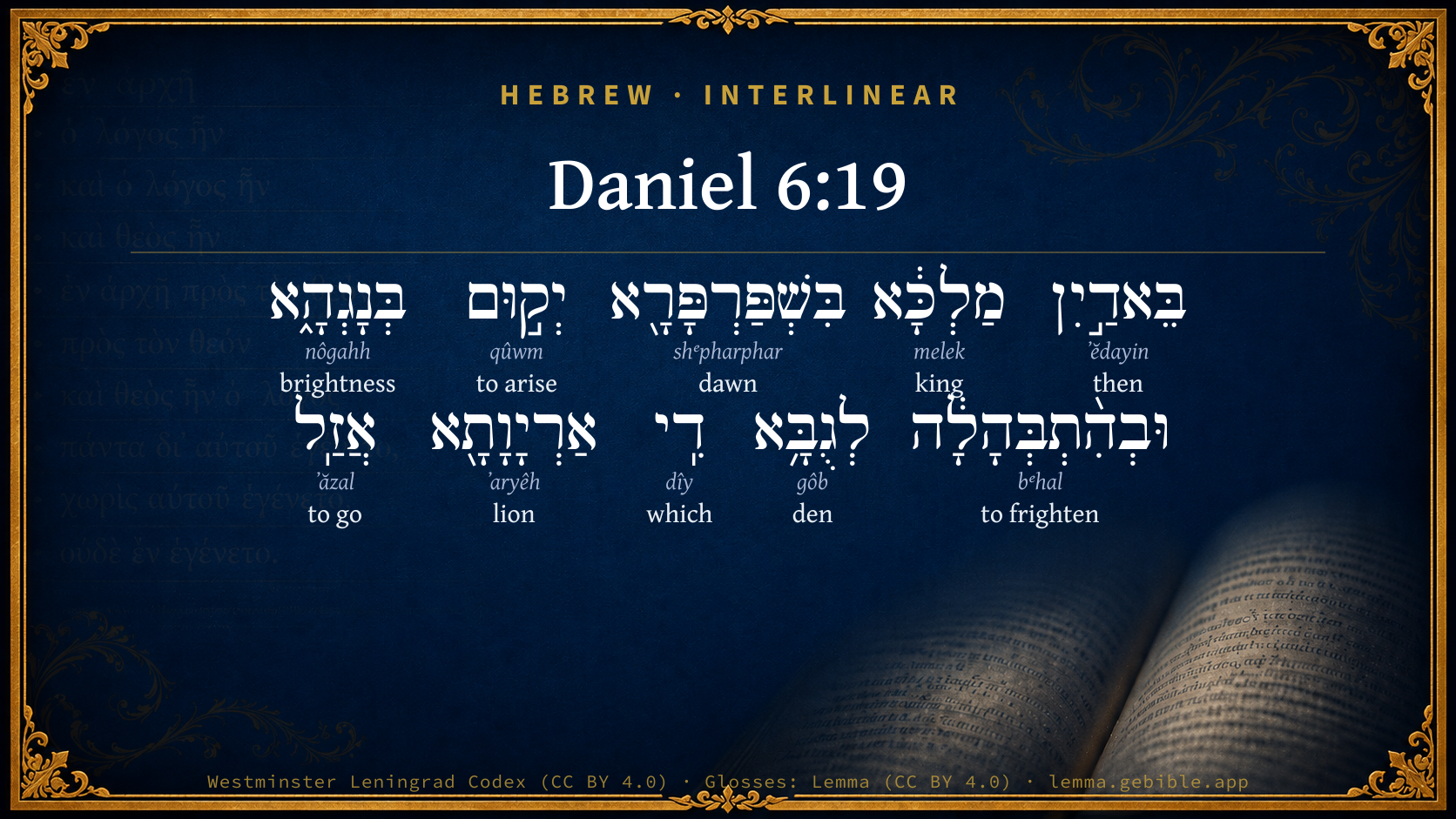
Hebrew (Westminster Leningrad Codex) Daniel 6:19 appears in the Hebrew Old Testament. The text above is from the Westminster Leningrad Codex. Each word links to its Strong’s number, a concise gloss, and parsing drawn from the Open Scriptures Hebrew Bible morphology. Click any word for its full Brown-Driver-Briggs (BDB) entry.
Download image
Cite this verse

Daniel 6:19 (World English Bible). Public Domain. Lemma interlinear Bible study tool, https://lemma.gebible.app/v/daniel/6/19.

Show BibTeX & RIS
BibTeX
RIS
English Translation
Then the king arose very early in the morning, and went in haste to the den of lions.
World English Bible · Public Domain
Highlights
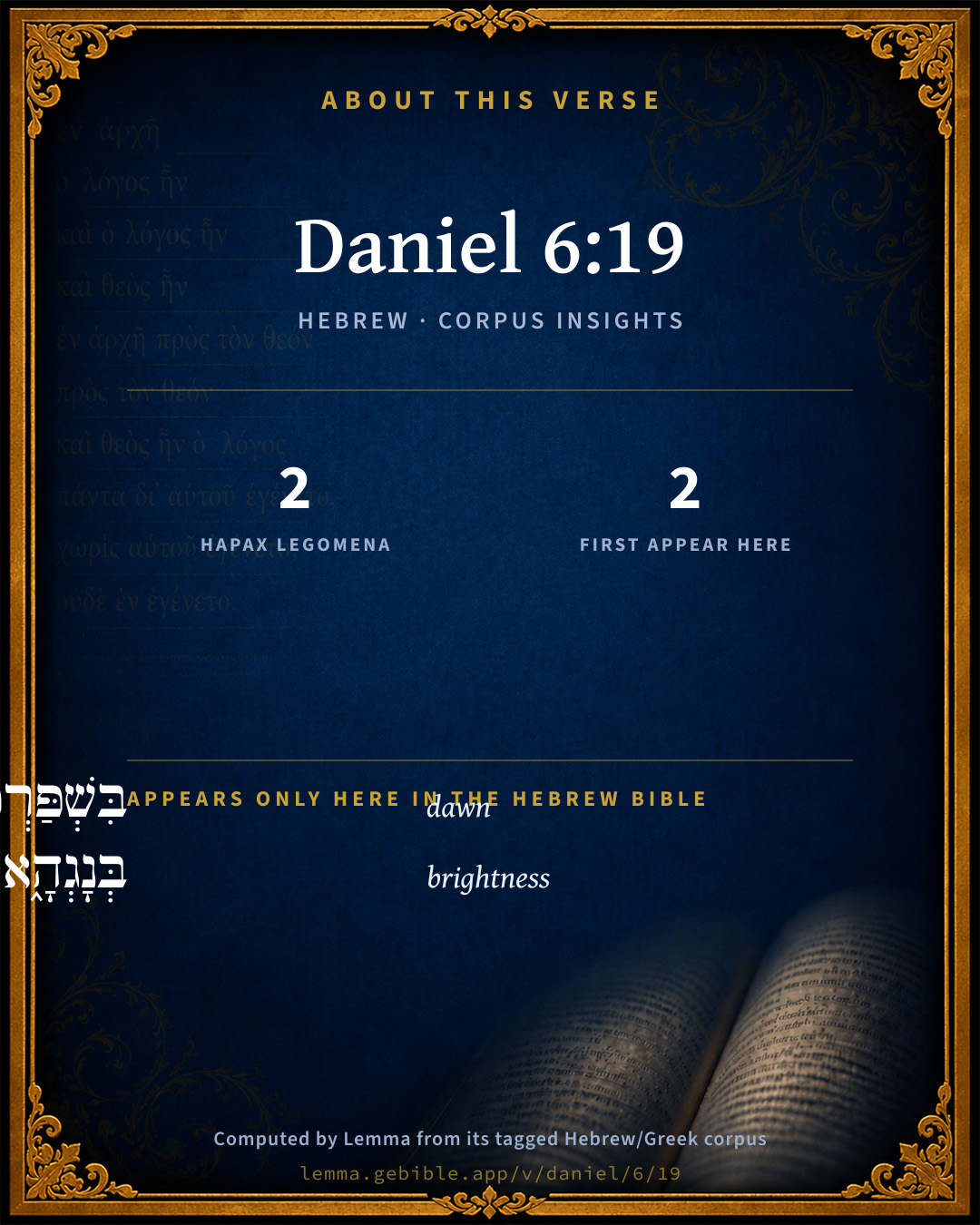
  • 2 hapax legomena — only here in the Hebrew Bible
  • 2 first appearances in the Hebrew Bible
Full analysis ↓
Download a study sheet

One document with this verse’s original text, its word-by-word gloss line, the meaning frame, cross-references with their text, attributed commentary, and full source and license credits — printable, and it pastes into notes with its structure intact.

This verse Autodidact and up

Study sheet (.html) Plain text (.txt)

A passage Seminary Student

Up to 50 verses in one chapter. A passage sheet keeps up to 6 commentary sources and 12 cross-references per verse, in the order this page ranks them, and says so on the sheet whenever that leaves anything out. Ask for a single verse and you get the Autodidact verse sheet above.

Everything on this page stays free to read, with no account — the sheet is a download of what is already on screen, not access to it.

Want to remove ads? Support Godless Engineer
Compare translations 3

The same verse in 3 English versions, stacked beneath the original-language interlinear above. Click any original word for its lexicon entry.

Each is an independent rendering of the whole verse — the interlinear is not word-aligned to these translations.

Highlighted words mark where these versions differ — a whole-verse word diff, not a word-by-word alignment.

  • World English Bible Public Domain
    Then the king arose very early in the morning, and went in haste to the den of lions.
  • King James Version Public Domain
    Then the king arose very early in the morning, and went in haste unto the den of lions.
  • unfoldingWord Literal Text CC BY-SA 4.0
    Then the king got up at dawn, at the break of day, and went in haste to the den of lions.

unfoldingWord Literal Text — © unfoldingWord, licensed CC BY-SA 4.0. Word-aligned USFM3 via Door43 (git.door43.org/unfoldingWord/en_ult).

Versions to compare (up to 4)

3 of 4 selected

Show all 18 translations

Every available English version of this verse, each an independent rendering of the whole verse.

  • World English Bible Public Domain
    Then the king arose very early in the morning, and went in haste to the den of lions.
  • Berean Standard Bible Public Domain
    At the first light of dawn, the king got up and hurried to the den of lions.
  • Majority Standard Bible Public Domain
    At the first light of dawn, the king got up and hurried to the den of lions.
  • King James Version Public Domain
    Then the king arose very early in the morning, and went in haste unto the den of lions.
  • American Standard Version (1901) Public Domain
    Then the king arose very early in the morning, and went in haste unto the den of lions.
  • Revised Version (1885) Public Domain
    Then the king arose very early in the morning, and went in haste unto the den of lions.
  • Geneva Bible (1599) Public Domain
    Then the King arose early in the morning, and went in all haste vnto the denne of lyons.
  • Douay-Rheims (1899) Public Domain
    Then the king rising very early in the morning, went in haste to the lions' den:
  • Young's Literal Translation Public Domain
    Then doth the king rise in the early morning, at the light, and in haste to the den of lions he hath gone;
  • Literal Standard Version CC BY-SA 4.0
    Then the king rises in the early morning, at the light, and he has gone in haste to the den of lions;
  • Unlocked Literal Bible CC BY-SA 4.0
    Then at daybreak the king got up and he quickly went to the lions' den.
  • unfoldingWord Literal Text CC BY-SA 4.0
    Then the king got up at dawn, at the break of day, and went in haste to the den of lions.
  • Darby Bible Public Domain
    Then the king arose with the light at break of day, and went in haste unto the den of lions.
  • World Messianic Bible Public Domain
    Then the king arose very early in the morning, and went in haste to the den of lions.
  • Webster's Bible Public Domain
    \\6:18\\Then the king went to his palace, and passed the night fasting: neither were instruments of music brought before him: and his sleep went from him.
  • Free Bible Version CC BY-SA 4.0
    At dawn, as soon as it was light, the king got up and rushed to the lions' den.
  • Bible in Basic English Public Domain
    Then the king went to his great house, and took no food that night, and no... were placed before him, and his sleep went from him.
  • JPS Tanakh (1917) Public Domain
    (6-20) Then the king arose very early in the morning, and went in haste unto the den of lions.

Literal Standard Version (2020), Covenant Press — licensed CC BY-SA 4.0. Text via the HelloAO Bible API (eBible.org). Unlocked Literal Bible (unfoldingWord) — licensed CC BY-SA 4.0. Text via the HelloAO Bible API (eBible.org). unfoldingWord Literal Text — © unfoldingWord, licensed CC BY-SA 4.0. Word-aligned USFM3 via Door43 (git.door43.org/unfoldingWord/en_ult). Free Bible Version, Dr. Jonathan Gallagher — licensed CC BY-SA 4.0. Text via the HelloAO Bible API (eBible.org).

Word by word

More ways to search: Search by grammar → Find every occurrence → Compare this word →

Practice this passage: Drill this verse → Learn its vocabulary →

בִּשְׁפַּרְפָּרָ֖א
shᵉpharphar
H8238
“in/at · dawn · the”
Adjective, R + Noun, Common, Masculine, Singular, Determined + Particle, Definite Article
Part of Speech
Adjective + Noun + Particle
Type
Definite Article
Full BDB Definition

Origin: from H8231

TWOT: 3046b

dawn, early morning
  1. בֵּאדַ֣יִן ʼĕdayin H116 “in/at · then” Adjective, R + Adverb
  2. מַלְכָּ֔א melek H4430 “king · the” Adjective, N, Common + Particle, Definite Article
  3. יְק֣וּם qûwm H6966 “to arise” Adjective, V
  4. בְּנָגְהָ֑א nôgahh H5053 “in/at · brightness · the” Adjective, R + Noun, Common, Masculine, Singular, Determined + Particle, Definite Article
  5. וּבְהִ֨תְבְּהָלָ֔ה bᵉhal H927 “and · in/at · haste” Adjective, C + Preposition + Noun, Common, Feminine, Singular, Absolute
  6. לְגֻבָּ֥א gôb H1358 “to/for · den · the” Adjective, R + Noun, Common, Masculine, Singular, Determined + Particle, Definite Article
  7. דִֽי dîy H1768 “which” Adjective, T
  8. אַרְיָוָתָ֖א ʼaryêh H744 “lions · the” Adjective, N, Common + Particle, Definite Article
  9. אֲזַֽל ʼăzal H236 “to go” Adjective, V, Plural

About this verse

These counts appear in no published source. They are computed here, from the morphology-tagged text and Lemma’s own curated glosses. What Lemma adds →

10
words
10
distinct lemmas
Prophets
section

Notable vocabulary

2 hapax legomena — words that appear only here in the entire Hebrew Bible:

  • בִּשְׁפַּרְפָּרָ֖א dawn H8238
  • בְּנָגְהָ֑א brightness H5053

First appearance in Scripture

These words make their first canonical appearance in the Hebrew Bible here:

  • בִּשְׁפַּרְפָּרָ֖א dawn H8238
  • בְּנָגְהָ֑א brightness H5053

Shared distinctive vocabulary

אֲזַֽל to go H236 occurs in 7 verses of the Hebrew Bible. Also found in:

Grammatical profile

  • 1 noun
  • 3 adjectives
  • 1 adverb
  • 5 particles

Hebrew & Septuagint length

In English translation the verse runs 18 words from the Hebrew and 18 from the Septuagint (LXX English) — the same length.

A rough comparison of the two English renderings, which tokenize alike — not a word-level alignment.

Word counts can differ between the Hebrew and the Greek without any difference in meaning — e.g. the Hebrew direct-object marker אֵת has no separate Greek word, and Greek often adds the article ὁ.

Cross-references

4

Topical passages linked to Daniel 6:19 in the Treasury of Scripture Knowledge — connected by theme and wording, ordered by reader-vote popularity; previews shown in the World English Bible.

  • 1 Thessalonians 3:5 For this cause I also, when I couldn't stand it any longer, sent that I might know your faith, for fear that by any means the tempter had tempted you, and our labor would have been in vain.
  • Matthew 28:1 Now after the Sabbath, as it began to dawn on the first day of the week, Mary Magdalene and the other Mary came to see the tomb.
  • Mark 16:2 Very early on the first day of the week, they came to the tomb when the sun had risen.
  • 2 Corinthians 2:13 I had no relief for my spirit, because I didn't find Titus, my brother, but taking my leave of them, I went out into Macedonia.

Cross-references courtesy of OpenBible.info (CC BY 4.0).

Hebrew and Greek witnesses Masoretic Hebrew ↔ Greek Septuagint

The same verse in the two great witnesses to the Old Testament, shown verse-for-verse.

These are two independent witnesses, not word-aligned to each other, and the Septuagint is shown in lemma (dictionary) form.

Hebrew Daniel 6:19 Masoretic · Westminster Leningrad Codex

בֵּאדַ֣יִן מַלְכָּ֔א בִּשְׁפַּרְפָּרָ֖א יְק֣וּם בְּנָגְהָ֑א וּבְהִ֨תְבְּהָלָ֔ה לְגֻבָּ֥א דִֽי אַרְיָוָתָ֖א אֲזַֽל

Then the king arose very early in the morning, and went in haste to the den of lions.

World English Bible · Public Domain

Greek LXX Daniel 6:19 Septuagint · lemma form

τότε ὑποστρέφω ὁ βασιλεύς εἰς ὁ βασίλειον αὐτός καί αὐλίζω νῆστις καί εἰμί λυπέω περί ὁ δανιηλ τότε ὁ θεός ὁ δανιηλ πρόνοια ποιέω αὐτός ἀποκλείω ὁ στόμα ὁ λέων καί οὐ παρα ἐνὀχλέω ὁ δανιηλ

Then the king arose very early in the morning, and came in have to the den of lions.

LXX2012 (modern English Septuagint) · Public Domain

On this verse, The Pulpit Commentary discusses the Septuagint’s reading. Read the note in Commentary ↓

Hebrew: Westminster Leningrad Codex (CC BY 4.0). Greek: Septuagint (public domain); English from LXX2012 (modern English Septuagint) (Public Domain). How the Septuagint differs from the Hebrew →

Commentary

Notes on Daniel 6:19 from classic Christian and Jewish commentators (each source and its license shown beneath its notes). The classic Christian expositions comment on the surrounding passage and are grouped to its opening verse, so a note may address several verses; the Jewish commentaries on the Tanakh (Rashi and others) are per-verse, so they appear only where the commentator wrote on this verse.

Lemma curates 59 commentaries, every one of them public domain or Creative Commons licensed, each selected and text-cleaned for this edition rather than reprinted as found. About our sources →

Trapp's Complete Commentary

John Trapp

Dan 6:19 Then the king arose very early in the morning, and went in haste unto the den of lions.

Ver. 19. Then the king arose very early in the morning.] He had lain all night on a bed of thorns, through trouble of mind, and was glad to get up, especially since sleep (the parenthesis of men’s griefs and cares) was quite gone from him.

And went in haste.] Chald., With perturbation.

Unto the den of lions.] Quo venit Leo, et liberavit leonem de ore leonis {a} (say the Jewish doctors by a kind of riddle), whither came God, and delivered this Coeur-de-lion out of the mouth of the lions.

{a} Galatin., lib. v. cap. 8.

John Trapp, A Commentary or Exposition upon All the Books of the Old and New Testament (1647–1656) — public domain. Text from a community e-Sword module.

Tyndale Open Study Notes

Tyndale Open Resources

6:19 Very early: Literally at dawn, the earliest possible hour.

Tyndale Open Study Notes — © Tyndale Open Resources, licensed CC BY-SA 4.0. Text via the HelloAO Bible API.

Jamieson, Fausset & Brown

Robert Jamieson, A. R. Fausset & David Brown

His grief overcame his fear of the nobles.

Jamieson, Fausset & Brown — Commentary Critical and Explanatory on the Whole Bible (1871) — public domain (CC PDM 1.0). Text via the HelloAO Bible API.

Adam Clarke's Commentary

Verse 19. The king arose very early] By the break of day.

Adam Clarke's Commentary on the Bible (1810–1826) — public domain. Text from a community e-Sword/MySword module.

John Calvin's Commentaries

Here the king begins to act with a little more consistency, when he approaches the pit. He was formerly struck down by fear as to yield to his nobles, and to forget his royal dignity by delivering himself up to them as a captive. But now he neither dreads their envy nor the perverseness of their discourse. He approaches the lions’ den early in the morning, says he, — that is, at dawn, before it was, light, coming during the twilight, and in haste. Thus we see him suffering under the most bitter grief, which overcomes all his former fears; for he might still have suffered from fear, through remembrance of that formidable denunciation, — Thou wilt no longer enjoy thy supreme command, unless thou dost vindicate thine edict from contempt! But, as I have said, grief overcomes all fear. And yet we are unable to praise either his piety or his humanity; because, though he approaches the cave and calls out, “Daniel!” with a lamentable voice, still he is not yet angry with his nobles till he sees the servant of God perfectly safe. Then his spirits revive, as we shall see; but as yet he persists in his weakness, and is in a middle place between the perverse despisers and the hearty worshippers of God, who follow with an upright intention what they know to be just.

John Calvin's Commentaries (1540-1563) — public domain. Text from the Calvin Translation Society English edition (1840s-50s) via the Christian Classics Ethereal Library (ccel.org). Calvin's coverage is partial (roughly two-thirds of the Bible); uncommented books and verses are honest gaps, never fabricated. The 19th-century editor's footnotes and remarks are omitted so the notes are faithfully Calvin's own voice.

The Cambridge Bible for Schools and Colleges

gen. ed. J. J. S. Perowne

19. Then the king arose at dawn, as soon as it was light] lit. at dawn, in the brightness. The words used imply that day had fully broken. The first word (‘dawn’) stands in the Targ. for ‘morning’ in Isa_48:8; and the second (‘brightness’), in its Heb. form, in Isa_52:1.

in haste (Dan_3:24)] So anxious was he to learn how Daniel had fared.

The Cambridge Bible for Schools and Colleges (gen. ed. J. J. S. Perowne; Cambridge University Press, 1878–1918) — public domain. Text from a community e-Sword module.

John Gill's Exposition

And when he came to the den, he cried with a lamentable voice unto Daniel,.... Expressing grief and sorrow his heart was full of; it was rather like howling than speaking; thus he cried before he saw Daniel, or heard him speak:

when he was near to the den (k), as it may be rendered; and he was between hope and fear about Daniel's safety; when within sight of the den, and hearing of Daniel, should he be alive to speak: but when he came nearer and saw him, then

the king spake and said to Daniel, O Daniel, servant of the living God; art thou alive? this is a plain case, that the God whom thou servest is the living God, since he has saved thee; and that thou art a true and faithful servant of his, seeing he has wrought such deliverance for thee:

is thy God, whom thou servest continually, able to deliver thee from the lions? has he made it to appear that he is able to deliver from them? has he really done the thing? he could scarcely believe for joy, being filled with amazement; for these words are not to be considered as expressive of any doubt or hesitation he had of the power of God to save him; for he had declared he had before, yea; his confidence that he would deliver him; but of his wonder and admiration at it, the thing being so extraordinary and amazing.

(k) "cum appropinquasset ad foveam", Pagninus; "quumque appropinquaret ad foveam", Piscator.

John Gill's Exposition of the Whole Bible (1746–1763) — public domain (CC PDM 1.0). Text via the HelloAO Bible API.

Albert Barnes' Notes on the Bible

Then the king arose very early in the morning ... - No one can doubt the probability of what is here said, if the previous account be true. His deep anxiety; his wakefulnight; the remorse which he endured, and his hope that Daniel would be after all preserved, all would prompt to an early visit to the place of his confinement, and to his earnestness in ascertaining whether he were still alive.

Albert Barnes' Notes on the Bible (1834–1885) — public domain. Text from a community e-Sword/MySword module.

Matthew Poole's English Annotations

Watching, and grieving, and being between fear and hope, longing to be satisfied.

Matthew Poole's English Annotations on the Holy Bible (1683–1685) — public domain. Text from a community e-Sword/MySword module.

Whedon's Commentary on the Bible

Daniel D. Whedon

19, 20. One ancient Greek version adds that the king took the “satraps” with him. The king voices here the great question to which this entire book gives the answer: Is thy God, whom thou servest continually [Syr., faithfully], able to deliver thee? Not the men suffering in the midst of the Maccabean persecution alone, but men in all ages have needed to hear a glorious affirmative in answer to this question.

Daniel D. Whedon (gen. ed.), Commentary on the Old and New Testaments (1874–1909) — public domain. Text from a community e-Sword module.

The Pulpit Commentary

Vers. 19, 20. Then the king arose very early in the morning, and went in haste unto the den of lions. And when he came to the den, he cried with a lamentable voice unto Daniel: and the king spake and said to Darnel O Daniel servant of the living God, is thy God, whom thou servest continually, able to deliver thee from the lions? "Very early" is really "the glimmer of day;" (shapharpara"). The word used occurs in the Targums. It may, however, be doubted whether the word here is not the Syriac shapbra. The writing here presents so many peculiarities that suspicion is forced upon the reader. The first p is small, and the second is large. There is the further difficulty that nogah is nearly equivalent to shaphra. One might suspect a doublet, as Behrmann maintains, here, did not the versions indicate something like this as the meaning of this clause. A lamentable voice (atzeeb) seems to mean "sad" or "grieved." The version of the Septuagint shows traces of addition, "And King Darius rose early in the morning, and took with him the satraps, and went and stood at the mouth of the den of lions. Then the king called to Daniel with a loud voice, with weeping, saying, O Daniel, if thou art alive, and thy God whom thou servest continually, hath he saved thee from the lions? and have they not harmed thee?" It is possible the addition of "the satraps" may have been due to shapharpara being read ahashdarpnayya. Certainly if the purpose of the double scaling was what it is assigned to be in the first verse, then the satraps would accompany him; only the suggestion is such a natural one that it might readily slip into the text. Ver. 20 (21) in the LXX has traces of expansion. The omission of yekeel and the change of sheezab to the finite preterite is possible enough, and may indicate that in the original text the word rendered "able" was not found. Theodotion renders ver. 19 (20) in accordance with the Massoretic reading, but, in ver. 20 (21) instead of "lamentable voice," has "strong voice," a reading that seems somewhat confirmed by the LXX Further, he translates the interrogative ha as if it were the Hebrew kee, "if." The Peshitta, though agreeing in the nineteenth verse with the Massoretic, has some minor differences in the following verse voice" instead of "lamentable voice," and "faithfully" instead of "continually." The Vulgate singularly inserts in ver. 20 putasne? "dost thou think?" That Darius should thus hasten in the semi-darkness of the first glimmer of dawn to the lions" den to see whether Daniel were yet alive, was but natural. As the sealing of the lions" den suggested the sealing of the holy sepulchre, so the hastening of Darius to the den in the earliest dawn suggests the action of the women who got up "a great while before day." When Darius calls Daniel the "servant of the living God," there is no necessary confession of faith in him on the part of the king. It is for him simply an act of politeness to a Deity who, if this were neglected, might resent. It is to be noted that this attribute "living" is omitted in the Septuagint.

Vers. 19-28.

The tables turned.

If human law and human authority are impotent to save an innocent man from death, the unseen but supreme Monarch will appear upon the scene, and will vindicate the cause of injured innocence. The calculations of human sagacity often prove false. Otto factor is omitted, which entirely vitiates the result. Just as the ruffian is about to seize his prize, a judicial hand is laid upon him, and completely defeats his project. The victor is vanquished; the biter bitten.

I WE HAVE PRESENTED TO US HERE NOBLE ACTIVITY IN THE PLACE OF INDOLENT EASE. The craft of these base politicians was too short-sighted. Within reach of success, they were doomed to ignominious failure. Fortunately for the interests of justice, the king awoke to the deceit that was practised on him. At once he shook off his lethargy, applied such mental energy as he had to the business of the state, and searched in every direction for an expedient to save Daniel. Now that the king has discovered the treacherous design of his princes, all his wits are summoned to meet craft by craft. No effort shall be left untried by which his trusty and noble servant may be saved. He will no longer be a pliant tool in the hands of others, but a master of his own destinies. The hour was critical for Babylon, and Darius rose to the high demands of the occasion. King he will be yet.

II THE GUILTY PUNISHED IN THE PLACE OF THE INNOCENT. Darius perceived that it would be perilous to abrogate, in unseemly haste, an edict so lately made. It would weaken the force of all imperial laws. It would loosen the bands of loyalty. It would arouse the sleepless hostility of his captains and princes. He had heard strange reports of the power of Daniel"s God to save in times of danger. He believes that the same God will rescue now. The penalty which Daniel had incurred was that he should be cast into the den of lions. The edict did not say that he should be, left there to die. The king"s decree would have been fulfilled if Daniel had spent an hour or less amid the caged beasts. All through that dismal night the king had taken counsel of himself. Desiring, on this occasion at least, to do for Daniel all that justice and good will could devise, we cannot doubt that his mind came under the influence of the Divine Spirit. The selfsame God who, through that long night, was giving Daniel courage to control and subdue the lions" rage was also conveying wisdom to King Darius. At earliest dawn the king goes in person to the den, and finds faith in God honoured, human malice frustrated. The king"s edict had been observed to the letter. But there was an authority, appertaining to the king, beyond what was embodied in law. He held in his hand the lives of all his subjects. It is clear as noonday that these envious statesmen had basely deceived the king. Under cover of bringing him honour, they thought only of glutting their own malice, and robbing the state of its best servant. It was nothing less than a murderous conspiracy. They were as guilty of murder as if Daniel had died. Justice plainly demanded that summary retribution should follow; and at once these crafty lords were consigned to the death they had prepared for Daniel. Every man shall receive the due reward of his deeds.

III GOD MAGNIFIED INSTEAD OF BEING DISCREDITED. Profane men thought to use God only as a tool in order to gain their nefarious end. If God was defrauded of his daily tribute of praise, what cared they? If humble souls were deprived of guidance and pardon and heaven, what heeded they, so long as they could lay murderous hands on Daniel? But will men rob God with impunity? Be well assured that God can defend his own! The opposition of vain men shall only advance his cause. The attempt to gag the mouth of prayer shall make even kings vocal in God"s praise. When pompous statesmen league themselves against him, "he that sitteth in the heavens shall laugh." The proposal was that all prayer should cease for the space of thirty days. The effect was that Jehovah was proclaimed as the True and Mighty all through the Persian empire; and a wider effect has been that God has been more honoured and trusted all the world over. "His Name shall endure for ever;" "To him all flesh shall come.

IV THE ELEVATION OF THE MAN WHOM MALICE SOUGHT TO DEPRESS. These worldly wise statesmen felt that Daniel was a superior man to themselves. They could not expect promotion so long as they had to compete with him. Hence they resolved that what they could not gain by fair means they would gain by foul means. But they reckoned without their host. It came to pass that they were degraded, and that Daniel was advanced. True merit will, sooner or later, find its fitting level! Now that these grasping placemen are removed from the empire, there is all the more room for Daniel the more need for an able and trusty councillor. Step by step he rises in favour and in influence. His increasing power brings advantage to the captive tribes of Israel. The sunshine of his prosperity lends brightness to their fallen fortunes. They, too, begin to lift up the head. This event becomes another step in the way of Israel"s restoration. And Daniel rises to the enjoyment of a reputation which is world-wide and immortal. "Me shines as the brightness of the firmament, and as the stars for ever and ever. D.

The Pulpit Commentary (1880–1919), ed. H.D.M. Spence-Jones & Joseph S. Exell — public domain. Text from a community e-Sword module.

unfoldingWord translationNotes

Door43 World Missions Community

lions' den

This may refer to a room or pit where lions were kept. See how you translated this in Daniel 6:7.

translationWords

servant

life

God

save

unfoldingWord translationNotes — © Distant Shores Media and the Door43 World Missions Community, licensed CC BY-SA 4.0. Source: git.door43.org/Door43/en_tn.

Rashi

Rabbi Shlomo Yitzchaki (Rashi)

and retired while fasting [as translated,] and retired while fasting.

table Aram. וְּדַּחֲוָן, and a table, in the Mishnah (Tosefta Kelim, B.M. 5:1). So did Dunash explain (p. 58). They did not bring before him a table upon which to eat.

and his sleep wandered from him [as translated,] his sleep wandered.

Rashi on the Tanakh — English translations: “The Judaica Press complete Tanach with Rashi, translated by A. J. Rosenberg” (CC BY 4.0); “Pentateuch with Rashi's commentary by M. Rosenbaum and A.M. Silbermann, 1929-1934” (public domain); “The Metsudah Tanach series, Lakewood, N.J” (CC BY 4.0); and “The Book of Joshua, Metsudah Publications, 1997” (CC BY 4.0). Text via Sefaria.

Lesson kit

Teaching starters — assembled from the data on this page, not authored interpretation. Every prompt links to the verse data it draws on. Edit before teaching.

Daniel, in the Prophets, opens this verse with 10 words (10 distinct Hebrew lemmas). Its most distinctive word is shᵉpharphar (“dawn”). A historical commentator’s framing appears above. Read the whole chapter for the surrounding context.

Discussion questions

  1. How does “dawn” (shᵉpharphar) shape what this verse is saying?
  2. 2 words here appear nowhere else in the Hebrew Bible. Why might the author reach for such rare wording?
  3. 2 words make their first appearance in Scripture here. What does this debut establish?
  4. How does Ezra 4:23, which shares the word «to go», read alongside this verse?
  5. The translations on this page render this verse differently — a whole-verse word diff, not a word-by-word alignment. What might account for the different wordings?
  6. Compare how Trapp's Complete Commentary and Tyndale Open Study Notes read this verse. Where do they agree or differ?

Things to notice

  • 2 words in this verse appear nowhere else in the Hebrew Bible.
  • 2 words make their first canonical appearance in Scripture here.
  • These translations choose different wording for 9 words in this verse.
  • 10 distinct Hebrew lemmas span 10 words in this verse.

Reading settings

Reading text

Shown beneath each verse's original-language words.

Old Testament
Old Testament edition

Read the OT as the Masoretic Hebrew (MT) or the Greek Septuagint (LXX).

English shown for the Greek Septuagint (in the Hebrew ↔ Greek comparison).

Comparing translations? Open the Compare panel on any verse page to stack up to four side by side.