
Daniel 5:19

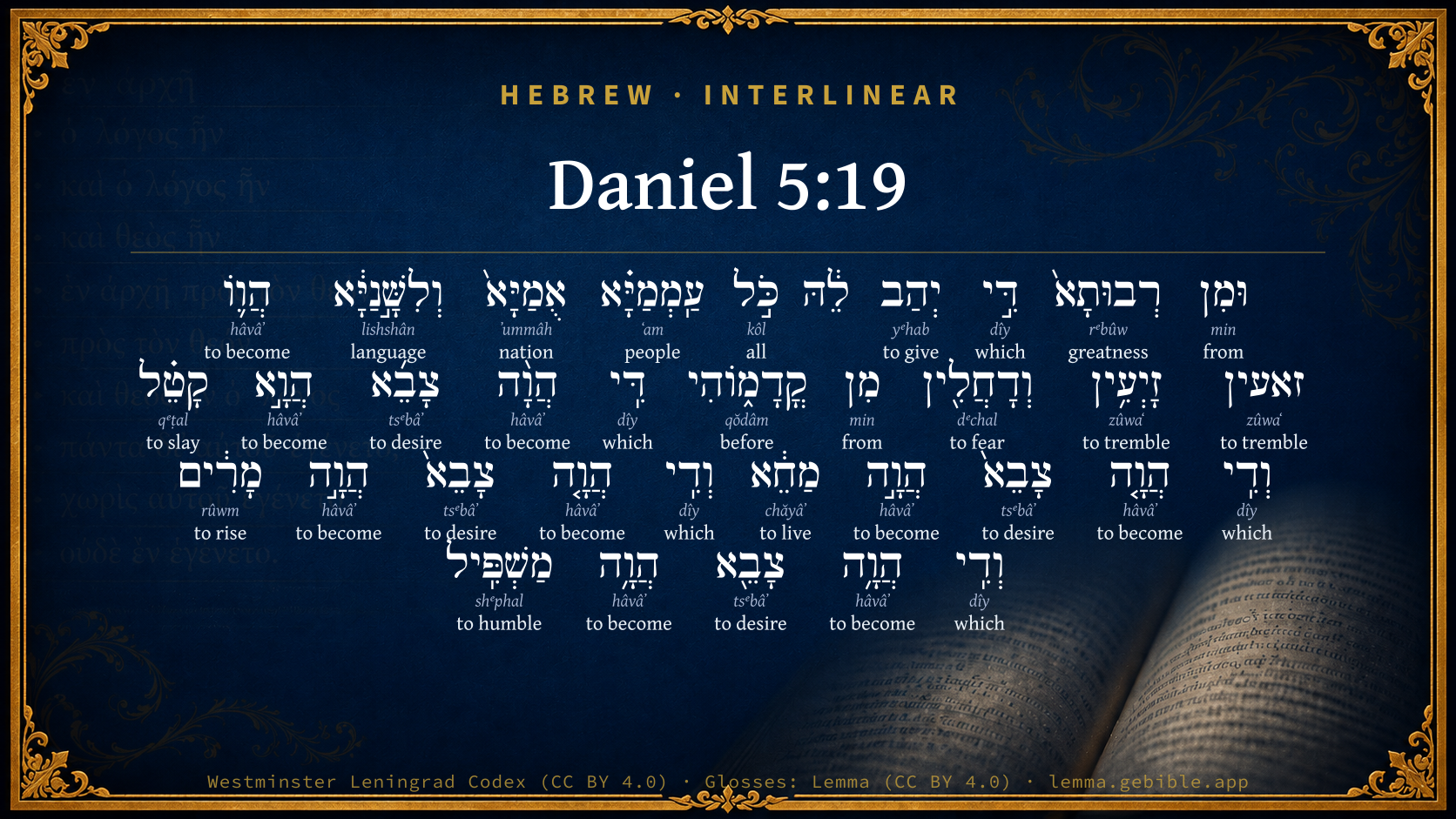
Hebrew (Westminster Leningrad Codex) Daniel 5:19 appears in the Hebrew Old Testament. The text above is from the Westminster Leningrad Codex. Each word links to its Strong’s number, a concise gloss, and parsing drawn from the Open Scriptures Hebrew Bible morphology. Click any word for its full Brown-Driver-Briggs (BDB) entry.
Download image
Cite this verse

Daniel 5:19 (World English Bible). Public Domain. Lemma interlinear Bible study tool, https://lemma.gebible.app/v/daniel/5/19.

Show BibTeX & RIS
BibTeX
RIS
English Translation
and because of the greatness that he gave him, all the peoples, nations, and languages trembled and feared before him: whom he would he killed, and whom he would he kept alive; and whom he would he raised up, and whom he would he put down.
World English Bible · Public Domain
Highlights
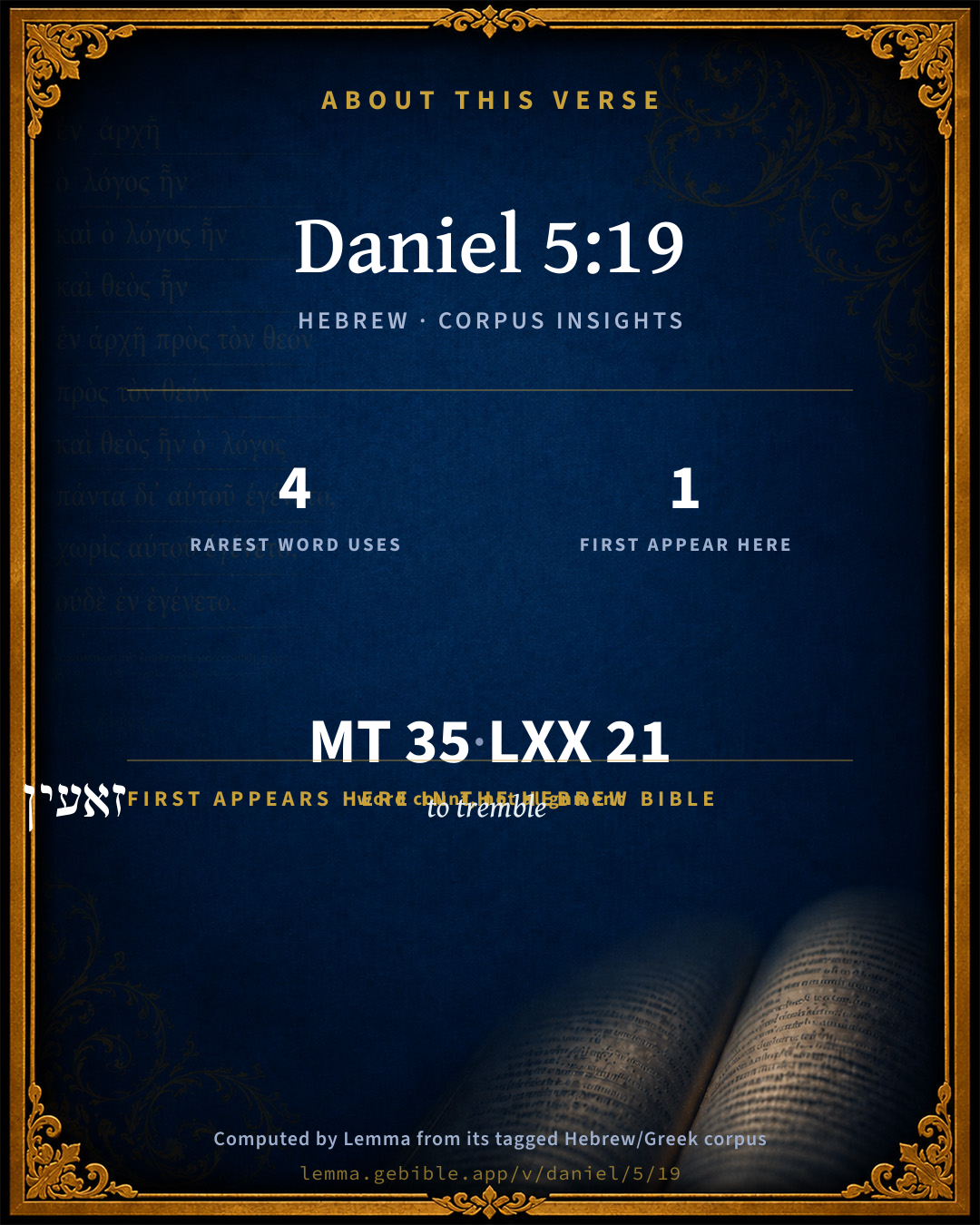
  • 1 first appearance in the Hebrew Bible
Full analysis ↓
Download a study sheet

One document with this verse’s original text, its word-by-word gloss line, the meaning frame, cross-references with their text, attributed commentary, and full source and license credits — printable, and it pastes into notes with its structure intact.

This verse Autodidact and up

Study sheet (.html) Plain text (.txt)

A passage Seminary Student

Up to 50 verses in one chapter. A passage sheet keeps up to 6 commentary sources and 12 cross-references per verse, in the order this page ranks them, and says so on the sheet whenever that leaves anything out. Ask for a single verse and you get the Autodidact verse sheet above.

Everything on this page stays free to read, with no account — the sheet is a download of what is already on screen, not access to it.

Want to remove ads? Support Godless Engineer
Compare translations 3

The same verse in 3 English versions, stacked beneath the original-language interlinear above. Click any original word for its lexicon entry.

Each is an independent rendering of the whole verse — the interlinear is not word-aligned to these translations.

Highlighted words mark where these versions differ — a whole-verse word diff, not a word-by-word alignment.

  • World English Bible Public Domain
    and because of the greatness that he gave him, all the peoples, nations, and languages trembled and feared before him: whom he would he killed, and whom he would he kept alive; and whom he would he raised up, and whom he would he put down.
  • King James Version Public Domain
    And for the majesty that he gave him, all people, nations, and languages, trembled and feared before him: whom he would he slew; and whom he would he kept alive; and whom he would he set up; and whom he would he put down.
  • unfoldingWord Literal Text CC BY-SA 4.0
    Because of the greatness that he gave him, all peoples, nations, and languages trembled and feared before him. Whom he wished, he killed, and whom he wished, he kept alive. Whom he wished, he raised up, and whom he wished, he humbled.

unfoldingWord Literal Text — © unfoldingWord, licensed CC BY-SA 4.0. Word-aligned USFM3 via Door43 (git.door43.org/unfoldingWord/en_ult).

Versions to compare (up to 4)

3 of 4 selected

Show all 18 translations

Every available English version of this verse, each an independent rendering of the whole verse.

  • World English Bible Public Domain
    and because of the greatness that he gave him, all the peoples, nations, and languages trembled and feared before him: whom he would he killed, and whom he would he kept alive; and whom he would he raised up, and whom he would he put down.
  • Berean Standard Bible Public Domain
    Because of the greatness that He bestowed on him, the people of every nation and language trembled in fear before him. He killed whom he wished and kept alive whom he wished; he exalted whom he wished and humbled whom he wished.
  • Majority Standard Bible Public Domain
    Because of the greatness that He bestowed on him, the people of every nation and language trembled in fear before him. He killed whom he wished and kept alive whom he wished; he exalted whom he wished and humbled whom he wished.
  • King James Version Public Domain
    And for the majesty that he gave him, all people, nations, and languages, trembled and feared before him: whom he would he slew; and whom he would he kept alive; and whom he would he set up; and whom he would he put down.
  • American Standard Version (1901) Public Domain
    and because of the greatness that he gave him, all the peoples, nations, and languages trembled and feared before him: whom he would he slew, and whom he would he kept alive; and whom he would he raised up, and whom he would he put down.
  • Revised Version (1885) Public Domain
    and because of the greatness that he gave him, all the peoples, nations, and languages trembled and feared before him: whom he would he slew, and whom he would he kept alive; and whom he would he raised up, and whom he would he put down.
  • Geneva Bible (1599) Public Domain
    And for the maiestie that he gaue him, all people, nations, and languages trembled, and feared before him: he put to death whom he would: he smote whome he would: whome he would he set vp, and whome he would he put downe.
  • Douay-Rheims (1899) Public Domain
    And for the greatness that he gave to him, all people, tribes, and languages trembled, and were afraid of him: whom he would, he slew: and whom he would, he destroyed: and whom he would, he set up: and whom he would, he brought down.
  • Young's Literal Translation Public Domain
    and because of the greatness that He gave to him, all peoples, nations, and languages were trembling and fearing before him: whom he willed he was slaying, and whom he willed he was keeping alive, and whom he willed he was raising up, and whom he willed he was making low;
  • Literal Standard Version CC BY-SA 4.0
    and because of the greatness that He gave to him, all peoples, nations, and languages were trembling and fearing before him: whom he willed he was slaying, and whom he willed he was keeping alive, and whom he willed he was raising up, and whom he willed he was making low;
  • Unlocked Literal Bible CC BY-SA 4.0
    Because of the greatness God gave him, all peoples, nations, and languages trembled and feared him. He put to death those he wanted to die, and he kept alive those he wished to live. He raised up those he wanted, and he humbled those he wished.
  • unfoldingWord Literal Text CC BY-SA 4.0
    Because of the greatness that he gave him, all peoples, nations, and languages trembled and feared before him. Whom he wished, he killed, and whom he wished, he kept alive. Whom he wished, he raised up, and whom he wished, he humbled.
  • Darby Bible Public Domain
    and for the greatness that he gave him, all peoples, nations, and languages, trembled and feared before him: whom he would he slew, and whom he would he kept alive; and whom he would he exalted, and whom he would he humbled.
  • World Messianic Bible Public Domain
    Because of the greatness that he gave him, all the peoples, nations, and languages trembled and feared before him. He killed whom he wanted to, and he kept alive whom he wanted to. He raised up whom he wanted to, and he put down whom he wanted to.
  • Webster's Bible Public Domain
    And for the majesty that he gave him, all people, nations, and languages, trembled and feared before him: whom he would he slew; and whom he would he kept alive; and whom he would he set up; and whom he would he put down.
  • Free Bible Version CC BY-SA 4.0
    Because of the power he gave him, people of every nation and language trembled with fear before him. Those he wished to kill were killed, and those he wished to live were allowed to live. Those he wanted to honor were honored, and those he wanted to humble were humbled.
  • Bible in Basic English Public Domain
    And because of the great power he gave him, all peoples and nations and languages were shaking in fear before him: some he put to death and others he kept living, at his pleasure, lifting up some and putting others down as it pleased him.
  • JPS Tanakh (1917) Public Domain
    and because of the greatness that He gave him, all the peoples, nations, and languages trembled and feared before him: whom he would he slew, and whom he would he kept alive; and whom he would he raised up, and whom he would he put down.

Literal Standard Version (2020), Covenant Press — licensed CC BY-SA 4.0. Text via the HelloAO Bible API (eBible.org). Unlocked Literal Bible (unfoldingWord) — licensed CC BY-SA 4.0. Text via the HelloAO Bible API (eBible.org). unfoldingWord Literal Text — © unfoldingWord, licensed CC BY-SA 4.0. Word-aligned USFM3 via Door43 (git.door43.org/unfoldingWord/en_ult). Free Bible Version, Dr. Jonathan Gallagher — licensed CC BY-SA 4.0. Text via the HelloAO Bible API (eBible.org).

Word by word

More ways to search: Search by grammar → Find every occurrence → Compare this word →

Practice this passage: Drill this verse → Learn its vocabulary →

זאעין
zûwaʻ
H2112
“trembling”
Adjective, V
Part of Speech
Adjective
Full BDB Definition

Origin: corresponding to H2111

TWOT: 2706

(Peal) to tremble
  1. וּמִן min H4481 “and · from” Adjective, C + Preposition
  2. רְבוּתָא֙ rᵉbûw H7238 “greatness · the” Adjective, N, Common + Particle, Definite Article
  3. דִּ֣י dîy H1768 “which” Adjective, T
  4. יְהַב yᵉhab H3052 “to give” Adjective, V, Plural
  5. כֹּ֣ל kôl H3606 “all of” Adjective, N, Common
  6. עַֽמְמַיָּ֗א ʻam H5972 “peoples · the” Adjective, N, Common + Particle, Definite Article
  7. אֻמַיָּא֙ ʼummâh H524 “nations · the” Adjective, N, Common + Particle, Definite Article
  8. וְלִשָּׁ֣נַיָּ֔א lishshân H3961 “and · languages · the” Adjective, C + Noun, Common, Masculine, Plural, Determined + Particle, Definite Article
  9. הֲו֛וֹ hâvâʼ H1934 “to become” Adjective, V, Plural
  10. זָיְעִ֥ין zûwaʻ H2112 “trembling” Adjective, V
  11. וְדָחֲלִ֖ין dᵉchal H1763 “and · fearing” Adjective, C + Verb, Qal, Participle Active, Masculine, Plural, Absolute
  12. מִן min H4481 “from” Adjective, R
  13. קֳדָמ֑וֹהִי qŏdâm H6925 “before · him” Adjective, R + Suffix, Personal, 3rd Person, Masculine, Singular
  14. דִּֽי dîy H1768 “which” Adjective, T
  15. הֲוָ֨ה hâvâʼ H1934 “to become” Adjective, V, Plural
  16. צָבֵ֜א tsᵉbâʼ H6634 “desiring” Adjective, V
  17. הֲוָ֣א hâvâʼ H1934 “to become” Adjective, V, Plural
  18. קָטֵ֗ל qᵉṭal H6992 “slaying” Adjective, V
  19. וְדִֽי dîy H1768 “and · which” Adjective, C + Particle, Relative
  20. הֲוָ֤ה hâvâʼ H1934 “to become” Adjective, V, Plural
  21. צָבֵא֙ tsᵉbâʼ H6634 “desiring” Adjective, V
  22. הֲוָ֣ה hâvâʼ H1934 “to become” Adjective, V, Plural
  23. מַחֵ֔א chăyâʼ H2418 “living” Adjective, V
  24. וְדִֽי dîy H1768 “and · which” Adjective, C + Particle, Relative
  25. הֲוָ֤ה hâvâʼ H1934 “to become” Adjective, V, Plural
  26. צָבֵא֙ tsᵉbâʼ H6634 “desiring” Adjective, V
  27. הֲוָ֣ה hâvâʼ H1934 “to become” Adjective, V, Plural
  28. מָרִ֔ים rûwm H7313 “rising” Adjective, V
  29. וְדִֽי dîy H1768 “and · which” Adjective, C + Particle, Relative
  30. הֲוָ֥ה hâvâʼ H1934 “to become” Adjective, V, Plural
  31. צָבֵ֖א tsᵉbâʼ H6634 “desiring” Adjective, V
  32. הֲוָ֥ה hâvâʼ H1934 “to become” Adjective, V, Plural
  33. מַשְׁפִּֽיל shᵉphal H8214 “humbling” Adjective, V

About this verse

These counts appear in no published source. They are computed here, from the morphology-tagged text and Lemma’s own curated glosses. What Lemma adds →

35
words
17
distinct lemmas
Prophets
section

Notable vocabulary

The rarest word here is זאעין to tremble H2112 — appearing just 4 times in the whole Hebrew Bible.

First appearance in Scripture

This word makes its first canonical appearance in the Hebrew Bible here:

  • זאעין to tremble H2112

Shared distinctive vocabulary

זאעין to tremble H2112 occurs in 2 verses of the Hebrew Bible. Also found in:

Grammatical profile

  • 1 verb
  • 26 adjectives
  • 1 preposition
  • 7 particles

Verb forms

  • וְדָחֲלִ֖ין Qal · Participle Active

Repetition

Words recur within this verse — often emphatic in Hebrew:

  • הֲו֛וֹ to become H1934 ×9
  • צָבֵ֜א to desire H6634 ×4
  • זאעין to tremble H2112 ×2
  • דִּ֣י which H1768 ×5
  • וּמִן from H4481 ×2

Hebrew & Septuagint length

In English translation the verse runs 46 words from the Hebrew and 44 from the Septuagint (LXX English) — closely comparable.

A rough comparison of the two English renderings, which tokenize alike — not a word-level alignment.

Word counts can differ between the Hebrew and the Greek without any difference in meaning — e.g. the Hebrew direct-object marker אֵת has no separate Greek word, and Greek often adds the article ὁ.

In the original languages it is 35 Hebrew tokens and 21 Greek tokens — but the two are counted differently (Hebrew bundles its prefixes and suffixes into one token; the Greek is in lemma form), so that isn’t a like-for-like length.

Cross-references

12

Topical passages linked to Daniel 5:19 in the Treasury of Scripture Knowledge — connected by theme and wording, ordered by reader-vote popularity; previews shown in the World English Bible.

  • Daniel 2:12–13 For this cause the king was angry and very furious, and commanded to destroy all the wise men of Babylon.
  • Daniel 3:6 and whoever doesn't fall down and worships shall the same hour be cast into the midst of a burning fiery furnace.
  • Daniel 3:4 Then the herald cried aloud, To you it is commanded, peoples, nations, and languages,
  • Proverbs 16:14 The king's wrath is a messenger of death, But a wise man will pacify it.
  • Jeremiah 25:9–14 behold, I will send and take all the families of the north, says Yahweh, and [I will send] to Nebuchadrezzar the king of Babylon, my servant, and will bring them against this land, and against the inhabitants of it, and against all these nations round about; and I will utterly destroy them, and make them an astonishment, and a hissing, and perpetual desolations.
  • Jeremiah 27:5–7 I have made the earth, the men and the animals that are on the surface of the earth, by my great power and by my outstretched arm; and I give it to whom it seems right to me.
  • Daniel 3:20–21 He commanded certain mighty men who were in his army to bind Shadrach, Meshach, and Abednego, [and] to cast them into the burning fiery furnace.
  • Daniel 3:29 Therefore I make a decree, that every people, nation, and language, which speak anything evil against the God of Shadrach, Meshach, and Abednego, shall be cut in pieces, and their houses shall be made a dunghill; because there is no other god who is able to deliver after this sort.
  • Daniel 4:22 it is you, O king, that are grown and become strong; for your greatness is grown, and reaches to the sky, and your dominion to the end of the earth.
  • Habakkuk 2:5 Yes, moreover, wine is treacherous. A haughty man who doesn't stay at home, who enlarges his desire as Sheol, and he is like death, and can't be satisfied, but gathers to himself all nations, and heaps to himself all peoples.
  • John 19:11 Jesus answered, "You would have no power at all against me, unless it were given to you from above. Therefore he who delivered me to you has greater sin."
  • Romans 13:1 Let every soul be in subjection to the higher authorities, for there is no authority except from God, and those who exist are ordained by God.

Cross-references courtesy of OpenBible.info (CC BY 4.0).

Hebrew and Greek witnesses Masoretic Hebrew ↔ Greek Septuagint

The same verse in the two great witnesses to the Old Testament, shown verse-for-verse.

These are two independent witnesses, not word-aligned to each other, and the Septuagint is shown in lemma (dictionary) form.

Hebrew Daniel 5:19 Masoretic · Westminster Leningrad Codex

וּמִן רְבוּתָא֙ דִּ֣י יְהַב לֵ֔הּ כֹּ֣ל עַֽמְמַיָּ֗א אֻמַיָּא֙ וְלִשָּׁ֣נַיָּ֔א הֲו֛וֹ זאעין זָיְעִ֥ין וְדָחֲלִ֖ין מִן קֳדָמ֑וֹהִי דִּֽי הֲוָ֨ה צָבֵ֜א הֲוָ֣א קָטֵ֗ל וְדִֽי הֲוָ֤ה צָבֵא֙ הֲוָ֣ה מַחֵ֔א וְדִֽי הֲוָ֤ה צָבֵא֙ הֲוָ֣ה מָרִ֔ים וְדִֽי הֲוָ֥ה צָבֵ֖א הֲוָ֥ה מַשְׁפִּֽיל

and because of the greatness that he gave him, all the peoples, nations, and languages trembled and feared before him: whom he would he killed, and whom he would he kept alive; and whom he would he raised up, and whom he would he put down.

World English Bible · Public Domain

Greek LXX Daniel 5:19 Septuagint · lemma form

καί ὁ σύγκριμα ἐπιἔρχομαι βαλτασαρ ὁ βασιλεύς καί ὁ βασίλειον ἐκαἴρω ἀπό ὁ χαλδαῖος καί δίδωμι ὁ μῆδος καί ὁ πέρσης

and by reason of the majesty which he gave to him, all nations, tribes, and languages trembled and feared before him: whom he would he killed; and whom he would he struck; and whom he would he exalted; and whom he would he abased.

LXX2012 (modern English Septuagint) · Public Domain

Hebrew: Westminster Leningrad Codex (CC BY 4.0). Greek: Septuagint (public domain); English from LXX2012 (modern English Septuagint) (Public Domain). How the Septuagint differs from the Hebrew →

Commentary

Notes on Daniel 5:19 from classic Christian and Jewish commentators (each source and its license shown beneath its notes). The classic Christian expositions comment on the surrounding passage and are grouped to its opening verse, so a note may address several verses; the Jewish commentaries on the Tanakh (Rashi and others) are per-verse, so they appear only where the commentator wrote on this verse.

Lemma curates 59 commentaries, every one of them public domain or Creative Commons licensed, each selected and text-cleaned for this edition rather than reprinted as found. About our sources →

Trapp's Complete Commentary

John Trapp

Dan 5:19 And for the majesty that he gave him, all people, nations, and languages, trembled and feared before him: whom he would he slew; and whom he would he kept alive; and whom he would he set up; and whom he would he put down.

Ver. 19. Whom he would he slew.] De facto loquitur, non de iure. See the like 1Sa 8:10-17. {See Trapp on "1Sa 8:10"} {See Trapp on "1Sa 8:11"} {See Trapp on "1Sa 8:12"} {See Trapp on "1Sa 8:13"} {See Trapp on "1Sa 8:14"} {See Trapp on "1Sa 8:15"} {See Trapp on "1Sa 8:16"} {See Trapp on "1Sa 8:17"} Lactantius {a} telleth of a certain tyrant, qui lucem vivis, terram mortuis denegabat, who would never let his subjects rest alive or dead.

{a} Lib. v. cap. 11.

John Trapp, A Commentary or Exposition upon All the Books of the Old and New Testament (1647–1656) — public domain. Text from a community e-Sword module.

Ibn Ezra

Rabbi Abraham ibn Ezra

[Daniel 5:19] Trembled (זָיְעִ֥ין - zay'in): [This is] like [the phrase in Esther 5:9 describing Mordecai's defiance of Haman]: “and did not move/tremble before him” (וְלֹא-זָע מִמֶּנּוּ - v'lo za mimenu).

Ibn Ezra on the Tanakh — English translations: “Sefaria Community Translation” (CC0 1.0 (public-domain dedication)); “Yalkut, Sifsei Chachomim Chumash, Metsudah Publications, 2009” (CC BY 4.0); and “Commentary of Ibn Ezra on Isaiah - trans. by M. Friedlander, 1873” (public domain). Text via Sefaria.

Jamieson, Fausset & Brown

Robert Jamieson, A. R. Fausset & David Brown

A purely absolute monarchy (Jer 27:7).

Jamieson, Fausset & Brown — Commentary Critical and Explanatory on the Whole Bible (1871) — public domain (CC PDM 1.0). Text via the HelloAO Bible API.

Adam Clarke's Commentary

Verse 19. Whom he would he slew] The genuine character of a despot, whose will is the only rule of his conduct.

Adam Clarke's Commentary on the Bible (1810–1826) — public domain. Text from a community e-Sword/MySword module.

The Cambridge Bible for Schools and Colleges

gen. ed. J. J. S. Perowne

19. and because of the greatness that he gave him, all peoples, nations, and languages, &c.] Cf. Dan_3:4.

trembled and feared before him] dreading what he might do next.

whom he would he slew, &c.] he acted as though he possessed the attributes of Deity, and was accountable to no superior. Similar expressions are used elsewhere of the action of God: e.g. Deu_32:39; 1Sa_2:6-7; Psa_75:7.

set up] lifted up (or exalted): the word used in Psa_75:7; Psa_89:19; Psa_113:7, &c.

The Cambridge Bible for Schools and Colleges (gen. ed. J. J. S. Perowne; Cambridge University Press, 1878–1918) — public domain. Text from a community e-Sword module.

John Gill's Exposition

And for the majesty that he gave him,.... The greatness of his power, the largeness of his dominions, and the vast armies he had at his command:

all people, nations, and languages, trembled and feared before him; not only those that were subject to him, but those that had only heard of him: who dreaded his approach unto them, and their falling into his victorious hands, and being made vassals to him:

whom he would he slew; and whom he would he kept alive; he ruled in an arbitrary and despotic manner, and kept the power of life and death in his own hands; whom he would he put to death, though ever so innocent; and whom he would he preserved from death, though ever so deserving of it; he had no regard to justice, but acted according to his own will and pleasure. Jacchiades renders the last clause, "whom he would he smote": but both the punctuation of the word, and the antithesis in the text, require the sense our version gives, and which is confirmed by Aben Ezra and Saadiah:

and whom he would he set up: and whom he would he put down; according to his pleasure, he raised persons from a low estate to great dignity, and put them into high posts of honour and profit, as he did Daniel: and others he as much debased, turned them out of their places, and reduced them to the lowest degree of disgrace and poverty; and all according to his absolute and irresistible will, without giving any reason for what he did.

John Gill's Exposition of the Whole Bible (1746–1763) — public domain (CC PDM 1.0). Text via the HelloAO Bible API.

Albert Barnes' Notes on the Bible

And, for the majesty that he gave him - That is, on account of his greatness, referring to the talents which God had conferred on him, and the power which he had put in his hands. It was so great that all people and nations trembled before him.

All people, nations, and languages trembled and feared before him - Stood in awe of him. On the extent of his empire, see the note at Dan 3:4; Dan 4:1, Dan 4:22.

Whom he would he slew ... - That is, he was an arbitrary - an absolute sovereign. This is exactly descriptive of the power which Oriental despotic monarchs have.

Whom he would he kept alive - Whether they had, or had not, been guilty of crime. He had the absolute power of life and death over them There was no such instrument as we call a “constitution” to control the sovereign as well as the people; there was no tribunal to which he was responsible, and no law by which he was bound; there were no judges to determine on the question of life and death in regard to those who were accused of crime, whom he did not appoint, and whom he might not remove, and whose judgments he might not set aside if he pleased; there were no “juries” of “peers” to determine on the question of fact whether an accused man was guilty or not. There were none of those safeguards which have been originated to protect the accused in modern times, and which enter so essentially into the notions of liberty now. In an absolute despotism all power is in the hands of one man, and this was in fact the case in Babylon.

Whom he would he set up - That is, in places of trust, of office, of rank, etc.

And whom he would he put down - No matter what their rank or office.

Albert Barnes' Notes on the Bible (1834–1885) — public domain. Text from a community e-Sword/MySword module.

Haydock's Catholic Bible Commentary

Slew. He was an absolute monarch, and considered his subjects as so many slaves. (Calmet) --- Xerxes having called together his nobles, that he might not seem to have resolved on the war with Greece alone, said: "Nevertheless, remember that you have to obey rather than to advise." (V. Max. 9. 5. 2.)

George Leo Haydock (1774–1849), Haydock's Catholic Family Bible and Commentary, 1859 edition — public domain. Excludes Psalms (Douay-Rheims chapter numbering differs from Protestant) and Deuterocanonical books (Catholic canon only).

Matthew Poole's English Annotations

He ruled arbitrarily, and had power of life and death, he did what he would, his will was a law. And this lifted up his heart in pride, and hardened it as Pharaoh’s, for which, being incorrigible,

he was deposed from his kingly throne, as in the next verse.

Matthew Poole's English Annotations on the Holy Bible (1683–1685) — public domain. Text from a community e-Sword/MySword module.

Lesson kit

Teaching starters — assembled from the data on this page, not authored interpretation. Every prompt links to the verse data it draws on. Edit before teaching.

Daniel, in the Prophets, opens this verse with 35 words (17 distinct Hebrew lemmas). Its most distinctive word is zûwaʻ (“to tremble”). A historical commentator’s framing appears above. Read the whole chapter for the surrounding context.

Discussion questions

  1. How does “to tremble” (zûwaʻ) shape what this verse is saying?
  2. The word “to tremble” first appears here in Scripture. What is being introduced at this debut?
  3. Daniel 6:26 shares the word «to tremble» with this verse. How do the two illuminate each other?
  4. “to become” occurs 9× in this one verse. What is the effect of the repetition?
  5. These translations render this verse differently. What is at stake in choosing one wording over another?
  6. The verb «וְדָחֲלִ֖ין» is Qal Participle Active. How does its form color the action?
  7. Reading how Trapp's Complete Commentary and Ibn Ezra read this verse, where do the two commentators agree and where do they part?

Things to notice

Reading settings

Reading text

Shown beneath each verse's original-language words.

Old Testament
Old Testament edition

Read the OT as the Masoretic Hebrew (MT) or the Greek Septuagint (LXX).

English shown for the Greek Septuagint (in the Hebrew ↔ Greek comparison).

Comparing translations? Open the Compare panel on any verse page to stack up to four side by side.