
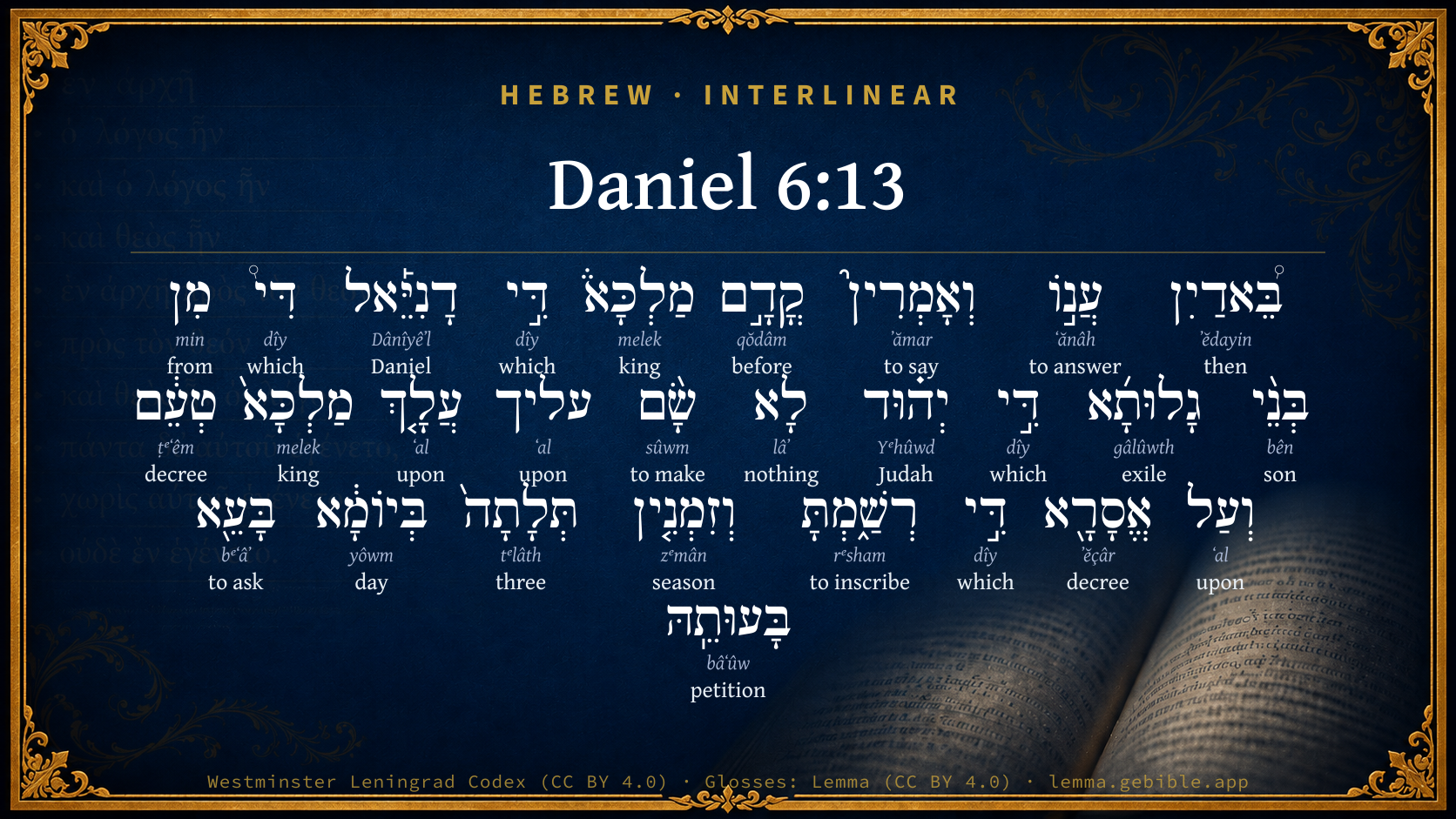
Daniel 6:13

Hebrew (Westminster Leningrad Codex) Daniel 6:13 appears in the Hebrew Old Testament. The text above is from the Westminster Leningrad Codex. Each word links to its Strong’s number, a concise gloss, and parsing drawn from the Open Scriptures Hebrew Bible morphology. Click any word for its full Brown-Driver-Briggs (BDB) entry.
Download image
Cite this verse

Daniel 6:13 (World English Bible). Public Domain. Lemma interlinear Bible study tool, https://lemma.gebible.app/v/daniel/6/13.

Show BibTeX & RIS
BibTeX
RIS
English Translation
Then answered they and said before the king, That Daniel, who is of the children of the captivity of Judah, doesn't regard you, O king, nor the interdict that you have signed, but makes his petition three times a day.
World English Bible · Public Domain
Download a study sheet

One document with this verse’s original text, its word-by-word gloss line, the meaning frame, cross-references with their text, attributed commentary, and full source and license credits — printable, and it pastes into notes with its structure intact.

This verse Autodidact and up

Study sheet (.html) Plain text (.txt)

A passage Seminary Student

Up to 50 verses in one chapter. A passage sheet keeps up to 6 commentary sources and 12 cross-references per verse, in the order this page ranks them, and says so on the sheet whenever that leaves anything out. Ask for a single verse and you get the Autodidact verse sheet above.

Everything on this page stays free to read, with no account — the sheet is a download of what is already on screen, not access to it.

Want to remove ads? Support Godless Engineer
Compare translations 3

The same verse in 3 English versions, stacked beneath the original-language interlinear above. Click any original word for its lexicon entry.

Each is an independent rendering of the whole verse — the interlinear is not word-aligned to these translations.

Highlighted words mark where these versions differ — a whole-verse word diff, not a word-by-word alignment.

  • World English Bible Public Domain
    Then answered they and said before the king, That Daniel, who is of the children of the captivity of Judah, doesn't regard you, O king, nor the interdict that you have signed, but makes his petition three times a day.
  • King James Version Public Domain
    Then answered they and said before the king, That Daniel, which is of the children of the captivity of Judah, regardeth not thee, O king, nor the decree that thou hast signed, but maketh his petition three times a day.
  • unfoldingWord Literal Text CC BY-SA 4.0
    Then they answered and said before the king, “Daniel, who is one of the people of the exile from Judah, pays no attention to you, O king, or to the injunction that you have signed, but makes his petition three times a day.”

unfoldingWord Literal Text — © unfoldingWord, licensed CC BY-SA 4.0. Word-aligned USFM3 via Door43 (git.door43.org/unfoldingWord/en_ult).

Versions to compare (up to 4)

3 of 4 selected

Show all 18 translations

Every available English version of this verse, each an independent rendering of the whole verse.

  • World English Bible Public Domain
    Then answered they and said before the king, That Daniel, who is of the children of the captivity of Judah, doesn't regard you, O king, nor the interdict that you have signed, but makes his petition three times a day.
  • Berean Standard Bible Public Domain
    Then they told the king, “Daniel, one of the exiles from Judah, shows no regard for you, O king, or for the decree that you have signed. He still makes his petition three times a day.”
  • Majority Standard Bible Public Domain
    Then they told the king, “Daniel, one of the exiles from Judah, shows no regard for you, O king, or for the decree that you have signed. He still makes his petition three times a day.”
  • King James Version Public Domain
    Then answered they and said before the king, That Daniel, which is of the children of the captivity of Judah, regardeth not thee, O king, nor the decree that thou hast signed, but maketh his petition three times a day.
  • American Standard Version (1901) Public Domain
    Then answered they and said before the king, That Daniel, who is of the children of the captivity of Judah, regardeth not thee, O king, nor the interdict that thou hast signed, but maketh his petition three times a day.
  • Revised Version (1885) Public Domain
    Then answered they and said before the king, That Daniel, which is of the children of the captivity of Judah, regardeth not thee, O king, nor the interdict that thou hast signed, but maketh his petition three times a day.
  • Geneva Bible (1599) Public Domain
    Then answered they, and sayd vnto the King, This Daniel which is of the children of the captiuitie of Iudah, regardeth not thee, O King, nor the decree, that thou hast sealed, but maketh his petition three times a day.
  • Douay-Rheims (1899) Public Domain
    Then they answered, and said before the king: Daniel, who is of the children of the captivity of Juda, hath not regarded thy law, nor the decree that thou hast made: but three times a day he maketh his prayer.
  • Young's Literal Translation Public Domain
    Then they have answered, yea, they are saying before the king, that, `Daniel, who `is' of the sons of the Removed of Judah, hath not placed on thee, O king, `any' regard, nor on the interdict that thou hast signed, and three times in a day he is seeking his petition.'
  • Literal Standard Version CC BY-SA 4.0
    Then they have answered, indeed, they are saying before the king, that, “Daniel, who [is] of the sons of the expulsion of Judah, has not placed on you, O king, [any] regard, nor on the interdict that you have signed, and three times in a day he is seeking his petition.”
  • Unlocked Literal Bible CC BY-SA 4.0
    Then they replied to the king, “That person Daniel, who is one of the people of the exile from Judah, pays no attention to you, king, or to the decree that you have signed. He prays to his God three times a day.”
  • unfoldingWord Literal Text CC BY-SA 4.0
    Then they answered and said before the king, “Daniel, who is one of the people of the exile from Judah, pays no attention to you, O king, or to the injunction that you have signed, but makes his petition three times a day.”
  • Darby Bible Public Domain
    Then they answered and said before the king, That Daniel, who is of the children of the captivity of Judah, regardeth not thee, O king, nor the decree that thou hast signed, but maketh his petition three times a day.
  • World Messianic Bible Public Domain
    Then they answered and said before the king, “That Daniel, who is of the children of the captivity of Judah, doesn’t respect you, O king, nor the decree that you have signed, but makes his petition three times a day.”
  • Webster's Bible Public Domain
    \\6:12\\Then they came near, and spoke before the king concerning the king's decree; Hast thou not signed a decree, that every man that shall ask a petition of any God or man within thirty days, save of thee, O king, shall be cast into the den of lions? The king answered and said, The thing is true, according to the law of the Medes and Persians, which altereth not.
  • Free Bible Version CC BY-SA 4.0
    Then they told the king, “Daniel, one of those captives from Judah, pays no attention to Your Majesty or to the decree you signed and prays three times a day.”
  • Bible in Basic English Public Domain
    Then they came near before the king and said, O King, have you not put your name to an order that any man who makes a request to any god or man but you, O King, for thirty days, is to be put into the lions' hole? The king made answer and said, The thing is fixed by the law of the Medes and Persians which may not come to an end.
  • JPS Tanakh (1917) Public Domain
    (6-14) Then answered they and said before the king: 'That Daniel, who is of the children of the captivity of Judah, regardeth not thee, O king, nor the interdict that thou hast signed, but maketh his petition three times a day.'

Literal Standard Version (2020), Covenant Press — licensed CC BY-SA 4.0. Text via the HelloAO Bible API (eBible.org). Unlocked Literal Bible (unfoldingWord) — licensed CC BY-SA 4.0. Text via the HelloAO Bible API (eBible.org). unfoldingWord Literal Text — © unfoldingWord, licensed CC BY-SA 4.0. Word-aligned USFM3 via Door43 (git.door43.org/unfoldingWord/en_ult). Free Bible Version, Dr. Jonathan Gallagher — licensed CC BY-SA 4.0. Text via the HelloAO Bible API (eBible.org).

Word by word

More ways to search: Search by grammar → Find every occurrence → Compare this word →

Practice this passage: Drill this verse → Learn its vocabulary →

בָּעוּתֵֽהּ
bâʻûw
H1159
“petition · his”
Adjective, N, Common + Suffix, Personal, 3rd Person, Masculine, Singular
Part of Speech
Adjective
Gender
Common
Full BDB Definition

Origin: from H1152

TWOT: 2635a

petition, request - prayer (always in Jewish liturgy)
  1. בֵּ֠אדַיִן ʼĕdayin H116 “in/at · then” Adjective, R + Adverb
  2. עֲנ֣וֹ ʻănâh H6032 “to answer” Adjective, V, Plural
  3. וְאָמְרִין֮ ʼămar H560 “and · saying” Adjective, C + Verb, Qal, Participle Active, Masculine, Plural, Absolute
  4. קֳדָ֣ם qŏdâm H6925 “before” Adjective, R
  5. מַלְכָּא֒ melek H4430 “king · the” Adjective, N, Common + Particle, Definite Article
  6. דִּ֣י dîy H1768 “which” Adjective, T
  7. דָנִיֵּ֡אל Dânîyêʼl H1841 “Daniel” Adjective, N
  8. דִּי֩ dîy H1768 “which” Adjective, T
  9. מִן min H4481 “from” Adjective, R
  10. בְּנֵ֨י bên H1123 “sons of” Adjective, N, Common
  11. גָלוּתָ֜א gâlûwth H1547 “exile · the” Adjective, N, Common + Particle, Definite Article
  12. דִּ֣י dîy H1768 “which” Adjective, T
  13. יְה֗וּד Yᵉhûwd H3061 “Judah” Adjective, N
  14. לָא lâʼ H3809 “nothing” Adjective, T
  15. שָׂ֨ם sûwm H7761 “to make” Adjective, V, Plural
  16. עליך ʻal H5922 “upon · you” Adjective, R + Suffix, Personal, 2nd Person, Masculine, Singular
  17. עֲלָ֤ךְ ʻal H5922 “upon · you” Adjective, R + Suffix, Personal, 2nd Person, Masculine, Singular
  18. מַלְכָּא֙ melek H4430 “king · the” Adjective, N, Common + Particle, Definite Article
  19. טְעֵ֔ם ṭᵉʻêm H2942 “decree” Adjective, N, Common
  20. וְעַל ʻal H5922 “and · upon” Adjective, C + Preposition
  21. אֱסָרָ֖א ʼĕçâr H633 “decree · the” Adjective, N, Common + Particle, Definite Article
  22. דִּ֣י dîy H1768 “which” Adjective, T
  23. רְשַׁ֑מְתָּ rᵉsham H7560 “to inscribe” Adjective, V, Plural
  24. וְזִמְנִ֤ין zᵉmân H2166 “and · seasons” Adjective, C + Noun, Common, Masculine, Plural, Absolute
  25. תְּלָתָה֙ tᵉlâth H8532 “three” Adjective, A, Common
  26. בְּיוֹמָ֔א yôwm H3118 “in/at · day · the” Adjective, R + Noun, Common, Masculine, Singular, Determined + Particle, Definite Article
  27. בָּעֵ֖א bᵉʻâʼ H1156 “asking” Adjective, V

About this verse

These counts appear in no published source. They are computed here, from the morphology-tagged text and Lemma’s own curated glosses. What Lemma adds →

28
words
22
distinct lemmas
Prophets
section

Notable vocabulary

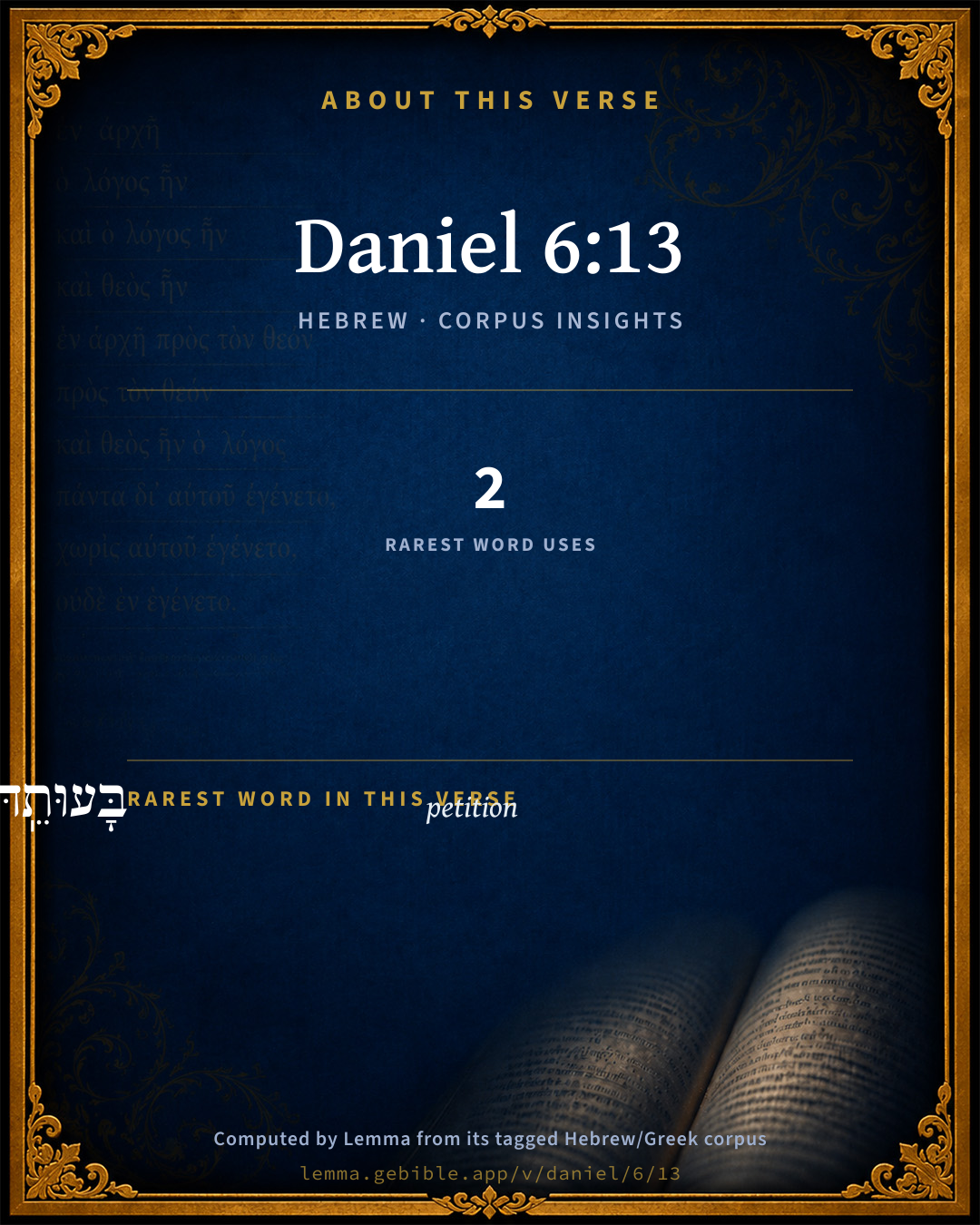
The rarest word here is בָּעוּתֵֽהּ petition H1159 — appearing just 2 times in the whole Hebrew Bible.

Shared distinctive vocabulary

בָּעוּתֵֽהּ petition H1159 occurs in 2 verses of the Hebrew Bible. Also found in:

Grammatical profile

  • 1 verb
  • 1 noun
  • 19 adjectives
  • 1 preposition
  • 1 adverb
  • 5 particles

Verb forms

  • וְאָמְרִין֮ Qal · Participle Active

Repetition

Words recur within this verse — often emphatic in Hebrew:

  • עליך upon H5922 ×3
  • מַלְכָּא֒ king H4430 ×2
  • דִּ֣י which H1768 ×4

Hebrew & Septuagint length

In English translation the verse runs 40 words from the Hebrew and 36 from the Septuagint (LXX English) — closely comparable.

A rough comparison of the two English renderings, which tokenize alike — not a word-level alignment.

Word counts can differ between the Hebrew and the Greek without any difference in meaning — e.g. the Hebrew direct-object marker אֵת has no separate Greek word, and Greek often adds the article ὁ.

Cross-references

7

Topical passages linked to Daniel 6:13 in the Treasury of Scripture Knowledge — connected by theme and wording, ordered by reader-vote popularity; previews shown in the World English Bible.

  • Daniel 3:12 There are certain Jews whom you have appointed over the affairs of the province of Babylon: Shadrach, Meshach, and Abednego; these men, O king, have not regarded you: they don't serve your gods, nor worship the golden image which you have set up.
  • Daniel 2:25 Then Arioch brought in Daniel before the king in haste, and said thus to him, I have found a man of the children of the captivity of Judah, who will make known to the king the interpretation.
  • Acts 5:29 But Peter and the apostles answered, "We must obey God rather than men.
  • Esther 3:8 Haman said to king Ahasuerus, There is a certain people scattered abroad and dispersed among the peoples in all the provinces of your kingdom; and their laws are diverse from [those of] every people; neither keep they the king's laws: therefore it is not for the king's profit to allow them.
  • Daniel 5:13 Then was Daniel brought in before the king. The king spoke and said to Daniel, Are you that Daniel, who are of the children of the captivity of Judah, whom the king my father brought out of Judah?
  • Daniel 1:6 Now among these were, of the children of Judah, Daniel, Hananiah, Mishael, and Azariah.
  • Acts 17:7 whom Jason has received. These all act contrary to the decrees of Caesar, saying that there is another king, Jesus!"

Cross-references courtesy of OpenBible.info (CC BY 4.0).

Hebrew and Greek witnesses Masoretic Hebrew ↔ Greek Septuagint

The same verse in the two great witnesses to the Old Testament, shown verse-for-verse.

These are two independent witnesses, not word-aligned to each other, and the Septuagint is shown in lemma (dictionary) form.

Hebrew Daniel 6:13 Masoretic · Westminster Leningrad Codex

בֵּ֠אדַיִן עֲנ֣וֹ וְאָמְרִין֮ קֳדָ֣ם מַלְכָּא֒ דִּ֣י דָנִיֵּ֡אל דִּי֩ מִן בְּנֵ֨י גָלוּתָ֜א דִּ֣י יְה֗וּד לָא שָׂ֨ם עליך עֲלָ֤ךְ מַלְכָּא֙ טְעֵ֔ם וְעַל אֱסָרָ֖א דִּ֣י רְשַׁ֑מְתָּ וְזִמְנִ֤ין תְּלָתָה֙ בְּיוֹמָ֔א בָּעֵ֖א בָּעוּתֵֽהּ

Then answered they and said before the king, That Daniel, who is of the children of the captivity of Judah, doesn't regard you, O king, nor the interdict that you have signed, but makes his petition three times a day.

World English Bible · Public Domain

Greek LXX Daniel 6:13 Septuagint · lemma form

τότε οὗτος ὁ ἄνθρωπος ἐντυγχάνω ὁ βασιλεύς καί εἶπον δαρεῖος βασιλεύς οὐ ὁρισμός ὁρίζω ἵνα πᾶς ἄνθρωπος μή εὔχομαι εὐχή μηδέ ἀξιόω ἀξίωμα παρά πᾶς θεός ἕως ἡμέρα τριάκοντα ἀλλά παρά σύ βασιλεύς εἰ δέ μή ῥίπτω εἰς ὁ λάκκος ὁ λέων ἀποκρίνω δέ ὁ βασιλεύς εἶπον αὐτός ἀκριβής ὁ λόγος καί μένω ὁ ὁρισμός καί εἶπον αὐτός ὁρκίζω σύ ὁ μῆδος καί πέρσης δόγμα ἵνα μή ἀλλοιόω ὁ πρόσταγμα μηδέ θαυμάζω πρόσωπον καί ἵνα μή ἐλαττόω τις ὁ εἶπον καί κολάζω ὁ ἄνθρωπος ὅς οὐ ἐνμένω ὁ ὁρισμός οὗτος καί εἶπον οὕτως ποιέω καθώς λέγω καί ἵστημι ἐγώ οὗτος

Then they answered and said before the king, Daniel of the children of the captivity of Judea, has not submitted to your decree; and three times in the day he makes his requests of his God.

LXX2012 (modern English Septuagint) · Public Domain

Hebrew: Westminster Leningrad Codex (CC BY 4.0). Greek: Septuagint (public domain); English from LXX2012 (modern English Septuagint) (Public Domain). How the Septuagint differs from the Hebrew →

Commentary

Notes on Daniel 6:13 from classic Christian and Jewish commentators (each source and its license shown beneath its notes). The classic Christian expositions comment on the surrounding passage and are grouped to its opening verse, so a note may address several verses; the Jewish commentaries on the Tanakh (Rashi and others) are per-verse, so they appear only where the commentator wrote on this verse.

Lemma curates 59 commentaries, every one of them public domain or Creative Commons licensed, each selected and text-cleaned for this edition rather than reprinted as found. About our sources →

Trapp's Complete Commentary

John Trapp

Dan 6:13 Then answered they and said before the king, That Daniel, which [is] of the children of the captivity of Judah, regardeth not thee, O king, nor the decree that thou hast signed, but maketh his petition three times a day.

Ver. 13. That Daniel.] He was principal president, and deserved a better attribution than that Daniel. But ill-will never speaketh well of any.

Which is of the captivity.] This also is terminus diminuent - q.d., This royal slave, whom thou hast preferred above us all, and hast moreover some thoughts to set him over the whole realm. {Dan 6:3} New men shall be much spited. It was therefore no ill counsel,

“ Fortunam reverenter habe quicunque repente

Dives ab exili progrediere loco. ” - Auson.

Regardeth not thee, O king.] Chald., Putteth no respect on thee. This is common, falsely to accuse God’s most faithful servants as antimagistratical, because they refuse to obey unlawful and impious decrees.

But maketh his petition three times a day.] They say not to whom he made it, which might have helped him greatly; for the king might conceive that he made it to some other man. It is an evil office to omit such circumstances as may help the accused. {2Sa 16:3}

John Trapp, A Commentary or Exposition upon All the Books of the Old and New Testament (1647–1656) — public domain. Text from a community e-Sword module.

Joseph Benson's Commentary

Dan 6:13. Then answered they, That Daniel — Thus they expressed themselves by way of contempt; which is of the children of the captivity of Judah — This was added to aggravate his fault; that one who was a foreigner, and brought thither a captive, should offer a public affront to the laws of the king, whose favour and protection he enjoyed. One cannot easily find a more striking instance than this relation affords of the power of inveterate malice and bitter envy. He regardeth not thee, O king, say they, nor the decree that thou hast signed — Thus it often happens, that what is done faithfully, and out of conscience toward God, is misrepresented as done obstinately, and in contempt of the civil powers. In other words, the best saints are frequently reproached as the worst men. Daniel regarded God, and therefore prayed, and doubtless prayed for the king and government; and yet this is construed as not regarding the king. And the excellent spirit with which Daniel was endued, and that established reputation which he had gained, could not protect him from these poisonous darts. They do not say, He makes his petition to his God, lest Darius should interpret that to his praise, but only, He makes his petition; which was the thing forbidden by the law.

Joseph Benson's Commentary on the Old and New Testaments (1811–1818) — public domain. Text from a community e-Sword module.

Jamieson, Fausset & Brown

Robert Jamieson, A. R. Fausset & David Brown

That Daniel--contemptuously.

of . . . captivity of Judah--recently a captive among thy servants, the Babylonians--one whom humble obedience most becomes. Thus they aggravate his guilt, omitting mention of his being prime minister, which might only remind Darius of Daniel's state services.

regardeth not thee--because he regarded God (Act 4:19; Act 5:29).

Jamieson, Fausset & Brown — Commentary Critical and Explanatory on the Whole Bible (1871) — public domain (CC PDM 1.0). Text via the HelloAO Bible API.

John Calvin's Commentaries

Now, when Daniel’s calumniators see that King Darius had no wish to defend his cause, they open up more freely what they had previously conceded; for, as we have said, if they had openly accused Daniel, their accusation could have been instantly and completely refuted; but after this sentiment had been expressed to the king, their statement is final, since by the laws of the Medes and Persians a king’s decree ought to be self-acting; hence, after this is accomplished, they then come to the person. Daniel, say they, one of the captives of Judah, has not obeyed thy will, O king, nor the decree which thou hast signed. By saying, “Daniel, one of the Jewish captives,” they doubtless intended to magnify his crime and to render him odious. For if any Chaldean had dared to despise the king’s edict, his rashness would not have been excused. But now when Daniel, who was lately a slave and a Chaldean captive, dares to despise the king’s command, who reigned over Chaldea by the right of conquest, this seemed less tolerable still. The effect is the same as if they had said, “He was lately a captive among thy slaves; thou art supreme lord, and his masters to whom he was subject are under thy yoke, because thou art their conqueror; he is but a captive and a stranger, a mere slave, and yet he rebels against thee!” We see then how they desired to poison the king’s mind against him by this allusion, He is one of the captives! The words are very harmless in themselves, but they endeavor to sting their monarch in every way, and to stir up his wrath against Daniel. He does not direct his mind to thee, O king; that is, he does not reflect upon who you are, and thus he despises thy majesty and the edict which thou hast signed This is another enlargement: Daniel, therefore, did not direct his mind either to thee or to thy edict; and wilt thou bear this? Next, they recite the deed itself — he prays three times a-day This would have been the simple narrative, Daniel has not obeyed thy command in praying to his own God; but, as I have said, they exaggerate his crime by accusing him of pride, contempt, and insolence. We see, therefore, by what artifices Daniel was oppressed by these malicious men. It now follows:

John Calvin's Commentaries (1540-1563) — public domain. Text from the Calvin Translation Society English edition (1840s-50s) via the Christian Classics Ethereal Library (ccel.org). Calvin's coverage is partial (roughly two-thirds of the Bible); uncommented books and verses are honest gaps, never fabricated. The 19th-century editor's footnotes and remarks are omitted so the notes are faithfully Calvin's own voice.

Ellicott's Commentary for English Readers

(13) Which is of the children.—By adding this to the charge of disobedience to the king’s commandment, they hoped to incense him still further against the prophet. Here was a foreigner, who had received the highest favours from the Court, setting himself up in antagonism to the laws of the kingdom.

A Bible Commentary for English Readers, edited by Charles John Ellicott (1878–1897) — public domain. Text from a community e-Sword module.

The Cambridge Bible for Schools and Colleges

gen. ed. J. J. S. Perowne

13. children of the exile of Judah] Dan_2:25, Dan_5:13.

The Cambridge Bible for Schools and Colleges (gen. ed. J. J. S. Perowne; Cambridge University Press, 1878–1918) — public domain. Text from a community e-Sword module.

John Gill's Exposition

Then the king, when he heard these words, was sore displeased with himself,.... Or "at it" (e); or "with him"; with Daniel, not so much for what he had done, but that he had not done it with more caution, or more privately, that it might not have been known: or rather, as we render it, "with himself", that he should so rashly sign the decree, without considering the consequences of it; for he now found that he was circumvented by his princes, and that their design was not his honour and glory, but the destruction of Daniel: or the sense in general is, that what he heard was very disagreeable, afflictive, and distressing to him:

and set his heart on Daniel to deliver him; he resolved, if possible, to do it; he applied his mind to it; he turned his thoughts wholly that way, and contrived all ways and means to effect it: R. Mattathiah, in Saadiah, interprets the phrase of his offering money as a ransom for his life:

and he laboured till the going down of the sun to save him; from the will of the princes, and from the jaws of the lions: very probably it was early in the morning these princes found Daniel at prayer, who went immediately to the king with their accusation; so that he was all day labouring with all his might and main to find out ways and means to save his darling favourite; he studied to put such a sense upon his decree, that it might not reach Daniel's case; he strove to make the princes easy, and to persuade them to drop the affair, and not insist on the execution of the decree.

(e) "super eo", Montanus; "super ipsum", De Dieu.

John Gill's Exposition of the Whole Bible (1746–1763) — public domain (CC PDM 1.0). Text via the HelloAO Bible API.

Albert Barnes' Notes on the Bible

Then answered they ... That Daniel which is of the children of the captivity of Judah - Who is one of the captive Jews. There was art in thus referring to Daniel, instead of mentioning him as sustaining an exalted office. It would serve to aggravate his guilt to remind the king that one who was in fact a foreigner, and a captive, had thus disregarded his solemn commandment. If he had been mentioned as the prime minister, there was at least a possibility that the king would be less disposed to deal with him according to the letter of the statute than if he were mentioned as a captive Jew.

Regardeth not thee ... - Shows open disregard and contempt for the royal authority by making a petition to his God three times a day.

Albert Barnes' Notes on the Bible (1834–1885) — public domain. Text from a community e-Sword/MySword module.

Matthew Poole's English Annotations

Here they call him

that Daniel, as, Dan 6:5,

this Daniel; both by way of contempt, when they had laid him low in their thoughts and words, intending the king should have the same thoughts of him too; hereby they should have the fairer blow at him.

Of the children of the captivity of Judah; a prisoner at mercy, and yet rebelliously slights the king and his laws. What! because he chose to obey God rather than men, and an ungodly law, as this was in the height? Well, that is his great crime, that he prays to his God three times a day.

Regardeth not thee, O king; which we account dishonourable to thy greatness, and unsufferable from such a mushroom as he is. What, do all the native subjects of the king keep his laws, and must this Daniel presume to break them and be indemnified? Wilt thou tolerate this, O king?

Matthew Poole's English Annotations on the Holy Bible (1683–1685) — public domain. Text from a community e-Sword/MySword module.

unfoldingWord translationNotes

Door43 World Missions Community

That person Daniel

This is not a respectful way of referring to Daniel. They intentionally used this phrase to avoid giving Daniel the respect he was due as a chief administrator.

who is one of the people of the exile from Judah

"who is an immagrant from Judah"

pays no attention to you

This idiom means he ignores the king. AT: "does not obey you" (See: Idiom)

he applied his mind

Here "mind" refers to his thinking. AT: "he thought very hard about how" (See: Metonymy)

He labored

This refers to mental labor, rather than to physical labor.

translationWords

king

Daniel

exile

Judah

decree

pray

unfoldingWord translationNotes — © Distant Shores Media and the Door43 World Missions Community, licensed CC BY-SA 4.0. Source: git.door43.org/Door43/en_tn.

Rashi

Rabbi Shlomo Yitzchaki (Rashi)

concerning the king’s decree concerning the infraction of the king’s decree, about which they had come to inform.

the thing is true [as translated,] the thing is true.

Rashi on the Tanakh — English translations: “The Judaica Press complete Tanach with Rashi, translated by A. J. Rosenberg” (CC BY 4.0); “Pentateuch with Rashi's commentary by M. Rosenbaum and A.M. Silbermann, 1929-1934” (public domain); “The Metsudah Tanach series, Lakewood, N.J” (CC BY 4.0); and “The Book of Joshua, Metsudah Publications, 1997” (CC BY 4.0). Text via Sefaria.

Lesson kit

Teaching starters — assembled from the data on this page, not authored interpretation. Every prompt links to the verse data it draws on. Edit before teaching.

Daniel, in the Prophets, opens this verse with 28 words (22 distinct Hebrew lemmas). Its most distinctive word is bâʻûw (“petition”). A historical commentator’s framing appears above. Read the whole chapter for the surrounding context.

Discussion questions

  1. How does “petition” (bâʻûw) shape what this verse is saying?
  2. How does Daniel 6:7, which shares the word «petition», read alongside this verse?
  3. What does the repetition of “upon” (3× in this one verse) do in this verse?
  4. These translations render this verse differently; the difference is in the English rendering, not the original. What questions does that raise?
  5. «וְאָמְרִין֮» is a Qal Participle Active verb. How does that grammatical form shape the action described?
  6. Compare how Trapp's Complete Commentary and Joseph Benson's Commentary read this verse. Where do they agree or differ?

Things to notice

Reading settings

Reading text

Shown beneath each verse's original-language words.

Old Testament
Old Testament edition

Read the OT as the Masoretic Hebrew (MT) or the Greek Septuagint (LXX).

English shown for the Greek Septuagint (in the Hebrew ↔ Greek comparison).

Comparing translations? Open the Compare panel on any verse page to stack up to four side by side.