
Daniel 6:15

Hebrew (Westminster Leningrad Codex) Daniel 6:15 appears in the Hebrew Old Testament. The text above is from the Westminster Leningrad Codex. Each word links to its Strong’s number, a concise gloss, and parsing drawn from the Open Scriptures Hebrew Bible morphology. Click any word for its full Brown-Driver-Briggs (BDB) entry.
Download image
Cite this verse

Daniel 6:15 (World English Bible). Public Domain. Lemma interlinear Bible study tool, https://lemma.gebible.app/v/daniel/6/15.

Show BibTeX & RIS
BibTeX
RIS
English Translation
Then these men assembled together to the king, and said to the king, Know, O king, that it is a law of the Medes and Persians, that no interdict nor statute which the king establishes may be changed.
World English Bible · Public Domain
Download a study sheet

One document with this verse’s original text, its word-by-word gloss line, the meaning frame, cross-references with their text, attributed commentary, and full source and license credits — printable, and it pastes into notes with its structure intact.

This verse Autodidact and up

Study sheet (.html) Plain text (.txt)

A passage Seminary Student

Up to 50 verses in one chapter. A passage sheet keeps up to 6 commentary sources and 12 cross-references per verse, in the order this page ranks them, and says so on the sheet whenever that leaves anything out. Ask for a single verse and you get the Autodidact verse sheet above.

Everything on this page stays free to read, with no account — the sheet is a download of what is already on screen, not access to it.

Want to remove ads? Support Godless Engineer
Compare translations 3

The same verse in 3 English versions, stacked beneath the original-language interlinear above. Click any original word for its lexicon entry.

Each is an independent rendering of the whole verse — the interlinear is not word-aligned to these translations.

Highlighted words mark where these versions differ — a whole-verse word diff, not a word-by-word alignment.

  • World English Bible Public Domain
    Then these men assembled together to the king, and said to the king, Know, O king, that it is a law of the Medes and Persians, that no interdict nor statute which the king establishes may be changed.
  • King James Version Public Domain
    Then these men assembled unto the king, and said unto the king, Know, O king, that the law of the Medes and Persians is, That no decree nor statute which the king establisheth may be changed.
  • unfoldingWord Literal Text CC BY-SA 4.0
    Then these men went as a group to the king and said to the king, “Know, O king, that it is a law of the Medes and Persians, that no injunction or statute that the king establishes can be changed.”

unfoldingWord Literal Text — © unfoldingWord, licensed CC BY-SA 4.0. Word-aligned USFM3 via Door43 (git.door43.org/unfoldingWord/en_ult).

Versions to compare (up to 4)

3 of 4 selected

Show all 18 translations

Every available English version of this verse, each an independent rendering of the whole verse.

  • World English Bible Public Domain
    Then these men assembled together to the king, and said to the king, Know, O king, that it is a law of the Medes and Persians, that no interdict nor statute which the king establishes may be changed.
  • Berean Standard Bible Public Domain
    Then the men approached the king together and said to him, “Remember, O king, that by the law of the Medes and Persians no decree or ordinance established by the king can be changed.”
  • Majority Standard Bible Public Domain
    Then the men approached the king together and said to him, “Remember, O king, that by the law of the Medes and Persians no decree or ordinance established by the king can be changed.”
  • King James Version Public Domain
    Then these men assembled unto the king, and said unto the king, Know, O king, that the law of the Medes and Persians is, That no decree nor statute which the king establisheth may be changed.
  • American Standard Version (1901) Public Domain
    Then these men assembled together unto the king, and said unto the king, Know, O king, that it is a law of the Medes and Persians, that no interdict nor statute which the king establisheth may be changed.
  • Revised Version (1885) Public Domain
    Then these men assembled together unto the king, and said unto the king, Know, O king, that it is a law of the Medes and Persians, that no interdict nor statute which the king establisheth may be changed.
  • Geneva Bible (1599) Public Domain
    Then these men assembled vnto the King, and sayde vnto ye King, Vnderstand, O King, that the lawe of the Medes and Persians is, that no decree nor statute which the King confirmeth, may be altered.
  • Douay-Rheims (1899) Public Domain
    But those mer. perceiving the king's design, said to him: Know thou, O king, that the law of the Medes and Persians is, that no decree which the king hath made, may be altered.
  • Young's Literal Translation Public Domain
    Then these men have assembled near the king, and are saying to the king, `know, O king, that the law of Media and Persia `is': That any interdict and statute that the king doth establish is not to be changed.'
  • Literal Standard Version CC BY-SA 4.0
    Then these men have assembled near the king, and are saying to the king, “Know, O king, that the law of Media and Persia [is] that any interdict and statute that the king establishes is not to be changed.”
  • Unlocked Literal Bible CC BY-SA 4.0
    Then these men who had formed the plot gathered together with the king and said to him, “Know, king, that it is a law of the Medes and Persians, that no decree or statute that the king issues can be changed.”
  • unfoldingWord Literal Text CC BY-SA 4.0
    Then these men went as a group to the king and said to the king, “Know, O king, that it is a law of the Medes and Persians, that no injunction or statute that the king establishes can be changed.”
  • Darby Bible Public Domain
    Then these men came in a body unto the king, and said unto the king, Know, O king, that the law of the Medes and Persians is, That no decree nor statute which the king establisheth may be changed.
  • World Messianic Bible Public Domain
    Then these men assembled together to the king, and said to the king, “Know, O king, that it is a law of the Medes and Persians, that no decree nor statute which the king establishes may be changed.”
  • Webster's Bible Public Domain
    \\6:14\\Then the king, when he heard these words, was much displeased with himself, and set his heart on Daniel to deliver him: and he labored till the setting of the sun to deliver him.
  • Free Bible Version CC BY-SA 4.0
    Then the men returned together and said to the king, “You know, Your Majesty, that according to the law of the Medes and the Persians no decree or statute can be changed.”
  • Bible in Basic English Public Domain
    When this thing came to the king's ears, it was very evil to him, and his heart was fixed on keeping Daniel safe, and till the going down of the sun he was doing everything in his power to get him free.
  • JPS Tanakh (1917) Public Domain
    (6-16) Then these men came tumultuously unto the king, and said unto the king: 'Know, O king, that it is a law of the Medes and Persians, that no interdict nor statute which the king establisheth may be changed.'

Literal Standard Version (2020), Covenant Press — licensed CC BY-SA 4.0. Text via the HelloAO Bible API (eBible.org). Unlocked Literal Bible (unfoldingWord) — licensed CC BY-SA 4.0. Text via the HelloAO Bible API (eBible.org). unfoldingWord Literal Text — © unfoldingWord, licensed CC BY-SA 4.0. Word-aligned USFM3 via Door43 (git.door43.org/unfoldingWord/en_ult). Free Bible Version, Dr. Jonathan Gallagher — licensed CC BY-SA 4.0. Text via the HelloAO Bible API (eBible.org).

Word by word

More ways to search: Search by grammar → Find every occurrence → Compare this word →

Practice this passage: Drill this verse → Learn its vocabulary →

וּקְיָ֛ם
qᵉyâm
H7010
“and · decree”
Adjective, C + Noun, Common, Masculine, Singular, Absolute
Part of Speech
Adjective + Noun
Type
Common
Gender
Masculine
Number
Singular
State
Absolute
Full BDB Definition

Origin: from H6966

TWOT: 2968a

decree, statute
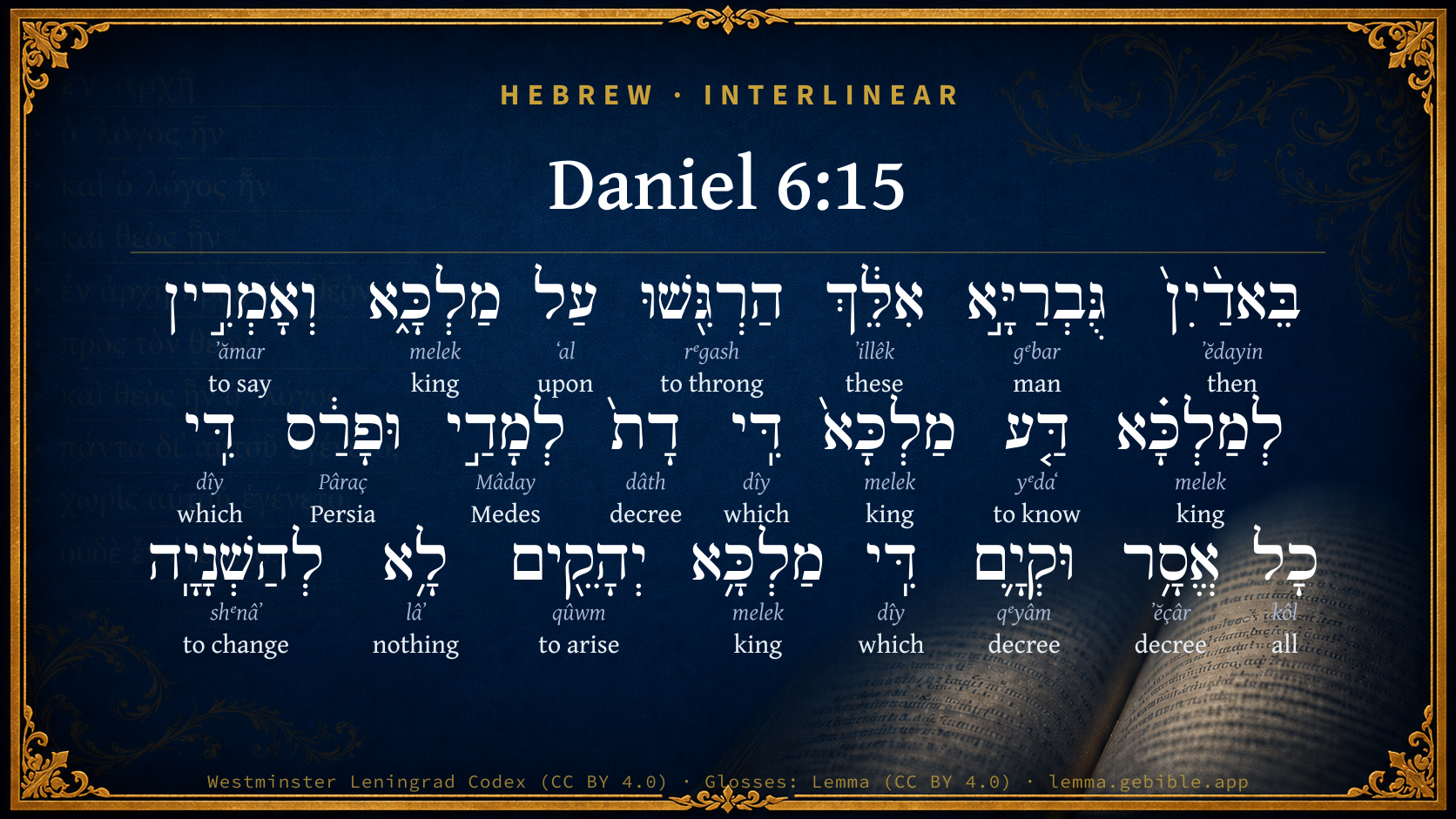
  1. בֵּאדַ֨יִן֙ ʼĕdayin H116 “in/at · then” Adjective, R + Adverb
  2. גֻּבְרַיָּ֣א gᵉbar H1400 “men · the” Adjective, N, Common + Particle, Definite Article
  3. אִלֵּ֔ךְ ʼillêk H479 “these” Adjective, P
  4. הַרְגִּ֖שׁוּ rᵉgash H7284 “to throng” Adjective, V, Plural
  5. עַל ʻal H5922 “upon” Adjective, R
  6. מַלְכָּ֑א melek H4430 “king · the” Adjective, N, Common + Particle, Definite Article
  7. וְאָמְרִ֣ין ʼămar H560 “and · saying” Adjective, C + Verb, Qal, Participle Active, Masculine, Plural, Absolute
  8. לְמַלְכָּ֗א melek H4430 “to/for · king · the” Adjective, R + Noun, Common, Masculine, Singular, Determined + Particle, Definite Article
  9. דַּ֤ע yᵉdaʻ H3046 “know” Adjective, V
  10. מַלְכָּא֙ melek H4430 “king · the” Adjective, N, Common + Particle, Definite Article
  11. דִּֽי dîy H1768 “which” Adjective, T
  12. דָת֙ dâth H1882 “decree” Adjective, N, Common
  13. לְמָדַ֣י Mâday H4076 “to/for · Medes” Adjective, R + Noun, Proper
  14. וּפָרַ֔ס Pâraç H6540 “and · Persia” Adjective, C + Noun, Proper
  15. דִּֽי dîy H1768 “which” Adjective, T
  16. כָל kôl H3606 “all of” Adjective, N, Common
  17. אֱסָ֥ר ʼĕçâr H633 “decree of” Adjective, N, Common
  18. דִּֽי dîy H1768 “which” Adjective, T
  19. מַלְכָּ֥א melek H4430 “king · the” Adjective, N, Common + Particle, Definite Article
  20. יְהָקֵ֖ים qûwm H6966 “to arise” Adjective, V
  21. לָ֥א lâʼ H3809 “nothing” Adjective, T
  22. לְהַשְׁנָיָֽה shᵉnâʼ H8133 “to change” Adjective, R + Verb, Hiphil, Infinitive Construct

About this verse

These counts appear in no published source. They are computed here, from the morphology-tagged text and Lemma’s own curated glosses. What Lemma adds →

23
words
18
distinct lemmas
Prophets
section

Notable vocabulary

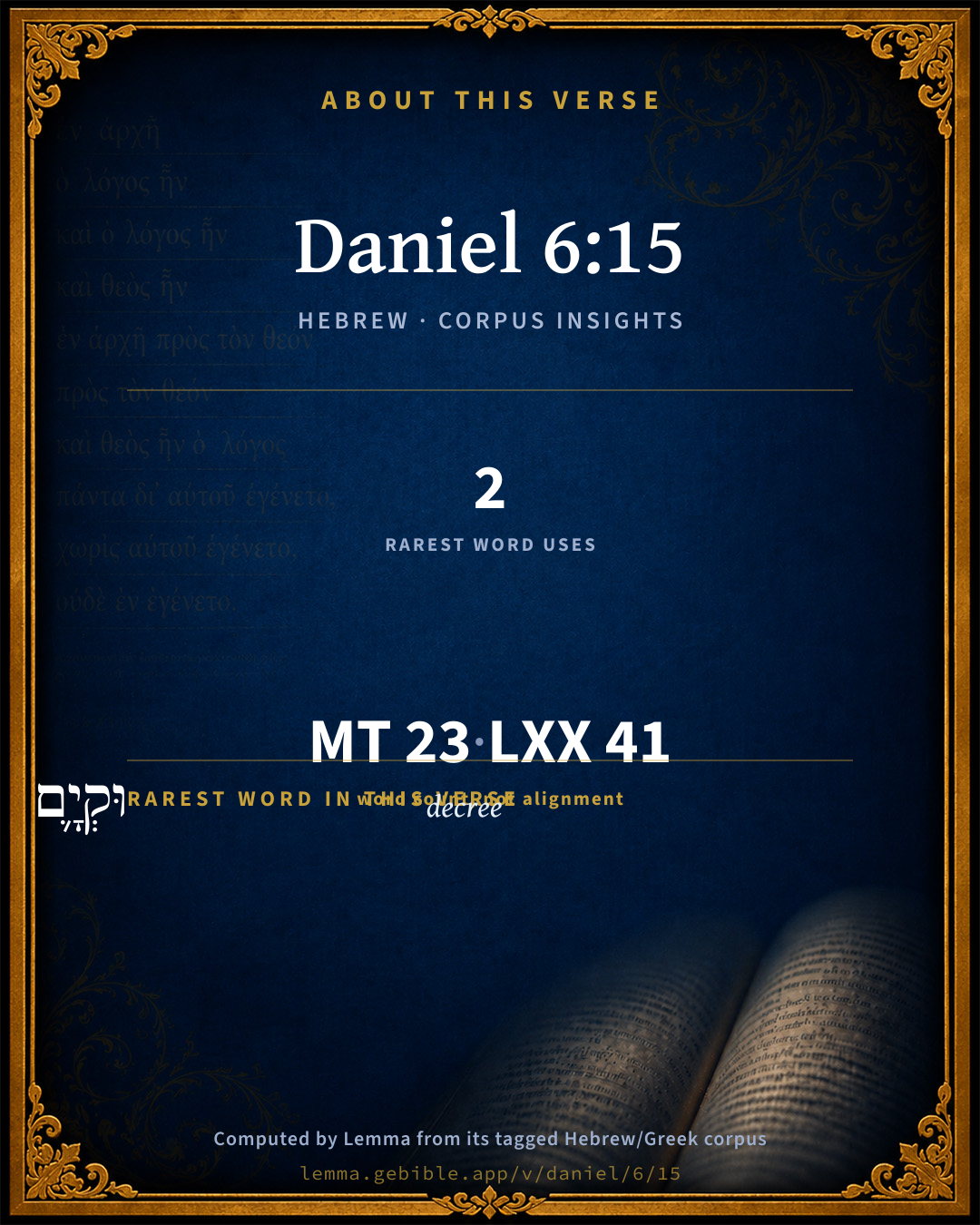
The rarest word here is וּקְיָ֛ם decree H7010 — appearing just 2 times in the whole Hebrew Bible.

Shared distinctive vocabulary

וּקְיָ֛ם decree H7010 occurs in 2 verses of the Hebrew Bible. Also found in:

Grammatical profile

  • 2 verbs
  • 3 nouns
  • 12 adjectives
  • 1 adverb
  • 5 particles

Verb forms

  • וְאָמְרִ֣ין Qal · Participle Active
  • לְהַשְׁנָיָֽה Hiphil · Infinitive Construct

Repetition

Words recur within this verse — often emphatic in Hebrew:

  • מַלְכָּ֑א king H4430 ×4
  • דִּֽי which H1768 ×3

Hebrew & Septuagint length

In English translation the verse runs 38 words from the Hebrew and 33 from the Septuagint (LXX English) — closely comparable.

A rough comparison of the two English renderings, which tokenize alike — not a word-level alignment.

Word counts can differ between the Hebrew and the Greek without any difference in meaning — e.g. the Hebrew direct-object marker אֵת has no separate Greek word, and Greek often adds the article ὁ.

In the original languages it is 23 Hebrew tokens and 41 Greek tokens — but the two are counted differently (Hebrew bundles its prefixes and suffixes into one token; the Greek is in lemma form), so that isn’t a like-for-like length.

Cross-references

4

Topical passages linked to Daniel 6:15 in the Treasury of Scripture Knowledge — connected by theme and wording, ordered by reader-vote popularity; previews shown in the World English Bible.

  • Daniel 6:12 Then they came near, and spoke before the king concerning the king's interdict: Haven't you signed an interdict, that every man who shall make petition to any god or man within thirty days, save to you, O king, shall be cast into the den of lions? The king answered, The thing is true, according to the law of the Medes and Persians, which doesn't alter.
  • Esther 8:8 Write you also to the Jews, as it pleases you, in the king's name, and seal it with the king's ring; for the writing which is written in the king's name, and sealed with the king's ring, may no man reverse.
  • Psalms 94:20–21 Shall the throne of wickedness have fellowship with you, Which brings about mischief by statute?
  • Daniel 6:8 Now, O king, establish the interdict, and sign the writing, that it not be changed, according to the law of the Medes and Persians, which doesn't alter.

Cross-references courtesy of OpenBible.info (CC BY 4.0).

Hebrew and Greek witnesses Masoretic Hebrew ↔ Greek Septuagint

The same verse in the two great witnesses to the Old Testament, shown verse-for-verse.

These are two independent witnesses, not word-aligned to each other, and the Septuagint is shown in lemma (dictionary) form.

Hebrew Daniel 6:15 Masoretic · Westminster Leningrad Codex

בֵּאדַ֨יִן֙ גֻּבְרַיָּ֣א אִלֵּ֔ךְ הַרְגִּ֖שׁוּ עַל מַלְכָּ֑א וְאָמְרִ֣ין לְמַלְכָּ֗א דַּ֤ע מַלְכָּא֙ דִּֽי דָת֙ לְמָדַ֣י וּפָרַ֔ס דִּֽי כָל אֱסָ֥ר וּקְיָ֛ם דִּֽי מַלְכָּ֥א יְהָקֵ֖ים לָ֥א לְהַשְׁנָיָֽה

Then these men assembled together to the king, and said to the king, Know, O king, that it is a law of the Medes and Persians, that no interdict nor statute which the king establishes may be changed.

World English Bible · Public Domain

Greek LXX Daniel 6:15 Septuagint · lemma form

καί λυπέω ὁ βασιλεύς εἶπον ῥίπτω ὁ δανιηλ εἰς ὁ λάκκος ὁ λέων κατά ὁ ὁρισμός ὅς ἵστημι κατά αὐτός τότε ὁ βασιλεύς σφόδρα λυπέω ἐπί ὁ δανιηλ καί βοηθέω ὁ ἐκαἱρέω αὐτός ἕως δυσμή ἥλιος ἀπό ὁ χείρ ὁ σατράπης

Then those men said to the king, Know, O king, that the law of the Medes and Persians is that we must not change any decree of statue which the king shall make.

LXX2012 (modern English Septuagint) · Public Domain

On this verse, The Pulpit Commentary discusses the Septuagint’s reading. Read the note in Commentary ↓

Hebrew: Westminster Leningrad Codex (CC BY 4.0). Greek: Septuagint (public domain); English from LXX2012 (modern English Septuagint) (Public Domain). How the Septuagint differs from the Hebrew →

Commentary

Notes on Daniel 6:15 from classic Christian and Jewish commentators (each source and its license shown beneath its notes). The classic Christian expositions comment on the surrounding passage and are grouped to its opening verse, so a note may address several verses; the Jewish commentaries on the Tanakh (Rashi and others) are per-verse, so they appear only where the commentator wrote on this verse.

Lemma curates 59 commentaries, every one of them public domain or Creative Commons licensed, each selected and text-cleaned for this edition rather than reprinted as found. About our sources →

Trapp's Complete Commentary

John Trapp

Dan 6:15 Then these men assembled unto the king, and said unto the king, Know, O king, that the law of the Medes and Persians [is], That no decree nor statute which the king establisheth may be changed.

Ver. 15. Then thase men assembled unto the king.] Or, Kept a stir with the king, from Psa 2:1. Congregaverunt se supra regem. Doubtless, saith Broughton, Daniel’s spirit thought of David his father’s terms. {a} So Dan 6:6. They came cluttering about the king.

Know, O king, that the law of the Medes and Persians, &c.] This he knew as well as they; but they press him to do accordingly. So did those Ignatian Boutefeans in Germany, who, in the year 1582, cast abroad this bloody distich:

“ Utere iure tuo, Cesar, sectamque Lutheri

Ense, rota, ponto, funibus, igne neca. ”

{a} [i.e., Thought of his father David’s expressions in Ps. ii.; "Why do the heathen tumultuously assemble": see marginal reading.]

John Trapp, A Commentary or Exposition upon All the Books of the Old and New Testament (1647–1656) — public domain. Text from a community e-Sword module.

The Biblical Illustrator

Joseph S. Exell

Dan_6:15

That no decree nor statute that the king establisheth may be changed.

Inviolable Law

These men were constitutional persecutors. They were constitutional liars. Some men are nothing if not constitutional. They would die for constitution; they dream of constitutional order: these men who are so addicted to constitution precedent and usage could kill a man. That is the difficulty we always have to deal with. You cannot convert a scribe: with man this is impossible; with God all things are possible. Once let a man become the victim of the letter, and the case is hopeless. See how these men deport themselves: all for a law, nothing for a life; on the one side full of constitutional obedience, on the other without feeling in reference to a human soul, a brothers life; only shed mans blood, but keep the letter of the law. The great complaint we have to make against this in all ages and countries, that it has about it a taint of respectability. You cannot get at the scribe on account of the scroll which he holds us between you and him.He is not worth getting at. He has the law, the chapter, the verse, the letter; he has no genius of law, no spirit of liberty, no inspiration and enthusiasm of human nature. The thing that was given to him as a hint, a help, a temporary assistance, is pressed so as to become an excuse, if not a defence, in the matter of murder. The Sabbath was made for man, not man for the Sabbath; the law was made for man, not man for the law. We must take care how we throw things out of proportion and perspective, how we overweight the one side or the other; let us see what it is that is really involved: if it is criminality, it must be put down; if it is a difference of judgment, if it is an exercise of conscience, then we must see what relation the law has to such spiritual or intellectual relationships and possessions and responsibilities. What is God always doing? Setting law aside. That seems strange. Certainly, God must be strange. Gods Government must be immeasurable in its inner thought, in its outward relation; it must be under his hand; it must lie well within the sweep of his omnipotence. (Joseph Parker, D.D.)

The Biblical Illustrator, edited by Joseph S. Exell (c. 1880s–1900s) — public domain. Text from a community e-Sword module.

Geneva Bible (1599)

Geneva Bible translators

Thus the wicked maintain evil laws by constancy and authority, which is ofttimes either lightness, or stubbornness, when as the innocents thereby perish, and therefore governors neither ought to fear, nor be ashamed to break such.

Geneva Bible (1599) marginal notes — public domain. Text via Bolls.life.

Adam Clarke's Commentary

Verse 15. Then these men assembled] Having got favourable answers, as we may presume, from many individuals, he called a parliament; but they now collectively joined to urge the execution of the law, not its repeal.

Adam Clarke's Commentary on the Bible (1810–1826) — public domain. Text from a community e-Sword/MySword module.

The Cambridge Bible for Schools and Colleges

gen. ed. J. J. S. Perowne

15. assembled] came thronging or tumultuously, as Dan_6:6.

Know, O king, &c.] The courtiers, in their violence against Daniel, address Darius, as in Dan_6:12, abruptly and peremptorily, without any respectful words of introduction (Dan_6:6).

decree] interdict.

The Cambridge Bible for Schools and Colleges (gen. ed. J. J. S. Perowne; Cambridge University Press, 1878–1918) — public domain. Text from a community e-Sword module.

John Gill's Exposition

Then the king commanded,.... Being overawed by his princes and fearing they would conspire against him, and stir up the people to rebel; and consulting his own credit lest he should be thought fickle and inconstant; he ordered the decree to be put in execution against Daniel, and delivered his favourite into their hands:

and they brought Daniel, and cast him into the den of lions; not the princes but proper officers employed by them: according to the additions to this book of Daniel, there were seven lions in this den, in the Apocrypha:

"And in the den there were seven lions, and they had given them every day two carcases, and two sheep: which then were not given to them, to the intent they might devour Daniel.'' (Bel 1:32)

but, according to Joseph ben Gorion (g), there were ten, who used to devour ten sheep, and as many human bodies every day; but this day they had no food, and ate nothing, that they might be more greedy, and devour Daniel the sooner:

now the king spake and said unto Daniel; being brought into his presence, in his palace, before he was cast into the den; or at the mouth of the den whither the king accompanied him:

thy God whom thou servest continually, he will deliver thee; he calls the Lord Daniel's God, not his own, as he was not, he served other gods; yet he suggests that Daniel was right in serving him continually, in praying to him daily, the very thing for which he was cast to the lions; and expresses his confidence that his God he served would deliver him from being devoured by them; which he might conclude, from, the innocency, integrity, and faithfulness of Daniel, and from his being such a peculiar favourite of God as to be indulged with the knowledge of future things; and perhaps he might have heard of the deliverance of his three companions from the fiery furnace: though the words may be rendered, as they are by some, as a wish or prayer, "may thy God &c. deliver thee" (h); I cannot, I pray he would; it is my hearty desire that so it might be.

(g) Hist. Heb. l. 1. c. 10. p. 34. (h) "liberet te", Junius & Tremellius, Piscator, Grotius, Cocceius, Michaelis.

John Gill's Exposition of the Whole Bible (1746–1763) — public domain (CC PDM 1.0). Text via the HelloAO Bible API.

Albert Barnes' Notes on the Bible

Then these men assembled unto the king - The Chaldee here is the same as in Dan 6:6, “they came tumultuously.” They were earnest that the law should be executed, and they probably apprehended that if the king were allowed to dwell upon it, the firmness of his own mind would give way, and that he would release Daniel. Perhaps they dreaded the effect of the compunctious visitings which he might have during the silence of the night, and they, therefore, came tumultuously to hasten his decision.

Know, O king, that the law ... - That is a settled matter about which there can be no debate or difference of opinion. It would seem that this was a point so well settled that no question could be raised in regard to it, and, to their minds, it was equally clear that if this were so, it was necessary that the sentence should be executed without delay.

Albert Barnes' Notes on the Bible (1834–1885) — public domain. Text from a community e-Sword/MySword module.

Haydock's Catholic Bible Commentary

Perceiving. Chaldee: "assembled," (Protestant; Haydock) or "came quickly in a body." (Calmet)

George Leo Haydock (1774–1849), Haydock's Catholic Family Bible and Commentary, 1859 edition — public domain. Excludes Psalms (Douay-Rheims chapter numbering differs from Protestant) and Deuterocanonical books (Catholic canon only).

Matthew Poole's English Annotations

These were bold men, they were resolved to follow their blows, and would have their will rather than the king should have his in this case; which on the king’s part was honourable and royal, to retrieve an evil act, and to retract, or at least to mitigate, a rigid and, rash decree.

No decree nor statute which the king establisheth may be changed: thus Haman contrived and pleaded, yet there was a way found to prevent execution, Es 8. Again, this law, which they plead was fundamental to make all laws and decrees immutable, was absurd and impolitic; for laws should be essentially changeable by the law-makers, because they often see greater cause to change a law when it grows obsolete and burdensome, though before thought necessary, than to make it at first; whereof we have sufficient instances in all nations in all ages. Will any legislative power in the world so bind their own hands, as to entail a yoke upon themselves and nation which they and posterity could not remedy? The intent of the lawgiver is the law, the equity of it is the obligation of it, which also is the true measure of its duration.

Matthew Poole's English Annotations on the Holy Bible (1683–1685) — public domain. Text from a community e-Sword/MySword module.

The Pulpit Commentary

Then these men assembled unto the king, and said unto the king. Know, O king, that the law of the Medes and Persians is, That no decree or statute which the king establisheth maybe changed. The corresponding verse in the Septuagint is much shorter, "And he was not able to deliver him from them." This verse in the Massoretic text has very much the appearance of a doublet mollified to fit a new position. The first clause has occurred already twice before in the sixth verse and the fifteenth. The last portion of the verse is a modification of what is stated in vers. 9 and 13. The first clause is omitted by Theodotion, but inserted by the Peshitta. The probability is that this verse, in its Massoretic form, has been inserted to explain the opposition the king strove in vain to overcome.

The Pulpit Commentary (1880–1919), ed. H.D.M. Spence-Jones & Joseph S. Exell — public domain. Text from a community e-Sword module.

unfoldingWord translationNotes

Door43 World Missions Community

no decree ... can be changed

The men were implying that since no decree or statute of the king can be changed, Daniel must be thrown into the pit of lions. This can be stated clearly if needed. AT: "no decree ... can be changed. They must throw Daniel into the pit of lions" (See: Assumed Knowledge and Implicit Information)

translationWords

king

law, laws

Medes

Persia

statute

unfoldingWord translationNotes — © Distant Shores Media and the Door43 World Missions Community, licensed CC BY-SA 4.0. Source: git.door43.org/Door43/en_tn.

Rashi

Rabbi Shlomo Yitzchaki (Rashi)

when...heard the thing [as translated,] when he heard the thing.

he became very displeased It was very bad in his eyes because he loved Daniel, and his death would be painful to him.

and he gave Daniel a reprieve to save him He gave Daniel a reprieve to push off the matter to save him, and he said to them, “I don’t believe you.”

a reprieve Aram. בָּל. I do not know of any word like it, but its context shows its meaning.

and until sunset and until sunset he tried to save him, but when the time of his prayer arrived, he prayed his prayer, and the king had no longer had a pretext to save him.

Rashi on the Tanakh — English translations: “The Judaica Press complete Tanach with Rashi, translated by A. J. Rosenberg” (CC BY 4.0); “Pentateuch with Rashi's commentary by M. Rosenbaum and A.M. Silbermann, 1929-1934” (public domain); “The Metsudah Tanach series, Lakewood, N.J” (CC BY 4.0); and “The Book of Joshua, Metsudah Publications, 1997” (CC BY 4.0). Text via Sefaria.

Lesson kit

Teaching starters — assembled from the data on this page, not authored interpretation. Every prompt links to the verse data it draws on. Edit before teaching.

Daniel, in the Prophets, opens this verse with 23 words (18 distinct Hebrew lemmas). Its most distinctive word is qᵉyâm (“decree”). A historical commentator’s framing appears above. Read the whole chapter for the surrounding context.

Discussion questions

  1. How does “decree” (qᵉyâm) shape what this verse is saying?
  2. How does Daniel 6:7, which shares the word «decree», read alongside this verse?
  3. What does the repetition of “king” (4× in this one verse) do in this verse?
  4. These translations render this verse differently. What is at stake in choosing one wording over another?
  5. «וְאָמְרִ֣ין» is a Qal Participle Active verb. How does that grammatical form shape the action described?
  6. Compare how Trapp's Complete Commentary and The Biblical Illustrator read this verse. Where do they agree or differ?

Things to notice

Reading settings

Reading text

Shown beneath each verse's original-language words.

Old Testament
Old Testament edition

Read the OT as the Masoretic Hebrew (MT) or the Greek Septuagint (LXX).

English shown for the Greek Septuagint (in the Hebrew ↔ Greek comparison).

Comparing translations? Open the Compare panel on any verse page to stack up to four side by side.