
Daniel 4:17

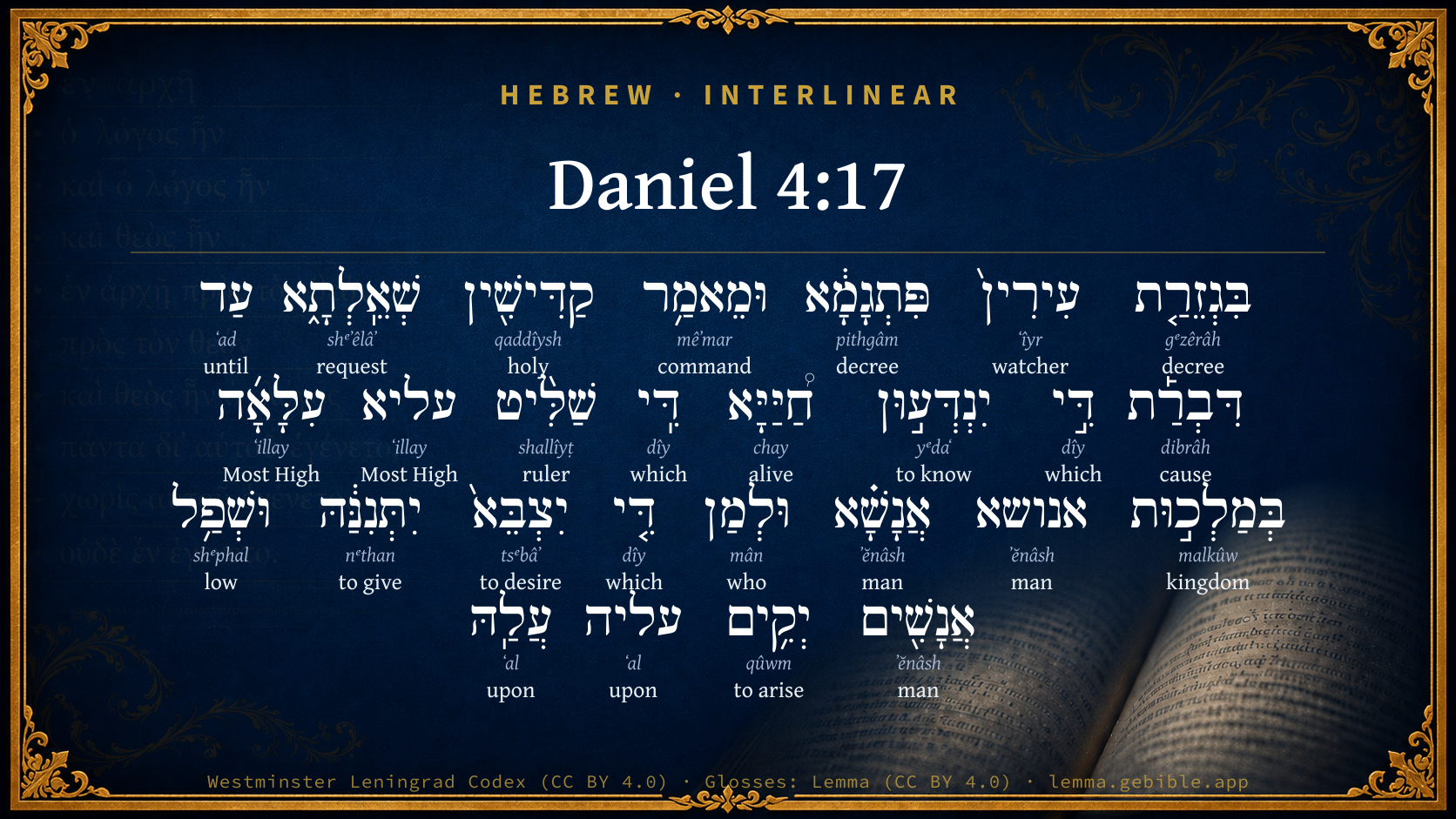
Hebrew (Westminster Leningrad Codex) Daniel 4:17 appears in the Hebrew Old Testament. The text above is from the Westminster Leningrad Codex. Each word links to its Strong’s number, a concise gloss, and parsing drawn from the Open Scriptures Hebrew Bible morphology. Click any word for its full Brown-Driver-Briggs (BDB) entry.
Download image
Cite this verse

Daniel 4:17 (World English Bible). Public Domain. Lemma interlinear Bible study tool, https://lemma.gebible.app/v/daniel/4/17.

Show BibTeX & RIS
BibTeX
RIS
English Translation
The sentence is by the decree of the watchers, and the demand by the word of the holy ones; to the intent that the living may know that the Most High rules in the kingdom of men, and gives it to whoever he will, and sets up over it the lowest of men.
World English Bible · Public Domain
Highlights Full analysis ↓
Download a study sheet

One document with this verse’s original text, its word-by-word gloss line, the meaning frame, cross-references with their text, attributed commentary, and full source and license credits — printable, and it pastes into notes with its structure intact.

This verse Autodidact and up

Study sheet (.html) Plain text (.txt)

A passage Seminary Student

Up to 50 verses in one chapter. A passage sheet keeps up to 6 commentary sources and 12 cross-references per verse, in the order this page ranks them, and says so on the sheet whenever that leaves anything out. Ask for a single verse and you get the Autodidact verse sheet above.

Everything on this page stays free to read, with no account — the sheet is a download of what is already on screen, not access to it.

Want to remove ads? Support Godless Engineer
Compare translations 3

The same verse in 3 English versions, stacked beneath the original-language interlinear above. Click any original word for its lexicon entry.

Each is an independent rendering of the whole verse — the interlinear is not word-aligned to these translations.

Highlighted words mark where these versions differ — a whole-verse word diff, not a word-by-word alignment.

  • World English Bible Public Domain
    The sentence is by the decree of the watchers, and the demand by the word of the holy ones; to the intent that the living may know that the Most High rules in the kingdom of men, and gives it to whoever he will, and sets up over it the lowest of men.
  • King James Version Public Domain
    This matter is by the decree of the watchers, and the demand by the word of the holy ones: to the intent that the living may know that the most High ruleth in the kingdom of men, and giveth it to whomsoever he will, and setteth up over it the basest of men.
  • unfoldingWord Literal Text CC BY-SA 4.0
    The sentence is by the decree of the watchers, and the decision is a command of the holy ones, so that the living may know that the Most High is ruler over the kingdom of men and gives it to whom he wishes and sets over it the lowliest of men.’

unfoldingWord Literal Text — © unfoldingWord, licensed CC BY-SA 4.0. Word-aligned USFM3 via Door43 (git.door43.org/unfoldingWord/en_ult).

Versions to compare (up to 4)

3 of 4 selected

Show all 18 translations

Every available English version of this verse, each an independent rendering of the whole verse.

  • World English Bible Public Domain
    The sentence is by the decree of the watchers, and the demand by the word of the holy ones; to the intent that the living may know that the Most High rules in the kingdom of men, and gives it to whoever he will, and sets up over it the lowest of men.
  • Berean Standard Bible Public Domain
    This decision is the decree of the watchers, the verdict declared by the holy ones, so that the living will know that the Most High rules over the kingdom of mankind and gives it to whom He wishes, setting over it the lowliest of men.’
  • Majority Standard Bible Public Domain
    This decision is the decree of the watchers, the verdict declared by the holy ones, so that the living will know that the Most High rules over the kingdom of mankind and gives it to whom He wishes, setting over it the lowliest of men.’
  • King James Version Public Domain
    This matter is by the decree of the watchers, and the demand by the word of the holy ones: to the intent that the living may know that the most High ruleth in the kingdom of men, and giveth it to whomsoever he will, and setteth up over it the basest of men.
  • American Standard Version (1901) Public Domain
    The sentence is by the decree of the watchers, and the demand by the word of the holy ones; to the intent that the living may know that the Most High ruleth in the kingdom of men, and giveth it to whomsoever he will, and setteth up over it the lowest of men.
  • Revised Version (1885) Public Domain
    The sentence is by the decree of the watchers, and the demand by the word of the holy ones: to the intent that the living may know that the Most High ruleth in the kingdom of men, and giveth it to whomsoever he will, and setteth up over it the lowest of men.
  • Geneva Bible (1599) Public Domain
    The tree that thou sawest, which was great and mightie, whose height reached vnto the heauen, and the sight thereof through all the world,
  • Douay-Rheims (1899) Public Domain
    This is the decree by the sentence of the watchers, and the word And demand of the holy ones; till the living know that the most High ruleth in the kingdom of men; and he will give it to whomsoever it shall please him, and he will appoint the basest man over it.
  • Young's Literal Translation Public Domain
    by the decree of the sifters `is' the sentence, and by the saying of the holy ones the requirement, to the intent that the living may know that the Most High is ruler in the kingdom of men, and to whom He willeth He giveth it, and the lowest of men He doth raise up over it.
  • Literal Standard Version CC BY-SA 4.0
    by the decree of the sifters [is] the sentence, and by the saying of the holy ones the requirement, to the intent that the living may know that the Most High is ruler in the kingdom of men, and to whom He wills He gives it, and the lowest of men He raises up over it.
  • Unlocked Literal Bible CC BY-SA 4.0
    This decision is by the decree reported by the messenger. It is a decision made by the holy ones so that those who are alive may know that the Most High rules over the kingdoms of people and gives them to anyone he wishes to place over them, even to the most humble men.'
  • unfoldingWord Literal Text CC BY-SA 4.0
    The sentence is by the decree of the watchers, and the decision is a command of the holy ones, so that the living may know that the Most High is ruler over the kingdom of men and gives it to whom he wishes and sets over it the lowliest of men.’
  • Darby Bible Public Domain
    This sentence is by the decree of the watchers, and the decision by the word of the holy ones: that the living may know that the Most High ruleth over the kingdom of men, and giveth it to whomsoever he will, and setteth up over it the basest of men.
  • World Messianic Bible Public Domain
    “‘The sentence is by the decree of the watchers and the demand by the word of the holy ones, to the intent that the living may know that the Most High rules in the kingdom of men, and gives it to whomever he will, and sets up over it the lowest of men.’
  • Webster's Bible Public Domain
    This matter is by the decree of the watchers, and the demand by the word of the holy ones: to the intent that the living may know that the most High ruleth in the kingdom of men, and giveth it to whomsoever he will, and setteth up over it the basest of men.
  • Free Bible Version CC BY-SA 4.0
    This is the decree conveyed by the watchers, the verdict declared by the holy ones in order that everyone alive may know that the Most High rules over human kingdoms. He gives them to anyone he chooses—he puts the most humble individuals in charge.’
  • Bible in Basic English Public Domain
    This order is fixed by the watchers, and the decision is by the word of the holy ones: so that the living may be certain that the Most High is ruler over the kingdom of men, and gives it to any man at his pleasure, lifting up over it the lowest of men.
  • JPS Tanakh (1917) Public Domain
    (4-14) The matter is by the decree of the watchers, and the sentence by the word of the holy ones; to the intent that the living may know that the Most High ruleth in the kingdom of men, and giveth it to whomsoever He will, and setteth up over it the lowest of men.

Literal Standard Version (2020), Covenant Press — licensed CC BY-SA 4.0. Text via the HelloAO Bible API (eBible.org). Unlocked Literal Bible (unfoldingWord) — licensed CC BY-SA 4.0. Text via the HelloAO Bible API (eBible.org). unfoldingWord Literal Text — © unfoldingWord, licensed CC BY-SA 4.0. Word-aligned USFM3 via Door43 (git.door43.org/unfoldingWord/en_ult). Free Bible Version, Dr. Jonathan Gallagher — licensed CC BY-SA 4.0. Text via the HelloAO Bible API (eBible.org).

Word by word

More ways to search: Search by grammar → Find every occurrence → Compare this word →

Practice this passage: Drill this verse → Learn its vocabulary →

שְׁאֵֽלְתָ֑א
shᵉʼêlâʼ
H7595
“request · the”
Adjective, N, Common + Particle, Definite Article
Part of Speech
Adjective + Particle
Type
Definite Article
Full BDB Definition

Origin: from H7593

TWOT: 3012a

affair, request
  1. בִּגְזֵרַ֤ת gᵉzêrâh H1510 “in/at · decree of” Adjective, R + Noun, Common, Feminine, Singular, Construct
  2. עִירִין֙ ʻîyr H5894 “watchers” Adjective, N, Common
  3. פִּתְגָמָ֔א pithgâm H6600 “decree · the” Adjective, N, Common + Particle, Definite Article
  4. וּמֵאמַ֥ר mêʼmar H3983 “and · command of” Adjective, C + Noun, Common, Masculine, Singular, Construct
  5. קַדִּישִׁ֖ין qaddîysh H6922 “holy” Adjective, A
  6. עַד ʻad H5705 “until” Adjective, R
  7. דִּבְרַ֡ת dibrâh H1701 “cause of” Adjective, N, Common
  8. דִּ֣י dîy H1768 “which” Adjective, T
  9. יִנְדְּע֣וּן yᵉdaʻ H3046 “to know” Adjective, V
  10. חַ֠יַּיָּא chay H2417 “alive · the” Adjective, A + Particle, Definite Article
  11. דִּֽי dîy H1768 “which” Adjective, T
  12. שַׁלִּ֨יט shallîyṭ H7990 “ruler” Adjective, A
  13. עליא ʻillay H5943 “Most High · the” Adjective, N, Common + Particle, Definite Article
  14. עִלָּאָ֜ה ʻillay H5943 “Most High · the” Adjective, N, Common + Particle, Definite Article
  15. בְּמַלְכ֣וּת malkûw H4437 “in/at · kingdom of” Adjective, R + Noun, Common, Feminine, Singular, Construct
  16. אנושא ʼĕnâsh H606 “man · the” Adjective, N, Common + Particle, Definite Article
  17. אֲנָשָׁ֗א ʼĕnâsh H606 “man · the” Adjective, N, Common + Particle, Definite Article
  18. וּלְמַן mân H4479 “and · to/for · who” Adjective, C + Preposition + Pronoun, Indefinite, Common, Singular
  19. דִּ֤י dîy H1768 “which” Adjective, P, Feminine, Construct
  20. יִצְבֵּא֙ tsᵉbâʼ H6634 “to desire” Adjective, V, Plural
  21. יִתְּנִנַּ֔הּ nᵉthan H5415 “to give · her” Adjective, V + Suffix, Personal, 3rd Person, Feminine, Singular
  22. וּשְׁפַ֥ל shᵉphal H8215 “and · low of” Adjective, C + Adjective, Adjective, Masculine, Singular, Construct
  23. אֲנָשִׁ֖ים ʼĕnâsh H606 “men” Adjective, N, Common
  24. יְקִ֥ים qûwm H6966 “to arise” Adjective, V
  25. עליה ʻal H5922 “upon · her” Adjective, R + Suffix, Personal, 3rd Person, Feminine, Singular
  26. עֲלַֽהּ ʻal H5922 “upon · her” Adjective, R + Suffix, Personal, 3rd Person, Feminine, Singular

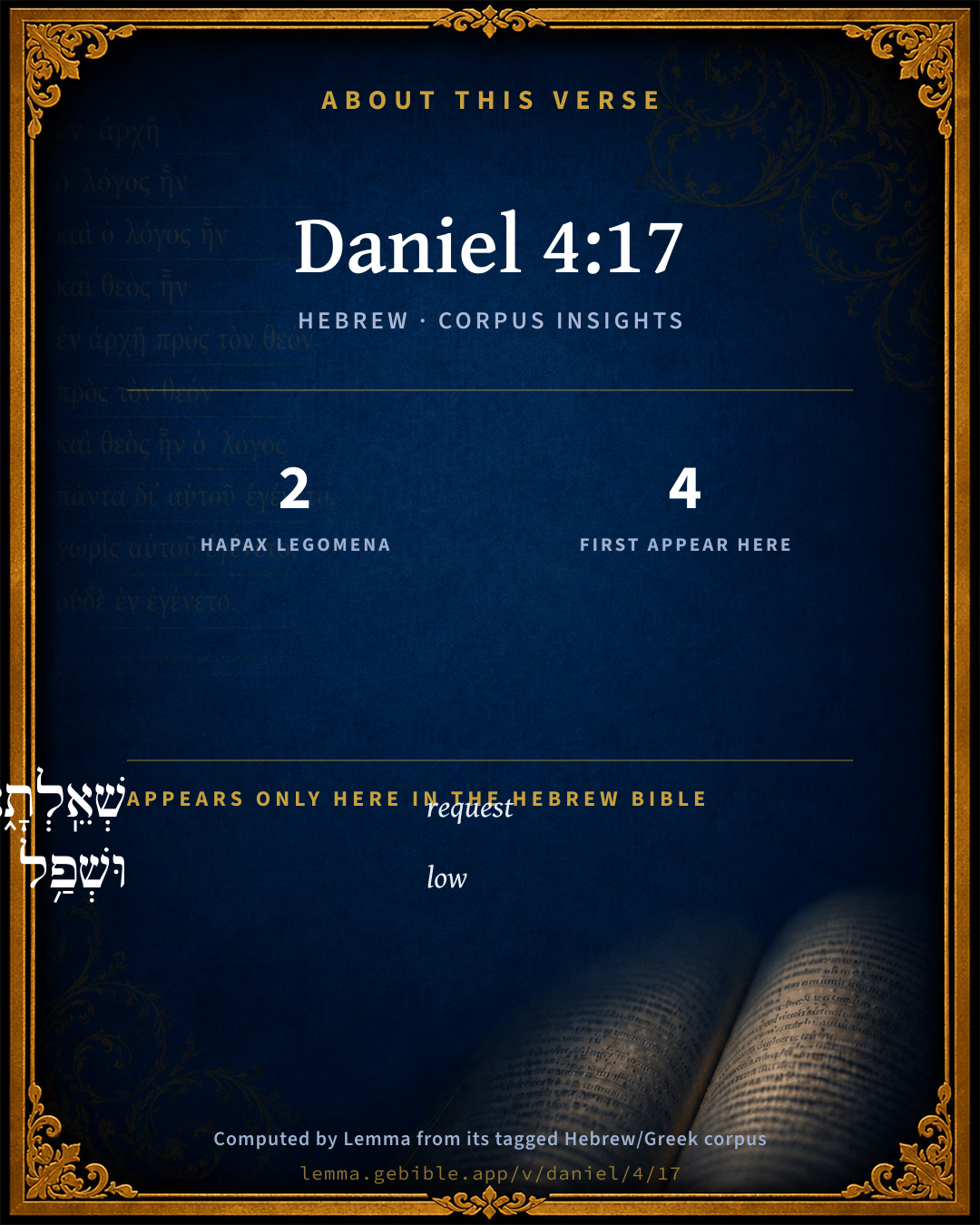
About this verse

These counts appear in no published source. They are computed here, from the morphology-tagged text and Lemma’s own curated glosses. What Lemma adds →

27
words
21
distinct lemmas
Prophets
section

Notable vocabulary

2 hapax legomena — words that appear only here in the entire Hebrew Bible:

  • שְׁאֵֽלְתָ֑א request H7595
  • וּשְׁפַ֥ל low H8215

First appearance in Scripture

These words make their first canonical appearance in the Hebrew Bible here:

  • בִּגְזֵרַ֤ת decree H1510
  • שְׁאֵֽלְתָ֑א request H7595
  • יִצְבֵּא֙ to desire H6634
  • וּשְׁפַ֥ל low H8215

Shared distinctive vocabulary

בִּגְזֵרַ֤ת decree H1510 occurs in 2 verses of the Hebrew Bible. Also found in:

Grammatical profile

  • 3 nouns
  • 16 adjectives
  • 1 pronoun
  • 7 particles

Repetition

Words recur within this verse — often emphatic in Hebrew:

  • אנושא man H606 ×3
  • עליא Most High H5943 ×2
  • עליה upon H5922 ×2
  • דִּ֣י which H1768 ×3

Hebrew & Septuagint length

In English translation the verse runs 53 words from the Hebrew and 23 from the Septuagint (LXX English) — the Septuagint runs noticeably shorter here. See the side-by-side →

A rough comparison of the two English renderings, which tokenize alike — not a word-level alignment.

Word counts can differ between the Hebrew and the Greek without any difference in meaning — e.g. the Hebrew direct-object marker אֵת has no separate Greek word, and Greek often adds the article ὁ.

Cross-references

26

Topical passages linked to Daniel 4:17 in the Treasury of Scripture Knowledge — connected by theme and wording, ordered by reader-vote popularity; previews shown in the World English Bible.

  • Daniel 2:21 He changes the times and the seasons; he removes kings, and sets up kings; he gives wisdom to the wise, and knowledge to those who have understanding;
  • Daniel 4:25 that you shall be driven from men, and your dwelling shall be with the animals of the field, and you shall be made to eat grass as oxen, and shall be wet with the dew of the sky, and seven times shall pass over you; until you know that the Most High rules in the kingdom of men, and gives it to whoever he will.
  • 1 Samuel 2:8 He raises up the poor out of the dust, He lifts up the needy from the dunghill, To make them sit with princes, Inherit the throne of glory: For the pillars of the earth are Yahweh's, He has set the world on them.
  • Psalms 75:6–7 For neither from the east, nor from the west, Nor yet from the south, comes exaltation.
  • Jeremiah 27:5–7 I have made the earth, the men and the animals that are on the surface of the earth, by my great power and by my outstretched arm; and I give it to whom it seems right to me.
  • Psalms 113:7–8 He raises up the poor out of the dust. Lifts up the needy from the ash heap;
  • Daniel 5:18–21 You king, the Most High God gave Nebuchadnezzar your father the kingdom, and greatness, and glory, and majesty:
  • 1 Corinthians 1:28 and God chose the lowly things of the world, and the things that are despised, and the things that are not, that he might bring to nothing the things that are:
  • Daniel 11:21 In his place shall stand up a contemptible person, to whom they had not given the honor of the kingdom: but he shall come in time of security, and shall obtain the kingdom by flatteries.
  • Exodus 9:16 but indeed for this cause I have made you stand: to show you my power, and that my name may be declared throughout all the earth;
  • Psalms 83:17–18 Let them be disappointed and dismayed forever. Yes, let them be confounded and perish;
  • Daniel 4:32–35 and you shall be driven from men; and they dwelling shall be with the animals of the field; you shall be made to eat grass as oxen; and seven times shall pass over you; until you know that the Most High rules in the kingdom of men, and gives it to whoever he will.
  • Daniel 4:13–14 I saw in the visions of my head on my bed, and, behold, a watcher and a holy one came down from the sky.
  • 1 Kings 21:25 (But there was none like Ahab, who did sell himself to do that which was evil in the sight of Yahweh, whom Jezebel his wife stirred up.
  • 2 Kings 21:6–18 He made his son to pass through the fire, and practiced sorcery, and used enchantments, and dealt with those who had familiar spirits, and with wizards: he worked much evil in the sight of Yahweh, to provoke him to anger.
  • Psalms 9:16 Yahweh has made himself known. He has executed judgment. The wicked is snared by the work of his own hands. Meditation. Selah.
  • Isaiah 6:3 One called to another, and said, "Holy, holy, holy, is Yahweh of Hosts! The whole earth is full of his glory!"
  • Ezekiel 7:24 Therefore I will bring the worst of the nations, and they shall possess their houses: I will also make the pride of the strong to cease; and their holy places shall be profaned.
  • Ezekiel 25:17 I will execute great vengeance on them with wrathful rebukes; and they shall know that I am Yahweh, when I shall lay my vengeance on them.
  • 1 Kings 22:19–20 [Micaiah] said, Therefore hear you the word of Yahweh: I saw Yahweh sitting on his throne, and all the host of heaven standing by him on his right hand and on his left.
  • 2 Chronicles 28:22 In the time of his distress did he trespass yet more against Yahweh, this same king Ahaz.
  • Psalms 12:8 The wicked walk on every side, When what is vile is exalted among the sons of men.
  • Isaiah 6:8 I heard the Lord's voice, saying, "Whom shall I send, and who will go for us?" Then I said, "Here I am. Send me!"
  • Daniel 4:8–9 But at the last Daniel came in before me, whose name was Belteshazzar, according to the name of my god, and in whom is the spirit of the holy gods: and I told the dream before him, [saying],
  • 1 Timothy 5:21 I charge you in the sight of God, and Christ Jesus, and the chosen angels, that you observe these things without prejudice, doing nothing by partiality.
  • Revelation 4:8 The four living creatures, each one of them having six wings, are full of eyes around about and within. They have no rest day and night, saying, "Holy, holy, holy, holy, holy, holy, holy, holy, holy is the Lord God, the Almighty, who was and who is and who is to come!"

Cross-references courtesy of OpenBible.info (CC BY 4.0).

Hebrew and Greek witnesses Masoretic Hebrew ↔ Greek Septuagint

The same verse in the two great witnesses to the Old Testament, shown verse-for-verse.

Here the Septuagint runs noticeably shorter than the Hebrew — LXX2012 (modern English Septuagint) 23 words vs World English Bible 53. A rough length comparison of the two English translations, not a word-level alignment — read both below.

These are two independent witnesses, not word-aligned to each other, and the Septuagint is shown in lemma (dictionary) form.

Hebrew Daniel 4:17 Masoretic · Westminster Leningrad Codex

בִּגְזֵרַ֤ת עִירִין֙ פִּתְגָמָ֔א וּמֵאמַ֥ר קַדִּישִׁ֖ין שְׁאֵֽלְתָ֑א עַד דִּבְרַ֡ת דִּ֣י יִנְדְּע֣וּן חַ֠יַּיָּא דִּֽי שַׁלִּ֨יט עליא עִלָּאָ֜ה בְּמַלְכ֣וּת אנושא אֲנָשָׁ֗א וּלְמַן דִּ֤י יִצְבֵּא֙ יִתְּנִנַּ֔הּ וּשְׁפַ֥ל אֲנָשִׁ֖ים יְקִ֥ים עליה עֲלַֽהּ

The sentence is by the decree of the watchers, and the demand by the word of the holy ones; to the intent that the living may know that the Most High rules in the kingdom of men, and gives it to whoever he will, and sets up over it the lowest of men.

World English Bible · Public Domain

Greek LXX Daniel 4:17 Septuagint · lemma form

καί ὁ ὕψιστος καί ὁ ἄγγελος αὐτός ἐπί σύ κατατρέχω

The tree which you saw, that grew large and strong, whose height reached to the sky and its extent to all the earth;

LXX2012 (modern English Septuagint) · Public Domain

On this verse, Whedon's Commentary on the Bible discusses the Septuagint’s reading. Read the note in Commentary ↓

Hebrew: Westminster Leningrad Codex (CC BY 4.0). Greek: Septuagint (public domain); English from LXX2012 (modern English Septuagint) (Public Domain). How the Septuagint differs from the Hebrew →

Commentary

Notes on Daniel 4:17 from classic Christian and Jewish commentators (each source and its license shown beneath its notes). The classic Christian expositions comment on the surrounding passage and are grouped to its opening verse, so a note may address several verses; the Jewish commentaries on the Tanakh (Rashi and others) are per-verse, so they appear only where the commentator wrote on this verse.

Lemma curates 59 commentaries, every one of them public domain or Creative Commons licensed, each selected and text-cleaned for this edition rather than reprinted as found. About our sources →

The Cambridge Bible for Schools and Colleges

gen. ed. J. J. S. Perowne

17. This matter] either The word (i.e. The sentence, R.V., as Ecc_8:11 [cf. Est_1:20, the decree, for the same word in Hebrew]), or (in a weakened sense), The thing (cf. Dan_3:16 ‘in this matter’), i.e. what has just been described.

by the decree &c.] implying that it is unalterably fixed.

of the watchers, &c.] in Dan_4:24 the king’s doom is said to be ‘by the decree of the Most High.’ God is represented in the O.T. as surrounded by an assembly of angels (1Ki_22:19), who form almost a kind of heavenly council, Job_1:6; Job_2:1; Job_15:8 (R.V. marg.), Jer_23:18, Psa_89:7; and it seems that in Dan. the decree is regarded as possessing the joint authority of God and of His council. By the later Jews this assembly of angels was called God’s ‘court of judgement’ (בית דין), or His ‘family’ (פמליא); and He was represented as taking counsel with it, or communicating to it His purposes (so Gen_1:26 in the Targ. of Ps.-Jon.). In Sanh. 38 b it is said, “The Holy One, blessed be He! does nothing without first consulting the family above, as it is said (Dan_4:17), ‘By the decree of the watchers,’ &c.” See further Weber, System der Altsynag. Theol. p. 170 f.

the demand] probably the matter (R.V. marg.). The Aram. means either a request (1Ki_2:16, Heb. and Targ., Luk_23:24, Pesh. for αἴτημα), or a question, subject of discussion or dispute (Jer_12:1, Targ.); and is hence generally supposed to have here the weakened sense of the matter. (‘Demand’ must be understood in a sense analogous to that expressed by the verb in Dan_2:27 (see the note); there is no warrant for giving the Aram. word the sense of authoritative request.)

to the intent &c.] the humiliation of the mighty king is to teach all who witness it that God is supreme over the kingdoms of the world.

the basest] i.e. the lowest (R.V.),—viz. in rank and position, not in character. ‘Base’ in Old English meant ‘low, humble, not necessarily worthless or wicked,’ (Wright, Bible Word-Book, s.v.). Polydore Vergil i. 70 (cited ib.), ‘which the baser sorte [i.e. common people] doe sometime superstitiouslye note as signs and wonders.’ In 1Co_1:28 the ‘base things of the world’ (τὰ ἀγενῆ τοῦ κόσμου) means merely ‘things of no account’; and in 2Co_10:1 St Paul in calling himself (A.V.) ‘base among you,’ of course really only means to say that he is ‘lowly’ (R.V.). Cf. Eze_17:14; Eze_29:14-15. The same word which is used in the Aram. here is used also (in its Heb. form) in Job_5:11, ‘to set up on high those that be low;’ Psa_138:6, ‘yet hath he respect unto the lowly,’ and Isa_57:15 (‘humble’).

The Cambridge Bible for Schools and Colleges (gen. ed. J. J. S. Perowne; Cambridge University Press, 1878–1918) — public domain. Text from a community e-Sword module.

Trapp's Complete Commentary

John Trapp

Dan 4:17 This matter [is] by the decree of the watchers, and the demand by the word of the holy ones: to the intent that the living may know that the most High ruleth in the kingdom of men, and giveth it to whomsoever he will, and setteth up over it the basest of men.

Ver. 17. This matter is by the decree of the watchers,] i.e., Of God surrounded with his holy angels as his assessors and approvers of the divine decree.

And the demand by the word of the holy ones.] Petitio haec - scil., that the tree may be cut down. It is hereby intimated, saith Piscator, that the angels, in the consultation held for the punishing of Nebuchadnezzar’s pride, petitioned God that it might be so.

John Trapp, A Commentary or Exposition upon All the Books of the Old and New Testament (1647–1656) — public domain. Text from a community e-Sword module.

The Biblical Illustrator

Joseph S. Exell

Dan_4:17

This matter is by the decree of the watchers--the word of the holy ones.

A Watcher and a Holy One

The word for watcher became an ordinary term in the Syrian church for angel; and Ephrem Syrus classes the watchers with the Seraphim and Cherubim as a special order of Heavenly beings. The use, however, of the word in the Syrian church was probably borrowed from this passage, and it is interesting to find in the Babylonian mythology a complete explanation of its use. For as there are watchers mentioned also in the literature of the Parsees, or Persian fire worshippers, it has been argued that the Book of Daniel was a late book, which had borrowed its doctrines of angels from Zoroaster. Our enlarged knowledge of Babylonian literature has revealed to us the fact that they believed in a vast hierarchy of spiritual beings of every rank, some belonging to the earth and some to Heaven; and among these the seven spirits, to whom the seven planets were entrusted, held an important place as the guardians of the universe and of the house. There were also seven warder spirits who kept watch at the gates of Hades. Each dwelling also had special watchers, whose office it was to drive away the wicked and all enemies, and who could oven inflict upon them the penalty of death. There have been brought home to our museums figures coarsely fashioned in bronze of these watchers; while in the cuneiform inscriptions there are found solemn forms, directing where, with magical rites, each one of these guardian beings was to be placed, and detailing his attributes of office. The being, therefore, which the king saw in his dream was one of his own guardians, a warder spirit under whose protection he had been placed. (R. Payne Smith, D.D.)

The Most High

There was something new to the king in this appellation. He had thought of many gods. The heavens were to him a repetition of the earth. There were beings there of every kind and class, good and evil, powerful for mischief, partial, capricious, but useful if propitiated. He thought that these beings existed for mans sake. He was to learn of one God, for and by whom all things exist, and who rules in the kingdom of men. He supposed that men such as himself, kings and princes, ruled, and that the gods would help or try to frustrate these earthly rulers according to file treatment which they themselves received. He had never conceived such a thought as that which is so natural to us, that while man proposes God disposes of earthly things. Even the philosophical Greeks supposed that the Deity was subject to the rule of necessity or fate. Zeus might hold the balance, but the scale would go up or down independently of his will. But during these seven years there was to be a growth of knowledge in the kings mind, until he had mastered the truth that the earth is the Lords and that all things on earth are as He wills and by His permission. (R. Payne Smith, D. D.)

Decrees and Demands of the Watchers

I. First, THE APPELLATIONS; the watchers and the holy ones. Now here I am obliged again to differ from the commentators, some of whom speak of these watchers and holy ones as being created angels or glorified saints. The saints in glory have entered into rest, and cannot interfere with, nor be disturbed by, earthly affairs. The angels, it is true, are emphatically called ministering spirits sent forth to minister to them who shall be heirs of salvation; but where is the Scripture which gives the least idea of either saints or angels having the prerogative of decreeing and demanding? We have many instances of angels being sent as messengers of vengeance and of mercy, but the prerogative of decreeing and demanding belongs only to Jehovah! I, therefore, conclude that these watchers, these holy ones, are the blessed, glorious, undivided Trinity in unity, distinct in personality, indivisible in essential eternal union. All the solicitude which paternal love can possess--all the affection which can be supposed to exist in the heart of a bridegroom or husband, and all the tenderness and care which the very name of the Comforter implies put forth to watch over and preserve the Zion of our God: this accounts for her safety, and opens to her a never-failing source of consolation, for so long as Jehovah wears the sacred appellations of the watchers and the holy ones, the most vigilant enemies of His Church must be disappointed and frustrated in their malicious assaults because they cannot elude omniscience. The holy ones must cease to be holy ones before they can neglect their charge. These watchers watch over the church publicly, personally, and perpetually. Their public watchings are sometimes for signal judgments and sometimes for special mercies Jer_31:28). Now who is so blind as not to see that the watchers have been watching over the professing churches in dear old England. Moreover, the Lord watches over His people personally as well as collectively, as it is written, The Lord is thy keeper, the Lord is thy shade upon thy right hand (Psa_121:5). So that while these holy watchers take special charge of the church as a body, protecting her, providing for her, and present with her; every member, however obscure, is as much His care as the whole body, for the body would not be complete if the least member were missing. He watches the book where all their names are written--He watches the dates there recorded when they are to be regenerated--He watches the instruments and the providences which He has decreed to employ. So that our blessed watchers are never off the watch, though we often are, then let earth and hell assail by day or night, Israel is safe because omnipotence, omniscience, and omnipresence belong to our watchers, our holy ones, the covenant God of Israel. We ought also to bear in mind that these Heavenly watchers are quite aware of, and well know both the friends and the foes of, the church; so as to be prepared to suppress the one and to succour the other. You and I may be taken by surprise, but our holy watchers cannot. Does the appellation of the holy ones find a response in your experience? Does the nature, yea, the very life of these holy ones dwell in you? Then it must and will manifest itself in holy aspirings, holy feastings, holy actions and the like, as it is written, but as He which hath called you is holy, so be ye holy in all manner of conversation (1Pe_1:15).

II. Let us now proceed to notice THE LEGISLATION SET FORTH IN OUR TEXT in the words decreeing and demanding, throughout the wide range of Divine government in the worlds of nature, providence, and grace; and who, I ask, can be trusted to decree and demand, but these Almighty watchers, these holy ones? This glorious Triune Jehovah alone doeth what seemeth Him good in the armies of Heaven and among the inhabitants of earth. Of Him only can it be said, He spake, and it was done; He commanded, and it stood fast; for the counsel of the Lord standeth for ever, the thoughts of His heart to all generations. So that what the watchers decree, the holy ones demand throughout the world of nature. Hence the Psalmist assures us that fire and hail, snow and vapours, stormy wind, mountains and all hills, fulfil His word (Psa_148:8). Yea, when He decrees the reversing of natures order for any special purpose, He also demands its accomplishment; as when the sun stood still while Joshua completed his victory over Israels enemies (Jos_10:1-43); and when the sun went backward ten degrees by the sun-dial of Ahaz to confirm the Lords promise of adding unto the kings days fifteen years (Isa_38:8). Let us now turn from the world of nature to the world, of providence, and see how Divine legislation rules there without human interference; yea, against human hostility. The history of the patriarch Joseph was a striking exemplification of this principle. The watchers had decreed that he should

rise to an eminence above all his brethren for the purpose of saving Egypt from desolation, and the chosen tribes from perishing in the time of famine; but at every step of his advancement human hostility seemed determined to frustrate that decree. Just glance at the history of David in confirmation of the grand truth which we are dwelling upon. The decree of the watchers was that he should be King of Israeli that he should slay Goliath and vanquish the Philistines; but everything human seemed to militate against that decree. Take one more sample of sacred history to illustrate this point, the history of Paul. The decree of the watchers concerning him is recorded thus, He is a chosen vessel unto me to bear my name before the Gentiles and kings, and the children of Israel. Yet, before the demand is made, he is breathing out threatenings and slaughter against the disciples of the Lord. But what an imperative demand was that word of the holy ones, Saul! Saul! which invincibly struck him to the ground, changed his heart, and made him cry out, Lord, what wilt thou have me do? Still, human hostility determines upon reversing the decree of the watchers, and perverse man sets himself to overturn Divine legislation by conspiring against the life of Paul--yea, against the progress of Christs Kingdom; but what do all their conspiracies effect, but the very furtherance of that great work which they aimed to destroy? Having thus surveyed the worlds of nature and providence as under this Divine legislation, we will turn our attention to the world of grace; and here our text will be the running title of the statute-book, and the farther we read the more deeply shall we be convinced that decrees and demands made up the whole amount of legislation by which the world of grace is governed. The whole system is ushered in with this royal proclamation, I will be gracious to whom I will be gracious, and will show mercy on whom I wilt show mercy Exo_33:19).

III. We will now attend, in the third place, TO THE LESSONS OF INFORMATION SET BEFORE US IN THIS HIGH AND HOLY PROCLAMATION. And the first lesson of information is that there is but one sovereign Ruler of all worlds, all beings, and all things; To throw off Divine authority, and the absolute sovereignty of Jehovah, is the bent and determination of fallen man; because the carnal mind is enmity against God, for it is not subject to the law of God, neither indeed can be (Rom_8:7). Moreover, His redeemed, grace-taught subjects may well rejoice even now that all nations, all kings, yea, all worlds shall know that the Most High ruleth over all; so that all the great events, the revolutions, the rise and fall of empires are subject to His control, and subservient to the decree of the watchers, and to the demand by the word of the holy ones. Now let us learn a second lesson of information from this subject, the entire dependence of the creature upon these Almighty watchers. (Joseph Irons.)

The Fortunes of Kings and Empires are in the Hand of God

God was pleased to humble Nebuchadnezzar, and to make him an example to the world and to himself of the frailty of all human power--the instability of all human greatness. Strange as it may seem, notwithstanding Daniels weight and credit with the king--notwithstanding the consternation of mind into which the dream had thrown him, this warning had no permanent effect. He who was not cured of his overweening pride and vanity till he was overtaken by the threatened judgment. This judgment the text refers to the decree of the washers, and the word of the holy ones. The intent of the matter is to give mankind a proof, in the fall and restoration of this mighty monarch, that the fortunes of kings and empires are in the hand of God--that His providence perpetually interposes in the affairs of men, distributing crowns and sceptres, always for the good of the faithful primarily, ultimately of his whole creation, but according to His will. It is a mistake to regard these watchers and holy ones as angels. They are none other than the Three Persons in the Godhead. Watchers describes them by the vigilance of their universal providence. Holy ones by the transcendent sanctity of their nature. The assertion in the text is that God had decreed to execute a signal judgment upon Nebuchadnezzar for his pride and impiety. To make the declaration more solemn and striking, the terms in which it is conceived distinctly express that consent and concurrence of all the Persons in the Trinity in the design and execution of this judgment, which must be understood indeed in every act of the Godhead. It is the express assertion of the text that God governs the world according to His will. If this were always, present to the minds of men, they would never be cast down beyond measure by the successes of any enemy. And a firm belief in Gods providence will moderate our excessive admiration of the virtues and talents of men, and especially of bad men. (Bishop Horsley.)

The Biblical Illustrator, edited by Joseph S. Exell (c. 1880s–1900s) — public domain. Text from a community e-Sword module.

Joseph Benson's Commentary

Dan 4:17-18. This matter is by the decree of the watchers, &c., to the intent that the living may know, &c. — The intent of the matter was to give mankind a proof, in the fall and restoration of this mighty monarch, that the fortunes of kings and empires are in the hand of God; that his providence perpetually interposes in the affairs of men, and that he distributes crowns and sceptres according to his will, but always for the good of the faithful primarily, and ultimately of his whole creation. And setteth over it the basest of men — If this be applied to Nebuchadnezzar, it must be understood, either with respect to his present condition, whose pride and cruelty rendered him as despicable in the sight of God as his high estate made him appear honourable in the eyes of men; and, therefore, was justly doomed to so low a degree of abasement: or else it may be interpreted of his wonderful restoration and advancement after he had been degraded from his dignity.

Joseph Benson's Commentary on the Old and New Testaments (1811–1818) — public domain. Text from a community e-Sword module.

Tyndale Open Study Notes

Tyndale Open Resources

4:17 the Most High rules: God distributes kingship and kingdoms to whomever he will, even to the lowliest (e.g., Joseph, Gen 41:41-57; David, 1 Sam 16—2 Sam 5).

Tyndale Open Study Notes — © Tyndale Open Resources, licensed CC BY-SA 4.0. Text via the HelloAO Bible API.

Ibn Ezra

Rabbi Abraham ibn Ezra

[Daniel 4:17] The tree (אִֽילָנָא֙): Rabbi Yeshua [ben Yehuda] said: that “and its visibility” (vachazoteh, from Daniel 4:8) is from the root/language (מִלָּשׁוֹן - mi-lashon) of “vision/see” (chazah - חָזָה), meaning it is visible/seen (שֶׁהוּא נִרְאֶה - shehu nir'eh). And similarly [he explains] “a conspicuous horn” (keren chazut) [from Daniel 8:5] derives its meaning [from being easily seen]. [However, Ibn Ezra challenges this interpretation:] And if so, how will he [Rabbi Yeshua] explain [the phrase in Daniel 8:8]: “and four chazut came up in its place” (וַתַּעֲלֶ֛ינָה חָז֥וּת אַרְבַּ֖ע תַּחְתֶּֽיהָ - vata'alena chazut arba tachteha)? [Ibn Ezra implies that if chazut merely means 'visible,' then 'four visibles' coming up in place of the horn doesn't make clear sense, suggesting chazut must carry a more substantial meaning related to the horn/branch structure itself, supporting Ibn Ezra's own earlier interpretation in his commentary on Daniel 4:8].

Ibn Ezra on the Tanakh — English translations: “Sefaria Community Translation” (CC0 1.0 (public-domain dedication)); “Yalkut, Sifsei Chachomim Chumash, Metsudah Publications, 2009” (CC BY 4.0); and “Commentary of Ibn Ezra on Isaiah - trans. by M. Friedlander, 1873” (public domain). Text via Sefaria.

Jamieson, Fausset & Brown

Robert Jamieson, A. R. Fausset & David Brown

demand--that is, determination; namely, as to the change to which Nebuchadnezzar is to be doomed. A solemn council of the heavenly ones is supposed (compare Job 1:6; Job 2:1), over which God presides supreme. His "decree" and "word" are therefore said to be theirs (compare Dan 4:24, "decree of the Most High"); "the decree of the watchers," "the word of the holy ones." For He has placed particular kingdoms under the administration of angelic beings, subject to Him (Dan 10:13, Dan 10:20; Dan 12:1). The word "demand," in the second clause, expresses a distinct idea from the first clause. Not only as members of God's council (Dan 7:10; Kg1 22:19; Psa 103:21; Zac 1:10) do they subscribe to His "decree," but that decree is in answer to their prayers, wherein they demand that every mortal who tries to obscure the glory of God shall be humbled [CALVIN]. Angels are grieved when God's prerogative is in the least infringed. How awful to Nebuchadnezzar to know that angels plead against him for his pride, and that the decree has been passed in the high court of heaven for his humiliation in answer to angels' demands! The conceptions are moulded in a form peculiarly adapted to Nebuchadnezzar's modes of thought.

the living--not as distinguished from the dead, but from the inhabitants of heaven, who "know" that which the men of the world need to the taught (Psa 9:16); the ungodly confess there is a God, but would gladly confine Him to heaven. But, saith Daniel, God ruleth not merely there, but "in the kingdom of men."

basest--the lowest in condition (Sa1 2:8; Luk 1:52). It is not one's talents, excellency, or noble birth, but God's will, which elevates to the throne. Nebuchadnezzar abased to the dunghill, and then restored, was to have in himself an experimental proof of this (Dan 4:37).

Jamieson, Fausset & Brown — Commentary Critical and Explanatory on the Whole Bible (1871) — public domain (CC PDM 1.0). Text via the HelloAO Bible API.

Adam Clarke's Commentary

Verse 17. This matter is by the decree of the watchers] See on Da 4:13.

The Most High ruleth] He never leaves the government of the world to man, to second causes, or to fortuitous occurrences. What are thus called are his agents; they are no moving causes.

And setteth up - the basest of men.]

"Tyrants and kings from Jove proceed

Those are permitted, these decreed."

The throne ennobles no man: to be properly filled, the man must be noble. Some of the greatest and some of the meanest of men have sat on the throne. Kings differ in education, seldom in intellect, from the common mass of men; the power and authority are from God. The king himself may be given either in mercy or in wrath. When James II. ruled this kingdom, it might well be said, God hath set up over it the basest of men. His successor was one of the best. The former nearly ruined it both in a civil and religious point of view; the latter was the means of restoring it in both these respects.

Adam Clarke's Commentary on the Bible (1810–1826) — public domain. Text from a community e-Sword/MySword module.

John Calvin's Commentaries

In this verse God confirms what he had shewn to the king of Babylon by means of a dream. He says, then, the king was instructed in a certain thing; since it had been so determined before God and his angels. The full meaning is this, —Nebuchadnezzar must know it to be impossible to escape the punishment whose image he had seen in the dream. There is, however, some ambiguity in the words, since interpreters find great difficulties with the second clause; for they say the angels ask the question, to afford proof to the king of Babylon, and that all men may acknowledge the supreme power of the one God. But this seems to me too forced. As far as the word פתגמא, pethegma, is concerned, it signifies “word” in Chaldee; but here I think it properly used for “edict,” as in the first chapter of Esther, (Esther 1:20;) and this is a very suitable sense, as the edict was promulgated in the decree so that the “word” or vision might not prove vain and inefficient; since God wished to point out to the king what was already fixed and determined in heaven. We now understand the Prophet’s intention. But a new question still remains, because it seems absurd to attribute power and authority to those angels, lest in this way they seem to be equal to God. We know God to be judge alone, and hence it is his proper office to determine what pleases him; and if this is transferred to angels, it seems as if it lessened his supreme authority, because it is not becoming to make them companions of his Majesty. But we know it to be no new thing in Scripture for God to join angels with himself, not as equals but as attendants, and to attribute to them so much honor as to deign to call them into counsel. Hence angels are often called God’s counselors. As in this place they are said to decree together with God; and not by their own will or pleasure, as they say, but because they subscribe to God’s judgment. Meanwhile, we must remark the double character assigned to them. In the first clause, Daniel makes them subscribe to the decree, and afterwards uses the word demand. And this suits the sense well enough; because the angels urge God by their prayers to humble all mortals and to exalt himself alone. Thus, whatever obscures his glory may be reduced into order. It is right for angels constantly to desire this, since we know them to desire nothing in comparison with the adoration of God by themselves in alliance with all mankind. But when they see God’s authority diminished by man’s pride and audacity, the object of their demand is that God would reduce under his yoke the proud who erect their crests against him.

We now see why Daniel says, this was declared in, the decree of the watchers, and was demanded in their speech; as if he should. say; “thou hast all angels opposed to thee; for by one consent and with Gale mouth they accuse thee before God, for as far as possible thou obscurest his glory; and God, assenting to their prayers, has determined to cast thee away, and to render thee an object of contempt and reproach before the whole world; and this decree has been signed by all the angels, as if it were common between him and them. For by their subscription and agreement he might prevail[ in confirming the confidence of the profane king. Without doubt God, after his usual manner, accommodated the vision to the understanding of a man who never was taught in his law, but only imbued with a confused notion of his divinity, so that he could not distinguish between God and angels. Meanwhile, this sentiment is true — the edict was promulgated at the united consent and demand of the whole celestial host; for angels bear with the greatest reluctance whatever detracts from God’s glory, and all the folly of mankind when they wish to draw and attract to themselves the peculiar attributes of the only God. This seems to be flute genuine sense. The following sentence flows very suitably, — mortals must know God to be a ruler in the kingdoms of men For Daniel marks the end of the demand, since angels desire God’s rights to remain entire, and to be quite unaffected by the ingratitude of mankind. But men cannot ascribe even the slightest merit to themselves without detracting from God’s praise; hence angels continually seek from God the casting down of all the proud, and that he will not permit himself to be defrauded of his proper rights, but maintain in all its integrity his own sovereign powers. This also must. be diligently observed — mortals should notice how the Lord reigns in the kingdoms of men. For even the worst of men confess the mighty power of God; they dare not draw him down from his heavenly throne by their blasphemies, but they imagine themselves able to obtain and defend their worldly kingdoms, by either their exertions or their wealth, or by some other means. Unbelievers, therefore, willingly shut up God in heaven, just as Ephcurus fancied him to be enjoying his own delights at his ease. Hence Daniel shews God to be deprived of his rights, unless he is recognized as a ruler in the kingdoms of men, that is, on earth to humble all whom he pleases. So also it is said in the Psalms, (Psalm 75:7,) Power springs not from either the east or the west, but; from heaven; and elsewhere, God raises the poor out of the mire, (Psalm 113:6.) Then in the sacred Canticle of the Virgin, he casts down the proud from their seat, and exalts the abject and the humble. (Luke 1:52.) All indeed confess this, but scarcely one in a hundred feels in his mind the dominion of God over the earth, and that no man can raise himself, or remain in any post of honor, since this is the peculiar gift of God. Because men are persuaded of this with difficulty. Daniel eloquently expresses it, the Lord shall be lofty in the kingdoms of men; that is, shall not; only exercise his power in heaven, but also govern the human race, and assign to every one his own grade and position. He will give it to whom he wills He speaks of different empires in the singular number; just as if God had said, some: are raised up by God’s will, and others are cast down; and the whole happens according to God’s pleasure. The meaning is this — -every one has his own condition divinely assigned to him; and thus a, man’s ambition, or skill, or prudence, or wealth, or the help of others, do not profit men in aspiring to any altitude, unless God raises them by his stretched out hand. Paul also teaches the same thing in other words; there is no power but from God, (Romans 13:1,) and afterwards Daniel often repeats the same sentiment.

He adds, he raises up the humble man above himself In a change so remarkable as this, God’s power shines forth better while he raises from the dust those who were formerly obscure and contemptible, and even sets them above kings. When this happens, profane men say, God is playing with them, and rolls men about like balls in his hand, which are first tossed upwards and then thrown down upon the ground. But they do not consider the reason why God by open proofs wishes to shew how we are under his absolute power, on which our condition entirely depends; when we do not comprehend this of our own accord, examples are necessarily set before us by which we are compelled to perceive what almost all are willingly ignorant of. We now understand the whole intention of the Prophet. Angels seek from God by continual prayers to declare his own power to mortals, and thus to lay prostrate the proud who think to excel by their own power and industry, or else by chance, or by the help of men. To induce God to punish men for their sacrilegious deeds, the angels desire him to prostrate them, and thus to shew himself to be not only the king and ruler of heaven, but also of earth. Now, this not only happens in the case of a single king, but we know history to be full of such proofs. Whence, then, or from what order have kings often been created? And when there was no greater pride in the world than in the Roman empire, we see what happened. For God brought forward certain monsters which caused the greatest astonishment among the Greeks and all the 0rien.tals, the Spaniards, Italians, and Gauls; for nothing was more monstrous than some of the emperors. Then their origin was most base and shameful, and God could not shew more clearly their empires were not transferred by the will of man, nor even acquired by valor, counsel, and powerful troops, but remained under his own hand to bestow upon whomsoever he pleased. Let us go on:

John Calvin's Commentaries (1540-1563) — public domain. Text from the Calvin Translation Society English edition (1840s-50s) via the Christian Classics Ethereal Library (ccel.org). Calvin's coverage is partial (roughly two-thirds of the Bible); uncommented books and verses are honest gaps, never fabricated. The 19th-century editor's footnotes and remarks are omitted so the notes are faithfully Calvin's own voice.

Ellicott's Commentary for English Readers

(17) By the decree—i.e., the message to the king rests on this decree or sentence, and it is ascribed to the “watcher,” because to him pertained the execution of the decree.

The demand.—Comp. Isa_44:26. According to the use of the word in Chaldee elsewhere, this can be the only true meaning. The “holy one” makes this request of God, and the carrying out of His decree pertains to the “watcher.” “This,” says Dr. Pusey, “gives another glimpse into the interest of the holy angels in ourselves. They, too, longed that oppression should cease, and joining in the cry which for ever is going up from the oppressed to the throne of mercy and judgment, prayed for that chastisement which was to relieve the oppressed and convert the oppressor” (Lectures on Daniel, p. 525).

Ruleth . . .—i.e., Almighty God disposes of human empires as He pleases. (Comp. Dan_5:21.)

A Bible Commentary for English Readers, edited by Charles John Ellicott (1878–1897) — public domain. Text from a community e-Sword module.

John Gill's Exposition

This matter is by the decree of the watchers,.... That is, the cutting down the tree, and what is signified by it, was with the advice, consent, and approbation of the watchers, by whom is generally understood angels; not that they were the authors of this decree, but approvers of it; and were ready, not only to subscribe it, but to execute it; it being against a wicked man, and an oppressor of the Lord's people: they are represented as assessors with God; called into a consultation with him; alluding to the manner of kings and princes, who have their privy council, whom they advise with on occasion; though, properly speaking, nothing of this nature is to be attributed to God, only after the manner of men; see Kg1 22:19.

and the demand by the word of the Holy Ones; the same as before, in other words; watchers and Holy Ones being the same, the holy angels; See Gill on Dan 4:13, and the decree and the demand the same; or the request (o), or petition; which shows what concern they had in the decree; they only requested it might pass, or be carried into execution; though some understand this of saints on earth, who, in their prayers and supplications, requested for the judgments of God to come down upon this proud monarch: though, after all, it may be best to interpret the whole of the three Persons in the Godhead, who are perfectly pure and holy, essentially and inderivatively; and may be called watchers, because they watch over the good, to bring it upon the Lord's people; and over the evil, to bring it upon their enemies: and to them well agree the decree and the demand; and the rather this may be thought to be the true sense, since this decree is called the decree of the most High, Dan 4:24, and who is expressed in the next clause:

to the intent that the living may know that the most High ruleth in the kingdom of men; though men have kingdoms on earth, and multitudes subject to them, yet they are not absolute sovereigns; there is a God that is higher than they, at whose control they are, and does whatsoever he pleases in their kingdoms, of which the event signified in this dream was a proof; and would be brought about on purpose to make it appear that those that live on earth (for, as for the dead, they know nothing what is done on it), both princes and people, might be sufficiently convinced of the truth of it:

and giveth it to whomsoever he will; that is, the kingdom; he takes it from one, and gives it to another; pulls down one, and sets up another, as he pleases; see Dan 2:21,

and setteth up over it the basest of men; or, "the lowest of men" (p); men of the meanest and lowest rank and condition of life, as David was taken from the sheepfold, and made king of Israel; perhaps respect is had to Nebuchadnezzar himself; not to his person, as Saadiah, who says he was short, and low of stature; but to his llater state and condition, when he was taken from among the beasts of the field, and restored to his throne and kingdom.

(o) "petitio", Pagninus, Montanus; "postulatio", Munster; "hoc postulatum", Junius & Tremellius; "petitio haec", Piscator. (p) "humliem hominum". Montanus, Grotius; "humilem inter homines", Pagninus; "humilem virorum", Michaelis; "humillimum hominum", Cocceius.

John Gill's Exposition of the Whole Bible (1746–1763) — public domain (CC PDM 1.0). Text via the HelloAO Bible API.

Albert Barnes' Notes on the Bible

This matter is by the decree of the watchers - See the notes at Dan 4:13. They are described here not only as watching over the affairs of men, but as entrusted wth the execution of high and important designs of God. The representation is, that one of these heavenly beings was seen by Nebuchadnezzar in his visions, and that this one stated to him that he had come to execute what had been determined on by his associates, or in counsel with others. The idea would seem to be, that the affairs of the kingdom of Nebuchadnezzar had been in important respects placed under the administration of these beings, and that in solemn council they had resolved on this measure. It is not said that this was not in accordance with, and under the direction of, a higher power - that of God; and that is rather implied when it is said that the great design of this was to show to the living that “the Most High ruleth in the kingdom of men.” In itself considered, there is no improbability in supposing that the affairs of this lower world are in some respects placed under the administration of beings superior to man, nor that events may occur as the result of their deliberation, or, as it is here expressed, by their “decree.” If, in any respect, the affairs of the world are subject to their jurisdiction, there is every reason to suppose that there would be harmony of counsel and of action, and an event of this kind might be so represented.

And the demand - Or, the matter; the affair; the business. The Chaldee word properly means a question, a petition; then a subject of inquiry, a matter of business. Here it means, that this matter, or this business, was in accordance with the direction of the holy ones.

The holy ones - Synonymous with the watchers, and referring to the same. See the note at Dan 4:13.

To the intent that the living may know - With the design that those who live on the earth may understand this. That is, the design was to furnish a proof of this, so impressive and striking, that it could not be doubted by any. No more effectual way of doing this could occur than by showing the absolute power of the Most High over such a monarch as Nebuchadnezzar.

That the Most High - He who is exalted above all men; all angels; all that pretend to be gods. The phrase here is designed to refer to the true God, and the object was to show that he was the most exalted of all beings, and had absolute control over all.

Ruleth in the kingdom of men - Whoever reigns, he reigns over them.

And giveth it to whomsoever he will - That is, he gives dominion over men to whomsoever he chooses. It is not by human ordering, or by arrangements among men. It is not by hereditary right; not by succession; not by conquest; not by usurpation; not by election, that this matter is finally determined; it is by the decree and purpose of God. He can remove the hereditary prince by death; he can cause him to be set aside by granting success to a usurper; he can dispose of a crown by conquest; he can cut off the conqueror by death, and transfer the crown to an inferior officer; he can remove one who was the united choice of a people by death, and put another in his place. So the apostle Paul says, “There is no power but of God: the powers that be are ordained of God” Rom 13:1.

And setteth up over it the basest of men - That is, he appoints over the kingdom of men, at his pleasure, those who are of the humblest or lowest rank. The allusion here is not to Nebuchadnezzar as if he were the “basest” or the “vilest” of men, but the statement is a general truth, that God, at his pleasure, sets aside those of exalted rank, and elevates those of the lowest rank in their place. There is an idea now attached commonly to the word “basest,” which the word used here by no means conveys. It does not denote the mean, the vile, the worthless, the illiberal, but those of humble or lowly rank. This is the proper meaning of the Chaldee word שׁפל shephal - and so it is rendered in the Vulgate, humillimum hominem. The Greek of Theodotion, however, is, “what is disesteemed among men” - ἐξουδένωμα ἀνθρώπῶν exoudenōma anthrōpōn. In the latter part of the dream Dan 4:15-16 we have an illustration of what often occurs in dreams - their singular incongruity. In the early part of the dream, the vision is that of a tree, and the idea is consistently carried out for a considerable part of it - the height of the tree, the branches, the leaves, the fruit, the shade, the stump; then suddenly there is a “change” to something that is living and human - the change of the “heart” to that of a beast; the being exposed to the dew of heaven; the portion with the beasts of the earth, etc. Such changes and incongruities, as every one knows, are common in dreams. So Shakespeare -

“True, I talk of dreams,

Which are the children of an idle brain,

Begot of nothing but vain fantasy;

Which is as thin of substance as the air,

And more inconstant than the wind, who woos

Even now the frozen bosom of the North,

And, being anger’d puffs away from thence

Turning his face to the dew-dropping South.”

Romeo and Juliet.

Albert Barnes' Notes on the Bible (1834–1885) — public domain. Text from a community e-Sword/MySword module.

Matthew Poole's English Annotations

The decree was God’s, and the demand was of the holy angels; if God would enact and ratify it, the angels as commissioners had the dispensation of it put into their hands, and they all consent to it as a just judgment of God, to be executed by them according to the will and pleasure of God; and they desire of God it may be done, alluding to the customs of some nations, and speaking after the manner, for the holy angels are zealous for God’s honour, and pray him to assert his own sovereignty against the bold encroachments of mortal men, especially rampant and savage tyrants, to make them know themselves.

Most High ruleth in the kingdom of men: this Nebuchadnezzar and his flatterers conceited he was god in earth, independent and unaccountable to any; and though he had notions of a supreme God, yet he confined his government to heaven. Jupiter in heaven, Caesar in earth, rules all, said the heathen poet. But the great God will make all men know he rules all in earth too, and sets up at his pleasure whom he will, and plucks them down again. All power is of God, Rom 13:1, who doth often make use of his power in this case, thereby declaring he only is arbitrary and absolute; for instance, he gives this dignity sometimes to the basest of men, as he took it from Saul and gave it David, a poor shepherd’s boy, Psa 78:70,71, and made him a name among the great men of the earth, 1Sa 2:7,8; 1Ch 17:7,8.

Matthew Poole's English Annotations on the Holy Bible (1683–1685) — public domain. Text from a community e-Sword/MySword module.

Whedon's Commentary on the Bible

Daniel D. Whedon

17. “The sentence is by the decree of the watchers” (R.V.). These are the angels referred to in Dan_4:13, who are messengers of Jehovah, and are empowered to announce his decree (Dan_4:24). The reference to these “watchers” (compare Dan_4:23) is omitted from the LXX., and sounds very much like the late Talmudic distinctions between various classes in the angelic hierarchy. Thomson, therefore, considers this verse an interpolation. He thinks the statement that the kingdom is to be taken after Nebuchadnezzar by the “lowest of men” is a reference to Antiochus Epiphanes, the “vile person” of Dan_11:21. This entire section, however, insists upon the superiority of Nebuchadnezzar and the comparative and increasing degradation of all his successors (Dan_2:38-39; Dan_5:25-27). Ewald has an interesting practical remark on this verse, saying that any man who resists the divine will is, after all, ultimately but an animal (Psa_32:9-10), having fallen from his original glory to the beastly level.

Daniel D. Whedon (gen. ed.), Commentary on the Old and New Testaments (1874–1909) — public domain. Text from a community e-Sword module.

The Pulpit Commentary

This matter is by the decree of the watchers, and the demand by the word of the holy odes: to the intent that the living may know that the Most High ruleth in the kingdom of men, and giveth it to whomsoever he will, and setteth up over it the basest of men. In this verse the difference between the Septuagint text we mean the text behind that version and that of the Massoretes is great. It is as follows: "Until he know the Lord of heaven to have power over all things which are in heaven and on the earth, and such things as he willeth to do, tie doeth." This, as may be observed, is very much briefer than the Massoretic, and hence, to a certain extent, to be preferred. It is, however, difficult to imagine the genesis of the one from the other, as they have only two words in common in a similar connection, fYLiv (shaleet) and WDny (yinedeoon)" If we start with the supposition that the Massoretic text is the primary, we have a difficulty in seeing what reason induced this peculiar form of condensation. Had it been to get rid of the decree of the watchers, and the demand of the holy ones, that clause might have been simply omitted, and the sense would have given no sign of anything having been omitted. If, again, we start with the Septuagint text as our basis, it is difficult to understand what led to the insertion of "the decree of the watchers" and "the demand of the holy ones." Of course, the period of the Persian domination and that of the early Greek supremacy was one in which the angelic hierarchy was enormously increased and made vastly more complex than it had been before. Further, it is to be noted that "the watchers," yry (ereen), are here distinguished absolutely from "the holy ones," yviydiq (gad-deesbeen), whereas in ver. 10 (13) "the watchers" and "the holy ones" are identified. This distinction is made in later Jewish commentators, and therefore its. presence here, fin contradistinction to ver. 13, is proof of a relatively late origin for this clause. Zockler would avoid this by asserting a parallelism of members in this sentence; but, in the first place, this is not verse, but prose, and therefore parallelism need not be expected. Further, tdezeg (gezayrath) is "a decree" given by a person in authority, and XXX (sh"alayth) is "a petition" presented to one in authority. So far from the two being identified in the verse before us, the watchers and the holy ones are as absolutely contrasted as they can be. Bevan simply appeals to ver. 10 (13) to prove their identity sense has no influence with him. When we turn to Theodotion, we find that, in his practical identity with the Massoretic text, he has preserved the contrast between decree" and petition," the former word being represented by sugkrima, and the second by ejperwthma. These two words represent fairly well the distinction between trexeg (gezayrath), and tleav (sh"alayth). It is probable that sugkrima is used instead of krima in order to show that eir is to be regarded as genitive plural. The Peshitta follows the Massoretic, but less closely. It has ry, "watcher," in the singular. This clause in the Syriac should be rendered, "according to the decrees of the watcher is this order, and according to the word of the holy one is the request;" it retains the distinction in question much as it is in the received text, but with a distinct difference of meaning in regard to the ether words of the clause. So, too, Jerome in the Vulgate translates, "In sententia vigilum decretum eat et sermo sanctorum et petitio," thus maintaining, in all the confusion there is in this rendering, the distinction we have referred to. In the final clause, the Vulgate is further astray from the Massoretic. translating, super eum. The theology of this passage is singular, so singular that, were it not for the omission of the passage from the Septuagint. and its contradiction of ver. 13, we might be inclined to think it must be genuine. (For a similar statement, see Gal_3:19, "The Law was ordained by angels;" Heb_2:2, "If the word spoken by angels was steadfast.") The view seems to be that the Almighty had a council of angels, and before them was every question discussed ere it was decreed. In short, that there was a heavenly sanhedrin, corresponding to that on earth an idea which was developed by the Talmudists. It appears in Enoch, not vet fully developed. In Enoch 12. certain of the watchers are denounced as having defiled themselves with women; in ch. 20. we have the name of the holy angels who watch, and in this chapter we have the different provinces assigned to each of them. Six are enumerated. They have thus no collective function. In the portion of Enoch preserved in Syncellus, men are represented as calling to the heavens, and addressing them; and the four angels, Michael, Uriel, Raphael, and Gabriel, give answer by looking down upon the earth, and they see the blood that is being shed by violence. Then follows the statement, "And the four archangels came before the Lord, and said." They may be here said to act in a collective capacity, but they have no deliberative function, still less have they any power to decree. The interpolated verse before us thus represents an angelo-logy more developed than that of the date of the Book of Enoch. And setteth up over it the basest of men. This phrase suggests the "vile person," Hz,bni (nibezeh), of Dan_11:21, who is probably Epiphanes the reference in this interpolated verse is not unlikely the same. The Syriac form of hyl in the K"thib has to be observed. One peculiarity which points to interpolation is the Hebrew plural here used, (anasheem). Were it not that our suspicions of this verse are deepened by examination of it, we should be inclined to see a reference to that usurpation of Nebuchadnezzar"s throne, which Lenormant thinks is implied in the title Neriglissar gives to his father. There seems to be a reference to something like this in ver. 24 of this chapter, according to the version of the LXX

The Pulpit Commentary (1880–1919), ed. H.D.M. Spence-Jones & Joseph S. Exell — public domain. Text from a community e-Sword module.

John Wesley's Explanatory Notes

Of the holy ones - The decree was God's, and the demand was of the holy angels; if God enact it, the angels had the dispensation of it put into their hands, and they all consent to it as a just judgment of God to be executed by them according to the will of God. The most high ruleth - Nebuchadnezzar and his flatterers conceded he was a God in earth unaccountable to any. But the great God will make all men know he rules all in earth too, and sets up at his pleasure whom he will, and plucks them down again.

John Wesley, Explanatory Notes Upon the Whole Bible (1754–1765) — public domain. Text via the GEBible commentary corpus.

Keil & Delitzsch

C. F. Keil & F. Delitzsch

The divine messenger concludes his announcement with the words that the matter was unchangeably decreed, for this purpose, that men might be led to recognise the supremacy of the Most High over the kings of the earth. The first two passages have no verb, and thus the verb. substant. must be supplied. Accordingly we must not translate: by the decree of the watchers is the message, i.e., is it delivered (Kran.), nor: the decree is included in the fate, the unalterable will of Heaven (Hv.); but בdenotes the department within which the גּזרה lies, and is to be translated: "the message consists in, or rests on, the decree of the watchers." גּזרה, the unchangeable decision, the decretum divinum, quod homini aut rebus humanis tanquam inevitabile impositum est (Buxtorf's Lex. talm. rabb. p. 419), the Fatum in which the Chaldeans believed. Regarding פּתגּם see under Dan 3:16. Here the fundamental meaning, the message, that which is to happen, can be maintained. The second member is synonymous, and affirms the same thing in another way. The word, the utterance of the holy ones, i.e., the watchers (see under Dan 4:13), is שׁאלתּא, the matter. The meaning lying in the etymon, request or question, is not here suitable, but only the derivative meaning, matter as the object of the request or inquiry. The thing meant is that which is decided regarding the tree, that it should be cut down, etc. This is so clear, that a pronoun referring to it appears superfluous.

דּי דּברת עד, till the matter that ... to the end that; not = דּי עד, Dan 4:25, because here no defining of time goes before. The changing of עד into על (Hitz.) is unnecessary and arbitrary. That the living may know, etc. The expression is general, because it is not yet said who is to be understood by the tree which should be cut down. This general expression is in reality correct; for the king comes by experience to this knowledge, and so all will attain to it who consider this. The two last passages of Dan 4:14 express more fully how the Most High manifests His supremacy over the kingdom of men. The Kethiv עליה is shortened from עליהא, and in the Keri is yet further shortened by the rejection of the ;י cf. Dan 5:21; Dan 7:4., etc.

Keil & Delitzsch — Biblical Commentary on the Old Testament (1861–1891) — public domain (CC PDM 1.0). Text via the HelloAO Bible API. (Old Testament only.)

unfoldingWord translationNotes

Door43 World Missions Community

General Information:

In verses 1-18, Nebuchadnezzar describes in the first person his vision from God. (See: First, Second, or Third Person)

It is a decision made by the holy ones

This can be stated in active form. AT: "The holy ones have made this decision" (See: Active or Passive)

the holy ones

This phrase probably refers to angels. AT: "the holy angels" (See: Assumed Knowledge and Implicit Information)

those who are alive

"every living person" or "everyone"

gives them

"gives the kingdoms"

Belteshazzar

This was the name the Babylonians gave to Daniel. See how you translated this name in Daniel 1:7.

you are able to do so

"you are able to interpret it"

the spirit of the holy gods

Nebuchadnezzar believed that Daniel's power came from the false gods that Nebuchadnezzar worshiped. These are not the same as "the holy ones" in verse 17. See how you translated this phrase in Daniel 4:8.

translationWords

decree

messenger

holy

Most High

rule

kingdom

humble

king

Nebuchadnezzar

dream

interpret

wise

spirit

false god

unfoldingWord translationNotes — © Distant Shores Media and the Door43 World Missions Community, licensed CC BY-SA 4.0. Source: git.door43.org/Door43/en_tn.

Lesson kit

Teaching starters — assembled from the data on this page, not authored interpretation. Every prompt links to the verse data it draws on. Edit before teaching.

Daniel, in the Prophets, opens this verse with 27 words (21 distinct Hebrew lemmas). Its most distinctive word is shᵉʼêlâʼ (“request”). The Greek Septuagint runs shorter here. A historical commentator’s framing appears above. Read the whole chapter for the surrounding context.

Discussion questions

  1. How does “request” (shᵉʼêlâʼ) shape what this verse is saying?
  2. 2 words here appear nowhere else in the Hebrew Bible. Why might the author reach for such rare wording?
  3. 4 words make their first appearance in Scripture here. What does this debut establish?
  4. How does Daniel 4:24, which shares the word «decree», read alongside this verse?
  5. What does the repetition of “man” (3× in this one verse) do in this verse?
  6. The Septuagint runs shorter here than the Hebrew. What might account for the difference?
  7. The translations on this page render this verse differently — a whole-verse word diff, not a word-by-word alignment. What might account for the different wordings?
  8. Compare how The Cambridge Bible for Schools and Colleges and Trapp's Complete Commentary read this verse. Where do they agree or differ?

Things to notice

  • 2 words in this verse appear nowhere else in the Hebrew Bible.
  • 4 words make their first canonical appearance in Scripture here.
  • These translations choose different wording for 23 words in this verse.
  • “man” occurs 3× in this single verse.
  • 21 distinct Hebrew lemmas span 27 words in this verse.

Reading settings

Reading text

Shown beneath each verse's original-language words.

Old Testament
Old Testament edition

Read the OT as the Masoretic Hebrew (MT) or the Greek Septuagint (LXX).

English shown for the Greek Septuagint (in the Hebrew ↔ Greek comparison).

Comparing translations? Open the Compare panel on any verse page to stack up to four side by side.