
Ezra 7:25

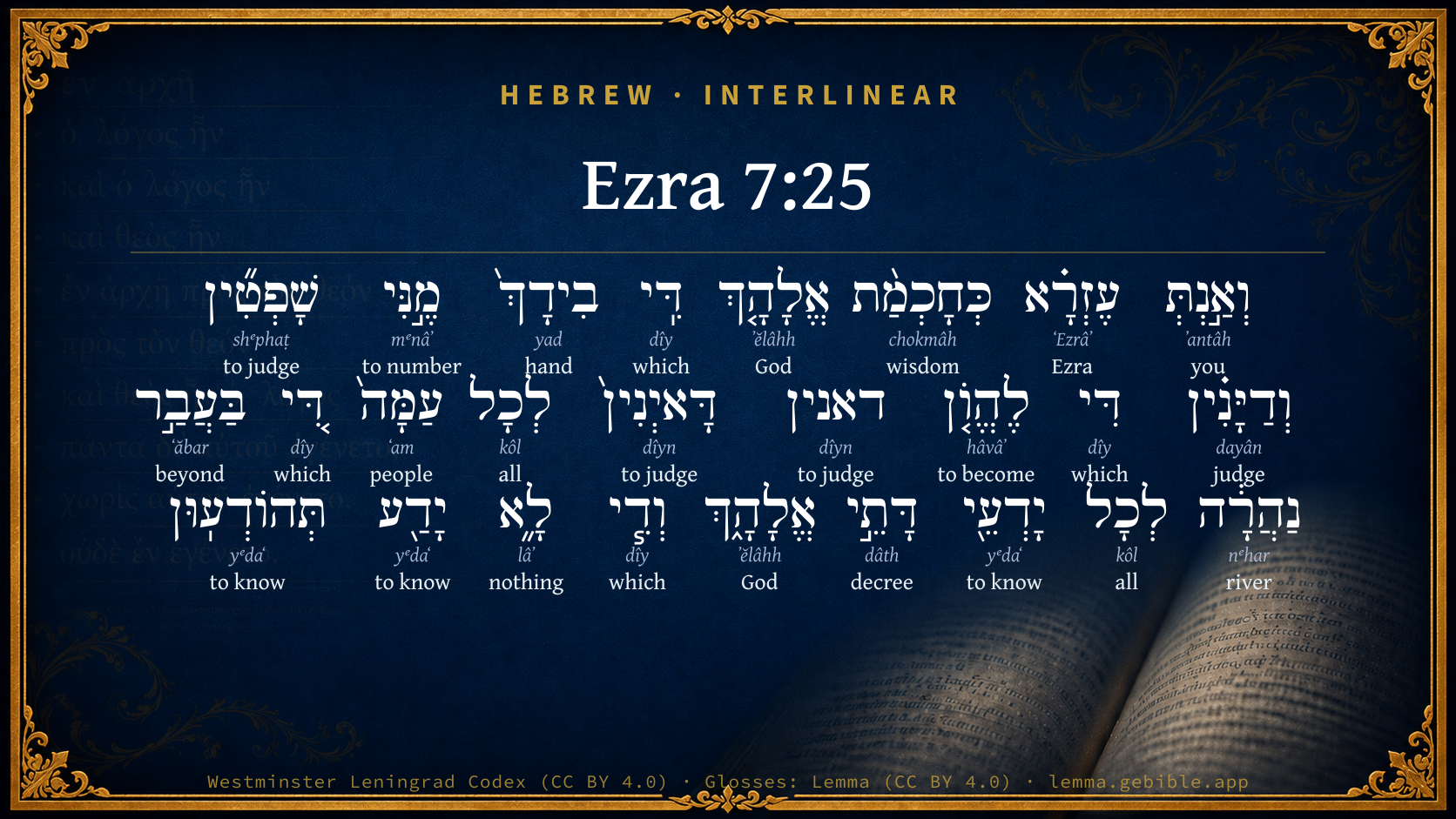
Hebrew (Westminster Leningrad Codex) Ezra 7:25 appears in the Hebrew Old Testament. The text above is from the Westminster Leningrad Codex. Each word links to its Strong’s number, a concise gloss, and parsing drawn from the Open Scriptures Hebrew Bible morphology. Click any word for its full Brown-Driver-Briggs (BDB) entry.
Download image
Cite this verse

Ezra 7:25 (World English Bible). Public Domain. Lemma interlinear Bible study tool, https://lemma.gebible.app/v/ezra/7/25.

Show BibTeX & RIS
BibTeX
RIS
English Translation
You, Ezra, after the wisdom of your God who is in your hand, appoint magistrates and judges, who may judge all the people who are beyond the River, all such as know the laws of your God; and teach you him who doesn't know them.
World English Bible · Public Domain
Highlights
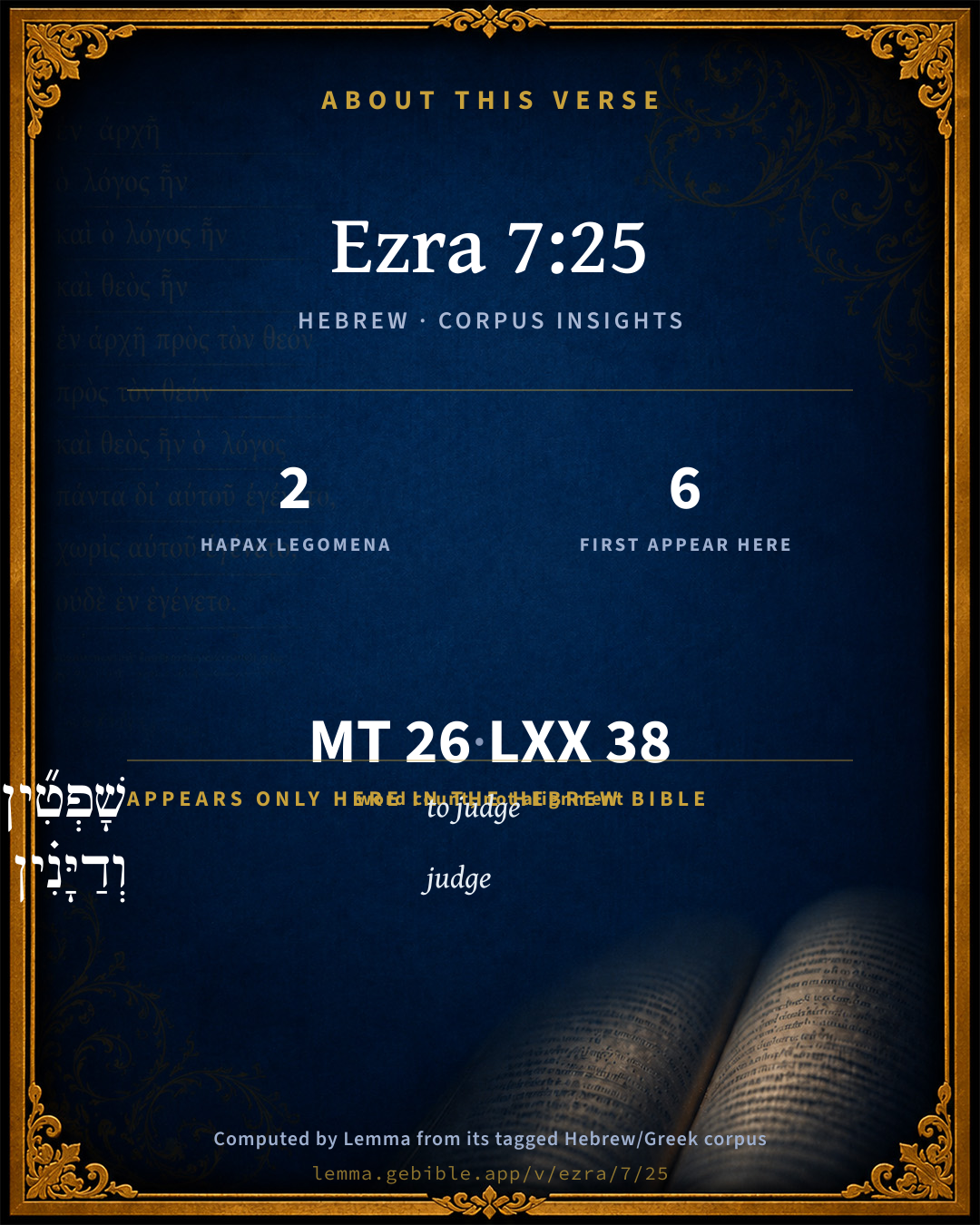
  • 2 hapax legomena — only here in the Hebrew Bible
  • 6 first appearances in the Hebrew Bible
Full analysis ↓
Download a study sheet

One document with this verse’s original text, its word-by-word gloss line, the meaning frame, cross-references with their text, attributed commentary, and full source and license credits — printable, and it pastes into notes with its structure intact.

This verse Autodidact and up

Study sheet (.html) Plain text (.txt)

A passage Seminary Student

Up to 50 verses in one chapter. A passage sheet keeps up to 6 commentary sources and 12 cross-references per verse, in the order this page ranks them, and says so on the sheet whenever that leaves anything out. Ask for a single verse and you get the Autodidact verse sheet above.

Everything on this page stays free to read, with no account — the sheet is a download of what is already on screen, not access to it.

Want to remove ads? Support Godless Engineer
Compare translations 3

The same verse in 3 English versions, stacked beneath the original-language interlinear above. Click any original word for its lexicon entry.

Each is an independent rendering of the whole verse — the interlinear is not word-aligned to these translations.

Highlighted words mark where these versions differ — a whole-verse word diff, not a word-by-word alignment.

  • World English Bible Public Domain
    You, Ezra, after the wisdom of your God who is in your hand, appoint magistrates and judges, who may judge all the people who are beyond the River, all such as know the laws of your God; and teach you him who doesn't know them.
  • King James Version Public Domain
    And thou, Ezra, after the wisdom of thy God, that is in thine hand, set magistrates and judges, which may judge all the people that are beyond the river, all such as know the laws of thy God; and teach ye them that know them not.
  • unfoldingWord Literal Text CC BY-SA 4.0
    And as for you, Ezra, according to the wisdom of your God that is in your hand, appoint magistrates and judges who may judge all the people who are in Beyond-the-River, all who know the laws of your God. And you shall teach those who do not know.

unfoldingWord Literal Text — © unfoldingWord, licensed CC BY-SA 4.0. Word-aligned USFM3 via Door43 (git.door43.org/unfoldingWord/en_ult).

Versions to compare (up to 4)

3 of 4 selected

Show all 18 translations

Every available English version of this verse, each an independent rendering of the whole verse.

  • World English Bible Public Domain
    You, Ezra, after the wisdom of your God who is in your hand, appoint magistrates and judges, who may judge all the people who are beyond the River, all such as know the laws of your God; and teach you him who doesn't know them.
  • Berean Standard Bible Public Domain
    And you, Ezra, according to the wisdom of your God which you possess, are to appoint magistrates and judges to judge all the people west of the Euphrates—all who know the laws of your God. And you are to teach these laws to anyone who does not know them.
  • Majority Standard Bible Public Domain
    And you, Ezra, according to the wisdom of your God, which you possess, are to appoint magistrates and judges to judge all the people west of the Euphrates—all who know the laws of your God. And you are to teach these laws to anyone who does not know them.
  • King James Version Public Domain
    And thou, Ezra, after the wisdom of thy God, that is in thine hand, set magistrates and judges, which may judge all the people that are beyond the river, all such as know the laws of thy God; and teach ye them that know them not.
  • American Standard Version (1901) Public Domain
    And thou, Ezra, after the wisdom of thy God that is in thy hand, appoint magistrates and judges, who may judge all the people that are beyond the River, all such as know the laws of thy God; and teach ye him that knoweth them not.
  • Revised Version (1885) Public Domain
    And thou, Ezra, after the wisdom of thy God that is in thine hand, appoint magistrates and judges, which may judge all the people that are beyond the river, all such as know the laws of thy God; and teach ye him that knoweth them not.
  • Geneva Bible (1599) Public Domain
    And thou Ezra (after the wisedome of thy God, that is in thine hand) set iudges and arbiters, which may iudge all the people that is beyond the Riuer, euen all that knowe the Lawe of thy God, and teach ye them that know it not.
  • Douay-Rheims (1899) Public Domain
    And thou Esdras according to the wisdom of thy God, which is in thy hand, appoint judges and magistrates, that may judge all the people, that is beyond the river, that is, for them who know the law of thy God, yea and the ignorant teach ye freely.
  • Young's Literal Translation Public Domain
    `And thou, Ezra, according to the wisdom of thy God, that `is' in thy hand, appoint magistrates and judges who may be judges to all the people who are beyond the river, to all knowing the law of thy God, and he who hath not known ye cause to know;
  • Literal Standard Version CC BY-SA 4.0
    And you, Ezra, according to the wisdom of your God, that [is] in your hand, appoint magistrates—even judges who may be judging—judging all the people who are beyond the river, to all knowing the Law of your God, and he who has not known, you cause to know;
  • Unlocked Literal Bible CC BY-SA 4.0
    Ezra, with the wisdom that God has given you, you must appoint judges and magistrates to judge all the people in the Province Beyond the River, and to serve all who know the laws of your God. You must also teach those who do not know the law.
  • unfoldingWord Literal Text CC BY-SA 4.0
    And as for you, Ezra, according to the wisdom of your God that is in your hand, appoint magistrates and judges who may judge all the people who are in Beyond-the-River, all who know the laws of your God. And you shall teach those who do not know.
  • Darby Bible Public Domain
    And thou, Ezra, after the wisdom of thy God, which is in thy hand, set magistrates and judges who may judge all the people that are beyond the river, all such as know the laws of thy God; and teach ye him that knows [them] not.
  • World Messianic Bible Public Domain
    You, Ezra, according to the wisdom of your God that is in your hand, appoint magistrates and judges who may judge all the people who are beyond the River, who all know the laws of your God; and teach him who doesn’t know them.
  • Webster's Bible Public Domain
    And thou, Ezra, after the wisdom of thy God, that is in thy hand, set magistrates and judges, who may judge all the people that are beyond the river, all such as know the laws of thy God; and teach ye them that know them not.
  • Free Bible Version CC BY-SA 4.0
    You, Ezra, are to follow the wisdom of your God which you possess, shall appoint magistrates and judges to provide justice to all the people west of the Euphrates—all those who follow the laws of your God. You are to teach these laws to those who do not.
  • Bible in Basic English Public Domain
    And you, Ezra, by the wisdom of your God which is in you, are to put rulers and judges to have authority over all the people across the river who have knowledge of the laws of your God; and you are to give teaching to him who has no knowledge of them.
  • JPS Tanakh (1917) Public Domain
    And thou, Ezra, after the wisdom of thy God that is in thy hand, appoint magistrates and judges, who may judge all the people that are beyond the River, all such as know the laws of thy God; and teach ye him that knoweth them not.

Literal Standard Version (2020), Covenant Press — licensed CC BY-SA 4.0. Text via the HelloAO Bible API (eBible.org). Unlocked Literal Bible (unfoldingWord) — licensed CC BY-SA 4.0. Text via the HelloAO Bible API (eBible.org). unfoldingWord Literal Text — © unfoldingWord, licensed CC BY-SA 4.0. Word-aligned USFM3 via Door43 (git.door43.org/unfoldingWord/en_ult). Free Bible Version, Dr. Jonathan Gallagher — licensed CC BY-SA 4.0. Text via the HelloAO Bible API (eBible.org).

Word by word

More ways to search: Search by grammar → Find every occurrence → Compare this word →

Practice this passage: Drill this verse → Learn its vocabulary →

שָׁפְטִ֞ין
shᵉphaṭ
H8200
“judging”
Adjective, V
Part of Speech
Adjective
Full BDB Definition

Origin: corresponding to H8199

TWOT: 2045

to judge - (Peal) judge (participle)
  1. וְאַ֣נְתְּ ʼantâh H607 “and · you” Adjective, C + Pronoun, Personal, 2nd Person, Masculine, Singular
  2. עֶזְרָ֗א ʻEzrâʼ H5831 “Ezra” Adjective, N
  3. כְּחָכְמַ֨ת chokmâh H2452 “like/as · wisdom of” Adjective, R + Noun, Common, Feminine, Singular, Construct
  4. אֱלָהָ֤ךְ ʼĕlâhh H426 “God · your” Adjective, N, Common + Suffix, Personal, 2nd Person, Masculine, Singular
  5. דִּֽי dîy H1768 “which” Adjective, T
  6. בִידָךְ֙ yad H3028 “in/at · hand · your” Adjective, R + Noun, Common, Feminine, Singular, Construct + Suffix, Personal, 2nd Person, Masculine, Singular
  7. מֶ֣נִּי mᵉnâʼ H4483 “number” Adjective, V
  8. וְדַיָּנִ֗ין dayân H1782 “and · judges” Adjective, C + Noun, Common, Masculine, Plural, Absolute
  9. דִּי dîy H1768 “which” Adjective, T
  10. לֶהֱוֺ֤ן hâvâʼ H1934 “to become” Adjective, V
  11. דאנין dîyn H1778 “judging” Adjective, V
  12. דָּאיְנִין֙ dîyn H1778 “judging” Adjective, V
  13. לְכָל kôl H3606 “to/for · all of” Adjective, R + Noun, Common, Masculine, Singular, Construct
  14. עַמָּה֙ ʻam H5972 “people · the” Adjective, N, Common + Particle, Definite Article
  15. דִּ֚י dîy H1768 “which” Adjective, T
  16. בַּעֲבַ֣ר ʻăbar H5675 “in/at · beyond” Adjective, R + Noun, Proper
  17. נַהֲרָ֔ה nᵉhar H5103 “river · the” Adjective, N + Particle, Definite Article
  18. לְכָל kôl H3606 “to/for · all of” Adjective, R + Noun, Common, Masculine, Singular, Construct
  19. יָדְעֵ֖י yᵉdaʻ H3046 “knowing” Adjective, V
  20. דָּתֵ֣י dâth H1882 “decrees of” Adjective, N, Common
  21. אֱלָהָ֑ךְ ʼĕlâhh H426 “God · your” Adjective, N, Common + Suffix, Personal, 2nd Person, Masculine, Singular
  22. וְדִ֧י dîy H1768 “and · which” Adjective, C + Particle, Relative
  23. לָ֦א lâʼ H3809 “nothing” Adjective, T
  24. יָדַ֖ע yᵉdaʻ H3046 “to know” Adjective, V, Plural
  25. תְּהוֹדְעֽוּן yᵉdaʻ H3046 “to know” Adjective, V

About this verse

These counts appear in no published source. They are computed here, from the morphology-tagged text and Lemma’s own curated glosses. What Lemma adds →

26
words
18
distinct lemmas
Historical
section

Notable vocabulary

2 hapax legomena — words that appear only here in the entire Hebrew Bible:

  • שָׁפְטִ֞ין to judge H8200
  • וְדַיָּנִ֗ין judge H1782

First appearance in Scripture

These words make their first canonical appearance in the Hebrew Bible here:

  • וְאַ֣נְתְּ you H607
  • כְּחָכְמַ֨ת wisdom H2452
  • מֶ֣נִּי to number H4483
  • שָׁפְטִ֞ין to judge H8200
  • וְדַיָּנִ֗ין judge H1782
  • דאנין to judge H1778

Grammatical profile

  • 6 nouns
  • 16 adjectives
  • 1 pronoun
  • 3 particles

Repetition

Words recur within this verse — often emphatic in Hebrew:

  • יָדְעֵ֖י to know H3046 ×3
  • אֱלָהָ֤ךְ God H426 ×2
  • דאנין to judge H1778 ×2
  • לְכָל all H3606 ×2
  • דִּֽי which H1768 ×4

Hebrew & Septuagint length

In English translation the verse runs 45 words from the Hebrew and 48 from the Septuagint (LXX English) — closely comparable.

A rough comparison of the two English renderings, which tokenize alike — not a word-level alignment.

Word counts can differ between the Hebrew and the Greek without any difference in meaning — e.g. the Hebrew direct-object marker אֵת has no separate Greek word, and Greek often adds the article ὁ.

In the original languages it is 26 Hebrew tokens and 38 Greek tokens — but the two are counted differently (Hebrew bundles its prefixes and suffixes into one token; the Greek is in lemma form), so that isn’t a like-for-like length.

Cross-references

25

Topical passages linked to Ezra 7:25 in the Treasury of Scripture Knowledge — connected by theme and wording, ordered by reader-vote popularity; previews shown in the World English Bible.

  • Deuteronomy 16:18 Judges and officers shall you make you in all your gates, which Yahweh your God gives you, according to your tribes; and they shall judge the people with righteous judgment.
  • Ezra 7:10 For Ezra had set his heart to seek the law of Yahweh, and to do it, and to teach in Israel statutes and ordinances.
  • James 1:5 But if any of you lacks wisdom, let him ask of God, who gives to all liberally and without reproach; and it will be given to him.
  • Psalms 19:7 Yahweh's law is perfect, restoring the soul. Yahweh's testimony is sure, making wise the simple.
  • Malachi 2:7 For the priest's lips should keep knowledge, and they should seek the law at his mouth; for he is the messenger of Yahweh of Hosts.
  • James 3:17–18 But the wisdom that is from above is first pure, then peaceful, gentle, reasonable, full of mercy and good fruits, without partiality, and without hypocrisy.
  • Exodus 18:21–25 Moreover you shall provide out of all the people able men, such as fear God: men of truth, hating unjust gain; and place such over them, to be rulers of thousands, rulers of hundreds, rulers of fifties, and rulers of tens.
  • 1 Kings 3:28 All Israel heard of the judgment which the king had judged; and they feared the king: for they saw that the wisdom of God was in him, to do justice.
  • 1 Chronicles 22:12 May Yahweh give you discretion and understanding, and put you in charge of Israel; that so you may keep the law of Yahweh your God.
  • 1 Chronicles 23:4 Of these, twenty-four thousand were to oversee the work of the house of Yahweh; and six thousand were officers and judges;
  • 2 Chronicles 17:7–9 Also in the third year of his reign he sent his princes, even Ben Hail, and Obadiah, and Zechariah, and Nethanel, and Micaiah, to teach in the cities of Judah;
  • 2 Chronicles 19:8–10 Moreover in Jerusalem did Jehoshaphat set of the Levites and the priests, and of the heads of the fathers' [houses] of Israel, for the judgment of Yahweh, and for controversies. They returned to Jerusalem.
  • Ezra 6:6 Now therefore, Tattenai, governor beyond the River, Shetharbozenai, and your companions the Apharsachites, who are beyond the River, be you far from there:
  • Ezra 7:14 Because you are sent of the king and his seven counselors, to inquire concerning Judah and Jerusalem, according to the law of your God which is in your hand,
  • Nehemiah 8:1–3 All the people gathered themselves together as one man into the broad place that was before the water gate; and they spoke to Ezra the scribe to bring the book of the law of Moses, which Yahweh had commanded to Israel.
  • Nehemiah 8:7–8 Also Jeshua, and Bani, and Sherebiah, Jamin, Akkub, Shabbethai, Hodiah, Maaseiah, Kelita, Azariah, Jozabad, Hanan, Pelaiah, and the Levites, caused the people to understand the law: and the people [stood] in their place.
  • Nehemiah 9:3 They stood up in their place, and read in the book of the law of Yahweh their God a fourth part of the day; and [another] fourth part they confessed, and worshiped Yahweh their God.
  • Nehemiah 13:1–3 On that day they read in the book of Moses in the audience of the people; and therein was found written, that an Ammonite and a Moabite should not enter into the assembly of God forever,
  • Psalms 119:98–100 Your commandments make me wiser than my enemies, For your commandments are always with me.
  • Proverbs 2:6 For Yahweh gives wisdom. Out of his mouth comes knowledge and understanding.
  • Proverbs 6:23 For the commandment is a lamp, And the law is light. Reproofs of instruction are the way of life,
  • Matthew 13:52 He said to them, "Therefore, every scribe who has been made a disciple in the Kingdom of Heaven is like a man who is a householder, who brings out of his treasure new and old things."
  • Matthew 23:2–3 saying, "The scribes and the Pharisees sat on Moses' seat.
  • Mark 6:34 Jesus came out, saw a great multitude, and he had compassion on them, because they were like sheep without a shepherd, and he began to teach them many things.
  • Romans 10:14–17 How then will they call on him in whom they have not believed? How will they believe in him whom they have not heard? How will they hear without a preacher?

Cross-references courtesy of OpenBible.info (CC BY 4.0).

Hebrew and Greek witnesses Masoretic Hebrew ↔ Greek Septuagint

The same verse in the two great witnesses to the Old Testament, shown verse-for-verse.

These are two independent witnesses, not word-aligned to each other, and the Septuagint is shown in lemma (dictionary) form.

Hebrew Ezra 7:25 Masoretic · Westminster Leningrad Codex

וְאַ֣נְתְּ עֶזְרָ֗א כְּחָכְמַ֨ת אֱלָהָ֤ךְ דִּֽי בִידָךְ֙ מֶ֣נִּי שָׁפְטִ֞ין וְדַיָּנִ֗ין דִּי לֶהֱוֺ֤ן דאנין דָּאיְנִין֙ לְכָל עַמָּה֙ דִּ֚י בַּעֲבַ֣ר נַהֲרָ֔ה לְכָל יָדְעֵ֖י דָּתֵ֣י אֱלָהָ֑ךְ וְדִ֧י לָ֦א יָדַ֖ע תְּהוֹדְעֽוּן

You, Ezra, after the wisdom of your God who is in your hand, appoint magistrates and judges, who may judge all the people who are beyond the River, all such as know the laws of your God; and teach you him who doesn't know them.

World English Bible · Public Domain

Greek LXX Ezra 7:25 Septuagint · lemma form

καί σύ εσδρα ὡς ὁ σοφία ὁ θεός ἐν χείρ σύ καταἵστημι γραμματεύς καί κριτής ἵνα εἰμί κρίνω πᾶς ὁ λαός ὁ ἐν πέραν ὁ ποταμός πᾶς ὁ οἶδα νόμος ὁ θεός σύ καί ὁ μή οἶδα γνωρίζω

And you, Esdras, as the wisdom of God is in your hand, appoint scribes and judges, that they may judge for all the people beyond the river, all that know the law of the Lord your God; and you⌃ shall make it known to him that knows not.

LXX2012 (modern English Septuagint) · Public Domain

In the Septuagint this is one book — Esdras B (2 Esdras): Ezra is chapters 1–10, Nehemiah 11–23.

Hebrew: Westminster Leningrad Codex (CC BY 4.0). Greek: Septuagint (public domain); English from LXX2012 (modern English Septuagint) (Public Domain). How the Septuagint differs from the Hebrew →

Commentary

Notes on Ezra 7:25 from classic Christian and Jewish commentators (each source and its license shown beneath its notes). The classic Christian expositions comment on the surrounding passage and are grouped to its opening verse, so a note may address several verses; the Jewish commentaries on the Tanakh (Rashi and others) are per-verse, so they appear only where the commentator wrote on this verse.

Lemma curates 59 commentaries, every one of them public domain or Creative Commons licensed, each selected and text-cleaned for this edition rather than reprinted as found. About our sources →

Trapp's Complete Commentary

John Trapp

Ezr 7:25 And thou, Ezra, after the wisdom of thy God, that [is] in thine hand, set magistrates and judges, which may judge all the people that [are] beyond the river, all such as know the laws of thy God; and teach ye them that know [them] not.

Ver. 25. And thou, Ezra] Qui monet ut facias, who warned you to do this, &c.

After the wisdom of thy God, that is in thine hand] That is, in thine heart and life, Sapientia est vel codicibus vel cordibus. Wisdom is either from the books or the heart. Ezra had both these, being a thorough wise man.

All such as know the laws of thy God] Else how shall they see them duly executed? How shall they be as so many living laws, walking statuted? How shall they teach in the cities of Judah, as Jehoshaphat’s judges did, 2Ch 17:7; 2Ch 17:9, and as it followeth here, "And teach ye them that know them not"; how can the people perform their duty, which they are ignorant of?

John Trapp, A Commentary or Exposition upon All the Books of the Old and New Testament (1647–1656) — public domain. Text from a community e-Sword module.

Joseph Benson's Commentary

Ezr 7:25. After the wisdom of thy God in thy hand — That is, which God hath put into thy heart, and which appears in the works of thy hand. Wisdom is sometimes ascribed to the hand, as Psa 78:72. Or, by the wisdom of God, he means the law of God, which was said to be in his hand, Ezr 7:14. Set magistrates and judges, which may judge all the people, &c. — All the Jews on that side of the river. All such as know the laws of thy God — All that professed the Jewish religion were to be under the jurisdiction of these judges; which intimates that they were exempt from the jurisdiction of heathen magistrates. It was a great favour to the Jews to have such magistrates of themselves, and especially of Ezra’s nomination. And teach ye them that know them not — They were to instruct in the laws of God those that were ignorant of them, whether Jews or others, which implies that he had no objection to their making proselytes to the Jewish religion.

Joseph Benson's Commentary on the Old and New Testaments (1811–1818) — public domain. Text from a community e-Sword module.

Tyndale Open Study Notes

Tyndale Open Resources

7:25-26 Ezra was to teach God’s laws and govern the area occupied by the Jews in accordance with God’s laws and the law of the king—i.e., Persian civil law.

Tyndale Open Study Notes — © Tyndale Open Resources, licensed CC BY-SA 4.0. Text via the HelloAO Bible API.

Geneva Bible (1599)

Geneva Bible translators

He gave Ezra full authority to restore all things according to the word of God, and to punish them that resisted, and would not obey.

Geneva Bible (1599) marginal notes — public domain. Text via Bolls.life.

Ellicott's Commentary for English Readers

(25) All such as know.—The firman, or king’s commission, returning directly to Ezra, makes him supreme in the province over the Jewish population.

And teach ye them that know them not.—That is, those Jews who had comparatively forsaken the law. Here he has absolute authority in religion.

A Bible Commentary for English Readers, edited by Charles John Ellicott (1878–1897) — public domain. Text from a community e-Sword module.

The Cambridge Bible for Schools and Colleges

gen. ed. J. J. S. Perowne

25. Ezra again addressed, empowered to appoint judges for Jews in the country W. of the Euphrates and to inflict penalties for the violation of the law.

after the wisdom of God, that is in thine hand] cf. Ezr_7:14, ‘the law of by God which is in thy hand’. Law in its obligation, wisdom in its spirit.

magistrates and judges] The former is the same word as the ‘Judges’ (Shôphetim) of the book so called. The two words, if capable of distinction, represent administrative and judicial functions.

all such as know the laws of thy God] No authority save over those of Israelite race or Jewish religion. But this commission gave Ezra and the community at Jerusalem the right to exercise special powers over all countrymen in Syria, Phœnicia and Palestine.

and teach ye them that know them not] R.V. and teach ye him that knoweth them not. The injunction, expressed in the plural, seems to include the leaders of the Jews along with Ezra, with special reference to the ‘magistrates and judges’ to be appointed. The primary intention of this sentence is to ensure instruction in the Law for those Jews. Who by living among the heathen had grown to neglect or to forget the obligations of their religion. It does not amount to a command ‘to proselytize’, but would, no doubt, include the instruction of proselytes, and grant general permission to teach the Jewish religion.

The Cambridge Bible for Schools and Colleges (gen. ed. J. J. S. Perowne; Cambridge University Press, 1878–1918) — public domain. Text from a community e-Sword module.

John Gill's Exposition

Blessed be the Lord God of our fathers,.... This is Ezra's thanksgiving to God for the above decree:

which hath put such a thing as this in the king's heart; which he rightly took to be of God, who wrought in him to will and to do:

to beautify the house of the Lord which is in Jerusalem; to provide for the ornamenting of it, for vessels in it, as well as for sacrifices; for as for the building of it, that was finished.

John Gill's Exposition of the Whole Bible (1746–1763) — public domain (CC PDM 1.0). Text via the HelloAO Bible API.

Haydock's Catholic Bible Commentary

River. 3 Esdras, "In all Syria and Phenicia." (Haydock) --- Hitherto, it seems, the royal judges had decided all affairs of consequence, which required any public chastisement.

George Leo Haydock (1774–1849), Haydock's Catholic Family Bible and Commentary, 1859 edition — public domain. Excludes Psalms (Douay-Rheims chapter numbering differs from Protestant) and Deuterocanonical books (Catholic canon only).

Matthew Poole's English Annotations

The wisdom of thy God that is in thine hand, i.e. which God hath put into thy heart, and which appears in the works of thy hand. Wisdom is sometimes ascribed to the hands, as Psa 78:72. See my Latin Synopsis on Gen 48:14. Or, by the wisdom of God, he means the law of God, which was said to be in his hand, Ezr 7:14.

Matthew Poole's English Annotations on the Holy Bible (1683–1685) — public domain. Text from a community e-Sword/MySword module.

Whedon's Commentary on the Bible

Daniel D. Whedon

25. Set magistrates and judges — Hereby Ezra was commissioned with authority to appoint all officers of the State. The fact indicates that the new community at Jerusalem had fallen into great irregularities.

Daniel D. Whedon (gen. ed.), Commentary on the Old and New Testaments (1874–1909) — public domain. Text from a community e-Sword module.

The Pulpit Commentary

And thou, Ezra. This conclusion would be by itself sufficient to remove the document out of the ordinary category of "decrees" or "edicts," and to render it, what it is called in ver. 11, nish-tevan, "a letter." After the wisdom of thy God, that is in thy hand. i.e. "that is in thy possession." Set magistrates and judges. Both the words used are derived from roots signifying "to judge," and it is difficult to draw any distinction between them. The one translated "magistrates" is that which gives its title to the Book of "Judges." Which may judge all the people that are beyond the river, all such as know the laws of thy God. The latter clause is probably intended to be limitative of the former, and to consign to Ezra"s government only the Jewish portion of the population, in which, however, are to be reckoned the proselytes. (see comment on Ezr_6:21) And teach ye them that know them not. As the other inhabitants of Syria were not Zoroastrians, but idolaters, Ezra was given free permission to spread his religion among them.

The Pulpit Commentary (1880–1919), ed. H.D.M. Spence-Jones & Joseph S. Exell — public domain. Text from a community e-Sword module.

John Wesley's Explanatory Notes

The wisdom - Which God hath put into thy heart, and which appears in the works of thy hand. All that professed the Jewish religion, were to be under the jurisdiction of these Judges.

John Wesley, Explanatory Notes Upon the Whole Bible (1754–1765) — public domain. Text via the GEBible commentary corpus.

unfoldingWord translationNotes

Door43 World Missions Community

Connecting Statement:

This is the end of the decree that King Artaxerxes gave to Ezra.

with the wisdom that God has given you, you must appoint judges and magistrates

The abstract noun "wisdom" can be expressed with a verbal phrase. AT: "God has made you wise, so you must wisely appoint judges and magistrates" (See: Abstract Nouns)

whether by death, banishment, confiscation of their goods, or imprisonment

The abstract nouns can be translated with verbs. AT: "whether by killing them, banishing them, confiscating their goods, or imprisoning them" or "You may kill them, send them away, take the things the own, or put them in prison" (See: Abstract Nouns)

translationWords

wise

God

appoint

judge, judges

magistrate

servant

law

punish

unfoldingWord translationNotes — © Distant Shores Media and the Door43 World Missions Community, licensed CC BY-SA 4.0. Source: git.door43.org/Door43/en_tn.

Rashi

Rabbi Shlomo Yitzchaki (Rashi)

And you, Ezra, according to the wisdom of your God, which is in your hand and you, Ezra, according to the wisdom of your God, which is in your hand [and which is] greater than that of the judges and the magistrates who judge all the people beyond the river to the side of Israel, the people knowledgeable in the Torah.

and whoever does not know and the judge who does not know how to judge, inform him of the judgment that he should execute it.

Rashi on the Tanakh — English translations: “The Judaica Press complete Tanach with Rashi, translated by A. J. Rosenberg” (CC BY 4.0); “Pentateuch with Rashi's commentary by M. Rosenbaum and A.M. Silbermann, 1929-1934” (public domain); “The Metsudah Tanach series, Lakewood, N.J” (CC BY 4.0); and “The Book of Joshua, Metsudah Publications, 1997” (CC BY 4.0). Text via Sefaria.

Lesson kit

Teaching starters — assembled from the data on this page, not authored interpretation. Every prompt links to the verse data it draws on. Edit before teaching.

Ezra, in the Historical, opens this verse with 26 words (18 distinct Hebrew lemmas). Its most distinctive word is shᵉphaṭ (“to judge”). A historical commentator’s framing appears above. Read the whole chapter for the surrounding context.

Discussion questions

  1. How does “to judge” (shᵉphaṭ) shape what this verse is saying?
  2. This verse holds 2 words here found nowhere else in the Hebrew Bible. What might the rare words draw attention to?
  3. 6 words here appear for the first time in Scripture. What is being introduced at this debut?
  4. Deuteronomy 16:18 shares this passage’s theme. How do the two illuminate each other?
  5. “to know” occurs 3× in this one verse. What is the effect of the repetition?
  6. The translations on this page render this verse differently — a whole-verse word diff, not a word-by-word alignment. What might account for the different wordings?
  7. Reading how Trapp's Complete Commentary and Joseph Benson's Commentary read this verse, where do the two commentators agree and where do they part?

Things to notice

  • 2 words in this verse appear nowhere else in the Hebrew Bible.
  • 6 words make their first canonical appearance in Scripture here.
  • This verse counts 26 Hebrew ↔ 38 Greek words.
  • These translations choose different wording for 15 words in this verse.
  • “to know” occurs 3× in this single verse.

Reading settings

Reading text

Shown beneath each verse's original-language words.

Old Testament
Old Testament edition

Read the OT as the Masoretic Hebrew (MT) or the Greek Septuagint (LXX).

English shown for the Greek Septuagint (in the Hebrew ↔ Greek comparison).

Comparing translations? Open the Compare panel on any verse page to stack up to four side by side.