Jeremiah 10:11

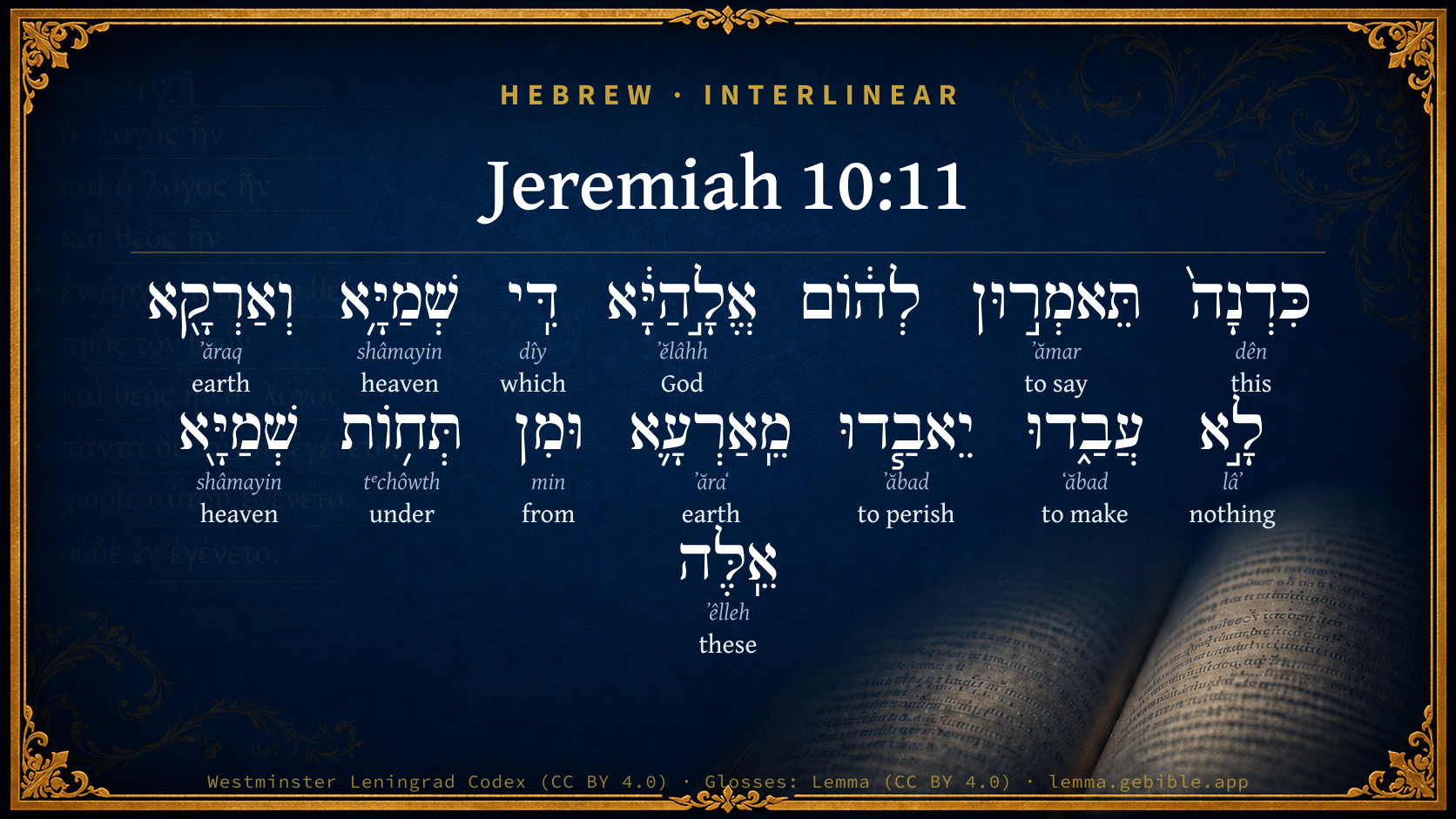
Hebrew (Westminster Leningrad Codex) Jeremiah 10:11 appears in the Hebrew Old Testament. The text above is from the Westminster Leningrad Codex. Each word links to its Strong’s number, a concise gloss, and parsing drawn from the Open Scriptures Hebrew Bible morphology. Click any word for its full Brown-Driver-Briggs (BDB) entry.
Download image
Cite this verse

Jeremiah 10:11 (World English Bible). Public Domain. Lemma interlinear Bible study tool, https://lemma.gebible.app/v/jeremiah/10/11.

Show BibTeX & RIS
BibTeX
RIS
English Translation
Thus shall you say to them, The gods that have not made the heavens and the earth, these shall perish from the earth, and from under the heavens.
World English Bible · Public Domain
Highlights
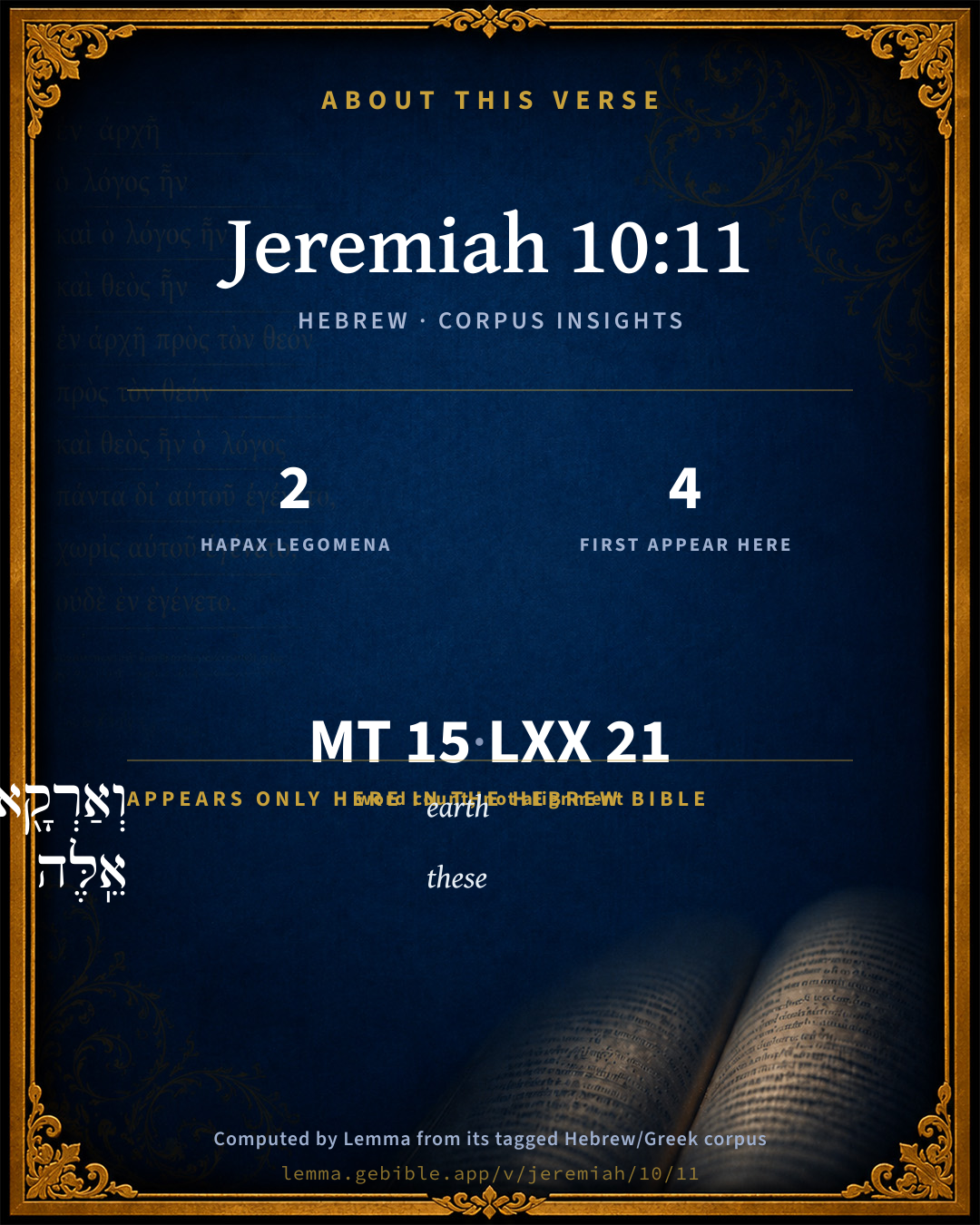
  • 2 hapax legomena — only here in the Hebrew Bible
  • 4 first appearances in the Hebrew Bible
Full analysis ↓
Download a study sheet

One document with this verse’s original text, its word-by-word gloss line, the meaning frame, cross-references with their text, attributed commentary, and full source and license credits — printable, and it pastes into notes with its structure intact.

This verse Autodidact and up

Study sheet (.html) Plain text (.txt)

A passage Seminary Student

Up to 50 verses in one chapter. A passage sheet keeps up to 6 commentary sources and 12 cross-references per verse, in the order this page ranks them, and says so on the sheet whenever that leaves anything out. Ask for a single verse and you get the Autodidact verse sheet above.

Everything on this page stays free to read, with no account — the sheet is a download of what is already on screen, not access to it.

Want to remove ads? Support Godless Engineer
Compare translations 3

The same verse in 3 English versions, stacked beneath the original-language interlinear above. Click any original word for its lexicon entry.

Each is an independent rendering of the whole verse — the interlinear is not word-aligned to these translations.

Highlighted words mark where these versions differ — a whole-verse word diff, not a word-by-word alignment.

  • World English Bible Public Domain
    Thus shall you say to them, The gods that have not made the heavens and the earth, these shall perish from the earth, and from under the heavens.
  • King James Version Public Domain
    Thus shall ye say unto them, The gods that have not made the heavens and the earth, even they shall perish from the earth, and from under these heavens.
  • unfoldingWord Literal Text CC BY-SA 4.0
    You shall say like this to them, “The gods that did not make the heavens and earth shall perish from the earth and from under these heavens.”

unfoldingWord Literal Text — © unfoldingWord, licensed CC BY-SA 4.0. Word-aligned USFM3 via Door43 (git.door43.org/unfoldingWord/en_ult).

Versions to compare (up to 4)

3 of 4 selected

Show all 18 translations

Every available English version of this verse, each an independent rendering of the whole verse.

  • World English Bible Public Domain
    Thus shall you say to them, The gods that have not made the heavens and the earth, these shall perish from the earth, and from under the heavens.
  • Berean Standard Bible Public Domain
    Thus you are to tell them: “These gods, who have made neither the heavens nor the earth, will perish from this earth and from under these heavens.”
  • Majority Standard Bible Public Domain
    Thus you are to tell them: “These gods, who have made neither the heavens nor the earth, will perish from this earth and from under these heavens.”
  • King James Version Public Domain
    Thus shall ye say unto them, The gods that have not made the heavens and the earth, even they shall perish from the earth, and from under these heavens.
  • American Standard Version (1901) Public Domain
    Thus shall ye say unto them, The gods that have not made the heavens and the earth, these shall perish from the earth, and from under the heavens.
  • Revised Version (1885) Public Domain
    Thus shall ye say unto them, The gods that have not made the heavens and the earth, these shall perish from the earth, and from under the heavens.
  • Geneva Bible (1599) Public Domain
    (Thus shall you say vnto them, The gods that haue not made the heauens and the earth, shall perish from the earth, and from vnder these heauens)
  • Douay-Rheims (1899) Public Domain
    Thus then shall you say to them: The gods that have not made heaven and earth, let them perish from the earth, and from among those places that are under heaven.
  • Young's Literal Translation Public Domain
    Thus do ye say to them, The gods Who the heavens and earth have not made, They do perish from the earth, And from under these heavens.
  • Literal Standard Version CC BY-SA 4.0
    Thus you say to them, “The gods who have not made the heavens and earth, || They perish from the earth, || And from under these heavens.”
  • Unlocked Literal Bible CC BY-SA 4.0
    You will speak to them like this, “The gods that did not make the heavens and earth will perish from the earth and from under these heavens.”
  • unfoldingWord Literal Text CC BY-SA 4.0
    You shall say like this to them, “The gods that did not make the heavens and earth shall perish from the earth and from under these heavens.”
  • Darby Bible Public Domain
    Thus shall ye say unto them: The gods that have not made the heavens and the earth, these shall perish from the earth, and from under the heavens.
  • World Messianic Bible Public Domain
    “You shall say this to them: ‘The gods that have not made the heavens and the earth will perish from the earth, and from under the heavens.’”
  • Webster's Bible Public Domain
    Thus shall ye say to them, The gods that have not made the heavens and the earth, even they shall perish from the earth, and from under these heavens.
  • Free Bible Version CC BY-SA 4.0
    This is what you are to tell the nations: “These gods, who didn't make either the heavens or the earth, will be wiped out from this earth and from under these heavens.”
  • Bible in Basic English Public Domain
    This is what you are to say to them: The gods who have not made the heavens and the earth will be cut off from the earth and from under the heavens.
  • JPS Tanakh (1917) Public Domain
    Thus shall ye say unto them: 'The gods that have not made the heavens and the earth, these shall perish from the earth, and from under the heavens.'

Literal Standard Version (2020), Covenant Press — licensed CC BY-SA 4.0. Text via the HelloAO Bible API (eBible.org). Unlocked Literal Bible (unfoldingWord) — licensed CC BY-SA 4.0. Text via the HelloAO Bible API (eBible.org). unfoldingWord Literal Text — © unfoldingWord, licensed CC BY-SA 4.0. Word-aligned USFM3 via Door43 (git.door43.org/unfoldingWord/en_ult). Free Bible Version, Dr. Jonathan Gallagher — licensed CC BY-SA 4.0. Text via the HelloAO Bible API (eBible.org).

Word by word

More ways to search: Search by grammar → Find every occurrence → Compare this word →

Practice this passage: Drill this verse → Learn its vocabulary →

וְאַרְקָ֖א
ʼăraq
H778
“and · earth · the”
Adjective, C + Noun, Common, Feminine, Singular, Determined + Particle, Definite Article
Part of Speech
Adjective + Noun + Particle
Type
Definite Article
Full BDB Definition

Origin: by transmutation for H772

TWOT: 2612

earth, the earth
  1. כִּדְנָה֙ dên H1836 “like/as · this” Adjective, R + Pronoun, Demonstrative, Common, Singular
  2. תֵּאמְר֣וּן ʼămar H560 “to say” Adjective, V
  3. אֱלָ֣הַיָּ֔א ʼĕlâhh H426 “gods · the” Adjective, N, Common + Particle, Definite Article
  4. דִּֽי dîy H1768 “which” Adjective, T
  5. שְׁמַיָּ֥א shâmayin H8065 “heaven(s) · the” Adjective, N, Common + Particle, Definite Article
  6. לָ֣א lâʼ H3809 “nothing” Adjective, T
  7. עֲבַ֑דוּ ʻăbad H5648 “to make” Adjective, V, Plural
  8. יֵאבַ֧דוּ ʼăbad H7 “to perish” Adjective, V
  9. מֵֽאַרְעָ֛א ʼăraʻ H772 “from · earth · the” Adjective, R + Noun, Common, Feminine, Singular, Determined + Particle, Definite Article
  10. וּמִן min H4481 “and · from” Adjective, C + Preposition
  11. תְּח֥וֹת tᵉchôwth H8460 “under” Adjective, R
  12. שְׁמַיָּ֖א shâmayin H8065 “heaven(s) · the” Adjective, N, Common + Particle, Definite Article
  13. אֵֽלֶּה ʼêlleh H429 “these” Adjective, P, Construct

About this verse

These counts appear in no published source. They are computed here, from the morphology-tagged text and Lemma’s own curated glosses. What Lemma adds →

15
words
13
distinct lemmas
Prophets
section

Notable vocabulary

2 hapax legomena — words that appear only here in the entire Hebrew Bible:

  • וְאַרְקָ֖א earth H778
  • אֵֽלֶּה these H429

First appearance in Scripture

These words make their first canonical appearance in the Hebrew Bible here:

  • וְאַרְקָ֖א earth H778
  • יֵאבַ֧דוּ to perish H7
  • תְּח֥וֹת under H8460
  • אֵֽלֶּה these H429

Shared distinctive vocabulary

תְּח֥וֹת under H8460 occurs in 4 verses of the Hebrew Bible. Also found in:

Grammatical profile

  • 8 adjectives
  • 1 pronoun
  • 1 preposition
  • 5 particles

Repetition

A word recurs within this verse — often emphatic in Hebrew:

  • שְׁמַיָּ֥א heaven H8065 ×2

Hebrew & Septuagint length

In the original languages it is 15 Hebrew tokens and 21 Greek tokens — but the two are counted differently (Hebrew bundles its prefixes and suffixes into one token; the Greek is in lemma form), so that isn’t a like-for-like length.

Cross-references

8

Topical passages linked to Jeremiah 10:11 in the Treasury of Scripture Knowledge — connected by theme and wording, ordered by reader-vote popularity; previews shown in the World English Bible.

  • Psalms 96:5 For all the gods of the peoples are idols, But Yahweh made the heavens.
  • Isaiah 2:18 The idols shall utterly pass away.
  • Jeremiah 10:15 They are vanity, a work of delusion: in the time of their visitation they shall perish.
  • Jeremiah 51:18 They are vanity, a work of delusion: in the time of their visitation they shall perish.
  • Lamentations 3:66 You will pursue them in anger, and destroy them from under the heavens of Yahweh.
  • Zephaniah 2:11 Yahweh will be awesome to them, for he will famish all the gods of the land. Men will worship him, everyone from his place, even all the shores of the nations.
  • Zechariah 13:2 It will come to pass in that day, says Yahweh of Hosts, that I will cut off the names of the idols out of the land, and they will no more be remembered; and also I will cause the prophets and the spirit of impurity to pass out of the land.
  • Revelation 20:2 He seized the dragon, the old serpent, which is the devil and Satan, who deceives the whole inhabited earth, and bound him for a thousand years,

Cross-references courtesy of OpenBible.info (CC BY 4.0).

Hebrew and Greek witnesses Masoretic Hebrew ↔ Greek Septuagint

The same verse in the two great witnesses to the Old Testament, shown verse-for-verse.

These are two independent witnesses, not word-aligned to each other, and the Septuagint is shown in lemma (dictionary) form.

Hebrew Jeremiah 10:11 Masoretic · Westminster Leningrad Codex

כִּדְנָה֙ תֵּאמְר֣וּן לְה֔וֹם אֱלָ֣הַיָּ֔א דִּֽי שְׁמַיָּ֥א וְאַרְקָ֖א לָ֣א עֲבַ֑דוּ יֵאבַ֧דוּ מֵֽאַרְעָ֛א וּמִן תְּח֥וֹת שְׁמַיָּ֖א אֵֽלֶּה

Thus shall you say to them, The gods that have not made the heavens and the earth, these shall perish from the earth, and from under the heavens.

World English Bible · Public Domain

Greek LXX Structure differs

In the Septuagint, Jeremiah is about an eighth shorter than the Hebrew and arranges its material differently — the Oracles Against the Nations (Hebrew chapters 46–51) appear in the middle of the Greek book, after 25:13. Because the chapter and verse boundaries do not line up, a verse-for-verse comparison with the Hebrew is not shown.

A verse-for-verse comparison isn’t shown here because the chapters and verses don’t line up. Switch to the LXX edition with the MT / LXX toggle above to read the Greek directly.

On this verse, The Pulpit Commentary discusses the Septuagint’s reading. Read the note in Commentary ↓

Hebrew: Westminster Leningrad Codex (CC BY 4.0). Greek: Septuagint (public domain); English from a public-domain English Septuagint. How the Septuagint differs from the Hebrew →

Targum (Aramaic paraphrase)

1

The Targum is the ancient Jewish Aramaic paraphrase of the Hebrew Scriptures — an interpretive translation, not the Hebrew text itself. Onkelos (literal) and Pseudo-Jonathan (expansive) render the Torah, and Jonathan the Prophets. Coverage is partial: where no permissively-licensed English translation exists for a verse, only the Aramaic is shown. This is verse-level text, not a word-by-word alignment to the Hebrew.

  1. Targum Jonathan Prophets (Joshua–Malachi)
    דְנָא פַתְשֶׁגֶן אִגַרְתָּא דִשְׁלַח יִרְמִיָה נְבִיָא לְוַת שְׁאָר סָבֵי גַלְוָתָא דִי בְּבָבֶל וְאִם יֵמְרוּן לְכוֹן כַּשְׂדָאֵי דְאַתּוּן בֵּינֵיהוֹן פְּלָחוּ לְטַעֲוָתָא בֵּית יִשְׂרָאֵל כְּדֵין תְּתִיבוּ וּכְדֵין תֵּימְרוּן לְהוֹן טַעֲוָן דְּאַתּוּן פְלָחִין לְהוֹן טַעֲוַת דְלֵית בְּהוֹן צְרוֹךְ אִינוּן מִן שְׁמַיָא לָא יָכְלִין לְאַחָתָא מִטְרָא וּמִן אַרְעָא לָא יָכְלִין לְצַמָחָא פֵרִין אִינוּן וּפָלְחֵיהוֹן יֵיבְדוּ מֵאַרְעָא וְיִשְׁתֵּיצוּן מִן תְּחוֹת שְׁמַיָא אִלֵין:

    (no public-domain English translation for this verse)

    Targum Jonathan — Aramaic: “Mikraot Gedolot” (public domain). English: “Sefaria Community Translation” (CC0 1.0 (public-domain dedication)); “London "Chaldee Paraphrase," 1871” (public domain). Text via Sefaria.

Commentary

Notes on Jeremiah 10:11 from classic Christian and Jewish commentators (each source and its license shown beneath its notes). The classic Christian expositions comment on the surrounding passage and are grouped to its opening verse, so a note may address several verses; the Jewish commentaries on the Tanakh (Rashi and others) are per-verse, so they appear only where the commentator wrote on this verse.

Lemma curates 59 commentaries, every one of them public domain or Creative Commons licensed, each selected and text-cleaned for this edition rather than reprinted as found. About our sources →

Trapp's Complete Commentary

John Trapp

Jer 10:11 Thus shall ye say unto them, The gods that have not made the heavens and the earth, [even] they shall perish from the earth, and from under these heavens.

Ver. 11. Thus shall ye say unto them.] Confession with the mouth is necessary to salvation. This verse (written therefore in the Syriac tongue, which was spoken at Babylon) is a formulary given to God’s people, to be made use of by them in detestation of the idolatries of that city.

The gods that made not the heaven and the earth.] The vanity of idols and heathenish gods is set forth (1.) By their impotence; (2.) Frailty. Quid ad haec respondebunt Papistae? aut qualem contradictoriae reconciliationem afferent?

John Trapp, A Commentary or Exposition upon All the Books of the Old and New Testament (1647–1656) — public domain. Text from a community e-Sword module.

Joseph Benson's Commentary

Jer 10:11. Thus shall ye say unto them — “This verse is in the Chaldee language, and it appears here as a kind of parenthesis. Houbigant thinks that the most probable reason why it is here inserted in the Chaldee, and not in the Hebrew, is, that Jeremiah prescribes to the Jews what they shall answer in living among idolaters, and using the Chaldee language; hereby prescribing that they should be the captives of the Chaldees.” — Dodd. The gods that have not made the heavens and the earth — And therefore they are no gods, but the usurpers of the honour due to him only who did make them; shall perish from the earth, &c. — Shall perish of course, because they are vanity, formed of perishing materials; and shall perish by his righteous sentence, because they are rivals with him who made all things. Here the prophet foretels that there shall be a final period put to idolatry. God hath already blotted out the names of many of the heathen idols, as an earnest of the utter destruction of the rest in his due time.

Joseph Benson's Commentary on the Old and New Testaments (1811–1818) — public domain. Text from a community e-Sword module.

Tyndale Open Study Notes

Tyndale Open Resources

10:11 The pagan deities were not present at the creation of the heavens and earth, nor are they everlasting. • The original text of this verse is in Aramaic, perhaps indicating that it was a quotation of an Aramaic saying and that this passage was addressed to the exiles in Babylon, where Aramaic was spoken.

Tyndale Open Study Notes — © Tyndale Open Resources, licensed CC BY-SA 4.0. Text via the HelloAO Bible API.

Geneva Bible (1599)

Geneva Bible translators

This declareth that all that hath been in this chapter spoken of idols, was to arm the Jews when they should be in Chaldea among the idolaters, and now with one sentence he instructeth them both how to protect their own religion against the idolaters, and how to answer them to their shame which should exhort them to idolatry, and therefore he writeth this sentence in the Chaldean’s tongue for a memorial, whereas all the rest of his writing is Hebrew.

Geneva Bible (1599) marginal notes — public domain. Text via Bolls.life.

Jamieson, Fausset & Brown

Robert Jamieson, A. R. Fausset & David Brown

This verse is in Chaldee, Jeremiah supplying his countrymen with a formula of reply to Chaldee idolaters in the tongue most intelligible to the latter. There may be also derision intended in imitating their barbarous dialect. ROSENMULLER objects to this view, that not merely the words put in the mouths of the Israelites, but Jeremiah's own introductory words, "Thus shall ye say to them," are in Chaldee, and thinks it to be a marginal gloss. But it is found in all the oldest versions. It was an old Greek saying: "Whoever thinks himself a god besides the one God, let him make another world" (Psa 96:5).

shall perish-- (Isa 2:18; Zac 13:2).

these heavens--the speaker pointing to them with his fingers.

Jamieson, Fausset & Brown — Commentary Critical and Explanatory on the Whole Bible (1871) — public domain (CC PDM 1.0). Text via the HelloAO Bible API.

Adam Clarke's Commentary

Verse 11. Thus shall ye say unto them] This is the message you shall deliver to the Chaldean idolaters.

The gods that have not made the heavens and the earth, even they shall perish] Both they and their worshippers shall be destroyed; and idolatry shall finally be destroyed from the earth; and the heavens shall look no more on so great an abomination. It is suffered for a while: but in the end shall be destroyed. This verse is written in a sort of Hebraeo-Syriaco-Chaldee; such a dialect as I suppose was spoken at that time in Babylon, or during the captivity. As it is a message to the Babylonians, therefore, it is given in their own language. The Chaldee makes it the beginning of the copy of the epistle which the Prophet Jeremiah sent to the rest of the elders of the captivity who were in Babylon. All the ancient Versions acknowledge this verse; and it is found in all MSS. hitherto collated, except one of Dr. Kennicott's numbered 526; and he has included it between lines, as doubting its authenticity. Dr. Blayney supposes that some public teacher during the captivity, deducing it by direct inference from the prophet's words, had it inserted in the margin, and perhaps usually read together with this section, in the assemblies of the people, in order that they might have their answer always ready, whenever they were molested on the point of religion, or importuned to join the idolatrous worship of the Chaldeans.

Dahler has left it entirely out of the text, and introduces it in a note thus: - "After Jer 10:10 the Hebrew text is interrupted by a verse written in the Chaldean or Babylonish tongue. It is thus expressed: -

Ye shall say unto them, Let the gods perish!

Who have not made the heavens and the earth.

Let them be banished from above the earth,

and from under the heavens.

This verse can be considered only as a foreign insertion, not only on account of the difference of the language, but also because it interrupts the natural course of the ideas, and of the connexion of the tenth and twelfth verses."

As a curiosity I shall insert it in Hebrew, which the reader may compare with the Chaldee text, which I also subjoin.

כזאת תאמרו להם האלהים אשר לא עשו השמים והארץ יאבדו מן הארץ ומן תחת השמים אלה

cazoth tomeru lahem; haelohim asher lo asu hashshamayim vehaarets, yobedu min haarets, umin tachath hashshamayim elleh.

כדנא תאמרון להון אלהיא די שמיא וארקא לא עבדו יאבדו מארעא ומן תחות שמיא אלה

kidna temerun lehon; elahaiya di shemaiya vearka la abadu, yebadu meara umin techoth shemaiya elleh.

The Hebrew is the translation of Leusden; the Chaldee is that of the common text. Had not all the ancient Versions acknowledged it, I also, principally on account of the strangeness of the language, as being neither Chaldee nor Syriac, should have doubted its authenticity.

Adam Clarke's Commentary on the Bible (1810–1826) — public domain. Text from a community e-Sword/MySword module.

John Calvin's Commentaries

Now, the reason why he bids the Israelites to speak in the Chaldee language is, because they had been led into exile, and were mingled with the Assyrians and Chaldeans. He then required from those despised exiles an open and a bold confession, as though he had said, “Even though ye are now in the most miserable bondage, and though the Chaldeans disdainfully oppress you, as if ye were slaves, yet proclaim the glory of God and shrink not from an open confession of your religion, and say to them, in contempt of all their idols, perish must your gods from the earth and from under heaven, for they have not made heaven nor the earth.” We now understand the meaning of the Prophet. But the rest I shall defer until tomorrow.

John Calvin's Commentaries (1540-1563) — public domain. Text from the Calvin Translation Society English edition (1840s-50s) via the Christian Classics Ethereal Library (ccel.org). Calvin's coverage is partial (roughly two-thirds of the Bible); uncommented books and verses are honest gaps, never fabricated. The 19th-century editor's footnotes and remarks are omitted so the notes are faithfully Calvin's own voice.

Ellicott's Commentary for English Readers

(11) Thus shall ye say unto them.—The verse presents an almost unique phenomenon. It is not, like the rest of the book, in Hebrew, but in Chaldee or Aramaic, the language of the enemies of Israel. Two explanations have been offered—(1) that a marginal note, added by one of the exiles in Babylon, found its way at a later period into the text; (2) a far more probable view, viz., that the prophet, whose intercourse with the Chaldeans had made him familiar with their language, put into the mouths of his own countrymen the answer they were to give when they were invited to join in the worship of their conquerors. Little as they might know of the strange language, they might learn enough to give this answer. The words have the ring of a kind of popular proverb, and in the original there is a play of sound which can only be faintly reproduced in English—The gods that have not made . . . they shall be made away with. The apocryphal Epistle of Jeremiah, already referred to, may, perhaps, be regarded as a rhetorical sermon on this text.

A Bible Commentary for English Readers, edited by Charles John Ellicott (1878–1897) — public domain. Text from a community e-Sword module.

The Cambridge Bible for Schools and Colleges

gen. ed. J. J. S. Perowne

11. The v. is not Hebrew, but Aramaic. Either it is a marginal note, subsequently introduced into the text, where it interrupts the connexion of Jer_10:10; Jer_10:12, or it was designed by the prophet to supply the exiles with a form of answer when solicited to share in idolatrous practices. In the former case, inasmuch as the word for “earth” appears here in two distinct (non-Hebraic) forms, both of which are found in the Assuan papyri (see Intr. i. § 17 note), it has been conjectured to be an insertion on the part of some member of the Jewish colony in Egypt.

The Cambridge Bible for Schools and Colleges (gen. ed. J. J. S. Perowne; Cambridge University Press, 1878–1918) — public domain. Text from a community e-Sword module.

John Gill's Exposition

Thus shall ye say unto them,.... The godly Jews to the idolatrous Chaldeans; and therefore this verse alone is written in the Chaldee language. The Targum prefaces it thus,

"this is the copy of the letter, which Jeremiah the prophet sent to the rest of the elders of the captivity in Babylon; and if the people among whom you are should say unto you, serve idols, O house of Israel; then shall ye answer, and so shall ye say unto them, the idols whom ye serve are errors, in whom there is no profit; from heaven they cannot bring down rain, and out of the earth they cannot produce fruit:''

so Jarchi observes: it follows in the text,

the gods that have not made the heavens and the earth, even they shall perish from the earth, and from under these heavens; which the Targum paraphrases thus,

"they and their worshippers shall perish from the earth, and shall be consumed from under these heavens.''

The words may be considered as a prediction that so it would be; or as an imprecation that so it might be, and be read, "let the gods", &c.; and considered either way, being put into the mouth of the godly Jews in Babylon, to be openly pronounced by them in the midst of idolaters, and in answer to them, when they should be enticed to idolatry, show how open and ingenuous men should be in the profession of the true God, and his religion and worship: and it may be observed, against the deniers of the true deity of our Lord Jesus Christ, that if he is not that God that made the heavens and the earth, he lies under this imprecation or prediction.

John Gill's Exposition of the Whole Bible (1746–1763) — public domain (CC PDM 1.0). Text via the HelloAO Bible API.

Albert Barnes' Notes on the Bible

This verse is (in the original) in Chaldee. It was probably a proverbial saying, which Jeremiah inserts in its popular form.

Albert Barnes' Notes on the Bible (1834–1885) — public domain. Text from a community e-Sword/MySword module.

Haydock's Catholic Bible Commentary

Heaven. This verse is in Chaldean, for the captives to use at Babylon, to defend themselves. It should be in a parenthesis, as it interrupts the discourse. Perhaps it was added during the captivity.

George Leo Haydock (1774–1849), Haydock's Catholic Family Bible and Commentary, 1859 edition — public domain. Excludes Psalms (Douay-Rheims chapter numbering differs from Protestant) and Deuterocanonical books (Catholic canon only).

Matthew Poole's English Annotations

Say unto them, viz. to your great lords, the Babylonians, when they shall solicit you to worship idols.

The gods that have not made the heavens and the earth: this seems to have some allusion to a saying common among those Greeks that held one supreme Deity, Let him that saith he is a god make another world. Here is noted both how frail they are,

they shall perish; and how weak they are, they could not make

the heavens or the earth. This verse is writ in the Chaldean tongue, and not in the Hebrew, that when they came among them that did worship their idols, they might openly and plainly profess the true God in that language, which the enemies understood better than they did the Hebrew, and that in such kind of bold language as this; Let all those gods perish from off the earth, and under the heavens, that were not able to make either. It is an imprecation upon their idols.

Matthew Poole's English Annotations on the Holy Bible (1683–1685) — public domain. Text from a community e-Sword/MySword module.

The Pulpit Commentary

Thus shall ye say, etc. This verse is, unlike the rest of the chapter, written in Chaldee, and greatly interrupts the connection. Whether it is a fragment of a Targum (or Chaldee paraphrase) representing a Hebrew verse really written by Jeremiah, or whether it is a marginal note by some scribe or reader which has found its way by accident into the text, cannot be positively determined. What is certain is that it is not in its right place, though it already stood here when the Septuagint Version of Jeremiah was made. To argue, with the "Speaker"s Commentary," that the latter circumstance is decisive of the correctness of the passage in its present position, implies a view of the unchangeableness of the text in the early centuries which few leading scholars will admit.

The Pulpit Commentary (1880–1919), ed. H.D.M. Spence-Jones & Joseph S. Exell — public domain. Text from a community e-Sword module.

unfoldingWord translationNotes

Door43 World Missions Community

General Information:

God is speaking to Jeremiah.

You will speak to them like this

The word "you" refers to the Israelites and the word "them" refers to the people of the other nations.

will perish from the earth

This speaks of the idols disappearing and losing their significance as if they were dying. This emphasizes their lack of power. AT: "will disappear from the earth" (See: Metaphor)

stretched out the heavens

This speaks of Yahweh creating the sky as if it were a large sheet that he stretched out. AT: "created the heavens" or "created the sky" (See: Metaphor)

His voice makes the roar of waters in the heavens

Here Yahweh is represented by his "voice" to emphasize his speech. The phrase "the roar of waters" refers to loud storms. AT: "His voice causes the storms in the sky" (See: Metonymy)

he brings up the mists from the ends of the earth

This means that he causes the mists to evaporate and form clouds. The phrase "the ends of the earth" refers to all of the earth. AT: "he causes clouds to form over every part of the earth" (See: Assumed Knowledge and Implicit Information)

sends out wind from his storehouse

This speaks of Yahweh causing the wind to blow as if the wind were kept in a storehouse and brought out when he desires. (See: Metaphor)

storehouse

a building where things are kept

translationWords

false god

earth

perish

voice

water

send

unfoldingWord translationNotes — © Distant Shores Media and the Door43 World Missions Community, licensed CC BY-SA 4.0. Source: git.door43.org/Door43/en_tn.

Rashi

Rabbi Shlomo Yitzchaki (Rashi)

So shall you say to them This is a letter that Jeremiah sent to Jeconiah and those exiled with him in exile, to reply to the Chaldees in Aramaic, a reply if they tell them to worship idols.

Rashi on the Tanakh — English translations: “The Judaica Press complete Tanach with Rashi, translated by A. J. Rosenberg” (CC BY 4.0); “Pentateuch with Rashi's commentary by M. Rosenbaum and A.M. Silbermann, 1929-1934” (public domain); “The Metsudah Tanach series, Lakewood, N.J” (CC BY 4.0); and “The Book of Joshua, Metsudah Publications, 1997” (CC BY 4.0). Text via Sefaria.

Lesson kit

Teaching starters — assembled from the data on this page, not authored interpretation. Every prompt links to the verse data it draws on. Edit before teaching.

Jeremiah, in the Prophets, opens this verse with 15 words (13 distinct Hebrew lemmas). Its most distinctive word is ʼăraq (“earth”). A historical commentator’s framing appears above. Read the whole chapter for the surrounding context.

Discussion questions

  1. How does “earth” (ʼăraq) shape what this verse is saying?
  2. This verse holds 2 words here found nowhere else in the Hebrew Bible. What might the rare words draw attention to?
  3. 4 words here appear for the first time in Scripture. What is being introduced at this debut?
  4. Daniel 4:12 shares the word «under» with this verse. How do the two illuminate each other?
  5. “heaven” occurs 2× in this one verse. What is the effect of the repetition?
  6. These translations render this verse differently. What is at stake in choosing one wording over another?
  7. Reading how Trapp's Complete Commentary and Joseph Benson's Commentary read this verse, where do the two commentators agree and where do they part?

Things to notice

  • 2 words in this verse appear nowhere else in the Hebrew Bible.
  • 4 words make their first canonical appearance in Scripture here.
  • This verse counts 15 Hebrew ↔ 21 Greek words.
  • These translations choose different wording for 8 words in this verse.
  • “heaven” occurs 2× in this single verse.

Reading settings

Reading text

Shown beneath each verse's original-language words.

Old Testament
Old Testament edition

Read the OT as the Masoretic Hebrew (MT) or the Greek Septuagint (LXX).

English shown for the Greek Septuagint (in the Hebrew ↔ Greek comparison).

Comparing translations? Open the Compare panel on any verse page to stack up to four side by side.