
Daniel 2:47

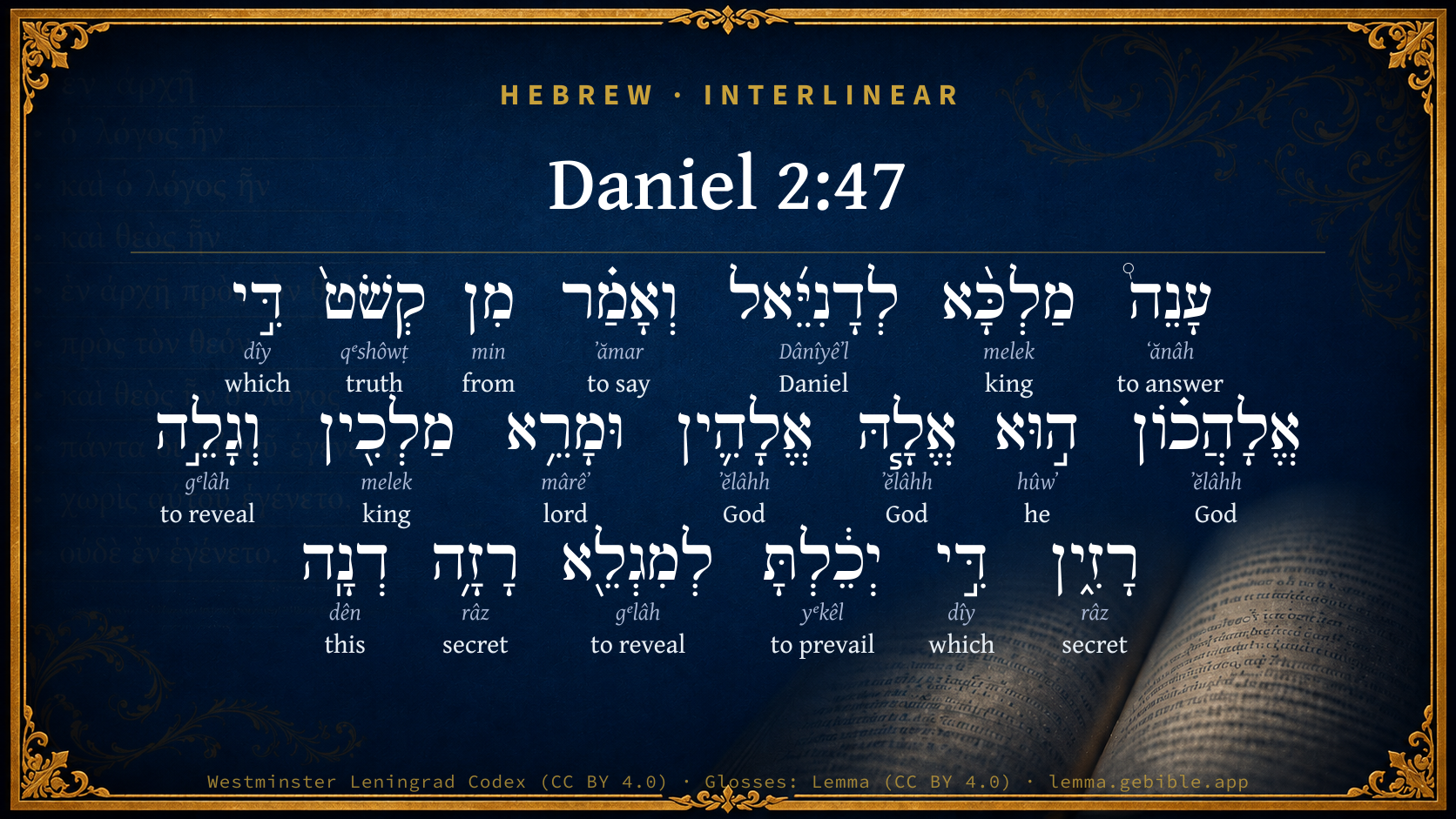
Hebrew (Westminster Leningrad Codex) Daniel 2:47 appears in the Hebrew Old Testament. The text above is from the Westminster Leningrad Codex. Each word links to its Strong’s number, a concise gloss, and parsing drawn from the Open Scriptures Hebrew Bible morphology. Click any word for its full Brown-Driver-Briggs (BDB) entry.
Download image
Cite this verse

Daniel 2:47 (World English Bible). Public Domain. Lemma interlinear Bible study tool, https://lemma.gebible.app/v/daniel/2/47.

Show BibTeX & RIS
BibTeX
RIS
English Translation
The king answered to Daniel, and said, Of a truth your God is the God of gods, and the Lord of kings, and a revealer of secrets, seeing you have been able to reveal this secret.
World English Bible · Public Domain
Highlights
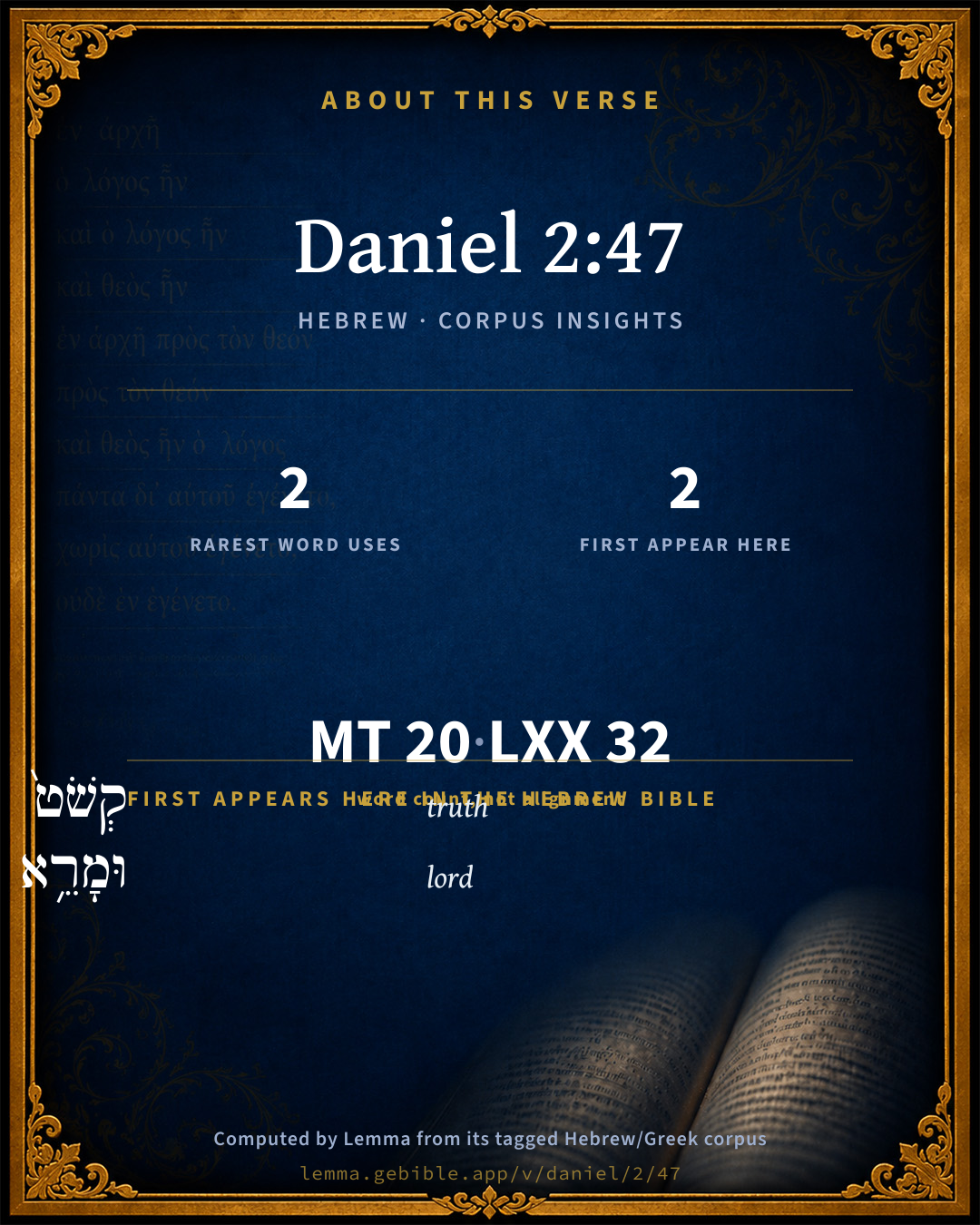
  • 2 first appearances in the Hebrew Bible
Full analysis ↓
Download a study sheet

One document with this verse’s original text, its word-by-word gloss line, the meaning frame, cross-references with their text, attributed commentary, and full source and license credits — printable, and it pastes into notes with its structure intact.

This verse Autodidact and up

Study sheet (.html) Plain text (.txt)

A passage Seminary Student

Up to 50 verses in one chapter. A passage sheet keeps up to 6 commentary sources and 12 cross-references per verse, in the order this page ranks them, and says so on the sheet whenever that leaves anything out. Ask for a single verse and you get the Autodidact verse sheet above.

Everything on this page stays free to read, with no account — the sheet is a download of what is already on screen, not access to it.

Want to remove ads? Support Godless Engineer
Compare translations 3

The same verse in 3 English versions, stacked beneath the original-language interlinear above. Click any original word for its lexicon entry.

Each is an independent rendering of the whole verse — the interlinear is not word-aligned to these translations.

Highlighted words mark where these versions differ — a whole-verse word diff, not a word-by-word alignment.

  • World English Bible Public Domain
    The king answered to Daniel, and said, Of a truth your God is the God of gods, and the Lord of kings, and a revealer of secrets, seeing you have been able to reveal this secret.
  • King James Version Public Domain
    The king answered unto Daniel, and said, Of a truth it is, that your God is a God of gods, and a Lord of kings, and a revealer of secrets, seeing thou couldest reveal this secret.
  • unfoldingWord Literal Text CC BY-SA 4.0
    The king answered and said to Daniel, “Truly your God is the God of gods and the Lord of kings, and the one who reveals mysteries, for you have been able to reveal this mystery.”

unfoldingWord Literal Text — © unfoldingWord, licensed CC BY-SA 4.0. Word-aligned USFM3 via Door43 (git.door43.org/unfoldingWord/en_ult).

Versions to compare (up to 4)

3 of 4 selected

Show all 18 translations

Every available English version of this verse, each an independent rendering of the whole verse.

  • World English Bible Public Domain
    The king answered to Daniel, and said, Of a truth your God is the God of gods, and the Lord of kings, and a revealer of secrets, seeing you have been able to reveal this secret.
  • Berean Standard Bible Public Domain
    The king said to Daniel, “Your God is truly the God of gods and Lord of kings, the Revealer of Mysteries, since you were able to reveal this mystery.”
  • Majority Standard Bible Public Domain
    The king said to Daniel, “Your God is truly the God of gods and Lord of kings, the Revealer of Mysteries, since you were able to reveal this mystery.”
  • King James Version Public Domain
    The king answered unto Daniel, and said, Of a truth it is, that your God is a God of gods, and a Lord of kings, and a revealer of secrets, seeing thou couldest reveal this secret.
  • American Standard Version (1901) Public Domain
    The king answered unto Daniel, and said, Of a truth your God is the God of gods, and the Lord of kings, and a revealer of secrets, seeing thou hast been able to reveal this secret.
  • Revised Version (1885) Public Domain
    The king answered unto Daniel, and said, Of a truth your God is the God of gods, and the Lord of kings, and a revealer of secrets, sing thou hast been able to reveal this secret.
  • Geneva Bible (1599) Public Domain
    Also the King answered vnto Daniel, and said, I know of a trueth that your God is a God of gods, and the Lord of Kings, and the reueiler of secrets, seeing thou couldest open this secret.
  • Douay-Rheims (1899) Public Domain
    And the king spoke to Daniel, and said: Verily your God is the God of gods, and Lord of kings, and a revealer of hidden things: seeing thou couldst discover this secret.
  • Young's Literal Translation Public Domain
    The king hath answered Daniel and said, `Of a truth `it is' that your God is a God of gods, and a Lord of kings, and a revealer of secrets, since thou hast been able to reveal this secret.'
  • Literal Standard Version CC BY-SA 4.0
    The king has answered Daniel and said, “Of a truth [it is] that your God is a God of gods, and a Lord of kings, and a revealer of secrets, since you have been able to reveal this secret.”
  • Unlocked Literal Bible CC BY-SA 4.0
    The king said to Daniel, “Truly your God is the God of gods, the Lord of kings, and the one who reveals mysteries, for you have been able to reveal this mystery.”
  • unfoldingWord Literal Text CC BY-SA 4.0
    The king answered and said to Daniel, “Truly your God is the God of gods and the Lord of kings, and the one who reveals mysteries, for you have been able to reveal this mystery.”
  • Darby Bible Public Domain
    The king answered Daniel and said, Of a truth it is that your God is the God of gods, and the Lord of kings, and a revealer of secrets, because thou wast able to reveal this secret.
  • World Messianic Bible Public Domain
    The king answered to Daniel, and said, “Of a truth your God is the God of gods, and the Lord of kings, and a revealer of secrets, since you have been able to reveal this secret.”
  • Webster's Bible Public Domain
    The king answered to Daniel, and said, Of a truth it is, that your God is a God of gods, and a Lord of kings, and a revealer of secrets, seeing thou couldst reveal this secret.
  • Free Bible Version CC BY-SA 4.0
    The king said to Daniel, “Truly, your God is the God of gods, the Lord of kings, the revealer of mysteries, for you have been able to reveal this mystery.”
  • Bible in Basic English Public Domain
    And the king made answer to Daniel and said, Truly, your God is a God of gods and a Lord of kings, and an unveiler of secrets, for you have been able to make this secret clear.
  • JPS Tanakh (1917) Public Domain
    The king spoke unto Daniel, and said: 'Of a truth it is, that your God is the God of gods, and the Lord of kings, and a revealer of secrets, seeing thou hast been able to reveal this secret.'

Literal Standard Version (2020), Covenant Press — licensed CC BY-SA 4.0. Text via the HelloAO Bible API (eBible.org). Unlocked Literal Bible (unfoldingWord) — licensed CC BY-SA 4.0. Text via the HelloAO Bible API (eBible.org). unfoldingWord Literal Text — © unfoldingWord, licensed CC BY-SA 4.0. Word-aligned USFM3 via Door43 (git.door43.org/unfoldingWord/en_ult). Free Bible Version, Dr. Jonathan Gallagher — licensed CC BY-SA 4.0. Text via the HelloAO Bible API (eBible.org).

Word by word

More ways to search: Search by grammar → Find every occurrence → Compare this word →

Practice this passage: Drill this verse → Learn its vocabulary →

קְשֹׁט֙
qᵉshôwṭ
H7187
“truth”
Adjective, N, Common
Part of Speech
Adjective
Gender
Common
Full BDB Definition

Origin: corresponding to H7189

TWOT: 2982

truth
  1. עָנֵה֩ ʻănâh H6032 “answering” Adjective, V
  2. מַלְכָּ֨א melek H4430 “king · the” Adjective, N, Common + Particle, Definite Article
  3. לְדָנִיֵּ֜אל Dânîyêʼl H1841 “to/for · Daniel” Adjective, R + Noun, Proper
  4. וְאָמַ֗ר ʼămar H560 “and · saying” Adjective, C + Verb, Qal, Participle Active, Masculine, Singular, Absolute
  5. מִן min H4481 “from” Adjective, R
  6. דִּ֣י dîy H1768 “which” Adjective, T
  7. אֱלָהֲכ֗וֹן ʼĕlâhh H426 “God · your” Adjective, N, Common + Suffix, Personal, 2nd Person, Masculine, Plural
  8. ה֣וּא hûwʼ H1932 “he” Adjective, T
  9. אֱלָ֧הּ ʼĕlâhh H426 “God of” Adjective, N, Common
  10. אֱלָהִ֛ין ʼĕlâhh H426 “gods” Adjective, N, Common
  11. וּמָרֵ֥א mârêʼ H4756 “and · lord of” Adjective, C + Noun, Common, Masculine, Singular, Construct
  12. מַלְכִ֖ין melek H4430 “kings” Adjective, N, Common
  13. וְגָלֵ֣ה gᵉlâh H1541 “and · revealing” Adjective, C + Verb, Qal, Participle Active, Masculine, Singular, Construct
  14. רָזִ֑ין râz H7328 “secrets” Adjective, N, Common
  15. דִּ֣י dîy H1768 “which” Adjective, C
  16. יְכֵ֔לְתָּ yᵉkêl H3202 “to prevail” Adjective, V, Plural
  17. לְמִגְלֵ֖א gᵉlâh H1541 “to reveal” Adjective, R + Verb, Qal, Infinitive Construct
  18. רָזָ֥ה râz H7328 “secret · the” Adjective, N, Common + Particle, Definite Article
  19. דְנָֽה dên H1836 “this” Adjective, P

About this verse

These counts appear in no published source. They are computed here, from the morphology-tagged text and Lemma’s own curated glosses. What Lemma adds →

20
words
14
distinct lemmas
Prophets
section

Notable vocabulary

The rarest word here is קְשֹׁט֙ truth H7187 — appearing just 2 times in the whole Hebrew Bible.

First appearance in Scripture

These words make their first canonical appearance in the Hebrew Bible here:

  • קְשֹׁט֙ truth H7187
  • וּמָרֵ֥א lord H4756

Shared distinctive vocabulary

קְשֹׁט֙ truth H7187 occurs in 2 verses of the Hebrew Bible. Also found in:

Grammatical profile

  • 3 verbs
  • 2 nouns
  • 13 adjectives
  • 2 particles

Verb forms

  • וְאָמַ֗ר Qal · Participle Active
  • וְגָלֵ֣ה Qal · Participle Active
  • לְמִגְלֵ֖א Qal · Infinitive Construct

Repetition

Words recur within this verse — often emphatic in Hebrew:

  • אֱלָהֲכ֗וֹן God H426 ×3
  • מַלְכָּ֨א king H4430 ×2
  • וְגָלֵ֣ה to reveal H1541 ×2
  • רָזִ֑ין secret H7328 ×2
  • דִּ֣י which H1768 ×2

Hebrew & Septuagint length

In English translation the verse runs 36 words from the Hebrew and 34 from the Septuagint (LXX English) — closely comparable.

A rough comparison of the two English renderings, which tokenize alike — not a word-level alignment.

Word counts can differ between the Hebrew and the Greek without any difference in meaning — e.g. the Hebrew direct-object marker אֵת has no separate Greek word, and Greek often adds the article ὁ.

In the original languages it is 20 Hebrew tokens and 32 Greek tokens — but the two are counted differently (Hebrew bundles its prefixes and suffixes into one token; the Greek is in lemma form), so that isn’t a like-for-like length.

Cross-references

23

Topical passages linked to Daniel 2:47 in the Treasury of Scripture Knowledge — connected by theme and wording, ordered by reader-vote popularity; previews shown in the World English Bible.

  • Daniel 2:22 he reveals the deep and secret things; he knows what is in the darkness, and the light dwells with him.
  • Daniel 2:28 but there is a God in heaven who reveals secrets, and he has made known to the king Nebuchadnezzar what shall be in the latter days. Your dream, and the visions of your head on your bed, are these:
  • Amos 3:7 Surely the Lord Yahweh will do nothing, Unless he reveals his secret to his servants the prophets.
  • Deuteronomy 10:17 For Yahweh your God, he is God of gods, and Lord of lords, the great God, the mighty, and the awesome, who doesn't regard persons, nor takes reward.
  • Daniel 11:36 The king shall do according to his will; and he shall exalt himself, and magnify himself above every god, and shall speak marvelous things against the God of gods; and he shall prosper until the indignation be accomplished; for that which is determined shall be done.
  • Genesis 41:39 Pharaoh said to Joseph, "Because God has shown you all of this, there is none so discreet and wise as you.
  • Psalms 72:11 Yes, all kings shall fall down before him. All nations shall serve him.
  • Psalms 82:1 God presides in the great assembly. He judges among the gods.
  • Psalms 136:2 Give thanks to the God of gods; For his loving kindness endures forever.
  • Daniel 2:37 You, O king, are king of kings, to whom the God of heaven has given the kingdom, the power, and the strength, and the glory;
  • Daniel 4:8–9 But at the last Daniel came in before me, whose name was Belteshazzar, according to the name of my god, and in whom is the spirit of the holy gods: and I told the dream before him, [saying],
  • 1 Timothy 6:15 which in its own times he will show, who is the blessed and only Ruler, the King of kings, and Lord of lords;
  • Revelation 1:5 and from Jesus Christ, the faithful witness, the firstborn of the dead, and the ruler of the kings of the earth. To him who loves us, and washed us from our sins by his blood;
  • Revelation 17:14 These will war against the Lamb, and the Lamb will overcome them, for he is Lord of lords, and King of kings. They also will overcome who are with him, called and chosen and faithful."
  • Revelation 19:16 He has on his garment and on his thigh a name written, "KING OF KINGS, AND LORD OF LORDS."
  • Joshua 22:22 The Mighty One, God, Yahweh, the Mighty One, God, Yahweh, he knows; and Israel he shall know: if it be in rebellion, or if in trespass against Yahweh (don't save us this day),
  • Job 12:19 He leads priests away stripped, And overthrows the mighty.
  • Psalms 2:10–11 Now therefore be wise, you kings. Be instructed, you judges of the earth.
  • Proverbs 8:15–16 By me kings reign, And princes decree justice.
  • Daniel 2:19 Then was the secret revealed to Daniel in a vision of the night. Then Daniel blessed the God of heaven.
  • Daniel 4:17 The sentence is by the decree of the watchers, and the demand by the word of the holy ones; to the intent that the living may know that the Most High rules in the kingdom of men, and gives it to whoever he will, and sets up over it the lowest of men.
  • Daniel 4:32 and you shall be driven from men; and they dwelling shall be with the animals of the field; you shall be made to eat grass as oxen; and seven times shall pass over you; until you know that the Most High rules in the kingdom of men, and gives it to whoever he will.
  • Daniel 4:25 that you shall be driven from men, and your dwelling shall be with the animals of the field, and you shall be made to eat grass as oxen, and shall be wet with the dew of the sky, and seven times shall pass over you; until you know that the Most High rules in the kingdom of men, and gives it to whoever he will.

Cross-references courtesy of OpenBible.info (CC BY 4.0).

Hebrew and Greek witnesses Masoretic Hebrew ↔ Greek Septuagint

The same verse in the two great witnesses to the Old Testament, shown verse-for-verse.

These are two independent witnesses, not word-aligned to each other, and the Septuagint is shown in lemma (dictionary) form.

Hebrew Daniel 2:47 Masoretic · Westminster Leningrad Codex

עָנֵה֩ מַלְכָּ֨א לְדָנִיֵּ֜אל וְאָמַ֗ר מִן קְשֹׁט֙ דִּ֣י אֱלָהֲכ֗וֹן ה֣וּא אֱלָ֧הּ אֱלָהִ֛ין וּמָרֵ֥א מַלְכִ֖ין וְגָלֵ֣ה רָזִ֑ין דִּ֣י יְכֵ֔לְתָּ לְמִגְלֵ֖א רָזָ֥ה דְנָֽה

The king answered to Daniel, and said, Of a truth your God is the God of gods, and the Lord of kings, and a revealer of secrets, seeing you have been able to reveal this secret.

World English Bible · Public Domain

Greek LXX Daniel 2:47 Septuagint · lemma form

καί ἐκφωνέω ὁ βασιλεύς πρός ὁ δανιηλ εἶπον ἐπί ἀλήθεια εἰμί ὁ θεός σύ θεός ὁ θεός καί κύριος ὁ βασιλεύς ὁ ἐκφαίνω μυστήριον κρυπτός μόνος ὅτι δύναμαι δηλόω ὁ μυστήριον οὗτος

And the king answered and said to Daniel, Of a truth your God is a God of gods, and Lord of kings, who reveals mysteries; for you have been able to reveal this mystery.

LXX2012 (modern English Septuagint) · Public Domain

Hebrew: Westminster Leningrad Codex (CC BY 4.0). Greek: Septuagint (public domain); English from LXX2012 (modern English Septuagint) (Public Domain). How the Septuagint differs from the Hebrew →

Commentary

Notes on Daniel 2:47 from classic Christian and Jewish commentators (each source and its license shown beneath its notes). The classic Christian expositions comment on the surrounding passage and are grouped to its opening verse, so a note may address several verses; the Jewish commentaries on the Tanakh (Rashi and others) are per-verse, so they appear only where the commentator wrote on this verse.

Lemma curates 59 commentaries, every one of them public domain or Creative Commons licensed, each selected and text-cleaned for this edition rather than reprinted as found. About our sources →

Trapp's Complete Commentary

John Trapp

Dan 2:47 The king answered unto Daniel, and said, Of a truth [it is], that your God [is] a God of gods, and a Lord of kings, and a revealer of secrets, seeing thou couldest reveal this secret.

Ver. 47. The king answered unto Daniel.] Who dissuaded him, with all his might, from doing on that sort, and inculcated that God was the chief doer.

Of a truth it is, that your God is a God of gods.] Hoc fuit momentaneum, saith Calvin; this was but a flash, such as was found in Pharaoh, Saul, and other temporaries; for if it had been in truth, he would not have set up the golden idol, &c. {Dan 3:1} Nevertheless Nebuchadnezzar showed more ingenuity than our stiff unpersuadable refractories, and especially than the perverse Jesuits, of whom it is noted that they are so cross grained and quarrelsome that they had rather quaerere than credere, start questions than believe truth, and pertinaciously dispute than rest in the plainest interpretations.

John Trapp, A Commentary or Exposition upon All the Books of the Old and New Testament (1647–1656) — public domain. Text from a community e-Sword module.

Joseph Benson's Commentary

Dan 2:47-48. Of a truth it is, that your God is a God of gods — Such a God as there is no other; above all gods in dignity, over all gods in dominion. And a Lord of kings — From whom they derive their power, and to whom they are accountable: the supreme Governor of the world, and Ruler of all the kings and kingdoms in it. And a revealer of secrets — One who sees and can bring to light what is most secret; seeing thou couldest reveal this secret — Couldest discover a matter, which it would have been impossible for thee to discover, if God had not revealed it to thee. Then the king made Daniel a great man — Or magnified him, as the original expression means. God made Daniel a great man indeed, when he took him into such intimate communion with himself, a much greater man than Nebuchadnezzar could make him; but because God had honoured him, therefore the king honoured him too. And gave him many great gifts — Which Daniel had no reason to refuse, since they put him into the greater capacity of doing good to his brethren in captivity. These gifts were no more than grateful returns from the king for the good services Daniel had done him, and were not desired or aimed at by Daniel, as the rewards of divination were by Balaam. And made him ruler over the whole province of Babylon — Which, no doubt, had a mighty influence upon the other provinces; and chief of the governors over all the wise men — Constituted him the chief ruler and inspector of them who were students and professors of learning and wisdom. We are not to suppose that this holy prophet, in the exercise of the office now assigned him, would give any countenance or encouragement to any who practised unlawful arts and divinations: rather he would do all in his power to abolish all such practices, and would instruct those of whom he had the oversight in the knowledge of the one living and true God, and in that wisdom which has him for its author and its end.

Joseph Benson's Commentary on the Old and New Testaments (1811–1818) — public domain. Text from a community e-Sword module.

Tyndale Open Study Notes

Tyndale Open Resources

2:47 greatest of gods . . . Lord over kings: Nebuchadnezzar repaid the compliment (2:37-38), acknowledging by his words and actions (2:46) that God is supreme over all, even over Nebuchadnezzar himself.

Tyndale Open Study Notes — © Tyndale Open Resources, licensed CC BY-SA 4.0. Text via the HelloAO Bible API.

Ibn Ezra

Rabbi Abraham ibn Ezra

[Daniel 2:47] ʿAneh malka... min keshot (עָנֵה מַלְכָּא... מִן־קְשֹׁט - The king answered... Truly): [The word] K'shot [means] words of truth (imrei emet - אִמְרֵי אֱמֶת).

Ibn Ezra on the Tanakh — English translations: “Sefaria Community Translation” (CC0 1.0 (public-domain dedication)); “Yalkut, Sifsei Chachomim Chumash, Metsudah Publications, 2009” (CC BY 4.0); and “Commentary of Ibn Ezra on Isaiah - trans. by M. Friedlander, 1873” (public domain). Text via Sefaria.

Geneva Bible (1599)

Geneva Bible translators

This confession was but a sudden motion, as it was also in Pharaoh, Exod. 9:28, but his heart was not touched, as appeared soon afterward.

Geneva Bible (1599) marginal notes — public domain. Text via Bolls.life.

Jamieson, Fausset & Brown

Robert Jamieson, A. R. Fausset & David Brown

Lord of kings--The world power shall at last have to acknowledge this (Rev 17:14; Rev 19:16); even as Nebuchadnezzar, who had been the God-appointed "king of kings" (Dan 2:37), but who had abused the trust, is constrained by God's servant to acknowledge that God is the true "Lord of kings."

Jamieson, Fausset & Brown — Commentary Critical and Explanatory on the Whole Bible (1871) — public domain (CC PDM 1.0). Text via the HelloAO Bible API.

Adam Clarke's Commentary

Verse 47. Your God is a God of gods] He is greater than all others.

And a Lord of kings] He governs both in heaven and earth.

Adam Clarke's Commentary on the Bible (1810–1826) — public domain. Text from a community e-Sword/MySword module.

John Calvin's Commentaries

This confession is quite pious and holy, and is fraught with rectitude and sincerity; it may even be taken as a proof of true conversion and repentance. But, as I have lately reminded you, profane men are sometimes seized with an admiration of God and then they profess largely and copiously whatever may be expected from God’s true worshippers. Still this is but momentary, for all the while they remain wrapt up in their own superstitions. God, therefore, extorts this language from them, when they speak so piously; but they inwardly retain their faults, and afterwards easily fall back to their accustomed habits — as a memorable example will shortly prove to us. Whatever sense be adopted, God wished his glory to be proclaimed by the mouth of the profane king, and desired him to be the herald of his own power and influence. But this was peculiarly profitable to those Jews who still remained firm in their allegiance; for the greater part had revolted — notoriously enough, and had degenerated with great facility from the pure worship of God. When led into captivity, they became idolaters and apostates, and denied the living God; but a small number of the pious remained; God wished to promote their benefit, and to strengthen their minds when he drew this confession from the king of Babylon. But another object was gained, since the king as well as all the Chaldeans and Assyrians were rendered more excuseless. For if the God of Israel was truly God, why did Bel in the meantime retain his rank? He is the God of gods — then it must be added at once, he is the enemy of false gods. We observe how Nebuchadnezzar here mingles light with darkness, and black with white, while he confesses the God of Israel to be supreme among gods, and set continues to worship other deities. For if the God of Israel obtains his right, all idols vanish away. Hence, Nebuchadnezzar contends with himself in this language. But, as I have said, he is seized by a violent impulse, and is not quite in his senses when he so freely declares the power of the only God.

As far then as words go, he says, truly your God is himself a God of gods The particle truly is by no means superfluous here; it is strongly affirmative. For if any one had inquired of him whether Bel and other idols were to be worshipped as gods, he might answer, “yes;” but doubtfully, and according to pre-conceived opinion, since all superstitious worshippers are perplexed, and if ever they defend their superstitons, they do so with the rashness which the devil suggests, but not according to their judgment. In truth, their minds are not composed when they dare to assert their own superstitions to be pious and holy. But Nebuchadnezzar seems here formally to renounce his own errors; as if he had said — Hitherto I acknowledged other gods, but I now change my opinion; I have discovered your God to be the chief of all gods. And, truly, if he really spoke his own mind, he might perceive he was doing injustice to his own idols, if there was any divinity in them; Israel’s God was confessedly held in utter hatred and abomination by the profane nations. By extolling him above all gods, he degrades Bel and the whole crew of false gods which the Babylonian worshipped. But, as we have said, he was swayed by impulse and spoke without thinking. He was in a kind of enthusiasm, since God astonished him, and then drew him on to wonder at and to declare his own power. He calls him Lord of kings, by which eulogium he claims for him the supreme dominion over the world; he means to assert that Israel’s God not only excels all others, but holds the reins of government over the world. For if he is the Lord of kings, all people are under his hand and dominion! and the multitude of mankind cannot be drawn away from his empire, if he rules their very monarchs. We understand, therefore, the meaning of these words, namely, whatever deity is worshipped is inferior to the God of Israel, because he is high above all gods; then his providence rules over the world, while he is Lord of all peoples and kings, and governs all things by his will.

He adds, he is a revealer of secrets This is our proof of Divinity, as we have said elsewhere. For Isaiah, when wishing to prove the existence of only one God, takes these two principles, viz., Nothing happens without his permission; and his foreseeing all things. (Daniel 48:3-5.) These two principles have been inseparably unified. Although Nebuchadnezzar did not understand what was the true peculiarity of Divinity, yet he is here impelled by the secret instinct of God’s Spirit clearly to set forth God’s power and wisdom. Hence he confesses the God of Israel to excel all gods, since he obtains power in the whole world, and nothing whatever is concealed from him. He adds the reason — Daniel could reveal that secret This reason does not seem very good one; for he infers the world to be governed by one God, because Daniel made this secret known. But, then “this has no reference to his power.” The answer to this remark is easy; we shewed elsewhere how we ought not to imagine a god like Apollo who can only predict future events. And, truly, it is far too insipid to attribute to God simple prescience, as if the events of the world had any other dependence than upon his power; for God is said to have a previous knowledge of future events, because he determined what he wished to have done. Hence Nebuchadnezzar concluded the dominion of the whole world to be in God’s hands, because he could predict futurity; for unless he had the full power over the future, he could not predict anything with certainty. As, therefore, he really predicts future; events, this clearly determines all things to be ordained by him, and disproves the existence of chance, while he fulfills whatever he has decreed.

Let us learn from this passage, how insufficient it is to celebrate God’s wisdom and power with noisy declamation, unless we at the same time reject all superstitions from our minds, and so cling to the only God as to bid all others heartily farewell. No fuller verbal confession can be required than is here set before us; and yet we observe how Nebuchadnezzar was always involved in Satan’s impostures, because he wished to retain his false gods, and thought it sufficient to yield the first place to the God of Israel. Let us learn again, to do our best in purging the mind front all superstitions, that the only God may pervade all our senses. Meanwhile, we must observe how severe and dreadful a judgment awaits Papists, and all like them, who at least ought to be imbued with the rudiments of piety, while they confess the existence of but one supreme God, and yet; mingle together a great multitude of deities, and dishonor both his power and wisdom, and at the same time observe, what is here said by a profane king. For the Papists not; only divide God’s power, by distributing it in parts to each of their saints; but also when they speak of God himself, they fancy him as knowing all things beforehand, and yet; leaving all things contingent on man’s free will; first creating all things, and then leaving every event in suspense. Hence heaven and earth, as they bear either men’s merits; or crimes, at one time become useful, and at another adverse to mankind. Truly enough, neither rain, nor heat, nor cloudy nor serene weather, nor anything else happens without God’s permission; and whatever is adverse is a sign of his curse; whatever is prosperous and desirable is the sign of his favor. This, indeed, is true, but when the Papists lay their foundation in the will of man, we see how they deprive God of his rights. Let us learn, then, from this passage, not to attribute to God less than was conceded by this profane king.

John Calvin's Commentaries (1540-1563) — public domain. Text from the Calvin Translation Society English edition (1840s-50s) via the Christian Classics Ethereal Library (ccel.org). Calvin's coverage is partial (roughly two-thirds of the Bible); uncommented books and verses are honest gaps, never fabricated. The 19th-century editor's footnotes and remarks are omitted so the notes are faithfully Calvin's own voice.

Ellicott's Commentary for English Readers

(47) God of gods.—He does not acknowledge Jehovah as the true God, but deems Him worthy of a place in the Babylonian Pantheon.

A Bible Commentary for English Readers, edited by Charles John Ellicott (1878–1897) — public domain. Text from a community e-Sword module.

The Cambridge Bible for Schools and Colleges

gen. ed. J. J. S. Perowne

47. a God … a Lord] the God … the Lord. Nebuchadnezzar acknowledges the supremacy of Daniel’s God over all other gods, and His sovereignty over all kings. ‘Lord of lords’ (bêl bêlê), and ‘Lord of gods’ (bêl ilâni), are titles often given by the Babylonian kings (including Nebuchadnezzar) to Marduk, the supreme god of Babylon; but it is doubtful whether the terms here used were chosen with allusion to the fact. ‘God of gods,’ as Deu_10:17; Psa_136:2; ch. Dan_11:36.

a revealer of secrets] as Daniel had averred, Dan_2:28; cf. Dan_5:22.

couldest] better, hast been able to.

The Cambridge Bible for Schools and Colleges (gen. ed. J. J. S. Perowne; Cambridge University Press, 1878–1918) — public domain. Text from a community e-Sword module.

John Gill's Exposition

The king answered unto Daniel,.... By which it appears that Daniel interposed and expostulated with the king, and prevented the oblation to him as a god, and instructed him in the knowledge of the true God he ought to worship; as the following confession of the king more clearly shows:

and said, of a truth it is, that your God is a God of gods; the God of Daniel and his companions, and of the people of the Jews, to whom they belonged, is above all gods that are named and worshipped by men: this appeared at this time for the present, though it did not last long, as the following chapter shows, a most glaring truth; that the God of Israel was above all his gods, and whom his magicians and people worshipped, and above all others:

and a Lord of kings; that rules over them, and disposes of them; sets them up and pulls them down at his pleasure; and transfers their kingdoms from one to another, as he learned by the interpretation of his dream, to which he may in this refer:

and a revealer of secrets, seeing thou couldest reveal this secret; of the dream, and the interpretation of it; which he could never have done, had not his God been a revealer of secrets, and revealed it to him.

John Gill's Exposition of the Whole Bible (1746–1763) — public domain (CC PDM 1.0). Text via the HelloAO Bible API.

Albert Barnes' Notes on the Bible

The king answered unto Daniel - Answered either what he had said in the interpretation of the dream, or “possibly” something that he had said in regard to the impropriety of offering this homage to him. Compare the notes at Dan 2:46. It is certain that, for some cause. whatever might have been the homage which he was disposed to render to Daniel, his thoughts were soon turned from him to the true God, and to an acknowledgment of him as superior to all other beings. He seems, at least, instantly to have reflected on what Daniel had himself said Dan 2:30, and to have remembered that religious homage was due, not to Daniel, but to the God who had communicated the secret to him.

Of a truth it is - It is truly so. This had been shown by the manner in which this secret was disclosed.

That your God is a God of gods - Is superior to all other gods; is supreme over all. Compare Rev 17:14; 1Ti 6:15. The idea is, that whatever subordinate beings there may be, He is supreme.

And a Lord of kings - Supreme over kings. They are all inferior to him, and subject to his control.

And a revealer of secrets - One of the attributes of divinity. See the notes at Dan 2:28.

Seeing thou couldest reveal this secret - A secret which the wisest men of the realm had sought in vain to disclose. The fact that a professed servant of God had been able to do this showed that God was himself supreme, and worthy of adoration. We have here, then, an instance in which a proud and haughty pagan monarch was brought to an acknowledgment of the true God, and was constrained to render him homage. This was a result which it was evidently intended to reach in the whole transaction; in the dream itself; in the fact that the wise men of Babylon could not interpret it; and in the fact that an acknowledged servant of the Most High had been enabled to make the disclosure. The instance is instructive, as showing to what extent a mind clearly not under the influence of any genuine piety - for subsequent events showed that no “permanent” effects were produced on him, and that he was still an idolater Dan. 3, and a most proud and haughty man Dan. 4 - may be brought to acknowledge God. See the remarks at the end of the Dan. 7.

Albert Barnes' Notes on the Bible (1834–1885) — public domain. Text from a community e-Sword/MySword module.

Haydock's Catholic Bible Commentary

Of gods, above all those of the country for explaining hidden things: yet he did not acknowledge him to be the only true God. (Calmet) --- He afterwards erected an idol to represent his own greatness. (Worthington)

George Leo Haydock (1774–1849), Haydock's Catholic Family Bible and Commentary, 1859 edition — public domain. Excludes Psalms (Douay-Rheims chapter numbering differs from Protestant) and Deuterocanonical books (Catholic canon only).

Matthew Poole's English Annotations

A God of gods; the greatest and supreme God of all the world, above Baal, or Bel, and above all other gods.

A Lord of kings; the word is Maron or Maran, which in the Syriac signifies Lord, or high Lord, seeing he is the highest King of all the earth. He makes, overrules, and pulls down whom he will, 1Ti 6:15; Rev 17:14; 19:16; by this he gathers that God is a

revealer of secrets, Isa 48:3,5-8. A revealer of secrets; is supreme God, because he knows, and foreknows, and decrees all things future.

Seeing thou couldest reveal this secret; therefore Daniel had it from God, who revealed it to him, which here the king confesseth.

Matthew Poole's English Annotations on the Holy Bible (1683–1685) — public domain. Text from a community e-Sword/MySword module.

Whedon's Commentary on the Bible

Daniel D. Whedon

47. This verse proves that the “worship” of Dan_2:46 was not to Daniel, but, as Augustine said, through him to the God whose representative he was; just as Nebuchadnezzar reverenced a living God behind the image to which he was accustomed to pour out libations. Of course Nebuchadnezzar’s words are no indication that he had turned monotheist. He was accustomed to use these titles when speaking of any one of the great Babylonian deities.

Daniel D. Whedon (gen. ed.), Commentary on the Old and New Testaments (1874–1909) — public domain. Text from a community e-Sword module.

The Pulpit Commentary

The king answered unto Daniel, and said, Of a truth it is, that your God is a God of gods, and a Lord of kings, and a Revealer of secrets, seeing thou couldest reveal this secret. The versions do not exhibit any important variation from the Massoretic text. We must observe the plural form of the pronoun "your," implying the Hebrew nation as a whole, or at all events the three youths along with Daniel. It must be noted that the titles are not in the emphatic state, but are simply absolute, implying that Nebuchadnezzar simply placed the God of heaven, the God of Daniel, in his pantheon, as one of the superior gods. The historical difficulty that some have seen in Nebuchadnezzar making this confession to God, and yet straightway framing a golden image, is due to a failure to understand the attitude of a polytheist to his gods. To the heathen his god is a person he is afraid of, much more powerful than he is himself, able to do him much ill, or, on the other hand, able to bestow upon him much good, but able to be deceived, cajoled, and flattered. In worshipping his deities the heathen feels that any breach of sacred etiquette in regard to any deity is far more certain of bringing down the vengeance of the aggrieved power than any crime, however heinous. He would be most potent in prayer who could go over all the deities of the pantheon, and give to each his or her appropriate title. Thus the Hindus tell tales of fakirs whose power over the gods was due to this. One of the forms of this religious etiquette was to address each deity as if he were the supreme god who alone deserved worship. Lenormant ("Los Premieres Civilizations," 2:159) gives an address to the god Hourki, or Sin, in which he is called "prince of the gods of heaven and earth, the good god, the great god, lather of gods and men, the lord who extends his power over heaven and earth" In the same work (p. 178) there is an address to Marduk (Merodach), the favourite deity of Nebuchadnezzar, in which he is called "god of gods, king of heaven and earth." A little further on in the same work (p. 18t) Nebu is called "the supreme intelligence, scribe of the universe, who bears the supreme sceptre, the interpreter of the celestial spheres." In p. 189 Nergal is addressed as "great prince of the greatest gods, who has brought up the greatest gods." In his "La Magie," p. 175, he gives an address to Silik-mulu-ki, regarded as an Accadian name of Marduk, in which he is called "god of gods." In his "Hibbert Lecture," pp. 97-104, Professor Sayce, on the contrast between the religion of Babylon and that of Persia in this respect, says that Nebuchadnezzar calls Merodach "lord of all," yet declares him the "son of the gods." The same titles are given to Merodach and to Samas, and yet Samas is distinct from Merodach he is his comrade in the struggle with the assailants of Otis, the moon-god. At the same time, we must observe the limitations of Nebuchadnezzar"s praise it is simply as the Revealer of secrets that he praises and honours the God of Daniel.

The Pulpit Commentary (1880–1919), ed. H.D.M. Spence-Jones & Joseph S. Exell — public domain. Text from a community e-Sword module.

John Wesley's Explanatory Notes

God of gods - The supreme God of all the world, above Baal and all other gods. Lord of kings - The word in the Syriack signifies, high Lord, seeing he is the highest king of all the earth.

John Wesley, Explanatory Notes Upon the Whole Bible (1754–1765) — public domain. Text via the GEBible commentary corpus.

Rashi

Rabbi Shlomo Yitzchaki (Rashi)

truly [as translated,] in truth.

and the Master of the kings The Lord of lords.

this secret [as translated,] this secret.

Rashi on the Tanakh — English translations: “The Judaica Press complete Tanach with Rashi, translated by A. J. Rosenberg” (CC BY 4.0); “Pentateuch with Rashi's commentary by M. Rosenbaum and A.M. Silbermann, 1929-1934” (public domain); “The Metsudah Tanach series, Lakewood, N.J” (CC BY 4.0); and “The Book of Joshua, Metsudah Publications, 1997” (CC BY 4.0). Text via Sefaria.

Lesson kit

Teaching starters — assembled from the data on this page, not authored interpretation. Every prompt links to the verse data it draws on. Edit before teaching.

Daniel, in the Prophets, opens this verse with 20 words (14 distinct Hebrew lemmas). Its most distinctive word is qᵉshôwṭ (“truth”). A historical commentator’s framing appears above. Read the whole chapter for the surrounding context.

Discussion questions

  1. What does “truth” (qᵉshôwṭ) contribute to the verse as a whole?
  2. 2 words here appear for the first time in Scripture. What is being introduced at this debut?
  3. Daniel 4:37 shares the word «truth» with this verse. How do the two illuminate each other?
  4. “God” occurs 3× in this one verse. What is the effect of the repetition?
  5. The translations on this page render this verse differently — a whole-verse word diff, not a word-by-word alignment. What might account for the different wordings?
  6. The verb «וְאָמַ֗ר» is Qal Participle Active. How does its form color the action?
  7. Reading how Trapp's Complete Commentary and Joseph Benson's Commentary read this verse, where do the two commentators agree and where do they part?

Things to notice

Reading settings

Reading text

Shown beneath each verse's original-language words.

Old Testament
Old Testament edition

Read the OT as the Masoretic Hebrew (MT) or the Greek Septuagint (LXX).

English shown for the Greek Septuagint (in the Hebrew ↔ Greek comparison).

Comparing translations? Open the Compare panel on any verse page to stack up to four side by side.