
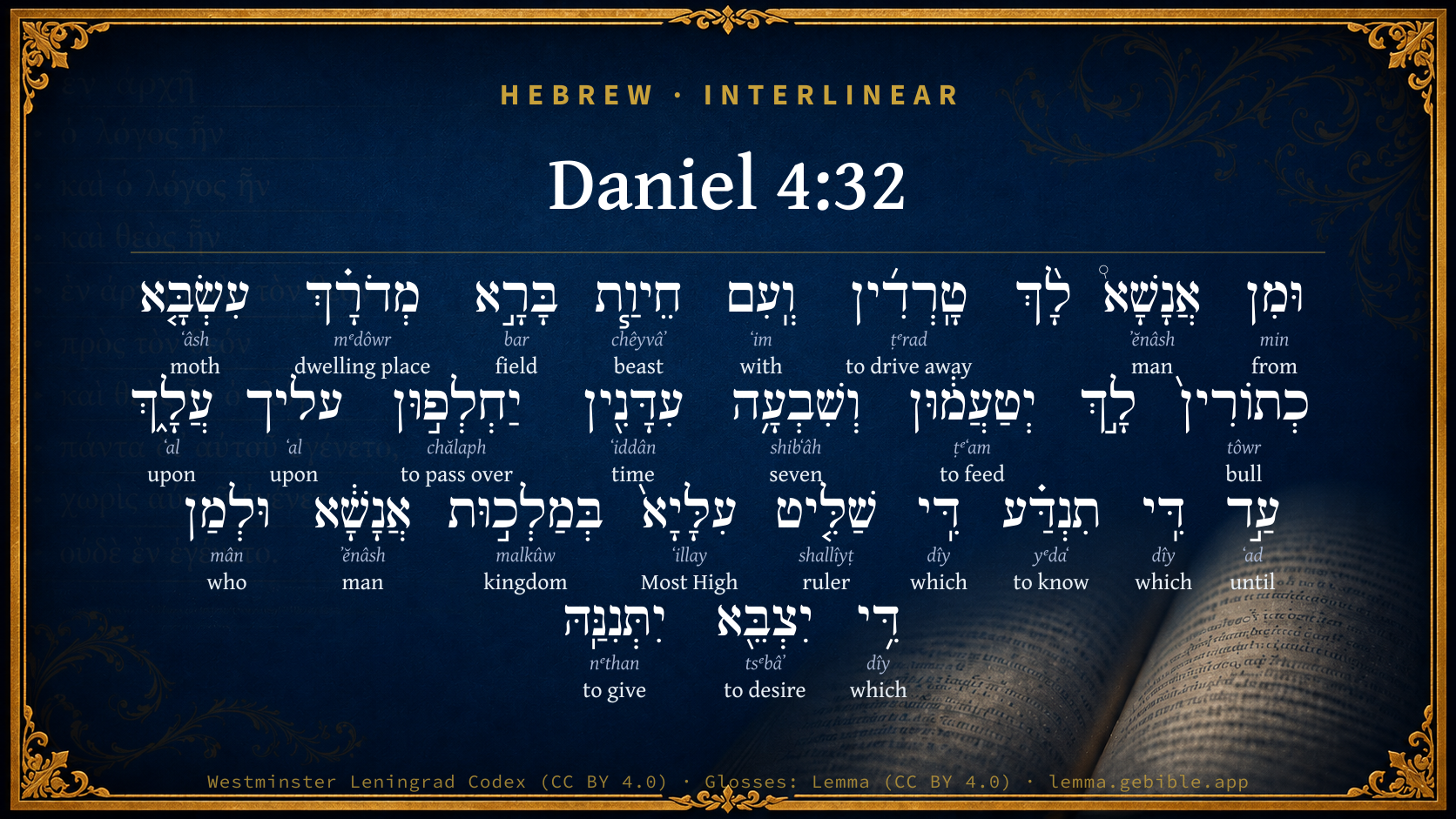
Daniel 4:32

Hebrew (Westminster Leningrad Codex) Daniel 4:32 appears in the Hebrew Old Testament. The text above is from the Westminster Leningrad Codex. Each word links to its Strong’s number, a concise gloss, and parsing drawn from the Open Scriptures Hebrew Bible morphology. Click any word for its full Brown-Driver-Briggs (BDB) entry.
Download image
Cite this verse

Daniel 4:32 (World English Bible). Public Domain. Lemma interlinear Bible study tool, https://lemma.gebible.app/v/daniel/4/32.

Show BibTeX & RIS
BibTeX
RIS
English Translation
and you shall be driven from men; and they dwelling shall be with the animals of the field; you shall be made to eat grass as oxen; and seven times shall pass over you; until you know that the Most High rules in the kingdom of men, and gives it to whoever he will.
World English Bible · Public Domain
Download a study sheet

One document with this verse’s original text, its word-by-word gloss line, the meaning frame, cross-references with their text, attributed commentary, and full source and license credits — printable, and it pastes into notes with its structure intact.

This verse Autodidact and up

Study sheet (.html) Plain text (.txt)

A passage Seminary Student

Up to 50 verses in one chapter. A passage sheet keeps up to 6 commentary sources and 12 cross-references per verse, in the order this page ranks them, and says so on the sheet whenever that leaves anything out. Ask for a single verse and you get the Autodidact verse sheet above.

Everything on this page stays free to read, with no account — the sheet is a download of what is already on screen, not access to it.

Want to remove ads? Support Godless Engineer
Compare translations 3

The same verse in 3 English versions, stacked beneath the original-language interlinear above. Click any original word for its lexicon entry.

Each is an independent rendering of the whole verse — the interlinear is not word-aligned to these translations.

Highlighted words mark where these versions differ — a whole-verse word diff, not a word-by-word alignment.

  • World English Bible Public Domain
    and you shall be driven from men; and they dwelling shall be with the animals of the field; you shall be made to eat grass as oxen; and seven times shall pass over you; until you know that the Most High rules in the kingdom of men, and gives it to whoever he will.
  • King James Version Public Domain
    And they shall drive thee from men, and thy dwelling shall be with the beasts of the field: they shall make thee to eat grass as oxen, and seven times shall pass over thee, until thou know that the most High ruleth in the kingdom of men, and giveth it to whomsoever he will.
  • unfoldingWord Literal Text CC BY-SA 4.0
    You will be driven away from men, and your dwelling will be with the animals of the field. You will be made to eat grass like an ox. Seven periods of time will pass over you until you acknowledge that the Most High is ruler over the kingdom of men and he gives it to whom he wishes.”

unfoldingWord Literal Text — © unfoldingWord, licensed CC BY-SA 4.0. Word-aligned USFM3 via Door43 (git.door43.org/unfoldingWord/en_ult).

Versions to compare (up to 4)

3 of 4 selected

Show all 18 translations

Every available English version of this verse, each an independent rendering of the whole verse.

  • World English Bible Public Domain
    and you shall be driven from men; and they dwelling shall be with the animals of the field; you shall be made to eat grass as oxen; and seven times shall pass over you; until you know that the Most High rules in the kingdom of men, and gives it to whoever he will.
  • Berean Standard Bible Public Domain
    You will be driven away from mankind to live with the beasts of the field, and you will feed on grass like an ox. And seven times will pass you by, until you acknowledge that the Most High rules over the kingdom of mankind and gives it to whom He wishes.”
  • Majority Standard Bible Public Domain
    You will be driven away from mankind to live with the beasts of the field, and you will feed on grass like an ox. And seven times will pass you by, until you acknowledge that the Most High rules over the kingdom of mankind and gives it to whom He wishes.”
  • King James Version Public Domain
    And they shall drive thee from men, and thy dwelling shall be with the beasts of the field: they shall make thee to eat grass as oxen, and seven times shall pass over thee, until thou know that the most High ruleth in the kingdom of men, and giveth it to whomsoever he will.
  • American Standard Version (1901) Public Domain
    and thou shalt be driven from men; and they dwelling shall be with the beasts of the field; thou shalt be made to eat grass as oxen; and seven times shall pass over thee; until thou know that the Most High ruleth in the kingdom of men, and giveth it to whomsoever he will.
  • Revised Version (1885) Public Domain
    and thou shalt be driven from men, and thy dwelling shall be with the beasts of the field; thou shalt be made to eat grass as oxen, and seven times shall pass over thee; until thou know that the Most High ruleth in the kingdom of men, and giveth it to whomsoever he will.
  • Geneva Bible (1599) Public Domain
    And all the inhabitants of the earth are reputed as nothing: and according to his will he worketh in the armie of heauen, and in the inhabitants of the earth: and none can stay his hand, nor say vnto him, What doest thou?
  • Douay-Rheims (1899) Public Domain
    And they shall cast thee out from among men, and thy dwelling shall be with cattle and wild beasts: thou shalt eat grass like an ox, and seven times shall pass over thee, till thou know that the most High ruleth in the kingdom of men, and giveth it to whomsoever he will.
  • Young's Literal Translation Public Domain
    and from men they are driving thee away, and with the beast of the field `is' thy dwelling, the herb as oxen they do cause thee to eat, and seven times do pass over thee, till that thou knowest that the Most High is ruler in the kingdom of men, and to whom He willeth He giveth it.
  • Literal Standard Version CC BY-SA 4.0
    and from men they are driving you away, and your dwelling [is] with the beast of the field, they cause you to eat the herb as oxen, and pass over you seven times, until you know that the Most High is ruler in the kingdom of men, and to whom He wills He gives it.”
  • Unlocked Literal Bible CC BY-SA 4.0
    You will be driven away from people, and your home will be with the wild animals in the fields. You will be made to eat grass like an ox. Seven years will pass until you acknowledge that the Most High rules over the kingdoms of people and he gives them to anyone he wishes.”
  • unfoldingWord Literal Text CC BY-SA 4.0
    You will be driven away from men, and your dwelling will be with the animals of the field. You will be made to eat grass like an ox. Seven periods of time will pass over you until you acknowledge that the Most High is ruler over the kingdom of men and he gives it to whom he wishes.”
  • Darby Bible Public Domain
    and they shall drive thee from men, and thy dwelling shall be with the beasts of the field; they shall make thee to eat grass as oxen, and seven times shall pass over thee, until thou know that the Most High ruleth over the kingdom of men, and giveth it to whomsoever he will.
  • World Messianic Bible Public Domain
    You shall be driven from men, and your dwelling shall be with the animals of the field. You shall be made to eat grass like oxen. Seven times shall pass over you, until you know that the Most High rules in the kingdom of men, and gives it to whomever he will.’”
  • Webster's Bible Public Domain
    And they shall drive thee from men, and thy dwelling shall be with the beasts of the field: they shall make thee to eat grass as oxen, and seven times shall pass over thee, until thou shalt know that the most High ruleth in the kingdom of men, and giveth it to whomsoever he will.
  • Free Bible Version CC BY-SA 4.0
    You will be driven away from human society and you will live with the wild animals. You will eat grass like the cattle, and you will become soaked with the dew of heaven. You will be like this for seven times until you acknowledge that the Most High rules over human kingdoms, and that he gives them to whoever he chooses.”
  • Bible in Basic English Public Domain
    And they will send you out from among men, to be with the beasts of the field; they will give you grass for your food like the oxen, and seven times will go by you, till you are certain that the Most High is ruler in the kingdom of men, and gives it to any man at his pleasure.
  • JPS Tanakh (1917) Public Domain
    (4-29) And thou shalt be driven from men, and thy dwelling shall be with the beasts of the field; thou shalt be made to eat grass as oxen, and seven times shall pass over thee; until thou know that the Most High ruleth in the kingdom of men, and giveth it to whomsoever He will.'

Literal Standard Version (2020), Covenant Press — licensed CC BY-SA 4.0. Text via the HelloAO Bible API (eBible.org). Unlocked Literal Bible (unfoldingWord) — licensed CC BY-SA 4.0. Text via the HelloAO Bible API (eBible.org). unfoldingWord Literal Text — © unfoldingWord, licensed CC BY-SA 4.0. Word-aligned USFM3 via Door43 (git.door43.org/unfoldingWord/en_ult). Free Bible Version, Dr. Jonathan Gallagher — licensed CC BY-SA 4.0. Text via the HelloAO Bible API (eBible.org).

Word by word

More ways to search: Search by grammar → Find every occurrence → Compare this word →

Practice this passage: Drill this verse → Learn its vocabulary →

טָֽרְדִ֜ין
ṭᵉrad
H2957
“driving away”
Adjective, V
Part of Speech
Adjective
Full BDB Definition

Origin: corresponding to H2956

TWOT: 2759

(Peal) to drive away, drive from, chase away
  1. וּמִן min H4481 “and · from” Adjective, C + Preposition
  2. אֲנָשָׁא֩ ʼĕnâsh H606 “man · the” Adjective, N, Common + Particle, Definite Article
  3. וְֽעִם ʻim H5974 “and · with” Adjective, C + Preposition
  4. חֵיוַ֧ת chêyvâʼ H2423 “beast of” Adjective, N, Common
  5. בָּרָ֣א bar H1251 “field · the” Adjective, N, Common + Particle, Definite Article
  6. מְדֹרָ֗ךְ mᵉdôwr H4070 “dwelling place · your” Adjective, N, Common + Suffix, Personal, 2nd Person, Masculine, Singular
  7. עִשְׂבָּ֤א ʻâsh H6211 “moth · the” Adjective, N, Common + Particle, Definite Article
  8. כְתוֹרִין֙ tôwr H8450 “like/as · bulls” Adjective, R + Noun, Common, Masculine, Plural, Absolute
  9. יְטַעֲמ֔וּן ṭᵉʻam H2939 “to feed” Adjective, V
  10. וְשִׁבְעָ֥ה shibʻâh H7655 “and · seven” Adjective, C + Adjective, Cardinal number, Both, Singular, Absolute
  11. עִדָּנִ֖ין ʻiddân H5732 “times” Adjective, N, Common
  12. יַחְלְפ֣וּן chălaph H2499 “to pass over” Adjective, V
  13. עליך ʻal H5922 “upon · you” Adjective, R + Suffix, Personal, 2nd Person, Masculine, Singular
  14. עֲלָ֑ךְ ʻal H5922 “upon · you” Adjective, R + Suffix, Personal, 2nd Person, Masculine, Singular
  15. עַ֣ד ʻad H5705 “until” Adjective, R
  16. דִּֽי dîy H1768 “which” Adjective, T
  17. תִנְדַּ֗ע yᵉdaʻ H3046 “to know” Adjective, V
  18. דִּֽי dîy H1768 “which” Adjective, T
  19. שַׁלִּ֤יט shallîyṭ H7990 “ruler” Adjective, A
  20. עִלָּיָא֙ ʻillay H5943 “Most High · the” Adjective, A + Particle, Definite Article
  21. בְּמַלְכ֣וּת malkûw H4437 “in/at · kingdom of” Adjective, R + Noun, Common, Feminine, Singular, Construct
  22. אֲנָשָׁ֔א ʼĕnâsh H606 “man · the” Adjective, N, Common + Particle, Definite Article
  23. וּלְמַן mân H4479 “and · to/for · who” Adjective, C + Preposition + Pronoun, Relative, Common, Singular
  24. דִּ֥י dîy H1768 “which” Adjective, P, Construct
  25. יִצְבֵּ֖א tsᵉbâʼ H6634 “to desire” Adjective, V
  26. יִתְּנִנַּֽהּ nᵉthan H5415 “to give · her” Adjective, V + Suffix, Personal, 3rd Person, Feminine, Singular

About this verse

These counts appear in no published source. They are computed here, from the morphology-tagged text and Lemma’s own curated glosses. What Lemma adds →

29
words
23
distinct lemmas
Prophets
section

Notable vocabulary

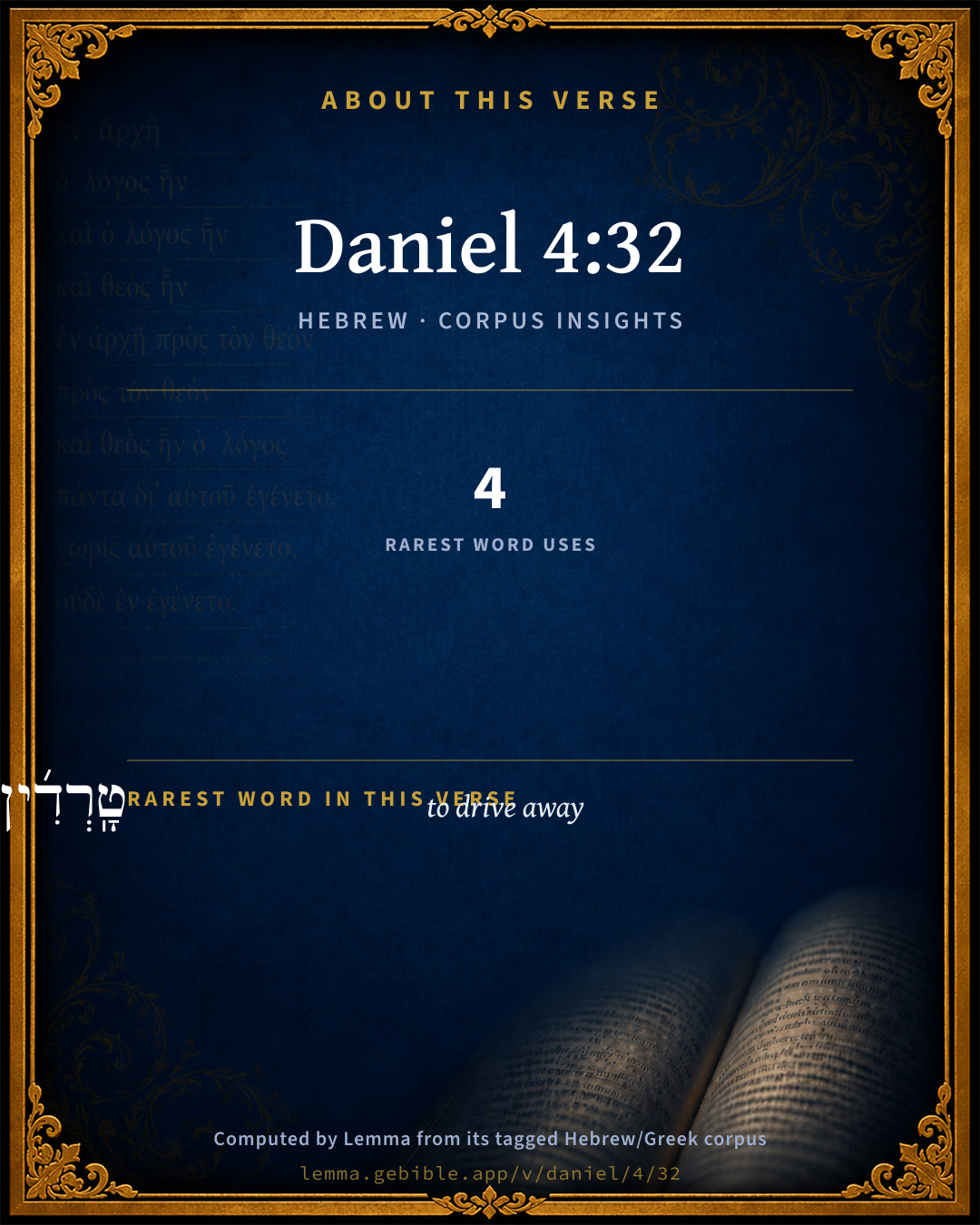
The rarest word here is טָֽרְדִ֜ין to drive away H2957 — appearing just 4 times in the whole Hebrew Bible.

Shared distinctive vocabulary

טָֽרְדִ֜ין to drive away H2957 occurs in 4 verses of the Hebrew Bible. Also found in:

Grammatical profile

  • 2 nouns
  • 19 adjectives
  • 1 pronoun
  • 2 prepositions
  • 5 particles

Repetition

Words recur within this verse — often emphatic in Hebrew:

  • אֲנָשָׁא֩ man H606 ×2
  • עליך upon H5922 ×2
  • דִּֽי which H1768 ×3

Hebrew & Septuagint length

In English translation the verse runs 54 words from the Hebrew and 47 from the Septuagint (LXX English) — closely comparable.

A rough comparison of the two English renderings, which tokenize alike — not a word-level alignment.

Word counts can differ between the Hebrew and the Greek without any difference in meaning — e.g. the Hebrew direct-object marker אֵת has no separate Greek word, and Greek often adds the article ὁ.

Cross-references

12

Topical passages linked to Daniel 4:32 in the Treasury of Scripture Knowledge — connected by theme and wording, ordered by reader-vote popularity; previews shown in the World English Bible.

  • Jeremiah 27:5 I have made the earth, the men and the animals that are on the surface of the earth, by my great power and by my outstretched arm; and I give it to whom it seems right to me.
  • Daniel 5:21 and he was driven from the sons of men, and his heart was made like the animals', and his dwelling was with the wild donkeys; he was fed with grass like oxen, and his body was wet with the dew of the sky; until he knew that the Most High God rules in the kingdom of men, and that he sets up over it whoever he will.
  • Job 12:18–21 He loosens the bond of kings, He binds their loins with a belt.
  • Proverbs 8:15–16 By me kings reign, And princes decree justice.
  • Exodus 8:10 He said, "Tomorrow." He said, "Be it according to your word, that you may know that there is none like Yahweh our God.
  • Exodus 9:29 Moses said to him, "As soon as I have gone out of the city, I will spread abroad my hands to Yahweh. The thunders shall cease, neither shall there be any more hail; that you may know that the earth is Yahweh's.
  • Joshua 4:24 that all the peoples of the earth may know the hand of Yahweh, that it is mighty; that you may fear Yahweh your God forever.
  • Exodus 9:14 For this time I will send all my plagues against your heart, against your officials, and against your people; that you may know that there is none like me in all the earth.
  • Isaiah 37:20 Now therefore, Yahweh our God, save us from his hand, that all the kingdoms of the earth may know that you are Yahweh, even you only.
  • Daniel 4:14–17 He cried aloud, and said thus, Hew down the tree, and cut off its branches, shake off its leaves, and scatter its fruit: let the animals get away from under it, and the fowls from its branches.
  • Daniel 4:25–26 that you shall be driven from men, and your dwelling shall be with the animals of the field, and you shall be made to eat grass as oxen, and shall be wet with the dew of the sky, and seven times shall pass over you; until you know that the Most High rules in the kingdom of men, and gives it to whoever he will.
  • Isaiah 45:3 and I will give you the treasures of darkness, and hidden riches of secret places, that you may know that it is I, Yahweh, who call you by your name, even the God of Israel.

Cross-references courtesy of OpenBible.info (CC BY 4.0).

Hebrew and Greek witnesses Masoretic Hebrew ↔ Greek Septuagint

The same verse in the two great witnesses to the Old Testament, shown verse-for-verse.

These are two independent witnesses, not word-aligned to each other, and the Septuagint is shown in lemma (dictionary) form.

Hebrew Daniel 4:32 Masoretic · Westminster Leningrad Codex

וּמִן אֲנָשָׁא֩ לָ֨ךְ טָֽרְדִ֜ין וְֽעִם חֵיוַ֧ת בָּרָ֣א מְדֹרָ֗ךְ עִשְׂבָּ֤א כְתוֹרִין֙ לָ֣ךְ יְטַעֲמ֔וּן וְשִׁבְעָ֥ה עִדָּנִ֖ין יַחְלְפ֣וּן עליך עֲלָ֑ךְ עַ֣ד דִּֽי תִנְדַּ֗ע דִּֽי שַׁלִּ֤יט עִלָּיָא֙ בְּמַלְכ֣וּת אֲנָשָׁ֔א וּלְמַן דִּ֥י יִצְבֵּ֖א יִתְּנִנַּֽהּ

and you shall be driven from men; and they dwelling shall be with the animals of the field; you shall be made to eat grass as oxen; and seven times shall pass over you; until you know that the Most High rules in the kingdom of men, and gives it to whoever he will.

World English Bible · Public Domain

Greek LXX Daniel 4:32 Septuagint · lemma form
and all the inhabitants of the earth are reputed as nothing: and he does according to his will in the army of heaven, and among the inhabitants of the earth: and there is none who shall withstand his power, and say to him, What has you done?

LXX2012 (modern English Septuagint) · Public Domain

Hebrew: Westminster Leningrad Codex (CC BY 4.0). Greek: Septuagint (public domain); English from LXX2012 (modern English Septuagint) (Public Domain). How the Septuagint differs from the Hebrew →

Commentary

Notes on Daniel 4:32 from classic Christian and Jewish commentators (each source and its license shown beneath its notes). The classic Christian expositions comment on the surrounding passage and are grouped to its opening verse, so a note may address several verses; the Jewish commentaries on the Tanakh (Rashi and others) are per-verse, so they appear only where the commentator wrote on this verse.

Lemma curates 59 commentaries, every one of them public domain or Creative Commons licensed, each selected and text-cleaned for this edition rather than reprinted as found. About our sources →

Trapp's Complete Commentary

John Trapp

Dan 4:32 And they shall drive thee from men, and thy dwelling [shall be] with the beasts of the field: they shall make thee to eat grass as oxen, and seven times shall pass over thee, until thou know that the most High ruleth in the kingdom of men, and giveth it to whomsoever he will.

Ver. 32. And they shall drive thee.] See on Dan 4:25, {See Trapp on "Dan 4:25"} that new impieties work out old threatened curses, which seldom rot in the air, as we use to say of winter.

John Trapp, A Commentary or Exposition upon All the Books of the Old and New Testament (1647–1656) — public domain. Text from a community e-Sword module.

Tyndale Open Study Notes

Tyndale Open Resources

4:32 The king who took Israel into exile for seventy years experienced his own exile for seven periods of time until he was purified of his pride.

Tyndale Open Study Notes — © Tyndale Open Resources, licensed CC BY-SA 4.0. Text via the HelloAO Bible API.

Geneva Bible (1599)

Geneva Bible translators

He confesseth God’s will to be the rule of all justice, and a most perfect law, whereby he governeth both man and Angels and devils, so that none ought to murmur or ask a reason of his doings, but only to stand content therewith and give him the glory.

Geneva Bible (1599) marginal notes — public domain. Text via Bolls.life.

Adam Clarke's Commentary

Verse 32. They shall make thee, c.] Thou shalt be made to eat grass as oxen. The madness that fell upon him induced him to forsake society, and to run to the woods and deserts, where he lived like a wild beast, his hairs growing long and thick, so as to be a substitute for clothing and his nails strong and hooked, that he might the better climb trees and grub up the ground, in order to get roots and earth-nuts. It was the mercy of God that thus clothed and accoutred him. His case seems much like that of the maniac in the Gospel, whose dwelling was among the tombs and in the mountains, and who shunned the society of men.

Adam Clarke's Commentary on the Bible (1810–1826) — public domain. Text from a community e-Sword/MySword module.

John Calvin's Commentaries

It follows, — They shall expel thee from among men, and thy habitation shall be with the beasts of the field — or of the country, — they shall make thee eat grass like oxen! Some think Nebuchadnezzar to have been changed into a beast; but this is too harsh and absurd. We need not fancy any change of nature; but he was cut off from all intercourse with men, and with the exception of a human form, he did not differ from the brutes, — nay, such was his deformity in his exile that, as we shall afterwards see, he became a horrid spectacle; — all the hairs of his body stood up and grew like eagles’ feathers; his claws were like those of birds. In these points he was like the beasts, in others like the rest of mankind. It is uncertain whether God struck this king with madness, causing him to escape and he hid for a length of time, or whether he was cast forth by a tumult and conspiracy of nobles, or even the consent of the whole people. All this is doubtful, since the history of those times is unknown to us. Whether, then, Nebuchadnezzar was snatched away by madness, and while he continued a maniac was separated from the society of men, or was cast forth as many tyrants have been, his dwelling with beasts for a time, becomes a memorable example to us. He was probably rendered stupid, by God’s leaving him a human form while be deprived him of reason, as the context will make evident to us. They shall cast thee out from human society; thy dwelling shall be with wild beasts; they shall make thee eat grass like an ox! that is, when deprived of all delight, nay, of the commonest and plainest food, thou wilt find no other sustenance than that of oxen. Thou shalt eat the grass like an animal, and seven times shall pass over thee. Of the “seven times” we have spoken before. Some restrict this to days, but this is contrary not only to every reason, but to every pretext. Nor do I explain it of months; the space of time would have been much too short. Hence the opinion of those who extend it to seven years is more probable. If Nebuchadnezzar had been cast out by a tumult, he would not have been so quickly recalled: then, since God wished to make an example of him for all generations, I suppose him to have been driven out from common society for a length of time. For if the penalty had been for seven months only, we see how coolly God’s judgments would be received in the world. Hence, with the view of engraving this penalty more deeply in the hearts of all, he wished to protract it longer — I will not say to seven years, since I have previously expounded the certain number as put for an uncertain one, implying a long space of time.

Seven years, then, shall pass away, says he, until thou shalt know that there is a lofty ruler in the kingdoms of men. This is the end of the punishment, as we have previously said, for I need not repeat my former remarks. But we must remember this — God mitigates the bitterness of the penalty by making it temporary. Then he proposed this end to induce Nebuchadnezzar to repent, as he required many blows for this purpose, according to the old proverb about the fool who can never be recalled to a sound mind without suffering calamity. Thus King Nebuchadnezzar ought to be beaten with stripes, to render him submissive to God, as he never profited by any holy admonition or any heavenly oracle. God does not treat; all in this way. Hence we have here a special example of his clemency, which provides for the punishment inflicted on King Nebuchadnezzar, being both useful and profitable. For the reprobate are more and more hardened against God, and are ever stirred up and excited to madness. It was an act, then, of special grace, when Nebuchadnezzar was chastised for the time by the hand of God, to cause his repentance and his owning God’s entire sway over the whole world.

He says, that God may be Lord in the kingdom of men; because nothing is more difficult than to persuade tyrants to submit to the power of God. On the one side they confess themselves to reign by his grace; but at the same time, they suppose their own sway to be obtained by either valor or good fortune, and to be retained by their own guards, counsels, and wealth. Hence, as far as they can, they shut God out from the government of the world, while they are puffed up with a false conceit of themselves, as if all things were maintained in their present state by their valor or advice. This, then, was an ordinary effect when Nebuchadnezzar began to feel God to be the ruler in the kingdom of men, since kings wish to place him somewhere between themselves and the multitude. They confess the people to be subject to God’s power, but think themselves exempt from the common order of events, and in possession of a privilege in favor of their lusts, relieving them from the hand and empire of God. Hence, as I have said, it was no common thing for Nebuchadnezzar to acknowledge God to reign in the earth; for tyrants usually enclose God in heaven, and think him content with his own happiness, and careless about mingling in the concerns of men. Hence thou mayest know him to be the ruler. He afterwards adds the kind of dominion, because God raises up whomsoever he pleases, and casts down others: God is not only supreme in the sense of sustaining’ all things by his universal providence, but because no one without his will obtains empire at all. He binds some with a belt, and looseth the bonds of others, as it is said in the book of Job. (Job 12:18.) We ought not, therefore, to imagine God’s power to be at rest, but we should join it with present action, as the phrase is. Whether tyrants obtain power, or sovereigns are pious and just, all are governed by God’s secret counsel, since otherwise there could be no king of the world. It follows:

John Calvin's Commentaries (1540-1563) — public domain. Text from the Calvin Translation Society English edition (1840s-50s) via the Christian Classics Ethereal Library (ccel.org). Calvin's coverage is partial (roughly two-thirds of the Bible); uncommented books and verses are honest gaps, never fabricated. The 19th-century editor's footnotes and remarks are omitted so the notes are faithfully Calvin's own voice.

Ellicott's Commentary for English Readers

(32) They shall drive thee.—This verse is only slightly abridged from Dan_4:25 by the omission of the clause “they shall wet thee with the dew of heaven.”

A Bible Commentary for English Readers, edited by Charles John Ellicott (1878–1897) — public domain. Text from a community e-Sword module.

The Cambridge Bible for Schools and Colleges

gen. ed. J. J. S. Perowne

32. And thou shalt be driven … shalt be made to eat grass as oxen] The passives, as Dan_4:25,—with which, indeed, except that one clause is omitted, the present verse agrees almost verbally.

The Cambridge Bible for Schools and Colleges (gen. ed. J. J. S. Perowne; Cambridge University Press, 1878–1918) — public domain. Text from a community e-Sword module.

John Gill's Exposition

And all the inhabitants of the earth are reputed as nothing,.... That is, by the most high God, in comparison of him; and that not only the common people, but magistrates, princes, and kings, and even so great a monarch as Nebuchadnezzar; they are like mere nonentities, nothing as to existence, substance, greatness, glory, and duration, when compared with him: for this is to be understood not absolutely as in themselves; for as such they are something; their bodies are something in their original, and especially in their make, form, and constitution, and even in their dissolution; and their souls are yet more valuable, are of more worth than the whole world, being immaterial and immortal; but comparatively with respect to God, in whom they live, and move, and have that being they have, and by whom they are supported in it; al whose glory and grandeur is fading and passing away, and continuance is but very short; and all nothing with God, the Being of beings, whose glory is inconceivable, and with whom a thousand years are as one day, and who is from everlasting to everlasting: and this meant chiefly of the rational inhabitants of the earth; not of the beasts of the field, the cattle on a thousand hills, and the innumerable reptiles of the earth, which also are the inhabitants of it; but of men, the principal ones, and of all of these, high and low, rich and poor, bond and free; not as in their own account, and that of others; for they are something in their own esteem, and seem so in the eyes of others, who judge according to the outward appearance; but they are nothing in the account of God: and as this is true of them in things natural and civil, it is much more so in things spiritual, or relating to everlasting salvation: in these men are nothing, and counted as nothing; no use is made of them, or any account is had of anything done by them; these have no causal influence in their salvation; they are nothing in God's choice of them to eternal life, which is all of mere sovereign grace; nothing in redemption, which is only by Jesus Christ; nothing in regeneration, which is alone by the Spirit and grace of God; nothing in justification, which is not by the works of the law, but by the righteousness of Christ; in short, they are nothing in their salvation from first to last, which is all of grace, and not of works. Jarchi and Saadiah interpret this of an atom or mote in a sunbeam, which is seen flying about, but cannot be laid hold on, having no substance, and disappears when the sun shines not; see Isa 40:15.

And he doeth according to his will in the army of heaven, and among the inhabitants of the earth; he orders the angels, which are the host of heaven, to stand or go where he pleases; and he disposes of men on earth, and puts them into such stations, and such conditions and circumstances, and appoints them such business and services, as he thinks meet. The angels are "the army of heaven", or the heavenly host; so called for their number, there being legions of them, even an innumerable company; and for their military use, being employed to fight for the people of God, to encamp about them, and protect them: those who formerly belonged to them, that sinned against God, he cast them down to hell, without showing them any mercy; and the rest he chose and confirmed in Christ, and all according to his sovereign will; and these he makes use of according to his pleasure, to minister to the heirs of salvation in life, to convoy their souls to heaven at death, and to gather in all the elect at the last day. The "inhabitants of the earth" are the men of it, as before, with whom he does as he pleases in things temporal and civil, making some rich, and others poor; raising some to great honour and dignity, while others live in meanness, poverty, and disgrace: and in things spiritual; he loves whom he will; he chooses whom he pleases; he redeems whom he wishes from among men; he regenerates and calls by his grace, of his own will; and reveals Christ, and the great things of the Gospel, to whom it seems good in his sight; he does what he will with his own; he bestows grace and glory on whomsoever be pleases, as free grace gifts, without any merit of the creature, according to his sovereign will and pleasure.

And none can stay his hand: stop his power, resist his will, or hinder him from acting, or cause him to cease from his work, which he is bent upon; his will in both worlds is sovereign and arbitrary, and his power uncontrollable. It was so in creation, he said, and it was done; it is so in providence, he does what he pleases; there is nothing done without his knowledge and will, and there is no counsel against the Lord: it is so in his works of grace; in the great work of redemption; no difficulties could discourage or hinder Christ from the performance of that arduous work, he being the mighty God: and in the work of grace upon the heart of a sinner, when God begins to work, none can let; not corruptions within, nor Satan without; nor can anything hinder the carrying of it on; not indwelling sin, nor the snares of the world, nor the temptations of Satan. The purposes of God cannot be disannulled; his hand cannot be held, stopped, or turned back from the execution of them; he will do his will and his work in the world, and in his churches, and on particular persons, maugre all the opposition of men and devils.

Or say unto him, what dost thou? what is this thou hast done? and wherefore hast thou done it? why was it not done in another form and manner, and for other ends and purposes? see Isa 45:9, all such like questions are vain and foolish, and are despised by the Lord; he gives no account of his matters unto the children of men. Some may with wonder say, "what has God wrought!" but none ought to say, in a complaining and murmuring way, "what dost thou?" and should they, it is of no avail, he will do what he pleases.

John Gill's Exposition of the Whole Bible (1746–1763) — public domain (CC PDM 1.0). Text via the HelloAO Bible API.

Albert Barnes' Notes on the Bible

And they shall drive thee from men ... - See the note at Dan 4:25.

Albert Barnes' Notes on the Bible (1834–1885) — public domain. Text from a community e-Sword/MySword module.

Haydock's Catholic Bible Commentary

With, or "by the powers (angels. ver. 10.)....as by men." (Grotius) --- The stars are also frequently thus described. (Matthew xxiv. 29.) The king probably believed that the God of the Jews was above his gods, the sun, fire, &c. (Calmet)

George Leo Haydock (1774–1849), Haydock's Catholic Family Bible and Commentary, 1859 edition — public domain. Excludes Psalms (Douay-Rheims chapter numbering differs from Protestant) and Deuterocanonical books (Catholic canon only).

Matthew Poole's English Annotations

From men; from the society and conversation of men.

Matthew Poole's English Annotations on the Holy Bible (1683–1685) — public domain. Text from a community e-Sword/MySword module.

Rashi

Rabbi Shlomo Yitzchaki (Rashi)

are reckoned as nothing Aram. כְּלָה. Our Rabbis said (Yoma 20b): The dust of the sun is called לָא i.e., the dust that appears in the sun.

and according to His will, He does with the host of heaven [as translated,] and according to His will, He does with the host of heaven.

and no one can stop His hand Aram. וְלָא אִיתַי דִּי יְמַחֵא בִידֵהּ. And there is none who will stop His hand.

Rashi on the Tanakh — English translations: “The Judaica Press complete Tanach with Rashi, translated by A. J. Rosenberg” (CC BY 4.0); “Pentateuch with Rashi's commentary by M. Rosenbaum and A.M. Silbermann, 1929-1934” (public domain); “The Metsudah Tanach series, Lakewood, N.J” (CC BY 4.0); and “The Book of Joshua, Metsudah Publications, 1997” (CC BY 4.0). Text via Sefaria.

Lesson kit

Teaching starters — assembled from the data on this page, not authored interpretation. Every prompt links to the verse data it draws on. Edit before teaching.

Daniel, in the Prophets, opens this verse with 29 words (23 distinct Hebrew lemmas). Its most distinctive word is ṭᵉrad (“to drive away”). A historical commentator’s framing appears above. Read the whole chapter for the surrounding context.

Discussion questions

  1. The word ṭᵉrad carries the sense “to drive away.” How does it shape the verse?
  2. Daniel 4:25 shares the word «to drive away» with this verse. How do the two illuminate each other?
  3. “man” occurs 2× in this one verse. What is the effect of the repetition?
  4. The translations on this page render this verse differently — a whole-verse word diff, not a word-by-word alignment. What might account for the different wordings?
  5. Reading how Trapp's Complete Commentary and Tyndale Open Study Notes read this verse, where do the two commentators agree and where do they part?

Things to notice

Reading settings

Reading text

Shown beneath each verse's original-language words.

Old Testament
Old Testament edition

Read the OT as the Masoretic Hebrew (MT) or the Greek Septuagint (LXX).

English shown for the Greek Septuagint (in the Hebrew ↔ Greek comparison).

Comparing translations? Open the Compare panel on any verse page to stack up to four side by side.