
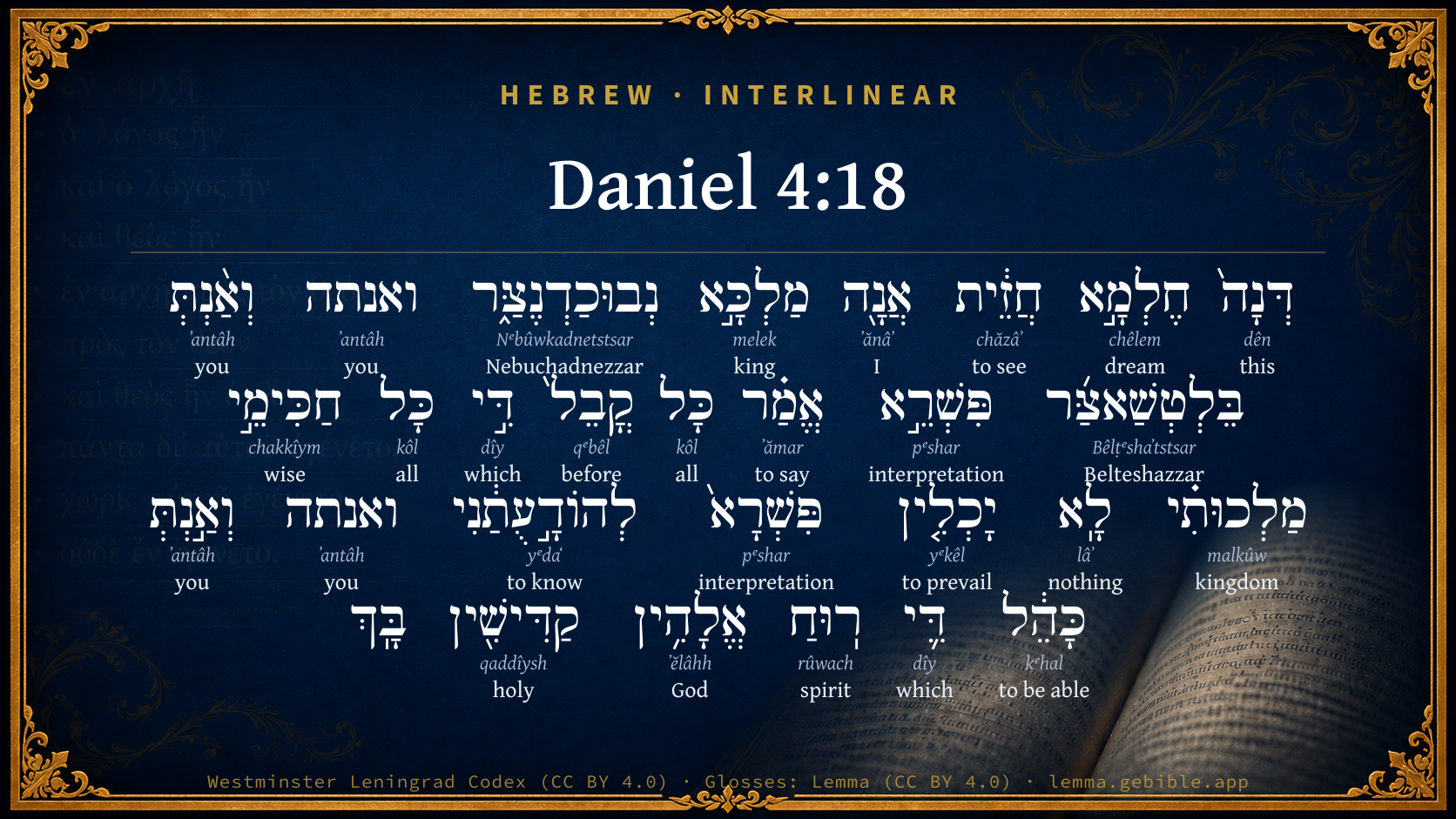
Daniel 4:18

Hebrew (Westminster Leningrad Codex) Daniel 4:18 appears in the Hebrew Old Testament. The text above is from the Westminster Leningrad Codex. Each word links to its Strong’s number, a concise gloss, and parsing drawn from the Open Scriptures Hebrew Bible morphology. Click any word for its full Brown-Driver-Briggs (BDB) entry.
Download image
Cite this verse

Daniel 4:18 (World English Bible). Public Domain. Lemma interlinear Bible study tool, https://lemma.gebible.app/v/daniel/4/18.

Show BibTeX & RIS
BibTeX
RIS
English Translation
This dream I, king Nebuchadnezzar, have seen; and you, Belteshazzar, declare the interpretation, because all the wise men of my kingdom are not able to make known to me the interpretation; but you are able; for the spirit of the holy gods is in you.
World English Bible · Public Domain
Download a study sheet

One document with this verse’s original text, its word-by-word gloss line, the meaning frame, cross-references with their text, attributed commentary, and full source and license credits — printable, and it pastes into notes with its structure intact.

This verse Autodidact and up

Study sheet (.html) Plain text (.txt)

A passage Seminary Student

Up to 50 verses in one chapter. A passage sheet keeps up to 6 commentary sources and 12 cross-references per verse, in the order this page ranks them, and says so on the sheet whenever that leaves anything out. Ask for a single verse and you get the Autodidact verse sheet above.

Everything on this page stays free to read, with no account — the sheet is a download of what is already on screen, not access to it.

Want to remove ads? Support Godless Engineer
Compare translations 3

The same verse in 3 English versions, stacked beneath the original-language interlinear above. Click any original word for its lexicon entry.

Each is an independent rendering of the whole verse — the interlinear is not word-aligned to these translations.

Highlighted words mark where these versions differ — a whole-verse word diff, not a word-by-word alignment.

  • World English Bible Public Domain
    This dream I, king Nebuchadnezzar, have seen; and you, Belteshazzar, declare the interpretation, because all the wise men of my kingdom are not able to make known to me the interpretation; but you are able; for the spirit of the holy gods is in you.
  • King James Version Public Domain
    This dream I king Nebuchadnezzar have seen. Now thou, O Belteshazzar, declare the interpretation thereof, forasmuch as all the wise men of my kingdom are not able to make known unto me the interpretation: but thou art able; for the spirit of the holy gods is in thee.
  • unfoldingWord Literal Text CC BY-SA 4.0
    I, King Nebuchadnezzar, saw this dream. Now you, O Belteshazzar, tell me the interpretation, because all the wise men of my kingdom are not able to make known to me the interpretation. But you are able, because the spirit of the holy gods is in you.”

unfoldingWord Literal Text — © unfoldingWord, licensed CC BY-SA 4.0. Word-aligned USFM3 via Door43 (git.door43.org/unfoldingWord/en_ult).

Versions to compare (up to 4)

3 of 4 selected

Show all 18 translations

Every available English version of this verse, each an independent rendering of the whole verse.

  • World English Bible Public Domain
    This dream I, king Nebuchadnezzar, have seen; and you, Belteshazzar, declare the interpretation, because all the wise men of my kingdom are not able to make known to me the interpretation; but you are able; for the spirit of the holy gods is in you.
  • Berean Standard Bible Public Domain
    This is the dream that I, King Nebuchadnezzar, saw. Now, Belteshazzar, tell me the interpretation, because none of the wise men of my kingdom can interpret it for me. But you are able, because the spirit of the holy gods is in you.”
  • Majority Standard Bible Public Domain
    This is the dream that I, King Nebuchadnezzar, saw. Now, Belteshazzar, tell me the interpretation, because none of the wise men of my kingdom can interpret it for me. But you are able, because the spirit of the holy gods is in you.”
  • King James Version Public Domain
    This dream I king Nebuchadnezzar have seen. Now thou, O Belteshazzar, declare the interpretation thereof, forasmuch as all the wise men of my kingdom are not able to make known unto me the interpretation: but thou art able; for the spirit of the holy gods is in thee.
  • American Standard Version (1901) Public Domain
    This dream I, king Nebuchadnezzar, have seen; and thou, O Belteshazzar, declare the interpretation, forasmuch as all the wise men of my kingdom are not able to make known unto me the interpretation; but thou art able; for the spirit of the holy gods is in thee.
  • Revised Version (1885) Public Domain
    This dream I king Nebuchadnezzar have seen: and thou, O Belteshazzar, declare the interpretation, forasmuch as all the wise men of my kingdom are not able to make known unto me the interpretation; but thou art able, for the spirit of the holy gods is in thee.
  • Geneva Bible (1599) Public Domain
    Whose leaues were faire and the fruit thereof much, and in it was meate for all, vnder the which the beastes of the fielde dwelt, and vpon whose branches the foules of the heauen did sit,
  • Douay-Rheims (1899) Public Domain
    I king Nabuchodonosor saw this dream: thou, therefore, O Baltassar, tell me quickly the interpretation: for all the wise men of my kingdom axe not able to declare the meaning of it to me: but thou art able, because the spirit of the holy gods is in thee.
  • Young's Literal Translation Public Domain
    `This dream I have seen, I king Nebuchadnezzar; and thou, O Belteshazzar, the interpretation tell, because that all the wise men of my kingdom are not able to cause me to know the interpretation, and thou `art' able, for the spirit of the holy gods `is' in thee.
  • Literal Standard Version CC BY-SA 4.0
    This dream I have seen, I King Nebuchadnezzar; and you, O Belteshazzar, tell the interpretation, because that all the wise men of my kingdom are not able to cause me to know the interpretation, and you [are] able, for the spirit of the holy gods [is] in you.”
  • Unlocked Literal Bible CC BY-SA 4.0
    I, King Nebuchadnezzar, had this dream. Now you, Belteshazzar, tell me the interpretation, because none of the men with wisdom in my kingdom can interpret it for me. But you are able to do so, because the spirit of the holy gods is in you.”
  • unfoldingWord Literal Text CC BY-SA 4.0
    I, King Nebuchadnezzar, saw this dream. Now you, O Belteshazzar, tell me the interpretation, because all the wise men of my kingdom are not able to make known to me the interpretation. But you are able, because the spirit of the holy gods is in you.”
  • Darby Bible Public Domain
    This dream I, king Nebuchadnezzar, have seen; and thou, Belteshazzar, tell the interpretation, forasmuch as all the wise men of my kingdom are not able to make known unto me the interpretation; but thou art able, for the spirit of the holy gods is in thee.
  • World Messianic Bible Public Domain
    “This dream I, King Nebuchadnezzar, have seen; and you, Belteshazzar, declare the interpretation, because all the wise men of my kingdom are not able to make known to me the interpretation; but you are able, for the spirit of the holy gods is in you.”
  • Webster's Bible Public Domain
    This dream I king Nebuchadnezzar have seen. Now thou, O Belteshazzar, declare the interpretation of it, forasmuch as all the wise men of my kingdom are not able to make known to me the interpretation: but thou art able; for the spirit of the holy gods is in thee.
  • Free Bible Version CC BY-SA 4.0
    This is what I, King Nebuchadnezzar, saw in my dream. Now it's up to you, Belteshazzar, to give me the explanation as you have before. None of the wise men in my kingdom could explain it to me. But you can, because the spirit of the holy gods is in you.”
  • Bible in Basic English Public Domain
    This dream I, King Nebuchadnezzar, saw; and do you, O Belteshazzar, make clear the sense of it, for all the wise men of my kingdom are unable to make the sense of it clear to me; but you are able, for the spirit of the holy gods is in you.
  • JPS Tanakh (1917) Public Domain
    (4-15) This dream I king Nebuchadnezzar have seen; and thou, O Belteshazzar, declare the interpretation, forasmuch as all the wise men of my kingdom are not able to make known unto me the interpretation; but thou art able, for the spirit of the holy gods is in thee.'

Literal Standard Version (2020), Covenant Press — licensed CC BY-SA 4.0. Text via the HelloAO Bible API (eBible.org). Unlocked Literal Bible (unfoldingWord) — licensed CC BY-SA 4.0. Text via the HelloAO Bible API (eBible.org). unfoldingWord Literal Text — © unfoldingWord, licensed CC BY-SA 4.0. Word-aligned USFM3 via Door43 (git.door43.org/unfoldingWord/en_ult). Free Bible Version, Dr. Jonathan Gallagher — licensed CC BY-SA 4.0. Text via the HelloAO Bible API (eBible.org).

Word by word

More ways to search: Search by grammar → Find every occurrence → Compare this word →

Practice this passage: Drill this verse → Learn its vocabulary →

כָּהֵ֔ל
kᵉhal
H3546
“being able”
Adjective, V
Part of Speech
Adjective
Full BDB Definition

Origin: a root corresponding to H3201 and H3557

TWOT: 2785

to be able - (Peal) to be able
  1. דְּנָה֙ dên H1836 “this” Adjective, P
  2. חֶלְמָ֣א chêlem H2493 “dream · the” Adjective, N, Common + Particle, Definite Article
  3. חֲזֵ֔ית chăzâʼ H2370 “to see” Adjective, V, Plural
  4. אֲנָ֖ה ʼănâʼ H576 “I” Adjective, P, Construct
  5. מַלְכָּ֣א melek H4430 “king · the” Adjective, N, Common + Particle, Definite Article
  6. נְבוּכַדְנֶצַּ֑ר Nᵉbûwkadnetstsar H5020 “Nebuchadnezzar” Adjective, N
  7. ואנתה ʼantâh H607 “and · you” Adjective, C + Pronoun, Personal, 2nd Person, Masculine, Singular
  8. וְאַ֨נְתְּ ʼantâh H607 “and · you” Adjective, C + Pronoun, Personal, 2nd Person, Masculine, Singular
  9. בֵּלְטְשַׁאצַּ֜ר Bêlṭᵉshaʼtstsar H1096 “Belteshazzar” Adjective, N
  10. פִּשְׁרֵ֣א pᵉshar H6591 “interpretation · the” Adjective, N, Common + Particle, Definite Article
  11. אֱמַ֗ר ʼămar H560 “say” Adjective, V
  12. כָּל kôl H3606 “all” Adjective, C + Conjunction
  13. קֳבֵל֙ qᵉbêl H6903 “before” Adjective, C
  14. דִּ֣י dîy H1768 “which” Adjective, C
  15. כָּל kôl H3606 “all of” Adjective, N, Common
  16. חַכִּימֵ֣י chakkîym H2445 “wise men of” Adjective, N, Common
  17. מַלְכוּתִ֗י malkûw H4437 “kingdom · my” Adjective, N, Common + Suffix, Personal, 1st Person, Common, Singular
  18. לָֽא lâʼ H3809 “nothing” Adjective, T
  19. יָכְלִ֤ין yᵉkêl H3202 “prevailing” Adjective, V
  20. פִּשְׁרָא֙ pᵉshar H6591 “interpretation · the” Adjective, N, Common + Particle, Definite Article
  21. לְהוֹדָ֣עֻתַ֔נִי yᵉdaʻ H3046 “to know · me” Adjective, R + Verb, Hiphil, Infinitive Construct + Suffix, Personal, 1st Person, Common, Singular
  22. ואנתה ʼantâh H607 “and · you” Adjective, C + Pronoun, Personal, 2nd Person, Masculine, Singular
  23. וְאַ֣נְתְּ ʼantâh H607 “and · you” Adjective, C + Pronoun, Personal, 2nd Person, Masculine, Singular
  24. דִּ֛י dîy H1768 “which” Adjective, C
  25. רֽוּחַ rûwach H7308 “spirit of” Adjective, N, Common
  26. אֱלָהִ֥ין ʼĕlâhh H426 “gods” Adjective, N, Common
  27. קַדִּישִׁ֖ין qaddîysh H6922 “holy” Adjective, A

About this verse

These counts appear in no published source. They are computed here, from the morphology-tagged text and Lemma’s own curated glosses. What Lemma adds →

29
words
22
distinct lemmas
Prophets
section

Notable vocabulary

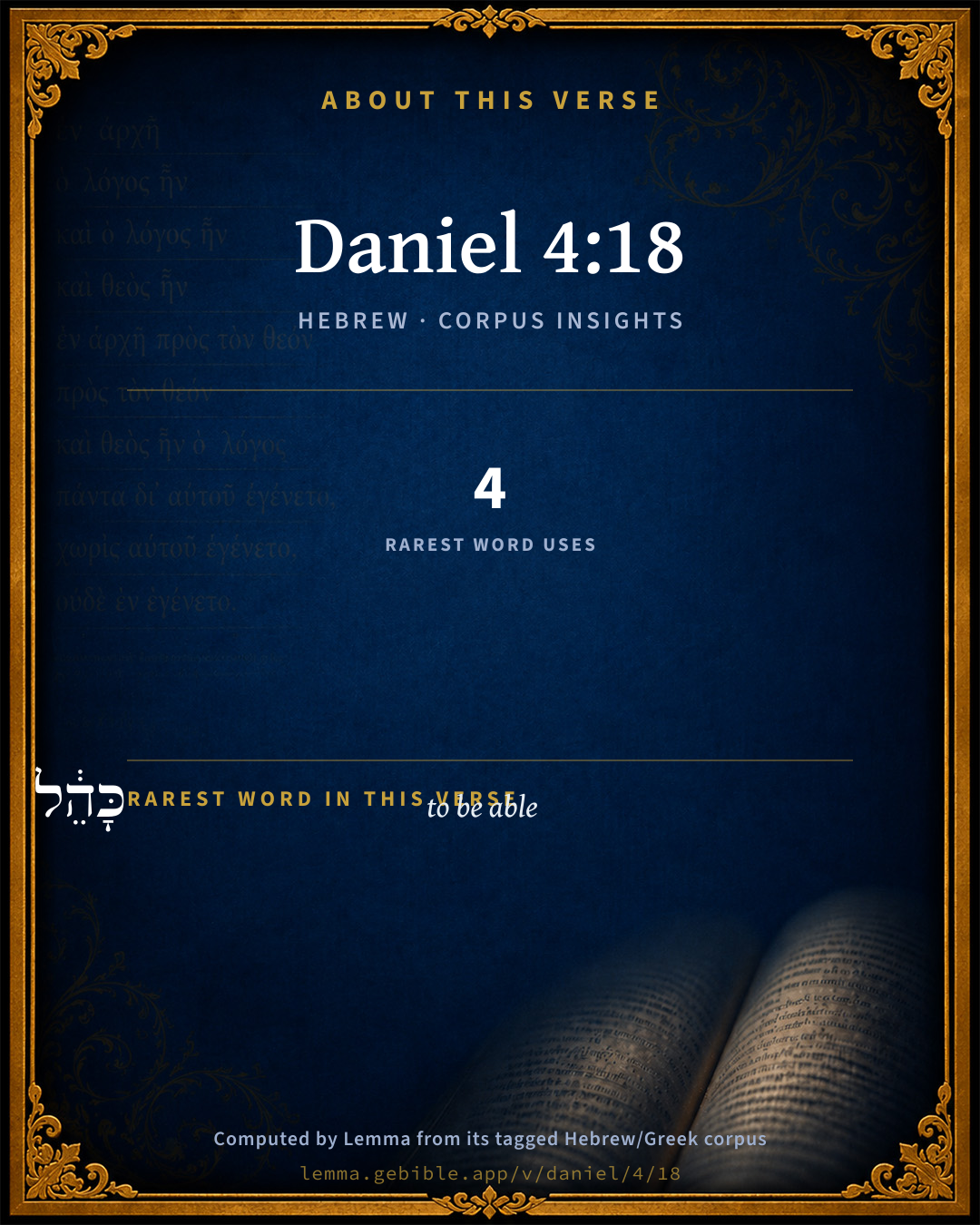
The rarest word here is כָּהֵ֔ל to be able H3546 — appearing just 4 times in the whole Hebrew Bible.

Shared distinctive vocabulary

כָּהֵ֔ל to be able H3546 occurs in 4 verses of the Hebrew Bible. Also found in:

Grammatical profile

  • 1 verb
  • 19 adjectives
  • 4 pronouns
  • 1 conjunction
  • 4 particles

Verb forms

  • לְהוֹדָ֣עֻתַ֔נִי Hiphil · Infinitive Construct

Repetition

Words recur within this verse — often emphatic in Hebrew:

  • פִּשְׁרֵ֣א interpretation H6591 ×2
  • כָּל all H3606 ×2
  • ואנתה you H607 ×4
  • דִּ֣י which H1768 ×2

Hebrew & Septuagint length

In English translation the verse runs 45 words from the Hebrew and 32 from the Septuagint (LXX English) — the Septuagint runs noticeably shorter here. See the side-by-side →

A rough comparison of the two English renderings, which tokenize alike — not a word-level alignment.

Word counts can differ between the Hebrew and the Greek without any difference in meaning — e.g. the Hebrew direct-object marker אֵת has no separate Greek word, and Greek often adds the article ὁ.

Cross-references

11

Topical passages linked to Daniel 4:18 in the Treasury of Scripture Knowledge — connected by theme and wording, ordered by reader-vote popularity; previews shown in the World English Bible.

  • Genesis 41:8 It happened in the morning that his spirit was troubled, and he sent and called for all the magicians of Egypt, and all the wise men of it. Pharaoh told them his dream, but there was no one who could interpret them to Pharaoh.
  • Daniel 5:15 Now the wise men, the enchanters, have been brought in before me, that they should read this writing, and make known to me the interpretation of it; but they could not show the interpretation of the thing.
  • Genesis 41:15 Pharaoh said to Joseph, "I have dreamed a dream, and there is no one who can interpret it. I have heard it said of you, that when you hear a dream you can interpret it."
  • Daniel 4:7–9 Then came in the magicians, the enchanters, the Chaldeans, and the soothsayers; and I told the dream before them; but they did not make known to me the interpretation of it.
  • Daniel 5:8 Then came in all the king's wise men; but they could not read the writing, nor make known to the king the interpretation.
  • 1 Kings 14:2–3 Jeroboam said to his wife, Please get up and disguise yourself, that you not be known to be the wife of Jeroboam; and get you to Shiloh: behold, there is Ahijah the prophet, who spoke concerning me that I should be king over this people.
  • Isaiah 19:3 The spirit of Egypt shall fail in the midst of it; and I will destroy the counsel of it: and they shall seek to the idols, and to the charmers, and to those who have familiar spirits, and to the wizards.
  • Isaiah 47:12–14 Stand now with your enchantments, and with the multitude of your sorceries, in which you have labored from your youth; if so be you shall be able to profit, if so be you may prevail.
  • Daniel 2:7 They answered the second time and said, Let the king tell his servants the dream, and we will show the interpretation.
  • Daniel 2:26–28 The king answered Daniel, whose name was Belteshazzar, Are you able to make known to me the dream which I have seen, and the interpretation of it?
  • Amos 3:7 Surely the Lord Yahweh will do nothing, Unless he reveals his secret to his servants the prophets.

Cross-references courtesy of OpenBible.info (CC BY 4.0).

Hebrew and Greek witnesses Masoretic Hebrew ↔ Greek Septuagint

The same verse in the two great witnesses to the Old Testament, shown verse-for-verse.

Here the Septuagint runs noticeably shorter than the Hebrew — LXX2012 (modern English Septuagint) 32 words vs World English Bible 45. A rough length comparison of the two English translations, not a word-level alignment — read both below.

These are two independent witnesses, not word-aligned to each other, and the Septuagint is shown in lemma (dictionary) form.

Hebrew Daniel 4:18 Masoretic · Westminster Leningrad Codex

דְּנָה֙ חֶלְמָ֣א חֲזֵ֔ית אֲנָ֖ה מַלְכָּ֣א נְבוּכַדְנֶצַּ֑ר ואנתה וְאַ֨נְתְּ בֵּלְטְשַׁאצַּ֜ר פִּשְׁרֵ֣א אֱמַ֗ר כָּל קֳבֵל֙ דִּ֣י כָּל חַכִּימֵ֣י מַלְכוּתִ֗י לָֽא יָכְלִ֤ין פִּשְׁרָא֙ לְהוֹדָ֣עֻתַ֔נִי ואנתה וְאַ֣נְתְּ כָּהֵ֔ל דִּ֛י רֽוּחַ אֱלָהִ֥ין קַדִּישִׁ֖ין בָּֽךְ

This dream I, king Nebuchadnezzar, have seen; and you, Belteshazzar, declare the interpretation, because all the wise men of my kingdom are not able to make known to me the interpretation; but you are able; for the spirit of the holy gods is in you.

World English Bible · Public Domain

Greek LXX Daniel 4:18 Septuagint · lemma form

εἰς φυλακή ἀποἄγω σύ καί εἰς τόπος ἔρημος ἀποστέλλω σύ

and whose leaves were flourishing, and its fruit abundant, (and it was meat for all; under it the wild beasts lodged, and the birds of the sky took shelter in its branches:)

LXX2012 (modern English Septuagint) · Public Domain

On this verse, The Pulpit Commentary discusses the Septuagint’s reading. Read the note in Commentary ↓

Hebrew: Westminster Leningrad Codex (CC BY 4.0). Greek: Septuagint (public domain); English from LXX2012 (modern English Septuagint) (Public Domain). How the Septuagint differs from the Hebrew →

Commentary

Notes on Daniel 4:18 from classic Christian and Jewish commentators (each source and its license shown beneath its notes). The classic Christian expositions comment on the surrounding passage and are grouped to its opening verse, so a note may address several verses; the Jewish commentaries on the Tanakh (Rashi and others) are per-verse, so they appear only where the commentator wrote on this verse.

Lemma curates 59 commentaries, every one of them public domain or Creative Commons licensed, each selected and text-cleaned for this edition rather than reprinted as found. About our sources →

Trapp's Complete Commentary

John Trapp

Dan 4:18 This dream I king Nebuchadnezzar have seen. Now thou, O Belteshazzar, declare the interpretation thereof, forasmuch as all the wise [men] of my kingdom are not able to make known unto me the interpretation: but thou [art] able; for the spirit of the holy gods [is] in thee.

Ver. 18. This dream I king Nebuchadnezzar have seen.] Such as would have resolution, must fully relate their doubts. {Gen 41:17}

John Trapp, A Commentary or Exposition upon All the Books of the Old and New Testament (1647–1656) — public domain. Text from a community e-Sword module.

The Biblical Illustrator

Joseph S. Exell

Dan_4:18

This dream I, Nebuchadnezzar, have seen.

Nebuchadnezzars Dream

I. THE SYMBOL.

1. A tree (v. 10). An image common in both Old and New Testament. The image of prosperity; and that both of the righteous, as in Psa_1:3, and of the wicked, as in Psa_37:36 (Prayer Book ver.). In this latter passage note the verbal coincidence between it and Dan_4:4.

2. A tree growing to an immense size (v. 11-13). Like that in Mt Eze_17:22-24; Eze_31:3-9. Significant of wide dominion.

3. A tree condemned by a decree from Heaven (v. 13, 14), reminding us of the Baptists words (Mat_3:10), and of our Lords (Luk_13:7; Mat_21:19).

4. A tree spared (v. 15-17); though to be cut down to its stump, it was not to be entirely destroyed, but left to shoot forth and grow again.

II. THE INTERPRETATION.

1. The Chaldean magi could not explain its meaning (v. 6, 7).

2. Daniel, being called, felt it to be so terrible that he hesitated to reveal it (v. 18, 19). Like Samuel with Eli (1Sa_3:15).

3. He broke the dread news gently. Led the kings mind to review his vast power and majesty (v. 20-22). Pointed out his forgetfulness of God in the midst of his earthly splendour (v. 25). Announced the judgment that God had decreed against him to bring down his pride (v. 24).

4. He then became a preacher of righteousness, in exhorting the king to repentance and amendment, if perchance the chastisement might be averted (v. 27).

III. THE FULFILMENT.

1. The king is not ashamed to acknowledge the supremacy of the King of kings, whose royal Heavenly decree was accomplished even upon the mighty monarch of the world (v. 28).

2. But not till a day of grace had been mercifully given. Twelve months passed by, and Nebuchadnezzar was still revelling in his pride and self-exaltation (v. 29, 30).

3. The terrible judgment then fell suddenly upon him (v. 31-33). He became mad, and like a brute beast, for a period denoted by the mystic expression seven times, which probably means the time of the perfecting of Gods purpose concerning him.

4. At the end of this time he was restored to reason and to royal dominion. The lesson had been learnt. He gave God glory, and acknowledged Him as King (v.34-37). Conclusion. From this page of Old Testament history let us learn:

1. How the effect made upon us by religious impressions wears off in course of time. God has to repeat His revelations and providential dealings.

2. How many ways God has of warning us.

3. How long a time God gives sinners in which to come to repentance.

4. How pure is the fulfilment of His word. (T. H. Barnett.)

The Biblical Illustrator, edited by Joseph S. Exell (c. 1880s–1900s) — public domain. Text from a community e-Sword module.

Ibn Ezra

Rabbi Abraham ibn Ezra

[Daniel 4:18] And its foliage (וְעׇפְיֵ֤הּ): [Regarding the beginning of the verse, "And its foliage..."] And the verse following it [i.e., this entire verse, which repeats the description from Daniel 4:9] does not need explanation (אֵין צָרִיךְ פֵּרוּשׁ - ein tzarich perush).

Ibn Ezra on the Tanakh — English translations: “Sefaria Community Translation” (CC0 1.0 (public-domain dedication)); “Yalkut, Sifsei Chachomim Chumash, Metsudah Publications, 2009” (CC BY 4.0); and “Commentary of Ibn Ezra on Isaiah - trans. by M. Friedlander, 1873” (public domain). Text via Sefaria.

John Calvin's Commentaries

Here Nebuchadnezzar repeats what he had formerly said about seeking an interpretation for his dream. He understood the figure which was shewn to him, but he could not understand God’s intentions nor even determine its relation to himself. On this point he implores Daniel’s confidence; he affirms his vision in a dream to induce Daniel to pay great attention to its interpretation. Then he adds, with the same purpose, All the wise men of his kingdom could not explain the dreary; where he confesses all the astrologers, and diviners, and others of this kind to be utterly vain and fallacious, since they professed to know everything. For some were augurs, some conjectures, some interpreters of dreams, and others astrologers, who not only discoursed on the course, distances, and orders of the stars, and the peculiarities of each, but wished to predict futurity from the course of the stars. Since, therefore, they boasted so magnificently in their superior knowledge of all events, Nebuchadnezzar confesses them to have been impostors. But he ascribes this power in reality to Daniel, because he was endued by the divine Spirit. Hence he excludes all the wise men of Babylon from so great a gift through his having proved them destitute of God’s Spirit. He does not assert this in so many words, but this meaning is easily elicited from his expressions implying all the variety of the Chaldean wise men. Then in the second clause he exempts Daniel from their number, and states the reason to be his excelling in the divine Spirit. Nebuchadnezzar, therefore, here asserts what is peculiar to God, and acknowledges Daniel to be his Prophet and minister. When he calls angels holy deities, we have mentioned this already as an expression which ought not to seem surprising in a heathen, uninstructed in the true doctrine of piety, and only just initiated in its elements. But we know this common opinion respecting angels being mingled together with the one God. Hence Nebuchadnezzar speaks in the ordinary and received language when he says, the spirit of the holy gods dwells in Daniel. It now follows:

John Calvin's Commentaries (1540-1563) — public domain. Text from the Calvin Translation Society English edition (1840s-50s) via the Christian Classics Ethereal Library (ccel.org). Calvin's coverage is partial (roughly two-thirds of the Bible); uncommented books and verses are honest gaps, never fabricated. The 19th-century editor's footnotes and remarks are omitted so the notes are faithfully Calvin's own voice.

Ellicott's Commentary for English Readers

(18) This dream.—More correctly translated, This in a dream I saw—i.e., it was communicated to me in a vision.

A Bible Commentary for English Readers, edited by Charles John Ellicott (1878–1897) — public domain. Text from a community e-Sword module.

The Cambridge Bible for Schools and Colleges

gen. ed. J. J. S. Perowne

18. Nebuchadnezzar closes his description of his dream by appealing to Daniel to interpret it.

for the spirit &c.] See Dan_4:8.

The Cambridge Bible for Schools and Colleges (gen. ed. J. J. S. Perowne; Cambridge University Press, 1878–1918) — public domain. Text from a community e-Sword module.

John Gill's Exposition

This dream I King Nebuchadnezzar have seen,.... So things were represented to him by a vision in a dream:

now thou, O Belteshazzar, declare the interpretation thereof; at once, directly; as he was well assured he could, by what he had already done; having both told him his dream when forgotten by him, and the meaning of it; and therefore doubted not but he could interpret his dream, being told him:

forasmuch as all the wise men of my kingdom are not able to make known unto me the interpretation; he had sent for them, even all of them; he had told them his dream, but they could not interpret it; see Dan 4:6,

but thou art able, for the spirit of the holy gods is in thee; he not only knew his ability from former experience, but for the reason here given; of which he might have more proofs than one, that the Spirit, not of impure deities, of the gods and demons of the Heathens, but of the one true, living, and holy God, who knows all things, dwelt in him; see Dan 4:9.

John Gill's Exposition of the Whole Bible (1746–1763) — public domain (CC PDM 1.0). Text via the HelloAO Bible API.

Albert Barnes' Notes on the Bible

This dream I king Nebuchadnezzar have seen - This is the dream which I saw. He had detailed it at length as it appeared to him, without pretending to be able to explain it.

Forasmuch as all the wise men of my kingdom ... - Dan 4:7.

But thou art able ... - See the notes at Dan 4:9.

Albert Barnes' Notes on the Bible (1834–1885) — public domain. Text from a community e-Sword/MySword module.

Whedon's Commentary on the Bible

Daniel D. Whedon

18, 19. Compare Dan_4:8 and Dan_2:17-26. Daniel is at first greatly troubled and “astonished as it were for a moment” (Bevan), but when Nebuchadnezzar encourages him he replies that he is troubled not so much because of his inability to interpret the dream as because the interpretation will trouble the king. The words of Daniel here are in the highest degree diplomatic and courteous, and in agreement with current usage at the Babylonian and other courts, while at the same time no jot or tittle of the truth is omitted or glossed over for fear or favor.

Daniel D. Whedon (gen. ed.), Commentary on the Old and New Testaments (1874–1909) — public domain. Text from a community e-Sword module.

The Pulpit Commentary

This dream I King Nebuchadnezzar have seen. Now thou, O Belteshazzar, declare the interpretation thereof, forasmuch as all the wise men of my kingdom are not able to make known unto me the interpretation; but thou art able; for the spirit of the holy gods is in thee. This verse is wholly omitted in the Septuagint. On the other hand, the verse in the Septuagint which occupies this place is totally different from anything in the Massoretic text: "Before me was it cut down in one day, and its destruction was in one hour of the day, and its branches were given to every wind, and it was driven out and dragged forth, and it ate the grass of the earth, and it was delivered to a guard, and in brazen fetters and shackles was it bound with them. I marvelled exceedingly at these things, and the sleep departed from mine eyes." The first thing that strikes one with this is the fact that it is a translation from Aramaic. The clause, "in brazen fetters and shackles was it bound with them," seems nearly demonstrative of this. jEn pedaiv kaidaiv calkaiv ejdeqh uJp aujtwn is not a sentence which any one would naturally write in Greek, but the sentence is natural if the translator followed his Aramaic original slavishly. If, then, this is correct, the hypothesis of a falsarius is reduced to that of an Aramaic falsarius, who intruded this verse into the Aramaic original which was conveyed down to Egypt. On the other hand, the verse in the Septuagint completes the narrative which the Massoretic text leaves unfinished. This may be used. as an argument against the authenticity of this version, as the need of completion may have suggested the mode in which the need was to be supplied. But it is also to be noted that there is present the same mixture of sign and thing signified, which, natural in a dream, is so unnatural in ordinary narration, that the falsarius who had observed the incompleteness of the Massoretic text, and had the necessary skill to supply the want, would not have increased the confusion, already manifest enough. When we turn to Theodotion, we see symptoms of trouble, "This is the vision which I Nebuchadnezzar the king had, and thou, Beltasar, tell the interpretation, because none of the wise men of my kingdom were able to show me its interpretation; but thou, Daniel, art able, because a holy spirit of God is in thee." The introduction of the Jewish name Daniel in the midst of a speech in which he is always elsewhere addressed by his Bahylonian name, is suspicious. The repetition, in this as in the Masoretic, of the original incongruity that Daniel, the head of the court magicians, is only summoned after the other magicians have proved unable to solve the mystery of this dream, is to be noted. The Peshitta here partly follows the same text as that followed by Theodotion, and partly that of the Massoretes. Like Theodotion, "Daniel" is inserted, but, following the basis of the Massoretic text in opposition to Theodotion, it has "a spirit of the holy gods." There seems no possibility of imagining the LXX reading to have developed from the Massoretic, or vice versa. If there were any proof of Dr. C. H. H. Wright"s hypothesis, that our present Daniel was a condensation of a larger work, it might be supposed that the Massoretic represented one condensation, and the LXX another. The Septuagint at this point inserts, "And having risen early in the morning,. I summoned Daniel, the ruler of the wise men and chief of the interpreters, and related to him the dream, and he showed all the interpretation of it." In Genesis 41. we have two accounts of Pharaoh"s dream, first in connection with his actual dreaming, and next in his narrating to Joseph his experience. If the original tract from the union of several of which we imagine our book has been compiled from which this chapter is condensed contained, like Ge 41, two accounts of Nebuchadnezzar"s vision, and the Egyptian recension followed one condensation of this tract, and the Palestinian another, the phenomena are explicable without the idea of a vague gratuitous variation, such as that of which, on the traditional view, the writer of the Septuagint has been guilty. On the ground that the Massoretic text may represent also a true text of Daniel, another fragment of the original document, we may examine it a little more closely. The king declares the dream to Daniel in a way that indicates a certain attestation of the accuracy of the report of what he had seen. "This is the dream which I Nebuchadnezzar the king saw." Then follows the command to declare the interpretation, "You are master of magicians. I have duly brought before you an accredited dream which I have had, fulfil now your office, interpret to me my dream." This much is natural. What follows is an obvious interpolation. It contradicts what has preceded, which, by implication, asserts Daniel"s duty to interpret, and therefore the probability that not last, but first, would Daniel have been appealed to. It contradicts also what follows, which is a commendation of Daniel"s powers, which, as known to the king, ought to have led him at once to summon him, as the Septuagint says Nebuchadnezzar did. The commendation of Daniel appears an addition to get over the difficulty, but, like many other attempts of the same kind, it fails, and really adds to the confusion.

The Pulpit Commentary (1880–1919), ed. H.D.M. Spence-Jones & Joseph S. Exell — public domain. Text from a community e-Sword module.

Keil & Delitzsch

C. F. Keil & F. Delitzsch

Nebuchadnezzar adds to his communication of his dream a command to Daniel to interpret it. The form פּשׁרא (its interpretation) is the old orthography and the softened form for פּשׁרהּ (cf. Dan 4:6).

Keil & Delitzsch — Biblical Commentary on the Old Testament (1861–1891) — public domain (CC PDM 1.0). Text via the HelloAO Bible API. (Old Testament only.)

Lesson kit

Teaching starters — assembled from the data on this page, not authored interpretation. Every prompt links to the verse data it draws on. Edit before teaching.

Daniel, in the Prophets, opens this verse with 29 words (22 distinct Hebrew lemmas). Its most distinctive word is kᵉhal (“to be able”). The Greek Septuagint runs shorter here. A historical commentator’s framing appears above. Read the whole chapter for the surrounding context.

Discussion questions

  1. The word kᵉhal carries the sense “to be able.” How does it shape the verse?
  2. Daniel 2:26 shares the word «to be able» with this verse. How do the two illuminate each other?
  3. “interpretation” occurs 2× in this one verse. What is the effect of the repetition?
  4. Compared with the Hebrew, the Septuagint runs shorter here. What questions does that raise?
  5. These translations render this verse differently. What is at stake in choosing one wording over another?
  6. The verb «לְהוֹדָ֣עֻתַ֔נִי» is Hiphil Infinitive Construct. How does its form color the action?
  7. Reading how Trapp's Complete Commentary and The Biblical Illustrator read this verse, where do the two commentators agree and where do they part?

Things to notice

  • These translations choose different wording for 11 words in this verse.
  • “interpretation” occurs 2× in this single verse.
  • 22 distinct Hebrew lemmas span 29 words in this verse.

Reading settings

Reading text

Shown beneath each verse's original-language words.

Old Testament
Old Testament edition

Read the OT as the Masoretic Hebrew (MT) or the Greek Septuagint (LXX).

English shown for the Greek Septuagint (in the Hebrew ↔ Greek comparison).

Comparing translations? Open the Compare panel on any verse page to stack up to four side by side.