
Daniel 5:13

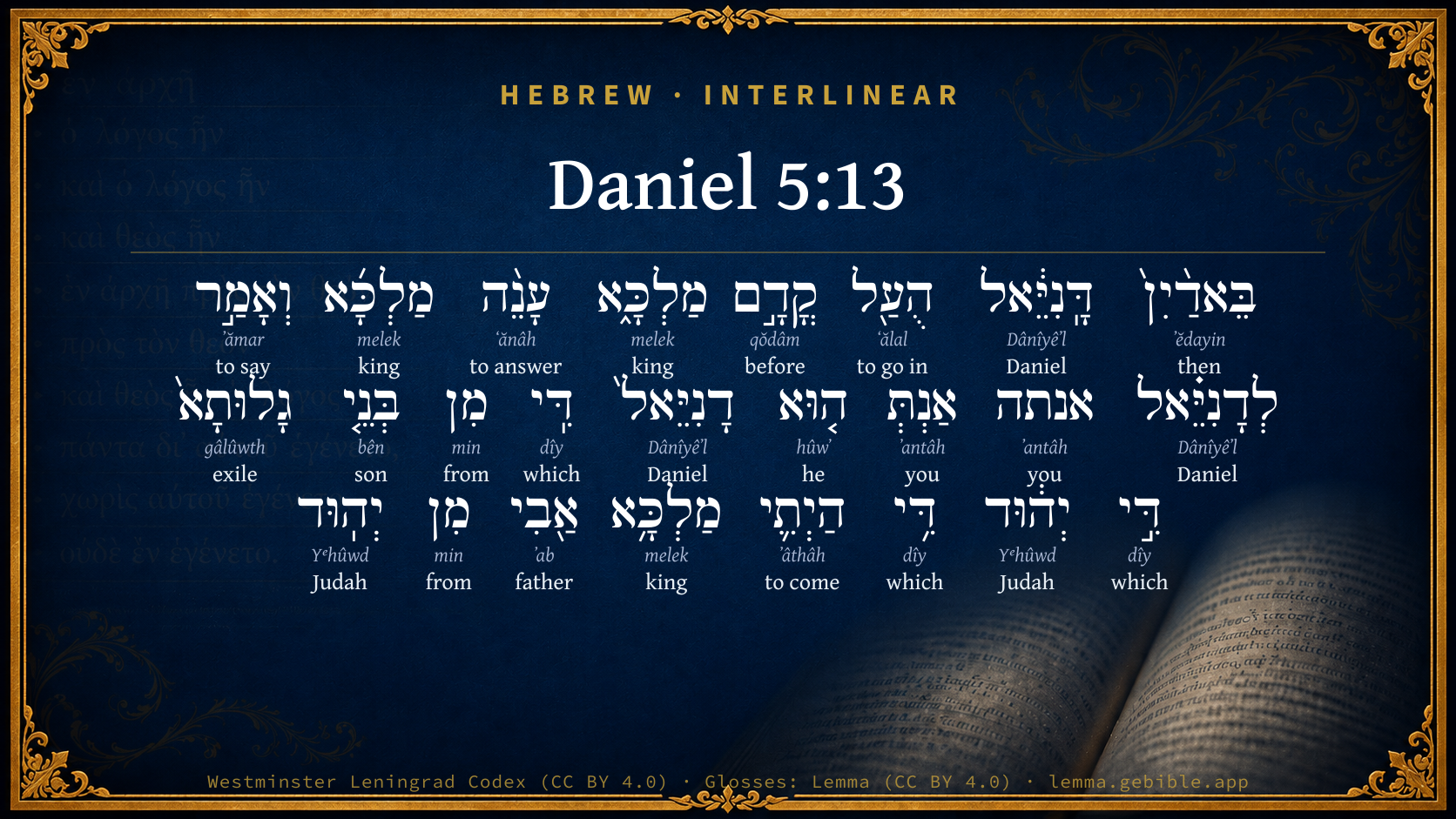
Hebrew (Westminster Leningrad Codex) Daniel 5:13 appears in the Hebrew Old Testament. The text above is from the Westminster Leningrad Codex. Each word links to its Strong’s number, a concise gloss, and parsing drawn from the Open Scriptures Hebrew Bible morphology. Click any word for its full Brown-Driver-Briggs (BDB) entry.
Download image
Cite this verse

Daniel 5:13 (World English Bible). Public Domain. Lemma interlinear Bible study tool, https://lemma.gebible.app/v/daniel/5/13.

Show BibTeX & RIS
BibTeX
RIS
English Translation
Then was Daniel brought in before the king. The king spoke and said to Daniel, Are you that Daniel, who are of the children of the captivity of Judah, whom the king my father brought out of Judah?
World English Bible · Public Domain
Download a study sheet

One document with this verse’s original text, its word-by-word gloss line, the meaning frame, cross-references with their text, attributed commentary, and full source and license credits — printable, and it pastes into notes with its structure intact.

This verse Autodidact and up

Study sheet (.html) Plain text (.txt)

A passage Seminary Student

Up to 50 verses in one chapter. A passage sheet keeps up to 6 commentary sources and 12 cross-references per verse, in the order this page ranks them, and says so on the sheet whenever that leaves anything out. Ask for a single verse and you get the Autodidact verse sheet above.

Everything on this page stays free to read, with no account — the sheet is a download of what is already on screen, not access to it.

Want to remove ads? Support Godless Engineer
Compare translations 3

The same verse in 3 English versions, stacked beneath the original-language interlinear above. Click any original word for its lexicon entry.

Each is an independent rendering of the whole verse — the interlinear is not word-aligned to these translations.

Highlighted words mark where these versions differ — a whole-verse word diff, not a word-by-word alignment.

  • World English Bible Public Domain
    Then was Daniel brought in before the king. The king spoke and said to Daniel, Are you that Daniel, who are of the children of the captivity of Judah, whom the king my father brought out of Judah?
  • King James Version Public Domain
    Then was Daniel brought in before the king. And the king spake and said unto Daniel, Art thou that Daniel, which art of the children of the captivity of Judah, whom the king my father brought out of Jewry?
  • unfoldingWord Literal Text CC BY-SA 4.0
    Then Daniel was brought in before the king. The king answered and said to Daniel, “You are that Daniel, one of the exiles of Judah, whom my father the king brought from Judah.

unfoldingWord Literal Text — © unfoldingWord, licensed CC BY-SA 4.0. Word-aligned USFM3 via Door43 (git.door43.org/unfoldingWord/en_ult).

Versions to compare (up to 4)

3 of 4 selected

Show all 18 translations

Every available English version of this verse, each an independent rendering of the whole verse.

  • World English Bible Public Domain
    Then was Daniel brought in before the king. The king spoke and said to Daniel, Are you that Daniel, who are of the children of the captivity of Judah, whom the king my father brought out of Judah?
  • Berean Standard Bible Public Domain
    So Daniel was brought before the king, who asked him, “Are you Daniel, one of the exiles my father the king brought from Judah?
  • Majority Standard Bible Public Domain
    So Daniel was brought before the king, who asked him, “Are you Daniel, one of the exiles my father the king brought from Judah?
  • King James Version Public Domain
    Then was Daniel brought in before the king. And the king spake and said unto Daniel, Art thou that Daniel, which art of the children of the captivity of Judah, whom the king my father brought out of Jewry?
  • American Standard Version (1901) Public Domain
    Then was Daniel brought in before the king. The king spake and said unto Daniel, Art thou that Daniel, who art of the children of the captivity of Judah, whom the king my father brought out of Judah?
  • Revised Version (1885) Public Domain
    Then was Daniel brought in before the king. The king spake and said unto Daniel, Art thou that Daniel, which art of the children of the captivity of Judah, whom the king my father brought out of Judah?
  • Geneva Bible (1599) Public Domain
    Then was Daniel brought before the King, and the King spake and sayd vnto Daniel, Art thou that Daniel, which art of the children of the captiuitie of Iudah, whom my father the King brought out of Iewrie?
  • Douay-Rheims (1899) Public Domain
    Then Daniel was brought in before the king. And the king spoke, and said to him: Art thou Daniel of the children of the captivity of Juda, whom my father the king brought out of Judea?
  • Young's Literal Translation Public Domain
    Then Daniel hath been caused to come up before the king; answered hath the king, and said to Daniel, `Thou art that Daniel who `art' of the sons of the Removed of Judah, whom the king my father brought in out of Judah?
  • Literal Standard Version CC BY-SA 4.0
    Then Daniel has been caused to come up before the king; the king has answered and said to Daniel, “You are that Daniel who [is] of the sons of the expulsion of Judah, whom my father the king brought in out of Judah?
  • Unlocked Literal Bible CC BY-SA 4.0
    Then Daniel was brought before the king. The king said to him, “You are that Daniel, one of the people of the exiles of Judah, whom my father the king brought out of Judah.
  • unfoldingWord Literal Text CC BY-SA 4.0
    Then Daniel was brought in before the king. The king answered and said to Daniel, “You are that Daniel, one of the exiles of Judah, whom my father the king brought from Judah.
  • Darby Bible Public Domain
    Then was Daniel brought in before the king. The king spoke and said unto Daniel, Art thou that Daniel, of the children of the captivity of Judah, whom the king my father brought out of Judah?
  • World Messianic Bible Public Domain
    Then Daniel was brought in before the king. The king spoke and said to Daniel, “Are you that Daniel of the children of the captivity of Judah, whom the king my father brought out of Judah?
  • Webster's Bible Public Domain
    Then was Daniel brought in before the king. And the king spoke and said to Daniel, Art thou that Daniel, who art of the children of the captivity of Judah, whom the king my father brought out of Judea?
  • Free Bible Version CC BY-SA 4.0
    So Daniel was brought in before the king. The king asked him, “Are you Daniel, one of the prisoners my father the king brought from Judah?
  • Bible in Basic English Public Domain
    Then they took Daniel in before the king; the king made answer and said to Daniel, So you are that Daniel, of the prisoners of Judah, whom my father took out of Judah.
  • JPS Tanakh (1917) Public Domain
    Then was Daniel brought in before the king. The king spoke and said unto Daniel: 'Art thou Daniel, who is of the children of the captivity of Judah, whom the king my father brought out of Judah?

Literal Standard Version (2020), Covenant Press — licensed CC BY-SA 4.0. Text via the HelloAO Bible API (eBible.org). Unlocked Literal Bible (unfoldingWord) — licensed CC BY-SA 4.0. Text via the HelloAO Bible API (eBible.org). unfoldingWord Literal Text — © unfoldingWord, licensed CC BY-SA 4.0. Word-aligned USFM3 via Door43 (git.door43.org/unfoldingWord/en_ult). Free Bible Version, Dr. Jonathan Gallagher — licensed CC BY-SA 4.0. Text via the HelloAO Bible API (eBible.org).

Word by word

More ways to search: Search by grammar → Find every occurrence → Compare this word →

Practice this passage: Drill this verse → Learn its vocabulary →

גָלוּתָא֙
gâlûwth
H1547
“exile · the”
Adjective, N, Common + Particle, Definite Article
Part of Speech
Adjective + Particle
Type
Definite Article
Full BDB Definition

Origin: corresponding to H1546

TWOT: 2656a

exile
  1. בֵּאדַ֨יִן֙ ʼĕdayin H116 “in/at · then” Adjective, R + Adverb
  2. דָּֽנִיֵּ֔אל Dânîyêʼl H1841 “Daniel” Adjective, N
  3. הֻעַ֖ל ʻălal H5954 “to go in” Adjective, V, Plural
  4. קֳדָ֣ם qŏdâm H6925 “before” Adjective, R
  5. מַלְכָּ֑א melek H4430 “king · the” Adjective, N, Common + Particle, Definite Article
  6. עָנֵ֨ה ʻănâh H6032 “answering” Adjective, V
  7. מַלְכָּ֜א melek H4430 “king · the” Adjective, N, Common + Particle, Definite Article
  8. וְאָמַ֣ר ʼămar H560 “and · saying” Adjective, C + Verb, Qal, Participle Active, Masculine, Singular, Absolute
  9. לְדָנִיֵּ֗אל Dânîyêʼl H1841 “to/for · Daniel” Adjective, R + Noun, Proper
  10. אנתה ʼantâh H607 “you” Adjective, P
  11. אַנְתְּ ʼantâh H607 “you” Adjective, P
  12. ה֤וּא hûwʼ H1932 “he” Adjective, T
  13. דָנִיֵּאל֙ Dânîyêʼl H1841 “Daniel” Adjective, N
  14. דִּֽי dîy H1768 “which” Adjective, T
  15. מִן min H4481 “from” Adjective, R
  16. בְּנֵ֤י bên H1123 “sons of” Adjective, N, Common
  17. דִּ֣י dîy H1768 “which” Adjective, T
  18. יְה֔וּד Yᵉhûwd H3061 “Judah” Adjective, N
  19. דִּ֥י dîy H1768 “which” Adjective, T
  20. הַיְתִ֛י ʼâthâh H858 “to come” Adjective, V, Plural
  21. מַלְכָּ֥א melek H4430 “king · the” Adjective, N, Common + Particle, Definite Article
  22. אַ֖בִי ʼab H2 “father · my” Adjective, N, Common + Suffix, Personal, 1st Person, Common, Singular
  23. מִן min H4481 “from” Adjective, R
  24. יְהֽוּד Yᵉhûwd H3061 “Judah” Adjective, N

About this verse

These counts appear in no published source. They are computed here, from the morphology-tagged text and Lemma’s own curated glosses. What Lemma adds →

25
words
16
distinct lemmas
Prophets
section

Notable vocabulary

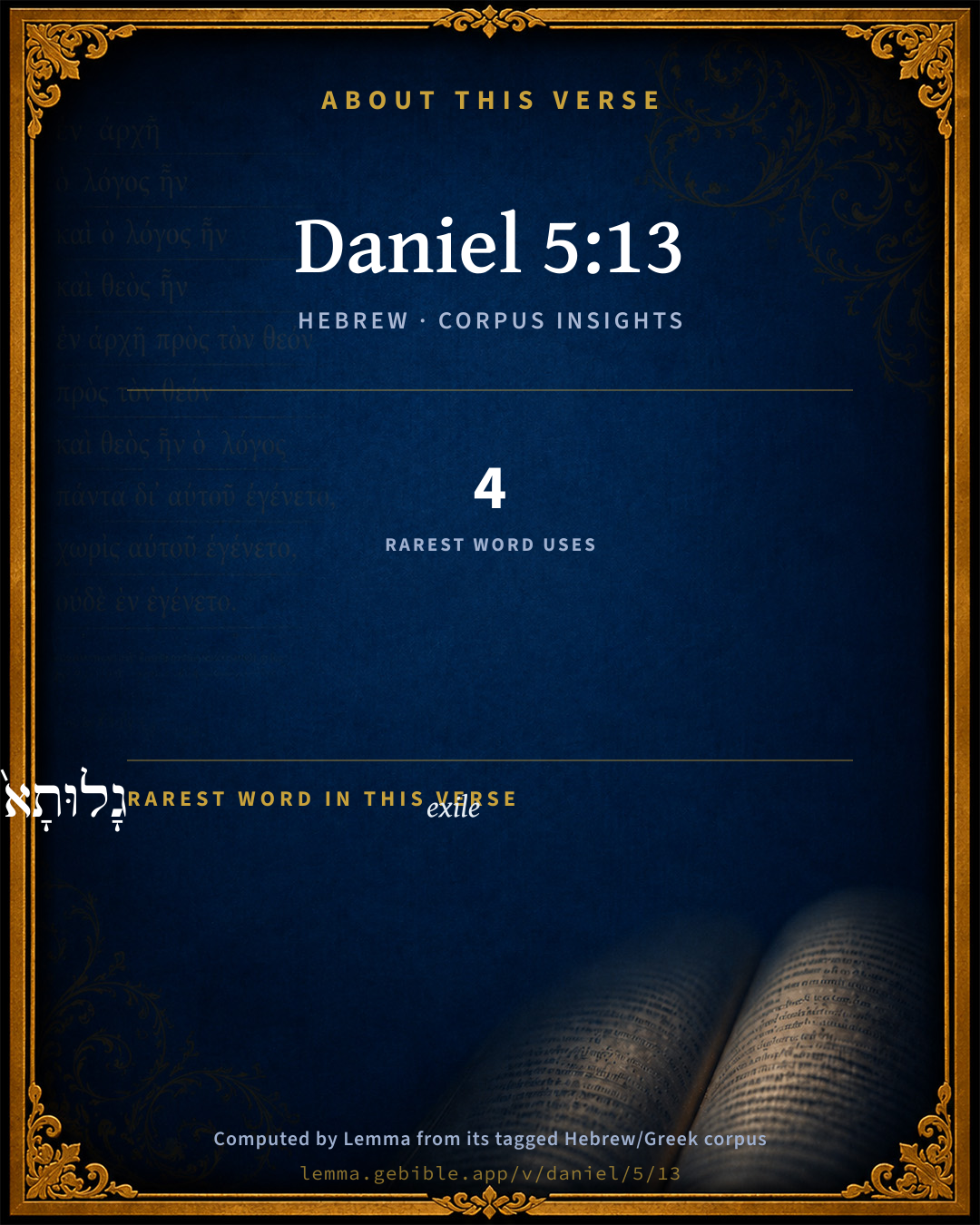
The rarest word here is גָלוּתָא֙ exile H1547 — appearing just 4 times in the whole Hebrew Bible.

Shared distinctive vocabulary

גָלוּתָא֙ exile H1547 occurs in 4 verses of the Hebrew Bible. Also found in:

Grammatical profile

  • 1 verb
  • 1 noun
  • 18 adjectives
  • 1 adverb
  • 4 particles

Verb forms

  • וְאָמַ֣ר Qal · Participle Active

Repetition

Words recur within this verse — often emphatic in Hebrew:

  • דָּֽנִיֵּ֔אל Daniel H1841 ×3
  • מַלְכָּ֑א king H4430 ×3
  • יְה֔וּד Judah H3061 ×2
  • דִּֽי which H1768 ×3
  • אנתה you H607 ×2
  • מִן from H4481 ×2

Hebrew & Septuagint length

In English translation the verse runs 38 words from the Hebrew and 31 from the Septuagint (LXX English) — closely comparable.

A rough comparison of the two English renderings, which tokenize alike — not a word-level alignment.

Word counts can differ between the Hebrew and the Greek without any difference in meaning — e.g. the Hebrew direct-object marker אֵת has no separate Greek word, and Greek often adds the article ὁ.

Cross-references

16

Topical passages linked to Daniel 5:13 in the Treasury of Scripture Knowledge — connected by theme and wording, ordered by reader-vote popularity; previews shown in the World English Bible.

  • Daniel 6:13 Then answered they and said before the king, That Daniel, who is of the children of the captivity of Judah, doesn't regard you, O king, nor the interdict that you have signed, but makes his petition three times a day.
  • Daniel 5:11 There is a man in your kingdom, in whom is the spirit of the holy gods; and in the days of your father light and understanding and wisdom, like the wisdom of the gods, were found in him; and the king Nebuchadnezzar your father, the king, [I say], your father, made him master of the magicians, enchanters, Chaldeans, and soothsayers;
  • Daniel 2:25 Then Arioch brought in Daniel before the king in haste, and said thus to him, I have found a man of the children of the captivity of Judah, who will make known to the king the interpretation.
  • Ezra 4:1 Now when the adversaries of Judah and Benjamin heard that the children of the captivity were building a temple to Yahweh, the God of Israel;
  • Ezra 6:16 The children of Israel, the priests, and the Levites, and the rest of the children of the captivity, kept the dedication of this house of God with joy.
  • Ezra 6:19–20 The children of the captivity kept the Passover on the fourteenth [day] of the first month.
  • Ezra 10:16 The children of the captivity did so. Ezra the priest, [with] certain heads of fathers' [houses], after their fathers' houses, and all of them by their names, were set apart; and they sat down in the first day of the tenth month to examine the matter.
  • John 7:3 His brothers therefore said to him, "Depart from here, and go into Judea, that your disciples also may see your works which you do.
  • Ezra 10:7 They made proclamation throughout Judah and Jerusalem to all the children of the captivity, that they should gather themselves together to Jerusalem;
  • Daniel 1:21 Daniel continued even to the first year of king Cyrus.
  • Daniel 2:48 Then the king made Daniel great, and gave him many great gifts, and made him to rule over the whole province of Babylon, and to be chief governor over all the wise men of Babylon.
  • Daniel 5:2 Belshazzar, while he tasted the wine, commanded to bring the golden and silver vessels which Nebuchadnezzar his father had taken out of the temple which was in Jerusalem; that the king and his lords, his wives and his concubines, might drink from it.
  • Daniel 5:18 You king, the Most High God gave Nebuchadnezzar your father the kingdom, and greatness, and glory, and majesty:
  • Daniel 8:1 In the third year of the reign of king Belshazzar a vision appeared to me, even to me, Daniel, after that which appeared to me at the first.
  • Daniel 8:27 I, Daniel, fainted, and was sick certain days; then I rose up, and did the king's business: and I wondered at the vision, but none understood it.
  • John 7:1 After these things, Jesus was walking in Galilee, for he wouldn't walk in Judea, because the Jews sought to kill him.

Cross-references courtesy of OpenBible.info (CC BY 4.0).

Hebrew and Greek witnesses Masoretic Hebrew ↔ Greek Septuagint

The same verse in the two great witnesses to the Old Testament, shown verse-for-verse.

These are two independent witnesses, not word-aligned to each other, and the Septuagint is shown in lemma (dictionary) form.

Hebrew Daniel 5:13 Masoretic · Westminster Leningrad Codex

בֵּאדַ֨יִן֙ דָּֽנִיֵּ֔אל הֻעַ֖ל קֳדָ֣ם מַלְכָּ֑א עָנֵ֨ה מַלְכָּ֜א וְאָמַ֣ר לְדָנִיֵּ֗אל אנתה אַנְתְּ ה֤וּא דָנִיֵּאל֙ דִּֽי מִן בְּנֵ֤י גָלוּתָא֙ דִּ֣י יְה֔וּד דִּ֥י הַיְתִ֛י מַלְכָּ֥א אַ֖בִי מִן יְהֽוּד

Then was Daniel brought in before the king. The king spoke and said to Daniel, Are you that Daniel, who are of the children of the captivity of Judah, whom the king my father brought out of Judah?

World English Bible · Public Domain

Greek LXX Daniel 5:13 Septuagint · lemma form

τότε δανιηλ εἰςἄγω πρός ὁ βασιλεύς καί ἀποκρίνω ὁ βασιλεύς εἶπον αὐτός

Then Daniel was brought in before the king: and the king said to Daniel, Are you Daniel, of the children of the captivity of Judea, which the king my father brought?

LXX2012 (modern English Septuagint) · Public Domain

On this verse, Whedon's Commentary on the Bible discusses the Septuagint’s reading. Read the note in Commentary ↓

Hebrew: Westminster Leningrad Codex (CC BY 4.0). Greek: Septuagint (public domain); English from LXX2012 (modern English Septuagint) (Public Domain). How the Septuagint differs from the Hebrew →

Commentary

Notes on Daniel 5:13 from classic Christian and Jewish commentators (each source and its license shown beneath its notes). The classic Christian expositions comment on the surrounding passage and are grouped to its opening verse, so a note may address several verses; the Jewish commentaries on the Tanakh (Rashi and others) are per-verse, so they appear only where the commentator wrote on this verse.

Lemma curates 59 commentaries, every one of them public domain or Creative Commons licensed, each selected and text-cleaned for this edition rather than reprinted as found. About our sources →

Trapp's Complete Commentary

John Trapp

Dan 5:13 Then was Daniel brought in before the king. [And] the king spake and said unto Daniel, [Art] thou that Daniel, which [art] of the children of the captivity of Judah, whom the king my father brought out of Jewry?

Ver. 13. Then was Daniel brought in.] Wise men are never found to be unnecessarily forthputting, or overly forward to express themselves. They know qui bene latuit bene vixit; et qui bene tacuit, bene dixit; and when they must speak, use as few words as may be, and as direct to the point.

Art thou that Daniel.] Daniel had deserved of the Babylonian state to have been better known of Belshazzar, and better respected; but this is the world’s wages.

Which art of the children of the captivity of Judah, &c.] What needed all this? he never learned it surely of his queen mother. She had spoken all good of Daniel, and inminded the king of another both office and name. He only takes notice of Daniel’s captive condition, and vaunts of his grandfather’s victory, moving this insolent and unseasonable question in tanta necessitate et consilii inopia, "Art thou Daniel?" &c

John Trapp, A Commentary or Exposition upon All the Books of the Old and New Testament (1647–1656) — public domain. Text from a community e-Sword module.

Matthew Poole's English Annotations

Though he was in high esteem for his skill in the days of Nebuchadnezzar, who had him in high honour, for the Spirit of God in him; yet he being dead, and other kings coming on that had never tried his abilities nor known his merits, (as it was in Joseph’s case, Exo 1:8) hereby he came to be neglected and despised, as those words seem to import, Dan 5:13,

Art thou that Daniel of the captivity of the children of Judah, & c.?

Matthew Poole's English Annotations on the Holy Bible (1683–1685) — public domain. Text from a community e-Sword/MySword module.

The Biblical Illustrator

Joseph S. Exell

Dan_5:13-17

Then was Daniel brought in before the king.

The Preachers Opportunity

How the prophet always clears a space for himself; how on great occasions men distribute themselves into proper classes. When the occasion is little, one man is as good as another; there is a general hum of conversation, and it is difficult to tell the great man from the small, the obscure man from the famous; but when the crisis comes, by some law hardly to be expressed in words, men fall into their right relations, and there stands up the man who has the keys of the Kingdom of God. Preachers of the Word, you will be wanted some day by Belshazzar; you were not at the beginning of the feast, but you will be there before the banqueting-hall is closed; the king will not ask you to drink wine, but he will ask you to tell the secret of his pain and heal the malady of his heart. Abide your time. You are nobody now. Who cares for preachers, teachers, seers, and men of insight, while the wine goes round, and the feast is unfolding its tempting luxuries? Midway down the programme to mention pulpit, or preacher, or Bible, would be to violate the harmony of the occasion. But the preacher, as we have often had occasion to say, will have his opportunity. They will send for him when all other friends have failed; may he then come fearlessly, independently, asking only to be made a medium through which Divine communications can be addressed to the listening trouble of the world. Daniel will take the scarlet and the chain by-and-by, but not as a bribe; he will take the poor baubles of this dying Babylon and will use them to the advantage of the world through actions that shall become historical, but he will not first fill his hands with bribes, and then read the kings riddles. The prophet is self-sustained by being Divinely inspired. He needs no promise to enable him to speak the truth, the whole truth, and nothing but the truth. Indeed, he has nothing to say of himself. Every man, in proportion as he is a Daniel, has nothing to invent, nothing to conceive in his own intellect; he has no warrant or credential from the empty court of his own genius; he bears letters from Heaven; he expresses the claims of God. O Daniel, preacher, speaker, teacher, thunder out Gods word, if it be a case of judgment and doom; or whisper it, or rain in gracious tears, if it be a message of sympathy and love and welcome. (Joseph Parker, D.D.)

Daniels Speech to Belshazzar

Never was there a finer example of fidelity than this address. There is nothing harsh, nothing violent, nothing designed merely to irritate. All is plain, direct, and pointed--like one speaking in Gods name, and who felt himself standing in Gods presence. Daniel reminds Belshazzar of what God had done to Nebuchadnezzar, both in the way of mercy and of judgment. The address proceeds on the assumption that Belshazzar ought to have considered, with devout attention, the dealings of God towards Nebuchadnezzar. From this we learn that it is our duty to regard the providential dealings of God, and that we cannot neglect this without sin. Daniel intimated that if Belshazzar had duly considered the Divine procedure towards Nebuchadnezzar, he might have arrived at the knowledge that Jehovah was the true God. Daniel condemned Belshazzar because he did not take warning from the punishment of Nebuchadnezzar. All the punishments which God has inflicted because of sin are warnings to fear God and hate evil. Belshazzars knowledge of those things which befel Nebuchadnezzar rendered him wholly inexcusable. (William White.)

The Biblical Illustrator, edited by Joseph S. Exell (c. 1880s–1900s) — public domain. Text from a community e-Sword module.

Joseph Benson's Commentary

Dan 5:13-17. Then was Daniel brought in before the king — Daniel was now near ninety years of age; so that his years and honours, and former preferments, might have entitled him to a free admission into the king’s presence; yet he was willing to be introduced, as a stranger, by the king’s servants. The king said unto Daniel, Art thou that Daniel — This question of the king shows, that if he was at all acquainted with Daniel, it was very imperfectly; and that in however high esteem that extraordinary man had been held in the days of Nebuchadnezzar, and whatever offices of trust and honour he had then filled, he was now sunk into neglect, Belshazzar being a weak and vicious prince, according to the character historians give of him, and one who interested himself very little in public affairs, leaving the care of them to his mother, and himself minding nothing but his pleasures. Now if thou canst read the writing, &c., thou shalt be clothed with scarlet — He promises him the same rewards if he could read and interpret the writing as he had promised his wise men on condition of their doing it. Then Daniel answered, Let thy gifts be to thyself — As Daniel was now in years, and Belshazzar young, he therefore seems to take a greater liberty, and to deal more plainly with him, than he had done upon the like occasions with Nebuchadnezzar. He addresses him as a very aged and eminent person would address one much younger than himself. When he was consulted by Nebuchadnezzar, and was allowed the liberty of conversing with him and giving him counsel, he foresaw that the Chaldean monarchy would continue for some time, and that his being preferred would give him an opportunity of being useful to his brethren; but he now knew that that empire was about to terminate, and Belshazzar’s reign and life to come to a period. Nebuchadnezzar, though an idolater and a tyrant, yet had great abilities, attended to the affairs of his kingdom, and was, in many respects, very eminent as a monarch; but Belshazzar was every way base, odious, and contemptible. “Above all, he had that night been insulting the God of heaven in the most daring manner, by profaning the sacred vessels in his revels, and extolling his own idols. Daniel therefore knew that his doom was irreversible, and immediately to be put in execution; and he did not speak to him as a subject to his prince, but as the delegate of heaven he denounced sentence against him as a condemned criminal.” — Scott. Some commentators have been puzzled to account for Daniel’s rejecting the king’s presents here, and afterward accepting them, as is mentioned Dan 5:29; but his intention in what he now says is only modestly to decline the honours, and to intimate that they could have no influence on his mind, which yet, at the king’s command, afterward he could not but accept. In other words, he means to say, that he was ready to do whatever the king enjoined, without any respect to a recompense: see Calmet. Yet will I read the writing unto the king — Daniel seems to have made this declaration in consequence of a persuasion wherewith he was inspired of God, before he even cast his eye upon the writing.

Joseph Benson's Commentary on the Old and New Testaments (1811–1818) — public domain. Text from a community e-Sword module.

Jamieson, Fausset & Brown

Robert Jamieson, A. R. Fausset & David Brown

the captivity of Judah--the captive Jews residing in Babylon.

Jamieson, Fausset & Brown — Commentary Critical and Explanatory on the Whole Bible (1871) — public domain (CC PDM 1.0). Text via the HelloAO Bible API.

John Calvin's Commentaries

Here the king does not acknowledge his own folly, but without any modesty he interrogates Daniel, and that, too, as a captive, — Art thou, that Daniel, of the captives of Judah, whom my father led away? He seems to speak contemptuously here, to keep Daniel in servile obedience; although we may read this sentence as if Belshazzar inquired, Are you that Daniel? In truth, I have heard of thee! He had heard before, and had said nothing; but now, when extreme necessity urges him, he pays the greatest respect to Daniel. I have heard, therefore, that the spirit of the gods is in thee, since thou canst unravel intricacies and reveal secrets With regard to the spirit of the gods, we have already mentioned how King Belshazzar, by the common custom of all nations, promiscuously mingled angels with God; because those miserable ones could not extol God as they ought, and treat angels as entirely under his feet. But this sentence shews men never were so brutal as not to ascribe all excellence to God, as we see in profane writers; whatever promotes human advantage, and is remarkable for superiority and dignity, they treat as benefits derived from the gods. Thus the Chaldeans called the gift of intelligence a spirit of the gods, being a rare and singular power of penetration; since men acknowledge they do not acquire and attain to the prophetic office by their own industry, but it is a heavenly gift. Hence men are compelled by God to assign to him his due praise; but because the true God was unknown to them, they speak implicitly, and, as I have said, they called angels gods, since in the darkness of their ignorance they could not discern which was the true God. Whatever be the meaning, Belshazzar here shews in what estimation he holds Daniel, saying, he depends on the reports received from others, and thus displaying his own slothfulness. He ought to have known the Prophet by personal experience; but from his being content with simple rumor, he proudly neglected the teacher offered to him, and neither reflected upon nor wished to confess his own disgrace. But thus God. often extracts a confession from the impious, by which they condemn themselves, even if they wish exceedingly to escape censure.

John Calvin's Commentaries (1540-1563) — public domain. Text from the Calvin Translation Society English edition (1840s-50s) via the Christian Classics Ethereal Library (ccel.org). Calvin's coverage is partial (roughly two-thirds of the Bible); uncommented books and verses are honest gaps, never fabricated. The 19th-century editor's footnotes and remarks are omitted so the notes are faithfully Calvin's own voice.

Ellicott's Commentary for English Readers

(13) And the king spake.—The words of the queen-mother, especially her mention of the circumstance that Daniel’s name had been changed to Beltehazzar, at once recalls the whole of the circumstances to the king’s mind. That Belshazzar knew him by reputation is plain from the description given of him at the end of the verse: “which art of the children of the captivity of Judah.”

Art thou that Daniel?—He calls him by his Hebrew name, so as to avoid one which sounded so much like his own. Daniel was now nearly ninety years of age.

A Bible Commentary for English Readers, edited by Charles John Ellicott (1878–1897) — public domain. Text from a community e-Sword module.

The Cambridge Bible for Schools and Colleges

gen. ed. J. J. S. Perowne

13. spake] answered.

Art thou that Daniel] Art thou Daniel. The pron. thou is emphatic; but ‘that’ implies a false view of the syntax of the sentence (cf. on Dan_2:38 and Dan_3:15).

who is of the children of the exile of Judah, &c.] See Dan_2:25.

Jewry] Judah. ‘Jewry,’ i.e., the country of the Jews, is an old English expression for Judah (or Judæa): in A.V. it occurs besides in Luk_23:5 and Joh_7:1, as well as frequently in the Apocrypha. It is a standing expression in Coverdale’s version of the Bible (1535); and from him it passed into Psa_76:1 in the P.B.V. Shakespeare uses it seven times; e.g. ‘Herod of Jewry,’ A. and Cl. i. 2, 28, iii. 3, 3.

The Cambridge Bible for Schools and Colleges (gen. ed. J. J. S. Perowne; Cambridge University Press, 1878–1918) — public domain. Text from a community e-Sword module.

John Gill's Exposition

Then was Daniel brought in before the king,.... Proper officers being sent to seek and find him; and having fetched him from his house or apartment where he lived, which seems to have been in the city of Babylon, though not very probably at court as formerly, he was introduced in form into the king's presence;

and the king spake and said unto Daniel, art thou that Daniel, which art of the children of the captivity of Judah, whom the king my father brought out of Jewry? by which it appears he did not know him, at least had forgot him; not having admitted him to any familiarity with him, as his grandfather had done; and though the queen had given such great commendations of him, yet the king does not treat him with that respect as might have been expected, and as Nebuchadnezzar did, Dan 4:9, but seems to reproach him with his servile condition, being a captive whom his grandfather had brought out of Judea, as it were triumphing over him and his people; which shows the haughtiness of his heart, and that it was not brought down by this consternation and fright he was thrown into.

John Gill's Exposition of the Whole Bible (1746–1763) — public domain (CC PDM 1.0). Text via the HelloAO Bible API.

Albert Barnes' Notes on the Bible

Then was Daniel brought in before the king - From this it is clear that he lived in Babylon, though in comparative obscurity. It would seem to be not improbable that he was still known to the queen-mother, who, perhaps, kept up an acquaintance with him on account of his former services.

Art thou that Daniel - This is a clear proof that Belshazzar was not acquainted personally with him. See the note at Dan 5:11.

Which art of the children of the captivity of Judah - Belonging to those of Judah, or those Jews who were made captives, and who reside in Babylon. See the notes at Dan 1:3. He could not be ignorant that there were Jews in his kingdom, though he was not personally acquainted with Daniel.

Whom the king my father - Margin, as in Dan 5:2, Dan 5:1, “grandfather.”

Brought out of Jewry? - Out of Judea. See Dan 1:1-3.

Albert Barnes' Notes on the Bible (1834–1885) — public domain. Text from a community e-Sword/MySword module.

Whedon's Commentary on the Bible

Daniel D. Whedon

13-16. Art thou that Daniel — Or, with Prince, So thou art Daniel. (Compare Dan_8:27, and note on Dan_5:12.) The oldest LXX. follows a shorter text: “Then Daniel was brought to the king, and the king answered and said, O Daniel, art thou able to show me the interpretation of the writing? And I will clothe thee with purple and put a gold chain about thy neck, and thou shalt have authority over a third part of my kingdom.” This is more reasonable than the elaborate speech of the A.V., which he would hardly have made while trembling in the presence of the mysterious writing (Dan_5:6, and see remarks of Thomson in loco). Wyclif speaks of the decoration given to Daniel as “a golden bee in the neck.”

Daniel D. Whedon (gen. ed.), Commentary on the Old and New Testaments (1874–1909) — public domain. Text from a community e-Sword module.

The Pulpit Commentary

Vers. 13-16. Then was Daniel brought in before the king. And the king spake and said unto Daniel, Art thou that Daniel, which art of the children of the captivity of Judah, whom the king my father brought out of Jewry? I have even heard of thee, that the spirit of the gods is in thee, and that light and understanding and excellent wisdom is found in thee. And now the wise men, the astrologers, have been brought in before me, that they should read this writing, and make known unto me the interpretation thereof: but they could not show the interpretation of the thing; and I have heard of thee, that thou canst make interpretations, and dissolve doubts; now if thou canst read the writing, and make known to me the interpretation thereof, thou shalt be clothed with scarlet, and have a chain of gold about thy neck, and shalt be the third ruler in the kingdom. There is a great deal of rhetoric in this, and the attempt to restore the stately etiquette of the Babylonian court. The king is represented as repeating very much what his mother had told him. It is to be observed that, although the queen-mother as the Massoretic text records her words has not spoken a word of Daniel"s origin, and implies that Belshazzar knew noticing of him, yet when he comes, Belshazzar addresses him as knowing who and whence he is. The suspicion that is engendered by the mere reading of the text as we have it is confirmed by a study of the Septuagint text, where these four verses shrink into very modest dimensions, "Then Daniel was brought to the king, and the king answered and said, O Daniel, art thou able to show me the interpretation of the writing? and I will clothe thee with purple, and put a gold chain about thy neck, and thou shalt have authority over a third part of my kingdom." The brevity of this, the utter want of rhetoric, not to speak of its dramatic verisimilitude to the speech of a man beside himself with terror, make it the more probable text. Condensation was rarely the work of a falsarius; he might omit statements that were antagonistic to some preconceived notion, or, if only a leaf or so remained of a parchment otherwise filled up, he might endeavour to utilize the space left him by putting down as much as he could of some work he valued. Then, in such a case, a copyist might really condense. But neither of these causes can explain the omission of the rhetorical passages here. We are compelled, then, to regard the text behind the Septuagint in this place as the true Daniel. Theodotion, while on the whole agreeing with the text of the Massoretes, is briefer in some respects. There is one addition, the insertion of "magicians" between "wise men and "astrologers. This shows the process of the evolution of the Massoretic text. The Peshitta, though but little, if at all, later than Theodotion, is in yet closer agreement with the text of the Massoretes. Yet the Massoretic text shows certain peculiarities. The presence of n, in the second personal pronoun, which was disappearing from Targumic, but is regularly found in Daniel, is to be observed. Further, there is ba with the suffix of the first person, which is not Targumic, but is found in the Sindschirli inscription. In the Targums it is aba, not yba, asT (tal"ti), Gen_9:3-4, Onkelos. Eastern Aramaic retained it, as may be seen in the Peshitta Version of the passage before us, and of that to which we have referred. This is another of the many slight indications which all point to the Eastern origin of the Book or" Daniel. It may be observed that we have not here yTil but aTlT (tal"ta). This is regarded by Behrmann as status empbaticus. The king in his terror makes appeal to one who, perhaps, had been dismissed the court on suspicion of being opposed to the new dynasty. That dynasty had displaced and murdered Evil-Merodach, the son of Daniel"s old master, and one who had shown himself specially favourable to the Jews. As the text of the Septuagint gives the narrative, we have the king eager to have his terrors laid, and, to lead this opponent, whom his father, if not also Neriglissatr, had displaced, and put in opposition to his rule, to look favourably on him, he mentions the reward he offers.

The Pulpit Commentary (1880–1919), ed. H.D.M. Spence-Jones & Joseph S. Exell — public domain. Text from a community e-Sword module.

Keil & Delitzsch

C. F. Keil & F. Delitzsch

Daniel is summoned, reminds the king of his sin, and reads and interprets the writing.

The counsel of the queen was followed, and without delay Daniel was brought in. העל, cf. העלּוּ Dan 5:15, is Hebr. Hophal of על = עלל, to go in, as הוּסף, Dan 4:33. The question of the king: Art thou Daniel ... ? did not expect an answer, and has this meaning: Thou art indeed Daniel. The address shows that Belshazzar was acquainted with Daniel's origin, of which the queen had said nothing, but that he had had no official intercourse with him. It shows also that Daniel was no longer the president of the magicians at the king's court (Dan 2:48.).

Dan 5:14

cf. Dan 5:11. It is not to be overlooked that here Belshazzar leaves out the predicate holy in connection with אלהין (of the gods).

Dan 5:15

The asyndeton אשׁפיּא is in apposition to חכּימיּא as explanatory of it: the wise men, namely the conjurers, who are mentioned instar omnium. דּי with the imperf. following is not the relative particle, but the conjunction that before the clause expressive of design, and the infinitive clause dependent on the clause of design going before: that you may read the writing to make known to me the interpretation. מלּתא is not the mysterious writing = word, discourse, but the writing with its wonderful origin; thus, the matter of which he wishes to know the meaning.

Dan 5:16-17

The Kethiv תּוּכל, Dan 5:16, is the Hebr. Hophal, as Dan 2:10; the Keri תכּוּל the formation usual in the Chaldee, found at Dan 3:29. Regarding the reward to Daniel, see under Dan 5:7. Daniel declines (Dan 5:17) the distinction and the place of honour promised for the interpretation, not because the former might be dangerous to him and the latter only temporary, as Hitzig supposes; for he had no reason for such a fear, when he spoke "as one conveying information who had just seen the writing, and had read it and understood its import," for the interpretation, threatening ruin and death to the king, could bring no special danger to him either on the part of Belshazzar or on that of his successor. Much rather Daniel rejected the gift and the distinction promised, to avoid, as a divinely enlightened seer, every appearance of self-interest in the presence of such a king, and to show to the king ad his high officers of state that he was not determined by a regard to earthly advantage, and would unhesitatingly declare the truth, whether it might be pleasing or displeasing to the king. But before he read and interpreted the writing, he reminded the king of the punishment his father Nebuchadnezzar had brought upon himself on account of his haughty pride against God (Dan 5:18-21), and then showed him how he, the son, had done wickedly toward God, the Lord of his life (Dan 5:22, Dan 5:23), and finally explained to him that on this account this sign had been given by God (Dan 5:24).

Dan 5:18-21

The address, Thou, O king, is here an absolute clause, and is not resumed till Dan 5:22. By this address all that follows regarding Nebuchadnezzar is placed in definite relation to Belshazzar. The brilliant description of Nebuchadnezzar's power in Dan 5:18 and Dan 5:19 has undeniably the object of impressing it on the mind of Belshazzar that he did not equal his father in power and majesty. Regarding וגו עממיּא, see under Dan 3:4, and with regard to the Kethiv זאעין, with the Keri יעין, see under Dan 3:3. מחא is not from מחא, to strike (Theodot., Vulg.), but the Aphel of חיא (to live), the particip. of which is מחי in Deu 32:39, contracted from מחיא, here the part. מחא, in which the Jod is compensated by the lengthening of the vowel a4. Accordingly, there is no ground for giving the preference, with Buxt., Ges., Hitz., and others, to the variant מחא, which accommodates itself to the usual Targum. form. The last clause in Dan 5:19 reminds us of Sa1 2:6-7. In Dan 5:20 and Dan 5:21 Daniel brings to the remembrance of Belshazzar the divine judgment that fell upon Nebuchadnezzar (Daniel 4). רם is not the passive part., but the perf. act. with an intransitive signification; cf. Winer, 22, 4. תּקף, strong, to be and to become firm, here, as the Hebr. חזק, Exo 7:13, of obduracy. העדּיו, 3rd pers. plur. imper., instead of the passive: they took away, for it was taken away, he lost it; see under Dan 3:4, and Winer, 49, 3. שׁוּי is also to be thus interpreted, since in its impersonal use the singular is equivalent to the plur.; cf. Winer. There is no reason for changing (with v. Leng. and Hitz.) the form into shewiy, part. Piel. The change of construction depends on the rhetorical form of the address, which explains also the naming of the ערדין, wild asses, as untractable beasts, instead of בּרא חיות (beasts of the field), Dan 4:20 (23). Regarding the Kethiv עליה, see under Dan 4:14; and for the subject, cf. Dan 4:22 (25), 29 (32).

Dan 5:22-24

Daniel now turns to Belshazzar. The words: forasmuch as thou, i.e., since thou truly knowest all this, place it beyond a doubt that Belshazzar knew these incidents in the life of Nebuchadnezzar, and thus that he was his son, since his grandson (daughter's son) could scarcely at that time have been so old as that the forgetfulness of that divine judgment could have been charged against him as a sin. In the דּי קבל כּל, just because thou knowest it, there is implied that, notwithstanding his knowledge of the matter, he did not avoid that which heightened his culpability. In Dan 5:23 Daniel tells him how he had sinned against the God of heaven, viz., by desecrating (see Dan 5:2 and Dan 5:3) the vessels of the temple of the God of Israel. And to show the greatness of this sin, he points to the great contrast that there is between the gods formed of dead material and the living God, on whom depend the life and fortune of men. The former Belshazzar praised, the latter he had not honoured - a Litotes for had dishonoured. The description of the gods is dependent on Deu 4:28, cf. with the fuller account Psa 115:5., Psa 135:15., and reminds us of the description of the government of the true God in Job 12:10; Num 16:22, and Jer 10:23. ארחת, ways, i.e., The destinies. - To punish Belshazzar for this wickedness, God had sent the hand which wrote the mysterious words (Dan 5:24 cf. with Dan 5:5).

Dan 5:25-28

Daniel now read the writing (Dan 5:25), and gave its interpretation (Dan 5:26-28). The writing bears the mysterious character of the oracle. פּרס, תּקל, מנא (Dan 5:28) are partic. Piel, and the forms תּקל and פּרס, instead of תּקיל and פּריס, are chosen on account of their symphony with מנא. פּרסין is generally regarded as partic. plur., but that would be פּרסין; it much rather appears to be a noun form, and plur. of פּרס = Hebr. פּרס (cf. פּרסיהן, Zac 11:16), in the sense of broken pieces, fragments, for פרס signifies to divide, to break in pieces, not only in the Hebr. (cf. Lev 11:4; Isa 58:7; Psa 69:32), but also in the Chald., Kg2 4:39 (Targ.), although in the Targg. The meaning to spread out prevails. In all the three words there lies a double sense, which is brought out in the interpretation. מנא, for the sake of the impression, or perhaps only of the parallelism, is twice given, so as to maintain two members of the verse, each of two words. In the numbering lies the determination and the completion, or the conclusion of a manner, a space of time. Daniel accordingly interprets מנא thus: God has numbered (מנה for מנא, perf. act.) thy kingdom, i.e., its duration or its days, והשׁלמהּ, and has finished it, i.e., its duration is so counted out that it is full, that it now comes to an end. In תּקל there lies the double sense that the word תּקל, to weigh, accords with the Niphal of קלל, to be light, to be found light (cf. תּקל, Gen 16:4). The interpretation presents this double meaning: Thou art weighed in the balances (תּקלתּא) and art found too light (like the תּקל). חסּיר, wanting in necessary weight, i.e., deficient in moral worth. תּקלתּא, a perf. formed from the partic. Piel; cf. Winer, 13, 2. As to the figure of the balance, cf. Job 31:6; Psa 62:10 (9).

For פּרסין (Dan 5:25) Daniel uses in the interpretation the sing. פּרס, which, after the analogy of תּקל, may be regarded as partic. Piel, and he interprets it accordingly, so that he brings out, along with the meaning lying in the word, also the allusion to פּרס, Persian: thy kingdom is divided, or broken into pieces, and given to the Medes and Persians. The meaning is not that the kingdom was to be divided into two equal parts, and the one part given to the Medes and the other to the Persians; but פרס is to divide into pieces, to destroy, to dissolve the kingdom. This shall be effected by the Medes and Persians, and was so brought about when the Persian Cyrus with the united power of the Medes and Persians destroyed Babylon, and thus put an end to the Chaldean kingdom, whereby the kingdom was transferred first to the Median Darius (Daniel 6:1 [Dan 5:31]), and after him to the Persian Cyrus. In the naming of the Median before the Persian there lies, as already remarked in the Introduction, a notable proof of the genuineness of this narrative, and with it of the whole book; for the hegemony of the Medes was of a very short duration, and after its overthrow by the Persians the form of expression used is always "Persians and Medes," as is found in the book of Esther.

Keil & Delitzsch — Biblical Commentary on the Old Testament (1861–1891) — public domain (CC PDM 1.0). Text via the HelloAO Bible API. (Old Testament only.)

unfoldingWord translationNotes

Door43 World Missions Community

Then Daniel was brought before the king

This can be stated in active form. AT: "Then they brought Daniel before the king" or "Then the soldiers brought Daniel before the king" (See: Active or Passive)

whom my father the king brought out of Judah

In this phrase "father" is being used to represent all of the soldiers. AT: "whom my father's soldiers brought out of Judah" (See: Metonymy)

the spirit of the gods

Belshazzar believed that Daniel's power came from the false gods that Belshazzar worshiped. See how you translated a similar phrase in Daniel 4:8.

light and understanding and excellent wisdom are found in you

This can be stated in active form. AT: "you have light and understanding and excellent wisdom" (See: Active or Passive)

translationWords

Daniel

king

exile

Judah

spirit

false god

light

wise

unfoldingWord translationNotes — © Distant Shores Media and the Door43 World Missions Community, licensed CC BY-SA 4.0. Source: git.door43.org/Door43/en_tn.

Lesson kit

Teaching starters — assembled from the data on this page, not authored interpretation. Every prompt links to the verse data it draws on. Edit before teaching.

Daniel, in the Prophets, opens this verse with 25 words (16 distinct Hebrew lemmas). Its most distinctive word is gâlûwth (“exile”). A historical commentator’s framing appears above. Read the whole chapter for the surrounding context.

Discussion questions

  1. The word gâlûwth carries the sense “exile.” How does it shape the verse?
  2. Ezra 6:16 shares the word «exile» with this verse. How do the two illuminate each other?
  3. “Daniel” occurs 3× in this one verse. What is the effect of the repetition?
  4. The translations on this page render this verse differently — a whole-verse word diff, not a word-by-word alignment. What might account for the different wordings?
  5. The verb «וְאָמַ֣ר» is Qal Participle Active. How does its form color the action?
  6. Reading how Trapp's Complete Commentary and Matthew Poole's English Annotations read this verse, where do the two commentators agree and where do they part?

Things to notice

Reading settings

Reading text

Shown beneath each verse's original-language words.

Old Testament
Old Testament edition

Read the OT as the Masoretic Hebrew (MT) or the Greek Septuagint (LXX).

English shown for the Greek Septuagint (in the Hebrew ↔ Greek comparison).

Comparing translations? Open the Compare panel on any verse page to stack up to four side by side.