
Daniel 5:16

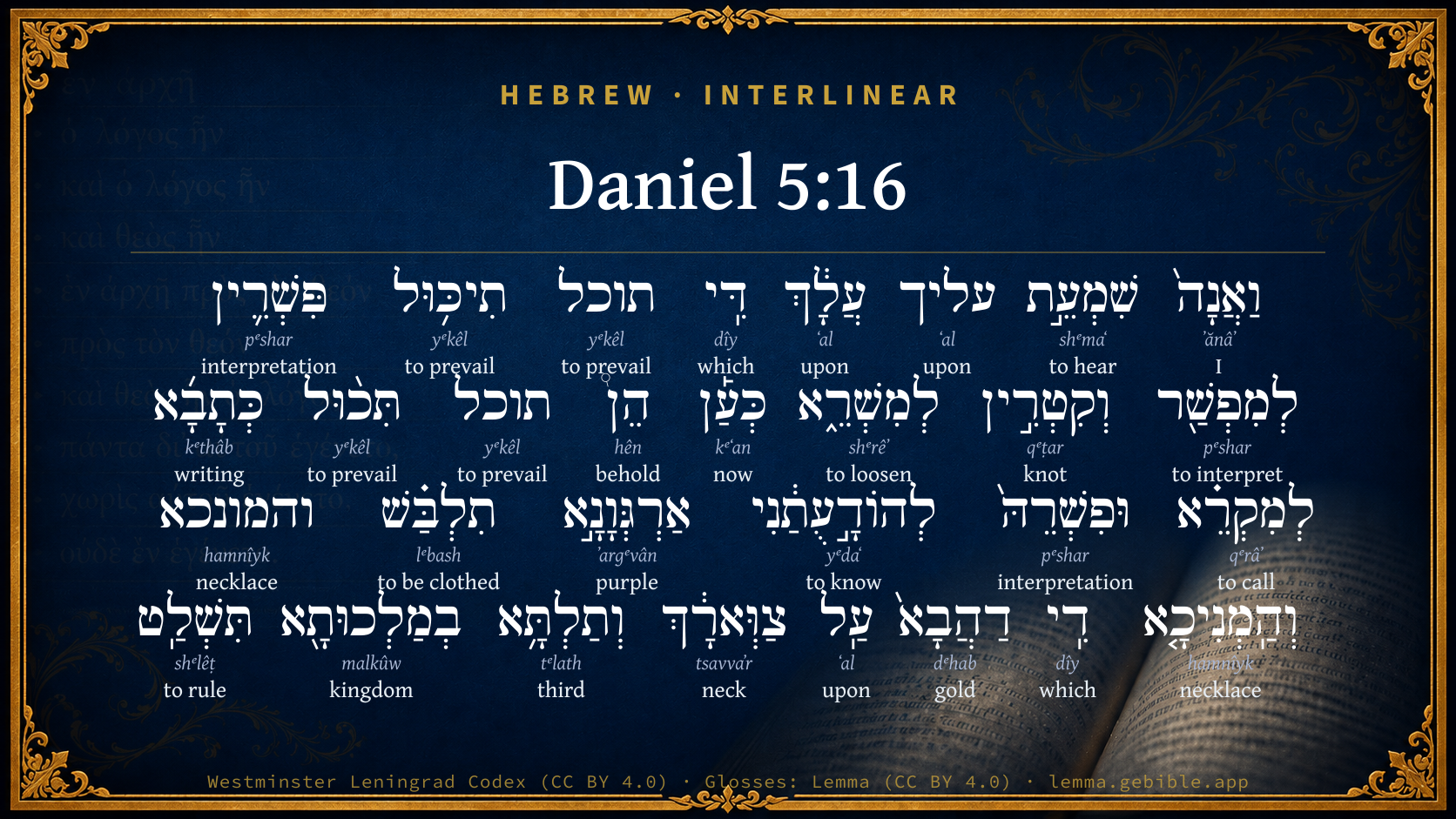
Hebrew (Westminster Leningrad Codex) Daniel 5:16 appears in the Hebrew Old Testament. The text above is from the Westminster Leningrad Codex. Each word links to its Strong’s number, a concise gloss, and parsing drawn from the Open Scriptures Hebrew Bible morphology. Click any word for its full Brown-Driver-Briggs (BDB) entry.
Download image
Cite this verse

Daniel 5:16 (World English Bible). Public Domain. Lemma interlinear Bible study tool, https://lemma.gebible.app/v/daniel/5/16.

Show BibTeX & RIS
BibTeX
RIS
English Translation
But I have heard of you, that you can give interpretations, and dissolve doubts; now if you can read the writing, and make known to me the interpretation of it, you shall be clothed with purple, and have a chain of gold about your neck, and shall be the third ruler in the kingdom.
World English Bible · Public Domain
Highlights
  • 1 first appearance in the Hebrew Bible
Full analysis ↓
Download a study sheet

One document with this verse’s original text, its word-by-word gloss line, the meaning frame, cross-references with their text, attributed commentary, and full source and license credits — printable, and it pastes into notes with its structure intact.

This verse Autodidact and up

Study sheet (.html) Plain text (.txt)

A passage Seminary Student

Up to 50 verses in one chapter. A passage sheet keeps up to 6 commentary sources and 12 cross-references per verse, in the order this page ranks them, and says so on the sheet whenever that leaves anything out. Ask for a single verse and you get the Autodidact verse sheet above.

Everything on this page stays free to read, with no account — the sheet is a download of what is already on screen, not access to it.

Want to remove ads? Support Godless Engineer
Compare translations 3

The same verse in 3 English versions, stacked beneath the original-language interlinear above. Click any original word for its lexicon entry.

Each is an independent rendering of the whole verse — the interlinear is not word-aligned to these translations.

Highlighted words mark where these versions differ — a whole-verse word diff, not a word-by-word alignment.

  • World English Bible Public Domain
    But I have heard of you, that you can give interpretations, and dissolve doubts; now if you can read the writing, and make known to me the interpretation of it, you shall be clothed with purple, and have a chain of gold about your neck, and shall be the third ruler in the kingdom.
  • King James Version Public Domain
    And I have heard of thee, that thou canst make interpretations, and dissolve doubts: now if thou canst read the writing, and make known to me the interpretation thereof, thou shalt be clothed with scarlet, and have a chain of gold about thy neck, and shalt be the third ruler in the kingdom.
  • unfoldingWord Literal Text CC BY-SA 4.0
    But I have heard about you, that you are able to give interpretations and solve problems. Now if you are able to read the writing and make known to me its interpretation, you will be clothed with purple and have a chain of gold around your neck, and you will be the third ruler in the kingdom.”

unfoldingWord Literal Text — © unfoldingWord, licensed CC BY-SA 4.0. Word-aligned USFM3 via Door43 (git.door43.org/unfoldingWord/en_ult).

Versions to compare (up to 4)

3 of 4 selected

Show all 18 translations

Every available English version of this verse, each an independent rendering of the whole verse.

  • World English Bible Public Domain
    But I have heard of you, that you can give interpretations, and dissolve doubts; now if you can read the writing, and make known to me the interpretation of it, you shall be clothed with purple, and have a chain of gold about your neck, and shall be the third ruler in the kingdom.
  • Berean Standard Bible Public Domain
    But I have heard about you, that you are able to give interpretations and solve difficult problems. Therefore, if you can read this inscription and give me its interpretation, you will be clothed in purple and have a gold chain placed around your neck, and you will be made the third highest ruler in the kingdom.”
  • Majority Standard Bible Public Domain
    But I have heard about you, that you are able to give interpretations and solve difficult problems. Therefore, if you can read this inscription and give me its interpretation, you will be clothed in purple and have a gold chain placed around your neck, and you will be made the third highest ruler in the kingdom.”
  • King James Version Public Domain
    And I have heard of thee, that thou canst make interpretations, and dissolve doubts: now if thou canst read the writing, and make known to me the interpretation thereof, thou shalt be clothed with scarlet, and have a chain of gold about thy neck, and shalt be the third ruler in the kingdom.
  • American Standard Version (1901) Public Domain
    But I have heard of thee, that thou canst give interpretations, and dissolve doubts; now if thou canst read the writing, and make known to me the interpretation thereof, thou shalt be clothed with purple, and have a chain of gold about thy neck, and shalt be the third ruler in the kingdom.
  • Revised Version (1885) Public Domain
    But I have heard of thee, that thou canst give interpretations, and dissolve doubts: now if thou canst read the writing, and make known to me the interpretation thereof, thou shalt be clothed with purple, and have a chain of gold about thy neck, and shalt be the third ruler in the kingdom.
  • Geneva Bible (1599) Public Domain
    Then heard I of thee, that thou couldest shewe interpretations, and dissolue doutes: nowe if thou canst reade the writing, and shew me the interpretation thereof, thou shalt be clothed with purple, and shalt haue a chaine of golde about thy necke, and shalt be the third ruler in the kingdome.
  • Douay-Rheims (1899) Public Domain
    But I have heard of thee, that thou canst interpret obscure things, and resolve difficult things: now if thou art able to read the writing, and to shew me the interpretation thereof, thou shalt be clothed with purple, and shalt have a chain of gold about thy neck, and shalt be the third prince in my kingdom.
  • Young's Literal Translation Public Domain
    and I -- I have heard of thee, that thou art able to give interpretations, and to loose knots: now, lo -- thou art able to read the writing, and its interpretation to cause me to know -- purple thou dost put on, and a bracelet of gold `is' on thy neck, and third in the kingdom thou dost rule.'
  • Literal Standard Version CC BY-SA 4.0
    and I have heard of you, that you are able to give interpretations, and to loose knots: now, behold—you are able to read the writing, and its interpretation to cause me to know—purple you put on, and a bracelet of gold [is] on your neck, and you rule third in the kingdom.”
  • Unlocked Literal Bible CC BY-SA 4.0
    I have heard that you can give interpretations and solve problems. Now if you can read the writing and tell me its meaning, you will be clothed with purple and have a gold chain placed around your neck, and you will have the authority of the third highest ruler in the kingdom.”
  • unfoldingWord Literal Text CC BY-SA 4.0
    But I have heard about you, that you are able to give interpretations and solve problems. Now if you are able to read the writing and make known to me its interpretation, you will be clothed with purple and have a chain of gold around your neck, and you will be the third ruler in the kingdom.”
  • Darby Bible Public Domain
    But I have heard of thee, that thou canst give interpretations, and solve problems. Now if thou canst read the writing, and make known to me the interpretation thereof, thou shalt be clothed with purple, and have a chain of gold about thy neck, and shalt be the third ruler in the kingdom.
  • World Messianic Bible Public Domain
    But I have heard of you, that you can give interpretations and dissolve doubts. Now if you can read the writing and make known to me its interpretation, you shall be clothed with purple, and have a chain of gold around your neck, and shall be the third ruler in the kingdom.”
  • Webster's Bible Public Domain
    And I have heard of thee, that thou canst make interpretations, and dissolve doubts: now if thou canst read the writing, and make known to me the interpretation of it, thou shalt be clothed with scarlet, and have a chain of gold about thy neck, and shalt be the third ruler in the kingdom.
  • Free Bible Version CC BY-SA 4.0
    However, I'm told that you are able to give interpretations and solve difficult problems. If you can read this writing and explain it to me, you will be clothed in purple and have a gold chain placed around your neck, and you will become the third highest ruler in the kingdom.”
  • Bible in Basic English Public Domain
    And I have had news of you, that you have the power of making things clear, and of answering hard questions: now if you are able to make out the writing and give me the sense of it, you will be clothed in purple and have a gold chain round your neck and be a ruler of high authority in the kingdom.
  • JPS Tanakh (1917) Public Domain
    But I have heard of thee, that thou canst give interpretations, and loose knots; now if thou canst read the writing, and make known to me the interpretation thereof, thou shalt be clothed with purple, and have a chain of gold about thy neck, and shalt rule as one of three in the kingdom.'

Literal Standard Version (2020), Covenant Press — licensed CC BY-SA 4.0. Text via the HelloAO Bible API (eBible.org). Unlocked Literal Bible (unfoldingWord) — licensed CC BY-SA 4.0. Text via the HelloAO Bible API (eBible.org). unfoldingWord Literal Text — © unfoldingWord, licensed CC BY-SA 4.0. Word-aligned USFM3 via Door43 (git.door43.org/unfoldingWord/en_ult). Free Bible Version, Dr. Jonathan Gallagher — licensed CC BY-SA 4.0. Text via the HelloAO Bible API (eBible.org).

Word by word

More ways to search: Search by grammar → Find every occurrence → Compare this word →

Practice this passage: Drill this verse → Learn its vocabulary →

לְמִפְשַׁ֖ר
pᵉshar
H6590
“to interpret”
Adjective, R + Verb, Qal, Infinitive Construct
Part of Speech
Adjective + Verb
Stem
Qal
Form
Infinitive Construct
Full BDB Definition

Origin: corresponding to H6622

TWOT: 2949

to interpret - (Peal) to interpret - (Pael) to interpret
  1. וַאֲנָה֙ ʼănâʼ H576 “and · I” Adjective, C + Pronoun, Personal, 1st Person, Common, Singular
  2. שִׁמְעֵ֣ת shᵉmaʻ H8086 “to hear” Adjective, V, Plural
  3. עליך ʻal H5922 “upon · you” Adjective, R + Suffix, Personal, 2nd Person, Masculine, Singular
  4. עֲלָ֔ךְ ʻal H5922 “upon · you” Adjective, R + Suffix, Personal, 2nd Person, Masculine, Singular
  5. דִּֽי dîy H1768 “which” Adjective, T
  6. תוכל yᵉkêl H3202 “to prevail” Adjective, V
  7. תִיכּ֥וּל yᵉkêl H3202 “to prevail” Adjective, V
  8. פִּשְׁרִ֛ין pᵉshar H6591 “interpretations” Adjective, N, Common
  9. וְקִטְרִ֣ין qᵉṭar H7001 “and · knots” Adjective, C + Noun, Common, Masculine, Plural, Absolute
  10. לְמִשְׁרֵ֑א shᵉrêʼ H8271 “to loosen” Adjective, R + Verb, Qal, Infinitive Construct
  11. כְּעַ֡ן kᵉʻan H3705 “now” Adjective, D
  12. הֵן֩ hên H2006 “behold” Adjective, C
  13. תוכל yᵉkêl H3202 “to prevail” Adjective, V
  14. תִּכ֨וּל yᵉkêl H3202 “to prevail” Adjective, V
  15. כְּתָבָ֜א kᵉthâb H3792 “writing · the” Adjective, N, Common + Particle, Definite Article
  16. לְמִקְרֵ֗א qᵉrâʼ H7123 “to call” Adjective, R + Verb, Qal, Infinitive Construct
  17. וּפִשְׁרֵהּ֙ pᵉshar H6591 “and · interpretation · his” Adjective, C + Noun, Common, Masculine, Singular, Construct + Suffix, Personal, 3rd Person, Masculine, Singular
  18. לְהוֹדָ֣עֻתַ֔נִי yᵉdaʻ H3046 “to know · me” Adjective, R + Verb, Hiphil, Infinitive Construct + Suffix, Personal, 1st Person, Common, Singular
  19. אַרְגְּוָנָ֣א ʼargᵉvân H711 “purple · the” Adjective, N, Common + Particle, Definite Article
  20. תִלְבַּ֗שׁ lᵉbash H3848 “to be clothed” Adjective, V
  21. והמונכא hamnîyk H2002 “and · necklace · the” Adjective, C + Noun, Common, Masculine, Singular, Determined + Particle, Definite Article
  22. וְהַֽמְנִיכָ֤א hamnîyk H2002 “and · necklace · the” Adjective, C + Noun, Common, Masculine, Singular, Determined + Particle, Definite Article
  23. דִֽי dîy H1768 “which” Adjective, T
  24. דַהֲבָא֙ dᵉhab H1722 “gold · the” Adjective, N, Common + Particle, Definite Article
  25. עַֽל ʻal H5922 “upon” Adjective, R
  26. צַוְּארָ֔ךְ tsavvaʼr H6676 “neck · your” Adjective, N, Common + Suffix, Personal, 2nd Person, Masculine, Singular
  27. וְתַלְתָּ֥א tᵉlath H8531 “and · third” Adjective, C + Adjective, Ordinal number, Both, Singular, Absolute
  28. בְמַלְכוּתָ֖א malkûw H4437 “in/at · kingdom · the” Adjective, R + Noun, Common, Feminine, Singular, Determined + Particle, Definite Article
  29. תִּשְׁלַֽט shᵉlêṭ H7981 “to rule” Adjective, V

About this verse

These counts appear in no published source. They are computed here, from the morphology-tagged text and Lemma’s own curated glosses. What Lemma adds →

30
words
22
distinct lemmas
Prophets
section

Notable vocabulary

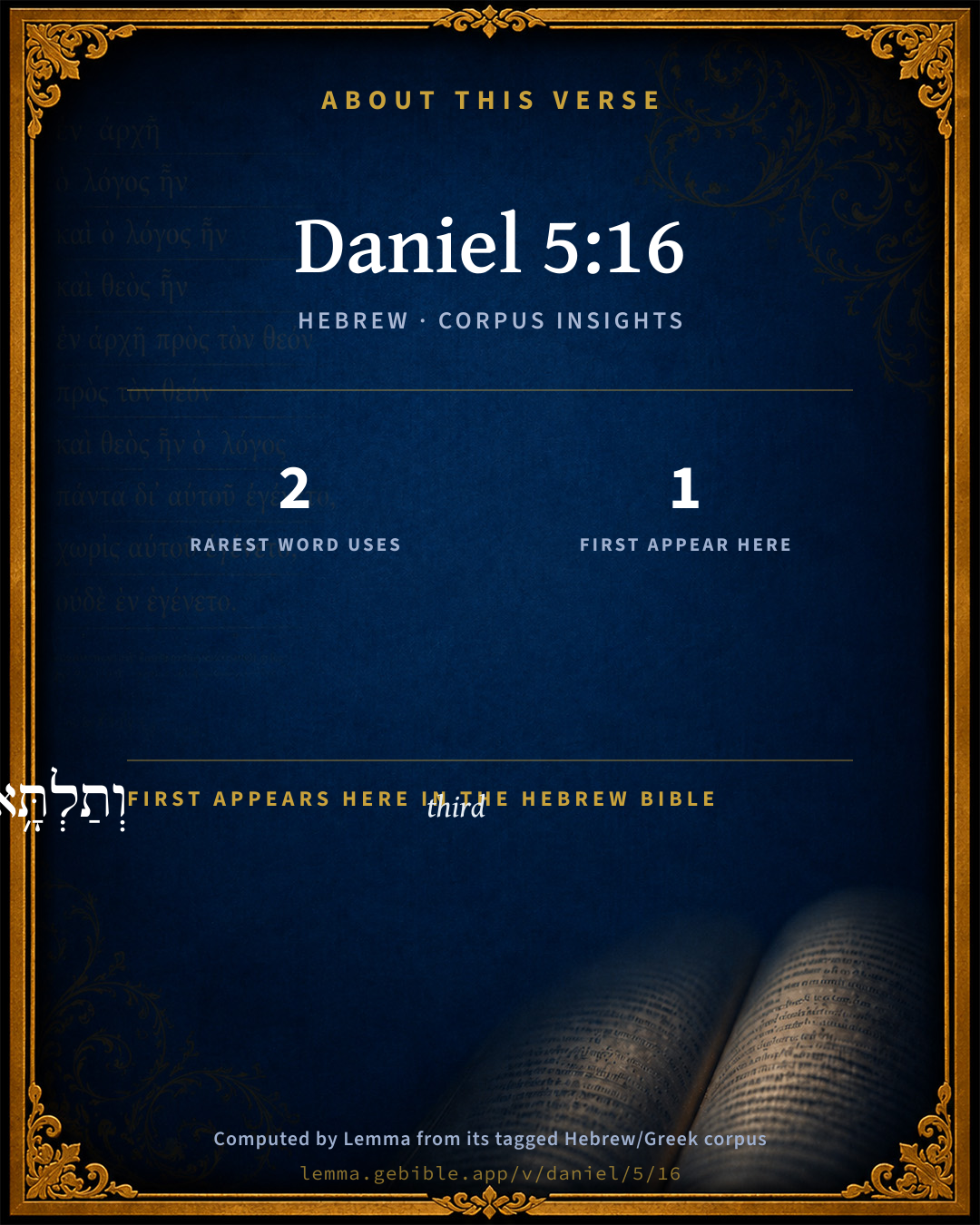
The rarest word here is לְמִפְשַׁ֖ר to interpret H6590 — appearing just 2 times in the whole Hebrew Bible.

First appearance in Scripture

This word makes its first canonical appearance in the Hebrew Bible here:

  • וְתַלְתָּ֥א third H8531

Shared distinctive vocabulary

לְמִפְשַׁ֖ר to interpret H6590 occurs in 2 verses of the Hebrew Bible. Also found in:

Grammatical profile

  • 4 verbs
  • 2 nouns
  • 17 adjectives
  • 1 pronoun
  • 6 particles

Verb forms

  • לְמִפְשַׁ֖ר Qal · Infinitive Construct
  • לְמִשְׁרֵ֑א Qal · Infinitive Construct
  • לְמִקְרֵ֗א Qal · Infinitive Construct
  • לְהוֹדָ֣עֻתַ֔נִי Hiphil · Infinitive Construct

Repetition

Words recur within this verse — often emphatic in Hebrew:

  • תוכל to prevail H3202 ×4
  • עליך upon H5922 ×3
  • פִּשְׁרִ֛ין interpretation H6591 ×2
  • והמונכא necklace H2002 ×2
  • דִּֽי which H1768 ×2

Hebrew & Septuagint length

In English translation the verse runs 54 words from the Hebrew and 59 from the Septuagint (LXX English) — closely comparable.

A rough comparison of the two English renderings, which tokenize alike — not a word-level alignment.

Word counts can differ between the Hebrew and the Greek without any difference in meaning — e.g. the Hebrew direct-object marker אֵת has no separate Greek word, and Greek often adds the article ὁ.

Cross-references

4

Topical passages linked to Daniel 5:16 in the Treasury of Scripture Knowledge — connected by theme and wording, ordered by reader-vote popularity; previews shown in the World English Bible.

  • Daniel 5:7 The king cried aloud to bring in the enchanters, the Chaldeans, and the soothsayers. The king spoke and said to the wise men of Babylon, Whoever shall read this writing, and show me the interpretation of it, shall be clothed with purple, and have a chain of gold about his neck, and shall be the third ruler in the kingdom.
  • Genesis 40:8 They said to him, "We have dreamed a dream, and there is no one who can interpret it." Joseph said to them, "Don't interpretations belong to God? Please tell it to me."
  • Daniel 5:29 Then commanded Belshazzar, and they clothed Daniel with purple, and put a chain of gold about his neck, and made proclamation concerning him, that he should be the third ruler in the kingdom.
  • Acts 8:18 Now when Simon saw that the Holy Spirit was given through the laying on of the apostles' hands, he offered them money,

Cross-references courtesy of OpenBible.info (CC BY 4.0).

Hebrew and Greek witnesses Masoretic Hebrew ↔ Greek Septuagint

The same verse in the two great witnesses to the Old Testament, shown verse-for-verse.

These are two independent witnesses, not word-aligned to each other, and the Septuagint is shown in lemma (dictionary) form.

Hebrew Daniel 5:16 Masoretic · Westminster Leningrad Codex

וַאֲנָה֙ שִׁמְעֵ֣ת עליך עֲלָ֔ךְ דִּֽי תוכל תִיכּ֥וּל פִּשְׁרִ֛ין לְמִפְשַׁ֖ר וְקִטְרִ֣ין לְמִשְׁרֵ֑א כְּעַ֡ן הֵן֩ תוכל תִּכ֨וּל כְּתָבָ֜א לְמִקְרֵ֗א וּפִשְׁרֵהּ֙ לְהוֹדָ֣עֻתַ֔נִי אַרְגְּוָנָ֣א תִלְבַּ֗שׁ והמונכא וְהַֽמְנִיכָ֤א דִֽי דַהֲבָא֙ עַֽל צַוְּארָ֔ךְ וְתַלְתָּ֥א בְמַלְכוּתָ֖א תִּשְׁלַֽט

But I have heard of you, that you can give interpretations, and dissolve doubts; now if you can read the writing, and make known to me the interpretation of it, you shall be clothed with purple, and have a chain of gold about your neck, and shall be the third ruler in the kingdom.

World English Bible · Public Domain

Greek LXX Daniel 5:16 Septuagint · lemma form

βασιλεύς σύ ποιέω ἑστιατορία ὁ φίλος σύ καί πίνω οἶνος καί ὁ σκεῦος ὁ οἶκος ὁ θεός ὁ ζάω φέρω σύ καί πίνω ἐν αὐτός σύ καί ὁ μεγιστάν σύ καί αἰνέω πᾶς ὁ εἴδωλον ὁ χειροποίητος ὁ ἄνθρωπος καί ὁ θεός ὁ ζάω οὐ εὐλογέω καί ὁ πνεῦμα σύ ἐν ὁ χείρ αὐτός καί ὁ βασίλειον σύ αὐτός δίδωμι σύ καί οὐ εὐλογέω αὐτός οὐδέ αἰνέω αὐτός

And I have heard concerning you, that you are able to make interpretations: now then if you shall be able to read the writing, and to make known to me the interpretation of it, you shall be clothed with purple, and there shall be a golden chain upon your neck, and you shall be third ruler in my kingdom.

LXX2012 (modern English Septuagint) · Public Domain

Hebrew: Westminster Leningrad Codex (CC BY 4.0). Greek: Septuagint (public domain); English from LXX2012 (modern English Septuagint) (Public Domain). How the Septuagint differs from the Hebrew →

Commentary

Notes on Daniel 5:16 from classic Christian and Jewish commentators (each source and its license shown beneath its notes). The classic Christian expositions comment on the surrounding passage and are grouped to its opening verse, so a note may address several verses; the Jewish commentaries on the Tanakh (Rashi and others) are per-verse, so they appear only where the commentator wrote on this verse.

Lemma curates 59 commentaries, every one of them public domain or Creative Commons licensed, each selected and text-cleaned for this edition rather than reprinted as found. About our sources →

Trapp's Complete Commentary

John Trapp

Dan 5:16 And I have heard of thee, that thou canst make interpretations, and dissolve doubts: now if thou canst read the writing, and make known to me the interpretation thereof, thou shalt be clothed with scarlet, and [have] a chain of gold about thy neck, and shalt be the third ruler in the kingdom.

Ver. 16. And I have heard of thee.] As far off as he maketh it, Belshazzar could not be so ignorant of Daniel, as he would seem to be, since he understood punctually the dreams, honours, and troubles of his grandfather. {Dan 5:22} But this he took for a piece of his silly glory, to make it very strange, as if he had never heard of Daniel till now.

John Trapp, A Commentary or Exposition upon All the Books of the Old and New Testament (1647–1656) — public domain. Text from a community e-Sword module.

The Biblical Illustrator

Joseph S. Exell

Dan_5:16

And dissolve doubts.

The Dissolving of Doubts

Doubts and questions are not peculiar to Nebuchadnezzar, but they are the common lot and heritage of humanity. We live just now in a specially doubting age. Science puts everything in question, and literature distils the questions, making an atmosphere of them. The cultivated and mature have their doubts ingrown they know not how, and the younger minds encounter their public visitations when they do not seek them. Note that the three principles sources and causes whence our doubts arise, and from which they get force to make their assault

1. All the truths of religion are inherently dubitable. They are only what are called probable, never necessary truths like the truths of geometry or of numbers. This field of probable truth is the whole field of religion, and of course it is competent for doubt to cover it in every part and item.

2. We begin life as unknowing creatures that have everything to learn. We grope, the groping is doubt; we handle, we question, we guess, we experiment, beginning in darkness and stumbling on towards intelligence.

3. It is a fact, disguise it as we can, or deny it as we may, that our faculty is itself in disorder. A broken or bent telescope will not see anything rightly. A filthy window will not bring in even the day as it is. As long as these three sources, or originating causes of doubt continue, doubts will continue, and will, in one form or another, be multiplied. I do not propose, therefore, to show how they may be stopped, for that is impossible, but only how they may be dissolved, or cleared away. The first thing to be said is negative, viz., that the doubters never can dissolve or extirpate their doubts by inquiry, search, investigation, or any kind of speculative endeavour. They must never go after the truth to merely find it, but to practice it and live by it. To be simply curious is only a way to multiply doubts; for in doing it their are, in fact, postponing all the practical rights of truth. They imagine, it may be, that they are going first to settle their questions, and then at their leisure to act. As if they were going to get the perfect system and complete knowledge of truth before they move an inch in doing what they know! And they come out wondering at the discovery, that the more they investigate the less they believe! Their very endeavour mocks them--just as it really ought. For truth is something to be lived. How shall a mind get on finding more truth, save as it takes direction from what it gets? There is no fit search after truth which does not, first of all, begin to live the truth it knows. To come to positive matter. There is a way for dissolving any and all doubts--a way that opens at a very small gate, but widens wonderfully after you pass. Every human soul, at a certain first point of its religious outfit, has a key given to it which is to be the open sesame of all right discovery. Every man acknowledges the distinction of right and wrong, feels the reality of that distinction, knows it by immediate consciousness even as he knows himself. He would not be a man without that distinction. It is even this which distinguishes him from the mere animals. Here is the key that opens everything. The only reason why we fall into so many doubts, and get unsettled in our inquiries, instead of being settled by them, as we undertake to be, is that we do not begin at the beginning. A right mind has a right polarity, and discovers right things by feeling after them. The true way, then, of dissolving doubts, is to begin at the beginning, and do the first thing first. Say nothing of investigation till you have made sure of being grounded everlastingly, and with a completely whole intent in the principle of right doing as a principle. Unreligious men are right only so far as they can be, they may not be at all right in principle. Lessons:

1. Be never afraid of doubt.

2. Be afraid of all sophistries, and tricks, and strifes.

3. Getting into a scornful way is fatal.

4. Never put force on the mind to make it believe.

5. Never be in a hurry to believe. (Horace Bushnell, D. D.)

The Biblical Illustrator, edited by Joseph S. Exell (c. 1880s–1900s) — public domain. Text from a community e-Sword module.

Adam Clarke's Commentary

Verse 16. Dissolve doubts] Untie knots - unbind what is bound. An expression used in the east to signify a judge of eminent wisdom and skill.

Adam Clarke's Commentary on the Bible (1810–1826) — public domain. Text from a community e-Sword/MySword module.

The Cambridge Bible for Schools and Colleges

gen. ed. J. J. S. Perowne

16. make] better give (R.V.); lit. interpret.

dissolve doubts] loose knots. See on Dan_5:12.

thou shalt be clothed with purple, &c.] As Dan_5:7.

and rule as one of three in the kingdom] See on Dan_5:7.

The Cambridge Bible for Schools and Colleges (gen. ed. J. J. S. Perowne; Cambridge University Press, 1878–1918) — public domain. Text from a community e-Sword module.

John Gill's Exposition

And I have heard of thee,.... That is, by the queen, which he repeats for the sake of observing what she had said of him, and which gave him encouragement to send for him:

that thou canst make interpretations; of dreams, and of things hard to be understood:

and dissolve doubts; untie knots, solve difficulties, and answer hard and intricate questions:

now if thou canst read the writing, and make known to me the interpretation thereof; that which is upon the wall before thee, and which the wise men of Babylon could not:

thou shalt be clothed with scarlet, and have a chain of gold about thy neck, and shall be the third ruler in the kingdom; the same reward he had proposed to the astrologers and soothsayers, Dan 5:7 but what was no temptation or motive to Daniel, as appears by what follows:

John Gill's Exposition of the Whole Bible (1746–1763) — public domain (CC PDM 1.0). Text via the HelloAO Bible API.

Albert Barnes' Notes on the Bible

And I have heard of thee ... - Dan 5:11.

Canst make interpretations - Margin, “interpret.” Chaldee, “interpret interpretations.” The meaning is, that he was skilled in interpreting or explaining dreams, omens, etc.

And dissolve doubts - See the notes at Dan 5:12.

Now, if thou canst read the writing ... thou shalt be clothed with scarlet ... - This was the reward which at the first he had promised to any one that was able to do it, and as all others had failed, he was willing that it should be offered to a Jew.

Albert Barnes' Notes on the Bible (1834–1885) — public domain. Text from a community e-Sword/MySword module.

Haydock's Catholic Bible Commentary

Difficult. Literally, "things which are tied," or perplexing. (Haydock) --- The Persians still used the like expressions, to imply an intelligent governor. (Chardin.)

George Leo Haydock (1774–1849), Haydock's Catholic Family Bible and Commentary, 1859 edition — public domain. Excludes Psalms (Douay-Rheims chapter numbering differs from Protestant) and Deuterocanonical books (Catholic canon only).

Matthew Poole's English Annotations

These things were spoken to before, Dan 5:7,8.

Matthew Poole's English Annotations on the Holy Bible (1683–1685) — public domain. Text from a community e-Sword/MySword module.

The Pulpit Commentary

The dissolving of doubt.

have heard of thee, that thou canst make interpretations, and dissolve doubts," etc. A most important subject (not growing exegetically out of the passage, nevertheless) is suggested by the text, which is admirably treated by Horace Bushnell, in "Sermons on Living Subjects." For the sake of any who may not have access to the book, we give a brief outline, for the most part in Bushnell"s words.

I THE PREVALENCE OF DOUBT. The prevalence of doubt is exhibited and illustrated at considerable length. "Science puts everything in question, and literature distils the questions, making an atmosphere of them.

II CAUSES OF DOUBT. "They never come of truth or high discovery, but always of the want of it.

1. All the truths of religion are inherently dub/table. They are the subjects of moral evidence, not of absolute demonstration.

2. We begin life as unknowing creatures that have everything to learn.

3. Our faculty is itself disorder; e.g. a bent telescope; a filthy window.

III THE DISSOLUTION OF DOUBT.

1. Counsel negative. Not "by inquiry, search, investigation, or any kind of speculative endeavour. Men must never go after the truth to merely find it, but to practise it and live by it.

2. Counsel positive. Bushnell asserts and illustrates at length that man has universally the absolute idea of right and its correlative wrong; and then enforces, with power and manifoldness of illumination, this: "Say nothing of investigation till you have made sure of being grounded everlastingly, and" with a completely whole intent, in the principle of right doing as a principle. " (No condensation can give any idea of the grasp and fatness with which this is exhibited and applied.)

IV THE RESULT. A soul thus won to its integrity of thought and meaning will rapidly clear all tormenting questions and difficulties. They are not all gone, but they are going. " "The ship is launched; he is gone to sea, and has the needle on board.

V SUPPLEMENTARY DIRECTION.

1. Be never afraid of doubt.

2. Be afraid of all sophistries and tricks and strifes of disingenuousargument.

3. Getting into any scornful way is fatal.

4. Never settle upon any thing as true, because it is safer to hold it than not.

5. Have it as a law never to put force on the mind or try to make it believe.

It spoils the mind"s integrity.

6. Never be in a hurry to believe; never try to conquer doubts against time. "One of the greatest talents in religious discovery is the finding how to hang up questions and let them hang without being at all anxious about them What seemed perfectly insoluble will clear itself in a wondrous revelation." And here is a thought: "It will not hurt you, nor hurt the truth, if you should have some few questions left to be carried on with you when you go hence, for in that more luminous state, most likely they will soon be cleared, only a thousand others will be springing up even there, and you will go on dissolving still your new sets of questions, and growing mightier and more deep-seeing for eternal ages. R.

The Pulpit Commentary (1880–1919), ed. H.D.M. Spence-Jones & Joseph S. Exell — public domain. Text from a community e-Sword module.

Rashi

Rabbi Shlomo Yitzchaki (Rashi)

Now if you can [as translated,] Now if you can.

Rashi on the Tanakh — English translations: “The Judaica Press complete Tanach with Rashi, translated by A. J. Rosenberg” (CC BY 4.0); “Pentateuch with Rashi's commentary by M. Rosenbaum and A.M. Silbermann, 1929-1934” (public domain); “The Metsudah Tanach series, Lakewood, N.J” (CC BY 4.0); and “The Book of Joshua, Metsudah Publications, 1997” (CC BY 4.0). Text via Sefaria.

Lesson kit

Teaching starters — assembled from the data on this page, not authored interpretation. Every prompt links to the verse data it draws on. Edit before teaching.

Daniel, in the Prophets, opens this verse with 30 words (22 distinct Hebrew lemmas). Its most distinctive word is pᵉshar (“to interpret”). A historical commentator’s framing appears above. Read the whole chapter for the surrounding context.

Discussion questions

  1. What does “to interpret” (pᵉshar) contribute to the verse as a whole?
  2. This is the first place “third” appears in Scripture (first appears here). What does its debut here establish?
  3. How does Daniel 5:12, which shares the word «to interpret», read alongside this verse?
  4. What does the repetition of “to prevail” (4× in this one verse) do in this verse?
  5. These translations render this verse differently; the difference is in the English rendering, not the original. What questions does that raise?
  6. «לְמִפְשַׁ֖ר» is a Qal Infinitive Construct verb. How does that grammatical form shape the action described?
  7. Compare how Trapp's Complete Commentary and The Biblical Illustrator read this verse. Where do they agree or differ?

Things to notice

  • 1 word makes its first canonical appearance in Scripture here.
  • These translations choose different wording for 15 words in this verse.
  • “to prevail” occurs 4× in this single verse.
  • 22 distinct Hebrew lemmas span 30 words in this verse.

Reading settings

Reading text

Shown beneath each verse's original-language words.

Old Testament
Old Testament edition

Read the OT as the Masoretic Hebrew (MT) or the Greek Septuagint (LXX).

English shown for the Greek Septuagint (in the Hebrew ↔ Greek comparison).

Comparing translations? Open the Compare panel on any verse page to stack up to four side by side.