
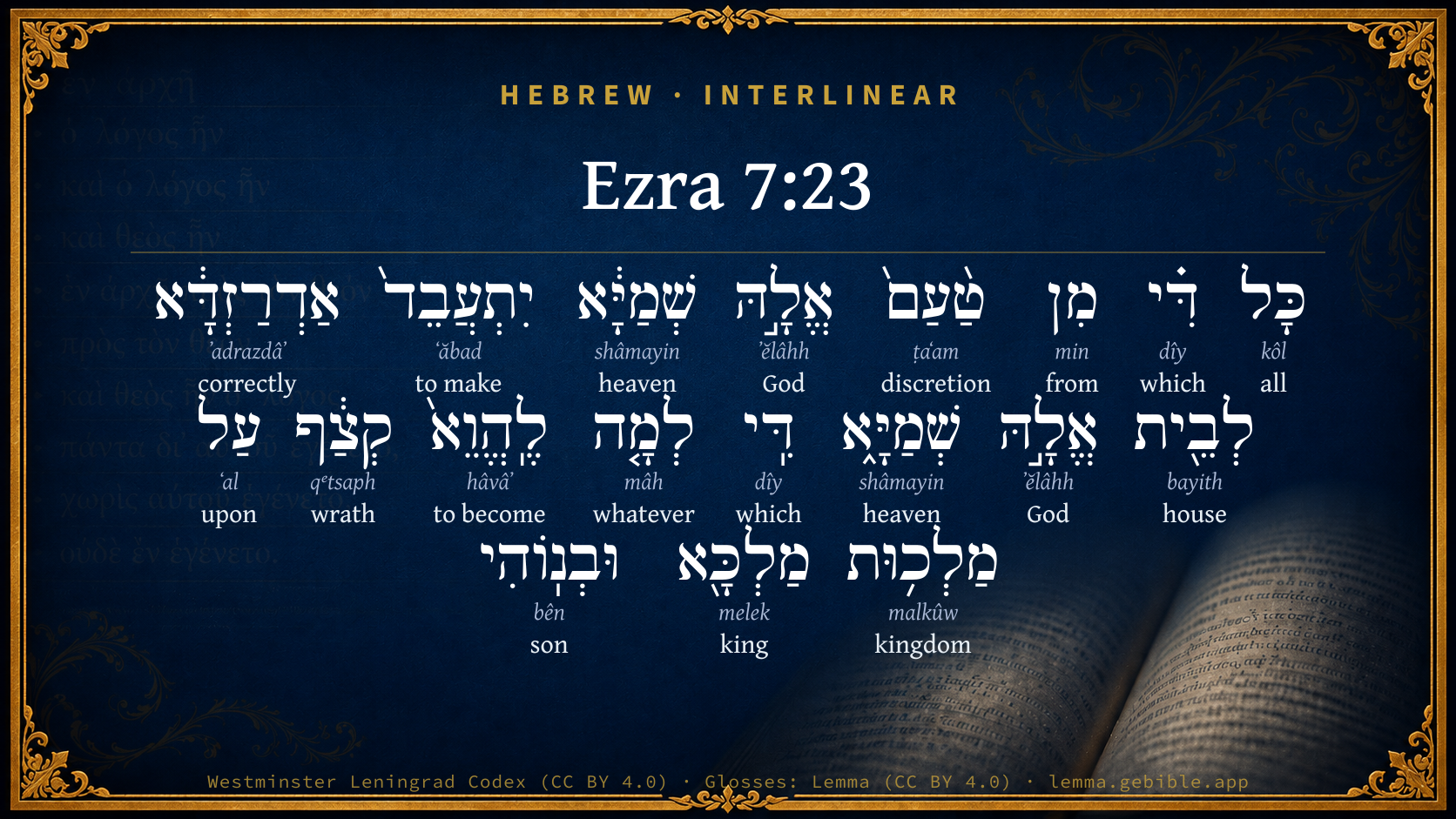
Ezra 7:23

Hebrew (Westminster Leningrad Codex) Ezra 7:23 appears in the Hebrew Old Testament. The text above is from the Westminster Leningrad Codex. Each word links to its Strong’s number, a concise gloss, and parsing drawn from the Open Scriptures Hebrew Bible morphology. Click any word for its full Brown-Driver-Briggs (BDB) entry.
Download image
Cite this verse

Ezra 7:23 (World English Bible). Public Domain. Lemma interlinear Bible study tool, https://lemma.gebible.app/v/ezra/7/23.

Show BibTeX & RIS
BibTeX
RIS
English Translation
Whatever is commanded by the God of heaven, let it be done exactly for the house of the God of heaven; for why should there be wrath against the realm of the king and his sons?
World English Bible · Public Domain
Highlights
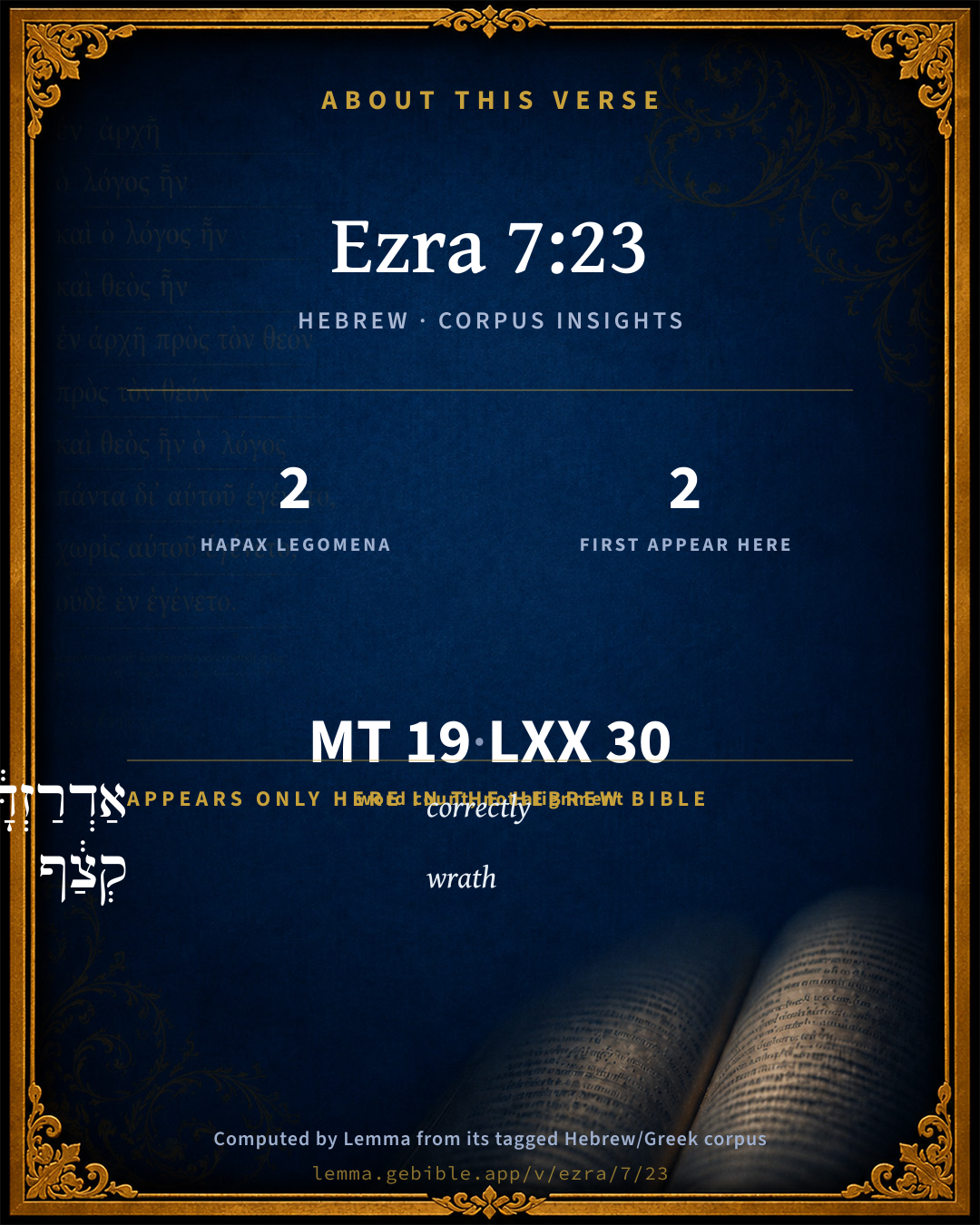
  • 2 hapax legomena — only here in the Hebrew Bible
  • 2 first appearances in the Hebrew Bible
Full analysis ↓
Download a study sheet

One document with this verse’s original text, its word-by-word gloss line, the meaning frame, cross-references with their text, attributed commentary, and full source and license credits — printable, and it pastes into notes with its structure intact.

This verse Autodidact and up

Study sheet (.html) Plain text (.txt)

A passage Seminary Student

Up to 50 verses in one chapter. A passage sheet keeps up to 6 commentary sources and 12 cross-references per verse, in the order this page ranks them, and says so on the sheet whenever that leaves anything out. Ask for a single verse and you get the Autodidact verse sheet above.

Everything on this page stays free to read, with no account — the sheet is a download of what is already on screen, not access to it.

Want to remove ads? Support Godless Engineer
Compare translations 3

The same verse in 3 English versions, stacked beneath the original-language interlinear above. Click any original word for its lexicon entry.

Each is an independent rendering of the whole verse — the interlinear is not word-aligned to these translations.

Highlighted words mark where these versions differ — a whole-verse word diff, not a word-by-word alignment.

  • World English Bible Public Domain
    Whatever is commanded by the God of heaven, let it be done exactly for the house of the God of heaven; for why should there be wrath against the realm of the king and his sons?
  • King James Version Public Domain
    Whatsoever is commanded by the God of heaven, let it be diligently done for the house of the God of heaven: for why should there be wrath against the realm of the king and his sons?
  • unfoldingWord Literal Text CC BY-SA 4.0
    Everything that is from the decree of the God of heaven shall be done exactly for the house of the God of heaven. For why should there be wrath against the kingdom of the king and his sons?

unfoldingWord Literal Text — © unfoldingWord, licensed CC BY-SA 4.0. Word-aligned USFM3 via Door43 (git.door43.org/unfoldingWord/en_ult).

Versions to compare (up to 4)

3 of 4 selected

Show all 18 translations

Every available English version of this verse, each an independent rendering of the whole verse.

  • World English Bible Public Domain
    Whatever is commanded by the God of heaven, let it be done exactly for the house of the God of heaven; for why should there be wrath against the realm of the king and his sons?
  • Berean Standard Bible Public Domain
    Whatever is commanded by the God of heaven must be done diligently for His house. For why should wrath fall on the realm of the king and his sons?
  • Majority Standard Bible Public Domain
    Whatever is commanded by the God of heaven must be done diligently for His house. For why should wrath fall on the realm of the king and his sons?
  • King James Version Public Domain
    Whatsoever is commanded by the God of heaven, let it be diligently done for the house of the God of heaven: for why should there be wrath against the realm of the king and his sons?
  • American Standard Version (1901) Public Domain
    Whatsoever is commanded by the God of heaven, let it be done exactly for the house of the God of heaven; for why should there be wrath against the realm of the king and his sons?
  • Revised Version (1885) Public Domain
    Whatsoever is commanded by the God of heaven, let it be done exactly for the house of the God of heaven; for why should there be wrath against the realm of the king and his sons?
  • Geneva Bible (1599) Public Domain
    Whatsoeuer is by the commandement of the God of heauen, let it be done speedily for the house of the God of heauen: for why should he be wroth against the realme of the King, and his children?
  • Douay-Rheims (1899) Public Domain
    All that belongeth to the rites of the God of heaven, let it be given diligently in the house of the God of heaven: lest his wrath should be enkindled against the realm of the king, and of his sons.
  • Young's Literal Translation Public Domain
    all that `is' by the decree of the God of heaven, let be done diligently for the house of the God of heaven; for why is there wrath against the kingdom of the king and his sons?
  • Literal Standard Version CC BY-SA 4.0
    all that [is] by the decree of the God of the heavens, let be done diligently for the house of the God of the heavens; for why is there wrath against the kingdom of the king and his sons?
  • Unlocked Literal Bible CC BY-SA 4.0
    Anything that comes from the decree of the God of Heaven, do it with devotion for his house. For why should his wrath come upon the kingdom of me and my sons?
  • unfoldingWord Literal Text CC BY-SA 4.0
    Everything that is from the decree of the God of heaven shall be done exactly for the house of the God of heaven. For why should there be wrath against the kingdom of the king and his sons?
  • Darby Bible Public Domain
    Whatever is commanded by the God of the heavens, let it be carefully done for the house of the God of the heavens; for why should there be wrath against the realm of the king and his sons?
  • World Messianic Bible Public Domain
    Whatever is commanded by the God of heaven, let it be done exactly for the house of the God of heaven; for why should there be wrath against the realm of the king and his sons?
  • Webster's Bible Public Domain
    Whatever is commanded by the God of heaven, let it be diligently done for the house of the God of heaven: for why should there be wrath against the realm of the king and his sons?
  • Free Bible Version CC BY-SA 4.0
    Make sure you provide in full whatever the God of heaven requires for his Temple, for why should his anger be brought down on the king and his sons?
  • Bible in Basic English Public Domain
    Whatever is ordered by the God of heaven, let it be done completely for the house of the God of heaven; so that there may not be wrath against the kingdom of the king and his sons.
  • JPS Tanakh (1917) Public Domain
    Whatsoever is commanded by the God of heaven, let it be done exactly for the house of the God of heaven; for why should there be wrath against the realm of the king and his sons?

Literal Standard Version (2020), Covenant Press — licensed CC BY-SA 4.0. Text via the HelloAO Bible API (eBible.org). Unlocked Literal Bible (unfoldingWord) — licensed CC BY-SA 4.0. Text via the HelloAO Bible API (eBible.org). unfoldingWord Literal Text — © unfoldingWord, licensed CC BY-SA 4.0. Word-aligned USFM3 via Door43 (git.door43.org/unfoldingWord/en_ult). Free Bible Version, Dr. Jonathan Gallagher — licensed CC BY-SA 4.0. Text via the HelloAO Bible API (eBible.org).

Word by word

More ways to search: Search by grammar → Find every occurrence → Compare this word →

Practice this passage: Drill this verse → Learn its vocabulary →

אַדְרַזְדָּ֔א
ʼadrazdâʼ
H149
“correctly”
Adjective, D
Part of Speech
Adjective
Full BDB Definition

Origin: probably of Persian origin

TWOT: 2562

correctly, exactly, diligently, earnestly
  1. כָּל kôl H3606 “all” Adjective, N, Common
  2. דִּ֗י dîy H1768 “which” Adjective, T
  3. מִן min H4481 “from” Adjective, R
  4. טַ֨עַם֙ ṭaʻam H2941 “discretion of” Adjective, N, Common
  5. אֱלָ֣הּ ʼĕlâhh H426 “God of” Adjective, N, Common
  6. שְׁמַיָּ֔א shâmayin H8065 “heaven(s) · the” Adjective, N, Common + Particle, Definite Article
  7. יִתְעֲבֵד֙ ʻăbad H5648 “to make” Adjective, V
  8. לְבֵ֖ית bayith H1005 “to/for · house of” Adjective, R + Noun, Common, Masculine, Singular, Construct
  9. אֱלָ֣הּ ʼĕlâhh H426 “God of” Adjective, N, Common
  10. שְׁמַיָּ֑א shâmayin H8065 “heaven(s) · the” Adjective, N, Common + Particle, Definite Article
  11. דִּֽי dîy H1768 “which” Adjective, C
  12. לְמָ֤ה mâh H4101 “to/for · whatever” Adjective, R + Pronoun, Interrogative, Common, Singular
  13. לֶֽהֱוֵא֙ hâvâʼ H1934 “to become” Adjective, V
  14. קְצַ֔ף qᵉtsaph H7109 “wrath” Adjective, N, Common
  15. עַל ʻal H5922 “upon” Adjective, R
  16. מַלְכ֥וּת malkûw H4437 “kingdom of” Adjective, N, Common
  17. מַלְכָּ֖א melek H4430 “king · the” Adjective, N, Common + Particle, Definite Article
  18. וּבְנֽוֹהִי bên H1123 “and · sons · his” Adjective, C + Noun, Common, Masculine, Plural, Construct + Suffix, Personal, 3rd Person, Masculine, Singular

About this verse

These counts appear in no published source. They are computed here, from the morphology-tagged text and Lemma’s own curated glosses. What Lemma adds →

19
words
16
distinct lemmas
Historical
section

Notable vocabulary

2 hapax legomena — words that appear only here in the entire Hebrew Bible:

  • אַדְרַזְדָּ֔א correctly H149
  • קְצַ֔ף wrath H7109

First appearance in Scripture

These words make their first canonical appearance in the Hebrew Bible here:

  • אַדְרַזְדָּ֔א correctly H149
  • קְצַ֔ף wrath H7109

Shared distinctive vocabulary

טַ֨עַם֙ discretion H2941 occurs in 5 verses of the Hebrew Bible. Also found in:

Grammatical profile

  • 2 nouns
  • 13 adjectives
  • 1 pronoun
  • 3 particles

Repetition

Words recur within this verse — often emphatic in Hebrew:

  • אֱלָ֣הּ God H426 ×2
  • שְׁמַיָּ֔א heaven H8065 ×2
  • דִּ֗י which H1768 ×2

Hebrew & Septuagint length

In English translation the verse runs 36 words from the Hebrew and 46 from the Septuagint (LXX English) — closely comparable.

A rough comparison of the two English renderings, which tokenize alike — not a word-level alignment.

Word counts can differ between the Hebrew and the Greek without any difference in meaning — e.g. the Hebrew direct-object marker אֵת has no separate Greek word, and Greek often adds the article ὁ.

In the original languages it is 19 Hebrew tokens and 30 Greek tokens — but the two are counted differently (Hebrew bundles its prefixes and suffixes into one token; the Greek is in lemma form), so that isn’t a like-for-like length.

Cross-references

5

Topical passages linked to Ezra 7:23 in the Treasury of Scripture Knowledge — connected by theme and wording, ordered by reader-vote popularity; previews shown in the World English Bible.

  • Psalms 119:4 You have commanded your precepts, That we should fully obey them.
  • Ezra 6:10–12 that they may offer sacrifices of sweet savor to the God of heaven, and pray for the life of the king, and of his sons.
  • Ezra 7:13 I make a decree, that all those of the people of Israel, and their priests and the Levites, in my realm, who are minded of their own free will to go to Jerusalem, go with you.
  • Ezra 7:18 Whatever shall seem good to you and to your brothers to do with the rest of the silver and the gold, that do you after the will of your God.
  • Zechariah 12:3 It will happen in that day, that I will make Jerusalem a burdensome stone for all the peoples. All who burden themselves with it will be severely wounded, and all the nations of the earth will be gathered together against it.

Cross-references courtesy of OpenBible.info (CC BY 4.0).

Hebrew and Greek witnesses Masoretic Hebrew ↔ Greek Septuagint

The same verse in the two great witnesses to the Old Testament, shown verse-for-verse.

These are two independent witnesses, not word-aligned to each other, and the Septuagint is shown in lemma (dictionary) form.

Hebrew Ezra 7:23 Masoretic · Westminster Leningrad Codex

כָּל דִּ֗י מִן טַ֨עַם֙ אֱלָ֣הּ שְׁמַיָּ֔א יִתְעֲבֵד֙ אַדְרַזְדָּ֔א לְבֵ֖ית אֱלָ֣הּ שְׁמַיָּ֑א דִּֽי לְמָ֤ה לֶֽהֱוֵא֙ קְצַ֔ף עַל מַלְכ֥וּת מַלְכָּ֖א וּבְנֽוֹהִי

Whatever is commanded by the God of heaven, let it be done exactly for the house of the God of heaven; for why should there be wrath against the realm of the king and his sons?

World English Bible · Public Domain

Greek LXX Ezra 7:23 Septuagint · lemma form

πᾶς ὅς εἰμί ἐν γνώμη θεός ὁ οὐρανός γίγνομαι προςἔχω μή τις ἐπιχειρέω εἰς οἶκος θεός ὁ οὐρανός μήποτε γίγνομαι ὀργή ἐπί ὁ βασιλεία ὁ βασιλεύς καί ὁ υἱός αὐτός

Let whatever is in the decree of the God of heaven, be done: take heed lest any one make an attack on the house of the God of heaven, lest at any time there shall be wrath against the realm of the king and his sons.

LXX2012 (modern English Septuagint) · Public Domain

In the Septuagint this is one book — Esdras B (2 Esdras): Ezra is chapters 1–10, Nehemiah 11–23.

On this verse, The Cambridge Bible for Schools and Colleges discusses the Septuagint’s reading. Read the note in Commentary ↓

Hebrew: Westminster Leningrad Codex (CC BY 4.0). Greek: Septuagint (public domain); English from LXX2012 (modern English Septuagint) (Public Domain). How the Septuagint differs from the Hebrew →

Commentary

Notes on Ezra 7:23 from classic Christian and Jewish commentators (each source and its license shown beneath its notes). The classic Christian expositions comment on the surrounding passage and are grouped to its opening verse, so a note may address several verses; the Jewish commentaries on the Tanakh (Rashi and others) are per-verse, so they appear only where the commentator wrote on this verse.

Lemma curates 59 commentaries, every one of them public domain or Creative Commons licensed, each selected and text-cleaned for this edition rather than reprinted as found. About our sources →

Trapp's Complete Commentary

John Trapp

Ezr 7:23 Whatsoever is commanded by the God of heaven, let it be diligently done for the house of the God of heaven: for why should there be wrath against the realm of the king and his sons?

Ver. 23. For why should there be wrath] Heb. Boiling or foaming anger, great indignation, as it is rendered, and made the utmost degree of the Divine displeasure, Deu 29:28. Of all things God cannot endure to be slighted, and to have his service neglected; this blind nature saw, and was, therefore, sedulous herein to prevent wrath. Aristotle hath this divine precept, Pρωτα περι θειων επιμελει, Make religion thy first and chief care, that thou mayest prosper, &c. (Arist. Polit. l. 7. c. 8). Let our worship scorners look to it: Do they provoke the Lord to wrath? Are they stronger than he? Will they bring God’s vengeance upon us all?

Against the realm of the king and his sons] For God is higher than the highest, and will rain down indignation and wrath, tribulation and anguish, upon every soul of man that doth evil, or that neglecteth to do good, Rom 2:8-9; for not serving of God, not sacrificing, is a sin, Mal 3:18 Ecc 9:2. And sin doth as naturally draw and suck judgments to it, both personal and public, as the lodestone doth iron, or turpentine fire.

John Trapp, A Commentary or Exposition upon All the Books of the Old and New Testament (1647–1656) — public domain. Text from a community e-Sword module.

The Biblical Illustrator

Joseph S. Exell

Ezr_7:23

Whatsoever is commanded by the God of heaven, let it be diligently done.

The decree of Artaxerzes

It is remarkable that some of the richest effusions of poetry in the whole Scriptures proceeded from heathen monarchs, e.g., Darius and Nebuchadnezzar. Consider these words--

I. In reference to the Jewish church.

1. The state of the Jewish Church at this time is not unlike to that in which it was in the days of Ezra. It is impossible to behold them in their religious services, and not to see how thick s veil is yet upon their hearts. Nor do they manifest any respect for their own law in its sublimer precepts. Of real holiness of heart and life they are ignorant in the extreme.

2. But to us is given, no less than to Ezra, a command to advance their welfare.

3. In this work we should engage with all diligence (Rom_11:30-31).

II. In reference to the church which is amongst us.

1. We need to have Gods work advanced in our midst.

2. We ought to engage in this work with our whole hearts. Conclusion:

We ought to obey this imperial mandate--

1. In a way of personal reformation.

2. In a way of ministerial exertion. (C. Simeon, M. A.)

Christian missions

We may well sit at the feet of Artaxerxes and learn from heathen lips the extent of our duty and the nature of our obligations. We plead for missions.

I. To assign some reasons for active devotedness to the cause of God in the world.

1. From the Divine authority by which it is enjoined. It is commanded by the God of heaven. We love to see the estimate of Christian duties from the men of the world. They often take a just measure of our obligations. The law of love to the perishing heathen is clearly laid down. God makes man the medium of His blessings to man. The same God who bids us believe on the Lord Jesus Christ that we may be saved bids us go into all the world, etc. We should like to see inscribed over all our missionary institutions the law, Whatsoever ye would that men should do to you, do ye even so to them.

2. From the urgent necessity which exists for your exertions.

3. From the fearful consequences of the neglect of this duty. For why should there be wrath against the realm of the king and his sons?

4. From the success which has attended the fulfilment of this duty.

II. To offer some suggestions as to the spirit and mode in which this work should be carried on.

1. Earnestly, without remissness. Let it be diligently done.

2. Prayerfully.

3. Speedily. (Samuel Thodey.)

The Biblical Illustrator, edited by Joseph S. Exell (c. 1880s–1900s) — public domain. Text from a community e-Sword module.

Joseph Benson's Commentary

Ezr 7:23. Whatsoever is commanded by the God of heaven, let it be diligently done — Here Jacobus Capellus cries out in a kind of rapture, “O, words to be written upon the palaces of kings, in golden letters, and engraven on the minds of all, with a style of adamant! For they express an exceeding great sense of God, and of his supreme authority, and the regard due to him from the greatest kings and potentates.” It appears from this verse, that Ezra had informed Artaxerxes that the God of Israel had appointed and given his people certain laws, according to which he was to be worshipped, and therefore the edict enjoins these laws to be exactly observed. For why should there be wrath against the realm of the king and his sons? — For the omission of any part of his worship, occasioned by my neglect. He discerned his duty in this matter, and the danger of incurring God’s displeasure if he neglected it, partly by the light of nature, and principally by the information of Ezra. The neglect and contempt of religion brings the judgments of God upon kings and kingdoms; and the likeliest expedient to turn away his wrath, when it is ready to break out against a people, is to support and encourage religion.

Joseph Benson's Commentary on the Old and New Testaments (1811–1818) — public domain. Text from a community e-Sword module.

Tyndale Open Study Notes

Tyndale Open Resources

7:23 the God of heaven: This is the title by which the Jews had referred to the Lord (5:11-12) and that Cyrus had used (1:2). The Persian king probably believed, like others in the ancient Near East, that each country’s god or gods controlled their territory. Artaxerxes did not want to risk bringing God’s anger against the realm of the king and undermine the peace of his empire by failing to provide for the God of Jerusalem (7:19) the worship that he required.

Tyndale Open Study Notes — © Tyndale Open Resources, licensed CC BY-SA 4.0. Text via the HelloAO Bible API.

Geneva Bible (1599)

Geneva Bible translators

This declareth that the fear of God’s judgments causeth him to use this liberality, and not the love that he bare to God’s glory: or affection to his people.

Geneva Bible (1599) marginal notes — public domain. Text via Bolls.life.

Adam Clarke's Commentary

Verse 23. Why should there be wrath] As he believed he was appointed by the Almighty to do this work, he therefore wished to do it heartily, knowing that if he did not, God would be displeased, and that the kingdom would be cut off from him or his posterity.

Adam Clarke's Commentary on the Bible (1810–1826) — public domain. Text from a community e-Sword/MySword module.

Ellicott's Commentary for English Readers

(23) Whatsoever is commanded by the God of heaven.—The last is the strongest ground for such an ample authorisation. In the solemn and devout firman the phrase “the God of heaven” occurs twice, and the Persian prince deprecates His wrath. In this seventh year of Artaxerxes, B.C. 458, the tide of success turned for Persia against the Athenians in Egypt.

And his sons.—Though Artaxerxes Longimanus was young at this time, he is said to have left eighteen sons.

A Bible Commentary for English Readers, edited by Charles John Ellicott (1878–1897) — public domain. Text from a community e-Sword module.

The Cambridge Bible for Schools and Colleges

gen. ed. J. J. S. Perowne

23. Whatsoever is commanded &c.] literally, “Whatsoever is from the commandment”, same word as in Ezr_6:14.

let it be diligently done] R.V. Let it be done exactly. The word in the original ‘adrazda’, occurs only here; if, as is very probable, of Babylonian origin, it will mean “strenuously”, being compounded of two words ‘adar’ abundance or excellence, ‘azda’ strength or firmness. Others assign it a Persian origin.

The A.V. follows on the line of the Vulgate ‘tribuatur diligenter’.

The LXX. προσέχετε μή τις ἐπιχειρήση missed the meaning altogether.

for why should there be wrath &c.] Wrath ‘q’çaph’, like the Hebrew ‘qeçeph’, especially of Divine displeasure, cf. Jos_9:20; 1Ch_27:24; 2Ch_19:2; 2Ch_19:10; Zec_1:2; Zec_1:15.

It is natural to connect this allusion to the Divine displeasure with the disasters which had overtaken the Persian Empire since the days of Marathon, and more especially with the revolt of Egypt in the year 460 b.c. It was in this very year 458 that a Persian army was marched into Egypt to attempt its pacification.

The king desired to propitiate the wrath of the gods, and more especially to conciliate Divine favour upon the S.W. frontier.

the king and his sons] see note on Ezr_6:10. The reference is to the dynasty generally, but Artaxerxes left sons behind him, and they may have been born at this time.

The Cambridge Bible for Schools and Colleges (gen. ed. J. J. S. Perowne; Cambridge University Press, 1878–1918) — public domain. Text from a community e-Sword module.

John Gill's Exposition

And thou, Ezra, after the wisdom of thy God, that is in thine hand,.... Which he had a large share of from the Lord, and could readily make use of to good purpose; and this may be meant of the law of God made with the highest wisdom, and to know and observe which is an instance of wisdom in men, Deu 4:6,

set magistrates and judges, which may judge all the people that are beyond the river, all such as know the laws of thy God; such as God, in his great wisdom, directed to in his wise law to be appointed over the people, to judge righteous judgment; to inform them in all matters of controversy that might arise among them, and decide them according to it; and lead them into a greater and better knowledge of it, Deu 16:18. Jarchi takes the word for "set" to be a comparative, and the sense to be, that the wisdom of Ezra was greater than the judges that judged the people, than them that knew the law:

and teach ye them that know them not; such people that were ignorant thereof; though the above writer interprets this of ignorant judges,"the judge that knows not to judge, make him know judgment to do it.''

John Gill's Exposition of the Whole Bible (1746–1763) — public domain (CC PDM 1.0). Text via the HelloAO Bible API.

Albert Barnes' Notes on the Bible

Literally, as in the margin, i. e., Whatsoever is commanded in the Law with respect to the temple service.

Albert Barnes' Notes on the Bible (1834–1885) — public domain. Text from a community e-Sword/MySword module.

Matthew Poole's English Annotations

For the omission of any part of his worship occasioned by my neglect. This danger and duty he discerned, partly by natural light, and principally by the information of Ezra, Ezr 8:22, who had the king’s ear and heart.

Matthew Poole's English Annotations on the Holy Bible (1683–1685) — public domain. Text from a community e-Sword/MySword module.

Whedon's Commentary on the Bible

Daniel D. Whedon

23. Why should there be wrath — From this remark it may be naturally inferred that the king had been led by words of Ezra, or of some other Jew, to fear the wrath of God against him if he did not favour these exiles. Perhaps he had been led to regard the troubles and rebellions that had recently taken place in his empire (see note on Ezr_7:1) as tokens of Divine anger against him. At any rate, he now seeks to avoid any further judgments of the kind by timely kindness toward the people of Jehovah.

Daniel D. Whedon (gen. ed.), Commentary on the Old and New Testaments (1874–1909) — public domain. Text from a community e-Sword module.

The Pulpit Commentary

Why should there be wrath against the realm? In the seventh year of Artaxerxes Longimanns there was "wrath against the realm" of Persia in a very dangerous quarter, viz., Egypt. Egypt had revolted from the Persians in B.C. 460, and in the following year, with the assistance of the Athenians, had driven the last Persian out of the country. A vain attempt was made by an embassy to Sparta, towards the close of B.C. 459, to force Athens to recall her troops. In B.C. 458, Artaxerxes" seventh year, it was resolved that a Persian force should attempt the recovery of the revolted country. Artaxerxes gives his firman to Ezra when this expedition is preparing to start, and partly alludes to the past "wrath," shown in the success of the rebels, partly deprecates any further visitation. Without pretending to penetrate the Divine counsels, it may be noticed that from the year B.C. 458 things went well for the Persians in Egypt. Memphis was recovered in that year or the next; and in B.C. 455 the Athenians were finally defeated, and the province recovered. The king and his sons. This mention of the "sons" of Artaxerxes has been regarded as a proof that the Artaxerxes of Esther was Mnemon, and not Longimanus (Patrick). But it is quite a gratuitous supposition that Longimanus, who had attained to manhood before he ascended the throne, had no sons in the seventh year of his reign. Ultimately he left behind him eighteen sons (Ctesias, "Exc. Pers.,"

The Pulpit Commentary (1880–1919), ed. H.D.M. Spence-Jones & Joseph S. Exell — public domain. Text from a community e-Sword module.

Rashi

Rabbi Shlomo Yitzchaki (Rashi)

Whatever is with the authorization Whatever is with the authorization of the Holy One, blessed be He, and His command, shall be done with alacrity, with the seal of the king for the House of the Holy One, blessed be He.

with a seal Aram. אַדְרַזְדָּא, seal in Arabic.

for why should there be For why should there be wrath against the realm of the king and his sons? Therefore, the treasurers shall provide all the needs of the House.

Rashi on the Tanakh — English translations: “The Judaica Press complete Tanach with Rashi, translated by A. J. Rosenberg” (CC BY 4.0); “Pentateuch with Rashi's commentary by M. Rosenbaum and A.M. Silbermann, 1929-1934” (public domain); “The Metsudah Tanach series, Lakewood, N.J” (CC BY 4.0); and “The Book of Joshua, Metsudah Publications, 1997” (CC BY 4.0). Text via Sefaria.

Lesson kit

Teaching starters — assembled from the data on this page, not authored interpretation. Every prompt links to the verse data it draws on. Edit before teaching.

Ezra, in the Historical, opens this verse with 19 words (16 distinct Hebrew lemmas). Its most distinctive word is ʼadrazdâʼ (“correctly”). A historical commentator’s framing appears above. Read the whole chapter for the surrounding context.

Discussion questions

  1. How does “correctly” (ʼadrazdâʼ) shape what this verse is saying?
  2. This verse holds 2 words here found nowhere else in the Hebrew Bible. What might the rare words draw attention to?
  3. 2 words here appear for the first time in Scripture. What is being introduced at this debut?
  4. Ezra 4:21 shares the word «discretion» with this verse. How do the two illuminate each other?
  5. “God” occurs 2× in this one verse. What is the effect of the repetition?
  6. The translations on this page render this verse differently — a whole-verse word diff, not a word-by-word alignment. What might account for the different wordings?
  7. Reading how Trapp's Complete Commentary and The Biblical Illustrator read this verse, where do the two commentators agree and where do they part?

Things to notice

  • 2 words in this verse appear nowhere else in the Hebrew Bible.
  • 2 words make their first canonical appearance in Scripture here.
  • This verse counts 19 Hebrew ↔ 30 Greek words.
  • These translations choose different wording for 11 words in this verse.
  • “God” occurs 2× in this single verse.

Reading settings

Reading text

Shown beneath each verse's original-language words.

Old Testament
Old Testament edition

Read the OT as the Masoretic Hebrew (MT) or the Greek Septuagint (LXX).

English shown for the Greek Septuagint (in the Hebrew ↔ Greek comparison).

Comparing translations? Open the Compare panel on any verse page to stack up to four side by side.