
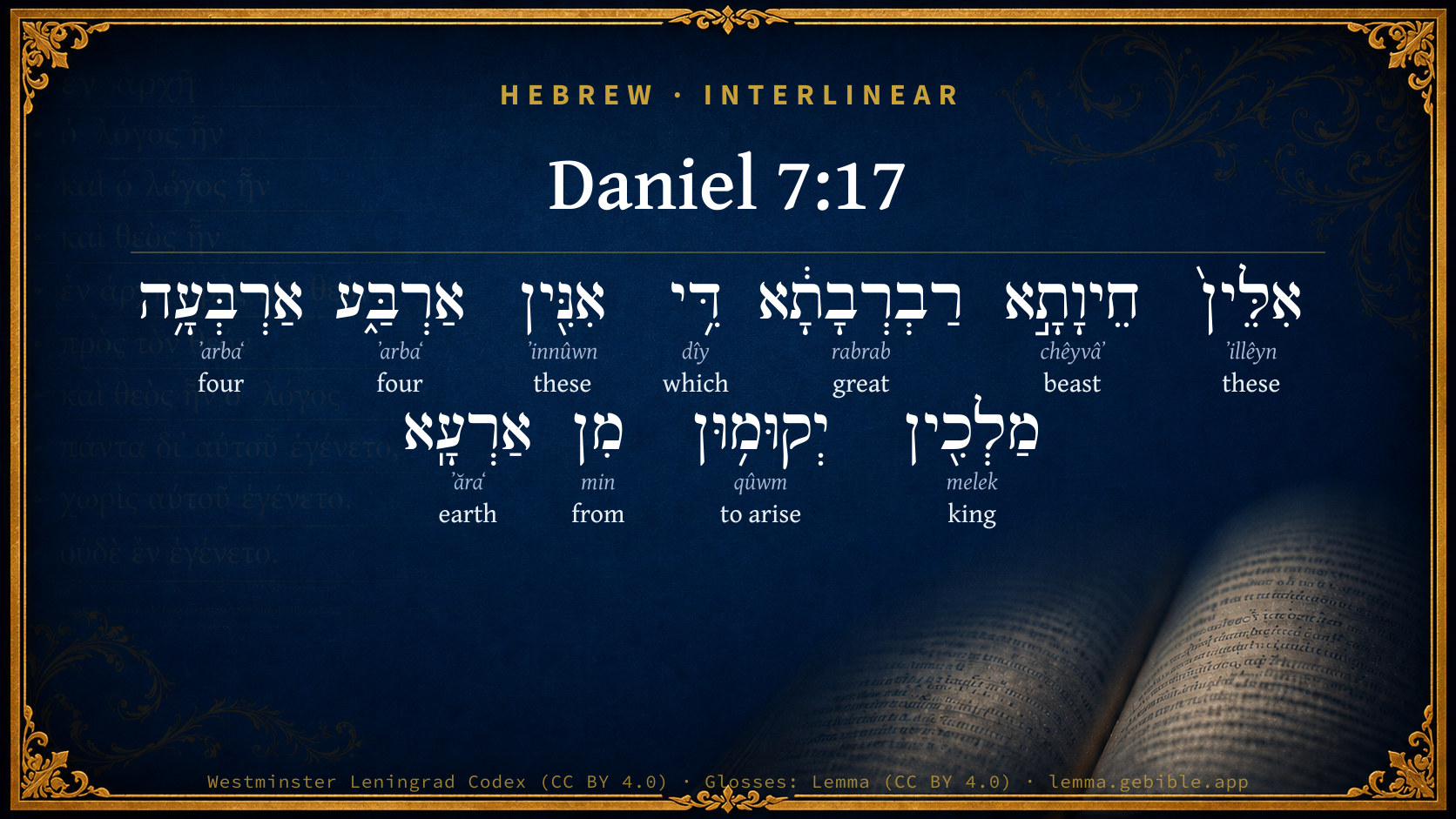
Daniel 7:17

Hebrew (Westminster Leningrad Codex) Daniel 7:17 appears in the Hebrew Old Testament. The text above is from the Westminster Leningrad Codex. Each word links to its Strong’s number, a concise gloss, and parsing drawn from the Open Scriptures Hebrew Bible morphology. Click any word for its full Brown-Driver-Briggs (BDB) entry.
Download image
Cite this verse

Daniel 7:17 (World English Bible). Public Domain. Lemma interlinear Bible study tool, https://lemma.gebible.app/v/daniel/7/17.

Show BibTeX & RIS
BibTeX
RIS
English Translation
These great animals, which are four, are four kings, who shall arise out of the earth.
World English Bible · Public Domain
Download a study sheet

One document with this verse’s original text, its word-by-word gloss line, the meaning frame, cross-references with their text, attributed commentary, and full source and license credits — printable, and it pastes into notes with its structure intact.

This verse Autodidact and up

Study sheet (.html) Plain text (.txt)

A passage Seminary Student

Up to 50 verses in one chapter. A passage sheet keeps up to 6 commentary sources and 12 cross-references per verse, in the order this page ranks them, and says so on the sheet whenever that leaves anything out. Ask for a single verse and you get the Autodidact verse sheet above.

Everything on this page stays free to read, with no account — the sheet is a download of what is already on screen, not access to it.

Want to remove ads? Support Godless Engineer
Compare translations 3

The same verse in 3 English versions, stacked beneath the original-language interlinear above. Click any original word for its lexicon entry.

Each is an independent rendering of the whole verse — the interlinear is not word-aligned to these translations.

Highlighted words mark where these versions differ — a whole-verse word diff, not a word-by-word alignment.

  • World English Bible Public Domain
    These great animals, which are four, are four kings, who shall arise out of the earth.
  • King James Version Public Domain
    These great beasts, which are four, are four kings, which shall arise out of the earth.
  • unfoldingWord Literal Text CC BY-SA 4.0
    ‘These great beasts, which are four in number, are four kings who will arise from the earth.

unfoldingWord Literal Text — © unfoldingWord, licensed CC BY-SA 4.0. Word-aligned USFM3 via Door43 (git.door43.org/unfoldingWord/en_ult).

Versions to compare (up to 4)

3 of 4 selected

Show all 18 translations

Every available English version of this verse, each an independent rendering of the whole verse.

  • World English Bible Public Domain
    These great animals, which are four, are four kings, who shall arise out of the earth.
  • Berean Standard Bible Public Domain
    ‘These four great beasts are four kings who will arise from the earth.
  • Majority Standard Bible Public Domain
    ‘These four great beasts are four kings who will arise from the earth.
  • King James Version Public Domain
    These great beasts, which are four, are four kings, which shall arise out of the earth.
  • American Standard Version (1901) Public Domain
    These great beasts, which are four, are four kings, that shall arise out of the earth.
  • Revised Version (1885) Public Domain
    These great beasts, which are four, are four kings, which shall arise out of the earth.
  • Geneva Bible (1599) Public Domain
    These great beastes which are foure, are foure Kings, which shall arise out of the earth,
  • Douay-Rheims (1899) Public Domain
    These four great beasts are four kingdoms, which shall arise out of the earth.
  • Young's Literal Translation Public Domain
    `These great beasts, that `are' four, `are' four kings, they rise up from the earth;
  • Literal Standard Version CC BY-SA 4.0
    These great beasts, that [are] four, [are] four kings, they rise up from the earth;
  • Unlocked Literal Bible CC BY-SA 4.0
    'These large animals, four in number, are four kings that will arise from the earth.
  • unfoldingWord Literal Text CC BY-SA 4.0
    ‘These great beasts, which are four in number, are four kings who will arise from the earth.
  • Darby Bible Public Domain
    These great beasts, which are four, are four kings, [that] shall arise out of the earth.
  • World Messianic Bible Public Domain
    ‘These great animals, which are four, are four kings, who will arise out of the earth.
  • Webster's Bible Public Domain
    These great beasts, which are four, are four kings, which shall arise out of the earth.
  • Free Bible Version CC BY-SA 4.0
    “These four large beasts symbolize four kingdoms that will rise to power on the earth.
  • Bible in Basic English Public Domain
    These great beasts are four kings who will be cut off from the earth.
  • JPS Tanakh (1917) Public Domain
    'These great beasts, which are four, are four kings, that shall arise out of the earth.

Literal Standard Version (2020), Covenant Press — licensed CC BY-SA 4.0. Text via the HelloAO Bible API (eBible.org). Unlocked Literal Bible (unfoldingWord) — licensed CC BY-SA 4.0. Text via the HelloAO Bible API (eBible.org). unfoldingWord Literal Text — © unfoldingWord, licensed CC BY-SA 4.0. Word-aligned USFM3 via Door43 (git.door43.org/unfoldingWord/en_ult). Free Bible Version, Dr. Jonathan Gallagher — licensed CC BY-SA 4.0. Text via the HelloAO Bible API (eBible.org).

Word by word

More ways to search: Search by grammar → Find every occurrence → Compare this word →

Practice this passage: Drill this verse → Learn its vocabulary →

About this verse

These counts appear in no published source. They are computed here, from the morphology-tagged text and Lemma’s own curated glosses. What Lemma adds →

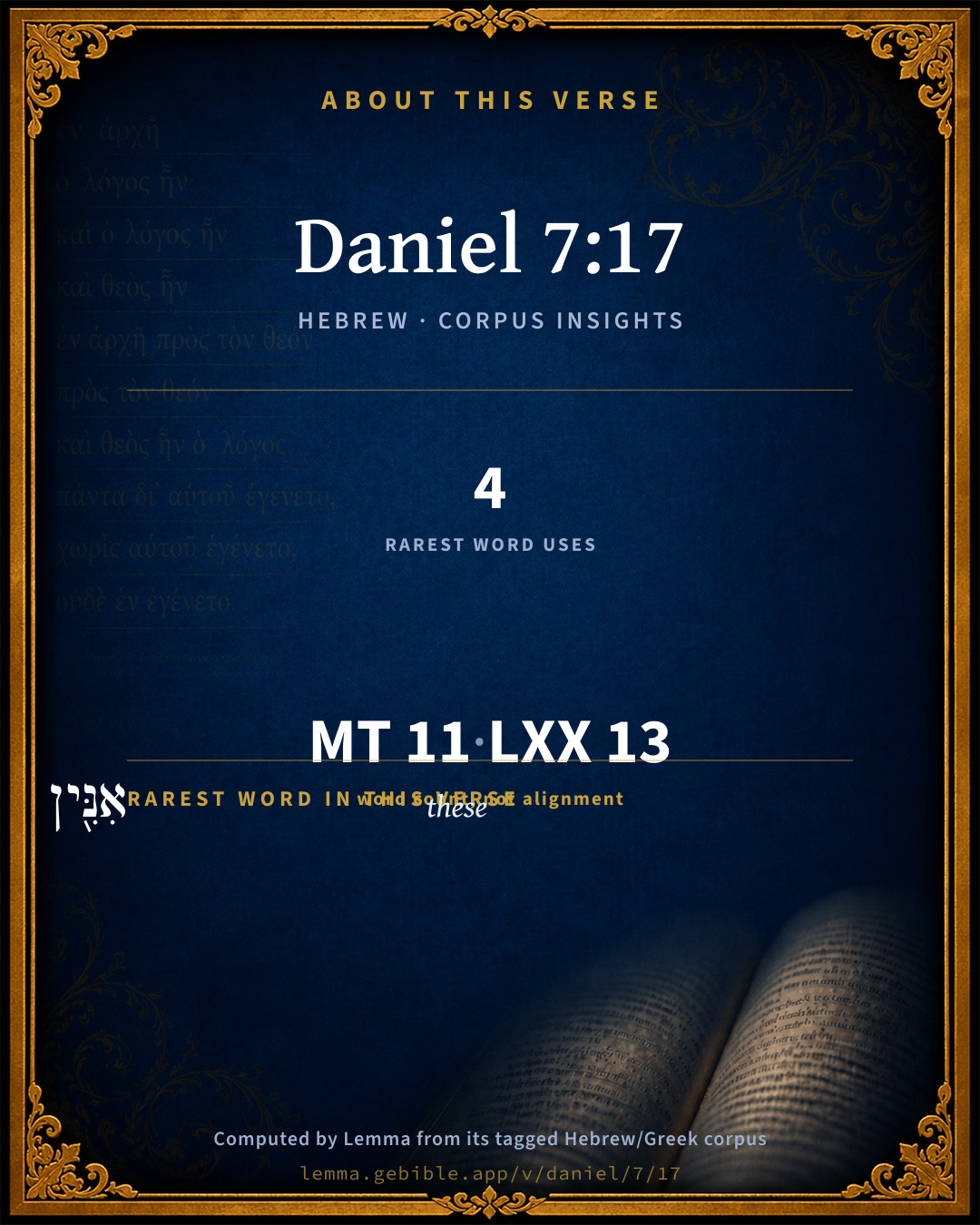
11
words
10
distinct lemmas
Prophets
section

Notable vocabulary

The rarest word here is אִנִּ֖ין these H581 — appearing just 4 times in the whole Hebrew Bible.

Shared distinctive vocabulary

אִנִּ֖ין these H581 occurs in 4 verses of the Hebrew Bible. Also found in:

Grammatical profile

  • 8 adjectives
  • 3 particles

Repetition

A word recurs within this verse — often emphatic in Hebrew:

  • אַרְבַּ֑ע four H703 ×2

Hebrew & Septuagint length

In English translation the verse runs 16 words from the Hebrew and 13 from the Septuagint (LXX English) — closely comparable.

A rough comparison of the two English renderings, which tokenize alike — not a word-level alignment.

Word counts can differ between the Hebrew and the Greek without any difference in meaning — e.g. the Hebrew direct-object marker אֵת has no separate Greek word, and Greek often adds the article ὁ.

In the original languages it is 11 Hebrew tokens and 13 Greek tokens — but the two are counted differently (Hebrew bundles its prefixes and suffixes into one token; the Greek is in lemma form), so that isn’t a like-for-like length.

Cross-references

7

Topical passages linked to Daniel 7:17 in the Treasury of Scripture Knowledge — connected by theme and wording, ordered by reader-vote popularity; previews shown in the World English Bible.

  • Psalms 17:14 From men by your hand, Yahweh, From men of the world, whose portion is in this life. You fill the belly of your cherished ones. Your sons have plenty, And they store up wealth for their children.
  • Daniel 2:37–40 You, O king, are king of kings, to whom the God of heaven has given the kingdom, the power, and the strength, and the glory;
  • Daniel 7:3–4 Four great animals came up from the sea, diverse one from another.
  • Daniel 8:19–22 He said, Behold, I will make you know what shall be in the latter time of the indignation; for it belongs to the appointed time of the end.
  • John 18:36 Jesus answered, "My Kingdom is not of this world. If my Kingdom were of this world, then my servants would fight, that I wouldn't be delivered to the Jews. But now my Kingdom is not from here."
  • Revelation 13:1 Then I stood on the sand of the sea. I saw a beast coming up out of the sea, having ten horns and seven heads. On his horns were ten crowns, and on his heads, blasphemous names.
  • Revelation 13:11 I saw another beast coming up out of the earth. He had two horns like a lamb, and he spoke like a dragon.

Cross-references courtesy of OpenBible.info (CC BY 4.0).

Hebrew and Greek witnesses Masoretic Hebrew ↔ Greek Septuagint

The same verse in the two great witnesses to the Old Testament, shown verse-for-verse.

These are two independent witnesses, not word-aligned to each other, and the Septuagint is shown in lemma (dictionary) form.

Hebrew Daniel 7:17 Masoretic · Westminster Leningrad Codex

אִלֵּין֙ חֵיוָתָ֣א רַבְרְבָתָ֔א דִּ֥י אִנִּ֖ין אַרְבַּ֑ע אַרְבְּעָ֥ה מַלְכִ֖ין יְקוּמ֥וּן מִן אַרְעָֽא

These great animals, which are four, are four kings, who shall arise out of the earth.

World English Bible · Public Domain

Greek LXX Daniel 7:17 Septuagint · lemma form

οὗτος ὁ θηρίον ὁ μέγας εἰμί τέσσαρες βασιλεία ὅς ἀποὀλλύω ἀπό ὁ γῆ

These four beasts are four kingdoms that shall rise up on the earth:

LXX2012 (modern English Septuagint) · Public Domain

On this verse, John Gill's Exposition discusses the Septuagint’s reading. Read the note in Commentary ↓

Hebrew: Westminster Leningrad Codex (CC BY 4.0). Greek: Septuagint (public domain); English from LXX2012 (modern English Septuagint) (Public Domain). How the Septuagint differs from the Hebrew →

Commentary

Notes on Daniel 7:17 from classic Christian and Jewish commentators (each source and its license shown beneath its notes). The classic Christian expositions comment on the surrounding passage and are grouped to its opening verse, so a note may address several verses; the Jewish commentaries on the Tanakh (Rashi and others) are per-verse, so they appear only where the commentator wrote on this verse.

Lemma curates 59 commentaries, every one of them public domain or Creative Commons licensed, each selected and text-cleaned for this edition rather than reprinted as found. About our sources →

Trapp's Complete Commentary

John Trapp

Dan 7:17 These great beasts, which are four, [are] four kings, [which] shall arise out of the earth.

Ver. 17. These great beasts … are four kings,] i.e., A succession of kings, all of them truculent and savage towards the saints.

Which shall arise out of the earth.] And as toads, strive who shall die with most earth in their mouths.

John Trapp, A Commentary or Exposition upon All the Books of the Old and New Testament (1647–1656) — public domain. Text from a community e-Sword module.

Tyndale Open Study Notes

Tyndale Open Resources

7:17 beasts represent . . . kingdoms: God gave Daniel a vision of the course of history, a feat no human could accomplish. These kingdoms from the earth (cp. 7:2) are not heavenly kingdoms but human kingdoms of this world.

Tyndale Open Study Notes — © Tyndale Open Resources, licensed CC BY-SA 4.0. Text via the HelloAO Bible API.

Jamieson, Fausset & Brown

Robert Jamieson, A. R. Fausset & David Brown

kings--that is, kingdoms. Compare Dan 7:23, "fourth kingdom"; Dan 2:38; Dan 8:20-22. Each of the four kings represents a dynasty. Nebuchadnezzar, Alexander, Antiochus, and Antichrist, though individually referred to, are representatives of characteristic tendencies.

Jamieson, Fausset & Brown — Commentary Critical and Explanatory on the Whole Bible (1871) — public domain (CC PDM 1.0). Text via the HelloAO Bible API.

Adam Clarke's Commentary

Verse 17. These great beasts - are four kings] See the preceding verses, where the following explanations are inserted and illustrated.

Adam Clarke's Commentary on the Bible (1810–1826) — public domain. Text from a community e-Sword/MySword module.

John Calvin's Commentaries

Here the angel answers Daniel concerning the four beasts which had been shewn him in the vision. He says, therefore, Four kingdoms arose, and by the name kingdom he means monarchy; for we know that the Persians had many kings until Alexander transferred to himself the empire of the East. Although Cyrus had seven or eight successors, yet the Persian empire continued through them all. And as we saw before, although whatever Alexander had acquired by his arms was divided among his four successors, yet it still remained the Macedonian kingdom. The same thing must be said concerning the fourth kingdom. Although we know consuls to have been created yearly at Rome, yet that government lasted till Julius Caesar destroyed it, and consumed the strength of the empire, so as to surpass by his power the splendid altitude which had been long and widely conspicuous in the world. Hence the angel replied, By the four beasts four kingdoms are denoted: he says, shall arise; and yet the Chaldean had long ago arisen, and was now verging under Belshazzar to its fall. But it was proposed by the angel to teach the Prophet and all the people that there was no reason why revolutions should disturb them too much. The Israelites then saw themselves lying as if dead, yea, actually buried and concealed under the earth. For exile was to them equivalent to the tomb. For this reason, then, the angel announces the springing up of four kingdoms, while the first was then flourishing; but, as I have already said., this suits very well within the scope and object of the prophecy. He had formerly said from the sea, but the word “sea” is used metaphorically, since the condition of the earth was turbulent through many ages. As, therefore, nothing was stable, God appropriately set forth the whole world under the figure of the sea. He afterwards adds, They will obtain the kingdom of the holy lofty ones Here interpreters vary considerably, because, as I have before explained it, some take this prophecy to relate to the kingdom of Turkey, others to the tyranny of the Pope of Rome, and extend what the Prophet here says to the final judgment. There is nothing surprising, then, in this diversity of opinion shewing itself more fully in the various details. By sacred holy ones some understand angels; but there is still much controversy about the words, for the noun of saints is “in regimen,” as if the Prophet, had said saints of lofty ones, properly speaking. Similar passages justify those who take it “in the absolute state.” But if we follow the grammatical construction, we cannot explain it otherwise; but the former noun may be put in a state of regimen, as we have said. And I embrace this opinion. Some refer it to the one God, but. I think this a profane way of expression. I have no doubt about the Prophet meaning sons of God by sacred lofty ones, because, though they are pilgrims in the world: yet they raise their minds upwards, and know themselves to be citizens of the heavenly kingdom. Hence by the word עליונין, gnelionin, “lofty ones,” I have no doubt; the Prophet means heavenly powers; that is, whatever we can conceive of divinity, and whatever is exalted above the world. I will1 now give my reasons shortly why I like this sense the best.

If we call the holy lofty ones God himself, what sense can we elicit from the passage? Did the Chaldeans and the rest of the monarchies usurp and transfer to themselves the power of God? There, is some truth in this, because all who domineer without submitting to the one God despoil him of his peculiar honor, and are rather robbers than kings. But the Prophet, in my opinion, understood something else from the angel, namely, that the Church should lose all form and dignity in the world during the flourishing of these four monarchies. We know the sons of God to be heirs of the world; and Paul, when speaking of the promise given to Abraham, says, he was chosen by God as heir of the world. (Romans 4:13; Hebrews 1:2) And this doctrine is sufficiently known — the world was created for the sake of the human race. When Adam fell from his lawful rights, all his posterity became aliens. God deprived them of the inheritance which he had designed for them. Now, therefore, our inheritance must be restored through Christ, for which reason he is called the only heir of the world. Thus it is not surprising if the angel says that tyrants, when they exercise supreme dominion, assume and arrogate to themselves the peculiar property of the sacred lofty ones, meaning the people of God. And this suits very well with the assertions of the present passage concerning the Church being deprived of its dignity, eminence, and visibility in the world. For then God’s people were like a putrid carcass, the limbs of which were separated and dispersed on all sides, without any hope of restoration. Lastly, although by the permission of Darius, and the edict and liberality of Cyrus, some portion of them returned to their country, yet what was that nominal return? They had but a precarious dwelling in the inheritance divinely promised them; they were pressed on all sides by their enemies, and were subject to the lust and injustice of them all. For the Church had no empire under the Persians. After the third change we know how miserably they were afflicted, especially under Antiochus. That nation was always opposed to them, but then they were almost reduced to extremities, when Antiochus endeavored furiously to abolish the whole law and worship of God. Under the Macedonian kingdom the Jews were in constant slavery; but when the Roman army penetrated those regions, they felt the horrible tyranny of the fourth beast, as we have already seen. Lastly, it is sufficiently evident from the continual history of those times, that the sons of God were always under the yoke, and were not only cruelly but ignominiously treated.

John Calvin's Commentaries (1540-1563) — public domain. Text from the Calvin Translation Society English edition (1840s-50s) via the Christian Classics Ethereal Library (ccel.org). Calvin's coverage is partial (roughly two-thirds of the Bible); uncommented books and verses are honest gaps, never fabricated. The 19th-century editor's footnotes and remarks are omitted so the notes are faithfully Calvin's own voice.

Ellicott's Commentary for English Readers

(17) Four kings.—Kingdoms are frequently represented by their heads or founders; hence kings and kingdoms are occasionally used synonymously. (Comp. Dan_8:21.)

A Bible Commentary for English Readers, edited by Charles John Ellicott (1878–1897) — public domain. Text from a community e-Sword module.

The Cambridge Bible for Schools and Colleges

gen. ed. J. J. S. Perowne

17. The four beasts represent four kings, or (Dan_7:23) four kingdoms, the ‘king’ in each case being not an individual king, but a typical king, embodying the characteristics of the empire ruled by him. The angel does not however dwell more fully on the ‘beasts,’ or interpret their symbolism; but hastens (Dan_7:18) to explain the nature of the kingdom which is to succeed theirs.

The Cambridge Bible for Schools and Colleges (gen. ed. J. J. S. Perowne; Cambridge University Press, 1878–1918) — public domain. Text from a community e-Sword module.

John Gill's Exposition

These great beasts, which are four, are four kings,.... Or kingdoms, as the Septuagint, Vulgate Latin, and Arabic versions; and so Jarchi, Aben Ezra, and Saadiah; so the fourth beast is called the fourth kingdom, Dan 7:23 or a succession of kings in four kingdoms or monarchies, comparable to beasts for their strength, cruelty, and tyranny: these are the words of him that stood by, of one of the angels Daniel applied to, to know the meaning of his dream; and might be better rendered, "as to these (c) great beasts, which are four"; for their quality beasts, for their quantity great, and for number four. The meaning is,

four kings shall arise out of the earth; or kingdoms; which have an earthly original and foundation; are supported by earthly and worldly means, and with earthly and worldly views; and are different from the kingdom of Christ and his saints, which is not of the world, though it may be in it: this explains what is meant by the great sea, from whence these beasts are said to come up, Dan 7:3, nor is it any material objection that the first of these kingdoms, the Babylonian, was risen already, and almost at an end; since the denomination is taken from the larger number; three of them were to arise, and the first was of the same original with them; thus it is said, Dan 11:2, that three kings of Persia should stand up, and yet Cyrus, who was one of them, reigned already.

(c) "Quod attinet", Michaelis.

John Gill's Exposition of the Whole Bible (1746–1763) — public domain (CC PDM 1.0). Text via the HelloAO Bible API.

Albert Barnes' Notes on the Bible

These great beasts, which are four, are four kings - Four kings or four dynasties. There is no reason for supposing that they refer to individual kings, but the obvious meaning is, that they refer to four dominions or empires that would succeed one another on the earth. So the whole representation leads us to suppose, and so the passage has been always interpreted. The Latin Vulgate renders it regna; the Septuagint βασιλεῖαι basileiai; Luther, Reiche; Lengerke, Konigreiche. This interpretation is confirmed, also, by Dan 7:23, where it is expressly said that “the fourth beast shall be the fourth kingdom upon earth.” See also Dan 7:24.

Which shall arise out of the earth - In Dan 7:2 the beasts are represented as coming up from the sea - the emblem of agitated nations. Here the same idea is presented more literally - that they would seem to spring up out of the earth, thus thrown into wild commotion. These dynasties were to be upon the earth, and they were in all things to indicate their earthly origin. Perhaps, also, it is designed by these words to denote a marked contrast between these four dynasties and the one that would follow - which would be of heavenly origin. This was the general intimation which was given to the meaning of the vision, and he was satisfied at once as to the explanation, so far as the first three were concerned; but the fourth seemed to indicate more mysterious and important events, and respecting this he was induced to ask a more particular explanation.

Albert Barnes' Notes on the Bible (1834–1885) — public domain. Text from a community e-Sword/MySword module.

Haydock's Catholic Bible Commentary

Earth. The first was on the point of disappearing. (Chap. v. 31.) (Haydock)

George Leo Haydock (1774–1849), Haydock's Catholic Family Bible and Commentary, 1859 edition — public domain. Excludes Psalms (Douay-Rheims chapter numbering differs from Protestant) and Deuterocanonical books (Catholic canon only).

Matthew Poole's English Annotations

Men of the earth, of earthly principles, idolatrous, ambitious, sensual, tyrannical; who, after they have acted their parts, shall be driven off the stage into the tiring rooms of death and destruction.

Matthew Poole's English Annotations on the Holy Bible (1683–1685) — public domain. Text from a community e-Sword/MySword module.

Whedon's Commentary on the Bible

Daniel D. Whedon

17, 18. The four beasts symbolize four kings (or, rather, kingdoms, Dan_7:23), at the end of whose brutal rule the kingdom of the saints, ruled over by “one like unto a son of man,” shall take the sovereignty. “As Michael, ‘the great prince,’ is not identical with the people of God (Dan_10:21; Dan_12:1), but is rather their representative and defender, so here it seems most satisfactory to understand the Son of man (Dan_7:13) as the personal representative and Prince of the people of the saints (Dan_7:27).” — Terry. So the saints of Christ shall reign with him in glory (Rom_8:17; 2Ti_2:12; Mat_19:28; Rev_2:26-27, etc.).

Daniel D. Whedon (gen. ed.), Commentary on the Old and New Testaments (1874–1909) — public domain. Text from a community e-Sword module.

Scofield Reference Notes

C. I. Scofield

beasts

The monarch vision of Nebuchadnezzar (Daniel 2) covers the same historic order as the beast vision of Daniel, but with this difference: Nebuchadnezzar saw the imposing outward power and splendour of the "times of the Gentiles" Luk 21:24; Rev 16:19 while Daniel saw the true character of Gentile world-government as rapacious and warlike, established and maintained by force. It is remarkable that the heraldic insignia of the Gentile nations are all beasts or birds of prey.

The Scofield Reference Bible (1917 edition), notes by C. I. Scofield — public domain. Text from a community e-Sword module.

unfoldingWord translationNotes

Door43 World Missions Community

These large animals, four in number,

"These four large animals"

are four kings

"represent four kings"

four kings that will arise from the earth

Here "from the earth" means they are real people. AT: "four kings who will come to power on the earth" or "four men who will rise up from among the people of the earth and become kings" (See: Idiom)

they will possess it

"they will rule over it"

forever and ever

This repetition of ideas emphasizes that this kingdom will never come to an end. (See: Doublet)

translationWords

king

raise

Most High

kingdom

possess

eternity

unfoldingWord translationNotes — © Distant Shores Media and the Door43 World Missions Community, licensed CC BY-SA 4.0. Source: git.door43.org/Door43/en_tn.

Rashi

Rabbi Shlomo Yitzchaki (Rashi)

four kingdoms Aram. אַרְבְּעָא מַלְכִין, lit. four kings.

Rashi on the Tanakh — English translations: “The Judaica Press complete Tanach with Rashi, translated by A. J. Rosenberg” (CC BY 4.0); “Pentateuch with Rashi's commentary by M. Rosenbaum and A.M. Silbermann, 1929-1934” (public domain); “The Metsudah Tanach series, Lakewood, N.J” (CC BY 4.0); and “The Book of Joshua, Metsudah Publications, 1997” (CC BY 4.0). Text via Sefaria.

Lesson kit

Teaching starters — assembled from the data on this page, not authored interpretation. Every prompt links to the verse data it draws on. Edit before teaching.

Daniel, in the Prophets, opens this verse with 11 words (10 distinct Hebrew lemmas). Its most distinctive word is ʼinnûwn (“these”). A historical commentator’s framing appears above. Read the whole chapter for the surrounding context.

Discussion questions

  1. The word ʼinnûwn carries the sense “these.” How does it shape the verse?
  2. Ezra 5:4 shares the word «these» with this verse. How do the two illuminate each other?
  3. “four” occurs 2× in this one verse. What is the effect of the repetition?
  4. The translations on this page render this verse differently — a whole-verse word diff, not a word-by-word alignment. What might account for the different wordings?
  5. Reading how Trapp's Complete Commentary and Tyndale Open Study Notes read this verse, where do the two commentators agree and where do they part?

Things to notice

Reading settings

Reading text

Shown beneath each verse's original-language words.

Old Testament
Old Testament edition

Read the OT as the Masoretic Hebrew (MT) or the Greek Septuagint (LXX).

English shown for the Greek Septuagint (in the Hebrew ↔ Greek comparison).

Comparing translations? Open the Compare panel on any verse page to stack up to four side by side.