
Daniel 2:26

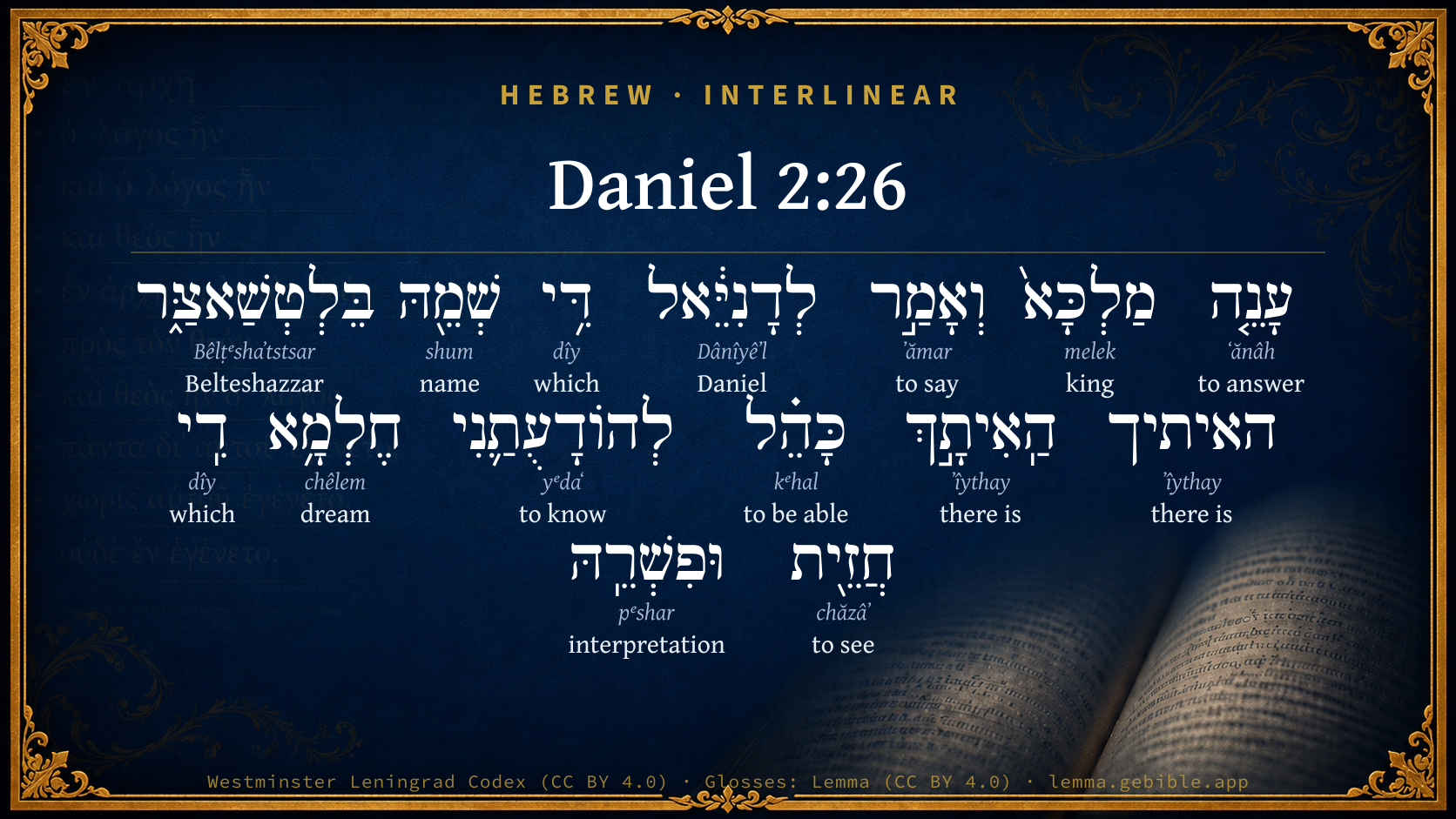
Hebrew (Westminster Leningrad Codex) Daniel 2:26 appears in the Hebrew Old Testament. The text above is from the Westminster Leningrad Codex. Each word links to its Strong’s number, a concise gloss, and parsing drawn from the Open Scriptures Hebrew Bible morphology. Click any word for its full Brown-Driver-Briggs (BDB) entry.
Download image
Cite this verse

Daniel 2:26 (World English Bible). Public Domain. Lemma interlinear Bible study tool, https://lemma.gebible.app/v/daniel/2/26.

Show BibTeX & RIS
BibTeX
RIS
English Translation
The king answered Daniel, whose name was Belteshazzar, Are you able to make known to me the dream which I have seen, and the interpretation of it?
World English Bible · Public Domain
Highlights
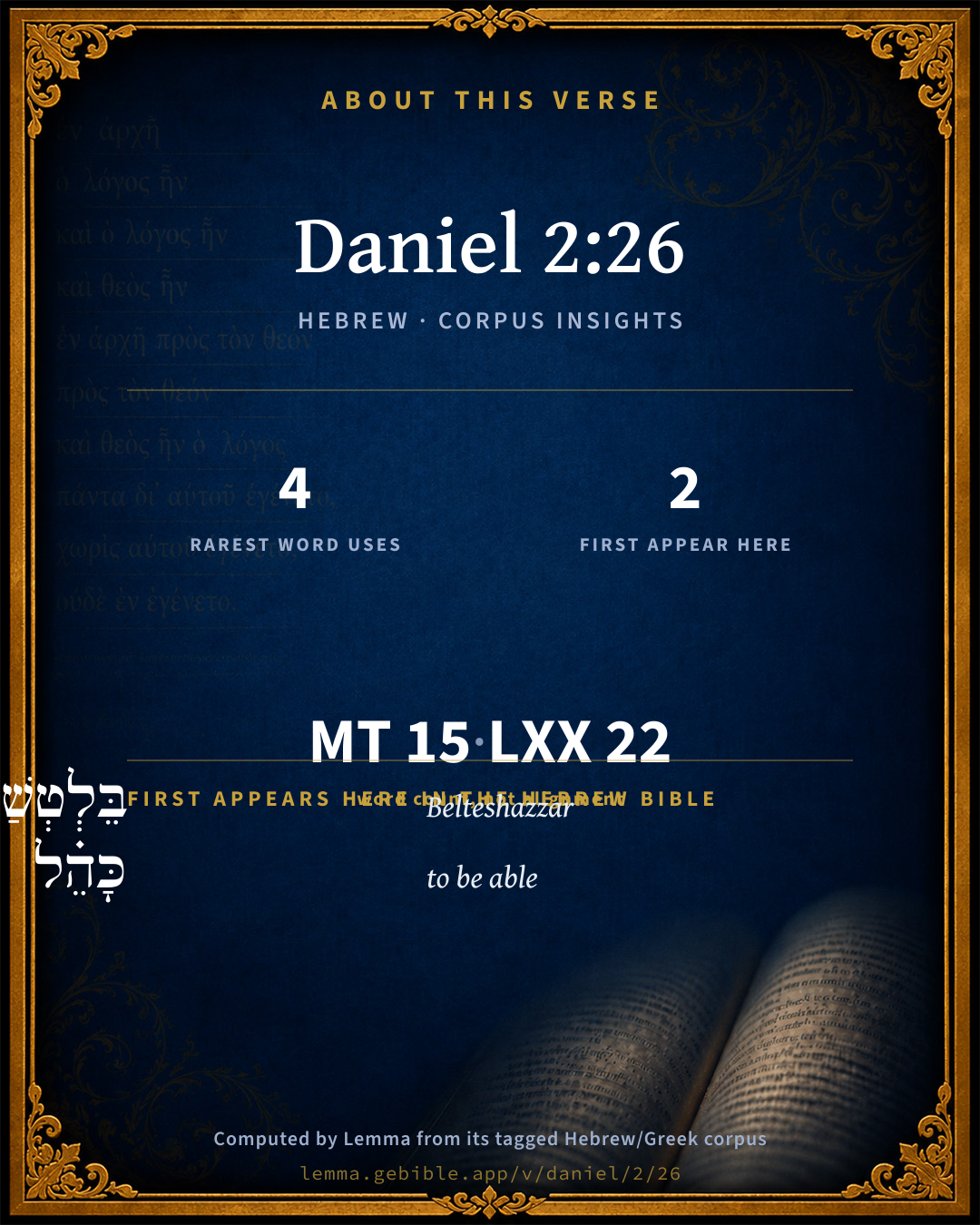
  • 2 first appearances in the Hebrew Bible
Full analysis ↓
Download a study sheet

One document with this verse’s original text, its word-by-word gloss line, the meaning frame, cross-references with their text, attributed commentary, and full source and license credits — printable, and it pastes into notes with its structure intact.

This verse Autodidact and up

Study sheet (.html) Plain text (.txt)

A passage Seminary Student

Up to 50 verses in one chapter. A passage sheet keeps up to 6 commentary sources and 12 cross-references per verse, in the order this page ranks them, and says so on the sheet whenever that leaves anything out. Ask for a single verse and you get the Autodidact verse sheet above.

Everything on this page stays free to read, with no account — the sheet is a download of what is already on screen, not access to it.

Want to remove ads? Support Godless Engineer
Compare translations 3

The same verse in 3 English versions, stacked beneath the original-language interlinear above. Click any original word for its lexicon entry.

Each is an independent rendering of the whole verse — the interlinear is not word-aligned to these translations.

Highlighted words mark where these versions differ — a whole-verse word diff, not a word-by-word alignment.

  • World English Bible Public Domain
    The king answered Daniel, whose name was Belteshazzar, Are you able to make known to me the dream which I have seen, and the interpretation of it?
  • King James Version Public Domain
    The king answered and said to Daniel, whose name was Belteshazzar, Art thou able to make known unto me the dream which I have seen, and the interpretation thereof?
  • unfoldingWord Literal Text CC BY-SA 4.0
    The king said to Daniel (whose name was Belteshazzar), “Are you able to make known to me the dream that I saw and its interpretation?”

unfoldingWord Literal Text — © unfoldingWord, licensed CC BY-SA 4.0. Word-aligned USFM3 via Door43 (git.door43.org/unfoldingWord/en_ult).

Versions to compare (up to 4)

3 of 4 selected

Show all 18 translations

Every available English version of this verse, each an independent rendering of the whole verse.

  • World English Bible Public Domain
    The king answered Daniel, whose name was Belteshazzar, Are you able to make known to me the dream which I have seen, and the interpretation of it?
  • Berean Standard Bible Public Domain
    The king responded to Daniel, whose name was Belteshazzar, “Are you able to tell me what I saw in the dream, as well as its interpretation?”
  • Majority Standard Bible Public Domain
    The king responded to Daniel, whose name was Belteshazzar, “Are you able to tell me what I saw in the dream, as well as its interpretation?”
  • King James Version Public Domain
    The king answered and said to Daniel, whose name was Belteshazzar, Art thou able to make known unto me the dream which I have seen, and the interpretation thereof?
  • American Standard Version (1901) Public Domain
    The king answered and said to Daniel, whose name was Belteshazzar, Art thou able to make known unto me the dream which I have seen, and the interpretation thereof?
  • Revised Version (1885) Public Domain
    The king answered and said to Daniel, whose name was Belteshazzar, Art thou able to make known unto me the dream which I have seen, and the interpretation thereof?
  • Geneva Bible (1599) Public Domain
    Then answered the King, and sayde vnto Daniel, whose name was Belteshazzar, Art thou able to shew me the dreame, which I haue seene, and the interpretation thereof?
  • Douay-Rheims (1899) Public Domain
    The king answered, and said to Daniel, whose name was Baltassar: Thinkest thou indeed that thou canst tell me the dream that I saw, and the interpretation thereof?
  • Young's Literal Translation Public Domain
    The king hath answered and said to Daniel, whose name `is' Belteshazzar, `Art thou able to cause me to know the dream that I have seen, and its interpretation?'
  • Literal Standard Version CC BY-SA 4.0
    The king has answered and said to Daniel, whose name [is] Belteshazzar, “Are you able to cause me to know the dream that I have seen, and its interpretation?”
  • Unlocked Literal Bible CC BY-SA 4.0
    The king said to Daniel (who was called Belteshazzar), “Are you able to tell me the dream that I saw and its meaning?”
  • unfoldingWord Literal Text CC BY-SA 4.0
    The king said to Daniel (whose name was Belteshazzar), “Are you able to make known to me the dream that I saw and its interpretation?”
  • Darby Bible Public Domain
    The king answered and said unto Daniel, whose name was Belteshazzar, Art thou able to make known unto me the dream that I have seen, and its interpretation?
  • World Messianic Bible Public Domain
    The king answered Daniel, whose name was Belteshazzar, “Are you able to make known to me the dream which I have seen, and its interpretation?”
  • Webster's Bible Public Domain
    The king answered and said to Daniel, whose name was Belteshazzar, Art thou able to make known to me the dream which I have seen, and the interpretation of it?
  • Free Bible Version CC BY-SA 4.0
    The king asked Daniel (also called Belteshazzar), “Are you really able to tell me what my dream was, and what it means?”
  • Bible in Basic English Public Domain
    The king made answer and said to Daniel, whose name was Belteshazzar, Are you able to make clear to me the dream which I saw and its sense?
  • JPS Tanakh (1917) Public Domain
    The king spoke and said to Daniel, whose name was Belteshazzar: 'Art thou able to make known unto me the dream which I have seen, and the interpretation thereof?'

Literal Standard Version (2020), Covenant Press — licensed CC BY-SA 4.0. Text via the HelloAO Bible API (eBible.org). Unlocked Literal Bible (unfoldingWord) — licensed CC BY-SA 4.0. Text via the HelloAO Bible API (eBible.org). unfoldingWord Literal Text — © unfoldingWord, licensed CC BY-SA 4.0. Word-aligned USFM3 via Door43 (git.door43.org/unfoldingWord/en_ult). Free Bible Version, Dr. Jonathan Gallagher — licensed CC BY-SA 4.0. Text via the HelloAO Bible API (eBible.org).

Word by word

More ways to search: Search by grammar → Find every occurrence → Compare this word →

Practice this passage: Drill this verse → Learn its vocabulary →

כָּהֵ֗ל
kᵉhal
H3546
“being able”
Adjective, V
Part of Speech
Adjective
Full BDB Definition

Origin: a root corresponding to H3201 and H3557

TWOT: 2785

to be able - (Peal) to be able
  1. עָנֵ֤ה ʻănâh H6032 “answering” Adjective, V
  2. מַלְכָּא֙ melek H4430 “king · the” Adjective, N, Common + Particle, Definite Article
  3. וְאָמַ֣ר ʼămar H560 “and · saying” Adjective, C + Verb, Qal, Participle Active, Masculine, Singular, Absolute
  4. לְדָנִיֵּ֔אל Dânîyêʼl H1841 “to/for · Daniel” Adjective, R + Noun, Proper
  5. דִּ֥י dîy H1768 “which” Adjective, T
  6. שְׁמֵ֖הּ shum H8036 “name · his” Adjective, N, Common + Suffix, Personal, 3rd Person, Masculine, Singular
  7. בֵּלְטְשַׁאצַּ֑ר Bêlṭᵉshaʼtstsar H1096 “Belteshazzar” Adjective, N
  8. האיתיך ʼîythay H383 “there is · you” Adjective, T + Particle, Accusative + Suffix, Personal, 2nd Person, Masculine, Singular
  9. הַֽאִיתָ֣ךְ ʼîythay H383 “there is · you” Adjective, T + Particle, Accusative + Suffix, Personal, 2nd Person, Masculine, Singular
  10. לְהוֹדָעֻתַ֛נִי yᵉdaʻ H3046 “to know · me” Adjective, R + Verb, Hiphil, Infinitive Construct + Suffix, Personal, 1st Person, Common, Singular
  11. חֶלְמָ֥א chêlem H2493 “dream · the” Adjective, N, Common + Particle, Definite Article
  12. דִֽי dîy H1768 “which” Adjective, T
  13. חֲזֵ֖ית chăzâʼ H2370 “to see” Adjective, T
  14. וּפִשְׁרֵֽהּ pᵉshar H6591 “and · interpretation · his” Adjective, C + Noun, Common, Masculine, Singular, Construct + Suffix, Personal, 3rd Person, Masculine, Singular

About this verse

These counts appear in no published source. They are computed here, from the morphology-tagged text and Lemma’s own curated glosses. What Lemma adds →

15
words
13
distinct lemmas
Prophets
section

Notable vocabulary

The rarest word here is כָּהֵ֗ל to be able H3546 — appearing just 4 times in the whole Hebrew Bible.

First appearance in Scripture

These words make their first canonical appearance in the Hebrew Bible here:

  • בֵּלְטְשַׁאצַּ֑ר Belteshazzar H1096
  • כָּהֵ֗ל to be able H3546

Shared distinctive vocabulary

כָּהֵ֗ל to be able H3546 occurs in 4 verses of the Hebrew Bible. Also found in:

Grammatical profile

  • 2 verbs
  • 2 nouns
  • 7 adjectives
  • 4 particles

Verb forms

  • וְאָמַ֣ר Qal · Participle Active
  • לְהוֹדָעֻתַ֛נִי Hiphil · Infinitive Construct

Repetition

Words recur within this verse — often emphatic in Hebrew:

  • האיתיך there is H383 ×2
  • דִּ֥י which H1768 ×2

Hebrew & Septuagint length

In English translation the verse runs 27 words from the Hebrew and 26 from the Septuagint (LXX English) — closely comparable.

A rough comparison of the two English renderings, which tokenize alike — not a word-level alignment.

Word counts can differ between the Hebrew and the Greek without any difference in meaning — e.g. the Hebrew direct-object marker אֵת has no separate Greek word, and Greek often adds the article ὁ.

In the original languages it is 15 Hebrew tokens and 22 Greek tokens — but the two are counted differently (Hebrew bundles its prefixes and suffixes into one token; the Greek is in lemma form), so that isn’t a like-for-like length.

Cross-references

8

Topical passages linked to Daniel 2:26 in the Treasury of Scripture Knowledge — connected by theme and wording, ordered by reader-vote popularity; previews shown in the World English Bible.

  • Daniel 1:7 The prince of the eunuchs gave names to them: to Daniel he gave [the name of] Belteshazzar; and to Hananiah, [of] Shadrach; and to Mishael, [of] Meshach; and to Azariah, [of] Abednego.
  • Daniel 4:8 But at the last Daniel came in before me, whose name was Belteshazzar, according to the name of my god, and in whom is the spirit of the holy gods: and I told the dream before him, [saying],
  • Daniel 5:12 because an excellent spirit, and knowledge, and understanding, interpreting of dreams, and showing of dark sentences, and dissolving of doubts, were found in the same Daniel, whom the king named Belteshazzar. Now let Daniel be called, and he will show the interpretation.
  • Daniel 5:16 But I have heard of you, that you can give interpretations, and dissolve doubts; now if you can read the writing, and make known to me the interpretation of it, you shall be clothed with purple, and have a chain of gold about your neck, and shall be the third ruler in the kingdom.
  • Genesis 41:15 Pharaoh said to Joseph, "I have dreamed a dream, and there is no one who can interpret it. I have heard it said of you, that when you hear a dream you can interpret it."
  • 1 Samuel 17:33 Saul said to David, You are not able to go against this Philistine to fight with him; for you are but a youth, and he a man of war from his youth.
  • Daniel 2:3–7 The king said to them, I have dreamed a dream, and my spirit is troubled to know the dream.
  • Daniel 4:18–19 This dream I, king Nebuchadnezzar, have seen; and you, Belteshazzar, declare the interpretation, because all the wise men of my kingdom are not able to make known to me the interpretation; but you are able; for the spirit of the holy gods is in you.

Cross-references courtesy of OpenBible.info (CC BY 4.0).

Hebrew and Greek witnesses Masoretic Hebrew ↔ Greek Septuagint

The same verse in the two great witnesses to the Old Testament, shown verse-for-verse.

These are two independent witnesses, not word-aligned to each other, and the Septuagint is shown in lemma (dictionary) form.

Hebrew Daniel 2:26 Masoretic · Westminster Leningrad Codex

עָנֵ֤ה מַלְכָּא֙ וְאָמַ֣ר לְדָנִיֵּ֔אל דִּ֥י שְׁמֵ֖הּ בֵּלְטְשַׁאצַּ֑ר האיתיך הַֽאִיתָ֣ךְ כָּהֵ֗ל לְהוֹדָעֻתַ֛נִי חֶלְמָ֥א דִֽי חֲזֵ֖ית וּפִשְׁרֵֽהּ

The king answered Daniel, whose name was Belteshazzar, Are you able to make known to me the dream which I have seen, and the interpretation of it?

World English Bible · Public Domain

Greek LXX Daniel 2:26 Septuagint · lemma form

ἀποκρίνω δέ ὁ βασιλεύς εἶπον ὁ δανιηλ ἐπικαλέω δέ χαλδαϊστί βαλτασαρ δύναμαι δηλόω ἐγώ ὁ ὅραμα ὅς ὁράω καί ὁ οὗτος σύγκρισις

And the king answered and said to Daniel, whose name was Baltasar, Canst you declare to me the dream which I saw, and the interpretation thereof?

LXX2012 (modern English Septuagint) · Public Domain

On this verse, Joseph Benson's Commentary discusses the Septuagint’s reading. Read the note in Commentary ↓

Hebrew: Westminster Leningrad Codex (CC BY 4.0). Greek: Septuagint (public domain); English from LXX2012 (modern English Septuagint) (Public Domain). How the Septuagint differs from the Hebrew →

Commentary

Notes on Daniel 2:26 from classic Christian and Jewish commentators (each source and its license shown beneath its notes). The classic Christian expositions comment on the surrounding passage and are grouped to its opening verse, so a note may address several verses; the Jewish commentaries on the Tanakh (Rashi and others) are per-verse, so they appear only where the commentator wrote on this verse.

Lemma curates 59 commentaries, every one of them public domain or Creative Commons licensed, each selected and text-cleaned for this edition rather than reprinted as found. About our sources →

Trapp's Complete Commentary

John Trapp

Dan 2:26 The king answered and said to Daniel, whose name [was] Belteshazzar, Art thou able to make known unto me the dream which I have seen, and the interpretation thereof?

Ver. 26. The king answered and said to Daniel, {a} whose name was Belteshazzar.] So the king and courtiers had called him; but he took no felicity in that idolatrous appellation, which signified a treasurer to Bel, or Baal.

Art thou able?] Interrogatio regis admiratoria.

{a} Daniel se Danielem nominat.

John Trapp, A Commentary or Exposition upon All the Books of the Old and New Testament (1647–1656) — public domain. Text from a community e-Sword module.

Joseph Benson's Commentary

Dan 2:26-29. The king said to Daniel, whose name was Belteshazzar —

See note on Dan 1:7; Art thou able to make known to me the dream? &c. — The king seems to have questioned whether he could make his promise good. The less likely, however, it appeared to the king that Daniel should do this, the more God was glorified in enabling him to do it. Daniel answered, Cannot the wise men, &c. — Daniel’s words, as here translated, bear the interrogative form; but not in the original. They seem to be more accurately translated by the LXX., Το μυστηριον ο βασικευς επερωτα ουκ εστι σοφων — αναγγειλαι τω βασιλει, The mystery concerning which the king inquires, it does not belong to the wise men, &c., to declare to the king. Or, as the Vulgate has it, “the wise men cannot declare.” But there is a God in heaven that revealeth secrets — Daniel assumes nothing to himself, but gives the glory to God alone, whose knowledge, as he tells the king, infinitely exceeds that of all the wise men of Chaldea, and of the gods, or demons, which they consulted, or worshipped. And at the same time he also, with great generosity, pleads the cause of the wise men, who could not tell the dream; alleging in their excuse, that such knowledge was not attainable by any mere human ability; and that he should have been as much at a loss as they, had not God been pleased to reveal it unto him: see Dan 2:30. The modesty and humility of Daniel, in this whole address to the king, are highly deserving of our notice and imitation. The soothsayers, here mentioned, were not noticed among the several sorts of pretenders to wisdom, named in Dan 2:2. The word so rendered, derived from גזר, to cut, is thought by some to signify either the aruspices, who examined the liver and entrails of beasts by cutting them open; or those diviners who, by the disposition and combination of numbers, made amulets, or charms, by which they pretended to foretel future events. Rabbi Jacchiades favours the latter opinion, supposing that the aruspices were scarcely known in the East. And maketh known what shall be in the latter days — Or, what shall come to pass hereafter, as it is expressed Dan 2:29; Dan 2:45. O king, thy thoughts came into thy mind upon thy bed — Daniel, by way of introduction to his telling the king what had been the subject of his dream, informs him of what he meditated, or thought, before he fell asleep, namely, that he revolved in his mind what should be the future condition of the vast empire which he had erected by his various conquests. This surely must have excited in Nebuchadnezzar a great admiration of the God whom Daniel worshipped.

Joseph Benson's Commentary on the Old and New Testaments (1811–1818) — public domain. Text from a community e-Sword module.

Tyndale Open Study Notes

Tyndale Open Resources

2:26 Is this true? Nebuchadnezzar was surprised that a non-Babylonian could have this ability since the Babylonian religion and culture strongly emphasized their own wise men as “purveyors of the heavens.”

Tyndale Open Study Notes — © Tyndale Open Resources, licensed CC BY-SA 4.0. Text via the HelloAO Bible API.

Ibn Ezra

Rabbi Abraham ibn Ezra

[Daniel 2:26] ʿAneh malka v'amar (עָנֵה מַלְכָּא וְאָמַר - The king answered and said): [Regarding the phrase] Are you (ha'itakh - הַֽאִיתָךְ) able (kahel - כָּהֵל)? [This means:] Are you able? (hayeshkha yachol - הֲיֶשְׁךָ יָכוֹל).

Ibn Ezra on the Tanakh — English translations: “Sefaria Community Translation” (CC0 1.0 (public-domain dedication)); “Yalkut, Sifsei Chachomim Chumash, Metsudah Publications, 2009” (CC BY 4.0); and “Commentary of Ibn Ezra on Isaiah - trans. by M. Friedlander, 1873” (public domain). Text via Sefaria.

John Calvin's Commentaries

The king uses these words through his despair of all interpretation, since he perceived all the Magi in this respect without judgment and understanding; for he was at first persuaded that the Magi alone were the possessors of wisdom. Since he had asked them in vain, the error with which he was imbued, as I have said, prevented him from hoping for anything better elsewhere. Through surprise, then, he here inquires, as if the thing were impossible, Have you that power? There is no doubt that God drew this interrogation from the proud king to render his grace in Daniel more illustrious. The less hope there was in the king himself, the more there was in the revelation of both dignity and reverence, as we shall afterwards see; for the, king was astonished, and fell prostrate through stupor upon the earth before a captive! This is the reason wily Daniel relates the use of this interrogation by the king. It now follows, —

John Calvin's Commentaries (1540-1563) — public domain. Text from the Calvin Translation Society English edition (1840s-50s) via the Christian Classics Ethereal Library (ccel.org). Calvin's coverage is partial (roughly two-thirds of the Bible); uncommented books and verses are honest gaps, never fabricated. The 19th-century editor's footnotes and remarks are omitted so the notes are faithfully Calvin's own voice.

Ellicott's Commentary for English Readers

(26) Whose name was Belteshazzar.—A parenthetic clause, introduced to remind the reader that by this name only Daniel was known to the king. (Comp. Dan_4:8.)

Art thou able.—The king does not pretend to be ignorant of the person of Daniel. He had, in fact, only recently (Dan_1:19-20) examined him in “matters of wisdom and understanding.” What surprises him is, that after the wise and experienced had failed to tell him his dream, one so young and a mere novice should succeed.

A Bible Commentary for English Readers, edited by Charles John Ellicott (1878–1897) — public domain. Text from a community e-Sword module.

John Gill's Exposition

The king answered and said to Daniel, whose name was Belteshazzar,.... The name given him by the prince of the eunuchs, Dan 1:7, and by which he was known to Nebuchadnezzar; and very likely he called him now by this name, which is the reason of its being mentioned:

art thou able to make known unto me the dream which I have seen, and the interpretation thereof? this he said, either as doubting and questioning, or as admiring that one so young should be able to do that, which his seniors, the wise men in Babylon, could not do; or he put this question, as impatient to hear what he must expect from him, whether the performance of his promise, or such an answer as the wise men had given him.

John Gill's Exposition of the Whole Bible (1746–1763) — public domain (CC PDM 1.0). Text via the HelloAO Bible API.

Albert Barnes' Notes on the Bible

The king answered, and said to Daniel, whose name was Belteshazzar - See the notes at Dan 1:7. The “king” may have addressed him by this name, and probably did during this interview. This was the name, it would seem, by which he was known in Babylon - a name which implied honor and respectability, as being conferred on one whom it was supposed the principal Babylonian divinity favored.

Art thou able to make known unto me the dream? - One of the first points in the difficulty was to recal “the dream itself,” and hence, this was the first inquiry which the king presented. If he could not recal that, of course the matter was at an end, and the law would be suffered to take its course.

Albert Barnes' Notes on the Bible (1834–1885) — public domain. Text from a community e-Sword/MySword module.

Matthew Poole's English Annotations

By this name of

Belteshazzar he had given Daniel, he took courage as if he might expect some great thing from him; for the word signifies the keeper of secret treasure, i.e. to lay up and bring forth.

Art thou able, & c.? as if he had said, I question if thou canst, seeing all my wise men cannot do it; canst thou presume to do more than all they?

Matthew Poole's English Annotations on the Holy Bible (1683–1685) — public domain. Text from a community e-Sword/MySword module.

The Pulpit Commentary

The king answered and said to Daniel, whose name was Belteshazzar, Art thou able to make known unto me the dream which I have seen, and the interpretation thereof? The variations in the versions are here unimportant, save that the Septuagint interpolates "in the Chaldee tongue" before the Babylonian name of Daniel. It is also to be noted that here, as throughout, the Babylonian name of Daniel, in beth the Greek versions, appears as Baltasar, the same form in which they give Belshazzar. When Daniel is brought in before the king, Nebuchadnezzar demands if he can fulfil his promise, and tell the dream as well as the interpretation. There is no indication that Nebuchadnezzar remembered anything of the youth who had done well in the examination held in his presence some months before. This certainly is confirmatory of Wieseler"s hypothesis. That the king should have forgotten, however, is nothing extraordinary, for the occasions of this kind would be many. Nebuchadnezzar, in the case of the young Hebrew, does not question his willingness to tell him what he wishes, but only his ability. With regard to the wise men, he believed, or professed to believe, in their ability to do what he wished, and reckoned their refusal to answer him as due to obstinacy or treason. It may be that he has moderated somewhat the rancour of his ire, and is willing to recognize their ignorance as to dreams and such light furniture of the mind as not militating against their claim to knowledge in other directions, only for his oath"s sake he must demand that the dream be told him by at least some one. It may be that there was a certain emphasis on the pronoun when Nebuchadnezzar demanded of Daniel, "Is there to thee the power to declare to me the dream which I have seen, and its interpretation?" Is there to thee, mere student of the sacred mysteries as thou art, alien as thou art, a hostage from a city whose king I overthrew easily? It certainly must have been strange to Nebuchadnezzar that what the soothsayers, astrologers, and magicians of the court, the highest, and reputed to be the most skilful of their respective guilds, could not do, this young Hebrew proclaimed himself able to perform. It may be observed that while in the narrative the author calls the prophet by his sacred name Daniel, "the Divine judge," here in the presence of Nebuchadnezzar, the court name he had received is introduced. To his friends, to his fellow-countrymen, he is Daniel; but as a court official he is Belteshazzar, or perhaps Belshazzar. It may be that there is intended to be conveyed to us that not only was he introduced into the royal presence as Belshazzar, but that the king addressed him," Belteshazzar (Belshazzar), art thou able?"

The Pulpit Commentary (1880–1919), ed. H.D.M. Spence-Jones & Joseph S. Exell — public domain. Text from a community e-Sword module.

John Wesley's Explanatory Notes

Belteshazzar - By this name of Belteshazzar he had given Daniel, he took courage as if he might expect some great thing from him: for the word signifies the keeper of secret treasure.

John Wesley, Explanatory Notes Upon the Whole Bible (1754–1765) — public domain. Text via the GEBible commentary corpus.

Rashi

Rabbi Shlomo Yitzchaki (Rashi)

Do you have the ability Are you able?

that I have seen [as translated,] that I have seen.

Rashi on the Tanakh — English translations: “The Judaica Press complete Tanach with Rashi, translated by A. J. Rosenberg” (CC BY 4.0); “Pentateuch with Rashi's commentary by M. Rosenbaum and A.M. Silbermann, 1929-1934” (public domain); “The Metsudah Tanach series, Lakewood, N.J” (CC BY 4.0); and “The Book of Joshua, Metsudah Publications, 1997” (CC BY 4.0). Text via Sefaria.

Lesson kit

Teaching starters — assembled from the data on this page, not authored interpretation. Every prompt links to the verse data it draws on. Edit before teaching.

Daniel, in the Prophets, opens this verse with 15 words (13 distinct Hebrew lemmas). Its most distinctive word is kᵉhal (“to be able”). A historical commentator’s framing appears above. Read the whole chapter for the surrounding context.

Discussion questions

  1. What does “to be able” (kᵉhal) contribute to the verse as a whole?
  2. 2 words make their first appearance in Scripture here. What does this debut establish?
  3. How does Daniel 4:18, which shares the word «to be able», read alongside this verse?
  4. What does the repetition of “there is” (2× in this one verse) do in this verse?
  5. These translations render this verse differently. What is at stake in choosing one wording over another?
  6. «וְאָמַ֣ר» is a Qal Participle Active verb. How does that grammatical form shape the action described?
  7. Compare how Trapp's Complete Commentary and Joseph Benson's Commentary read this verse. Where do they agree or differ?

Things to notice

Reading settings

Reading text

Shown beneath each verse's original-language words.

Old Testament
Old Testament edition

Read the OT as the Masoretic Hebrew (MT) or the Greek Septuagint (LXX).

English shown for the Greek Septuagint (in the Hebrew ↔ Greek comparison).

Comparing translations? Open the Compare panel on any verse page to stack up to four side by side.