Daniel 2:37

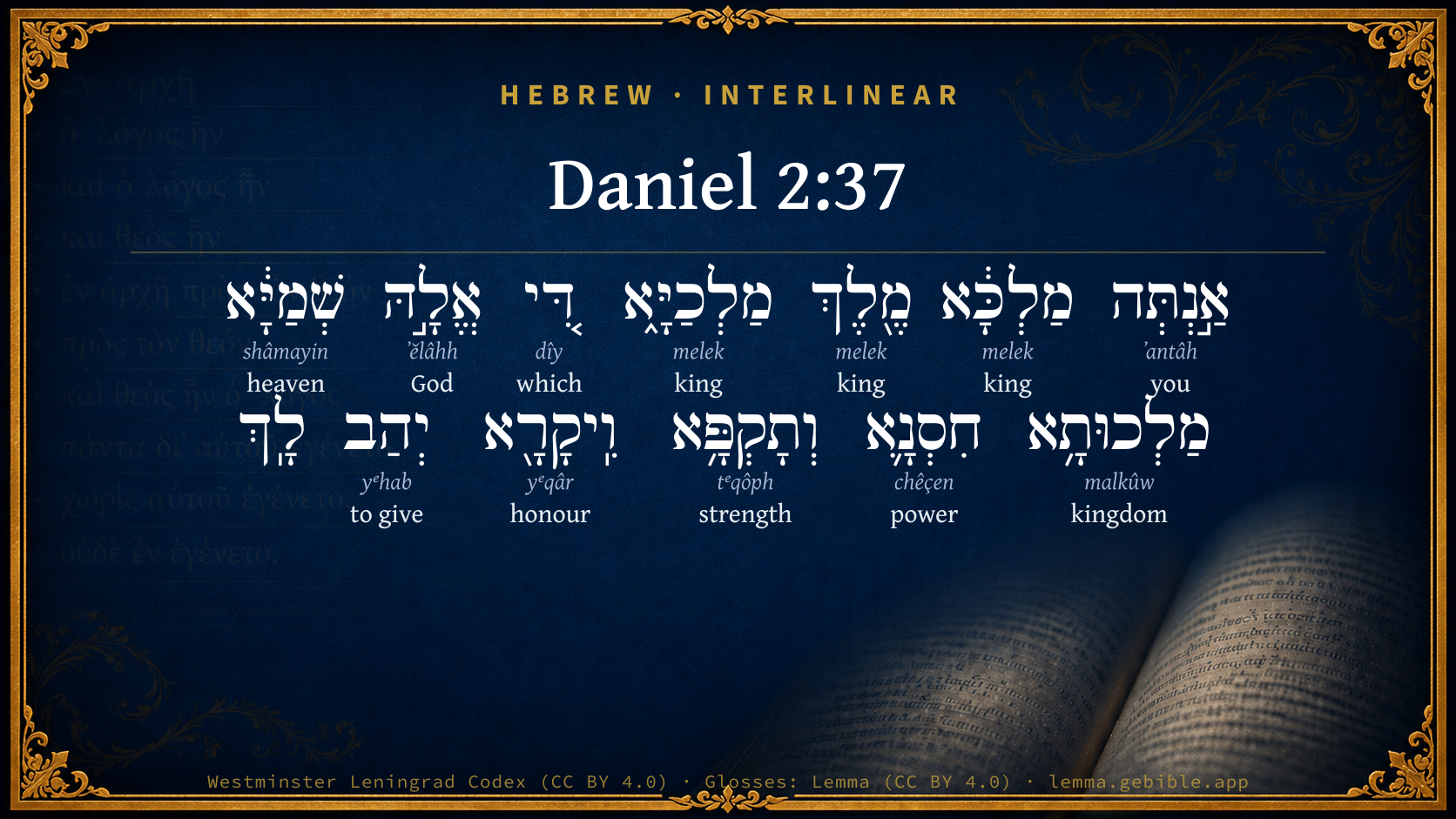
Hebrew (Westminster Leningrad Codex) Daniel 2:37 appears in the Hebrew Old Testament. The text above is from the Westminster Leningrad Codex. Each word links to its Strong’s number, a concise gloss, and parsing drawn from the Open Scriptures Hebrew Bible morphology. Click any word for its full Brown-Driver-Briggs (BDB) entry.
Download image
Cite this verse

Daniel 2:37 (World English Bible). Public Domain. Lemma interlinear Bible study tool, https://lemma.gebible.app/v/daniel/2/37.

Show BibTeX & RIS
BibTeX
RIS
English Translation
You, O king, are king of kings, to whom the God of heaven has given the kingdom, the power, and the strength, and the glory;
World English Bible · Public Domain
Highlights
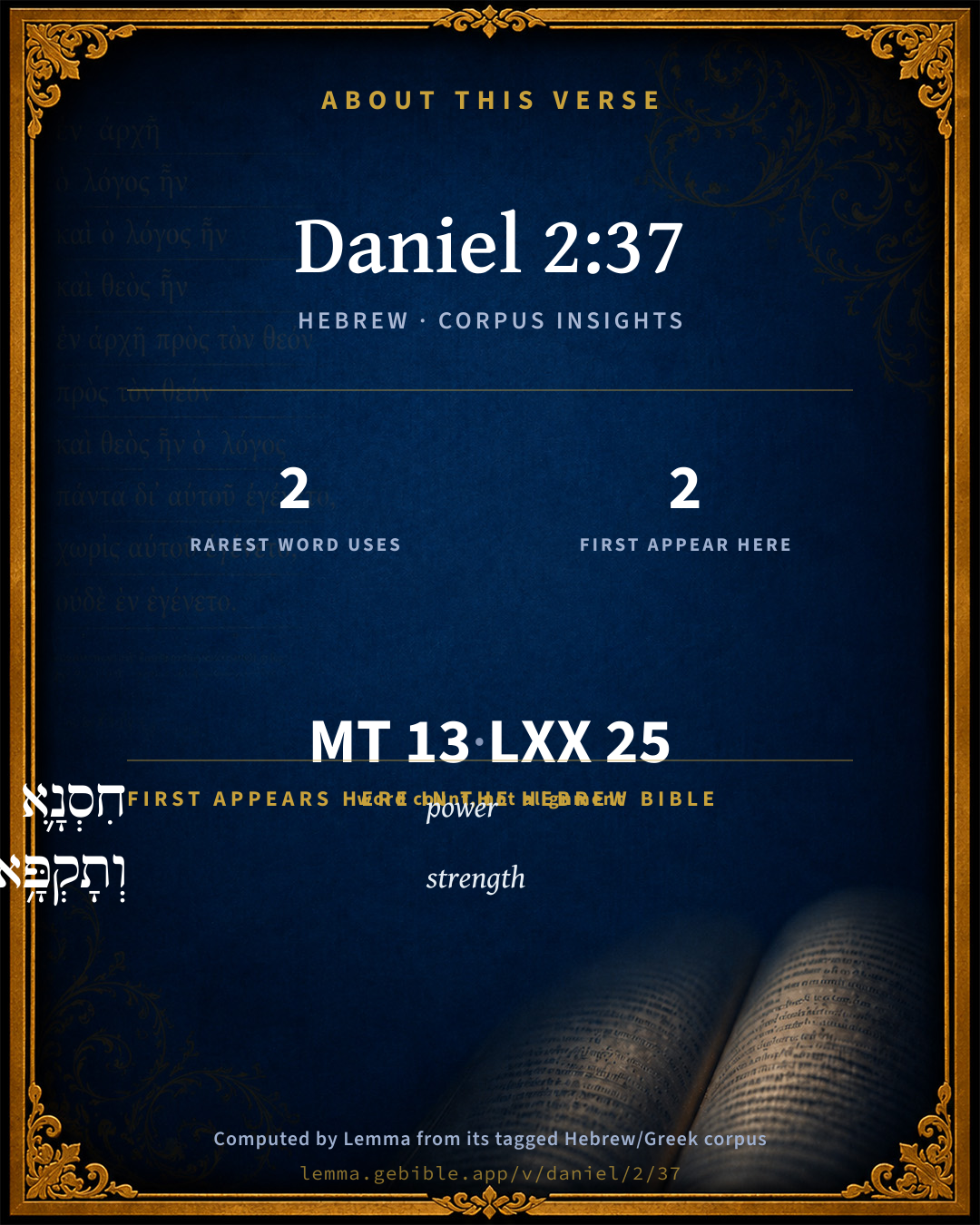
  • 2 first appearances in the Hebrew Bible
Full analysis ↓
Download a study sheet

One document with this verse’s original text, its word-by-word gloss line, the meaning frame, cross-references with their text, attributed commentary, and full source and license credits — printable, and it pastes into notes with its structure intact.

This verse Autodidact and up

Study sheet (.html) Plain text (.txt)

A passage Seminary Student

Up to 50 verses in one chapter. A passage sheet keeps up to 6 commentary sources and 12 cross-references per verse, in the order this page ranks them, and says so on the sheet whenever that leaves anything out. Ask for a single verse and you get the Autodidact verse sheet above.

Everything on this page stays free to read, with no account — the sheet is a download of what is already on screen, not access to it.

Want to remove ads? Support Godless Engineer
Compare translations 3

The same verse in 3 English versions, stacked beneath the original-language interlinear above. Click any original word for its lexicon entry.

Each is an independent rendering of the whole verse — the interlinear is not word-aligned to these translations.

Highlighted words mark where these versions differ — a whole-verse word diff, not a word-by-word alignment.

  • World English Bible Public Domain
    You, O king, are king of kings, to whom the God of heaven has given the kingdom, the power, and the strength, and the glory;
  • King James Version Public Domain
    Thou, O king, art a king of kings: for the God of heaven hath given thee a kingdom, power, and strength, and glory.
  • unfoldingWord Literal Text CC BY-SA 4.0
    You, O king, are the king of kings to whom the God of heaven has given the kingdom, the power, the strength, and the glory;

unfoldingWord Literal Text — © unfoldingWord, licensed CC BY-SA 4.0. Word-aligned USFM3 via Door43 (git.door43.org/unfoldingWord/en_ult).

Versions to compare (up to 4)

3 of 4 selected

Show all 18 translations

Every available English version of this verse, each an independent rendering of the whole verse.

  • World English Bible Public Domain
    You, O king, are king of kings, to whom the God of heaven has given the kingdom, the power, and the strength, and the glory;
  • Berean Standard Bible Public Domain
    You, O king, are the king of kings, to whom the God of heaven has given sovereignty, power, strength, and glory.
  • Majority Standard Bible Public Domain
    You, O king, are the king of kings, to whom the God of heaven has given sovereignty, power, strength, and glory.
  • King James Version Public Domain
    Thou, O king, art a king of kings: for the God of heaven hath given thee a kingdom, power, and strength, and glory.
  • American Standard Version (1901) Public Domain
    Thou, O king, art king of kings, unto whom the God of heaven hath given the kingdom, the power, and the strength, and the glory;
  • Revised Version (1885) Public Domain
    Thou, O king, art king of kings, unto whom the God of heaven hath given the kingdom, the power, and the strength, and the glory;
  • Geneva Bible (1599) Public Domain
    O King, thou art a king of Kings: for the God of heauen hath giuen thee a kingdome, power, and strength, and glorie.
  • Douay-Rheims (1899) Public Domain
    Thou art a king of kings: and the God of heaven hath given thee a kingdom, and strength, and power, and glory:
  • Young's Literal Translation Public Domain
    `Thou, O king, art a king of kings, for the God of the heavens a kingdom, strength, and might, and glory, hath given to thee;
  • Literal Standard Version CC BY-SA 4.0
    You, O king, are a king of kings, for the God of the heavens a kingdom, strength, and might, and glory, has given to you;
  • Unlocked Literal Bible CC BY-SA 4.0
    You, king, are king of the kings to whom the God of heaven has given the kingdom, the power, the strength, and the honor.
  • unfoldingWord Literal Text CC BY-SA 4.0
    You, O king, are the king of kings to whom the God of heaven has given the kingdom, the power, the strength, and the glory;
  • Darby Bible Public Domain
    Thou, O king, art a king of kings, unto whom the God of the heavens hath given the kingdom, the power, and the strength, and the glory;
  • World Messianic Bible Public Domain
    You, O king, are king of kings, to whom the God of heaven has given the kingdom, the power, the strength, and the glory.
  • Webster's Bible Public Domain
    Thou, O king, art a king of kings: for the God of heaven hath given thee a kingdom, power, and strength, and glory.
  • Free Bible Version CC BY-SA 4.0
    Your Majesty, you are the king of kings to whom the God of heaven has given the kingdom, and power, strength, and glory.
  • Bible in Basic English Public Domain
    You, O King, king of kings, to whom the God of heaven has given the kingdom, the power, and the strength, and the glory,
  • JPS Tanakh (1917) Public Domain
    Thou, O king, king of kings, unto whom the God of heaven hath given the kingdom, the power, and the strength, and the glory;

Literal Standard Version (2020), Covenant Press — licensed CC BY-SA 4.0. Text via the HelloAO Bible API (eBible.org). Unlocked Literal Bible (unfoldingWord) — licensed CC BY-SA 4.0. Text via the HelloAO Bible API (eBible.org). unfoldingWord Literal Text — © unfoldingWord, licensed CC BY-SA 4.0. Word-aligned USFM3 via Door43 (git.door43.org/unfoldingWord/en_ult). Free Bible Version, Dr. Jonathan Gallagher — licensed CC BY-SA 4.0. Text via the HelloAO Bible API (eBible.org).

Word by word

More ways to search: Search by grammar → Find every occurrence → Compare this word →

Practice this passage: Drill this verse → Learn its vocabulary →

חִסְנָ֛א
chêçen
H2632
“power · the”
Adjective, N, Common + Particle, Definite Article
Part of Speech
Adjective + Particle
Type
Definite Article
Full BDB Definition

Origin: from H2631

TWOT: 2738a

power, strength, power (of the king), (royal) power
  1. אַ֣נְתְּה ʼantâh H607 “you” Adjective, P
  2. מַלְכָּ֔א melek H4430 “king · the” Adjective, N, Common + Particle, Definite Article
  3. מֶ֖לֶךְ melek H4430 “king of” Adjective, N, Common
  4. מַלְכַיָּ֑א melek H4430 “kings · the” Adjective, N, Common + Particle, Definite Article
  5. דִּ֚י dîy H1768 “which” Adjective, T
  6. אֱלָ֣הּ ʼĕlâhh H426 “God of” Adjective, N, Common
  7. שְׁמַיָּ֔א shâmayin H8065 “heaven(s) · the” Adjective, N, Common + Particle, Definite Article
  8. מַלְכוּתָ֥א malkûw H4437 “kingdom · the” Adjective, N, Common + Particle, Definite Article
  9. וְתָקְפָּ֥א tᵉqôph H8632 “and · strength · the” Adjective, C + Noun, Common, Masculine, Singular, Determined + Particle, Definite Article
  10. וִֽיקָרָ֖א yᵉqâr H3367 “and · honour · the” Adjective, C + Noun, Common, Masculine, Singular, Determined + Particle, Definite Article
  11. יְהַב yᵉhab H3052 “to give” Adjective, V, Plural

About this verse

These counts appear in no published source. They are computed here, from the morphology-tagged text and Lemma’s own curated glosses. What Lemma adds →

13
words
10
distinct lemmas
Prophets
section

Notable vocabulary

The rarest word here is חִסְנָ֛א power H2632 — appearing just 2 times in the whole Hebrew Bible.

First appearance in Scripture

These words make their first canonical appearance in the Hebrew Bible here:

  • חִסְנָ֛א power H2632
  • וְתָקְפָּ֥א strength H8632

Shared distinctive vocabulary

חִסְנָ֛א power H2632 occurs in 2 verses of the Hebrew Bible. Also found in:

Grammatical profile

  • 6 adjectives
  • 7 particles

Repetition

A word recurs within this verse — often emphatic in Hebrew:

  • מַלְכָּ֔א king H4430 ×3

Hebrew & Septuagint length

In English translation the verse runs 25 words from the Hebrew and 23 from the Septuagint (LXX English) — closely comparable.

A rough comparison of the two English renderings, which tokenize alike — not a word-level alignment.

Word counts can differ between the Hebrew and the Greek without any difference in meaning — e.g. the Hebrew direct-object marker אֵת has no separate Greek word, and Greek often adds the article ὁ.

In the original languages it is 13 Hebrew tokens and 25 Greek tokens — but the two are counted differently (Hebrew bundles its prefixes and suffixes into one token; the Greek is in lemma form), so that isn’t a like-for-like length.

Cross-references

24

Topical passages linked to Daniel 2:37 in the Treasury of Scripture Knowledge — connected by theme and wording, ordered by reader-vote popularity; previews shown in the World English Bible.

  • Ezekiel 26:7 For thus says the Lord Yahweh: Behold, I will bring on Tyre Nebuchadrezzar king of Babylon, king of kings, from the north, with horses, and with chariots, and with horsemen, and a company, and much people.
  • Jeremiah 27:6–7 Now have I given all these lands into the hand of Nebuchadnezzar the king of Babylon, my servant; and the animals of the field also have I given him to serve him.
  • Ezra 1:2 Thus says Cyrus king of Persia, All the kingdoms of the earth has Yahweh, the God of heaven, given me; and he has charged me to build him a house in Jerusalem, which is in Judah.
  • Ezra 7:12 Artaxerxes, king of kings, to Ezra the priest, the scribe of the law of the God of heaven, perfect and so forth.
  • Psalms 62:11 God has spoken once, Twice I have heard this, That power belongs to God.
  • Isaiah 47:5 Sit you silent, and get you into darkness, daughter of the Chaldeans; for you shall no more be called The mistress of kingdoms.
  • Daniel 5:18 You king, the Most High God gave Nebuchadnezzar your father the kingdom, and greatness, and glory, and majesty:
  • 1 Kings 4:24 For he had dominion over all [the region] on this side the River, from Tiphsah even to Gaza, over all the kings on this side the River: and he had peace on all sides round about him.
  • 2 Chronicles 36:23 Thus says Cyrus king of Persia, All the kingdoms of the earth has Yahweh, the God of heaven, given me; and he has charged me to build him a house in Jerusalem, which is in Judah. Whoever there is among you of all his people, Yahweh his God be with him, and let him go up.
  • Proverbs 8:15 By me kings reign, And princes decree justice.
  • Isaiah 10:8 For he says, Aren't my princes all of them kings?
  • Jeremiah 28:14 For thus says Yahweh of Hosts, the God of Israel: I have put a yoke of iron on the neck of all these nations, that they may serve Nebuchadnezzar king of Babylon; and they shall serve him: and I have given him the animals of the field also.
  • Daniel 4:3 How great are his signs! and how mighty are his wonders! his kingdom is an everlasting kingdom, and his dominion is from generation to generation.
  • Daniel 4:25 that you shall be driven from men, and your dwelling shall be with the animals of the field, and you shall be made to eat grass as oxen, and shall be wet with the dew of the sky, and seven times shall pass over you; until you know that the Most High rules in the kingdom of men, and gives it to whoever he will.
  • Daniel 4:32 and you shall be driven from men; and they dwelling shall be with the animals of the field; you shall be made to eat grass as oxen; and seven times shall pass over you; until you know that the Most High rules in the kingdom of men, and gives it to whoever he will.
  • Daniel 4:34 At the end of the days I, Nebuchadnezzar, lifted up my eyes to heaven, and my understanding returned to me, and I blessed the Most High, and I praised and honored him who lives forever; for his dominion is an everlasting dominion, and his kingdom from generation to generation.
  • Hosea 8:10 But although they sold themselves among the nations, I will now gather them; and they begin to waste away because of the oppression of the king of mighty ones.
  • Matthew 6:13 Bring us not into temptation, but deliver us from the evil one. For yours is the Kingdom, the power, and the glory forever. Amen.'
  • John 19:11 Jesus answered, "You would have no power at all against me, unless it were given to you from above. Therefore he who delivered me to you has greater sin."
  • Revelation 1:5 and from Jesus Christ, the faithful witness, the firstborn of the dead, and the ruler of the kings of the earth. To him who loves us, and washed us from our sins by his blood;
  • Revelation 4:11 "Worthy are you, our Lord and God, the Holy One, to receive the glory, the honor, and the power, for you created all things, and because of your desire they existed, and were created!"
  • Revelation 5:12 saying with a loud voice, "Worthy is the Lamb who has been killed to receive the power, wealth, wisdom, strength, honor, glory, and blessing!"
  • Revelation 17:14 These will war against the Lamb, and the Lamb will overcome them, for he is Lord of lords, and King of kings. They also will overcome who are with him, called and chosen and faithful."
  • Revelation 19:16 He has on his garment and on his thigh a name written, "KING OF KINGS, AND LORD OF LORDS."

Cross-references courtesy of OpenBible.info (CC BY 4.0).

Hebrew and Greek witnesses Masoretic Hebrew ↔ Greek Septuagint

The same verse in the two great witnesses to the Old Testament, shown verse-for-verse.

These are two independent witnesses, not word-aligned to each other, and the Septuagint is shown in lemma (dictionary) form.

Hebrew Daniel 2:37 Masoretic · Westminster Leningrad Codex

אַ֣נְתְּה מַלְכָּ֔א מֶ֖לֶךְ מַלְכַיָּ֑א דִּ֚י אֱלָ֣הּ שְׁמַיָּ֔א מַלְכוּתָ֥א חִסְנָ֛א וְתָקְפָּ֥א וִֽיקָרָ֖א יְהַב לָֽךְ

You, O king, are king of kings, to whom the God of heaven has given the kingdom, the power, and the strength, and the glory;

World English Bible · Public Domain

Greek LXX Daniel 2:37 Septuagint · lemma form

σύ βασιλεύς βασιλεύς βασιλεύς καί σύ ὁ κύριος ὁ οὐρανός ὁ ἀρχή καί ὁ βασιλεία καί ὁ ἰσχύς καί ὁ τιμή καί ὁ δόξα δίδωμι

You, O king, are a king of kings, to whom the God of heaven has given a powerful and strong and honorable kingdom,

LXX2012 (modern English Septuagint) · Public Domain

On this verse, The Pulpit Commentary discusses the Septuagint’s reading. Read the note in Commentary ↓

Hebrew: Westminster Leningrad Codex (CC BY 4.0). Greek: Septuagint (public domain); English from LXX2012 (modern English Septuagint) (Public Domain). How the Septuagint differs from the Hebrew →

Commentary

Notes on Daniel 2:37 from classic Christian and Jewish commentators (each source and its license shown beneath its notes). The classic Christian expositions comment on the surrounding passage and are grouped to its opening verse, so a note may address several verses; the Jewish commentaries on the Tanakh (Rashi and others) are per-verse, so they appear only where the commentator wrote on this verse.

Lemma curates 59 commentaries, every one of them public domain or Creative Commons licensed, each selected and text-cleaned for this edition rather than reprinted as found. About our sources →

Trapp's Complete Commentary

John Trapp

Dan 2:37 Thou, O king, [art] a king of kings: for the God of heaven hath given thee a kingdom, power, and strength, and glory.

Ver. 37. Thou, O king, art a king of kings.] And yet the whole Babylonian empire was but as a crust cast by God, the great housekeeper of the world, to his dogs, as Luther somewhere saith of the Turkish.

John Trapp, A Commentary or Exposition upon All the Books of the Old and New Testament (1647–1656) — public domain. Text from a community e-Sword module.

Ibn Ezra

Rabbi Abraham ibn Ezra

[Daniel 2:37] Ant malka... chisna (אַנְתְּ מַלְכָּא... חִסְנָא - You, O king... power): Power (Chisna - חִסְנָא): [This Aramaic word for power/strength] is like [its Hebrew cognate chason in the verse] “And the strong (ha-chason) shall become tow” [Isaiah 1:31]. And the Gaon [Rav Saadia Gaon] said: [It means] kingdom as an inheritance/possession (malchut nachalah - מַלְכוּת נַחֲלָה).

Ibn Ezra on the Tanakh — English translations: “Sefaria Community Translation” (CC0 1.0 (public-domain dedication)); “Yalkut, Sifsei Chachomim Chumash, Metsudah Publications, 2009” (CC BY 4.0); and “Commentary of Ibn Ezra on Isaiah - trans. by M. Friedlander, 1873” (public domain). Text via Sefaria.

Jamieson, Fausset & Brown

Robert Jamieson, A. R. Fausset & David Brown

Thou . . . art a king of kings--The committal of power in fullest plenitude belongs to Nebuchadnezzar personally, as having made Babylon the mighty empire it was. In twenty-three years after him the empire was ended: with him its greatness is identified (Dan 4:30), his successors having done nothing notable. Not that he actually ruled every part of the globe, but that God granted him illimitable dominion in whatever direction his ambition led him, Egypt, Nineveh, Arabia, Syria, Tyre, and its Phœnician colonies (Jer 27:5-8). Compare as to Cyrus, Ezr 1:2.

Jamieson, Fausset & Brown — Commentary Critical and Explanatory on the Whole Bible (1871) — public domain (CC PDM 1.0). Text via the HelloAO Bible API.

Adam Clarke's Commentary

Verse 37. The God of heaven] Not given by thy own gods, nor acquired by thy own skill and prowess; it is a Divine gift.

Power] To rule this kingdom.

And strength] To defend it against all foes.

And glory.] Great honour and dignity.

Adam Clarke's Commentary on the Bible (1810–1826) — public domain. Text from a community e-Sword/MySword module.

Ellicott's Commentary for English Readers

(37, 38) Interpretation of the vision. Nebuchadnezzar is the head; or, in other words, he is the first of the four kingdoms which are denoted by the image. His kingdom was the largest that the world had till then known; in fact, a writer cited by Josephus (Ap. i. 20), compares him to Hercules. We find a similar allusion to the beasts of the field as Nebuchadnezzar’s servants Jer_27:6; Jer_28:14. The title of “king of kings” is also ascribed to Nebuchadnezzar by Ezekiel (Eze_26:7). We are therefore left in no doubt as to what is meant by the first of the four empires. It is the Babylonian Empire, of which Nebuchadnezzar was in every sense the head, being the actual founder of it, and its mainstay during his long reign of forty-three years.

A Bible Commentary for English Readers, edited by Charles John Ellicott (1878–1897) — public domain. Text from a community e-Sword module.

The Cambridge Bible for Schools and Colleges

gen. ed. J. J. S. Perowne

37. a king of kings] king of kings,—a title applied to Nebuchadnezzar in Eze_26:7, though (Prince) not the customary Babylonian form of address. It is, however, one that was borne constantly by the Persian kings: cf. Ezr_7:12; and see the series of inscriptions of Persian kings, published in Records of the Past, 1st ser., i. iii ff., v. 151 ff., ix. 65 ff. An Aramaic inscription found at Saqqarah, near Cairo, is dated in the 4th year of “Xerxes, king of kings”

for, &c.] unto whom the God of heaven (Dan_2:19) hath given the kingdom, the power, the strength, and the glory. Daniel ascribes Nebuchadnezzar’s dominion to the Providence of God, exactly as is done (in other terms) by Jeremiah (Jer_25:9; Jer_27:6; Jer_28:14).

The Cambridge Bible for Schools and Colleges (gen. ed. J. J. S. Perowne; Cambridge University Press, 1878–1918) — public domain. Text from a community e-Sword module.

John Gill's Exposition

Thou, O king, art a king of kings,.... Having many kings subject and tributary to him, or would have; as the kings of Judah, Ammon, Moab, and others, and who were even his captives and prisoners; see Jer 52:32. Jarchi and Saadiah join this with the next clause, "the God of heaven", and interpret it of him thus, thou, O King Nebuchadnezzar, "the King of kings, who is the God of heaven, hath given unto thee", &c.; so some in the Talmud understand it of God (k); but this is contrary to the accents:

for the God of heaven hath given thee a kingdom, power, and strength, and glory; that is, a very powerful, strong, and glorious kingdom, famous for its mighty armies, strong fortresses, and great riches, from all which the king had great honour and glory; and this he had not by his ancestors, or his own military skill and prowess, but by the favour and gift of God.

(k) T. Bab. Shebuot, fol. 35. 2.

John Gill's Exposition of the Whole Bible (1746–1763) — public domain (CC PDM 1.0). Text via the HelloAO Bible API.

Albert Barnes' Notes on the Bible

Thou, O King, art a king of kings - The phrase “king of kings” is a Hebraism, to denote a supreme monarch, or one who has other kings under him as tributary, Ezr 7:12; Eze 26:7. As such it is applied by way of eminence to the Son of God, in Rev 17:14; Rev 19:16. As here used, it means that Nebuchadnezzar ruled over tributary kings and princes, or that he was the most eminent of the kings of the earth. The scepter which he swayed was, in fact, extended over many nations that were once independent kingdoms, and the title here conferred on him was not one that was designed to flatter the monarch, but was a simple statement of what was an undoubted truth. Daniel would not withhold any title that was in accordance with reality, as he did not withhold any communication in accordance with reality that was adapted to humble the monarch.

For the God of heaven hath given thee a kingdom ... - At the same time that Daniel gave him a title which might in itself have ministered to the pride of the monarch, he is careful to remind him that he held this title in virtue of no wisdom or power of his own. It was the true God who had conferred on him the sovereignty of these extensive realms, and it was one of the designs of this vision to show him that he held his power at his will, and that at his pleasure he could cause it to pass away. It was the forgetfulness of this, and the pride resulting from that forgetfulness, which led to the melancholy calamity which befel this haughty monarch, as recorded in Dan. 4.

Albert Barnes' Notes on the Bible (1834–1885) — public domain. Text from a community e-Sword/MySword module.

Haydock's Catholic Bible Commentary

Of kings. This title was used by the Persians. Nabuchodonosor was at that time the most potent monarch on earth. He conquered many nations, and greatly embellished the city of Babylon, surrounding it with three walls in fifteen days, and building hanging gardens, which were the wonder of the world. See Eusebius, præp. ix. 41. and x. 42. &c. (Calmet)

George Leo Haydock (1774–1849), Haydock's Catholic Family Bible and Commentary, 1859 edition — public domain. Excludes Psalms (Douay-Rheims chapter numbering differs from Protestant) and Deuterocanonical books (Catholic canon only).

Matthew Poole's English Annotations

A king of kings; he means Nebuchadnezzar in person, together with his successors, Evil-merodach and Belshazzar. The prophet would not mind the king of any thing past, nor of any other governments but those with whom his church were then and to be concerned for the future, till the coming of the Messiah, by whose coming they should support and comfort themselves against all their sufferings by oppressors; and also God would have the prophet mind Nebuchadnezzar of the stone cut out of the mountain without hands, growing and breaking in pieces all earthly power.

The God of heaven hath given thee a kingdom; it came not to thee by thy ancestors, or by fortune, or by thy valour, but the great God of heaven hath the bestowing of those, and giveth them to whomsoever he will.

Power, and strength, and glory; authority; victorious armies, with great prosperity.

Matthew Poole's English Annotations on the Holy Bible (1683–1685) — public domain. Text from a community e-Sword/MySword module.

The Pulpit Commentary

Thou, O king, art a king of kings: for the God of heaven hath given thee a kingdom, power, and strength, and glory. The Septuagint renders the latter clause, "To thee the Lord of heaven gave the dominion, and the kingdom, and the might, anti the honor, and the glory in all the earth (ejn pash th oijkoumenh)." There appears here to be two cases of doublet; ajrch and basileia are probably originally alternative renderings of malcutha, and timh and doxa double renderings of yiqara. On this hypothesis there is only one Greek word for two Aramaic. We shall consider this later. Paulus Tellensis, in his translation of the Septuagint Version, draws the beginning of the next verse into connection with the final words of this verse as given here. The words, "in the whole earth," is a transference from the next verse. The rendering of Theodotion is, "Thou, O king, art a king of kings, to whom the God of heaven gave a strong and mighty and honourable kingdom," making thus hisna, toqpa, and yiqara adjectives of malcut a. But malcutha is feminine, and, if adjectives. hisna, etc., are masculine. The Peshitta differs from the Massoretic in leaving out one of the terms, "Thou, O king, art a king of kings; God most high (merima) a strong kingdom and glory has given to thee." Of course, the same objection holds to some extent against this version as against that of Theodotion, but it is to be noted that there are not two words conveying the same idea of strength. As there was only one in the Septuagint, we are inclined to think that toqpi must have been an addition. Jerome"s rendering is, "Thou art a king of kings, and the God of heaven has given to thee the kingdom, and might, and dominion, and glory." There seems to be a transposition here. The general scope of this verse and the next is given in Jer_27:5, Jer_27:6. There is certainly high honour given to Nebuchadnezzar in this address, but, at the same time, he is warned that all his glory is bestowed upon him by the God of heaven. It is possible that Nebuchadnezzar interpreted the words as referring to Merodach, the god whom he specially worshipped, or regarded the God of heaven as only another of the gods many and lords many which, as a polytheist, he acknowledged. The title of the Babylonian king was shar-sharani," king of kings," and sharru-rabbu, "great king." Thus in this address the technical title is given him. The Babylonian monarchs assumed this from their Assyrian predecessors, as e.g. Asshurbanipal (Smith, "History," pp. 26, 73, 196). From the Babylonians it was passed on to the Persian monarchs. In Eze_26:7 the prophet gives Nebuchadnezzar this title. As we find by the succeeding verse, the kingdom here is not mere royalty or kingship, but the special royalty of practically universal empire; that is to say, universal so far as the knowledge of the times went. Our rendering in the Authorized Version fails in accuracy, in not inserting the definite article, which is really implied in the sign of the status emphaticus. Luther makes the same mistake. Happily the Revisers have altered matters, and inserted "the," as does Behrmann. The Greek Version and Peshitta are accurate in this. The word translated "power," ans (his"na), is consonantly present in both dialects of more recent Aramaic.

The Pulpit Commentary (1880–1919), ed. H.D.M. Spence-Jones & Joseph S. Exell — public domain. Text from a community e-Sword module.

Rashi

Rabbi Shlomo Yitzchaki (Rashi)

The King of kings Our Sages, of blessed memory, explained (Shev. 35b): Every mention of “king” in Daniel refers to an earthly king, except this one, which he said in reference to the Holy One, blessed be He, and this is what it means: The King of kings, Who is the God of heaven.

a strong... kingdom gave you a strong and prominent kingdom.

Rashi on the Tanakh — English translations: “The Judaica Press complete Tanach with Rashi, translated by A. J. Rosenberg” (CC BY 4.0); “Pentateuch with Rashi's commentary by M. Rosenbaum and A.M. Silbermann, 1929-1934” (public domain); “The Metsudah Tanach series, Lakewood, N.J” (CC BY 4.0); and “The Book of Joshua, Metsudah Publications, 1997” (CC BY 4.0). Text via Sefaria.

Lesson kit

Teaching starters — assembled from the data on this page, not authored interpretation. Every prompt links to the verse data it draws on. Edit before teaching.

Daniel, in the Prophets, opens this verse with 13 words (10 distinct Hebrew lemmas). Its most distinctive word is chêçen (“power”). A historical commentator’s framing appears above. Read the whole chapter for the surrounding context.

Discussion questions

  1. How does “power” (chêçen) shape what this verse is saying?
  2. 2 words make their first appearance in Scripture here. What does this debut establish?
  3. How does Daniel 4:30, which shares the word «power», read alongside this verse?
  4. What does the repetition of “king” (3× in this one verse) do in this verse?
  5. These translations render this verse differently. What is at stake in choosing one wording over another?
  6. Compare how Trapp's Complete Commentary and Ibn Ezra read this verse. Where do they agree or differ?

Things to notice

Reading settings

Reading text

Shown beneath each verse's original-language words.

Old Testament
Old Testament edition

Read the OT as the Masoretic Hebrew (MT) or the Greek Septuagint (LXX).

English shown for the Greek Septuagint (in the Hebrew ↔ Greek comparison).

Comparing translations? Open the Compare panel on any verse page to stack up to four side by side.