
Daniel 5:7

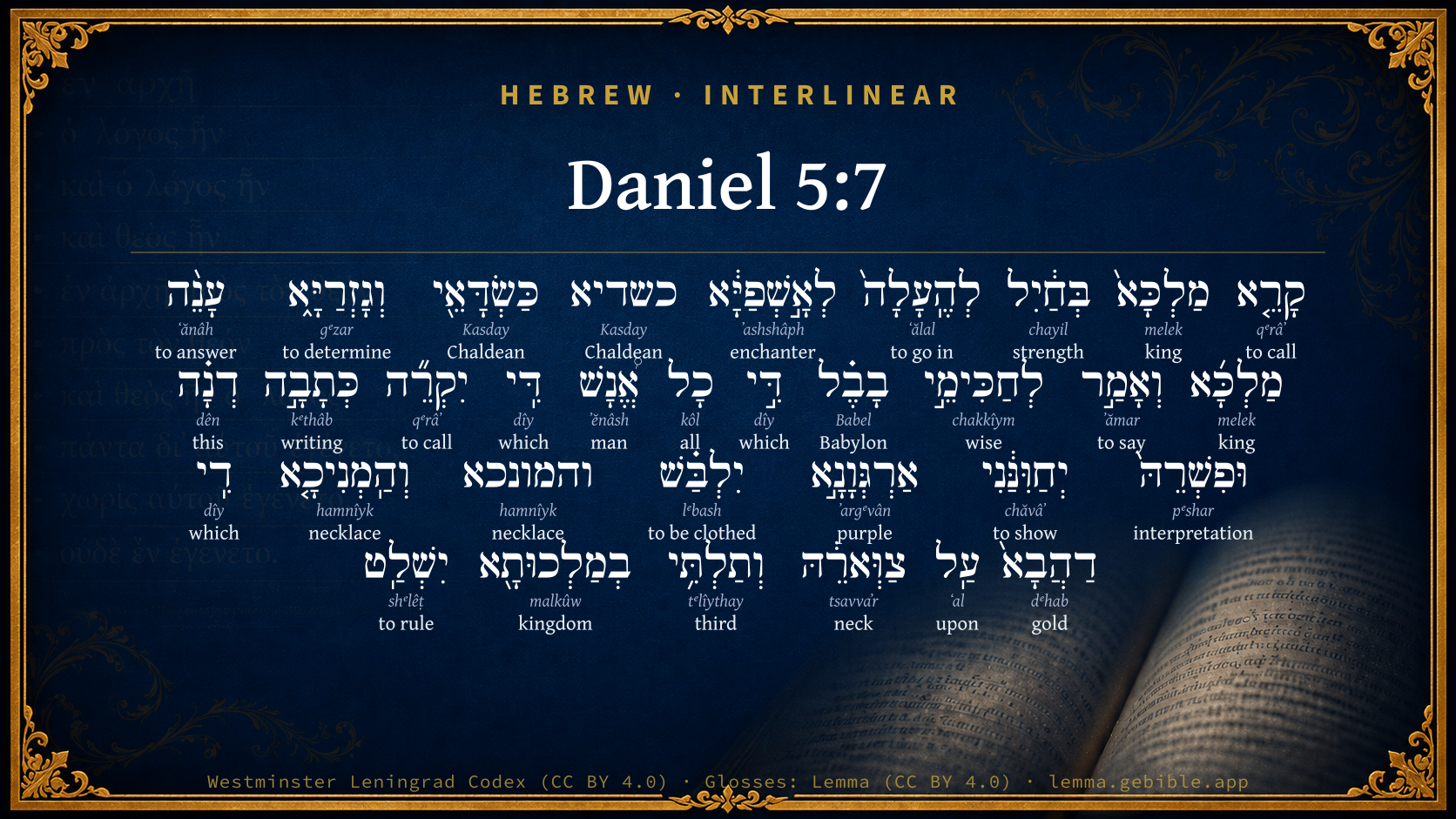
Hebrew (Westminster Leningrad Codex) Daniel 5:7 appears in the Hebrew Old Testament. The text above is from the Westminster Leningrad Codex. Each word links to its Strong’s number, a concise gloss, and parsing drawn from the Open Scriptures Hebrew Bible morphology. Click any word for its full Brown-Driver-Briggs (BDB) entry.
Download image
Cite this verse

Daniel 5:7 (World English Bible). Public Domain. Lemma interlinear Bible study tool, https://lemma.gebible.app/v/daniel/5/7.

Show BibTeX & RIS
BibTeX
RIS
English Translation
The king cried aloud to bring in the enchanters, the Chaldeans, and the soothsayers. The king spoke and said to the wise men of Babylon, Whoever shall read this writing, and show me the interpretation of it, shall be clothed with purple, and have a chain of gold about his neck, and shall be the third ruler in the kingdom.
World English Bible · Public Domain
Highlights
  • 4 first appearances in the Hebrew Bible
Full analysis ↓
Download a study sheet

One document with this verse’s original text, its word-by-word gloss line, the meaning frame, cross-references with their text, attributed commentary, and full source and license credits — printable, and it pastes into notes with its structure intact.

This verse Autodidact and up

Study sheet (.html) Plain text (.txt)

A passage Seminary Student

Up to 50 verses in one chapter. A passage sheet keeps up to 6 commentary sources and 12 cross-references per verse, in the order this page ranks them, and says so on the sheet whenever that leaves anything out. Ask for a single verse and you get the Autodidact verse sheet above.

Everything on this page stays free to read, with no account — the sheet is a download of what is already on screen, not access to it.

Want to remove ads? Support Godless Engineer
Compare translations 3

The same verse in 3 English versions, stacked beneath the original-language interlinear above. Click any original word for its lexicon entry.

Each is an independent rendering of the whole verse — the interlinear is not word-aligned to these translations.

Highlighted words mark where these versions differ — a whole-verse word diff, not a word-by-word alignment.

  • World English Bible Public Domain
    The king cried aloud to bring in the enchanters, the Chaldeans, and the soothsayers. The king spoke and said to the wise men of Babylon, Whoever shall read this writing, and show me the interpretation of it, shall be clothed with purple, and have a chain of gold about his neck, and shall be the third ruler in the kingdom.
  • King James Version Public Domain
    The king cried aloud to bring in the astrologers, the Chaldeans, and the soothsayers. And the king spake, and said to the wise men of Babylon, Whosoever shall read this writing, and shew me the interpretation thereof, shall be clothed with scarlet, and have a chain of gold about his neck, and shall be the third ruler in the kingdom.
  • unfoldingWord Literal Text CC BY-SA 4.0
    The king called aloud to bring in the enchanters, the Chaldeans, and the astrologers. The king spoke and said to the wise men of Babylon, “Any man who reads this writing and shows me its interpretation will be clothed with purple and will have a chain of gold around his neck, and he will be the third ruler in the kingdom.”

unfoldingWord Literal Text — © unfoldingWord, licensed CC BY-SA 4.0. Word-aligned USFM3 via Door43 (git.door43.org/unfoldingWord/en_ult).

Versions to compare (up to 4)

3 of 4 selected

Show all 18 translations

Every available English version of this verse, each an independent rendering of the whole verse.

  • World English Bible Public Domain
    The king cried aloud to bring in the enchanters, the Chaldeans, and the soothsayers. The king spoke and said to the wise men of Babylon, Whoever shall read this writing, and show me the interpretation of it, shall be clothed with purple, and have a chain of gold about his neck, and shall be the third ruler in the kingdom.
  • Berean Standard Bible Public Domain
    The king called out for the enchanters, astrologers, and diviners to be brought in, and he said to these wise men of Babylon, “Whoever reads this inscription and tells me its interpretation will be clothed in purple and have a gold chain placed around his neck, and he will be made the third highest ruler in the kingdom.”
  • Majority Standard Bible Public Domain
    The king called out for the enchanters, astrologers, and diviners to be brought in, and he said to these wise men of Babylon, “Whoever reads this inscription and tells me its interpretation will be clothed in purple and have a gold chain placed around his neck, and he will be made the third highest ruler in the kingdom.”
  • King James Version Public Domain
    The king cried aloud to bring in the astrologers, the Chaldeans, and the soothsayers. And the king spake, and said to the wise men of Babylon, Whosoever shall read this writing, and shew me the interpretation thereof, shall be clothed with scarlet, and have a chain of gold about his neck, and shall be the third ruler in the kingdom.
  • American Standard Version (1901) Public Domain
    The king cried aloud to bring in the enchanters, the Chaldeans, and the soothsayers. The king spake and said to the wise men of Babylon, Whosoever shall read this writing, and show me the interpretation thereof, shall be clothed with purple, and have a chain of gold about his neck, and shall be the third ruler in the kingdom.
  • Revised Version (1885) Public Domain
    The king cried aloud to bring in the enchanters, the Chaldeans, and the soothsayers. The king spake and said to the wise men of Babylon, Whosoever shall read this writing, and shew me the interpretation thereof, shall be clothed with purple, and have a chain of gold about his neck, and shall be the third ruler in the kingdom.
  • Geneva Bible (1599) Public Domain
    Wherefore the King cryed loude, that they should bring the astrologians, the Caldeans and the soothsayers. And the King spake, and sayd to the wise men of Babel, Whosoeuer can reade this writing, and declare me the interpretation thereof, shalbe clothed with purple, and shall haue a chaine of golde about his necke, and shall be the third ruler in the kingdome.
  • Douay-Rheims (1899) Public Domain
    And the king cried out aloud to bring in the wise men, the Chaldeans, and the soothsayers. And the king spoke, and said to the wise men of Babylon: Whosoever shall read this writing, and shall make known to me the interpretation thereof, shall be clothed with purple, and shall have a golden chain on his neck, and shall be the third man in my kingdom.
  • Young's Literal Translation Public Domain
    Call doth the king mightily, to bring up the enchanters, the Chaldeans, and the soothsayers. Answered hath the king, and said to the wise men of Babylon, that, `Any man who doth read this writing, and its interpretation doth shew me, purple he putteth on, and a bracelet of gold `is' on his neck, and third in the kingdom he doth rule.'
  • Literal Standard Version CC BY-SA 4.0
    The king calls mightily, to bring up the enchanters, the Chaldeans, and the soothsayers. The king has answered and said to the wise men of Babylon, that, “Any man who reads this writing, and shows me its interpretation, he puts on purple, and a bracelet of gold [is] on his neck, and he rules third in the kingdom.”
  • Unlocked Literal Bible CC BY-SA 4.0
    The king shouted a command to bring in those who claimed to speak with the dead, wise men, and astrologers. The king said to those known for their wisdom in Babylon, “Whoever explains this writing and its meaning will be clothed with purple and will have a gold chain around his neck. He will have the authority of the third highest ruler in the kingdom.”
  • unfoldingWord Literal Text CC BY-SA 4.0
    The king called aloud to bring in the enchanters, the Chaldeans, and the astrologers. The king spoke and said to the wise men of Babylon, “Any man who reads this writing and shows me its interpretation will be clothed with purple and will have a chain of gold around his neck, and he will be the third ruler in the kingdom.”
  • Darby Bible Public Domain
    The king cried aloud to bring in the magicians, the Chaldeans, and the astrologers. The king spoke and said to the wise men of Babylon, Whosoever shall read this writing, and shew me the interpretation thereof, shall be clothed with purple, and have a chain of gold about his neck, and shall be the third ruler in the kingdom.
  • World Messianic Bible Public Domain
    The king cried aloud to bring in the enchanters, the Kasdim, and the soothsayers. The king spoke and said to the wise men of Babylon, “Whoever reads this writing and shows me its interpretation shall be clothed with purple, and have a chain of gold about his neck, and shall be the third ruler in the kingdom.”
  • Webster's Bible Public Domain
    The king cried aloud to bring in the astrologers, the Chaldeans, and the sooth-sayers. And the king spoke and said to the wise men of Babylon, Whoever shall read this writing, and show me the interpretation of it, shall be clothed with scarlet, and have a chain of gold about his neck, and shall be the third ruler in the kingdom.
  • Free Bible Version CC BY-SA 4.0
    The king shouted, “Bring in the enchanters and astrologers and diviners!” He told these wise men of Babylon, “Anyone who can read this writing and explain it to me will be clothed in purple and have a gold chain placed around his neck, and he will become the third highest ruler in the kingdom.”
  • Bible in Basic English Public Domain
    The king, crying out with a loud voice, said that the users of secret arts, the Chaldaeans, and the readers of signs, were to be sent for. The king made answer and said to the wise men of Babylon, Whoever is able to make out this writing, and make clear to me the sense of it, will be clothed in purple and have a chain of gold round his neck, and will be a ruler of high authority in the kingdom.
  • JPS Tanakh (1917) Public Domain
    The king cried aloud to bring in the enchanters, the Chaldeans, and the astrologers. The king spoke and said to the wise men of Babylon: 'Whosoever shall read this writing, and declare unto me the interpretation thereof, shall be clothed with purple, and have a chain of gold about his neck, and shall rule as one of three in the kingdom.'

Literal Standard Version (2020), Covenant Press — licensed CC BY-SA 4.0. Text via the HelloAO Bible API (eBible.org). Unlocked Literal Bible (unfoldingWord) — licensed CC BY-SA 4.0. Text via the HelloAO Bible API (eBible.org). unfoldingWord Literal Text — © unfoldingWord, licensed CC BY-SA 4.0. Word-aligned USFM3 via Door43 (git.door43.org/unfoldingWord/en_ult). Free Bible Version, Dr. Jonathan Gallagher — licensed CC BY-SA 4.0. Text via the HelloAO Bible API (eBible.org).

Word by word

More ways to search: Search by grammar → Find every occurrence → Compare this word →

Practice this passage: Drill this verse → Learn its vocabulary →

אַרְגְּוָנָ֣א
ʼargᵉvân
H711
“purple · the”
Adjective, N, Common + Particle, Definite Article
Part of Speech
Adjective + Particle
Type
Definite Article
Full BDB Definition

Origin: corresponding to H710

TWOT: 2603

purple, red-purple
  1. קָרֵ֤א qᵉrâʼ H7123 “calling” Adjective, V
  2. מַלְכָּא֙ melek H4430 “king · the” Adjective, N, Common + Particle, Definite Article
  3. בְּחַ֔יִל chayil H2429 “in/at · strength” Adjective, R + Noun, Common, Masculine, Singular, Absolute
  4. לְהֶֽעָלָה֙ ʻălal H5954 “to go in” Adjective, R + Verb, Hiphil, Infinitive Construct
  5. לְאָ֣שְׁפַיָּ֔א ʼashshâph H826 “to/for · enchanters · the” Adjective, T + Noun, Common, Masculine, Plural, Determined + Particle, Definite Article
  6. כשדיא Kasday H3779 “Chaldeans · the” Adjective, N + Particle, Definite Article
  7. כַּשְׂדָּאֵ֖י Kasday H3779 “Chaldeans · my” Adjective, N + Suffix, Personal, 1st Person, Common, Singular
  8. וְגָזְרַיָּ֑א gᵉzar H1505 “and · determining · the” Adjective, C + Verb, Qal, Participle Active, Masculine, Plural, Determined + Particle, Definite Article
  9. עָנֵ֨ה ʻănâh H6032 “answering” Adjective, V
  10. מַלְכָּ֜א melek H4430 “king · the” Adjective, N, Common + Particle, Definite Article
  11. וְאָמַ֣ר ʼămar H560 “and · saying” Adjective, C + Verb, Qal, Participle Active, Masculine, Singular, Absolute
  12. לְחַכִּימֵ֣י chakkîym H2445 “to/for · wise men of” Adjective, R + Noun, Common, Masculine, Plural, Construct
  13. בָבֶ֗ל Babel H895 “Babylon” Adjective, N
  14. דִּ֣י dîy H1768 “which” Adjective, T
  15. כָל kôl H3606 “all of” Adjective, N, Common
  16. אֱ֠נָשׁ ʼĕnâsh H606 “man” Adjective, N, Common
  17. דִּֽי dîy H1768 “which” Adjective, T
  18. יִקְרֵ֞ה qᵉrâʼ H7123 “to call” Adjective, V
  19. כְּתָבָ֣ה kᵉthâb H3792 “writing · the” Adjective, N, Common + Particle, Definite Article
  20. דְנָ֗ה dên H1836 “this” Adjective, P
  21. וּפִשְׁרֵהּ֙ pᵉshar H6591 “and · interpretation · his” Adjective, C + Noun, Common, Masculine, Singular, Construct + Suffix, Personal, 3rd Person, Masculine, Singular
  22. יְחַוִּנַּ֔נִי chăvâʼ H2324 “to show · me” Adjective, V + Suffix, Personal, 1st Person, Common, Singular
  23. יִלְבַּ֗שׁ lᵉbash H3848 “to be clothed” Adjective, V
  24. והמונכא hamnîyk H2002 “and · necklace · the” Adjective, C + Noun, Common, Masculine, Singular, Determined + Particle, Definite Article
  25. וְהַֽמְנִיכָ֤א hamnîyk H2002 “and · necklace · the” Adjective, C + Noun, Common, Masculine, Singular, Determined + Particle, Definite Article
  26. דִֽי dîy H1768 “which” Adjective, T
  27. דַהֲבָא֙ dᵉhab H1722 “gold · the” Adjective, N, Common + Particle, Definite Article
  28. עַֽל ʻal H5922 “upon” Adjective, R
  29. צַוְּארֵ֔הּ tsavvaʼr H6676 “neck · his” Adjective, N, Common + Suffix, Personal, 3rd Person, Masculine, Singular
  30. וְתַלְתִּ֥י tᵉlîythay H8523 “and · third” Adjective, C + Adjective, Ordinal number, Masculine, Singular, Absolute
  31. בְמַלְכוּתָ֖א malkûw H4437 “in/at · kingdom · the” Adjective, R + Noun, Common, Feminine, Singular, Determined + Particle, Definite Article
  32. יִשְׁלַֽט shᵉlêṭ H7981 “to rule” Adjective, V

About this verse

These counts appear in no published source. They are computed here, from the morphology-tagged text and Lemma’s own curated glosses. What Lemma adds →

33
words
27
distinct lemmas
Prophets
section

Notable vocabulary

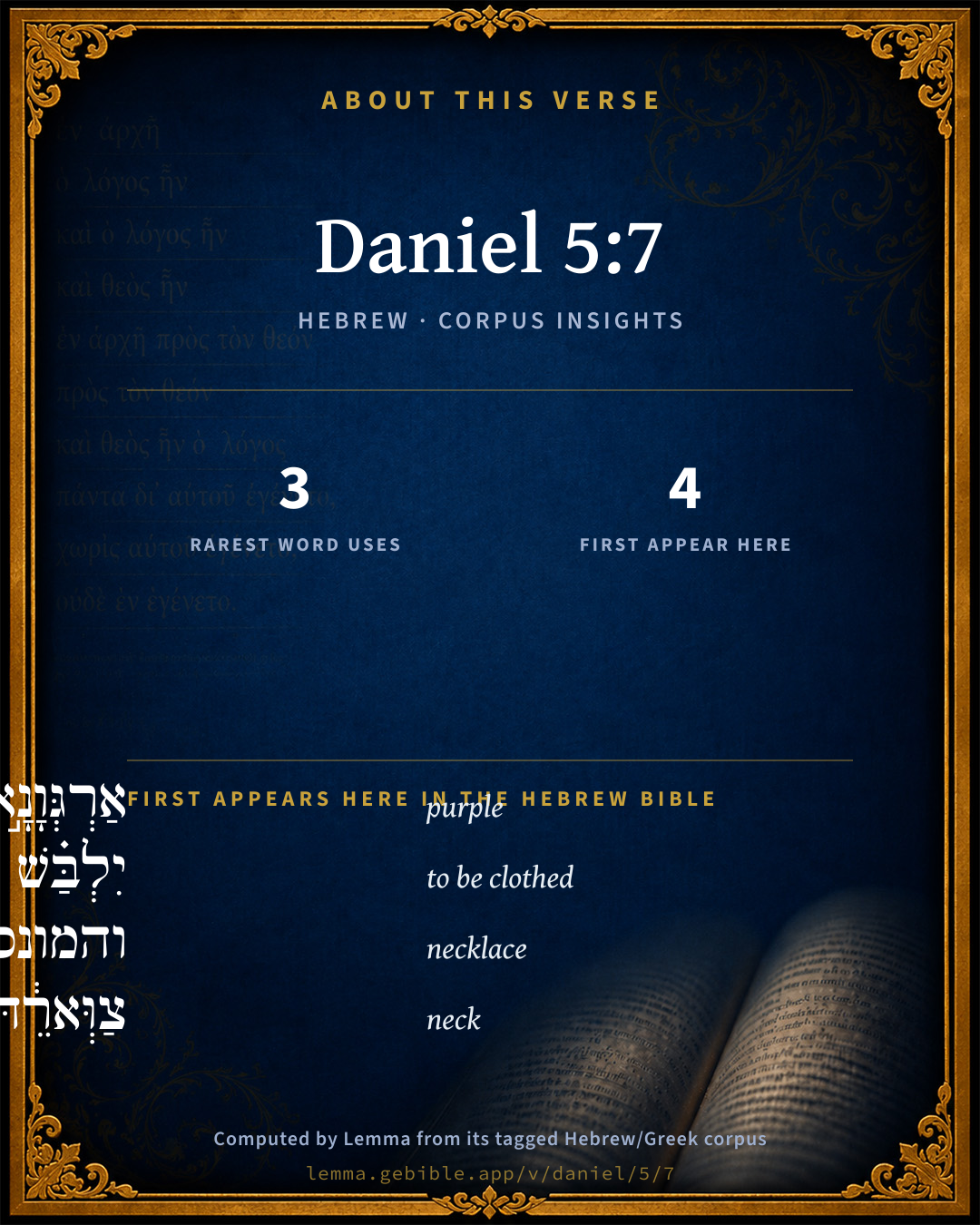
The rarest word here is אַרְגְּוָנָ֣א purple H711 — appearing just 3 times in the whole Hebrew Bible.

First appearance in Scripture

These words make their first canonical appearance in the Hebrew Bible here:

  • אַרְגְּוָנָ֣א purple H711
  • יִלְבַּ֗שׁ to be clothed H3848
  • והמונכא necklace H2002
  • צַוְּארֵ֔הּ neck H6676

Shared distinctive vocabulary

אַרְגְּוָנָ֣א purple H711 occurs in 3 verses of the Hebrew Bible. Also found in:

Grammatical profile

  • 2 verbs
  • 3 nouns
  • 17 adjectives
  • 11 particles

Verb forms

  • לְהֶֽעָלָה֙ Hiphil · Infinitive Construct
  • וְגָזְרַיָּ֑א Qal · Participle Active
  • וְאָמַ֣ר Qal · Participle Active

Repetition

Words recur within this verse — often emphatic in Hebrew:

  • קָרֵ֤א to call H7123 ×2
  • מַלְכָּא֙ king H4430 ×2
  • כשדיא Chaldean H3779 ×2
  • והמונכא necklace H2002 ×2
  • דִּ֣י which H1768 ×3

Hebrew & Septuagint length

In English translation the verse runs 60 words from the Hebrew and 59 from the Septuagint (LXX English) — closely comparable.

A rough comparison of the two English renderings, which tokenize alike — not a word-level alignment.

Word counts can differ between the Hebrew and the Greek without any difference in meaning — e.g. the Hebrew direct-object marker אֵת has no separate Greek word, and Greek often adds the article ὁ.

Cross-references

21

Topical passages linked to Daniel 5:7 in the Treasury of Scripture Knowledge — connected by theme and wording, ordered by reader-vote popularity; previews shown in the World English Bible.

  • Daniel 5:16 But I have heard of you, that you can give interpretations, and dissolve doubts; now if you can read the writing, and make known to me the interpretation of it, you shall be clothed with purple, and have a chain of gold about your neck, and shall be the third ruler in the kingdom.
  • Daniel 5:29 Then commanded Belshazzar, and they clothed Daniel with purple, and put a chain of gold about his neck, and made proclamation concerning him, that he should be the third ruler in the kingdom.
  • Daniel 2:48 Then the king made Daniel great, and gave him many great gifts, and made him to rule over the whole province of Babylon, and to be chief governor over all the wise men of Babylon.
  • Genesis 41:42–44 Pharaoh took off his signet ring from his hand, and put it on Joseph's hand, and arrayed him in robes of fine linen, and put a gold chain about his neck,
  • Daniel 2:6 But if you show the dream and the interpretation of it, you shall receive of me gifts and rewards and great honor: therefore show me the dream and the interpretation of it.
  • Daniel 6:2–3 and over them three presidents, of whom Daniel was one; that these satraps might give account to them, and that the king should have no damage.
  • Genesis 41:8 It happened in the morning that his spirit was troubled, and he sent and called for all the magicians of Egypt, and all the wise men of it. Pharaoh told them his dream, but there was no one who could interpret them to Pharaoh.
  • Numbers 22:7 The elders of Moab and the elders of Midian departed with the rewards of divination in their hand; and they came to Balaam, and spoke to him the words of Balak.
  • Numbers 24:11 Therefore now flee you to your place: I thought to promote you to great honor; but, behold, Yahweh has kept you back from honor.
  • Esther 10:2–3 All the acts of his power and of his might, and the full account of the greatness of Mordecai, whereunto the king advanced him, aren't they written in the book of the chronicles of the kings of Media and Persia?
  • Proverbs 1:9 For they will be a garland to grace your head, And chains around your neck.
  • Song of Solomon 1:10 Your cheeks are beautiful with earrings, Your neck with strings of jewels.
  • Isaiah 47:13 You are wearied in the multitude of your counsels: let now the astrologers, the star-gazers, the monthly prognosticators, stand up, and save you from the things that shall come on you.
  • Ezekiel 16:11 I decked you with ornaments, and I put bracelets on your hands, and a chain on your neck.
  • Daniel 2:2 Then the king commanded to call the magicians, and the enchanters, and the sorcerers, and the Chaldeans, to tell the king his dreams. So they came in and stood before the king.
  • Numbers 22:17 for I will promote you to very great honor, and whatever you say to me I will do. Please come therefore, and curse this people for me.
  • 1 Samuel 17:25 The men of Israel said, Have you seen this man who is come up? surely to defy Israel is he come up: and it shall be, that the man who kills him, the king will enrich him with great riches, and will give him his daughter, and make his father's house free in Israel.
  • Esther 3:1 After these things did king Ahasuerus promote Haman the son of Hammedatha the Agagite, and advanced him, and set his seat above all the princes who were with him.
  • Isaiah 44:25–26 who frustrates the signs of the liars, and makes diviners mad; who turns wise men backward, and makes their knowledge foolish;
  • Daniel 4:6–7 Therefore made I a decree to bring in all the wise men of Babylon before me, that they might make known to me the interpretation of the dream.
  • Daniel 4:14 He cried aloud, and said thus, Hew down the tree, and cut off its branches, shake off its leaves, and scatter its fruit: let the animals get away from under it, and the fowls from its branches.

Cross-references courtesy of OpenBible.info (CC BY 4.0).

Hebrew and Greek witnesses Masoretic Hebrew ↔ Greek Septuagint

The same verse in the two great witnesses to the Old Testament, shown verse-for-verse.

These are two independent witnesses, not word-aligned to each other, and the Septuagint is shown in lemma (dictionary) form.

Hebrew Daniel 5:7 Masoretic · Westminster Leningrad Codex

קָרֵ֤א מַלְכָּא֙ בְּחַ֔יִל לְהֶֽעָלָה֙ לְאָ֣שְׁפַיָּ֔א כשדיא כַּשְׂדָּאֵ֖י וְגָזְרַיָּ֑א עָנֵ֨ה מַלְכָּ֜א וְאָמַ֣ר לְחַכִּימֵ֣י בָבֶ֗ל דִּ֣י כָל אֱ֠נָשׁ דִּֽי יִקְרֵ֞ה כְּתָבָ֣ה דְנָ֗ה וּפִשְׁרֵהּ֙ יְחַוִּנַּ֔נִי אַרְגְּוָנָ֣א יִלְבַּ֗שׁ והמונכא וְהַֽמְנִיכָ֤א דִֽי דַהֲבָא֙ עַֽל צַוְּארֵ֔הּ וְתַלְתִּ֥י בְמַלְכוּתָ֖א יִשְׁלַֽט

The king cried aloud to bring in the enchanters, the Chaldeans, and the soothsayers. The king spoke and said to the wise men of Babylon, Whoever shall read this writing, and show me the interpretation of it, shall be clothed with purple, and have a chain of gold about his neck, and shall be the third ruler in the kingdom.

World English Bible · Public Domain

Greek LXX Daniel 5:7 Septuagint · lemma form

καί ὁ βασιλεύς φωνέω φωνή μέγας καλέω ὁ ἐπαοιδός καί φαρμακός καί χαλδαῖος καί γαζαρηνός ἀποἀγγέλλω ὁ σύγκριμα ὁ γραφή καί εἰςπορεύομαι ἐπί θεωρία ὁράω ὁ γραφή καί ὁ σύγκριμα ὁ γραφή οὐ δύναμαι συνκρίνω ὁ βασιλεύς τότε ὁ βασιλεύς ἐκτίθημι πρόσταγμα λέγω πᾶς ἀνήρ ὅς ἄν ὑποδεικνύω ὁ σύγκριμα ὁ γραφή στολίζω αὐτός πορφύρα καί μανιάκης χρυσοῦς περιτίθημι αὐτός καί δίδωμι αὐτός ἐξουσία ὁ τρίτος μέρος ὁ βασιλεία

And the king cried aloud to bring in the magicians, Chaldeans, and soothsayers; and he said to the wise men of Babylon, Whosoever shall read this writing, and make known to me the interpretation, shall be clothed with scarlet, and there shall be a golden chain upon his neck, and he shall be the third ruler in my kingdom.

LXX2012 (modern English Septuagint) · Public Domain

On this verse, The Cambridge Bible for Schools and Colleges discusses the Septuagint’s reading. Read the note in Commentary ↓

Hebrew: Westminster Leningrad Codex (CC BY 4.0). Greek: Septuagint (public domain); English from LXX2012 (modern English Septuagint) (Public Domain). How the Septuagint differs from the Hebrew →

Commentary

Notes on Daniel 5:7 from classic Christian and Jewish commentators (each source and its license shown beneath its notes). The classic Christian expositions comment on the surrounding passage and are grouped to its opening verse, so a note may address several verses; the Jewish commentaries on the Tanakh (Rashi and others) are per-verse, so they appear only where the commentator wrote on this verse.

Lemma curates 59 commentaries, every one of them public domain or Creative Commons licensed, each selected and text-cleaned for this edition rather than reprinted as found. About our sources →

Trapp's Complete Commentary

John Trapp

Dan 5:7 The king cried aloud to bring in the astrologers, the Chaldeans, and the soothsayers. [And] the king spake, and said to the wise [men] of Babylon, Whosoever shall read this writing, and shew me the interpretation thereof, shall be clothed with scarlet, and [have] a chain of gold about his neck, and shall be the third ruler in the kingdom.

Ver. 7. The king cried aloud to bring in the astrologers.] Daniel seemeth not to have been in any request in the days of this dissolute prince, Neither was there any courtier that would mention him, or mind the king of him till the old queen came in. Such combibones drinking buddies are unfit comforters; many of them likely were by this time bucked with wine, and then laid out to be sunned and scorned.

Shall be clothed with scarlet, &c.] A troubled heart will give anything for release, as Cain, Spira, &c.

And shall be the third ruler in the kingdom,] i.e., Next to myself and the queen-mother. Thus he promiseth to another a third place, who could not promise to himself any place. Spirat superbiam miser.

John Trapp, A Commentary or Exposition upon All the Books of the Old and New Testament (1647–1656) — public domain. Text from a community e-Sword module.

Joseph Benson's Commentary

Dan 5:7. The king cried aloud — Manifesting at once great fear and great impatience; to bring in the astrologers, &c. — In this he imitated Nebuchadnezzar his grandfather: it seems indeed to have been the general practice of these heathen kings, in all unexpected emergencies, to apply to these their wise men for help. But the ill success of Nebuchadnezzar, in such applications, might have taught Belshazzar a better lesson. The king said, Whosoever shall read this writing, &c. — To engage these wise men to exert the utmost of their skill in this matter, he promises that whosoever would give him a satisfactory account of this writing should be dignified with the highest honours of the court; and be the third ruler in the kingdom — “Grotius considers the king as the first, the king’s son as the second, and the interpreter of the vision to be the third. Or it may mean, that there should be a triumvirate appointed to govern the kingdom, as was the case in the beginning of the reign of Darius, and the interpreter should be one of these. Mr. Bruce (vol. 4. p. 32) speaks of a person who was suddenly advanced to a command, the third in the kingdom of Abyssinia for rank, power, and riches; and that, at his public investiture, he had a circle of gold put upon his head, was clothed with a white and blue mantle, and made the king’s lieutenant-general in the provinces allotted to him.” — Wintle.

Joseph Benson's Commentary on the Old and New Testaments (1811–1818) — public domain. Text from a community e-Sword module.

Keil & Delitzsch

C. F. Keil & F. Delitzsch

Since there are in this verse only three classes of wise men named as ordered to come to the king, to whom he promised the reward for the reading and the interpretation of the writing, and in Dan 5:8 it is first stated that all the king's wise men came, the probability, is, that at first the king commanded only the three classes named in Dan 5:7 to be brought to him. On this probability Kranichfeld founds the supposition that the king purposely, or with intention, summoned only the three classes named to avoid Daniel, whom he did not wish to consult, from his heathen religious fear of the God of the Jews. But this supposition is altogether untenable. For, first, it does not follow from Dan 8:27 that under Belshazzar Daniel was president over all the wise men, but only that he was in the king's service. Then, in the event of Daniel's yet retaining the place assigned to him by Nebuchadnezzar, his non-appearance could not be explained on the supposition that Belshazzar called only three classes of the wise men, because the supposition that מלכּא חכּימי כּל (all the king's wise men) in Dan 5:8 forms a contrast to the three classes named in Dan 5:7 is not sustained by the language here used. But if by "all the wise men of the king," Dan 5:8, we are to understand the whole body of the wise men of all the classes, and that they appeared before the king, then they must all have been called at the first, since no supplementary calling of the two classes not named in Dan 5:7 is mentioned. Besides this, the words, "the king spake to the wise men of Babylon," make it probable that all the classes, without the exception of the two, were called. Moreover it is most improbable that in the case before us, where the matter concerned the reading of a writing, the חרטמּים, the magicians Schriftkenner, should not have been called merely to avoid Daniel, who was their רב (president) (Daniel 4:6 [Dan 4:9]). Finally, it is psychologically altogether very improbable, that in the great agitation of fear which had filled him at the sight of the hand writing, Belshazzar should have reflected at all on this, that Daniel would announce to him misfortune or the vengeance of the God of the Jews. Such a reflection might perhaps arise on quiet deliberation, but not in the midst of agitating heart-anguish.

The strange circumstance that, according to Dan 5:7, the king already promised a reward to the wise men, which presupposes that they were already present, and then that for the first time their presence is mentioned in Dan 5:8, is occasioned by this, that in Dan 5:7 the appearing of the wise men is not expressly mentioned, but is naturally presupposed, and that the first two clauses of the eighth verse are simply placed together, and are not united to each other by a causal nexus. The meaning of the statement in Dan 5:7 and Dan 5:8 is this: The king calls aloud, commanding the astrologers, etc., to be brought to him; and when the wise men of Babylon came to him, he said to each of them, Whoever reads the writing, etc. But all the king's wise men, when they had come, were unable to read the writing. As to the names of the wise men in Dan 5:7, see under Dan 2:2. יקרה for יקרא, from קרא, to read. As a reward, the king promises a purple robe, a gold chain for the neck, and the highest office in the kingdom. A robe of purple was the sign of rank worn by the high officers of state among the Persians, - cf. Est 8:15 with Xenophon, Anab. i. 5. 8, - and among the Selucidae, 1 Macc. 10:20; and was also among the Medes the princely garb, Xen. Anab. i. 3. 2, ii. 4. 6. ארגּון, Hebr. ארגּמן, purple, is a word of Aryan origin, from the Sanscrit râga, red colour, with the formative syllables man and vat; cf. Gesen. Thes. Addid. p. 111f. וגו' דּי והמנוּכא does not depend on ילבּשׁ, but forms a clause by itself: and a chain of gold shall be about his neck. For the Kethiv המנוּכא the Keri substitutes the Targum. and Syr. form המניכא (Dan 5:7, Dan 5:16, and Dan 5:29), i.e., The Greek μανιάκης, from the Sansc. mani, jewel, pearl, with the frequent formative syllable ka in the Zend, whence the Chaldee word is derived; it signifies neck- or arm-band, here the former. The golden neck-chain (στρεπτὸς χρύσεος) was an ornament worn by the Persians of rank, and was given by kings as a mark of favour even to kings, e.g., Cambyses and the younger Cyrus; cf. Herod. iii. 20; Xen. Anab. i. 1. 27, 5. 8, 8. 29.

It is not quite certain what the princely situation is which was promised to the interpreter of the writing, since the meaning of תּלתּי is not quite clear. That it is not the ordinale of the number third, is, since Hvernick, now generally acknowledged, because for tertius in Aram. תּליתי is used, which occurs also in Dan 2:39. Hvernick therefore regards תּלתּי, for which תּלתּא is found in Dan 5:16 and Dan 5:29, as an adjective formation which indicates a descent or occupation, and is here used as a nomen officii corresponding to the Hebr. שׁלישׁי. Gesenius and Dietrich regard תּלתּי as only the singular form for תּליתי, and תּלתּא as the stat. abs. of תּלת, third rank. Hitzig would change תּלתּי into תּלתּי, and regard תּלתּא as a singular formed from תּלתּאין, as triumvir from triumvirorum, and would interpret it by τρίτος αὐτός, the third (selbst-dritt): as one of three he shall rule in the kingdom, according to Dan 6:3. Finally, Kranichfeld takes תּלתּי to be a fem. verbal formation according to the analogy of ארמית, אחרי, in the sense of three-ruler-wise, and תּלתּא for a noun formed from תּלתא, triumvir. Almost all these explanations amount to this, that the statements here regard the government of a triumvirate as it was regulated by the Median king Darius, Dan 6:3 (2); and this appears also to be the meaning of the words as one may literally explain תּלתּי and תּלתּא. Regarding the Keri עלּין see under Dan 4:4, and regarding פּשׁרא, under Dan 4:15.

As all the wise men were unable to read the writing, it has been thought that it was in a foreign language different from the usual language of Babylon, the knowledge of which could not legitimately be expected to be possessed by the native wise men; and since, according to Dan 5:17, Dan 5:24., Daniel at once showed his acquaintance with the writing in question, it has from this been concluded that already the old Babylonians had handwriting corresponding to the later Syro-Palmyrenian inscriptions, while among the Hebrews to the time of the Exile the essentially Old-Phoenician writing, which is found on the so-called Samaritan coins and in the Samaritan Scriptures, was the peculiar national style of writing (Kran.). But this interpretation of the miracle on natural principles is quite erroneous. First, it is very unlikely that the Chaldean wise men should not have known these old Semitic characters, even although at that time they had ceased to be in current use among the Babylonians in their common writing. Then, from the circumstance that Daniel could at once read the writing, it does not follow that it was the well-known Old-Hebrew writing of his fatherland. "The characters employed in the writing," as Hengstenberg has rightly observed (Beitr. i. p. 122), "must have been altogether unusual so as not to be deciphered but by divine illumination." Yet we must not, with M. Geier and others, assume that the writing was visible only to the king and Daniel. This contradicts the text, according to which the Chaldean wise men, and without doubt all that were present, also saw the traces of the writing, but were not able to read it.

Keil & Delitzsch — Biblical Commentary on the Old Testament (1861–1891) — public domain (CC PDM 1.0). Text via the HelloAO Bible API. (Old Testament only.)

Tyndale Open Study Notes

Tyndale Open Resources

5:7 Purple robes and a gold chain are associated with royalty and power. • third highest: After Nabonidus and Belshazzar himself (see study note on 5:1).

Tyndale Open Study Notes — © Tyndale Open Resources, licensed CC BY-SA 4.0. Text via the HelloAO Bible API.

Ibn Ezra

Rabbi Abraham ibn Ezra

[Daniel 5:7] And the chain (וְהַֽמְנִיכָ֤א - v'hamnikha): [This means] the golden necklace/chain (רְבִיד הַזָּהָב - revid hazahav).

And third (וְתַלְתִּ֥י - v'talti): [Meaning] and he shall rule as the third in the kingdom (וּבַשְּׁלִישִׁית בַּמַּלְכוּת יִשְׁלֹט - u'vashlishit ba'malchut yishlot).

Ibn Ezra on the Tanakh — English translations: “Sefaria Community Translation” (CC0 1.0 (public-domain dedication)); “Yalkut, Sifsei Chachomim Chumash, Metsudah Publications, 2009” (CC BY 4.0); and “Commentary of Ibn Ezra on Isaiah - trans. by M. Friedlander, 1873” (public domain). Text via Sefaria.

Geneva Bible (1599)

Geneva Bible translators

Thus the wicked in their troubles seek many means, who draw them from God, because they seek not to him who is the only comfort in all afflictions.

Geneva Bible (1599) marginal notes — public domain. Text via Bolls.life.

Jamieson, Fausset & Brown

Robert Jamieson, A. R. Fausset & David Brown

He calls for the magicians, who more than once had been detected in imposture. He neglects God, and Daniel, whose fame as an interpreter was then well-established. The world wishes to be deceived and shuts its eyes against the light [CALVIN]. The Hebrews think the words were Chaldee, but in the old Hebrew character (like that now in the Samaritan Pentateuch).

third ruler--The first place was given to the king; the second, to the son of the king, or of the queen; the third, to the chief of the satraps.

Jamieson, Fausset & Brown — Commentary Critical and Explanatory on the Whole Bible (1871) — public domain (CC PDM 1.0). Text via the HelloAO Bible API.

Adam Clarke's Commentary

Verse 7. Whosoever shall read this writing] He knew it must be some awful portent, and wished to know what.

Adam Clarke's Commentary on the Bible (1810–1826) — public domain. Text from a community e-Sword/MySword module.

John Calvin's Commentaries

The Prophet narrates how King Belshazzar sought a remedy for his anxiety; hence we gather how his mind was so immediately wounded, and how he felt he could not escape God’s hand, otherwise he would not have called the wise men so suddenly in the midst of the banquet. Again, when the Prophet says, He cried out loudly, he was clearly so astonished as to forget his being king, for to cry out at table was not consistent with his dignity. But God expelled all pride from him, by compelling him to burst forth into a cry, like a man completely beside himself. We must now consider the remedy to which he resorted: he ordered the Chaldeans, and magi, and astrologers to be called We learn from this how exceedingly prone men are to vanity, lying, and falsehood. Daniel ought to have been first, even among the Chaldeans, for that was an answer worthy of remembrance which he had given to the grandfather of this king, when he predicted his becoming like the beasts of the forest. Since this prophecy was verified by the event, his authority ought to have flourished even to a thousand years. He was daily in the king’s sight, and yet he was neglected, while the king sent for all the Chaldeans, and astrologers, and diviners, and magi. Truly enough, these men were then in so great repute that they deservedly obscured the fame of Daniel, for they were indignant at a captive being preferred to native teachers, when they knew their own glory amongst all peoples depended upon the persuasion of their being the only wise men. As, therefore, they wished to retain their good opinion, as being God’s counselors, no wonder they despised this stranger. But this feeling cannot avail for a moment before God: for what can be urged in defense of the king’s impiety? His grandfather was a memorable instance of God’s vengeance, when rejected from the company of men, and compelled to dwell among the wildest beasts of the forest. This, truly, could not appear a matter of chance. God, then, had first admonished him by a dream, and next sent his own Prophet as the interpreter of the oracle and the vision. As I have said, the fame of this event ought to have been perpetual among the Chaldeans, yet the grandson of King Nebuchadnezzar had forgotten his example, insulted the God of Israel, profaned the vessels of the temple, and triumphed with his idols! When God sets before him the sign of his judgment, he calls together the magi and the Chaldeans, and passes by Daniel. And what possible excuse can he have for this? We have seen, as I have said, how very prone men are to be deluded by Satan’s impostures, and the well-known proverb becomes true, — The world loves to be deceived!

This, also, is worthy of notice, because in the present day, and in troublous times, many protect themselves behind the shield of their ignorance. But the explanation is at hand — they are willingly blind; they shut their eyes amidst the clearest light; for if God considered King Belshazzar without excuse when the Prophet was once presented to him, what excuse can the ‘blind of these days allege? Oh! if I could determine what God’s will is for me, I would submit myself instantly to it, because God daily and openly calls to us and invites us, and shews us the way; but none answer him, none follow him, or at least how very few! Hence we must diligently consider the example of the King of Babylon when we see him full of anxiety, and yet not seeking God as he ought. And why so? He wanders about in great hesitation; he sees himself constrained, and yet he cannot fly from the judgment of God, but seeks consolation in magi, Chaldeans, and other impostors; for, as we have seen, they had been once or twice proved so, and this ought to have been sufficiently celebrated and notorious to all men. We see, then, how blind King Belshazzar was, since he closed his eyes to the light offered him. So in the present day almost all the world continues in blindness; it is not allowed to wander in darkness, but when light shines upon it, it closes its eyes, rejects God’s grace, and purposely desires to cast itself headlong. This conduct is far too common.

Now the Prophet says, — The king promised the wise men a present of a chain of gold to whoever read the writing; and besides this, raiment of purple, and the third rank in the kingdom! This shews him not to have been sincerely touched by the fear of God. And this repugnance is worthy of observation in the wicked, who dread God’s judgments, and yet the pride of their hearts is not corrected and subdued, as we saw in the case of this king. For his knees smote one against the other, and the joints of his loins were loosened: he trembles throughout his entire frame, and becomes half dead with fear, because God’s terror seizes on all his senses. Meanwhile, we see a hidden pride lurking in his mind, which breaks forth in the promise, whoever shall interpret the writing, shall be the third in rank in the kingdom! God had already deprived him of his royal dignity; yet he still wishes to raise others on high in defiance of God! What, then, is the meaning of this? We see how often the wicked are terrified, and how deeply they cherish a hidden contumacy, so that God never subdues them. They shew, indeed, many signs of repentance; but if any one carefully weighs all their words and deeds, he will find the Prophet’s narration concerning King Belshazzar completely verified, because they rage against God, and are never teachable or obedient, but utterly stupefied. We saw this partly in former verse, and shall see it again more clearly at the end of the chapter. As to the latter clause of the verse, he shall rule as third in the kingdom, it is uncertain whether he promises the third portion or the third rank; for many think the queen, of whom mention will soon be made, was the wife of King Nebuchadnezzar, and grandmother of King Belshazzar. It follows: —

John Calvin's Commentaries (1540-1563) — public domain. Text from the Calvin Translation Society English edition (1840s-50s) via the Christian Classics Ethereal Library (ccel.org). Calvin's coverage is partial (roughly two-thirds of the Bible); uncommented books and verses are honest gaps, never fabricated. The 19th-century editor's footnotes and remarks are omitted so the notes are faithfully Calvin's own voice.

Ellicott's Commentary for English Readers

(7) The astrologers.—It is worthy of notice that on this occasion the magicians (the chartummim) do not appear. We must either suppose that they are included under the general term “Chaldeans,” or that the king in his terror forgot to summon them. The “wise men” spoken of (Dan_5:8) were the body over which Daniel was president—a post which it appears. from Dan_8:27, he held at this time. It is needless to discuss why Daniel did not come in at first.

The third ruler.—See Excursus C. Those who adopt another view of Belshazzar maintain that a triumvirate existed at this time similar to that in the days of Darius the Mede (Dan_6:2), and that the king promises to raise to the rank of “triumvir” the person who could interpret the vision successfully. It may be noticed that the form of the ordinal “third,” both here and in Dan_5:16; Dan_5:29, is very peculiar, and that in the last two passages it resembles a substantive rather than an adjective.

A Bible Commentary for English Readers, edited by Charles John Ellicott (1878–1897) — public domain. Text from a community e-Sword module.

The Cambridge Bible for Schools and Colleges

gen. ed. J. J. S. Perowne

7. aloud] lit. with might, as Dan_3:4, Dan_4:14. Not simply ‘commanded,’ but ‘cried aloud’: the king’s alarm was reflected in the tones of his voice.

the enchanters, the Chaldeans, and the determiners (of fates)] Cf. Dan_4:7; and see on Dan_1:21, Dan_2:2; Dan_2:27.

spake] answered (Dan_2:20). So Dan_5:10.

the wise men of Babylon] Dan_2:12; Dan_2:14, &c.

shew me] declare to me (Dan_2:4; Dan_2:6, &c.).

scarlet] purple (R.V.), as Exo_25:4; Jdg_8:26, &c. So Dan_5:16; Dan_5:29. Purple was a royal, or princely, colour among the Persians (Est_8:15; Xen. Anab. i. Dan_5:8), the Medes (Cyrop. i. iii. 2, ii. iv. 6), and also (it may be inferred) among the Seleucidae (1Ma_10:20; 1Ma_10:62; 1Ma_10:64; 1Ma_14:43 f.; cf. Dan_8:14).

a chain of gold about his neck] Cf. Gen_41:42, where Pharaoh decorates Joseph similarly. A golden necklace was worn also by Persians of rank (cf. Xen. Anab. i. Dan_5:8, viii. 29); and was given sometimes by the Persian kings as a compliment or mark of distinction: in Hdt. iii. 20 Cambyses sends ‘a purple garment, a golden necklace, bracelets,’ with other presents, to the Ethiopians; and in Xen. Anab. I. ii. 27 the younger Cyrus gives one to Syennesis. (The word, hamnuk or hamnik, occurs in the O.T. only here and Dan_5:16; Dan_5:29. It is probably of Persian origin [hamyânak], a diminutive from hämyân ‘girdle.’ It is found in the Targums, in the form mìnîk and in Syriac as hamnîk and hemnîk (see Gen_41:42, Onk. and Pesh.); and it made its way into Greek as μανιάκης, LXX. Theod. here, Polyb., &c.).

and shall rule as one of three in the kingdom] So R.V. marg. The expression (which recurs Dan_5:16; Dan_5:29) is difficult. The rendering of A.V. is however certainly not tenable. The word rendered ‘third’ in A.V. is not that which is used anywhere else (either in the Targums or in Daniel) to denote the ordinal; but resembles most closely the word (tiltâ or tûltâ) which both in the Targums and in Syriac means. a third part (e.g. 2Ki_11:5-6, ‘a third part of you’). Hence the literal rendering appears to be, ‘shall rule as a third part in the kingdom,’ i.e. have a third part of the supreme authority in the country, be one of the three chief ministers, ‘rule as one of three.’ Cf. LXX. δοθήσεται αὐτῷ ἐξουσία τοῦ τρίτου μέρους τῆς βασιλείας.

The Cambridge Bible for Schools and Colleges (gen. ed. J. J. S. Perowne; Cambridge University Press, 1878–1918) — public domain. Text from a community e-Sword module.

John Gill's Exposition

The king cried aloud to bring in the astrologers, the Chaldeans, and the soothsayers,.... Or, "with strength" (n); with a strong voice, as loud as he could; which is expressive of the fright he was in, and of his eagerness and impatience of information; laying aside all decency, and forgetting his royal majesty, like a man out of his senses, quite distracted, as it were: of the "astrologers", &c. See Gill on Dan 1:20, Dan 2:2, this was the usual course the kings of Babylon took, when they had matters of difficulty upon them, as appears from Dan 2:2 and though they found it oftentimes fruitless and vain, yet still they pursued it; so besotted and addicted were they to this kind of superstition:

and the king spake and said to the wise men of Babylon; who were presently brought in from the several parts of the city where they dwelt, and probably many of them might be at court at that time; and being introduced into the hall where the king and his nobles were, he addressed them in the following manner;

whosoever shall read this writing, and show me the interpretation thereof: pointing to the writing upon the wall, which continued; and which neither the king nor any about him could read or interpret, and therefore both are required to be done:

he shall be clothed with scarlet, and have a chain of gold about his neck; or "with purple" (o); the colour wore by persons of rank and figure; and the chain of gold was an emblem of honour and dignity, and more to be regarded for that than for the value of the gold of which it was made:

and shall be the third ruler in the kingdom; not rule over the third part of the kingdom, as Aben Ezra; but be the third man in the kingdom; next to the king and the queen mother, or to the king and the heir apparent; or one of the third principal rulers; or one of the three presidents of the kingdom, as Daniel afterwards was.

(n) "cum virtute", Vatablus; "in virtute", Montanus; "fortiter", Cocceius; "cum robore", Michaelis. (o) "purpura", Vatablus, Pagninus; Montanus; Grotius, Junius & Tremellius, Piscator, Cocceius, Michaelis.

John Gill's Exposition of the Whole Bible (1746–1763) — public domain (CC PDM 1.0). Text via the HelloAO Bible API.

Albert Barnes' Notes on the Bible

And the king cried aloud - Margin, as in the Chaldee, “with might.” This indicates a sudden and an alarming cry. The king was deeply terrified; and, unable himself to divine the meaning of the mysterious appearance of the hand, he naturally turned at once to those whose office it was to explain dreams and supernatural appearances.

To bring in the astrologers ... - See the note at Dan 2:2; Dan 4:7.

And said to the wise men of Babylon - Those just referred to - the astrologers, etc. Having the power, as was supposed, of interpreting the indications of coming events, they were esteemed as eminently wise.

Whosoever shall read this writing - It would seem from this that even the characters were not familiar to the king and to those who were with him. Evidently the letters were not in the ordinary Chaldee form, but in some form which to them was strange and unknown. Thus there was a double mystery hanging over the writing - a mystery in regard to the language in which the words were written, and to the meaning of the words. Many conjectures have been formed as to the language employed in this writing (compare the note at Dan 5:24), but such conjectures are useless, since it is impossible now to ascertain what it was. As the writing, however, had a primary reference to the sacrilege committed in regard to the sacred vessels of the temple, and as Daniel was able to read the letters at once, it would seem not improbable that the words were in the Hebrew character then used - a character such as that found now in the Samaritan Pentateuch - for the Chaldee character now found in the Bible has not improbably been substituted for the more ancient and less elegant character now found in the Samaritan Pentateuch alone. There is no improbability in supposing that even the astrologers and the soothsayers were not familiar with that character, and could not readily read it.

And show me the interpretation thereof - The meaning of the words.

Shall be clothed with scarlet - The color worn usually by princes and by persons of rank. The margin is “purple.” So the Greek of Theodotion - πορφύραν porphuran. So also the Latin Vulgate - “purpura.” On the nature and uses of this color, see the note at Isa 1:18.

And have a chain of gold about his neck - Also indicative of rank and authority. Compare Gen 41:42. When Joseph was placed over the land of Egypt, the king honored him in a similar manner, by putting “a gold chain about his neck.” This was common in Persia. See Xen. “Cyrop.” I. 3, 2, II. 4, 6, VIII. 5, 18; Anab. I. 5, 8. Upon most of the figures in the ruins of Persepolis the same ornament is now found. Prof. Stuart renders this, “a collar of gold.”

And shall be the third ruler in the kingdom - Of course, the king was first. Who the second was, or why the one who could disclose the meaning of the words should not be raised to the second rank, is not stated. It may be, that the office of prime minister was so fixed, or was held by one whose services were so important to the king, that he could not be at once displaced. Or the meaning may be, that the favored person who could interpret this would be raised to the third “rank” of dignity, or placed in the third class of those who held offices in the realm. The Chaldee is, “and shall rule third in the kingdom,” and the idea would seem rather to be that he should be of the third rank or grade in office. So Bertholdt understands it. Grotius understands it as the third person in rank. He says the first was the king; the second, the son of the king; the third, the prince of the Satraps.

Albert Barnes' Notes on the Bible (1834–1885) — public domain. Text from a community e-Sword/MySword module.

Haydock's Catholic Bible Commentary

Purple. This and the chain were reserved for the highest nobility. --- Third, or one of the three great officers. (Chap. vi. 1. and 2 Kings xxiii. 8. 19.)

George Leo Haydock (1774–1849), Haydock's Catholic Family Bible and Commentary, 1859 edition — public domain. Excludes Psalms (Douay-Rheims chapter numbering differs from Protestant) and Deuterocanonical books (Catholic canon only).

Matthew Poole's English Annotations

To bring in the astrologers, the Chaldeans, and the sooth-sayers, to read the hand-writing, with promise of scarlet clothing, gold chains, and honours. This is the old trade, and the last refuge this poor heathen prince had, which yet failed him; for how can the devil help when God is against him? 1Sa 28:16, &c. Moreover, he had his father’s experience, Dan 2:27; 4:7. Twice he tried them, and they could do nothing, and yet he will go to the devil’s oracle. Men naturally leave God and go to refuges of lies, and God gives them up to strong delusions to believe their lies.

Matthew Poole's English Annotations on the Holy Bible (1683–1685) — public domain. Text from a community e-Sword/MySword module.

Whedon's Commentary on the Bible

Daniel D. Whedon

7-9. This Babylonian king, like his “father,” forgetting Daniel, calls for help from the same worthless crowd of “witches” (Wyclif) and Chaldeans (see note Dan_2:2; some ancient texts omit “Chaldeans” here) and offers, as Nebuchadnezzar had done, great rewards to the man who can explain the vision (see Gen_41:42; Est_8:15; Eze_27:7), who also shall be the third ruler in the kingdom. That is, according to its natural meaning, “third in rank” (Kautzsch); meaning, probably, chief ruler after Nabonidus and Belshazzar. [See Introduction, III, 3, (4); 4.] The rendering “one of the board of three” is not a fit here, while Bevan’s twist, changing the word so as to make it mean that the successful interpreter should reign over the kingdom on alternate days with the king himself, is more ingenious than convincing.

Daniel D. Whedon (gen. ed.), Commentary on the Old and New Testaments (1874–1909) — public domain. Text from a community e-Sword module.

The Pulpit Commentary

The king cried aloud to bring in the astrologers, the Chaldeans, and the soothsayers. And the king spake, and said to the wise men of Babylon, Whosoever shall read this writing, and show me the interpretation thereof, shall be clothed with scarlet, and have a chain of gold about his neck, and shall be the third ruler in the kingdom. The Septuagint here also differs from the Massoretic text, "And the king cried out with a great cry to call in the enchanters (ejpaoidoujv) and sorcerers (farmakouv), and Chaldeans, and soothsayers, to announce to him the interpretation of the writing, and they came in for inspection (ejpian), to see the writing, And they were not able to make known to the king the interpretation of the writing. Then the king made commandment, saying, Any man who shall show the interpretation of the writing, he shall put on him a purple robe, and shall put round his neck a golden chain, and authority shall be given him over a third part of the kingdom." Theodotion is an exact rendering of the Massoretic text in the sense represented by the English versions, save that it wholly omits the conjunctions between the various classes of wise men, so that Caldaiouv might be an adjective qualifying either magouv or gaxarhnouv, and the article is also omitted, which is represented in the Massoretic text by the status emphaticus. The Peshitta has four classes of wise men called in; as the Septuagint has, otherwise it agrees with the Massoretic text. It is a matter of some interest to observe that the position of the Chaldeans is somewhat precarious here, as in the second chapter. They disappear wholly from the list in the next verse, which really seems to be another version of this. It is a marginal gloss that has crept into the text. If we accept the reading of the Septuagint here, so far at least as.to assume the entrance of the wise men before the king"s declaration of the reward, the succession of events becomes more natural. The king calls for the presence of these interpreters of omens, and then, when they fail to interpret the writing to him, he proclaims his offer of a reward to whoever can do so. It is to be noted that there is in the Septuagint no question of ability to read the writing, but simply to interpret it. It has been pointed out to me by a friend that if these words were written in cuneiform, the signs that would represent them might have a great variety of possible sounds, and with these differing sounds, differing meanings. Sometimes a sign was phonetic and a syllable, sometimes it was idiographic and might represent a whole word. There is this to be said for this view the Assyrian was the writing expected in inscriptions. Still, from the fact that the Septuagint omits the demand that the inscription should be read, we may regard the matter as doubtful. Assuming that the wise men were required to read the inscription, some of the Jewish interpreters, as Jephet-ibn-Ali, think that the letters of the word were inverted; others have it that the letters were arranged in columns. Even, however, if the words were written correctly enough as Aramaic words, it would be a difficult matter to put any meaning in them as they stood, as we shall see when we consider Daniel"s interpretation. The reward promised is of special interest. The word argvana, translated "scarlet," appears in Assyrian as argmamm; hamneeka, the word rendered "necklace," is of doubtful origin. We find in the Ninevite sculptures and on the cylinders from Babylon many instances of splendid robes (vide Rawlinson, "Five Great Monarchies," 560); the rich necklace is also to be seen (ibid., 2. 497, 499). The great difficulty has arisen over the rank given to Daniel, "the third ruler in the kingdom." The difficulty is that the ordinal here is not in its usual form, although Petermann gives taltu as one of the forms of the ordinal. There is, further, the unusual position of the numeral in relation to the verb, though the abnormality is less than Professor Bevan represents it, as the Peshitta follows word for word the arrangement of the Massoretic text. The truth seems to be that the word really was toolta, as in the Syriac, and the difficulty has risen in not recognizing the transference from one dialect of Aramaic to another. It is used in the Peshitta (2Co_10:2) of the third heaven. Professor Bevan"s interpretation, that it means every third day,") may be dismissed as absurd. Ewald (in loc.) regards the title as one of a board of three not an in,possible meaning, in the light of what we find in the following chapter. Yet his reasoning, that it cannot be third in rank, because the queen-mother could not be counted in, is inept now, when we learn that Belshazzar was colleague with his father, and so the third place was all he had to give. On this question Behrmann takes the view discarded as impossible by Ewald, and holds that Daniel was placed third because of the queen-mother. It is one of the commonplaces of the criticism of this book that the history ascribed to Daniel is borrowed from the history of Joseph: why was the position offered not made "second," as was that of Joseph? We have the reason in what we know of the history of Babylon at the time. The Septuagint and Josephus were unaware of the facts, and translated as they did.

The Pulpit Commentary (1880–1919), ed. H.D.M. Spence-Jones & Joseph S. Exell — public domain. Text from a community e-Sword module.

unfoldingWord translationNotes

Door43 World Missions Community

those known for their wisdom in Babylon

This refers back to those who claimed to speak with the dead, the wise men, and the astrologers.

Whoever explains this writing and its meaning will be clothed with purple and will have a gold chain around his neck

This can be stated in active form. AT: "I will give purple clothes and a gold neck chain to whoever explains this writing and its meaning" (See: Active or Passive)

clothed with purple

Purple cloth was rare and reserved for royal officials. AT: "dressed in royal clothing" (See: Assumed Knowledge and Implicit Information)

the third highest ruler

"the number three ruler" (See: Ordinal Numbers)

translationWords

king

die

wise

learned men

Babylon

purple

gold

authority

kingdom

unfoldingWord translationNotes — © Distant Shores Media and the Door43 World Missions Community, licensed CC BY-SA 4.0. Source: git.door43.org/Door43/en_tn.

Rashi

Rabbi Shlomo Yitzchaki (Rashi)

aloud Aram. בְּחַיִל, lit. with strength.

to bring in [as translated,] to bring in.

this writing [as translated,] this writing.

shall wear purple following the custom of the nobles.

chain Aram. וְהַמְנִיכָא, medallion, necklace.

and rule over over a third of the kingdom [as translated,] and rule over a third of the kingdom.

Rashi on the Tanakh — English translations: “The Judaica Press complete Tanach with Rashi, translated by A. J. Rosenberg” (CC BY 4.0); “Pentateuch with Rashi's commentary by M. Rosenbaum and A.M. Silbermann, 1929-1934” (public domain); “The Metsudah Tanach series, Lakewood, N.J” (CC BY 4.0); and “The Book of Joshua, Metsudah Publications, 1997” (CC BY 4.0). Text via Sefaria.

Lesson kit

Teaching starters — assembled from the data on this page, not authored interpretation. Every prompt links to the verse data it draws on. Edit before teaching.

Daniel, in the Prophets, opens this verse with 33 words (27 distinct Hebrew lemmas). Its most distinctive word is ʼargᵉvân (“purple”). A historical commentator’s framing appears above. Read the whole chapter for the surrounding context.

Discussion questions

  1. The word ʼargᵉvân carries the sense “purple.” How does it shape the verse?
  2. 4 words make their first appearance in Scripture here. What does this debut establish?
  3. How does Daniel 5:16, which shares the word «purple», read alongside this verse?
  4. What does the repetition of “to call” (2× in this one verse) do in this verse?
  5. These translations render this verse differently; the difference is in the English rendering, not the original. What questions does that raise?
  6. «לְהֶֽעָלָה֙» is a Hiphil Infinitive Construct verb. How does that grammatical form shape the action described?
  7. Compare how Trapp's Complete Commentary and Joseph Benson's Commentary read this verse. Where do they agree or differ?

Things to notice

  • 4 words make their first canonical appearance in Scripture here.
  • These translations choose different wording for 24 words in this verse.
  • “to call” occurs 2× in this single verse.
  • 27 distinct Hebrew lemmas span 33 words in this verse.

Reading settings

Reading text

Shown beneath each verse's original-language words.

Old Testament
Old Testament edition

Read the OT as the Masoretic Hebrew (MT) or the Greek Septuagint (LXX).

English shown for the Greek Septuagint (in the Hebrew ↔ Greek comparison).

Comparing translations? Open the Compare panel on any verse page to stack up to four side by side.