Daniel 4:22

Hebrew (Westminster Leningrad Codex) Daniel 4:22 appears in the Hebrew Old Testament. The text above is from the Westminster Leningrad Codex. Each word links to its Strong’s number, a concise gloss, and parsing drawn from the Open Scriptures Hebrew Bible morphology. Click any word for its full Brown-Driver-Briggs (BDB) entry.
Download image
Cite this verse

Daniel 4:22 (World English Bible). Public Domain. Lemma interlinear Bible study tool, https://lemma.gebible.app/v/daniel/4/22.

Show BibTeX & RIS
BibTeX
RIS
English Translation
it is you, O king, that are grown and become strong; for your greatness is grown, and reaches to the sky, and your dominion to the end of the earth.
World English Bible · Public Domain
Highlights Full analysis ↓
Download a study sheet

One document with this verse’s original text, its word-by-word gloss line, the meaning frame, cross-references with their text, attributed commentary, and full source and license credits — printable, and it pastes into notes with its structure intact.

This verse Autodidact and up

Study sheet (.html) Plain text (.txt)

A passage Seminary Student

Up to 50 verses in one chapter. A passage sheet keeps up to 6 commentary sources and 12 cross-references per verse, in the order this page ranks them, and says so on the sheet whenever that leaves anything out. Ask for a single verse and you get the Autodidact verse sheet above.

Everything on this page stays free to read, with no account — the sheet is a download of what is already on screen, not access to it.

Want to remove ads? Support Godless Engineer
Compare translations 3

The same verse in 3 English versions, stacked beneath the original-language interlinear above. Click any original word for its lexicon entry.

Each is an independent rendering of the whole verse — the interlinear is not word-aligned to these translations.

Highlighted words mark where these versions differ — a whole-verse word diff, not a word-by-word alignment.

  • World English Bible Public Domain
    it is you, O king, that are grown and become strong; for your greatness is grown, and reaches to the sky, and your dominion to the end of the earth.
  • King James Version Public Domain
    It is thou, O king, that art grown and become strong: for thy greatness is grown, and reacheth unto heaven, and thy dominion to the end of the earth.
  • unfoldingWord Literal Text CC BY-SA 4.0
    it is you, O king, who have grown and become strong. Your greatness has grown and reaches to heaven, and your dominion to the ends of the earth.

unfoldingWord Literal Text — © unfoldingWord, licensed CC BY-SA 4.0. Word-aligned USFM3 via Door43 (git.door43.org/unfoldingWord/en_ult).

Versions to compare (up to 4)

3 of 4 selected

Show all 18 translations

Every available English version of this verse, each an independent rendering of the whole verse.

  • World English Bible Public Domain
    it is you, O king, that are grown and become strong; for your greatness is grown, and reaches to the sky, and your dominion to the end of the earth.
  • Berean Standard Bible Public Domain
    you, O king, are that tree! For you have become great and strong; your greatness has grown to reach the sky, and your dominion extends to the ends of the earth.
  • Majority Standard Bible Public Domain
    you, O king, are that tree! For you have become great and strong; your greatness has grown to reach the sky, and your dominion extends to the ends of the earth.
  • King James Version Public Domain
    It is thou, O king, that art grown and become strong: for thy greatness is grown, and reacheth unto heaven, and thy dominion to the end of the earth.
  • American Standard Version (1901) Public Domain
    it is thou, O king, that art grown and become strong; for thy greatness is grown, and reacheth unto heaven, and thy dominion to the end of the earth.
  • Revised Version (1885) Public Domain
    it is thou, O king, that art grown and become strong: for thy greatness is grown, and reacheth unto heaven, and thy dominion to the end of the earth.
  • Geneva Bible (1599) Public Domain
    That they shall driue thee from men, and thy dwelling shalbe with the beasts of the fielde: they shall make thee to eate grasse as the oxen, and they shall wet thee with the dewe of heauen: and seuen times shall passe ouer thee, till thou knowe, that the most High beareth rule ouer the kingdome of men, and giueth it to whom so euer he will.
  • Douay-Rheims (1899) Public Domain
    It is thou, O king, who art grown great and become mighty: for thy greatness hath grown, and hath reached to heaven, and thy power unto the ends of the earth.
  • Young's Literal Translation Public Domain
    `Thou it `is', O king, for thou hast become great and mighty, and thy greatness hath become great, and hath reached to the heavens, and thy dominion to the end of the earth;
  • Literal Standard Version CC BY-SA 4.0
    It [is] you, O king, for you have become great and mighty, and your greatness has become great, and has reached to the heavens, and your dominion to the end of the earth;
  • Unlocked Literal Bible CC BY-SA 4.0
    this tree is you, king, you who have grown so strong. Your greatness has grown and reaches to the heavens, and your authority reaches to the ends of the earth.
  • unfoldingWord Literal Text CC BY-SA 4.0
    it is you, O king, who have grown and become strong. Your greatness has grown and reaches to heaven, and your dominion to the ends of the earth.
  • Darby Bible Public Domain
    it is thou, O king, who art grown and become strong; for thy greatness is grown, and reacheth unto the heavens, and thy dominion to the end of the earth.
  • World Messianic Bible Public Domain
    it is you, O king, that have grown and become strong; for your greatness has grown, and reaches to the sky, and your dominion to the end of the earth.
  • Webster's Bible Public Domain
    It is thou, O king, that art grown and become strong: for thy greatness is grown, and reacheth to heaven, and thy dominion to the end of the earth.
  • Free Bible Version CC BY-SA 4.0
    This is you, Your Majesty. You have grown strong, your power has become so great that it has reached high into the sky, and your rule extends to the ends of the earth.
  • Bible in Basic English Public Domain
    It is you, O King, who have become great and strong: for your power is increased and stretching up to heaven, and your rule to the end of the earth.
  • JPS Tanakh (1917) Public Domain
    (4-19) it is thou, O king, that art grown and become strong; for thy greatness is grown, and reacheth unto heaven, and thy dominion to the end of the earth.

Literal Standard Version (2020), Covenant Press — licensed CC BY-SA 4.0. Text via the HelloAO Bible API (eBible.org). Unlocked Literal Bible (unfoldingWord) — licensed CC BY-SA 4.0. Text via the HelloAO Bible API (eBible.org). unfoldingWord Literal Text — © unfoldingWord, licensed CC BY-SA 4.0. Word-aligned USFM3 via Door43 (git.door43.org/unfoldingWord/en_ult). Free Bible Version, Dr. Jonathan Gallagher — licensed CC BY-SA 4.0. Text via the HelloAO Bible API (eBible.org).

Word by word

More ways to search: Search by grammar → Find every occurrence → Compare this word →

Practice this passage: Drill this verse → Learn its vocabulary →

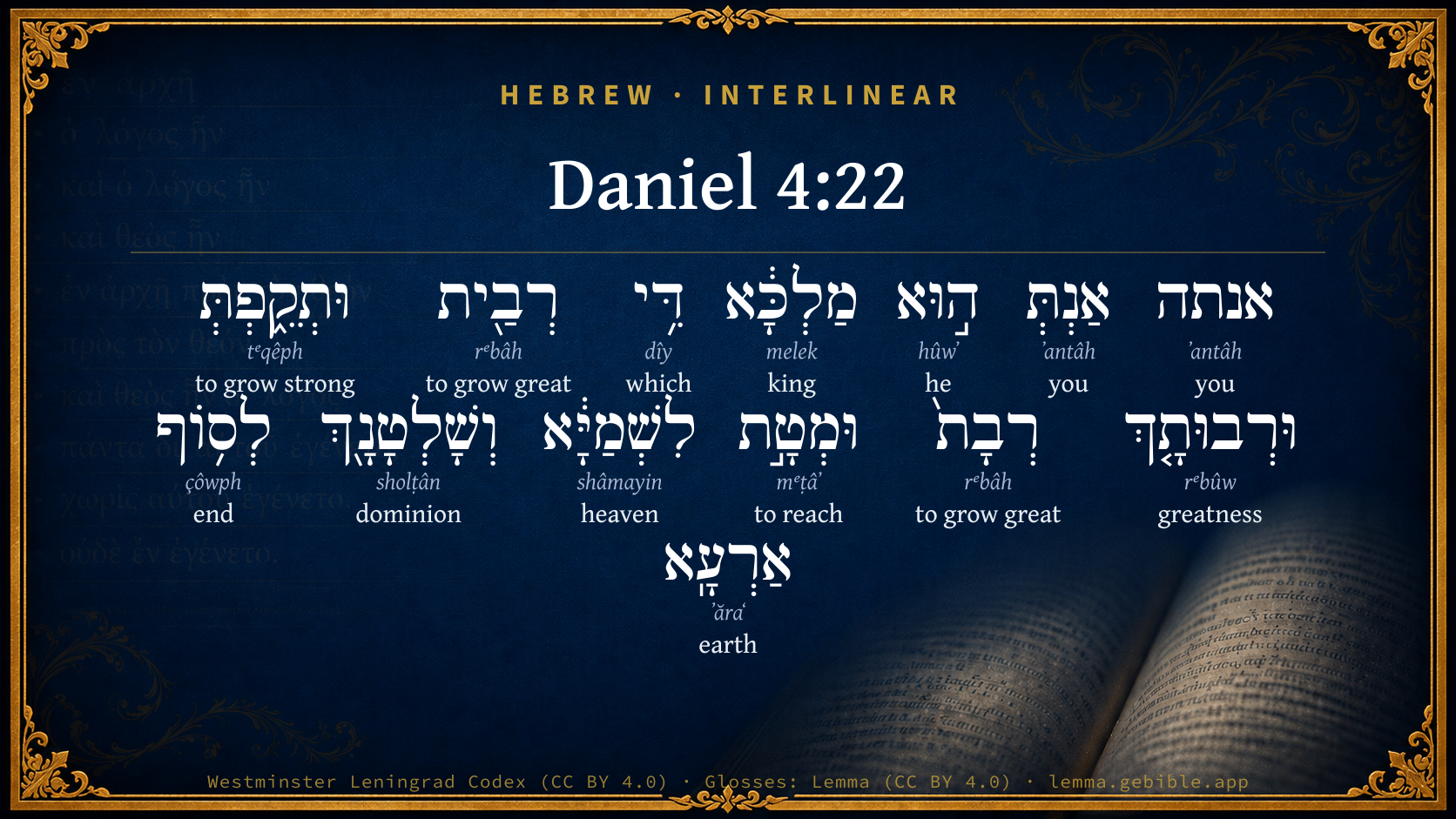
וּתְקֵ֑פְתְּ
tᵉqêph
H8631
“and · to grow strong”
Adjective, C + Verb, Qal, Perfect, 2nd Person, Masculine, Singular
Part of Speech
Adjective + Verb
Stem
Qal
Form
Perfect
Person
2nd Person
Gender
Masculine
Number
Singular
Full BDB Definition

Origin: corresponding to H8630

TWOT: 3065

to grow strong, be hardened - (Peal) - to grow strong, be hardened - to grow arrogant (figuratively) - (Pael) to make strong, make firm, make stringent
  1. אנתה ʼantâh H607 “you” Adjective, P
  2. אַנְתְּ ʼantâh H607 “you” Adjective, P
  3. ה֣וּא hûwʼ H1932 “he” Adjective, P
  4. מַלְכָּ֔א melek H4430 “king · the” Adjective, N, Common + Particle, Definite Article
  5. דִּ֥י dîy H1768 “which” Adjective, T
  6. רְבַ֖ית rᵉbâh H7236 “to grow great” Adjective, V, Plural
  7. וּרְבוּתָ֤ךְ rᵉbûw H7238 “and · greatness · your” Adjective, C + Noun, Common, Feminine, Singular, Construct + Suffix, Personal, 2nd Person, Masculine, Singular
  8. רְבָת֙ rᵉbâh H7236 “to grow great” Adjective, V, Plural
  9. וּמְטָ֣ת mᵉṭâʼ H4291 “and · to reach” Adjective, C + Verb, Qal, Perfect, 3rd Person, Feminine, Singular
  10. לִשְׁמַיָּ֔א shâmayin H8065 “to/for · heaven(s) · the” Adjective, R + Noun, Common, Masculine, Plural, Determined + Particle, Definite Article
  11. וְשָׁלְטָנָ֖ךְ sholṭân H7985 “and · dominion · your” Adjective, C + Noun, Common, Masculine, Singular, Construct + Suffix, Personal, 2nd Person, Masculine, Singular
  12. לְס֥וֹף çôwph H5491 “to/for · end of” Adjective, R + Noun, Common, Masculine, Singular, Construct
  13. אַרְעָֽא ʼăraʻ H772 “earth · the” Adjective, N, Common + Particle, Definite Article

About this verse

These counts appear in no published source. They are computed here, from the morphology-tagged text and Lemma’s own curated glosses. What Lemma adds →

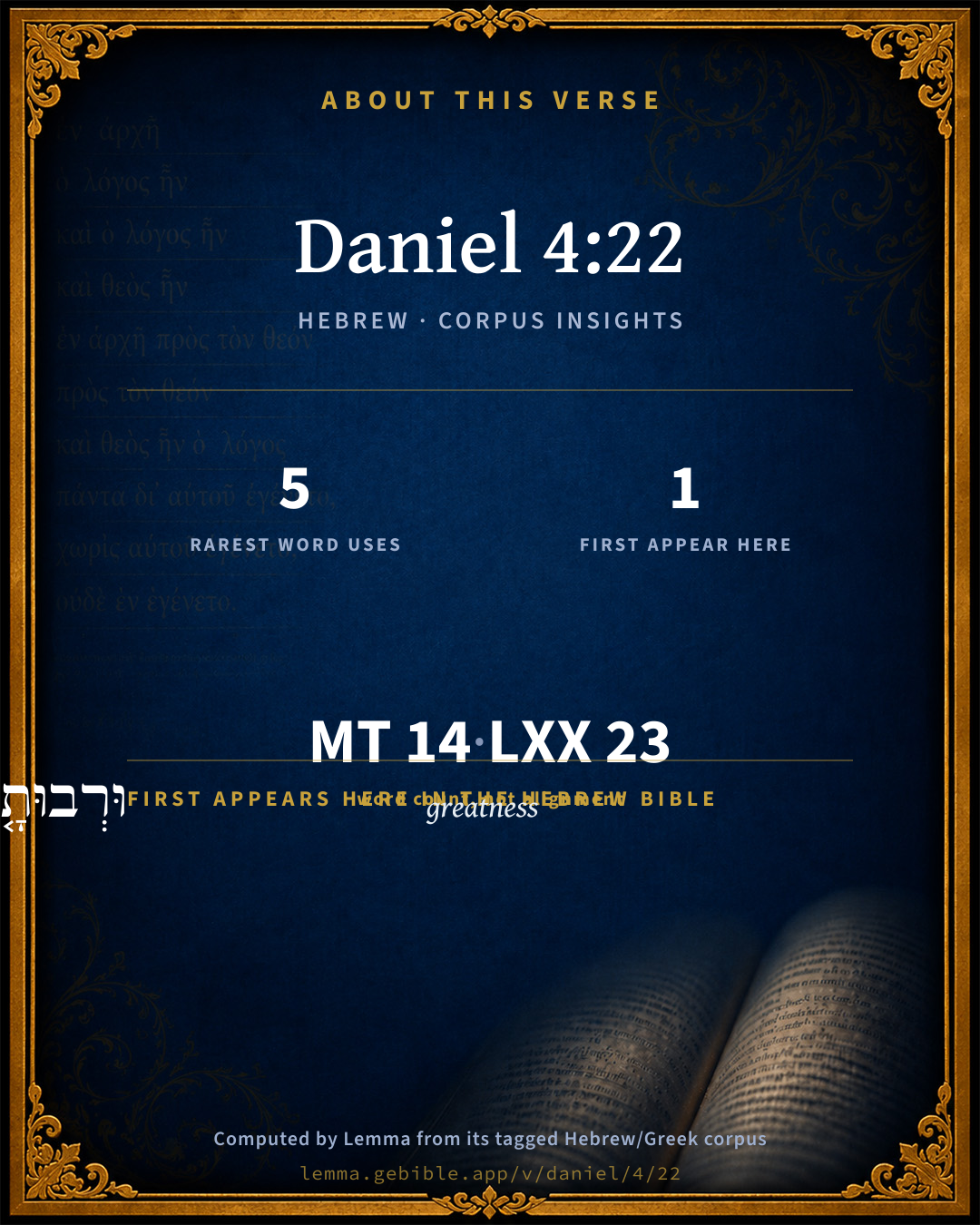
14
words
12
distinct lemmas
Prophets
section

Notable vocabulary

The rarest word here is וּתְקֵ֑פְתְּ to grow strong H8631 — appearing just 5 times in the whole Hebrew Bible.

First appearance in Scripture

This word makes its first canonical appearance in the Hebrew Bible here:

  • וּרְבוּתָ֤ךְ greatness H7238

Shared distinctive vocabulary

וּתְקֵ֑פְתְּ to grow strong H8631 occurs in 5 verses of the Hebrew Bible. Also found in:

Grammatical profile

  • 2 verbs
  • 3 nouns
  • 6 adjectives
  • 3 particles

Verb forms

  • וּתְקֵ֑פְתְּ Qal · Perfect
  • וּמְטָ֣ת Qal · Perfect

Repetition

Words recur within this verse — often emphatic in Hebrew:

  • רְבַ֖ית to grow great H7236 ×2
  • אנתה you H607 ×2

Hebrew & Septuagint length

In English translation the verse runs 30 words from the Hebrew and 67 from the Septuagint (LXX English) — the Septuagint runs noticeably longer here. See the side-by-side →

A rough comparison of the two English renderings, which tokenize alike — not a word-level alignment.

Word counts can differ between the Hebrew and the Greek without any difference in meaning — e.g. the Hebrew direct-object marker אֵת has no separate Greek word, and Greek often adds the article ὁ.

In the original languages it is 14 Hebrew tokens and 23 Greek tokens — but the two are counted differently (Hebrew bundles its prefixes and suffixes into one token; the Greek is in lemma form), so that isn’t a like-for-like length.

Cross-references

11

Topical passages linked to Daniel 4:22 in the Treasury of Scripture Knowledge — connected by theme and wording, ordered by reader-vote popularity; previews shown in the World English Bible.

  • 2 Samuel 12:7 Nathan said to David, "You are the man. This is what Yahweh, the God of Israel, says: 'I anointed you king over Israel, and I delivered you out of the hand of Saul.
  • Daniel 2:37–38 You, O king, are king of kings, to whom the God of heaven has given the kingdom, the power, and the strength, and the glory;
  • Jeremiah 27:6–8 Now have I given all these lands into the hand of Nebuchadnezzar the king of Babylon, my servant; and the animals of the field also have I given him to serve him.
  • Genesis 11:4 They said, "Come, let's build us a city, and a tower, whose top reaches to the sky, and let's make us a name; lest we be scattered abroad on the surface of the whole earth."
  • Genesis 28:12 He dreamed. Behold, a stairway set up on the earth, and the top of it reached to heaven. Behold, the angels of God ascending and descending on it.
  • Psalms 36:5 Your loving kindness, Yahweh, is in the heavens. Your faithfulness reaches to the skies.
  • Psalms 108:4 For your loving kindness is great above the heavens. Your faithfulness reaches to the skies.
  • Daniel 5:18–23 You king, the Most High God gave Nebuchadnezzar your father the kingdom, and greatness, and glory, and majesty:
  • Matthew 14:4 For John said to him, "It is not lawful for you to have her."
  • Revelation 18:5 for her sins have reached to the sky, and God has remembered her iniquities.
  • 2 Chronicles 28:9 But a prophet of Yahweh was there, whose name was Oded: and he went out to meet the host that came to Samaria, and said to them, Behold, because Yahweh, the God of your fathers, was angry with Judah, he has delivered them into your hand, and you have slain them in a rage which has reached up to heaven.

Cross-references courtesy of OpenBible.info (CC BY 4.0).

Hebrew and Greek witnesses Masoretic Hebrew ↔ Greek Septuagint

The same verse in the two great witnesses to the Old Testament, shown verse-for-verse.

Here the Septuagint runs noticeably longer than the Hebrew — LXX2012 (modern English Septuagint) 67 words vs World English Bible 30. A rough length comparison of the two English translations, not a word-level alignment — read both below.

These are two independent witnesses, not word-aligned to each other, and the Septuagint is shown in lemma (dictionary) form.

Hebrew Daniel 4:22 Masoretic · Westminster Leningrad Codex

אנתה אַנְתְּ ה֣וּא מַלְכָּ֔א דִּ֥י רְבַ֖ית וּתְקֵ֑פְתְּ וּרְבוּתָ֤ךְ רְבָת֙ וּמְטָ֣ת לִשְׁמַיָּ֔א וְשָׁלְטָנָ֖ךְ לְס֥וֹף אַרְעָֽא

it is you, O king, that are grown and become strong; for your greatness is grown, and reaches to the sky, and your dominion to the end of the earth.

World English Bible · Public Domain

Greek LXX Daniel 4:22 Septuagint · lemma form

καί μετά μήν δώδεκα ὁ βασιλεύς ἐπί ὁ τεῖχος ὁ πόλις μετά πᾶς ὁ δόξα αὐτός περιπατέω καί ἐπί ὁ πύργος αὐτός διαπορεύομαι

And they shall drive you forth from men, and your dwelling shall be with wild beasts, and they shall feed you with grass as an ox, and you shall have your lodging under the dew of heaven, and seven times shall pass over you, until you known that the Most High is Lord of the kingdom of men, and will give it to whom he shall please.

LXX2012 (modern English Septuagint) · Public Domain

Hebrew: Westminster Leningrad Codex (CC BY 4.0). Greek: Septuagint (public domain); English from LXX2012 (modern English Septuagint) (Public Domain). How the Septuagint differs from the Hebrew →

Commentary

Notes on Daniel 4:22 from classic Christian and Jewish commentators (each source and its license shown beneath its notes). The classic Christian expositions comment on the surrounding passage and are grouped to its opening verse, so a note may address several verses; the Jewish commentaries on the Tanakh (Rashi and others) are per-verse, so they appear only where the commentator wrote on this verse.

Lemma curates 59 commentaries, every one of them public domain or Creative Commons licensed, each selected and text-cleaned for this edition rather than reprinted as found. About our sources →

Trapp's Complete Commentary

John Trapp

Dan 4:22 It [is] thou, O king, that art grown and become strong: for thy greatness is grown, and reacheth unto heaven, and thy dominion to the end of the earth.

Ver. 22. It is thou, O king,] i.e., It is that great empire which thou boldest and rulest.

John Trapp, A Commentary or Exposition upon All the Books of the Old and New Testament (1647–1656) — public domain. Text from a community e-Sword module.

Tyndale Open Study Notes

Tyndale Open Resources

4:22 The tree is a haven of sustenance, rest, and safety for the world (cp. Gen 2:15-17; Rev 22:14). • your greatness reaches up to heaven: Cp. Gen 11:1-9.

Tyndale Open Study Notes — © Tyndale Open Resources, licensed CC BY-SA 4.0. Text via the HelloAO Bible API.

Geneva Bible (1599)

Geneva Bible translators

Daniel showeth the cause why God thus punished him.

Not that his shape or form was changed into a beast, but that he was either stricken mad, and so avoided man’s company, or was cast out for his tyranny, and so wandered among the beasts, and ate herbs and grass.

Geneva Bible (1599) marginal notes — public domain. Text via Bolls.life.

Jamieson, Fausset & Brown

Robert Jamieson, A. R. Fausset & David Brown

It is thou--He speaks pointedly, and without circumlocution (Sa2 12:7). While pitying the king, he uncompromisingly pronounces his sentence of punishment. Let ministers steer the mean between, on the one hand, fulminations against sinners under the pretext of zeal, without any symptom of compassion; and, on the other, flattery of sinners under the pretext of moderation.

to the end of the earth-- (Jer 27:6-8). To the Caspian, Euxine, and Atlantic seas.

Jamieson, Fausset & Brown — Commentary Critical and Explanatory on the Whole Bible (1871) — public domain (CC PDM 1.0). Text via the HelloAO Bible API.

Ellicott's Commentary for English Readers

(22) This gives us to understand that Nebuchadnezzar had arrived at the zenith of his power. The extent of his dominions may be estimated with tolerable accuracy as follows:—Northwards he possessed Armenia, and a considerable portion of Asia Minor; in the west, Syria, and at one time Egypt; southwards, his power reached the Persian Gulf; while in the east, the Medes and Elamites were subject to him. Possessing, as he did, the Mediterranean and the Persian Gulf, all the treasures of the known world were at his command. In his first vision he was represented as the golden head of the image. In his pride he desired the whole image to be of gold, and himself to be the image—but this was the sin for which he was to suffer.

A Bible Commentary for English Readers, edited by Charles John Ellicott (1878–1897) — public domain. Text from a community e-Sword module.

The Cambridge Bible for Schools and Colleges

gen. ed. J. J. S. Perowne

22. The tree represented Nebuchadnezzar himself, in the pride and greatness of his empire.

to the end of the earth] Comp. what was said on Dan_4:1.

The Cambridge Bible for Schools and Colleges (gen. ed. J. J. S. Perowne; Cambridge University Press, 1878–1918) — public domain. Text from a community e-Sword module.

John Gill's Exposition

And whereas the king saw a watcher, and an Holy One,.... Here is related another part of the dream, which respects the cutting down of the tree, or the miserable condition the king should be brought into; see Dan 4:13.

.

Daniel 4:24

dan 4:24

dan 4:24

dan 4:24This is the interpretation, O king,.... Of this part of the dream, namely, what follows in the two next verses:

and this is the decree of the most High; called before the decree of the watchers, Dan 4:17, and is no other than the decree of that sovereign and absolute Being, whose purposes are unfrustrable:

which is come upon my lord the king; the decree had passed concerning him, and would be most certainly fulfilled: and, because of the certainty of it, it is represented as if it was; for it would shortly and surely come upon him, exactly as it was determined, and by the dream signified.

John Gill's Exposition of the Whole Bible (1746–1763) — public domain (CC PDM 1.0). Text via the HelloAO Bible API.

Albert Barnes' Notes on the Bible

It is thou, O king - It is a representation of thyself. Compare Dan 2:38.

That art grown and become strong - Referring to the limited extent of his dominion when he came to the throne, and the increase of his power by a wise administration and by conquest.

For thy greatness is grown - The majesty and glory of the monarch had increased by all his conquests, and by the magnificence which he had thrown around his court.

And reacheth unto heaven - An expression merely denoting the greatness of his authority. The tree is said to have reached unto heaven Dan 4:11, and the stateliness and grandeur of so great a monarch might be represented by language which seemed to imply that he had control over all things.

And thy dominion to the end of the earth - To the extent of the world as then known. This was almost literally true.

Albert Barnes' Notes on the Bible (1834–1885) — public domain. Text from a community e-Sword/MySword module.

Matthew Poole's English Annotations

It is thou, O king; thou art he that is meant by it. The king is the tree, the branches are his princes, children, and nephews, the leaves are his nobles and captains, the fruits are his riches and revenues, the shadow is the protection which his people had under him. See Aehmetes of the Language of the East. Now in that he speaks plainly and roundly the whole truth, this prophet is herein a pattern to every faithful minister of Christ; first to preach the truth of God and to apply it without respect of persons, and yet with that wisdom and moderation that men may see they have a compassionate care for their souls.

Thy greatness is grown, and reacheth unto heaven; thou art high and mighty in the majesty and splendour which God hath given thee.

To the end of the earth; say some, to the Caspian Sea north, to the Euxine and Ægean west, to the Mediterranean south, for it is not clear that it reached further, and this alone was great.

Matthew Poole's English Annotations on the Holy Bible (1683–1685) — public domain. Text from a community e-Sword/MySword module.

John Wesley's Explanatory Notes

Reacheth unto heaven - Thou art high and mighty in the in majesty which God hath given thee. To the end of the earth - To the Caspian sea north, to the Euxine and Aegean sea west, to the Mediterranean south.

John Wesley, Explanatory Notes Upon the Whole Bible (1754–1765) — public domain. Text via the GEBible commentary corpus.

Rashi

Rabbi Shlomo Yitzchaki (Rashi)

And they will banish you from mankind [as translated,] and they will banish you from mankind.

and with the dew of the heavens you shall be drenched They will immerse you.

and seven periods shall pass over you We may say that this is the recompense for the Temple, which he destroyed, which was built in seven years.

Rashi on the Tanakh — English translations: “The Judaica Press complete Tanach with Rashi, translated by A. J. Rosenberg” (CC BY 4.0); “Pentateuch with Rashi's commentary by M. Rosenbaum and A.M. Silbermann, 1929-1934” (public domain); “The Metsudah Tanach series, Lakewood, N.J” (CC BY 4.0); and “The Book of Joshua, Metsudah Publications, 1997” (CC BY 4.0). Text via Sefaria.

Lesson kit

Teaching starters — assembled from the data on this page, not authored interpretation. Every prompt links to the verse data it draws on. Edit before teaching.

Daniel, in the Prophets, opens this verse with 14 words (12 distinct Hebrew lemmas). Its most distinctive word is tᵉqêph (“to grow strong”). The Greek Septuagint runs longer here. A historical commentator’s framing appears above. Read the whole chapter for the surrounding context.

Discussion questions

  1. How does “to grow strong” (tᵉqêph) shape what this verse is saying?
  2. This is the first place “greatness” appears in Scripture (first appears here). What does its debut here establish?
  3. How does Daniel 4:11, which shares the word «to grow strong», read alongside this verse?
  4. What does the repetition of “to grow great” (2× in this one verse) do in this verse?
  5. The Septuagint runs longer here than the Hebrew. What might account for the difference?
  6. These translations render this verse differently. What is at stake in choosing one wording over another?
  7. «וּתְקֵ֑פְתְּ» is a Qal Perfect verb. How does that grammatical form shape the action described?
  8. Compare how Trapp's Complete Commentary and Tyndale Open Study Notes read this verse. Where do they agree or differ?

Things to notice

Reading settings

Reading text

Shown beneath each verse's original-language words.

Old Testament
Old Testament edition

Read the OT as the Masoretic Hebrew (MT) or the Greek Septuagint (LXX).

English shown for the Greek Septuagint (in the Hebrew ↔ Greek comparison).

Comparing translations? Open the Compare panel on any verse page to stack up to four side by side.