
Daniel 3:26

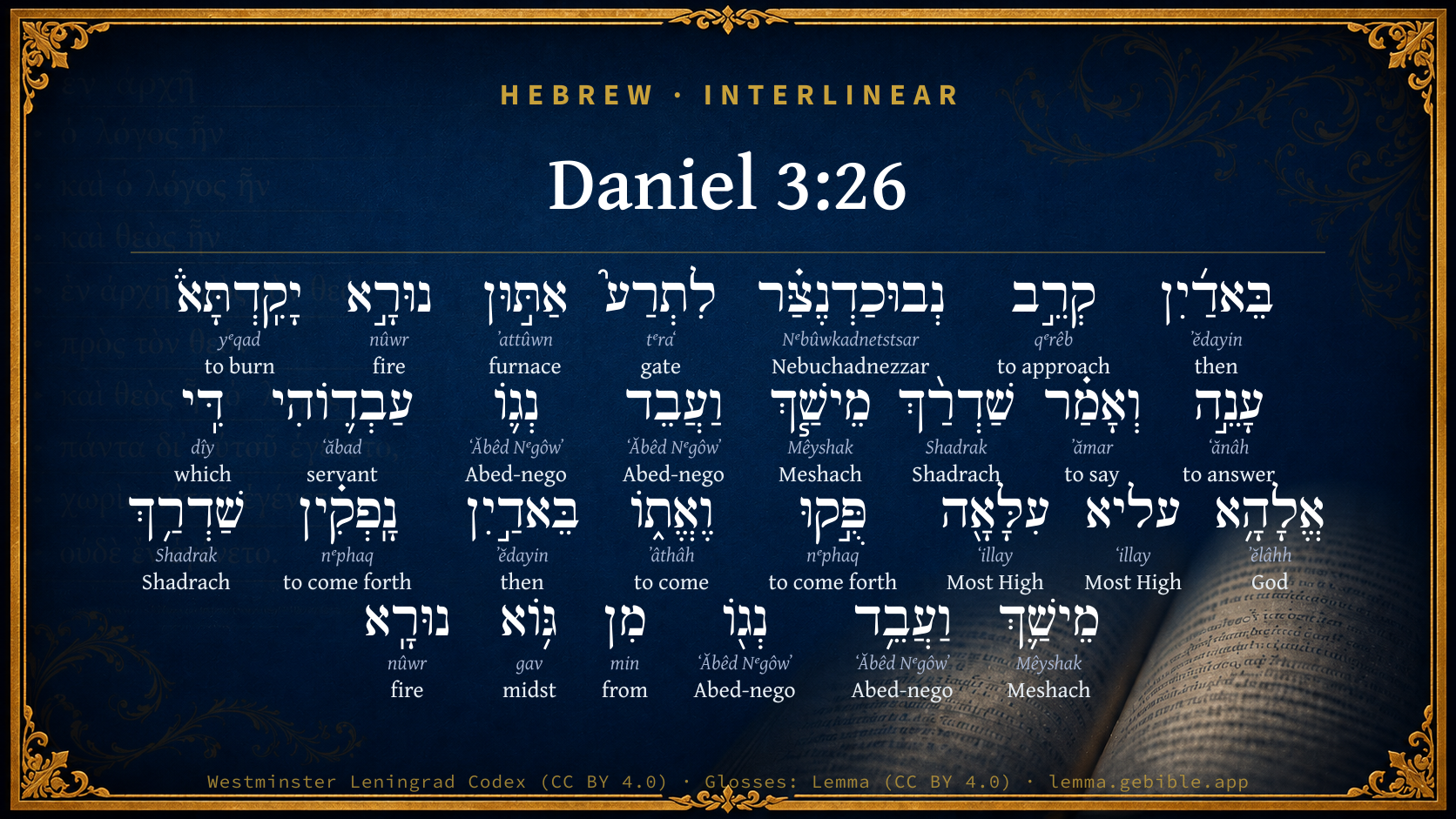
Hebrew (Westminster Leningrad Codex) Daniel 3:26 appears in the Hebrew Old Testament. The text above is from the Westminster Leningrad Codex. Each word links to its Strong’s number, a concise gloss, and parsing drawn from the Open Scriptures Hebrew Bible morphology. Click any word for its full Brown-Driver-Briggs (BDB) entry.
Download image
Cite this verse

Daniel 3:26 (World English Bible). Public Domain. Lemma interlinear Bible study tool, https://lemma.gebible.app/v/daniel/3/26.

Show BibTeX & RIS
BibTeX
RIS
English Translation
Then Nebuchadnezzar came near to the mouth of the burning fiery furnace: he spoke and said, Shadrach, Meshach, and Abednego, you servants of the Most High God, come forth, and come here. Then Shadrach, Meshach, and Abednego came forth out of the midst of the fire.
World English Bible · Public Domain
Highlights
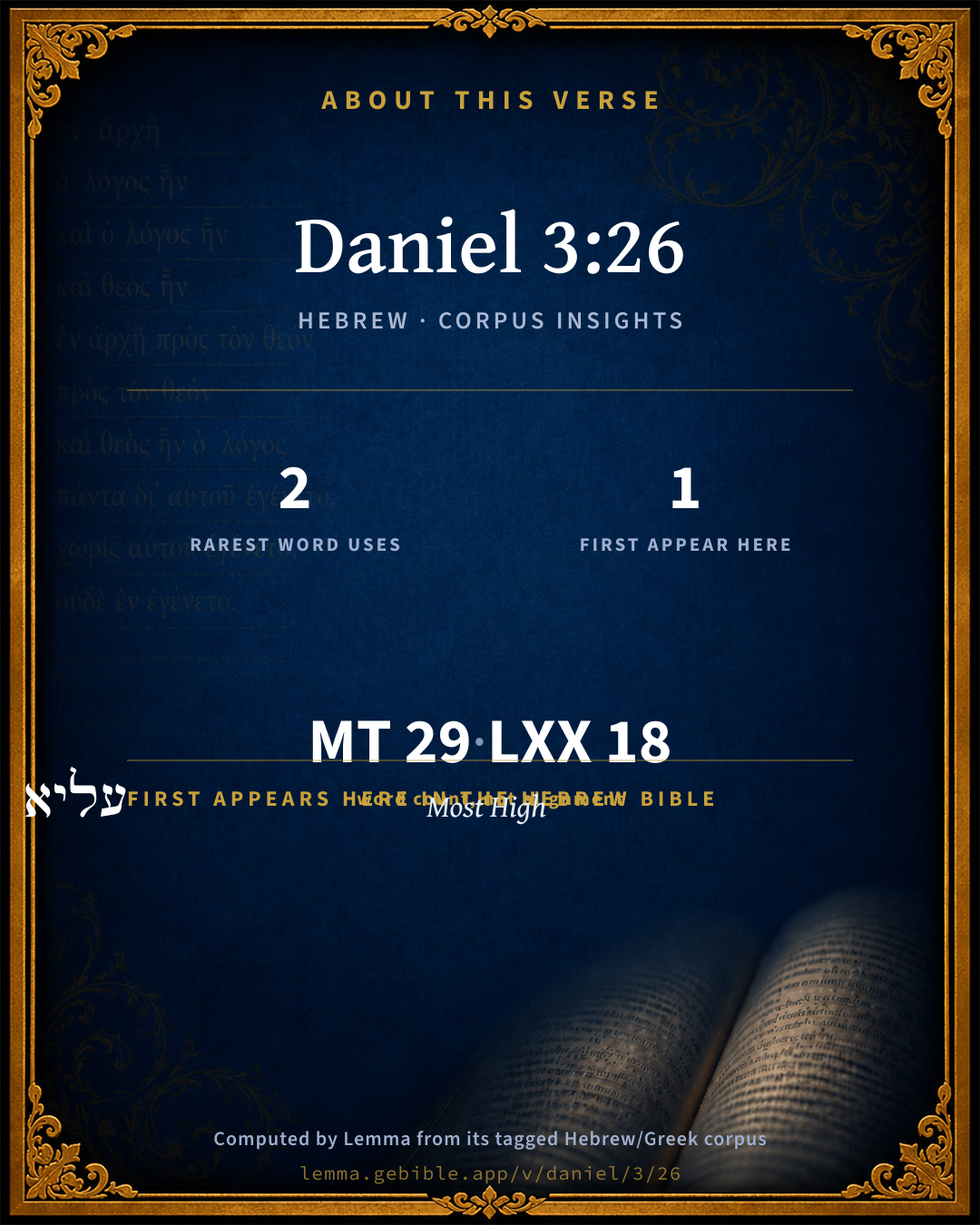
  • 1 first appearance in the Hebrew Bible
Full analysis ↓
Download a study sheet

One document with this verse’s original text, its word-by-word gloss line, the meaning frame, cross-references with their text, attributed commentary, and full source and license credits — printable, and it pastes into notes with its structure intact.

This verse Autodidact and up

Study sheet (.html) Plain text (.txt)

A passage Seminary Student

Up to 50 verses in one chapter. A passage sheet keeps up to 6 commentary sources and 12 cross-references per verse, in the order this page ranks them, and says so on the sheet whenever that leaves anything out. Ask for a single verse and you get the Autodidact verse sheet above.

Everything on this page stays free to read, with no account — the sheet is a download of what is already on screen, not access to it.

Want to remove ads? Support Godless Engineer
Compare translations 3

The same verse in 3 English versions, stacked beneath the original-language interlinear above. Click any original word for its lexicon entry.

Each is an independent rendering of the whole verse — the interlinear is not word-aligned to these translations.

Highlighted words mark where these versions differ — a whole-verse word diff, not a word-by-word alignment.

  • World English Bible Public Domain
    Then Nebuchadnezzar came near to the mouth of the burning fiery furnace: he spoke and said, Shadrach, Meshach, and Abednego, you servants of the Most High God, come forth, and come here. Then Shadrach, Meshach, and Abednego came forth out of the midst of the fire.
  • King James Version Public Domain
    Then Nebuchadnezzar came near to the mouth of the burning fiery furnace, and spake, and said, Shadrach, Meshach, and Abednego, ye servants of the most high God, come forth, and come hither. Then Shadrach, Meshach, and Abednego, came forth of the midst of the fire.
  • unfoldingWord Literal Text CC BY-SA 4.0
    Then Nebuchadnezzar came near to the door of the furnace of blazing fire; he responded and said, “Shadrach, Meshach, and Abednego, servants of the Most High God, come out, and come here!” Then Shadrach, Meshach, and Abednego came out of the midst of the fire.

unfoldingWord Literal Text — © unfoldingWord, licensed CC BY-SA 4.0. Word-aligned USFM3 via Door43 (git.door43.org/unfoldingWord/en_ult).

Versions to compare (up to 4)

3 of 4 selected

Show all 18 translations

Every available English version of this verse, each an independent rendering of the whole verse.

  • World English Bible Public Domain
    Then Nebuchadnezzar came near to the mouth of the burning fiery furnace: he spoke and said, Shadrach, Meshach, and Abednego, you servants of the Most High God, come forth, and come here. Then Shadrach, Meshach, and Abednego came forth out of the midst of the fire.
  • Berean Standard Bible Public Domain
    Then Nebuchadnezzar approached the door of the blazing fiery furnace and called out, “Shadrach, Meshach, and Abednego, servants of the Most High God, come out!” So Shadrach, Meshach, and Abednego came out of the fire,
  • Majority Standard Bible Public Domain
    Then Nebuchadnezzar approached the door of the blazing fiery furnace and called out, “Shadrach, Meshach, and Abednego, servants of the Most High God, come out!” So Shadrach, Meshach, and Abednego came out of the fire,
  • King James Version Public Domain
    Then Nebuchadnezzar came near to the mouth of the burning fiery furnace, and spake, and said, Shadrach, Meshach, and Abednego, ye servants of the most high God, come forth, and come hither. Then Shadrach, Meshach, and Abednego, came forth of the midst of the fire.
  • American Standard Version (1901) Public Domain
    Then Nebuchadnezzar came near to the mouth of the burning fiery furnace: he spake and said, Shadrach, Meshach, and Abed-nego, ye servants of the Most High God, come forth, and come hither. Then Shadrach, Meshach, and Abed-nego came forth out of the midst of the fire.
  • Revised Version (1885) Public Domain
    Then Nebuchadnezzar came near to the mouth of the burning fiery furnace: he spake and said, Shadrach, Meshach, and Abed-nego, ye servants of the Most High God, come forth, and come hither. Then Shadrach, Meshach, and Abed-nego, came forth out of the midst of the fire.
  • Geneva Bible (1599) Public Domain
    Then the King Nebuchad-nezzar came neere to the mouth of the hote fierie fornace, and spake and said, Shadrach, Meshach and Abednego, the seruants of the hie God goe foorth and come hither: so Shadrach, Meshach and Abednego came foorth of the middes of the fire.
  • Douay-Rheims (1899) Public Domain
    Then Nabuchodonosor came to the door of the burning fiery furnace, and said: Sidrach, Misach, and Abdenago, ye servants of the most high God, go ye forth, and come. And immediately Sidrach, Misach, and Abdenago went out from the midst of the fire.
  • Young's Literal Translation Public Domain
    Then Nebuchadnezzar hath drawn near to the gate of the burning fiery furnace; he hath answered and said, `Shadrach, Meshach, and Abed-Nego, servants of God Most High come forth, yea, come;' then come forth do Shadrach, Meshach, and Abed-Nego, from the midst of the fire;
  • Literal Standard Version CC BY-SA 4.0
    Then Nebuchadnezzar has drawn near to the gate of the burning fiery furnace; he has answered and said, “Shadrach, Meshach, and Abed-Nego, servants of God Most High come forth, indeed, come”; then Shadrach, Meshach, and Abed-Nego come forth, from the midst of the fire;
  • Unlocked Literal Bible CC BY-SA 4.0
    Then Nebuchadnezzar came near the door of the blazing furnace and called out, “Shadrach, Meshach, and Abednego, servants of God Most High, come out! Come here!” Then Shadrach, Meshach, and Abednego came out of the fire.
  • unfoldingWord Literal Text CC BY-SA 4.0
    Then Nebuchadnezzar came near to the door of the furnace of blazing fire; he responded and said, “Shadrach, Meshach, and Abednego, servants of the Most High God, come out, and come here!” Then Shadrach, Meshach, and Abednego came out of the midst of the fire.
  • Darby Bible Public Domain
    Then Nebuchadnezzar came near to the opening of the burning fiery furnace; he spoke and said, Shadrach, Meshach, and Abed-nego, ye servants of the Most High God, come forth, and come [hither]. Then Shadrach, Meshach, and Abed-nego came forth from the midst of the fire.
  • World Messianic Bible Public Domain
    Then Nebuchadnezzar came near to the mouth of the burning fiery furnace. He spoke and said, “Shadrach, Meshach, and Abednego, you servants of the Most High God, come out, and come here!” Then Shadrach, Meshach, and Abednego came out of the middle of the fire.
  • Webster's Bible Public Domain
    Then Nebuchadnezzar came near to the mouth of the burning fiery furnace, and spoke, and said, Shadrach, Meshach, and Abed-nego, ye servants of the most high God, come forth, and come hither. Then Shadrach, Meshach, and Abed-nego, came forth from the midst of the fire.
  • Free Bible Version CC BY-SA 4.0
    Nebuchadnezzar went towards the door of the furnace of blazing fire. “Shadrach, Meshach, and Abednego, servants of the Most High God, come out! Come here!” he shouted. So Shadrach, Meshach, and Abednego came out of the fire.
  • Bible in Basic English Public Domain
    Then Nebuchadnezzar came near the door of the burning and flaming fire: he made answer and said, Shadrach, Meshach, and Abed-nego, you servants of the Most High God, come out and come here. Then Shadrach, Meshach, and Abed-nego came out of the fire.
  • JPS Tanakh (1917) Public Domain
    Then Nebuchadnezzar came near to the mouth of the burning fiery furnace; he spoke and said: 'Shadrach, Meshach, and Abed-nego, ye servants of God Most High, come forth, and come hither.' Then Shadrach, Meshach, and Abed-nego, came forth out of the midst of the fire.

Literal Standard Version (2020), Covenant Press — licensed CC BY-SA 4.0. Text via the HelloAO Bible API (eBible.org). Unlocked Literal Bible (unfoldingWord) — licensed CC BY-SA 4.0. Text via the HelloAO Bible API (eBible.org). unfoldingWord Literal Text — © unfoldingWord, licensed CC BY-SA 4.0. Word-aligned USFM3 via Door43 (git.door43.org/unfoldingWord/en_ult). Free Bible Version, Dr. Jonathan Gallagher — licensed CC BY-SA 4.0. Text via the HelloAO Bible API (eBible.org).

Word by word

More ways to search: Search by grammar → Find every occurrence → Compare this word →

Practice this passage: Drill this verse → Learn its vocabulary →

לִתְרַע֮
tᵉraʻ
H8651
“to/for · gate of”
Adjective, R + Noun, Common, Masculine, Singular, Construct
Part of Speech
Adjective + Noun
Type
Common
Gender
Masculine
Number
Singular
State
Construct
Full BDB Definition

Origin: corresponding to H8179

TWOT: 3066

gate, door - door - gate - court
  1. בֵּאדַ֜יִן ʼĕdayin H116 “in/at · then” Adjective, R + Adverb
  2. קְרֵ֣ב qᵉrêb H7127 “to approach” Adjective, V, Plural
  3. נְבוּכַדְנֶצַּ֗ר Nᵉbûwkadnetstsar H5020 “Nebuchadnezzar” Adjective, N
  4. אַתּ֣וּן ʼattûwn H861 “furnace of” Adjective, N, Common
  5. נוּרָ֣א nûwr H5135 “fire · the” Adjective, N, Common + Particle, Definite Article
  6. יָקִֽדְתָּא֒ yᵉqad H3345 “burning · the” Adjective, V + Particle, Definite Article
  7. עָנֵ֣ה ʻănâh H6032 “answering” Adjective, V
  8. וְאָמַ֗ר ʼămar H560 “and · saying” Adjective, C + Verb, Qal, Participle Active, Masculine, Singular, Absolute
  9. שַׁדְרַ֨ךְ Shadrak H7715 “Shadrach” Adjective, N
  10. מֵישַׁ֧ךְ Mêyshak H4336 “Meshach” Adjective, N
  11. וַעֲבֵד ʻĂbêd Nᵉgôwʼ H5665 “and · Abed-nego” Adjective, C + Noun, Proper
  12. נְג֛וֹ ʻĂbêd Nᵉgôwʼ H5665 “Abed-nego” Adjective, N
  13. עַבְד֛וֹהִי ʻăbad H5649 “servants · his” Adjective, N, Common + Suffix, Personal, 3rd Person, Masculine, Singular
  14. דִּֽי dîy H1768 “which” Adjective, T
  15. אֱלָהָ֥א ʼĕlâhh H426 “God · the” Adjective, N, Common + Particle, Definite Article
  16. עליא ʻillay H5943 “Most High · the” Adjective, A + Particle, Definite Article
  17. עִלָּאָ֖ה ʻillay H5943 “Most High · the” Adjective, A + Particle, Definite Article
  18. פֻּ֣קוּ nᵉphaq H5312 “come forth” Adjective, V
  19. וֶאֱת֑וֹ ʼâthâh H858 “and · come” Adjective, C + Verb, Qal, Imperative, 2nd Person, Masculine, Plural
  20. בֵּאדַ֣יִן ʼĕdayin H116 “in/at · then” Adjective, R + Adverb
  21. נָֽפְקִ֗ין nᵉphaq H5312 “coming forth” Adjective, V
  22. שַׁדְרַ֥ךְ Shadrak H7715 “Shadrach” Adjective, N
  23. מֵישַׁ֛ךְ Mêyshak H4336 “Meshach” Adjective, N
  24. וַעֲבֵ֥ד ʻĂbêd Nᵉgôwʼ H5665 “and · Abed-nego” Adjective, C + Noun, Proper
  25. נְג֖וֹ ʻĂbêd Nᵉgôwʼ H5665 “Abed-nego” Adjective, N
  26. מִן min H4481 “from” Adjective, R
  27. גּ֥וֹא gav H1459 “midst of” Adjective, N, Common
  28. נוּרָֽא nûwr H5135 “fire · the” Adjective, N, Common + Particle, Definite Article

About this verse

These counts appear in no published source. They are computed here, from the morphology-tagged text and Lemma’s own curated glosses. What Lemma adds →

29
words
20
distinct lemmas
Prophets
section

Notable vocabulary

The rarest word here is לִתְרַע֮ gate H8651 — appearing just 2 times in the whole Hebrew Bible.

First appearance in Scripture

This word makes its first canonical appearance in the Hebrew Bible here:

  • עליא Most High H5943

Shared distinctive vocabulary

לִתְרַע֮ gate H8651 occurs in 2 verses of the Hebrew Bible. Also found in:

Grammatical profile

  • 2 verbs
  • 3 nouns
  • 16 adjectives
  • 2 adverbs
  • 6 particles

Verb forms

  • וְאָמַ֗ר Qal · Participle Active
  • וֶאֱת֑וֹ Qal · Imperative

Repetition

Words recur within this verse — often emphatic in Hebrew:

  • וַעֲבֵד Abed-nego H5665 ×4
  • נוּרָ֣א fire H5135 ×2
  • שַׁדְרַ֨ךְ Shadrach H7715 ×2
  • מֵישַׁ֧ךְ Meshach H4336 ×2
  • עליא Most High H5943 ×2
  • פֻּ֣קוּ to come forth H5312 ×2
  • בֵּאדַ֜יִן then H116 ×2

Hebrew & Septuagint length

In English translation the verse runs 46 words from the Hebrew and 44 from the Septuagint (LXX English) — closely comparable.

A rough comparison of the two English renderings, which tokenize alike — not a word-level alignment.

Word counts can differ between the Hebrew and the Greek without any difference in meaning — e.g. the Hebrew direct-object marker אֵת has no separate Greek word, and Greek often adds the article ὁ.

In the original languages it is 29 Hebrew tokens and 18 Greek tokens — but the two are counted differently (Hebrew bundles its prefixes and suffixes into one token; the Greek is in lemma form), so that isn’t a like-for-like length.

Cross-references

16

Topical passages linked to Daniel 3:26 in the Treasury of Scripture Knowledge — connected by theme and wording, ordered by reader-vote popularity; previews shown in the World English Bible.

  • Daniel 3:17 If it be [so], our God whom we serve is able to deliver us from the burning fiery furnace; and he will deliver us out of your hand, O king.
  • Isaiah 52:12 For you shall not go out in haste, neither shall you go by flight: for Yahweh will go before you; and the God of Israel will be your rearward.
  • Daniel 4:2 It has seemed good to me to show the signs and wonders that the Most High God has worked toward me.
  • Revelation 19:5 A voice came forth from the throne, saying, "Give praise to our God, all you his servants, you who fear him, the small and the great!"
  • Genesis 14:18 Melchizedek king of Salem brought forth bread and wine: and he was priest of God Most High.
  • Joshua 3:17 The priests who bore the ark of the covenant of Yahweh stood firm on dry ground in the midst of the Jordan; and all Israel passed over on dry ground, until all the nation were passed clean over the Jordan.
  • Joshua 4:10 For the priests who bore the ark stood in the midst of the Jordan, until everything was finished that Yahweh commanded Joshua to speak to the people, according to all that Moses commanded Joshua: and the people hurried and passed over.
  • Daniel 2:47 The king answered to Daniel, and said, Of a truth your God is the God of gods, and the Lord of kings, and a revealer of secrets, seeing you have been able to reveal this secret.
  • Acts 16:17 Following Paul and us, she cried out, "These men are servants of the Most High God, who proclaim to us the way of salvation!"
  • Galatians 1:10 For am I now seeking the favor of men, or of God? Or am I striving to please men? For if I were still pleasing men, I wouldn't be a servant of Christ.
  • Joshua 4:16–18 Command the priests who bear the ark of the testimony, that they come up out of the Jordan.
  • Ezra 5:11 Thus they returned us answer, saying, We are the servants of the God of heaven and earth, and are building the house that was built these many years ago, which a great king of Israel built and finished.
  • Isaiah 28:16 therefore thus says the Lord Yahweh, Behold, I lay in Zion for a foundation a stone, a tried stone, a precious corner -[stone] of sure foundation: he who believes shall not be in haste.
  • Daniel 6:20 When he came near to the den to Daniel, he cried with a lamentable voice; the king spoke and said to Daniel, Daniel, servant of the living God, is your God, whom you serve continually, able to deliver you from the lions?
  • Acts 16:37 But Paul said to them, "They have beaten us publicly, without a trial, men who are Romans, and have cast us into prison! Do they now release us secretly? No, most assuredly, but let them come themselves and bring us out!"
  • Acts 27:23 For there stood by me this night an angel, belonging to the God whose I am and whom I serve,

Cross-references courtesy of OpenBible.info (CC BY 4.0).

Hebrew and Greek witnesses Masoretic Hebrew ↔ Greek Septuagint

The same verse in the two great witnesses to the Old Testament, shown verse-for-verse.

These are two independent witnesses, not word-aligned to each other, and the Septuagint is shown in lemma (dictionary) form.

Hebrew Daniel 3:26 Masoretic · Westminster Leningrad Codex

בֵּאדַ֜יִן קְרֵ֣ב נְבוּכַדְנֶצַּ֗ר לִתְרַע֮ אַתּ֣וּן נוּרָ֣א יָקִֽדְתָּא֒ עָנֵ֣ה וְאָמַ֗ר שַׁדְרַ֨ךְ מֵישַׁ֧ךְ וַעֲבֵד נְג֛וֹ עַבְד֛וֹהִי דִּֽי אֱלָהָ֥א עליא עִלָּאָ֖ה פֻּ֣קוּ וֶאֱת֑וֹ בֵּאדַ֣יִן נָֽפְקִ֗ין שַׁדְרַ֥ךְ מֵישַׁ֛ךְ וַעֲבֵ֥ד נְג֖וֹ מִן גּ֥וֹא נוּרָֽא

Then Nebuchadnezzar came near to the mouth of the burning fiery furnace: he spoke and said, Shadrach, Meshach, and Abednego, you servants of the Most High God, come forth, and come here. Then Shadrach, Meshach, and Abednego came forth out of the midst of the fire.

World English Bible · Public Domain

Greek LXX Daniel 3:26 Septuagint · lemma form

εὐλογητός εἰμί κύριος ὁ θεός ὁ πατήρ ἐγώ καί αἰνετός καί δοξάζω ὁ ὄνομα σύ εἰς ὁ αἰών

Then Nabuchodonosor drew near to the door of the burning fiery furnace, and said, Sedrach, Misach, and Abdenago, you⌃ servants of the most high God, proceed forth, and come here. So Sedrach, Misach, and Abdenago, came forth out of the midst of the fire.

LXX2012 (modern English Septuagint) · Public Domain

On this verse, The Pulpit Commentary discusses the Septuagint’s reading. Read the note in Commentary ↓

Hebrew: Westminster Leningrad Codex (CC BY 4.0). Greek: Septuagint (public domain); English from LXX2012 (modern English Septuagint) (Public Domain). How the Septuagint differs from the Hebrew →

Commentary

Notes on Daniel 3:26 from classic Christian and Jewish commentators (each source and its license shown beneath its notes). The classic Christian expositions comment on the surrounding passage and are grouped to its opening verse, so a note may address several verses; the Jewish commentaries on the Tanakh (Rashi and others) are per-verse, so they appear only where the commentator wrote on this verse.

Lemma curates 59 commentaries, every one of them public domain or Creative Commons licensed, each selected and text-cleaned for this edition rather than reprinted as found. About our sources →

Trapp's Complete Commentary

John Trapp

Dan 3:26 Then Nebuchadnezzar came near to the mouth of the burning fiery furnace, [and] spake, and said, Shadrach, Meshach, and Abednego, ye servants of the most high God, come forth, and come [hither]. Then Shadrach, Meshach, and Abednego, came forth of the midst of the fire.

Ver. 26. Ye servants of the most high God.] This was a high title, such as David and other great princes have gloried in; {Psa 36:1 title} {See Trapp on "Psa 36:1"} The devil gave it to Paul and his fellow labourers; {Act 16:17} and they who deny it to Christ’s faithful ministers, loading them with names of scorn and obloquy, show therein less ingenuity than the devil himself.

Then Shadrach, Meshach, and Abednego came forth.] Not till they were called had they any mind to come forth; for where could they possibly mend themselves? Any place is a paradise where God is present. Ubi imperator, ibi Roma. Where the emperor is, there is Rome. Noah was well content to lie buried, as it were, in the ark, which was made in the form of a coffin, so long as God was there with him. Nos quoque non abhorremus a sepulchris ipsis, saith an expositor, {a} We also fear not to go down to the grave so long as we may hear God saying unto us, as once he did to old Jacob thinking of his journey to Egypt, "Fear not to go down into Egypt; for I will go with thee, and I will also bring thee up again." {Gen 46:3-4} Further, note how these three martyrs carry themselves toward the tyrant: they do simply obey his command, and come forth; they are not puffed up by the strangeness of the miracle wrought upon them, neither do they tattle, but suffer the matter itself and experience to speak, showing themselves to all sorts to be looked upon with greatest humility and modesty.

{a} Rollock.

John Trapp, A Commentary or Exposition upon All the Books of the Old and New Testament (1647–1656) — public domain. Text from a community e-Sword module.

Joseph Benson's Commentary

Dan 3:26-27. Then Nebuchadnezzar came near to the mouth of the furnace — As near as he durst come; and spake — With a milder tone than before, God having abated the fire of his fury; and said, Ye servants of the most high God, &c. — The miracle calls to his mind the confession which he had formerly made of the true God, Dan 2:47. And he can now at once both acknowledge him to be most high above all gods, and the three worthies, who had been condemned to the flames, to be his faithful servants. Observe, reader, sooner or later God will convince the proudest of men, that he is the most high God, and above them, and too hard for them, even in those things wherein they deal proudly and presumptuously, Exo 18:11. He will likewise let them know who are his servants, and that he owns them, and will stand by them. Nebuchadnezzar now embraces those whom he had abandoned to destruction, and is ready to show them every possible kindness, perceiving them to be the favourites of Heaven. How the fourth, whose form was like the Son of God, withdrew, and whether he vanished away or visibly ascended, we are not told; but of the other three we are informed, that they came forth out of the midst of the fire — As Abraham their father out of Ur, that is, the`fire, of the Chaldees, into which, says the tradition of the Jews, he was cast for refusing to worship idols, and out of which he was delivered, as those his three descendants were. When they had their discharge, they did not tempt God by staying any longer, but came forth as brands out of the burning. And the princes, governors, &c., being gathered together, saw those men — All the great men came together to view them, and were amazed to find that they had not received the least damage by the fire; that it had no power over their bodies, &c. — Several expressions are here used, which rise in fine order one above another, and the climax is beautiful. The fire not only had no prevailing power over their bodies, but neither was a hair of their head burned, nor their flowing robes singed, nor even the smell of fire had passed on them.

Joseph Benson's Commentary on the Old and New Testaments (1811–1818) — public domain. Text from a community e-Sword module.

Tyndale Open Study Notes

Tyndale Open Resources

3:26 The title Most High is often used to refer to God (e.g., 4:2, 24-25; 7:25; Gen 14:18; Num 24:16; Deut 32:8-9; Ps 73:11; Isa 14:14). In Canaanite religion, it often referred to Baal.

Tyndale Open Study Notes — © Tyndale Open Resources, licensed CC BY-SA 4.0. Text via the HelloAO Bible API.

Ibn Ezra

Rabbi Abraham ibn Ezra

[Daniel 3:26] Then (בֵּאדַיִן - Be'adayin)... to the opening/gate (לִתְרַע - l'taraʿ): [Means] To the gate (l'shaʿar). And [the root ת-ר-ע also appears in Hebrew, as in the name] “Tirathites (Tirʿatim), Sucathites” [I Chronicles 2:55].

Come out (פֻּקוּ - puquTze'u).

And come (וֶאֱתוֹ - ve'eto): [Means] And come (u-vo'u). Like [the imperative form etayu in the phrase] “Return, come!” (שֻׁ֥בוּ אֵתָֽיוּ - shuvu etayu) [Isaiah 21:12].

Ibn Ezra on the Tanakh — English translations: “Sefaria Community Translation” (CC0 1.0 (public-domain dedication)); “Yalkut, Sifsei Chachomim Chumash, Metsudah Publications, 2009” (CC BY 4.0); and “Commentary of Ibn Ezra on Isaiah - trans. by M. Friedlander, 1873” (public domain). Text via Sefaria.

Geneva Bible (1599)

Geneva Bible translators

This commendeth their obedience unto God, that they would not for any fear depart out of this furnace, till the time appointed, as Noah remained in the ark, till the Lord called him forth.

Geneva Bible (1599) marginal notes — public domain. Text via Bolls.life.

Jamieson, Fausset & Brown

Robert Jamieson, A. R. Fausset & David Brown

the most high God--He acknowledges Jehovah to be supreme above other gods (not that he ceased to believe in these); so he returns to his original confession, "your God is a God of gods" (Dan 2:47), from which he had swerved in the interim, perhaps intoxicated by his success in taking Jerusalem, whose God he therefore thought unable to defend it.

Jamieson, Fausset & Brown — Commentary Critical and Explanatory on the Whole Bible (1871) — public domain (CC PDM 1.0). Text via the HelloAO Bible API.

John Calvin's Commentaries

HERE a sudden change is described in the mood of this cruel and proud king. We have already seen how confidently he extracted worship from the servants of God, and when he saw them disobedient to his command, how mightily he raged against them. Now Daniel shews in how short a time this pride was subdued and this cruelty appeased; but we must remark that the king was not so changed as entirely to put his disposition and manners. For when he was touched with this present miracle, he gave God the glory, but only for a moment; and still he did not return to wisdom. We cannot take too diligent notice of examples of this kind, as many estimate the characters of others from a single action. But the worst despisers of God can submit to him for a short time, not merely by feigning to do so before men, but in real seriousness, since God compels them by his power, but meanwhile they retain their pride and ferocity within their breasts. Of this kind, then, was the conversion of King Nebuchadnezzar. For when astonished by the miracle, he could no longer resist the Almighty, he was still inconsistent, as we shall afterwards see. We may also notice how the impious, who are unregenerate by God’s Spirit, are often impelled to worship God; but this is only temporary, and this equable tenor never remains through their whole life. But when God renews his own, he undertakes to govern them even to the end; he animates them to perseverance, and confirms them by his Spirit.

We must here remark how God’s glory is illustrated by this temporary and vanishing conversion of the reprobate; because, whether they will or not, yet they yield to God for a time, and thus the greatness of his power is acknowledged. God, therefore, turns an event which does not profit the reprobate to his own glory, and at the same time punishes them more severely. For Nebuchadnezzar’s conduct was less excusable after his once acknowledging the God of Israel to be the supreme and only God, and then relapsing into his former superstitions. He says, therefore, — He approached the door of the furnace, and spoke thus, — Shadrach, Meshach, and Abed-nego, servants of the most high God, come forth and come hither A short time before, he wished his own statue to be worshipped, and his own name to be esteemed the only one in heaven and earth, since this was pleasing to him. We then saw how he claimed the right of subjecting the religion and worship of God to his own will and lust; but now, as if he were a new man, he calls Shadrach, Meshach, and Abed-nego, servants of the most high God! What place, then, was left to him and to all the Chaldeans? How could they now worship those fictitious gods and idols which they had fabricated? But God extracted these words from the proud and cruel king, as when criminals and compelled, by tortures, to say what they would otherwise refuse. Thus Nebuchadnezzar confessed God to be the most high God of Israel, as if he had been tortured, but not of his own accord, or in a composed state of mind. He does not pretend this before men, as I have said; but his mind was neither pure nor perfect, since it was in a ferment with this temporary commotion. And this must also be added — the instinct was rather violent; than voluntary.

Daniel afterwards relates — His companions came forth from the midst of the fire By these words he again confirms the miracle; for God could extinguish the fire of the furnace, but he wished it to burn in the sight of all, to render the power of this deliverance the more conspicuous. Meanwhile we must notice the three men walking in the furnace, until the king commanded them to come forth, because God had issued no command. They saw themselves perfectly safe and. sound in the midst of the furnace; they were content with God’s present benefit, but still they had no free departure, until fetched by the king’s voice. As when Noah, in the ark, saw safety prepared for him in that tomb, yet he did not try anything until commanded to come forth. (Genesis 8:16.) So also Daniel asserts that his companions did not, come forth from the furnace till the king commanded them. Then at length they understood how what they had heard from the king was pleasing to God; not because he was a Prophet or teacher, but because they were cast into the furnace by his command. So also when he recalls them, they know the end of their cross to be arrived, and thus they pass from death unto life. It follows —

John Calvin's Commentaries (1540-1563) — public domain. Text from the Calvin Translation Society English edition (1840s-50s) via the Christian Classics Ethereal Library (ccel.org). Calvin's coverage is partial (roughly two-thirds of the Bible); uncommented books and verses are honest gaps, never fabricated. The 19th-century editor's footnotes and remarks are omitted so the notes are faithfully Calvin's own voice.

The Cambridge Bible for Schools and Colleges

gen. ed. J. J. S. Perowne

26. mouth] Aram. door.

God Most High] so Dan_4:2; Dan_5:18; Dan_5:21 : without ‘God,’ Dan_4:17; Dan_4:24-25; Dan_4:32; Dan_4:34, Dan_7:25 (first time); and with the adj. in a more Hebraistic form, Dan_7:18; Dan_7:22; Dan_7:25 (second time), 27. The title is found in Hebrew, Gen_14:18-20; Gen_14:22 (of the deity of Melchizedek, identified by the narrator with Jehovah); elsewhere only in poetry, especially in the Psalms, as Psa_57:2, though usually without ‘God,’ as Psa_9:3, Psa_18:13 : as applied to Jehovah, it is a title of dignity and respect, denoting Him as one who is supreme, whether over the earth, as ruler and governor of the world (e.g. Psa_47:2), or over other gods (e.g. Psa_95:3 : cf. Cheyne on Ps. 7:18). It occurs not unfrequently with the same force in the Apocrypha, being used sometimes by Israelites (cf. Luk_1:32; Luk_1:35; Luk_1:76), and sometimes (as here and Dan_4:2; Dan_4:34, cf. Isa_14:14) placed in the mouth of heathen speakers (1Es_2:3; 1Es_6:31; 1Es_8:19; 1Es_8:21, al.: cf. Mar_5:7, Act_16:17): it is also common (as a title, without ‘God’) in the Book of Enoch. See more fully the article Most High in Hastings’ Dict. of the Bible.

The Cambridge Bible for Schools and Colleges (gen. ed. J. J. S. Perowne; Cambridge University Press, 1878–1918) — public domain. Text from a community e-Sword module.

John Gill's Exposition

And the princes, governors, and captains, and the king's counsellors, being gathered together,.... Either by the order of the king, or of their own accord, to see the miracle that was wrought:

saw these men; saw them walking in the furnace, saw them come out of it at the king's call, and saw them when they were out, and examined them thoroughly; so that they had ocular demonstration, full proof and conviction, of the truth of what was done:

upon whose bodies the fire had no power; to blister, scorch, burn, and consume them, as it has usually over the bodies of men, or any creature:

nor was an hair of their head singed; which is easily done with the weakest flame; and this must be understood of the hair of their eyebrows and beards also; see Luk 21:18,

neither were their coats changed; neither the substance, nor form, nor colour of them, but were just as they were when cast into the furnace; the same holds good of all their other garments, their interior ones, with their turbants, shoes, and stockings:

nor the smell of the fire had passed on them; as will upon persons that stay at any time in a place where there is much fire and smoke; and especially where much combustible things are burnt, as pitch, sulphur, and the like, as in furnaces; and very probably in this, which had been so vehemently heated; and yet there was no smell of it on their garments; all which serve to make the miracle the more wonderful.

John Gill's Exposition of the Whole Bible (1746–1763) — public domain (CC PDM 1.0). Text via the HelloAO Bible API.

Albert Barnes' Notes on the Bible

Then Nebuchadnezzar came near to the mouth ... - Margin, “door.” The Chaldee word means door, gate, entrance. The “form” of the furnace is unknown. There was a place, however, through which the fuel was cast into it, and this is doubtless intended by the word “door” or “mouth” here used.

Ye servants of the most high God - They had professed to be his servants; he now saw that they were acknowledged as such. The phrase “most high God” implies that he regarded him as supreme over all other gods, though it is probable that he still retained his belief in the existence of inferior divinities. It was much, however, to secure the acknowledgment of the monarch of the capital of the pagan world, that the God whom they adored was supreme. The phrase “most high God” is not often employed in the Scriptures, but in every instance it is used as an appellation of the true God.

Come forth, and come hither - The “reasons” which seem to have influenced this singular monarch to recal the sentence passed on them, and to attempt to punish them no further, seem to have been, that he had some remains of conscience; that he was accustomed to pay respect to what “he” regarded as God; and that he now saw evidence that a “true” God was there.

Albert Barnes' Notes on the Bible (1834–1885) — public domain. Text from a community e-Sword/MySword module.

Matthew Poole's English Annotations

Came near; as near as he durst come, within hearing. And spake with a milder tone than before, God having abated the fire of his fury. Now he could at once confess and acknowledge the true God to be the Most High above all gods, and the three worthies to be his faithful servants.

Came forth of the midst of the fire; they went out upon the king’s call, without which they would not have stirred.

Matthew Poole's English Annotations on the Holy Bible (1683–1685) — public domain. Text from a community e-Sword/MySword module.

Whedon's Commentary on the Bible

Daniel D. Whedon

26. On the furnace see Dan_3:25. On the most high God compare Gen_14:18; Mic_6:6, and notes Dan_3:13-15; Dan_3:25. Thomson well says that this term did not imply a recognition by the king of Jehovah’s supreme divinity “any more than a king of France acknowledged the supremacy of the Holy Roman Empire when in the credentials of his embassador the emperor was called Domiuus urbis et orbis.” It was simply a matter of “religious etiquette” to address the gods thus (Dan_2:47).

Daniel D. Whedon (gen. ed.), Commentary on the Old and New Testaments (1874–1909) — public domain. Text from a community e-Sword module.

The Pulpit Commentary

Then Nebuchadnezzar came near to the mouth of the burning fiery furnace, and spake and said, Shadrach, Meshach, and Abed-nego, ye servants of the Most High God, come forth and come hither. Then Shadrach, Meshach, and Abed-nego, came forth of the midst of the fire. The variations of the Septuagint Version here arc inconsiderable. Instead of "spake and said," it renders, "called them by name," and omits the second repetition of the names, and the pleonastic "come hither;" instead of "Most High God," it has"God of gods Most High." Theodotion is in closer agreement with the Massoretic text; the only differnce is that "spake" is omitted. The Peshitta and Vulgate are in exact accordance with the Massoretic. The distinction between qpn and hta is "go out" and "come." It is well rendered in our Authorized Verb-ion. only there was no need of "hither" being put in italics. As above mentioned, this shows the form of the furnace to be not unlike our own open at the top, but having a door at the side. It was to this side door that the king approached. The fact that Nebuchadnezzar acknowledges Jehovah to be "Most High God" does not imply any recognition of his supreme Divinity, any more than a king of France acknowledged the supremacy of the head of the Holy Roman Empire. when in the credentials of his ambassador the emperor was called Dominus urbis et orbis. It was simply a matter of what we may call religious etiquette to address gods of the higher class as "god of gods." and "god most high." in Dan_2:47 Nebuchadnezzar had already declared the God of Daniel to be "God of gods" It is not impossible that to the Babylonians illa"a might have the appearance of a proper name.

The Pulpit Commentary (1880–1919), ed. H.D.M. Spence-Jones & Joseph S. Exell — public domain. Text from a community e-Sword module.

John Wesley's Explanatory Notes

And spake - With a milder tone than before, God having abated the fire of his fury. Now he could at once acknowledge the true God to be the most high above all gods, and the three worthies to be his faithful servants.

John Wesley, Explanatory Notes Upon the Whole Bible (1754–1765) — public domain. Text via the GEBible commentary corpus.

unfoldingWord translationNotes

Door43 World Missions Community

The provincial governors, regional governors, other governors

These are officials who have authority over different sizes of territory. See how you translated these in Daniel 3:2.

the hair on their heads was not singed

This can be stated in active form. AT: "the fire had not singed the hair on their heads" (See: Active or Passive)

was not singed

"was not burned even a little"

their robes were not harmed

This can be stated in active form. AT: "the fire did not harm their robes" (See: Active or Passive)

there was no smell of fire on them

"they did not smell like fire"

translationWords

Nebuchadnezzar

servant

Most High

province

govern

advice

robe

unfoldingWord translationNotes — © Distant Shores Media and the Door43 World Missions Community, licensed CC BY-SA 4.0. Source: git.door43.org/Door43/en_tn.

Rashi

Rabbi Shlomo Yitzchaki (Rashi)

approached the gate of the... fiery furnace He approached the gate of the court, in which the furnace was situated, to speak with them, and at first, he saw them from afar.

Step out and come “step out and come,” but he did not say to them, “step out and ascend.” From here we learn that the floor of the furnace floated up and became even with the ground, so that they should not be troubled to go up.

Then...came out Although they were confident of the miracle that had been performed for them, they did not dare to treat the king lightly, to go out without permission.

Rashi on the Tanakh — English translations: “The Judaica Press complete Tanach with Rashi, translated by A. J. Rosenberg” (CC BY 4.0); “Pentateuch with Rashi's commentary by M. Rosenbaum and A.M. Silbermann, 1929-1934” (public domain); “The Metsudah Tanach series, Lakewood, N.J” (CC BY 4.0); and “The Book of Joshua, Metsudah Publications, 1997” (CC BY 4.0). Text via Sefaria.

Lesson kit

Teaching starters — assembled from the data on this page, not authored interpretation. Every prompt links to the verse data it draws on. Edit before teaching.

Daniel, in the Prophets, opens this verse with 29 words (20 distinct Hebrew lemmas). Its most distinctive word is tᵉraʻ (“gate”). A historical commentator’s framing appears above. Read the whole chapter for the surrounding context.

Discussion questions

  1. How does “gate” (tᵉraʻ) shape what this verse is saying?
  2. The word “Most High” first appears here in Scripture. What is being introduced at this debut?
  3. Daniel 2:49 shares the word «gate» with this verse. How do the two illuminate each other?
  4. “Abed-nego” occurs 4× in this one verse. What is the effect of the repetition?
  5. The translations on this page render this verse differently — a whole-verse word diff, not a word-by-word alignment. What might account for the different wordings?
  6. The verb «וְאָמַ֗ר» is Qal Participle Active. How does its form color the action?
  7. Reading how Trapp's Complete Commentary and Joseph Benson's Commentary read this verse, where do the two commentators agree and where do they part?

Things to notice

Reading settings

Reading text

Shown beneath each verse's original-language words.

Old Testament
Old Testament edition

Read the OT as the Masoretic Hebrew (MT) or the Greek Septuagint (LXX).

English shown for the Greek Septuagint (in the Hebrew ↔ Greek comparison).

Comparing translations? Open the Compare panel on any verse page to stack up to four side by side.