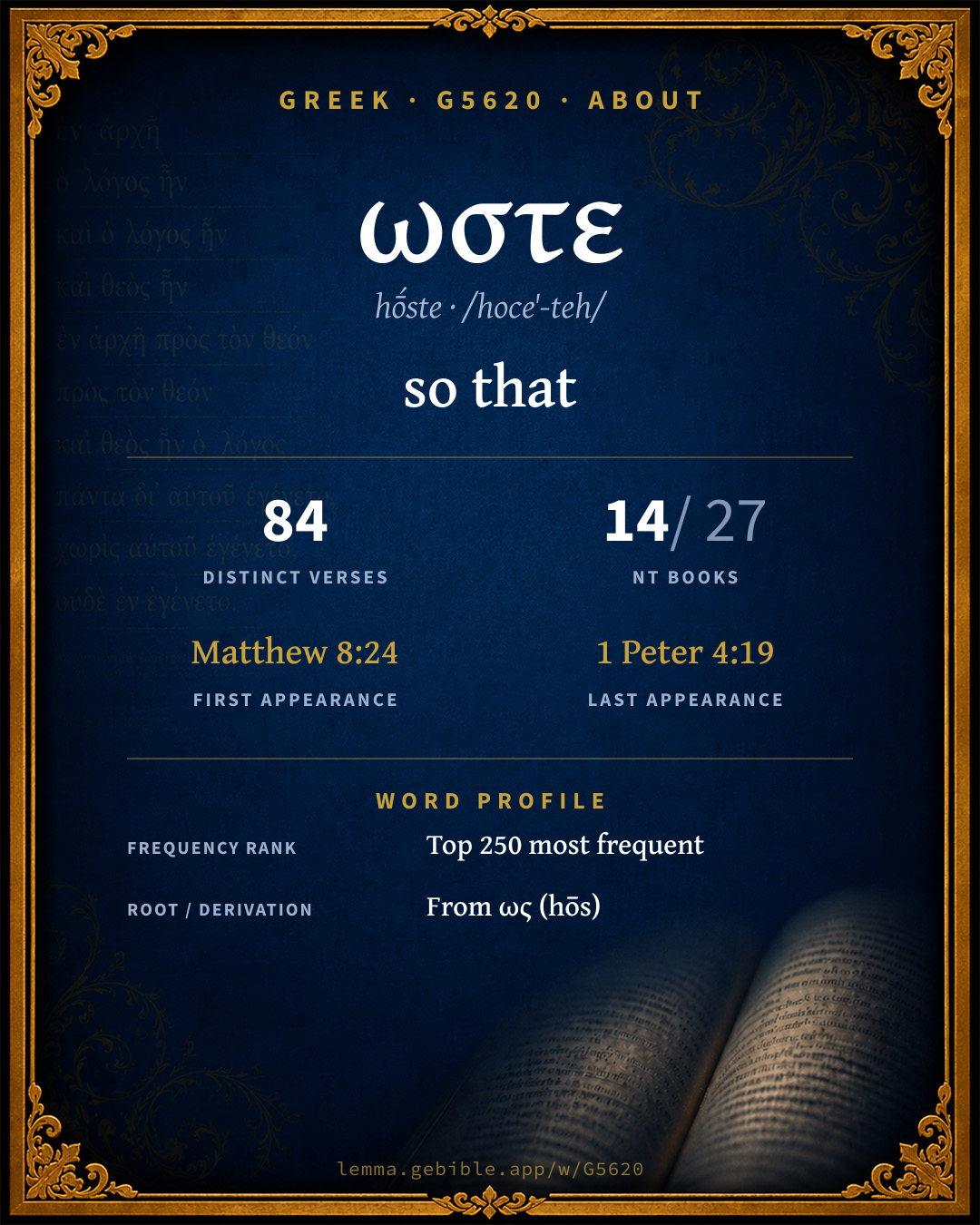
ὥστε
so that
‘so that’ is one of 2 main senses fuller range ↓
Full lexicon entry — Thayer's Greek Lexicon
From Thayer's Greek Lexicon
Where this word appears
Grammar key — what these labels mean
Part of speech
- Conjunction
- A joining word linking words or clauses.
Every verse where G5620 appears — 84 distinct verses across 14 books. Click any verse to open its interlinear word-by-word view. Verse text shown in the World English Bible for context — . Each verse’s Greek form is shown with its reference; the English is not keyword-highlighted, since the data carries no word-level English alignment. Use “Compare translations” on any verse to read it across multiple English versions. This concordance covers the Greek New Testament; Septuagint (Greek Old Testament) occurrences of this word are not indexed here.
Matthew 15 verses
- Matthew 8:24 ὥστε conj Behold, a great tempest arose in the sea, so much that the boat was covered with the waves, but he was asleep.
- Matthew 8:28 ὥστε conj When he came to the other side, into the country of the Gergesenes, two people possessed by demons met him there, coming out of the tombs, exceedingly fierce, so that nobody could pass by that way.
- Matthew 10:1 ὥστε conj He called to himself his twelve disciples, and gave them authority over unclean spirits, to cast them out, and to heal every disease and every sickness.
- Matthew 12:12 ὥστε conj Of how much more value then is a man than a sheep! Therefore it is lawful to do good on the Sabbath day."
- Matthew 12:22 ὥστε conj Then one possessed by a demon, blind and mute, was brought to him and he healed him, so that the blind and mute man both spoke and saw.
- Matthew 13:2 ὥστε conj Great multitudes gathered to him, so that he entered into a boat, and sat, and all the multitude stood on the beach.
- Matthew 13:32 ὥστε conj which indeed is smaller than all seeds. But when it is grown, it is greater than the herbs, and becomes a tree, so that the birds of the air come and lodge in its branches."
- Matthew 13:54 ὥστε conj Coming into his own country, he taught them in their synagogue, so that they were astonished, and said, "Where did this man get this wisdom, and these mighty works?
- Matthew 15:31 ὥστε conj so that the multitude wondered when they saw the mute speaking, injured whole, lame walking, and blind seeing--and they glorified the God of Israel.
- Matthew 15:33 ὥστε conj The disciples said to him, "Where should we get so many loaves in a deserted place as to satisfy so great a multitude?"
- Matthew 19:6 ὥστε conj So that they are no more two, but one flesh. What therefore God has joined together, don't let man tear apart."
- Matthew 23:31 ὥστε conj Therefore you testify to yourselves that you are children of those who killed the prophets.
- Matthew 24:24 ὥστε conj For there will arise false christs, and false prophets, and they will show great signs and wonders, so as to lead astray, if possible, even the chosen ones.
- Matthew 27:1 ὥστε conj Now when morning had come, all the chief priests and the elders of the people took counsel against Jesus to put him to death:
- Matthew 27:14 ὥστε conj He gave him no answer, not even one word, so that the governor marveled greatly.
Mark 13 verses
- Mark 1:27 ὥστε conj They were all amazed, so that they questioned among themselves, saying, "What is this? A new teaching? For with authority he commands even the unclean spirits, and they obey him!"
- Mark 1:45 ὥστε conj But he went out, and began to proclaim it much, and to spread about the matter, so that Jesus could no more openly enter into a city, but was outside in desert places: and they came to him from everywhere.
- Mark 2:2 ὥστε conj Immediately many were gathered together, so that there was no more room, not even around the door; and he spoke the word to them.
- Mark 2:12 ὥστε conj He arose, and immediately took up the mat, and went out in front of them all; so that they were all amazed, and glorified God, saying, "We never saw anything like this!"
- Mark 2:28 ὥστε conj Therefore the Son of Man is lord even of the Sabbath."
- Mark 3:10 ὥστε conj For he had healed many, so that as many as had diseases pressed on him that they might touch him.
- Mark 3:20 ὥστε conj The multitude came together again, so that they could not so much as eat bread.
- Mark 4:1 ὥστε conj Again he began to teach by the seaside. A great multitude was gathered to him, so that he entered into a boat in the sea, and sat down. All the multitude were on the land by the sea.
- Mark 4:32 ὥστε conj yet when it is sown, grows up, and becomes greater than all the herbs, and puts out great branches, so that the birds of the sky can lodge under its shadow."
- Mark 4:37 ὥστε conj There arose a great wind storm, and the waves beat into the boat, so much that the boat was already filled.
- Mark 9:26 ὥστε conj Having cried out, and convulsed greatly, it came out of him. The boy became like one dead; so much that most of them said, "He is dead."
- Mark 10:8 ὥστε conj and the two will become one flesh,' so that they are no longer two, but one flesh.
- Mark 15:5 ὥστε conj But Jesus made no further answer, so that Pilate marveled.
Luke 5 verses
- Luke 4:29 ὥστε conj They rose up, threw him out of the city, and led him to the brow of the hill that their city was built on, that they might throw him off the cliff.
- Luke 5:7 ὥστε conj They beckoned to their partners in the other boat, that they should come and help them. They came, and filled both boats, so that they began to sink.
- Luke 9:52 ὥστε conj and sent messengers before his face. They went, and entered into a village of the Samaritans, so as to prepare for him.
- Luke 12:1 ὥστε conj Meanwhile, when a multitude of many thousands had gathered together, so much so that they trampled on each other, he began to tell his disciples first of all, "Beware of the yeast of the Pharisees, which is hypocrisy.
- Luke 20:20 ὥστε conj They watched him, and sent out spies, who pretended to be righteous, that they might trap him in something he said, so as to deliver him up to the power and authority of the governor.
John 1 verse
Acts 8 verses
- Acts 1:19 ὥστε conj It became known to everyone who lived in Jerusalem that in their language that field was called 'Akeldama,' that is, 'The field of blood.'
- Acts 5:15 ὥστε conj They even carried out the sick into the streets, and laid them on cots and mattresses, so that as Peter came by, at the least his shadow might overshadow some of them.
- Acts 14:1 ὥστε conj It happened in Iconium that they entered together into the synagogue of the Jews, and so spoke that a great multitude both of Jews and of Greeks believed.
- Acts 15:39 ὥστε conj Then the contention grew so sharp that they separated from each other. Barnabas took Mark with him, and sailed away to Cyprus,
- Acts 16:26 ὥστε conj Suddenly there was a great earthquake, so that the foundations of the prison were shaken; and immediately all the doors were opened, and everyone's bonds were loosened.
- Acts 19:10 ὥστε conj This continued for two years, so that all those who lived in Asia heard the word of the Lord Jesus, both Jews and Greeks.
- Acts 19:12 ὥστε conj so that even handkerchiefs or aprons were carried away from his body to the sick, and the evil spirits went out.
- Acts 19:16 ὥστε conj The man in whom the evil spirit was leaped on them, and overpowered them, and prevailed against them, so that they fled out of that house naked and wounded.
Romans 5 verses
- Romans 7:4 ὥστε conj Therefore, my brothers, you also were made dead to the law through the body of Christ, that you would be joined to another, to him who was raised from the dead, that we might bring forth fruit to God.
- Romans 7:6 ὥστε conj But now we have been discharged from the law, having died to that in which we were held; so that we serve in newness of the spirit, and not in oldness of the letter.
- Romans 7:12 ὥστε conj Therefore the law indeed is holy, and the commandment holy, and righteous, and good.
- Romans 13:2 ὥστε conj Therefore he who resists the authority, withstands the ordinance of God; and those who withstand will receive to themselves judgment.
- Romans 15:19 ὥστε conj in the power of signs and wonders, in the power of God's Spirit; so that from Jerusalem, and around as far as to Illyricum, I have fully preached the Gospel of Christ;
1 Corinthians 14 verses
- 1 Corinthians 1:7 ὥστε conj so that you come behind in no gift; waiting for the revelation of our Lord Jesus Christ;
- 1 Corinthians 3:7 ὥστε conj So then neither he who plants is anything, nor he who waters, but God who gives the increase.
- 1 Corinthians 3:21 ὥστε conj Therefore let no one boast in men. For all things are yours,
- 1 Corinthians 4:5 ὥστε conj Therefore judge nothing before the time, until the Lord comes, who will both bring to light the hidden things of darkness, and reveal the counsels of the hearts. Then each man will get his praise from God.
- 1 Corinthians 5:1 ὥστε conj It is actually reported that there is sexual immorality among you, and such sexual immorality as is not even named among the Gentiles, that one has his father's wife.
- 1 Corinthians 5:8 ὥστε conj Therefore let us keep the feast, not with old yeast, neither with the yeast of malice and wickedness, but with the unleavened bread of sincerity and truth.
- 1 Corinthians 7:38 ὥστε conj So then both he who gives his own virgin in marriage does well, and he who doesn't give her in marriage does better.
- 1 Corinthians 10:12 ὥστε conj Therefore let him who thinks he stands be careful that he doesn't fall.
- 1 Corinthians 11:27 ὥστε conj Therefore whoever eats this bread or drinks the Lord's cup in a manner unworthy of the Lord will be guilty of the body and the blood of the Lord.
- 1 Corinthians 11:33 ὥστε conj Therefore, my brothers, when you come together to eat, wait one for another.
- 1 Corinthians 13:2 ὥστε conj If I have the gift of prophecy, and know all mysteries and all knowledge; and if I have all faith, so as to remove mountains, but don't have love, I am nothing.
- 1 Corinthians 14:22 ὥστε conj Therefore other languages are for a sign, not to those who believe, but to the unbelieving; but prophesying is for a sign, not to the unbelieving, but to those who believe.
- 1 Corinthians 14:39 ὥστε conj Therefore, brothers, desire earnestly to prophesy, and don't forbid speaking with other languages.
- 1 Corinthians 15:58 ὥστε conj Therefore, my beloved brothers, be steadfast, immovable, always abounding in the Lord's work, because you know that your labor is not in vain in the Lord.
2 Corinthians 7 verses
- 2 Corinthians 1:8 ὥστε conj For we don't desire to have you uninformed, brothers, concerning our affliction which happened to us in Asia, that we were weighed down exceedingly, beyond our power, so much that we despaired even of life.
- 2 Corinthians 2:7 ὥστε conj so that on the contrary you should rather forgive him and comfort him, lest by any means such a one should be swallowed up with his excessive sorrow.
- 2 Corinthians 3:7 ὥστε conj But if the service of death, written engraved on stones, came with glory, so that the children of Israel could not look steadfastly on the face of Moses for the glory of his face; which was passing away:
- 2 Corinthians 4:12 ὥστε conj So then death works in us, but life in you.
- 2 Corinthians 5:16 ὥστε conj Therefore we know no one after the flesh from now on. Even though we have known Christ after the flesh, yet now we know him so no more.
- 2 Corinthians 5:17 ὥστε conj Therefore if anyone is in Christ, he is a new creation. The old things have passed away. Behold, all things have become new.
- 2 Corinthians 7:7 ὥστε conj and not by his coming only, but also by the comfort with which he was comforted in you, while he told us of your longing, your mourning, and your zeal for me; so that I rejoiced still more.
Galatians 5 verses
- Galatians 2:13 ὥστε conj And the rest of the Jews joined him in his hypocrisy; so that even Barnabas was carried away with their hypocrisy.
- Galatians 3:9 ὥστε conj So then, those who are of faith are blessed with the faithful Abraham.
- Galatians 3:24 ὥστε conj So that the law has become our tutor to bring us to Christ, that we might be justified by faith.
- Galatians 4:7 ὥστε conj So you are no longer a bondservant, but a son; and if a son, then an heir of God through Christ.
- Galatians 4:16 ὥστε conj So then, have I become your enemy by telling you the truth?
Philippians 3 verses
- Philippians 1:13 ὥστε conj so that it became evident to the whole praetorian guard, and to all the rest, that my bonds are in Christ;
- Philippians 2:12 Ὥστε conj So then, my beloved, even as you have always obeyed, not only in my presence, but now much more in my absence, work out your own salvation with fear and trembling.
- Philippians 4:1 Ὥστε conj Therefore, my brothers, beloved and longed for, my joy and crown, so stand firm in the Lord, my beloved.
1 Thessalonians 3 verses
- 1 Thessalonians 1:7 ὥστε conj so that you became an example to all who believe in Macedonia and in Achaia.
- 1 Thessalonians 1:8 ὥστε conj For from you has sounded forth the word of the Lord, not only in Macedonia and Achaia, but also in every place your faith toward God has gone forth; so that we need not to say anything.
- 1 Thessalonians 4:18 ὥστε conj Therefore comfort one another with these words.
2 Thessalonians 2 verses
- 2 Thessalonians 1:4 ὥστε conj so that we ourselves boast about you in the assemblies of God for your patience and faith in all your persecutions and in the afflictions which you endure.
- 2 Thessalonians 2:4 ὥστε conj he who opposes and exalts himself against all that is called God or that is worshiped; so that he sits as God in the temple of God, setting himself up as God.
Hebrews 1 verse
1 Peter 2 verses
- 1 Peter 1:21 ὥστε conj who through him are believers in God, who raised him from the dead, and gave him glory; so that your faith and hope might be in God.
- 1 Peter 4:19 ὥστε conj Therefore let them also who suffer according to the will of God in doing good entrust their souls to him, as to a faithful Creator.
About this entry
At a glance — auto-summarized from this page’s data, not written by a person. Every figure links to its source below. This summary describes the numbers; it doesn’t interpret them.
“so that” is the headline sense of the Greek word ωστε (hṓste). The King James Version also renders it “wherefore,” a usage modern versions have dropped for “that” — see the renderings breakdown. It appears 84 verses across 14 books of the Greek New Testament, among its moderately common vocabulary. Scripture first uses it in Matthew 8:24. Catalogued under 2 senses, its meaning is not single-sense. See the sense tree, 84-verse concordance, and the renderings breakdown below.
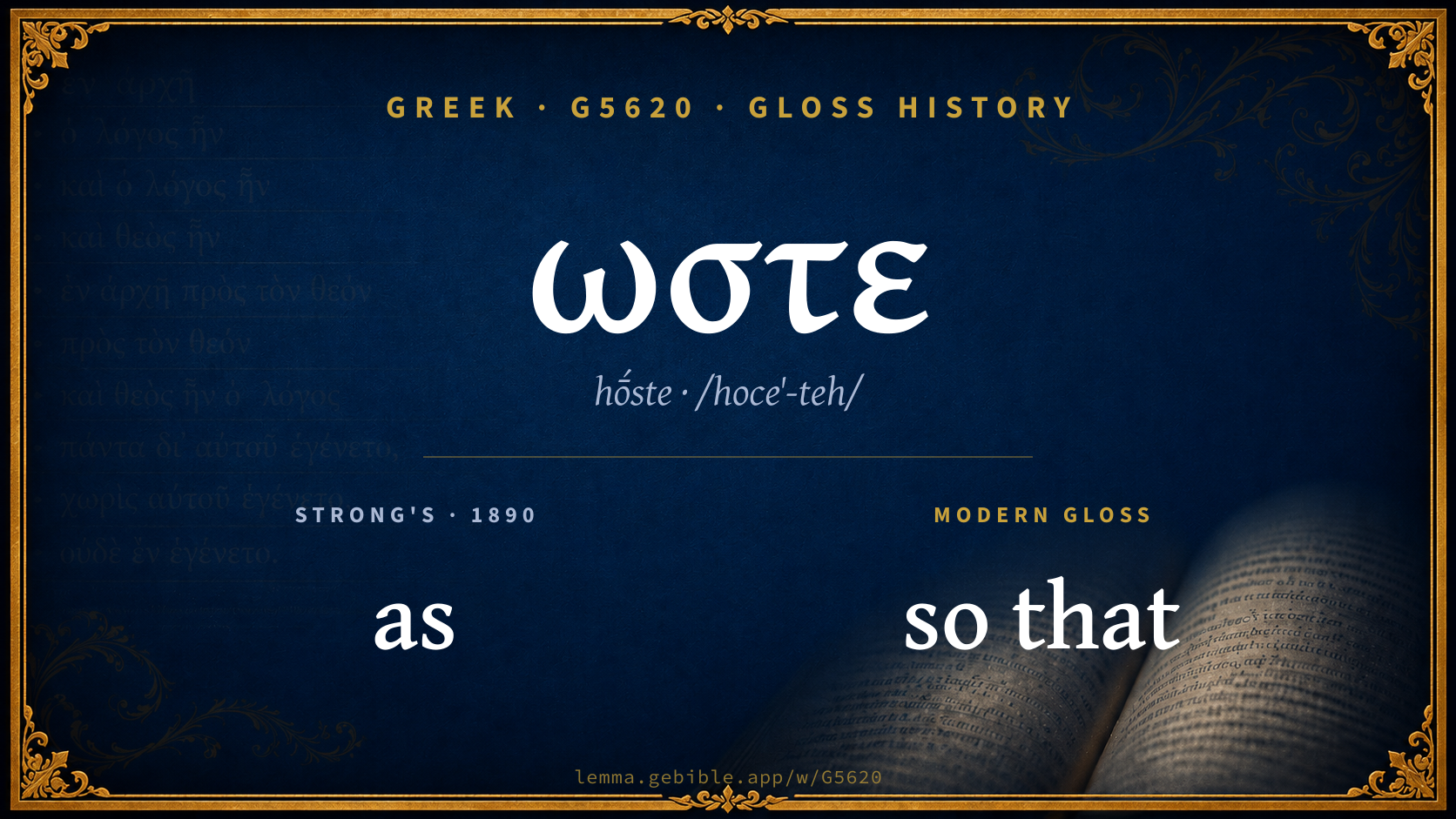
Gloss history
Strong's 1890 vs modern scholarship
About this word
Strong's G5620 catalogs a Greek word from the Greek New Testament.
These counts are not copied from any lexicon or concordance. They are computed here, from the morphology-tagged Greek New Testament. What Lemma adds →
- 84
- distinct verses
- The word appears in 84 distinct verses.
- 14 / 27
- NT books
- The word appears in 14 of 27 New Testament books.
- #204
- by frequency
- Top 250 most frequent Greek words (rank 204 of 5,347 Greek words by occurrence).
View all 84 occurrences in the concordance →
Most concentrated in
- Matthew 15 verses 18%
- 1 Corinthians 14 verses 17%
- Mark 13 verses 15%
By section of the New Testament
By traditional corpus
Conventional, traditional groupings — biblical authorship is debated, so this is a traditional corpus grouping, not an authorship claim. Some books belong to more than one corpus (Luke is in both the Gospels and the Lukan corpus, and so on), so these shares overlap and need not total 100%. Each figure is a share of the word’s 84 distinct verses.
- Pauline corpus 39 verses · 46%
- Gospels 34 verses · 40%
- Lukan (Luke–Acts) 13 verses · 15%
- General (Catholic) Epistles 2 verses · 2%
- Johannine 1 verse · 1%
- Hebrews 1 verse · 1%
How translations render this word
Counts come from each version’s own published word-to-Strong’s tagging or interlinear alignment — an approximate guide to how each version renders this word, not a word-level alignment the data otherwise carries. Because each total is that version’s own tagged count, the per-version totals vary from one another and need not match the appearance or distinct-verse counts above. These counts may also differ from a printed concordance because Lemma counts each distinctly tagged rendering and does not collapse phrase taggings into a single head-word total. This is a fixed set of word-tagged versions (KJV, ASV, BSB, ULT) and does not change with the reading translation you choose elsewhere. Each version’s license is shown beside its name below (and on Sources).
- King James Version: That 17×, Wherefore 17×, So 16×
- American Standard Version: That 28×, Wherefore 16×, Insomuch that 15×
- Berean Standard Bible: That 26×, So 18×, Therefore 13×
- unfoldingWord Literal Text: That 39×, Then 16×, Therefore 13×
King James Version Public Domain
Renders G5620 across 82 tagged occurrences — most commonly:
Plus 3 renderings that appear only once — usually multi-word phrases or single function words the recovered tagging swept in, not distinct renderings. Not rendered by a distinct English word in 1 further occurrence.
American Standard Version Public Domain
Renders G5620 across 81 tagged occurrences — most commonly:
Plus 6 renderings that appear only once — usually multi-word phrases or single function words the recovered tagging swept in, not distinct renderings.
Berean Standard Bible Public Domain
Renders G5620 across 77 tagged occurrences — most commonly:
Plus 4 renderings that appear only once — usually multi-word phrases or single function words the recovered tagging swept in, not distinct renderings. Not rendered by a distinct English word in 4 further occurrences.
unfoldingWord Literal Text CC BY-SA 4.0
Renders G5620 across 85 tagged occurrences — most commonly:
Plus 3 renderings that appear only once — usually multi-word phrases or single function words the recovered tagging swept in, not distinct renderings.
Senses in Thayer's
The 2 senses Thayer's distinguishes for this word, in lexicon order (not ranked by frequency or importance). The full entry — with sub-senses — is in the Lexicon Entry tab.
- so that, insomuch that
- so then, therefore, wherefore
Word origin
Derived from ως (hōs) (G5613) — as.
Forms in the corpus
The 2 distinct written forms G5620 takes in the Greek New Testament, most frequent first — each parse links to that case’s occurrences in the concordance.
| Form | Parsing | Example | Uses |
|---|---|---|---|
| ὥστε hṓste | Conjunction | Matthew 8:24 | 82 |
| Ὥστε Hṓste | Conjunction | Philippians 2:12 | 2 |
Same root — word family
Other Thayer's entries built from the same root as G5620, grouped by Strong’s listed origin. These share a root / origin per the lexicon — not necessarily a shared meaning. Each links to that word’s own entry.
Derives from
Shares the same root
Compare all same-root words → Showing 4 of 5 — not the complete family. They share a root, not necessarily a meaning.
Septuagint usage
The same Greek word ωστε appears 120 times in the Greek Old Testament (Septuagint), across 114 verses in 21 books.
- 120
- LXX occurrences
- Tagged occurrences of this Greek word in the Septuagint.
- 114
- verses
- Distinct Septuagint verses containing this word.
- 21 / 39
- OT books
- The word appears in 21 of the 39 Old Testament books.
Sample Septuagint occurrences
- Genesis 1:15 ὥστε
- Exodus 5:2 ὥστε
- Leviticus 5:22 ὥστε
- Numbers 5:8 ὥστε
- Deuteronomy 4:35 ὥστε
- Joshua 8:3 ὥστε
- Judges 3:1 ὥστε
- Ruth 4:5 ὥστε
- 1 Samuel 3:11 ὥστε
- 2 Samuel 2:17 ὥστε
- 2 Kings 9:37 ὥστε
- 2 Chronicles 6:6 ὥστε
Septuagint occurrences (same lexeme)
Every verse where the same Strong’s number (G5620) appears in the Greek Septuagint — showing the first 50 of 114. Verse text shown in the World English Bible for context; the Greek form is the matched word — the English is not keyword-highlighted.
- Genesis 1:15 ὥστε and let them be for lights in the expanse of sky to give light on the earth," and it was so.
- Genesis 1:17 ὥστε God set them in the expanse of sky to give light to the earth,
- Genesis 9:15 ὥστε and I will remember my covenant, which is between me and you and every living creature of all flesh, and the waters will no more become a flood to destroy all flesh.
- Genesis 15:7 ὥστε He said to him, "I am Yahweh who brought you out of Ur of the Chaldees, to give you this land to inherit it."
- Genesis 23:8 ὥστε He talked with them, saying, "If it be your mind that I should bury my dead out of my sight, hear me, and entreat for me to Ephron the son of Zohar,
- Genesis 34:22 ὥστε Only on this condition will the men consent to us to dwell with us, to become one people, if every male among us be circumcised, as they are circumcised.
- Genesis 34:30 ὥστε Jacob said to Simeon and Levi, "You have troubled me, to make me odious to the inhabitants of the land, among the Canaanites and the Perizzites. I am few in number. They will gather themselves together against me and strike me, and I will be destroyed, I and my house."
- Genesis 45:27 ὥστε They told him all the words of Joseph, which he had said to them. When he saw the wagons which Joseph had sent to carry him, the spirit of Jacob, their father, revived.
- Exodus 5:2 ὥστε Pharaoh said, "Who is Yahweh, that I should listen to his voice to let Israel go? I don't know Yahweh, and moreover I will not let Israel go."
- Exodus 6:4 ὥστε I have also established my covenant with them, to give them the land of Canaan, the land of their travels, in which they lived as aliens.
- Exodus 6:13 ὥστε Yahweh spoke to Moses and to Aaron, and gave them a charge to the children of Israel, and to Pharaoh king of Egypt, to bring the children of Israel out of the land of Egypt.
- Exodus 7:2 ὥστε You shall speak all that I command you; and Aaron your brother shall speak to Pharaoh, that he let the children of Israel go out of his land.
- Exodus 7:24 ὥστε All the Egyptians dug round about the river for water to drink; for they couldn't drink of the water of the river.
- Exodus 12:4 ὥστε and if the household be too little for a lamb, then he and his neighbor next to his house shall take one according to the number of the souls; according to what everyone can eat you shall make your count for the lamb.
- Exodus 12:42 ὥστε It is a night to be much observed to Yahweh for bringing them out from the land of Egypt. This is that night of Yahweh, to be much observed of all the children of Israel throughout their generations.
- Exodus 15:22 ὥστε Moses led Israel onward from the Red Sea, and they went out into the wilderness of Shur; and they went three days in the wilderness, and found no water.
- Exodus 23:2 ὥστε You shall not follow a crowd to do evil; neither shall you testify in court to side with a multitude to pervert justice;
- Exodus 25:27 ὥστε the rings shall be close to the rim, for places for the poles to carry the table.
- Exodus 29:1 ὥστε "This is the thing that you shall do to them to make them holy, to minister to me in the priest's office: take one young bull and two rams without blemish,
- Exodus 29:36 ὥστε Every day shall you offer the bull of sin-offering for atonement: and you shall cleanse the altar, when you make atonement for it; and you shall anoint it, to sanctify it.
- Exodus 29:42 ὥστε It shall be a continual burnt offering throughout your generations at the door of the tent of meeting before Yahweh, where I will meet with you, to speak there to you.
- Exodus 30:4 ὥστε You shall make two golden rings for it under its molding; on its two ribs, on its two sides you shall make them; and they shall be for places for poles with which to bear it.
- Exodus 30:18 ὥστε "You shall also make a basin of brass, and the base of it of brass, in which to wash. You shall put it between the tent of meeting and the altar, and you shall put water in it.
- Exodus 30:38 ὥστε Whoever shall make any like that, to smell of it, he shall be cut off from his people."
- Exodus 36:2 ὥστε Moses called Bezalel and Oholiab, and every wise-hearted man, in whose heart Yahweh had put wisdom, even everyone whose heart stirred him up to come to the work to do it:
- Exodus 36:10 ὥστε He coupled five curtains to one another, and the other five curtains he coupled one to another.
- Exodus 36:38 ὥστε and the five pillars of it with their hooks. He overlaid their capitals and their fillets with gold, and their five sockets were of brass.
- Exodus 38:4 ὥστε He made for the altar a grating of a network of brass, under the ledge around it beneath, reaching halfway up.
- Exodus 38:10 ὥστε their pillars were twenty, and their sockets twenty, of brass; the hooks of the pillars and their fillets were of silver.
- Exodus 38:24 ὥστε All the gold that was used for the work in all the work of the sanctuary, even the gold of the offering, was twenty-nine talents, and seven hundred thirty shekels, after the shekel of the sanctuary.
- Exodus 39:12 ὥστε and the third row, a jacinth, an agate, and an amethyst;
- Exodus 40:15 ὥστε You shall anoint them, as you anointed their father, that they may minister to me in the priest's office. Their anointing shall be to them for an everlasting priesthood throughout their generations.
- Leviticus 5:22 ὥστε
- Leviticus 7:30 ὥστε With his own hands he shall bring the offerings of Yahweh made by fire. He shall bring the fat with the breast, that the breast may be waved for a wave offering before Yahweh.
- Leviticus 8:34 ὥστε What has been done this day, so Yahweh has commanded to do, to make atonement for you.
- Leviticus 14:21 ὥστε "If he is poor, and can't afford so much, then he shall take one male lamb for a trespass offering to be waved, to make atonement for him, and one tenth of an ephah of fine flour mingled with oil for a meal offering, and a log of oil;
- Leviticus 15:32 ὥστε This is the law of him who has a discharge, and of him who has an emission of semen, so that he is unclean thereby;
- Leviticus 16:10 ὥστε But the goat, on which the lot fell for the scapegoat, shall be presented alive before Yahweh, to make atonement for him, to send him away for the scapegoat into the wilderness.
- Leviticus 17:4 ὥστε and hasn't brought it to the door of the Tent of Meeting, to offer it as an offering to Yahweh before the tabernacle of Yahweh: blood shall be imputed to that man. He has shed blood; and that man shall be cut off from among his people.
- Leviticus 20:5 ὥστε then I will set my face against that man, and against his family, and will cut him off, and all who play the prostitute after him, to play the prostitute with Molech, from among their people.
- Leviticus 20:6 ὥστε "'The person that turns to those who are mediums, and to the wizards, to play the prostitute after them, I will even set my face against that person, and will cut him off from among his people.
- Leviticus 22:33 ὥστε who brought you out of the land of Egypt, to be your God. I am Yahweh."
- Leviticus 23:37 ὥστε "'These are the appointed feasts of Yahweh, which you shall proclaim to be holy convocations, to offer an offering made by fire to Yahweh, a burnt offering, and a meal offering, a sacrifice, and drink offerings, each on its own day;
- Leviticus 25:28 ὥστε But if he isn't able to get it back for himself, then what he has sold shall remain in the hand of him who has bought it until the Year of Jubilee: and in the Jubilee it shall be released, and he shall return to his propery.
- Leviticus 25:38 ὥστε I am Yahweh your God, who brought you forth out of the land of Egypt, to give you the land of Canaan, and to be your God.
- Leviticus 26:15 ὥστε and if you shall reject my statutes, and if your soul abhors my ordinances, so that you will not do all my commandments, but break my covenant;
- Leviticus 26:44 ὥστε Yet for all that, when they are in the land of their enemies, I will not reject them, neither will I abhor them, to destroy them utterly, and to break my covenant with them; for I am Yahweh their God;
- Leviticus 27:2 ὥστε "Speak to the children of Israel, and say to them, 'When a man makes a vow, the persons shall be for Yahweh by your valuation.
- Numbers 5:8 ὥστε But if the man has no kinsman to whom restitution may be made for the guilt, the restitution for guilt which is made to Yahweh shall be the priest's; besides the ram of the atonement, by which atonement shall be made for him.
- Numbers 7:1 ὥστε It happened on the day that Moses had finished setting up the tabernacle, and had anointed it and sanctified it, with all its furniture, and the altar with all its vessels, and had anointed and sanctified them;
These are occurrences of the same Greek lexeme (G5620) in the Septuagint — not a translation of any one Hebrew word. The store carries no word-level Hebrew↔Greek alignment, so no Hebrew original is asserted here. Counts come from the recovered LXX Strong's tagging — high-frequency vocabulary is well covered, while rare or late forms may be untagged — so they reflect tagged occurrences and may slightly undercount.