2 Corinthians 4:12

Greek (Tischendorf 8th ed.) 2 Corinthians 4:12 appears in the Greek New Testament. The text above is from the Tischendorf 8th edition. Each word links to its Strong’s number and a concise gloss. Click any word for its full Thayer’s Greek Lexicon entry.
Download image
Cite this verse

2 Corinthians 4:12 (World English Bible). Public Domain. Lemma interlinear Bible study tool, https://lemma.gebible.app/v/2-corinthians/4/12.

Show BibTeX & RIS
BibTeX
RIS
English Translation
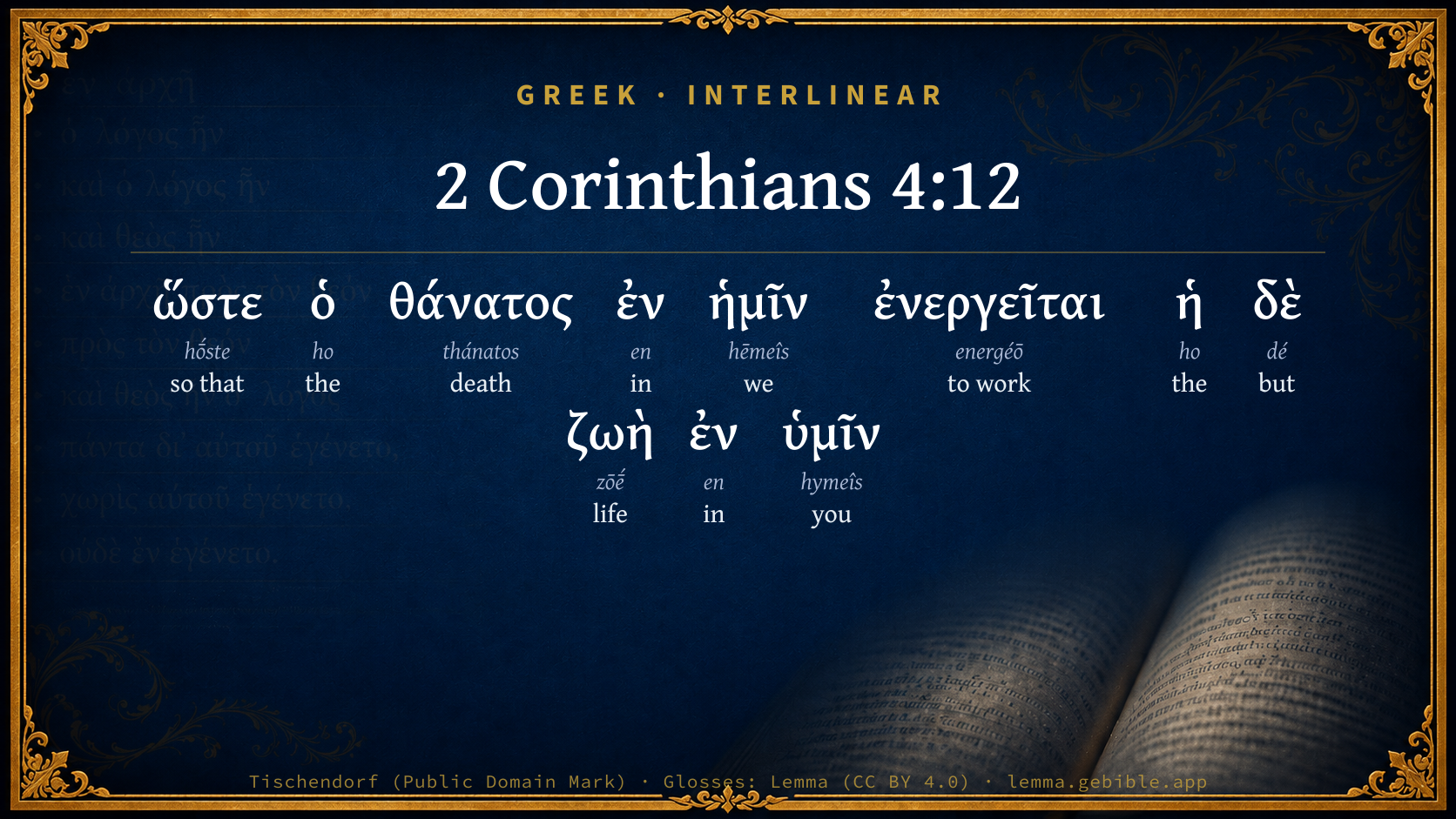
So then death works in us, but life in you.
World English Bible · Public Domain
Download a study sheet

One document with this verse’s original text, its word-by-word gloss line, the meaning frame, cross-references with their text, attributed commentary, and full source and license credits — printable, and it pastes into notes with its structure intact.

This verse Autodidact and up

Study sheet (.html) Plain text (.txt)

A passage Seminary Student

Up to 50 verses in one chapter. A passage sheet keeps up to 6 commentary sources and 12 cross-references per verse, in the order this page ranks them, and says so on the sheet whenever that leaves anything out. Ask for a single verse and you get the Autodidact verse sheet above.

Everything on this page stays free to read, with no account — the sheet is a download of what is already on screen, not access to it.

Want to remove ads? Support Godless Engineer
Compare translations 3

The same verse in 3 English versions, stacked beneath the original-language interlinear above. Click any original word for its lexicon entry.

Each is an independent rendering of the whole verse — the interlinear is not word-aligned to these translations.

Highlighted words mark where these versions differ — a whole-verse word diff, not a word-by-word alignment.

  • World English Bible Public Domain
    So then death works in us, but life in you.
  • King James Version Public Domain
    So then death worketh in us, but life in you.
  • unfoldingWord Literal Text CC BY-SA 4.0
    So then, death works in us, but life in you.

unfoldingWord Literal Text — © unfoldingWord, licensed CC BY-SA 4.0. Word-aligned USFM3 via Door43 (git.door43.org/unfoldingWord/en_ult).

Versions to compare (up to 4)

3 of 4 selected

Show all 19 translations

Every available English version of this verse, each an independent rendering of the whole verse.

  • World English Bible Public Domain
    So then death works in us, but life in you.
  • Berean Standard Bible Public Domain
    So then, death is at work in us, but life is at work in you.
  • Majority Standard Bible Public Domain
    So then, death is at work in us, but life is at work in you.
  • King James Version Public Domain
    So then death worketh in us, but life in you.
  • American Standard Version (1901) Public Domain
    So then death worketh in us, but life in you.
  • Revised Version (1885) Public Domain
    So then death worketh in us, but life in you.
  • Geneva Bible (1599) Public Domain
    So then death worketh in vs, and life in you.
  • Douay-Rheims (1899) Public Domain
    So then death worketh in us, but life in you.
  • Young's Literal Translation Public Domain
    so that, the death indeed in us doth work, and the life in you.
  • Literal Standard Version CC BY-SA 4.0
    so that, death indeed works in us, and life in you.
  • Unlocked Literal Bible CC BY-SA 4.0
    So death is at work in us, but life is at work in you.
  • unfoldingWord Literal Text CC BY-SA 4.0
    So then, death works in us, but life in you.
  • Darby Bible Public Domain
    so that death works in us, but life in you.
  • World Messianic Bible Public Domain
    So then death works in us, but life in you.
  • Webster's Bible Public Domain
    So then death worketh in us, but life in you.
  • Free Bible Version CC BY-SA 4.0
    As a result, we are facing death so that you may have life!
  • Bible in Basic English Public Domain
    So then, death is working in us, but life in you.
  • Text-Critical English NT CC BY 4.0
    So then, death is at work in us, but life is at work in you.
  • Tyndale New Testament (1534) Public Domain
    So then deeth worketh in vs and lyfe in you.

Literal Standard Version (2020), Covenant Press — licensed CC BY-SA 4.0. Text via the HelloAO Bible API (eBible.org). Unlocked Literal Bible (unfoldingWord) — licensed CC BY-SA 4.0. Text via the HelloAO Bible API (eBible.org). unfoldingWord Literal Text — © unfoldingWord, licensed CC BY-SA 4.0. Word-aligned USFM3 via Door43 (git.door43.org/unfoldingWord/en_ult). Free Bible Version, Dr. Jonathan Gallagher — licensed CC BY-SA 4.0. Text via the HelloAO Bible API (eBible.org).

Word by word

More ways to search: Search by grammar → Find every occurrence → Compare this word →

Practice this passage: Drill this verse → Learn its vocabulary →

About this verse

These counts appear in no published source. They are computed here, from the morphology-tagged text and Lemma’s own curated glosses. What Lemma adds →

11
words
9
distinct lemmas
Pauline Epistles
section

Notable vocabulary

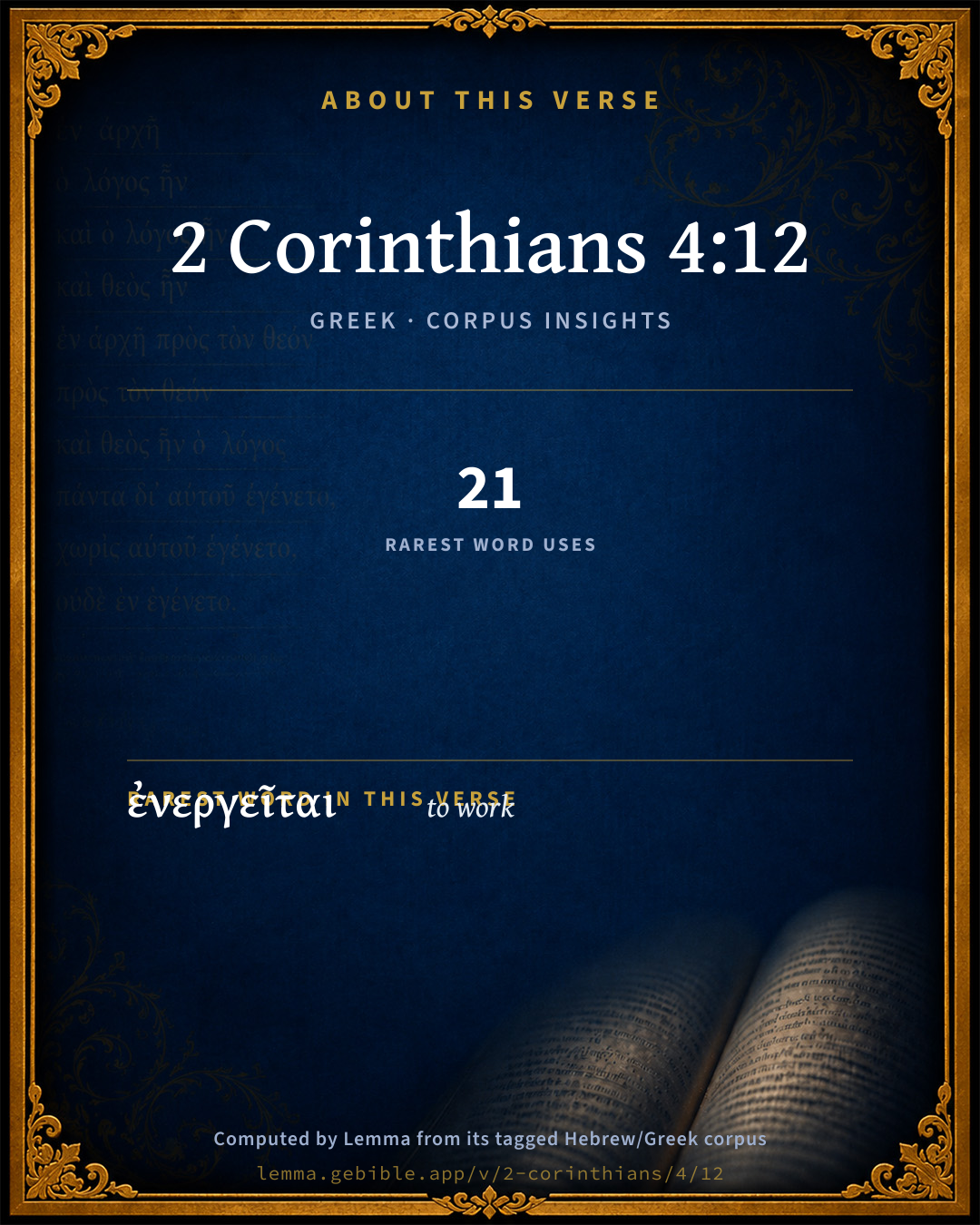
The rarest word here is ἐνεργεῖται to work G1754 — appearing just 21 times in the whole Greek New Testament.

Shared distinctive vocabulary

ἐνεργεῖται to work G1754 occurs in 19 verses of the Greek New Testament. Also found in:

Repetition

Words recur within this verse:

Cross-references

7

Topical passages linked to 2 Corinthians 4:12 in the Treasury of Scripture Knowledge — connected by theme and wording, ordered by reader-vote popularity; previews shown in the World English Bible.

  • 2 Corinthians 13:9 For we rejoice when we are weak and you are strong. And this we also pray for, even your perfecting.
  • Acts 20:24 But these things don't count; nor do I hold my life dear to myself, so that I may finish my race with joy, and the ministry which I received from the Lord Jesus, to fully testify to the Gospel of the grace of God.
  • 1 Corinthians 4:10 We are fools for Christ's sake, but you are wise in Christ. We are weak, but you are strong. You have honor, but we have dishonor.
  • 1 John 3:16 By this we know love, because he laid down his life for us. And we ought to lay down our lives for the brothers.
  • Philippians 2:17 Yes, and if I am poured out on the sacrifice and service of your faith, I rejoice, and rejoice with you all.
  • 2 Corinthians 12:15 I will most gladly spend and be spent for your souls. If I love you more abundantly, am I loved the less?
  • Philippians 2:30 because for the work of Christ he came near to death, risking his life to supply that which was lacking in your service toward me.

Cross-references courtesy of OpenBible.info (CC BY 4.0).

Commentary

Notes on 2 Corinthians 4:12 from classic Christian and Jewish commentators (each source and its license shown beneath its notes). The classic Christian expositions comment on the surrounding passage and are grouped to its opening verse, so a note may address several verses; the Jewish commentaries on the Tanakh (Rashi and others) are per-verse, so they appear only where the commentator wrote on this verse.

Lemma curates 59 commentaries, every one of them public domain or Creative Commons licensed, each selected and text-cleaned for this edition rather than reprinted as found. About our sources →

Tyndale Open Study Notes

Tyndale Open Resources

4:12 Through his life of danger and exposure to mortal peril (see 1 Cor 15:30), Paul was reinforcing the faith of the Christians in the churches that he founded (cp. Col 1:24; 2 Tim 2:10).

Tyndale Open Study Notes — © Tyndale Open Resources, licensed CC BY-SA 4.0. Text via the HelloAO Bible API.

Bengel's Gnomon

Johann Albrecht Bengel

2Co 4:12. Θάνατος, death) of the body [by the corruption (decay) of the outward man.—V. g.]—ζωὴ, life) viz., that of the Spirit.

Bengel's Gnomon of the New Testament — English translation (T&T Clark, Edinburgh, 1860) — public domain. Text from a community e-Sword module.

Meyer's Critical & Exegetical Commentary

Heinrich August Wilhelm Meyer

2Co_4:12. An inference from 2Co_4:11; hence the meaning can be no other than: Accordingly, since we are continually exposed to death, it is death whose working clings to us; but since the revelation of the life of Jesus in us goes to benefit you through our work in our vocation, the power opposed to death, life, is that which exercises its working on you. ὁ θάνατος and ἡ ζωή can, according to 2Co_4:10-11, be nothing else than the bodily death and the bodily life, both conceived of as personal powers, and consequently the life not as existent in Jesus (Hofmann). It was death to which Paul and those like him were ever given up, and it was life which, in spite of all deadly perils, retained the victory and remained preserved. And this victorious power of life, presenting in His servants the life of the risen Lord, was active (comp. Php_1:22; Php_1:24) through the continuance thereby rendered possible of the apostolic working among the Christians, and especially among the Corinthians (ἐν ὑμῖν), although they were not affected in like manner by that working of death. Estius (following Lombard) and Grotius (comp. Olshausen) take ἐνεργ. passively: in nobis … mors agitur et exercetur … ut vicissim … per nostra pericula nostramque quotidianam mortem vobis gignitur, augetur, perficitur vita spiritualis (Estius). But in the N. T. ἐνεργ. never occurs in a passive sense (see on 2Co_1:6), and according to 2Co_4:10-11, ἡ ζωή cannot be vita spiritualis, as even Osiander (comp. Ewald) here again interprets it. Calvin, Menochius, and Michaelis find in it something ironical: we are in continual deadly peril, while you are in comfort. Comp. Chrysostom, who, however, does not expressly signalize the ironical character of the passage. On ζῆν, vita frui, see Jacobs, ad Anthol. X. p. 70; comp. ζῆν καὶ εἶναι, Dissen, ad Dem. de Cor. p. 239. But the context gives no suggestion whatever of irony or of any such reference of ἡ ζωή (ὑμεῖς δὲ ἐν ἀνέσει, τὴν ἐκ τούτων τῶν κινδύνων καρπούμενοι ζωήν, Chrysostom). As foreign to it is Rückerts view, which refers the first half of the verse to Pauls alleged sickness, and the second half to the state of health of the Corinthians, which, as Paul had recently learned through Titus, had considerably improved after a sickness that had been prevalent (1Co_11:30).

We may add that the first clause is set down without μέν, because Paul purposely avoids paving the way for the contrast, in order thereupon to bring it forward by way of surprise. Infert particula δέ novam rem cum aliqua oppositione, Klotz, ad Devar. p. 356.

Meyer — Critical and Exegetical Commentary on the New Testament — English translation by Peter Christie, edited by Frederick Crombie (T&T Clark, 1880) — public domain. Text from a community e-Sword module.

Expositor's Greek Testament

ed. W. Robertson Nicoll

2Co 4:12 . The manifestation of Christ’s Life in the Apostle’s daily νέκρωσις is thus visible to the world and especially to his converts. ὥστε ὁ μὲν θάνατος κ . τ . λ .: so then Death worketh in us (see on 2Co 1:6 ), but Life in you, i.e. , the Risen Life of Christ, the source of present grace as of future glory. It is this latter aspect of ζωή , viz. , as the life after death, to which his thoughts now turn.

The Expositor's Greek Testament, edited by W. Robertson Nicoll (1897–1910) — public domain. Text from a community e-Sword module.

Geneva Bible (1599)

Geneva Bible translators

A very cunning conclusion: as if he would say, Therefore to be short, we die, that you may live by our death, for that they ventured into all those dangers for the building of the Church’s sake, and they ceased not to confirm all the faithful with the examples of their patience.

Geneva Bible (1599) marginal notes — public domain. Text via Bolls.life.

Jamieson, Fausset & Brown

Robert Jamieson, A. R. Fausset & David Brown

The "death" of Christ manifested in the continual "perishing of our outward man" (Co2 4:16), works peculiarly in us, and is the means of working spiritual "life" in you. The life whereof we witness in our bodily dying, extends beyond ourselves, and is brought by our very dying to you.

Jamieson, Fausset & Brown — Commentary Critical and Explanatory on the Whole Bible (1871) — public domain (CC PDM 1.0). Text via the HelloAO Bible API.

Adam Clarke's Commentary

Verse 12. Death worketh in us, c.] We apostles are in continual danger, and live a dying life while you who have received this Gospel from us are in no danger.

Adam Clarke's Commentary on the Bible (1810–1826) — public domain. Text from a community e-Sword/MySword module.

John Calvin's Commentaries

12. Hence death indeed. This is said ironically, because it was unseemly that the Corinthians should live happily, and in accordance with their desire, and that they should, free from anxiety, take their ease, while in the mean time Paul was struggling with incessant hardships. Such an allotment would certainly have been exceedingly unreasonable. It was also necessary that the folly of the Corinthians should be reproved, inasmuch as they contrived to themselves a Christianity without the cross, and, not content with this, held in contempt the servants of Christ, because they were not so effeminate. Now as death denotes all afflictions, or a life full of vexations, so also life denotes a condition that is prosperous and agreeable; agreeably to the maxim: “Life is — not to live, but to be well.”

John Calvin's Commentaries (1540-1563) — public domain. Text from the Calvin Translation Society English edition (1840s-50s) via the Christian Classics Ethereal Library (ccel.org). Calvin's coverage is partial (roughly two-thirds of the Bible); uncommented books and verses are honest gaps, never fabricated. The 19th-century editor's footnotes and remarks are omitted so the notes are faithfully Calvin's own voice.

Ellicott's Commentary for English Readers

(12) So then death worketh in us, but life in you.—“Life” is here clearly used in its higher spiritual sense, as in the preceding verse. We trace in the words something of the same pathos as in 1Co_4:8-13, without the irony which is there perceptible. “You,” he seems to say, “reap the fruit of my sufferings. The ‘dying’ is all my own; you know nothing of that conflict with pain and weakness; but the ‘life’ which is the result of that experience works in you as well as in me, and finds in you the chief sphere of its operation.”

A Bible Commentary for English Readers, edited by Charles John Ellicott (1878–1897) — public domain. Text from a community e-Sword module.

The Cambridge Bible for Schools and Colleges

gen. ed. J. J. S. Perowne

12. So then death worketh in us, but life in you] See 1Co_4:9. The Apostle here enunciates a principle common to the material and the spiritual world. From death comes life, from decay regeneration. The death of Christ was the life of the world; the daily dying (1Co_15:31) of His disciples, by virtue of the same Spirit that lives in Him, is the means whereby that life spreads among mankind. Death may be said to be working in Christ’s ministers, because of their visible sorrows, anxieties, persecutions (but see 2Co_4:16); life in their converts, because of the visible change in their character and acts. Cf. Plato, Phaedo, ch. 16: “ ‘What is that which is produced from life?’ ‘Death,’ he said. ‘What then,’ replied he, ‘from death?’ ‘It must be confessed that life is.’ ”

The Cambridge Bible for Schools and Colleges (gen. ed. J. J. S. Perowne; Cambridge University Press, 1878–1918) — public domain. Text from a community e-Sword module.

John Gill's Exposition

So then death worketh in us,.... This is the conclusion of the foregoing account, or the inference deduced from it; either the death, or dying of Christ, that is, the sufferings of his body, the church, for his sake, "is wrought in us"; fulfilled and perfected in us; see Col 1:24 or rather a corporeal death has seized upon us; the seeds of death are in us; our flesh, our bodies are mortal, dying off apace; death has already attacked us, is working on our constitutions gradually, and unpinning our tabernacles, which in a short time will be wholly took down and laid in the dust:

but life in you. Some understand these words as spoken ironically, like those in Co1 4:8 but the apostle seems not to be speaking in such a strain, but in the most serious manner, and about things solemn and awful; and his meaning is, ours is the sorrow, the trouble, the affliction, and death itself, yours is the gain, the joy, the pleasure, and life; what we get by preaching the Gospel are reproach, persecution, and death; but this Gospel we preach at such expense is the savour of life unto life to you, and is the means of maintaining spiritual life in your souls, and of nourishing you up unto eternal life; and which is no small encouragement to us to go on in our work with boldness and cheerfulness: or these words regard the different state and condition of the apostle, and other ministers, and of the Corinthians; the one were in adversity, and the other in prosperity.

John Gill's Exposition of the Whole Bible (1746–1763) — public domain (CC PDM 1.0). Text via the HelloAO Bible API.

Trapp's Complete Commentary

John Trapp

12 So then death worketh in us, but life in you.

Ver. 12. Death worketh in us] It hath already seized upon us, but yet we are not killed with death, as those were, Rev 2:23. As a godly man said, that he did aegrotare vitaliter; to be mortally ill so as to give life, so the saints do mori vitaliter, die to live for ever.

But life in you.] q.d. You have the happiness to be exempted, while we are tantum non interempti, yet not killed, little less than done to death.

John Trapp, A Commentary or Exposition upon All the Books of the Old and New Testament (1647–1656) — public domain. Text from a community e-Sword module.

Albert Barnes' Notes on the Bible

So then death worketh in us - We are exposed to death. The preaching of the gospel exposes us to trials which may be regarded as death working in us. Death has an energy over us (ἐνεργεῖται energeitai, is at work, is active, or operates); it is constantly employed in inflicting pains on us, and subjecting us to privation and trials. This is a strong and emphatic mode of saying that they were always exposed to death. We are called to serve and glorify the Redeemer, as it were, by repeated deaths and by constantly dying.

But life in you - You live as the effect of our being constantly exposed to death. You reap the advantage of all our exposure to trials, and of all our sufferings. You are comparatively safe; are freed from this exposure to death; and will receive eternal life as the fruit of our toils, and exposures. Life here may refer either to exemption from danger and death; or it may refer to the life of religion; the hopes of piety; the prospect of eternal salvation. To me it seems most probable that Paul means to use it in the latter sense, and that he designs to say that while he was exposed to death and called to endure constant trial, the effect would be that they would obtain, in consequence of his sufferings, the blessedness of eternal life; compare 2Co 4:15. Thus understood, this passage means, that the sufferings and self-denials of the apostles were for the good of others, and would result in their benefit and salvation; and the design of Paul here is to remind them of his sufferings in their behalf, in order to conciliate their favor and bind them more closely to him by the remembrance of his sufferings on their account.

Albert Barnes' Notes on the Bible (1834–1885) — public domain. Text from a community e-Sword/MySword module.

Haydock's Catholic Bible Commentary

Death worketh in us, when we are under persecutions, and dangers of death, and life in you, who live in ease and plenty. (Witham) --- The preaching of the gospel, which we undertake in such a disinterested manner, and which exposes us to so many dangers, is the case of death to us, but procures you all kinds of advantages. You tranquilly enjoy the fruit of our labour, though we do not envy you this happiness, because we hope one day to enjoy the reward of our labours. (Calmet)

George Leo Haydock (1774–1849), Haydock's Catholic Family Bible and Commentary, 1859 edition — public domain. Excludes Psalms (Douay-Rheims chapter numbering differs from Protestant) and Deuterocanonical books (Catholic canon only).

Matthew Poole's English Annotations

You see the difference between us and you; either the real difference, or the fancied difference. We are killed all the day long, in deaths often, delivered to death always; you are rich, and full, and want nothing;

life, that is, security, happiness, and prosperity, attends you. Or the fancied difference: You bless yourselves, that you are not in so much jeopardy as we are, and some of you are ready to curse us, because vipers stick to our hands, and we are in continually renewed and repeated troubles. Very good interpreters think these words a smart ironical expression, by which the apostle reflecteth upon a party in this church, who from his sufferings concluded against the truth of his doctrine, or his favour with God; and for themselves, because of their immunity and freedom from such sufferings. Others think the sense this, our death is your life; our sufferings are your spiritual advantage.

Matthew Poole's English Annotations on the Holy Bible (1683–1685) — public domain. Text from a community e-Sword/MySword module.

Whedon's Commentary on the Bible

Daniel D. Whedon

12. So then—Thus far both sides of the antithesis have united in the apostles. In this verse they are divided between the apostles and the Corinthians. The death side is effective to magnifying God’s power in us, but the life side, alone in you. The life in you is manifested not by supernatural conservation amid martyrdoms, for those you do not encounter; but as vitalizing you even now with a resurrection life from Christ. See 2Co_4:14.

Daniel D. Whedon (gen. ed.), Commentary on the Old and New Testaments (1874–1909) — public domain. Text from a community e-Sword module.

The Pulpit Commentary

So then. In accordance with what he has just said. Death worketh in us, but life in you. The life of us apostles is a constant death; (Rom_8:36) but of this daily dying you reap the benefits; our dying is your living; our afflictions become to you a source of consolation and joy (2Co_1:6; Php_2:17)

The Pulpit Commentary (1880–1919), ed. H.D.M. Spence-Jones & Joseph S. Exell — public domain. Text from a community e-Sword module.

John Wesley's Explanatory Notes

So then death worketh in us, but life in you - You live in peace; we die daily. Yet - Living or dying, so long as we believe, we cannot but speak.

John Wesley, Explanatory Notes Upon the Whole Bible (1754–1765) — public domain. Text via the GEBible commentary corpus.

McGarvey & Pendleton's Commentaries

J. W. McGarvey

So then death worketh in us, but life in you . [The apostle has been speaking of having and holding the knowledge of God in a mortal body. But the knowledge of God brings with it the eternal life that is within God, so that to have divine knowledge is to have divine life ( 1Jo_1:3 ; 1Jo_5:19 ). The knowledge of 2Co_4:6 ; therefore, gives place in this passage to the life which it produces. The minister of Christ, having in him the life of Christ ( Gal_2:20 ), becomes in a large measure a reduplication of the life and experiences of Christ. He is, as it were, constantly dying and being resurrected. With Paul death was a matter of daily experience ( 1Co_15:31 ). But by thus constantly dying and yet continuing to live, Paul typically re-enacted the crucifixion and resurrection of the Lord. By surviving so many trials he made it evident to the world that he was sustained by a life other than human, viz.: the life of Jesus. Moreover, the daily sacrifice of the life of Paul, like the sacrifice of Christ, worked out life and blessing for others, notably the Corinthians, to whom he wrote.]

J. W. McGarvey (with Philip Y. Pendleton), Commentaries on the New Testament (The Fourfold Gospel, 1914; Acts; and the epistles) — public domain. Text from a community e-Sword/MySword module.

The People's New Testament

B. W. Johnson

12. Death working in us. The ever present image of death, threatening the gospel ministers, was the means of life to the saved.

B. W. Johnson's The People's New Testament with Notes (1889–1891) — public domain. Electronic text from the Christian Classics Ethereal Library (CCEL) ThML edition.

Cambridge Greek Testament for Schools and Colleges

12. The tendency to insert μέν, against overwhelming evidence, in order to balance a subsequent δέ, is here illustrated. KL and some late authorities here read ὥστε ὁ μὲν θάνατος: comp. Act 5:23; Act 19:15. Even without δέ to suggest it, it is sometimes inserted, as Act 19:5; Heb 6:16. In such cases the Rec. commonly inserts, as here.

12. ὥστε ὁ θάνατος ἐν ἡμῖν ἑνεργεῖται, ἡ δὲ ζωὴ ἐν ὑμῖν. This is a startling conclusion to draw from what has just been said; so startling, that Chrysostom, Calvin, and others treat it as sarcastic: ‘So you see that Apostles have a very hard existence, while you live in comfort.’ But there is probably no irony. The first half of the conclusion is drawn from the first half of 2Co 4:11: ‘Always we the living are being handed over unto death; so that it is death that is at work in us.’ The second half of the conclusion is drawn from the second half of 2Co 4:11: ‘The power of the life of Jesus preserves us to work for your salvation; so that it is life that is at work in you.’ Some of the Corinthians had taunted S. Paul with his bodily infirmities; his appearance was against him; no one would suppose that such a miserably broken-down man was an Apostle. He tells them that they should have been the last people to utter such a scoff; for it is they who have profited by his endurance of sufferings which, but for Divine support, would have killed him. Those who get the treasure should not mock at the shabby appearance of the vessel which brought it to them. Comp. 1Co 4:10. Theodoret takes it in the same way: τῆς γὰρ ὑμετέρας εἵνεκα σωτηρίας ὑπομένομεν τοὺς κινδύνους· μετὰ κινδύνων γὰρ ὑμῖν τὴν διδασκαλίαν προσφέρομεν· ἡμῶν δὲ κινδυνευόντων, ὑμεῖς ἀπολαύετε τῆς ζωῆς. The articles (ὁ θάνατος … ἡ ζωή) perhaps mean the death and the life which have just been mentioned in 2Co 4:11.

Cambridge Greek Testament for Schools and Colleges (Cambridge University Press, 1896; 21 vols, various authors incl. Carr, Maclear, Plummer, Farrar, Lumby, Moule, M. R. James, Simcox) — public domain. Text from a community e-Sword module.

Alford’s Greek Testament

Henry Alford

12.] By it is also brought out that which is here the immediate subject,—the vast and unexampled trials of the apostolic office, all summed up in these words: So that death works in us, but life in you; i.e. ‘the trials by which the dying of Jesus is exhibited in us, are exclusively and peculiarly our own,—whereas (and this is decisive for the spiritual sense of ζωή) the life, whereof we are to be witnesses, extends beyond ourselves, nay finds its field of action and energizing in you.’ Estius, Grot., and apparently Olsh., take ἐνεργεῖται passively, ‘is wrought’ (‘mors agitur et exercetur … perficitur vita.’ Est.): but it is never so used in N. T. Chrys., Calv., al., take the verse ironically, τὰ μὲν ἐπικίνδυνα ἡμεῖς ὑπομένομεν, τῶν δὲ χρηστῶν ὑμεῖς ἀπολαύετε,—but such a sentiment seems alien from the spirit of the passage. Meyer, as unfortunately, limits ζωή to natural life, whereas (as above) the context plainly evinces spiritual life to be meant, not merely natural.

In Rom 8:10, Rom 8:11, the vivifying influence of His Spirit who raised Jesus from the dead is spoken of as extending to the body also; here, the upholding influence of Him who delivers and preserves the body, is spoken of as vivifying the whole man: LIFE, in both places, being the higher and spiritual life, including the lower and natural. ‘And, in our relative positions,—of this life, ye are the examples,—a church of believers, alive to God through Christ in your various vocations, and not called on to be θεατριζόμενοι [cf. 1Co 4:9; Heb 10:33] as we are, who are (not indeed excluded from that life,—nay it flows from us to you,—but are) more especially examples of conformity to the death of our common Lord:—in whom death works.’

Henry Alford, The Greek Testament (1849–1861) — public domain. Text from a community e-Sword module.

International Critical Commentary

12. ὥστε. Another paradox; ‘So then, it is the death that takes effect in us, while it is the life that takes effect in you.’ The antithesis is mainly verbal, for ὁ θάνατος is wholly physical and ἡ ζωή is chiefly spiritual; ‘we have the physical suffering and loss; you have the spiritual comfort and gain.’ Moreover, ἡ ζωή was active in the Apostle no less than in the Corinthians.

Calvin and others are so surprised at this conclusion (ὥστε), that they think that it must be ironical. But the literal meaning is quite intelligible, and it is a mark of the Apostle’s characteristic tact, for the conclusion which he draws is a compliment to the Corinthians. ‘You are now in the way that leads to life. It is marvellous that you should owe this enormous blessing to so insignificant and depressed a person as myself: but that strange fact manifests the power of God.’ Schmiedel thinks that St Paul is here indirectly showing that his sufferings are not judgments on him for exceptional sinfulness. But would any one see this? Others make ἡ ζωή physical. ‘I am always ill, while your illnesses and deaths (1Co 11:30) are diminishing.’ This interpretation gives a very low meaning to the statement. Herveius is also misleading, when he makes the sentence a rebuke; mors, qua quotidie pro Salvatore morimur, operatur in nobis vitam aeternae felicitatis; sed e contrario vita, qua delectamini in terrenis, operatur in vobis mortem aeternam.

The articles probably indicate the θάνατος and the ζωή mentioned in the previous verse, and in that case should be translated. In the true text there is no μέν to anticipate the δέ, so that the second clause comes as a surprise. K L and Syr-Hark. insert μέν. Almost certainly ἐνεργεῖται is middle, not passive, a use not found in N.T. Even if admissible, ‘is wrought’ makes poorer sense than ‘takes effect.’

International Critical Commentary — older volumes (1896–1929), various authors — public domain. Text from a community e-Sword module.

Lesson kit

Teaching starters — assembled from the data on this page, not authored interpretation. Every prompt links to the verse data it draws on. Edit before teaching.

2 Corinthians, in the Pauline Epistles, opens this verse with 11 words (9 distinct Greek lemmas). Its most distinctive word is energéō (“to work”). A historical commentator’s framing appears above. Read the whole chapter for the surrounding context.

Discussion questions

  1. The word energéō carries the sense “to work.” How does it shape the verse?
  2. How does Matthew 14:2, which shares the word «to work», read alongside this verse?
  3. What does the repetition of “the” (2× in this one verse) do in this verse?
  4. These translations render this verse differently. What is at stake in choosing one wording over another?
  5. Compare how Tyndale Open Study Notes and Bengel's Gnomon read this verse. Where do they agree or differ?

Things to notice

  • These translations choose different wording for 2 words in this verse.
  • “the” occurs 2× in this single verse.
  • 9 distinct Greek lemmas span 11 words in this verse.

Reading settings

Reading text

Shown beneath each verse's original-language words.

Old Testament
Old Testament edition

Read the OT as the Masoretic Hebrew (MT) or the Greek Septuagint (LXX).

English shown for the Greek Septuagint (in the Hebrew ↔ Greek comparison).

Comparing translations? Open the Compare panel on any verse page to stack up to four side by side.