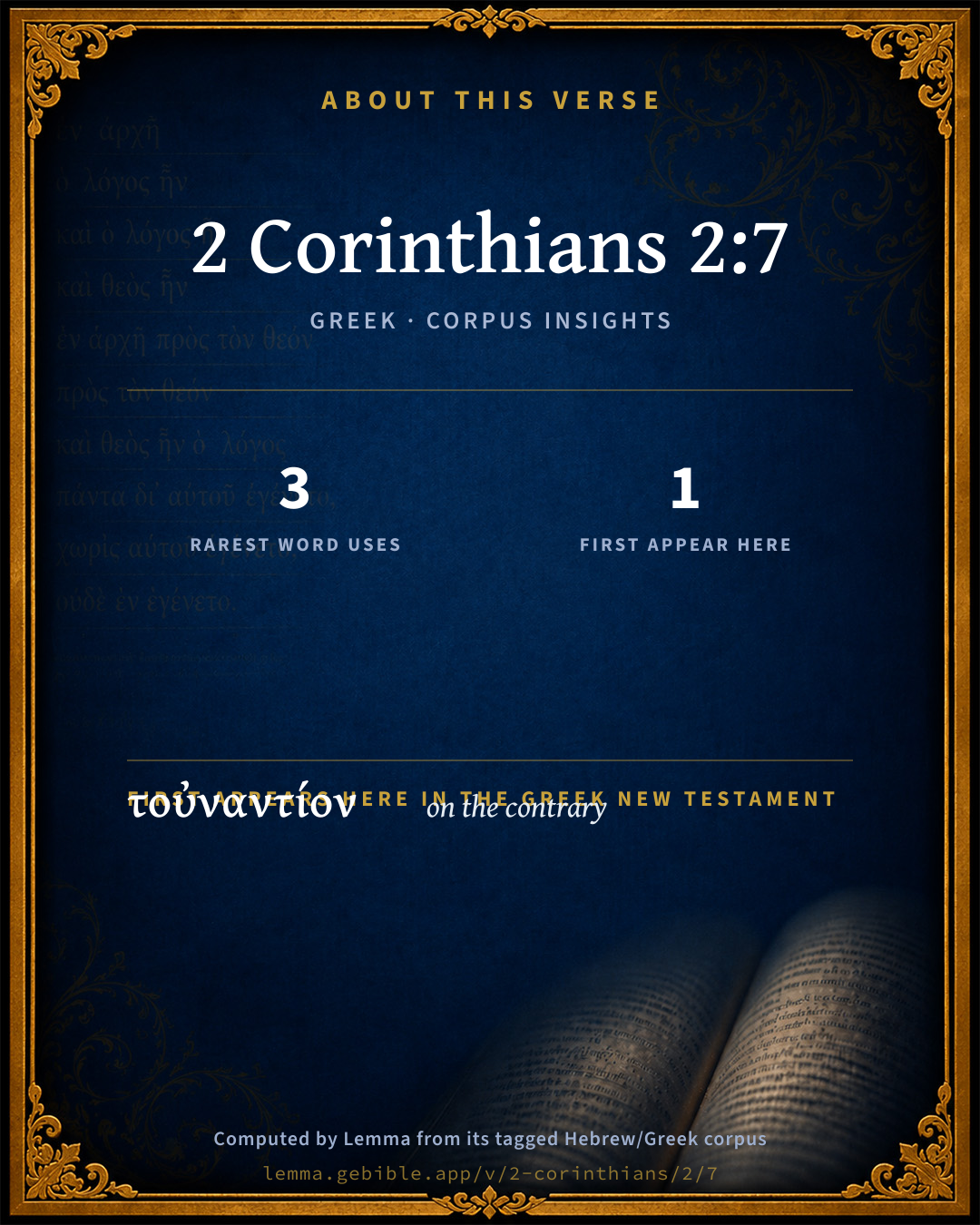
2 Corinthians 2:7

Greek (Tischendorf 8th ed.) 2 Corinthians 2:7 appears in the Greek New Testament. The text above is from the Tischendorf 8th edition. Each word links to its Strong’s number and a concise gloss. Click any word for its full Thayer’s Greek Lexicon entry.

Download image
Cite this verse

2 Corinthians 2:7 (World English Bible). Public Domain. Lemma interlinear Bible study tool, https://lemma.gebible.app/v/2-corinthians/2/7.

Show BibTeX & RIS
BibTeX
RIS
English Translation
so that on the contrary you should rather forgive him and comfort him, lest by any means such a one should be swallowed up with his excessive sorrow.
World English Bible · Public Domain
Highlights
  • 1 first appearance in the Greek New Testament
Full analysis ↓
Download a study sheet

One document with this verse’s original text, its word-by-word gloss line, the meaning frame, cross-references with their text, attributed commentary, and full source and license credits — printable, and it pastes into notes with its structure intact.

This verse Autodidact and up

Study sheet (.html) Plain text (.txt)

A passage Seminary Student

Up to 50 verses in one chapter. A passage sheet keeps up to 6 commentary sources and 12 cross-references per verse, in the order this page ranks them, and says so on the sheet whenever that leaves anything out. Ask for a single verse and you get the Autodidact verse sheet above.

Everything on this page stays free to read, with no account — the sheet is a download of what is already on screen, not access to it.

Want to remove ads? Support Godless Engineer
Compare translations 3

The same verse in 3 English versions, stacked beneath the original-language interlinear above. Click any original word for its lexicon entry.

Each is an independent rendering of the whole verse — the interlinear is not word-aligned to these translations.

Highlighted words mark where these versions differ — a whole-verse word diff, not a word-by-word alignment.

  • World English Bible Public Domain
    so that on the contrary you should rather forgive him and comfort him, lest by any means such a one should be swallowed up with his excessive sorrow.
  • King James Version Public Domain
    So that contrariwise ye ought rather to forgive him, and comfort him, lest perhaps such a one should be swallowed up with overmuch sorrow.
  • unfoldingWord Literal Text CC BY-SA 4.0
    so that, on the contrary, you should rather forgive and comfort such a might not be overwhelmed in his excessive sorrow.

unfoldingWord Literal Text — © unfoldingWord, licensed CC BY-SA 4.0. Word-aligned USFM3 via Door43 (git.door43.org/unfoldingWord/en_ult).

Versions to compare (up to 4)

3 of 4 selected

Show all 19 translations

Every available English version of this verse, each an independent rendering of the whole verse.

  • World English Bible Public Domain
    so that on the contrary you should rather forgive him and comfort him, lest by any means such a one should be swallowed up with his excessive sorrow.
  • Berean Standard Bible Public Domain
    So instead, you ought to forgive and comfort him, so that he will not be overwhelmed by excessive sorrow.
  • Majority Standard Bible Public Domain
    So instead, you ought to forgive and comfort him, so that he will not be overwhelmed by excessive sorrow.
  • King James Version Public Domain
    So that contrariwise ye ought rather to forgive him, and comfort him, lest perhaps such a one should be swallowed up with overmuch sorrow.
  • American Standard Version (1901) Public Domain
    so that contrariwise ye should rather forgive him and comfort him, lest by any means such a one should be swallowed up with his overmuch sorrow.
  • Revised Version (1885) Public Domain
    so that contrariwise ye should rather forgive him and comfort him, lest by any means such a one should be swallowed up with his overmuch sorrow.
  • Geneva Bible (1599) Public Domain
    So that nowe contrariwise yee ought rather to forgiue him, and comfort him, lest the same shoulde bee swalowed vp with ouermuch heauinesse.
  • Douay-Rheims (1899) Public Domain
    So that on the contrary, you should rather forgive him and comfort him, lest perhaps such a one be swallowed up with overmuch sorrow.
  • Young's Literal Translation Public Domain
    so that, on the contrary, `it is' rather for you to forgive and to comfort, lest by over abundant sorrow such a one may be swallowed up;
  • Literal Standard Version CC BY-SA 4.0
    so that, on the contrary, [it is] rather for you to forgive and to comfort, lest by over abundant sorrow such a one may be swallowed up;
  • Unlocked Literal Bible CC BY-SA 4.0
    So now rather than punishment, you should forgive and comfort him. Do this so that he is not overwhelmed by too much sorrow.
  • unfoldingWord Literal Text CC BY-SA 4.0
    so that, on the contrary, you should rather forgive and comfort such a might not be overwhelmed in his excessive sorrow.
  • Darby Bible Public Domain
    so that on the contrary ye should rather shew grace and encourage, lest perhaps such a one should be swallowed up with excessive grief.
  • World Messianic Bible Public Domain
    so that, on the contrary, you should rather forgive him and comfort him, lest by any means such a one should be swallowed up with his excessive sorrow.
  • Webster's Bible Public Domain
    So that on the other hand, ye ought rather to forgive him, and comfort him, lest perhaps such one should be swallowed up with excessive sorrow.
  • Free Bible Version CC BY-SA 4.0
    so now you should forgive him and be kind to him. Otherwise he may sink into despair.
  • Bible in Basic English Public Domain
    So that now, on the other hand, it is right for him to have forgiveness and comfort from you, for fear that his sorrow may be over-great.
  • Text-Critical English NT CC BY 4.0
    So you should forgive and comfort him instead, so that he will not be overwhelmed with excessive sorrow.
  • Tyndale New Testament (1534) Public Domain
    lest that same persone shuld be swalowed vp with over moche hevines.

Literal Standard Version (2020), Covenant Press — licensed CC BY-SA 4.0. Text via the HelloAO Bible API (eBible.org). Unlocked Literal Bible (unfoldingWord) — licensed CC BY-SA 4.0. Text via the HelloAO Bible API (eBible.org). unfoldingWord Literal Text — © unfoldingWord, licensed CC BY-SA 4.0. Word-aligned USFM3 via Door43 (git.door43.org/unfoldingWord/en_ult). Free Bible Version, Dr. Jonathan Gallagher — licensed CC BY-SA 4.0. Text via the HelloAO Bible API (eBible.org).

Word by word

More ways to search: Search by grammar → Find every occurrence → Compare this word →

Practice this passage: Drill this verse → Learn its vocabulary →

τοὐναντίον
tounantíon
G5121
“on the contrary”
Adverb, Aramaic form
Part of Speech
Adverb
Degree
Aramaic form
Full Thayer's Definition

Origin: contraction for the neuter of G3588 and G1726

TDNT: None

1. on the contrary, contrariwise
  1. ὥστε hṓste G5620 “so that” Conjunction
  2. μᾶλλον mâllon G3123 “more” Adverb
  3. ὑμᾶς sý G4771 “you” Personal pronoun, 2nd person, Accusative, Plural
  4. χαρίσασθαι charízomai G5483 “to favor” Verb, Aorist, Middle deponent, Infinitive
  5. καὶ kaí G2532 “and” Conjunction
  6. παρακαλέσαι parakaléō G3870 “to call beside” Verb, Aorist, Active, Infinitive
  7. μήπως mḗpōs G3381 “lest” Conjunction, Negative
  8. τῇ ho G3588 “the” Article, Dative, Singular, Feminine
  9. περισσοτέρᾳ perissós G4053 “exceeding” Adjective, Dative, Singular, Feminine, Comparative
  10. λύπῃ lýpē G3077 “grief” Noun, Dative, Singular, Feminine
  11. καταποθῇ katapínō G2666 “to swallow up” Verb, Aorist, Passive, Subjunctive, 3rd person, Singular
  12. ὁ ho G3588 “the” Article, Nominative, Singular, Masculine
  13. τοιοῦτος toioûtos G5108 “such” Demonstrative pronoun, Nominative, Singular, Masculine

About this verse

These counts appear in no published source. They are computed here, from the morphology-tagged text and Lemma’s own curated glosses. What Lemma adds →

14
words
13
distinct lemmas
Pauline Epistles
section

Notable vocabulary

The rarest word here is τοὐναντίον on the contrary G5121 — appearing just 3 times in the whole Greek New Testament.

First appearance in Scripture

This word makes its first canonical appearance in the Greek New Testament here:

  • τοὐναντίον on the contrary G5121

Shared distinctive vocabulary

τοὐναντίον on the contrary G5121 occurs in 3 verses of the Greek New Testament. Also found in:

Repetition

A word recurs within this verse:

Cross-references

19

Topical passages linked to 2 Corinthians 2:7 in the Treasury of Scripture Knowledge — connected by theme and wording, ordered by reader-vote popularity; previews shown in the World English Bible.

  • Ephesians 4:32 And be kind to one another, tenderhearted, forgiving each other, just as God also in Christ forgave you.
  • Galatians 6:1–2 Brothers, even if a man is caught in some fault, you who are spiritual must restore such a one in a spirit of gentleness; looking to yourself so that you also aren't tempted.
  • Colossians 3:13 bearing with one another, and forgiving each other, if any man has a complaint against any; even as Christ forgave you, so you also do.
  • Proverbs 17:22 A cheerful heart makes good medicine, But a crushed spirit dries up the bones.
  • Isaiah 28:7 Even these reel with wine, and stagger with strong drink; the priest and the prophet reel with strong drink, they are swallowed up of wine, they stagger with strong drink; they err in vision, they stumble in judgment.
  • 2 Samuel 20:19–20 I am of those who are peaceable and faithful in Israel: you seek to destroy a city and a mother in Israel: why will you swallow up the inheritance of Yahweh?
  • Psalms 21:9 You will make them as a fiery furnace in the time of your anger. Yahweh will swallow them up in his wrath. The fire shall devour them.
  • Psalms 124:3 Then they would have swallowed us up alive, When their wrath was kindled against us;
  • Proverbs 1:12 Let's swallow them up alive like Sheol, And whole, like those who go down into the pit.
  • 1 Corinthians 15:54 But when this corruptible will have put on incorruption, and this mortal will have put on immortality, then what is written will happen: "Death is swallowed up in victory."
  • 2 Corinthians 5:4 For indeed we who are in this tent do groan, being burdened; not that we desire to be unclothed, but that we desire to be clothed, that what is mortal may be swallowed up by life.
  • 2 Corinthians 7:10 For godly sorrow works repentance to salvation, which brings no regret. But the sorrow of the world works death.
  • Philippians 2:27 For indeed he was sick, nearly to death, but God had mercy on him; and not on him only, but on me also, that I might not have sorrow on sorrow.
  • 1 Thessalonians 4:13 But we don't want you to be ignorant, brothers, concerning those who have fallen asleep, so that you don't grieve like the rest, who have no hope.
  • 2 Thessalonians 3:6 Now we command you, brothers, in the name of our Lord Jesus Christ, that you withdraw yourselves from every brother who walks in rebellion, and not after the tradition which they received from us.
  • 2 Thessalonians 3:14–15 If any man doesn't obey our word in this letter, note that man, that you have no company with him, to the end that he may be ashamed.
  • Psalms 56:1–2 Be merciful to me, God, for man wants to swallow me up. All day long, he attacks and oppresses me.
  • Psalms 57:3 He will send from heaven, and save me, He rebukes the one who is pursuing me. Selah. God will send out his loving kindness and his truth.
  • Hebrews 12:12–15 Therefore, lift up the hands that hang down and the feeble knees,

Cross-references courtesy of OpenBible.info (CC BY 4.0).

Commentary

Notes on 2 Corinthians 2:7 from classic Christian and Jewish commentators (each source and its license shown beneath its notes). The classic Christian expositions comment on the surrounding passage and are grouped to its opening verse, so a note may address several verses; the Jewish commentaries on the Tanakh (Rashi and others) are per-verse, so they appear only where the commentator wrote on this verse.

Lemma curates 59 commentaries, every one of them public domain or Creative Commons licensed, each selected and text-cleaned for this edition rather than reprinted as found. About our sources →

Bengel's Gnomon

Johann Albrecht Bengel

2Co 2:7. Χαρίσασθαι) This word has the meaning of an indicative, whence he is rather forgiven; and the indicative is a very mild form of exhortation: 2Co 12:9; Mat 26:18, note.

Bengel's Gnomon of the New Testament — English translation (T&T Clark, Edinburgh, 1860) — public domain. Text from a community e-Sword module.

Meyer's Critical & Exegetical Commentary

Heinrich August Wilhelm Meyer

2Co_2:7. So that you, on the contrary, rather (potius) pardon and comfort. This is the consequence which ensued, connected with the utterance of ἱκανὸν κ.τ.λ … Hence the notion of δεῖν (Lobeck, ad Phryn. p. 754; Kühner, ad Xen. Mem. ii. 2. 1) is not here to be supplied, as Billroth and Olshausen wish, following the older commentators. It is not said what ought to happen, but what, according to the apostles conception, ensued as a necessary and essential consequence of the ἱκανὸν κ.τ.λ. (Kühner, II. p. 564). The χαρίσασθαι, however, is not at variance with the reference to the adulterer (because forgiveness belongs to God

Bleek, Neander), for what is here spoken of in a general way is only the pardon, which the church imparts in reference to the offence produced in it, the pardon of Christian brethren (Eph_4:32; Col_3:20).

τῇ περισσοτέρᾳ λύπῃ] through the higher degree of affliction, which, namely, would be the consequence of the refusal of pardon, and certainly of the eventual complete excommunicatio.

καταποθῇ] Comp. 1Co_15:54; 1Pe_5:8. This being swallowed up is explained by some, of dying (Grotius, according to his view of an illness of the sinner), by others, of suicide, or of apostasy from Christianity (the latter is held by Theodoret, Pelagius, and others, also Flatt; Kypke and Stolz, following Chrysostom, Theophylact, and others, leave a choice between the two); or as conveying a hint that the λύπη bordering on despair might drive him into the world, and he might be devoured by its prince (Olshausen). The latter point: by the prince of the world, is quite arbitrarily imported. The sadness (conceived as a hostile animal) is what swallows up. The context gives nothing more precise than the notion: to be brought by the sadness to despair, to the abandoning of all hope and of all striving after the Christian salvation.[142] Comp. on καταπίνειν in the sense of destroying, Jacobs, Animadv. in Athen. p. 315.

[142] The ὁ τοιοῦτος repeated at the end, in itself superfluous, has the tone of compassion.

Meyer — Critical and Exegetical Commentary on the New Testament — English translation by Peter Christie, edited by Frederick Crombie (T&T Clark, 1880) — public domain. Text from a community e-Sword module.

Expositor's Greek Testament

ed. W. Robertson Nicoll

2Co 2:7 . ὥστε τοὐναντίον μᾶλλον κ . τ . λ .: so that contrariwise ye should rather forgive him and comfort him ( cf. , for the sentiment, Sir 8:5 , Col 3:13 , Eph 4:32 ). We should expect some verb like δεῖν , but it is perhaps sufficiently suggested by ὥστε . χαρίζεσθαι is generally found in the N.T. in the sense of “to bestow a favour”; but it conveys the special meaning “to forgive” in the passages referred to above. μήπως τῇ περισσοτέρᾳ λύπῃ κ . τ . λ .: lest such an one should be swallowed up with his excessive sorrow, sc. , should be driven to despair through overmuch severity. Again (see on 2Co 2:4 above) we are not to press the comparative force of περισσοτέρᾳ .

The Expositor's Greek Testament, edited by W. Robertson Nicoll (1897–1910) — public domain. Text from a community e-Sword module.

Geneva Bible (1599)

Geneva Bible translators

That whereas before you punished him sharply, you would now forgive him.

Geneva Bible (1599) marginal notes — public domain. Text via Bolls.life.

Jamieson, Fausset & Brown

Robert Jamieson, A. R. Fausset & David Brown

with overmuch sorrow--Greek, "with HIS overmuch sorrow."

Jamieson, Fausset & Brown — Commentary Critical and Explanatory on the Whole Bible (1871) — public domain (CC PDM 1.0). Text via the HelloAO Bible API.

Adam Clarke's Commentary

Verse 7. Ye ought rather to forgive him] He had now suffered enough; for the punishment inflicted had answered the end for which it was inflicted; and there was some danger that, if this poor culprit were not restored to the bosom of the Church, his distress and anguish would destroy his life, or drive him to despair.

Adam Clarke's Commentary on the Bible (1810–1826) — public domain. Text from a community e-Sword/MySword module.

John Calvin's Commentaries

7. Lest such an one should be swallowed up by overmuch sorrow The end of excommunication, so far as concerns the power of the offender, is this: that, overpowered with a sense of his sin, he may be humbled in the sight of God and the Church, and may solicit pardon with sincere dislike and confession of guilt. The man who has been brought to this, is now more in need of consolation, than of severe reproof. Hence, if you continue to deal with him harshly, it will be — not discipline, but cruel domineering. Hence we must carefully guard against pressing them beyond this limit. For nothing is more dangerous, than to give Satan a handle, to tempt an offender to despair. Now we furnish Satan with arms in every instance, in which we leave without consolation those, who are in good earnest affected with a view of their sin.

John Calvin's Commentaries (1540-1563) — public domain. Text from the Calvin Translation Society English edition (1840s-50s) via the Christian Classics Ethereal Library (ccel.org). Calvin's coverage is partial (roughly two-thirds of the Bible); uncommented books and verses are honest gaps, never fabricated. The 19th-century editor's footnotes and remarks are omitted so the notes are faithfully Calvin's own voice.

Ellicott's Commentary for English Readers

(7) Ye ought rather to forgive.—The indignation which St. Paul had felt has passed, on his hearing of the offender’s state, into pity and anxiety. The time had come for words of pardon and comfort and counsel. What if he should be “swallowed up,” and sink as in the great deep of sorrow? Suicide, madness, apostasy, seem to float before his mind as but too possible results.

A Bible Commentary for English Readers, edited by Charles John Ellicott (1878–1897) — public domain. Text from a community e-Sword module.

The Cambridge Bible for Schools and Colleges

gen. ed. J. J. S. Perowne

7. comfort him] Better, perhaps, encourage him. See note on ch. 2Co_1:3.

such a one] ὁ τοιοῦτος, the man of that description, the name by which St Paul always denotes the offender. See note on 1Co_5:5. St Paul will not disgrace him to all future ages by mentioning his name.

swallowed up] Some commentators have supposed that St Paul here meant apostasy or suicide. But he designedly leaves the result indefinite. It is impossible to foresee what will become of a man overwhelmed with excessive sorrow.

with overmuch sorrow] Literally, by the excess of sorrow. “Nothing is more dangerous than to give Satan a handle whereby he may harass a sinner into despair.” Calvin. Cf. also Gal_6:1 and Sir_8:5.

The Cambridge Bible for Schools and Colleges (gen. ed. J. J. S. Perowne; Cambridge University Press, 1878–1918) — public domain. Text from a community e-Sword module.

John Gill's Exposition

So that contrariwise ye ought rather to forgive him,.... On the other hand, so far the apostle suggests they should be from inflicting any other punishment on him, or by any means adding to, and increasing what was inflicted, that they ought to forgive him his offence, by taking off the censure from him, which had been sufficient for the purpose, and had continued on him a sufficient time:

and comfort him; by restoring him to the communion of the church, and to an enjoyment of all the privileges and ordinances of the house of God: and this was necessary to be done,

lest perhaps such an one should be swallowed up with over much sorrow: be overwhelmed with trouble, engulfed in despair, and so become unfit for the exercise of grace, and discharge of duty; to prevent therefore such dangerous and pernicious consequences, it is incumbent on the churches of Christ, as soon as ever they observe that censures have answered the end in bringing persons to a sense and acknowledgment of sin and amendment of life, to remove them, and restore such to fellowship.

John Gill's Exposition of the Whole Bible (1746–1763) — public domain (CC PDM 1.0). Text via the HelloAO Bible API.

Trapp's Complete Commentary

John Trapp

7 So that contrariwise ye ought rather to forgive him, and comfort him, lest perhaps such a one should be swallowed up with overmuch sorrow.

Ver. 7. Should be swallowed up] It was a saying of Mr Philpot, martyr, Satan goes about to mix the detestable darnel of desperation with the godly sorrow of a pure penitent heart.

With overmuch grief] Some holy men (as Master Leaver) have desired to see their sin in the most ugly colours, and God hath heard them; but yet his hand was so heavy upon them therein, that they went always mourning to their graves; and thought it fitter to leave it to God’s wisdom to mingle the portion of sorrow, than to be their own choosers. (Dr Sibbs, on Psa 42:5) It is a saying of Austin, Let a man grieve for his sin, and then joy for his grief. Sorrow for sin, if it so far exceed, as that thereby we are disabled for the discharge of our duties, it is a sinful sorrow, yea, though it be for sin.

John Trapp, A Commentary or Exposition upon All the Books of the Old and New Testament (1647–1656) — public domain. Text from a community e-Sword module.

Albert Barnes' Notes on the Bible

So that contrariwise - On the other hand: on the contrary. That is, instead of continuing the punishment. Since the punishment was sufficient, and has answered all the purpose of bearing your testimony against the offence, and of bringing him to repentance, you ought again to admit him to your communion.

Ye ought rather to forgive him - Rather than continue the pain and disgrace of excommunication. It follows from this:

That the proper time for restoring an offender is only when the punishment has answered the purpose for which it was designed; that is, has shown the just abhorrence of the church against the sin, and has reformed the offender; and, That when that is done the church ought to forgive the offending brother, and admit him again to their fellowship.

When it can be ascertained that the punishment has been effectual in reforming him, may depend somewhat on the nature of the offence. In this case, it was sufficiently shown by his putting away his wife, and by the manifestations of sorrow. So in other cases, it may be shown by a man’s abandoning a course of sin, and reforming his life. If he has been unjust, by his repairing the evil; if he has been pursuing an unlawful business, by abandoning it; if he has pursued a course of, vice; by his forsaking it, and by giving satisfactory evidences of sorrow and of reformation, for a period sufficiently long to show his sincerity. The time which will be required in each case, must depend, of course, somewhat on the nature of the offence, the previous character of the individual, the temptations to which he may be exposed, and the disgrace which he may have brought on his Christian calling. It is to be observed, also, that then his restoration is to be regarded as an act of “forgiveness,” a favor (χαρίσασθαι charisasthai, that is, χαρις charis, favor, grace) on the part of the church. It is not a matter of justice, or of claim on his part for having once dishonored his calling, he has forfeited his right to a good standing among Christians; but it is a matter of favor, and he should be willing to humble himself before the church, and make suitable acknowledgment for his offences.

And comfort him - There is every reason to think that this man became a sincere penitent. If so, he must have been deeply pained at the remembrance of his sin, and the dishonor which he had brought on his profession, as well as at the consequences in which he had been involved. In this deep distress, Paul tells them that they ought to comfort him. They should receive him kindly, as God receives to his favor a penitent sinnor. They should not cast out his name as evil; they should not reproach him for his sins; they should not harrow up his recollection of the offence by often referring to it; they should be willing to bury it in lasting forgetfulness, and treat him now as a brother. It is a duty of a church to treat with kindness a true penitent, and receive him to their affectionate embrace. The offence should be forgiven and forgotten. The consolations of the gospel, adapted to the condition of penitents, should be freely administered; and all should be done that can be, to make the offender, when penitent, happy and useful in the community.

Lest perhaps such a one - Still forbearing to mention his name; still showing toward him the utmost tenderness and delicacy.

Should be swallowed up ... - Should be overcome with grief, and should be rendered incapable of usefulness by his excessive sorrow. This is a strong expression, denoting intensity of grief. We speak of a man’s being drowned in sorrow; or overwhelmed with grief; of grief preying upon him. The figure here is probably taken from deep waters, or from a whirlpool which seems to swallow up anything that comes within reach. Excessive grief or calamity, in the Scriptures, is often compared to such waters; see Psa 124:2-5. “If it had not been the Lord who was on our side when men rose up against us, then they had swallowed us up quick, when their wrath was kindled against us; then the waters had overwhelmed us, the stream had gone over our soul; then the proud waters had gone over our soul;” see Psa 69:1. “Save me, O God, for the waters are come into my soul.” Paul apprehended that by excessive grief, the offending brother would be destroyed. His life would waste away under the effect of his excommunication and disgrace, and the remembrance of his offence would prey upon him, and sink him to the grave.

Albert Barnes' Notes on the Bible (1834–1885) — public domain. Text from a community e-Sword/MySword module.

Haydock's Catholic Bible Commentary

===============================

[BIBLIOGRAPHY]

Ne forte....absorbeatur, Greek: katapothe, absorbeatur, deglutiatur.

George Leo Haydock (1774–1849), Haydock's Catholic Family Bible and Commentary, 1859 edition — public domain. Excludes Psalms (Douay-Rheims chapter numbering differs from Protestant) and Deuterocanonical books (Catholic canon only).

Matthew Poole's English Annotations

So that contrariwise ye ought rather to forgive him, and comfort him: forgiveness in this place doth not signify the taking away or remitting of the guilt of sin, (that is God’s work, not man’s), but remitting of the punishment. And this maketh that probable, that they had not as yet proceeded with this person to excommunication, only kept him (like a suspected leper, without the camp) out of a communion with the church: or if they had actually cast him out, forgiving here can signify nothing but restoring him again to a full communion with them; which is also the comforting which is here mentioned.

Lest perhaps such a one should be swallowed up with overmuch sorrow: it is plain from hence, that the apostle had intelligence that this person expressed abundant sorrow; otherwise he would not have expressed his fear of his being drowned in his own tears. Though the condition of such, at this day, is sad enough, who are regularly cast out of the communion of any true church of Christ, for crimes which deserve such a punishment, yet we must imagine it much sadder then. Now churches are multiplied, whole cities and nations are Christianized, and though a person be cast outof a church, yet it is not so taken notice of, but he may yet have converse with other Christians, &c.: but there, the greater part of the city being heathens, and the whole countries of Achaia and Greece (contiguous to it) being heathens; one cast out of the communion of the church (if he had the least sense of religion) could not but be deeply afflicted to be in such a case, as none but heathens and professed idolaters would keep him company, or have any intimacy with him.

Matthew Poole's English Annotations on the Holy Bible (1683–1685) — public domain. Text from a community e-Sword/MySword module.

Whedon's Commentary on the Bible

Daniel D. Whedon

7. Contrariwise—The reverse of penalty.

Forgive—Literally, favour him, implying probable forgiveness.

Overmuch sorrow—Leading to despair, perhaps to insanity or suicide. In all this is implied that the criminal viewed the judgment of the Church as the judgment of God, and preventive of his salvation.

Daniel D. Whedon (gen. ed.), Commentary on the Old and New Testaments (1874–1909) — public domain. Text from a community e-Sword module.

The Pulpit Commentary

Contrariwise; i.e. contrary to the line taken or to the view expressed by the severer portion of the community. Rather. The word is omitted in A and B. To forgive him. The word is used of the mutual attitude of gracious forbearance which ought to exist among Christians(Forgiving one another," (Eph_4:32; Col_3:13) so that they might be not only Christians, but as Gentiles ignorantly called them, Chrestians "kind-hearted,". (Eph_4:32) And comfort; i.e. "strengthen," "encourage." The "him" is emitted in the Greek, with the same delicate, compassionate reticence which leads St. Paul to speak of this person "a man of such of a kind." In Gal_6:11 St. Paul suddenly breaks off the course of his remarks to give similaradvice in a tone of peculiar solemnity; and in 2Th_3:15 he warns against any excess in the severity which he enjoins in the previous verse. Such a one. Like the indefinite "one" in 1Co_5:5. In the Greek it is compassionately placed last in the clause. Should be swallowed up. The same metaphor, of being swallowed in an abyss, occurs in 1Co_15:54. In 1Pe_5:8 it is said that Satan is ever striving to "swallow up" men. With overmuch sorrow; rather, with the, or his, excessive grief. Despair might drive the man to suicide, or apostasy, or the wretchlessness of unclean living.

The Pulpit Commentary (1880–1919), ed. H.D.M. Spence-Jones & Joseph S. Exell — public domain. Text from a community e-Sword module.

Burkitt's Expository Notes on the New Testament

William Burkitt

Observe, 1. The great duty which the apostle directs the Corinthians to the performance of, towards this sorrowful offender: to forgive him, to comfort him, to confirm him; that is, to absolve him from the sentence and censure of the church; no longer to continue their aversion to him, but to restore him to the church’s communion, to re-admit him to their fellowship and society, to comfort him with the notices of God’s pardoning mercy; and to confirm their love to him, by showing that their excommunicating of him was with design to reform, not to ruin him; to recover him by repentence, and not to drive him to despair. This is the importance of the three several words which are used here, Forgive him, comfort him, confirm him.

From whence note, That in notorious crimes which give great cause of scandal to the church, the comfort of the offender depends not only upon his peace and reconciliation with God, but also upon the relaxation of the censures of the church, and his re-admission to the church’s fellowship and communion: forgive him, and confirm your love towards him.

Observe, 2. The reason offered by our apostle why this penitent offender should be forgiven and comforted, namely, Lest he should be swallowed up with overmuch sorrow.

Learn hence, 1. That sorrow even for sin itself may be excessive and overmuch.

2. That excessive and overmuch sorrow swalloweth up a person; it may swallow him up in the gulf of despair, and, as a consequent of it, in the gulf of death.

As worldly sorrow causeth death, so may religious sorrow also, even sorrow for sin. We may dishonour God by an excessive mourning, even for God’s dishonour. Sorrow is not of any worth in itself, but only as it serves to a spiritual end and purpose; and when it is excessive, not only the comforts, but the gifts and usefulness, of the person sorrowing, are in danger to be swallowed up by it.

Quest. But when is sorrow for sin excessive and overmuch?

Ans. When it obstructs the exercise of our graces, when it hinders the performance of our duties, when it hurts our health, and overwhelmeth nature, when it perverts reason, swalloweth up faith, hindereth our hope, prejudiceth our joy, and unfits us both for doing and suffering the will of God; in a word, that sorrow for sin which keeps the soul from looking towards the mercy-seat, that keeps Christ and the soul asunder, and renders a person unfit for the service of God and for the communion of saints, is a sinful sorrow.

William Burkitt's Expository Notes on the New Testament (1700–1703) — public domain. Text from a community e-Sword module.

McGarvey & Pendleton's Commentaries

J. W. McGarvey

So that contrariwise ye should rather forgive him and comfort him, lest by any means such a one should be swallowed up with his overmuch sorrow . [Paul's purpose had been to save this sinner ( 1Co_5:5 ). It seems that a minority had espoused his cause, but the majority had excommunicated him according to the apostle's instruction at 1Co_5:13 . The apostle here writes that this punishment has already proved sufficient, and should not be continued, but that, on the contrary, the offender should be forgiven, received back and comforted, lest he should be swallowed up by despair, and thus the punishment should defeat the very end for which it was designed. We should note here that excommunication and restoration are actions of the church, and not of the officers.]

J. W. McGarvey (with Philip Y. Pendleton), Commentaries on the New Testament (The Fourfold Gospel, 1914; Acts; and the epistles) — public domain. Text from a community e-Sword/MySword module.

The People's New Testament

B. W. Johnson

7. Ye ought rather to forgive him. The Apostle sternly commands excommunication of the offender, but tenderly enjoins forgiveness of the penitent sinner.

B. W. Johnson's The People's New Testament with Notes (1889–1891) — public domain. Electronic text from the Christian Classics Ethereal Library (CCEL) ThML edition.

Cambridge Greek Testament for Schools and Colleges

7. The μᾶλλον after τοὐναντίον (אCKLOP) or after ὑμᾶς (DFG) is doubtful. AB and Aug. omit.

7. ὥστε τοὐναντίον [μᾶλλον] ὑμᾶς χαρίσασθαι καὶ παρακαλέσαι. There is no need to understand δεῖν: so that on the contrary you may forgive and comfort him. If μᾶλλον is genuine (see critical note), it indicates that feeling on the subject is still acute. For χαρίσασθαι, which implies gracious forgiveness, comp. 2Co 12:13; Luk 7:42-43: the aorist is timeless. With the thought comp. Gal 6:1.

μή πως. Lest by any means (1Co 9:27; Gal 2:2). The A.V. stumbles over this particle here, 2Co 9:4, and 2Co 12:20.

τῇ περισσοτέρᾳ λύπῃ καταποθῇ. The article must not be neglected: be swallowed up by his overmuch sorrow. It is useless to ask whether death, suicide, apostasy, or despair of salvation is meant. Probably nothing more definite is intended than that a continuation of punishment will do much more harm than good: nihil enim periculosius quam ansam Satanae porrigere, ut peccatorem ad desperationem sollicitet (Calvin). As Theodoret remarks, S. Paul here exhibits his fatherly tenderness and affection, τὴν πατρικὴν φιλοστοργίαν γυμνοῖ. With καταποθῇ comp. 2Co 5:4; 1Co 15:54. The verb is common in the LXX. to represent a Heb. word of similar meaning.

Cambridge Greek Testament for Schools and Colleges (Cambridge University Press, 1896; 21 vols, various authors incl. Carr, Maclear, Plummer, Farrar, Lumby, Moule, M. R. James, Simcox) — public domain. Text from a community e-Sword module.

Alford’s Greek Testament

Henry Alford

7.] so that (conseq. on ἱκανόν) on the contrary you (should) [rather (than continue the punishment)] forgive and comfort him, &c. Meyer denies that δεῖν should be supplied, and makes ὥστε depend immediately on ἱκανόν,—‘enough, for you to forgive and console him.’

τῇ περισσοτέρᾳ λύπῃ] not, as E. V., ‘by overmuch sorrow:’ but (as Meyer), by the increase of sorrow which will come on the continuance of his punishment.

καταποθῇ does not set any definite result of the excessive sorrow before them, such as apostasy or suicide, but leaves them to imagine such possible.

Henry Alford, The Greek Testament (1849–1861) — public domain. Text from a community e-Sword module.

International Critical Commentary

7. ὥστε τοὐναντίον μᾶλλον κ.τ.λ. ‘So that on the contrary you may rather forgive him fully and comfort him.’ The ἕστε gives the natural consequence of the view that the penalty which has been imposed satisfies the requirements. So far from imposing anything more, they may put an end to what has been imposed. He is not telling them what they must do; there is no δεῖν. He tactfully points out the logical consequence of admitting the ἱκανόν, and leaves them to act upon it. The μᾶλλον is probably genuine (see below), and it indicates that there were still some who felt that the punishment was insufficient. For χαρίσασθαι, which implies making the man a present of the remainder of the penalty, * and forgiving him absolutely, cf. 12:13; Luk 7:42, Luk 7:43; Col 2:13, Col 2:3:13; Eph 4:32.

μή πως τῇ περισσοτέρᾳ λύπῃ καταποθῇ ὁ τ. ‘Lest by any means such a one should be swallowed up by his overmuch sorrow.’ Neither here nor 9:4 nor 12:20 does the AV give the right force to μή πως: it does so 1Co 9:27; Gal 2:2. Various conjectures are made as to what the Apostle feared might be the result; apostasy, reckless indulgence in sin, suicide. It is more important to notice that this implies that the man had already repented; he was no longer rebellious; and vera poenitentia est jam cessare a peccato (Herveius). Evidently, his grief was already great, and there was danger of his despairing of being restored to favour in Christian society. For καταπίνειν in the metaphorical sense cf. v. 4; 1Co 15:54; 1Pe 5:8. It is freq. in LXX. The ‘swallowing,’ as Chrys. says, may be ὡς ἐπὶ θηρίου, ὡς ἐπὶ χειμῶνος, ὡς ἐπὶ κλύδωνος. In the Ep. of the Churches of Lugdunum and Vienna those who had apostatized are said to have been swallowed by the Beast, ἵνα ἀποπνιχθεὶς ὁ θήρ, οὓς πρότερον ᾤετο καταπεπωκέναι, ζῶντας ἐξεμέσῃ (Eus. H.E. v. ii. 6). The rather superfluous repetition of ὁ τοιοῦτος at the end of the sentence gives a touch of compassion, enforcing the plea. Locus diligenter observandus, says Calvin; docet enint qua aequitate et clementia temperanda sit disciplina Ecclesiae, ne rigor mtodum excedat. Severitate opus est ne impunitate (quae peccandi illecebra merito vocatur) mali reddantur audaciores. Sed rursus, quia periculum est, ne is qui castigatur animum despondeat, hic adhibenda est moderatio; nempe ut Ecclesia simulatque resipiscentiam illius certo cognoverit, ad dandam veniam sit parata. He goes on to contrast the cruel sentences of the penitential system. The comment is remarkable as coming from so rigorous a disciplinarian.

H. C. Lea points out that in the Roman Catholic version of the N.T. there is a note appended to this text explaining that “the Apostle here granted an indulgence or pardon in the person and by the authority of Christ to the incestuous Corinthian whom he had put under penance, which pardon consisted in a releasing of part of the temporal punishment due to sin.” This, says Lea, is “a typical instance of the facility with which men read into Scripture whatever they desire to find there” (Hist. of Auricular Confession and Indulgences, iii. p. 5). *

A B, Syr-Pesh., Aug. omit μᾶλλον, which is found before ὑμᾶς in א C K L O P, Syr-Hark. Vulg. Copt. Arm., Chrys. Ambrst. and after ὑμᾶς in D E F G17, Goth., Thdrt. Tert.

International Critical Commentary — older volumes (1896–1929), various authors — public domain. Text from a community e-Sword module.

Vincent's Word Studies in the New Testament

Marvin R. Vincent

Forgive [χαρισασθαι] . The idea of freeness (cariv, see on Luk 1:30) lies in the word forgive, which is forth - give.

Overmuch sorrow [τη περισσοτερα λυπη] . Rev. gives the force of the article, his sorrow. Overmuch, excessive, through the refusal of pardon.

Marvin R. Vincent, Word Studies in the New Testament (1887–1900) — public domain. Text from a community e-Sword/MySword module.

Lesson kit

Teaching starters — assembled from the data on this page, not authored interpretation. Every prompt links to the verse data it draws on. Edit before teaching.

2 Corinthians, in the Pauline Epistles, opens this verse with 14 words (13 distinct Greek lemmas). Its most distinctive word is tounantíon (“on the contrary”). A historical commentator’s framing appears above. Read the whole chapter for the surrounding context.

Discussion questions

  1. How does “on the contrary” (tounantíon) shape what this verse is saying?
  2. This is the first place “on the contrary” appears in Scripture (first appears here). What does its debut here establish?
  3. How does Galatians 2:7, which shares the word «on the contrary», read alongside this verse?
  4. What does the repetition of “the” (2× in this one verse) do in this verse?
  5. These translations render this verse differently; the difference is in the English rendering, not the original. What questions does that raise?
  6. Compare how Bengel's Gnomon and Meyer's Critical & Exegetical Commentary read this verse. Where do they agree or differ?

Things to notice

  • 1 word makes its first canonical appearance in Scripture here.
  • These translations choose different wording for 16 words in this verse.
  • “the” occurs 2× in this single verse.
  • 13 distinct Greek lemmas span 14 words in this verse.

Reading settings

Reading text

Shown beneath each verse's original-language words.

Old Testament
Old Testament edition

Read the OT as the Masoretic Hebrew (MT) or the Greek Septuagint (LXX).

English shown for the Greek Septuagint (in the Hebrew ↔ Greek comparison).

Comparing translations? Open the Compare panel on any verse page to stack up to four side by side.