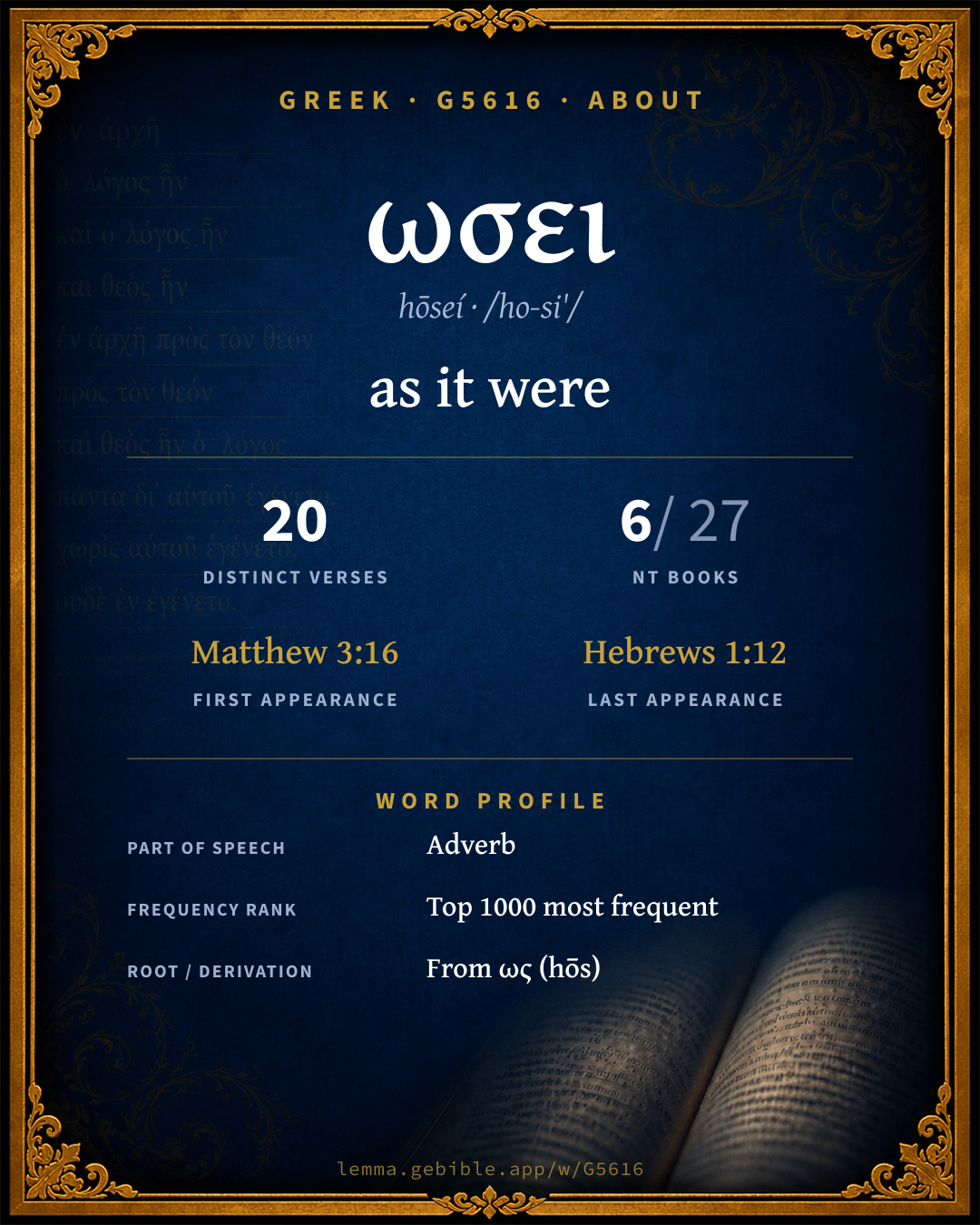
ὡσεί
as it were
also: as though, as, like as, like fuller range ↓
Full lexicon entry — Thayer's Greek Lexicon
From Thayer's Greek Lexicon
Where this word appears
Grammar key — what these labels mean
Part of speech
- Adverb
- A word that modifies a verb, adjective, or other adverb.
Every verse where G5616 appears — 20 distinct verses across 6 books. Click any verse to open its interlinear word-by-word view. Verse text shown in the World English Bible for context — . Each verse’s Greek form is shown with its reference; the English is not keyword-highlighted, since the data carries no word-level English alignment. Use “Compare translations” on any verse to read it across multiple English versions. This concordance covers the Greek New Testament; Septuagint (Greek Old Testament) occurrences of this word are not indexed here.
Matthew 3 verses
- Matthew 3:16 ὡσεὶ adv Jesus, when he was baptized, went up directly from the water: and behold, the heavens were opened to him. He saw the Spirit of God descending as a dove, and coming on him.
- Matthew 9:36 ὡσεὶ adv But when he saw the multitudes, he was moved with compassion for them, because they were harassed and scattered, like sheep without a shepherd.
- Matthew 14:21 ὡσεὶ adv Those who ate were about five thousand men, besides women and children.
Mark 1 verse
Luke 8 verses
- Luke 3:23 ὡσεὶ adv Jesus himself, when he began to teach, was about thirty years old, being the son (as was supposed) of Joseph, the son of Heli,
- Luke 9:14 ὡσεὶ adv For they were about five thousand men. He said to his disciples, "Make them sit down in groups of about fifty each."
- Luke 9:28 ὡσεὶ adv It happened about eight days after these sayings, that he took with him Peter, John, and James, and went up onto the mountain to pray.
- Luke 22:41 ὡσεὶ adv He was withdrawn from them about a stone's throw, and he knelt down and prayed,
- Luke 22:44 ὡσεὶ adv Being in agony he prayed more earnestly. His sweat became like great drops of blood falling down on the ground.
- Luke 22:59 ὡσεὶ adv After about one hour passed, another confidently affirmed, saying, "Truly this man also was with him, for he is a Galilean!"
- Luke 23:44 ὡσεὶ adv It was now about the sixth hour, and darkness came over the whole land until the ninth hour.
- Luke 24:11 ὡσεὶ adv These words seemed to them to be nonsense, and they didn't believe them.
Acts 6 verses
- Acts 1:15 ὡσεὶ adv In these days, Peter stood up in the midst of the disciples (and the number of names was about one hundred twenty), and said,
- Acts 2:3 ὡσεὶ adv Tongues like fire appeared and were distributed to them, and one sat on each of them.
- Acts 2:41 ὡσεὶ adv Then those who gladly received his word were baptized. There were added that day about three thousand souls.
- Acts 6:15 ὡσεὶ adv All who sat in the council, fastening their eyes on him, saw his face like it was the face of an angel.
- Acts 10:3 ὡσεὶ adv At about the ninth hour of the day, he clearly saw in a vision an angel of God coming to him, and saying to him, "Cornelius!"
- Acts 19:7 ὡσεὶ adv They were about twelve men in all.
Romans 1 verse
Hebrews 1 verse
About this entry
At a glance — auto-summarized from this page’s data, not written by a person. Every figure links to its source below. This summary describes the numbers; it doesn’t interpret them.
“as it were” is the headline sense of the Greek verb ωσει (hōseí). First canonically at Matthew 3:16, it enters the text early. It turns up in 20 verses across 6 books, an uncommon footprint. It concentrates in Luke, which alone accounts for 40% of its uses. Not a single-sense word, it carries 2 senses, among them “as though”, “as”, and “like as”. See the sense tree, 20-verse concordance, and the renderings breakdown below.
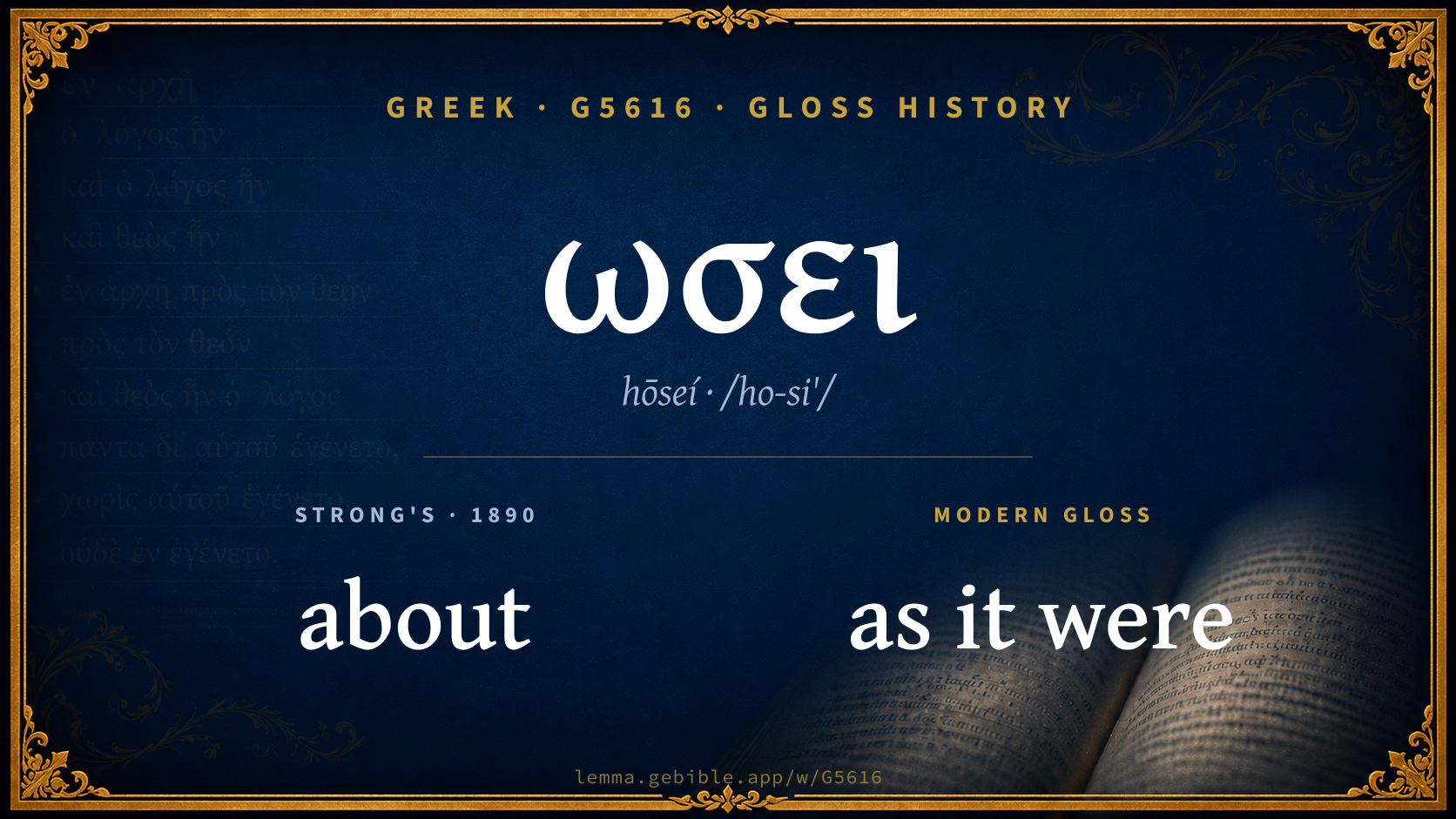
Gloss history
Strong's 1890 vs modern scholarship
About this word
Strong's G5616 catalogs a Greek word from the Greek New Testament.
These counts are not copied from any lexicon or concordance. They are computed here, from the morphology-tagged Greek New Testament. What Lemma adds →
- 20
- distinct verses
- The word appears in 20 distinct verses.
- 6 / 27
- NT books
- The word appears in 6 of 27 New Testament books.
- #622
- by frequency
- Top 1000 most frequent Greek words (rank 622 of 5,347 Greek words by occurrence).
View all 20 occurrences in the concordance →
By section of the New Testament
By traditional corpus
Conventional, traditional groupings — biblical authorship is debated, so this is a traditional corpus grouping, not an authorship claim. Some books belong to more than one corpus (Luke is in both the Gospels and the Lukan corpus, and so on), so these shares overlap and need not total 100%. Each figure is a share of the word’s 20 distinct verses.
- Lukan (Luke–Acts) 14 verses · 70%
- Gospels 12 verses · 60%
- Pauline corpus 1 verse · 5%
- Hebrews 1 verse · 5%
How translations render this word
Counts come from each version’s own published word-to-Strong’s tagging or interlinear alignment — an approximate guide to how each version renders this word, not a word-level alignment the data otherwise carries. Because each total is that version’s own tagged count, the per-version totals vary from one another and need not match the appearance or distinct-verse counts above. These counts may also differ from a printed concordance because Lemma counts each distinctly tagged rendering and does not collapse phrase taggings into a single head-word total. This is a fixed set of word-tagged versions (KJV, ASV, BSB, ULT) and does not change with the reading translation you choose elsewhere. Each version’s license is shown beside its name below (and on Sources).
- King James Version: About 18×, As 8×, Like 5×
- American Standard Version: About 13×, As 9×
- Berean Standard Bible: About 12×, Like 8×
- unfoldingWord Literal Text: About 11×, Like 5×, As 3×
King James Version Public Domain
Renders G5616 across 34 tagged occurrences — most commonly:
Plus 3 renderings that appear only once — usually multi-word phrases or single function words the recovered tagging swept in, not distinct renderings.
American Standard Version Public Domain
Renders G5616 across 30 tagged occurrences — most commonly:
Plus 8 renderings that appear only once — usually multi-word phrases or single function words the recovered tagging swept in, not distinct renderings.
Berean Standard Bible Public Domain
Renders G5616 across 21 tagged occurrences — most commonly:
Plus 1 rendering that appears only once — usually multi-word phrases or single function words the recovered tagging swept in, not distinct renderings.
unfoldingWord Literal Text CC BY-SA 4.0
Renders G5616 across 20 tagged occurrences — most commonly:
Plus 1 rendering that appears only once — usually multi-word phrases or single function words the recovered tagging swept in, not distinct renderings.
Senses in Thayer's
The 2 senses Thayer's distinguishes for this word, in lexicon order (not ranked by frequency or importance). The full entry — with sub-senses — is in the Lexicon Entry tab.
- as it were, (had been), as though, as, like as, like
- about, nearly
Word origin
Derived from ως (hōs) (G5613) — as.
Same root — word family
Other Thayer's entries built from the same root as G5616, grouped by Strong’s listed origin. These share a root / origin per the lexicon — not necessarily a shared meaning. Each links to that word’s own entry.
Derives from
Shares the same root
Compare all same-root words → Showing 4 of 5 — not the complete family. They share a root, not necessarily a meaning.
Septuagint usage
The same Greek word ωσει appears 172 times in the Greek Old Testament (Septuagint), across 145 verses in 21 books.
- 172
- LXX occurrences
- Tagged occurrences of this Greek word in the Septuagint.
- 145
- verses
- Distinct Septuagint verses containing this word.
- 21 / 39
- OT books
- The word appears in 21 of the 39 Old Testament books.
Sample Septuagint occurrences
- Genesis 19:28 ὡσεί
- Exodus 4:6 ὡσεί
- Leviticus 26:19 ὡσεί
- Numbers 11:7 ὡσεί
- Deuteronomy 1:10 ὡσεί
- Joshua 3:15 ὡσεί
- Judges 3:29 ὡσεί
- 1 Samuel 9:22 ὡσεί
- 2 Samuel 2:18 ὡσεί
- 1 Kings 21:27 ὡσεί
- 2 Kings 3:22 ὡσεί
- Ezra 19:11 ὡσεί
Septuagint occurrences (same lexeme)
Every verse where the same Strong’s number (G5616) appears in the Greek Septuagint — showing the first 50 of 145. Verse text shown in the World English Bible for context; the Greek form is the matched word — the English is not keyword-highlighted.
- Genesis 19:28 ὡσεί He looked toward Sodom and Gomorrah, and toward all the land of the plain, and looked, and saw that the smoke of the land went up as the smoke of a furnace.
- Genesis 21:16 ὡσεί She went and sat down opposite him, a good way off, about a bow shot away. For she said, "Don't let me see the death of the child." She sat over against him, and lifted up her voice, and wept.
- Genesis 24:55 ὡσεί Her brother and her mother said, "Let the young lady stay with us a few days, at least ten. After that she will go."
- Genesis 25:25 ὡσεί The first came out red all over, like a hairy garment. They named him Esau.
- Genesis 34:31 ὡσεί They said, "Should he deal with our sister as with a prostitute?"
- Genesis 41:49 ὡσεί Joseph laid up grain as the sand of the sea, very much, until he stopped counting, for it was without number.
- Genesis 49:16 ὡσεί "Dan will judge his people, As one of the tribes of Israel.
- Exodus 4:6 ὡσεί Yahweh said furthermore to him, "Now put your hand inside your cloak." He put his hand inside his cloak, and when he took it out, behold, his hand was leprous, as white as snow.
- Exodus 15:5 ὡσεί The deeps cover them. They went down into the depths like a stone.
- Exodus 15:8 ὡσεί With the blast of your nostrils the waters were piled up. The floods stood upright as a heap. The deeps were congealed in the heart of the sea.
- Exodus 15:10 ὡσεί You blew with your wind. The sea covered them. They sank like lead in the mighty waters.
- Exodus 16:14 ὡσεί When the dew that lay had gone, behold, on the surface of the wilderness was a small round thing, small as the hoar-frost on the ground.
- Exodus 19:4 ὡσεί 'You have seen what I did to the Egyptians, and how I bore you on eagles' wings, and brought you to myself.
- Exodus 24:10 ὡσεί They saw the God of Israel. Under his feet was like a paved work of sapphire stone, like the skies for clearness.
- Exodus 24:17 ὡσεί The appearance of the glory of Yahweh was like devouring fire on the top of the mountain in the eyes of the children of Israel.
- Exodus 28:33 ὡσεί On its hem you shall make pomegranates of blue, and of purple, and of scarlet, around its hem; and bells of gold between them round about:
- Exodus 32:13 ὡσεί Remember Abraham, Isaac, and Israel, your servants, to whom you swore by your own self, and said to them, 'I will multiply your seed as the stars of the sky, and all this land that I have spoken of I will give to your seed, and they shall inherit it forever.'"
- Leviticus 26:19 ὡσεί I will break the pride of your power, and I will make your sky like iron, and your soil like brass;
- Leviticus 26:37 ὡσεί They will stumble over one another, as it were before the sword, when no one pursues: and you will have no power to stand before your enemies.
- Numbers 11:7 ὡσεί The manna was like coriander seed, and the appearance of it as the appearance of bdellium.
- Numbers 11:8 ὡσεί The people went about, and gathered it, and ground it in mills, or beat it in mortars, and boiled it in pots, and made cakes of it: and the taste of it was as the taste of fresh oil.
- Numbers 11:12 ὡσεί Have I conceived all this people? have I brought them forth, that you should tell me, Carry them in your bosom, as a nursing-father carries the sucking child, to the land which you swore to their fathers?
- Numbers 11:31 ὡσεί There went forth a wind from Yahweh, and brought quails from the sea, and let them fall by the camp, about a day's journey on this side, and a day's journey on the other side, round about the camp, and about two cubits above the surface of the earth.
- Numbers 12:10 ὡσεί The cloud removed from over the Tent; and, behold, Miriam was leprous, as [white as] snow: and Aaron looked at Miriam, and, behold, she was leprous.
- Numbers 12:12 ὡσεί Let her not, I pray, be as one dead, of whom the flesh is half consumed when he comes out of his mother's womb.
- Numbers 13:33 ὡσεί There we saw the Nephilim, the sons of Anak, who come of the Nephilim: and we were in our own sight as grasshoppers, and so we were in their sight.
- Numbers 14:15 ὡσεί Now if you shall kill this people as one man, then the nations which have heard the fame of you will speak, saying,
- Numbers 24:6 ὡσεί As valleys are they spread forth, As gardens by the river-side, As lign-aloes which Yahweh has planted, As cedar trees beside the waters.
- Numbers 27:17 ὡσεί who may go out before them, and who may come in before them, and who may lead them out, and who may bring them in; that the congregation of Yahweh not be as sheep which have no shepherd.
- Deuteronomy 1:10 ὡσεί Yahweh your God has multiplied you, and, behold, you are this day as the stars of the sky for multitude.
- Deuteronomy 9:21 ὡσεί I took your sin, the calf which you had made, and burnt it with fire, and stamped it, grinding it very small, until it was as fine as dust: and I cast the dust of it into the brook that descended out of the mountain.
- Deuteronomy 10:22 ὡσεί Your fathers went down into Egypt with seventy persons; and now Yahweh your God has made you as the stars of the sky for multitude.
- Deuteronomy 11:10 ὡσεί For the land, where you go in to possess it, isn't as the land of Egypt, from whence you came out, where you sowed your seed, and watered it with your foot, as a garden of herbs;
- Deuteronomy 28:29 ὡσεί and you shall grope at noonday, as the blind gropes in darkness, and you shall not prosper in your ways: and you shall be only oppressed and robbed always, and there shall be none to save you.
- Deuteronomy 28:49 ὡσεί Yahweh will bring a nation against you from far, from the end of the earth, as the eagle flies; a nation whose language you shall not understand;
- Deuteronomy 28:62 ὡσεί You shall be left few in number, whereas you were as the stars of the sky for multitude; because you didn't listen to the voice of Yahweh your God.
- Deuteronomy 29:27 ὡσεί therefore the anger of Yahweh was kindled against this land, to bring on it all the curse that is written in this book;
- Deuteronomy 32:2 ὡσεί My doctrine shall drop as the rain; My speech shall condense as the dew, As the small rain on the tender grass, As the showers on the herb.
- Joshua 3:15 ὡσεί and when those who bore the ark were come to the Jordan, and the feet of the priests who bore the ark were dipped in the brink of the water (for the Jordan overflows all its banks all the time of harvest),
- Joshua 7:4 ὡσεί So there went up there of the people about three thousand men: and they fled before the men of Ai.
- Joshua 10:2 ὡσεί that they feared greatly, because Gibeon was a great city, as one of the royal cities, and because it was greater than Ai, and all the men of it were mighty.
- Joshua 14:11 ὡσεί As yet I am as strong this day as I as in the day that Moses sent me: as my strength was then, even so is my strength now, for war, and to go out and to come in.
- Judges 3:29 ὡσεί They struck of Moab at that time about ten thousand men, every lusty man, and every man of valor; and there escaped not a man.
- Judges 6:16 ὡσεί Yahweh said to him, Surely I will be with you, and you shall strike the Midianites as one man.
- Judges 7:12 ὡσεί The Midianites and the Amalekites and all the children of the east lay along in the valley like locusts for multitude; and their camels were without number, as the sand which is on the sea-shore for multitude.
- Judges 8:10 ὡσεί Now Zebah and Zalmunna were in Karkor, and their hosts with them, about fifteen thousand men, all who were left of all the host of the children of the east; for there fell one hundred twenty thousand men who drew sword.
- Judges 14:6 ὡσεί The Spirit of Yahweh came mightily on him, and he tore him as he would have torn a kid; and he had nothing in his hand: but he didn't tell his father or his mother what he had done.
- Judges 15:14 ὡσεί When he came to Lehi, the Philistines shouted as they met him: and the Spirit of Yahweh came mightily on him, and the ropes that were on his arms became as flax that was burnt with fire, and his bands dropped from off his hands.
- 1 Samuel 9:22 ὡσεί Samuel took Saul and his servant, and brought them into the guest-chamber, and made them sit in the best place among those who were invited, who were about thirty persons.
- 1 Samuel 17:7 ὡσεί The staff of his spear was like a weaver's beam; and his spear's head [weighed] six hundred shekels of iron: and his shield-bearer went before him.
These are occurrences of the same Greek lexeme (G5616) in the Septuagint — not a translation of any one Hebrew word. The store carries no word-level Hebrew↔Greek alignment, so no Hebrew original is asserted here. Counts come from the recovered LXX Strong's tagging — high-frequency vocabulary is well covered, while rare or late forms may be untagged — so they reflect tagged occurrences and may slightly undercount.