Galatians 3:24

Greek (Tischendorf 8th ed.) Galatians 3:24 appears in the Greek New Testament. The text above is from the Tischendorf 8th edition. Each word links to its Strong’s number and a concise gloss. Click any word for its full Thayer’s Greek Lexicon entry.
Download image
Cite this verse

Galatians 3:24 (World English Bible). Public Domain. Lemma interlinear Bible study tool, https://lemma.gebible.app/v/galatians/3/24.

Show BibTeX & RIS
BibTeX
RIS
English Translation
So that the law has become our tutor to bring us to Christ, that we might be justified by faith.
World English Bible · Public Domain
Download a study sheet

One document with this verse’s original text, its word-by-word gloss line, the meaning frame, cross-references with their text, attributed commentary, and full source and license credits — printable, and it pastes into notes with its structure intact.

This verse Autodidact and up

Study sheet (.html) Plain text (.txt)

A passage Seminary Student

Up to 50 verses in one chapter. A passage sheet keeps up to 6 commentary sources and 12 cross-references per verse, in the order this page ranks them, and says so on the sheet whenever that leaves anything out. Ask for a single verse and you get the Autodidact verse sheet above.

Everything on this page stays free to read, with no account — the sheet is a download of what is already on screen, not access to it.

Want to remove ads? Support Godless Engineer
Compare translations 3

The same verse in 3 English versions, stacked beneath the original-language interlinear above. Click any original word for its lexicon entry.

Each is an independent rendering of the whole verse — the interlinear is not word-aligned to these translations.

Highlighted words mark where these versions differ — a whole-verse word diff, not a word-by-word alignment.

  • World English Bible Public Domain
    So that the law has become our tutor to bring us to Christ, that we might be justified by faith.
  • King James Version Public Domain
    Wherefore the law was our schoolmaster to bring us unto Christ, that we might be justified by faith.
  • unfoldingWord Literal Text CC BY-SA 4.0
    So the law became our guardian until Christ, so that we might be justified by faith.

unfoldingWord Literal Text — © unfoldingWord, licensed CC BY-SA 4.0. Word-aligned USFM3 via Door43 (git.door43.org/unfoldingWord/en_ult).

Versions to compare (up to 4)

3 of 4 selected

Show all 19 translations

Every available English version of this verse, each an independent rendering of the whole verse.

  • World English Bible Public Domain
    So that the law has become our tutor to bring us to Christ, that we might be justified by faith.
  • Berean Standard Bible Public Domain
    So the law became our guardian to lead us to Christ, that we might be justified by faith.
  • Majority Standard Bible Public Domain
    So the law became our guardian to lead us to Christ, that we might be justified by faith.
  • King James Version Public Domain
    Wherefore the law was our schoolmaster to bring us unto Christ, that we might be justified by faith.
  • American Standard Version (1901) Public Domain
    So that the law is become our tutor `to bring us' unto Christ, that we might be justified by faith.
  • Revised Version (1885) Public Domain
    So that the law hath been our tutor to bring us unto Christ, that we might be justified by faith.
  • Geneva Bible (1599) Public Domain
    Wherefore the Lawe was our scholemaster to bring vs to Christ, that we might be made righteous by faith.
  • Douay-Rheims (1899) Public Domain
    Wherefore the law was our pedagogue in Christ, that we might be justified by faith.
  • Young's Literal Translation Public Domain
    so that the law became our child-conductor -- to Christ, that by faith we may be declared righteous,
  • Literal Standard Version CC BY-SA 4.0
    so that the Law became our tutor—to Christ, that we may be declared righteous by faith,
  • Unlocked Literal Bible CC BY-SA 4.0
    So then the law became our guardian until Christ came, so that we might be justified by faith.
  • unfoldingWord Literal Text CC BY-SA 4.0
    So the law became our guardian until Christ, so that we might be justified by faith.
  • Darby Bible Public Domain
    So that the law has been our tutor up to Christ, that we might be justified on the principle of faith.
  • World Messianic Bible Public Domain
    So that the law has become our tutor to bring us to Messiah, that we might be justified by faith.
  • Webster's Bible Public Domain
    Wherefore the law was our school-master to bring us to Christ, that we might be justified by faith.
  • Free Bible Version CC BY-SA 4.0
    The law was our guardian until Christ came, so that we could be made right by trusting him.
  • Bible in Basic English Public Domain
    So the law has been a servant to take us to Christ, so that we might have righteousness by faith.
  • Text-Critical English NT CC BY 4.0
    The law, then, was our guardian until Christ came, so that we could be justified by faith.
  • Tyndale New Testament (1534) Public Domain
    Wherfore the lawe was oure scolemaster vnto the tyme of Christ that we might be made rightewes by fayth.

Literal Standard Version (2020), Covenant Press — licensed CC BY-SA 4.0. Text via the HelloAO Bible API (eBible.org). Unlocked Literal Bible (unfoldingWord) — licensed CC BY-SA 4.0. Text via the HelloAO Bible API (eBible.org). unfoldingWord Literal Text — © unfoldingWord, licensed CC BY-SA 4.0. Word-aligned USFM3 via Door43 (git.door43.org/unfoldingWord/en_ult). Free Bible Version, Dr. Jonathan Gallagher — licensed CC BY-SA 4.0. Text via the HelloAO Bible API (eBible.org).

Word by word

More ways to search: Search by grammar → Find every occurrence → Compare this word →

Practice this passage: Drill this verse → Learn its vocabulary →

παιδαγωγὸς
paidagōgós
G3807
“tutor”
Noun, Nominative, Singular, Masculine
Part of Speech
Noun
Case
Nominative
Number
Singular
Gender
Masculine
Full Thayer's Definition

Origin: from G3816 and a reduplicated form of G71

TDNT: 14:56,8

1. a tutor i.e. a guardian and guide of boys. Among the Greeks and the Romans the name was applied to trustworthy slaves who were charged with the duty of supervising the life and morals of boys belonging to the better class. The boys were not allowed so much as to step out of the house without them before arriving at the age of manhood.
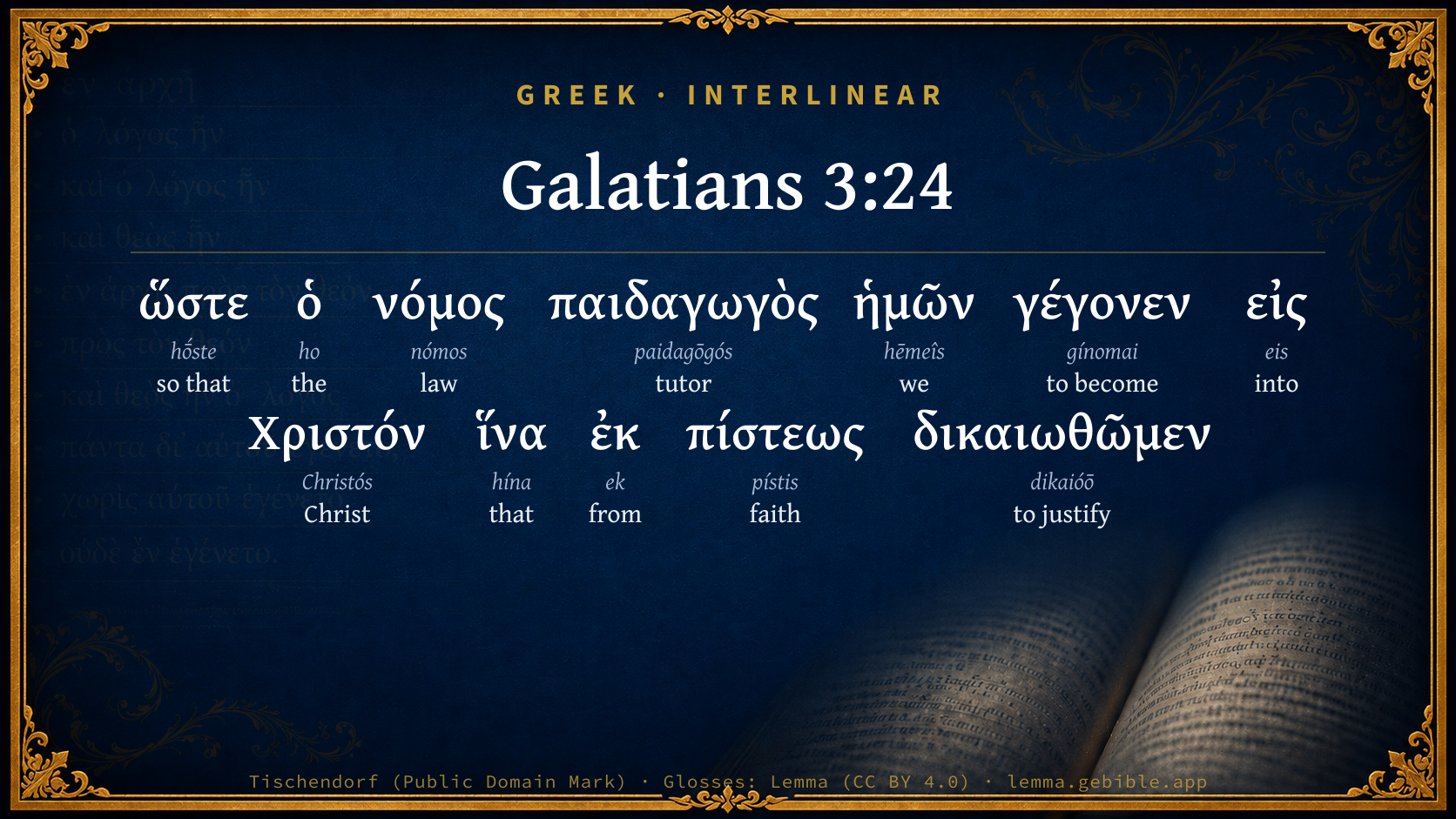
  1. ὥστε hṓste G5620 “so that” Conjunction
  2. ὁ ho G3588 “the” Article, Nominative, Singular, Masculine
  3. νόμος nómos G3551 “law” Noun, Nominative, Singular, Masculine
  4. ἡμῶν hēmeîs G2249 “we” Personal pronoun, 1st person, Genitive, Plural
  5. γέγονεν gínomai G1096 “to become” Verb, Perfect, Active, Indicative, 3rd person, Singular
  6. εἰς eis G1519 “into” Preposition
  7. Χριστόν Christós G5547 “Christ” Noun, Accusative, Singular, Masculine
  8. ἵνα hína G2443 “that” Conjunction
  9. ἐκ ek G1537 “from” Preposition
  10. πίστεως pístis G4102 “faith” Noun, Genitive, Singular, Feminine
  11. δικαιωθῶμεν dikaióō G1344 “to justify” Verb, Aorist, Passive, Subjunctive, 1st person, Plural

About this verse

These counts appear in no published source. They are computed here, from the morphology-tagged text and Lemma’s own curated glosses. What Lemma adds →

12
words
12
distinct lemmas
Pauline Epistles
section

Notable vocabulary

The rarest word here is παιδαγωγὸς tutor G3807 — appearing just 3 times in the whole Greek New Testament.

Shared distinctive vocabulary

παιδαγωγὸς tutor G3807 occurs in 3 verses of the Greek New Testament. Also found in:

Cross-references

15

Topical passages linked to Galatians 3:24 in the Treasury of Scripture Knowledge — connected by theme and wording, ordered by reader-vote popularity; previews shown in the World English Bible.

  • Romans 10:4 For Christ is the fulfillment of the law for righteousness to everyone who believes.
  • Acts 13:38–39 Be it known to you therefore, brothers, that through this man is proclaimed to you remission of sins,
  • Hebrews 10:1–14 For the law, having a shadow of the good to come, not the very image of the things, can never with the same sacrifices year by year, which they offer continually, make perfect those who draw near.
  • Romans 7:24–25 What a wretched man I am! Who will deliver me out of the body of this death?
  • Matthew 5:17–18 "Don't think that I came to destroy the law or the prophets. I didn't come to destroy, but to fulfill.
  • Galatians 2:16 yet knowing that a man is not justified by the works of the law but through the faith of Jesus Christ, even we believed in Christ Jesus, that we might be justified by faith in Christ, and not by the works of the law, because no flesh will be justified by the works of the law.
  • Colossians 2:17 which are a shadow of the things to come; but the body is Christ's.
  • Galatians 2:19 For I, through the law, died to the law, that I might live to God.
  • Galatians 3:25 But now that faith has come, we are no longer under a tutor.
  • Galatians 4:2–3 but is under guardians and stewards until the day appointed by the father.
  • Hebrews 7:18–19 For there is an annulling of a foregoing commandment because of its weakness and uselessness
  • Romans 7:7–9 What shall we say then? Is the law sin? May it never be! However, I wouldn't have known sin, except through the law. For I wouldn't have known coveting, unless the law had said, "You shall not covet."
  • Romans 3:20–22 Because by the works of the law, no flesh will be justified in his sight. For through the law comes the knowledge of sin.
  • 1 Corinthians 4:15 For though you have ten thousand tutors in Christ, yet not many fathers. For in Christ Jesus, I became your father through the Gospel.
  • Hebrews 9:8–16 The Holy Spirit is indicating this, that the way into the Holy Place wasn't yet revealed while the first tabernacle was still standing;

Cross-references courtesy of OpenBible.info (CC BY 4.0).

Commentary

Notes on Galatians 3:24 from classic Christian and Jewish commentators (each source and its license shown beneath its notes). The classic Christian expositions comment on the surrounding passage and are grouped to its opening verse, so a note may address several verses; the Jewish commentaries on the Tanakh (Rashi and others) are per-verse, so they appear only where the commentator wrote on this verse.

Lemma curates 59 commentaries, every one of them public domain or Creative Commons licensed, each selected and text-cleaned for this edition rather than reprinted as found. About our sources →

The Biblical Illustrator

Joseph S. Exell

Gal_3:24

Wherefore the law was our schoolmaster.

The law was our schoolmaster

I. The condition of humanity and the ultimate purpose of God respecting it. The Jews a type of mankind. Humanity is the Son of God, legally disinherited by apostasy, and gross and sensual. The heart of the Father is set upon its restoration, by pure favour, by means of faith. The Divine purpose was spiritual, and man must be conducted to it gradually. So God put man to school that, by a course of preparatory discipline, he might have his senses exercised.

II. The heir as long as he was a child was at school. The methods adopted were such as befitted his condition and age. The young mind is first made familiar with visible symbols, which for a time it mistakes for substance, but eventually learns the inner meaning. These methods were--

1. Prophetic intimations which must be put together like a dissected map.

2. A large picture-book was put before the scholars in the Levitical institute.

3. In addition to this pupils were required to do something, which constituted another process of emblematical teaching; ceremonies for purification, e.g.

III. These lessons of the schoolmaster became a preparation for the gospel. Christ was the end or scope of the law. The process of learning, however, was similar to what occurs in ordinary teaching. The mind of the scholar opens very gradually to that of the teacher.

1. The map which the young pupil had to study, the earthly land secured to Abraham, and his seed, is found to expand into a higher region, and to associate itself with another race (Rom_4:13; Heb_11:8; Heb_11:13-16).

2. The pieces of prophecy are put together, and compose the majestic figure of the Messiah.

3. With new views of the centre figure the whole of the Levitical system assumes its Divine significance.

(1) Its sacrifices become symbols of the better sacrifice.

(2) Its purification of the fountain opened for sin and uncleanness.

(3) Its feasts superseded by the spiritual privileges symbolized.

(4) With all this comes a new and ennobling sentiment of obedience. The law is not now heard in thunder and as a terrible shalt not, but a privilege and a joy. (T. Binney, D. D.)

There was a time of the worlds minority, and a time when it came of age. These times were marked--

1. By two stages--bondage and liberty.

2. By two principles of action--law and faith. Moses was the worlds schoolmaster, Christ became the worlds higher teacher. This state of things obtains in natural life, and in the single hearts life. Observe--

I. The uses of restraint in the hearts education. The law to the Jews was a system of checks.

1. To restrain from violence. The law is a schoolmaster to rule those who cannot rule themselves. In this stage it would be madness to relax from restraint.

2. To show the inward force of evil. Evil is unsuspected until opposed.

3. To form habits of obedience. Would you have your child happy, decided, manly? Teach him to obey.

4. To nourish the temper of faith. The use of all education is to form faith. The child does not know the reason of his teachers command; he has to trust.

II. The time when restraint may be safely laid aside.

1. When self-command is obtained. To be brought to Christ is to have learned to deny self.

2. When the state of justification by faith has been attained. Justification is acceptance with God, not because a man is perfect, but because he does all in a large and generous spirit. In such a state a man acts on principle, and gets beyond enactments. Apply to parents and teachers. How is it that children of religious parents turn out ill?

1. Because there has been no restraint during the time of discipline.

2. Because restraint has been applied when there should have been an appeal to principle and faith. (F. W. Robertson, M. A.)

The law is a schoolmaster

I. As giving precepts in which principles are involved but not expressly taught. Every wise teacher begins so, and the first duty of the pupil is a blind obedience. At length when the pupil discovers the principle he may dispense with the rule or not, as he pleases.

II. As prescribing inadequate duties--a part instead of the whole, which was to develop into the whole.

1. The institution of temple worship, by means of which the Jews were to be led into the truth that God is here, and therefore to be worshipped. But God is everywhere, and His true temples infinite space and the soul of man.

2. The institution of the Sabbath. But just as a right of way is often secured to the proprietor by shutting up a road one day in the year, not to declare it his only on that day, or more on that day than others, but simply to vindicate his right in it for every day; so did God shut up one-seventh part of time, that it might be understood that all belonged to Him.

3. The third commandment, which is not simply a prohibition of blasphemy, but was equivalent to thou shalt not forswear thyself, but perform thy oaths.

Learn:

1. That revelation is education. What education is for the individual, revelation is for the race.

2. That revelation is progressive.

3. That the training of character in Gods revelation has always preceded illumination of the intellect. (F. W. Robertson, M. A.)

The stern pedagogue

I. The office of the law. Our guardian, ruler, tutor, governor.

1. To teach us our obligations.

2. To show us our sinfulness.

3. To sweep away our excuses.

4. To chasten our delinquencies.

5. To watch us everywhere

II. The design of this office.

1. Not to conduct any man to despair, except of himself and it.

2. Not to urge us to make an amalgam of works and faith.

3. But to make us accept salvation as a free gift of God.

III. The termination of this office. When we come to believe in Jesus, the pedagogue troubles us no more. We become, then, of age. The office of the law ends.

1. When we ascertain that Christ has fulfilled it.

2. When it comes to be written on the heart. The man can be trusted, the boy must be watched.

3. When we take up our heirship in Christ. (C. H. Spurgeon.)

The law a guide to Christ

I. The method of this guiding power is exercised--

1. By completely shutting us out from every other hope.

2. By showing us the character and qualifications which we must find in the Saviour on whom we can entirely rely.

(1) He must be one competent to fulfil all the provisions of the holy law.

(2) But no creaturely being has ever accomplished this.

(3) The Saviour, therefore, must be Divine as well as human.

(4) These conditions meet in Christ.

3. By revealing the way in which we must be partakers of the Saviours mercy, and be interested in His redemption.

(1) It must be all of grace;

(2) by faith;

(3) issuing in justification.

4. By proclaiming its entire satisfaction with the provided Saviour.

(1) All its demands are honoured;

(2) its penalties borne;

(3) its acquital secured.

II. The object for which this guiding power is exercised.

1. Justification before God is the great want of the rebel under the condemnation of the law. He must gain this blessing or perish.

2. This cannot be obtained by the works of the law, which involve the discharge of its obligations and the endurance of its penalty.

3. It must, and therefore is, to be obtained by faith in Christ.

4. This faith working by love manifests itself in righteousness. (S. H. Tyng, D. D.)

The pedagogue

The pedagogue was a slave who had charge of his owners children, And who led them to the porch of the one who was really to give them lessons. But his office was not merely to keep the children in the right path and out of danger; he was a sort of private tutor, who prepared them for the instruction they were to receive from the philosopher or the professor. These higher lessons were quite beyond the power of the tutor himself; but he could do something to remove the difficulties which prevented young people from understanding, but above all he could undertake that they should be punctually in their place when the professor began his work. (Canon Liddon.)

Christ our schoolmaster

You send your little child in the care of some one to school. The ward takes the little creature, and says, Come, I will take you to school, and away they go to the place of instruction. Now the law was our care-taker, our companion, to take us to our schoolmaster Christ; Christ keeps a school, Christ calls those who go to His school His disciples, His scholars; Christ says, Learn of Me. (J. Parker, D. D.)

Life a school

Men are brought into this world, just as children are taken to school, to learn their lessons. We are born into this world to be schooled for heaven. There are vacancies in heaven for a certain number of us, and all who pass a good examination when the time comes will have their cards of admission given them into the place marked which they are to take. This life the public school that prepares for the university which we call heaven; and the Bible the code by which our lives will be tested when we present ourselves as candidates for admission: this is all, literally, that our present existence was contrived for, or the Bible given. (E. S. Ffoulkes, B. D.)

Love in the schooling of the law

A written law of God being given to man, what is its further office? The fulfulling of that law is in one word, love; for God is its Author, and God is love. Can the will of man, by itself and unaided, fulfil that law? And hero observe two things. First, this is not a question of much or little--can mans will half fulfil the law, or nearly fulfil it, or quite fulfil it?--but it is an absolute question, which must be answered, yea or nay, from the very nature of mans will and of the law. It is not, Can mans will fulfil this or that part of it? but Can it ever fulfil it at all, any single command of it? What is mans will? A will diverted, in the fall, from its central object; a selfish will; a will which recognizes not, follows not, the law of love as its guide; and in this wandering away from love and from God, leads with it mans whole nature. Now you see our question is this, Can such a will again renew itself into love? Manifestly not. It is powerless to give itself a new direction. What we want, then, is not a law to obey, but a Redeemer to set us free. Next, we may remark, that this question of the ability of man by his own will to keep Gods law, must not be confused, by being mixed up with the entirely distinct question of the relation of Gods absolute foreknowledge and foreordination to the free will of man. That relation did not begin with the fall of man at all; it would have subsisted just as much if he had never fallen: it subsists with regard to the holy angels in heaven, who have never sinned; it is an universal law of all created being. The incapacity of mans will of which we here speak, is not in consequence of any fettering of it by Gods sovereign decrees, but in consequence of its own act and deed, by which it left God and the law of love in our first parent, and became subject to those lower desires and faculties which it was created to rule and guide. Now let me not be mistaken as to my present position. In saying that the will of fallen man is incapable of fulfilling Gods law, let me be thoroughly understood. I am drawing no wild, exaggerated picture of depravity, but wish to keep to the strict letter of fact, and to build on it important consequences. There is much that the human will can do. It can choose between the outward objects which are presented to us in life--the objects of thought, of speech, of action. Nay, more; over all mere outward obedience to Gods law the will has power. But the will has not power over the desires and affections; in other words, over the superior faculties, of which it is a servant. It can produce good deeds to a certain extent, but it cannot produce good tendencies. And so by the law it has been proved, that redemption is necessary for man. And more; it has been brought about that man should be receptive of redemption, prepared to welcome it, eager to avail himself of it. His very demonstrated helplessness has shown that he must be helped from above. The law was Gods great instrument to prepare man for redemption by Christ. He used it in this way on a large scale in the history of the world. The Jewish people, who were placed under it, were by it not rendered a people acceptable to God, but proved incapable of pleasing Him. Its lower requirements became to them a substitute for its first and great commandment; and no restoration to the law of love was effected by it in them. In the course of history its threatenings were executed on them, its promises, and more than its promises, fulfilled to them as a people; and when the Redeemer came, they were for the most part a nation of hardened hypocrites. All its power was power to convict and find guilty--not power to save even by that conviction:--for mans depraved conscience might quench and annul the conviction. And He has ever made the same use of His law in the hearts of individuals. And now I would ask you to mark the wonderful course and progress of Divine love towards us. In mankind at large, as in individual men, there must be produced this knowledge and feeling of their own unworthiness and incapacity to save themselves; not indeed so as to make them universally cry out for the gospel, but so as to make them, when the gospel has come, on looking over the page of history, confess that God has manifested beyond a doubt the sinfulness of man. For the first many ages after the fall, the unwritten law took its course. The conscience became darkened--the earth full of violence--till the vengeance of God was drawn down upon it in the Flood. Again, the true knowledge and fear of him, in the family of Noah, was assumed as a starting-point for the new world; again, even from this more definite covenant did the nations of the world go astray as widely as ever. Out of them God selected Abraham, and entered into special covenant with him and his seed. And while in them was proved the powerlessness of His revealed law to renew or to save, among the Gentile nations a lesson not less remarkable was being taught to mankind. Of them God suffered some to advance to the very highest pitch of art, and science, and acuteness of the human intellect. Their philosophy has set the pattern for the world; their oratory, their poetry, have been since unrivalled. And that nothing might be wanting to the full trial of man, another people found its employment and pride in civil arts; in taming the nations, in sparing and consolidating by exquisite polity the states subjected to its sway; in laying the foundation of public right and justice for the latest age of mankind. And thus both by these, and in other parts of the inhabited world by other nations, the powers of man for good were fully and maturely tried. Every facility was given him which belonged to his fallen state. And the result of all was this: that neither by wisdom, nor by imagination, nor by individual or social power for good, nor by the revelation of Gods will in the law, could man put himself back again into the path of love which he had left. O you who read ancient history, whether sacred or profane, read it to trace it in this design of God, to prepare the world for Christ; for this is the master-key to its secrets. (Dean Alford.)

The use of the law

A minister says, When I was a boy I ploughed a field with a team of spirited horses. I ploughed it very quickly, Once in a while I passed over some of the sod without turning it, but I did not jerk back the plough with its rattling devices. I thought it made no difference. After awhile, my father came along, and said: Why, this will never do; this isnt ploughed deep enough; there, you have missed this and you have missed that. And he ploughed it over again. The difficulty with a great many people is that they are only scratched with conviction when the subsoil plough of Gods truth ought to be put in up to the beam.

The law and the gospel

You never saw a woman sewing without a needle. She would come but poor speed if she only sewed wi the thread. So, I think, when were dealing with sinners, we maun aye put in the needle of the law first; for the fact is, they are sleepin sound, and they need to be awakened up wi something sharp. But, when weve got the needle o the law fairly in, we may draw as long a thread as you like o gospel consolation after it. (Lockhart.)

The law a schoolmaster

The method devised by Dr. Arnold at Rugby School, was to eventually raise the moral tone of the whole school by first raising the tone of a certain part. Is it irreverent to call the Israelites the Sixth Form of the school of the human race, an elect nation for the sake of the non-elect, chosen neither for their own merits, nor principally for their own blessing (though their privileges were inestimable), but to hasten the coming of Christ, and thus in the end to open the kingdom of heaven to all believers? (C. R. Lloyd Engstrom, M. A.)

The law leading men to Christ

The law! It is one of a group of words round which the thought of St. Paul constantly moves; and he uses it in more senses than one. Here he means by it generally the five Books of Moses to which the Jews commonly gave the name; and more particularly he means those parts of Exodus, Leviticus, Numbers, and Deuteronomy, in which are contained the various rules which God gave to Moses for the moral, social, political, and religious, or ceremonial conduct of the people of Israel. This was the law in which, as St. Paul said, the Jew of his day made his boast; he was proud to belong to the race which had received it. This was the law, the possession of which made Israel a peculiar people, marking it off by a deep-cut line of separation from all the other nations of the world. This was the law which it was the business of every Israelite to obey. Now St. Paul says bluntly, that the main purpose of this law was not present, but prospective; it was not to be so much prized on its own account, as for the sake of that to which it was to lead. It was really like those slaves who were kept in well-to-do households in the ancient world, first to teach the children of their masters roughly, or as well as they could, and then to lead them down day by day to the school of some neighbouring philosopher, at whose hands they would receive real instruction. This, then, was the business of the law; it did the little it could do for the Jewish people as an elementary instructor, and then it had to take them by the hand and lead them to the school of Jesus Christ. This it did:

I. By foreshadowing him. This was especially true of its ceremonies. All the Jewish ritual, in its minutest details, was a shadow of good things to come. Each ceremony was felt to have some meaning beyond the time then present, and so it fostered an expectant habit of mind; and as the ages passed, these expectations converged more and more towards a coming Messiah; and so, in a subordinate but real way, the ceremonial law did its part in leading the nation to the school of Christ.

II. By creating in mans conscience a sense of want, which Christ alone could relieve. This was the work of the moral law. Exact obedience to strict precepts was commanded; but who could render it? So the law, universally disobeyed, became like a torch carried into the dark cellars and crevices of human nature that it might reveal the foul shapes lurking there, and might rouse man to long for a righteousness which it could not confer. And this could only be found in Christ.

III. By putting them under a discipline which trained them for Christ. God begins with rule, and ends with principle; begins with law, and ends with faith; begins with Moses and ends with Christ. In the earlier revelation God only said Do this, do not do that. In the later or Christian revelation He has done much more; He has said, Join yourselves by an act of adhesion of your whole moral nature to the perfect moral Being--in other words, Believe on the Lord Jesus Christ, This is justification by faith. So far from being moral anarchy, it is the absorption of rule into the higher realm of principle. In the experience of the soul, faith corresponds to the empire of principle in the growth of individual character and in the development of national life; while the law answers to that elementary stage in which outward rules are not yet absorbed into principle. (Canon Liddon.)

The schooling of the law

There were three systems of law delivered to the Jews, each leading, like a highway of the Lord, to Christ.

I. The judicial law. This involved their civil policy as a state or nation, governed their conduct as between man and man, and determined their offences and penalties as citizens and subjects.

II. The ceremonial law, determining their ecclesiastical polity.

III. The moral law. Resolved by Christ into two commandments, and by St. Paul into one word--love. This law brings us to Christ

(1) By convicting of sin;

(2) by revealing our peril;

(3) by its weakness through the flesh to save from death. (J. B. Owen, M. A.)

Pedagogic character of the law

A schoolmaster nowadays is not at all like the personage Paul intended. He speaks of a pedagogue, an official seldom if ever now seen among men. This was not a person who actually officiated as master in the school, and gave instruction in the school itself; but one--a slave generally--who was set to take the boys to school, and to watch over them, and to be a sort of general supervisor of them, both in school and Out of school, and at all times. A pedagogue was very generally employed in the training of the young; indeed, it was a common and customary thing for the sons of the Greek and Roman nobility to have appointed over them some trustworthy servant who took them in charge. The boys were entirely under these servants; and thus had their spirits broken in, and their vivacity restrained. As a rule these pedagogues were very stern and strict--they used the rod freely, not to say cruelly, and the condition of the boys was sometimes no better than slavery. The boys (as it was supposed to be for their good) were kept in perpetual fear. Their recreations were restricted; even their walks were under the surveillance of the grim pedagogue. They were sternly held in check in all points, and were thus disciplined for the battle of life. Now Paul, taking up this thought, says the law was our pedagogue, our guardian, our custodian, ruler, tutor, governor, until Christ came. (C. H. Spurgeon.)

The Church to be governed by principle, not rigid law

A Christian Church, from the necessity of the case, is based on faith--that is, on principle; it represents by its existence the definitive triumph of believing principle over mere outward Jewish rule; it does not discard rule, far from it, but it provides for the good that is to be achieved by rule, by insisting always on the higher influence of principle; and thus the true direction of the Churchs life would seem to be adherence to principle, combined with freedom as to all that touches mere outward rule. In modern language, Holy Scripture, the three great Creeds which guard it, the essential conditions of the means of grace--that is, the governing and informing principles of the Churchs life,--should all of them be defended to the very last extremity; but as to matters of mere ceremonial and the like, there should be as much freedom as is compatible with the very elementary requirements of order. Where the faith is held sincerely, the rules of outward observance should be largely left to take care of themselves; the margin of liberty within which devotional feeling at very different stages of its growth finds its congenial expression, should be as wide as possible. (Canon Liddon.)

The gentleness of Christs dominion

Moses and the law is a rigid and severe schoolmaster, who by whips and threats requires a hard lesson of his scholars, whether able to learn it or not; but Christ and the gospel is a mild and gentle teacher, who by sweet promises and good rewards, invite their scholars to duty, and guide and help them to do what of themselves they cannot do; by which means they love both their Master and their lessons, and rejoice when it is nearest to them to direct them in their studies. (W. Burkitt.)

Relation of the law to the gospel

I. The whole law of god is one. Gods law is the declaration of His will; and Gods perfect will never changes, and, therefore, Gods law is like Himself--the same yesterday, to-day, and for ever. It is essentially impossible that one part of Gods law should ever contradict any other part; from beginning to end it is one. But this law may develop itself by successive stages, and manifest itself in different ways in these different stages. Under ground, among the rocks, among the subterranean springs, the tree develops in the form of roots. Above ground, we find the tree developing in the form of trunk. We go higher, and our tree is branches, and then leaves, and blossoms, and fruit. The tree is one. Fruit and root are the extremes of one perfect organism; yet what a difference between them. So Gods law is one, whether we see it in its lower or higher stage.

II. We are to distinguish between the substance and the form of the law. The Divine thought is the essential thing; not the mere formal precept or symbol by which it was conveyed. So, while the former must ever be retained, the latter may drop off; just as the tree drops off in the branches the mould which clings about the roots, and drops off in the blossom and fruit the bark of the trunk and branches, while root and trunk and branch and blossom yet continue to be one tree. (Marvin R. Vincent, D. D.)

Rule yields to principle

Here is a boy who begins to study mathematics. The teacher gives him specific rules. Do thus, and you will add numbers. Do so, and you will subtract or multiply. It is not a matter of principles or laws at all. The boy has, and can have, no conception of the great fundamental laws of numbers and of their relations. He takes his arithmetic and studies the rule for decimals or long division, and does his sums by the process laid down in the rule. But one day, the boy comes to the teacher with his sum worked out by a process not laid down in his arithmetic. He has thought it out by a process of his own. The rules he has been practising have led him unconsciously up to certain great mathematical principles which are not confined in their working out to the one little rule of the arithmetic, but are capable of a variety of expressions. Is the teacher angry because the sum was not done by the rule? Is he not rather delighted? He sees, in the lads overstepping the rule, the very result at which he has been aiming. All the rules were directed to bring about this grasp of principles which he has obtained. Henceforth he will not be bound by the rules, but will he therefore violate the great laws of mathematics? Will he not be as much under law as ever, yea, under the same law, when he measures the orbits of planets or weighs suns, as when he repeated the multiplication table, or cast up the little columns in simple addition? So it is in moral development. You want to teach a child the great principle of order. You begin with specific rules. You must put your books in such a place, and your hat in such a place. You must study such and such hours. You may amuse yourself at such times. The time finally comes when all thess rules drop off of themselves. They are no longer needed. He has got hold of the great truth of order, and its obligation has its grip upon him, and that was all that the rules were intended for. That being reached, he may be orderly and systematic in his own way. The great point is that, however his way may differ from that prescribed by his old rules, he is still under law, and under the same law--the law of order. So then, when Gods law, the pedagogue, the law of commandments, precepts, prohibitions, hands a man over to Christ, it introduces him to a life which is just as much under the power of law and of the same law as ever. Law is not abolished, but whereas formerly the law was applied to the man from without, it now begins to work from within the man. In other words, he lives by the law of God written upon his conscience and wrought into his life. He is a law unto himself. He is no longer a moral schoolboy, but a man in Christ Jesus. The law of precepts has been silently preparing the man to be kindled and quickened into life by contact with Christs life. You know how, at the sacred season in Rome, the workmen are engaged for clays in arranging the lines of lamps over the dome and portico of St. Peters; and when at last the hour strikes, on a sudden the whole gigantic structure bursts into flame. Just so law draws the line of obedience and duty; but these, however symmetrical and sharp, are dead and cold until they feel Christs touch; then the life kindles and glows. The lines of law are all irradiated. (Marvin R. Vincent, D. D.)

Christ supersedes the law

If the law is done away, we are never henceforth under its tyranny, but are under Christ, and live in all security and joy, through Him who now reigns in us mildly and graciously by His spirit. Therefore, if we could rightly apprehend Christ, the dear Saviour, this severe and wrathful schoolmaster would not dare to touch a hair of our heads. From this it follows that believers, as concerns the conscience, are by all means free from the law; on this account the schoolmaster should not rule therein, i.e., he should not affright, threaten, or take the conscience captive, and though he should undertake it, the conscience should not care for it, but should behold Christ on the cross, who through His death had freed us from the law and all its terrors. Nevertheless there is sin still remaining in the saints, whereby their conscience is accused and plagued. Yet Christ helps it up again through His daily, yea, continual drawing near. (Luther.)

The law a schoolmaster

The law taught, as a schoolmaster teaches, the elements of true religion and right morals. It therefore prepared men for Christianity, or was the introduction to Christianity, which supposes and embraces those elements, though it carries them forward into further and higher developments, and surrounds them with more mature and heavenly sanctions than were before revealed; just as the schoolmaster prepares a pupil by the studies of the school-room, for the studies and pursuits of life, and furnishes the knowledge which is absolutely necessary for the attainment of the superior knowledge of future years, and which can never be entirely dispensed with. The pupil is not required to remain in the school-room, amenable to all the minor regulations of the school-room, and indeed would not be justified in doing so, when the time has come for his entrance upon the advanced discipline and broader duties and prospects of maturity and the world; and yet he must never slight or forget the real knowledge and true habits which have been instilled and formed within those humbler precincts, for these are always available and useful, and are indeed indispensable to his progress. The law was our schoolmaster to bring us unto Christ. It could not have brought us unto Christ, unless it had taught us much that is intrinsically and permanently true and good, and of Divine authority. Such aa introduction could have been made by no unworthy or unauthorized hand. Holiness unto the Lord must have been engraved upon the forehead of that instructor, who performed the high office of leading us into the presence of the Son of God. Let us see how this truth may be confirmed. Let us refer to what may be gathered of the mind of Jesus on this subject. First and chiefly, he always speaks of the God by whose commission Moses gave the law to the Israelites, aa his own God and Father, by whom he was sanctified and sent into the world. It is impossible for any man of common-sense and a clear and unprejudiced head, who shall read the Old Testament and then proceed to read the New, to entertain any other idea than that the Supreme Being and Almighty God of the one is the Supreme Being and Almighty God of the other, though more chiefly revealed and brought nearer to us in the second than in the first. Jesus refers also to the patriarchs and prophets of the former dispensation not as strangers, or belonging to a hostile order or communion, but as His own predecessors and forerunners, who had seen His day and intimated His coming, and He often repeats and applies their sayings and predictions. The proposition is further confirmed by a view of those characters of the law which are evidently intrinsic and unchangeable. The primary truth of the Unity of God is declared in it with a distinctness and a grandeur which no words and no imagination can surpass. The Hear, O Israel! the Lord our God is one Lord, is a proclamation which sounds, as with trumpet voice, from one dispensation to the other, from the Tabernacle and the Temple to the Church, and from the Church into the depths of time. Those infinite attributes of God, which, when proposed to the mind, are in perfect conformity with the best exercises of our reason, and are yet so high that our highest reason cannot reach or measure them, are revealed in the law with all the clearness which human language can command, and with an original sublimity which is to be found nowhere else. As in the doctrinal, so in the ethical part of the law, there is a height and a purity which might fitly introduce the moral system of the gospel, and be blended and incorporated with it, because it is in unison with it, and speaks of a common origin. The ten commandments, which are the condensation of this part of the law, are unquestionably permanent and irreversible. Finally, two important inferences must be kept in mind.

1. That we should never take one part of the conclusion, when the apostle is pressing it upon our attention with all his innate zeal, without a reference to the other part, which, under different circumstances, he would have pressed as warmly, and which was never really absent from his mind. He must be interpreted by himself; what he says at one time compared with what he says at another.

2. We ourselves are bound to pay becoming reverence to that ancient law, whose office it was to introduce men to the knowledge and enjoyment of gospel privileges and blessings. There is little danger at present of our falling back under the yoke against which St. Paul warns his converts; but there is some danger of our erring on the opposite side, and treating the law, and the books which contain it, with an undeserved and unbecoming irreverence. Let us remember that the law was a schoolmaster to bring us to Christ, and that, as such, its instructions were necessary and are still to be revered. Having entered a higher institution, we do not go back to school; but having been well taught in those elements which prepared us for that institution, we will remember the teacher with respect and gratitude. While the Saviour of men appears before us in all his transfigured glory, though we shall give to His person our longest and intensest regards, we shall not shut our eyes to the venerable forms of Moses, and Elias, who appear with Him and talk with Him. (F. W. P. Greenwood, D. D.)

After that faith is come, Christian freedom and sonship

I. To prove to ourselves that we have faith we must prove that we need not the law;

II. To prove that emancipation and liberty we must prove that we are the sons of God.

III. To prove that engrafting and adoption we must prove that we have put on Christ.

IV. To prove that apparelling our proof is that we are baptized into Him. (Doune.)

The superiority of Christianity to Judaism

It was the happiness of the Jews to have had the law, but it is ours not to need it; they had the benefit of a guide to direct them, but we are at our journeys end; they had a schoolmaster to lead them to Christ, but we have proceeded so far as that we are in possession of Christ. The law of Moses binds us not at all as it is His law; whatsoever binds a Christian in that law would have bound Him though there had been no law given to Moses. (John Donne, D. D.)

The law our schoolmaster

I. The Holy Ghost employs the law as a servant. Salvation never came by the law, never could have come by the law, never can come by the law, through any obedience that fallen man can render either felts letter or its spirit. The law is the map; it is not the country. The law is the model; it is not the substance. The law is the picture; it is not the person. The law prophesies, prefigures, presents the fulness of the salvation which is wrought by Jesus Christ as the ground of the believers security and the warrant of his faith. But under the ministry of the Holy Ghost another illustration is introduced, and the apostle says the law is the schoolmaster, or, to Anglicise the Greek word, is the pedagogue, to bring us unto Christ. And the parts of the figure are easily comprehended. The Holy Ghost is the parent of the soul; the law is the tutor to whose instruction it is committed until the time of majority, when all the tutors and governors of minority disappear, and the privileges of heirship in Christ become the possession and the enjoyment of those who have passed from the tutors care. Now, the Spirit of God presents to us the law of God under this simile. Go where the sinner will, before he has come to the full age of faith, the law of God is his shadow. Oh I that men would remember this. They do not in darkness escape Gods ever present detection; they do not by double dealing evade the inspection of Him who has established the law for their discipline to bring them unto Christ. Wherever the man goes before he has learned the fulness of his salvation in Jesus, he must be looking about him for the presence of the schoolmaster. When the law of God takes hold of a man, and he realizes his obligation under its commandment and his subjection to its penalty, then, of course, pleasures cease for him, for the presence of the schoolmaster destroys every circumstance of peace and enjoyment. Does he go to a place of frivolous amusement? The law of God whispers to his conscience, What if you should die here? Does he go to his pillow and seek relief from remorse? He lays his head upon it without possible quietness, while the law of God recounts to him the condemnation he has justly deserved for every impurity of thought and defection in act. Does he go to church, and is the minister of God expounding the gospel of Gods grace? Next to him in the pew sits the law of God, his inseparable companion, who tells him, in the midst of promises, These are not for you. In the midst of all the descriptions of the pleasures of the saint, You have no part in these. And when the dark cloud of Divine indignation which brings out in relief the grace of Jesus Christ rises before him, the awful menace of the law tells him, The storm will burst upon you, the condemnation of God will catch you, hell is yawning to receive you. Oh! the horrors of this pedagogue-companion under whose discipline men are so ready to live. Now let us, having looked at their inseparable companionship, overtake them in their walk and listen to some of their conversation. The refrain of all that the law says is, Do. Do this and thou shalt live. And to this constant exhortation, which stirs up all the bitterness of the heart, there is a succession of apologies and pleas presented, which, for the time, will silence the voice of conscience, but which the law brushes away with ridicule as of offering chaff for wheat, brass for gold, currency for coin. Do this and thou shalt live. I want to do it. It is not wanting to do; it is doing, saith the law. I will try to obey. That will not suffice. It is not trying; it is obeying. I have obeyed a great many of the commandments. I am reputed to be obedient. I think I have almost reached it. Almost is not enough, child; altogether thou must do it. Not a single defect must there be in either spirit or letter of prohibition or command. Oh, what a multitude of apologies does the pedagogue have to hear! I am quite as good as those about me. Thou hast nothing to do with another; Cursed is every one that continueth not in all things which are written in the book of the law to do them. Yes, but I am ready to believe in Christ after I have done all I can. Christ cannot help thee; as long as thou art under age thou must be under the law and thou must do all. When thou hast become of majority, then my office is at an end, and is passed away. Well, I am praying for help to obey the commandment. There will no help come to thee until thou dost come of age, child, and dost trust completely in Him who is the Saviour of the world. Thou canst never compound and commingle and amalgamate the law and the gospel. The illustration might be indefinitely continued to cover all the possible pretexts of sinners before the law of God. But the whole story is told in this one statement, that the law of God never smiles upon a sinner. This schoolmaster always frowns. There is no pity in the law; there is no mercy under its ministration. The one office of the pedagogue was to drag the boy down. The one office of Gods law, as the spirit employs it, is to humble every proud thought, every high look, every personal ambition and determination, until the man is willing to be a beggar and be saved by the blood of the Crucified One.

II. The errand which is entrusted to this pedagogue. The law was our schoolmaster to bring us to Christ. The original reads, The law is our schoolmaster unto Christ. When we reach Christ, then is the vocation of the schoolmaster at an end. It convinces men that they need Christ--that they need a free salvation. Christ has fulfilled the law. His obedience was perfect. Now we want to be justified by faith through His righteousness.

III. The sign that the law has discharged his commission. Our boys come of age at twenty-one years. Under the Greek code, the child came of age at thirteen and a half years. And I know some boys in our congregation that it would greatly delight if that were the rule in America. We have very few children nowadays. They are all men and women. Under the Roman law, majority was not attained until twenty-five years, but when the day was reached at which the child, by the custom of the land and the constitution of the Government, was pronounced a man, he could laugh at the school-master, and his office had passed away. Up to that hour he was imperious. Now he was impertinent. Up to that day his sharpness of examination was only the fulfilment of the duty he had assumed. After that day, to assume any such relation to the man, was to bring himself under the law which would condemn him utterly. So, saith the apostle, when faith is come, when the child has passed up toward full majority by trusting in Jesus Christ, then the schoolmaster has gone, the believer is freed from the law as a discipline. Oh I dear friend, this is the mountain top from which we view the land of promise. This is the place of privilege to which every child of God is permitted to attain. We are not under the law, says the apostle, we are under grace. But the sign that this majority has been reached is the transference of the soul from the discipline of precepts to that of principles, which the apostle calls the law written on the fleshly tables of the heart. We are not free from this law. It never passes away; but now we delight in the law of God. There is no fear now as we remember the old commandments. (S. H. Tyng.)

The Biblical Illustrator, edited by Joseph S. Exell (c. 1880s–1900s) — public domain. Text from a community e-Sword module.

Joseph Benson's Commentary

Gal 3:24-26. Wherefore the law was our schoolmaster — That is, the instructer of the childhood of us Jews, or of the church of God, in its state of minority; see on Gal 4:3; to bring us unto Christ — To train us up for him. And this it did, both by its precepts, which showed us the need we had of his atonement, and by its sacrifices, oblations, purifications, and other ceremonies, which all pointed us to him; that we might be justified by faith — In him, and so might obtain the benefit of the promise. But after that faith is come — The gospel dispensation being fully revealed, and the law of faith promulgated; we are no longer under that schoolmaster —

The Mosaic law, but pass over into a more liberal and happy state. For ye — Who have believed on Christ, with a faith working by love; are all — Not merely the subjects and servants of God, your Lord and Master, but his children, by faith in Christ Jesus — The sons and daughters of the Lord Almighty; yea, his heirs, and joint heirs with his beloved Son: and to you his commandments are not grievous.

Joseph Benson's Commentary on the Old and New Testaments (1811–1818) — public domain. Text from a community e-Sword module.

Scofield Reference Notes

C. I. Scofield

law

I. The law of Moses, Summary:

(1) The Mosaic Covenant was given to Israel in three parts: the commandments, expressing the righteous will of God Exo 20:1-26, the "judgments," governing the social life of Israel Exo 21:1 to Exo 24:11, and the "ordinances," governing the religious life of Israel; Exo 24:12; Exo 31:18.

(2) The commandments and ordinances were one complete and inseparable whole. When an Israelite sinned, he was held "blameless" if he brought the required offering Luk 1:6; Php 3:6.

(3) Law, as a method of the divine dealing with man, characterized the dispensation extending from the giving of the law to the death of Jesus Christ Gal 3:13; Gal 3:14; Gal 3:23; Gal 3:24.

(4) The attempt of legalistic teachers (e.g.) Act 15:1-31; Gal 2:1-5, to mingle law with grace as the divine method for this present dispensation of grace, brought out the true relation of the law to the Christian, viz.

II. The Christian doctrine of the law:

(1) Law is in contrast with grace. Under the latter God bestows the righteousness which, under law, He demanded Exo 19:5; Joh 1:17. (See Scofield "Rom 3:21").; Rom 10:3-10; 1Co 1:30.

(2) The law is, in itself, holy, just, good, and spiritual Rom 7:12-14.

(3) Before the law the whole world is guilty, and the law is therefore of necessity a ministry of condemnation, death, and the divine curse Rom 3:19; 2Co 3:7-9; Gal 3:10.

For Another Point of View: See Topic 301242

Other Factors to Consider: See Topic 301187

(4) Christ bore the curse of the law, and redeemed the believer both from the curse and from the dominion of the law Gal 3:13; Gal 4:5-7.

(5) Law neither justifies a sinner nor sanctifies a believer Gal 2:16; Gal 3:2; Gal 3:3; Gal 3:11; Gal 3:12.

(6) The believer is both dead to the law and redeemed from it, so that he is "not under the law, but under grace" Rom 6:14; Rom 7:4; Gal 2:19; Gal 4:4-7; 1Ti 1:8; 1Ti 1:9.

(7) Under the new covenant of grace the principle of obedience to the divine will is inwrought Heb 10:6. So far is the life of the believer from the anarchy of self-will that he is "inlawed to Christ" 1Co 9:21 and the new "law of Christ"; Gal 6:2; 2Jn 1:5 is his delight; while, through the indwelling Spirit, the righteousness of the law is fulfilled in him; Rom 8:2-4; Gal 5:16-18. The commandments are used in the distinctively Christian Scriptures as an instruction in righteousness; 2Ti 3:16; Rom 13:8-10; Eph 6:1-3; 1Co 9:8; 1Co 9:9.

to bring us Omit "to bring us."

unto up to, or until.

The Scofield Reference Bible (1917 edition), notes by C. I. Scofield — public domain. Text from a community e-Sword module.

Tyndale Open Study Notes

Tyndale Open Resources

3:24 The law is like a child’s guardian (Greek paidagōgos, “tutor”). In Greco-Roman culture, a guardian was a faithful slave responsible for training and protecting the heir until he came of age.

Tyndale Open Study Notes — © Tyndale Open Resources, licensed CC BY-SA 4.0. Text via the HelloAO Bible API.

Bengel's Gnomon

Johann Albrecht Bengel

Gal 3:24. Παιδαγωγὸς, a schoolmaster) who has kept us under discipline, lest we should slip from his hands.—νήπιοι, infants [‘children’], need such discipline, Gal 4:3. There is again a personification of the law.

Bengel's Gnomon of the New Testament — English translation (T&T Clark, Edinburgh, 1860) — public domain. Text from a community e-Sword module.

Meyer's Critical & Exegetical Commentary

Heinrich August Wilhelm Meyer

Gal_3:24. Accordingly the law has become our paedagogue unto Christ. As a paedagogue (see on 1Co_4:15) has his wards in guidance and training for the aim of their future majority, so the law has taken us into a guidance and training, of which Christ was the aim, that is, of which the aim was that we in due time should no longer be under the law, but should belong to Christ. This munus paedagogicum, however, resulting from Gal_3:23, did not consist in the restriction of sin,[168] or in the circumstance that the law ab inhonestis minarum asperitate deterreret (Winer, and most expositors, including de Wette, Baur, Hofmann, Reithmayr, but not Usteri, Hilgenfeld, Wieseler),views decidedly inconsistent with the aim expressed in Gal_3:19, and with the tenor of Gal_3:23, which by no means expresses the idea of preparatory improvement; but it consisted in this, that the law prepared those belonging to it for the future reception of Christian salvation (justification by faith) in such a manner that, by virtue of the principle of sin which it excited, it continually brought about and promoted transgressions (Gal_3:19; Rom_7:5 ff.), thereby held the people in moral bondage (in the φρουρά, Gal_3:23), and by producing at the same time the acknowledgment of sin (Rom_3:20) powerfully brought home to the heart (Rom_7:24) the sense of guilt and of the need of redemption from the divine wrath (Rom_4:15),a redemption which, with our natural moral impotence, was not possible by means of the law itself (Rom_3:19 f., Rom_8:3). Luther appropriately remarks: Lex enim ad gratiam praeparat, dum peccatum revelat et auget, humilians superbos ad auxilium Christi desiderandum. See also Weiss, bibl. Theol. p. 287 f.; Holsten, z. Evang. d. Paul. u. Petr. p. 315 f. Under this paedagogal discipline man finally cries out: ταλαίπωρος ἐγώ, Rom_7:24.

ΕἸς ΧΡΙΣΤΌΝ] not usque ad Christum (Castalio, J. Cappellus, Morus, Rosenmüller, Rückert, Matthias), but designating the end aimed at, as is shown by ἵνα ἐκ π. δικ.; comp. Gal_3:23. Chrysostom and his successors (see Suicer, Thes. II. pp. 421, 544), Erasmus, Zeger, Elsner, and others, refer εἰς to the idea that the law ΠΡῸς ΤῸΝ ΧΡΙΣΤΌΝ, Ὅς ἘΣΤΙΝ Ὁ ΔΙΔΆΣΚΑΛΟς, ἈΠΉΓΕ, just as the paedagogi had to conduct the boys to the schools and gymnasia (Plat. Lys. p. 208 C; Dem. 313. 12; Ael V. H. iii. 21). But this introduces the idea of Christ as a teacher, which is foreign to the passage; He is conceived of as reconciler (ἵνα ἐκ πίστ. δικ.).

ἽΝΑ ἘΚ ΠΊΣΤΕΩς ΔΙΚΑΙΩΘ.] is the divine destination, which the paedagogic function of the law was to fulfil in those who were subject to it. The emphatic ἐκ πίστεως (by faith, not by the law) shows how erroneously the paedagogic efficacy of the law is referred to the restriction of sin.

[168] Comp. Liban. D. xxv. p. 576 C: πρῶτον μὲν νομῷ παιδαγωγήσομεν αὐτῶν τὴν προαίρεσιν, ὡς ἂν τὴν ἀπὸ τοῦ νόμου ζημίαν ἀναδυόμεναι σωφρονεῖν ἀναγκάζωνται. Comp. also Simplic. Epict. 10, p. 116, ed. Schweigh.; and see Grotius on our passage.

Meyer — Critical and Exegetical Commentary on the New Testament — English translation by Peter Christie, edited by Frederick Crombie (T&T Clark, 1880) — public domain. Text from a community e-Sword module.

Cambridge Greek Testament for Schools and Colleges

24. A change of metaphor from protection by a guard to a “tutor,” i.e. here the beneficent action of the Law is more directly indicated. In all probability too we should place a full stop at the end of this verse, joining Gal 3:25 closely with the following verses. On the other hand the thought of the παιδαγωγός is too akin to much of the contents of Gal 3:25 to Gal 4:7 to warrant our making (with Weiss) Gal 3:24 the end of a section beginning at Gal 3:15. It naturally leads on to νἱοί.

ὥστε. Though about to change the metaphor St Paul draws his conclusion from Gal 3:23.

ὁ νόμος. The nominative without the article would have been very ambiguous (Gal 2:16 note), and even have suggested a law (or law), Gal 5:23, rather than the Mosaic Law which St Paul here intends.

παιδαγωγὸς ἡμῶν. παιδ.: Gal 3:25, 1Co 4:15[111]. Much material for studying the use of the word is given in Suicer II. 543 sq. and s.v. νόμος II. 421. Lightfoot quotes a long and instructive passage from Plato, Lysis, p. 208 c. The Paedagogus looked after boys from seven to seventeen years of age, his duties being in Greek households solely moral and disciplinary, in Roman also, and perhaps chiefly, educational. Here there is no hint of instruction being given by him, but of his disciplinary protection such as φρουρεῖν might suggest. It is however unreasonable to deduce from this (with Ramsay, Gal. pp. 381 sqq.) that the Epistle was written to Churches in South Galatia where Greek influence was more prevalent. For it is very doubtful whether the North Galatians had definitely Roman customs. Compare, for the subject generally, Appendix, Note C.

[111] Is affixed it means that all the passages are mentioned where the word occurs in the Greek Bible.

It is worthy of note that in the Rabbinic writings the word is used in the same disciplinary sense as here, e.g. as a king sends his son’s Paedagogue to turn him back from his evil ways, so God sends Jeremiah to Israel (Debarim R. Parasha 2 on Deu 4:30).

Thus the Law is described as exercising a sound moral influence over us with the view of bringing us to Christ. Except that Christ is not here regarded as a schoolmaster Theodoret’s words are excellent: παιδαγωγοῦ γὰρ ἡμῖν ἐπλήρωσε χρείαν· καὶ τῆς μὲν προτέρας ἡμᾶς ἠλευθέρωσεν ἀσεβείας, θεογνωσίαν δὲ παιδεύσας, οἶόν τινι σοφῷ διδασκάλῳ προσφέρει τῷ δεσπότῃ Χριστῷ, ἵνα τέλεια παρʼ αὐτοῦ παιδευθῶμεν μαθήματα, καὶ τὴν διὰ τῆς πίστεως δικαιοσύνην κτησώμεθα.

γἐγονεν has proved itself so in our case.

εἰς Χριστόν, not Ἰησοῦς, because not the historical person but the expected Messiah is under consideration.

ἵνα (Gal 3:22) ἐκ πίστεως δικαιωθῶμεν, Gal 2:16 note.

Cambridge Greek Testament for Schools and Colleges (Cambridge University Press, 1896; 21 vols, various authors incl. Carr, Maclear, Plummer, Farrar, Lumby, Moule, M. R. James, Simcox) — public domain. Text from a community e-Sword module.

Vincent's Word Studies in the New Testament

Marvin R. Vincent

Wherefore [ωστε] . Better, so that. Theological consequence of the previous statements.

Our schoolmaster [παιδαγωγος ημων] . Our. Paul speaks as a Jew of Jews especially. Schoolmaster [παιδαγωγος π] is an error. The word means an overseer or guardian. See on 1Co 9:15. Tutor (Rev.) is defensible on the ground of etymology, tueri to look upon, thence to guard. In civil law a tutor is a person legally appointed for the care of the person and property ===Gal4

CHAPTER IV

The last words of chapter iii, "heirs according to the promise," are now further discussed. It is shown that the capability of heirship, which was first conferred through Christ, could not enter earlier into the history of mankind, because mankind was still in its minority; and its majority, its sonship, was first entered upon through Christ. The way of the law was not, as the Jews supposed, a direct way to the fulfillment of the divine promise. At the same time, it did not utterly lead away from the true goal. It was a roundabout way to it. Sabatier (l' Apotre Paul) observes : "The law is neither absolutely identical with the promise, nor absolutely opposed to it. It is not the negation of the promise, but is distinct from it and subordinate to it. Its final purpose lies in the promise itself. It is an essential but transitional element in the historical development of humanity. It must disappear on attaining its goal. 'Christ is the end of the law. '" But why was this way necessary? Why did not God open the way of faith leading to the inheritance of the promise immediately after the promise was given? The answer to this was indicated in Gal 3:24 - 26. It is now given more fully.

Marvin R. Vincent, Word Studies in the New Testament (1887–1900) — public domain. Text from a community e-Sword/MySword module.

Jamieson, Fausset & Brown

Robert Jamieson, A. R. Fausset & David Brown

"So that the law hath been (that is, hath turned out to be) our schoolmaster (or "tutor," literally, "pedagogue": this term, among the Greeks, meant a faithful servant entrusted with the care of the boy from childhood to puberty, to keep him from evil, physical and moral, and accompany him to his amusements and studies) to guide us unto Christ," with whom we are no longer "shut up" in bondage, but are freemen. "Children" (literally, infants) need such tutoring (Gal 4:3).

might be--rather, "that we may be justified by faith"; which we could not be till Christ, the object of faith, had come. Meanwhile the law, by outwardly checking the sinful propensity which was constantly giving fresh proof of its refractoriness--as thus the consciousness of the power of the sinful principle became more vivid, and hence the sense of need both of forgiveness of sin and freedom from its bondage was awakened--the law became a "schoolmaster to guide us unto Christ" [NEANDER]. The moral law shows us what we ought to do, and so we learn our inability to do it. In the ceremonial law we seek, by animal sacrifices, to answer for our not having done it, but find dead victims no satisfaction for the sins of living men, and that outward purifying will not cleanse the soul; and that therefore we need an infinitely better Sacrifice, the antitype of all the legal sacrifices. Thus delivered up to the judicial law, we see how awful is the doom we deserve: thus the law at last leads us to Christ, with whom we find righteousness and peace. "Sin, sin! is the word heard again and again in the Old Testament. Had it not there for centuries rung in the ear, and fastened on the conscience, the joyful sound, "grace for grace," would not have been the watchword of the New Testament. This was the end of the whole system of sacrifices" [THOLUCK].

Jamieson, Fausset & Brown — Commentary Critical and Explanatory on the Whole Bible (1871) — public domain (CC PDM 1.0). Text via the HelloAO Bible API.

Adam Clarke's Commentary

Verse 24. The law was our schoolmaster] Ὁ νομος παιδαγωγος ἡμων γεγονεν εις Χριστον· The law was our pedagogue unto Christ. The παιδαγωγος, pedagogue, is not the schoolmaster, but the servant who had the care of the children to lead them to and bring them back from school, and had the care of them out of school hours. Thus the law did not teach us the living, saving knowledge; but, by its rites and ceremonies, and especially by its sacrifices, it directed us to Christ, that we might be justified by faith. This is a beautiful metaphor, and highly illustrative of the apostle's doctrine. See Clarke on Ro 10:4, where this figure is farther explained.

Adam Clarke's Commentary on the Bible (1810–1826) — public domain. Text from a community e-Sword/MySword module.

John Calvin's Commentaries

24. Wherefore the law was our schoolmaster This is the second comparison, which still more clearly expresses Paul’s design. A schoolmaster is not appointed for the whole life, but only for childhood, as the etymology of the Greek word παιδαγωγός implies. Besides, in training a child, the object is to prepare him, by the instructions of childhood, for maturer years. The comparison applies in both respects to the law, for its authority was limited to a particular age, and its whole object was to prepare its scholars in such a manner, that, when its elementary instructions were closed, they might make progress worthy of manhood. And so he adds, that it was our schoolmaster (εἰς Χριστὸν) unto Christ. The grammarian, when he has trained a boy, delivers him into the hands of another, who conducts him through the higher branches of a finished education. In like manner, the law was the grammar of theology, which, after carrying its scholars a short way, handed them over to faith to be completed. Thus, Paul compares the Jews to children, and us to advanced youth.

But a question arises, what was the instruction or education of this schoolmaster? First, the law, by displaying the justice of God, convinced them that in themselves they were unrighteous; for in the commandments of God, as in a mirror, they might see how far they were distant from true righteousness. They were thus reminded that righteousness must be sought in some other quarter. The promises of the law served the same purpose, and might lead to such reflections as these: “If you cannot obtain life by works but by fulfilling the law, some new and different method must be sought. Your weakness will never allow you to ascend so high; nay, though you desire and strive ever so much, you will fall far short of the object.” The threatenings, on the other hand, pressed and entreated them to seek refuge from the wrath and curse of God, and gave them no rest till they were constrained to seek the grace of Christ.

Such too, was the tendency of all the ceremonies; for what end did sacrifices and washings serve but to keep the mind continually fixed on pollution and condemnation? When a man’s uncleanness is placed before his eyes, when the unoffending animal is held forth as the image of his own death, how can he indulge in sleep? How can he but be roused to the earnest cry for deliverance? Beyond all doubt, ceremonies accomplished their object, not merely by alarming and humbling the conscience, but by exciting them to the faith of the coming Redeemer. In the imposing services of the Mosaic ritual, every thing that was presented to the eye bore an impress of Christ. The law, in short, was nothing else than an immense variety of exercises, in which the worshippers were led by the hand to Christ.

That we might be justified by faith. He has already said that the law is not perfect, when he compared it to the training of childhood; but it would make men perfect if it bestowed upon them righteousness. What remains but that faith shall take its place? And so it does, when we, who are destitute of a righteousness of our own, are clothed by it with the righteousness of Christ. Thus is the saying accomplished, “he hath filled the hungry with good things.” (Luke 1:53.)

John Calvin's Commentaries (1540-1563) — public domain. Text from the Calvin Translation Society English edition (1840s-50s) via the Christian Classics Ethereal Library (ccel.org). Calvin's coverage is partial (roughly two-thirds of the Bible); uncommented books and verses are honest gaps, never fabricated. The 19th-century editor's footnotes and remarks are omitted so the notes are faithfully Calvin's own voice.

Ellicott's Commentary for English Readers

(24) The law was our schoolmaster.—Not quite a satisfactory translation; yet it is difficult to suggest a better. The Greek word is that from which is derived the English “pedagogue.” Originally it meant the slave who was placed in charge of a child, and whose duty it was to conduct it to school. The idea is that of moral rather than of intellectual discipline. The care of the “pedagogue” ceased where that of the school-master began, but it was he who had more especially to form the character of the child. Horace notes as a peculiar advantage of his own that his father himself had taken the place of pedagogue to him (Sat. i. 6, 81, 82).

To bring us unto Christ.—The words “to bring us,” it will be seen, are supplied. They may be retained, provided that the metaphor is not pressed to the extent of supposing that Christ represents the schoolmaster proper to whom the child is led by the pedagogue slave. The work of Christ as a Teacher is not what the Apostle has in mind. It is rather a higher kind of guardianship, which is to succeed that of the Law, and to which the Law hands over its pupil. Once brought within the guardianship of Christ, and so made a member of the Messianic kingdom, the Christian is justified by faith, he receives an amnesty for his past sins, and is accounted righteous before God. (See Epistle to the Romans, Excursus E: On the Doctrine of Justification by Faith and Imputed Righteousness.)

A Bible Commentary for English Readers, edited by Charles John Ellicott (1878–1897) — public domain. Text from a community e-Sword module.

The Cambridge Bible for Schools and Colleges

gen. ed. J. J. S. Perowne

24. Translate, so that the law has proved to us a tutor unto Christ.

our schoolmaster] The Greek word, ‘paidagogos’ (from which Engl. pedagogue) does not mean a teacher, but a confidential slave, who had the general charge of boys, watching over their conduct and exercising discipline—sometimes, though not always, attending them to school. The sense is, that the legal dispensation, with its requirements and restrictions, was a preparation for the liberty of the Gospel. But while rejecting the narrow interpretation which would limit the office of the law to the functions of a schoolmaster or teacher, we must not (with some commentators) regard Christ as the Schoolmaster to Whose school the law conducted us. The contrast is not between the ‘tutor’ and the teacher, but between the state of tutelage and that of freedom see Gal_3:25.

The Cambridge Bible for Schools and Colleges (gen. ed. J. J. S. Perowne; Cambridge University Press, 1878–1918) — public domain. Text from a community e-Sword module.

John Gill's Exposition

Wherefore the law was our schoolmaster unto Christ,.... So the words should be read, as they are by the Syriac and Ethiopic versions; for the words "to bring us" are a supplement of our translators, and have nothing to answer to them in the original; and the sense of the passage is, that the law performed this office of a schoolmaster until the coming of Christ; which shows that till that time the church was in its minority, that the Jews were but children in knowledge and understanding, and therefore stood in need, and were under the care of a schoolmaster, the law, by which the whole Mosaic administration is designed. They were taught by the moral law, the letter, the writing on the two tables, with other statutes and judgments, their duty to God and men, what is to be done and to be avoided, what is righteousness and what is not, the nature of sin, its demerit and consequences; but these gave them no instructions about a Saviour, and life and righteousness by him. The ceremonial law gave them some hints of the Gospel scheme, and the way of salvation by Christ, but in a manner suited to their estate of childhood; by sights and shows, by types and figures, by rites and ceremonies, by shadows and sacrifices; it taught them by divers washings the pollution of their nature, their need of the blood of Christ to cleanse from all sin; by circumcision, the necessity of regeneration, and the internal circumcision of the heart; by the passover, the daily sacrifice and other offerings, the doctrines of redemption, satisfaction, and atonement; and by the brazen serpent, the necessity of looking to Christ for life and salvation, and by various other things in that branch of the legal economy: but besides the instruction the law gave, it made use of discipline as a schoolmaster does; it kept a strict eye and hand over them, and them close to the performance of their duty; and restrained them from many things their inclinations led them to, threatening them with death in case of disobedience, and inflicting its penalties on delinquents; hence they that were under its discipline, were through fear of death it threatened them with, all their time subject to bondage: even the ceremonial law had something awful and tremendous in it; every beast that was slain in sacrifice was not only an instruction to them that they deserved to die as that creature did; but carried in it a tacit acknowledgment and confession of their own guilt; and the whole was an handwriting of ordinances against them. Moreover, the law being called a schoolmaster, shows that the use of it was but temporary, and its duration but for a time; children are not always to be under, nor designed to be always under a schoolmaster, no longer than till they are come to a proper age for greater business and higher exercises of life; so the law was to continue, and did continue, to be of this use and service to the Jewish church during its minority, until Christ came, the substance of all it taught and directed to: both the Jerusalem Targum and that of Jonathan ben Uzziel, on Num 11:12 use the very Greek word the apostle does here, concerning Moses, rendering the words, as a "pedagogue" or "schoolmaster" bears a sucking child into the land, &c.

That we might be justified by faith; by Christ the object of faith, by his righteousness, which faith looks unto and receives, and not by the law and the works of it; the people of the Jews were in such a state under the law, and the law of that use unto them before the coming of Christ, as above represented, that it might be made manifest, be a clear point, and out of all dispute, that there is no such thing as justification by the law; for how could ever such a blessing be expected from it, when men were kept under it as under a military guard; when they were shut up in it as in a prison, and were treated by it as malefactors, convicted and condemned; and when they were under the discipline of it, as a rigid and severe schoolmaster? this being their case till Christ came, when it ceased to be all this to them, he being the end of it for righteousness, it became a thing self-evident, that justification is only by him and his righteousness, and so the end here mentioned was answered.

John Gill's Exposition of the Whole Bible (1746–1763) — public domain (CC PDM 1.0). Text via the HelloAO Bible API.

Trapp's Complete Commentary

John Trapp

24 Wherefore the law was our schoolmaster to bring us unto Christ, that we might be justified by faith.

Ver. 24. The law was our schoolmaster] Such a one as that Livy and Florus speak of in Italy, who brought forth his scholars to Hannibal; and if he had not been more merciful than otherwise, they had all perished.

John Trapp, A Commentary or Exposition upon All the Books of the Old and New Testament (1647–1656) — public domain. Text from a community e-Sword module.

Albert Barnes' Notes on the Bible

Wherefore the law was our schoolmaster - The word rendered schoolmaster (παιδαγωγὸς paidagōgos, whence the word “pedagogue”), referred originally to a slave or freedman, to whose care boys were committed, and who accompanied them to the public schools. The idea here is not that of instructor, but there is reference to the office and duty of the “paedagogus” among the ancients. The office was usually intrusted to slaves or freedmen. It is true, that when the “paedagogus” was properly qualified, he assisted the children committed to his care in preparing their lessons. But still his main duty was not instruction, but it was to watch over the boys; to restrain them from evil and temptation; and to conduct them to the schools, where they might receive instruction. See, for illustrations of this, Wetstein, Bloomfield, etc. In the passage before us, the proper notion of pedagogue is retained. In our sense of the word schoolmaster, Christ is the schoolmaster, and not the Law. The Law performs the office of the ancient pedagogue, to lead us to the teacher or the instructor. That teacher or instructor is Christ. The ways in which the Law does this may be the following:

(1) It restrains us and rebukes us, and keeps us as the ancient pedagogue did his boys.

(2) The whole law was designed to be introductory to Christ. The sacrifices and offerings were designed to shadow forth the Messiah, and to introduce him to the world.

(3) The moral law - the Law of God - shows people their sin and danger, and thus leads them to the Saviour. It condemns them, and thus prepares them to welcome the offer of pardon through a Redeemer.

(4) It still does this. The whole economy of the Jews was designed to do this and under the preaching of the gospel it is still done. People see that they are condemned; they are convinced by the Law that they cannot save themselves, and thus they are led to the Redeemer. The effect of the preached gospel is to show people their sins, and thus to be preparatory to the embracing of the offer of pardon. Hence, the importance of preaching the Law still; and hence, it is needful that people should be made to feel that they are sinners, in order that they may be prepared to embrace the offers of mercy; compare the note at Rom 10:4.

Albert Barnes' Notes on the Bible (1834–1885) — public domain. Text from a community e-Sword/MySword module.

Haydock's Catholic Bible Commentary

As for the law, it was put or given because of transgressions, to put a stop, by the punishments prescribed, to idolatry and other crimes, which the Jews had learnt from other nations, particularly in Egypt. The law was a pedagogue, or schoolmaster, to direct and correct and bring men to Christ, our chief Master, our great Mediator, who being now come, we are no longer under our former pedagogue. Christ hath by his grace made all, who believe in him and follow his doctrine, his sons and his adopted children, whether they were before Jews or Gentiles; now they are all one, united in the same faith, and in the same spirit of charity. All the faithful are to be accounted of the seed of Abraham, and his spiritual children by the accomplishment of the promise. (Witham) --- Pedagogue; i.e. schoolmaster, conductor, or instructor. (Challoner)

George Leo Haydock (1774–1849), Haydock's Catholic Family Bible and Commentary, 1859 edition — public domain. Excludes Psalms (Douay-Rheims chapter numbering differs from Protestant) and Deuterocanonical books (Catholic canon only).

Matthew Poole's English Annotations

The law, both the law contained in ordinances and the moral law,

was our schoolmaster; serving us in the same stead that a schoolmaster in a school doth, who only fitteth children for higher degrees of learning at universities.

To bring us unto Christ: the ceremonial law showed us Christ in all his types and sacrifices; the moral law showed us the absolute need of a Mediator, as it showed us sin, accused and condemned us for it; and it showed us no help either for the guilt of sin contracted, or against the power of it.

That we might be justified by faith; so that God’s end in giving us the law was, that we might be fitted for Christ, and obtain justification by believing in him.

Matthew Poole's English Annotations on the Holy Bible (1683–1685) — public domain. Text from a community e-Sword/MySword module.

Whedon's Commentary on the Bible

Daniel D. Whedon

24. Wherefore—Rather, so that. In strict accordance with the above image of a fortress is the image next to be introduced—a tutor.

Our schoolmaster—Rather, our private tutor or monitor. A boy was anciently placed under care of an elder person, perhaps a cultured slave, to attend him, and guard his manners and morals.

Unto Christ—As the monitor brings the boy to a well-mannered manhood, so the law brings us to justification by faith through Christ. The monitor is not represented as bringing us to Christ’s school, but into full emancipation, as of adulthood and freedom.

Daniel D. Whedon (gen. ed.), Commentary on the Old and New Testaments (1874–1909) — public domain. Text from a community e-Sword module.

The Pulpit Commentary

Wherefore the Law was our schoolmaster to bring us unto Christ (wste oJ nomov paidagwgogonen eijv Criston) wherefore the Law hath been the keeper of our childhood to keep us unto Christ. With St. Paul, wste, so that, frequently is used to introduce a sentence which is not dependent in construction on the preceding words, but is one which makes a fresh departure as if with the adverbial conjunction wherefore," or "so then." Thus ver. 9; Gal_4:7; 2Co_4:12 2Co_5:16; gonen 1Th_4:18, in which last passage it is even followed by an imperative, Ge differs from hn or ejgeneto by describing, past action as ending in a result which still continues. The verb gignesqai frequently denotes "prove one"s self, act as". (comp. 1Th_2:7; Act_1:16 Act_7:52) The Law hath done with us (says the apostle) the work of a child"s caretaker (paedagogus), with an eye to Christ, to whom we have now been banded over. (For the use of eijv, see note on ver. 23.) Paedagogus has no equivalent in the English language; "pedagogue," "schoolmaster," "tutor," "guardian," are all inadequate, covering each one an area of thought more or less quite different. "Tutor," as the masculine of "governess," comes perhaps nearest; but a tutor to a gentleman"s children is generally an educated man, and often of like rank in life with those he is with; whereas a paedagogus was usually a slave an element of thought probably very near to the apostle"s consciousness in his present use of the term. In illustration of this and other points bearing upon this subject, the reader will be interested by a passage cited by Bishop Lightfoot out of Plato"s "Lysis" (p. 208, C). Socrates is questioning a young friend. let you have your own ruling of yourself: or do they not trust you with this, either?" "Trust me with it, indeed!" he said. "But as to this, who has the ruling of you?" "This man here," he said, "a tutor.

"Being a slave, eh?" "But what of that?" said he; "yes; only, a slave of our own." "An awfully strange thing this," I said, "that you, freeman that you are, should be under the ruling of a slave. But further, what does this tutor of yours, as your ruler, do with you?" "He takes me," said he, "to a teacher"s house, of course." "Do they rule you too, the teachers?" "Certainly, of course." "A mighty number it seems of masters and rulers does your father think proper to set over you. Teaching, except possibly of the very first rudiments, was not the padagogus"s business, but only the general care and superintendence of his charge taking him to and back from his teachers" houses or the schools of physical training, looking after him in his play hours, and the like. In applying to the Law the figure of a paedagogus, the features which the apostle had in view were probably these: the childhood or non-age of those under its tutelage; their withdrawal from free parental intercourse; their degraded condition probably as being under servile management; the exercise over dram of unsympathizing hardness; (comp. 1Co_4:15, "Though ye have ten thousand tutors in Christ, yet have ye not many fathers coercive discipline; the rudimentary character of their instruction (this particular, however, is likewise of questionable application); the temporary and purely provisional nature of the condition under which they were placed; its termination in the full enjoyment of freedom and of participation in their father"s inheritance. The clause, "unto Christ," can hardly mean "to bring us to Christ," tempting as this interpretation may seem, in view of the verbal constituent (agw)" bring" in paidagwgov, and of the fact that it was one part of the duty of the child"s keeper to take him to his school. For there are the following objections to taking it so:

(1) The child-keeper"s relation to his charge did not end with his taking him to school, but continued on throughout his non-age;

(2) the function of Christ is not viewed here as instruction;

(3) if this construction had been in the apostle"s view, he would have written prov Criston or eijv Cristou, as in the eijv didaskalou ("to the teacher"s house") of the passage above cited from Plato. We must, therefore, understand the preposition as in the preceding verse, "with a view to." The next clause is the explanation. That we might be justified by faith (ina ejk pistrewv dikaiwqwmen); in order that by faith we might get justified. This clause is the most important part of the sentence. Not from the Law was to come righteousness; the Law was no more than introductory or preparatory; righteousness (once more the apostle reminds the Galatians) was to come to us as a free gift through Christ, upon simply our faith, the Law having now nothing to do with us. Hence the emphatic position of the words ejk pistewv. The apostle does not, in the present connection, make it his business to explain in what way the Law was preparatory, which he does in Ro 7; his purpose at present is to insist upon its purely provisional character. What we have here is a description of the relation of the Law to God"s people viewed collectively; but we can hardly fail to be reminded, that this experience of the collective people of God very commonly finds its counterpart in respect to the ethical bearing of the Law in the experience of each individual believer. Only, we have still to bear in mind that the apostle is thinking of the Law just now more in its ceremonial aspect than its ethical.

Vers. 24, 25.

The tutor.

The image of the Law as a tutor would apply directly to the condition of the Jews, to whom the Levitical system was given in their religious childhood in order to prepare them for the privileges of sonship which Christ was to confer. But what was true of them is more or less true of all of us. For the religious history of Israel is just an emphasized epitome of the religious history of the race. Through longer ages, by more obscure methods, in spite of more grievous lapses, God is educating mankind as he educated the Jews. Though in their case the process was hastened by the tropical heat of prophetic inspiration, and the results are portrayed in the clear light of a Scripture revelation, the method is still essentially the same. Law comes first and serves as the tutor till the gospel of Christ brings the liberty of manhood. Individually we pass through a similar education. The function of Law is here described. Law is a tutor.

I THE TUTOR RESTRAINS AND CONTROLS HIS PUPIL, The tutor or poedagogos was not so much the teacher as the person to whom was entrusted the charge of the whole moral direction of the child. He had an almost absolute authority, such as English lads with the greater freedom allowed among us would resent as a galling yoke. A similar function pertained to the Jewish Law, and pertains to all law in so far as it comes into practical relations with our religious life. In particular note three characteristics common to the control of the tutor over his charge and the dominion of a religion of Law.

1. Rigid orders. The tutor would leave little to the discretion of his pupil, nor would he be likely to explain the reason for his mandates. So Law requires definite actions and affords little scope for the intelligent consideration of general principles and none for freedom of action upon them.

2. Compulsion. The tutor commands. He does not spare the rod. Law depends on threats and fear of punishment, or on hopes of reward, or at best on a stern sense of necessary obligation, and not on love and willing acquiescence.

3. Restraints. Probably the old tutor would check and repress rather than guide, encourage, and develop the natural disposition of his pupil Law says, "Thou shalt not," with more emphasis than "Thou shalt.

II THE TUTOR IS SUITED TO THE PERIOD OF CHILDHOOD. Much that entered into the stern old system of discipline was as unfitted to youth as to manhood, and we are beginning to see the advantages of a freer kind of education. Nevertheless, certain restraints are essential to the condition of childhood, and the relaxing of them must be most disastrous. The duty of implicit obedience must be learnt before it is possible to understand the principles of abstract morality. Conscience must be educated by Law. In the infancy of the race the pure spirituality of Christianity could not be perceived, and a lower, narrower religion was all that came within the grasp of men. There is a law enclosed within the gospel, and those who are spiritually too backward to say, "The love of Christ constraineth me," are reminded that "whatsoever a man soweth that shall he also reap.

III THE TUTOR PREPARES FOR THE TIME or MANHOOD. If he does his work welt he does not convert his pupil into a slave. By teaching the habit of obedience he prepares for a willing acquiescence in a higher will; by inculcating a certain course of action he lays the foundation for a character in harmony with it. This preparatory influence in education admits of wide application; e.g. the boy must first master the rules of arithmetic in order that he may subsequently comprehend the principles of mathematics, must take grammar as an introduction to philology, etc. Thus St. Paul gives no excuse for the Marcionite heresy, which rejects the Old Testament religion as a had thing. He not only allows it to be good in its way, but the only thing possible in its time and a direct preparation for the later and freer religion. There is a continuity in history, there is a continuity in God"s providential control of history, and there is a continuity in the growing stream of grace that flows through history. Christianity stands on the foundation of Judaism. The Old Testament is useful in preparing us for Christ. Nevertheless, it must not be forgotten that part of this efficacy is negative. The very failure of the Law and its increasing irksomeness prepare for Christ by making us feel the need and enjoy the liberty of his grace.

IV THE TUTOR IS DISMISSED WHEN THE TIME OF MANHOOD ARRIVES. The tutor who was useful to the child will be a hindrance to the grown man. The submission which was dutiful in childhood becomes servile in manhood. The yoke of the Law is not the less a nuisance to the Christian because it was a necessity for the Jew. There is great skill in the apostle"s argument, for, while showing that he was no enemy to the Law but appreciated its utility, he pointed out that that very utility involved its being superseded. Its purpose was important, but preparatory, to prepare for the gospel. The blossom must fall that the fruit may develop. W.F.A.

The Pulpit Commentary (1880–1919), ed. H.D.M. Spence-Jones & Joseph S. Exell — public domain. Text from a community e-Sword module.

John Wesley's Explanatory Notes

Wherefore the law was our schoolmaster unto Christ - It was designed to train us up for Christ. And this it did both by its commands, which showed the need we had of his atonement; and its ceremonies, which all pointed us to him.

John Wesley, Explanatory Notes Upon the Whole Bible (1754–1765) — public domain. Text via the GEBible commentary corpus.

Luther on Galatians

Martin Luther

VERSE 24. Wherefore the law was our schoolmaster to bring us unto Christ.

This simile of the schoolmaster is striking. Schoolmasters are indispensable. But show me a pupil who loves his schoolmaster. How little love is lost upon them the Jews showed by their attitude toward Moses. They would have been glad to stone Moses to death. (Exo 17:4.) You cannot expect anything else. How can a pupil love a teacher who frustrates his desires? And if the pupil disobeys, the schoolmaster whips him, and the pupil has to like it and even kiss the rod with which he was beaten. Do you think the schoolboy feels good about it? As soon as the teacher turns his back, the pupil breaks the rod and throws it into the fire. And if he were stronger than the teacher he would not take the beatings, but beat up the teacher. All the same, teachers are indispensable, otherwise the children would grow up without discipline, instruction, and training.

But how long are the scolding and the whippings of the schoolmaster to continue? Only for a time, until the boy has been trained to be a worthy heir of his father. No father wants his son to be whipped all the time. The discipline is to last until the boy has been trained to be his father’s worthy successor.

The Law is such a schoolmaster. Not for always, but until we have been brought to Christ. The Law is not just another schoolmaster. The Law is a specialist to bring us to Christ. What would you think of a schoolmaster who could only torment and beat a child? Yet of such schoolmasters there were plenty in former times, regular bruisers. The Law is not that kind of a schoolmaster. It is not to torment us always. With its lashings it is only too anxious to drive us to Christ. The Law is like the good schoolmaster who trains his children to find pleasure in doing things they formerly detested.

VERSE 24. That we might be justified by faith.

The Law is not to teach us another Law. When a person feels the full force of the Law he is likely to think: I have transgressed all the commandments of God; I am guilty of eternal death. If God will spare me I will change and live right from now on. This natural but entirely wrong reaction to the Law has bred the many ceremonies and works devised to earn grace and remission of sins.

The Law means to enlarge my sins, to make me small, so that I may be justified by faith in Christ. Faith is neither law nor word; but confidence in Christ "who is the end of the law." How so is Christ the end of the Law? Not in this way that He replaced the old Law with new laws. Nor is Christ the end of the Law in a way that makes Him a hard judge who has to be bribed by works as the papists teach. Christ is the end or finish of the Law to all who believe in Him. The Law can no longer accuse or condemn them.

But what does the Law accomplish for those who have been justified by Christ? Paul answers this question next.

Martin Luther — Commentary on the Epistle to the Galatians (1535), English translation by Theodore Graebner (Zondervan, 1939) — public domain (U.S. copyright not renewed). Text from a community e-Sword module.

McGarvey & Pendleton's Commentaries

J. W. McGarvey

So that the law is become our tutor to bring us unto Christ, that we might be justified by faith . [In the first of these two verses, Paul enlarges the thought of verse 22, fully describing those subjects of the law as prisoners incarcerated in a fortress, and awaiting the coming of a deliverer. The next image is distinct from that of a fortress, yet very similar to it; for the pedagogue or tutor was usually a slave, whose duty it was to take charge of a boy from his childhood to his majority, shield him from physical and moral evil, accompany him in all his amusement, and, as it were, keep him as a prisoner at large, lest he should in any way injure himself. Now, the law was such a tutor to bring those under his care to a state of development fit for the society and fellowship of Christ, the spiritual father.]

J. W. McGarvey (with Philip Y. Pendleton), Commentaries on the New Testament (The Fourfold Gospel, 1914; Acts; and the epistles) — public domain. Text from a community e-Sword/MySword module.

The People's New Testament

B. W. Johnson

24–29. Wherefore the law was our schoolmaster. “Tutor,” in the Revision. In Roman families a trusted slave, a pedagogue, had charge of children, preserved them from harm, and took them to school. The law is such a tutor; not a schoolmaster, but a guide to lead us to the school of Christ. There we are justified by faith.

B. W. Johnson's The People's New Testament with Notes (1889–1891) — public domain. Electronic text from the Christian Classics Ethereal Library (CCEL) ThML edition.

Alford’s Greek Testament

Henry Alford

24.] So that (taking up the condition in which the last verse left us, and adding to it the fact that we are the sons of God, cf. γάρ, ver. 26) the Law has become (has turned out to be) our tutor (pedagogue, see below) unto (ethically; for) Christ (the παιδαγωγός was a faithful slave, entrusted with the care of the boy from his tender years till puberty, to keep him from evil physical and moral, and accompany him to his amusements and studies. See Dict. of Gr. and Rom. Antt. sub voce. The E. V. ‘schoolmaster’ does not express the meaning fully: but it disturbs the sense less than those have done, who have selected one portion only of the pedagogue’s duty, and understood by it, ‘the slave who leads a child to the house of the schoolmaster’ (οἷόν τινι σοφῷ διδασκάλῳ προσφέρει τῷ δεσπότῃ χριστῷ, Thdrt.: so also Thl.: see Suicer, νόμος, b), thus making Christ the schoolmaster, which is inconsistent with the imagery. On the contrary, the whole schoolmaster’s work is included in the παιδαγωγός, and Christ represents the ἐλευθερία of the grown-up son, in which he is no longer guarded or shut up, but justified by faith, the act of a free man; and to Christ as a Teacher there is here no allusion), in order that by faith we might be justified (which could only be done when Christ had come): but (adversative) now that the faith (see above) has come, we are no longer under a tutor (pedagogue).

Henry Alford, The Greek Testament (1849–1861) — public domain. Text from a community e-Sword module.

International Critical Commentary

24. ὥστε ὁ νόμος παιδαγωγὸς ἡμῶν γέγονεν εἰς Χριστόν, “So that the law has been for us a pedagogue to bring us to Christ.” ὁ νόμος has the same significance as in v. 23, except that it is here definitely instead of qualitatively spoken of. A παιδαγωγός was a slave employed in Greek and Roman families to have general charge of a boy in the years from about six to sixteen, watching over his outward behaviour and attending him whenever he went from home, as e. g. to school. See exx. below. By describing the law as having the functions of a παιδαγωγός Paul emphasises both the inferiority of the condition of those under it, analogous to that of a child who has not yet arrived at the freedom of a mature person, and its temporariness (cf. v. 25). εἰς Χριστόν may be temporal (cf. on εἰς τὴν … πίστιν, v. 23) or may be pregnantly used. For exx. of a somewhat similar though not identical pregnant force, see Rom 8:18, Rom 8:21, Mat 20:1, 1Pe 1:11, τὰ εἰς Χριστὸν παθήματα. In view of the fact that εἰς temporal usually takes a temporal object, and of the final clause, ἵνα…δικαιωθῶμεν, the pregnant use is here the more probable. Yet it does not follow, nor is it probable that it is to Christ as a teacher that men are thought of as coming; the functions of the παιδαγωγός were not so exclusively to take the boy to school as to suggest this, and the apostle’s thought of Christ both in general and in this passage is not of him as a teacher but as one through faith in whom men were to be saved. Nor is the reference to the individual experience under law as bringing men individually to faith in Christ. For the context makes it clear that the apostle is speaking, rather, of the historic succession of one period of revelation upon another and the displacement of the law by Christ. See esp. vv. 23 a, 25 a. How the law accomplished its task is in no way intimated in this word or phrase, but appears in the final clause following, and the repeated intimations of the entire context. See esp. v. 19. Cf. Th. s. v. παιδαγωγός.

On the use of the word παιδαγωγός, see Hdt. 8:75: Σίκιννος, οἰκέτης δὲ καὶ παιδαγωγὸς ἦν τῶν Θεμιστοκλέος παίδων. Eur. Ion, 725, ὦ πρέσβυ παιδαγώγʼ Ἐρεχθέως πατρός τοὐμοῦ ποτʼ ὄντος, and esp. the following passage quoted by Ltft. ad loc. from Plato, Lysis, 208C:σὲ αὐτὸν ἐῶσιν ἄρχειν σεαυτοῦ, ἤ οὐδὲ τοῦτο ἐπιτρέπουσί σοι; Πῶς γάρ, ἔφη, ἐπιτρέπουσιν; Ἀλλʼ ἄρχει τίς σου; Ὅδε παιδαγωγός, ἔφη. Μῶν δοῦλος ὤν; Ἀλλὰ τί μήν; ἡμέτερός γε, ἔφη. Ἠ δεινόν, ἦν δʼ ἐγώ, ἐλεύθερον ὄντα ὑπὸ δούλου ἄρχεσθαι. τί δὲ ποιῶν αὖ οὖτος ὁ παιδαγωγός σου ἄρχει; Ἄγων δήπου, ἔφη, εἰς διδασκάλου. See also Xen. Laced. 3:1: ὅταν γε μὴν ἐκ παίδων εἰς τὸ μειρακιοῦσθαι ἐκβαίνωσι, τηνικαῦτα οἱ μὲν ἄλλοι παύουσι μὲν ἀπὸ παιδαγωγῶν, παύουσι δὲ καὶ ἀπὸ διδασκάλων, ἄρχουσι δὲ οὐδένες ἔτι αὐτῶν, ἀλλʼ αὐτονόμους ἀφιᾶσιν. Plut. Fab. 5:4: οἱ τὸν μὲν Φάβιον σκώπτοντες καὶ καταφρονοῦντες Ἀννίβου παιδαγωγὸν ἀπεκάλουν. The word is frequent in Plutarch’s Lives. With the παιδαγωγία of Plut. Numa, 15:1 (cf. Ltft.) in the sense of “moral education” this passage has little or no connection. For further treatment and references, see Becker, Charicles, E. T. 4th ed., pp. 226 f.; Becker and Marquardt, Röm. Alt. vol. I, pp. 114, 122, 164; Girard, L’Education Athénienne, pp. 114 ff.; Cramer, De Educatione Puerorum apud Athenienses, Marburg, 1823. Harper’s Dictionary of Classical Lit. and Antiq., art. “Education”; HDB, art. “Schoolmaster”; further references to sources in L. & S. s. v.

ἵνα ἐκ πίστεως δικαιωθῶμεν· “that we might be justified by faith.” The clause expresses the ultimate purpose of the law in its function as παιδαγωγός, as v. 19 expresses the immediate intended result. The emphasis of the expression is on δικαιωθῶμεν, not on ἐκ πίστεως, as if there were different ways of justification, and the purpose of the law was that we might be justified in this rather than in some other way; for the apostle maintains that there is no other way. Cf. ἐκ πίστεως Χριστοῦ in 2:16b, which is similarly added for completeness, and with descriptive rather than restrictive force. On the meaning of ἐκ πίστεως, cf. also on 2:16b (pp. 121, 123), and on δικαιωθῶμεν see detached note on Δίκαιος, etc., p. 473.

International Critical Commentary — older volumes (1896–1929), various authors — public domain. Text from a community e-Sword module.

Lesson kit

Teaching starters — assembled from the data on this page, not authored interpretation. Every prompt links to the verse data it draws on. Edit before teaching.

Galatians, in the Pauline Epistles, opens this verse with 12 words (12 distinct Greek lemmas). Its most distinctive word is paidagōgós (“tutor”). A historical commentator’s framing appears above. Read the whole chapter for the surrounding context.

Discussion questions

  1. The word paidagōgós carries the sense “tutor.” How does it shape the verse?
  2. How does 1 Corinthians 4:15, which shares the word «tutor», read alongside this verse?
  3. These translations render this verse differently. What is at stake in choosing one wording over another?
  4. Compare how The Biblical Illustrator and Joseph Benson's Commentary read this verse. Where do they agree or differ?

Things to notice

Reading settings

Reading text

Shown beneath each verse's original-language words.

Old Testament
Old Testament edition

Read the OT as the Masoretic Hebrew (MT) or the Greek Septuagint (LXX).

English shown for the Greek Septuagint (in the Hebrew ↔ Greek comparison).

Comparing translations? Open the Compare panel on any verse page to stack up to four side by side.