Philippians 1:13

Greek (Tischendorf 8th ed.) Philippians 1:13 appears in the Greek New Testament. The text above is from the Tischendorf 8th edition. Each word links to its Strong’s number and a concise gloss. Click any word for its full Thayer’s Greek Lexicon entry.
Download image
Cite this verse

Philippians 1:13 (World English Bible). Public Domain. Lemma interlinear Bible study tool, https://lemma.gebible.app/v/philippians/1/13.

Show BibTeX & RIS
BibTeX
RIS
English Translation
so that it became evident to the whole praetorian guard, and to all the rest, that my bonds are in Christ;
World English Bible · Public Domain
Download a study sheet

One document with this verse’s original text, its word-by-word gloss line, the meaning frame, cross-references with their text, attributed commentary, and full source and license credits — printable, and it pastes into notes with its structure intact.

This verse Autodidact and up

Study sheet (.html) Plain text (.txt)

A passage Seminary Student

Up to 50 verses in one chapter. A passage sheet keeps up to 6 commentary sources and 12 cross-references per verse, in the order this page ranks them, and says so on the sheet whenever that leaves anything out. Ask for a single verse and you get the Autodidact verse sheet above.

Everything on this page stays free to read, with no account — the sheet is a download of what is already on screen, not access to it.

Want to remove ads? Support Godless Engineer
Compare translations 3

The same verse in 3 English versions, stacked beneath the original-language interlinear above. Click any original word for its lexicon entry.

Each is an independent rendering of the whole verse — the interlinear is not word-aligned to these translations.

Highlighted words mark where these versions differ — a whole-verse word diff, not a word-by-word alignment.

  • World English Bible Public Domain
    so that it became evident to the whole praetorian guard, and to all the rest, that my bonds are in Christ;
  • King James Version Public Domain
    So that my bonds in Christ are manifest in all the palace, and in all other places;
  • unfoldingWord Literal Text CC BY-SA 4.0
    As a result, my chains in Christ became apparent among the whole palace guard and all the others.

unfoldingWord Literal Text — © unfoldingWord, licensed CC BY-SA 4.0. Word-aligned USFM3 via Door43 (git.door43.org/unfoldingWord/en_ult).

Versions to compare (up to 4)

3 of 4 selected

Show all 19 translations

Every available English version of this verse, each an independent rendering of the whole verse.

  • World English Bible Public Domain
    so that it became evident to the whole praetorian guard, and to all the rest, that my bonds are in Christ;
  • Berean Standard Bible Public Domain
    As a result, it has become clear throughout the whole palace guard and to everyone else that I am in chains for Christ.
  • Majority Standard Bible Public Domain
    As a result, it has become clear throughout the whole palace guard and to everyone else that I am in chains for Christ.
  • King James Version Public Domain
    So that my bonds in Christ are manifest in all the palace, and in all other places;
  • American Standard Version (1901) Public Domain
    so that my bonds became manifest in Christ throughout the whole praetorian guard, and to all the rest;
  • Revised Version (1885) Public Domain
    so that my bonds became manifest in Christ throughout the whole praetorian guard, and to all the rest;
  • Geneva Bible (1599) Public Domain
    So that my bandes in Christ are famous throughout all the iudgement hall, and in all other places,
  • Douay-Rheims (1899) Public Domain
    So that my bands are made manifest in Christ, in all the court, and in all other places;
  • Young's Literal Translation Public Domain
    so that my bonds have become manifest in Christ in the whole praetorium, and to the other places -- all,
  • Literal Standard Version CC BY-SA 4.0
    so that my bonds have become evident in Christ in the whole Praetorium, and to all the other places,
  • Unlocked Literal Bible CC BY-SA 4.0
    As a result, my chains in Christ came to light throughout the whole palace guard and to everyone else.
  • unfoldingWord Literal Text CC BY-SA 4.0
    As a result, my chains in Christ became apparent among the whole palace guard and all the others.
  • Darby Bible Public Domain
    so that my bonds have become manifest [as being] in Christ in all the praetorium and to all others;
  • World Messianic Bible Public Domain
    so that it became evident to the whole palace guard, and to all the rest, that my bonds are in Messiah,
  • Webster's Bible Public Domain
    So that my bonds in Christ are manifest in all the palace, and in all other places;
  • Free Bible Version CC BY-SA 4.0
    For everyone—including the whole praetorian guard —now knows that I'm in chains for Christ;
  • Bible in Basic English Public Domain
    So that it became clear through all the Praetorium, and to all the rest, that I was a prisoner on account of Christ;
  • Text-Critical English NT CC BY 4.0
    so that it has become known among the entire imperial guard and to everyone else that my imprisonment is for Christ.
  • Tyndale New Testament (1534) Public Domain
    So that my bondes in Christ are manyfest thorow out all the iudgement hall and in all other places:

Literal Standard Version (2020), Covenant Press — licensed CC BY-SA 4.0. Text via the HelloAO Bible API (eBible.org). Unlocked Literal Bible (unfoldingWord) — licensed CC BY-SA 4.0. Text via the HelloAO Bible API (eBible.org). unfoldingWord Literal Text — © unfoldingWord, licensed CC BY-SA 4.0. Word-aligned USFM3 via Door43 (git.door43.org/unfoldingWord/en_ult). Free Bible Version, Dr. Jonathan Gallagher — licensed CC BY-SA 4.0. Text via the HelloAO Bible API (eBible.org).

Word by word

More ways to search: Search by grammar → Find every occurrence → Compare this word →

Practice this passage: Drill this verse → Learn its vocabulary →

πραιτωρίῳ
praitṓrion
G4232
“headquarters”
Noun, Dative, Singular, Neuter
Part of Speech
Noun
Case
Dative
Number
Singular
Gender
Neuter
Full Thayer's Definition

Origin: of Latin origin

TDNT: None

1. "head-quarters" in a Roman camp, the tent of the commander-in-chief 2. the palace in which the governor or procurator of a province resided, to which use the Romans were accustomed to appropriate the palaces already existing, and formerly dwelt in by kings or princes; at Jerusalem it was a magnificent palace which Herod the Great had built for himself, and which the Roman procurators seemed to have occupied whenever they came from Caesarea to Jerusalem to transact public business 3. the camp of the Praetorian soldiers established by Tiberius
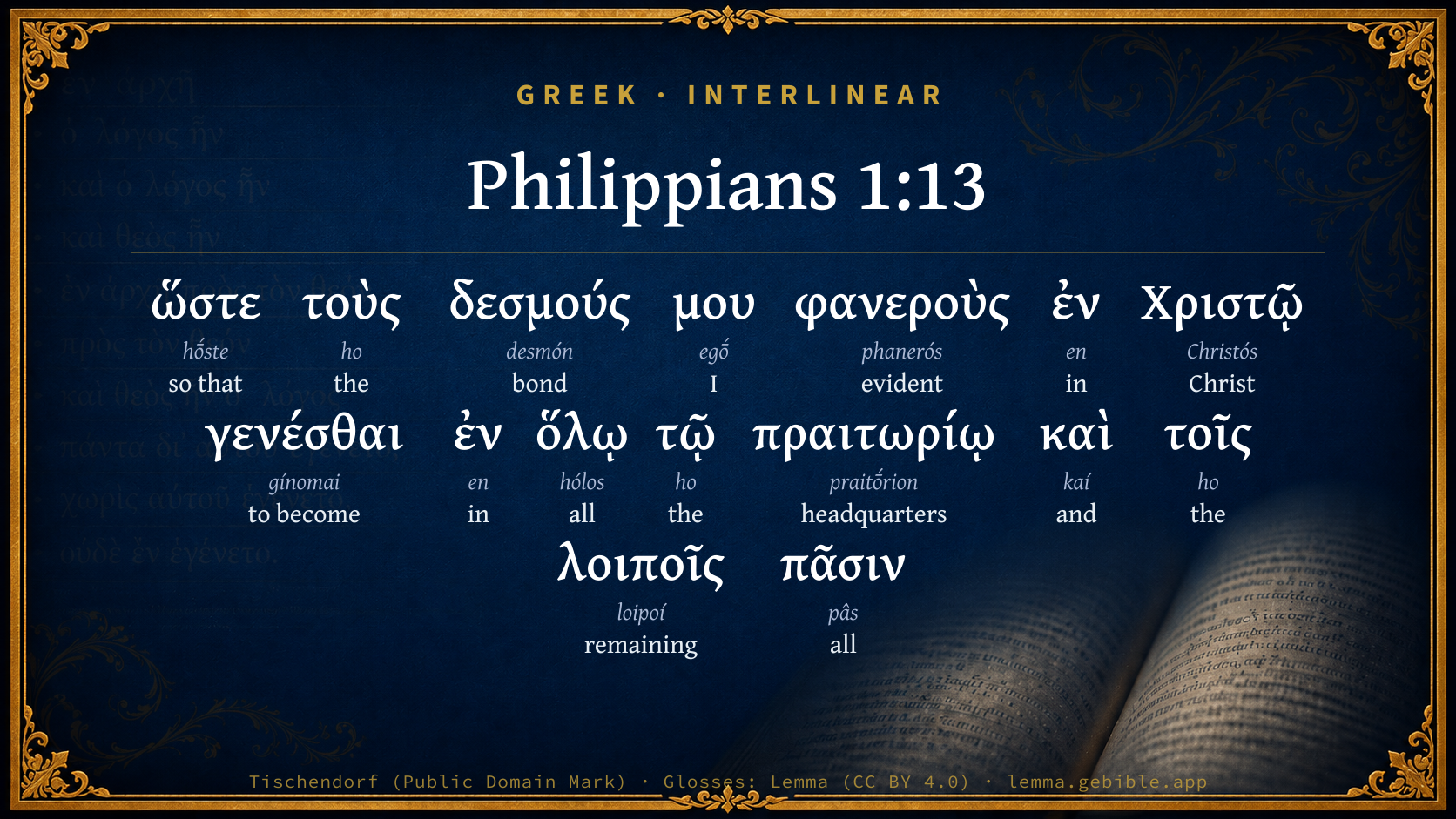
  1. ὥστε hṓste G5620 “so that” Conjunction
  2. τοὺς ho G3588 “the” Article, Accusative, Plural, Masculine
  3. δεσμούς desmón G1199 “bond” Noun, Accusative, Plural, Masculine
  4. μου egṓ G1473 “I” Personal pronoun, 1st person, Genitive, Singular
  5. φανεροὺς phanerós G5318 “evident” Adjective, Accusative, Plural, Masculine
  6. ἐν en G1722 “in” Preposition
  7. Χριστῷ Christós G5547 “Christ” Noun, Dative, Singular, Masculine
  8. γενέσθαι gínomai G1096 “to become” Verb, Aorist, Middle deponent, Infinitive
  9. ἐν en G1722 “in” Preposition
  10. ὅλῳ hólos G3650 “all” Adjective, Dative, Singular, Neuter
  11. τῷ ho G3588 “the” Article, Dative, Singular, Neuter
  12. καὶ kaí G2532 “and” Conjunction
  13. τοῖς ho G3588 “the” Article, Dative, Plural, Masculine
  14. λοιποῖς loipoí G3062 “remaining” Adjective, Dative, Plural, Masculine
  15. πᾶσιν pâs G3956 “all” Adjective, Dative, Plural, Masculine

About this verse

These counts appear in no published source. They are computed here, from the morphology-tagged text and Lemma’s own curated glosses. What Lemma adds →

16
words
13
distinct lemmas
Pauline Epistles
section

Notable vocabulary

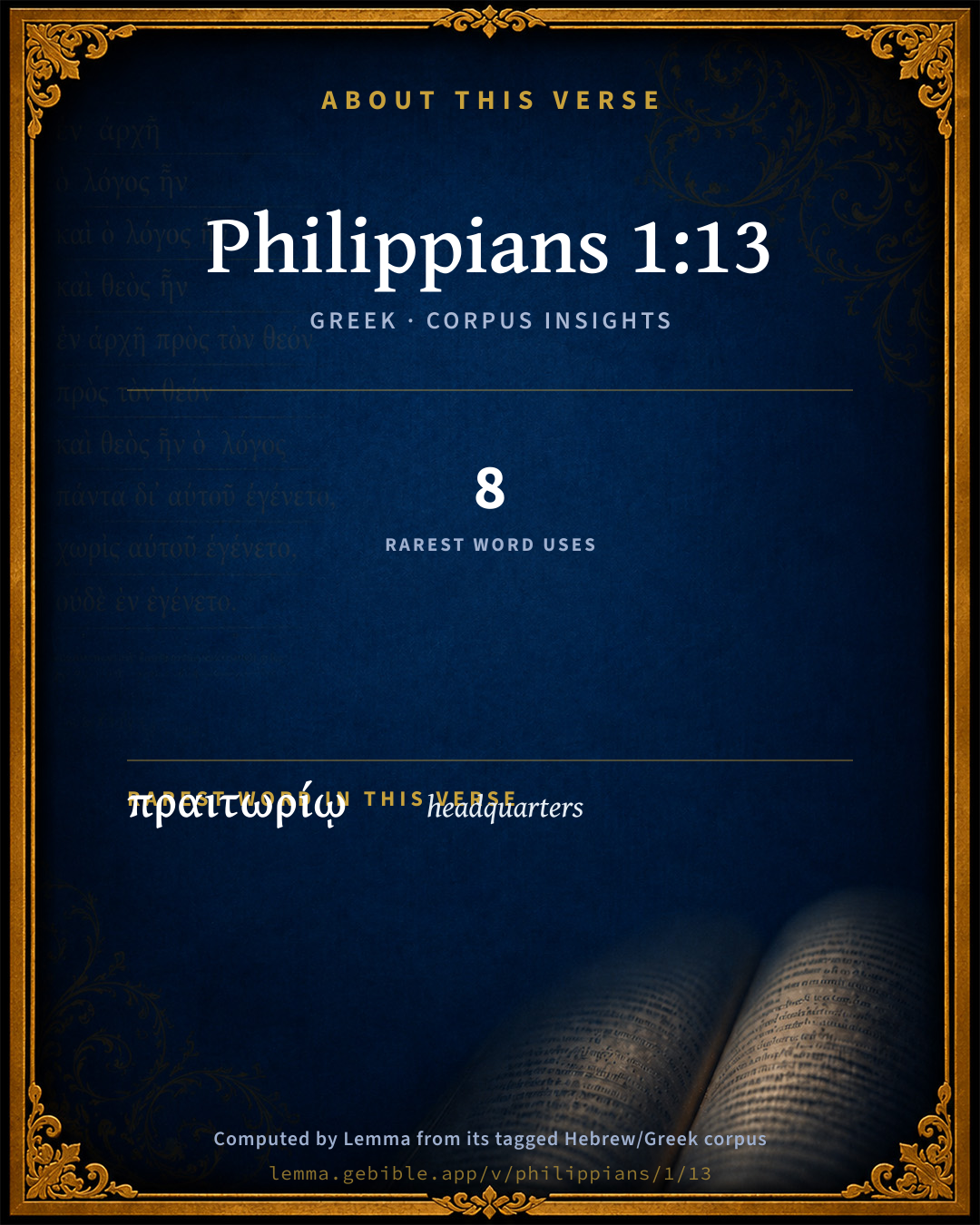
The rarest word here is πραιτωρίῳ headquarters G4232 — appearing just 8 times in the whole Greek New Testament.

Shared distinctive vocabulary

πραιτωρίῳ headquarters G4232 occurs in 7 verses of the Greek New Testament. Also found in:

Repetition

Words recur within this verse:

Cross-references

16

Topical passages linked to Philippians 1:13 in the Treasury of Scripture Knowledge — connected by theme and wording, ordered by reader-vote popularity; previews shown in the World English Bible.

  • 2 Timothy 2:9 in which I suffer hardship to the point of chains as a criminal. But God's word isn't chained.
  • Ephesians 3:1 For this cause I, Paul, am the prisoner of Christ Jesus on behalf of you Gentiles,
  • Acts 26:29 Paul said, "I pray to God, that whether with little or with much, not only you, but also all that hear me this day, might become such as I am, except for these bonds."
  • Ephesians 6:20 for which I am an ambassador in chains; that in it I may speak boldly, as I ought to speak.
  • Philippians 1:7 It is even right for me to think this way on behalf of all of you, because I have you in my heart, because, both in my bonds and in the defense and confirmation of the Gospel, you all are partakers with me of grace.
  • Philippians 4:22 All the saints greet you, especially those who are of Caesar's household.
  • 1 Peter 4:12–16 Beloved, don't be astonished at the fiery trial which has come upon you, to test you, as though a strange thing happened to you.
  • Acts 20:23–24 except that the Holy Spirit testifies in every city, saying that bonds and afflictions wait for me.
  • Acts 21:11–13 Coming to us, and taking Paul's belt, he bound his own feet and hands, and said, "Thus says the Holy Spirit: 'So will the Jews at Jerusalem bind the man who owns this belt, and will deliver him into the hands of the Gentiles.'"
  • Acts 26:31 When they had withdrawn, they spoke one to another, saying, "This man does nothing worthy of death or of bonds."
  • Acts 28:17 It happened that after three days Paul called together those who were the leaders of the Jews. When they had come together, he said to them, "I, brothers, though I had done nothing against the people, or the customs of our fathers, still was delivered prisoner from Jerusalem into the hands of the Romans,
  • Acts 28:20 For this cause therefore I asked to see you and to speak with you. For because of the hope of Israel I am bound with this chain."
  • Acts 28:30 Paul stayed two whole years in his own rented house, and received all who were coming to him,
  • Colossians 4:3–18 praying together for us also, that God may open to us a door for the word, to speak the mystery of Christ, for which I am also in bonds;
  • Ephesians 4:1 I therefore, the prisoner in the Lord, beg you to walk worthily of the calling with which you were called,
  • 1 Thessalonians 1:8–9 For from you has sounded forth the word of the Lord, not only in Macedonia and Achaia, but also in every place your faith toward God has gone forth; so that we need not to say anything.

Cross-references courtesy of OpenBible.info (CC BY 4.0).

Commentary

Notes on Philippians 1:13 from classic Christian and Jewish commentators (each source and its license shown beneath its notes). The classic Christian expositions comment on the surrounding passage and are grouped to its opening verse, so a note may address several verses; the Jewish commentaries on the Tanakh (Rashi and others) are per-verse, so they appear only where the commentator wrote on this verse.

Lemma curates 59 commentaries, every one of them public domain or Creative Commons licensed, each selected and text-cleaned for this edition rather than reprinted as found. About our sources →

Albert Barnes' Notes on the Bible

So that my bonds in Christ - Margin, “for.” The meaning is, his bonds in the cause of Christ. He was imprisoned because he preached Christ (see the notes, Eph 6:20), and was really suffering because of his attachment to the Redeemer. It was not for crime, but for being a Christian for had he not been a Christian, he would have escaped all this. The manner of Paul’s imprisonment was, that he was permitted to occupy a house by himself, though chained to a soldier who was his guard; Act 28:16. He was not in a dungeon indeed, but he was not at liberty, and this was a severe mode of confinement. Who would wish to be chained night and day to a living witness of all that he did; to a spy on all his movements? Who would wish to have such a man always with him, to hear all he said, and to see all that he did? Who could well bear the feeling that he could never be alone - and never be at liberty to do anything without the permission of one too who probably had little disposition to be indulgent?

Are manifest - That is, it has become known that I am imprisoned only for the sake of Christ - Grotius. The true reason why I am thus accused and imprisoned begins to be understood, and this has awakened sympathy for me as an injured man. They see that it is not for crime, but that it is on account of my religious opinions, and the conviction of my innocence has spread abroad, and has produced a favorable impression in regard to Christianity itself. It must have been a matter of much importance for Paul to have this knowledge of the real cause why he was imprisoned go abroad. Such a knowledge would do much to prepare others to listen to what he had to say - for there is no man to whom we listen more readily than to one who is suffering wrongfully.

In all the palace - Margin, “Or, Caesar’s court.” Greek, ἐν ὅλῳ τῷ πραιτωρίῳ en holō tō praitōriō - in all the praetorium. This word properly denotes the general’s tent in a camp; then the house or palace of a governor of a province, then any large hall, house, or palace. It occurs in the New Testament only in the following places: Mat 27:27, where it is rendered “common hall”; Mar 15:16, rendered “Praetorium”; Joh 18:28, Joh 18:33; Joh 19:9; Act 23:35, rendered “judgment hall”; and here in Phi 1:13. It is employed to denote:

(1)The palace of Herod at Jerusalem, built with great magnificence at the northern part of the upper city, westward of the temple, and overlooking the temple;

(2)The palace of Herod at Caesarea, which was probably occupied by the Roman procurator; and,

(3)In the place before us to denote either the palace of the emperor at Rome, or the praetorian camp, the headquarters of the praetorian guards or cohorts.

These cohorts were a body of select troops instituted by Augustus to guard his person, and have charge of the city; see Robinson (Lexicon), Bloomfield, Rosenmuller, and some others, understand this of the praetorian camp, and suppose that Paul meant to say that the cause of his imprisonment had become known to all the band of the praetorians.

Grotius says that the usual word to denote the residence of the emperor at Rome was palatium - palace, but that those who resided in the provinces were accustomed to the word “praetorium,” and would use it when speaking of the palace of the emperor. Chrysostom says that the palace of the emperor was called praetorium, by a Latin word derived from the Greek; see Erasmus in loc. Calvin supposes that the palace of Nero is intended. The question about the meaning of the word is important, as it bears on the inquiry to what extent the gospel was made known at Rome in the time of Paul, and perhaps as to the question why he was released from his imprisonment. It the knowledge of his innocence had reached the palace, it was a ground of hope that he might be acquitted; and if that palace is here intended, it is an interesting fact, as showing that in some way the gospel had been introduced into the family of the emperor himself. That the palace or residence of the emperor is intended here, may be considered at least probable from the following considerations:

(1) It is the name which would be likely to be used by the Jews who came up from Judea and other provinces, to denote the chief place of judgment, or the principal residence of the highest magistrate. So it was used in Jerusalem, in Cesarea, and in the provinces generally, to denote the residence of the general in the camp, or the procurator in the cities - the highest representative of the Roman power.

(2) If the remark of Chrysostom, above referred to, be well founded, that this was a common name given to the palace in Rome, then this goes far to determine the question.

(3) In Phi 4:22, Paul, in the salutation of the saints at Rome to those of Philippi, mentions particularly those of “Caesar’s household.” From this it would seem that some of the family of the emperor had been made acquainted with the Christian religion, and had been converted. In what way the knowledge of the true cause of Paul’s imprisonment had been circulated in the “palace,” is not now known. There was, however, close intimacy between the military officers and the government, and it was probably by means of some of the soldiers or officers who had the special charge of Paul, that this had been communicated. To Paul, in his bonds, it must have been a subject of great rejoicing, that the government became thus apprised of the true character of the opposition which had been excited against him; and it must have done much to reconcile him to the sorrows and privations of imprisonment, that he was thus the means of introducing religion to the very palace of the emperor.

And in all other places - Margin, to all others. The Greek will bear either construction. But if, as has been supposed, the reference in the word praetorium is to the palace, then this should be rendered “all other places.” It then means, that the knowledge of his innocence, and the consequences of that knowledge in its happy influence in spreading religion, were not confined to the palace, but were extended to other places. The subject was generally understood, so that it might be said that correct views of the matter pervaded the city, and the fact of his imprisonment was accomplishing extensively the most happy effects on the public mind.

Albert Barnes' Notes on the Bible (1834–1885) — public domain. Text from a community e-Sword/MySword module.

Tyndale Open Study Notes

Tyndale Open Resources

1:13 The whole palace guard were workers in the emperor’s or provincial governor’s official residence (see 4:22). • Paul was in prison because of Christ—that is, because of preaching the Good News of Christ (cp. Acts 21:26–28:31).

Tyndale Open Study Notes — © Tyndale Open Resources, licensed CC BY-SA 4.0. Text via the HelloAO Bible API.

Bengel's Gnomon

Johann Albrecht Bengel

Php 1:13. Τοὺς δεσμοὺς, bonds) Paul, delivered up along with other prisoners, seemed on the same footing with them: afterwards it became known that his case was different, and so the Gospel prevailed.—φανεροὺς, manifest) Col 4:4.—πραιτωρίῳ, in the prœtorium) The court of Cæsar; comp. Php 4:22.—καὶ, and) then.—τοῖς λοιποῖς, in the other) places outside of it; 2Ti 4:17. So other, 1Th 4:13.

Bengel's Gnomon of the New Testament — English translation (T&T Clark, Edinburgh, 1860) — public domain. Text from a community e-Sword module.

Meyer's Critical & Exegetical Commentary

Heinrich August Wilhelm Meyer

Php_1:13. Ὥστε κ.τ.λ.] so that my bonds became manifest in Christ, etc. This ὥστε introduces the actual result of that προκοπή, and consequently a more precise statement of its nature.[59] Ἐν Χριστῷ does not belong to ΤΟῪς ΔΕΣΜΟΎς ΜΟΥ, alongside of which it does not stand; but ΦΑΝΕΡΟῪς ἘΝ ΧΡΙΣΤ. is to be taken together, and the emphasis is laid on ΦΑΝΕΡΟΎς, so that the ΔΕΣΜΟΊ did not remain ΚΡΥΠΤΟΊ or ἈΠΟΚΡΎΦΟΙ ἘΝ ΧΡΙΣΤῷ, as would have been the case, if their relation to Christ had continued unknown, and if people had been compelled to look upon the apostle as nothing but an ordinary prisoner detained for examination. This ignorance, however, did not exist; on the contrary, his bonds became known in Christ, in so far, namely, that in their causal relation to Christin this their specific peculiaritywas found information and elucidation with respect to his condition of bondage, and thus the specialty of the case of the prisoner, became notorious. If Paul had been only known generally as δέσμιος, his bonds would have been ΟὐΚ ἘΜΦΑΝΕῖς ἘΝ ΧΡΙΣΤῷ; but now that, as ΔΈΣΜΙΟς ἘΝ ΚΥΡΊῼ or ΤΟῦ ΚΥΡΊΟΥ (Eph_4:1; Eph_3:1; Phm_1:9), as ΠΆΣΧΩΝ Ὡς ΧΡΙΣΤΙΑΝΌς (1Pe_4:16), he had become the object of public notice, the ΦΑΝΈΡΩΣΙς of his state of bondage, as resting ἐν Χριστῷ, was thereby brought about,a ΦΑΝΕΡῸΝ ΓΊΝΕΣΘΑΙ, consequently, which had its distinctive characteristic quality in the ἐν Χριστῷ. It is arbitrary to supply ὌΝΤΑς with ἘΝ ΧΡΙΣΤῷ (Hofmann). Ewald takes it as: shining in Christ, i.e. much sought after and honoured as Christian. Comp. also Calvin, and Wieseler, Chronol. d. apost. Zeitalt. p. 457. But, according to New Testament usage, φανερός does not convey so much as this; in classical usage (Thuc. i. 17. 2, iv. 11. 3; Xen. Cyr. vii. 5. 58, Anab. vii. 7. 22 and Krüger in loc.) it may mean conspicuous, eminent.

ἐν ὅλῳ τῷ πραιτωρίῳ] ΠΡΑΙΤΏΡΙΟΝ is not the imperial palace in Rome (Chrysostom, Theodoret, Oecumenius, Theophylact, Erasmus, Luther, Beza, Calvin, Estius, Cornelius a Lapide, Grotius, Bengel, and many others, also Mynster, Rheinwald, and Schneckenburger in the Deutsch. Zeitschr. 1855, p. 300), which is denoted in Php_4:22 by ἡ Καίσαρος οἰκία, but was never called praetorium.[60] It could not well, indeed, be so called, as τὸ πραιτώριον is the standing appellation for the palaces of the chief governors of provinces (Mat_27:27; Joh_18:28; Joh_19:9; Act_23:35); hence it might and must have been explained as the Procurators palace in Caesarea, if our epistle had been written there (see especially Böttger, Beitr. I. p. 51 f.). But it is the Roman castrum praetorianorum, the barracks of the imperial body-guard (Camerarius, Perizonius, Clericus, Elsner, Michaelis, Storr, Heinrichs, Flatt, Matthies, Hoelemann, van Hengel, de Wette, Rilliet, Wiesinger, Ewald, Weiss, J. B. Lightfoot, and others), whose chief was the praefectus praetorio, the στρατοπέδων ἔπαρχος, to whom Paul was given in charge on his arrival in Rome (Act_28:16). It was built by Sejanus, and was situated not far from the Porta Viminalis, on the eastern side of the city.[61] See Suet. Tib. 37; Tac. Ann. iv. 2; Pitiscus, Thesaur. antiq. III. 174; and especially Perizonius, de orig., signif. et usu vocc. praetoris et praetorii, Franeq. 1687, as also his Disquisitio de praetorio ac vero sensu verborum Phil. i. 13, Franeq. 1690; also Hoelemann, p. 45, and J. B. Lightfoot, p. 97 ff. τὸ πραιτώριον does not mean the troop of praetorian cohorts (Hofmann), which would make it equivalent to οἱ πραιτωριανοί (Herodian, viii. 8. 14).[62]

The becoming known in the whole praetorium is explained by the fact, that a praetorian was always present with Paul as his guard (Act_28:16), and Paul, even in his captivity, continued his preaching without hindrance (Act_28:30 f.).

καὶ τοῖς λοιποῖς πᾶσι] not in the sense of locality, dependent on ἐν (Chrysostom, Theodoret, Calvin), but: and to all the others, besides the praetorians. It is a popular and inexact way of putting the fact of its becoming still more widely known among the (non-Christian) Romans, and therefore it must be left without any more specific definition. This extensive proclamation of the matter took place in part directly through Paul himself, since any one might visit him, and in part indirectly, through the praetorians, officers of justice, disciples, and friends of the apostle, and the like.[63] Van Hengel, moreover, understands it incorrectly, as if οἱ λοιποί were specially homines exteri, Gentiles,a limitation which could only be suggested by the context, and therefore cannot be established by the use of the word in Eph_2:3; Eph_4:17; 1Th_4:13. Equally arbitrary is the limitation of Hofmann: that it refers to those, who already knew about him.

[59] Rem, qualis sit, addita rei consequentis significatione definit, Ellendt, Lex. Soph. II. p. 1012. Hofmanns view, that it stands in the sense of εἰς τοῦτο ὥστε, also amounts to this. But Hoelemann is in error in making it assert the greatness of the προκοπή. Not the greatness, but the salutary effect, is indicated.

[60] Act. Thom. § 3, 17, 18, 19, in Tischendorf, Act. apocr. pp. 192, 204 f., cannot be cited in favour of this designation (in opposition to Rheinwald); the πραιτώρια βασιλικά there spoken of (§ 3) are royal castles, so designated after the analogy of the residences of the Roman provincial rulers. Comp. Sueton. Aug. 72; Tib. 39, et al.; Juvenal, x. 161.

[61] Doubtless there was a praetorian guard stationed in the imperial palace itself, on the Mons Palatinus, as in the time of Augustus (Dio. Cass. liii. 16). See Wieseler, Chronol. d. apost. Zeitalt. p. 404, who understands the station of this palace-guard to be here referred to. But it cannot be proved that after the times of Tiberius, in whose reign the castra praetoriana were built in front of the Viminal gate (only three cohorts having previously been stationed in the city, and that sine castris, Suetonius, Octav. 49), anything else than these castra is to be understood by the wonted term praetorium, στρατόπεδον, when mentioned without any further definition (as Joseph. Antt. xviii. 6. 7: πρὸ τοῦ βασιλείου).

[62] Not even in such passages as Tacitus, Hist. ii. 24, iv. 46; Suetonius, Ner. 7; Plin. H. N. xxv. 2, 6, et al., where the prepositional expression (in praetorium, ex praetorio) is always local.

[63] This suffices fully to explain the situation set forth in ver. 13. The words therefore afford no ground for the historical combination which Hofmann here makes: that during the two years, Act_28:30, the apostles case was held in abeyance; and that only now had it been brought up for judicial discussion, whereby first it had become manifest that his captivity was caused, not by his having committed any crime against the state, but by his having preached Christ, which might not be challenged (?) on the states account. As if what is expressly reported in Act_28:31 were not sufficient to have made the matter known, and as if that διετία ἐν ἰδίῳ μισθώματι precluded the judicial preparation of the case (ver. 7)! As if the increased courage of the πλείονες, ver. 14, were intelligible only on the above assumption! As if, finally, it were admissible to understand, with Hofmann, among these πλείονες all those who even now before the conclusion of the trial were inspired with such courage by it!

Meyer — Critical and Exegetical Commentary on the New Testament — English translation by Peter Christie, edited by Frederick Crombie (T&T Clark, 1880) — public domain. Text from a community e-Sword module.

Expositor's Greek Testament

ed. W. Robertson Nicoll

Phi 1:13 . For the skilful rhetorical structure of Phi 1:13-17 see J. Weiss, Beitr. , p. 17, who compares Rom 2:6-12 . τὰ δεσμά is, on the whole, more common; see Luk 8:29 , Act 16:26 ; Act 20:23 . According to Cobet, Mnemosyne , 1858, p. 74 ff. (quoted in W-Sch [4] , p. 85, n. 8), the neuter form refers to actual bonds, the masc. to the imprisonment. But there seems to be no distinction, e.g. , in Attic Inscrr [5] (see Meisterhans, Gramm. d. attisch. Inschr. , p. 112, n. 1025). And Sch. states that the distinction will not apply to LXX. φαν . ἐν Χ . γεν . It has become plain that he is a prisoner wholly for Christ’s sake, and not on account of any breach of law. γεν . must be translated by the English perfect, for, as Moule (CT [6] ) well points out, “our English thought separates present from past less rapidly than Greek”. Of course we must supply δεσμ . as predicate with φαν . γεν . ἐν ὅλῳ τ . πραιτ . is one of the most keenly contested expressions in the Epistle. Four leading interpretations are found. (1) Those forming the praetorian guard . So Lft [7] , Hfm [8] , Abbott, Hpt [9] , Vinc. This explanation has much in its favour. Those coming up on appeal from the Provinces were handed over for surveillance to the praefecti praetorio (see Marquardt-Momms., ii. 2 3 , p. 972 and n. 2). And Lft [10] ( Com. , pp. 99 104) has shown conclusively that the word admits of this meaning. (2) The barracks or camp of the praetorian guard . So Lips [11] , Kl [12] , Alf [13] , De W., Myr [14] , Ws [15] , Von Soden. But none of these Comm [16] bring direct evidence to show that the name praetorium was ever definitely applied to the castra praetoriana , built under Tiberius at the Porta Viminalis (Tac., Ann. , iv., 2). (3) The emperor’s palace . So Chr [17] , Th. Mps [18] , Thdrt [19] , Beng., Mynster ( Kleine theol. Schriften , p. 184, some strong arguments), Gwynn, Duchesne. In all other passages of N.T. πραιτ . = residence of the ruler. It is said that it would be impossible for anyone writing from Rome to call the palace πραιτ . But; as Gw [20] observes, this is a provincial writing to provincials, and using the word in a familiar sense. Further, the change for the better in Paul’s circumstances is connected with the knowledge that his bonds are in Christ. Is it because the authorities (emperor, etc.) have already begun to take a favourable view of his case that the preaching is allowed to prosper without hindrance and that his associates take courage? This interpretation cannot be dismissed altogether lightly. (4) The judicial authorities . So Mommsen ( op. cit. , p. 498) and Ramsay ( St. Paul , etc., p. 357 ff.). These would be the praefecti praetorio (either one or two) with their assessors and other officials of the imperial court. Momms. quotes from a letter of Trajan to Pliny ( Ep. Plin. , 57 [65]), in which he decides that a criminal condemned to exile, but, in spite of this, lingering in the province, should be sent in chains ad praefectos praetorii mei , who are not the prison officials but those concerned with the hearing of cases. This explanation also would agree well with what Paul says about his bonds and the progress of the Gospel. We would hesitate to decide between (1) and (4), the context seeming to support the latter, while, perhaps, ὅλῳ favours the former. καὶ τ . λοιποῖς π . Cf. CIG. , i., 1770, ἐπεὶ καὶ ἐν τοῖς λοιποῖς πᾶσιν φανερὰν πεποήκαμεν τήν τε ἰδίαν καὶ τοῦ δήμου τοῦ Ῥωμαίων προαίρεσιν . Apparently a vague phrase = everywhere else.

[4]-Sch. Schmiedel’s Ed. of Winer.

[5]nscrr. Inscriptions.

[6] Cambridge Greek Testament .

[7] Lightfoot.

[8] Hofmann.

[9] Haupt.

[10] Lightfoot.

[11]ips. Lipsius.

[12] Klöpper.

[13] Alford’s Greek Testament .

[14] Meyer.

[15] Weiss.

[16]omm. Commentators.

[17] Chrysostom.

[18] Mps. Theodore of Mopsuestia.

[19]hdrt. Theodoret.

[20] Gwynn.

The Expositor's Greek Testament, edited by W. Robertson Nicoll (1897–1910) — public domain. Text from a community e-Sword module.

Geneva Bible (1599)

Geneva Bible translators

In the Emperor’s court.

For Christ’s sake.

Geneva Bible (1599) marginal notes — public domain. Text via Bolls.life.

Jamieson, Fausset & Brown

Robert Jamieson, A. R. Fausset & David Brown

my bonds in Christ--rather as Greek, "So that my bonds have become manifest in Christ," that is, known, as endured in Christ's cause.

palace--literally, "Prætorium," that is, the barrack of the Prætorian guards attached to the palace of Nero, on the Palatine hill at Rome; not the general Prætorian camp outside of the city; for this was not connected with "Cæsar's household," which Phi 4:22 shows the Prætorium here meant was. The emperor was "Prætor," or Commander-in-Chief; naturally then the barrack of his bodyguard was called the Prætorium. Paul seems now not to have been at large in his own hired house, though chained to a soldier, as in Act 28:16, Act 28:20, Act 28:30-31, but in strict custody in the Prætorium; a change which probably took place on Tigellinus becoming Prætorian Prefect. See Introduction.

in all other places--so CHRYSOSTOM. Or else, "TO all the rest," that is, "manifest to all the other" Prætorian soldiers stationed elsewhere, through the instrumentality of the Prætorian household guards who might for the time be attached to the emperor's palace, and who relieved one another in succession. Paul had been now upwards of two years a prisoner, so that there was time for his cause and the Gospel having become widely known at Rome.

Jamieson, Fausset & Brown — Commentary Critical and Explanatory on the Whole Bible (1871) — public domain (CC PDM 1.0). Text via the HelloAO Bible API.

Adam Clarke's Commentary

Verse 13. My bonds - are manifest in all the palace] In consequence of the public defence which he was obliged to make, his doctrines must be fully known in the court, and throughout the whole city, as on his trial he would necessarily explain the whole. The praetorium, πραιτωριον, which we here translate palace, signifies the court where causes were heard and judged by the praetor or civil magistrate; it sometimes signifies the general's tent, and at others, the emperor's palace. It is supposed that it is used in this latter sense here. There were, no doubt, persons belonging to the emperor's household who would bring the news of so remarkable a case to the palace; for we find that there were Christians even in Caesar's household; Php 4:22.

Adam Clarke's Commentary on the Bible (1810–1826) — public domain. Text from a community e-Sword/MySword module.

John Calvin's Commentaries

13 So that my bonds He employs the expression — in Christ, to mean, in the affairs, or in the cause of Christ, for he intimates that his bonds had become illustrious, so as to promote the honor of Christ. The rendering given by some — through Christ, seems forced. I have also employed the word illustria (illustrious) in preference to manifesta, (manifest,) — as having ennobled the gospel by their fame. “Satan, indeed, has attempted it, and the wicked have thought that it would turn out so, that the gospel would be destroyed; but God has frustrated both the attempts of the former and the expectations of the latter, and that in two ways, for while the gospel was previously obscure and unknown, it has come to be well known, and not only so, but has even been rendered honorable in the Praetorium, no less than in the rest of the city.” By the praetorium I understand the hall and palace of Nero, which Fabius and writers of that age call Augustale, (the Augustal.) For as the name praetor was at first a general term, and denoted all magistrates who held the chief sway, (hence it came that the dictator was called the sovereign praetor, ) it, consequently, became customary to employ the term praetorium in war to mean the tent, either of the consul, or of the person who presided, while in the city it denoted the palace of Caesar, from the time that the Cesars took possession of the monarchy. Independently of this, the bench of praetor is also called the praetorium

John Calvin's Commentaries (1540-1563) — public domain. Text from the Calvin Translation Society English edition (1840s-50s) via the Christian Classics Ethereal Library (ccel.org). Calvin's coverage is partial (roughly two-thirds of the Bible); uncommented books and verses are honest gaps, never fabricated. The 19th-century editor's footnotes and remarks are omitted so the notes are faithfully Calvin's own voice.

Ellicott's Commentary for English Readers

(13) My bonds in Christ are manifest.—Properly, My bonds are made manifest as in Christ—i.e., my captivity is understood as being a part of my Christian life and work, and so becomes a starting-point for the preaching of the gospel. So St. Paul made it to the Jews (Act_28:20), “For the hope of Israel am I bound in this chain.” (Comp. Eph_6:20, “I am an ambassador in bonds.”)

In all the palace, and in all other places.—The word “palace” is prætorium. It is elsewhere used in the New Testament: first, of the palace of Pilate; in Mat_27:27, Mar_15:16, apparently, of the soldiers’ guardroom, or barrack; in Joh_18:28; Joh_18:33; Joh_19:9, of “the hall of judgment;” and next in Act_23:35, of the “judgment hall of Herod,” evidently forming a part of the palace of Felix. (It may be noted that coincidence with this last passage is the chief, and almost the sole, argument for the untenable idea that this Epistle belongs to the Cæsarean and not the Roman captivity.) Its sense here has been disputed. It has been variously interpreted as the emperor’s palace, or the praetorian barrack attached to it, or the prætorian camp outside the walls. Its original meaning of “the head-quarters of a general” would lend itself well enough to any of these, as a derivative sense. The first or the second sense (which is virtually the same) is the interpretation of all ancient commentators, and suits best with the mention of “Caesar’s household” in Php_4:22, but not very well with the historical statement in Act_28:16-30, that St. Paul dwelt “in his own hired house,” “with a soldier that kept him.” The other sense suits better with this last statement, and also with the delivery of the prisoner “to the captain of the guard,” i.e., literally, the commander of the camp, or prætorian prefect, and perhaps with abstract probability in the case of an obscure Jewish prisoner. But the difficulty is that, although the word might be applied to any of these places, yet, as a matter of fact, it is not found to be so applied. Moreover, we notice here that the words “in all other places” are an inaccurate rendering of a phrase really meaning “to all the rest” (see marginal reading). The connection therefore seems even in itself to suggest that the “prætorium” may more properly refer to a body of men than to a place. Accordingly (following Dr. Lightfoot), since the word “prætorium” is undoubtedly used for the “prætorian guard,” it seems best to take that sense here. “My bonds” (says the Apostle) “are known in all the prætorian regiments”—for the soldiers, no doubt, guarded him by turns—“and to all the rest of the world, whether of soldiers or of citizens.” This would leave it an open question where St. Paul was imprisoned, only telling us that it was under praetorian surveillance;

A Bible Commentary for English Readers, edited by Charles John Ellicott (1878–1897) — public domain. Text from a community e-Sword module.

The Cambridge Bible for Schools and Colleges

gen. ed. J. J. S. Perowne

13. So that, &c.] Render, So that my bonds are become manifest (as being) in Christ. In other words, his imprisonment has come to be seen in its true significance, as no mere political or ecclesiastical matter, but due to his union of life and action with a promised and manifested Messiah.

in all the palace] Greek, “in the whole Prœtorium (praitôrion).” The word occurs elsewhere in N. T., Mat_27:27; Mar_15:16; Joh_18:28; Joh_18:33; Joh_19:9; Act_23:35; in the sense of the residence, or a part of it, of an official grandee, regarded as a prœtor, a military commander. (Not that the word, in Latin usage, always keeps a military reference; it is sometimes the near equivalent of the word villa, the country residence of a Roman gentleman.) The A.V. rendering here is obviously an inference from these cases, and it assumes that St Paul was imprisoned within the precincts of the residence of the supreme Prætor, the Emperor; within the Palatium, the mansion of the Cæsars on the Mons Palatinus, the Hill of the goddess Pales. In Nero’s time this mansion (whose name is the original of all “palaces”) had come to occupy the whole hill, and was called the Golden House.—The rendering of the A.V. is accepted by high authorities, as Dean Merivale (Hist. Rom. vi. ch. 54), and Mr Lewin (Life and Epistles of St Paul, ii. p. 282). On the other hand Bp Lightfoot (on this verse, Philippians, p. 99) prefers to render “in all the Prætorian Guard,” the Roman life-guard of the Cæsar; and gives full evidence for this use of the word Prœtorium. And there is no evidence for the application of the word by Romans to the imperial Palace. To this last reason, however, it is fair to reply, with Mr Lewin, that St Paul, as a Provincial, might very possibly apply to the Palace a word meaning a residency in the provinces, especially after his long imprisonment in the royal Prœtorium at Cæsarea (Act_23:35; Act_24:27). But again it is extremely likely, as Bp Lightfoot remarks, that the word Prœtorium, in the sense of the Guard, would be often on the lips of the “soldiers that kept” St Paul (Act_28:16); and thus this would be now the more familiar reference. On the whole, we incline to the rendering of Lightfoot, (and of the R.V.) throughout the (whole) Prætorian Guard. Warder after warder came on duty to the Apostle’s chamber (whose locality, on this theory, is nowhere certainly defined in N. T.), and carried from it, when relieved, information and often, doubtless, deep impressions, which gave his comrades knowledge of the Prisoner’s message and of the claims of the Saviour.

Other explanations of the word Prœtorium are (a) the Barrack within the Palatium where a detachment of Prætorians was stationed, and within which St Paul may have been lodged; (b) the great Camp of the Guard, just outside the eastern walls of Rome. But the barrack was a space too limited to account for the strong phrase, “in all the Prætorium”; and there is no evidence that the great Camp was ever called Prætorium.

Wyclif renders, curiously, “in eche moot (council) halle”; Tyndale, Cranmer, and Geneva, “throughout all the judgment hall.”

in all other places] Better, to all other (men); to the Roman “public,” as distinguished from this special class. The phrase points to a large development of St Paul’s personal influence.

The Cambridge Bible for Schools and Colleges (gen. ed. J. J. S. Perowne; Cambridge University Press, 1878–1918) — public domain. Text from a community e-Sword module.

John Gill's Exposition

So that my bonds in Christ,.... What he had more darkly hinted before, he more clearly expresses here; the things that happened to him were his bonds; he was now a prisoner at Rome and in chains; though he had the liberty of dwelling alone in his own hired house, and of his friends coming to see him and hear him, yet he was bound with a chain, and under the care and guard of a soldier continually, who held one end of it. These bonds of his were not for debt, which he took care not to run into, but chose rather to work with his own hands, and so ministering to his own and the necessities of others, that he might not eat any man's bread for nought; nor for any capital crime, as murder, or theft, or anything that was worthy of death or of bonds; but his bonds were in Christ, or for Christ's sake, for professing Christ and preaching his Gospel; he was a prisoner in the Lord, or for his sake; see Eph 4:1. The use of his sufferings, which is more generally signified in Phi 1:12, is here and in Phi 1:14 more particularly related, and the several instances of it given, these his bonds for the sake of Christ, he says,

are manifest in all the palace, and in all other places, or "my bonds are manifest in Christ", as the words may be read; that is, by the means of Christ, he causing them to be taken notice of by men, and some of the first rank: by his bonds being manifest may be meant he himself who was bound; who by his bonds became known to persons, to whom in all probability he would otherwise have remained unknown; as to Felix, and Festus, and King Agrippa, and others in Caesar's court: or the Gospel for the sake of which he was bound; this was made manifest and became known, not barely notionally, but savingly and experimentally; and even Christ himself the substance of it, for whom he was laid in bonds, by this means came to be known, "in all the palace". The Arabic version reads it, "in the palace of the emperor". The word "praetorium", here used, signifies sometimes the judgment hall, or court of judicature belonging to the Roman governors, as Herod and Pilate; see Act 23:35; and if it designs any such court at Rome, then the sense is, that through the apostle's being sent a prisoner to Rome, and his cause heard in the praetorium, or judgment hall, he and the cause of his bonds came to be known by the judges in that court; and which might be the means of the conversion of some of them: sometimes it signifies the general's pavilion in the camp, and sometimes the emperor's palace at Rome, he being the chief "praetor", or magistrate; and so here it seems to design Nero's house or court, where the Gospel, through the apostle's bonds, had made its way to the conversion of many there; see Phi 4:22; and in all other places; or as the Arabic version renders it, "with all other men"; for it may be understood either of men or places; and that Christ and his Gospel came to be known through the apostle's sufferings, not only in the court of judicature where his cause was tried, or in Caesar's palace, and to many of his courtiers, but in other places in Rome, and parts of the empire, and to many persons there, both Jews and Gentiles; so that what was intended for the disadvantage of the Gospel, proved for the service of it.

John Gill's Exposition of the Whole Bible (1746–1763) — public domain (CC PDM 1.0). Text via the HelloAO Bible API.

Trapp's Complete Commentary

John Trapp

13 So that my bonds in Christ are manifest in all the palace, and in all other places;

Ver. 13. In all the palace] So in the Diet held at Augsburgh in Germany, A.D. 1530. Caesar reading the Protestants’ confession, and sending it abroad to other Christian princes, as desiring their advice about it, dispersed and spread it more in all parts than all the Lutheran preachers could have done. For which cause Luther laughs agood (heartily) at the foolish wisdom of the Papists, in a certain epistle of his to the elector of Saxony. When Bonner allowed William Hunter, martyr, no more than a half penny a day in prison, he confessed that he lacked nothing, but had meat and clothing enough, yea, even out of the court, both money, meat, clothes, wood and coals, and all things necessary. What friends John Wycliffe found, both in the court of England and in the court of Bohemia, is famously known; and yet the proverb is,

" Exeat aula qui velit esse pius-"

John Trapp, A Commentary or Exposition upon All the Books of the Old and New Testament (1647–1656) — public domain. Text from a community e-Sword module.

Haydock's Catholic Bible Commentary

In all the court,[2] or in the whole palace of the emperor, and to all others, or in all other places at and near Rome. (Witham)

===============================

[BIBLIOGRAPHY]

In omni Prætorio, Greek: en olo to praitorio.

====================

George Leo Haydock (1774–1849), Haydock's Catholic Family Bible and Commentary, 1859 edition — public domain. Excludes Psalms (Douay-Rheims chapter numbering differs from Protestant) and Deuterocanonical books (Catholic canon only).

Matthew Poole's English Annotations

And many of the brethren in the Lord, waxing confident by my bonds; and here again, contrary to the expectation of those persecutors, who designed to make havoc of the church, his innocent carriage and constancy in bearing the cross, had all influence upon the greater part of

the brethren (not according to the flesh, Rom 9:3, but) in the service of Christ.

Are much more bold to speak the word without fear; pastors, and teachers, who had been timorous at the first, were greatly imboldened to shake of carnal fear, and to profess and preach Christ crucified, or the cross of Christ, 1Co 1:18,23, which is the power of God to salvation, Rom 1:16, more confidently than ever; as he and Barnabas had done elsewhere, Act 13:46; and as Joseph of Arimathea and Nicodemus, who were but secret disciples before Christ’s sufferings, upon his death owned him openly for their Lord, Mat 27:57, with Joh 19:39.

Matthew Poole's English Annotations on the Holy Bible (1683–1685) — public domain. Text from a community e-Sword/MySword module.

Whedon's Commentary on the Bible

Daniel D. Whedon

13. My bonds in Christ—The first result of his imprisonment was a correct and wide-spread intelligence of its true cause and character. We prefer to read, my bonds have become manifest in Christ. Men had come to know that they were connected with Christ, and endured in his service; and that Paul himself was not seditious, turbulent, or a traitor.

All the palace—Probably the pretorian camp is meant, the barracks of the imperial lifeguard, perhaps including the detachment quartered near Nero’s palace. The word is never used for the palace of the emperor. See note on Act_28:16, and the cut of Rome.

All other—Literally, and to all the rest. Very likely the people who had become familiar with his case; as to-day we say, “every body else.” Soldier after soldier had attended him, to whom he had spoken of the great salvation; visitors—Jews, Christians, and pagans—had freely received from his lips the “things which concern the Lord Jesus Christ.” Act_28:31. Thus soldiers and visitors had learned the true cause of Paul’s imprisonment. To them Christ was preached.

Daniel D. Whedon (gen. ed.), Commentary on the Old and New Testaments (1874–1909) — public domain. Text from a community e-Sword module.

The Pulpit Commentary

So that my bonds in Christ are manifest; rather, as R.V, so that my bonds became manifest in Christ. At first he seemed like ether prisoners; afterwards it became known that he suffered bonds, not for any crime, but in Christ, i.e. in fellowship with Christ and in consequence of the relation in which he stood to Christ. In all the palace; rather, as R.V, throughout the whole Praetorian Guard; literally, in the whole praetorium, The word elsewhere means a governor"s house: Pilate"s house in the Gospels, Herod"s palace in Act_23:35. But at Rome the name so used would give unnecessary offense, and there is no proof that it was ever used for the palatium there. St. Paul must have heard it constantly as the name of the Praetorian regiment; he was kept chained to a soldier of that corps; (Act_28:16) and as his guard was continually relieved, his name and sufferings for Christ would become gradually known throughout the force. Others, on the authority of a passage in Dion Cassius, understand the word of the barracks of that part of the Praetorian guard attached to the imperial residence on the Palatine. But the passage relates to the time of Augustus, before the Praetorian cohorts were established by Tiberius in the camp outside of the Colline Gate. And in all other places; rather, as R.V and to all the rest; generally, that is, throughout the city.

The Pulpit Commentary (1880–1919), ed. H.D.M. Spence-Jones & Joseph S. Exell — public domain. Text from a community e-Sword module.

John Wesley's Explanatory Notes

My bonds in Christ - Endured for his sake. Have been made manifest - Much taken notice of. In the whole palace - Of the Roman emperor.

John Wesley, Explanatory Notes Upon the Whole Bible (1754–1765) — public domain. Text via the GEBible commentary corpus.

Scofield Reference Notes

C. I. Scofield

the palace

Or, Caesar’s court. Php 4:22.

The Scofield Reference Bible (1917 edition), notes by C. I. Scofield — public domain. Text from a community e-Sword module.

The People's New Testament

B. W. Johnson

13. So that my bonds in Christ are manifest in all the palace. Prætorium in the Greek, rendered by the Revision, “Prætorian guard.” The prætorian camp was the great military camp of a body of soldiers stationed permanently at Rome, called the prætorian guards. Paul, as a military prisoner, was under charge of its commander, the præfect. The necessity of reporting regularly would make him well known, and would give him many opportunities to preach Christ there and elsewhere. Compare Acts 28:16.

B. W. Johnson's The People's New Testament with Notes (1889–1891) — public domain. Electronic text from the Christian Classics Ethereal Library (CCEL) ThML edition.

Cambridge Greek Testament for Schools and Colleges

13. φανεροὺς ἐν Χριστῷ. Certainly connect these words. Briefly, they are as if he had written φανεροὺς ὡς ἐν Χριστῷ ὄντας. What was “manifest” about the captivity was that it was “in Christ”; it was due to no political or social crime, but to his union with his Lord.

γενέσθαι. Literally, “Proved, came to be.” But the aorist, as often, asks an English perfect to represent it; our English thought separates the present from the past less rapidly than the Greek’s. “Have proved” expresses, for us, the fact of recent incidents felt in a present result.

ἐν ὅλῳ τῷ πραιτωρίῳ. Πραιτώριον occurs in N. T. Mat 27:27; Mar 15:16; Joh 18:28; Joh 18:33; Joh 19:9; Act 23:35; always in the sense of the residence of an official grandee, regarded as a prætor, or military commander. (Not that the word, in Latin, always keeps a military reference; it is sometimes the near equivalent of villa, though always suggesting a grandiose scale. E.g. Sueton. Aug., 72; Juv. i. 75.) The A.V. rendering here is an inference from these cases; as if St Paul were imprisoned within the precincts of the residence of the supreme Prætor, the Emperor—the Palatium, the imperial House on the Hill of Pales, Mons Palatinus. In St Paul’s day this was a maze of buildings covering the whole hill, and more; Nero having built as far as the Esquiline (Sueton. Nero, 31) in constructing his “Golden House.” The rendering of the A.V. is accepted by high authorities, as Merivale (Hist. Rom., ch. liv.), and Lewin (Life &c. of St Paul, ii. p. 282). On the other hand Lightfoot, on this verse, and in an extensive detached note (Philippians, ed. 8, p. 99), prefers to render “in all the prætorian guard,” the Roman life-guards of the Cæsar; and he collects ample evidence for this use of πραιτώριον from both authors and inscriptions[1]. And meanwhile there is no evidence that the Palace was called Prætorium by Romans at Rome. To this however Lewin fairly answers that St Paul, a provincial, might easily apply to the Palace a provincial term for a Residency, especially after his imprisonment in Herod’s Prætorium (Acts 23, 24). But again it is yet more likely that, as Lightfoot suggests, the word πραιτώριον, in the sense of “the Guards,” would be often on the lips of the “soldiers who kept” St Paul; and so that this would now be to him the more familiar reference. On the whole we advocate the rendering of Lightfoot (and of R.V. text), “throughout the (whole) Prætorian guard.” Warder after warder came to the Apostle’s chamber (whose locality, on this theory, is left undefined; it may have been far from “the Palace,” or close to it), and carried from it information and often, doubtless, deep impressions, giving his comrades at large some knowledge of the Prisoner’s message and of the claims of the Saviour.

[1] He (p. 102) quotes from an inscription the words, Τι. Κλαύδιον οὐετρανὸν στρατευσάμενον ἐν πραιτωρίῳ, “a veteran, who served in the Guards.”

Other explanations of πραιτώριον are (a) the Barrack within the Palatium where a Prætorian detachment was stationed; (b) the great Guards’ Camp (castra prætoriana) just outside the eastern wall of Rome. But the Barrack was too limited a space to justify the phrase ἐν ὅλῳ κτλ.; and there is no evidence that the Camp was ever called τὸ πραιτώριον.

τοῖς λοιποῖς πᾶσιν. “To all other men”; to “the public” at large, whether through the soldiers, or as civilians of all kinds came and went as visitors to the Apostle. The words intimate a wide personal influence.

Cambridge Greek Testament for Schools and Colleges (Cambridge University Press, 1896; 21 vols, various authors incl. Carr, Maclear, Plummer, Farrar, Lumby, Moule, M. R. James, Simcox) — public domain. Text from a community e-Sword module.

Alford’s Greek Testament

Henry Alford

13.] so that (effect of this εἰς προκ. ἐληλυθέναι) my bonds (the fact of my imprisonment) have become manifest in Christ (φανερ. ἐν χριστῷ is to be taken together. They became known, not as a matter simply of notoriety, but of notoriety in Christ, i.e. in connexion with Christ’s cause,—as endured for Christ’s sake;—and thus the Gospel was furthered) in the whole prætorium (i.e. the barrack of the prætorian guards attached to the palatium of Nero (Dio liii. 16, καλεῖται δὲ τὰ βασίλεια παλάτιον … ὅτι ἔν τε τῷ Παλατίῳ (monte Palatino) ὁ Καῖσαρ ᾤκει, καὶ ἐκεῖ τὸ στρατήγιον εἶχε. See Wieseler’s note, ii. 403 f.): not the camp of the same outside the city (‘castra prætorianorum,’ Tac. Hist. i. 31: Suet. Tiber. 37). That this was so, is shewn by the greeting sent ch. 4:22 from οἱ ἐκ τῆς Καίσαρος οἰκίας, who would hardly have been mentioned in the other case. The word ‘prætorium’ is also used of castles or palaces belonging to Cæsar (Suet. Aug. 72, Tiber. 39, Calig. 37, Tit. 8), or to foreign princes (Act 23:35, Juv. x. 161), or even to private persons (Juv. i. 75): it cannot be shewn ever to have signified the palatium at Rome, but the above meanings approach so nearly to this, that it seems to me no serious objection can be taken to it. The fact here mentioned may be traced to St. Paul being guarded by a prætorian soldier, and having full liberty of preaching the Gospel (Act 28:30 f.): but more probably his situation had been changed since then,—see Prolegg. to this Epistle, § iii. 6. I should now say that the ὅλῳ, and the τοῖς λοιποῖς πᾶσιν, make it more probable that the prætorium is to be taken in the larger acceptation,—the quadrangular camp now forming part of Aurelian’s city walls,—including also the smaller camp on the Palatine) and to all the rest (a popular hyperbole:—i.e., to others, besides those in the prætorium: not to be taken (Chr., Thdrt., E. V.) as governed by ἐν and signifying, ‘in all other places.’ The matter of fact interpretation would be, that the soldiers, and those who visited him, carried the fame of his being bound for Christ over all Rome),

Henry Alford, The Greek Testament (1849–1861) — public domain. Text from a community e-Sword module.

International Critical Commentary

13. ὥστε τοὺς δεσμούς μου φανεροὺς ἐν Χριστῷ:

Ὥστε with the accus. w. inf., as 1Co 1:7. With an explanatory force, the explanation being regarded as a result of the notion of προκοπὴν. (See Jelf, Gram. 863, obs. 7.) Render: ‘so that my bonds became manifest in Christ’; not ‘my bonds in Christ,’ against which is the position of the words. Moreover, the force of the statement lies in the fact that his imprisonment has become a matter of notoriety as being for Christ. His confinement as a Christian would excite attention and inquiry. (Comp. Ign. Smyr. xi. δεδεμένος θεοπρεπεστάτοις δεσμοῖς πάντας ἀσπάζομαι: “A prisoner in bonds which are divine ornaments, I salute all men.”) Jerome says: “Vincula mea manifesta fierent in Christo. Non solum non obsunt sed etiam profuerunt, dum manifestatur me non pro aliquo crimine, sed pro Christo omnia sustinere.”

ἐν ὅλῳ τῷ πραιτωρίῳ:

‘In (or throughout) the whole prætorian guard.’ The prætorians formed the imperial guard. They were ten thousand in number, picked men, originally of Italian birth, but drawn later from Macedonia, Noricum, and Spain. They were originally instituted by Augustus, who stationed three of their cohorts in Rome, and dispersed the others in the adjacent towns. Tiberius concentrated them all at Rome in a permanent and strongly fortified camp. Vitellius increased their number to sixteen thousand. They were distinguished by special privileges and by double pay. Their original term of service was twelve years, afterwards increased to sixteen. On retiring, each soldier received a bounty amounting to nearly nine hundred dollars. Paul was committed to the charge of these troops, the soldiers relieving each other in mounting guard over him in his private lodging. (See note at the end of this chapter.)

καὶ τοῖς λοιποῖς πᾶσιν: (Comp. 2Co 13:2.) ‘All the rest,’ as distinguished from the prætorians. Not as A.V., ‘in all other places’ (so Chrys., Thdrt., Calv.). His imprisonment as a Christian became known beyond the limits of the guard, in the city at large. Immediately upon his arrival he addressed the chief of the Jews (Act 28:17), and later a larger number (vs. 23), and for two years received all that came to him (vs. 30).

International Critical Commentary — older volumes (1896–1929), various authors — public domain. Text from a community e-Sword module.

Vincent's Word Studies in the New Testament

Marvin R. Vincent

My bonds in Christ are manifest [τους δεσμους μου φανερους εν χριστω γενεσθαι] . Bonds and Christ, in the Greek, are too far apart to be construed together. Better, as Rev., my bonds became manifest in Christ. His imprisonment became known as connected with Christ. It was understood to be for Christ 's sake. His bonds were not hidden as though he were an ordinary prisoner. His very captivity proclaimed Christ.

In all the palace [εν ολω τω πραιτωριω] . Rev., throughout the whole praetorian guard. So Lightfoot, Dwight, Farrar. This appears to be the correct rendering. The other explanations are, the imperial residence on the Palatine, so A. V.; the praetorian barracks attached to the palace, so Eadie, Ellicott, Lumby, and Alford; the praetortan camp on the east of the city, so Meyer. 174 The first explanation leaves the place of Paul 's confinement uncertain. It may have been in the camp of the Praetorians, which was large enough to contain within its precincts lodgings for prisoners under military custody, so that Paul could dwell "in his own hired house," Act 28:30. This would be difficult to explain on the assumption that Paul was confined in the barracks or within the palace precincts.

The Praetorians, forming the imperial guard, were picked men, ten thousand in number, and all of Italian birth. The body was instituted by Augustus and was called by him praetoriae cohortes, praetorian cohorts, in imitation of the select troop which attended the person of the praetor or Roman general. Augustus originally stationed only three thousand of them, three cohorts, at Rome, and dispersed the remainder in the adjacent Italian towns. Under Tiberius they were all assembled at Rome in a fortified camp. They were distinguished by double pay and special privileges.

Their term of service was originally twelve years, afterward increased to sixteen. On completing his term, each soldier received a little over eight hundred dollars. They all seem to have had the same rank as centurions in the regular legions. They became the most powerful body in the state; the emperors were obliged to court their favor, and each emperor on his accession was expected to bestow on them a liberal donative. After the death of Pertinax (A. D. 193) they put up the empire at public sale, and knocked it down to Didius Julianus. They were disbanded the same year on the accession of Severus, and were banished; but were restored by that emperor on a new plan, and increased to four times their original number. They were finally suppressed by Constantine.

The apostle was under the charge of these troops, the soldiers relieving each other in mounting guard over the prisoner, who was attached to his guard 's hand by a chain. In the allusion to his bonds, Eph 6:20, he uses the specific word for the coupling - chain. His contact with the different members of the corps in succession, explains the statement that his bonds had become manifest throughout the praetorian guard.

In all other places (toiv loipoiv pasin). Rev., correctly, to all the rest; that is, to all others besides the Praetorians.

Marvin R. Vincent, Word Studies in the New Testament (1887–1900) — public domain. Text from a community e-Sword/MySword module.

Lesson kit

Teaching starters — assembled from the data on this page, not authored interpretation. Every prompt links to the verse data it draws on. Edit before teaching.

Philippians, in the Pauline Epistles, opens this verse with 16 words (13 distinct Greek lemmas). Its most distinctive word is praitṓrion (“headquarters”). A historical commentator’s framing appears above. Read the whole chapter for the surrounding context.

Discussion questions

  1. The word praitṓrion carries the sense “headquarters.” How does it shape the verse?
  2. Matthew 27:27 shares the word «headquarters» with this verse. How do the two illuminate each other?
  3. “the” occurs 3× in this one verse. What is the effect of the repetition?
  4. These translations render this verse differently; the difference is in the English rendering, not the original. What questions does that raise?
  5. Reading how Albert Barnes' Notes on the Bible and Tyndale Open Study Notes read this verse, where do the two commentators agree and where do they part?

Things to notice

Reading settings

Reading text

Shown beneath each verse's original-language words.

Old Testament
Old Testament edition

Read the OT as the Masoretic Hebrew (MT) or the Greek Septuagint (LXX).

English shown for the Greek Septuagint (in the Hebrew ↔ Greek comparison).

Comparing translations? Open the Compare panel on any verse page to stack up to four side by side.