1 Peter 4:19

Greek (Tischendorf 8th ed.) 1 Peter 4:19 appears in the Greek New Testament. The text above is from the Tischendorf 8th edition. Each word links to its Strong’s number and a concise gloss. Click any word for its full Thayer’s Greek Lexicon entry.
Download image
Cite this verse

1 Peter 4:19 (World English Bible). Public Domain. Lemma interlinear Bible study tool, https://lemma.gebible.app/v/1-peter/4/19.

Show BibTeX & RIS
BibTeX
RIS
English Translation
Therefore let them also who suffer according to the will of God in doing good entrust their souls to him, as to a faithful Creator.
World English Bible · Public Domain
Highlights
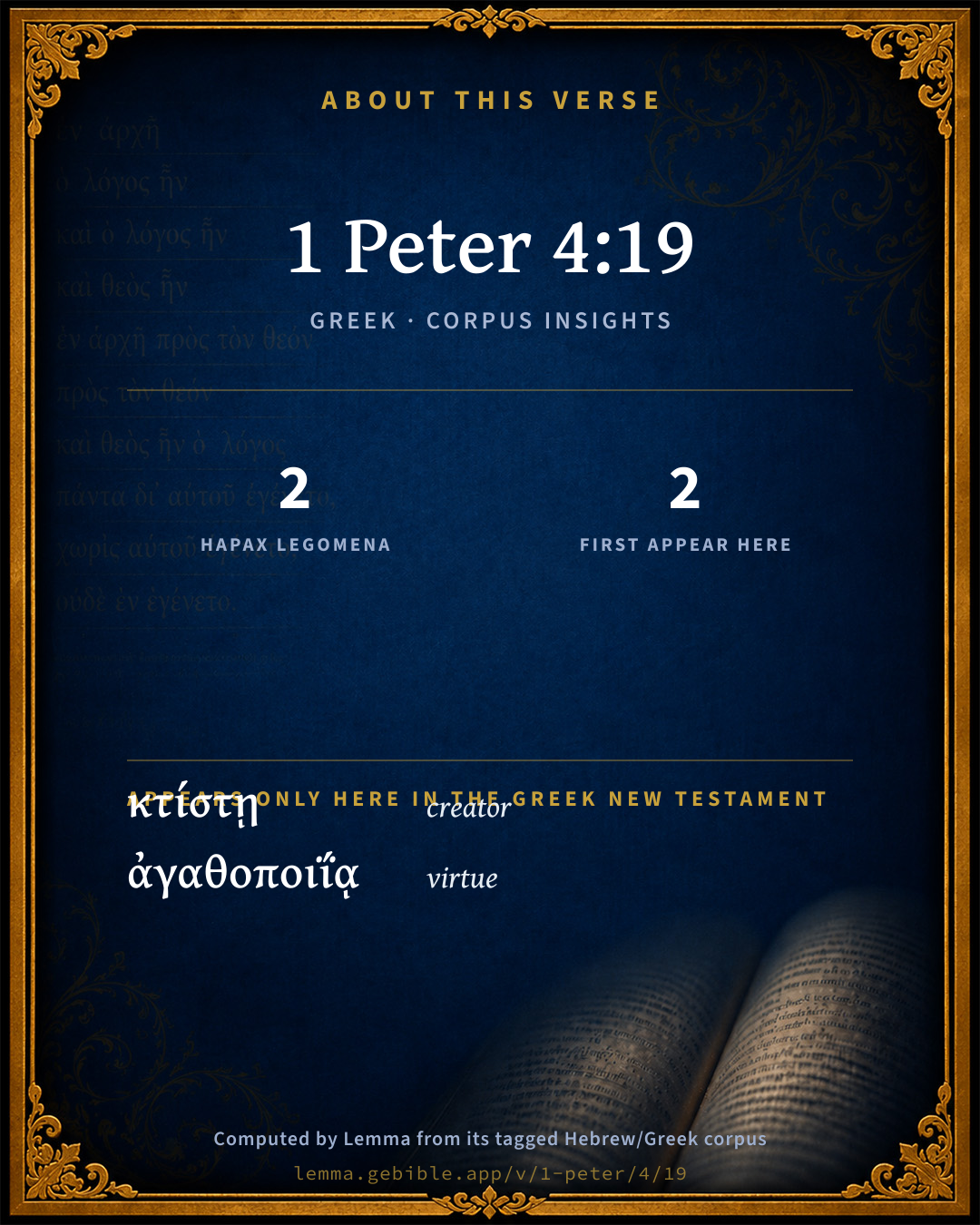
  • 2 hapax legomena — only here in the Greek New Testament
  • 2 first appearances in the Greek New Testament
Full analysis ↓
Download a study sheet

One document with this verse’s original text, its word-by-word gloss line, the meaning frame, cross-references with their text, attributed commentary, and full source and license credits — printable, and it pastes into notes with its structure intact.

This verse Autodidact and up

Study sheet (.html) Plain text (.txt)

A passage Seminary Student

Up to 50 verses in one chapter. A passage sheet keeps up to 6 commentary sources and 12 cross-references per verse, in the order this page ranks them, and says so on the sheet whenever that leaves anything out. Ask for a single verse and you get the Autodidact verse sheet above.

Everything on this page stays free to read, with no account — the sheet is a download of what is already on screen, not access to it.

Want to remove ads? Support Godless Engineer
Compare translations 3

The same verse in 3 English versions, stacked beneath the original-language interlinear above. Click any original word for its lexicon entry.

Each is an independent rendering of the whole verse — the interlinear is not word-aligned to these translations.

Highlighted words mark where these versions differ — a whole-verse word diff, not a word-by-word alignment.

  • World English Bible Public Domain
    Therefore let them also who suffer according to the will of God in doing good entrust their souls to him, as to a faithful Creator.
  • King James Version Public Domain
    Wherefore let them that suffer according to the will of God commit the keeping of their souls to him in well doing, as unto a faithful Creator.
  • unfoldingWord Literal Text CC BY-SA 4.0
    So then, also let those suffering according to the will of God entrust their souls to the faithful Creator in doing good.

unfoldingWord Literal Text — © unfoldingWord, licensed CC BY-SA 4.0. Word-aligned USFM3 via Door43 (git.door43.org/unfoldingWord/en_ult).

Versions to compare (up to 4)

3 of 4 selected

Show all 19 translations

Every available English version of this verse, each an independent rendering of the whole verse.

  • World English Bible Public Domain
    Therefore let them also who suffer according to the will of God in doing good entrust their souls to him, as to a faithful Creator.
  • Berean Standard Bible Public Domain
    So then, those who suffer according to God’s will should entrust their souls to their faithful Creator and continue to do good.
  • Majority Standard Bible Public Domain
    So then, those who suffer according to God’s will should entrust their souls to their faithful Creator and continue to do good.
  • King James Version Public Domain
    Wherefore let them that suffer according to the will of God commit the keeping of their souls to him in well doing, as unto a faithful Creator.
  • American Standard Version (1901) Public Domain
    Wherefore let them also that suffer according to the will of God commit their souls in well-doing unto a faithful Creator.
  • Revised Version (1885) Public Domain
    Wherefore let them also that suffer according to the will of God commit their souls in well-doing unto a faithful Creator.
  • Geneva Bible (1599) Public Domain
    Wherefore let them that suffer according to the will of God, commit their soules to him in well doing, as vnto a faithfull Creator.
  • Douay-Rheims (1899) Public Domain
    Wherefore let them also that suffer according to the will of God, commend their souls in good deeds to the faithful Creator.
  • Young's Literal Translation Public Domain
    so that also those suffering according to the will of god, as to a stedfast Creator, let them commit their own souls in good doing.
  • Literal Standard Version CC BY-SA 4.0
    So that those also suffering according to the will of God, as to a steadfast Creator, let them commit their own souls in doing good.
  • Unlocked Literal Bible CC BY-SA 4.0
    Therefore let those who suffer because of God's will entrust their souls to the faithful Creator in well-doing.
  • unfoldingWord Literal Text CC BY-SA 4.0
    So then, also let those suffering according to the will of God entrust their souls to the faithful Creator in doing good.
  • Darby Bible Public Domain
    Wherefore also let them who suffer according to the will of God commit their souls in well-doing to a faithful Creator.
  • World Messianic Bible Public Domain
    Therefore let them also who suffer according to the will of God in doing good entrust their souls to him, as to a faithful Creator.
  • Webster's Bible Public Domain
    Wherefore, let them that suffer according to the will of God, commit the keeping of their souls to him in well-doing, as to a faithful Creator.
  • Free Bible Version CC BY-SA 4.0
    So then those who suffer according to the will of God, the trustworthy Creator, should make sure they are doing good.
  • Bible in Basic English Public Domain
    For this reason let those who by the purpose of God undergo punishment, keep on in well-doing and put their souls into the safe hands of their Maker.
  • Text-Critical English NT CC BY 4.0
    Therefore, those who suffer according to the will of God should entrust their souls to him as their faithful Creator while doing what is good.
  • Tyndale New Testament (1534) Public Domain
    Wherfore let them that suffer accordynge to the will of god commit their soules to him with well doynge as vnto a faythfull creator.

Literal Standard Version (2020), Covenant Press — licensed CC BY-SA 4.0. Text via the HelloAO Bible API (eBible.org). Unlocked Literal Bible (unfoldingWord) — licensed CC BY-SA 4.0. Text via the HelloAO Bible API (eBible.org). unfoldingWord Literal Text — © unfoldingWord, licensed CC BY-SA 4.0. Word-aligned USFM3 via Door43 (git.door43.org/unfoldingWord/en_ult). Free Bible Version, Dr. Jonathan Gallagher — licensed CC BY-SA 4.0. Text via the HelloAO Bible API (eBible.org).

Word by word

More ways to search: Search by grammar → Find every occurrence → Compare this word →

Practice this passage: Drill this verse → Learn its vocabulary →

κτίστῃ
ktístēs
G2939
“creator”
Noun, Dative, Singular, Masculine
Part of Speech
Noun
Case
Dative
Number
Singular
Gender
Masculine
Full Thayer's Definition

Origin: from G2936

TDNT: 19:40,5

1. a founder 2. a creator
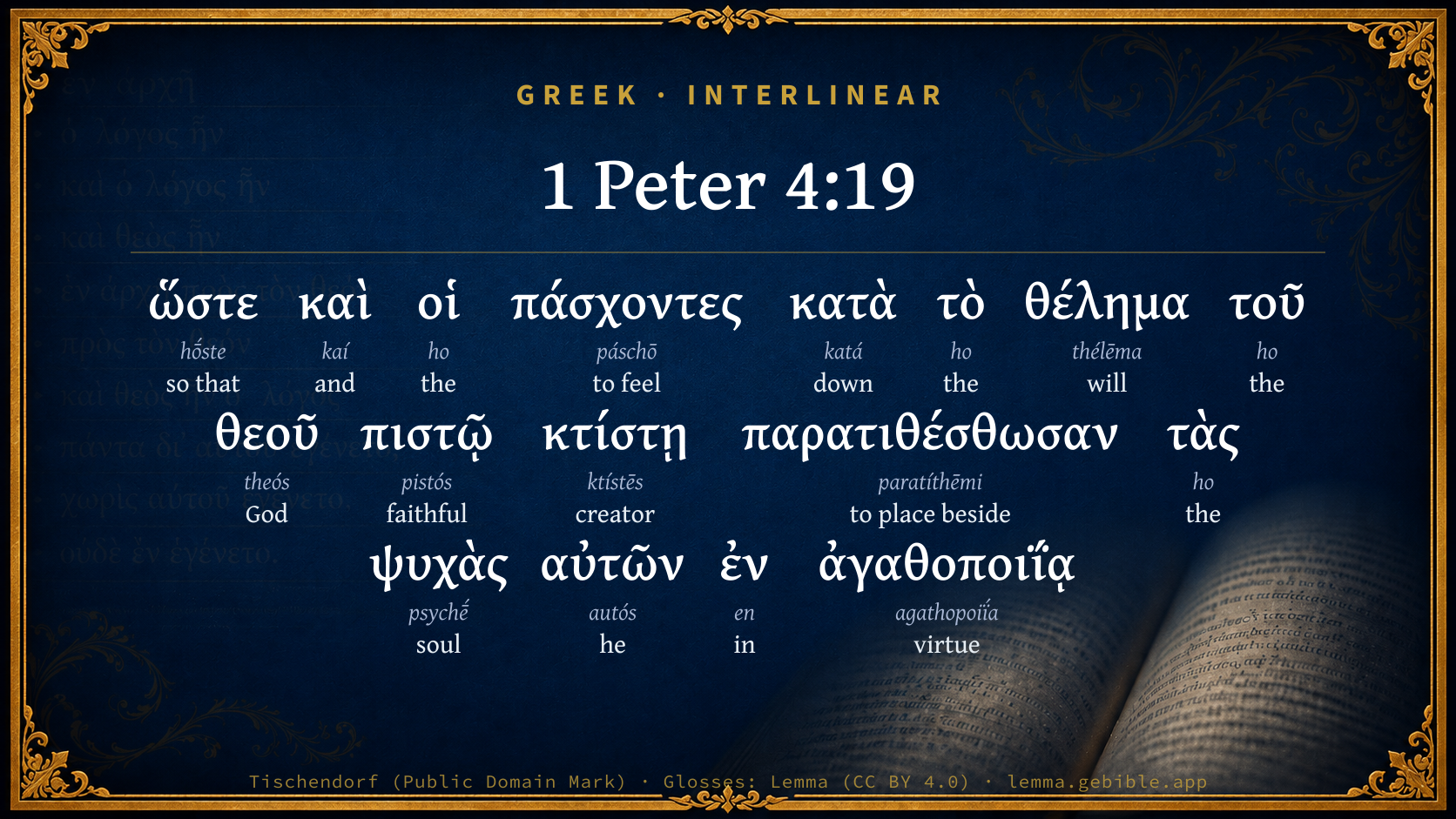
  1. ὥστε hṓste G5620 “so that” Conjunction
  2. καὶ kaí G2532 “and” Conjunction
  3. οἱ ho G3588 “the” Article, Nominative, Plural, Masculine
  4. πάσχοντες páschō G3958 “to feel” Verb, Present, Active, Participle, Nominative, Plural, Masculine
  5. κατὰ katá G2596 “down” Preposition
  6. τὸ ho G3588 “the” Article, Accusative, Singular, Neuter
  7. θέλημα thélēma G2307 “will” Noun, Accusative, Singular, Neuter
  8. τοῦ ho G3588 “the” Article, Genitive, Singular, Masculine
  9. θεοῦ theós G2316 “God” Noun, Genitive, Singular, Masculine
  10. πιστῷ pistós G4103 “faithful” Adjective, Dative, Singular, Masculine
  11. παρατιθέσθωσαν paratíthēmi G3908 “to place beside” Verb, Present, Passive, Imperative, 3rd person, Plural
  12. τὰς ho G3588 “the” Article, Accusative, Plural, Feminine
  13. ψυχὰς psychḗ G5590 “soul” Noun, Accusative, Plural, Feminine
  14. αὐτῶν autós G846 “he” Personal pronoun, Genitive, Plural, Masculine
  15. ἐν en G1722 “in” Preposition
  16. ἀγαθοποιΐᾳ agathopoiḯa G16 “virtue” Noun, Dative, Singular, Feminine

About this verse

These counts appear in no published source. They are computed here, from the morphology-tagged text and Lemma’s own curated glosses. What Lemma adds →

17
words
14
distinct lemmas
General Epistles
section

Notable vocabulary

2 hapax legomena — words that appear only here in the entire Greek New Testament:

  • κτίστῃ creator G2939
  • ἀγαθοποιΐᾳ virtue G16

First appearance in Scripture

These words make their first canonical appearance in the Greek New Testament here:

  • κτίστῃ creator G2939
  • ἀγαθοποιΐᾳ virtue G16

Shared distinctive vocabulary

παρατιθέσθωσαν to place beside G3908 occurs in 18 verses of the Greek New Testament. Also found in:

Repetition

A word recurs within this verse:

Cross-references

26

Topical passages linked to 1 Peter 4:19 in the Treasury of Scripture Knowledge — connected by theme and wording, ordered by reader-vote popularity; previews shown in the World English Bible.

  • Psalms 37:5 Commit your way to Yahweh. Trust also in him, and he will do this:
  • 2 Timothy 1:12 For this cause I suffer also these things. Yet I am not ashamed, for I know him whom I have believed, and I am persuaded that he is able to guard that which I have committed to him against that day.
  • 1 Peter 3:17 For it is better, if the will of God should so will, that you suffer for doing well than for doing evil.
  • Psalms 138:8 Yahweh will fulfill that which concerns me; Your loving kindness, Yahweh, endures forever. Don't forsake the works of your own hands.
  • Psalms 146:5–6 Happy is he who has the God of Jacob for his help, Whose hope is in Yahweh, his God:
  • Psalms 31:5 Into your hand I commend my spirit. You redeem me, Yahweh, God of truth.
  • 1 Peter 4:12–16 Beloved, don't be astonished at the fiery trial which has come upon you, to test you, as though a strange thing happened to you.
  • Romans 2:7 to those who by patience in well-doing seek for glory and honor and incorruptibility, eternal life;
  • 1 Peter 2:15 For this is the will of God, that by well-doing you should put to silence the ignorance of foolish men:
  • Daniel 6:22 My God has sent his angel, and has shut the lions' mouths, and they have not hurt me; because as before him innocence was found in me; and also before you, O king, have I done no hurt.
  • Luke 23:46 Jesus, crying with a loud voice, said, "Father, into your hands I commit my spirit!" Having said this, he breathed his last.
  • Acts 21:11–14 Coming to us, and taking Paul's belt, he bound his own feet and hands, and said, "Thus says the Holy Spirit: 'So will the Jews at Jerusalem bind the man who owns this belt, and will deliver him into the hands of the Gentiles.'"
  • Revelation 5:9–14 They sang a new song, saying, "You are worthy to take the book, And to open its seals: For you were killed, And bought us for God with your blood, Out of every tribe, language, people, and nation,
  • Isaiah 54:16–17 Behold, I have created the smith who blows the fire of coals, and brings forth a weapon for his work; and I have created the waster to destroy.
  • Daniel 3:16–18 Shadrach, Meshach, and Abednego answered the king, Nebuchadnezzar, we have no need to answer you in this matter.
  • Acts 7:59 They stoned Stephen as he called out, saying, "Lord Jesus, receive my Spirit!"
  • Colossians 1:16–20 For by him were all things created, in the heavens and on the earth, things visible and things invisible, whether thrones or dominions or principalities or powers; all things have been created through him, and for him.
  • Isaiah 43:21 the people which I formed for myself, that they might set forth my praise.
  • Jeremiah 26:11–15 Then spoke the priests and the prophets to the princes and to all the people, saying, This man is worthy of death; for he has prophesied against this city, as you have heard with your ears.
  • Daniel 6:10–11 When Daniel knew that the writing was signed, he went into his house (now his windows were open in his chamber toward Jerusalem) and he kneeled on his knees three times a day, and prayed, and gave thanks before his God, as he did before.
  • Esther 4:16 Go, gather together all the Jews who are present in Shushan, and fast you for me, and neither eat nor drink three days, night or day: I also and my maidens will fast in like manner; and so will I go in to the king, which is not according to the law: and if I perish, I perish.
  • Isaiah 40:27–28 Why say you, Jacob, and speak, Israel, My way is hid from Yahweh, and the justice [due] to me is passed away from my God?
  • Isaiah 43:7 everyone who is called by my name, and whom I have created for my glory, whom I have formed, yes, whom I have made.
  • Isaiah 51:12–13 I, even I, am he who comforts you: who are you, that you are afraid of man who shall die, and of the son of man who shall be made as grass;
  • Hebrews 1:2–3 has at the end of these days spoken to us by his Son, whom he appointed heir of all things, through whom also he made the worlds.
  • Revelation 4:10–11 the twenty-four elders fall down before him who sits on the throne, and worship him who lives forever and ever, and throw their crowns before the throne, saying,

Cross-references courtesy of OpenBible.info (CC BY 4.0).

Where the printed editions differ

1 variant

Places in this verse where the major printed Greek editions disagree on the wording in a way that affects the translation — a comparison of editions, not a manuscript-by-manuscript collation. The editions are the modern critical texts (Nestlé-Aland 28/27, SBL, Westcott-Hort, Tregelles, Tyndale House) and the traditional texts behind the KJV (the Textus Receptus and the Byzantine/Majority text). It is not a claim about which reading is original.

  1. Extra text
    ὡς,

    “as”

    In TRByz Not in NA28NA27TynSBLWHTreg

    ὡς, (hōs) 'as' is only in traditional manuscripts (TR+Byz)

Textual data: Translators Amalgamated Greek New Testament (STEPBible TAGNT) · CC BY 4.0.

Commentary

Notes on 1 Peter 4:19 from classic Christian and Jewish commentators (each source and its license shown beneath its notes). The classic Christian expositions comment on the surrounding passage and are grouped to its opening verse, so a note may address several verses; the Jewish commentaries on the Tanakh (Rashi and others) are per-verse, so they appear only where the commentator wrote on this verse.

Lemma curates 59 commentaries, every one of them public domain or Creative Commons licensed, each selected and text-cleaned for this edition rather than reprinted as found. About our sources →

Joseph Benson's Commentary

1Pe 4:19. Wherefore let them that suffer — This temporary chastisement; according to the will of God — Namely, for a good cause, and in a right spirit; commit the keeping of their souls to him — Intrust themselves to God’s care, either to preserve their lives, if he see good, or to save their souls if they suffer death; or, whatever becomes of their bodies, let them commit their souls to him as a sacred depositum: in well-doing — Persevering to the end in the way of duty and obedience, notwithstanding all the sufferings to which they are exposed. In other words, let it be their care to do well, and suffer patiently, and God will take care of the rest. As unto a faithful Creator — In whose wisdom, power, goodness, truth, and faithfulness to his promises, they may safely trust: for as he called them into existence when they were not, he is able to preserve them without any visible means, and will dispose of them as he sees will conduce most to their eternal welfare.

Joseph Benson's Commentary on the Old and New Testaments (1811–1818) — public domain. Text from a community e-Sword module.

Bengel's Gnomon

Johann Albrecht Bengel

1Pe 4:19. Καὶ οἱ πάσχοντες, even those who suffer) Καὶ, even, with the force of a concession. Καὶ, even, with a participle, is the same as εἰ καὶ, and if [even though]; with a verb, εἰ καὶ πάσχοιτε, and if [even though] ye suffer, ch. 1Pe 3:14. We ought not to conceive distrust from suffering.—κατὰ τὸ θέλημα τοῦ Θεοῦ, according to the will of God) on account of doing the will of God in a different manner from evil-doers, who suffer according to the will of God, inasmuch as God wills them to be punished: 1Pe 4:15. The will of God is in Christ.—πιστῷ κτίστῃ, to a faithful Creator) to Him to whom souls are safely committed, who does not even at the first [at the earliest time that He might in each instance] send upon us sufferings for our injury. Let the supra-Lapsarians see how they recognise a Creator faithful towards all.—παρατιθέσθωσαν, let them commit) as a deposit, not alarmed, but rather gladdened by sufferings, since they receive them to their advantage.—ψυχὰς, their souls) although the body appears to perish.—ἐν ἀγαθοποιΐα, in well-doing) This should be the one and only care of those who suffer, both to act well and to suffer well: He will take care of the rest. To be taken with let them commit. Well-doing always has confidence united to it: ch. 1Pe 3:6; 1Jn 3:22.

Bengel's Gnomon of the New Testament — English translation (T&T Clark, Edinburgh, 1860) — public domain. Text from a community e-Sword module.

Meyer's Critical & Exegetical Commentary

Heinrich August Wilhelm Meyer

1Pe_4:19. The exhortation contained in this verse is closely connected with 1Pe_4:17-18, in such a way, however, that it brings to a close the whole section which treats of suffering for the sake of Christ (Hofmann); Hornejus: clausula est qua totam exhortationem obsignat.

ὥστε] as in Rom_7:4, and often elsewhere, with a finite verb following (Winer, p. 282 f. [E. T. 377]) therefore.

καί does not belong to οἱ πάσχοντες, equivalent to those also who suffer, with reference to those who do not suffer (Wiesinger, Hofmann), for there is no allusion in the context to any distinction between those who suffer because of their Christian profession and those who have not so to suffer,[262] but it is united with ὥστε, and applies to the verb, and just for this reason (cf. Winer, p. 408 [E. T. 544 ff.]). Incorrectly, Bengel: καί concessive cum participio i. q. εἰ καὶ πάσχοιτε.

οἱ πάσχοντες] namely, the believers.

κατὰ τὸ θέλημα τοῦ Θεοῦ] that is, πρὸς πειρασμόν, 1Pe_4:12. Wiesinger: looking back to 1Pe_4:17, inasmuch as they as Christians are overtaken by the judgment God pronounces on His house. Besser incorrectly takes it as referring to their subjective behaviour under suffering.

ὡς πιστῷ κτιστῇ παρατιθέσθωσαν κ.τ.λ.] Gerhard: ὡς exprimit causam, propter quam, hi qui patiuntur animas suas apud Deum deponere debeant, nimirum quia est earum creator et fidelis custos. If ὡς be the correct reading, then from the foregoing τοῦ Θεοῦ an αὐτῷ must be supplied, to which ὡς πιστῷ κτιστῇ applies.

κτιστής is not possessor (Calvin), but the creator; ὁ κτίσας, Rom_1:25. It is used here in its strict sense, and not with reference to the new creation (Steiger, Schott connect both together); cf. Act_4:24 ff.: this prayer is an actual example of what is here demanded (Weiss, p. 190). In the N. T. κτίστης is ἅπ. λεγ., in the O. T. it occurs frequently; Jdt_9:12; 2Ma_1:24. πιστός: Oecumenius, equivalent to: ἀσφαλὴς καὶ ἀψευδὴς κατὰ τὰς ἐπαγγελίας αὐτοῦ, καὶ οὐκ ἐάσει ἡμᾶς πειρασθῆναι ὑπὲρ ὃ δυνάμεθα; cf. 1Co_10:13.

With παρατίθεσθαι, cf. Act_14:23; Act_20:32 : to commit to the protection of any one.

ἐν ἀγαθοποιΐᾳ] ἀγαθοποιΐα, ἅπ. λεγ.; the adjec., chap. 1Pe_2:14. This addition shows that the confident surrender to God is to be joined, not with careless indolence, but with the active practice of good. Oecumenius erroneously paraphrases the word by ταπεινοφροσύνη.

[262] Schott explains καί by the contrast between the individual sufferers and the church; but nothing in the context alludes to this.

Meyer — Critical and Exegetical Commentary on the New Testament — English translation by Peter Christie, edited by Frederick Crombie (T&T Clark, 1880) — public domain. Text from a community e-Sword module.

Expositor's Greek Testament

ed. W. Robertson Nicoll

1Pe 4:19 . So let even those who suffer in accordance with the will of God with a faithful Creator deposit their souls in well-doing . The Christian must still follow the pattern. It is God’s will that he share Christ’s sufferings in whatever degree; let him in this also copy Christ, who said, Father into thy hands I commit my spirit (Luk 23:46 = Psa 31:6 ) and bade His disciples lose their souls that they might find them unto life eternal. With this teaching Peter combines that of the Psalmist which is assumed by Jesus (Mat 6:25 ff.), Jehovah knows His creature . He the God of faithfulness ( אל אמת , Ps. l.c. ) is the faithful Creator to whom the soul He gave and redeemed (Ps. l.c. ) may confidently return.

The Expositor's Greek Testament, edited by W. Robertson Nicoll (1897–1910) — public domain. Text from a community e-Sword module.

Geneva Bible (1599)

Geneva Bible translators

The conclusion: Seeing the godly are not afflicted by chance, but by the will of God, they ought not to despair, but go forward, notwithstanding in the way of holiness and well doing, commending themselves to God their faithful Creator, that is to say, their Father.

Geneva Bible (1599) marginal notes — public domain. Text via Bolls.life.

Jamieson, Fausset & Brown

Robert Jamieson, A. R. Fausset & David Brown

General conclusion from Pe1 4:17-18. Seeing that the godly know that their sufferings are by God's will, to chasten them that they may not perish with the world, they have good reason to trust God cheerfully amidst sufferings, persevering in well-doing.

let them--Greek, "let them also," "let even them," as well as those not suffering. Not only under ordinary circumstances, but also in time of suffering, let believers commit. (Compare Note, see on Pe1 3:14).

according to the will of God--(See on Pe1 3:17). God's will that the believer should suffer (Pe1 4:17), is for his good. One oldest manuscript and Vulgate read, "in well-doings"; contrast ill-doings, Pe1 4:15. Our committing of ourselves to God is to be, not in indolent and passive quietism, but accompanied with active well-doings.

faithful--to His covenant promises.

Creator--who is therefore also our Almighty Preserver. He, not we, must keep our souls. Sin destroyed the original spiritual relation between creature and Creator, leaving that only of government. Faith restores it; so that the believer, living to the will of God (Pe1 4:2), rests implicitly on his Creator's faithfulness.

Next: 1 Peter Chapter 5

Jamieson, Fausset & Brown — Commentary Critical and Explanatory on the Whole Bible (1871) — public domain (CC PDM 1.0). Text via the HelloAO Bible API.

Adam Clarke's Commentary

Verse 19. Suffer according to the will of God] A man suffers according to the will of God who suffers for righteousness' sake; and who, being reviled, reviles not again.

Commit the keeping of their souls] Place their lives confidently in his hand, who, being their Creator, will also be their preserver, and keep that safely which is committed to his trust. God is here represented as faithful, because he will always fulfil his promises, and withhold no good thing from them that walk uprightly.

But they had no reason to hope that he would care for their lives and souls unless they continued in well-doing. He who is employed in God's work will have God's protection. The path of duty ever was, and ever will be, the only way of safety.

1. THE apostle recommends fervent charity-unfeigned love both to God and man. It is well said of this grace that it is a universal virtue which ought to precede, accompany, and follow, all others. A charity which has God for its principle, and Jesus Christ for its pattern, never faileth. If our charity be extensive enough to cover all the defects of our neighbour in bearing with them; that of God is sufficient to cover all the sins of a sincere penitent by blotting them out. If we ought to be charitable to all, it is after the example of our heavenly Father, who is loving to every man, and hateth nothing that he has made.

2 The difficulty of escaping the corruption that is in the world is great; and, consequently, the danger of losing our souls. In this great work, watchfulness, prayer; faith, and obedience, are indispensably necessary. He who does not walk with God here cannot see nor enjoy him hereafter.

Adam Clarke's Commentary on the Bible (1810–1826) — public domain. Text from a community e-Sword/MySword module.

John Calvin's Commentaries

19 Wherefore let them that suffer He draws this conclusion, that persecutions ought to be submissively endured, for the condition of the godly in them is much happier than that of the unbelieving, who enjoy prosperity to their utmost wishes. He, however, reminds us that we suffer nothing except according to the permission of God, which tends much to comfort us; when he says, Let them commit themselves to God, it is the same as though he had said, “Let them deliver themselves and their life to the safe keeping of God.” And he calls him a faithful possessor, because he faithfully keeps and defends whatever is under his protection or power. Some render the word “Creator;” and the term κτίστης means both; but the former meaning I prefer, for by bidding us to deposit our life with God, he makes him its safe keeper. He adds, in well-doing, lest the faithful should retaliate the wrongs done to them, but that they might on the contrary contend with the ungodly, who injured them, by well-doing.

John Calvin's Commentaries (1540-1563) — public domain. Text from the Calvin Translation Society English edition (1840s-50s) via the Christian Classics Ethereal Library (ccel.org). Calvin's coverage is partial (roughly two-thirds of the Bible); uncommented books and verses are honest gaps, never fabricated. The 19th-century editor's footnotes and remarks are omitted so the notes are faithfully Calvin's own voice.

Ellicott's Commentary for English Readers

(19) Wherefore.—Because the beginning of the judgment—the judgment of the Christians—is so light in comparison with the fearful end when it lights on the disobedient and wicked.

Let them that suffer according to the will of God.—Our version omits an important little word: Let them that suffer also (or, Let even them that suffer) according to the will of God. The stress is on “suffer”—i.e., be put to death. And the clause, “according to the will of God,” seems not intended to mean “in a godly and unblameable manner,” as opposed to the “suffering as a murderer” (1Pe_4:15); rather, it brings out that such a death is no accident, no sudden calamity, but in strict accordance with God’s prearranged design. (Comp. 1Pe_3:17 : “if the will of God will it.”) Thus it harmonises with the following: “faithful Creator,” “commit their souls.”

Commit the keeping of their souls.—The beautiful verb rendered “commit the keeping of” is a technical term for depositing a deed, or sum of money, or other valuable, with any one in trust. In the literal sense it occurs in Luk_12:48; 2Ti_1:12 : in a metaphorical sense, of doctrines committed in trust to the safe keeping of the Episcopate, in 1Ti_1:18; 1Ti_6:20; 2Ti_1:14; 2Ti_2:2 : of leaving persons whom you love in trust, in Act_14:23; Act_20:32. But the words which St. Peter probably has ringing in his ears when he thus writes are the words of our Lord on the cross (where the same verb is used): “Father, into Thy hands I commend My spirit” (Luk_23:46). “Their souls” might, perhaps, with still more propriety, be here translated their lives. The connection will then be: “Consider the mildness of these trials compared with the terrors overhanging the sinful. Even if the worst should come to the worst, and you must die a martyr’s death, it is but the execution of God’s plan for you. View your life as a deposit: lay it confidently in His hands, to be returned to you again when the time comes: and you will find Him faithful to what a Creator ought to be.”

A faithful Creator.—The word “faithful” is used in reference to the “deposit” placed in His hands; and the title “Creator” seems to be chosen here rather than “Father,” or the like, because creation of the soul includes not only the giving of its existence but the shaping of its destiny. “The will of God,” in accordance with which they “suffer,” is part of the act of creation. The noble expression, however, contains the idea that the act of creation imposes duties and responsibilities upon the Creator. It is conceivable that some powerful being (not our God) might create, and be careless of the happiness or of the moral welfare or of the mutual relations of his creatures. Such a creator would be “unfaithful:” we should have a right to expect differently of him. But God is a “faithful Creator.” “Though He slay me, yet will I trust Him.”

In well doing.—In the Greek these words come emphatically last. (Comp. 1Pe_3:17.)

A Bible Commentary for English Readers, edited by Charles John Ellicott (1878–1897) — public domain. Text from a community e-Sword module.

The Cambridge Bible for Schools and Colleges

gen. ed. J. J. S. Perowne

19. Wherefore let them that suffer according to the will of God] In the acceptance of sufferings as being according to the will of God, much more is meant than the mere submission to an inevitable destiny. If we really think of pain and persecution as working out God’s will, permitted and controlled by Him, we know that that Will is righteous and loving; planning nothing less than our completeness in holiness (1Th_4:3), the Will of which we daily pray that it may be done on earth as it is in heaven. The Greek word for “Creator” is not found elsewhere in the New Testament, but is found in the LXX. of Jdt_9:12, 2Ma_1:24. Stress is laid on the attribute, or act, of creation as the ground of confidence. He who made the soul is also He who hateth nothing that He hath made. Here, also, we can scarcely doubt the example of the Great Sufferer was present to the Apostle’s mind, and his words were therefore echoes of those spoken on the Cross, “Father, into thy hands I commend my spirit” (Luk_23:46).

The Cambridge Bible for Schools and Colleges (gen. ed. J. J. S. Perowne; Cambridge University Press, 1878–1918) — public domain. Text from a community e-Sword module.

John Gill's Exposition

Wherefore let them that suffer according to the will of God,.... This is the conclusion made from the foregoing premises; that seeing the state and condition of the saints in this world, at worst, and which is but for a time, is infinitely preferable to the dreadful state and condition of disobedient persons, ungodly men, and sinners, and which will endure to all eternity; they should not think strange of their sufferings, or complain of them, but patiently endure them; and especially when they consider that these are not the effects of chance, or merely owing to the malice and wickedness of men, or to any second cause only; but they are the will of God, are by his appointment, under his direction, and by his order, and for their good, and his own glory; and therefore it becomes them to

commit the keeping of their souls to him, in well doing, as unto a faithful Creator: and which is not only their duty, but their privilege: and the sense is, that when they are called to suffer for Christ, they should commit their cause to God, who, as he is the Creator, is the Governor of the universe, and will judge righteously; and when they are even called to lay down their lives for his sake, they shall not lose them; though their bodies are killed, they may and should commit their souls, when departing from their bodies, into the hands of God; as Stephen, the first martyr, committed his into the hands of Christ, in imitation of him; where he that made them, as he is able to keep them, will faithfully preserve them in happiness and glory, till the resurrection morn, when their bodies shall be raised and reunited to them: and this is to be performed, in "well doing"; for which they suffer, and in which they should continue to the last; not rendering evil for evil, but blessing; and in imitation of Christ, and his servant Stephen, pray for their worst enemies, and wish them all the good, and do them all the acts of kindness that lie in their power.

Next: 1 Peter Chapter 5

John Gill's Exposition of the Whole Bible (1746–1763) — public domain (CC PDM 1.0). Text via the HelloAO Bible API.

Trapp's Complete Commentary

John Trapp

19 Wherefore let them that suffer according to the will of God commit the keeping of their souls to him in well doing, as unto a faithful Creator.

Ver. 19. Commit the keeping] As a precious depositum. So did our Saviour both in his lifetime, 1Pe 2:23, and at his death, Luk 23:46. So did Stephen and all the holy martyrs after him. Archbishop Cranmer often repeated these words in the flame, "Lord Jesus, receive my spirit." A certain Spanish monk that stood by and heard him, ran to a nobleman there present, and cried out that Cranmer died in great desperation, ratus desperationis fuisse voces, as conceiving those to be words of despair.

As unto a faithful] Who will rather unmake all than we shall miscarry. And doth still manage all occurrences to the glory of his name and the good of those that trust in him, Psa 124:8.

John Trapp, A Commentary or Exposition upon All the Books of the Old and New Testament (1647–1656) — public domain. Text from a community e-Sword module.

Albert Barnes' Notes on the Bible

Wherefore, let them that suffer according to the will of God - That is, who endure the kind of sufferings that he, by his providence, shall appoint. Compare 1Pe 3:17; 1Pe 4:15-16.

Commit the keeping of their souls - to him. Since there is so much danger; since there is no one else that can keep them; and since he is a Being so faithful, let them commit all their interests to him. Compare Psa 37:5. The word “souls” here (ψυχὰς psuchas) is equivalent to themselves. They were to leave everything in his hand, faithfully performing every duty, and not being anxious for the result.

In well doing - Constantly doing good, or seeking to perform every duty in a proper manner. Their business was always to do right; the result was to be left with God. A man who is engaged always in well-doing, may safely commit all his interest to God.

As unto a faithful Creator - God may be trusted, or confided in, in all His attributes, and in all the relations which He sustains as Creator, Redeemer, Moral Governor, and Judge. In these, and in all other respects, we may come before Him with confidence, and put unwavering trust in Him. As Creator particularly; as one who has brought us, and all creatures and things into being, we may be sure that he will be “faithful” to the design which he had in view. From that design he will never depart until it is fully accomplished. He abandons no purpose which he has formed, and we may be assured that he will faithfully pursue it to the end. As our Creator we may come to Him, and look to Him for His protection and care. He made us. He had a design in our creation. He so endowed us that we might live forever, and so that we might honor and enjoy Him. He did not create us that we might be miserable; nor does He wish that we should be. He formed us in such a way that, if we choose, we may be eternally happy. In that path in which He has appointed us to go, if we pursue it, we may be sure of His help and protection. If we really aim to accomplish the purposes for which we were made, we may be certain that He will show Himself to be a “faithful Creator;” one in whom we may always confide. And even though we have wandered from Him, and have long forgotten why we were made, and have loved and served the creature more than the Creator, we may be sure, if we will return to Him, that He will not forget the design for which He originally made us. As our Creator we may still confide in Him. Redeemed by the blood of His Son, and renewed by His Spirit after the image of Him who erected us, we may still go to Him as our Creator, and may pray that even yet the high and noble ends for which we were made may be accomplished in us. Doing this, we shall find Him as true to that purpose as though we had never sinned.

Albert Barnes' Notes on the Bible (1834–1885) — public domain. Text from a community e-Sword/MySword module.

Matthew Poole's English Annotations

Let them that suffer; viz. any manner of affliction or persecution for righteousness’ sake.

According to the will of God; according to that will of God, whereby he hath appointed them to suffer such things, 1Pe 3:17; 1Th 3:3.

Commit; commend into his hands, or lay up, or intrust with him as a depositum, Psa 31:5; 2Ti 1:12.

The keeping of their souls; as the most precious things while they live, and most to be cared for when they die; that they may be kept from sin under afflictions, and from perishing in death: or rather, their souls here includes their bodies, and so committing their souls is committing their whole selves to God.

In well-doing; not being deterred from well-doing by the evils they suffer, but by persevering in holiness notwithstanding their afflictions, making it appear to the last, that they do not suffer as evil-doers.

As unto a faithful Creator; one who, as Creator, is able to keep what they commit to him; and being faithful to his promises, certainly will do it.

Matthew Poole's English Annotations on the Holy Bible (1683–1685) — public domain. Text from a community e-Sword/MySword module.

Whedon's Commentary on the Bible

Daniel D. Whedon

19. That suffer—In this time of distress.

Will of God—As shown in his providential dealings.

Commit—With most absolute, unfaltering trust, whatever befalls.

Their souls—Their bodies and lives, indeed, but especially their souls, joining all holy obedience to their faith, so that they would be filled with his Spirit and kept from forsaking Christ in the hour of peril; and, if their lives were lost, they would be saved in heaven.

A faithful Creator—Who, with all his wisdom, power, and love, is forever faithful to his faithful covenant people.

Daniel D. Whedon (gen. ed.), Commentary on the Old and New Testaments (1874–1909) — public domain. Text from a community e-Sword module.

The Pulpit Commentary

Wherefore let them that suffer according to the will of God; rather, let them also that suffer. St. Peter sums up his exhortation; he returns to the thought of 1Pe_3:17, "It is better, if the will of God be so, that ye suffer for well-doing, than for evil-doing." In the hour of suffering, as well as in times of prosperity, we are in the hands of a merciful and loving Father; we are to learn submission, not because the suffering is inevitable, but because it is according to his will, and his will is our sanctification and salvation. Commit the keeping of their souls to him in well-doing, as unto a faithful Creator; rather, as in the Revised Version, commit their souls in well-doing unto a faithful Creator. The conjunction "as" must be omitted, not being found in any of the best manuscripts. The word rendered "Creator" (ktisthv) Occurs nowhere else in the Greek Testament. God is our Creator, the Father of spirits, He gave the spirit; to him it returneth. We must imitate our dying Lord, and, like him, commit our souls to the keeping of our heavenly Father as a deposit which may be left with perfect confidence in the hands of a faithful Creator. (2Ti_1:12) There is an evident reference here to our Lord"s words upon the cross. (Luk_23:46; Psa_31:5) St. Peter adds, "in well-doing." The Christian"s faith must bring forth the fruits of holy living; even in the midst of suffering he must "be careful to maintain good works.

The sufferer"s wisdom and peace.

The word carries us back to the whole series of thoughts on persecution and sorrow in the preceding verses, and, as it were, binds them all together, as a man might bind a bundle of twigs to make a standing-ground for himself and his companions on a black bog. The fagot is made up of these truths, namely sorrow is no extraordinary anomaly; we share in the great Sufferer"s afflictions; the purpose of them is our participation in the great King"s glory, and that a joy exceeding the sorrow may be ours; that sorrow and shame will bring the Divine Spirit to overshadow us with his peaceful, dove-like wing, and to fill our souls with the radiance of a present God; that by it we may glorify the God who in it glorifies us; that the sharpest sorrows are but a light portion of the judgments which are to come upon all the earth, and are meant, not to destroy, but to purify and to separate from those on whom the final and fatal judgment of condemnation shall fall. Wherefore, for all this closely knit structure of calming and courage-giving truths, quiet confidence and uninterrupted diligence in holy deeds is the sorrowful heart"s wisdom.

I THE TRUE TEMPER OF THE CHRISTIAN SUFFERER. We can scarcely fail to hear in the words one more echo of the gospel story. Peter remembers, "Father, into thy hands I commend my spirit," and bids us all, in our lighter sorrows, in like manner commit our souls to God. The word is the same, and, though our Lord spoke of the act of death, and the apostle of the surrender in life, the temper and disposition are the same. Absolute confidence and complete submission were exhibited on the cross. Nothing less is our duty and privilege. When sorrow comes, and not only in joy when it is so easy, we are to give up ourselves to God in the full abandonment of trust, as a man who has been fighting for hours against the storm reaches home at last, and, with muscles relieved from strain, gratefully flings himself down to rest. We are to put ourselves in God"s care, as people in war flock into the forts, or as a householder will deposit his valuables in the hands of his banker, and then sleep careless of thieves or fire. God will take good care of all that is deposited in his custody. No violence can force his safe where his jewels are kept. If we recognize our own importance, and, abandoning all self-reliance, trust wholly to him, we shall suffer no harm and fear no foe; but if we will live in the open country, and refuse the shelter of his stronghold, because we either do not believe the peril, or think we can keep ourselves sale by our own arms, some night or other we shall be roused from dreams to see the faces of the savage foes all about our bed, and shall know the sharpness of their arrows and the implacableness of their hearts. These two things, which are but the positive and the negative sides of one self-distrust and reliance on God are the secret of all tranquility as well as of all safety. That heart may well be at rest which has shifted the responsibility of its defense from its own weak self to God. If we once can come to feel that it is more his business than ours to take care of us, a whole cloud of cares falls like some black precipitate to the bottom, and leaves the heart clear. Confidence is not enough without submission. To commit our souls to God includes "Do what thou wilt," as well as "Thou wilt do lovingly and well." Only when the will yields, and, though it may be with tears bitter as death, and lasting as life, accepts and conforms itself to God"s will, do we really know the blessedness of faith. That which we no longer kick against no longer pricks us. The cell out of which we do not wish to go ceases to be a prison, and becomes an oratory or a study. The horse that plunges feels the restraint of his harness, which would not gall if he went quietly. "It is the Lord, let him do what seemeth him good," is a talisman which changes bitter into sweet, darkness into light, sorrow into content, and death into life.

II THE PRACTICAL ACCOMPANIMENT OF THIS TEMPER. "In well-doing." There are many important truths suggested by that significant addition.

1. The familiar truth is suggested that our committing our souls to God does not mean that we are to fold our hands in indolence, which we misname trust. Neither are we to be so much engaged with cultivating the inward graces of faith and submission as to neglect the practice of common deeds of kindness. Our religion may become transcendental, a thing of spiritual experiences and emotions, and may be in danger of soaring so high as to forget the work which has to be done here. But it must have hands to toil as well as wings to mount. Peter was foolish when he desired to stay on the Mount of Transfiguration, for there was a poor devil-ridden boy waiting in the plain to be healed.

2. Here is a warning against giving up work because of sorrow. Ages of persecution have seldom been ages of service. All the strength of the Church has been absorbed in simple endurance. And in our private sorrows we are too apt to fling aside our tools in order to sit down, and brood, and remember, and weep. We hold ourselves excused from tasks which otherwise seem plain duties, because our hearts are heavy. There is no greater mistake than to give up work because of trouble. Next to God"s Spirit, it is the best comforter. We feel our own burdens less when we try to help some heavy-laden brother to catty his. Our sorrow will be less and our faith more if we honestly set ourselves to the tasks, and especially to the tasks of doing good to others which lie at our hands.

3. All sin kills faith. "Well-doing" here may either mean beneficence or pure moral conduct. If the former, the remarks just made apply. If the latter, the principle is presented that such conduct must be associated with our committing of our souls to God, because every breach of the solemn law of right will weaken our power of faith and make a barrier between us and God. A small grain of sin will blind us; a little sin will prevent us from seeing God. A thin film of air hinders two bodies from uniting; a thin layer of sin keeps the soul from touching God. Any transgression will disturb our faith, and make it close its opening buds, as a bright cloud crossing the sun folds together the petals of some plants. There must be pure and noble deeds if there is to be any completeness and continuity of peaceful confidence; for, though faith is the parent of righteousness, righteousness reacts on faith, and a hand foul with evil is lamed thereby, so that it cannot firmly grasp the outstretched hand of Christ.

III THE GROUND OF THIS CONFIDENCE IN THE ACTS AND CHARACTER OF GOD. He to whom we entrust our souls is their Creator. Therefore he is strong to preserve no less than to make, and therefore, too, he knows how much tension and strain the soul can bear, and will not overweight it, nor test it up to the breaking-point. As St. Paul says, he will not suffer us to be tempted above that we are able. Where better can some precious work be put for safe keeping than in the maker"s hands? Where can my soul be so secure and well than confided to the care of him who fashioned me, and measures my sorrows, knowing my frame and remembering that I am dust? He is a faithful Creator. The act of creation constitutes a relation between God and us, which imposes on "him obligations and gives us claims on him. He has made a covenant with his creatures in the hour when he created them, which he keeps for ever. He is faithful, in that he ever remains true to himself, to his own past, and to his articulate promises. What he has been we can rely on, and be sure that, as we have heard, so shall we see, and that every act of mercy and succor in the past binds him to extend the same mercy and succor today and for ever. So all the old history flashes up into new meaning for every poor sorrowful, trusting soul. What he has spoken he will adhere to, and there are promises enough for us to build absolute confidence upon. No man shall ever be able to quote an assurance of his which turned out a rotten support, a rind without a kernel. He is a faithful Creator. Therefore, if we "commit the keeping of our souls to him in well-doing," with the ancient prayer, "Forsake not the work of thine own hands," we too shall be blessed with the answer given to a hundred generations, and fulfilled to every soul that rested upon it, "I will not leave thee until I have done that which I have spoken to thee of. A.M.

The Pulpit Commentary (1880–1919), ed. H.D.M. Spence-Jones & Joseph S. Exell — public domain. Text from a community e-Sword module.

John Wesley's Explanatory Notes

Let them that suffer according to the will of God - Both for a good cause, and in a right spirit. Commit to him their souls - (Whatever becomes of the body) as a sacred depositum. In well doing - Be this your care, to do and suffer well: He will take care of the rest. As unto a faithful Creator - In whose truth, love, and power, ye may safely trust.

John Wesley, Explanatory Notes Upon the Whole Bible (1754–1765) — public domain. Text via the GEBible commentary corpus.

Burkitt's Expository Notes on the New Testament

William Burkitt

Observe here, 1. A cautionary direction given, that in all our sufferings we take care that we suffer according to the will of God: that is, for what is according to God’s will, either to be believed or practised by us, for asserting and maintaining the purity of the Christian doctrine and worship; and when our patience under such sufferings is as extensive and intensive as God requires, when our patience is as large and as lasting as our troubles, then may we be said to suffer according to the will of God.

Observe, 2. The special privilege allowed to such sufferers as suffer according to the will of God: they may commit the keeping of their souls to God in well-doing, as unto a faithful Creator.

Learn hence, 1. That when men suffer really and truly for well-doing, they may with confidence and great assurance commit their lives, and all that is dear unto them, to the special care of the divine providence; either God will keep us from, or support us under, trials, when we thus commit ourselves to him.

William Burkitt's Expository Notes on the New Testament (1700–1703) — public domain. Text from a community e-Sword module.

The People's New Testament

B. W. Johnson

19. Wherefore let them also that suffer. Let all who suffer, not for evil doing but for righteousness sake, keep on in well doing and commit their souls to the care of the all seeing and faithful God.

B. W. Johnson's The People's New Testament with Notes (1889–1891) — public domain. Electronic text from the Christian Classics Ethereal Library (CCEL) ThML edition.

Cambridge Greek Testament for Schools and Colleges

19. ὥστε. The view of suffering inculcated in the preceding verses enables Christians to glorify God for permitting them to suffer in Christ’s name, and they can do this with perfect trust because they can also (καί) feel that they are committing their souls (or lives) to the keeping of the God who made them, and He can be relied upon not to deal untruly with His own handiwork.

παρατίθεσθαι. In the sense of entrusting a deposit to safe keeping cf. our Lord’s dying words Luk 23:46 quoting Psa 31:5 εἰς χεῖράς σου παρατίθεμαι τὸ πνεῦμά μου, cf. Act 14:23; Act 20:32; 1Ti 1:18; 2Ti 2:2.

κτίστης is used of God in the prayer of Jonathan, 2Ma 1:24, but does not occur elsewhere in the N.T.

ἐν ἀγαθοποιίᾳ. The way in which Christians are to shew their trust is by continued well-doing in spite of their sufferings. There must be active obedience as well as patient endurance.

Cambridge Greek Testament for Schools and Colleges (Cambridge University Press, 1896; 21 vols, various authors incl. Carr, Maclear, Plummer, Farrar, Lumby, Moule, M. R. James, Simcox) — public domain. Text from a community e-Sword module.

Alford’s Greek Testament

Henry Alford

19.] Wherefore (general conclusion from vv. 17, 18. If the sufferings of Christians as Christians are a sign of God’s favour towards them, in subjecting them to His judgments, with a view to their not perishing with the ungodly world, then have they every reason to trust Him in those sufferings, and to take comfort: continuing in that same well-doing which is their very element and condition) let also them who suffer (καί, as well as all other persons: not as Bengel, καί, concessive: “καί, etiam, cum participio, idem quod εἰ καί, et si, cum verbo:” for it is on this very εἰ καί hypothesis that the Apostle has been long proceeding; so that it would be unnatural for him to introduce it here again with a climax:—nor as De Wette and Huther, is it to be taken with ὥστε) according to (in pursuit of, along the course of) the will of God (see on ch. 3:17: here especially in reference to our ver. 17, seeing that it is God’s will that judgment should begin at His house), commit (reff. deliver (subjectively) into the hands of, and confidently leave there) their souls (their personal safety and ultimate σώζεσθαι, ver. 18) in (ἐν, as clad in, accompanied with, subsisting and employed in) well-doing (as contrasted with the opposite characters in ver. 15. Huther says well: “This addition, ἐν ἀγαθοπ., shews that the confident surrender to God is to be joined, not with careless indolence, but with active practice of good”) to a faithful Creator (in God being our Creator, without whom not a hair falls to the ground, we have an assurance that we are not overlooked by Him: in His being a faithful Creator (ἀσφαλὴς κ. ἀψευδὴς κατὰ τὰς ἐπαγγελίας αὐτοῦ, Œc.), whose covenant truth is pledged to us, it is implied that we are within that covenant, suffering according to His will and as His children. κτίστης must not be understood of the second creation in the new birth, nor must it be rendered possessor, as Calvin).

Henry Alford, The Greek Testament (1849–1861) — public domain. Text from a community e-Sword module.

Vincent's Word Studies in the New Testament

Marvin R. Vincent

Commit [παρατιθεσθωσαν] . Give in charge as a deposit. Compare Luk 12:48; Act 20:32; 1Ti 1:18. The word is used by Christ in commending his soul to God (Luk 23:46).

Well - doing [αγαθοποιια] . Only here in New Testament. Compare ch. 2 14. The surrender to God is to be coupled with the active practice of good.

Marvin R. Vincent, Word Studies in the New Testament (1887–1900) — public domain. Text from a community e-Sword/MySword module.

Lesson kit

Teaching starters — assembled from the data on this page, not authored interpretation. Every prompt links to the verse data it draws on. Edit before teaching.

1 Peter, in the General Epistles, opens this verse with 17 words (14 distinct Greek lemmas). Its most distinctive word is ktístēs (“creator”). A historical commentator’s framing appears above. Read the whole chapter for the surrounding context.

Discussion questions

  1. The word ktístēs carries the sense “creator.” How does it shape the verse?
  2. 2 words here appear nowhere else in the Greek New Testament. Why might the author reach for such rare wording?
  3. 2 words make their first appearance in Scripture here. What does this debut establish?
  4. How does Matthew 13:24, which shares the word «to place beside», read alongside this verse?
  5. What does the repetition of “the” (4× in this one verse) do in this verse?
  6. The translations on this page render this verse differently — a whole-verse word diff, not a word-by-word alignment. What might account for the different wordings?
  7. Compare how Joseph Benson's Commentary and Bengel's Gnomon read this verse. Where do they agree or differ?

Things to notice

  • 2 words in this verse appear nowhere else in the Greek New Testament.
  • 2 words make their first canonical appearance in Scripture here.
  • These translations choose different wording for 12 words in this verse.
  • “the” occurs 4× in this single verse.
  • 14 distinct Greek lemmas span 17 words in this verse.

Reading settings

Reading text

Shown beneath each verse's original-language words.

Old Testament
Old Testament edition

Read the OT as the Masoretic Hebrew (MT) or the Greek Septuagint (LXX).

English shown for the Greek Septuagint (in the Hebrew ↔ Greek comparison).

Comparing translations? Open the Compare panel on any verse page to stack up to four side by side.