1 Thessalonians 4:18

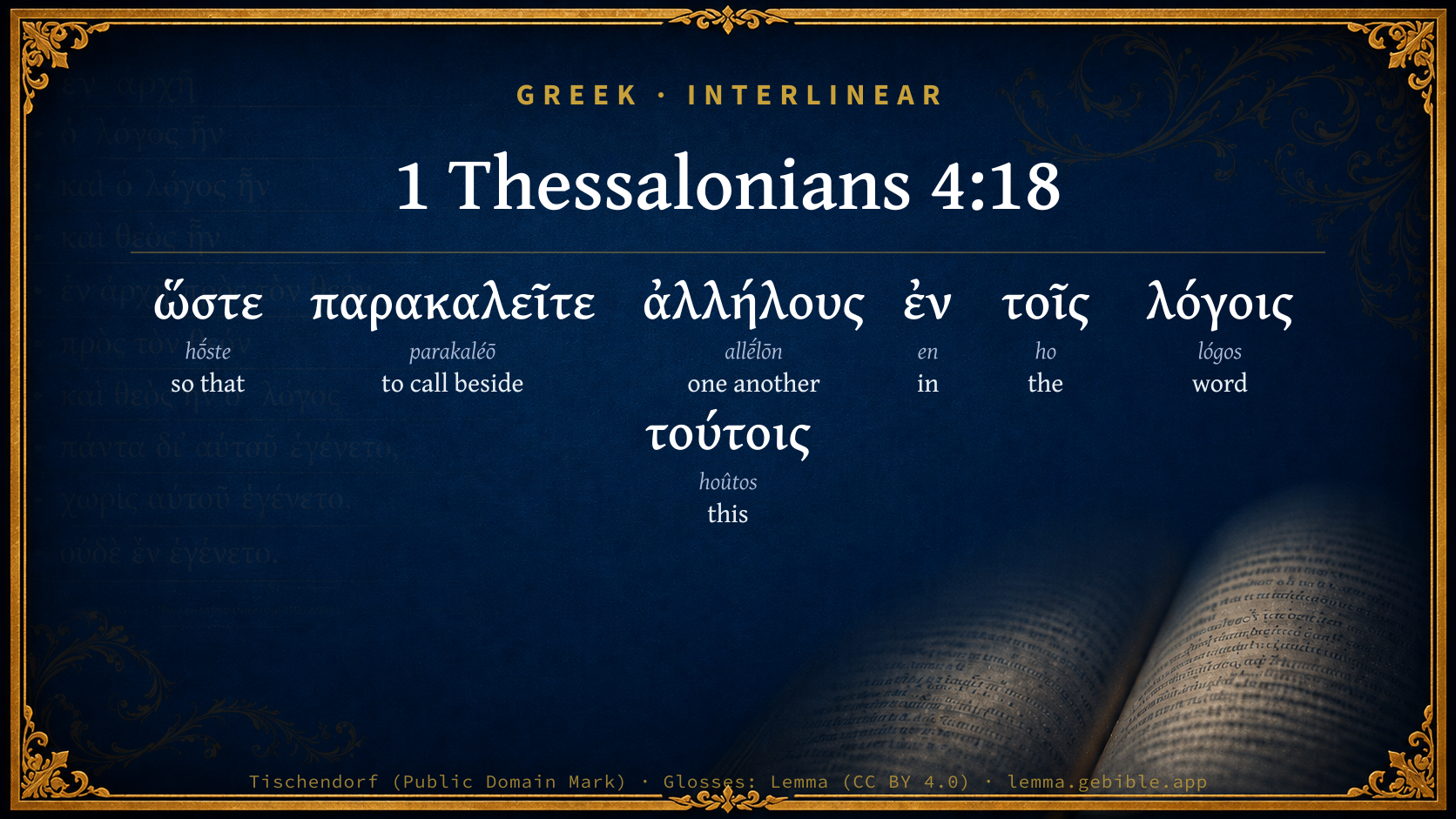
Greek (Tischendorf 8th ed.) 1 Thessalonians 4:18 appears in the Greek New Testament. The text above is from the Tischendorf 8th edition. Each word links to its Strong’s number and a concise gloss. Click any word for its full Thayer’s Greek Lexicon entry.
Download image
Cite this verse

1 Thessalonians 4:18 (World English Bible). Public Domain. Lemma interlinear Bible study tool, https://lemma.gebible.app/v/1-thessalonians/4/18.

Show BibTeX & RIS
BibTeX
RIS
English Translation
Therefore comfort one another with these words.
World English Bible · Public Domain
Download a study sheet

One document with this verse’s original text, its word-by-word gloss line, the meaning frame, cross-references with their text, attributed commentary, and full source and license credits — printable, and it pastes into notes with its structure intact.

This verse Autodidact and up

Study sheet (.html) Plain text (.txt)

A passage Seminary Student

Up to 50 verses in one chapter. A passage sheet keeps up to 6 commentary sources and 12 cross-references per verse, in the order this page ranks them, and says so on the sheet whenever that leaves anything out. Ask for a single verse and you get the Autodidact verse sheet above.

Everything on this page stays free to read, with no account — the sheet is a download of what is already on screen, not access to it.

Want to remove ads? Support Godless Engineer
Compare translations 3

The same verse in 3 English versions, stacked beneath the original-language interlinear above. Click any original word for its lexicon entry.

Each is an independent rendering of the whole verse — the interlinear is not word-aligned to these translations.

Highlighted words mark where these versions differ — a whole-verse word diff, not a word-by-word alignment.

  • World English Bible Public Domain
    Therefore comfort one another with these words.
  • King James Version Public Domain
    Wherefore comfort one another with these words.
  • unfoldingWord Literal Text CC BY-SA 4.0
    Therefore, encourage one another with these words.

unfoldingWord Literal Text — © unfoldingWord, licensed CC BY-SA 4.0. Word-aligned USFM3 via Door43 (git.door43.org/unfoldingWord/en_ult).

Versions to compare (up to 4)

3 of 4 selected

Show all 18 translations

Every available English version of this verse, each an independent rendering of the whole verse.

  • World English Bible Public Domain
    Therefore comfort one another with these words.
  • Berean Standard Bible Public Domain
    Therefore encourage one another with these words.
  • Majority Standard Bible Public Domain
    Therefore encourage one another with these words.
  • King James Version Public Domain
    Wherefore comfort one another with these words.
  • American Standard Version (1901) Public Domain
    Wherefore comfort one another with these words.
  • Revised Version (1885) Public Domain
    Wherefore comfort one another with these words.
  • Geneva Bible (1599) Public Domain
    Wherefore, comfort your selues one another with these wordes.
  • Young's Literal Translation Public Domain
    so, then, comfort ye one another in these words.
  • Literal Standard Version CC BY-SA 4.0
    so, then, comfort one another with these words.
  • Unlocked Literal Bible CC BY-SA 4.0
    Therefore, comfort one another with these words.
  • unfoldingWord Literal Text CC BY-SA 4.0
    Therefore, encourage one another with these words.
  • Darby Bible Public Domain
    So encourage one another with these words.)
  • World Messianic Bible Public Domain
    Therefore comfort one another with these words.
  • Webster's Bible Public Domain
    Wherefore, comfort one another with these words.
  • Free Bible Version CC BY-SA 4.0
    So encourage one another with these words.
  • Bible in Basic English Public Domain
    So then, give comfort to one another with these words.
  • Text-Critical English NT CC BY 4.0
    Therefore encourage one another with these words.
  • Tyndale New Testament (1534) Public Domain
    Wherfore comforte youre selves one another with these wordes

Literal Standard Version (2020), Covenant Press — licensed CC BY-SA 4.0. Text via the HelloAO Bible API (eBible.org). Unlocked Literal Bible (unfoldingWord) — licensed CC BY-SA 4.0. Text via the HelloAO Bible API (eBible.org). unfoldingWord Literal Text — © unfoldingWord, licensed CC BY-SA 4.0. Word-aligned USFM3 via Door43 (git.door43.org/unfoldingWord/en_ult). Free Bible Version, Dr. Jonathan Gallagher — licensed CC BY-SA 4.0. Text via the HelloAO Bible API (eBible.org).

Cross-references

6

Topical passages linked to 1 Thessalonians 4:18 in the Treasury of Scripture Knowledge — connected by theme and wording, ordered by reader-vote popularity; previews shown in the World English Bible.

  • 1 Thessalonians 5:11 Therefore exhort one another, and build each other up, even as you also do.
  • Luke 21:28 But when these things begin to happen, look up, and lift up your heads, because your redemption is near."
  • 1 Thessalonians 5:14 We exhort you, brothers, admonish the disorderly, encourage the fainthearted, support the weak, be patient toward all.
  • Hebrews 10:24–25 Let us consider how to provoke one another to love and good works,
  • Isaiah 40:1–2 Comfort you, comfort you my people, says your God.
  • Hebrews 12:12 Therefore, lift up the hands that hang down and the feeble knees,

Cross-references courtesy of OpenBible.info (CC BY 4.0).

Commentary

Notes on 1 Thessalonians 4:18 from classic Christian and Jewish commentators (each source and its license shown beneath its notes). The classic Christian expositions comment on the surrounding passage and are grouped to its opening verse, so a note may address several verses; the Jewish commentaries on the Tanakh (Rashi and others) are per-verse, so they appear only where the commentator wrote on this verse.

Lemma curates 59 commentaries, every one of them public domain or Creative Commons licensed, each selected and text-cleaned for this edition rather than reprinted as found. About our sources →

Albert Barnes' Notes on the Bible

Wherefore comfort one another - Margin, “exhort.” The word comfort probably best expresses the meaning. They were to bring these glorious truths and these bright prospects be fore their minds, in order to alleviate, the sorrows of bereavement. The topics of consolation are these: first, that those who had died in the faith would not always lie in the grave; second, that when they rose they would not occupy an inferior condition because they were cut off before the coming of the Lord; and third, that all Christians, living and dead, would be received to heaven and dwell forever with the Lord.

With these words - That is, with these truths.

Remarks On 1 Thessalonians 4

1. This passage 1Th 4:13-18 contains a truth which is to be found in no pagan classic writer, and nowhere else. except in the teachings of the New Testament. For the elevated and glorious view which it gives of future scenes pertaining to our world, and for all its inestimable consolations, we are wholly indebted to the Christian religion. Reason, unassisted by revelation, never dared to conjecture that such scenes would occur; if it had, it would have had no arguments on which the conjecture could be supported.

2. The death of the Christian is a calm and gentle slumber; 1Th 4:13. It is not annihilation; it is not the extinction of hope. It is like gentle repose when we lie down at night, and when we hope to awake again in the morning; it is like the quiet, sweet slumber of the infant. Why, then, should the Christian be afraid to die? Is he afraid to close his eyes in slumber? Why dread the night - the stillness of death? Is he afraid of the darkness, the silence, the chilliness of the midnight hour, when his senses are locked in repose? Why should death to him appear so terrible? “Is the slumbering of an infant an object of terror?”

3. There are magnificent scenes before us. There is no description anywhere which is more sublime than that in the close of this chapter. Great events are brought together here, any one of which is more grand than all the pomp of courts, and all the sublimity of battle, and all the grandeur of a triumphal civic procession. The glory of the descending Judge of all mankind; the attending retinue of angels, and of the spirits of the dead; the loud shout of the descending host; the clangor of the archangel’s trumpet; the bursting of graves and the coming forth of the million there entombed; the rapid, sudden, glorious change on the million of living people; the consternation of the wicked; the ascent of the innumerable host to the regions of the air, and the solemn process of the judgment there - what has ever occurred like these events in this world. And how strange it is that the thoughts of people are not turned away from the trifles - the show - the shadow - the glitter - the empty pageantry here - to these bright and glorious realities!

4. In those scenes we shall all be personally interested. If we do not survive until they occur, yet we shall have an important part to act in them. We shall hear the archangel’s trump; we shall be summoned before the descending Judge. In these scenes we shall mingle not as careless spectators, but as those whose eternal doom is there to be determined, and with all the intensity of emotion derived from the fact that the Son of God will descend to judge us, and to pronounce our final doom! Can we be too much concerned to be prepared for the solemnities of that day?

5. We have, in the passage before us, an interesting view of the order in which these great events will occur. There will be:

(1)The descent of the judge with the attending hosts of heaven;

(2)The raising up of the righteous dead;

(3)The change which the living will undergo (compare 1Co 15:52);

(4)The ascent to meet the Lord in the air; and,

(5)The return with him to glory.

What place in this series of wonders will be assigned for the resurrection of the wicked, is not mentioned here. The object of the apostle did not lead him to advert to that, since his purpose was to comfort the afflicted by the assurance that their pious friends would rise again, and would suffer no disadvantage by the fact that they had died before the coming of the Redeemer. From Joh 5:28-29, however, it seems most probable that they will be raised at the same time with the righteous, and will ascend with them to the place of judgment in the air.

6. There is no intimation here of a “personal reign” of Christ upon the earth. Indeed, there is no evidence that he will return to the earth at all. All that appears is, that he will descend “from heaven” to the regions of “the air,” and there will summon the living and the dead to his bar. But there is no intimation that he will set up a visible kingdom then on earth, to continue a thousand or more years; that the Jews will be re-collected in their own land; that a magnificent city or temple will be built there; or that the saints will hover in the air, or reign personally with the Lord Jesus over the nations. There are two considerations in view of this passage, which, to my mind, are conclusive proof that all this is romance - splendid and magnificent indeed as an Arabian tale - but wholly unknown to the apostle Paul. The one is, that if this were to occur, it is inconceivable that there should have been no allusion to it here. It would have been such a magnificent conception of the design of the Second Advent, that it could not have failed to have been adverted to in a description like this. The other consideration is, that such a view would have been exactly in point to meet the object of the apostle here. What could have been more appropriate in comforting the Thessalonian Christians respecting those who had died in the faith, than to describe the gorgeous scenes of the “personal reign” of Christ, and the important part which the risen saints were to play in that great drama? How can it he accounted for that the apostle did not advert to it? Would a believer in the “persocial reign” now be likely to omit so material a point in a description of the scenes which are to occur at the “Second Advent?”

7. The saints will be forever with the Lord. They will dwell with him in his own eternal home; Joh 14:3. This expression comprises the sum of all their anticipated felicity and glory. To be with Christ will be, in itself, the perfection of bliss; for it will be a security that they will sin no more, that they will suffer no more, and that they will be shielded from danger and death. They will have realized the object of their long, fond desire - that of seeing their Saviour; they will have suffered the last pang, encountered the last temptation, and escaped forever from the dominion of death. What a glorious prospect is this! Assuredly we should be willing to endure pain, privation, and contempt here for the brief period of our earthly pilgrimage, if we may come at last to a world of eternal rest. What trifles are all earthly sorrows compared with the glories of an endless life with our God and Saviour!

8. It is possible that even the prospect of the judgment-day should be a source of consolation; 1Th 4:18. To most people it is justly an object of dread - for all that they have to fear is concentrated on the issues of that day. But why should a Christian fear it? In the descending Judge he will hail his Redeemer and friend; and just in proportion as he has true religion here, will be the certainty of his acquittal there. Nay, his feelings in anticipation of the judgment may be more than the mere absence of fear and alarm. It may be to him the source of positive joy. It will be the day of his deliverance from death and the grave. It will confirm to him all his long cherished hopes. It will put the seal of approbation on his life spent in endeavoring to do the will of God. It will reunite him to his dear friends who have died in the Lord. It will admit him to a full and glorious view of that Saviour whom “having not seen he has loved;” and it will make him the-companion of angels and of God. If there is anything, therefore, which ought to cheer and sustain our hearts in the sorrows and bereavements of this life, it is the anticipation of the glorious scenes connected with the Second Advent of our Lord, and the prospect of standing before him clothed in the robes of salvation, surrounded by all those whom we have loved who have died in the faith, and with the innumerable company of the redeemed of all ages and lands.

Albert Barnes' Notes on the Bible (1834–1885) — public domain. Text from a community e-Sword/MySword module.

Tyndale Open Study Notes

Tyndale Open Resources

4:18 The purpose of Paul’s teaching about the end is so believers will encourage each other in the face of death. He is not promoting speculation about the end times.

Tyndale Open Study Notes — © Tyndale Open Resources, licensed CC BY-SA 4.0. Text via the HelloAO Bible API.

Bengel's Gnomon

Johann Albrecht Bengel

1Th 4:18. Παρακαλεῖτε ἀλλήλους, comfort one another) in your grief. Comp. also 1Th 4:11.

Bengel's Gnomon of the New Testament — English translation (T&T Clark, Edinburgh, 1860) — public domain. Text from a community e-Sword module.

Meyer's Critical & Exegetical Commentary

Heinrich August Wilhelm Meyer

1Th_4:18. A concluding exhortation.

παρακαλεῖν] not to exhort (Musculus), but to comfort; comp. ἵνα μὴ λυπῆσθε, 1Th_4:13.

λόγοι] denotes nothing more than words. Erroneously Aretius, Flatt, Pelt, Olshausen, and others: principles or doctrines (of faith). And ἐν τοῖς λόγοις τούτοις denotes on the ground of these or the above words.

Meyer — Critical and Exegetical Commentary on the New Testament — English translation by Peter Christie, edited by Frederick Crombie (T&T Clark, 1880) — public domain. Text from a community e-Sword module.

Expositor's Greek Testament

ed. W. Robertson Nicoll

1Th 4:18 . ἐν τοῖς λόγοις τούτοις . Paul had an intelligible word upon the future, unlike the Hellenic mysteries which usually made religion a matter of feeling rather than of definite teaching (Hardie’s Lect. on Classical Subjects , pp. 53 f.). A pagan letter of consolation has been preserved from the second century ( Oxyrh. Papyri , i. 115): “Eirene to Taonnophris and Philon good cheer! I was as grieved and wept as much over Eumoiros as over Didymas, and I did all that was fitting, as did all my family.… But still we can do nothing in such a case. So comfort yourselves. Goodbye.” One of Cicero’s pathetic letters ( ad. Fam. , xiv. 2), written from Thessalonica, speaks doubtfully of any re-union after death (“haec non sunt in manu nostra”).

The Expositor's Greek Testament, edited by W. Robertson Nicoll (1897–1910) — public domain. Text from a community e-Sword module.

Jamieson, Fausset & Brown

Robert Jamieson, A. R. Fausset & David Brown

comfort one another--in your mourning for the dead (Th1 4:13).

Next: 1 Thessalonians Chapter 5

Jamieson, Fausset & Brown — Commentary Critical and Explanatory on the Whole Bible (1871) — public domain (CC PDM 1.0). Text via the HelloAO Bible API.

Adam Clarke's Commentary

Verse 18. Comfort one another with these words.] Strange saying! comfort a man with the information that he is going to appear before the judgment-seat of God! Who can feel comfort from these words? That man alone with whose spirit the Spirit of God bears witness that his sins are blotted out, and the thoughts of whose heart are purified by the inspiration of Gods Holy Spirit, so that he can perfectly love him, and worthily magnify his name. Reader, thou art not in a safe state unless it be thus with thee, or thou art hungering and thirsting after righteousness. If so, thou shalt be filled; for it is impossible that thou shouldst be taken away in thy sins, while mourning after the salvation of God. They that seek shall find.

Adam Clarke's Commentary on the Bible (1810–1826) — public domain. Text from a community e-Sword/MySword module.

John Calvin's Commentaries

18 Comfort. He now shews more openly what I have previously stated — that in the faith of the resurrection we have good ground of consolation, provided we are members of Christ, and are truly united to him as our Head. At the same time, the Apostle would not have each one to seek for himself assuagement of grief, but also to administer it to others.

John Calvin's Commentaries (1540-1563) — public domain. Text from the Calvin Translation Society English edition (1840s-50s) via the Christian Classics Ethereal Library (ccel.org). Calvin's coverage is partial (roughly two-thirds of the Bible); uncommented books and verses are honest gaps, never fabricated. The 19th-century editor's footnotes and remarks are omitted so the notes are faithfully Calvin's own voice.

Ellicott's Commentary for English Readers

(18) Comfort one another.—Here is a balm for the “sorrow” of 1Th_4:13. Bather, “in these words” than “with;” “Repeat these very words to one another, and you will find the comfort.” What bereaved Christian has not found this true?

A Bible Commentary for English Readers, edited by Charles John Ellicott (1878–1897) — public domain. Text from a community e-Sword module.

The Cambridge Bible for Schools and Colleges

gen. ed. J. J. S. Perowne

18. Wherefore comfort one another with these words] Lit., in these words,—in the revelation just communicated the readers are to find comfort for each other under their recent bereavement, and in all such seasons. Observe how wishful the Apostle is that his flock should minister to each other. Comp. ch. 1Th_5:12; 1Th_5:14, and notes.

Comfort—or encourage: same as the “exhort” of 1Th_4:1; 1Th_4:10; it denotes any kind of animating and cheering address. See notes on “exhortation,” ch. 1Th_2:3, 1Th_3:2.

“Listen! it is no dream: the Apostles’ trump

Gives earnest of the Archangel’s;—calmly now,

Our hearts yet beating high

To that victorious lay,

(Most like a warrior’s, to the martial dirge

Of a true comrade,) in the grave we trust

Our treasure for a while.”

The Cambridge Bible for Schools and Colleges (gen. ed. J. J. S. Perowne; Cambridge University Press, 1878–1918) — public domain. Text from a community e-Sword module.

John Gill's Exposition

Wherefore comfort one another with these words. Or doctrines; as that the saints, when they die, do not cease to be, but are asleep, and asleep in Jesus; that their souls are with him, and their bodies sleep in his arms, and are his care; that these will be as soon with Christ, as the saints that will be alive when he comes; that the coming of Christ will be with great power and glory; that the righteous will rise first in the morning of the resurrection, and before the living saints are changed, and are with Christ; that they will both be taken up together to meet him; and that they shall all be with him, and that for ever, and never part more; than which nothing can yield more true and solid comfort, under all the trials and troubles of this life, under all diseases and distempers of body, under all afflictions and persecutions for Christ's sake, under the loss of near and dear relations, and in a view of death and eternity: some copies read, "with these words of the spirit"; and so the Arabic version, "with these spiritual words": for such they are, being the word of God, as in Th1 4:15.

Next: 1 Thessalonians Chapter 5

John Gill's Exposition of the Whole Bible (1746–1763) — public domain (CC PDM 1.0). Text via the HelloAO Bible API.

Trapp's Complete Commentary

John Trapp

18 Wherefore comfort one another with these words.

Ver. 18. Wherefore comfort, &c.] Scripture comforts come home to the heart, so do not philosophical. Nescio quomodo (saith Cicero of such medicina) morbo est imbecillior. And albeit it is marvellous sweet to meditate (as Mr Knox found it on his deathbed, so that he would have risen and gone into the pulpit to tell others what he had felt in his soul, Melch. Adam. in Vit.), yet there is a special force of strong consolation in Christian communication, which the Lord usually watereth with the dews of divine blessing.

John Trapp, A Commentary or Exposition upon All the Books of the Old and New Testament (1647–1656) — public domain. Text from a community e-Sword module.

Matthew Poole's English Annotations

The apostle makes application of all this discourse to the end he designed, which was to comfort them under their sorrows for departed Christian friends; and he saith not, be ye comforted, but

comfort one another, to put them upon the great duty of Christian sympathy; though this is a duty we owe to all, yet especially to the saints, and more especially of the same particular congregation. And funeral sorrows are usually most afflictive, and therefore need to be allayed with words of comfort; and not with any words, but, saith the apostle,

with these words, or these things, as the Hebrew, the things or words that he had before laid before them. The philosophers used many arguments against the fears of death, and for comfort under funeral sorrows, but Christians should fetch their comforts from the Scriptures. These are the best, most solid, most durable, and universal, and therefore the apostle commends them to the believing Romans, Rom 15:4, as here to these Thessalonians particularly. These considerations, that those which sleep in Jesus shall rise again, and that we shall meet them again, and we and they shall be for ever with the Lord together, are a great relief against the sorrows of their departure hence. And the comforts arising hence may serve to support under other sorrows as well as these, which the apostle also might intend in the words.

Matthew Poole's English Annotations on the Holy Bible (1683–1685) — public domain. Text from a community e-Sword/MySword module.

Whedon's Commentary on the Bible

Daniel D. Whedon

18. Comfort… words—After they had been read unto all, (1Th_5:27,) record them in your memories; and be ready to remind one another of their consoling import.

Daniel D. Whedon (gen. ed.), Commentary on the Old and New Testaments (1874–1909) — public domain. Text from a community e-Sword module.

The Pulpit Commentary

Wherefore comfort one another with these words; on the ground of that Divine revelation which I have made unto you.

The Pulpit Commentary (1880–1919), ed. H.D.M. Spence-Jones & Joseph S. Exell — public domain. Text from a community e-Sword module.

Burkitt's Expository Notes on the New Testament

William Burkitt

That is, draw matter of consolation to yourselves from the foregoing considerations, against the loss of your deceased friends; intimating, that the best and choicest of comforts, for supporting the spirits of men under afflictions in general, and the loss of dear relations in particular, are drawn from the holy scriptures; comfort one another with these words, that is, with such scriptural words as he had now written.

William Burkitt's Expository Notes on the New Testament (1700–1703) — public domain. Text from a community e-Sword module.

McGarvey & Pendleton's Commentaries

J. W. McGarvey

Wherefore comfort one another with these words . [Thus are we commanded to tell all Christians who mourn that they will meet their lost in Christ on the day that Christ appears, and that in sweet union and communion they will ever be with him.]

J. W. McGarvey (with Philip Y. Pendleton), Commentaries on the New Testament (The Fourfold Gospel, 1914; Acts; and the epistles) — public domain. Text from a community e-Sword/MySword module.

The People's New Testament

B. W. Johnson

18. Wherefore, comfort one another. Cheer each other with these assurances. Tell the mourning ones that when they are called to meet the Lord they will find their own sleeping ones in the glorious company.

B. W. Johnson's The People's New Testament with Notes (1889–1891) — public domain. Electronic text from the Christian Classics Ethereal Library (CCEL) ThML edition.

Cambridge Greek Testament for Schools and Colleges

18. Ὥστε παρακαλεῖτε ἀλλήλους ἐν τοῖς λόγοις τούτοις. Therefore cheer one another in these words,—the λόγος κυρίου which 1Th 4:15-17 have communicated, and the other apostolic words accompanying it. Ὥστε with imperative, or cohortative subjunctive, is an idiom St Paul often uses at the point where argument or explanation passes into appeal; cf. 1Co 3:21; 1Co 4:5; 1Co 5:8, &c.: the present imperative enjoins habitual comforting. For παρακαλέω, in its varied uses, see note on 1Th 2:12; here synonymous with παραμυθέομαι, as it stands opposed to λυπεῖσθαι (1Th 4:13). Ἐν τοῖς λόγοις τούτοις, “in (the use of) these words,”—at their public reading in the Church assembly (cf. 1Th 5:27; see note); then, presumably, in the repetition of their teaching by Thessalonians to each other when need occurred. Ἐν is perhaps instrumental (see Ellicott ad loc.)—“with these words”: later Greek tended to prefix ἐν to the bare dative thus. To this message of their Letter the Apostles attach great weight; they expect it to be distinctly remembered and often recalled: cf. 1Th 5:11; 1Th 5:14, and notes.

Cambridge Greek Testament for Schools and Colleges (Cambridge University Press, 1896; 21 vols, various authors incl. Carr, Maclear, Plummer, Farrar, Lumby, Moule, M. R. James, Simcox) — public domain. Text from a community e-Sword module.

Alford’s Greek Testament

Henry Alford

18.] ὥστε, so then: reff.

παρακ., comfort: cf. ἵνα μὴ λυπῆσθε, ver. 13.

λόγοις, not things, here or any where: but words: these words, which I have by inspiration delivered to you.

It will be manifest to the plain, as well as to the scholar-like reader, that attempts like that of Prof. Jowett, to interpret such a passage as this by the rules of mere figurative language, are entirely beside the purpose. The Apostle’s declarations here are made in the practical tone of strict matter of fact, and are given as literal details, to console men’s minds under an existing difficulty. Never was a place where the analogy of symbolical apocalyptic language was less applicable. Either these details must be received by us as matter of practical expectation, or we must set aside the Apostle as one divinely empowered to teach the Church. It is a fair opportunity for an experimentum crucis: and such test cannot be evaded by Prof. Jowett’s intermediate expedient of figurative language.

Henry Alford, The Greek Testament (1849–1861) — public domain. Text from a community e-Sword module.

International Critical Commentary

18. ὥστε παρακαλεῖτε κτλ. “So then,” as the result of the conviction drawn from the religious experience in Christ (v. 14), from the summarised word of the Lord (v. 15), and from the confirmatory description of the Parousia (vv. 16-17), do not grieve (v. 13), but “encourage one another (5:11) with these (τούτοι not τοιούτοι) words,” the very words that have been used.

On ὥστ = διο (5:11) = τοιγαροῦ (4:8) = διὰ τοῦτ (3:7) with imperative, cf. 1Co 10:12, 1Co 11:33, 1Co 14:39, 1Co 15:58, Php 2:12, Php 4:1. Paul does not simply offer encouragement; he bids them actively to encourage one another (cf. 2Co 1:3 ff).—It is obvious that vv. 16-17 do not pretend to give a description in detail of the Parousia. Of the points not mentioned, we may assume that Paul would admit the following: the assembling of the saints; the redemption, change, or transformation of the body (Rom 8:23, 1Co 15:51, Php 3:21); and the judgment on all men (Rom 14:10, 2Co 5:10) without the resurrection of the wicked. On the other hand, since Paul does not elsewhere indicate a belief in the intermediate kingdom (cf. Charles, Eschat. 389 ff.), it is not to be looked for between πρῶτο and ἔπειτ here (cf. Vos, Pauline Eschatology and Chiliasm, in the Princeton Theol. Rev. for Jan. 1911). It is, however, probable that after the meeting of the Lord in the air, the Lord with his saints go not to earth but to heaven, as ἄξει σὺν αὐτῷ (v. 14) suggests, the permanent abode of Christ and the believers. Even in this description of the Parousia it is worth noting that the interest centres in the ultimate form of the hope, εἶναι σὺν χυρίῳ and that only such elements are singled out for mention as serve to bring this religious hope to the forefront. Like the Master, Paul, out of the treasures of apocalyptic at his disposal, knows how to bring forth things new and old.

Grot Hugo de Groot (Grotius).

Ambst Ambrosiaster.

Zim F. Zimmer, Der Text der Thessalonicherbriefe (1893).

P P (a p r). Cod. Porphyrianus, saec. ix, now at St. Petersburg. Edited by Tischendorf (1865). Contains I and II except I 3:5 μηκετι—ημεις οι 4:17.

אԠא (e a p r). Cod. Sinaiticus, saec. iv, now at St. Petersburg. Edited by Tischendorf, its discoverer, in 1862. Photographic reproduction by H. and K. Lake, Oxford, 1911. Contains I and II complete.

A A (e a p r). Cod. Alexandrinus, saec. v, now in the British Museum. Edited by Woide in 1786. Facsimile by E. M. Thompson, 1879. Contains I and II complete.

D D (p). Cod. Claromontanus, saec. vi, Graeco-Latin, now in the National library at Paris. Edited by Tischendorf in 1852. Contains I and II complete.

E E Cod. Sangermanensis, saec. ix, now at St. Petersburg. A copy of D.

G G (p). Cod. Boernerianus, saec. ix, now in the Royal Library at Dresden. “It is closely related to F, according to some the archetype of F” (Souter). Edited by Matthaei, 1791. Im Lichtdruck nachgebildet, Leipzig (Hiersemann), 1909. Contains I and II complete.

F F (p). Cod. Augiensis, saec. ix, Graeco-Latin, now in the Library of Trinity College, Cambridge. An exact transcript by Scrivener, 1859. Contains I and II complete.

K K (a p). Cod. Mosquensis, saec. ix, now at Moscow. Collated by Matthaei, 1782. Contains I and II complete.

L L (a p). Cod. Angelicus, saec. ix, now in the Angelican Library at Rome. Collated among others by Tischendorf (1843) and Tregelles (1845). Contains I and II complete.

WH The New Testament in the Original Greek (1881; I, Text, II, Introduction and Appendix).

Tisch Tischendorf.

Weiss B. Weiss in TU. XIV, 3 (1896).

Dob Ernst von Dobschütz,

B B (e a p r). Cod. Vaticanus, saec. iv, now in the Vatican Library. Photographic reproduction by Cozza-Luzi, Rome, 1889, and by the Milan firm of Hoepli, 1904. Contains I and II complete.

Lft Lightfoot.

Ell Ellicott.

Lillie John Lillie, Epistles of Paul to the Thessalonians, Translated from the Greek, with Notes (1856).

Mill George Milligan.

ZWT Zeitschrift für Wissenschaftliche Theologie.

Witk St. Witkowski, Epistulæ Privatæ Græcæ (1906).

BMT E. D. Burton, Syntax of the Moods and Tenses in N. T. Greek (18983).

Bl F. Blass, Grammatik des neutestamentlichen Griechisch (1896, 19022).

AJT The American Journal of Theology (Chicago).

De De Wette.

Lxx The Old Testament in Greek (ed. H. B. Swete, 1887-94).

SH Comm. on Romans in ICC. by W. Sanday an A. C. Headlam.

Born Bornemann.

Vincent M. R. Vincent, Word Studies in the N. T., vol. IV, 1900.

Wohl Wohlenberg.

ICC International Critical Commentary.

Th. Mops Theodore of Mopsuestia, in epistolas Pauli commentarii (ed. H. B. Swete, 1880-82).

Chrys Chrysostom.

Calv Calvin.

Lün Lünemann.

Moult James Hope Moulton, A Grammar of N. T. Greek, I (1906).

Moff James Moffatt.

GMT W. W. Goodwin, Syntax of the Moods and Tenses of the Greek Verb (1890).

Vulg Vulgate.

I I (p). Cod. Saec. v. Ms. 4 in the Freer Collection at Detroit, Michigan. This manuscript is a “badly decayed fragment, now containing many short portions of the epistles of Paul. It is written on parchment in small uncials and probably belongs to the fifth century. … Originally contained Acts and practically all of the epistles but not Revelation. … While no continuous portion of the text remains, many brief passages from Eph. Phil. Col. Thess. and Heb. can be recovered” (H. A. Sanders, Biblical World, vol. XXI, 1908, 142; cf. also Gregory, Das Freer-Logion, 1908, 24). The fragments of Thess., a collation of which Prof. Sanders kindly sent me, contain I 1:1-2, 9-10 2:7-8, 14-16 3:2-4, 11-13 4:8-9, 16-18 5:9-11, 23-26 II 1:1-3, 10-11 2:5-8, 15-17 3:8-10.

Kennedy, Sources of N. T. Greek (1895).

H H (p). Cod. Saec. vi. Most of the forty-one leaves now known are in the National Library at Paris; the remainder are at Athos, Moscow, St. Petersburg, Kiev, and Turin. The fragments at Kiev contain 2Co 4:2-7, 1Th 2:9-13 (μνημονευετε … εστιν αληθως) and 4:4-11 (εαντον σκενος … φιλοτιμισθαι); cf. H. Omont, Notice sur un très ancien manuscrit, etc. 1889.

am am Vulgate codex Amiatinus (saec. viii).

C C (e a p r). Cod. Ephraemi Rescriptus, saec. v, now in the National Library at Paris. The N. T. fragments were edited by Tischendorf in 1843. Contains I 1:2 ευχαριστουμεν—2:8 εγενηθητε.

EB The Encyclopædia Biblica (London, 1899-1903; ed. J. S. Black and T. K. Cheyne).

Exp The Expositor (London; ed. W. R. Nicoll).

Charles, R. H. Charles, Eschatology, Hebrew, Jewish, and Christian (1899).

Volz, Paul Volz, Jüdische Eschatologie von Daniel bis Akiba (1903).

Kennedy, H. A. A. Kennedy, St. Paul’s Conceptions of the Last Things (1904).

Deiss. A. Deissmann, Light from the Ancient East (1910) = Licht vom Osten (19093).

Ephr Ephraem Syrus.

SK Studien und Kritiken.

HDB Hastings’ Dictionary of the Bible (1898-1904).

Bousset, W. Bousset, Die Religion des Judentums im neutestamentlichen Zeitalter (19062).

fuld fuld Vulgate codex Fuldensis (saec. vi).

m m Citations of the Speculum (edited by Weihrich in the Vienna Corpus, xii, 1887; contains I 2:1-14 1-16 5:6-22 II 1:3-12 3:6-15)

International Critical Commentary — older volumes (1896–1929), various authors — public domain. Text from a community e-Sword module.

Lesson kit

Teaching starters — assembled from the data on this page, not authored interpretation. Every prompt links to the verse data it draws on. Edit before teaching.

1 Thessalonians, in the Pauline Epistles, opens this verse with 7 words (7 distinct Greek lemmas). Its most distinctive word is hṓste (“so that”). A historical commentator’s framing appears above. Read the whole chapter for the surrounding context.

Discussion questions

  1. The word hṓste carries the sense “so that.” How does it shape the verse?
  2. 1 Thessalonians 5:11 shares this passage’s theme. How do the two illuminate each other?
  3. These translations render this verse differently. What is at stake in choosing one wording over another?
  4. Reading how Albert Barnes' Notes on the Bible and Tyndale Open Study Notes read this verse, where do the two commentators agree and where do they part?

Things to notice

Reading settings

Reading text

Shown beneath each verse's original-language words.

Old Testament
Old Testament edition

Read the OT as the Masoretic Hebrew (MT) or the Greek Septuagint (LXX).

English shown for the Greek Septuagint (in the Hebrew ↔ Greek comparison).

Comparing translations? Open the Compare panel on any verse page to stack up to four side by side.