Galatians 4:16

Greek (Tischendorf 8th ed.) Galatians 4:16 appears in the Greek New Testament. The text above is from the Tischendorf 8th edition. Each word links to its Strong’s number and a concise gloss. Click any word for its full Thayer’s Greek Lexicon entry.
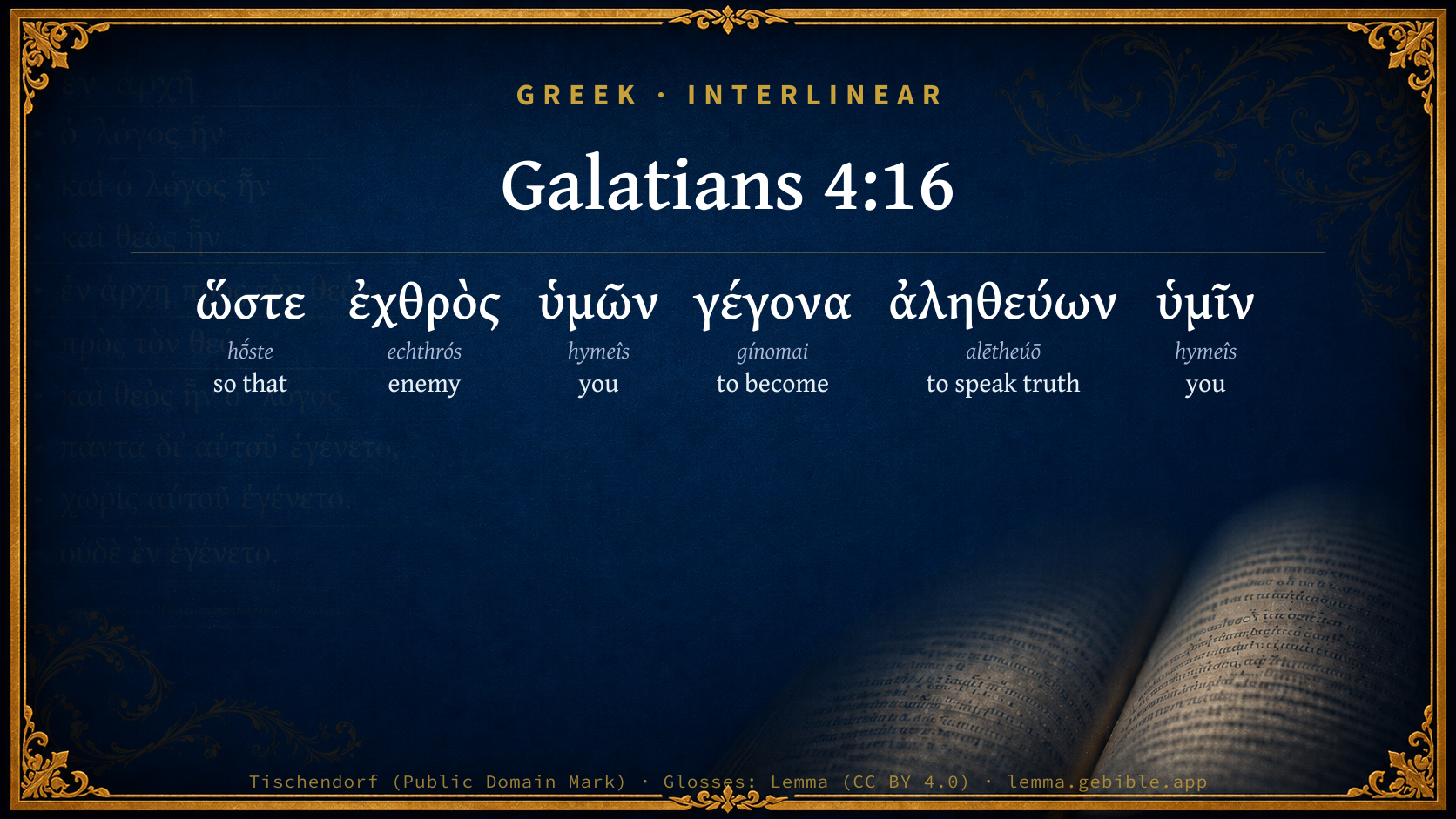
Download image
Cite this verse

Galatians 4:16 (World English Bible). Public Domain. Lemma interlinear Bible study tool, https://lemma.gebible.app/v/galatians/4/16.

Show BibTeX & RIS
BibTeX
RIS
English Translation
So then, have I become your enemy by telling you the truth?
World English Bible · Public Domain
Highlights
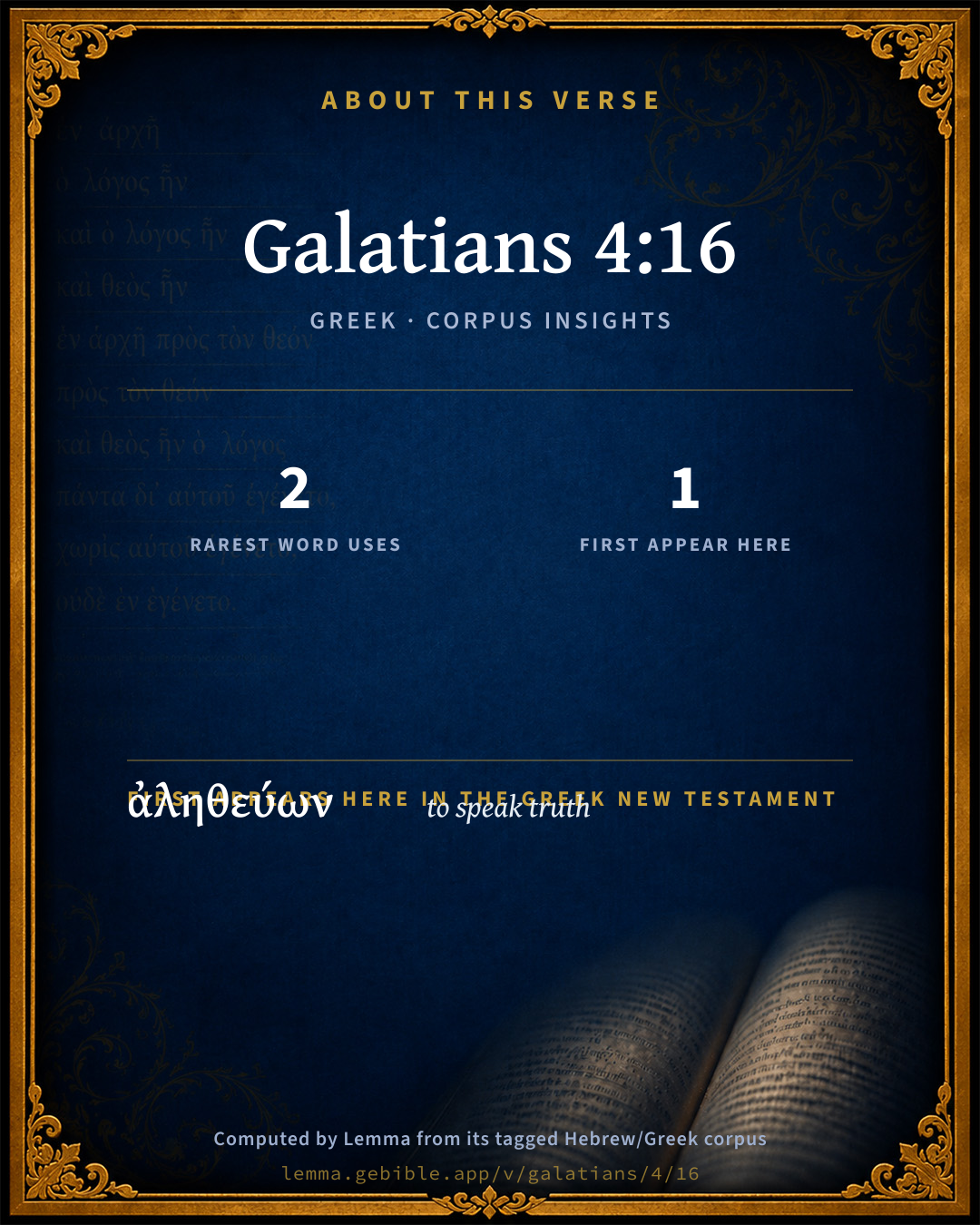
  • 1 first appearance in the Greek New Testament
Full analysis ↓
Download a study sheet

One document with this verse’s original text, its word-by-word gloss line, the meaning frame, cross-references with their text, attributed commentary, and full source and license credits — printable, and it pastes into notes with its structure intact.

This verse Autodidact and up

Study sheet (.html) Plain text (.txt)

A passage Seminary Student

Up to 50 verses in one chapter. A passage sheet keeps up to 6 commentary sources and 12 cross-references per verse, in the order this page ranks them, and says so on the sheet whenever that leaves anything out. Ask for a single verse and you get the Autodidact verse sheet above.

Everything on this page stays free to read, with no account — the sheet is a download of what is already on screen, not access to it.

Want to remove ads? Support Godless Engineer
Compare translations 3

The same verse in 3 English versions, stacked beneath the original-language interlinear above. Click any original word for its lexicon entry.

Each is an independent rendering of the whole verse — the interlinear is not word-aligned to these translations.

Highlighted words mark where these versions differ — a whole-verse word diff, not a word-by-word alignment.

  • World English Bible Public Domain
    So then, have I become your enemy by telling you the truth?
  • King James Version Public Domain
    Am I therefore become your enemy, because I tell you the truth?
  • unfoldingWord Literal Text CC BY-SA 4.0
    So then, speaking truth to you, have I become your enemy?

unfoldingWord Literal Text — © unfoldingWord, licensed CC BY-SA 4.0. Word-aligned USFM3 via Door43 (git.door43.org/unfoldingWord/en_ult).

Versions to compare (up to 4)

3 of 4 selected

Show all 19 translations

Every available English version of this verse, each an independent rendering of the whole verse.

  • World English Bible Public Domain
    So then, have I become your enemy by telling you the truth?
  • Berean Standard Bible Public Domain
    Have I now become your enemy by telling you the truth?
  • Majority Standard Bible Public Domain
    Have I now become your enemy by telling you the truth?
  • King James Version Public Domain
    Am I therefore become your enemy, because I tell you the truth?
  • American Standard Version (1901) Public Domain
    So then am I become your enemy, by telling you the truth?
  • Revised Version (1885) Public Domain
    So then am I become your enemy, because I tell you the truth?
  • Geneva Bible (1599) Public Domain
    Am I therefore become your enemie, because I tell you the trueth?
  • Douay-Rheims (1899) Public Domain
    Am I then become your enemy, because I tell you the truth?
  • Young's Literal Translation Public Domain
    so that your enemy have I become, being true to you?
  • Literal Standard Version CC BY-SA 4.0
    so have I become your enemy, being true to you?
  • Unlocked Literal Bible CC BY-SA 4.0
    So then, have I become your enemy because I am telling you the truth?
  • unfoldingWord Literal Text CC BY-SA 4.0
    So then, speaking truth to you, have I become your enemy?
  • Darby Bible Public Domain
    So I have become your enemy in speaking the truth to you?
  • World Messianic Bible Public Domain
    So then, have I become your enemy by telling you the truth?
  • Webster's Bible Public Domain
    Am I therefore become your enemy because I tell you the truth?
  • Free Bible Version CC BY-SA 4.0
    So what has happened—have I become your enemy by telling you the truth?
  • Bible in Basic English Public Domain
    So then am I no longer your friend, because I give you true words?
  • Text-Critical English NT CC BY 4.0
    Have I now become your enemy by telling you the truth?
  • Tyndale New Testament (1534) Public Domain
    Am I therfore become youre enemie because I tell you the truth?

Literal Standard Version (2020), Covenant Press — licensed CC BY-SA 4.0. Text via the HelloAO Bible API (eBible.org). Unlocked Literal Bible (unfoldingWord) — licensed CC BY-SA 4.0. Text via the HelloAO Bible API (eBible.org). unfoldingWord Literal Text — © unfoldingWord, licensed CC BY-SA 4.0. Word-aligned USFM3 via Door43 (git.door43.org/unfoldingWord/en_ult). Free Bible Version, Dr. Jonathan Gallagher — licensed CC BY-SA 4.0. Text via the HelloAO Bible API (eBible.org).

Word by word

More ways to search: Search by grammar → Find every occurrence → Compare this word →

Practice this passage: Drill this verse → Learn its vocabulary →

About this verse

These counts appear in no published source. They are computed here, from the morphology-tagged text and Lemma’s own curated glosses. What Lemma adds →

6
words
5
distinct lemmas
Pauline Epistles
section

Notable vocabulary

The rarest word here is ἀληθεύων to speak truth G226 — appearing just 2 times in the whole Greek New Testament.

First appearance in Scripture

This word makes its first canonical appearance in the Greek New Testament here:

  • ἀληθεύων to speak truth G226

Shared distinctive vocabulary

ἀληθεύων to speak truth G226 occurs in 2 verses of the Greek New Testament. Also found in:

Repetition

A word recurs within this verse:

  • ὑμῶν you G5210 ×2

Cross-references

15

Topical passages linked to Galatians 4:16 in the Treasury of Scripture Knowledge — connected by theme and wording, ordered by reader-vote popularity; previews shown in the World English Bible.

  • Amos 5:10 They hate him who reproves in the gate, And they abhor him who speaks blamelessly.
  • Proverbs 9:8 Don't reprove a scoffer, lest he hate you. Reprove a wise man, and he will love you.
  • John 8:45 But because I tell the truth, you don't believe me.
  • Galatians 5:7 You were running well! Who interfered with you that you should not obey the truth?
  • Psalms 141:5 Let the righteous strike me, it is kindness; Let him reprove me, it is like oil on the head; Don't let my head refuse it; Yet my prayer is always against evil deeds.
  • 1 Kings 22:8 The king of Israel said to Jehoshaphat, there is yet one man by whom we may inquire of Yahweh, Micaiah the son of Imlah: but I hate him; for he does not prophesy good concerning me, but evil. Jehoshaphat said, "Don't let the king say so."
  • John 7:7 The world can't hate you, but it hates me, because I testify about it, that its works are evil.
  • Galatians 2:5 to whom we gave no place in the way of subjection, not for an hour, that the truth of the Gospel might continue with you.
  • 1 Kings 18:17–18 It happened, when Ahab saw Elijah, that Ahab said to him, Is it you, you troubler of Israel?
  • 1 Kings 21:20 Ahab said to Elijah, Have you found me, my enemy? He answered, I have found you, because you have sold yourself to do that which is evil in the sight of Yahweh.
  • 2 Chronicles 24:20–22 The Spirit of God came on Zechariah the son of Jehoiada the priest; and he stood above the people, and said to them, Thus says God, Why disobey you the commandments of Yahweh, so that you can't prosper? because you have forsaken Yahweh, he has also forsaken you.
  • 2 Chronicles 25:16 It happened, as he talked with him, that [the king] said to him, Have we made you of the king's counsel? Stop! Why should you be struck down? Then the prophet stopped, and said, I know that God has determined to destroy you, because you have done this, and have not listened to my counsel.
  • Galatians 2:14 But when I saw that they didn't walk uprightly according to the truth of the Gospel, I said to Peter before them all, "If you, being a Jew, live as the Gentiles do, and not as the Jews do, why do you compel the Gentiles to live as the Jews do?
  • Galatians 3:1–4 Foolish Galatians, who has bewitched you not to obey the truth, before whose eyes Jesus Christ was openly set forth among you as crucified?
  • 1 Kings 22:27 and say, Thus says the king, Put this fellow in the prison, and feed him with bread of affliction and with water of affliction, until I come in peace.

Cross-references courtesy of OpenBible.info (CC BY 4.0).

Commentary

Notes on Galatians 4:16 from classic Christian and Jewish commentators (each source and its license shown beneath its notes). The classic Christian expositions comment on the surrounding passage and are grouped to its opening verse, so a note may address several verses; the Jewish commentaries on the Tanakh (Rashi and others) are per-verse, so they appear only where the commentator wrote on this verse.

Lemma curates 59 commentaries, every one of them public domain or Creative Commons licensed, each selected and text-cleaned for this edition rather than reprinted as found. About our sources →

Tyndale Open Study Notes

Tyndale Open Resources

4:16 The contrast couldn’t be greater between the Galatians’ acceptance of Paul and his message at the beginning of their Christian life, and their current suspicion or even rejection of him.

Tyndale Open Study Notes — © Tyndale Open Resources, licensed CC BY-SA 4.0. Text via the HelloAO Bible API.

Bengel's Gnomon

Johann Albrecht Bengel

Gal 4:16. Ἐχθρὸς, an enemy) He, who speaks the truth, is a friend, and truth ought not to produce hatred against him in your minds.—ἀληθεύων, speaking the truth) preaching the pure [unmixed] truth, even apart from my former temptation.

Bengel's Gnomon of the New Testament — English translation (T&T Clark, Edinburgh, 1860) — public domain. Text from a community e-Sword module.

Meyer's Critical & Exegetical Commentary

Heinrich August Wilhelm Meyer

Gal_4:16. Ὥστε] Accordingly; the actual state of things which, to judge from the cooling downwhich that painful question (τίς οὖν ὁ μακαρισμὸς ὑμῶν;) bewailsin the self-sacrificing love depicted in Gal_4:14-15, must have superseded this love, and must now subsist.[198] The words contain a profoundly melancholy exclamation: Accordingly, that is my position; I am become your enemy! etc. So great a change has the relation, previously so rich and happy in confidence and love, experienced by the fact that it is my business to speak the truth to you (mark the present participle ἀληθεύων). This conduct which I pursue towards you, instead of confirming your inclination towards me and confidence in me, has taken them away; I have become your enemy! To place (with Matthias) a note of interrogation after γέγονα, and then to take ἈΛΗΘ. ὙΜῖΝ as an exclamation (an enemy, who tells you the truth!), breaks up the passage without adequate ground. Utterly groundless, illogical, and unprecedented (for the ὥστε of an inferential sentence always follows the sentence which governs it) is the inversion forced upon the apostle by Hofmann, who makes out that ὭΣΤΕ Κ.Τ.Λ. is dependent on ΖΗΛΟῦΣΙΝ ὙΜᾶς: so that I am now your enemy, if I tell you truth, they court you; it is the result of these courtings, that, when the apostle agreeably to the truth tells his converts (as in Gal_1:8 f.) what is to be thought about the teaching of his opponents (?), he thereby comes to stand as their enemy. In this interpretation the special reference of ἀληθεύων ὑμῖν is purely gratuitous. To explain the ὭΣΤΕ consecutivum with the indicative the simple rule is quite sufficient, that it is used de re facta; and the emphasis of the relation which it introduces lies in its betokening the quality of the preceding, to which the consecutivum refers. Comp. Ellendt, Lex. Soph. II. p. 1012: Rem qualis sit, addita rei consequentis significatione definit. Hofmann increases the arbitrary character of his artificial exposition by subsequently, in Gal_4:17, separating οὐ καλῶς from ΖΗΛΟῦΣΙΝ ὙΜᾶς, and looking upon these words as an opinion placed alongside of ὭΣΤΕ ἘΧΘΡ. ὙΜ. ΓΈΓ., respecting this mode of courting. His interpretation thus presents at once a violent combination and a violent separation.

ἘΧΘΡῸς ὙΜῶΝ] The context permits either the passive sense: hated by you (de Wette, Windischmann, and older expositors), or the active: your enemy (Vulgate, Beza, Grotius, and many others; also Rückert, Matthies, Schott, Hilgenfeld, Ewald, Hofmann); the latter, however, so taken that ἐχθρ. ὑμῶν γέγονα is said in accordance with the (altered) opinion of the readers. This active interpretation is to be preferred, because the usage among Greek authors (and throughout in the N.T. also) in respect to the substantive ἐχθρός with the genitive is decisive in its favour (Dem. 439. 19. 1121. 12; Xen. Anab. iii. 2. 5, de venat. 13. 12; Soph. Aj. 554). From the time of Homer, ἐχθρός means hated only with the dative (Xen. Cyrop. v. 4. 50; Dem. 241. 12. 245. 16; Lucian, Sacrif. 1; Herodian. iii. 10. 6), which either stands beside it or is to be mentally supplied (Rom_5:10; Rom_11:28; Col_1:21).

γέγονα] To what time does this change (having become), which by the perfect is marked as continuing, refer? It did not occur in consequence of the present epistle (Jerome, Luther, Koppe, Flatt, and others), for the Galatians had not as yet read it; nor at the first visit, for he had then experienced nothing but abundant love. It must therefore have taken place at the second visit (Act_18:23), when Paul found the Galatian churches already inclined to Judaism, and in conformity with the truth could no longer praise them (for only ἐπαινέτης τοῦ δικαίου ἀληθεύει, Plat. Pol. ix. p. 589 C), but was compelled to blame their aberrations.

ἀληθεύων ὑμῖν] For veritas odium parit (Terent. Andr. i. 1. 40), and ὀργίζονται ἅπαντες τοῖς μετὰ παῤῥησίας τʼ ἀληθῆ λέγουσι (Lucian, Abdic. 7). As to ἀληθεύειν, to speak the truth, see on Eph_4:15.

[198] ὥστε cannot specify a reason, as Wieseler thinks, who, anticipating ver. 17, explains: For no other reason than because ye pronounced yourselves so happy on my account, am I (according to the representation of the false teachers) become your enemy, etc. Wieseler therefore takes ὥστε, as if it had been διὰ τοῦτο.

Meyer — Critical and Exegetical Commentary on the New Testament — English translation by Peter Christie, edited by Frederick Crombie (T&T Clark, 1880) — public domain. Text from a community e-Sword module.

Expositor's Greek Testament

ed. W. Robertson Nicoll

Gal 4:16 . ὥστε is often used in the sense of therefore to introduce an imperative or an affirmative conclusion in the Epistles of Paul, but not an interrogation. I can see no reason here for making the clause interrogative: the rendering I am therefore become an enemy to you is quite in harmony with the context, which assumes the existence of some actual estrangement. This estrangement is attributed to plain speaking which had given offence to the disciples. As he had seen no trace of coldness at the time of his recent visit, he must be referring to some language which he had used on that occasion. Circumstances forced him to take up strong ground at that time on the subject of circumcision and to denounce the opposition and intrigues which he had encountered from the Pharisaic party.

The Expositor's Greek Testament, edited by W. Robertson Nicoll (1897–1910) — public domain. Text from a community e-Sword module.

Jamieson, Fausset & Brown

Robert Jamieson, A. R. Fausset & David Brown

Translate, "Am I then become your enemy (an enemy in your eyes) by telling you the truth" (Gal 2:5, Gal 2:14)? He plainly did not incur their enmity at his first visit, and the words here imply that he had since then, and before his now writing, incurred it: so that the occasion of his telling them the unwelcome truth, must have been at his second visit (Act 18:23, see my Introduction). The fool and sinner hate a reprover. The righteous love faithful reproof (Psa 141:5; Pro 9:8).

Jamieson, Fausset & Brown — Commentary Critical and Explanatory on the Whole Bible (1871) — public domain (CC PDM 1.0). Text via the HelloAO Bible API.

Adam Clarke's Commentary

Verse 16. Am I therefore become your enemy] How is it that you are so much altered towards me, that you now treat me as an enemy, who formerly loved me with the most fervent affection? Is it because I tell you the truth; that very truth for which you at first so ardently loved me?

Adam Clarke's Commentary on the Bible (1810–1826) — public domain. Text from a community e-Sword/MySword module.

John Calvin's Commentaries

16. Am I therefore become your enemy? He now returns to speak about himself. It was entirely their own fault, he says, that they had changed their minds. Though it is a common remark, that truth begets hatred, yet, except through the malice and wickedness of those who cannot endure to hear it, truth is never hateful. While he vindicates himself from any blame in the unhappy difference between them, he indirectly censures their ingratitude. Yet still his advice is friendly, not to reject, on rash or light grounds, the apostleship of one whom they had formerly considered to be worthy of their warmest love. What can be more unbecoming than that the hatred of truth should change enemies into friends? His aim then is, not so much to upbraid, as to move them to repentance.

John Calvin's Commentaries (1540-1563) — public domain. Text from the Calvin Translation Society English edition (1840s-50s) via the Christian Classics Ethereal Library (ccel.org). Calvin's coverage is partial (roughly two-thirds of the Bible); uncommented books and verses are honest gaps, never fabricated. The 19th-century editor's footnotes and remarks are omitted so the notes are faithfully Calvin's own voice.

Ellicott's Commentary for English Readers

(16) Your enemy.—“The enemy” was the name by which St. Paul was commonly referred to by the party hostile to him in the next century. It is quite possible that the phrase “your enemy” ought to be placed, as it wore, in inverted commas, and attributed to the Judaising sectaries—”your enemy,” as these false teachers call me.

Because I tell you the truth.—It would seem that something had happened upon St. Paul’s second visit to Galatia (the visit recorded in Act_18:23) which had caused a change in their feelings towards him. His plain speaking had given offence.

A Bible Commentary for English Readers, edited by Charles John Ellicott (1878–1897) — public domain. Text from a community e-Sword module.

The Cambridge Bible for Schools and Colleges

gen. ed. J. J. S. Perowne

16. Am I therefore] ‘So that I am become … truth?’ The tone of the sentence is interrogative, rather than the form.

I tell you the truth] The reference is probably to the second visit to Galatia, when the Judaizers had begun to sow seeds of error and discord among St Paul’s converts. He says ‘I tell’, not ‘I told’, because he has made no change in his teaching. Truth is ever one and the same.

The Cambridge Bible for Schools and Colleges (gen. ed. J. J. S. Perowne; Cambridge University Press, 1878–1918) — public domain. Text from a community e-Sword module.

John Gill's Exposition

They zealously affect you,.... Or "are jealous of you"; meaning the false apostles, whose names, in contempt, he mentions not, being unworthy to be taken notice of, and their names to be transmitted to posterity. These were jealous of them, not with a godly jealousy, as the apostle was, lest their minds should be corrupted from the simplicity of the Gospel; but they were jealous, lest they should love the apostle more than they, and therefore represented him in a very bad light, and expressed great love and kindness for them themselves:

but not well; their zeal and affection were not hearty, and sincere, and without dissimulation, but were all feigned, were only in word and in tongue, not in deed, and in truth: this zealous affection neither proceeded from right principles, nor with right views; they sought themselves, and their own carnal worldly interest, their own pleasure and profit, and not the good and welfare of the souls of these Galatians:

yea, they would exclude you; that is, either from the apostle, from bearing any love unto, and having any respect for him. What they were wishing and seeking for was to draw off the minds and affections of these persons from him; or they were desirous of removing them from the Gospel of Christ unto another Gospel, and did all they could to hinder them from obeying the truth; and particularly were for shutting them out of their Christian liberty, and bringing them under the bondage of the law; yea, were for separating them from the churches, that they might set up themselves at the head of them. Some copies read "us", instead of "you"; and then the meaning is, that they were desirous of excluding the apostle from their company, and from having any share in their affections, which makes little alteration in the sense: and others, instead of "exclude", read "include"; and which is confirmed by the Syriac version, which renders the word "but they would include you"; that is, either they would include, or imprison you under the law, and the bondage of it; or they would monopolize you, and engross all your love to themselves; and which is also the sense of the Arabic version:

that you might affect them; love them, show respect to them, be on their side, follow their directions, imbibe their doctrines, and give up yourselves wholly to their care, and be at their call and command.

John Gill's Exposition of the Whole Bible (1746–1763) — public domain (CC PDM 1.0). Text via the HelloAO Bible API.

Trapp's Complete Commentary

John Trapp

16 Am I therefore become your enemy, because I tell you the truth?

Ver. 16. Am I therefore become, &c.] Truth breeds hatred, as the fair nymphs did the ugly fauns {a} and satyrs. The hearing of truth galls, as they write of some creatures, that they have fel in aure, gall in their ears. It was not for nothing therefore that the orator called upon his countrymen to get their ears healed before they came any more to hear him. To preach, saith Luther, is nothing else but to derive upon a man’s self the rage of all the country. And therefore when one defined the ministerial function to be Artem artium et scientiam scientiarum, the art of arts and science of sciences, Melancthon said, If he had defined it to be miseriam miseriatom, the misery of miseries, he had hit it.

Because I tell you the truth?] He that prizeth truth (saith Sir Walter Raleigh) shall never prosper by the possession or profession thereof. An expectus, ut Quintilianus ametur? When we seek to fetch men out of their sins, they are apt to fret and snarl; like men when wakened out of their sleep, they are unquiet, ready to brawl with their best friend.

{a} One of a class of rural deities; at first represented like men with horns and the tail of a goat, afterwards with goats’ legs like the Satyrs, to whom they were assimilated in lustful character. ŒD

John Trapp, A Commentary or Exposition upon All the Books of the Old and New Testament (1647–1656) — public domain. Text from a community e-Sword module.

Albert Barnes' Notes on the Bible

Am I therefore become your enemy ... - Is my telling you the truth in regard to the tendency of the doctrines which you have embraced, and the character of those who have led you astray, and your own error, a proof that I have ceased to be your friend? How apt are we to feel that the man who tells us of our faults is our enemy! How apt are we to treat him coldly, and to “cut his acquaintance,” and to regard him with dislike! The reason is, he gives us pain; and we cannot have pain given to us, even by the stone against which we stumble, or by any of the brute creation, without momentary indignation, or regarding them for a time as our enemies. Besides, we do not like to have another person acquainted with our faults and our follies; and we naturally avoid the society of those who are thus acquainted with us. Such is human nature; and it requires no little grace for us to overcome this. and to regard the man who tells us of our faults, or the faults of our families, as our friend.

We love to be flattered, and to have our friends flattered; and we shrink with pain from any exposure, or any necessity for repentance. Hence, we become alienated from him who is faithful in reproving us for our faults. Hence, people become offended with their ministers when they reprove them for their sins. Hence, they become offended at the truth. Hence, they resist the influences of the Holy Spirit, whose office it is to bring the truth to the heart, and to reprove men for their sins. There is nothing more difficult than to regard with steady and unwavering affection the man who faithfully tells us the truth at all times, when that truth is painful. Yet he is our best friend. “Faithful are the wounds of a friend, but the kisses of an enemy are deceitful,” Pro 27:6. If I am in danger of falling down a precipice, he shows to me the purest friendship who tells me of it; if I am in danger of breathing the air of the pestilence, and it can be avoided, he shows to me pure kindness who tells me of it. So still more, if I am indulging in a course of conduct that may ruin me, or cherishing error that may endanger my salvation, he shows me the purest friendship who is most faithful in warning me, and apprising me of what must be the termination of my course.

Albert Barnes' Notes on the Bible (1834–1885) — public domain. Text from a community e-Sword/MySword module.

Matthew Poole's English Annotations

What hath now altered your mind, or made you have a worse opinion of me? Wherein have I offended you or done you any harm? I have done nothing but revealed to you the truth of God; am I therefore become your enemy? Or do you account me your enemy on that account?

Matthew Poole's English Annotations on the Holy Bible (1683–1685) — public domain. Text from a community e-Sword/MySword module.

Whedon's Commentary on the Bible

Daniel D. Whedon

16. Therefore… enemy—Is it inferable from the immense change on your part?

The truth—For telling them the truth is he who was once their angel now their enemy? The change was neither in the truth nor its apostle, but in themselves. So is it with backsliders and apostates; the truth and its minister they once loved they often now dread and hate.

When was it that he so spoke the truth as to incur this enmity? Not at his first visit, commentators reply, for then he was as an angel to them. Nor in this letter, for they have not as yet read it. Therefore, at his second visit.

Act_18:23, it is said. Nevertheless he told them no new truth at that second visit. The very reason why he is now deemed their enemy is, because he is the fixed representative of the same unchanging truth, at his first visit, his second, and in this epistle.

Daniel D. Whedon (gen. ed.), Commentary on the Old and New Testaments (1874–1909) — public domain. Text from a community e-Sword module.

The Pulpit Commentary

Am I therefore become your enemy, because I tell you the truth? wste ejcqrogona ajlhqeuwn uJmin; so then, am I become your enemy, because I deal with you according to truth? This is a wailing remonstrance against an apprehended incipient state of alienation. "So then," wste (see note on ver. 7), occurs repeatedly before an imperative; as 1Co_3:21 1Co_4:5 1Co_10:12; Php_2:12 4:1; Jam_1:19; here only before a question. Its consecutive import here lies in the essential identification between their attachment to St. Paul and their allegiance to the pure gospel. If they forsook the gospel, their heart was gone from him. Naturally also their incipient defection from tile truth was accompanied by a jealousy on their part hew he would regard them, and by a preparedness to listen to those who spoke of him, as Judaizers everywhere did, with disparagement and dislike. No doubt the accounts which had just reached him of the symptoms showing themselves among them of defection from the gospel, and which prompted the immediate despatch of this Epistle, had informed him also of symptoms of a commencing aversation from himself. The construction of gegona with ajlhqeuwn is similar to that of gegona afrwn with kaucwmenov in the Textus Receptus of menov 2Co_12:11, which is perfectly good Greek, even though the word kaucw) must be removed from the text as not genuine. The verb "I am become" describes the now produced result of the action expressed by the participle ajlhqeuwn, "dealing according to truth an action which has been continuous to the present hour and is still going on. If the apostle were referring only to something which had taken place at his second visit, he would have probably used different tenses; either, perhaps, ejcqromhn ajlhqeuwn compare fanh... katergazomenh insav); Rom_7:13 (or with a contemporaneous aorist participle, ajlhqeu) or, ejcqrogona ajlhqeusav, like einai moicalida genomenhn ajndrirw inqeuwn Rom_7:3. As it stands, dealing with you according to truth" (ajlh uJmin) expresses the apostle"s continuous declaration of the gospel, and his never-flinching insstance upon the mortal danger of defection from it (seekamen); Gal_1:9, proeirh and "I am become your enemy" points to the result now manifesting itself from this steadfast attitude of his, in consequence of their consciousness of meriting his disapproval. The verb ajlhqeuw occurs only once in the Septuagint inete Gen_42:16, Eij ajlhqeu h ouj, "Whether there be any truth in you" (Authorized Version and Hebrew); and once besides in the New Testament inontev Eph_4:15, jAlhqeu ejn ajgaph, where the verb denotes, apparently, not merely being truthful in speech, but the whole habit of addiction both to uprightness and to God"s known truth; for we can hardly leave out of our view this latter idea, when we consider how frequently the apostle designates the gospel by the term "the truth". (2Co_4:2 2Co_6:7; Gal_3:1; Eph_1:13; 2Th_2:10, 2Th_2:12; 1Ti_2:4) "Enemy" is either one regarded as adopting a hostile position to them, or one viewed with hostile feeling by them, which latter is its sense in Rom_11:28; 2Th_3:15. The above exposition of the import of this verse is confirmed by the consideration that the Epistle affords no trace of the apostle"s relations with the Galatian converts having been other than mutually friendly at even his second visit to them. This fact is implied in ver. 12, and Gal_1:9 furnishes no evidence to the contrary; for those warnings may havebeen uttered in his first visit as well as in his second, without occasioning or being occasioned by any want of mutual confidence. This view of their mutual relations is confirmed likewise by the feelings of indignant astonishment with which evidently the apostle took up his pen to address them in this letter: the tidings which had just reached him had been a painful surprise to him.

A friend mistaken for an enemy.

On his first visit to Galatia, St. Paul was received, so he tells us, "as an angel of God, even as Christ Jesus." He paid, it appears, a second visit to the province, and then the fickle people treated him with coldness and suspicion because he found it necessary to point out their faults and the danger of them, as though he had become their enemy solely because he told them the truth. This narrow and unfair conduct of the Galatians is only too common to human nature. The causes of it are worth examining, and the evil of it being detected as a warning against a repetition of the same egregious blunder.

I IT IS SOMETIMES THE DUTY OF THE PREACHER TO TELL UNPLEASANT TRUTHS. It is a mistake to suppose that because he has a gospel to declare he must let only honied phrases fall from his lips. Jeremiah set up the prophesying of smooth things as the one sure test of a false prophet. (Jer_28:8, Jer_28:9) John the Baptist prepared for the gospel by denouncing the sins of his fellow-countrymen. Christ uttered some of the most terrible words ever spoken. (e.g. Mat_23:33) The Church has been too much pampered with comforting words. We need more preaching to the conscience.

1. There are unpleasant truths. Nature is not all roses and lilies; nettles and vipers exist. The page of history is blotted with tears and blood. There are many ugly facts in our own past experience.

2. The great ground on which the preacher is required to utter unpleasanttruths is that we are all sinners. The doctor who describes the eases in a hospital must say much about terrible diseases.

3. The purpose for which it is necessary to utter painful truths is to lead to repentance. It is not done merely to give pain nor to drive to despair. The lightning flash reveals the precipice that the unwary traveller may start back from destruction. Until we know ourselves to be in the wrong way we shall not turn to a better.

II THE PREACHER OF UNPLEASANT TRUTHS MUST EXPECT TO BE TREATED AS AN ENEMY BY THE VERY MEN HE IS TRYING TO HELP. This has been the case all the world over with the prophets of Israel, John the Baptist, the apostles, reformers in every age, and, above all, Christ himself, who was crucified simply because he told truths that stung the Jews to madness. The noblest heroes of the "noble army of martyrs" suffered on this account. It is well to understand and be ready for such treatment even in the milder form which it generally assumes in our own day. it can be explained, though of course it cannot be justified. It may be traced to the following causes:

1. The influences of association. The messenger of ill tidings is hated for his message. Milton calls the bird that foretells "a hapless doom" "a rude bird of hate.

2. Misinterpretation. It is assumed that the preacher wishes trouble because he predicts it, that he has pleasure in humiliating us by revealing our faults.

3. A corrupt conscience. Men often refuse to admit unpleasant truths about themselves, treat them as libels and the preachers of them as libellers of the race.

III IT IS A GREAT BLUNDER TO TREAT THE PREACHER OF UNPLEASANT TRUTHS AS AN ENEMY.

1. It is foolish. Truth is not the less true because we are blind to it. The revelation of its existence is not the creation of it.

2. It is unjust. The faithful servant of Christ, like his Master, will wish nothing but good to those whose guilt he denounces. He is the enemy of the sin just because he is the Friend of the sinner.

3. It is ungenerous. It is always a thankless task to tell unpleasant truths. For a man of kindly disposition it is a most painful task. Be undertakes it for the good of his friends. It would have been much more pleasant for St. Paul to have retained his popularity at the expense of the Church"s welfare. He is an ungrateful patient who treats as an enemy the surgeon who hurts only that he may heal. W.F.A.

The Pulpit Commentary (1880–1919), ed. H.D.M. Spence-Jones & Joseph S. Exell — public domain. Text from a community e-Sword module.

Luther on Galatians

Martin Luther

VERSE 16. Am I therefore become your enemy, because I tell you the truth?

Paul’s reason for praising the Galatians is to avoid giving them the impression as if he were their enemy because he had reprimanded them.

A true friend will admonish his erring brother, and if the erring brother has any sense at all he will thank his friend. In the world truth produces hatred. Whoever speaks the truth is counted an enemy. But among friends it is not so, much less among Christians. The Apostle wants his Galatians to know that just because he had told them the truth they are not to think that he dislikes them. "I told you the truth because I love you."

Martin Luther — Commentary on the Epistle to the Galatians (1535), English translation by Theodore Graebner (Zondervan, 1939) — public domain (U.S. copyright not renewed). Text from a community e-Sword module.

Burkitt's Expository Notes on the New Testament

William Burkitt

As if the apostle had said, "How comes your affections, which were so warm at first, to be so cold now? Whence is it that I, who was formerly so precious in your esteem, am now looked upon as an enemy, and only because I declare the truth of God unto you? Can any reason be given on my part, for the sudden change of affection on your part? I trow not, unless you count my candour and ingenuity in telling the truth, a crime: Am I become your enemy, because I tell you the truth?"

Learn hence, that notwithstanding the faithful ministers of Christ, in reproving sin, and vindicating the truths of God, are sometimes counted and treated as enemies, yet will they persist, and finally persevere in their duty, whatever the event may be; though the world account them their enemy, yet they will tell them the truth.

William Burkitt's Expository Notes on the New Testament (1700–1703) — public domain. Text from a community e-Sword module.

McGarvey & Pendleton's Commentaries

J. W. McGarvey

So then am I become your enemy, by telling you the truth? [I beseech you, brethren, become as I am, and be not Jews; for I forsook Judaism and became simply a Christian, which made me, in the eyes of my brethren, a Gentile like you. Though I have spoken severely to you, it is for no personal reasons. Ye have done me no wrong. On the contrary, your actions have been very gracious, for you will remember (and here the apostle refers to facts that are nowhere recorded, but which we presume to run thus:) that my journeying was providentially delayed as I was passing through your land, by my sickness; and so it came about that I preached the gospel unto you; and though my sickness was of so revolting a nature that ye might well have yielded to the temptation to ridicule or despise me, and reject me because of it, ye did not; for, conversely, ye received me as if I had been an angel of light, or the Lord himself. What, then, has become of your self-gratulation that you felt at having a real apostle among you? for I bear you witness that you so honored me that you would have plucked out your very eyes for my sake. Am I then showing myself to be your enemy by telling you truly how foolishly you are conducting yourselves? This plucking out of the eyes for another was a proverbial expression, indicating extreme attachment, and we have so rendered it in the paraphrase. Many take this as an indication that Paul's thorn in the flesh was ophthalmia; see 2Co_12:7 and note; and this is not improbable, for, though the expression is proverbial, Paul does not here state it in proverbial form. The words "given them to me" suggest that he needed eyes, and these words are not essential to the proverb.]

J. W. McGarvey (with Philip Y. Pendleton), Commentaries on the New Testament (The Fourfold Gospel, 1914; Acts; and the epistles) — public domain. Text from a community e-Sword/MySword module.

The People's New Testament

B. W. Johnson

16. Am I, therefore, become your enemy, etc. Then, you were so devoted to me; has the fact that I tell you the truth alienated you? It is probable that he refers to truth told on his second visit.

B. W. Johnson's The People's New Testament with Notes (1889–1891) — public domain. Electronic text from the Christian Classics Ethereal Library (CCEL) ThML edition.

Cambridge Greek Testament for Schools and Colleges

16. ὥστε. He argues from the fact of the change in their feelings towards him that there must be a reason for it. Has my faithful speech shown that I am an enemy to you?

ἐχθρὸς ὑμῶν γέγονα. From my second visit, when I warned you (Gal 1:9), up to now. The phrase means an enemy towards you, not “held in enmity by you,” as Wetstein’s quotation from Lucian, Abdicat. 7 ὀργίζονται ἅπαντες τοῖς μετὰ παῤῥησίας τἀληθῆ λέγουσι would imply.

ἀληθεύων ὑμῖν; Eph 4:15[127] absolutely, and it would seem including more than speech. Here however predominantly, perhaps solely, of speech; cf. Gen 42:16 εἰ ἀληθεύετε ἣ οὔ. Zahn makes the sentence a statement instead of a question, describing St Paul’s relation to them as he feels it at the moment of writing. But this is jejune.

[127] Is affixed to a word it means that all the passages are mentioned where that word occurs in the New Testament.

Cambridge Greek Testament for Schools and Colleges (Cambridge University Press, 1896; 21 vols, various authors incl. Carr, Maclear, Plummer, Farrar, Lumby, Moule, M. R. James, Simcox) — public domain. Text from a community e-Sword module.

Alford’s Greek Testament

Henry Alford

16.] So that (as things now stand; an inference derived from the contrast between their former love and their present dislike of him. See Klotz, Devar. ii. 776) have I become your enemy (‘hated by you;’—ἐχθρ. in passive sense: or perhaps it may be active, as Ellic.) by speaking the truth (see Eph 4:15 note) to you? When did he thus incur their enmity by speaking the truth? Not at his first visit, from the whole tenor of this passage: nor in this letter, as some think (Jer., Luther, al.), which they had not yet read; but at his second visit, see Act 18:23, when he probably found the mischief beginning, and spoke plainly against it. Cf. similar expressions in Wetst.: especially ‘obsequium amicos, veritas odium parit,’ Ter. Andr. i. 1. 40: ὀργίζονται ἅπαντες τοῖς μετὰ παῤῥησίας τʼ ἀληθῆ λέγουσι, Lucian, Abdic. 7.

Henry Alford, The Greek Testament (1849–1861) — public domain. Text from a community e-Sword module.

International Critical Commentary

16. ὥστε ἐχθρὸς ὑμῶν γέγονα ἀληθεύων ὑμῖν. “So that I have become your enemy by telling you the truth!” ἐχθρός must doubtless be taken not in the passive sense, “hated by” (so from Homer down; and probably in Rom 5:10, Rom 11:28), but in the active sense, “hostile to,” “hater of,” since in N. T. (Mat 5:43, Rom 12:20, et freq.) and (according to Sief. ad loc., citing Dem. 439:19 1121:12; Xen. An. 3. 2:5; Soph. Aj. 554) in classical writers also, ἐχθρός with the genitive regularly has this active sense. The passive sense requires a dative expressed or understood. Xen. Cyr. 5. 4:50, etc. It follows that the phrase ἐχθρὸς ὑμῶν expresses not the fact as Paul looked at it, but the view which the Galatians were taking or disposed to take; and the sentence is either a question asking (indignantly) whether [they hold that] he has indeed become hostile to them by telling the truth, or an exclamation expressing in ἐχθρὸς ὑμῶν γέγονα the view which the apostle sadly recognises the Galatians are taking of him, and in ἀληθεύων ὑμῖν the cause to which he ascribes their hostility. The latter explanation is the more probable, for ὥστε does not elsewhere, in N. T. at least, introduce a question nor bear the weak sense (= οὖν) which the interrogative interpretation requires. ὥστε … ὑμῖν is, then, an inference from the facts stated in vv. 14, 15, and the further premise supplied by the apostle’s conscience, that he has done nothing to produce this effect except to tell them the truth. “Since you, then, regarded me with such affection and now count me your enemy, this can only have come about through my telling you the truth.” The appropriate punctuation is, therefore, an exclamation point.

The question when the truth-speaking referred to in ἀληθεύων took place is of considerable interest for the chronology of Paul’s relations to the Galatians. That it can not have been on the occasion referred to in vv. 14, 15 is plain from the force of γέγονα, which, denoting a present state the result of a past act of becoming, describes a change from a former condition, as well as by the manifest contrariety between the enmity expressed in ἐχθρός and the friendly relations described in vv. 13-15. Had it been alleged that Paul had really been on that first visit not their friend but their enemy in that he had taught them things which he affirms to be true, but which his opponents called false, which enmity they had only discovered through the subsequent teachings of the judaisers, that thought must have been expressed by some such phrase as ἐγενόμην ἐχθρὸς ὑμῶν τῷ ἀληθεύειν, or εὕρημαι (or εἰμί) ἐχθρὸς ὑμῶν διὰ τὸ ἀληθεύειν (or ἀληθεῦσαι). Nor can the truth-speaking be that of this letter, since γέγονα implies a result already existing, and the Galatians had not yet read the letter. Zahn, indeed, proposes to take it as an epistolary perfect, referring to what the Galatians will say when the letter is read. But aside from the improbability that Paul would intimate to the Galatians that the effect of his letter would be to make them call him their enemy, the very existence of the epistolary perfect is doubtful (the usage described in Kühner-Gerth, 384:5, Gild. Syntax, 234 is not precisely this), and, if one may judge from the analogy of the epistolary aorist (BMT 44), would be confined to verbs of writing and sending. The natural inference, therefore, is that the reference is to things said at a second visit or in a letter previous to this one. That the utterances here referred to were those spoken of in 1:9, or utterances made at the same time, is an obvious suggestion in view of the somewhat minatory tone of 1:9. This, however, if accepted, would not decide whether the utterance was in person or letter (since προειρήκαμεν in 1:9 can, just as well as λέγω, refer to a written statement), and the present verse contributes to the question whether Paul had made a second visit to Galatia only the probability that there had been some communication from Paul to the Galatians between the evangelising visit and this letter. Cf. above on v. 14 and below on v. 20.

International Critical Commentary — older volumes (1896–1929), various authors — public domain. Text from a community e-Sword module.

Vincent's Word Studies in the New Testament

Marvin R. Vincent

Therefore [ωστε] . Better, so then : seeing that your love for me has waned.

Your enemy [εχθρος υμων] . 'Ecqrov enemy, in an active sense, as is shown by the next clause. Not passive, an object of hatred, which would have the pronoun in the dative.

Because I tell you the truth [αληθευων υμιν] . 'Alhqeuein, only here and Eph 4:15, means to speak the truth or to deal truly. The present participle refers to the same time as gegona I am become, the time of his second visit. The clause is usually construed as interrogative (A. V.). It is rather a direct statement with a slight interrogative suggestion. "So then, I am become your enemy, am I"

Marvin R. Vincent, Word Studies in the New Testament (1887–1900) — public domain. Text from a community e-Sword/MySword module.

Lesson kit

Teaching starters — assembled from the data on this page, not authored interpretation. Every prompt links to the verse data it draws on. Edit before teaching.

Galatians, in the Pauline Epistles, opens this verse with 6 words (5 distinct Greek lemmas). Its most distinctive word is alētheúō (“to speak truth”). A historical commentator’s framing appears above. Read the whole chapter for the surrounding context.

Discussion questions

  1. What does “to speak truth” (alētheúō) contribute to the verse as a whole?
  2. This is the first place “to speak truth” appears in Scripture (first appears here). What does its debut here establish?
  3. How does Ephesians 4:15, which shares the word «to speak truth», read alongside this verse?
  4. What does the repetition of “you” (2× in this one verse) do in this verse?
  5. These translations render this verse differently; the difference is in the English rendering, not the original. What questions does that raise?
  6. Compare how Tyndale Open Study Notes and Bengel's Gnomon read this verse. Where do they agree or differ?

Things to notice

  • 1 word makes its first canonical appearance in Scripture here.
  • These translations choose different wording for 7 words in this verse.
  • “you” occurs 2× in this single verse.
  • 5 distinct Greek lemmas span 6 words in this verse.

Reading settings

Reading text

Shown beneath each verse's original-language words.

Old Testament
Old Testament edition

Read the OT as the Masoretic Hebrew (MT) or the Greek Septuagint (LXX).

English shown for the Greek Septuagint (in the Hebrew ↔ Greek comparison).

Comparing translations? Open the Compare panel on any verse page to stack up to four side by side.