
1 Thessalonians 1:8

Greek (Tischendorf 8th ed.) 1 Thessalonians 1:8 appears in the Greek New Testament. The text above is from the Tischendorf 8th edition. Each word links to its Strong’s number and a concise gloss. Click any word for its full Thayer’s Greek Lexicon entry.
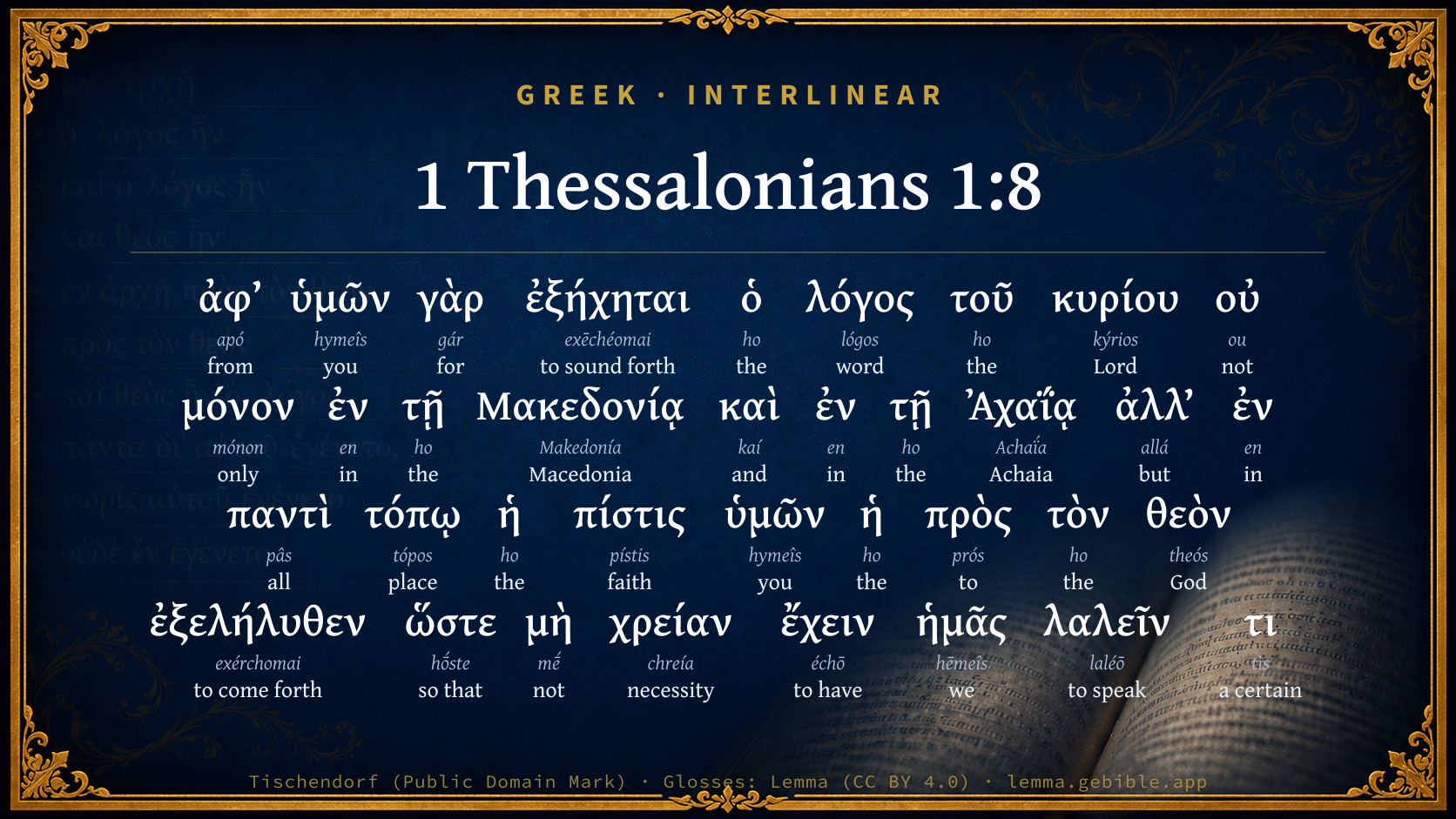
Download image
Cite this verse

1 Thessalonians 1:8 (World English Bible). Public Domain. Lemma interlinear Bible study tool, https://lemma.gebible.app/v/1-thessalonians/1/8.

Show BibTeX & RIS
BibTeX
RIS
English Translation
For from you has sounded forth the word of the Lord, not only in Macedonia and Achaia, but also in every place your faith toward God has gone forth; so that we need not to say anything.
World English Bible · Public Domain
Highlights
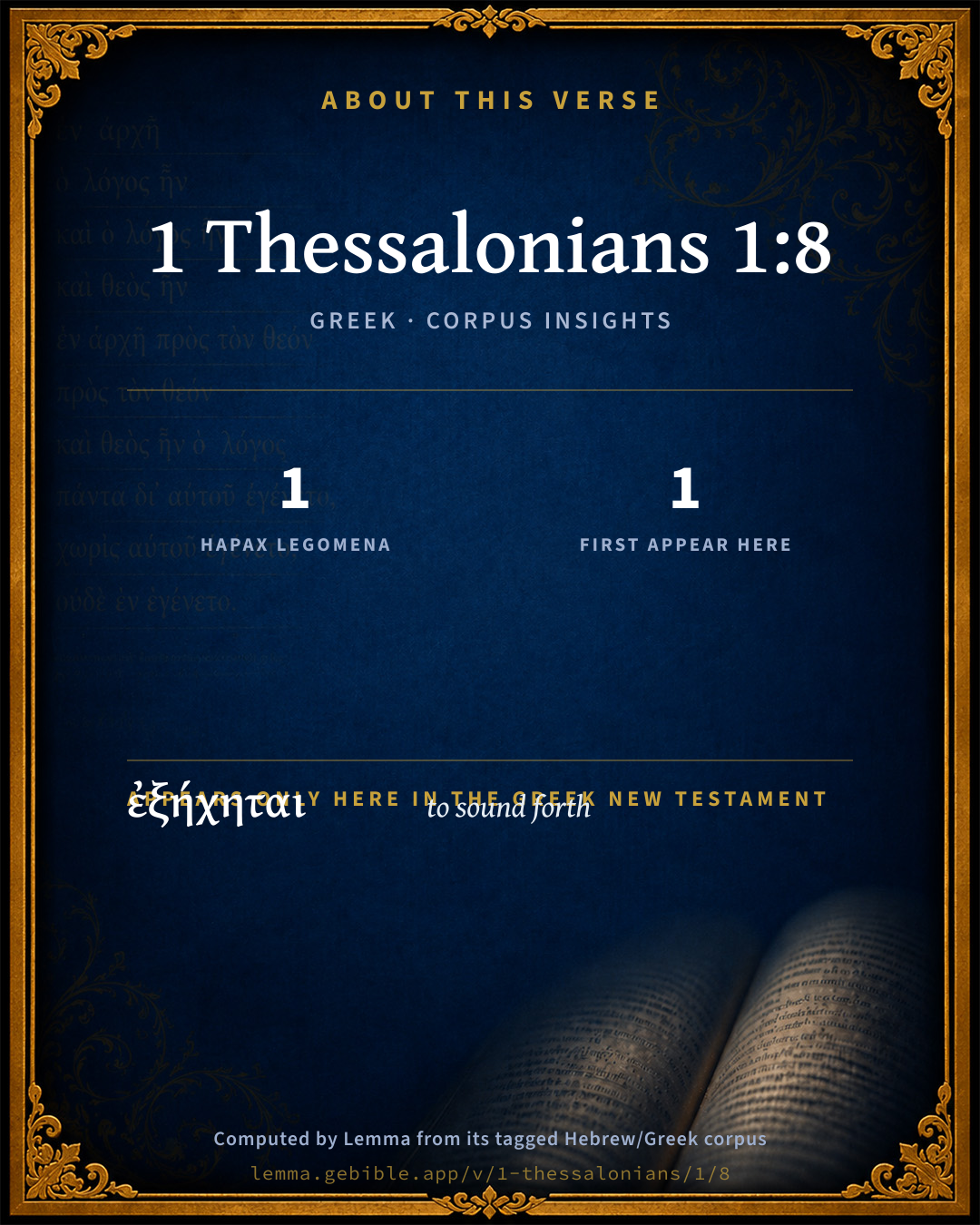
  • 1 hapax legomenon — only here in the Greek New Testament
  • 1 first appearance in the Greek New Testament
Full analysis ↓
Download a study sheet

One document with this verse’s original text, its word-by-word gloss line, the meaning frame, cross-references with their text, attributed commentary, and full source and license credits — printable, and it pastes into notes with its structure intact.

This verse Autodidact and up

Study sheet (.html) Plain text (.txt)

A passage Seminary Student

Up to 50 verses in one chapter. A passage sheet keeps up to 6 commentary sources and 12 cross-references per verse, in the order this page ranks them, and says so on the sheet whenever that leaves anything out. Ask for a single verse and you get the Autodidact verse sheet above.

Everything on this page stays free to read, with no account — the sheet is a download of what is already on screen, not access to it.

Want to remove ads? Support Godless Engineer
Compare translations 3

The same verse in 3 English versions, stacked beneath the original-language interlinear above. Click any original word for its lexicon entry.

Each is an independent rendering of the whole verse — the interlinear is not word-aligned to these translations.

Highlighted words mark where these versions differ — a whole-verse word diff, not a word-by-word alignment.

  • World English Bible Public Domain
    For from you has sounded forth the word of the Lord, not only in Macedonia and Achaia, but also in every place your faith toward God has gone forth; so that we need not to say anything.
  • King James Version Public Domain
    For from you sounded out the word of the Lord not only in Macedonia and Achaia, but also in every place your faith to God-ward is spread abroad; so that we need not to speak any thing.
  • unfoldingWord Literal Text CC BY-SA 4.0
    For from you the word of the Lord has been sounded out not only in Macedonia and in Achaia, but your faith toward God has gone out into every place, so that we do not have need to say anything.

unfoldingWord Literal Text — © unfoldingWord, licensed CC BY-SA 4.0. Word-aligned USFM3 via Door43 (git.door43.org/unfoldingWord/en_ult).

Versions to compare (up to 4)

3 of 4 selected

Show all 19 translations

Every available English version of this verse, each an independent rendering of the whole verse.

  • World English Bible Public Domain
    For from you has sounded forth the word of the Lord, not only in Macedonia and Achaia, but also in every place your faith toward God has gone forth; so that we need not to say anything.
  • Berean Standard Bible Public Domain
    For not only did the message of the Lord ring out from you to Macedonia and Achaia, but your faith in God has gone out to every place, so that we have no need to say anything more.
  • Majority Standard Bible Public Domain
    For not only did the message of the Lord ring out from you to Macedonia and Achaia, but your faith in God has gone out to every place, so that we have no need to say anything more.
  • King James Version Public Domain
    For from you sounded out the word of the Lord not only in Macedonia and Achaia, but also in every place your faith to God-ward is spread abroad; so that we need not to speak any thing.
  • American Standard Version (1901) Public Domain
    For from you hath sounded forth the word of the Lord, not only in Macedonia and Achaia, but in every place your faith to God-ward is gone forth; so that we need not to speak anything.
  • Revised Version (1885) Public Domain
    For from you hath sounded forth the word of the Lord, not only in Macedonia and Achaia, but in every place your faith to God-ward is gone forth; so that we need not to speak anything.
  • Geneva Bible (1599) Public Domain
    For from you sounded out the worde of the Lord, not in Macedonia and in Achaia only: but your faith also which is toward God, spred abroad in all quarters, that we neede not to speake any thing.
  • Douay-Rheims (1899) Public Domain
    For from you was spread abroad the word of the Lord, not only in Macedonia, and in Achaia, but also in every place, your faith which is towards God, is gone forth, so that we need not to speak any thing.
  • Young's Literal Translation Public Domain
    for from you hath sounded forth the word of the Lord, not only in Macedonia and Achaia, but also in every place your faith toward God did go forth, so that we have no need to say anything,
  • Literal Standard Version CC BY-SA 4.0
    for from you has sounded forth the word of the LORD, not only in Macedonia and Achaia, but also in every place your faith toward God went forth, so that we have no need to say anything,
  • Unlocked Literal Bible CC BY-SA 4.0
    For from you the word of the Lord has rung out, and not only in Macedonia and Achaia—everywhere your faith in God has gone out. Therefore we do not need to say anything about it.
  • unfoldingWord Literal Text CC BY-SA 4.0
    For from you the word of the Lord has been sounded out not only in Macedonia and in Achaia, but your faith toward God has gone out into every place, so that we do not have need to say anything.
  • Darby Bible Public Domain
    for the word of the Lord sounded out from you, not only in Macedonia and Achaia, but in every place your faith which [is] towards God has gone abroad, so that we have no need to say anything;
  • World Messianic Bible Public Domain
    For from you the word of the Lord has been declared, not only in Macedonia and Achaia, but also in every place your faith toward God has gone out, so that we need not to say anything.
  • Webster's Bible Public Domain
    For from you sounded out the word of the Lord not only in Macedonia and Achaia, but also in every place your faith toward God is spread abroad; so that we need not to speak any thing.
  • Free Bible Version CC BY-SA 4.0
    You have broadcast the Lord's message, not only in Macedonia and Greece, but everywhere people have heard of your trust in God—so there's no need for us to tell anybody about it!
  • Bible in Basic English Public Domain
    For not only was the word of the Lord sounding out from you in Macedonia and Achaia, but in every place your faith in God is made clear; so that we have no need to say anything.
  • Text-Critical English NT CC BY 4.0
    For not only has the word of the Lord sounded forth from you in Macedonia and Achaia, but reports of your faith in God have gone out everywhere, so that we have no need to say anything about it.
  • Tyndale New Testament (1534) Public Domain
    For from you sounded out the worde of the lorde not in Macedonia and in Achaia only: but youre fayth also which ye have vnto god spred her silfe abroade in all quartars so greatly that it nedeth not vs to speake eny thynge at all.

Literal Standard Version (2020), Covenant Press — licensed CC BY-SA 4.0. Text via the HelloAO Bible API (eBible.org). Unlocked Literal Bible (unfoldingWord) — licensed CC BY-SA 4.0. Text via the HelloAO Bible API (eBible.org). unfoldingWord Literal Text — © unfoldingWord, licensed CC BY-SA 4.0. Word-aligned USFM3 via Door43 (git.door43.org/unfoldingWord/en_ult). Free Bible Version, Dr. Jonathan Gallagher — licensed CC BY-SA 4.0. Text via the HelloAO Bible API (eBible.org).

Word by word

More ways to search: Search by grammar → Find every occurrence → Compare this word →

Practice this passage: Drill this verse → Learn its vocabulary →

ἐξήχηται
exēchéomai
G1837
“to sound forth”
Verb, Perfect, Passive, Indicative, 3rd person, Singular
Part of Speech
Verb
Tense
Perfect
Voice
Passive
Mood
Indicative
Person
3rd person
Number
Singular
Full Thayer's Definition

Origin: middle voice from G1537 and G2278

TDNT: None

1. to sound forth, emit, sound, resound
  1. ἀφ’ apó G575 “from” Preposition
  2. ὑμῶν hymeîs G5210 “you” Personal pronoun, 2nd person, Genitive, Plural
  3. γὰρ gár G1063 “for” Conjunction
  4. ὁ ho G3588 “the” Article, Nominative, Singular, Masculine
  5. λόγος lógos G3056 “word” Noun, Nominative, Singular, Masculine
  6. τοῦ ho G3588 “the” Article, Genitive, Singular, Masculine
  7. κυρίου kýrios G2962 “Lord” Noun, Genitive, Singular, Masculine
  8. οὐ ou G3756 “not” Particle, Negative
  9. μόνον mónon G3440 “only” Adverb
  10. ἐν en G1722 “in” Preposition
  11. τῇ ho G3588 “the” Article, Dative, Singular, Feminine
  12. Μακεδονίᾳ Makedonía G3109 “Macedonia” Noun, Dative, Singular, Feminine
  13. καὶ kaí G2532 “and” Conjunction
  14. ἐν en G1722 “in” Preposition
  15. τῇ ho G3588 “the” Article, Dative, Singular, Feminine
  16. Ἀχαΐᾳ Achaḯa G882 “Achaia” Noun, Dative, Singular, Feminine
  17. ἀλλ’ allá G235 “but” Conjunction
  18. ἐν en G1722 “in” Preposition
  19. παντὶ pâs G3956 “all” Adjective, Dative, Singular, Masculine
  20. τόπῳ tópos G5117 “place” Noun, Dative, Singular, Masculine
  21. ἡ ho G3588 “the” Article, Nominative, Singular, Feminine
  22. πίστις pístis G4102 “faith” Noun, Nominative, Singular, Feminine
  23. ὑμῶν hymeîs G5210 “you” Personal pronoun, 2nd person, Genitive, Plural
  24. ἡ ho G3588 “the” Article, Nominative, Singular, Feminine
  25. πρὸς prós G4314 “to” Preposition
  26. τὸν ho G3588 “the” Article, Accusative, Singular, Masculine
  27. θεὸν theós G2316 “God” Noun, Accusative, Singular, Masculine
  28. ἐξελήλυθεν exérchomai G1831 “to come forth” Verb, Perfect, Active, Indicative, 3rd person, Singular
  29. ὥστε hṓste G5620 “so that” Conjunction
  30. μὴ mḗ G3361 “not” Particle, Negative
  31. χρείαν chreía G5532 “necessity” Noun, Accusative, Singular, Feminine
  32. ἔχειν échō G2192 “to have” Verb, Present, Active, Infinitive
  33. ἡμᾶς hēmeîs G2249 “we” Personal pronoun, 1st person, Accusative, Plural
  34. λαλεῖν laléō G2980 “to speak” Verb, Present, Active, Infinitive
  35. τι tìs G5100 “a certain” Indefinite pronoun, Accusative, Singular, Neuter

About this verse

These counts appear in no published source. They are computed here, from the morphology-tagged text and Lemma’s own curated glosses. What Lemma adds →

36
words
27
distinct lemmas
Pauline Epistles
section

Notable vocabulary

1 hapax legomenon — a word that appears only here in the entire Greek New Testament:

  • ἐξήχηται to sound forth G1837

First appearance in Scripture

This word makes its first canonical appearance in the Greek New Testament here:

  • ἐξήχηται to sound forth G1837

Shared distinctive vocabulary

Ἀχαΐᾳ Achaia G882 occurs in 10 verses of the Greek New Testament. Also found in:
Repetition

Words recur within this verse:

Cross-references

14

Topical passages linked to 1 Thessalonians 1:8 in the Treasury of Scripture Knowledge — connected by theme and wording, ordered by reader-vote popularity; previews shown in the World English Bible.

  • Romans 1:8 First, I thank my God through Jesus Christ for all of you, that your faith is proclaimed throughout the whole world.
  • Romans 10:14–18 How then will they call on him in whom they have not believed? How will they believe in him whom they have not heard? How will they hear without a preacher?
  • Isaiah 52:7 How beautiful on the mountains are the feet of him who brings good news, who publishes peace, who brings good news of good, who publishes salvation, who says to Zion, Your God reigns!
  • 2 Thessalonians 1:4 so that we ourselves boast about you in the assemblies of God for your patience and faith in all your persecutions and in the afflictions which you endure.
  • 3 John 1:12 Demetrius has the testimony of all, and of the truth itself; yes, we also testify, and you know that our testimony is true.
  • Revelation 14:6 I saw an angel flying in mid heaven, having an eternal Gospel to proclaim to those who dwell on the earth, and to every nation, tribe, language, and people.
  • 2 Thessalonians 3:1 Finally, brothers, pray for us, that the word of the Lord may spread rapidly and be glorified, even as also with you;
  • Exodus 18:9 Jethro rejoiced for all the goodness which Yahweh had done to Israel, in that he had delivered them out of the hand of the Egyptians.
  • Isaiah 2:3 Many peoples shall go and say, "Come, let's go up to the mountain of Yahweh, To the house of the God of Jacob; And he will teach us of his ways, And we will walk in his paths. For out of Zion the law shall go forth, And the word of Yahweh from Jerusalem.
  • Romans 16:19 For your obedience has become known to all. I rejoice therefore over you. But I desire to have you wise in that which is good, but innocent in that which is evil.
  • Revelation 22:17 The Spirit and the bride say, "Come!" He who hears, let him say, "Come!" He who is thirsty, let him come. He who desires, let him take the water of life freely.
  • Isaiah 66:19 I will set a sign among them, and I will send such as escape of them to the nations, to Tarshish, Pul, and Lud, who draw the bow, to Tubal and Javan, to the isles afar off, who have not heard my fame, neither have seen my glory; and they shall declare my glory among the nations.
  • 1 Corinthians 14:36 What? Was it from you that the word of God went out? Or did it come to you alone?
  • 2 Corinthians 3:4 Such confidence we have through Christ toward God;

Cross-references courtesy of OpenBible.info (CC BY 4.0).

Commentary

Notes on 1 Thessalonians 1:8 from classic Christian and Jewish commentators (each source and its license shown beneath its notes). The classic Christian expositions comment on the surrounding passage and are grouped to its opening verse, so a note may address several verses; the Jewish commentaries on the Tanakh (Rashi and others) are per-verse, so they appear only where the commentator wrote on this verse.

Lemma curates 59 commentaries, every one of them public domain or Creative Commons licensed, each selected and text-cleaned for this edition rather than reprinted as found. About our sources →

Jamieson, Fausset & Brown

Robert Jamieson, A. R. Fausset & David Brown

from you sounded . . . the word of the Lord--not that they actually became missionaries: but they, by the report which spread abroad of their "faith" (compare Rom 1:8), and by Christian merchants of Thessalonica who travelled in various directions, bearing "the word of the Lord" with them, were virtually missionaries, recommending the Gospel to all within reach of their influence by word and by example (Th1 1:7). In "sounded," the image is that of a trumpet filling with its clear-sounding echo all the surrounding places.

to God-ward--no longer directed to idols.

so that we need not to speak any thing--to them in praise of your faith; "for (Th1 1:9) they themselves" (the people in Macedonia, Achaia, and in every place) know it already.

Jamieson, Fausset & Brown — Commentary Critical and Explanatory on the Whole Bible (1871) — public domain (CC PDM 1.0). Text via the HelloAO Bible API.

The Cambridge Bible for Schools and Colleges

gen. ed. J. J. S. Perowne

8. For from you sounded out the word of the Lord] Better, hath sounded out, or resounded. The Greek word suggests a clear ringing note, “as of a trumpet” (Chrysostom); and the tense (perfect) implies no transient sound, but a continuing effect: see note on beloved, 1Th_1:4.

“The word of the Lord” is the standing O. T. designation for God’s revealed will,—all that, as the Lord, He says to men. But “the Lord” is now Christ in His Divine authority and glory; and this title of Christ is notably frequent in our two Epistles. Only in them is this expression applied by St Paul to the Gospel (comp. ch. 1Th_4:15; 2Th_3:1). Afterwards he calls it “the word of God” or “of Christ”—“not men’s word, but as it is in truth, God’s word” (ch. 1Th_2:13). The fullest declaration of the authorship and purport of this “word” is from the lips of St Peter, in Act_10:36 : “The word which God sent,—in good tidings of peace through Jesus Christ: He is Lord of all.”

1Th_1:8 gives proof of the earnestness with which the Thessalonians had embraced the Gospel, as set forth in 1Th_1:6-7. For they had so received it as to echo it far and wide. The violent persecution directed against them, failing to shake their faith, had served to advertise it.

“Truth, like a torch, the more ’tis shaken shines.”

not only in Macedonia and Achaia] Now the two provinces are united, in contrast with the rest of the world.

but also in every place your faith to God-ward is spread abroad] Lit., hath gone out: the Apostle keeps up the metaphor with which he began the sentence. Psa_19:4, quoted also in Rom_10:18, seems to be running in his mind: “Their sound went forth into all the earth” (LXX). For the tense, see note on “hath sounded out.”

The conversion of the Thessalonians, taking place under such remarkable circumstances, had made a great sensation, the news spreading even beyond the limits of Greece. [For a view of the importance of Thessalonica and its commanding geographical position, see Introd. Ch. 1.] Aquila had lately come to Corinth from Rome (Act_18:2), and may have brought word that the news was current there. The charge of treason against Cæsar recorded in Act_17:6-7, would almost certainly be reported in Rome. “In every place” is a natural hyperbolé, used like our everywhere, everybody and the French tout le monde, of that which is widely and generally current. The Thessalonian believers in Christ were

“bravely furnished all abroad to fling

The wingèd shafts of truth.”

With “in every place” the sentence of 1Th_1:8 is complete; but as the writer extends his statement, it alters its shape in his mind, and the assertion with which he set out (the word … hath sounded forth) is now repeated in another way: your faith that is unto (is directed to) God, hath gone out. This mobility is characteristic of St Paul’s style (see Introd. Ch. VI.). The same thing appears in a double aspect: the fame of the gospel spread by the Thessalonians and the fame of their faith in it travelled together.

“Faith toward God” is a rare and distinct expression. It indicates the new direction, or attitude of the heart and life, which the next verse vividly depicts. Comp. 2Co_3:4 and Phm_1:5 : “toward the Lord Jesus.”

so that we need not to speak any thing] Lit., have no need,—a phrase used three times in this Epistle (ch. 1Th_4:9, 1Th_5:1), and nowhere else by St Paul.

Read this in close connection with the next verse. It is as much as to say, “No need for us to tell the story. We hear of it from all sides; everywhere people are talking about your conversion and your brave testimony for Christ.”

The Cambridge Bible for Schools and Colleges (gen. ed. J. J. S. Perowne; Cambridge University Press, 1878–1918) — public domain. Text from a community e-Sword module.

Lange's Commentary on the Holy Scriptures

1Th_1:8-10

2. Other Christians also, who have heard thereof, bear witness to the blessed work of the Apostle at Thessalonica, and the thorough conversion of the Thessalonians.

8For [sin. omits γάρ] from you sounded out [hath been sounded forth, ἐξήχηται] the word of the Lord43 not only in Macedonia and Achaia,44 but also in every [but in every]45 place your faith to God ward [toward God] is spread abroad [hath gone forth, ἐξελήλυθεν], so that we need not [have no need]46 to speak anything. 9For they themselves shew of us [report concerning us, περὶ ἡμῶν ἀπαγγέλλουσιν] what manner of entering in [entrance, εἴσοδον] we had47 unto you, and how ye turned to God from [the]48 idols, to serve the living and true God, 10and to wait for His Son from heaven [the heavens],49 whom He raised from the50 dead, even Jesus, which delivered us [who delivered us]51 from the wrath to come [the coming wrath, τῆς ὀργῆς τῆς ἐρχομένης],

EXEGETICAL AND CRITICAL

1. In commencing a new short section with 1Th_1:8, we vary from the common view which takes the whole of the first chapter together. But there are evidently three different testimonies adduced by Paul in support of the two facts, which he is now engaged in proving—his own pure, powerful preaching, and the genuine faith of the Thessalonians. He first gives his own testimony, 1Th_1:2-7, especially 1Th_1:5 sqq.; then he brings forward that of Christians elsewhere, 1Th_1:8-10; lastly, he appeals to the These salonians and their remembrance of his entrance among them (1Th_2:1-2), just as on his side he bears witness to them of their believing reception of the word, of which they had, and still have, experience as the word of God (1Th_2:13-16).

2. (1Th_1:8.) There is a question, first of all, of the punctuation of 1Th_1:8. Ordinarily a comma is put first after Ἀχαΐᾳ, and then there arises a double inconvenience. In the first place, the proof (γάρ) stretches unsuitably beyond the thing to be proved (1Th_1:7): Ye are become a pattern to the believers in Macedonia and Achaia, for not only in Macedonia and Achaia, but everywhere, have you been heard of. In the second place, the clause with but is, in a manner at once unsuitable and really insignificant, provided with a new subject and verb, whilst we are expecting only: From you the word of the Lord has come forth not only in Macedonia and Achaia, but in all places. If Paul meant to introduce a new subject and verb into the latter clause, he must have placed after οὐ μόνον the subject and verb of the former clause, together with ἀφʼ ὑμῶν, which answers to the ὑμῶν after πίστις.52 It will therefore be better, with Calvin, Lünemann and others, to put a colon after κυρίου, so that now οὐ μόνον ἐν, as well as ἀλλʼ ἐν, is dependent on ἡ πίστις ὑμῶν ἐξελήλυθεν..53 If in this way the second of the difficulties named is obviated, so not less is the first also, since now the logical relation, expressed by γἀρ, of 1Th_1:8 to 1Th_1:7 is formed thus: Ye are become a pattern to the believers in Macedonia and Achaia; for even in other quarters it has become known, how the word of God has wrought among you. On this new thought the Apostle now dwells, and carries it out by itself still further and beyond 1Th_1:7. For the exemplariness of the Thessalonians is not the main thought to be established in the following verses, but forms merely the transition to the new witnesses, the citation of whom is (according to Note 1) properly his object. That the clause with οὐ μόνον appears attached to the preceding one by asyndeton need not disturb us, since, with explanatory clauses particularly, this is frequently the case, comp. 1Th_2:7; 1Th_2:9. Winer, p. 476.

3. From you hath been sounded forth.—Ἀφʼὑμῶν stands emphatically first; ἀπό in the proper local sense: out from, you. Ἐξἠχηται in the New Testament ἅπαξ λεγόμενον; ἐξηχἐω commonly intransitive, but also in classic Greek transitive=to cause to sound forth; ἐξηχεῖται, it sounds forth, is heard abroad. Similarly here with the sense of the perfect: The word of God has been so powerful among you, has produced a movement so lively and loud, that the sound thereof, so to speak, [as of a trumpet; Chrysostom,] has propagated itself to a distance—that people have heard it everywhere. Bengel: claro sono diditus est. The idea of resonance (echo) does not lie in the word. Comp. the parallel έξελήλυθεν: has pressed forth, become known, (Luk_7:17).

4. The word of the Lord—your faith in God.—These two expressions of themselves describe Christianity on its two sides; the word on the Divine side, but offering itself to men; faith on the human, but turning to meet the approach of God; 1Th_1:4; 1Th_1:6. In the present connection, however, where the second clause merely carries out further the first, and where also, therefore, the verbs are synonymous, both points are jointly intended under both expressions:54 the word of God, as it was preached by the Apostle and believingly received by the Thessalonians (so also Olshausen, De Wette, Koch), and hence the emphatic position of ἀφʼ ὑμὦν; faith, as it was aroused in the Thessalonians by the Apostle’s preaching (Lünemann). But still the word of the Lord stands first, precluding mere human glory—The word of the Lord (as in 2Th_3:1), the word or the gospel of Christ (Col_3:16; Rom_1:9, and often), not different from the word or gospel of God (1Co_14:36; Rom_1:1, and often), just as in the Acts ὁ λόγος τοῦ θεοῦ and ὁ λόγος τοῦ κυρἰου are used interchangeably. It is not a genitive of the object=verbum de Deo, but, as is clear especially from 1Th_2:13, a genitive of the subject or author=the word which Christ or God causes to be proclaimed (Lünemann, &c.). Faith in God, because most of the Christians in Thessalonica had previously been heathens, see 1Th_1:9; πίστις πρός, instead of the common εἰσ,[55] also at Phm_1:5; comp. 2Co_3:4.

5. In every place, where, that is, there are Christian churches, even beyond Macedonia and Achaia; similarly full expressions, Rom_1:8; Col_1:6; Col_1:23. But since Paul had not in the meantime left these countries, ὡστε μή &c. must have reference to letters or visits. Ewald and others call attention to the fact that precisely in Corinth where Paul wrote our Epistle, with trade converging there from all quarters of the Roman world, was it possible for him to give such an assurance. The church need not, therefore, have already existed for a long period (against Baur), but its rapid, powerfully spreading conversion must have excited great attention. The words also indicate an intercourse of the liveliest kind among the Christians.

6. (1Th_1:9.) They themselves.—Ad sensum, the explanation is from the previous ἐν παντὶ τόπῳ (1Th_1:8).—Concerning us.—Ἡμῶν refers, as the double specification (ὁποίαν καὶ πῶς) shows, to the Apostle and his helpers on the one side, and the Thessalonians on the other.56

7. What manner of entrance we had unto you.—εἴσοδον does not answer to the German Eingang in the sense of friendly reception, entrance into the heart (Pelt, Olshausen and many). Opposed to this is partly the word itself (see 1Th_2:1 sq. and comp. Act_13:24), and partly the connection, since it is in the following clause, καὶ πῶς, that mention is first made of the reception of the Apostle and his preaching. The word means a going in introduction (Chrysostom, Calvin, De Wette, &c.): “what sort of an introduction we had to you, to wit, with the preaching of the gospel; i. e. (comp. 1Th_1:5), with what power and fulness of the Holy Ghost (Calvin), with what inward confidence and contempt of outward dangers (Chrysostom, &c.), we proclaimed to you the gospel.” Mark the expressive emphasis in δποίαν; it is not merely ἥν or οἷοι (comp. οἷοι, 1Th_1:5) or ποίαν. Πῶς likewise is not=that [Alford: how that, referring merely to the fact; and so Ellicott], but=under what difficult circumstances, and with what joy of the Spirit withal; it points back to 1Th_1:6. just as ὁποίαν to 1Th_1:6. At the same time we here detect the joy of the foreign brethren over the faith of the Thessalonians.

8. How ye turned to God from the idols.—is the regular New Testament word for conversion; in the Acts, where it is naturally of frequent occurrence, with the addition ἐπὶ τὸν κύριον (Act_11:21), or εἰς φῶς (Act_26:18), or ἐπὶ τὸν θεόν (Act_26:18; Act_26:20; Act_14:16; Act_15:9), often too with an ἀπό, whose substantive describes heathenism sometimes on the side of its demonian background, sometimes on the side of men, sometimes of the idols, viz. Act_26:18 ἀπὸ τῆς ἐξουσίας τοῦ σατανᾶ. Act_15:19 ἀπὸ τῶν ἐθνῶν. Act_14:15 ἀπὸ τῶν ματαίων ἐπιστρέφειν ἐπὶ θεὸν ζῶντα. With this class is connected the expression in our verse. The latter, negative clement corresponds to repentance (Act_26:20); the former, positive one to faith (Act_11:21).

9. To serve the living and true God.—Δουλεύειν[57] and ἀναμένειν are infinitives of the purpose. The primary feeling of profound awe in presence of Deity, that belongs to human nature and especially to antiquity, finds expression also in language. The Old Testament employs, over against God, the expression that denotes the relation of the most unconditional subjection, that of the slave to his master: עָבַד (Exo_9:1; Exo_9:13; Deu_8:19; and often); to which expression the corresponding inner sentiment is fear (יָרֵא, Jon_1:9; comp, פַּחַד, of God, Gen_31:42; Gen_31:53). To fear God and to serve God, these are the two most common Biblical expressions for religion. And so in our text also appears δουλεύειν θεῷ as the designation of religion or of religious practice generally; or rather, what we are accustomed to designate by these faint expressions, is in a more concrete and living way conveyed by the Apostle in that phrase, as we too have the beautiful word Gottesdienst [Divine service]. By means of the additions to τῷ θεῷ phraseology becomes a closer description of the true religion, in opposition to the false: ζῶντι, living, in opposition to the dead idol-images (see Rom_1:23); ἀληθινῷ, existing in objective truth and reality, in opposition to the merely imaginary, lying idols (see Rom_1:25). It may be thought strange that the Apostle uses, in regard to Christianity, such a general expression, that is applied also to the Old Testament religion as contrasted with heathenism, whereas he then puts what is specifically Christian, not into faith in Jesus, the Son of God and the Saviour, but into the expectation of His return from heaven. But it is just in its connection with 1Th_1:10 that the general expression of our verse acquires also a more especially Christian sense. A man can, in truth, only then really serve God, when he has access to him through Christ, and is by His blood purified from the dead works of the old, ungodly mind (see Heb_9:14). And that Paul had not been silent on this point at Thessalonica, that he had proclaimed Christ as the Son of God, as the Saviour, and salvation in His death and resurrection, all that we see from 1Th_1:10. But certainly our two verses show that his preaching at Thessalonica had turned, not so much round this central doctrine of salvation, as about the beginning and the end, the first things and the last. A parallel is furnished by the speech which the Apostle soon afterwards delivered at Athens (Act_17:22-31). There too he first of all leads Iris hearers over from the idols to the living God, and speaks of Christ especially as the future Judge, and only incidentally, in connection with that, of His resurrection, and of faith therein; though this, it is true, significantly enough forms the conclusion.—[Webster and Wilkinson: “He puts together the first and last articles of their creed; and then supplies the two most important of the intervening articles.”—J. L.]

10. (1Th_1:10.) And to wait for.—The Apostle defines the life-aim of the converts in two particulars, the service of God, and the waiting for the return of His Son from heaven. Though we should even say with Olshausen, that ἐπιστρέφειν includes faith, and δουλεύειν implies love, it is only the more surprising that hope is raised into such explicit and emphatic prominence. This agrees and is connected with the Whole eschatological tenor of our Epistles, as well as of the Apostle’s oral teaching at Thessalonica, and it contains a weighty warning for the Church (see Doctrinal and Ethical, no. 3). Bengel says in his New Testament on our text: To wait for the Son of God is the most appropriate mark of a true Christian. Ἀναμένειν only here in the New Testament; elsewhere we find used of the eschatological waiting προσδέχεσθαι, Luk_12:36; Tit_2:13; ἀπεκδέχεσθαι, Php_3:20; Heb_9:26 [28]; 1Co_1:7; Rom_8:19; Rom_8:23; Rom_8:25; Gal_5:5; προσδοκᾷν, 2Pe_3:12-14.

11. From the heavens &c. coming, belongs to ἀναμένειν. The plural οἱ οὐρανοί, which occurs so often in the New Testament, but in Luther’s version is unhappily obliterated (so even in the address of the Lord’s Prayer), is to give us an impression of the manifold, rich life of the super-terrestrial world (Joh_14:2). These heavens, which frequently seem to us so remote, strange, and shut, will open their doors, and from them the Son of God will come forth with the heavenly host, to the dismay of the world and the joy of His own. Comp. Act_1:1.

12. His Son, whom He raised from the dead.—The expression, Son of God, is thus used of Christ by Paul in his very first Epistle, though as yet without further specification. But it must be considered, in the first place, that the expression is plainly chosen, for the purpose of designating Christ in his inner relation to God mentioned immediately before, and, secondly, that already in connection with it even here is the characteristic from heaven, which holds good as well of His first appearing (Gal_4:4, ἐ ξαπέστειλεν, sent forth; Rom_8:3; 1Co_15:47): The Son of God is of heavenly, Divine origin. To the heathen at Thessalonica Paul had proclaimed not merely the true God, but also, what was still more unknown to them, that this God has a Son, who has become our Deliverer (ῥυόμενος). The resurrection of Jesus from the dead is the great fact by which He is shown to be the Son of God (Rom_1:4), and by which at the same time His return is rendered possible and certain (1 Pet. [1]:3–5). Was ἐκ τῶν νεκρῶν to form an antithesis to ἐκ τῶν οὐρανῶν Comp. Rom_10:6-7.

13. Jesus, our Deliverer.—The majestic title, Son of God, is on purpose followed simply and plainly by His human proper name, Jesus. [Webster and Wilkinson: presenting our Lord to us as He was revealed and known in the flesh.—J. L.] τὸνῥυόμενον: not ῥυσἀμ., with reference to the past deliverance by His death;58 nor ῥυσόμ., with reference to the future deliverance at the judgment59 (both, the latter as founded on the former, at Rom_5:9-10), but comprehensively ῥυόμ., our Deliverer, absolutely and evermore; the participle having thus a substantival sense (Winer, p. 316); comp. Rom_11:26, after Isa_59:20 גּוֹאֵל., Ῥύεσθαι (comp. Col_1:13; Rom_7:24; Mat_6:13), stronger than σώζειν, expresses the deliverance as a mighty fact, a strong, powerful extrication from the judgment, which shall inevitably smite all who have no part in Jesus. Τὸν ῥυόμενον has an explanatory relation to Ἰησοῦν (comp. Mat_1:21; Act_4:10-12), similar to that of ὅν ἤγειρεν &c. to τὸν υίὸν αὐτοῦ, [Bengel: Christus nos semel ἐλυτρώσατο, redemit: semper ῥύεται, eripit.—J. L.]

14. From the coming wrath.—Wrath is the holy will of God, energetically upholding, over against the sinful creature, His own inviolable order of life and government as the highest interest of the world, and for that reason surrendering for righteous punishment the party resisting it to self-chosen destruction. The word is used sometimes of the affection in God, His punitive justice (Rom_9:22; Heb_3:11; Heb_4:3; Rev_6:16; and often in the Old Testament); sometimes of the effect in the world, thence resulting, the judicial punishment (Luk_21:23; Rom_2:5; Rom_3:5; comp. Rom_13:4; Rom_13:9 [5]; Eph_5:6; Col_3:6); sometimes in such a way that both ideas are included (Joh_3:36; Rom_1:18; Rom_2:8; Eph_2:3; Rev_14:10; Revelation 16, 19; Rev_19:15). Here and in 1Th_2:16; 1Th_5:9 ὀργή stands in the second signification. This is shown also by the addition ἡἐρχομένη (comp. Col_3:6): the approaching, infallibly imminent punishment; similarly ἡ μέλλουσαὀργή, Mat_3:7; and then Rev_11:18, ἦλθεν ἡ ὀργή σου. Salvation or the deliverance is just the being rescued from the judgment that overwhelms the world, Rom_1:16-18 and, referring back to this, 1Th_5:9-11; and this is the immediate sense of σώζειν, σωτή, σωτηρία, as here of ῥύεσθαι In 1Th_5:9 also ὀργή and σωτηρία stand as mutual opposites. Because in Christ judgment has already passed upon the world (Joh_12:31), therefore whosoever believeth in Him is no longer judged (Joh_3:14-18; Joh_5:24).

DOCTRINAL AND ETHICAL

1. (1Th_1:8.) The man who walks uprightly before God, God accredits also before his brethren, imparting to them through all that is seen of him joy, refreshment, strength, so that they in return are able by their testimony to his conversion and spiritual walk to strengthen and encourage him, when tempted thereupon from without or within. This is the Christian import of the ideas glory, honor, praise, &c. The lofty consciousness, as it is here aroused by the Apostle, does not flatter self-love, but begets an earnest sense of obligation. To be a city on the hill, to which the eyes of all look, is no light responsibility, and brings a man under the discipline of the Spirit. The increase of idle talk is repressed by much affliction.

2. (1Th_1:9-10.) Christian truth is so rich and manysided (πολυπίκιλος, Eph_3:10), that it may be delivered in very various ways and from different points of view. Not only do we find in the New Testament a peculiar style of teaching in the case of every apostolic writer, but even the same Paul, it is evident, addressed the Thessalonians orally and in writing otherwise—put other truths in the foreground—than, for example, in the Epistles to the Galatians and the Romans; and yet at Thessalonica also there was laid the foundation of a steadfast Christianity, approved in trial. This consideration likewise cannot but inspire us in the Church with a large-heartedness and liberality of view in regard to the different ways of conceiving and representing the truth, provided only they stand sincerely and earnestly on the one foundation, 1Co_3:11, whether they be rather mystical or intellectual, churchly or specially biblical, practical or scientific (in the sense of Eph_1:17 sq.), clinging to antiquity or looking towards the future. Church Confessions tolerate and require by the side of them all? forms of expression. In our hymn-books too we find Paul Gerhardt, Tersteegen, Zinzendorf, Gellert [Toplady, Cowper, the Wesleys], and others, in peace together, uttering one language in various dialects.

3. (1Th_1:10.) The earliest Epistles of Paul are distinguished by their eschatological complexion. Subsequently he went back from eschatology to the doctrine of faith and justification (Galatians and Romans), of Christ and the Church (Philippians, Ephesians and Colossians).60 In his development of doctrine he pursued a regressive course similar to that of Messianic prophecy before him, and of the Church after him: first, the glorious end, and after that, the way to the end. But neither Old Testament prophecy nor apostolic teaching ever on the way lost sight of the end, the glorious consummation in the kingdom of God. And even in one of his latest Epistles (Tit_2:11 sq.) Paul has a passage very kindred to ours: conversion here has its counterpart there in the (objective) appearing of Divine grace, whose aim is declared to be a godly life with denial of the heathen worldly-mindedness (=to serve the living and true God), while expecting the blessed hope and appearing of the glory of our great God and Saviour Jesus Christ (=to wait for His Son from heaven). The Church, however, has, especially since the days of Constantine, too much neglected to wait for the coming of Christ; even the Reformation restored, indeed, the genuine Pauline faith, but not yet the full hope. Calvin finds it here worthy of note, that for the hope of eternal salvation Paul puts the expectation of Christ. For, he adds, without Christ we are lost and hopeless; but, where Christ comes forward, there shines life and prosperity. Very beautiful; still one perceives that he had not yet attained to the full apostolic consciousness of the importance of Christ’s coming as distinct from the blessedness after death,[61] when, it is true, we are even already present with the Lord. If the Reformation is a working back to what was originally exhibited for the Church in Holy Scripture, we have then here one of the points in which the Reformation of the 16th century needs to be carried yet further. As we would walk in the footsteps of Prophets and Apostles, and in particular even of our Paul, we must recognize it as our task to quicken anew the element of hope in knowledge and practice. The beginnings, moreover, of such a work show themselves latterly in almost all evangelical countries.

HOMILETICAL AND PRACTICAL

1Th_1:8. The clear pealing sound, that rings out from the living Church. J. M. Hahn: The awakening of some souls may produce much reflection far and wide.—J. G. Kolb: A good man may through his earnestness become the light and salt of a whole neighborhood. (Kurzer Lebensabriss von J. G. Kolb, nebst einer Sammlung von Betrachtungen, Stuttgart, 1859).—The report of faith a sweet-savor of Christ (comp. 2Co_2:15 sq.). Chrysostom: As a sweet-scented **ointment keeps not its fragrance shut up within itself, but sends it afar, so likewise noble men keep not their virtue shut up within themselves, but through their reputation are of service to many for their improvement. Chrysostom then further makes mention of the renown acquired by Macedonia, of which Thessalonica was a principal city, through Alexander the Great, who was not without reason beheld by the prophet [Dan_7:6] as a winged leopard, the swiftness and force being thus described, wherewith he scoured the whole world; and so what happened in Macedonia became not less universally known than what occurred in Rome (the seat of the fourth-world empire of Daniel; see Rom_1:8).—The same: In such circumstances there frequently arises envy (there is indeed, alas, such a thing as spiritual envy; see Gal_5:26, φθονοῦντες; Php_2:3-4; 1Co_12:15 sqq.); but even this also your excellence has overcome, and they themselves are heralds of your conflicts.—Zinzendorf: When Jesus glorifies His time of grace now here now there, rejoice thou in the mercy to others returning.—The testimony of others to our faith a comfort in trial.—[Benson: It was an honor to any church or city, to have the gospel go out from thence to other places.”—J. L.]

1Th_1:9. When the Lord enters the heart through the powerful preaching of the word, that is even the entrance of a king, though in humble raiment—Zwingli: Paul did not ride into Thessalonica with such pride and pomp, as Cardinals, Bishops, and Popish Legates are wont to display.—Rieger: The idols of the altar were not to be overthrown by the purer knowledge of God, which many philosophers at that time had; the word of the Cross must come, which brought the idols to an end in the heart’s affection, and forthwith also in the members; then too they fell as to the service that was paid to them a the altar.—Calvin: The end of true conversion is the living God. Many renounce superstition only to fall into what is worse; for, losing all sense of God, they plunge into a worldly minded, irrational62 contempt of the Holy One.—The same: We must first be converted, before we can serve God.—The same:—No one is duly converted to God, but the man who has learned to yield himself fully to Him as a servant (in servitutem).—Rieger: Conversion from idolatry to God was certainly in former times a great change; but neither is it at the present time any trifle, when on obedience to the truth the idols of wealth, pleasure, fleshly ease, honor from men, seeking to save one’s life in this world, self love, confidence in the flesh, and such like, are cast forth from the heart’s affection.—The same: The living and true God can be served only in spirit and in truth; and that requires a conscience purified in the blood of Jesus from dead works. Without fellowship with the Light, a man deals even with the living God as with a dumb idol (Joh_4:23-24; Heb_9:14; see Joh_1:5-10).

1Th_1:10.—[On the first clause of this verse, see a good note by Barnes.—J. L.]—The Christian is a man who serves God and waits for Jesus.—Calvin: In the service of God, which in the corruption of our nature is a more than difficult matter, we are kept and established by the expectation of Christ; otherwise the world drags us back to itself, and we grow weary. Waiting for the Lord a main point 1. in the doctrine of Jesus and His Apostles, 2. in the life of faith of the Apostles and first Christians.—Rieger: As to what is behind, free from everything; for what is before, watchful (Mar_13:33 sqq.; Luk_21:36).—[Alford: The especial aspect of the faith of the Thessalonians was hope: hope of the return of the Son of God from heaven: a hope, indeed, common to them with all Christians in all ages, but evidently entertained by them as pointing to an event more immediate than the church has subsequently believed it to be. Certainly these words would give them an idea of the nearness of the coming of Christ: and perhaps the misunderstanding of them may have contributed to the notion which the Apostle corrects, 2Th_2:1 sqq.—J. L]—We must be in earnest with the expectation of Christ’s coming, if we would stand in the fulness of apostolic Christianity. This carries with it, 1. a Warning, a. against every kind of worldly happiness, and service of perishable things and men, especially against the modern absorption in practical and theoretic materialism, even of a refined sort; b. against the Romanizing over valuing of what we already have even in the Church, and against striving for the Church’s outward dominion and glory; c. against false ideals of a great future of the life of nations, to be introduced by our own, be it even Christian, power and activity; and against the so frequent intermixture, concurrent therewith, of the world and the kingdom of God; 2. Comfort, a. in regard to imperfections and sins in ourselves, in the world, in the Church: it has not yet appeared, what we shall be (1Jn_3:2); b. in regard to the sufferings and afflictions, which are the divinely appointed way to the future glory, 2Co_4:17 sq.; Rom_8:17.—Chrysostom: The sword in hand, the good in expectancy.—[Vaughan: A summary of the Christian life in all times; service, and expectation. The loss or disparagement of either has been in all times the cause of injury to the Church. The one, by itself, degenerates into a dry routine of duty: the other, into excitement, dreaminess, and indolent sentiment. The two together make up that life of practical piety which is the true end and chief glory of the Gospel. Tit_2:12-13.—J. L.] Jesus, the Deliverer from the future wrath: 1. The wrath cometh; the world is going on to meet the judgment: an irrefragable matter of fact. On one hand, Roos: When the unbelieving world looks out to the time after death, it sees nothing, hopes for nothing, fears nothing, except when conscience is stirred; whereas there is to be feared a fearful wrath of God, which at the appearing of Christ shall wholly burst over it, and, even before that, will make the condition of the soul separated from the body an unhappy condition. On the other hand, Rieger: The wrath of God, its revelation against all ungodliness of men, judgment on hidden sins, is already written deep in the consciences of all men. Under that wrath abide, and are even already grievously tormented by the fear of it in this world and the next, all who are not begotten again by the gospel unto hope. 2. In Christ is deliverance from the judgment. Calvin: It is an invaluable privilege that believers, as often as the judgment is spoken of, know that Christ will come for their deliverance.—The same: The wrath of God is a future thing. We are not to measure it by our present afflictions in the world, as nothing is more absurd than to snatch at the enjoyment of transitory blessings, by way of forming an estimate of the grace of God. Faith is the sight of the invisible, and so is not misled by the aspect of the present life. Whilst the ungodly revel in their security, and we languish in sorrow, let us learn to fear the vengeance of God that is hidden from the eyes of the flesh, and rest in the calm pleasures of the spiritual life!

[Vaughan: The three phrases are equally scriptural, (1) Christ saved, (2) Christ saves, (3) Christ will save. Comp. (1) Rom_8:24; Eph_2:5; 2Ti_1:9. (2) 1Co_1:18; 1Co_15:2. (3) Mat_24:13; Mar_13:13; Php_2:12; 2Ti_2:10; Heb_9:28; 1Pe_1:5.—J. L.]

[There is a discourse by bishop Sherlock on 1Th_1:9-10.—J. L.]

Footnotes:

[43]1Th_1:8.—[The German adopts a different arrangement of this verse. See Exeg. Note 2. For κυριου, Sin.1 has θεοῦ.—J. L.]

[44]1Th_1:8.—[There is large authority of manuscripts (including Sin.) and versions for the repetition of ἐν τῇ every before Ἀχαḯᾳ (Scholz, Schott, Lachmann). But this is supposed to be an assimilation to 1Th_1:7. Tischendorf, Alford, Ellicott, &c., retain the common reading (A. B., many cursive mss., and some versions and Fathers).—J. L.]

[45]1Th_1:8.—Καί after ἀλλά should be cancelled, with Lachmann, Tischendorf and others [Alford, Wordsworth, Ellicott], on superior manuscript authority [including Sin.]—to the advantage of the sense.

[46]1Th_1:8.—[μὴ χρείαν ἡμᾶς ἔχειν (rather: ἔχειν ἡμᾶς, with A. B. C. D. Sin., &c.; Lachmann, Scholz, Tischendorf, Alford, Wordsworth, Ellicott) Our English Version renders χρείαν ἔχειν, to have need or lack, 24 times; and in 6 of these the negative phrase is, to have no need.—J. L.]

[47]1Th_1:9.—Instead of the Recepta ἔχομεν, all now read ἔσχομεν, according to the best manuscripts [Sin., &c.], and the sense also favors this.

[48]1Th_1:9.—[τῶν εἰδώλων=חָאֱלִילִים, Isa_2:18. Comp. 1Jn_5:21.—J. L.]

[49]1Th_1:10.—[τῶν οὐρανῶν. Comp. Act_2:34; &c.—J. L.]

[50]1Th_1:10.—[The reading, τῶν νεκρῶν, which nearly all the critical editions now follow, “is supported,” says Ellicott, “by preponderating external evidence... and by the probability of a conformation to the more usual ἐγείρειν ἐκ νεκρῶν.” Sin has the article.—J. L.]

[51]1Th_1:10.—[Or, our Deliverer, τὸν ῥυόμενον ἡμᾶς. See Exeg. Note 13. Our Translators here followed the Vulgate, qui eripuit, against the older English versions.—For ἀπό, Sin. and one cursive manuscript have ἐκ.—J. L.]

[52][Accordingly, not a few interpreters from Pagninus to Schott and Gerlach assume such a transposition.—J. L.]

[53][Others, on the contrary, as Martin’s French version and Michaelis, introduce the colon immediately after τόπῳ, and throw all that precedes on the first verb. “The most simple explanation,” says Ellicott, “appears that of Rückert (Loc. Paul. Expl. Jena, 1844), according to which the Apostle is led by the desire of making a forcible climax into a disregard of the preceding nominative, and in fact puts a sentence in antithesis to οὐ μόνον—Ἀχαΐᾳ instead of a simple local clause, ἐν πάντι τόπῳ or ἐν ὅλῳ τῷ κόσμῳ (Rom_1:8), as the strict logical connection actually required.” But if we acquiesce in this view of the case as one of interrupted or mixed construction, it is not necessary, as I remarked in the Revision of the verse, Note g, with Rückert, to lay the main stress on ἡ πίστις ὑμῶν, or, except in the particular of local extent, to find any increase of force whatever in the latter clause. On the contrary, ἀφ̓ ὑμῶν ἐξήχηται ὁ λόγος τοῦ κυρίου sounds something greater than ἡ πίστις ὑμῶν ἐξελήλυθεν; and the very feeling of the writer that the former phrase implied, on the part of the Thessalonians, more of evangelical influence, if not missionary activity, than could properly be asserted of them in reference to the regions beyond their own Greek provinces, may have prompted the use, in the latter connection, of the weaker form of expression: From you hath been sounded forth the word of the Lord, and not only is that true, as I have just intimated (1Th_1:7), in relation to Macedonia and Achaia, but everywhere, throughout all the household of faith, the fact and the circumstances of your conversion are familiarly known.” Alford retains the ordinary punctuation, but regards the “new subject and predicate as merely an epexegesis of the former.”—J. L.]

[54][This view of the synonymous equivalence of the two clauses is given by Baumgarten, and is adopted, besides those mentioned above, by Alford. But see Note† on p. 70.—J. L.]

[55][Ellicott: “The less usual preposition πρός is here used with great propriety, as there is a tacit contrast to a previous faith, πρὸς τὰ εἵδωλα (see 1Th_1:9), in which latter case the deeper πίστ. εἰς... would seem theologically unsuitable.”—J. L.]

[56][So Lünemann. But the common restriction of ἡμῶν to the preachers is greatly to be preferred; see Alford. Of the other view Ellicott remarks: “The studied prominence of περὶ ἡμῶν and the real point of the clause are thus completely overlooked: Instead of our telling about our own success, they do it for us; ἃ γὰρ αὐτοὺς ἐχρῆν παῤ ἡμῶν ἀκούειν,ταῦτα αὐτοὶ προλαβόντες λέγουσι, Chrys.”—J. L.]

[57][The very word applied by Rome to her worship of the saints, while she reserves λατρεύειν for God.—J, L.]

[58][See Critical Note 9.—J. L.]

[59][Grouius, Benson, Koppe, Pelt, and others.—J. L.]

[60][According as the development of error, and the circumstances of particular churches, required.—J. L.]

[61][For sufficiently obvious reasons, the general tone of the Reformation period on the subject of Christ’s second advent is not quite that of the apostolic age. Much more emphatically, however, is this true of the times that followed the Reformation. In the writings of the more eminen Reformers themselves, Luther, Melanchthon, Calvin Knox, &c., not a few strong and fervid utterances are found to which the remark of our Author would not do justice. For example, immediately preceding the above quotation from Calvin we find these words: “Ergo quisquis in vitæ sanctæ cursu perseverare volet, totam mentem applicet ad spem adventus Christi”—where there is no reference whatever to death or the intermediate state. And similar testimonies could easily be multiplied (see the Homiletical Notes on 1Th_1:10, and my Missionary Address, on The Hope of the Church, before the Synod of New York, 1865). But take only this pregnant one from Bishop Latimer’s Third Sermon on the Lord’s Prayer: “All those excellent learned men whom, without doubt, God hath sent into this world in these latter days to give the world warning—all those men do gather out of Sacred Scripture that the last day cannot be far off. And this is most certain and sure that, whensoever He cometh, He cometh not too timely; for all things which ought to come before are passed now: so that, if He come this night or to-morrow, He cometh not too early.” The modern device, of interposing between us and that blessed hope the promised times of universal blessing, had not yet been thought of.—J. L.]

[62][Weltlichgesinnte, unvernünftige; Calvin: profanum et brutum, profane and brutish.—J. L.]

Lange's Commentary on the Holy Scriptures (Critical, Doctrinal, and Homiletical), ed. John Peter Lange, English translation edited by Philip Schaff (1864–1880) — public domain. Text from a community e-Sword module.

MacLaren's Expositions of Holy Scripture

Alexander MacLaren

1 Thessalonians

GOD’S TRUMPET

1Th 1:8.

This is Paul’s first letter. It was written very shortly after his first preaching of the Gospel in the great commercial city of Thessalonica. But though the period since the formation of the Thessalonian Church was so brief, their conversion had already become a matter of common notoriety; and the consistency of their lives, and the marvellous change that had taken place upon them, made them conspicuous in the midst of the corrupt heathen community in which they dwelt. And so says Paul, in the text, by reason of their work of faith and labour of love and patience of hope, they had become ensamples to all that believe, and loud proclaimers and witnesses of the Gospel which had produced this change.

The Apostle employs a word never used anywhere else in the New Testament to describe the conspicuous and widespread nature of this testimony of theirs. He says, ‘The word of the Lord sounded out ‘ from them. That phrase is one most naturally employed to describe the blast of a trumpet. So clear and ringing, so loud, penetrating, melodious, rousing, and full was their proclamation, by the silent eloquence of their lives, of the Gospel which impelled and enabled them to lead such lives. A grand ideal of a community of believers! If our churches to-day were nearer its realisation there would be less unbelief, and more attraction of wandering prodigals to the Father’s house. Would that this saying were true of every body of professing believers! Would that from each there sounded out one clear accordant witness to Christ, in the purity and unworldliness of their Christlike lives!

I. This metaphor suggests the great purpose of the Church.

It is God’s trumpet, His means of making His voice heard through all the uproar of the world. As the captain upon the deck in the gale will use his speaking-trumpet, so God’s voice needs your voice. The Gospel needs to be passed through human lips in order that it may reach deaf ears. The purpose for which we have been apprehended of Christ is not merely our own personal salvation, whether we understand that in a narrow and more outward, or in a broader and more spiritual sense. No man is an end in himself, but every man, though he be partially and temporarily an end, is also a means. And just as, according to the other metaphor, the Kingdom of Heaven is like leaven, each particle of the dead dough, as soon as it is leavened and vitalised, becoming the medium for transmitting the strange, transforming, and living influence to the particle beyond, so all of us, if we are Christian people, have received that grace into our hearts, for our own sakes indeed, but also that through us might be manifested to the darkened eyes beyond, and through us might drop persuasively on the dull, cold ears that are further away from the Divine Voice, the great message of God’s mercy. The Church is God’s trumpet, and the purpose that He has in view in setting it in the world is to make all men know the fellowship of the mystery, and that through it there may ring out, as by some artificial means a poor human voice will be flung to a greater distance than it would otherwise reach, the gentle entreaties, and the glorious proclamation, and the solemn threatenings of the Word, the Incarnate as well as the written Word, of God.

Of course all this is true, not only about communities, but it is true of a community, just because it is true of each individual member of it. The Church is worse than as ‘sounding brass,’ it is as silent brass and an untinkling cymbal, unless the individuals that belong to it recognise God’s meaning in making them His children, and do their best to fulfil it. ‘Ye are my witnesses,’ saith the Lord. You are put into the witness-box; see that you speak out when you are there.

II. Another point that this figure may suggest is, the sort of sound that should come from the trumpet.

A trumpet note is, first of all, clear. There should be no hesitation in our witness; nothing uncertain in the sound that we give. There are plenty of so-called Christian people whose lives, if they bear any witness for the Master at all, are like the notes that some bungling learner will bring out of a musical instrument: hesitating, uncertain, so that you do not know exactly what note he wants to produce. How many of us, calling ourselves Christian people, testify on both sides; sometimes bearing witness for Christ; and alas! alas! oftener bearing witness against Him. Will the trumpet, the instrument of clear, ringing, unmistakable sounds, be the emblem of your Christian testimony? Would not some poor scrannel-pipe, ill-blown, be nearer the mark? The note should be clear.

The note should be penetrating. There is no instrument, I suppose, that carries further than the ringing clarion that is often heard on the field of battle, above all the strife; and this little church at Thessalonica, a mere handful of people, just converted, in the very centre of a strong, compact, organised, self-confident, supercilious heathenism, insisted upon being heard, and got itself made audible, simply by the purity and the consistency of the lives of its members. So that Paul, a few weeks, or at most a few months, after the formation of the church, could say, ‘From you sounded out the word of the Lord, not only in Macedonia and Achaia,’ your own province and the one next door to it, ‘but also in every place your faith to Godward is spread abroad.’ No man knows how far his influence will go. No man can tell how far his example may penetrate. Thessalonica was a great commercial city. So is Manchester. Hosts of people of all sorts came into it as they come here. There were many different circles which would be intersected by the lives of this Christian church, and wherever its units went they carried along with them the conviction that they had turned from idols to serve the living God, and to wait for His Son from heaven.

And so, dear brethren, if our witness is to be worth anything it must have this penetrating quality. There is a difference in sounds as there is a difference in instruments. Some of them carry further than others. A clear voice will fling words to a distance that a thick, mumbling one never can attain. One note will travel much further than another. Do you see to it that your notes are of the penetrating sort.

And then, again, the note should be a musical one. There is nothing to be done for God by harshness; nothing to be done by discords and gangling; nothing to be done by scolding and rebuke. The ordered sequence of melodious sound will travel a great deal further than unmusical, plain speech. You can hear a song at a distance at which a saying would be inaudible. Which thing is an allegory, and this is its lesson,--Music goes further than discord; and the witness that a Christian man bears will travel in direct proportion as it is harmonious, and gracious and gentle and beautiful.

And then, again, the note should be rousing. You do not play on a trumpet when you want to send people to sleep; dulcimers and the like are the things for that purpose. The trumpet means strung-up intensity, means a call to arms, or to rejoicing; means at any rate, vigour, and is intended to rouse. Let your witness have, for its utmost signification, ‘Awake! thou that sleepest, and arise from the dead; and Christ shall give thee light.’

III. Then, still further, take another thought that may be suggested from this metaphor, the silence of the loudest note.

If you look at the context, you will see that all the ways in which the word of the Lord is represented as sounding out from the Thessalonian Church were deeds, not words. The context supplies a number of them. Such as the following are specified in it: their work; their toil, which is more than work; their patience; their assurance; their reception of the word, in much affliction with joy in the Holy Ghost; their faith to Godward; their turning to God from idols, to serve and to wait.

That is all. So far as the context goes there might not have been a man amongst them who ever opened his mouth for Jesus Christ. We know not, of course, how far they were a congregation of silent witnesses, but this we know, that what Paul meant when he said, ‘The whole world is ringing with the voice of the word of God sounding from you,’ was not their going up and down the world shouting about their Christianity, but their quiet living like Jesus Christ. That is a louder voice than any other.

Ah! dear friends! it is with God’s Church as it is with God’s heavens; the ‘stars in Christ’s right hand’ sparkle in the same fashion as the stars that He has set in the firmament. Of them we read: ‘There is neither voice nor language, their speech is not heard’; and yet, as man stands with bared head and hushed heart beneath the violet abysses of the heavens, ‘their line’ {or chord, the metaphor being that of a stringed instrument} ‘is gone out through all the earth, and their words to the end of the world.’ Silent as they shine, they declare the glory of God, and proclaim His handiwork. And so you may speak of Him without speaking, and though you have no gift of tongues the night may be filled with music, and your lives be eloquent of Christ.

I do not mean to say that Christian men and women are at liberty to lock their lips from verbal proclamation of the Saviour they have found, but I do mean to say that if there was less talk and more living, the witness of God’s Church would be louder and not lower; ‘and men would take knowledge of us, that we had been with Jesus’; and of Jesus, that He had made us like Himself.

IV. And so, lastly, let me draw one other thought from this metaphor, which I hope you will not think fanciful playing with a figure; and that is the breath that makes the music.

If the Church is the trumpet, who blows it? God! It is by His Divine Spirit dwelling within us, and breathing through us, that the harsh discords of our natural lives become changed into melody of praise and the music of witness for Him. Keep near Christ, live in communion with God, let Him breathe through you, and when His Spirit passes through your spirits their silence will become harmonious speech; and from you ‘will sound out the word of the Lord.’

In a tropical country, when the sun goes behind a cloud, all the insect life that was cheerily chirping is hushed. In the Christian life, when the Son of Righteousness is obscured by the clouds born of our own carelessness and sin, all the music in our spirit ceases, and no more can we witness for Him. A scentless substance lying in a drawer, with a bit of musk, will become perfumed by contact, and will bring the fragrance wherever it is carried. Live near God, and let Him speak to you and in you; and then He will speak through you. And if He be the breath of your spiritual lives, and the soul of your souls, then, and only then, will your lives be music, the music witness, and the witness conviction. And only then will there be fulfilled what I pray there may be more and more fulfilled in us as a Christian community, this great word of our text, ‘from you sounded out,’ clear, rousing, penetrating, melodious, ‘the word of the Lord,’ so that we, with our poor preaching, need not to speak anything.

Alexander MacLaren, Expositions of Holy Scripture (1904–1910) — public domain. Text from a community e-Sword module.

Bengel's Gnomon

Johann Albrecht Bengel

1Th 1:8. Γὰρ, for) The intensive particle.—ἐξήχηται) was given (spread) abroad with a clear sound.—τοῦ Κυρίου, of the Lord) Christ.—ὥστε, so that) It is lawful to speak where the subject is the conversion of souls. Paul takes this for granted; and he himself would have taken also the subject of his remarks from the conversion of the Thessalonians, had not others known the fact already before, and spoken about it.—λαλεῖν τι, to speak anything) concerning your faith, 1Th 1:9.

Bengel's Gnomon of the New Testament — English translation (T&T Clark, Edinburgh, 1860) — public domain. Text from a community e-Sword module.

Meyer's Critical & Exegetical Commentary

Heinrich August Wilhelm Meyer

1Th_1:8. Proof of the praise in 1Th_1:7. See on the verse, Storr, Opusc. III. p. 317 ff.; Rückert, locorum Paulinorum 1Th_1:8 et 1Th_3:1-3, explanatio, Jen. 1844.

Baumgarten-Crusius arbitrarily assumes in 1Th_1:8 ff. an address, not only to the Thessalonians, but also to the Philippians, in short, to the first converts in Macedonia. For ὑμῶν (1Th_1:8) can have no further extension than ὑμᾶς (1Th_1:7).

ἀφʼ ὑμῶν] does not import vestra opera, so that a missionary activity was attributed to the Thessalonians (Rückert), also not per vos, ope consilioque vestro, so that the sense would be: that the gospel might be preached by me in other parts of Macedonia and Achaia, has been effected by your advice and co-operation, inasmuch as, when in imminent danger, my life and that of Silvanus was rescued by you (Schott, Flatt). For in the first case ὑφʼ ὑμῶν would be required, and in the second case διʼ ὑμῶν, not to mention that the entire occasion of the last interpretation is invented and artificially introduced. Rather ἀφʼ ὑμῶν is purely local (Schott and Bloomfield erroneously unite the local import with the instrumental), and denotes: out from you, forth from you, comp. 1Co_14:36. Yet this cannot be referred, with Koppe and Krause, to Paul: from you, that is, when I left Thessalonica, I found in the other cities of Macedonia and Achaia a favourable opportunity for preaching the gospel. For (1) this would have been otherwise grammatically expressed, perhaps by ἀφʼ ὑμῶν γὰρ ἀπελθόντι θύρα μοι ἀνέῳγε μεγάλη εἰς τὸ κηρύσσειν τὸν λόγον τοῦ κυρίου; add to this (2), which is the chief point, that the logical relation of 1Th_1:8 to 1Th_1:7 (γάρ) does not permit our seeking in 1Th_1:8 a reference to the conduct of the apostle, but indicates that a further praise of the Thessalonians is contained in it.

ἐξήχηται] Comp. Sir_40:13; Joe_3:14; an ἅπαξ λεγόμενον in N. T. is sounded out, like the tone of some far-sounding instrument, i.e. without a figure: was made known with power.

ὁ λόγος τοῦ κυρίου] is not the word from the Lord, or the report of what the Lord has done to you (so, as it seems, Theodore Mopsuest. [in N. T. commentariorum, quae reperiri potuerunt. Colleg., Fritzsche, Turici 1847, p. 145]: Λόγον κυρίου ἐνταῦθα οὐ τὴν πίστιν λέγει, οὐ γὰρ ἡ πίστις ἀπʼ αὐτῶν ἔλαβε τὴν ἀρχήν, ἀλλʼ ἀντὶ τοῦ πάντες ἔγνωσαν ὅσα ὑπὲρ τῆς πίστεως ἐπάθετε, καὶ πάντες ὑμῶν τὸ βέβαιον θαυμάζουσι τῆς πίστεως, ὥστε καὶ προτροπὴν ἑτέροις γενέσθαι τὰ ὑμέτερα), but the word of the Lord which He caused to be preached (subjective genitive), i.e. the gospel (comp. 2Th_3:1; Col_3:16); thus similar to the more usual expression of Paul: ὁ λόγος τοῦ Θεοῦ. But the meaning is not: The report of the gospel, that it was embraced by you, went forth from you, and made a favourable impression upon others (de Wette); but the knowledge of the gospel itself spread from you, so that the power and the eclat which was displayed at the conversion of the Thessalonians directed attention to the gospel, and gained friends for it.

The words οὐ μόνον have given much trouble to interpreters. According to their position they evidently belong to ἐν τῇ Μακεδονίᾳ καὶ ἐν τῇ Ἀχαΐᾳ, and form a contrast to ἐν παντὶ τόπῳ. But it does not agree with this view that a new subject and predicate are found in the contrast introduced with ἀλλά, because the emphasis lies (as the position of οὐ μόνον … ἀλλά appears to demand) only on the two local statements, so that only ἀφʼ ὑμῶν … τόπῳ should have been written, and ὥστε μὴ κ.τ.λ. should have been directly connected with them. This double subject and predicate could only be permissible provided the phrases: ἐξήχηται ὁ λόγος τοῦ κυρίου, and: ἡ πίστις ὑμῶν ἡ πρὸς τ. Θεὸν ἐξελήλυθεν were equivalent, as de Wette (also Olshausen and Koch) assumes (the fame of your acceptance of the gospel sounded forth not only in Macedonia and Achaia, but also in every place the fame of your faith in God is spread abroad); but, as is remarked above, de Wette does not correctly translate the first member of the sentence. Zanchius, Piscator, Vorstius, Beza, Grotius, Koppe, Storr, Flatt, Schrader, Schott, Baumgarten-Crusius, and others have felt themselves obliged to assume a trajection, uniting οὐ μόνον not with ἐν τῇ Μακεδονίᾳ καὶ ἐν τῇ Ἀχαΐᾳ, but with ἐξήχηται, and thus explain it as if the words stood: ἀφʼ ὑμῶν γὰρ οὐ μόνον ἐξήχηται κ.τ.λ. But this trajection is a grammatical impossibility. Bloomfield has understood the words as a mingling of two different forms of expression. According to him, it is to be analyzed: For from you sounded the word of the Lord over all Macedonia and Achaia; and not only has your faith in God been well known there, but the report of it has been disseminated everywhere else. But that which is united by Paul is thus forcibly severed, and arbitrarily moulded into an entirely new form. Lastly, Rückert has attempted another expedient. According to him, the apostle, after having written the greater part of the sentence, was led by the desire of making a forcible climax so to alter the originally intended form of the thought that the conclusion no longer corresponded with the announcement. Thus, then, the sense would be. Vestra opera factum est, ut domini sermo propagaretur non solum in Macedonia et Achaja, sed etiamimmo amplius quid, ipsa vestra fides ita per famam sparsa est, ut nullus jam sit locus, quem ejus nulla dum notitia attigerit. But against this is(1) that ἡ πίστις ὑμῶν, on account of its position after ἐν παντὶ τόπῳ, cannot have the principal accent; on the contrary, to preserve the meaning maintained by Rückert, it ought to have been written ἀλλʼ αὐτὴ ἡ πίστις ὑμῶν ἡ πρὸς τὸν Θεὸν ἐν παντὶ τόπῳ ἐξελήλυθεν; (2) that the wide extension of the report of the πίστις of the readers is not appropriate to form a climax to their supposed missionary activity expressed in the first clause of the sentence. However, to give οὐ μόνον … ἀλλά its proper force, and thereby to avoid the objection of the double subject and predicate, there is a very simple expedient (now adopted by Hofmann and Auberlen), namely, another punctuation; to put a colon after κυρίου, and to take together all that follows. According to this, 1Th_1:8 is divided into two parts, of which the first part (ἀφʼ ὑμῶν … κυρίου), in which ἀφʼ ὑμῶν and ἐξήχηται have the emphasis, contains the reason of 1Th_1:7, and of which the second part (οὐ μόνον … λαλεῖν τι) takes up the preceding ἐξήχηται, and works it out according to its locality.

From the fact that οὐ μόνον … ἀλλά serves to contrast the local designations, it follows that ἐν παντὶ τόπῳ is not to be limited (with Koppe, Storr, Flatt, Schott, and others) to Macedonia and Achaia (ἐν παντὶ τόπῳ τῆς Μακεδονίας καὶ τῆς Ἀχαΐας), but must denote every place outside of Macedonia and Achaia, entirely apart from the consideration whether Paul and his companions had already come in contact with those places or not (against Hofmann), thus the whole known world (Chrysostom: τὴν οἰκουμένην; Oecumenius: ἅπαντα τὸν κόσμον); by which it is to be conceded that Paul here, as in Rom_1:8, Col_1:6; Col_1:23, expresses himself in a popular hyperbolical manner.

ἡ πίστις ὑμῶν ἡ πρὸς τὸν Θεόν] your faith, that is, your believing or becoming believers in God (πίστις thus subjective); the unusual preposition πρός instead of εἰς is also found in Phm_1:5. That here God, and not Christ, is named as the object of faith does not alter the case, because God is the Father of Christ and the Author of the salvation contained in Him. But the unusual form ἡ πρὸς τὸν Θεόν is designedly chosen, in order to bring prominently forward the monotheistic faith to which the Thessalonians had turned, in contrast to their former idolatry.

ἐξελήλυθεν] has gone forth, has spread forth, namely, as a report. Comp. on ἐξέρχεσθαι in this sense, Mat_9:26; Luk_8:17, etc. Probably the report had spread particularly by means of Christian merchants (Zanchius, Grotius, Joach. Lange, Baumgarten, de Wette), and the apostle might easily have learned it in the great commercial city of Corinth, where there was a constant influx of strangers. Possibly also Aquila and Priscilla, who had lately come from Rome (Act_18:2), brought with them such a report (Wieseler, p. 42). At all events, neither a longer existence of the Thessalonian church follows from this passage (Schrader, Baur), nor that Paul had in the interval been in far distant places (Wurm). As, moreover, ἐξελήλυθεν is construed not with εἰς, but with ἐν, so not only the arrival of the report in those regions is represented, but its permanence after its arrival (see Winer, p. 385 [E. T. 514]; Bernhardy, Synt. p. 208).

ὥστε μὴ χρείαν ἔχειν ἡμᾶς λαλεῖν τι] so that we have no need to say anything of it (sc. of your πίστις; erroneously Michaelis, of the gospel; erroneously also Koch, something considerable), because we have been already instructed concerning it by its report; although this is contained in ἐξελήλυθεν, yet it is impressively brought forward and explained in what follows.

Meyer — Critical and Exegetical Commentary on the New Testament — English translation by Peter Christie, edited by Frederick Crombie (T&T Clark, 1880) — public domain. Text from a community e-Sword module.

Expositor's Greek Testament

ed. W. Robertson Nicoll

1Th 1:8 . ἡ πίστις … ἐξελ . (Rom 10:18 ), by anacoluthon, reiterates for emphasis ἀφʼ ὑμῶν … κυρίου ( ὁ λόγος τ . Κ . depending for its effectiveness on the definite testimony of Christians). Paul is dictating loosely but graphically. The touch of hyperbole is pardonable and characteristic ( cf. Rom 1:8 ; 1Co 4:17 ; Col 1:6 ); but the geographical and commercial position of Thessalonica see Introd., p. 5) must have offered ample facilities for the rapid dissemination of news and the promulgation of the faith, north and south, throughout European Greece ( Encycl. Bibl. , i. 32). The local Christians had taken full advantage of their natural opportunities. Through their imitation of the apostles (see Introd., p. 7) and of Christ (here as in 1Pe 2:19-21 , in his sufferings), they had become a pattern for others. The ἐν τῇ is omitted before Ἀχαίᾳ here because Μ . and Α . are grouped together, over against π . τ . ὥστε … γάρ , the reputation of the apostles rested upon solid evidence.

The Expositor's Greek Testament, edited by W. Robertson Nicoll (1897–1910) — public domain. Text from a community e-Sword module.

Cambridge Greek Testament for Schools and Colleges

8. On the other hand, אACDGP, &c., latt vg, insert εν τῃ before Αχαιᾳ, copying 1Th 1:7; while B 17 37 47 sah cop preserve the shorter reading. On the grammatical difference see Expository Note.

εχειν ημας (in this order): all pre-Syrian uncials; B* reads υμας, as in next note.

8. ἀφʼ ὑμῶν γὰρ ἐξήχηται ὁ λόγος τοῦ κυρίου. For from you hath rung out the word of the Lord: ὥσπερ σάλπιγγος λαμπρὸν ἠχούσης ὁ πλησίον ἅπας πληροῦται τόπος (Chrysostom); longe lateque sonitus (Estius); exsonuit, sive ebuccinatus est (Erasmus). The verb ἐξηχέω—a hap. legomenon for N.T.—belongs to later Greek; used in Joe 3:14 (LXX., in military context), Sir 40:13 (of thunder), it denotes a loud, resonant sound, like a trumpet-call. Ὁ λόγος τοῦ κυρίου, while redolent of O.T. associations (cf. Rom 10:18; Psa 18:5), denotes here, definitely, the message which “the Lord” Jesus (1Th 1:6) speaks through His servants: cf. 1Th 4:15, 2Th 3:1; Col 3:16; Rom 1:5. This reference is perfectly congruous with 1Th 2:2; 1Th 2:13, for “the Lord” authoritatively brings word from God to men (Joh 17:8, &c.); it accords with πίστις πρὸς τὸν θεόν in the sequel, for Christ’s word brings men to God (cf. Eph 2:17 f.; Joh 14:6, &c.). The effect, rather than the mere fact, of the conversion of the Thessalonians made the Good News “ring out from” them (1Th 1:3; 1Th 1:6; cf. 1Th 4:10, 2Th 1:3 f.).

The range of this sound is widened from “the Macedonia and Achaia” of 1Th 1:7 (the provinces being here united, as one area, by the single ἐν τῇ)—οὐ μόνον ἐν τῇ Μακεδονίᾳ καὶ Ἀχαίᾳ, ἀλλʼ ἐν παντὶ τόπῳ; and with this enlargement of the field in view the main assertion is restated—ἡ πίστις ὑμῶν ἡ πρὸς τὸν θεὸν ἐξελήλυθεν. This results in a curious anacoluthon, to which no exact parallel is forthcoming; it gives a sense natural and clear enough, as presented in the English Version. To this construction most interpreters, with Ellicott, Lightfoot, Schmiedel, WH, adhere. But Calvin, Hofmann, Bornemann, and others, divide the verse by a colon at κυρίου: “For from you hath rung out the word of the Lord; not only in Macedonia and Achaia, but in every place your faith toward God hath gone abroad”—which makes an awkward asyndeton, out of keeping in a paragraph so smoothly continuous as this (see Note introd. to 1Th 1:3). Ἐξελήλυθεν is synonymous with ἐξήχηται (minus the figure), while ἡ πίστις κ.τ.λ. is practically equivalent to ὁ λόγος τοῦ κυρίου, since the Gospel has spread in this manner by the active faith of the readers (ἡ πίστις ὑμῶν); such faith is “the word of the Lord” in effect: cf. 2Co 3:3; Php 2:15 f.; Mat 5:14-16. What the Apostle affirms in this sense of the Thessalonians, he questions, in another sense, of the Corinthians: ἣ ἀφʼ ὑμῶν ὁ λόγος τοῦ θεοῦ ἐξῆλθεν; (1Co 14:36).

ἐν παντὶ τόπῳ signifies “in every place (that we visit or communicate with”: see 1Th 1:9 a); cf. 1Co 1:2; 2Co 2:14; 1Ti 2:8. Aquila and his wife had just come from Rome (Act 18:2), and may have brought word that the story was current there; the charge of treason against Cæsar (Act 17:7) would surely be reported at Rome. The three missionaries were, most likely, in correspondence with the Churches in Asia Minor, Antioch, and Jerusalem (cf. note on 2Th 1:4), and had received congratulations from those distant spots. The commercial connexions of Thessalonica (see Introd. p. xi.) facilitated the dissemination of news. The work of St Paul and his companions here had made a great sensation and given a wide advertisement to Christianity; cf. Rom 1:8; Rom 16:19.

ἡ πίστις ἡ πρὸς τὸν θεόν. A unique expression, indicating the changed direction and attitude on the part of the readers, which 1Th 1:9-10 set forth—your faith, that is turned toward God: cf. 2Co 3:4; Phm 1:5; and see note on 1Th 3:4, for the force of πρός.

ὥστε μὴ χρείαν ἔχειν ἡμᾶς λαλεῖν τι. This report preceded the missionaries in their travels; they even found themselves anticipated in sending the news to distant correspondents. Χρείαν ἔχω with dependent infinitive recurs twice in this Epistle (1Th 4:9, 1Th 5:1),—only here in St. Paul; similarly in Mat 3:14, &c.; the phrase is complemented by the infinitive with τοῦ in Heb 5:12; by ἵνα and subjunctive in Joh 2:25, &c. In Plato Sympos. 204 c it bears the opposite sense, to be of service; but see Aeschylus Prom. 169, ἐμοῦ … χρείαν ἕξει, for the use of this idiom in earlier Greek. Ὥστε μή and infinitive, of negative result contemplated; contrast ὥστε οὐ and indicative, of negative consequence asserted, in 1Co 3:7; Gal 4:7. Λαλεῖν τι, loqui quidquam, to be saying anything—to open our mouths on the subject; cf. note on λαλῆσαι, 1Th 2:2.

The ὥστε-clause is supported by the reassertive and explanatory γάρ of 1Th 1:9, just as in the sequence of 1Th 1:7-8.

Cambridge Greek Testament for Schools and Colleges (Cambridge University Press, 1896; 21 vols, various authors incl. Carr, Maclear, Plummer, Farrar, Lumby, Moule, M. R. James, Simcox) — public domain. Text from a community e-Sword module.

Alford’s Greek Testament

Henry Alford

8.] Proof of the praise in ver. 7.

ἀφʼ ὑμῶν is merely local, from you, as in ref.; not ‘by you’ (as preachers) (ὑφʼ ὑμῶν), as Rückert, “locorum Paulinorum 1Th 1:8 1Th 3:1-31Th_3:1-3 explanatio:” nor ‘by your means,’ viz. in saving Silas and myself from danger of our lives and so enabling us to preach (διʼ ὑμῶν), as Storr, and Flatt.

ἐξήχηται] δηλῶν ὅτι ὥσπερ σάλπιγγος λαμπρὸν ἠχούσης ὁ πλησίον ἅπας πληροῦται τόπος, οὕτω τῆς ὑμετέρας ἀνδρείας ἡ φήμη καθάπερ ἐκείνη σαλπίζουσα ἱκανὴ τὴν οἰκουμένην ἐμπλῆσαι. Chrys.

ὁ λόγ. τ. κυρίου, cannot be as De W. ‘the fame of the reception of the Gospel by you:’ the sense seems to be that your ready reception and faith as it were sounded forth the λόγον τοῦ κυρίου, the word of the Lord, the Gospel message, loudly and clearly, through all parts.

The logical construction of this verse is somewhat difficult. After the οὐ μόνον ἐν τῇ Μακ. κ. Ἀχ., we expect merely ἀλλʼ ἐν παντὶ τόπῳ: but these words appear, followed by a new subject and a new predicate. Either then we must regard this new subject and predicate as merely an epexegesis of the former, ἐξήχηται ὁ λόγ. τοῦ κυρ., or, with Lünemann, we must place a colon at κυρίου, and begin a new sentence with οὐ μόνον. This last is very objectionable, for it leaves ἀφʼ ὑμ … κυρίου standing alone in the most vapid and spiritless manner, with the strong rhetorical word ἐξήχηται unaccounted for and unemphatic. The other way then must be our refuge, and I cannot see those objections to it which Lün. has found. It is quite according to the versatile style of St. Paul, half to lose sight of the οὐ μόνον ἀλλʼ, and to go on after ἐν παντὶ τόπῳ with a new sentence; and especially as that new sentence explains the somewhat startling one preceding.

πρός, towards, directed towards God as its object (and here, as contrasted with idols, see next verse)—not = the more usual εἰς, to and into, as Ellic. correcting my previous on (ἐπί).

De Wette, al., suppose with some probability that the report of the Thessalonians’ faith may have been spread by Christian travelling merchants, such as Aquila and Priscilla.

ὥστε μὴ …] The report being already rife, we found no occasion to speak of your faith, or in your praise.

Henry Alford, The Greek Testament (1849–1861) — public domain. Text from a community e-Sword module.

International Critical Commentary

8-10. The general drift of these verses is clear, but some of the details are obscure. The statement (v. 7) that the readers have become a pattern to all the Christians in Greece may well have surprised the Thessalonians. But the explanation (vv. 8 f.) must have been a greater surprise, for it is added that news of the gospel as proclaimed in Thessalonica and of the Christianity of the readers has spread not only in Greece (v. 7) but everywhere, as if v. 7 had ended with πιστεύουσι The point of vv. 8 f. is not that Paul himself is everywhere extolling the readers, as he probably did (II 1:4), for ἡμᾶ (v. 8) and αὐτοι (v. 9) are designedly contrasted; not that the readers are boasting at home and abroad of their spiritual life, even if they might have boasted of the gospel, for ἀφʼ ὑμῶ; but that other people, believers everywhere, whose names are not given, keep telling Paul in Corinth both about the visit he paid and about the conversion of the Thessalonians. These reports make unnecessary any words from Paul.

Difficulty arises only when we try to make Paul more definite than he is. He does not say who carried the news everywhere, but says only that the gospel which he preached has sounded out and the faith of the converts has gone out. He does not specify the indirect objects of λαλεῖ and ἀπαγγέλλουσιν nor does he define αὐτοι It may perhaps be conjectured that αὐτοι means the believers everywhere, that is, some of them. In this case, the αὐτοι are probably not those who bring the news to Greece and other parts from Thessalonica, but those who make reports to Paul. The indirect object of λαλεῖ may be the αὐτοί that of ἀπαγγέλλουσι, Paul and his associates. λαλεῖ rather than γράφει here suggests oral reports. To be sure, περὶ ὑμῶ (v. 9 B, et al.) is the easier reading, but περὶ ἡμῶ prepares better for ὁποίαν ἔσχομε Paul writes from the standpoint of Corinth where the reports keep coming in; hence not ἀπήγγειλα or ἀπήγγελλο, as if Berœa or Athens were in mind, but the progressive present ἀπαγγέλλουσιν

8. This verse, formally considered, is without asyndeton, unless recourse is had to the unnecessary expedient of placing a colon after κυρίο or τόπῳ The obscurity lies in the fact (1) that v. 8 (γά) explains not solely, as we should expect, why the readers became “a model to all Christians in Greece,” but also why they became a pattern to all believers everywhere; and in the fact (2) that after τόπῳ, where the sentence might naturally end, a second and, in the argument, a more important subject is introduced, ἡ πίστις ὑμῶν which is not synonymous with ὁ λόγος τοῦ κυρίου and a second predicate ἐξελήλυθε which is prose for ἐξήχητα Materially considered, this verse is concerned not with the method by which the news of the gospel and of the faith of the readers is brought everywhere, whether by Paul, by travelling Thessalonians, or by other Macedonians (cf. 4:10), but with the fact that the word of the Lord and their faith have actually spread, a fact that makes it unnecessary for Paul himself to say anything about this model community.

It is hardly worth while tampering with an innocent anacoluthon (see Lillie for a conspectus of attempts) whether by conjecturing ᾦ = ἐν ᾦ after τόπῳ and translating “in every place into which your faith has gone forth”; or by putting a colon after κυρίο (Lün., Born, Wohl., et. al.), a procedure which introduces a formal asyndeton and hints that the parallel subjects are synonymous. Simpler is it to let the balanced sentence remain untouched (Lft., Schmiedel, et al.), in which case ἐξήχηται κτλ explains only ἐν τῇ Μακεδονίᾳ … Ἀχαίᾳ (v. 7) and ἡ πίστις κτλ explains πᾶσιν τοῖς πιστεύουσι (v. 7).—In ὁ λόγος τοῦ κυρίο there is a covert allusion to Paul as a preacher in the Spirit and in much conviction (v. 5), and in ἡ πίστι a clear reference to the welcome which the converts gave (v. 6). Each of these points recurs in vv. 9-10 and 2:1-12, 13-16. In passing, be it observed that vv. 2-10 form a single sentence; hence after Ἀχαίᾳ (v. 7) a colon is to be placed and also after λαλεῖν τ (v. 8).

ἀθʼ ὑμῶν κτλ. “Starting from you, the word of the Lord (the word that Christ inspires) has sounded forth.” The parallel ἐξελήλυθε and the similar ἢ ἀθʼ ὑμῶν ὁ λόγος τοῦ θεοῦ ἐξῆλθε (1Co 14:36) suggests that ἀπο (which might = ὑπο; cf. Bl 403) is here local, marking the Thess. “as the simple terminus a quo of the ἐξηχεῖσθα” (Ell.).

Whether ἐξήχητα implies the sound either of a trumpet (Chrys.) or of thunder (Lft.) is uncertain; it may mean simply “has spread.” The word itself is rare in the Gk. Bib. (active in Joe 3:14, Sir. 40:13, middle in 3 Mal 3:2 (Ven.) and here); cf. Luk 4:37 ἦχο with 4:14 φήμ Before Ἀχαίᾳ, ἐν τῇ is retained by אCD, et al., a reading perhaps conformed to v. 7 (Weiss); cf. Act 19:21 where אB omit and AD retain τή before Ἀχαία If with B, et al. ἐν τῇ is omitted, then Greece as a whole is contrasted with the rest of the world.—The ἐ with ἐξήχητα and ἐξελήλυθε (cf. Luk 7:17) may be interpreted with the older grammarians to mean “not only the arrival of the report, but its permanence after its arrival” (Lün.), as, inded, the perfects of resultant action likewise suggest. Recent grammarians (Bl 411 and Mill.) are inclined not to press the point, in view of the frequency in later Gk. of ἐ for εἰ—After οὐ (μή) μόνο … ἀλλα, Paul adds και except here and Php 2:12; but to insert και here with KL is to fail to observe that the omission is purposed, for ἐν παντὶ τόπῳ includes Macedonia and Achaia (Bl .77:13).—ἐν παντὶ τόπῳ is a pardonable hyperbole (1Co 1:2, 2Co 2:14; cf. Rom 1:8, Col 1:6). As Paul is not speaking with geographical accuracy, it is unnecessary to assume that since he left Thessalonica he went beyond Greece or that he has Galatia or Rome in mind.

ἡ πίστις ὑμῶν ἡ πρὸς τὸν θεό. The repetition of the article serves to make clear the object toward which their faith is turned and also to suggest a contrast (Ell.) between their present attitude to God and their past pagan attitude to idols. The phrase is rare in the Greek Bible (4 Mac. 15:24 (א) 16:22) but frequent in Philo (cf. Hatch, Essays, 86 f.).

With πίστι and πιστεύει Paul uses εἰ (Col 2:5, Phm 1:5 v. l.), ἐ (Col 1:4, Gal 3:26, Eph 1:15), ἐπι (Rom 4:5) and πρό (Phm 1:5 v. l.). ἡ πίστις ὑμῶ (3:2, 5, 6, 7, 10, II 1:3, 4) is frequent in Paul (Rom 1:8, Rom 1:12, etc.) and elsewhere (Jas 1:3, etc.). ἐξέρχεσθα, a rare word in Paul, is used with εἰ (Rom 10:18) and πρό (2Co 8:17).

λαλεῖ has to do strictly with the utterance as such, λέγει with the content of the utterance (SH on Rom 3:19), as when we say: “he speaks well but says nothing.”

On λαλεῖ with accus., cf. 2:2, Php 1:14, Rom 15:18 (τ). Observe the parallelism of ὥστ … γά in vv. 7-8, 8-9. On ὥστε μή cf. 1Co 1:7, 2Co 3:7. The common χρείαν ἔχει with infin. only here and 4:9, 5:1 in Paul. The reading ὑμᾶ (B, et al.) for ἡμᾶ is probably conformation to ὑμῶ after πίστις

International Critical Commentary — older volumes (1896–1929), various authors — public domain. Text from a community e-Sword module.

Vincent's Word Studies in the New Testament

Marvin R. Vincent

Hath sounded forth [εξηχηται] . N. T. o. LXX Joe 3:14; Sir. 40 13, of thunder; 3 Macc. 3 2, of a report. It means a loud, unmistakable proclamation.

The word of the Lord [ο λογος του κυριου] . The phrase in Paul only in these Epistles. Comp. 2Th 3:1; 2Th 4:15. Comparatively frequent in Acts. Paul has logov Qeou or tou Qeou word of God, eight times, and logov tou cristou word of the Christ, once, Col 3:16. The meaning here is the gospel, regarded either as the message proceeding from the Lord, or concerning him. It is the eujaggelion qeou the gospel of God : see ch. 1Th 2:8, 9; Rom 1:1; Rom 14:16; 2Co 11:7; As Professor Sanday remarks on Rom 1:1, "it is probably a mistake in these cases to restrict the force of the genitive to one particular aspect : all aspects are included in which the gospel is in any way related to God and Christ." In every place. A rhetorical exaggeration, signifying the whole known world. It is explained by the extensive commercial relations of Thessalonica. Comp. Rom 1:8; Col 1:6, 23, 2Co 2:14. Is spread abroad [εξεληλυθεν] . Lit. and better, has gone forth. 12

Marvin R. Vincent, Word Studies in the New Testament (1887–1900) — public domain. Text from a community e-Sword/MySword module.

Adam Clarke's Commentary

Verse 8. From you sounded out] As Thessalonica vas very conveniently situated for traffic, many merchants from thence traded through Macedonia, Achaia, and different parts of Greece. By these, the fame of the Thessalonians having received the doctrine of the Gospel was doubtless carried far and wide. And it appears that they had walked so conscientiously before God and man, that their friends could speak of them without a blush, and their adversaries could say nothing to their disgrace.

Adam Clarke's Commentary on the Bible (1810–1826) — public domain. Text from a community e-Sword/MySword module.

John Calvin's Commentaries

8 For from you sounded forth. Here we have an elegant metaphor, by which he intimates that their faith was so lively, that it did, as it were, by its sound, arouse other nations. For he says that the word of God sounded forth from them, inasmuch as their faith was sonorous for procuring credit for the gospel. He says that this had not only occurred in neighboring places, but this sound had also extended far and wide, and had been distinctly heard, so that the matter did not require to be published by him.

John Calvin's Commentaries (1540-1563) — public domain. Text from the Calvin Translation Society English edition (1840s-50s) via the Christian Classics Ethereal Library (ccel.org). Calvin's coverage is partial (roughly two-thirds of the Bible); uncommented books and verses are honest gaps, never fabricated. The 19th-century editor's footnotes and remarks are omitted so the notes are faithfully Calvin's own voice.

Ellicott's Commentary for English Readers

(8) For.—“For, in fact,” (supporting and exceeding the statement of 1Th_1:7 about Greece) “you form the centre from which the doctrine of Christ has rung (not rang) out like a trumpet through those countries; and even beyond, your faith is well known.” The clauses are not quite logically balanced.

Your faith does not mean “your creed,” but “the report of your extraordinary faith.”

To say anything—i.e., about our success at Thessalonica.

A Bible Commentary for English Readers, edited by Charles John Ellicott (1878–1897) — public domain. Text from a community e-Sword module.

John Gill's Exposition

For from you sounded out the word of the Lord,.... By which is meant the Gospel, and is so called because it is from the Lord, as the author of it: and it is of the Lord, as the subject of it; and it is by the Lord, as the minister or dispenser of it; and it is owing to the efficacy of his grace that it is useful and successful, and ought to be attended to, received, and obeyed, not as the word of man, but as the word of the Lord. This is said to have "sounded out", alluding to the blowing of a trumpet, to which the Gospel is sometimes compared, as to the silver trumpet under the law, for the gathering of the people of Israel; or to the trumpet blown in the years of jubilee, which proclaimed liberty, release of debts, and restoration of inheritances, as the Gospel in a spiritual sense does; or to the trumpet used in war to prepare for the battle, and therefore should not give an uncertain sound; or as used musically, the Gospel being a joyful sound; and this sounding of it may denote the clear publication and open declaration, and large spread of it far and near: though, when it is said to sound forth from the Thessalonians, it is not to be understood as if the Gospel first began to be preached among them, and from thence went to other places; it was preached at Philippi before it came to them, and at many other places before it was there; the word of the Lord, according to the prophecy of Isa 2:2 came from Jerusalem; Christ and his apostles first preached there, and from thence their words and sound went to the ends of the earth; but not so much the preaching of the Gospel, as the fame and report of its being preached in this place, is here meant: and so the Latin translation of the Syriac version renders it, "for from you went the report of the word of our Lord"; the fame of its being preached and received at Thessalonica, in the manner it was, spread itself,

not only in Macedonia and Achaia, but also in every place; not only at Philippi, Berea, Athens, and Corinth, and other cities and towns in those countries, but also in other parts of the world; and what greatly contributed to it were the uproar that was made at Thessalonica, and continued at Berea upon the first preaching of the Gospel in those parts by the unbelieving Jews; as also the large numbers both of Greeks and Jews, and of devout women of considerable families, that were converted: to which may be added, that Thessalonica was the metropolis of Macedonia, and a city of great trade, and much frequented from all parts both by sea and land; and by this means it came to pass, that not only the fame of the preaching of the word among them went abroad everywhere; but, as the apostle adds,

your faith to God-ward is spread abroad; meaning the grace of faith bestowed on them, by which they received the Gospel in the love of it, assented to it, and professed it, and which has God for its object, and is very valuable, since such public notice is taken of it; and which shows that it was not kept to themselves, and lay hid in their own breasts; but they declared it both by words and by deeds, by making a profession of it, and by walking agreeably to it:

so that we had no need to speak anything; the Syriac version adds, "concerning you"; concerning the preaching of the Gospel among them, their faith in it and profession of it, all being so well known in the several places where they came; for it seems it was usual with the apostles, when they came to any place, to speak of their success in others, and of the faith, and hope, and joy of other Christians, for the encouragement of, and as ensamples to those to whom they minister; but with relation to the Thessalonians this was unnecessary.

John Gill's Exposition of the Whole Bible (1746–1763) — public domain (CC PDM 1.0). Text via the HelloAO Bible API.

Trapp's Complete Commentary

John Trapp

8 For from you sounded out the word of the Lord not only in Macedonia and Achaia, but also in every place your faith to God-ward is spread abroad; so that we need not to speak any thing.

Ver. 8. For from you sounded out] A vobis diffamatus est sermo. Remigius, commenting upon this place, telleth us that the apostle here speaketh somewhat improperly, by saying diffamatus for divulgatus. This man knew not (belike) that St Paul wrote in Greek and not in Latin; so great was the ignorance of that ninth age. The Greek word importeth that from the Thessalonians the word of the Lord sounded out as a trumpet, and resounded as an echo, εξηχηται. A vobis ebuccinatus est sermo Domini; so Vatablus rendereth it.

So that we need not to speak] A good people may ease their pastor of a great deal of pains.

John Trapp, A Commentary or Exposition upon All the Books of the Old and New Testament (1647–1656) — public domain. Text from a community e-Sword module.

Albert Barnes' Notes on the Bible

For from you sounded out the word of the Lord - The truths of religion were thus spread abroad. The word rendered “sounded out” - ἐξήχηται exēchētai - refers to the sounding of a trumpet (Bloomfield), and the idea is, that the gospel was proclaimed like the sonorous voice of a trumpet echoing from place to place; compare Isa 58:1; Rev 1:10. Their influence had an effect in diffusing the gospel in other places, as if the sound of a trumpet echoed and reechoed among the hills and along the vales of the classic land of Greece. This seems to have been done:

(1) Involuntarily; that is, the necessary result of their conversion, even without any direct purpose of the kind of their own, would be to produce this effect. Their central and advantageous commercial position; the fact that many of them were in the habit of visiting other places; and the fact that they were visited by strangers from abroad, would naturally contribute to this result. But.

(2) This does not appear to be all that is intended. The apostle commends them in such a way as to make it certain that they were voluntary in the spread of the gospel; that they made decided efforts to take advantage of their position to send the knowledge of the truth abroad. If so, this is an interesting instance of one of the first efforts made by a church to diffuse the gospel, and to send it to those who were destitute of it. There is no improbability in the supposition that they sent out members of their church - messengers of salvation - to other parts of Macedonia and Greece that they might communicate the same gospel to others. See Doddridge.

But also in every place - Thessalonica was connected not only with Macedonia and Greece proper, in its commercial relations, but also with the ports of Asia Minor, and not improbably with still more remote regions. The meaning is, that in all the places with which they trafficked the effect of their faith was seen and spoken of.

Faith to God-ward - Fidelity toward God. They showed that they had a true belief in God and in the truth which he had revealed.

So that we need not to speak anything - That is, wherever we go, we need say nothing of the fact that you have been turned to the Lord, or of the character of your piety. These things are sufficiently made known by those who come from you, by those who visit you, and by your zeal in spreading the true religion.

Albert Barnes' Notes on the Bible (1834–1885) — public domain. Text from a community e-Sword/MySword module.

Haydock's Catholic Bible Commentary

From you was spread abroad the word.[2] The Greek, was sounded about. --- In every place. In very many places. (Witham)

===============================

[BIBLIOGRAPHY]

Diffamatus est, Greek: exechetai. Insonuit, St. John Chrysostom says, (Greek: log. b. p. 166.) Greek: delon oti osper salpiggos, instar Tubæ.

====================

George Leo Haydock (1774–1849), Haydock's Catholic Family Bible and Commentary, 1859 edition — public domain. Excludes Psalms (Douay-Rheims chapter numbering differs from Protestant) and Deuterocanonical books (Catholic canon only).

Matthew Poole's English Annotations

How could they be examples to persons so remote, amongst whom they had no converse? The apostle here resolves it. It was by way of report. Things that are eminent, and done in eminent places, such as Thessalonica was, easily spread abroad, either by merchants, travellers, or correspondence by letters. And this report is compared to a sound that is heard afar off, that made an echo, as the word implies. And that which sounded out from you was the word of the Lord. The word is said to sound by the voice of the preacher, 1Co 14:8,9; Ga 6:6, and by the practice of the hearers. The mighty power and efficacy of it was made known abroad, not only in Macedonia and Achaia, but in every place; not strictly every where, but here and there, up and down in the world. As it is said of the apostles’ ministry, Their sound went into all the earth, and their words unto the end of the world, Rom 10:18; the report of the gospel went farther than the preachers of it, and their receiving the gospel sounded abroad far and near. And not only the word, but

your faith to God-ward is spread abroad, ezelhluyen. Your faith being so eminent, it was spoken of far and near. That ye believed so soon at our first entrance, as 1Th 1:9; and though we had been shamefully treated at Philippi a little before our coming to you, and persecution followed us and the gospel we preached to you, yet ye believed, and your faith was eminent in the fruits and operations of it also, as was mentioned before, and is afterwards in the Epistle. And it was faith God-ward; it rested not upon men, no, nor only the Man Christ Jesus, whom we preached to you, but upon God himself though through Christ ye became worshippers of the true God, and believed on him with an exemplary faith.

So that we need not to speak any thing, either of the manner of our preaching the gospel, or of your manner of receiving it. Where men’s deeds speak and commend men, words may be silent. And the apostle might have thought it needful to have divulged these things abroad for the advantage of the gospel, and the examples of others, if he had not been prevented by the report already spread abroad. The good examples of the people may ease their ministers of some labour in spreading the gospel.

Matthew Poole's English Annotations on the Holy Bible (1683–1685) — public domain. Text from a community e-Sword/MySword module.

Whedon's Commentary on the Bible

Daniel D. Whedon

8. Sounded out—As the voice of a trumpet.

Word of the Lord—The doctrine of the gospel to which you were reported to be converted. Men learned what the gospel is in being informed that you had embraced it.

In every place—By Jewish synagogues reporting how Jews had apostatized from their unbelief, and by Christian Churches rejoicing over your conversion.

Spread abroad—As remarkable news.

Need not to speak— All our boasts of your conversion are anticipated by the statements of others on every hand.

Daniel D. Whedon (gen. ed.), Commentary on the Old and New Testaments (1874–1909) — public domain. Text from a community e-Sword module.

The Pulpit Commentary

For; or, because the proof of tiffs praise conferred on the Thessalonians. From you sounded out. Resounded like the sound of a trumpet. Comp. Rom_10:18, "Their sound went into all the earth, and their words unto the end of the world." The word of the Lord. This does not intimate that the Thessalonians by their missionary activity disseminated the gospel, but that from them locally the-gospel had spread.

Not only in Macedonia and Achaia, but also in every place your faith to God-ward is spread abroad. There is a slight difficulty in the construction. The sentence is complete without the addition, "your faith to God-ward is spread abroad," and, therefore, we must consider these words as equivalent to from you sounded out the word of the Lord." When the apostle says that the faith of the Thessalonians is spread abroad in every place," the meaning is that the report of their joyful reception of the gospel had excited universal attention. There is here a certain use of the figure hyperbole. The words, "in every place," are not to be taken in their full literal sense, but are merely a strong expression for the wide diffusion of the faith of the Thessalonians. Paul uses similar hyperboles in other places, as when he speaks of the faith of the Romans being spoken of throughout the whole world, (Rom_1:5) and of the gospel having come into all the world. (Col_1:6) This wide diffusion of the Faith of the Thessalonians, notwithstanding the recent date of their conversion, may be accounted for when we consider that Thessalonica and Corinth were two great commercial cities, from and to which there was a constant coming and going, so that reports might easily be transmitted by merchants and strangers. It has also been suggested that Aquila and Priscilla, who had lately come from Rome, (Act_18:2) must in their journey have passed through Thessalonica, and would bring with them to Corinth such a report of the faith of the Thessalonians (Wieseler). So that we need not to speak anything; that is, of your faith, as this is already so well known and applauded. How the Word is sounded forth.

I THE NEED OF SOUNDING FORTH THE GOSPEL. This is a fine expression, "sounded forth;" not merely whispered in the ear, but proclaimed far and wide, with a fullness, a richness, and a power that command attention. Such is the proclamation that the royal message of the gospel deserves.

1. The gospel comes from God. It is not like the composition of an obscure man. If God. opens his mouth, surely his words must be worthy of publishing in trumpet-notes.

2. The gospel is for all men. It is not a secret doctrine for the cultured few. All the world needs it, all the world has a right to have it. Therefore it should spread over wide territories and penetrate to remote districts. The alarm-bell must be resonant, the bugle-call must be clear and piercing, the shepherd"s voice must be high and full that the wandering sheep may hear it and return to the fold.

3. The gospel is conflicted by other voices. Men are preoccupied. The din of the world renders them deaf to the message from heaven. The world will not lie in solemn stillness to hear the angels sing. The sound of the gospel must go forth so that deaf ears shall be unstopped, and walls of prejudice fall flat like those of old Jericho at the trumpet-notes of Israel"s priests.

II THE METHOD OF SOUNDING FORTH THE GOSPEL.

1. It must be sounded by living men. A written gospel is not enough. Soul must stir soul.

2. It must be sounded in the conduct of Christians. It would seem that St. Paul was thinking rather of the influence of the heroic endurance of the Thessalonians and of their spiritual prosperity than of the missionary labors of evangelists sent out by them, for he writes of how they became an ensample to all that believe in Macedonia and in Achaia, and how in every place their faith to God-ward was gone forth. The loudest, clearest, most eloquent, most unanswerable proclamation of the gospel is the unconscious testimony of Christian living.

3. It may be sounded forth with redoubled energy from the midst of affliction. The troubles endured by the Thessalonians tested and revealed their faith, and so led to the fuller proclamation of the gospel. "The blood of the martyrs is the seed of the Church." Men never preach Christ so perfectly as when they die for him. The torch that kindled Latimer"s fagots at Oxford kindled a glorious fire of reformation throughout England.

4. It can be sounded forth with greatest effect from central positions. Thessalonica was the capital of Macedonia. What happened there was not done in a corner. Christian testimony witnessed at this great center would spread far and wide. It is our duty to establish Christian influences in prominent places. While not boasting of our own doings, and not letting our left hand know what our right hand doeth, we should still not hide our candle under a bushel, but so let our light shine before men that we may glorify our Father which is in heaven, and remember that, if a city which is set on a hill cannot be hid, it is most important that the light of the gospel should shine from such a place. W.F.A.

The Pulpit Commentary (1880–1919), ed. H.D.M. Spence-Jones & Joseph S. Exell — public domain. Text from a community e-Sword module.

John Wesley's Explanatory Notes

For from you the word sounded forth - (Thessalonica being a city of great commerce.) Being echoed, as it were, from you. And your conversion was divulged far beyond Macedonia and Achaia. So that we need not speak anything - Concerning it.

John Wesley, Explanatory Notes Upon the Whole Bible (1754–1765) — public domain. Text via the GEBible commentary corpus.

Burkitt's Expository Notes on the New Testament

William Burkitt

Still our apostle proceeds in a copious commendation of these Thessalonians, or rather in a thankful admiration of the grace of God shining in them; he tells them, and that without flattery, that the fame and report of their graces was spread abroad far and near, insomuch that the foreign churches, amongst whom he conversed, were able to give him a perfect account how the aposles’ entrance amongst them at Thessalonica was; though not pompous, yet very prosperous, strangely succeeded, and singularly blessed, to the turning of them from dead idols, to serve the living and true God.

Learn, that where true grace is rooted in the heart, though it be not immediately seen, yet it cannot long be hid, but it will discover itself in the genuine fruits and vital effects of it, to the deserved admiration, and wished for imitation of all beholders whatsoever: From you sounded forth the word of the Lord &c.

And how you turned from idols, that is, how readily and speedily, how sincerely and heartily you turned from idolatry, your former idolatry, in which you had been educated and brought up; yet upon the preaching of our gospel, ye left it, and turned with indignation from it, to serve God, the living God, so called in opposition to their dead and dumb idols; and the true God, in opposition to their false gods.

These words of the apostle teach us how to expound those words of our Saviour, This is life eternal, to know thee the only true God: Joh 17:3.

Teaching us, that the Father is called the only true God, not in opposition to Jesus Christ, as the Socinians would insinuate, but in opposition to idols and false gods only.

Now from this effect, which the gospel had upon the Thessalonians, to turn them from idols to serve the living God, we learn, that as every man naturally bears an idol in his heart, that is, sets up something there in God’s stead, which attracts and draws off the chief of his affections from God; so wherever the gospel is heartily received and entertained, there will be an abandoning of, and turning from whatsoever did usurp God’s throne in the soul, and the person hereafter, will only love and serve the living and true God: Ye turned from idols to serve the living and true God.

William Burkitt's Expository Notes on the New Testament (1700–1703) — public domain. Text from a community e-Sword module.

McGarvey & Pendleton's Commentaries

J. W. McGarvey

For from you hath sounded forth [as the sonorous, soul-stirring blast of a trumpet] the word of the Lord, not only in Macedonia and Achaia [after its subjection by the Romans, all Greece was divided into two parts, of which. Macedonia was the northern, and Achaia the southern], but in every place your faith to God-ward is gone forth; so that we need not to speak anything . [Thessalonica, being a seaport, had intercourse with all Greece, and with much of the then known world. News of the church in that place, and of the peculiar virtues that characterized it, soon spread through all Greece, and was borne by believers, and those interested in carrying such news, to the more remote parts of the earth. Though Paul had not been beyond the confines of Greece since his departure from Thessalonica, yet his experience in Greece leads him to speak by way of anticipation of parts as yet unvisited, and to represent the good news of the faith, etc., of the Thessalonians to have preceded him so that he had no need to say anything about it.]

J. W. McGarvey (with Philip Y. Pendleton), Commentaries on the New Testament (The Fourfold Gospel, 1914; Acts; and the epistles) — public domain. Text from a community e-Sword/MySword module.

The People's New Testament

B. W. Johnson

8–10. For from you sounded out. The effect of the gospel in Thessalonica was so striking that the report of it went through all Macedonia and Greece, and awakened inquiry, so that a knowledge of the gospel was thus spread abroad. So that we need not to speak anything. Wherever he went he found that the news of the church in the great city of Thessalonica had preceded him, so that he did not need to tell it.

B. W. Johnson's The People's New Testament with Notes (1889–1891) — public domain. Electronic text from the Christian Classics Ethereal Library (CCEL) ThML edition.

unfoldingWord translationNotes

Door43 World Missions Community

the word of the Lord

"Word" here is a metonym for "message." AT: "the Lord's teachings" (See: Metonymy)

has rung out

Here Paul speaks of the Christian witness produced by the Thessalonian believers as if it were a bell that was rung or a musical instrument that was being played. (See: Metaphor)

Achaia

This is an ancient district in what is now present-day Greece. (See: How to Translate Names)

For they themselves ... They tell ... They report

Paul is referring to the churches that already existed in the surrounding regions, who have heard about the Thessalonian believers.

they themselves

Here "themselves" is used to emphasize those people who had heard about the Thessalonian believers. (See: Reflexive Pronouns)

what kind of coming we had among you

Here "coming" stands for the enthusiastic welcome experienced by Paul and his companions. AT: "how warmly you welcomed us" (See: Metonymy)

They tell how you turned to God from the idols to serve the living and true God

Here "turned to ... from" is a metaphor that means to start being loyal to one person and stop being loyal to someone else. AT: "They tell how you stopped worshiping idols and started serving the living and true God" (See: Metaphor)

his Son

This is an important title for Jesus that describes his relationship to God. (See: Translating Son and Father)

whom he raised

"whom God caused to live again"

from the dead

"so that he was no longer dead." This expression describes all dead people together in the underworld. To come back from among them speaks of becoming alive again.

who frees us

Here Paul includes the Thessalonian believers. (See: Inclusive "We")

translationWords

word of God

Macedonia

faith

God

false god

servant

Son of God

heaven

raise

Jesus

wrath

unfoldingWord translationNotes — © Distant Shores Media and the Door43 World Missions Community, licensed CC BY-SA 4.0. Source: git.door43.org/Door43/en_tn.

Lesson kit

Teaching starters — assembled from the data on this page, not authored interpretation. Every prompt links to the verse data it draws on. Edit before teaching.

1 Thessalonians, in the Pauline Epistles, opens this verse with 36 words (27 distinct Greek lemmas). Its most distinctive word is exēchéomai (“to sound forth”). A historical commentator’s framing appears above. Read the whole chapter for the surrounding context.

Discussion questions

  1. The word exēchéomai carries the sense “to sound forth.” How does it shape the verse?
  2. This verse holds 1 word here found nowhere else in the Greek New Testament. What might the rare word draw attention to?
  3. The word “to sound forth” first appears here in Scripture. What is being introduced at this debut?
  4. Acts 18:12 shares the word «Achaia» with this verse. How do the two illuminate each other?
  5. “the” occurs 7× in this one verse. What is the effect of the repetition?
  6. These translations render this verse differently; the difference is in the English rendering, not the original. What questions does that raise?
  7. Reading how Jamieson, Fausset & Brown and The Cambridge Bible for Schools and Colleges read this verse, where do the two commentators agree and where do they part?

Things to notice

  • 1 word in this verse appears nowhere else in the Greek New Testament.
  • 1 word makes its first canonical appearance in Scripture here.
  • These translations choose different wording for 19 words in this verse.
  • “the” occurs 7× in this single verse.
  • 27 distinct Greek lemmas span 36 words in this verse.

Reading settings

Reading text

Shown beneath each verse's original-language words.

Old Testament
Old Testament edition

Read the OT as the Masoretic Hebrew (MT) or the Greek Septuagint (LXX).

English shown for the Greek Septuagint (in the Hebrew ↔ Greek comparison).

Comparing translations? Open the Compare panel on any verse page to stack up to four side by side.