
Leviticus 25:28

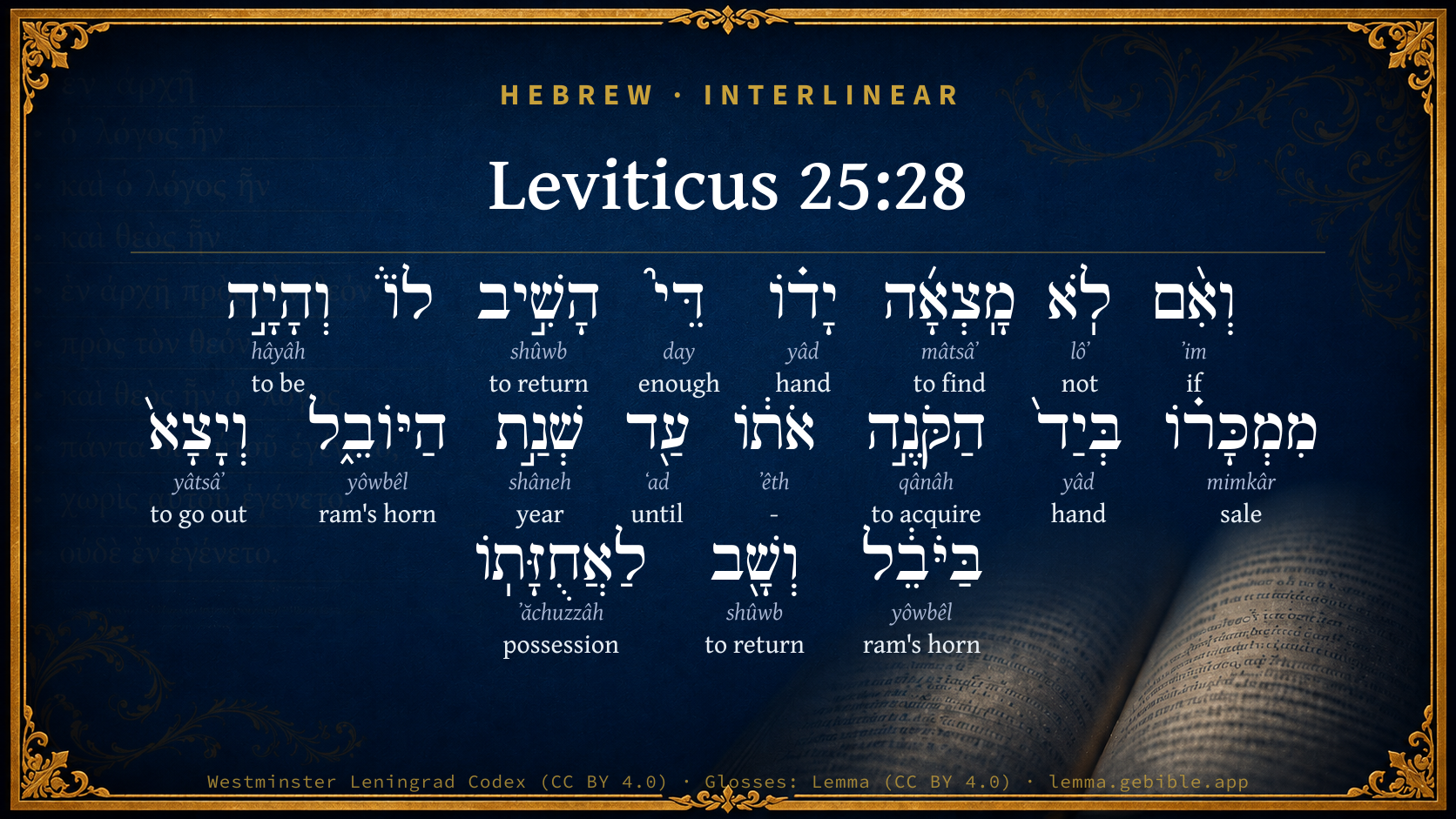
Hebrew (Westminster Leningrad Codex) Leviticus 25:28 appears in the Hebrew Old Testament. The text above is from the Westminster Leningrad Codex. Each word links to its Strong’s number, a concise gloss, and parsing drawn from the Open Scriptures Hebrew Bible morphology. Click any word for its full Brown-Driver-Briggs (BDB) entry.
Download image
Cite this verse

Leviticus 25:28 (World English Bible). Public Domain. Lemma interlinear Bible study tool, https://lemma.gebible.app/v/leviticus/25/28.

Show BibTeX & RIS
BibTeX
RIS
English Translation
But if he isn't able to get it back for himself, then what he has sold shall remain in the hand of him who has bought it until the Year of Jubilee: and in the Jubilee it shall be released, and he shall return to his propery.
World English Bible · Public Domain
Download a study sheet

One document with this verse’s original text, its word-by-word gloss line, the meaning frame, cross-references with their text, attributed commentary, and full source and license credits — printable, and it pastes into notes with its structure intact.

This verse Autodidact and up

Study sheet (.html) Plain text (.txt)

A passage Seminary Student

Up to 50 verses in one chapter. A passage sheet keeps up to 6 commentary sources and 12 cross-references per verse, in the order this page ranks them, and says so on the sheet whenever that leaves anything out. Ask for a single verse and you get the Autodidact verse sheet above.

Everything on this page stays free to read, with no account — the sheet is a download of what is already on screen, not access to it.

Want to remove ads? Support Godless Engineer
Compare translations 3

The same verse in 3 English versions, stacked beneath the original-language interlinear above. Click any original word for its lexicon entry.

Each is an independent rendering of the whole verse — the interlinear is not word-aligned to these translations.

Highlighted words mark where these versions differ — a whole-verse word diff, not a word-by-word alignment.

  • World English Bible Public Domain
    But if he isn't able to get it back for himself, then what he has sold shall remain in the hand of him who has bought it until the Year of Jubilee: and in the Jubilee it shall be released, and he shall return to his propery.
  • King James Version Public Domain
    But if he be not able to restore it to him, then that which is sold shall remain in the hand of him that hath bought it until the year of jubilee: and in the jubilee it shall go out, and he shall return unto his possession.
  • unfoldingWord Literal Text CC BY-SA 4.0
    But if his hand does not find enough to return to him, then his sold thing shall be in the hand of the one who bought it until the Year of Jubilee. And it shall go out in the Jubilee, and he shall return to his possession.

unfoldingWord Literal Text — © unfoldingWord, licensed CC BY-SA 4.0. Word-aligned USFM3 via Door43 (git.door43.org/unfoldingWord/en_ult).

Versions to compare (up to 4)

3 of 4 selected

Show all 18 translations

Every available English version of this verse, each an independent rendering of the whole verse.

  • World English Bible Public Domain
    But if he isn't able to get it back for himself, then what he has sold shall remain in the hand of him who has bought it until the Year of Jubilee: and in the Jubilee it shall be released, and he shall return to his propery.
  • Berean Standard Bible Public Domain
    But if he cannot obtain enough to repay him, what he sold will remain in possession of the buyer until the Year of Jubilee. In the Jubilee, however, it is to be released, so that he may return to his property.
  • Majority Standard Bible Public Domain
    But if he cannot obtain enough to repay him, what he sold will remain in possession of the buyer until the Year of Jubilee. In the Jubilee, however, it is to be released, so that he may return to his property.
  • King James Version Public Domain
    But if he be not able to restore it to him, then that which is sold shall remain in the hand of him that hath bought it until the year of jubilee: and in the jubilee it shall go out, and he shall return unto his possession.
  • American Standard Version (1901) Public Domain
    But if he be not able to get it back for himself, then that which he hath sold shall remain in the hand of him that hath bought it until the year of jubilee: and in the jubilee it shall go out, and he shall return unto his possession.
  • Revised Version (1885) Public Domain
    But if he be not able to get it back for himself, then that which he hath sold shall remain in the hand of him that hath bought it until the year of jubile: and in the jubile it shall go out, and he shall return unto his possession.
  • Geneva Bible (1599) Public Domain
    But if he can not get sufficient to restore to him, then that which is solde, shall remaine in the hande of him that hath bought it, vntill the yere of the Iubile: and in the Iubile it shall come out, and he shall returne vnto his possession.
  • Douay-Rheims (1899) Public Domain
    But if his hands find not the means to repay the price, the buyer shall have what he bought, until the year of the jubilee. For in that year all that is sold shall return to the owner, and to the ancient possessor.
  • Young's Literal Translation Public Domain
    `And if his hand hath not found sufficiency to give back to him, then hath his sold thing been in the hand of him who buyeth it till the year of jubilee; and it hath gone out in the jubilee, and he hath returned to his possession.
  • Literal Standard Version CC BY-SA 4.0
    And if his hand has not found sufficiency to give back to him, then his sold thing has been in the hand of him who buys it until the Year of Jubilee; and it has gone out in the Jubilee, and he has returned to his possession.
  • Unlocked Literal Bible CC BY-SA 4.0
    But if he is not able to get the land back for himself, then the land he has sold will remain in the ownership of the one who bought it until the year of Jubilee. At the year of Jubilee, the land will be returned to the man who sold it, and the original owner will return to his property.
  • unfoldingWord Literal Text CC BY-SA 4.0
    But if his hand does not find enough to return to him, then his sold thing shall be in the hand of the one who bought it until the Year of Jubilee. And it shall go out in the Jubilee, and he shall return to his possession.
  • Darby Bible Public Domain
    And if his hand have not found what sufficeth for him to restore it to him, then that which is sold shall remain in the hand of the purchaser, until the year of jubilee; and in the jubilee it shall go out, and he shall return unto his possession.
  • World Messianic Bible Public Domain
    But if he isn’t able to get it back for himself, then what he has sold shall remain in the hand of him who has bought it until the Year of Jubilee. In the Jubilee it shall be released, and he shall return to his property.
  • Webster's Bible Public Domain
    But if he shall not be able to restore it to him, then that which is sold shall remain in the hand of him that hath bought it until the year of jubilee: and in the jubilee it shall go out, and he shall return to his possession.
  • Free Bible Version CC BY-SA 4.0
    If they can't raise enough to pay the person back for the land, the buyer will remain its owner until the Jubilee Year. But in the Jubilee Year the land will be returned so that the original owners can go back to their property.
  • Bible in Basic English Public Domain
    But if he is not able to get it back for himself, then it will be kept by him who gave a price for it, till the year of Jubilee; and in that year it will go back to its first owner and he will have his property again.
  • JPS Tanakh (1917) Public Domain
    But if he have not sufficient means to get it back for himself, then that which he hath sold shall remain in the hand of him that hath bought it until the year of jubilee; and in the jubilee it shall go out, and he shall return unto his possession.

Literal Standard Version (2020), Covenant Press — licensed CC BY-SA 4.0. Text via the HelloAO Bible API (eBible.org). Unlocked Literal Bible (unfoldingWord) — licensed CC BY-SA 4.0. Text via the HelloAO Bible API (eBible.org). unfoldingWord Literal Text — © unfoldingWord, licensed CC BY-SA 4.0. Word-aligned USFM3 via Door43 (git.door43.org/unfoldingWord/en_ult). Free Bible Version, Dr. Jonathan Gallagher — licensed CC BY-SA 4.0. Text via the HelloAO Bible API (eBible.org).

Word by word

More ways to search: Search by grammar → Find every occurrence → Compare this word →

Practice this passage: Drill this verse → Learn its vocabulary →

מִמְכָּר֗וֹ
mimkâr
H4465
“sale · his”
Noun, Common, Masculine, Singular, Construct + Suffix, Personal, 3rd Person, Masculine, Singular
Part of Speech
Noun
Type
Common
Gender
Masculine
Number
Singular
State
Construct
Full BDB Definition

Origin: from H4376

TWOT: 1194b

sale, ware, thing sold
  1. וְאִ֨ם ʼim H518 “and · if” Conjunction + Conjunction
  2. לֹֽא lôʼ H3808 “not” Particle, Negative
  3. מָֽצְאָ֜ה mâtsâʼ H4672 “to find” Verb, Qal, Perfect, 3rd Person, Feminine, Singular
  4. יָד֗וֹ yâd H3027 “hand · his” Noun, Common, Both, Singular, Construct + Suffix, Personal, 3rd Person, Masculine, Singular
  5. דֵּי֮ day H1767 “enough of” Noun, Common, Masculine, Singular, Construct
  6. הָשִׁ֣יב shûwb H7725 “to return” Verb, Hiphil, Infinitive Construct
  7. וְהָיָ֣ה hâyâh H1961 “and · to be” Conjunction + Verb, Qal, Sequential Perfect, 3rd Person, Masculine, Singular
  8. בְּיַד֙ yâd H3027 “in/at · hand of” Preposition + Noun, Common, Both, Singular, Construct
  9. הַקֹּנֶ֣ה qânâh H7069 “the · acquiring” Particle, Definite Article + Verb, Qal, Participle Active, Masculine, Singular, Absolute
  10. אֹת֔וֹ ʼêth H853 “- · him” Particle, Direct Object + Suffix, Personal, 3rd Person, Masculine, Singular
  11. עַ֖ד ʻad H5704 “until” Preposition
  12. שְׁנַ֣ת shâneh H8141 “year of” Noun, Common, Feminine, Singular, Construct
  13. הַיּוֹבֵ֑ל yôwbêl H3104 “the · ram's horn” Particle, Definite Article + Noun, Common, Masculine, Singular, Absolute
  14. וְיָצָא֙ yâtsâʼ H3318 “and · to go out” Conjunction + Verb, Qal, Sequential Perfect, 3rd Person, Masculine, Singular
  15. בַּיֹּבֵ֔ל yôwbêl H3104 “in/at the · ram's horn” Preposition, Determined + Noun, Common, Masculine, Singular, Absolute
  16. וְשָׁ֖ב shûwb H7725 “and · to return” Conjunction + Verb, Qal, Sequential Perfect, 3rd Person, Masculine, Singular
  17. לַאֲחֻזָּתֽוֹ ʼăchuzzâh H272 “to/for · possession · his” Preposition + Noun, Common, Feminine, Singular, Construct + Suffix, Personal, 3rd Person, Masculine, Singular

About this verse

These counts appear in no published source. They are computed here, from the morphology-tagged text and Lemma’s own curated glosses. What Lemma adds →

19
words
15
distinct lemmas
Pentateuch
section

Notable vocabulary

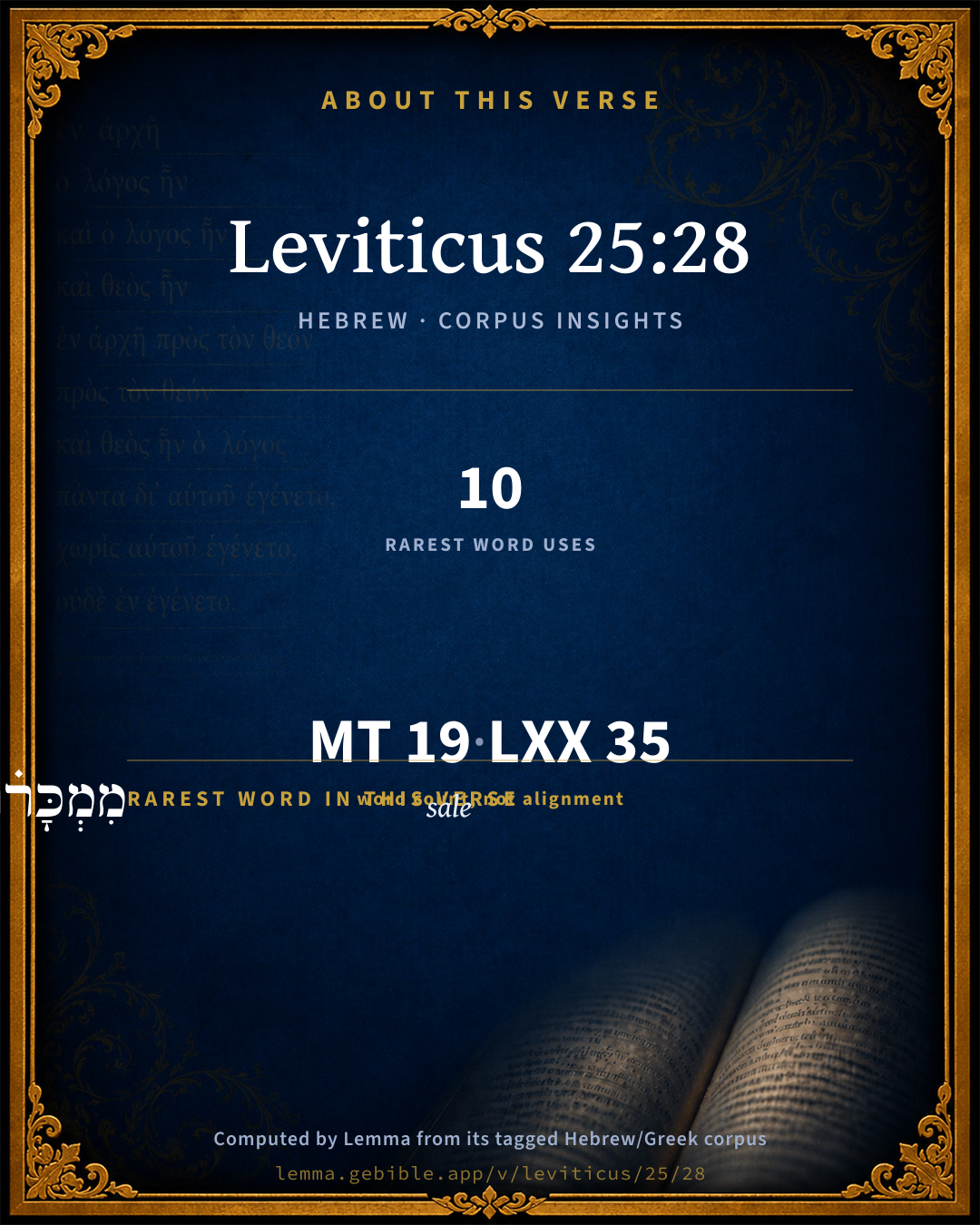
The rarest word here is מִמְכָּר֗וֹ sale H4465 — appearing just 10 times in the whole Hebrew Bible.

Shared distinctive vocabulary

מִמְכָּר֗וֹ sale H4465 occurs in 10 verses of the Hebrew Bible. Also found in:

Grammatical profile

  • 6 verbs
  • 8 nouns
  • 2 prepositions
  • 1 conjunction
  • 2 particles

Verb forms

  • מָֽצְאָ֜ה Qal · Perfect
  • הָשִׁ֣יב Hiphil · Infinitive Construct
  • וְהָיָ֣ה Qal · Sequential Perfect
  • הַקֹּנֶ֣ה Qal · Participle Active
  • וְיָצָא֙ Qal · Sequential Perfect
  • וְשָׁ֖ב Qal · Sequential Perfect

Repetition

Words recur within this verse — often emphatic in Hebrew:

  • יָד֗וֹ hand H3027 ×2
  • הָשִׁ֣יב to return H7725 ×2
  • הַיּוֹבֵ֑ל ram's horn H3104 ×2

Hebrew & Septuagint length

In English translation the verse runs 47 words from the Hebrew and 50 from the Septuagint (LXX English) — closely comparable.

A rough comparison of the two English renderings, which tokenize alike — not a word-level alignment.

Word counts can differ between the Hebrew and the Greek without any difference in meaning — e.g. the Hebrew direct-object marker אֵת has no separate Greek word, and Greek often adds the article ὁ.

In the original languages it is 19 Hebrew tokens and 35 Greek tokens — but the two are counted differently (Hebrew bundles its prefixes and suffixes into one token; the Greek is in lemma form), so that isn’t a like-for-like length.

Cross-references

7

Topical passages linked to Leviticus 25:28 in the Treasury of Scripture Knowledge — connected by theme and wording, ordered by reader-vote popularity; previews shown in the World English Bible.

  • Leviticus 25:10 You shall make the fiftieth year holy, and proclaim liberty throughout the land to all its inhabitants. It shall be a jubilee to you; and each of you shall return to his own property, and each of you shall return to his family.
  • Leviticus 25:13 "'In this Year of Jubilee each of you shall return to his property.
  • Isaiah 35:9–10 No lion shall be there, nor shall any ravenous animal go up thereon; they shall not be found there; but the redeemed shall walk [there]:
  • Jeremiah 32:15 For thus says Yahweh of Hosts, the God of Israel: Houses and fields and vineyards shall yet again be bought in this land.
  • 1 Corinthians 15:52–54 in a moment, in the twinkling of an eye, at the last trumpet. For the trumpet will sound, and the dead will be raised incorruptible, and we will be changed.
  • 1 Thessalonians 4:13–18 But we don't want you to be ignorant, brothers, concerning those who have fallen asleep, so that you don't grieve like the rest, who have no hope.
  • 1 Peter 1:4–5 to an incorruptible and undefiled inheritance that doesn't fade away, reserved in heaven for you,

Cross-references courtesy of OpenBible.info (CC BY 4.0).

Hebrew and Greek witnesses Masoretic Hebrew ↔ Greek Septuagint

The same verse in the two great witnesses to the Old Testament, shown verse-for-verse.

These are two independent witnesses, not word-aligned to each other, and the Septuagint is shown in lemma (dictionary) form.

Hebrew Leviticus 25:28 Masoretic · Westminster Leningrad Codex

וְאִ֨ם לֹֽא מָֽצְאָ֜ה יָד֗וֹ דֵּי֮ הָשִׁ֣יב לוֹ֒ וְהָיָ֣ה מִמְכָּר֗וֹ בְּיַד֙ הַקֹּנֶ֣ה אֹת֔וֹ עַ֖ד שְׁנַ֣ת הַיּוֹבֵ֑ל וְיָצָא֙ בַּיֹּבֵ֔ל וְשָׁ֖ב לַאֲחֻזָּתֽוֹ

But if he isn't able to get it back for himself, then what he has sold shall remain in the hand of him who has bought it until the Year of Jubilee: and in the Jubilee it shall be released, and he shall return to his propery.

World English Bible · Public Domain

Greek LXX Leviticus 25:28 Septuagint · lemma form

ἐάν δέ μή εὐπορέω ὁ χείρ αὐτός ὁ ἱκανός ὥστε ἀποδίδωμι αὐτός καί εἰμί ὁ πρᾶσις ὁ κτάομαι αὐτός ἕως ὁ ἕκτος ἔτος ὁ ἄφεσις καί ἐκἔρχομαι ὁ ἄφεσις καί ἀποἔρχομαι εἰς ὁ κατάσχεσις αὐτός

But if his hand have not prospered sufficiently, so as that he should restore the money to him, then he that bought the possessions shall have them till the sixth year of the release; and it shall go out in the release, and the owner shall return to his possession.

LXX2012 (modern English Septuagint) · Public Domain

Hebrew: Westminster Leningrad Codex (CC BY 4.0). Greek: Septuagint (public domain); English from LXX2012 (modern English Septuagint) (Public Domain). How the Septuagint differs from the Hebrew →

Targum (Aramaic paraphrase)

2

The Targum is the ancient Jewish Aramaic paraphrase of the Hebrew Scriptures — an interpretive translation, not the Hebrew text itself. Onkelos (literal) and Pseudo-Jonathan (expansive) render the Torah, and Jonathan the Prophets. Coverage is partial: where no permissively-licensed English translation exists for a verse, only the Aramaic is shown. This is verse-level text, not a word-by-word alignment to the Hebrew.

  1. Targum Onkelos Torah (Genesis–Deuteronomy)
    וְאִם לָא תַשְׁכַּח יְדֵהּ כְּמִסַת אֲתֵב לֵהּ וִיהֵי זְבִינוֹהִי בִּידָא דִזְבַן יָתֵהּ עַד שַׁתָּא דְיוֹבֵלָא וְיִפּוֹק בְּיוֹבֵלָא וִיתוּב לְאַחֲסַנְתֵּהּ

    (no public-domain English translation for this verse)

    Targum Onkelos — Aramaic: “Onkelos Genesis” (public domain); “Onkelos Exodus” (public domain); “Onkelos Leviticus” (public domain); “Onkelos Numbers” (public domain); “Onkelos Deuteronomy” (public domain). English: “Sefaria Community Translation” (CC0 1.0 (public-domain dedication)); “J.W. Etheridge. The Targums of Onkelos and Jonathan Ben Uzziel on the Pentateuch. London: Longmans, Green, 1862” (public domain). Text via Sefaria.

  2. Targum Pseudo-Jonathan Torah (Genesis–Deuteronomy)
    וְאִין לָא תְאַרַע יְדֵיהּ הֵיכְמִסַת דְיָתֵיב לֵיהּ וִיהֵי זְבִינוֹי בְּיַד מַאן דְזַבִּין יָתֵיהּ עַד שַׁתָּא דְיוֹבְלָא וְיִפּוֹק בְּלָא כְסַף וְיֵתוּב לְאַחֲסַנְתֵּיהּ

    But if his hand meet not with the price that he should give him, then the property sold shall (remain) in the hand of him who bought it until the year of Jubela, and shall then go out without money, and he shall return to his possession.

    Targum Pseudo-Jonathan — Aramaic: “Targum Jonathan on Genesis” (public domain); “Targum Jonathan on Exodus” (public domain); “Targum Jonathan on Leviticus” (public domain); “Targum Jonathan on Numbers” (public domain); “Targum Jonathan on Deuteronomy” (public domain). English: “The Targum of Jonathan ben Uzziel, trans. J. W. Etheridge, London, 1862” (public domain). Text via Sefaria.

Commentary

Notes on Leviticus 25:28 from classic Christian and Jewish commentators (each source and its license shown beneath its notes). The classic Christian expositions comment on the surrounding passage and are grouped to its opening verse, so a note may address several verses; the Jewish commentaries on the Tanakh (Rashi and others) are per-verse, so they appear only where the commentator wrote on this verse.

Lemma curates 59 commentaries, every one of them public domain or Creative Commons licensed, each selected and text-cleaned for this edition rather than reprinted as found. About our sources →

Trapp's Complete Commentary

John Trapp

Lev 25:28 But if he be not able to restore [it] to him, then that which is sold shall remain in the hand of him that hath bought it until the year of jubile: and in the jubile it shall go out, and he shall return unto his possession.

Ver. 28. And he shall return unto his possession.] So do all God’s Israel to their heavenly inheritance. {Col 1:12-14 Eph 1:10-11; Eph 1:18 1Pe 1:4}

John Trapp, A Commentary or Exposition upon All the Books of the Old and New Testament (1647–1656) — public domain. Text from a community e-Sword module.

Geneva Bible (1599)

Geneva Bible translators

From his hand that bought it.

Geneva Bible (1599) marginal notes — public domain. Text via Bolls.life.

Ellicott's Commentary for English Readers

(28) Not able to restore it to him.—That is, if the vendor is unable to return to the purchaser the probable value of the crops between the contemplated redemption and the next jubile year.

Then that which is sold.—In that case the land thus sold is to continue with the purchaser till jubile, when it is to revert to the vendor without any repayment whatever. The design of this law was to secure to each family a permanent interest in the soil, and to prevent the accumulation of land on the part of the greedy few who are ever anxious to join field unto field, thus precluding the existence of landless beggars and too extensive landed proprietors. To the same effect were the laws of inheritance (Num_27:6-11; Num_36:5-13). Similar laws obtained among other nations of antiquity. Laws were enacted that the lots which were distributed among the inhabitants were neither to be sold nor bought. Solon made it a law that no one should acquire as much land as he wished; whilst Plato held that no individual person is to possess more than four times the quantity of land than the lowest owner, who had only a single lot.

A Bible Commentary for English Readers, edited by Charles John Ellicott (1878–1897) — public domain. Text from a community e-Sword module.

John Gill's Exposition

But if he be not able to restore it to him,.... The overplus, or give him what is in proportion to the time he has had it, and yet to come:

then that which is sold shall remain in the hand of him that bought it until the year of the jubilee; continue in his possession, and he shall enjoy all the benefit of it till that year comes:

and in the jubilee it shall go out: out of his hands or possession; or "he shall go out" (g), the purchaser shall go out of what he has bought, and shall have no more possession of it, but it shall come into the hands of the seller, and that without money, as the Targum of Jonathan adds:

and he shall return unto his possession; the seller, and enter upon it and enjoy it as his own property, as before he sold it.

(g) "discedet emptor", Junius & Tremellius.

John Gill's Exposition of the Whole Bible (1746–1763) — public domain (CC PDM 1.0). Text via the HelloAO Bible API.

Albert Barnes' Notes on the Bible

It shall go out - i. e. it shall be set free.

Albert Barnes' Notes on the Bible (1834–1885) — public domain. Text from a community e-Sword/MySword module.

Matthew Poole's English Annotations

It shall go out, i.e. out of the buyer’s hand, without any redemption money.

Matthew Poole's English Annotations on the Holy Bible (1683–1685) — public domain. Text from a community e-Sword/MySword module.

John Wesley's Explanatory Notes

Go out - That is, out of the buyer's hand, without any redemption money.

John Wesley, Explanatory Notes Upon the Whole Bible (1754–1765) — public domain. Text via the GEBible commentary corpus.

Rashi

Rabbi Shlomo Yitzchaki (Rashi)

די השיב לו [BUT IF HE IS NOT ABLE] TO RESTORE IT (lit., if his hand find not sufficient means to restore to him) — Therefore it follows that he (the vendor) has no right to redeem his property in parts (lit., by halves) (Sifra, Behar, Chapter 5 5, Arachin 30a).

עד שנת היובל UNTIL THE YEAR OF JUBILEE — “until” but not “including” the year of the Jubilee; it means that nothing of time shall have entered into that year (that not one moment of that year shall have passed), because the Jubilee effects the release of such property at its very beginning (in contrast to the cancelling of debts in the “Shemittah” which takes place only at the end of the year; cf. Deuteronomy 15:1 ff.) (Sifra, Behar, Chapter 5 6; Arakhin 28b).

Rashi on the Tanakh — English translations: “The Judaica Press complete Tanach with Rashi, translated by A. J. Rosenberg” (CC BY 4.0); “Pentateuch with Rashi's commentary by M. Rosenbaum and A.M. Silbermann, 1929-1934” (public domain); “The Metsudah Tanach series, Lakewood, N.J” (CC BY 4.0); and “The Book of Joshua, Metsudah Publications, 1997” (CC BY 4.0). Text via Sefaria.

Lesson kit

Teaching starters — assembled from the data on this page, not authored interpretation. Every prompt links to the verse data it draws on. Edit before teaching.

Leviticus, in the Pentateuch, opens this verse with 19 words (15 distinct Hebrew lemmas). Its most distinctive word is mimkâr (“sale”). A historical commentator’s framing appears above. Read the whole chapter for the surrounding context.

Discussion questions

  1. The word mimkâr carries the sense “sale.” How does it shape the verse?
  2. How does Leviticus 25:14, which shares the word «sale», read alongside this verse?
  3. What does the repetition of “hand” (2× in this one verse) do in this verse?
  4. The translations on this page render this verse differently — a whole-verse word diff, not a word-by-word alignment. What might account for the different wordings?
  5. «מָֽצְאָ֜ה» is a Qal Perfect verb. How does that grammatical form shape the action described?
  6. Compare how Trapp's Complete Commentary and Geneva Bible (1599) read this verse. Where do they agree or differ?

Things to notice

Reading settings

Reading text

Shown beneath each verse's original-language words.

Old Testament
Old Testament edition

Read the OT as the Masoretic Hebrew (MT) or the Greek Septuagint (LXX).

English shown for the Greek Septuagint (in the Hebrew ↔ Greek comparison).

Comparing translations? Open the Compare panel on any verse page to stack up to four side by side.