

2 Thessalonians 2:4
Greek (Tischendorf 8th ed.) 2 Thessalonians 2:4 appears in the Greek New Testament. The text above is from the Tischendorf 8th edition. Each word links to its Strong’s number and a concise gloss. Click any word for its full Thayer’s Greek Lexicon entry.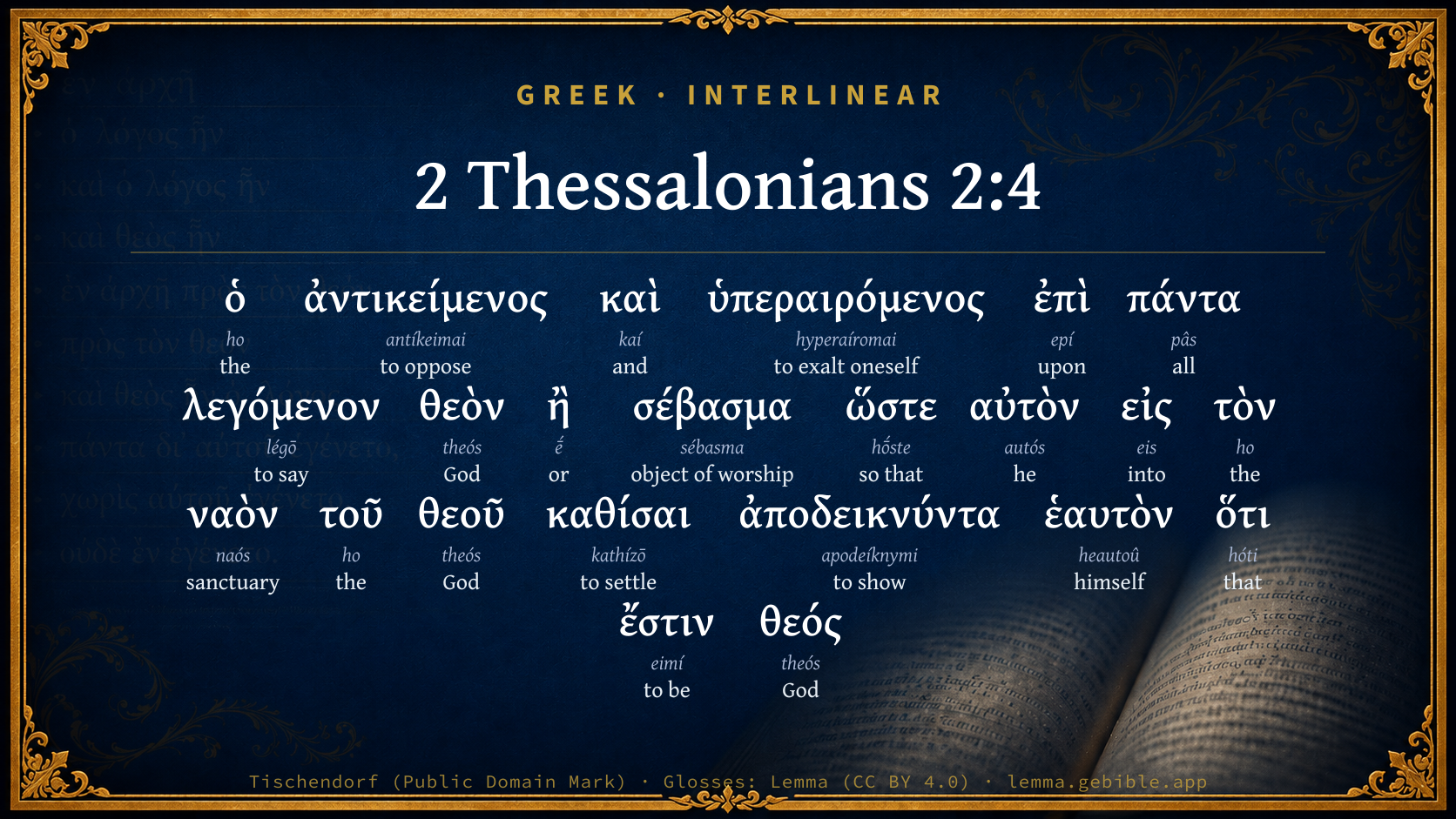
he who opposes and exalts himself against all that is called God or that is worshiped; so that he sits as God in the temple of God, setting himself up as God.
Download a study sheet
One document with this verse’s original text, its word-by-word gloss line, the meaning frame, cross-references with their text, attributed commentary, and full source and license credits — printable, and it pastes into notes with its structure intact.
This verse Autodidact and up
A passage Seminary Student
Up to 50 verses in one chapter. A passage sheet keeps up to 6 commentary sources and 12 cross-references per verse, in the order this page ranks them, and says so on the sheet whenever that leaves anything out. Ask for a single verse and you get the Autodidact verse sheet above.
Everything on this page stays free to read, with no account — the sheet is a download of what is already on screen, not access to it.
Compare translations 3
The same verse in 3 English versions, stacked beneath the original-language interlinear above. Click any original word for its lexicon entry.
Each is an independent rendering of the whole verse — the interlinear is not word-aligned to these translations.
Highlighted words mark where these versions differ — a whole-verse word diff, not a word-by-word alignment.
-
World English Bible Public Domain
he who opposes and exalts himself against all that is called God or that is worshiped; so that he sits as God in the temple of God, setting himself up as God.
-
King James Version Public Domain
Who opposeth and exalteth himself above all that is called God, or that is worshipped; so that he as God sitteth in the temple of God, shewing himself that he is God.
-
unfoldingWord Literal Text CC BY-SA 4.0
the one opposing and exalting himself against everything being called god or an object of worship. As a result, he himself sits in the temple of God, showing that he himself is God.
unfoldingWord Literal Text — © unfoldingWord, licensed CC BY-SA 4.0. Word-aligned USFM3 via Door43 (git.door43.org/unfoldingWord/en_ult).
Show all 19 translations
Every available English version of this verse, each an independent rendering of the whole verse.
-
World English Bible Public Domain
he who opposes and exalts himself against all that is called God or that is worshiped; so that he sits as God in the temple of God, setting himself up as God.
-
Berean Standard Bible Public Domain
He will oppose and exalt himself above every so-called god or object of worship. So he will seat himself in the temple of God, proclaiming himself to be God.
-
Majority Standard Bible Public Domain
He will oppose and exalt himself above every so-called god or object of worship. So he will seat himself as God in the temple of God, proclaiming himself to be God.
-
King James Version Public Domain
Who opposeth and exalteth himself above all that is called God, or that is worshipped; so that he as God sitteth in the temple of God, shewing himself that he is God.
-
American Standard Version (1901) Public Domain
he that opposeth and exalteth himself against all that is called God or that is worshipped; so that he sitteth in the temple of God, setting himself forth as God.
-
Revised Version (1885) Public Domain
he that opposeth and exalteth himself against all that is called God or that is worshipped; so that he sitteth in the temple of God, setting himself forth as God.
-
Geneva Bible (1599) Public Domain
Which is an aduersarie, and exalteth him selfe against all that is called God, or that is worshipped: so that he doeth sit as God in the Temple of God, shewing him selfe that he is God.
-
Douay-Rheims (1899) Public Domain
Who opposeth, and is lifted up above all that is called God, or that is worshipped, so that he sitteth in the temple of God, shewing himself as if he were God.
-
Young's Literal Translation Public Domain
who is opposing and is raising himself up above all called God or worshipped, so that he in the sanctuary of God as God hath sat down, shewing himself off that he is God -- `the day doth not come'.
-
Literal Standard Version CC BY-SA 4.0
who is opposing and is raising himself up above all called god or worshiped, so as for him to have sat down in the temple of God, proclaiming that he is God.
-
Unlocked Literal Bible CC BY-SA 4.0
This is he who opposes and exalts himself against all that is called God or that is worshiped. As a result, he sits in the temple of God and exhibits himself as God.
-
unfoldingWord Literal Text CC BY-SA 4.0
the one opposing and exalting himself against everything being called god or an object of worship. As a result, he himself sits in the temple of God, showing that he himself is God.
-
Darby Bible Public Domain
who opposes and exalts himself on high against all called God, or object of veneration; so that he himself sits down in the temple of God, shewing himself that he is God.
-
World Messianic Bible Public Domain
He opposes and exalts himself against all that is called God or that is worshiped, so that he sits as God in the temple of God, setting himself up as God.
-
Webster's Bible Public Domain
Who opposeth and exalteth himself above all that is called God, or that is worshiped; so that he as God sitteth in the temple of God, showing himself that he is God.
-
Free Bible Version CC BY-SA 4.0
He is the enemy of God, and proudly sets himself up over everything that is called God and is worshiped. He even installs himself in God's Temple, claiming to be God.
-
Bible in Basic English Public Domain
Who puts himself against all authority, lifting himself up over all which is named God or is given worship; so that he takes his seat in the Temple of God, putting himself forward as God.
-
Text-Critical English NT CC BY 4.0
He will oppose and exalt himself above every so-called god and object of worship, so that he sits as God in the temple of God, proclaiming himself to be God.
-
Tyndale New Testament (1534) Public Domain
which is an adversarie and is exalted above all that is called god or that is worshipped: so that he shall sitt as God in temple of god and shew him silfe as god.
Literal Standard Version (2020), Covenant Press — licensed CC BY-SA 4.0. Text via the HelloAO Bible API (eBible.org). Unlocked Literal Bible (unfoldingWord) — licensed CC BY-SA 4.0. Text via the HelloAO Bible API (eBible.org). unfoldingWord Literal Text — © unfoldingWord, licensed CC BY-SA 4.0. Word-aligned USFM3 via Door43 (git.door43.org/unfoldingWord/en_ult). Free Bible Version, Dr. Jonathan Gallagher — licensed CC BY-SA 4.0. Text via the HelloAO Bible API (eBible.org).
Word by word
More ways to search: Search by grammar → Find every occurrence → Compare this word →
Practice this passage: Drill this verse → Learn its vocabulary →
- Appears 2× in the Greek New Testament
- First appears at Acts 17:23
- Part of Speech
- Noun
- Case
- Accusative
- Number
- Singular
- Gender
- Neuter
Full Thayer's Definition
- ὁ ho G3588 “the” Article, Nominative, Singular, Masculine
- ἀντικείμενος antíkeimai G480 “to oppose” Verb, Present, Middle or Passive deponent, Participle, Nominative, Singular, Masculine
- καὶ kaí G2532 “and” Conjunction
- ὑπεραιρόμενος hyperaíromai G5229 “to exalt oneself” Verb, Present, Passive, Participle, Nominative, Singular, Masculine
- ἐπὶ epí G1909 “upon” Preposition
- πάντα pâs G3956 “all” Adjective, Accusative, Singular, Masculine
- λεγόμενον légō G3004 “to say” Verb, Present, Passive, Participle, Accusative, Singular, Masculine
- θεὸν theós G2316 “God” Noun, Accusative, Singular, Masculine
- ἢ ḗ G2228 “or” Particle
- σέβασμα sébasma G4574 “object of worship” Noun, Accusative, Singular, Neuter
- ὥστε hṓste G5620 “so that” Conjunction
- αὐτὸν autós G846 “he” Personal pronoun, Accusative, Singular, Masculine
- εἰς eis G1519 “into” Preposition
- τὸν ho G3588 “the” Article, Accusative, Singular, Masculine
- ναὸν naós G3485 “sanctuary” Noun, Accusative, Singular, Masculine
- τοῦ ho G3588 “the” Article, Genitive, Singular, Masculine
- θεοῦ theós G2316 “God” Noun, Genitive, Singular, Masculine
- καθίσαι kathízō G2523 “to settle” Verb, Aorist, Active, Infinitive
- ἀποδεικνύντα apodeíknymi G584 “to show” Verb, Present, Active, Participle, Accusative, Singular, Masculine
- ἑαυτὸν heautoû G1438 “himself” Reflexive pronoun, 3rd person, Accusative, Singular, Masculine
- ὅτι hóti G3754 “that” Conjunction
- ἔστιν eimí G1510 “to be” Verb, Present, Active, Indicative, 3rd person, Singular
- θεός theós G2316 “God” Noun, Nominative, Singular, Masculine
About this verse
These counts appear in no published source. They are computed here, from the morphology-tagged text and Lemma’s own curated glosses. What Lemma adds →
- 23
- words
- 19
- distinct lemmas
- Pauline Epistles
- section
Cross-references
11Topical passages linked to 2 Thessalonians 2:4 in the Treasury of Scripture Knowledge — connected by theme and wording, ordered by reader-vote popularity; previews shown in the World English Bible.
- Ezekiel 28:2 Son of man, tell the prince of Tyre, Thus says the Lord Yahweh: Because your heart is lifted up, and you have said, I am a god, I sit in the seat of God, in the midst of the seas; yet you are man, and not God, though you did set your heart as the heart of God;-
- Daniel 7:25 He shall speak words against the Most High, and shall wear out the saints of the Most High; and he shall think to change the times and the law; and they shall be given into his hand until a time and times and half a time.
- Isaiah 14:13–14 You said in your heart, I will ascend into heaven, I will exalt my throne above the stars of God; and I will sit on the mountain of congregation, in the uttermost parts of the north;
- Revelation 13:6–7 He opened his mouth for blasphemy against God, to blaspheme his name, and his dwelling, those who dwell in heaven.
- Ezekiel 28:6 therefore thus says the Lord Yahweh: Because you have set your heart as the heart of God,
- Daniel 11:45 He shall plant the tents of his palace between the sea and the glorious holy mountain; yet he shall come to his end, and none shall help him.
- Daniel 7:8 I considered the horns, and, behold, there came up among them another horn, a little one, before which three of the first horns were plucked up by the roots: and, behold, in this horn were eyes like the eyes of a man, and a mouth speaking great things.
- Daniel 8:9–14 Out of one of them came forth a little horn, which grew exceeding great, toward the south, and toward the east, and toward the glorious [land].
- 1 Corinthians 8:5 For though there are things that are called "gods," whether in the heavens or on earth; as there are many "gods" and many "lords;"
- Ezekiel 28:9 Will you yet say before him who kills you, I am God? but you are man, and not God, in the hand of him who wounds you.
- Daniel 11:36 The king shall do according to his will; and he shall exalt himself, and magnify himself above every god, and shall speak marvelous things against the God of gods; and he shall prosper until the indignation be accomplished; for that which is determined shall be done.
Cross-references courtesy of OpenBible.info (CC BY 4.0).
Where the printed editions differ
1 variantPlaces in this verse where the major printed Greek editions disagree on the wording in a way that affects the translation — a comparison of editions, not a manuscript-by-manuscript collation. The editions are the modern critical texts (Nestlé-Aland 28/27, SBL, Westcott-Hort, Tregelles, Tyndale House) and the traditional texts behind the KJV (the Textus Receptus and the Byzantine/Majority text). It is not a claim about which reading is original.
-
Extra text
ὡς θεὸν
“as god”
In TRByz Not in NA28NA27TynSBLWHTregὡς θεὸν (hōs theon) 'as god' is only in traditional manuscripts (TR+Byz)
Textual data: Translators Amalgamated Greek New Testament (STEPBible TAGNT) · CC BY 4.0.
Lesson kit
Teaching starters — assembled from the data on this page, not authored interpretation. Every prompt links to the verse data it draws on. Edit before teaching.
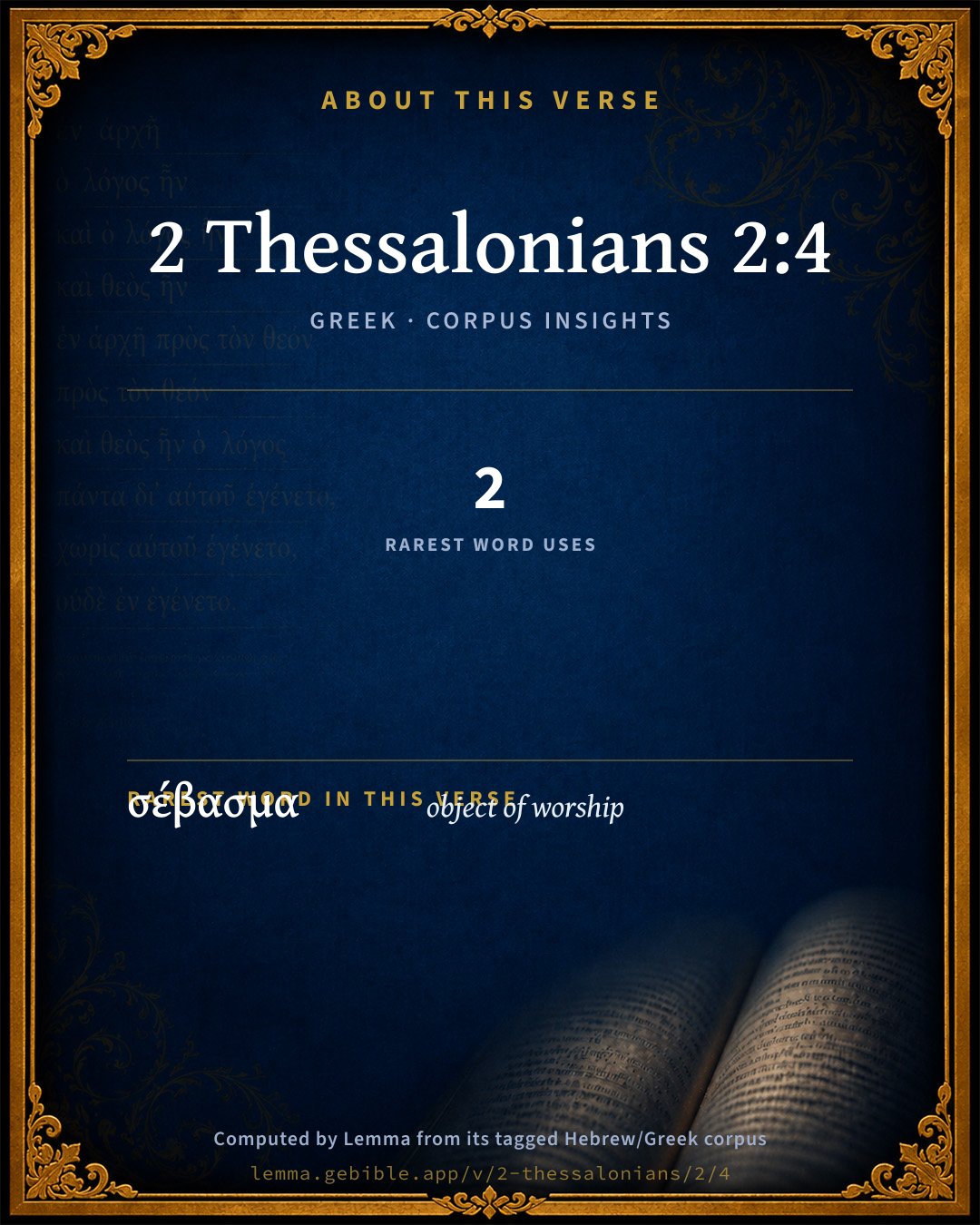
2 Thessalonians, in the Pauline Epistles, opens this verse with 23 words (19 distinct Greek lemmas). Its most distinctive word is sébasma (“object of worship”). A historical commentator’s framing appears above. Read the whole chapter for the surrounding context.
Discussion questions
- The word sébasma carries the sense “object of worship.” How does it shape the verse?
- Acts 17:23 shares the word «object of worship» with this verse. How do the two illuminate each other?
- “God” occurs 3× in this one verse. What is the effect of the repetition?
- These translations render this verse differently; the difference is in the English rendering, not the original. What questions does that raise?
- Reading how Jamieson, Fausset & Brown and The Biblical Illustrator read this verse, where do the two commentators agree and where do they part?
Things to notice
- These translations choose different wording for 24 words in this verse.
- “God” occurs 3× in this single verse.
- 19 distinct Greek lemmas span 23 words in this verse.
Commentary
Notes on 2 Thessalonians 2:4 from classic Christian and Jewish commentators (each source and its license shown beneath its notes). The classic Christian expositions comment on the surrounding passage and are grouped to its opening verse, so a note may address several verses; the Jewish commentaries on the Tanakh (Rashi and others) are per-verse, so they appear only where the commentator wrote on this verse.
Lemma curates 59 commentaries, every one of them public domain or Creative Commons licensed, each selected and text-cleaned for this edition rather than reprinted as found. About our sources →
Jamieson, Fausset & Brown
Robert Jamieson, A. R. Fausset & David Brown
Jamieson, Fausset & Brown — Commentary Critical and Explanatory on the Whole Bible (1871) — public domain (CC PDM 1.0). Text via the HelloAO Bible API.
The Biblical Illustrator
Joseph S. Exell
The Biblical Illustrator, edited by Joseph S. Exell (c. 1880s–1900s) — public domain. Text from a community e-Sword module.
Tyndale Open Study Notes
Tyndale Open Resources
Tyndale Open Study Notes — © Tyndale Open Resources, licensed CC BY-SA 4.0. Text via the HelloAO Bible API.
Bengel's Gnomon
Johann Albrecht Bengel
Bengel's Gnomon of the New Testament — English translation (T&T Clark, Edinburgh, 1860) — public domain. Text from a community e-Sword module.
Meyer's Critical & Exegetical Commentary
Heinrich August Wilhelm Meyer
Meyer — Critical and Exegetical Commentary on the New Testament — English translation by Peter Christie, edited by Frederick Crombie (T&T Clark, 1880) — public domain. Text from a community e-Sword module.
Cambridge Greek Testament for Schools and Colleges
Cambridge Greek Testament for Schools and Colleges (Cambridge University Press, 1896; 21 vols, various authors incl. Carr, Maclear, Plummer, Farrar, Lumby, Moule, M. R. James, Simcox) — public domain. Text from a community e-Sword module.
Geneva Bible (1599)
Geneva Bible translators
Geneva Bible (1599) marginal notes — public domain. Text via Bolls.life.
Adam Clarke's Commentary
Adam Clarke's Commentary on the Bible (1810–1826) — public domain. Text from a community e-Sword/MySword module.
John Calvin's Commentaries
John Calvin's Commentaries (1540-1563) — public domain. Text from the Calvin Translation Society English edition (1840s-50s) via the Christian Classics Ethereal Library (ccel.org). Calvin's coverage is partial (roughly two-thirds of the Bible); uncommented books and verses are honest gaps, never fabricated. The 19th-century editor's footnotes and remarks are omitted so the notes are faithfully Calvin's own voice.
Ellicott's Commentary for English Readers
A Bible Commentary for English Readers, edited by Charles John Ellicott (1878–1897) — public domain. Text from a community e-Sword module.
The Cambridge Bible for Schools and Colleges
gen. ed. J. J. S. Perowne
The Cambridge Bible for Schools and Colleges (gen. ed. J. J. S. Perowne; Cambridge University Press, 1878–1918) — public domain. Text from a community e-Sword module.
John Gill's Exposition
John Gill's Exposition of the Whole Bible (1746–1763) — public domain (CC PDM 1.0). Text via the HelloAO Bible API.
Trapp's Complete Commentary
John Trapp
John Trapp, A Commentary or Exposition upon All the Books of the Old and New Testament (1647–1656) — public domain. Text from a community e-Sword module.
Albert Barnes' Notes on the Bible
Albert Barnes' Notes on the Bible (1834–1885) — public domain. Text from a community e-Sword/MySword module.
Matthew Poole's English Annotations
Matthew Poole's English Annotations on the Holy Bible (1683–1685) — public domain. Text from a community e-Sword/MySword module.
Whedon's Commentary on the Bible
Daniel D. Whedon
Daniel D. Whedon (gen. ed.), Commentary on the Old and New Testaments (1874–1909) — public domain. Text from a community e-Sword module.
The Pulpit Commentary
The Pulpit Commentary (1880–1919), ed. H.D.M. Spence-Jones & Joseph S. Exell — public domain. Text from a community e-Sword module.
Burkitt's Expository Notes on the New Testament
William Burkitt
William Burkitt's Expository Notes on the New Testament (1700–1703) — public domain. Text from a community e-Sword module.
McGarvey & Pendleton's Commentaries
J. W. McGarvey
J. W. McGarvey (with Philip Y. Pendleton), Commentaries on the New Testament (The Fourfold Gospel, 1914; Acts; and the epistles) — public domain. Text from a community e-Sword/MySword module.
The People's New Testament
B. W. Johnson
B. W. Johnson's The People's New Testament with Notes (1889–1891) — public domain. Electronic text from the Christian Classics Ethereal Library (CCEL) ThML edition.
International Critical Commentary
International Critical Commentary — older volumes (1896–1929), various authors — public domain. Text from a community e-Sword module.
Vincent's Word Studies in the New Testament
Marvin R. Vincent
Marvin R. Vincent, Word Studies in the New Testament (1887–1900) — public domain. Text from a community e-Sword/MySword module.