
Galatians 2:13

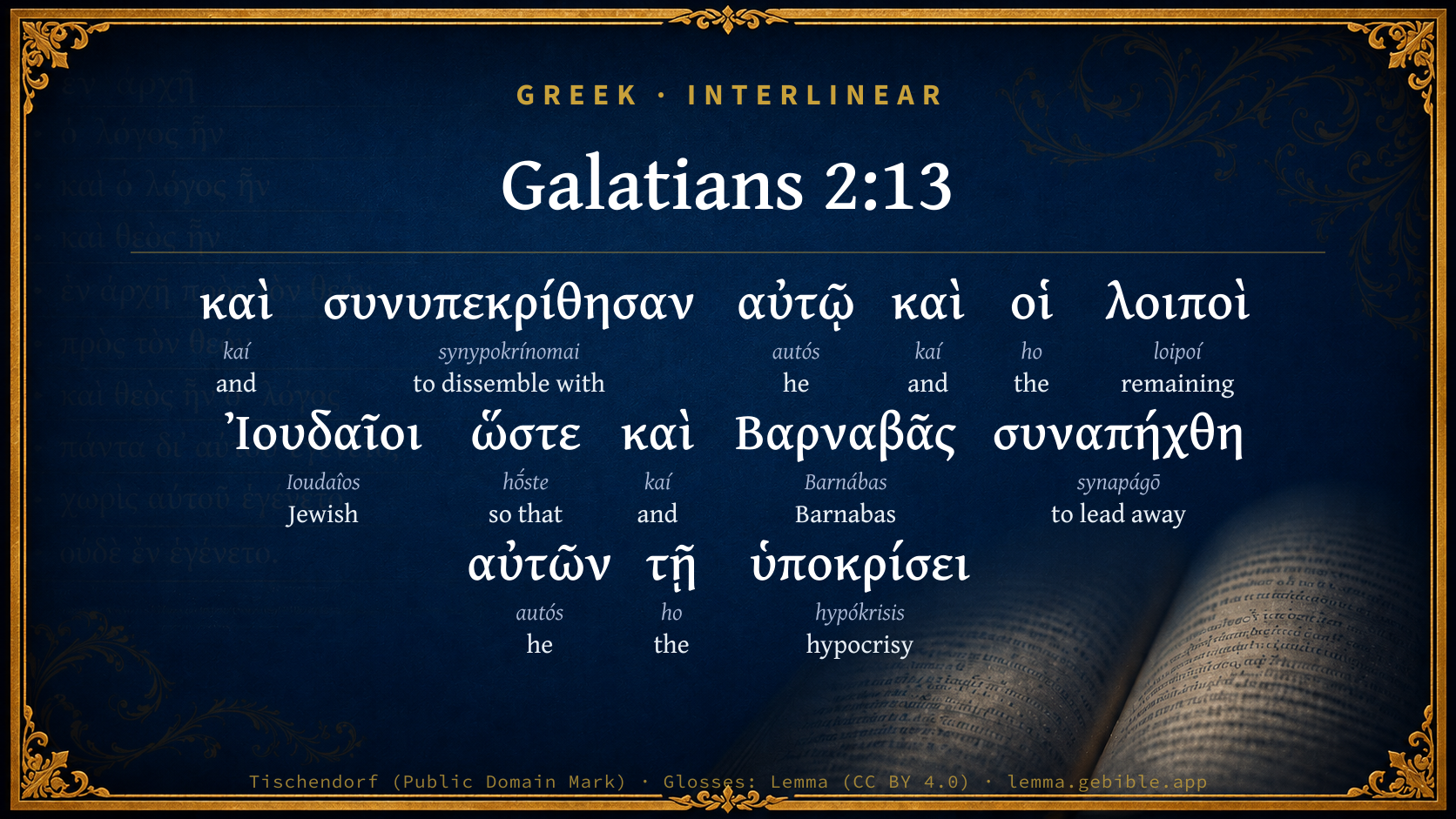
Greek (Tischendorf 8th ed.) Galatians 2:13 appears in the Greek New Testament. The text above is from the Tischendorf 8th edition. Each word links to its Strong’s number and a concise gloss. Click any word for its full Thayer’s Greek Lexicon entry.
Download image
Cite this verse

Galatians 2:13 (World English Bible). Public Domain. Lemma interlinear Bible study tool, https://lemma.gebible.app/v/galatians/2/13.

Show BibTeX & RIS
BibTeX
RIS
English Translation
And the rest of the Jews joined him in his hypocrisy; so that even Barnabas was carried away with their hypocrisy.
World English Bible · Public Domain
Highlights
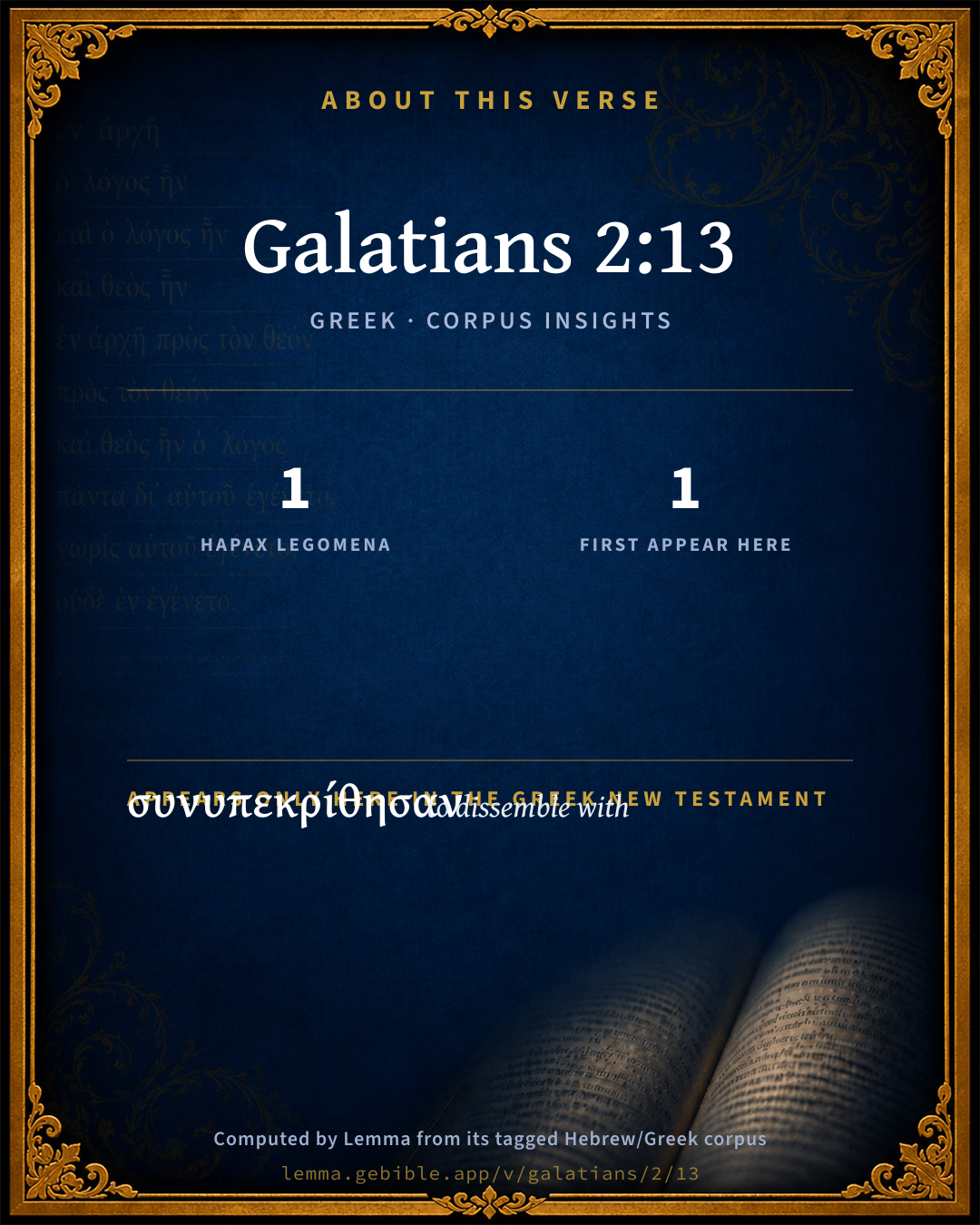
  • 1 hapax legomenon — only here in the Greek New Testament
  • 1 first appearance in the Greek New Testament
Full analysis ↓
Download a study sheet

One document with this verse’s original text, its word-by-word gloss line, the meaning frame, cross-references with their text, attributed commentary, and full source and license credits — printable, and it pastes into notes with its structure intact.

This verse Autodidact and up

Study sheet (.html) Plain text (.txt)

A passage Seminary Student

Up to 50 verses in one chapter. A passage sheet keeps up to 6 commentary sources and 12 cross-references per verse, in the order this page ranks them, and says so on the sheet whenever that leaves anything out. Ask for a single verse and you get the Autodidact verse sheet above.

Everything on this page stays free to read, with no account — the sheet is a download of what is already on screen, not access to it.

Want to remove ads? Support Godless Engineer
Compare translations 3

The same verse in 3 English versions, stacked beneath the original-language interlinear above. Click any original word for its lexicon entry.

Each is an independent rendering of the whole verse — the interlinear is not word-aligned to these translations.

Highlighted words mark where these versions differ — a whole-verse word diff, not a word-by-word alignment.

  • World English Bible Public Domain
    And the rest of the Jews joined him in his hypocrisy; so that even Barnabas was carried away with their hypocrisy.
  • King James Version Public Domain
    And the other Jews dissembled likewise with him; insomuch that Barnabas also was carried away with their dissimulation.
  • unfoldingWord Literal Text CC BY-SA 4.0
    And the rest of the Jews also joined with him, so that even Barnabas was led astray by their hypocrisy.

unfoldingWord Literal Text — © unfoldingWord, licensed CC BY-SA 4.0. Word-aligned USFM3 via Door43 (git.door43.org/unfoldingWord/en_ult).

Versions to compare (up to 4)

3 of 4 selected

Show all 19 translations

Every available English version of this verse, each an independent rendering of the whole verse.

  • World English Bible Public Domain
    And the rest of the Jews joined him in his hypocrisy; so that even Barnabas was carried away with their hypocrisy.
  • Berean Standard Bible Public Domain
    The other Jews joined him in his hypocrisy, so that by their hypocrisy even Barnabas was led astray.
  • Majority Standard Bible Public Domain
    The other Jews joined him in his hypocrisy, so that by their hypocrisy even Barnabas was led astray.
  • King James Version Public Domain
    And the other Jews dissembled likewise with him; insomuch that Barnabas also was carried away with their dissimulation.
  • American Standard Version (1901) Public Domain
    And the rest of the Jews dissembled likewise with him; insomuch that even Barnabas was carried away with their dissimulation.
  • Revised Version (1885) Public Domain
    And the rest of the Jews dissembled likewise with him; insomuch that even Barnabas was carried away with their dissimulation.
  • Geneva Bible (1599) Public Domain
    And the other Iewes played the hypocrites likewise with him, in so much that Barnabas was led away with them by that their hypocrisie.
  • Douay-Rheims (1899) Public Domain
    And to his dissimulation the rest of the Jews consented, so that Barnabas also was led by them into that dissimulation.
  • Young's Literal Translation Public Domain
    and dissemble with him also did the other Jews, so that also Barnabas was carried away by their dissimulation.
  • Literal Standard Version CC BY-SA 4.0
    and the other Jews acted hypocritically with him, so that Barnabas was also carried away by their hypocrisy.
  • Unlocked Literal Bible CC BY-SA 4.0
    Also the rest of the Jews joined in this hypocrisy. Even Barnabas was led astray with them by their hypocrisy.
  • unfoldingWord Literal Text CC BY-SA 4.0
    And the rest of the Jews also joined with him, so that even Barnabas was led astray by their hypocrisy.
  • Darby Bible Public Domain
    and the rest of the Jews also played the same dissembling part with him; so that even Barnabas was carried away too by their dissimulation.
  • World Messianic Bible Public Domain
    And the rest of the Jewish believers joined him in his hypocrisy, so that even Barnabas was carried away with their hypocrisy.
  • Webster's Bible Public Domain
    And the other Jews dissembled likewise with him; so that Barnabas also was carried away with their dissimulation.
  • Free Bible Version CC BY-SA 4.0
    As well as Peter, other Jewish Christians became hypocritical too, to the extent that even Barnabas was persuaded to follow their hypocrisy.
  • Bible in Basic English Public Domain
    And the rest of the Jews went after him, so that even Barnabas was overcome by their false ways.
  • Text-Critical English NT CC BY 4.0
    And the rest of the Jews acted hypocritically along with him, so that even Barnabas was led astray by their hypocrisy.
  • Tyndale New Testament (1534) Public Domain
    And the other Iewes dissembled lyke wyse in so moche that Barnabas was brought into their simulacion also.

Literal Standard Version (2020), Covenant Press — licensed CC BY-SA 4.0. Text via the HelloAO Bible API (eBible.org). Unlocked Literal Bible (unfoldingWord) — licensed CC BY-SA 4.0. Text via the HelloAO Bible API (eBible.org). unfoldingWord Literal Text — © unfoldingWord, licensed CC BY-SA 4.0. Word-aligned USFM3 via Door43 (git.door43.org/unfoldingWord/en_ult). Free Bible Version, Dr. Jonathan Gallagher — licensed CC BY-SA 4.0. Text via the HelloAO Bible API (eBible.org).

Word by word

More ways to search: Search by grammar → Find every occurrence → Compare this word →

Practice this passage: Drill this verse → Learn its vocabulary →

συνυπεκρίθησαν
synypokrínomai
G4942
“to dissemble with”
Verb, Aorist, Passive, Indicative, 3rd person, Plural
Part of Speech
Verb
Tense
Aorist
Voice
Passive
Mood
Indicative
Person
3rd person
Number
Plural
Full Thayer's Definition

Origin: from G4862 and G5271

TDNT: 17:19,1

1. to dissemble with 2. to act hypocritically with
  1. καὶ kaí G2532 “and” Conjunction
  2. αὐτῷ autós G846 “he” Personal pronoun, Dative, Singular, Masculine
  3. καὶ kaí G2532 “and” Conjunction
  4. οἱ ho G3588 “the” Article, Nominative, Plural, Masculine
  5. λοιποὶ loipoí G3062 “remaining” Adjective, Nominative, Plural, Masculine
  6. Ἰουδαῖοι Ioudaîos G2453 “Jewish” Adjective, Nominative, Plural, Masculine
  7. ὥστε hṓste G5620 “so that” Conjunction
  8. καὶ kaí G2532 “and” Conjunction
  9. Βαρναβᾶς Barnábas G921 “Barnabas” Noun, Nominative, Singular, Masculine
  10. συναπήχθη synapágō G4879 “to lead away” Verb, Aorist, Passive, Indicative, 3rd person, Singular
  11. αὐτῶν autós G846 “he” Personal pronoun, Genitive, Plural, Masculine
  12. τῇ ho G3588 “the” Article, Dative, Singular, Feminine
  13. ὑποκρίσει hypókrisis G5272 “hypocrisy” Noun, Dative, Singular, Feminine

About this verse

These counts appear in no published source. They are computed here, from the morphology-tagged text and Lemma’s own curated glosses. What Lemma adds →

14
words
10
distinct lemmas
Pauline Epistles
section

Notable vocabulary

1 hapax legomenon — a word that appears only here in the entire Greek New Testament:

  • συνυπεκρίθησαν to dissemble with G4942

First appearance in Scripture

This word makes its first canonical appearance in the Greek New Testament here:

  • συνυπεκρίθησαν to dissemble with G4942

Shared distinctive vocabulary

συναπήχθη to lead away G4879 occurs in 3 verses of the Greek New Testament. Also found in:
Repetition

Words recur within this verse:

Cross-references

14

Topical passages linked to Galatians 2:13 in the Treasury of Scripture Knowledge — connected by theme and wording, ordered by reader-vote popularity; previews shown in the World English Bible.

  • 1 Corinthians 15:33 Don't be deceived! "Evil companionships corrupt good morals."
  • Hebrews 13:9 Don't be carried away by various and strange teachings, for it is good that the heart be established by grace, not by food, through which those who were so occupied were not benefited.
  • Ephesians 4:14 that we may no longer be children, tossed back and forth and carried about with every wind of doctrine, by the trickery of men, in craftiness, after the wiles of error;
  • Genesis 12:11–13 It happened, when he was come near to enter into Egypt, that he said to Sarai his wife, "See now, I know that you are a beautiful woman to look on.
  • Ecclesiastes 10:1 Dead flies cause the oil of the perfumer to send forth an evil odor; so does a little folly outweigh wisdom and honor.
  • Acts 4:36 Joses, who by the apostles was surnamed Barnabas (which is, being interpreted, Son of Encouragement), a Levite, a man of Cyprus by race,
  • 1 Corinthians 5:6 Your boasting is not good. Don't you know that a little yeast leavens the whole lump?
  • 1 Corinthians 8:9 But be careful that by no means does this liberty of yours become a stumbling block to the weak.
  • Genesis 26:6–7 Isaac lived in Gerar.
  • Genesis 27:24 He said, "Are you really my son Esau?" He said, "I am."
  • Ecclesiastes 7:20 Surely there is not a righteous man on earth, who does good and doesn't sin.
  • 1 Corinthians 12:2 You know that when you were heathen, you were led away to those mute idols, however you might be led.
  • Galatians 2:1 Then after a period of fourteen years I went up again to Jerusalem with Barnabas, taking Titus also with me.
  • Job 15:12 Why does your heart carry you away? Why do your eyes flash,

Cross-references courtesy of OpenBible.info (CC BY 4.0).

Commentary

Notes on Galatians 2:13 from classic Christian and Jewish commentators (each source and its license shown beneath its notes). The classic Christian expositions comment on the surrounding passage and are grouped to its opening verse, so a note may address several verses; the Jewish commentaries on the Tanakh (Rashi and others) are per-verse, so they appear only where the commentator wrote on this verse.

Lemma curates 59 commentaries, every one of them public domain or Creative Commons licensed, each selected and text-cleaned for this edition rather than reprinted as found. About our sources →

The Biblical Illustrator

Joseph S. Exell

Gal_2:13

And the other Jews dissembled.

Barnabas was carried away

It is not difficult to trace here the characteristic temperament of Barnabas on its weak side. He was just that kind of disposition which makes it easy to become a partisan, to flow on with the general current, to take the complexion of surrounding opinion, and to sanction by acquiescence many things which ought to be resisted. It is not pleasant for a warm-hearted and generous man to tell his neighbours that they are all wrong. Where there is ready facility for giving and receiving confidence, and for securing co-operation, there must also be the danger of easy yielding, in order to please. But we may carry this trustful and inquiring acquiescence so far that it becomes unfaithfulness; and then harm results instead of good. The desire to make everything smooth with everybody is to be most resolutely resisted. If our end is to save souls we shall often find resistance a duty; and certainly the tolerating of erroneous human admixtures with revealed truth is not the way to save souls. (Dean Howson.)

The influence of pernicious example

As it sometimes happens on the snow slopes of the Alps that one mans slip will involve the overthrow and destruction of all his fellow-travellers, so it is in the spiritual life. Peter drags Barnabas and the rest of the Jews with him; and in our own day men too often exercise the same fatal spell on those within the region of their influence. (S. Pearson, M. A.)

Dissimulation

This is hypocrisy--not simply for a man to deceive others, knowing all the while that he is deceiving them, but to deceive himself and others at the same time; to aim at their praise by a religious profession, without perceiving that he loves their praise more than the praise of God. (J. H. Newman, D. D.)

The hypocrite sets his watch not by the sun, i.e., the Bible, but by the town clock; what most do he will do. (Gurnall.)

Influence of unfaithful leaders

When a number of ships are moored, or anchored, or buoyed in the river, all have an interest in the safety of each. If some of those that lie farther seaward break off from their moorings, and drift up with wind and tide, they will run foul of us as we lie secure in the channel farther up. The drifting ships may sink, but they will drag others down. (D. Guthrie.)

Dissimulation is

I. Sinful.

II. Infectious.

III. Totally inconsistent with Christian character, (J. Lyth.)

The Biblical Illustrator, edited by Joseph S. Exell (c. 1880s–1900s) — public domain. Text from a community e-Sword module.

Tyndale Open Study Notes

Tyndale Open Resources

2:13 Peter’s hypocrisy drew other Jewish believers into error regarding the Good News.

Tyndale Open Study Notes — © Tyndale Open Resources, licensed CC BY-SA 4.0. Text via the HelloAO Bible API.

Bengel's Gnomon

Johann Albrecht Bengel

Gal 2:13. Ὁι λοιποὶ) The others, believers.—καὶ) even Barnabas, whom you would by no means think likely to do such a thing.—συναπήχθη, was led away) The power of frequent example.

Bengel's Gnomon of the New Testament — English translation (T&T Clark, Edinburgh, 1860) — public domain. Text from a community e-Sword module.

Meyer's Critical & Exegetical Commentary

Heinrich August Wilhelm Meyer

Gal_2:13. And the rest of the Jewish Christians also played the hypocrite jointly with himthose, namely, living in Antioch, who previously, in harmony with the liberal standpoint which they had already attained to, had held fellowship at meals with the Gentile Christians of the place, but now, misled by the influential example of Peter, had likewise drawn back. This was hypocrisy on their part and on Peters, because, although at the bottom of their hearts convinced of Christian freedom, they, from fear of men (Gal_2:12), concealed the more liberal conviction of which they were conscious, and behaved just as if they entertained the opposite view. It is true that the apostolic council had not decided anything as to the conduct of the Jewish Christians among Gentile Christians; but the immorality consisted in the inwardly untrue duplicity of their behaviour, which was more than a mere inconsistency (Baur) of reformed Judaism, conceived by Paul as being hypocrisy (Hilgenfeld). The view of Holsten, z. Ev. des Paul. u. Petr. p. 357 ff., is similar.

On συνυπεκρίθ., comp. Polyb. iii. 92. 5, v. 49. 7; Plut. Mar_14:17; Joseph. Bell. xv. 7. 5.

καὶ Βαρνάβ.] even Barnabas, who was my associate withal in the apostleship to the Gentiles (Gal_2:9), and should consequently least of all have ventured insincerely to deny the principle of Christian freedom, to the disparagement of the Gentile Christians! So injurious was the effect of Peters example!

συναπήχθη] was jointly led away (led astray), namely, from his own standpoint. Comp. 2Pe_3:17 (Rom_12:16, and Wetstein in loc.). ὥστε with a finite verb, in the secondary sentence (comp. Joh_3:16), denotes the consequence simply as a fact which has occurred. See Tittmann, Synon. II. p. 70; Ellendt, Lex. Soph. II. p. 1012 f.; Klotz, ad Devar. p. 772. The infinitive would make the representation subjective (the seduction being conceived as a necessary result).

αὐτῶν] that is, αὐτοῦ καὶ τῶν λοιπῶν Ἰουδ. It is emphatically prefixed. The dative is instrumental: by their hypocrisy, not to their hypocrisy (Luther and others). No one can, without wronging Paul in respect to the choice of his strongly inculpating expression,[88] either call in question the fact that the conduct of Peter is here expressly designated as hypocrisy (Schwegler, I. p. 129), or reduce it to a mere supposition; although Ritschl, p. 145, is of opinion that the reproach thus used does not quite evince a clear and thorough conviction of the rightness of the non-Jewish practice. The purposely chosen expression in our passage shows, on the contrary, that Peters conviction, which was well known to Paul, agreed with the conviction of Paul himself, although it was hypocritically denied by the former. Peters ὑπόκρισις, according to the text, consisted in the Ἰουδαΐζειν, to which he had drawn back after his intercourse with the Gentile Christians, not in his previous fellowship with them, which is alleged to have been a momentary unfaithfulness to his real conviction (Baur, in the theol. Jahrb. 1849, p. 476; Schwegler, Zeller, Hilgenfeld). And the censure which Paulcertainly unwillingly, and with a complete realizing and appreciating of the moral situation to which it has referencehas directed against Peter expressly on the ground of hypocrisy,[89] exhibits plainly the agreement in principle of the personal convictions of the two apostles (comp. Wiesinger, de consensu, locor. Gal. ii. et Act. xv. p. 36; Lechler, p. 426).

[88] This expression is all the more strictly to be understood as it stands, since Paul has not anywhere else in his epistles or speeches used either the word ὑποκρίνεσθαι, or ὑποκριτής, or (with the exception of 1Ti_4:2) ὑπόκρισις. He would be the less likely to have omitted to weigh the gravity of the reproach conveyed in this very word otherwise strange to him, especially seeing that it was used after so long a time and was directed against Peter. This remark also applies in opposition to Schneckenburger in the Stud. u. Krit. 1855, p. 554 f., and to Möller on de Wette.

[89] Not merely (comp. de Wette) on account of an easily excusable want of firmness and clearness in conviction (Bisping), or of a momentary throwing of the same into the background under pressure of circumstances (Reithmayr). Even Erasmus exerts himself to come at length to the result, that Pauli objurgatio nihil aliud fuit quam confirmatio parum adhuc sibi constantium.

Meyer — Critical and Exegetical Commentary on the New Testament — English translation by Peter Christie, edited by Frederick Crombie (T&T Clark, 1880) — public domain. Text from a community e-Sword module.

Expositor's Greek Testament

ed. W. Robertson Nicoll

Gal 2:13 . συνυπεκρίθησαν … ὑποκρί σει The verb ὑποκρίνεσθαι is often used of playing a part as an actor in a play without any invidious meaning; but ὑπόκρισις corresponds throughout the N.T. to its English equivalent hypocrisy , and fidelity to the Greek text almost demands that rendering here. The men who had hitherto eaten with the uncircumcised and now withdrew because they shrank from giving offence were, in fact, affecting religious scruples which they did not feel, and the Apostle does not hesitate to denounce such insincerity by its true name hypocrisy . καὶ Βαρνάβας : even Barnabas . The defection of Barnabas was a heavier blow to the cause of Gentile freedom than the vacillation of Peter. With the single exception of Paul himself, Barnabas had been the most effective minister of Christ for the conversion of Greeks; he had been of late deputed to appear with Paul as their representative in Jerusalem, and his withdrawal from social communion with Greek Christians fell upon them with the force of a betrayal. Yet Paul, who had been for many years his most intimate companion, and knew his heart, writes more in sorrow than in anger of his lamentable weakness in being led away by evil example. For he saw that he was the victim of stronger wills than his own. Jerusalem had been his early home and the place of his earliest ministry. The Twelve had been his first teachers in Christ: his cousin John Mark, who was even then in Antioch, was so dear to him that Barnabas, when driven to choose between him and Paul, chose Mark for the companion of his future ministry. What wonder then that he was tempted on this occasion for a moment to yield to the influence of Peter and the brethren from Jerusalem!

The Expositor's Greek Testament, edited by W. Robertson Nicoll (1897–1910) — public domain. Text from a community e-Sword module.

Geneva Bible (1599)

Geneva Bible translators

By example rather than by judgment.

Geneva Bible (1599) marginal notes — public domain. Text via Bolls.life.

Jamieson, Fausset & Brown

Robert Jamieson, A. R. Fausset & David Brown

the other--Greek, "the rest."

Jews--Jewish Christians.

dissembled likewise--Greek, "joined in hypocrisy," namely, in living as though the law were necessary to justification, through fear of man, though they knew from God their Christian liberty of eating with Gentiles, and had availed themselves of it already (Acts 11:2-17). The case was distinct from that in 1Co. 8:1-10:33; Rom. 14:1-23. It was not a question of liberty, and of bearing with others' infirmities, but one affecting the essence of the Gospel, whether the Gentiles are to be virtually "compelled to live as do the Jews," in order to be justified (Gal 2:14).

Barnabas also--"Even Barnabas": one least likely to be led into such an error, being with Paul in first preaching to the idolatrous Gentiles: showing the power of bad example and numbers. In Antioch, the capital of Gentile Christianity and the central point of Christian missions, the controversy first arose, and in the same spot it now broke out afresh; and here Paul had first to encounter the party that afterwards persecuted him in every scene of his labors (Act 15:30-35).

Jamieson, Fausset & Brown — Commentary Critical and Explanatory on the Whole Bible (1871) — public domain (CC PDM 1.0). Text via the HelloAO Bible API.

Adam Clarke's Commentary

Verse 13. And the other Jews dissembled likewise] That is: Those who were converted to Christianity from among the Jews, and who had also been convinced that the obligation of the Jewish ritual had ceased, seeing Peter act this part, and also fearing them that were of the circumcision, they separated themselves from the converted Gentiles, and acted so as to convince the Jews that they still believed the law to be of moral obligation; and so powerful was the torrent of such an example, that the gentle, loving-hearted Barnabas was carried away by their dissimulation, αυτωντηυποκρισει, with their hypocrisy-feigning to be what they really were not.

Adam Clarke's Commentary on the Bible (1810–1826) — public domain. Text from a community e-Sword/MySword module.

Ellicott's Commentary for English Readers

(13) The other Jews . . .—i.e. converts from Judaism, as distinct from Gentile converts, in the Church at Antioch.

Dissembled.—The “dissimulation,” or “hypocrisy” (the literal sense of the Greek word), consisted in suppressing their real convictions, and acting as if from a set of convictions different from their real ones.

Barnabas also.—Rather, even Barnabas, my own familiar friend, and so recently my ally in pleading the cause of the Gentiles. The beginning of the breach which soon afterwards led to the definite separation of the two Apostles would seem to be traceable here.

A Bible Commentary for English Readers, edited by Charles John Ellicott (1878–1897) — public domain. Text from a community e-Sword module.

The Cambridge Bible for Schools and Colleges

gen. ed. J. J. S. Perowne

13. dissembled likewise with him] Lit. practised like hypocrisy. They believed and professed that they might eat with the Gentiles, they acted as if it were unlawful to do so.

Barnabas also] or, ‘even Barnabas’, who as Paul’s companion was familiar with his clear and unreserved teaching on the great doctrine of justification by faith—even he was swept away with the rising tide of dissimulation. This may have been the commencement of the dissension which took place so soon after between Paul and Barnabas, resulting in their separation (Act_15:39).

The Cambridge Bible for Schools and Colleges (gen. ed. J. J. S. Perowne; Cambridge University Press, 1878–1918) — public domain. Text from a community e-Sword module.

John Gill's Exposition

And the other Jews dissembled likewise with him,.... Not the men that came from James, for they never acted otherwise, and therefore could not be said to dissemble; but the Jews that were members of this church at Antioch from the beginning; or who came along with Paul and Barnabas, and stayed with them there; see Act 15:35 and who before had ate with the Gentiles, as Peter; but being under the same fear he was, and influenced by his example, concealed their true sentiments, and acted the very reverse of them, and of their former conduct:

insomuch that Barnabas also was carried away with their dissimulation; so good a man as he was, full of faith, and of the Holy Ghost; who had been a companion of the Apostle Paul's in his travels among the Gentiles, had greatly assisted him in preaching the Gospel to them, was a messenger with him at the council in Jerusalem, heard the debates of that assembly, and the issue of them, returned with him to Antioch, and was one with him both in principle and practice; and yet so forcible was the example of Peter, and the other Jews, that, as with a mighty torrent, he was carried away with it, and not able to withstand it; such is the force of example in men who are had in great veneration and esteem: wherefore it becomes all persons, particularly magistrates, masters of families, and ministers of the Gospel, to be careful what examples they set, since men both of grace and sense are much influenced by them.

John Gill's Exposition of the Whole Bible (1746–1763) — public domain (CC PDM 1.0). Text via the HelloAO Bible API.

Albert Barnes' Notes on the Bible

And the other Jews - That is, those who had been converted to Christianity. It is probable that they were induced to do it by the example of Peter, as they would naturally regard him as a leader.

Dissembled likewise with him - Dissembled or concealed their true sentiments. That is, they attempted to conceal from those who had come down from James the fact that they had been in the habit of associating with the Gentiles, and of eating with them. From this it would appear that they intended to conceal this wholly from them, and that they withdrew from the Gentiles before anything had been said to them by those who came down from James.

Insomuch that Barnabas also was carried away ... - Concerning Barnabas, see the note at Act 4:36. Barnabas was the intimate friend of Paul. He had been associated with him in very important labors; and the fact, therefore, that the conduct of Peter was exciting so unhappy an influence as even to lead so worthy and good a man as he was into hypocrisy and error, made it the more proper that Paul should publicly notice and reprove the conduct of Peter. It could not but be a painful duty, but the welfare of the church and the cause of religion demanded it, and Paul did not shrink from what was so obvious a duty.

Albert Barnes' Notes on the Bible (1834–1885) — public domain. Text from a community e-Sword/MySword module.

Matthew Poole's English Annotations

The fact was the worse, because those Christians which were of the church of Antioch, having been native Jews, followed his example, and made a separate party with him. Nay,

Barnabas, my fellow labourer, who was joined with me in bringing the decrees of the council in the case,

was carried away with their dissimulation. So dangerous and exemplary are the warpings and miscarriages of those that are eminent teachers.

Matthew Poole's English Annotations on the Holy Bible (1683–1685) — public domain. Text from a community e-Sword/MySword module.

Whedon's Commentary on the Bible

Daniel D. Whedon

13. Other Jews—All the converted Jews at Antioch. The whole Judaic Church!

Barnabas also was carried away—The apostle’s fellow-leader in building up this fortress of freedom! Young Paul alone is left, of all the Jews, to champion Gentile rights. It was the very Thermopylae of the contest.

Dissimulation—In acting from fear contrary to their own sense of duty; perhaps even trying to conceal their previous freedom with Gentiles.

Daniel D. Whedon (gen. ed.), Commentary on the Old and New Testaments (1874–1909) — public domain. Text from a community e-Sword module.

The Pulpit Commentary

And the other Jews dissembled likewise with him (kaiqhsan aujtw kai oiJ loipoi jIoudaioi); and the rest of the Jews dissembled likewise with him. "The Jews," i.e. the Christian Jews who were at Antioch before these brethren "from James" arrived there, and who, as Cephas had done till their coming, associated quite frankly with the Gentile Christians. "Dissembled with him;" they as well as he acted in a manner which did not faithfully represent their own inward man. They were, in reality, convinced that Christ had made all those who believed in him alike righteous before God with themselves, and alike meet to be admitted to Christian fellowship. But now, by practically siding with those who treated their Gentile brethren as more or less unclean, not fit for them to associate with, they disguised their real sentiments from "fear" of forfeiting the confidence and good will of those narrow-minded Jews. The apostle brands their behaviour as "dissimulation" or "hypocrisy," because their motive was a deceitful one. They, though, no doubt, in a degree unconsciously, wished to make those newly arrived Jews suppose that they themselves did at bottom feel as they did as to a certain measure of uncleanness attaching even to the believing uncircumcision. Insomuch that Barnabas also (wste kaibav); so that even Barnabas. The last man from whom such conduct could have been expected! The expression shows how deeply the apostle felt Barnabas to have hitherto sympathized with himself with regard to Gentile believers; as, indeed, the history of the Acts proves, beginning with Act_11:21-26 to Act_15:12, Act_15:25. Further, the tone of this reference to him, written three or four years after the occasion spoken of, as well as of that which he makes in his First Epistle to the Corinthians, (1Co_9:6) written at nearly the same time as this Epistle to the Galatians, shows in the most natural manner the high and cordial esteem with which he then regarded him, notwithstanding the unhappy variance which sprang up between them soon after the circumstances here mentioned. Again, years later on, he commends Mark to the consideration of the Colossians, (Col_4:10) as being a cousin of Barnabas"s, this giving him a high title to their respect. Obviously, the disapproval which St. Paul so openly expressed at Antioch of the behaviour of St. Peter and those who acted as he did, Barnabas, it seems, being one of them, helps to explain the sharpness of his subsequent difference with Barnabas concerning Mark. If St. Paul now, so long after the occurrence, does not hesitate in calm relation to brand the conduct of the party with the stern censure of "hypocrisy," it is not likely that he denounced it with less severity at the time in the excitement of actual conflict. How sharply and unsparingly he could on occasion express himself, his Epistles elsewhere very abundantly exemplify; and such vehement censure, so publicly expressed, and, which made it so especially cutting, so justly deserved, might well leave a sore feeling in the mind of the whole Judaic party, including even Barnabas, making the latter but too ready to Lake umbrage when the apostle insisted, with apparently again so much justice, upon the want which Mark had evinced of thoroughgoing sympathy with the work of evangelizing the Gentiles. This last was, in fact, a continuation of the conflict waged with Cephas probably but a short while before. On this point the Acts and the Epistles sustain each other. Was carried away with their dissimulation (sunaphcqh aujtwn th uJpokrisei); or, with the hypocrisy of them. The position of aujtwn ("of them") is emphatic. St. Paul means that, if it had not been for their hypocrisy, Barnabas would never have fallen into so grievous a mistake in conduct himself. The construction of the verb sunapagomai here is the same as in 2Pe_3:17; the dative which follows in each case being governed by the sun in the verb: "their dissimulation" was as it were a mighty torrent which swept even Barnabas away with it.

The Pulpit Commentary (1880–1919), ed. H.D.M. Spence-Jones & Joseph S. Exell — public domain. Text from a community e-Sword module.

John Wesley's Explanatory Notes

And the other believing Jews - Who were at Antioch. Dissembled with him, so that even Barnabas was carried away with their dissimulation - Was born away, as with a torrent, into the same ill practice.

John Wesley, Explanatory Notes Upon the Whole Bible (1754–1765) — public domain. Text via the GEBible commentary corpus.

Luther on Galatians

Martin Luther

VERSE 13. And the other Jews dissembled likewise with him; insomuch that Barnabas also was carried away with their dissimulation.

It is marvelous how God preserved the Church by one single person. Paul alone stood up for the truth, for Barnabas, his companion, was lost to him, and Peter was against him. Sometimes one lone person can do more in a conference than the whole assembly.

I mention this to urge all to learn how properly to differentiate between the Law and the Gospel, in order to avoid dissembling. When it come to the article of justification we must not yield, if we want to retain the truth of the Gospel.

When the conscience is disturbed, do not seek advice from reason or from the Law, but rest your conscience in the grace of God and in His Word, and proceed as if you had never heard of the Law. The Law has its place and its own good time. While Moses was in the mountain where he talked with God face to face, he had no law, he made no law, he administered no law. But when he came down from the mountain, he was a lawgiver. The conscience must be kept above the Law, the body under the Law.

Paul reproved Peter for no trifle, but for the chief article of Christian doctrine, which Peter’s hypocrisy had endangered. For Barnabas and other Jews followed Peter’s example. It is surprising that such good men as Peter, Barnabas, and others should fall into unexpected error, especially in a matter which they knew so well. To trust in our own strength, our own goodness, our own wisdom, is a perilous thing. Let us search the Scriptures with humility, praying that we may never lose the light of the Gospel. "Lord, increase our faith."

Martin Luther — Commentary on the Epistle to the Galatians (1535), English translation by Theodore Graebner (Zondervan, 1939) — public domain (U.S. copyright not renewed). Text from a community e-Sword module.

McGarvey & Pendleton's Commentaries

J. W. McGarvey

And the rest of the Jews dissembled likewise with him; insomuch that even Barnabas was carried away with their dissimulation. [These Jews from Jerusalem appear to have swept in like an invading army, and were joined by Peter, and then by the rest of the Jewish Christians in Antioch, and lastly by even Barnabas, who had hitherto been Paul's colleague in defending the gospel liberties. Truly the situation was critical. Either the surrender of the Gentiles, or a division of the church, was sure to follow if these conditions continued. Paul calls the conduct of these men "dissimulation." They were pretending that they believed one principle, when, in reality, they believed the very opposite. Bishop Lightfoot suggests that the action of Barnabas at this time may have paved the way for the quarrel which soon after separated him from Paul.]

J. W. McGarvey (with Philip Y. Pendleton), Commentaries on the New Testament (The Fourfold Gospel, 1914; Acts; and the epistles) — public domain. Text from a community e-Sword/MySword module.

The People's New Testament

B. W. Johnson

13. And the other Jews dissembled likewise with him. The other Jewish Christians at Antioch. To change their course thus, because of fear of these men from Jerusalem, was to dissemble. Even Barnabas, Paul's long-time companion in labor, was infected.

B. W. Johnson's The People's New Testament with Notes (1889–1891) — public domain. Electronic text from the Christian Classics Ethereal Library (CCEL) ThML edition.

unfoldingWord translationNotes

Door43 World Missions Community

Even Barnabas was led astray with them by their hypocrisy

Here to be "led astray" is a metaphor for being persuaded to do something wrong. The phrase "led astray" can be stated in active form. AT: "Even Barnabas acted like them and did what was wrong"

not following the truth of the gospel

"they were not living like people who believe the gospel" or "they were living as though they did not believe the gospel"

how can you force the Gentiles to live like Jews?

This rhetorical question is a rebuke and can be translated as a statement. The word "you" is singular and refers to Peter. AT: "you are wrong to force the Gentiles to live like Jews."

force

Possible meanings are 1) force by using words or 2) persuade .

translationWords

Jew

hypocrite

Peter

Barnabas

good news

Gentile

unfoldingWord translationNotes — © Distant Shores Media and the Door43 World Missions Community, licensed CC BY-SA 4.0. Source: git.door43.org/Door43/en_tn.

Cambridge Greek Testament for Schools and Colleges

13. καὶ συνυπεκρίθησαν[77] αὐτῷ, “dissembled with him” … For such an action was contrary to their real convictions. “The idea at the root of ὑπόκρισις is not a false motive entertained, but a false impression produced” (Lightfoot). Cf. 2Ma 6:24, Eleazar says οὐ γὰρ τῆς ἡμετέρας ἡλικίας ἄξιόν ἐστιν ὑποκριθῆναι.

[77] Is affixed it means that all the passages are mentioned where the word occurs in the Greek Bible.

[καὶ]. Omitted by B, Vulg., Origen, probably to limit the hypocrisy to the Jews, excluding St Peter. The σύν in συνυπεκρ. did not absolutely forbid this (see Zahn).

οἱ λοιποὶ Ἰουδαῖοι, Gal 2:14 note. Here of course Ἰουδ. is used of Christians who were Jews by race. Cf. Rom 2:10. So St Paul of himself, Act 21:39.

ὥστε καὶ Βαρνάβας. St Paul thus shows his independence even of him.

συναπήχθη, “was carried off.” 2Pe 3:17, but in Rom 12:16[78] in a wholly good sense. Here “their dissimulation was as a flood which swept everything away with it” (Lightfoot).

[78] Is affixed to a word it means that all the passages are mentioned where that word occurs in the New Testament.

αὐτῶν τῇ ὑποκρίσει, “with their dissimulation,” A.V., R.V.

The “dative” is probably instrumental as in 2Pe 3:17. On the instrumental case see A. T. Robertson, Short Grammar, pp. 108 sqq.

Cambridge Greek Testament for Schools and Colleges (Cambridge University Press, 1896; 21 vols, various authors incl. Carr, Maclear, Plummer, Farrar, Lumby, Moule, M. R. James, Simcox) — public domain. Text from a community e-Sword module.

Alford’s Greek Testament

Henry Alford

13. συνυπεκρ.] were guilty of like hypocrisy. The word is not (as De W.) too strong a one to describe their conduct. They were aware of the liberty in Christ which allowed them to eat with Gentiles, and had practised it: and now, being still aware of it, and not convinced to the contrary, from mere fear of man they adopted a contrary course. The case bore but very little likeness to that discussed in 1 Cor. 8-10; Rom_14. There, it was a mere matter of licence which was in question: here, the very foundation itself. It was not now a question of using a liberty, but of asserting a truth, that of justification by the faith of Christ, and not by the works of the law.

ὥστε … συναπήχθη] The indicative usually follows ὥστε, when the result is matter of fact: the infinitive usually, when it is matter of course as well. So Herod. vi. 83,—Ἄργος δὲ ἀνδρῶν ἐχηρώθη οὕτω, ὥστε οἱ δοῦλοι αὐτέων ἔσχον πάντα τὰ πρήγματα, where it was not a necessary consequence of the depopulation, but a result which followed as matter of fact (so also Joh 3:16, where the sending the Son to be the Saviour of the world was not a necessary consequence of the Father’s love, but followed it as its result in fact: so that it is (against Ellic. edn. 1) an instance in point): Plato, Apol. 37 c,—οὕτως ἀλόγιστός εἰμι, ὥστε μὴ δύνασθαι λογίζεσθαι, where the degree of ἀλογία supposed involves the result of not being able to reason at all. See Krüger, Gram. § 65, 3. 1; Kühner, ii. p. 563. But the distinction does not seem always to be accurately observed.

On συναπ., see ref. Rom., and note. Understand αὐτοῖς after συναπ., and take τῇ ὑπ. as the instrumental dative: ‘was carried away (with them) by their hypocrisy:’ or possibly the dative of the state into which &c.: see 2Pe 3:17: but this construction seems questionable: see Ellic. edn. 2. Fritz. cites Zosimus, Hist. v. 6, καὶ αὐτὴ δὲ ἡ Σπάρτη συναπήγετο τῇ κοινῇ τῆς Ἑλλάδος ἁλώσει: add Clem. Alex. Strom. i. 17, p. 368 P., τῇ ἡδονῇ συναπαγόμενος (Ellicott). “Besides the antagonism in which this passage represents the two great Apostles, it throws an important light on the history of the apostolic church in the following respects:—1] As exhibiting Peter’s relation to James, and his fear of those who were of the circumcision, whose leader we should have naturally supposed him to have been. 2] Also, as pourtraying the state of indecision in which all, except St. Paul, even including Barnabas, were in reference to the observance of the Jewish law.” Jowett.

Henry Alford, The Greek Testament (1849–1861) — public domain. Text from a community e-Sword module.

International Critical Commentary

13. καὶ συνυπεκρίθησαν αὐτῷ καὶ οἱ λοιποὶ Ἰουδαῖοι, ὥστε καὶ Βαρνάβας συναπήχθη αὐτῶν τῇ ὑποκρίσει· “And there joined him in the hypocrisy the rest of the Jews also, so that even Barnabas was carried along with their hypocrisy.” Hypocrisy, consisting essentially in the concealment of one’s real character, feelings, etc., under the guise of conduct implying something different (ὑποκρίνεσθαι* is “to answer from under,” i. e., from under a mask as the actor did, playing a part; cf. Luk 20:20), usually takes the form of concealing wrong feelings, character, etc., under the pretence of better ones. In the present case, however, the knowledge, judgment, and feelings which were concealed were worse only from the point of view of the Jews of whom Peter and those who joined with him were afraid. From Paul’s point of view it was their better knowledge which they cloaked under a mask of worse, the usual type of hypocrisy which proceeds from fear. By the characterisation of this conduct as hypocrisy Paul implies that there had been no real change of conviction on the part of Peter and the rest, but only conduct which belied their real convictions. “The rest of the Jews” are manifestly the other Jewish Christians in Antioch, from which it is evident that it was not Peter only who had eaten with the Gentile Christians but the Jewish Christians generally. That even Barnabas, who shared with Paul the apostleship to the Gentiles, yielded to the pressure exerted by the brethren from Jerusalem shows again how strong was the influence exerted by the latter.

Καί (after αὐτῷ) is the reading of אACDFGHKLP al. pler. d g Syr. (psh. harcl.) Arm. Aeth. Victorin. Ambrst. Hier. Or. It is omitted by B f Vg. Boh. Goth. Or. (Sout.). Neither external nor internal evidence is decisive; but its omission from the small number of authorities which do not contain it, either from pure inadvertence or from a feeling that it was superfluous, seems somewhat more probable than its addition to the great body of authorities.

Τῇ ὑποκρίσει may be either a dative of accompaniment—“swept along with their hypocrisy”—dependent on the σύν in composition (cf. Eph 5:11, Php 4:14, Rom 12:16 et freq.) or perhaps, a little more probably, a dative of agent, “by their hypocrisy,” “with them” being implied in σύν. On the use of the verb συναπάγω, found also in Xen. and Lxx, cf. esp. 2Pe 3:17.

13. The impossibility of identifying the event which Paul narrates in 2:1-10 with the visit of Act 11:27-30 (cf. 2 above), and the many similarities between Paul’s narrative in 2:1-10 and that of Act_15 make it necessary to suppose that these latter both refer to the same event; while the differences between the two accounts (cf. 7 and 8, above) compel the conclusion that the Acts narrative is inaccurate as to the result of the conference; it has perhaps introduced here an event that belongs somewhere else. From the argument of Gal 1:11-21 (cf. 1 above) it also follows that Act 11:27-30 is inaccurate.

International Critical Commentary — older volumes (1896–1929), various authors — public domain. Text from a community e-Sword module.

Vincent's Word Studies in the New Testament

Marvin R. Vincent

Dissembled with him [συνυπεκριθησαν] . N. T. o. Peter's course influenced the other Jewish Christians as Antioch, who had previously followed his example in eating with Gentiles.

Was carried away [συναπηχθη] . Lit. was carried away with them (sun). In Paul only here and Rom 12:16, on which see note. In LXX once, Exo 14:6.

With their dissimulation [αυτων τη υποκρισει] . Not to or over to their dissimulation. Paul uses a strong word, which is employed only in 1Ti 4:2. The kindred verb uJpokrinesqai to play a part, and the noun uJpokrithv hypocrisy do not occur in his letters. Their act was hypocrisy, because it was a concealment of their own more liberal conviction, and an open profession of still adhering to the narrow Pharisaic view. It was "a practical denial of their better spiritual insight" (Wieseler).

Marvin R. Vincent, Word Studies in the New Testament (1887–1900) — public domain. Text from a community e-Sword/MySword module.

Lesson kit

Teaching starters — assembled from the data on this page, not authored interpretation. Every prompt links to the verse data it draws on. Edit before teaching.

Galatians, in the Pauline Epistles, opens this verse with 14 words (10 distinct Greek lemmas). Its most distinctive word is synypokrínomai (“to dissemble with”). A historical commentator’s framing appears above. Read the whole chapter for the surrounding context.

Discussion questions

  1. What does “to dissemble with” (synypokrínomai) contribute to the verse as a whole?
  2. This verse holds 1 word here found nowhere else in the Greek New Testament. What might the rare word draw attention to?
  3. The word “to dissemble with” first appears here in Scripture. What is being introduced at this debut?
  4. Romans 12:16 shares the word «to lead away» with this verse. How do the two illuminate each other?
  5. “and” occurs 3× in this one verse. What is the effect of the repetition?
  6. These translations render this verse differently; the difference is in the English rendering, not the original. What questions does that raise?
  7. Reading how The Biblical Illustrator and Tyndale Open Study Notes read this verse, where do the two commentators agree and where do they part?

Things to notice

  • 1 word in this verse appears nowhere else in the Greek New Testament.
  • 1 word makes its first canonical appearance in Scripture here.
  • These translations choose different wording for 14 words in this verse.
  • “and” occurs 3× in this single verse.
  • 10 distinct Greek lemmas span 14 words in this verse.

Reading settings

Reading text

Shown beneath each verse's original-language words.

Old Testament
Old Testament edition

Read the OT as the Masoretic Hebrew (MT) or the Greek Septuagint (LXX).

English shown for the Greek Septuagint (in the Hebrew ↔ Greek comparison).

Comparing translations? Open the Compare panel on any verse page to stack up to four side by side.