1 Peter 4:18

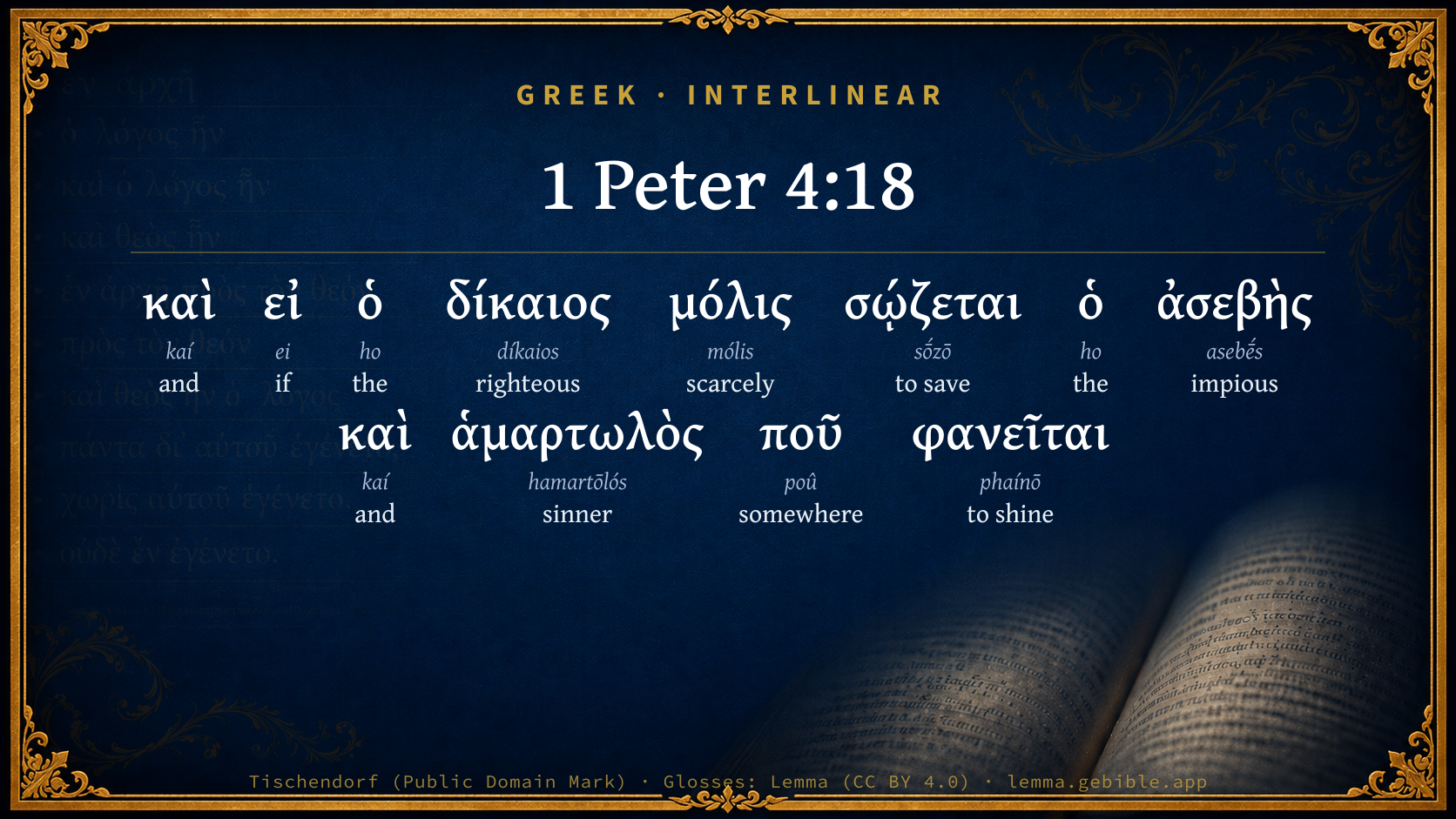
Greek (Tischendorf 8th ed.) 1 Peter 4:18 appears in the Greek New Testament. The text above is from the Tischendorf 8th edition. Each word links to its Strong’s number and a concise gloss. Click any word for its full Thayer’s Greek Lexicon entry.
Download image
Cite this verse

1 Peter 4:18 (World English Bible). Public Domain. Lemma interlinear Bible study tool, https://lemma.gebible.app/v/1-peter/4/18.

Show BibTeX & RIS
BibTeX
RIS
English Translation
"If it is hard for the righteous to be saved, what will happen to the ungodly and the sinner?"
World English Bible · Public Domain
Download a study sheet

One document with this verse’s original text, its word-by-word gloss line, the meaning frame, cross-references with their text, attributed commentary, and full source and license credits — printable, and it pastes into notes with its structure intact.

This verse Autodidact and up

Study sheet (.html) Plain text (.txt)

A passage Seminary Student

Up to 50 verses in one chapter. A passage sheet keeps up to 6 commentary sources and 12 cross-references per verse, in the order this page ranks them, and says so on the sheet whenever that leaves anything out. Ask for a single verse and you get the Autodidact verse sheet above.

Everything on this page stays free to read, with no account — the sheet is a download of what is already on screen, not access to it.

Want to remove ads? Support Godless Engineer
Compare translations 3

The same verse in 3 English versions, stacked beneath the original-language interlinear above. Click any original word for its lexicon entry.

Each is an independent rendering of the whole verse — the interlinear is not word-aligned to these translations.

Highlighted words mark where these versions differ — a whole-verse word diff, not a word-by-word alignment.

  • World English Bible Public Domain
    "If it is hard for the righteous to be saved, what will happen to the ungodly and the sinner?"
  • King James Version Public Domain
    And if the righteous scarcely be saved, where shall the ungodly and the sinner appear?
  • unfoldingWord Literal Text CC BY-SA 4.0
    And, “If with difficulty the righteous is being saved, where will the ungodly and sinner appear?”

unfoldingWord Literal Text — © unfoldingWord, licensed CC BY-SA 4.0. Word-aligned USFM3 via Door43 (git.door43.org/unfoldingWord/en_ult).

Versions to compare (up to 4)

3 of 4 selected

Show all 19 translations

Every available English version of this verse, each an independent rendering of the whole verse.

  • World English Bible Public Domain
    "If it is hard for the righteous to be saved, what will happen to the ungodly and the sinner?"
  • Berean Standard Bible Public Domain
    And, “If it is hard for the righteous to be saved, what will become of the ungodly and the sinner?”
  • Majority Standard Bible Public Domain
    And, “If it is hard for the righteous to be saved, what will become of the ungodly and the sinner?”
  • King James Version Public Domain
    And if the righteous scarcely be saved, where shall the ungodly and the sinner appear?
  • American Standard Version (1901) Public Domain
    And if the righteous is scarcely saved, where shall the ungodly and sinner appear?
  • Revised Version (1885) Public Domain
    And if the righteous is scarcely saved, where shall the ungodly and sinner appear?
  • Geneva Bible (1599) Public Domain
    And if the righteous scarcely bee saued, where shall the vngodly and the sinner appeare?
  • Douay-Rheims (1899) Public Domain
    And if the just man shall scarcely be saved, where shall the ungodly and the sinner appear?
  • Young's Literal Translation Public Domain
    And if the righteous man is scarcely saved, the ungodly and sinner -- where shall he appear?
  • Literal Standard Version CC BY-SA 4.0
    And if the righteous man is scarcely saved, where will the ungodly and sinner appear?
  • Unlocked Literal Bible CC BY-SA 4.0
    And “If it is difficult for the righteous to be saved, what will become of the ungodly and the sinner?”
  • unfoldingWord Literal Text CC BY-SA 4.0
    And, “If with difficulty the righteous is being saved, where will the ungodly and sinner appear?”
  • Darby Bible Public Domain
    And if the righteous is difficultly saved, where shall the impious and [the] sinner appear?
  • World Messianic Bible Public Domain
    “If it is hard for the righteous to be saved, what will happen to the ungodly and the sinner?”
  • Webster's Bible Public Domain
    And if the righteous is scarcely saved, where will the ungodly and the sinner appear?
  • Free Bible Version CC BY-SA 4.0
    “If it's hard for those who live right to be saved, what will happen to sinners, those who oppose God?”
  • Bible in Basic English Public Domain
    And if it is hard for even the good man to get salvation, what chance has the man without religion or the sinner?
  • Text-Critical English NT CC BY 4.0
    And, “If the righteous man is scarcely saved, what will become of the ungodly man and sinner?”
  • Tyndale New Testament (1534) Public Domain
    And yf the righteous scasly be saved: where shall the vngodly and the sinner appere?

Literal Standard Version (2020), Covenant Press — licensed CC BY-SA 4.0. Text via the HelloAO Bible API (eBible.org). Unlocked Literal Bible (unfoldingWord) — licensed CC BY-SA 4.0. Text via the HelloAO Bible API (eBible.org). unfoldingWord Literal Text — © unfoldingWord, licensed CC BY-SA 4.0. Word-aligned USFM3 via Door43 (git.door43.org/unfoldingWord/en_ult). Free Bible Version, Dr. Jonathan Gallagher — licensed CC BY-SA 4.0. Text via the HelloAO Bible API (eBible.org).

Word by word

More ways to search: Search by grammar → Find every occurrence → Compare this word →

Practice this passage: Drill this verse → Learn its vocabulary →

About this verse

These counts appear in no published source. They are computed here, from the morphology-tagged text and Lemma’s own curated glosses. What Lemma adds →

12
words
10
distinct lemmas
General Epistles
section

Notable vocabulary

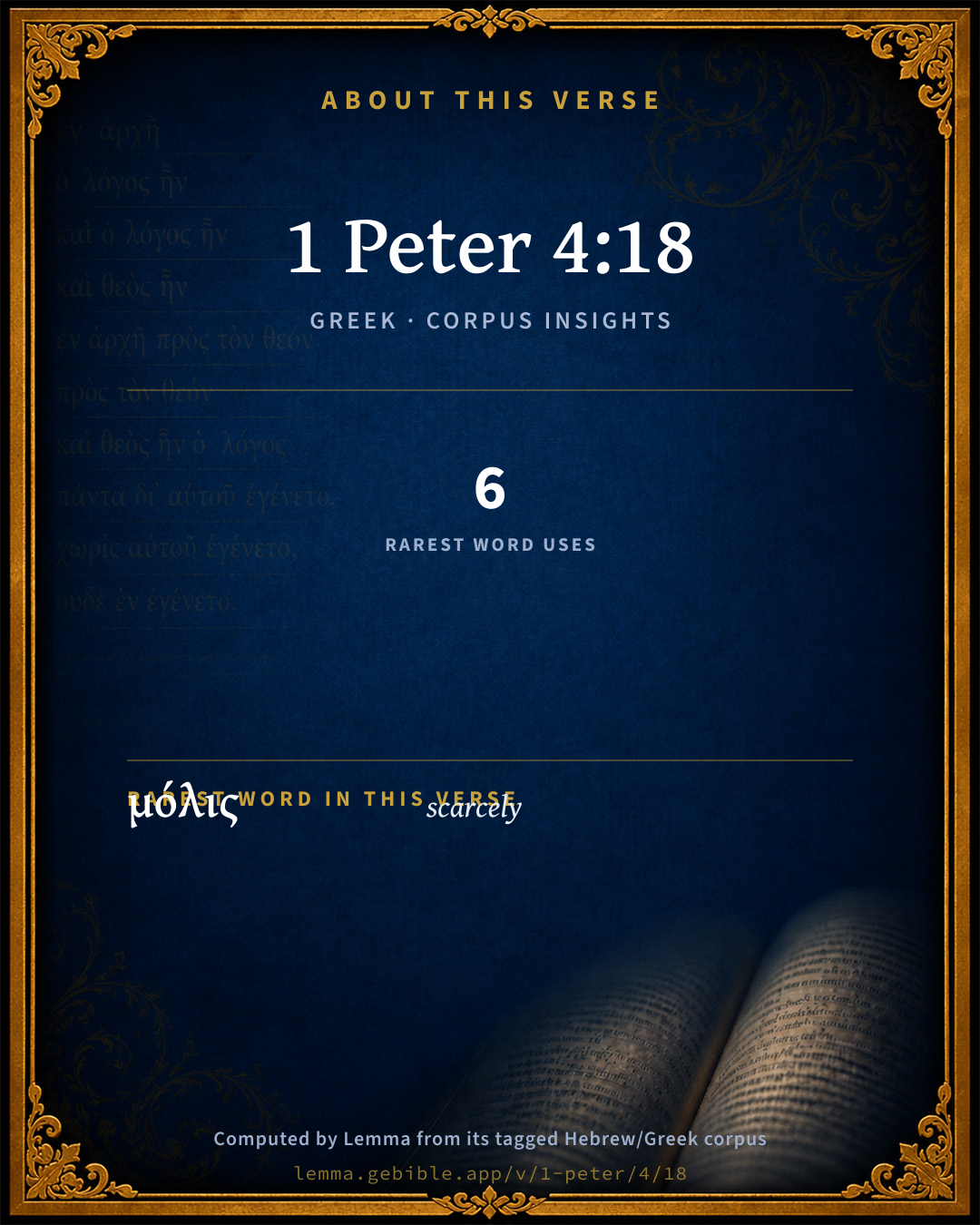
The rarest word here is μόλις scarcely G3433 — appearing just 6 times in the whole Greek New Testament.

Shared distinctive vocabulary

μόλις scarcely G3433 occurs in 6 verses of the Greek New Testament. Also found in:

Repetition

Words recur within this verse:

Cross-references

24

Topical passages linked to 1 Peter 4:18 in the Treasury of Scripture Knowledge — connected by theme and wording, ordered by reader-vote popularity; previews shown in the World English Bible.

  • Proverbs 11:31 Behold, the righteous shall be repaid in the earth; How much more the wicked and the sinner!
  • Ezekiel 18:24 But when the righteous turns away from his righteousness, and commits iniquity, and does according to all the abominations that the wicked man does, shall he live? None of his righteous deeds that he has done shall be remembered: in his trespass that he has trespassed, and in his sin that he has sinned, in them shall he die.
  • Luke 23:31 For if they do these things in the green tree, what will be done in the dry?"
  • 2 Peter 2:5–6 and didn't spare the ancient world, but preserved Noah with seven others, a preacher of righteousness, when he brought a flood on the world of the ungodly;
  • Jude 1:15 to execute judgment on all, and to convict all the ungodly of all their works of ungodliness which they have done in an ungodly way, and of all the hard things which ungodly sinners have spoken against him."
  • 1 Corinthians 10:12 Therefore let him who thinks he stands be careful that he doesn't fall.
  • Acts 14:22 confirming the souls of the disciples, exhorting them to continue in the faith, and that through many afflictions we must enter into the Kingdom of God.
  • Hebrews 10:38–39 But the righteous will live by faith. If he shrinks back, my soul has no pleasure in him."
  • Romans 1:18 For the wrath of God is revealed from heaven against all ungodliness and unrighteousness of men, who suppress the truth in unrighteousness,
  • 2 Peter 3:7 But the heavens that now are, and the earth, by the same word have been stored up for fire, being reserved against the day of judgment and destruction of ungodly men.
  • Romans 5:8 But God commends his own love toward us, in that while we were yet sinners, Christ died for us.
  • 1 Peter 5:8 Be sober and self-controlled. Be watchful. Your adversary the devil, walks around like a roaring lion, seeking whom he may devour.
  • Zechariah 13:9 I will bring the third part into the fire, And will refine them as silver is refined, And will test them like gold is tested. They will call on my name, and I will hear them. I will say, 'It is my people;' And they will say, 'Yahweh is my God.'"
  • Psalms 1:4–5 The wicked are not so, But are like the chaff which the wind drives away.
  • Jeremiah 25:29 For, behold, I begin to work evil at the city which is called by my name; and should you be utterly unpunished? You shall not be unpunished; for I will call for a sword on all the inhabitants of the earth, says Yahweh of Hosts.
  • Matthew 24:22–24 Unless those days had been shortened, no flesh would have been saved. But for the sake of the chosen ones, those days will be shortened.
  • Hebrews 4:1 Let us fear therefore, lest perhaps a promise being left of entering into his rest, anyone of you should seem to have come short of it.
  • Romans 5:6 For while we were yet weak, at the right time Christ died for the ungodly.
  • Acts 27:42–44 The soldiers' counsel was to kill the prisoners, so that none of them would swim out and escape.
  • Genesis 13:13 Now the men of Sodom were exceedingly wicked and sinners against Yahweh.
  • Mark 13:20–22 Unless the Lord had shortened the days, no flesh would have been saved; but for the sake of the chosen ones, whom he picked out, he shortened the days.
  • 1 Samuel 15:18 and Yahweh sent you on a journey, and said, 'Go, and utterly destroy the sinners the Amalekites, and fight against them until they are consumed.'
  • Luke 15:1 Now all the tax collectors and sinners were coming close to him to hear him.
  • Acts 27:24 saying, 'Don't be afraid, Paul. You must stand before Caesar. Behold, God has granted you all those who sail with you.'

Cross-references courtesy of OpenBible.info (CC BY 4.0).

Commentary

Notes on 1 Peter 4:18 from classic Christian and Jewish commentators (each source and its license shown beneath its notes). The classic Christian expositions comment on the surrounding passage and are grouped to its opening verse, so a note may address several verses; the Jewish commentaries on the Tanakh (Rashi and others) are per-verse, so they appear only where the commentator wrote on this verse.

Lemma curates 59 commentaries, every one of them public domain or Creative Commons licensed, each selected and text-cleaned for this edition rather than reprinted as found. About our sources →

Joseph Benson's Commentary

1Pe 4:18. And if the righteous scarcely be saved — Escape with the utmost difficulty. So the word μολις, rendered scarcely, signifies. That is, If it be not without much difficulty that the Christians are secured and preserved in those overflowing, devouring judgments which are coming on the Jewish nation; where shall the ungodly and the sinner — The impenitent and unbelieving, the obstinate and wicked part of the Jewish nation; appear? — That is, what will become of them? Dreadful will be their destruction. The meaning of the apostle, however, may be, If the righteous, ο δικαιος, the righteous man, be scarcely, or not wholly saved from suffering, that is, from chastisement, (in which light the apostle represents the persecutions to which the Christians were exposed,) if God judges, and, by various temporal afflictions and calamities, punishes him, where shall the ungodly and impenitent sinner appear? How terrible will be the wrath which will fall upon him? If the faults of the loyal subject, yea, of the dutiful son, be not passed over unnoticed, unchastised, by the holy and just Governor and Judge of the world, what has not the enemy and rebel to fear? Perhaps this may be the chief meaning of the apostle, and not the deliverance of the Christians from the Roman invasion, in which very few of them were concerned, to whom the apostle addressed his epistle; namely, those sojourning in Pontus, &c. See chap. 1Pe 1:1. And the passage may be intended to signify also the difficulty with which pious men get to heaven, through this dangerous and insnaring world. Compare Act 14:18; Act 27:7-8; Act 27:16. where the word μολις, here used, signifies with difficulty. “The turn of the latter clause of the verse in the original, που φανειται, is very lively; it seems as if the apostle were solicitous to lead the sinner to consider where he should hide his head, since wherever he was he would find God immediately appearing against him as an irresistible enemy. This he might say, by way of warning to persecutors, and to encourage Christians to hope that God would vindicate their cause, and preserve them from turning aside to crooked paths. And this the connection with the following verse favours.” — Doddridge.

Joseph Benson's Commentary on the Old and New Testaments (1811–1818) — public domain. Text from a community e-Sword module.

Bengel's Gnomon

Johann Albrecht Bengel

1Pe 4:18. Καὶ εἰ ὁ δίκαιος—φανεῖται; and if the righteous—appear?) Pro 11:31, Septuagint, εἰ ὁ μὲν δίκαιος μόλις σώζεται, ὁ ἀσεβὴς καὶ ἁμαρτωλὸς ποῦ φανεῖται; Very heavy chastisements are inflicted upon the righteous, when they at any time meanwhile offend: how much heavier punishments shall the wicked suffer? The persecution of Nero preceded the calamity of the Jews by a few years. The righteous, the ungodly, and the sinner. A semi-double sentence.[38] A man is righteous with reference to his neighbour, ungodly with reference to God, a sinner with reference to himself. We must therefore supply, by the force of the opposites in the first proposition, εὐσεβὴς, godly; and ὅσιος, holy: in the second proposition, ἄδικος, unjust.—μόλις) with difficulty [Comp. Mat 25:5; Mat 25:9]. This is softened, 2Pe 1:11, πλουσίως, abundantly.

[38] See Append. on SEMIDUPLEX ORATIO.—E.

Bengel's Gnomon of the New Testament — English translation (T&T Clark, Edinburgh, 1860) — public domain. Text from a community e-Sword module.

Meyer's Critical & Exegetical Commentary

Heinrich August Wilhelm Meyer

1Pe_4:18. Strengthening of the foregoing thought by quotation of the O. T. passage, Pro_11:31, after the LXX., whose translation, however, is inexact (cf. Delitzsch in loc.).

ὁ δίκαιος is he who stands in a right relation to God (Schott), that is, the believer who belongs to the οἶκ. τ. Θεοῦ; ὁ ἀσεβὴς καὶ ἁμαρτωλός, the unbeliever (ὁ ἀπειθῶν τῷ τ. Θ. εὐαγγ.). μόλις σώζεται is not, with Gerhard, to be referred to the fact, that for the pious non nisi per multas tribulationes ingressus in regnum coeleste pateat, but that it is difficult (μόλις, scarcely, with great difficulty) to stand in the judgment (1Pe_4:17), and to attain σωτηρία.

ποῦ φανεῖται] where will he appear? that is, he will not stand, but will be annihilated. The same thought as in Psa_1:5.

Meyer — Critical and Exegetical Commentary on the New Testament — English translation by Peter Christie, edited by Frederick Crombie (T&T Clark, 1880) — public domain. Text from a community e-Sword module.

Expositor's Greek Testament

ed. W. Robertson Nicoll

1Pe 4:18 . To the summary excerpt from Ezekiel Peter appends the Septuagint version of Pro 11:31 , which is followed by the Syriac and partially by the Targum: The original according to the Masoretic text is Behold or if the righteous will be punished on the earth: how much more the wicked and the sinner . The Greek, which probably represents a different Hebrew text, is more apt to his purpose and to the teaching of Jesus, which provoked the question, Who then can be saved (Mar 10:24-26 ).

The Expositor's Greek Testament, edited by W. Robertson Nicoll (1897–1910) — public domain. Text from a community e-Sword module.

Jamieson, Fausset & Brown

Robert Jamieson, A. R. Fausset & David Brown

scarcely--Compare "so as by fire," Co1 3:15; having to pass through trying chastisements, as David did for his sin. "The righteous" man has always more or less of trial, but the issue is certain, and the entrance into the kingdom abundant at last. The "scarcely" marks the severity of the ordeal, and the unlikelihood (in a mere human point of view) of the righteous sustaining it; but the righteousness of Christ and God's everlasting covenant make it all sure.

ungodly--having no regard for God; negative description.

sinner--loving sin; positive; the same man is at once God-forgetting and sin-loving.

appear--in judgment.

Jamieson, Fausset & Brown — Commentary Critical and Explanatory on the Whole Bible (1871) — public domain (CC PDM 1.0). Text via the HelloAO Bible API.

Adam Clarke's Commentary

Verse 18. And if the righteous scarcely be saved] If it shall be with extreme difficulty that the Christians shall escape from Jerusalem, when the Roman armies shall come against it with the full commission to destroy it, where shall the ungodly and the sinner appear? Where shall the proud Pharisaic boaster in his own outside holiness, and the profligate transgressor of the laws of God, show themselves, as having escaped the Divine vengeance? The Christians, though with difficulty, did escape, every man; but not one of the Jews escaped, whether found in Jerusalem or elsewhere.

It is rather strange, but it is a fact, that this verse is the Septuagint translation of Pr 11:31: Behold, the righteous shall be recompensed in the earth; much more the wicked and the sinner. For this the Septuagint and St. Peter have, If the righteous scarcely be saved, where shall the ungodly and the sinner appear? Such a latitude of construction can scarcely be accounted for. The original is this: hen tsaddik baarets yeshullam, aph ki rasha vechote: "Behold, to the righteous it shall be returned on the earth; and also to the wicked and the transgressor."

The Chaldee paraphrast has given this a different turn: Behold, the righteous shall be strengthened in the earth; but the ungodly and the sinners shall be consumed from the earth.

The Syriac thus: If the righteous scarcely live, the ungodly and the sinner where shall he stand?

The Arabic is nearly the same as the Septuagint and the apostle; the Vulgate follows the Hebrew.

I have on several occasions shown that, when Cestius Gallus came against Jerusalem, many Christians were shut up in it; when he strangely raised the siege the Christians immediately departed to Pella in Coele-syria, into the dominions of King Agrippa, who was an ally of the Romans, and there they were in safety; and it appears, from the ecclesiastical historians, that they had but barely time to leave the city before the Romans returned under the command of Titus, and never left the place till they had destroyed the temple, razed the city to the ground, slain upwards of a million of those wretched people, and put an end to their civil polity and ecclesiastical state.

Adam Clarke's Commentary on the Bible (1810–1826) — public domain. Text from a community e-Sword/MySword module.

John Calvin's Commentaries

When the faithful see that it is well with the wicked, they are necessarily tempted to be envious; and this is a very dangerous trial; for present happiness is what all desire. Hence the Spirit of God carefully dwells on this, in many places, as well as in the thirty-seventh Psalm, lest the faithful should envy the prosperity of the ungodly. The same is what Peter speaks of, for he shews that afflictions ought to be calmly borne by the children of God, when they compare the lot of others with their own. But he takes it as granted that God is the judge of the world, and that, therefore, no one can escape his hand with impunity. He hence infers, that a dreadful vengeance will soon overtake those whose condition seems now favorable. The design of what he says, as I have already stated, is to shew that the children of God should not faint under the bitterness of present evils, but that they ought, on the contrary, calmly to bear their afflictions for a short time, as the issue will be salvation, while the ungodly will have to exchange a fading and fleeting prosperity for eternal perdition.

But the argument is from the less to the greater; for if God spares not his own children whom he loves and who obey him, how dreadful will be his severity against enemies and such as are rebellious! There is, then, nothing better than to obey the Gospel, so that God may kindly correct us by his paternal hand for our salvation.

18 And if the righteous It has been thought that this sentence is taken from Proverbs 11:31; for the Greek translators have thus rendered what Solomon says,

“Behold, the just shall on the earth be recompensed; how much more the ungodly and the sinner?”

Now, whether Peter intended to quote this passage, or repeated a common and a proverbial saying, (which seems to me more probable,) the meaning is, that God’s judgment would be dreadful against the ungodly, since the way to salvation was so thorny and difficult to the elect. And this is said, lest we should securely indulge ourselves, but carefully proceed in our course, and lest we should also seek the smooth and easy road, the end of which is a terrible precipice.

But when he says, that a righteous man is scarcely saved, he refers to the difficulties of the present life, for our course in the world is like a dangerous sailing between many rocks, and exposed to many storms and tempests; and thus no one arrives at the port, except he who has escaped from [a] thousand deaths. It is in the meantime certain that we are guided by God’s hand, and that we are in no danger of shipwreck as long as we have him as our pilot.

Absurd, then, are those interpreters who think that we shall be hardly and with difficulty saved, when we shall come before God in judgment; for it is the present and not the future time that Peter refers to; nor does he speak of God’s strictness or rigour, but shews how many and what arduous difficulties must be surmounted by the Christian before he reaches the goal. Sinner here means a wicked man and the righteous are not those who are altogether perfect in righteousness, but who strive to live righteously.

John Calvin's Commentaries (1540-1563) — public domain. Text from the Calvin Translation Society English edition (1840s-50s) via the Christian Classics Ethereal Library (ccel.org). Calvin's coverage is partial (roughly two-thirds of the Bible); uncommented books and verses are honest gaps, never fabricated. The 19th-century editor's footnotes and remarks are omitted so the notes are faithfully Calvin's own voice.

Ellicott's Commentary for English Readers

(18) And if the righteous scarcely be saved.—This is a literal quotation, word for word, of Pro_11:31, according to the LXX. The quotation proves to us St. Peter’s perfect familiarity with both the Hebrew original and the Greek version. We have seen how he rejects the LXX. version when it does not suit his meaning (e.g., 1Pe_2:8): here it suits him (though it differs from the Hebrew), and he accepts it. The “righteous” man here means, apparently, as Leighton says, “he that endeavours to walk uprightly in the ways of God,” rather than the man who is then declared finally justified. The fact that they are “scarcely” saved “imports not,” according to Leighton, “any uncertainty or hazard in the thing itself to the end, in respect of the purpose and performance of God, but only the great difficulties and hard encounters in the way.” This is only partly true. The Apostle is rather thinking of the final judgment than of the life of trial; and he means that there was but little margin left: a very few more falls, a few more refusals to follow the calls of grace, and they would have been lost. Doubtless, when the best of us looks back, in the light of the last day, upon all that he has been through, he will be amazed that he ever could be saved at all. Yet Bengel well calls us to see the other side of the picture in 2Pe_1:11.

The ungodly and the sinner.—This is the Gentile character. “Ungodly” denotes open irreligion—contempt of God and all that belongs to His worship. “Sinner” goes more to the moral side of the nature, pointing most of all to sins of the flesh. (Comp., for instance, Luk_7:37.) “Sinners” was almost a synonym for “Gentiles.” (See, e.g., Luk_6:32; Luk_24:7; Gal_2:15.) The question “Where shall he appear?” imagines some scene such as that of Mat_25:32 : “Where shall we see him? where will he have to stand?”

A Bible Commentary for English Readers, edited by Charles John Ellicott (1878–1897) — public domain. Text from a community e-Sword module.

The Cambridge Bible for Schools and Colleges

gen. ed. J. J. S. Perowne

18. And if the righteous scarcely be saved] Once more we have a passage from the Old Testament (Pro_11:31) without any formula of quotation. In this instance the Apostle quotes from the LXX. version, though it is hardly more than an inaccurate paraphrase of the Hebrew, which runs “the righteous shall be requited” (the word may mean “punished”) “upon earth, much more the ungodly and the sinner.” St Peter, following the LXX., omits the words “upon earth,” which limit the application of the proverb to temporal chastisements; but it is obvious, as he is speaking primarily of the fiery trial of persecution, that he includes these as well as the issue of the final judgment. A time of “great tribulation,” such as Christ had foretold, was coming on the earth, in which, but for the elect’s sake, “no flesh should be saved” (Mat_24:22). The “un-godly” and the “sinner” correspond to “those that obey not” in the previous verse, the former pointing to sins against God, the latter to sins against man.

The Cambridge Bible for Schools and Colleges (gen. ed. J. J. S. Perowne; Cambridge University Press, 1878–1918) — public domain. Text from a community e-Sword module.

John Gill's Exposition

And if the righteous scarcely be saved,.... Reference is had to Pro 11:31 where in the Septuagint version are the same words as here: the "righteous" are such, not who are so in their own opinion, or merely in the esteem of others, nor on account of their vility, morality, and external righteousness before men, or by the deeds of the law; but who are made righteous by the righteousness of Christ imputed to them: and such are "scarcely saved"; not as if they were but in part saved, for they are completely saved; Christ has wrought out and finished a complete salvation for them; and they are saved from all enemies, and everything that might hurt them; from sin, Satan, the law, the world, hell, and death; and they are completely justified, and have all their sins pardoned, and shall be perfectly saved: nor as if their salvation was doubtful; for though they are scarcely, yet certainly saved; for they are chosen to salvation, and Christ has obtained it for them, and they have the application of it already made to them by the blessed Spirit; and being justified, or made righteous persons, nothing is more certain than that they shall be glorified: but they are said to be "scarcely" saved, because of the difficulty of it, both with respect to Christ, who met with difficulties in working out their salvation; by reason of the strictness of divine justice, and the demands of the righteous law, which would make no abatement; the sins of his people he had to bear, and make atonement for; the many enemies he had to grapple with, and the accursed death of the cross, he had to undergo; though they were such he was able to surmount, and did: and especially with respect to the saints themselves; for though their salvation is certain and complete, being finished by Christ, yet their enjoyment of it is attended with many difficulties; by reason of the corruptions of nature, a law in their members warring against the law of their minds; the frequent temptations of Satan, who seeks to devour them, and their wrestlings with principalities and powers, which are above their match; and also by reason of various afflictions and persecutions, and many tribulations, which make their way to eternal life a strait way, and through which they must enter into the kingdom of heaven: and if this be their case, as it is,

where shall the ungodly and the sinner appear? the profane sinner, the Christless, impenitent, unbelieving, and unregenerate man; otherwise all men are sinners, in themselves; but here it means such as are destitute of the sanctifying grace of the Spirit, and the justifying righteousness of Christ, and that live and die in their sins: where shall such appear? not in the congregation of the righteous; nor at the right hand of Christ; nor in heaven, into which no defiled sinner shall enter; nor even on earth, among and under the rocks and mountains, which will not be able to hide them from the face of the Judge, and his wrath, when he shall come; but at Christ's left hand, and in hell, and among the devils and damned there.

John Gill's Exposition of the Whole Bible (1746–1763) — public domain (CC PDM 1.0). Text via the HelloAO Bible API.

Trapp's Complete Commentary

John Trapp

18 And if the righteous scarcely be saved, where shall the ungodly and the sinner appear?

Ver. 18. Scarcely be saved] Hard and scarce; not at all from outward miseries (whereof he is sure to have his back’s burden), and not without somewhat ado from hell’s torments. The wise virgins had no oil to spare; the twelve tribes served God instantly and constantly day and night, and all little enough, Act 26:7.

Where shall the ungodly, &c.] Surely nowhere: not before saints and angels, for holiness is their trade. Not before God, for he is of "more pure eyes," &c. Not before Christ, for he shall come in flaming fire rendering vengeance. Not in heaven, for it is an undefiled inheritance, &c.

John Trapp, A Commentary or Exposition upon All the Books of the Old and New Testament (1647–1656) — public domain. Text from a community e-Sword module.

Albert Barnes' Notes on the Bible

And if the righteous scarcely be saved - If they are saved with difficulty. The word used here (μόλις molis) occurs in the following places: Act 14:18, “scarce restrained they the people;” Act 27:7, “and scarce were come over against Cnidus;” 1Pe 4:8, “and hardly passing it;” 1Pe 4:16, “we had much work to come by the boat” - literally, we were able with difficulty to get the boat; Rom 5:7, “scarcely for a righteous man will one die;” and in the passage before us. The word implies that there is some difficulty, or obstruction, so that the thing came very near not to happen, or so that there was much risk about it. Compare Luk 13:31. The apostle in this passage seems to have had his eye on a verse in Proverbs, Pro 11:31, and he has merely expanded and illustrated it: “Behold, the righteous shall be recompensed in the earth: much more the wicked and the sinner.” By the question which he employs, he admits that the righteous are saved with difficulty, or that there are perils which jeopard their salvation, and which are of such a kind as to make it very near not to happen. They would indeed be saved, but it would be in such a manner as to show that the circumstances were such as to render it, to human appearances, doubtful and problematical. This peril may have arisen from many circumstances:

(a) The difficulty of forming a plan of salvation, involving a degree of wisdom wholly beyond that of man, and of such a character that beforehand it would have been problematical and doubtful whether it could be. There was but one way in which it could be done. But what human wisdom could have devised that, or thought of it? There was but one being who could save. But who would have supposed that the Son of God would have been willing to become a man, and to die on a cross to do it? If he had been unwilling to come and die, the righteous could not have been saved.

(b) The difficulty of bringing those who are saved to a willingness to accept of salvation. All were disposed alike to reject it; and there were many obstacles in the human heart, arising from pride, and selfishness, and unbelief, and the love of sin, which must be overcome before any would accept of the offer of mercy. There was but one agent who could overcome these things, and induce any of the race to embrace the gospel - the Holy Spirit. But who could have anticipated that the Spirit of God would have undertaken to renew and sanctify the polluted human heart? Yet, if he had failed, there could have been no salvation for any.

(c) The difficulty of keeping them from falling away amidst the temptations and allurements of the world. Often it seems to be wholly doubtful whether those who have been converted will be kept to eternal life. They have so little religion; they yield so readily to temptation; they conform so much to the world; they have so little strength to bear up under trials, that it seems as if there was no power to preserve them and bring them to heaven. They are saved when they seemed almost ready to yield everything.

(d) The difficulty of rescuing them from the power of the great enemy of souls. The adversary has vast power, and he means, if be can, to destroy those who are the children of God. Often they are in most imminent danger, and it seems to be a question of doubtful issue whether they will not be entirely overcome and perish. It is no small matter to rescue a soul from the dominion of Satan, and to bring it to heaven, so that it shall be eternally safe. Through the internal struggles and the outward conflicts of life, it seems often a matter of doubt whether with all their effort they will be saved; and when they are saved, they will feel that they have been rescued from thousands of dangers, and that there has been many a time when they have stood on the very verge of ruin, and when, to human appearances, it was scarcely possible that they could be saved.

Where shall the ungodly and the sinner appear? - What hope is there of their salvation? The meaning is, that they would certainly perish; and the doctrine in the passage is, that the fact that the righteous are saved with so much difficulty is proof that the wicked will not be saved at all. This follows, because:

(a)There is the same difficulty in their salvation which there was in the salvation of those who became righteous; the same difficulty arising from the love of sin, the hardness of the heart, and the arts and power of the adversary.

No one can be saved without effort, and in fact the righteous are saved only by constant and strenuous effort on their part.

But the wicked make no effort for their own salvation. They make use of no means for it; they put forth no exertions to obtain it; they do not make it a part of their plan of life. How, then, can they be saved? But where will they appear? I answer:

(a)They will appear somewhere. They will not cease to exist when they pass away from this world. Not one of them will be annihilated; and though they vanish from the earth, and will be seen here no more, yet they will make their appearance in some other part of the universe.

They will appear at the judgment-seat, as all others will, to receive their sentence according to the deeds done in the body. It follows from this:

(1)That the wicked will certainly be destroyed. If the righteous are scarcely saved, how can they be?

(2)That there will be a state of future punishment, for this refers to what is to occur in the future world.

(3)That the punishment of the wicked will be eternal, for it is the opposite of what is meant by saved. The time will never come when it will be said that they are saved! But if so, their punishment must be eternal!

Albert Barnes' Notes on the Bible (1834–1885) — public domain. Text from a community e-Sword/MySword module.

Haydock's Catholic Bible Commentary

Scarcely. That is, not without much labour and difficulty. (Challoner)

George Leo Haydock (1774–1849), Haydock's Catholic Family Bible and Commentary, 1859 edition — public domain. Excludes Psalms (Douay-Rheims chapter numbering differs from Protestant) and Deuterocanonical books (Catholic canon only).

Matthew Poole's English Annotations

Scarcely be saved; with much labour and difficulty, through many tribulations, Act 14:22, as going in the narrow way, and entering in at the strait gate, Mat 7:13,14.

The ungodly and the sinner; unbelievers and impenitent sinners of all sorts; both words signify the same, in opposition to the righteous before mentioned.

Appear; he shall not be able to stand in God’s judgment against the sentence of condemnation then to be pronounced, Psa 1:5; q.d. If the righteous scarcely be saved, the wicked shall certainly perish.

Matthew Poole's English Annotations on the Holy Bible (1683–1685) — public domain. Text from a community e-Sword/MySword module.

Whedon's Commentary on the Bible

Daniel D. Whedon

18. Scarcely be saved—So severe the persecution, so terrible the trial, so powerful the influences to apostasy, and so weak his own nature, that the Christian will with difficulty endure to the end and be saved in heaven; but if he hold to his faith in Christ, his salvation is absolutely certain.

The ungodly and the sinner—Not two classes, but one; he who is utterly the opposite of God in character and life, and a regardless transgressor of his law, making no effort to be saved. The question implies a strong denial that he will be saved at all.

Daniel D. Whedon (gen. ed.), Commentary on the Old and New Testaments (1874–1909) — public domain. Text from a community e-Sword module.

The Pulpit Commentary

And if the righteous scarcely be saved. St. Peter is quoting the Septuagint Version ofliv Pro_11:31. That version departs considerably from the Hebrew, which is accurately represented by the Authorized Version, "Behold, the righteous shall be recompensed in the earth; much more the wicked and the sinner." Probably the word rendered" recompensed," which is neutral in its meaning, is best understood here, not of the good deeds of the righteous, but of the sin which still cleaves to all human righteousness. The righteous shall be requited in the earth, that is, chastised for his transgressions. So it would be now, St. Peter says; judgment must begin at the house of God. He adopts the inexact Septuagint translation for its substantial truth, as we now sometimes use versions which are sufficient for practical purposes, though we know them to be critically inaccurate. We observe again the absence of marks of quotation, as often in St. Peter. Bengel well remarks that the awful "scarcely" (mo swzetai) is softened by 2Pe_1:11. Where shall the ungodly and the sinner appear? The" ungodly "are the impious, scoffers, and blasphemers; the" sinners" are men of profligate and dissolute lives. But the words are (probably) included under one article in the Greek; the men were the same; one form of evil led to the other. (comp. Psa_1:5; see also Mat_19:25)

The Pulpit Commentary (1880–1919), ed. H.D.M. Spence-Jones & Joseph S. Exell — public domain. Text from a community e-Sword module.

John Wesley's Explanatory Notes

If the righteous scarcely be saved - Escape with the utmost difficulty. Where shall the ungodly - The man who knows not God. And the open sinner appear - In that day of vengeance. The salvation here primarily spoken of is of a temporal nature. But we may apply the words to eternal things, and then they are still more awful. Prov. xi, 31.

John Wesley, Explanatory Notes Upon the Whole Bible (1754–1765) — public domain. Text via the GEBible commentary corpus.

Scofield Reference Notes

C. I. Scofield

righteous

Righteousness. (See Scofield "Rom 10:10")

saved (See Scofield "Rom 1:16")

sinner Sin. (See Scofield "Rom 3:23").

The Scofield Reference Bible (1917 edition), notes by C. I. Scofield — public domain. Text from a community e-Sword module.

Burkitt's Expository Notes on the New Testament

William Burkitt

As if he had said, " When the day of visitation comes, which is verily at hand, and God shall begin to punish the Jews, his own people, called his house in the foregoing verse; if then the righteous among them escape the common calamity with great difficulty, and are scarcely preserved, how shall the ungodly and sinners think to escape unpunished in the day of Jerusalem’s calamity, that day of vengeance, when Christ shall come to plead with them? If then the rightious be scarcely saved, that is, with great difficulty preserved from that desolating calamity, that fiery trial spoken of, 1Pe 4:12, where shall the ungodly and sinner appear? And how shall they hope to escape in safety from that dreadful judgment now ready to come on the Jewish nation?"

There have been those that have made use of this text to show the difficulty of eternal salvation; and that the best and holiest of saints, even those that are most eminent in grace, are very difficultly saved; which, though a truth in itself, yet is scarcely deducible from this text, which certainly speaks of temporal preservation.

William Burkitt's Expository Notes on the New Testament (1700–1703) — public domain. Text from a community e-Sword module.

Godbey's Commentary on the New Testament

William B. Godbey

ARGUMENT 22

THE RIGHTEOUS SCARCELY SAVED

18. “If the righteous is scarcely saved, where shall the ungodly and the sinner appear?” The Greek dikaios literally means a justified man in contradistinction to the “sinner,” and the “ungodly,” who are under condemnation. The sinner is a person addicted to habits of overt wickedness, while the “ungodly,” sustaining a good moral character, are simply unsaved, i.e., without the knowledge and possession of God in the heart. Worldly churches are largely filled up with this class. It is frequently the case, as with moral outsiders, their greatest sins are self-righteousness. As a rule they seem to be harder to save than overt sinners, because they depend on their morality, churchanity and good works, all of which are utterly powerless to keep them out of hell, into which they plunge headlong with all of the outbreaking sinners. Not so with the justified man. He goes to heaven when he dies, though “scarcely,” i.e., he barely squeezes in. But see what a glorious achievement, though he barely gets in by the skin of his teeth. Having neglected sanctification during his life, he receives it in the article of death, going out of the world under the redeeming blood like an infant, and entering heaven in a state of spiritual infancy, having forfeited all of the glorious opportunities of spiritual growth, culture and development during probation (which at best are certainly very meager with the unsanctified). It is fearfully risky to live and die in the justified state, without sanctification, depending on its reception in the article of death, and then squeezing into heaven. I would not like to risk it, lest I be squeezed out instead of in. Peter gives us something infinitely better in his next letter, i.e., the abundant entrance for the man who has not only been justified, but sanctified and enriched with the bright constellation of spiritual graces described in the first chapter.

19. God is in everything, good and bad, so far as His true people are concerned, making all things a blessing to them through perfect submission and good works.

William B. Godbey, Commentary on the New Testament (1896–1900) — public domain. Text from a community e-Sword module.

The People's New Testament

B. W. Johnson

18. And if the righteous. A passage quoted from Prov. 11:31. The idea is that if sufferings and judgments (chastenings) come upon good people, what hope is there for the wicked?

B. W. Johnson's The People's New Testament with Notes (1889–1891) — public domain. Electronic text from the Christian Classics Ethereal Library (CCEL) ThML edition.

Cambridge Greek Testament for Schools and Colleges

18. εἰ ὁ δίκαιος μόλις σώζεται κ.τ.λ. The quotation is taken from the LXX. of Pro 11:31 where the Hebrew is “Behold the righteous shall be recompensed in the earth; how much more the wicked and the sinner.” The righteous is regarded as being “hardly saved” because of the painful nature of the “fiery trial” through which he has to pass. To share Christ’s glory he has to share Christ’s reproach. He has to “come out of great tribulation,” and his robes must be “washed in the Blood of the Lamb” by personal fellowship in his Master’s sufferings, Rev 7:14.

Cambridge Greek Testament for Schools and Colleges (Cambridge University Press, 1896; 21 vols, various authors incl. Carr, Maclear, Plummer, Farrar, Lumby, Moule, M. R. James, Simcox) — public domain. Text from a community e-Sword module.

Alford’s Greek Testament

Henry Alford

18.] and (the question of the last verse is again repeated under a well-known form, taken from the O. T., which however casts solemn light on both members of the interrogation: explaining what is meant by judgment on God’s people and also by the end of the disobedient. The citation is verbatim from the LXX, except that μέν is omitted between ὁ and δίκαιος. The LXX departs from the Heb. text, which is as the E. V., “Behold the righteous shall be recompensed in the earth: much more the wicked and the sinner”) if the righteous is (is being, see reff.: or rather perhaps the pres., of that which is to be) with difficulty saved (on account of the sharpness of the trial, and his own weakness. “Hoc μόλις temperatur 2Pe 1:11 prolixe.” Bengel. Cf. Rev 5:4, Rev 5:5. The μόλις does not induce any doubt as to the issue, only wonder: if we be δίκαιοι by faith in Christ, our salvation, however difficult and apparently impossible, is as certain as Christ’s own triumph), the ungodly (ἀσεβής, ‘impius,’ the man who in his innermost heart cares not for God and turns not to Him) and sinner (he that is devoted to sin. The absence of a second article, and the singular verb, both shew, that the same person is meant by both), where shall he appear (so in Psa 1:5: where shall he stand and find an abiding place in the judgment?)?

Henry Alford, The Greek Testament (1849–1861) — public domain. Text from a community e-Sword module.

Lesson kit

Teaching starters — assembled from the data on this page, not authored interpretation. Every prompt links to the verse data it draws on. Edit before teaching.

1 Peter, in the General Epistles, opens this verse with 12 words (10 distinct Greek lemmas). Its most distinctive word is mólis (“scarcely”). A historical commentator’s framing appears above. Read the whole chapter for the surrounding context.

Discussion questions

  1. The word mólis carries the sense “scarcely.” How does it shape the verse?
  2. Acts 14:18 shares the word «scarcely» with this verse. How do the two illuminate each other?
  3. “and” occurs 2× in this one verse. What is the effect of the repetition?
  4. These translations render this verse differently; the difference is in the English rendering, not the original. What questions does that raise?
  5. Reading how Joseph Benson's Commentary and Bengel's Gnomon read this verse, where do the two commentators agree and where do they part?

Things to notice

Reading settings

Reading text

Shown beneath each verse's original-language words.

Old Testament
Old Testament edition

Read the OT as the Masoretic Hebrew (MT) or the Greek Septuagint (LXX).

English shown for the Greek Septuagint (in the Hebrew ↔ Greek comparison).

Comparing translations? Open the Compare panel on any verse page to stack up to four side by side.