
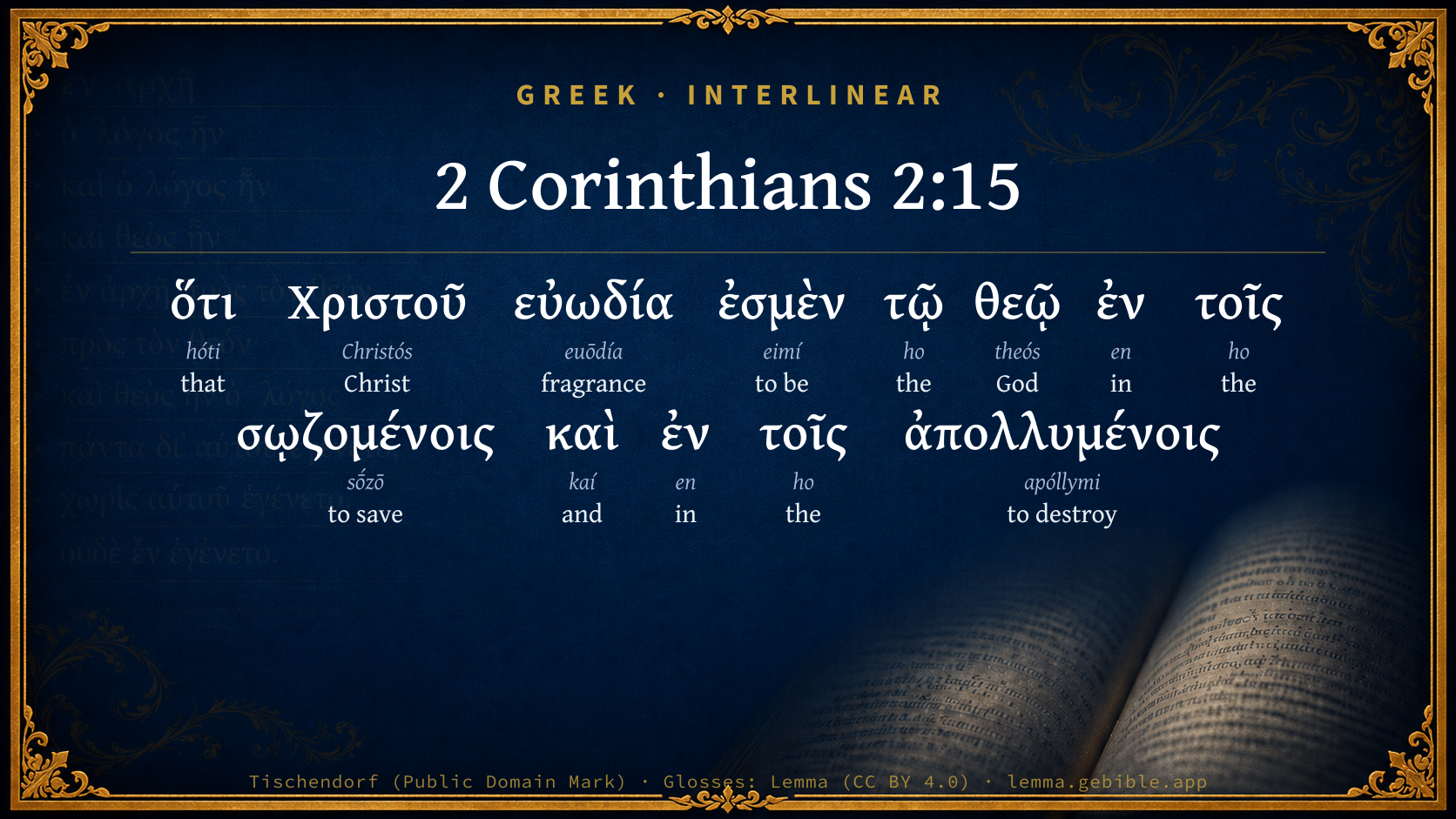
2 Corinthians 2:15

Greek (Tischendorf 8th ed.) 2 Corinthians 2:15 appears in the Greek New Testament. The text above is from the Tischendorf 8th edition. Each word links to its Strong’s number and a concise gloss. Click any word for its full Thayer’s Greek Lexicon entry.
Download image
Cite this verse

2 Corinthians 2:15 (World English Bible). Public Domain. Lemma interlinear Bible study tool, https://lemma.gebible.app/v/2-corinthians/2/15.

Show BibTeX & RIS
BibTeX
RIS
English Translation
For we are a sweet aroma of Christ to God, in those who are saved, and in those who perish;
World English Bible · Public Domain
Highlights
  • 1 first appearance in the Greek New Testament
Full analysis ↓
Download a study sheet

One document with this verse’s original text, its word-by-word gloss line, the meaning frame, cross-references with their text, attributed commentary, and full source and license credits — printable, and it pastes into notes with its structure intact.

This verse Autodidact and up

Study sheet (.html) Plain text (.txt)

A passage Seminary Student

Up to 50 verses in one chapter. A passage sheet keeps up to 6 commentary sources and 12 cross-references per verse, in the order this page ranks them, and says so on the sheet whenever that leaves anything out. Ask for a single verse and you get the Autodidact verse sheet above.

Everything on this page stays free to read, with no account — the sheet is a download of what is already on screen, not access to it.

Want to remove ads? Support Godless Engineer
Compare translations 3

The same verse in 3 English versions, stacked beneath the original-language interlinear above. Click any original word for its lexicon entry.

Each is an independent rendering of the whole verse — the interlinear is not word-aligned to these translations.

Highlighted words mark where these versions differ — a whole-verse word diff, not a word-by-word alignment.

  • World English Bible Public Domain
    For we are a sweet aroma of Christ to God, in those who are saved, and in those who perish;
  • King James Version Public Domain
    For we are unto God a sweet savour of Christ, in them that are saved, and in them that perish:
  • unfoldingWord Literal Text CC BY-SA 4.0
    For we are a fragrance of Christ to God among the ones being saved and among the ones perishing—

unfoldingWord Literal Text — © unfoldingWord, licensed CC BY-SA 4.0. Word-aligned USFM3 via Door43 (git.door43.org/unfoldingWord/en_ult).

Versions to compare (up to 4)

3 of 4 selected

Show all 19 translations

Every available English version of this verse, each an independent rendering of the whole verse.

  • World English Bible Public Domain
    For we are a sweet aroma of Christ to God, in those who are saved, and in those who perish;
  • Berean Standard Bible Public Domain
    For we are to God the sweet aroma of Christ among those who are being saved and those who are perishing.
  • Majority Standard Bible Public Domain
    For we are to God the sweet aroma of Christ among those who are being saved and those who are perishing.
  • King James Version Public Domain
    For we are unto God a sweet savour of Christ, in them that are saved, and in them that perish:
  • American Standard Version (1901) Public Domain
    For we are a sweet savor of Christ unto God, in them that are saved, and in them that perish;
  • Revised Version (1885) Public Domain
    For we are a sweet savour of Christ unto God, in them that are being saved, and in them that are perishing;
  • Geneva Bible (1599) Public Domain
    For wee are vnto God the sweete sauour of Christ, in them that are saued, and in them which perish.
  • Douay-Rheims (1899) Public Domain
    For we are the good odour of Christ unto God, in them that are saved, and in them that perish.
  • Young's Literal Translation Public Domain
    because of Christ a sweet fragrance we are to God, in those being saved, and in those being lost;
  • Literal Standard Version CC BY-SA 4.0
    we are a refreshing fragrance to God because of Christ, in those being saved, and in those being lost;
  • Unlocked Literal Bible CC BY-SA 4.0
    For we are to God the sweet aroma of Christ, both among those who are saved and among those who are perishing.
  • unfoldingWord Literal Text CC BY-SA 4.0
    For we are a fragrance of Christ to God among the ones being saved and among the ones perishing—
  • Darby Bible Public Domain
    For we are a sweet odour of Christ to God, in the saved and in those that perish:
  • World Messianic Bible Public Domain
    For we are a sweet aroma of Messiah to God in those who are saved and in those who perish:
  • Webster's Bible Public Domain
    For we are to God a sweet savor of Christ, in them that are saved, and in them that perish:
  • Free Bible Version CC BY-SA 4.0
    We are like a fragrance of Christ to God, rising up from among those who are being saved as well as those who are dying.
  • Bible in Basic English Public Domain
    For we are a sweet perfume of Christ to God in those who are getting salvation and in those who are going to destruction;
  • Text-Critical English NT CC BY 4.0
    For we are a sweet fragrance of Christ ascending to God among those who are being saved and among those who are perishing;
  • Tyndale New Testament (1534) Public Domain
    For we are vnto God the swete savoure of Christ both amonge them that are saved and also amonge them which perisshe.

Literal Standard Version (2020), Covenant Press — licensed CC BY-SA 4.0. Text via the HelloAO Bible API (eBible.org). Unlocked Literal Bible (unfoldingWord) — licensed CC BY-SA 4.0. Text via the HelloAO Bible API (eBible.org). unfoldingWord Literal Text — © unfoldingWord, licensed CC BY-SA 4.0. Word-aligned USFM3 via Door43 (git.door43.org/unfoldingWord/en_ult). Free Bible Version, Dr. Jonathan Gallagher — licensed CC BY-SA 4.0. Text via the HelloAO Bible API (eBible.org).

Word by word

More ways to search: Search by grammar → Find every occurrence → Compare this word →

Practice this passage: Drill this verse → Learn its vocabulary →

εὐωδία
euōdía
G2175
“fragrance”
Noun, Nominative, Singular, Feminine
Part of Speech
Noun
Case
Nominative
Number
Singular
Gender
Feminine
Full Thayer's Definition

Origin: from a compound of G2095 and a derivative of G3605

TDNT: 15:28,3

1. a sweet smell, fragrance 2. a fragrant or sweet smelling thing, incense, on odour or something sweet smelling a. an odour of acquiescence, satisfaction b. a sweet odour, spoken of the smell of sacrifices and obligations, agreeably to the ancient notion that God smells and is pleased with the odour of sacrifices 3. metaph. a thing well pleasing to God
  1. ὅτι hóti G3754 “that” Conjunction
  2. Χριστοῦ Christós G5547 “Christ” Noun, Genitive, Singular, Masculine
  3. ἐσμὲν eimí G1510 “to be” Verb, Present, Active, Indicative, 1st person, Plural
  4. τῷ ho G3588 “the” Article, Dative, Singular, Masculine
  5. θεῷ theós G2316 “God” Noun, Dative, Singular, Masculine
  6. ἐν en G1722 “in” Preposition
  7. τοῖς ho G3588 “the” Article, Dative, Plural, Masculine
  8. σῳζομένοις sṓzō G4982 “to save” Verb, Present, Passive, Participle, Dative, Plural, Masculine
  9. καὶ kaí G2532 “and” Conjunction
  10. ἐν en G1722 “in” Preposition
  11. τοῖς ho G3588 “the” Article, Dative, Plural, Masculine
  12. ἀπολλυμένοις apóllymi G622 “to destroy” Verb, Present, Middle or Passive, Participle, Dative, Plural, Masculine

About this verse

These counts appear in no published source. They are computed here, from the morphology-tagged text and Lemma’s own curated glosses. What Lemma adds →

13
words
10
distinct lemmas
Pauline Epistles
section

Notable vocabulary

The rarest word here is εὐωδία fragrance G2175 — appearing just 3 times in the whole Greek New Testament.

First appearance in Scripture

This word makes its first canonical appearance in the Greek New Testament here:

  • εὐωδία fragrance G2175

Shared distinctive vocabulary

εὐωδία fragrance G2175 occurs in 3 verses of the Greek New Testament. Also found in:

Repetition

Words recur within this verse:

Cross-references

10

Topical passages linked to 2 Corinthians 2:15 in the Treasury of Scripture Knowledge — connected by theme and wording, ordered by reader-vote popularity; previews shown in the World English Bible.

  • Ephesians 5:2 Walk in love, even as Christ also loved you, and gave himself up for us, an offering and a sacrifice to God for a sweet-smelling fragrance.
  • 1 Corinthians 1:18 For the word of the cross is foolishness to those who are dying, but to us who are saved it is the power of God.
  • Ezekiel 20:41 As a sweet savor will I accept you, when I bring you out from the peoples, and gather you out of the countries in which you have been scattered; and I will be sanctified in you in the sight of the nations.
  • Philippians 4:18 But I have all things, and abound. I am filled, having received from Epaphroditus the things that came from you, a sweet-smelling fragrance, an acceptable and well-pleasing sacrifice to God.
  • Genesis 8:21 Yahweh smelled the sweet savor. Yahweh said in his heart, "I will not again curse the ground any more for man's sake, because the imagination of man's heart is evil from his youth; neither will I ever again strike everything living, as I have done.
  • Exodus 29:18 You shall burn the whole ram on the altar: it is a burnt offering to Yahweh; it is a sweet savor, an offering made by fire to Yahweh.
  • 2 Thessalonians 2:10 and with all deception of wickedness for those who are being lost, because they didn't receive the love of the truth, that they might be saved.
  • 2 Corinthians 4:3–4 Even if our Gospel is veiled, it is veiled in those who perish;
  • Exodus 29:25 You shall take them from their hands, and burn them on the altar on the burnt offering, for a sweet savor before Yahweh: it is an offering made by fire to Yahweh.
  • Isaiah 49:5–6 Now says Yahweh who formed me from the womb to be his servant, to bring Jacob again to him, and that Israel be gathered to him (for I am honorable in the eyes of Yahweh, and my God is become my strength);

Cross-references courtesy of OpenBible.info (CC BY 4.0).

Commentary

Notes on 2 Corinthians 2:15 from classic Christian and Jewish commentators (each source and its license shown beneath its notes). The classic Christian expositions comment on the surrounding passage and are grouped to its opening verse, so a note may address several verses; the Jewish commentaries on the Tanakh (Rashi and others) are per-verse, so they appear only where the commentator wrote on this verse.

Lemma curates 59 commentaries, every one of them public domain or Creative Commons licensed, each selected and text-cleaned for this edition rather than reprinted as found. About our sources →

The Biblical Illustrator

Joseph S. Exell

2Co_2:15-16

For we are unto God a sweet savour of Christ, in them that are saved and in them that perish.

Dissimilar effects of the same thing

Consider the totally different effects which the same thing has on different people. An act, simple in itself, will rouse the joys of one and the rage of another. A substance which is food to one man is poison to another. The same medicine which effects a cure in one case will in a similar case in another man aggravate the malady and enhance his sufferings. Look again at the effects of the tempest on creation. & large number of the existences on the globe are terrified. But the seals love above all the tempest, the roaring of the waves, the whistling of the wind, the mighty voice of the thunder, and the vivid flashings of the lightning. They delight to see, rolling along in a sombre sky, the great black clouds which predict torrents of rain. Then it is that they leave the sea in crowds and come and play about on the shore, in the midst of the fury of the elements. They are at home in the tempests. It is in these crises of nature that they give full play to all their faculties, and to all the activity of which they are capable. When the weather is fine and the rest of creation is full of enjoyment they fall asleep, and resign themselves lazily to the dolce far niente. (Scientific Illustrations and Symbols.)

The fragrance of Christian life

The life of every Christian should be like the fragrant breeze which, in tropical waters, tells the mariner, while still far out at sea, that the land from which it comes is a land of pleasant forests and gardens, where the spices flow forth. It should testify, truthfully and clearly, of the sweetness and grace of heaven. (R. Johnstone, LL. B.)

Gospel a savour to God in them that perish

Round about the very perdition of the impenitent there is a circle and influences and associations that are acceptable to God. If you have lost a child by death, you know what a satisfaction it is to you to remember that all the medical skill that money could command was brought to bear, all that kind and unceasing ministrations of tenderness could do to save the precious life was done. Friends were hour by hour coming to the door ready to help, to sympathise, to pray; by and by thoughts of these things became a great solace to you, and you could bow yourself to the inevitable. Your life might have been shadowed to the very end, if there had been carelessness, neglect, indifference at any single point; if friends had been slow to help, advise, condole; if expedients for the salvation of the child could have been afterwards devised that you never thought of at the time. And so with God, as He looks upon the second death of those created in His own image. There is no sting of regretful reflection. The possible was done to its very last detail. All is quiet contentment and satisfaction. God did more than He had ever done for His universe before. The Son thought no sacrifice too great. The servants and disciples of the Son forgot all thoughts of self in their endeavours to save men. The perdition of the impenitent man is a terrible fact, but round about that fact there ever gather unselfish ministries and services upon which God looks with contentment, and which maintain the unbroken tenor of His blessedness. (T. G. Selby.)

God glorified in the preaching of the gospel

If you consult the Acts of the Apostles, you will perceive that St. Pauls course, as a preacher of Christianity, was very diversified; that in some places he rapidly formed a flourishing Church, while in others he encountered fierce persecution, or could make little or no impression on the reigning idolatry. It is very remarkable that, although defeat was thus mingled with success, the apostle could nevertheless break into the exclamation, Now thanks be unto God, which always causes us to triumph in Christ, and maketh manifest the savour of His knowledge by us in every place. You would think from his tone that he had only to enter a city and its idols trembled and falsehood gave place to truth. There is no great difficulty in understanding what St. Paul means when he describes himself and his fellow-labourers as being unto God a sweet savour of Christ. He alludes to a notion common among the heathen, that God was pleased with the smoke which ascended from the sacrifice burnt on His altars. Indeed, the Scriptures frequently speak of Jehovah in language borrowed from this prevalent opinion. Thus when the waters of the Deluge had subsided, and Noah standing on a baptized earth, had offered burnt-offerings of every clean beast and fowl, we read--And the Lord smelled a sweet savour; and the Lord said in His heart, I will not again curse the ground any more for mans sake. When, therefore, St. Paul speaks of a sweet savour of Christ, we should understand him as referring to the acceptableness of the sacrifice of Christ, and to its prevalence with God as a propitiatory offering. And when he speaks of preaching as being unto God a sweet savour of Christ, he means that by setting forth the sacrifice and causing it to be known, he was instrumental in bringing to God more and more of that glory which arises from the sin-offering which He provided for the world. He knew that he preached the gospel to many who would perish, as well as to many who would be saved; but, nevertheless, he would not admit that in any case he preached in vain. He contended, on the contrary, that wherever the sacrifice of Christ was made known, there ascended fragrant incense unto God; that God obtained honour from the display of His attributes, whether men received or whether they rejected the Redeemer. Now, we may observe to you, of the gospel of our Lord Jesus Christ, that it is a revelation of all which is most illustrious in Godhead, and of all that as sinful creatures we are most concerned in ascertaining. It is a revelation of those attributes and properties of God which natural theology could but dimly conjecture, or which it could not at all satisfactorily combine. He would not allow that it could at all depend upon the reception with which the gospel may meet, whether or not God could be glorified by its publication. Why should it? Suppose it were the pleasure of the Almighty to give some new and striking exhibition of His existence and majesty to a people that had been indifferent to those previously and uniformly furnished; suppose that the vault of heaven were to be spangled with fresh characters of the handwriting of the everlasting God, far outshining in their brilliancy and beauty the already magnificent tracery of a thousand constellations, would not God have splendidly shown forth His being and His power? Would He not have given such a demonstration of His greatness as must triumphantly contribute to His own glory, even if the people for whose sake the overhead canopy had been thus gorgeously decked were to close their eyes against it. We read, that when God rested from the work of creation, He saw everything that He had made, and He beheld that it was very good; and He surveyed His own work with unspeakable pleasure. He saw, He knew it to be good; and if no anthem of lofty gratulation had ascended to His throne from intelligent creatures, He would have reposed in majestic contentment in His vast performances, and have felt Himself so praised in His deeds, that neither angel nor man could break the mighty chorus. And why should we not hold the same in regard of the gospel? We may acknowledge or despise a manifestation of God; but this is the utmost we have in our power; we cannot obscure that manifestation; we cannot despoil it of one of its beams. But St. Paul wished to put his meaning somewhat more explicitly, and therefore he went on to speak of two separate classes, or to show with greater precision how his position held good in regard equally of the saved and the lost. To the one, saith he, we are a savour of death unto death, to the other a savour of life unto life. We do not think it necessary to speak at any length of the preacher as a savour of life unto life, to those who flee at his warning from thee wrath which is to come. But what are we to say to the preacher being a savour of death unto death to those who perish in their sins? It is implied in such saying, that the gospel did but in some way or another prove injurious--a savour of death unto those by whom it is heard and rejected; and, nevertheless, that this proclamation, even when thus injurious, brought glory to Christ, or contributed to the display of His perfections. Now, are these things so? Is the gospel indeed ever injurious to the hearer? and if injurious, can those who proclaim it be indeed unto God a sweet savour of Christ? Yes, the gospel may prove injurious to the hearer; but it cannot prove otherwise than glorious to its Author. You are not to think that the gospel can be a neutral thing, operating neither for evil nor for good. It is easy to come to regard that as an ordinary or unimportant thing, which is of such frequent occurrence, and to attach no solemn, no responsible character to these our weekly assemblings. But we have every warrant for asserting that the gospel which he is permitted to hear either improves a man or makes him worse, so that none of you can go away from Gods house precisely what you were when you entered it. You have had a fresh call from God, and if you have again refused, you have made yourselves less accessible than ever to the message. There is a self-propagating power in all kinds of evil; and every resistance to Gods Spirit, operating through the instrumentality of the Word, makes resistance easier. This is not the only case in which the gospel is a savour of death unto death. It is so whenever men abuse Scripture doctrines, whenever they pervert them, whenever they wrest them to the giving encouragement to unrighteousness, or use them as an argument for procrastination. It was this view of the office of the preacher which extorted from the apostle those words, Who is sufficient for these things? We are sure that it ought to be perfectly overcoming to a man, to see himself with an office, in performing which he thus makes himself a witness against multitudes. (H. Melvill, B. D.)

The two effects of the gospel

I. The gospel produces different effects. There is scarcely ever a good thing in the world of which some little evil is not the consequence. Let the sun pour down floods of light on the tropics, and the choicest fruits shall ripen, and the fairest flowers shall bloom, but who does not know that there the most venomous reptiles are also brought forth? So the gospel, although it is Gods best gift.

1. The gospel is to some men a savour of death unto death.

(1) Many men are hardened in their sins by hearing it. Those who can dive deepest into sin, and have the most quiet consciences, are some who are to be found in Gods own house. There are many who make even Gods truth a stalking-horse for the devil, and abuse Gods grace to palliate their sin. There is nothing more liable to lead men astray than a perverted gospel. A truth perverted is generally worse than a doctrine which all know to be false.

(2) It will increase some mens damnation at the last great day.

(a) Because men sin against greater light; and the light we have is an excellent measure of our guilt. What a Hottentot might do without a crime would be the greatest sin to me, because I am taught better. If he who is blind falls into the ditch we can pity him, but if a man with the light on his eyeballs dashes himself from the precipice and loses his own soul, is not pity out of the question?

(b) It must increase your condemnation if you oppose the gospel. If God devises a scheme of mercy and man rises up against it, how great must be his sin!

(3) It makes some men in this world more miserable than they would be. How happily could the libertine drive on his mad career, if he were not told, The wages of sin is death, and after death the judgment!

The gospel is to others a savour of life unto life.

(1) Here it confers spiritual life on the dead in trespasses and sins.

(2) In heaven it issues in eternal life.

II. The minister is not responsible for his success. He is responsible for what he preaches; he is accountable for his life and actions, but he is not responsible for other people. We are unto God a sweet savour of Christ, as well in them that perish as in the saved. An ambassador is not responsible for the failure of his embassy of peace, nor a fisherman for the quantity of fish he catches, nor a sower for the harvest, but only for the faithful discharge of their respective duties. So the gospel minister is only responsible for the faithful delivery of his message, for the due lowering of the gospel net, for the industrious sowing of the gospel seed. (C. H. Spurgeon.)

The opposite effects of the ministry of the gospel

In the language of the text we have a description of the very opposite effects of the ministry of the gospel, and of the consequences to which they lead. The same cloud which was dark to the Egyptians was bright to the Israelites.

1. As ministers, we are ordained to be unto God a sweet savour of Christ, in duly administering His sacraments, faithfully preaching His gospel, and in exemplifying it in our conduct.

2. It is then, instrumentally, by our life and doctrine, that we must diffuse in our respective spheres of duty the savour of the knowledge of Christ. In doctrine we must show incorruptness, gravity, sincerity.

3. It is by our manner of life also that we must spread the savour of His name and truth among these who are within the sphere of our influence. (W. Chambers, D. D.)

The gospel ministry

I. Its manward aspect. Consider--

1. Its vivifying influence. It produces new spiritual life in the souls of men.

2. Its deadly influence. There are principles which render it certain that the men who reject it will be injured by it. One is founded in eternal justice, and the other two in the moral constitution of man.

(1) The greater the mercy abused the greater the condemnation. The Bible is full of this truth. Unto whomsoever much is given, etc. If I had not come and spoken unto them, etc. Woe unto thee, Chorazin, etc. And thou Capernaum, etc. He that despised Moses law, etc.

(2) Mans susceptibility of virtuous impressions decreases in proportion to his resistance of them.

(3) Mans moral suffering will always be increased in proportion to the consciousness he has that he once had the means of being happy. From these principles the gospel must prove the savour of death unto death to those who reject it. The hearing of the gospel puts a man on a new level in the universe. To have heard its accents is the most momentous fact in the history of man. Do you say you will hear it no more? But you have heard it. This is a fact which you will ever remember and feel. If the gospel does not save you, better you had never been born.

II. Its godward aspect. In both cases, if we are true to it, we are unto God a sweet savour of Christ. The true ministry is pleasing to God, whatever may be its results on humanity. If this be so, two inferences seem irresistible.

1. If the gospel ministry is in itself grateful to God, it must be in itself an institution for good, and for good exclusively. Never could an institution in itself calculated to deaden and destroy the soul of men be grateful to the heart of infinite love.

(1) While the true gospel ministry saves by design, it destroys in spite of its design. That it is designed to save, who can doubt? God so loved the world, etc. Men can, men do, pervert Divine things. Did God give steel to be brought into weapons for the destruction of human life? Did He give corn to be transmuted into a substance to drown the reason and to brutalise the man? No! But man, by his perverting power, turns Gods blessings to an improper and pernicious use. So it is with the gospel. He wrests it to his own destruction.

(2) The true gospel ministry saves by its inherent tendency; it injures in spite of that tendency. Is there anything in the doctrines, precepts, provisions, promises, and warnings, of the gospel adapted to destroy souls? Was the ocean made to injure man, because it has terrified many a mariner and engulfed many a barque? Was the sun created to injure man, because by leading to the discovery of the robber and the assassin, it has proved their ruin? Was food created to injure health, because by intemperance and gluttony, it has brought on disease and death?

(3) That the gospel ministry saves by Divine agency; it destroys in spite of that agency. Ye do always resist the Holy Ghost.

2. If the gospel ministry is in itself grateful to God, it must be an institution from which a much larger amount of good than of evil will result. If greater evil resulted from it than good, I cannot believe that it would be grateful to infinite love. Remember--

(1) That the rejection of the gospel does not make the hell of the rejector; it only modifies and aggravates it. As a sinner he would have found a hell, had the sound of the gospel never greeted his ears.

(2) The restorative influence which the gospel ministry haft already exerted upon the race, It has swept from the world innumerable evils; it has planted institutions amongst us to mitigate human woe, abolish human oppression, heal human diseases, remove human ignorance, and correct human errors; and it has conducted millions to heaven.

(3) That what the gospel has done is but a very small instalment of the good it is destined to achieve. It is to bless a nation in a day. There are millennial ages awaiting it, and in the coming centuries it will be found that the evil which the gospel ministry has occasioned is no more to be compared with the good which it will cause than the pain which the light of the sun gives to the few tender eyes, with the streams of blessedness it pours into every part of nature. (D. Thomas, D. D.)

Savour of death or of life

In thought stand near those three crosses on Calvary, and see how near to each other are blessing and cursing. As you gaze on that sacred, awful scene, how plainly are revealed to you life and death. Now, wherever the gospel message is made known the effect will be the same as on Calvary--to some it will be the savour of life unto life, and to others the savour of death unto death.

I. Let us look at the two sides of the gospel message. The word gospel we associate with all that is lovely, tender, merciful. Now, all this is quite true; but it is not the whole message. Honestly read your Bibles, and you will find that it makes known to you salvation and damnation--heaven and hell. The gospel message is, He that believeth on the Son hath everlasting life; and he that believeth not shall not see life, but the wrath of God abideth on him.

II. Now, consider the double working of the gospel message. The gift of God must be either accepted or rejected; there is no alternative. Thus was it in the days of the apostles; their preaching was either a savour of life unto life, or of death unto death. But there are some who would raise objections to the gospel because it is thus the savour of death as well as of life. Better, say they, not to preach the gospel at all. To them we reply, Because some abuse Gods greatest gift, would it be better that the gift had never been offered? Because fire sometimes destroys, would it be better that a fire never were kindled? (James Aitken.)

Who is sufficient for these things?--

Who is sufficient for these things?

(Inaugural Sermon)--

1. St. Paul asked this question with a miraculous conversion in memory, with all the signs of a chiefest apostle in possession, with a crown of righteousness laid up for him in prospect.

2. That which weighed upon St. Paul was--

(1) The recollection of the issues for immortal souls, of having the revelation of grace offered to them (verses 15, 16).

(2) The difficulty of fidelity (verse 17). It would be easy, he says, to discharge this great office, if we might make traffic of the Word of God; if we might throw in here a grain of flattery, and there a scruple of indulgence; adapt it to the taste of the audience, or take counsel concerning it of the genius of the age. But to preach the gospel in its fourfold completeness--as of sincerity, as of God, in the sight of God, in Christ--this demands of the messenger that loftiest grace of an incorruptible fidelity.

3. It is easy to say, easier to think, that the first days of the gospel were more anxious than our own. We can understand how important, difficult, and perilous it was for the new faith to gain a hearing. And so men sympathise with the apostles as engaged in an enterprise disproportioned to their strength; but they have nothing but pity or ridicule for the ministers of to-day, especially if a minister should bewail his insufficiency, or recognise the need of Divine help to qualify him for his work. Thoughts such as these throw a very real stumbling-block in the way of the gospel. The minister himself has to dread their infection. Against these things, he has to ask himself, who is sufficient?

4. The difficulties which faced St. Paul were open and tangible. On the one side there was Jewish bigotry, and on the other side Greek speculation; here the charge of apostasy from ancestral sanctities, there of insubordination to existing authorities; here some definite risk of persecution, there some insidious corruption of gospel simplicity by Judaizing admixture or Alexandrian refinement.

5. But St. Paul was spared some experiences, belonging to an age not his. When he wrote 2Ti_3:1, etc., he scarcely sounded the depths of our sea of trouble, and nowhere quite prepares us for those developments which are the phenomena of this latter part of our century, and which draw forth from our hearts half the cry of the text, viz.

(1) The restless reckless impatience of the old, even when the old is Gods truth; the insolent disdain of Christs ordinance of preaching, except in so far as the preacher will fling away his Bible, and prophesy out of his own spirit; the light bandying of sacred subjects at every social table; the choosing and rejecting amongst the plain sayings of Scripture, as though each particular revelation were an open question.

(2) The schism of thought, where not of feeling, between the teachers of the Church and those who ought to be among the taught.

(3) The opposite experience, the surrender of all that is distinctive in the ministerial office, or the abandonment of all that is at first sight difficult in the Divine revelation. Not thus will the breach between clergy and laity be effectually healed--as though the Churchs commission were a thing to be ashamed of, or as though the one object were to show men that the Bible contained nothing which they might not have known without it.

(4) The timidity of the believing in the face of free thought and scientific discovery. I count it a great evil when true believers betray an uneasiness in the presence of true seekers. Truth and the truth can never really be at variance. Let not the evangelical doctrine ever fear lest the God of creation should betray it, or leave it naked to its enemies. Least of all let faith think that by hiding its head in the sand it can elude pursuit, or that by a clamorous outcry, The gospel in danger, it can breathe either confidence into its troops or panic into its foes. Let us be brave, with a courage at once of man and of God. Conclusion: Men have said to me, in the prospect of this ministry--

1. You must be careful what you advance. Say nothing which is not sound in logic, whatever it be in rhetoric. Assume nothing--prove your points. Is the gospel itself to be, as between me and you, an open question? Am I bound, every time I mention the Incarnation, the Resurrection, the Divinity of Christ, to prove each to you by some novel argument? Honestly do I say this to you, If that was what you wanted, I am not the man. If you believe not the gospel, I cannot hope to prove it to you. I am here, a steward of Gods mysteries, to bring out to you from His storehouse something profitable for doctrine, for reproof, for correction, for discipline in righteousness.

2. You will have a critical audience. Everything will be discussed. A fair field and no favour will be the motto of your congregation. The caution falls chillingly upon the ear. I believe not one word of it. Not to judge the preacher, but to hear the Word; not to say The sermon was long, but to say, On this day God has provided me with a sweet solace of heavenly hope and spiritual communion; and now I depart, warmed, cheered, edified for another weeks labour, and for the everlasting rest beyond--this shall be the attitude of your ear and heart as you listen to the voice of your minister. (Dean Vaughan.)

Difficulties of the pastoral office

I. I shall briefly survey some of the many and important duties of the pastoral office. Christ crucified, and salvation through Him; the law, as a schoolmaster, to bring men to Christ; and exhorting the disciples of Jesus to adorn His doctrine ought to be our chief themes. A comprehensive knowledge of Christian faith and practice. Great skill is requisite to explain the sublime mysteries of our holy faith, to unfold their mutual connections and dependencies, and so to demonstrate their certainty, that the sincere lover of truth may be convinced, and even the captious silenced. Our task, however, would be comparatively easy were men lovers of truth and holiness. Add to all this that the genius, spiritual condition, and outward circumstances of our hearers are various; and a manner of address proper for some would be improper for others. But our services are not confined to the pulpit, or to closet preparation for it. It is one important branch of our work, to instruct and catechise the young and ignorant in the first principles of religion. Parochial visitation, if managed in a way easy to plan, I will not say easy to execute, would be equally useful. Reconciling differences is a work highly suitable to the character of ambassadors of the Prince of Peace. In private reproof, what zeal for God, and what tender compassion for perishing souls are needful to overcome that aversion every good-natured man must feel, to tell another he has done amiss. There is another duty incumbent on ministers as such, more difficult than any I have yet mentioned, and that is, to show themselves patterns of good works (Tit_2:7).

II. I shall now complete the argument by considering the temptations and opposition which may probably arise to divert us from the right discharge of the duties of our office. Ministers, though bound to exemplary holiness, are men of like passions and infirmities with others, and equally exposed to be seduced by Satan, the world, and the flesh. But our chief danger arises from indwelling corruption. Our office obliges us to preach and pray on many occasions when our frames are dull and languid. Discouragement may have a fatal influence. Once more. As we grow older aversion to fatigue and love of ease grow upon us. Judge from the whole of what has been said, if the work of the ministry is so easy, as many, through ignorance or inadvertency, are apt to imagine. (R. Erskine, D. D.)

The Biblical Illustrator, edited by Joseph S. Exell (c. 1880s–1900s) — public domain. Text from a community e-Sword module.

Joseph Benson's Commentary

2Co 2:15-16. For we — The preachers of the gospel, the apostles especially; are unto God a sweet odour of Christ — He is well pleased with this perfume diffused by us, with this incense of his name and gospel, which we spread abroad both in them that believe, love, and obey, and are therefore saved, and in them that obstinately disbelieve, and disobey, and consequently perish. To the one — Those that believe not; we are the odour of death unto death — The fragrancy, so rich in itself, instead of reviving, destroys them, and is efficacious to bring on death in its most dreadful forms. The gospel, which we preach to them, finds them dead in sin; that Isaiah , 1 st, under guilt, and a sentence of condemnation to the second death; and, 2d, in a state of alienation from the life of God, and carnally minded, which is death, Eph 4:18; Rom 8:6. It offers them acquittance from condemnation, and the Holy Spirit to unite them to God, and render them spiritually minded, which is life and peace. But it being disbelieved and rejected by them, they become more guilty, and condemned to greater punishment, and further removed from all union with, and conformity to, God. The expression, therefore, of death unto death, is perfectly just in this point of view; and is still more so if interpreted of the progress of such from spiritual death on earth to eternal death in hell. And to the other, we are the odour of life unto life — The gospel revives them; acquits them from condemnation; justifies them; and thereby entitles them to eternal life, Tit 3:7. It also opens an intercourse between God and their souls, communicates to them the life of grace, with a continual increase thereof, Joh 10:10, and then brings them to the life of glory. This seems an easy exposition of the passage. But Macknight thinks that the apostle alludes here, not to the powerful effects of strong perfumes on different persons, but to another circumstance, namely, that, in the triumphs of the ancients, “the captives of greatest note followed the triumphal chariot in chains, and that some of them had their lives granted to them; but others were put to death immediately after the procession ended. Wherefore to such, the smell of the flowers and of the incense, with which the procession was accompanied, was οσμη θανατου εις θανατον, a deadly smelling, ending in their death. But to those captives who had their lives granted to them, this was οσμη ζωης εις ζωην, a smell of life; a vivifying, refreshing smell, which ended in life to them. In allusion,” he adds, “to the method of a triumph, the apostle represents Christ as a victorious general, riding in a triumphal procession through the world, attended by his apostles, prophets, evangelists, and other ministers of the gospel, and followed by all the idolatrous nations as his captives. Among these, the preachers of the gospel diffused the smell of the knowledge of Christ, which, to those who believed on him, was a vivifying smell ending in life to them. But to the unbelievers the smell of the knowledge of Christ was a smell of death, ending in death if they continued in unbelief.” And who is sufficient for these things — So great and weighty as they are? Who is fit to bear such an important charge? Who should undertake it without trembling? Certainly, as the apostle’s question implies, the eternal destruction of those who perish may be sometimes ascribed, in some measure, to the ignorance, unfaithfulness, or negligence of the minister appointed to preach the gospel to them, and watch over their souls; in which case, their blood will be required at his hands. As for instance, 1st, If he does not know the truth, as it is in Jesus himself. 2d, Does not make it fully known to others. 3d, Does not do this with seriousness and deep concern. 4th, Is not diligent in this work, in season and out of season; constant and persevering. 5th, If he does not water the seed sown with his prayers, and watch over the souls committed to his care, as one that must give an account. Who is sufficient? 1st, Not those who do not know God and his gospel themselves, and therefore cannot make them known to others. 2d, Not those who have not God’s honour at heart, and know not the worth of souls and the importance of saving them. 3d, Not those, of whatever denomination they may be, who are pursuing worldly gain, honour, pleasure, or ease. The hireling careth not for the sheep. 4th, Not the careless, negligent, slothful, self-indulgent watchmen. 5th, Not they to whom God has not given just and clear views of the great doctrines of the gospel, and of God’s will and man’s duty, nor has opened to them a door of utterance. 6th, Not those who think themselves sufficient, and engage in this great work depending on their natural abilities, or on the mere aids of human learning. For none are sufficient of themselves, or without the powerful influence of God’s Spirit.

Joseph Benson's Commentary on the Old and New Testaments (1811–1818) — public domain. Text from a community e-Sword module.

Tyndale Open Study Notes

Tyndale Open Resources

2:15-16 Incense was scattered along the parade route of a victorious Roman general, and it was received in one of two ways. For the captives, who were on their way to the arena and death, it was a dreadful smell of death and doom. For the victors, it was a life-giving perfume. So it is with the lives of those who proclaim the Good News, which either leads to eternal life or seals the fate of the person who rejects it (cp. 1 Cor 1:18).

Tyndale Open Study Notes — © Tyndale Open Resources, licensed CC BY-SA 4.0. Text via the HelloAO Bible API.

Bengel's Gnomon

Johann Albrecht Bengel

2Co 2:15. Εὐωδία) a sweet savour, i.e., powerful, grateful to the godly, offensive to the ungodly. The savour of Christ pervades us, as the odour of aromatics pervades garments.—ἐν) in the case of.—σωζομένοις· ἀπολλυμένοις, in them, who are saved; in them, who perish) To which class each may belong, is evident from the manner in which he receives the Gospel. Of the former class he treats, 2Co 3:1 to 2Co 4:2; of the latter, 2Co 4:3-6.—ἀπολλυμένοις, in them that are perishing) 2Co 4:3.

Bengel's Gnomon of the New Testament — English translation (T&T Clark, Edinburgh, 1860) — public domain. Text from a community e-Sword module.

Meyer's Critical & Exegetical Commentary

Heinrich August Wilhelm Meyer

2Co_2:15 f. Further confirmatory development of the previous καὶ τ. ὀσμὴν κ.τ.λ., in which, however, Paul does not keep to the continuity of the figure, but, with his versatility of view, now represents the apostolic teachers themselves as odou.

Χριστοῦ εὐωδία] may mean a perfume produced by Christ, or one filled with Christ, breathing of Christ. The latter (Calvin, Estius, Bengel, Rückert, Osiander, and most expositors; comp. also Hofmann) corresponds better with the previous ὀσμὴ τῆς γνώσεως αὐτοῦ, and is more in keeping with the emphasis which the prefixed Χριστοῦ has, because otherwise the εὐωδία would remain quite undefined as regards its essential quality. The sense of the figurative expression is: for our working stands in the specific relation to God, as a perfume breathing of Christ. The image itself is considered by most (comp. Ritschl in the Jahrb. für d. Th. 1863, p. 258) as borrowed from the sacrificial fragrance (so also Billroth, Rückert, Olshausen, de Wette, Osiander, Ewald), on which account appeal is made to the well-known ὀσμὴ εὐωδίας of the LXX., רֵיחַ נִיחֹחַ, Lev_1:9; Lev_1:13; Lev_1:17, al. But as Paul, wherever else he uses the image of sacrifice, marks it distinctly, as Eph_5:2, Php_4:18, and in the present passage the statedly used ὀσμὴ εὐωδίας does not stand at all, it is more probable that he was not thinking of an odour of sacrifice (which several, like Billroth, Ewald, Ritschl, find already in ὀσμή, 2Co_2:14), but of the odours of incense that accompanied the triumphal procession; these are to God a fragrance, redolent to Him of Christ. That in this is symbolized the relation of the acceptableness to God of the apostolic working, is seen from the very word chosen, εὐωδία, which Hofmann misconstrues by explaining τῷ θεῷ to Gods service.

καὶ ἐν τοῖς ἀπολλ.] and among those, who are incurring eternal death; comp. 2Co_4:3. See on 1Co_1:18. Grotius strangely wishes to supply here κακωδία ex vi contrariorum. It is, in fact, the relation to God that is spoken of, according to which the working of the apostle is to Him εὐωδία, whether the odour be exhaled among σωζομένοι or ἀπολλυμένοι. Comp. Chrysostom. To take ἐν in the sense of operative on (Osiander) anticipates what follows. Comp. 2Co_4:3.2Co_2:16 specifies now the different relation of this odour to the two classes. Paul, however, does not again use εὐωδία, but the in itself indifferent ὀσμή, because the former would be unsuitable for the first half, while the latter suits both halve.

ἐκ θανάτου εἰς θάνατον] an odour, which arises from death and produces death. The source, namely, of the odour is Christ, and He, according to the idea of the λίθος τοῦ προσκόμματος (Rom_9:33; 1Pe_2:8; Act_4:11), is for those who refuse the faith the author of eternal death.[151] For them, therefore, in accordance with their inward attitude towards Him, Christ, the source of the odour, i.e. of the apostolic activity, is death, and also the effect is death, though Christ in Himself is and works eternal life. Comp. Mat_21:44; Luk_2:34. Hence Christ, by means of the κρίσις which He brings with Him, is the source respectively of death and life, according as His preaching is accepted by one to salvation, is rejected by another to destruction. In the latter case the blame of Christs being θάνατος, although he is, as respects His nature and destination, ζωή, lies on the side of man in his resistance and stubbornness. Comp. 1Co_1:23, also Joh_9:39; Joh_3:18 f., Joh_12:48. Semper ergo distinguendum est proprium evangelii officium ab accidentali (ut ita loquar), quod hominum pravitati imputandum est, qua fit, ut vita illis vertatur in mortem, Calvin. Comp. Düsterdieck on 1 John, I. p. 166. This, at the same time, in opposition to Rückert, who objects that the apostolic activity and preaching can in no way be regarded as proceeding from θάνατος, and who therefore prefers the Recepta,[152] in which Reiche and Neander agree. Gregory of Nyssa remarks aptly in Oecumenius: ΚΑΤᾺ ΤῊΝ ΠΡΟΣΟῦΣΑΝ ἙΚΆΣΤῼ ΔΙΆΘΕΣΙΝ Ἢ ΖΩΟΠΟΙῸς ἘΓΈΝΕΤΟ, Ἢ ΘΑΝΑΤΗΦΌΡΟς Ἡ ΕὔΠΝΟΙΑ. Quite similar forms of expression are found in the Rabbins, who often speak of an aroma (סַם, see Buxt. Lex. Talm. p. 1494; L. Cappellus on the passage), or odor vitae and mortis, see in Wetstein and Schoettge.

καὶ πρὸς ταῦτα τίς ἱκανός;] This no longer depends on the ὅτι of 2Co_2:15 (Hofmann), a connection to which the interrogatory form would be so thoroughly unsuitable that no reader could have lighted on it; but after Paul has expressed the great, decisive efficacy of his calling, there comes into his mind the crowd of disingenuous teachers as a contrast to that exalted destination of the office, and with the quickly interjected καί he hence asks with emotion: And who is for this (i.e. for the work symbolized in 2Co_2:15-16) fit? Who is qualified for this? The ΤΊς is intentionally pushed towards the end of the question, in order to arrest reflection at the important ΠΡῸς ΤΑῦΤΑ, and then to bring in the question itself by surprise. Comp. Herod. v. 33: ΣΟῚ ΔῈ ΚΑῚ ΤΟΎΤΟΙΣΙ ΤΟῖΣΙ ΠΡΆΓΜΑΣΙ ΤΊ ἜΣΤΙ; Plat. Conv. p. 204 D: ὁ ἐρῶν τῶν καλῶν τί ἐρᾷ; Xen. Cyr. iv. 6, 8; Rom_8:24; Eph_4:9; Act_11:17.

[151] Θάνατος and ζωή are to be understood both times of eternal life and death. The contrast of σωζομένοι and ἀπολλυμένοι permits no other interpretation: comp. 2Co_7:10. Ewald takes ἐκ θανάτου of temporal death and ἐκ ζωῆς of temporal life: from the former we fall into eternal death, and from the temporal life we come into the eternal.

[152] According to the Recepta, which Hofmann also follows, ὀσμὴ ζωῆς is life-giving odour, and ὀσμὴ θανάτου is deadly odour; εἰς θάνατ. and εἰς ζ. would then be solemn additions of the final result, which actually ensues from the life-giving deadly power of the odour. According to Hofmann, the genitives are intended to mean: in which they get to smell of death and of life respectively. But comp. expressions like ἄρτος τ. ζωῆς, φῶς τ. ζωῆς, λόγος ζωῆς, ῥήματα ζωῆς.

Meyer — Critical and Exegetical Commentary on the New Testament — English translation by Peter Christie, edited by Frederick Crombie (T&T Clark, 1880) — public domain. Text from a community e-Sword module.

Expositor's Greek Testament

ed. W. Robertson Nicoll

2Co 2:15 . ὅτι Χρ . εὐωδία κ . τ . λ .: for we are a sweet savour of Christ unto God . Not only “through us” is the ὀσμή made manifest; we ourselves in so far as we realise and manifest our membership of Christ are, in fact, that εὐωδία . The influence of the lives of the saints is sweet and penetrative, like that of incense. From this verse comes the phrase “the odour of sanctity”. ἐν τοῖς σωζομένοις καὶ κ . τ . λ .: among them that are being saved and among them that are perishing . It is difficult to understand why the American Committee of Revisers objected to this rendering, and translated “are saved … perish”. The force of the present participles ought not to be overlooked (see reff.); men in this world are either in the way of life or the way of death, but their final destiny is not to be spoken of as fixed and irrevocable while they are in the flesh. Free will involves the possibility alike of falling away from a state of grace, or of repentance from a state of sin. But for men of either class is a Christian life lived in their midst, a εὐωδία Χριστοῦ .

The Expositor's Greek Testament, edited by W. Robertson Nicoll (1897–1910) — public domain. Text from a community e-Sword module.

Geneva Bible (1599)

Geneva Bible translators

He denieth that ought should be taken away from the dignity of his Apostleship, because they saw evidently that it was not received with like success in every place, nay rather very many rejected and detested him, seeing that he preacheth Christ, not only as a Savior of them that believe, but also as a Judge of them that condemn him.

Geneva Bible (1599) marginal notes — public domain. Text via Bolls.life.

Jamieson, Fausset & Brown

Robert Jamieson, A. R. Fausset & David Brown

The order is in Greek, "For (it is) of Christ (that) we are a sweet savor unto God"; thus, the "for" justifies his previous words (Co2 2:14), "the savor of HIS (Christ's) knowledge." We not only scatter the savor; but "we are the sweet savor" itself (Sol 1:3; compare Joh 1:14, Joh 1:16; Eph 5:2; Jo1 2:27).

in them that are saved--rather, "that are being saved . . . that are perishing" (see on Co1 1:18). As the light, though it blinds in darkness the weak, is for all that still light; and honey, though it taste bitter to the sick, is in itself still sweet; so the Gospel is still of a sweet savor, though many perish through unbelief [CHRYSOSTOM, Homilies, 5.467], (Co2 4:3-4, Co2 4:6). As some of the conquered foes led in triumph were put to death when the procession reached the capitol, and to them the smell of the incense was the "savor of death unto death," while to those saved alive, it was the "savor of life," so the Gospel was to the different classes respectively.

and in them--in the case of them. "Those being saved" (2Co. 3:1-4:2): "Those that are perishing" (Co2 4:3-5).

Jamieson, Fausset & Brown — Commentary Critical and Explanatory on the Whole Bible (1871) — public domain (CC PDM 1.0). Text via the HelloAO Bible API.

Adam Clarke's Commentary

Verse 15. For we are unto God a sweet savour of Christ] The apostle still alludes to the case of a triumph; the conqueror always represented the person of Jupiter; as even the heathens supposed that God alone could give the victory: and as the punishment of death was inflicted on some of the captives, who had often rebelled and broken leagues and covenants; so others were spared, made tributaries, and often became allies. Alluding to this, the apostle says: We are a sweet savour to God-we have fulfilled his will in faithfully proclaiming the Gospel, and fighting against sin. And as he has determined that those who believe shall be saved, and those who believe not shall perish, we are equally acceptable to him though we unsuccessfully preach the Gospel to some who obstinately reject it, and so perish, as we are in preaching to others who believe, and are saved.

Adam Clarke's Commentary on the Bible (1810–1826) — public domain. Text from a community e-Sword/MySword module.

John Calvin's Commentaries

15. A sweet odor of Christ The metaphor which he had applied to the knowledge of Christ, he now transfers to the persons of the Apostles, but it is for the same reason. For as they are called the light of the world, (Matthew 5:14,) because they enlighten men by holding forth the torch of the gospel, and not as if they shone forth upon them with their own lustre; so they have the name of odor, not as if they emitted any fragrance of themselves, but because the doctrine which they bring is odoriferous, so that it can imbue the whole world with its delectable fragrance. It is certain, however, that this commendation is applicable to all the ministers of the gospel, because wherever there is a pure and unvarnished proclamation of the gospel, there will be found there the influence of that odor, of which Paul here speaks. At the same time, there is no doubt, that he speaks particularly of himself, and those that were like him, turning to his own commendation what slanderers imputed to him as a fault. For his being opposed by many, and exposed to the hatred of many, was the reason why they despised him. He, accordingly, replies, that faithful and upright ministers of the gospel have a sweet odor before God, not merely when they quicken souls by a wholesome savour, but also, when they bring destruction to unbelievers. Hence the gospel ought not to be less esteemed on that account. “Both odors,” says he, “are grateful to God — that by which the elect are refreshed unto salvation, and that from which the wicked receive a deadly shock.”

Here we have a remarkable passage, by which we are taught, that, whatever may be the issue of our preaching, it is, notwithstanding, well-pleasing to God, if the Gospel is preached, and our service will be acceptable to him; and also, that it does not detract in any degree from the dignity of the Gospel, that it does not do good to all; for God is glorified even in this, that the Gospel becomes an occasion of ruin to the wicked, nay, it must turn out so. If, however, this is a sweet odor to God, it ought to be so to us also, or in other words, it does not become us to be offended, if the preaching of the Gospel is not salutary to all; but on the contrary, let us reckon, that it is quite enough, if it advance the glory of God by bringing just condemnation upon the wicked. If, however, the heralds of the Gospel are in bad odor in the world, because their success does not in all respects come up to their desires, they have this choice consolation, that they waft to God the perfume of a sweet fragrance, and what is to the world an offensive smell, is a sweet odor to God and angels.

The term odor is very emphatic. “Such is the influence of the Gospel in both respects, that it either quickens or kills, not merely by its taste, but by its very smell. Whatever it may be, it is never preached in vain, but has invariably an effect, either for life, or for death.” But it is asked, how this accords with the nature of the Gospel, which we shall find him, a little afterwards, calling the ministry of life? (2 Corinthians 3:6.) The answer is easy: The Gospel is preached for salvation: this is what properly belongs to it; but believers alone are partakers of that salvation. In the mean time, its being an occasion of condemnation to unbelievers — that arises from their own fault. Thus

Christ came not into the world to condemn the world, (John 3:17,)

for what need was there of this, inasmuch as without him we are all condemned? Yet he sends his apostles to bind, as well as to loose, and to retain sins, as well as remit them. (Matthew 18:18; John 20:23.) He is the light of the world, (John 8:12,) but he blinds unbelievers. (John 9:39.) He is a Rock, for a foundation, but he is also to many a stone of stumbling. (Isaiah 8:14.) We must always, therefore, distinguish between the proper office of the Gospel, and the accidental one (so to speak) which must be imputed to the depravity of mankind, to which it is owing, that life to them is turned into death.

John Calvin's Commentaries (1540-1563) — public domain. Text from the Calvin Translation Society English edition (1840s-50s) via the Christian Classics Ethereal Library (ccel.org). Calvin's coverage is partial (roughly two-thirds of the Bible); uncommented books and verses are honest gaps, never fabricated. The 19th-century editor's footnotes and remarks are omitted so the notes are faithfully Calvin's own voice.

Ellicott's Commentary for English Readers

(15) We are unto God a sweet savour of Christ.—If we believe this Epistle to have been written from Philippi, it is interesting to note the recurrence of the same imagery of a “sweet savour” in the Epistle to that Church (Php_4:18). Here the mind of the writer turns to the sterner, sadder side of the Roman triumph. Some who appeared in that triumph were on their way to deliverance, some on their way to perish (this is the exact rendering of the words translated saved and lost), and this also has its analogue in the triumph of Christ. He does not shrink from that thought. In his belief in the righteousness and mercy of Christ, he is content to leave the souls of all men to His judgment. He will not the less do his work as incense-bearer, and let the “sweet savour” of the knowledge of God be wafted through the words which it has been given him to utter. All things are for His glory, for His righteousness will be seen to have been working through all.

A Bible Commentary for English Readers, edited by Charles John Ellicott (1878–1897) — public domain. Text from a community e-Sword module.

The Cambridge Bible for Schools and Colleges

gen. ed. J. J. S. Perowne

15. For we are unto God a sweet savour of Christ] The form of the expression is here altered in two ways: (1) the Apostle himself now becomes the ‘sweet savour,’ while (2) the idea of sacrifice is first brought in. The Apostle now uses the phrase used in the LXX. for a sacrificial odour (see note on last verse). The ministers of Christ are a sweet savour of Him, the great Atoning Sacrifice, not only because they make Him known, but because they are imbued and interpenetrated with the spirit of His Sacrifice, ‘always bearing about in the body the dying of the Lord Jesus.’ And this not only in themselves but in those to whom they minister the Spirit of the Lord (cf. ch. 2Co_3:3) as soon as they in their turn begin to display the same spirit, or even in a certain sense (see next note) when they do not. See Eph_5:2; Php_4:18.

in them that are saved, and in them that perish] The tense in the original speaks of no completed work, but is strictly present: those who are in process of being saved or of perishing. Cf. Luk_13:23; Act_2:47; 1Co_1:18; ch. 2Co_4:3. The imagery of the triumphal procession is still before the Apostle. Some of those who took part in it were destined to rewards and honours, others were doomed to perpetual imprisonment or death. Christ and His servants are a savour of life unto them who are in the way of salvation, because through conformity to the spirit of Christ’s sacrifice arises conformity to His life, a savour of death unto those who are not in the way of salvation, because a deliverance refused does but make destruction inevitable. Cf. Mat_21:44; Luk_2:34; Joh_3:18-20; Joh_9:39; Joh_12:48; Joh_15:22.

The Cambridge Bible for Schools and Colleges (gen. ed. J. J. S. Perowne; Cambridge University Press, 1878–1918) — public domain. Text from a community e-Sword module.

John Gill's Exposition

For we are unto God a sweet savour,.... Here a reason is given, why the savour of the knowledge of God in Christ is made manifest by the ministers of the Gospel, because they themselves are a sweet savour; not that they are so in themselves, for they have the same corrupt hearts and natures, and complain of them as other men; but as having the gifts and graces of the Spirit of God, comparable to fragrant and sweet smelling ointments, Sol 1:3, by which they are enabled to preach the savoury doctrines of the Gospel, and to adorn and recommend them by their exemplary lives and conversations: the allusion is to Aaron and the priests under the law, who were anointed with the anointing oil, which was poured upon their heads, ran down upon their beards, and descended to the skirts of their garments, so that they were all over a perfume, a sweet smell and savour; and so are the ministers of the word, being anointed with that, which the other was typical of. They are said to be a sweet savour

of Christ, because they have their gifts, grace, and Gospel from him, and he is the subject of their ministry; so that this sweet savour of theirs, is not properly theirs, but his, whose person, blood, righteousness, sacrifice, grace, and the fulness of it, as held forth in the Gospel ministry, are sweet and savoury to believers. Moreover, it is "unto God" they are such a savour, not unto men, mere carnal men, for with them they are the filth of the world, and the offscouring of all things; but they are grateful and well pleasing to the Lord, as their ministrations make for, and show forth his honour and glory: and this they are

in them that are saved, who are chosen by God unto salvation, for whom Christ has wrought it out, to whom it is applied by the Spirit of God, who are heirs of it, and are kept unto it, and for it, by the power of God, and shall certainly enjoy it: yea, they are a sweet savour

in them that perish, all mankind are, through sin, in a perishing condition: some of them shall never perish; but are, and shall be saved with an everlasting salvation: others will perish in their sins, to which they are abandoned; and what sense the ministers of the Gospel are a savour in these is shown in the following verse.

John Gill's Exposition of the Whole Bible (1746–1763) — public domain (CC PDM 1.0). Text via the HelloAO Bible API.

Trapp's Complete Commentary

John Trapp

15 For we are unto God a sweet savour of Christ, in them that are saved, and in them that perish:

Ver. 15. A sweet savour] The Church is the mortar, preaching the pestle, the promises are the sweet spices, which being beaten, yield a heavenly and supernatural smell in the souls of the godly hearers. (Bifield on 1Pe 2:1-25)

John Trapp, A Commentary or Exposition upon All the Books of the Old and New Testament (1647–1656) — public domain. Text from a community e-Sword module.

Albert Barnes' Notes on the Bible

For we are unto God - We who are his ministers, and who thus triumph. It is implied here that Paul felt that ministers were laboring for God, and felt assured that their labors would be acceptable to him. The object of Paul in the statement, in this and in the following verses, is undoubtedly to meet the charges of his detractors and enemies. He says, therefore, that whatever was the result of his labors in regard to the future salvation of people; yet, that his well-meant endeavors, and labors, and self-denials in preaching the gospel, were acceptable to God. The measure of God’s approbation in the case was not his success, but his fidelity, his zeal, his self-denial, whatever might be the reception of the gospel among those who heard it.

A sweet savor - Like the smell of pleasant incense, or of grateful aromatics, such as were burned in the triumphal processions of returning conquerors. The meaning is, that their labors were acceptable to God; he was pleased with them, and would bestow on them the smiles and proofs of his approbation. The word rendered here as “sweet savor” (εὐωδία euōdia) occurs only in this place, and in Eph 5:2; Phi 4:18; and is applied to persons or things well-pleasing to God. It properly means good odor, or fragrance, and in the Septuagint it is frequently applied to the incense that was burnt in the public worship of God and to sacrifices in general; Gen 8:21; Exo 29:18, Exo 29:25, Exo 29:41; Lev 1:9, Lev 1:13, Lev 1:17; Lev 2:2, Lev 2:9,Lev 2:12; Lev 3:5, Lev 3:16; Lev 4:31, etc. Here it means that the services of Paul and the other ministers of religion were as grateful to God as sweet incense, or acceptable sacrifices.

Of Christ - That is, we are Christ’s sweet savor to God: we are that which he has appointed, and which he has devoted and consecrated to God; we are the offering, so to speak, which he is continually making to God.

In them that are saved - In regard to them who believe the gospel through our ministry and who are saved. Our labor in carrying the gospel to them, and in bringing them to the knowledge of the truth, is acceptable to God. Their salvation is an object of his highest desire, and he is gratified with our fidelity, and with our success. This reason why their work was acceptable to God is more fully stated in the following verse, where it is said that in reference to them they were the “savor of life unto life.” The word “saved” here refers to all who become Christians, and who enter heaven; and as the salvation of people is an object of such desire to God, it cannot but be that all who bear the gospel to people are engaged in an acceptable service, and that all their efforts will be pleasing to him, and approved in his sight In regard to this part of Paul’s statement, there can be no difficulty.

And in them that perish - In reference to them who reject the gospel, and who are finally lost. It is implied here:

(1) That some would reject the gospel and perish, with whatever fidelity and self-denial the ministers of religion might labor.

(2) That though this would be the result, yet the labors of the ministers of religion would be acceptable to God. This is a fearful and awful declaration, and has been thought by many to be attended with difficulty. A few remarks may present the true sense of the passage, and remove the difficulty from it:

It is not affirmed or implied here that the destruction of those who would reject the gospel, and who would perish, was desired by God or would be pleasing to him. This is nowhere affirmed or implied in the Bible. It is affirmed only that the labors of the ministers of religion in endeavoring to save them would be acceptable and pleasing to God. Their labors would be in order to save them, not to destroy them.

Their desire was to bring all to heaven - and this was acceptable to God. Whatever might be the result, whether successful or not, yet God would be pleased with self-denial, and toil, and prayer that was honestly and zealously put forth to save others from death. They would be approved by God in proportion to the amount of labor, zeal, and fidelity which they evinced.

(3) It would be by no fault of faithful ministers that people would perish. Their efforts would be to save them, and those efforts would be pleasing to God.

(4) It would be by no fault of the gospel that people would perish. The regular and proper tendency of the gospel is to save, not to destroy men; as the tendency of medicine is to heal them, of food to support the body, of air to give vitality, of light to give pleasure to the eye, etc. It is provided for all, and is adapted to all. There is a sufficiency in the gospel. for all people, and in its nature it is as really suited to save one as another. Whatever may be the manner in which it is received, it is always in itself the same pure and glorious system; full of benevolence and mercy. The bitterest enemy of the gospel cannot point to one of its provisions that is adapted or designed to make people miserable, and to destroy them. All its provisions are adapted to salvation; all its arrangements are those of benevolence; all the powers and influences which it originates, are those which are suited to save, not to destroy people. The gospel is what it is in itself - a pure, holy, and benevolent system, and is answerable only for effects which a pure, holy, and benevolent system is suited to produce. To use the beautiful language of Theodoret, as quoted by Bloomfield: “We indeed bear the sweet odor of Christ’s gospel to all; but all who participate in it do not experience its salutiferous effects. Thus, to diseased eyes even the light of heaven is noxious; yet the sun does not bring the injury. And to those in a fever, honey is bitter; yet it is sweet nevertheless. Vultures too, it is said, fly away from sweet odors of myrrh; yet myrrh is myrrh though the vultures avoid it, Thus, if some be saved, though others perish, the gospel retains its own virtue, and we the preachers of it remain just as we are; and the gospel retains its odorous and salutiferous properties, though some may disbelieve and abuse it, and perish.” Yet:

(5) It is implied that the gospel would be the occasion of heavier condemnation to some, and that they would sink into deeper ruin in consequence of its being preached to them. This is implied in the expression in 2Co 2:16, “to the one we are a savor of death unto death.” In the explanation of this, we may observe:

(a) That those who perish would have perished at any rate. All were under condemnation whether the gospel had come to them or not. None will perish in consequence of the gospel’s having been sent to them who would not have perished had it been unknown. People do not perish because the gospel is sent to them, but for their own sins.

(b) It is in fact by their own fault that people reject the gospel, and that they are lost. They are voluntary in this; and, whatever is their final destiny, they are not under compulsion. The gospel compels no one against his will either to go to heaven, or to hell.

(c) People under the gospel sin against greater light than they do without it. They have more to answer for. It increases their responsibility. If, therefore, they reject it, and go down to eternal death, they go from higher privileges; and they go, of course, to meet a more aggravated condemnation. For condemnation will always be in exact proportion to guilt; and guilt is in proportion to abused light and privileges.

(d) The preaching of the gospel, and the offers of life, are often the occasion of the deeper guilt of the sinner. Often he becomes enraged. He gives vent to the deep malignity of his soul. He opposes the gospel with malice and infuriated anger, His eye kindles with indignation, and his lip curls with pride and scorn. He is profane and blasphemous; and the offering of the gospel to him is the occasion of exciting deep and malignant passions against God, against the Saviour, against the ministers of religion. Against the gospel, people often manifest the same malignity and scorn which they did against the Saviour himself. Yet this is not the fault of the gospel, nor of the ministers of religion. It is the fault of sinners themselves; and while there can be no doubt that such a rejection of the gospel will produce their deeper condemnation, and that it is a savor of death unto death unto them; still the gospel is good and benevolent, and still God will be pleased with those who faithfully offer its provisions, and who urge it on the attention of people.

Albert Barnes' Notes on the Bible (1834–1885) — public domain. Text from a community e-Sword/MySword module.

Matthew Poole's English Annotations

For the God whom we serve doth not judge of us, nor will reward us, according to our success, but according to our faithfulness and diligence in his work. We give unto all a good savour by our doctrine; and our labours are a sweet savour in the nostrils of God, whatever effects they have upon souls. God accepteth of our labours as to good men, to whom we are instruments of eternal life and salvation; and though others despise the gospel, and refuse the sweet sound of it, yet as to them also we are a sweet savour in the nostrils of God: Though Israel be not saved, (saith the prophet, Isa 49:5), yet I shall be glorified. It is not for any neglect in us, as to our duty, if any perish, but from their own wilfulness and perverseness.

Matthew Poole's English Annotations on the Holy Bible (1683–1685) — public domain. Text from a community e-Sword/MySword module.

Whedon's Commentary on the Bible

Daniel D. Whedon

15. We—Apostles and preachers.

Unto God—In God’s view and purpose.

Sweet savour—Odour. Garlands were flung and spices were burned in the streets through which a triumphal procession passed. In this energetic language Paul makes the preachers themselves the very odour they diffuse.

Of Christ—As if Christ were a garland of flowers, and the gospel were the fragrance from it emitted.

Are saved—Are in the process of being saved.

Daniel D. Whedon (gen. ed.), Commentary on the Old and New Testaments (1874–1909) — public domain. Text from a community e-Sword module.

The Pulpit Commentary

We are unto God a sweet savour of Christ. The undeveloped metaphor involved in these words is that "we and our preaching diffuse to God"s glory the knowledge of Christ which is as a sweet savour." The apostles are identified with their work; they were as the incense, crushed and burned, but diffusing everywhere a waft of perfume. St. Paul is still thinking of the incense burnt in the streets of Rome during a triumph Divis Tura benignis" (Horace, "Od.," 4:2.51) though his expression recalls the "odour of a sweet smell," of Lev_1:9, Lev_1:13, Lev_1:17; (comp. Eph_5:2) see on this passage the excellent note of Bishop Wordsworth. In them that are saved, and in them that perish; rather, among those who are perishing and those who are being saved. (comp. Act_2:47) The odour is fragrant to God, though those who breathe it may be variously affected by it.

Vers. 15, 16.

The twofold issues of a preached gospel.

Heroes, in the older days of the apostle, were usually great generals, leaders of mighty armies, conquerors of other nations men whose "glory" came from desolated cities, down-trodden races, wasted harvests, and crushed and bleeding hearts. And such heroes were permitted to have a "triumph," as it was called. A triumphal procession was arranged in their honour, and to this event the Roman generals looked as to the very goal of their ambition. Magnificent and thrilling scenes they must have been. The general was received, at the gates of the imperial city, by all that was noble and grave and venerable among the officials, and he was led from the gate through the crowded and shouting streets to the Capitol. First marched the ancient men, the grave senators of the Roman council, headed by a body of magistrates. Then came the trumpeters, making the air ring again with their prolonged and joyous blasts. Then followed a long train of carriages and frames laden with the spoils brought from battlefields or plundered from conquered cities, the articles which were most remarkable for their value, or rarity, or beauty being fully exposed to view. There might be seen models of the forts or cities which had been captured; gold and silver statues, pictures, handsome vases, and embroidered stuffs. Then came a band of players on the flute, and then white bulls and oxen destined for sacrifice; and incense bearer, waving to and fro their censers, and sending forth their sweet savour. Then were seen caged lions and tigers, or monstrous elephants, or other strange creatures, brought as specimens from the captive lands. And then the procession filled with pathos, for there followed the leaders of the conquered foe, and the long train of inferior captives, all bound and fettered, and altogether a sad and humiliating sight. At last came the great conqueror, standing in a splendid chariot, drawn by four milk-white horses, magnificently adorned, the conqueror bearing a royal sceptre, and having his brow encircled with a laurel crown. After him marched his great officers, the horse soldiers, and the vast army of foot soldiers, each one holding aloft a spear adorned with laurel boughs. And so the procession moved on through the crowded, shouting streets until it reached the Capitoline hill. There they halted, dragged some of those poor captives aside to be killed, and then offered their sacrifices and began their triumphal feast. St. Paul"s mind was evidently full of such a scene as this, and he took his figures from it. He says that God permits us, as apostles and ministers, always to triumph with Christ. We are, through grace, always conquering generals. But St. Paul fixed his thoughts chiefly on those miserable, naked, fettered captives, who were going on to death. He could not help thinking What was the sound of the clanging trumpet and the piping flute to them poor hopeless ones? What was the savour of sweet incense in the air to them poor agitated ones? Some among them may indeed have had the promise of life, and to them the savour of the incense would be sweet; it would be "life unto life." But so many of them knew what their fate must be; they dreaded the worst; they trembled as they came nearer to the ascent of the hill; and as the wind wafted the savour of the incense to them they could but sadly feel that it was a savour of "death unto death." And the apostle thought of his life work of preaching the gospel. It was even thus with the savour of the gospel triumph. To some it was death, to others it was life. Not, indeed, at the arbitrary will of some proud general, but as the necessary issue of the relations in which men stand to a preached gospel; for "he that hath the Son hath life, and he that hath not the Son of God hath not life, but the wrath of God abideth on him.

I THE PROPER RESULT OF A PREACHED GOSPEL IS LIFE. It was God"s gracious purpose that men, "dead in trespasses and sins," should have life, and have. it more abundantly. In his Son Jesus Christ life and immortality are brought to light. In the early days God set before men life and death, and, with all holy persuasions, urged them to choose life and good. This was the one absorbing purpose and endeavour of the Lord Jesus. While he was here he was ever doing one thing quickening life, restoring life, renewing life: the life of health to those afflicted, of reason to those possessed with devils, of knowledge to ignorant disciples, and even of the body to those smitten and dead. And the apostles carried his gospel forth into all the world as the light and life of men. Dwell upon the significance and interest of the word "life," and explain the new life in Christ Jesus, which the Christian enjoys.

II THE MOURNFUL RESULT OF A PREACHED GOSPEL OFTEN IS DEATH. Our Lord used forcible but painful figures to express the death of the impenitent and unbelieving: "outer darkness;" "wailing and gnashing of teeth;" "worm that never dies;" "fire that none may quench." We must feel the force of these things, for no man can worthily explain them. This "death" was the mournful issue of a preached gospel when the Son of man was himself the Preacher. Foolish Gadarenes besought him to depart out of their coasts, and leave them to their night and death. Hardened Capernaum, exalted even to heaven in privilege, must be thrust down to hell. St. Paul must turn from bigoted and prejudiced Jews, and go to the Gentiles, leaving the very children of the covenant in a darkness that might be felt. He who came to give life is practically found to be a Stone of stumbling and a Rock of offence. Five foolish virgins put their hands about their flickering lamps as they cry against the closed door; and this is the simple, awful ending of their story, "The darkness took them." We do see men hardened under a preached gospel now. Illustrate by the dropping well at Knaresborough. Water ought to soften and melt, but these waters, falling upon things, encrust them with stone, and even turn them into stone. Such may have been the droppings of the "water of life" upon us. There are only these two issues. The gospel must either take us by the hand and lead us up into the sunlight or it must bid us away down into the dark. Only two issues, but what issues they are! Life! As we think of that word, all joy, light, and heaven come into our view. Death! As we speak that word, all darkness, woe, and hell come into our thoughts. "Who indeed is sufficient for these things? even for the preaching of a gospel which must prove to be a "savour of life unto life or of death unto death. R.T.

The Pulpit Commentary (1880–1919), ed. H.D.M. Spence-Jones & Joseph S. Exell — public domain. Text from a community e-Sword module.

John Wesley's Explanatory Notes

For we - The preachers of the gospel. Are to God a sweet odour of Christ - God is well-pleased with this perfume diffused by us, both in them that believe and are saved, treated of, chap. iii, 1; chap. iv, 2; and in them that obstinately disbelieve and, consequently, perish, treated of, chap. iv, 3-6.

John Wesley, Explanatory Notes Upon the Whole Bible (1754–1765) — public domain. Text via the GEBible commentary corpus.

Scofield Reference Notes

C. I. Scofield

saved

(See Scofield "Rom 1:16").

The Scofield Reference Bible (1917 edition), notes by C. I. Scofield — public domain. Text from a community e-Sword module.

Burkitt's Expository Notes on the New Testament

William Burkitt

Observe here, 1. The title given to the gospel, and to the preachers and dispensers of it; they are a savour, an illusion, probably, to the ointment of sweet perfume, which the high-priests under the law were anointed with. The breath of the gospel is a sweet odour or smell, and God’s faithful ministers are they that carry it, and blow it abroad to perfume sinners that lie stinking in their sins.

Observe,2. The contrary effects which the preaching of the gospel has upon those that sit under it; it is the savour of life unto some, of death unto others. Here it was so: the apostle’s ministry was a savour of life to the believing Gentiles, of death to the unbelieving Jews; all men are to be reckoned in a state of life or death, of perishing or being saved, according as they do or do not receive the savour, and relish the doctrine, of the gospel.

But how comes the preaching of the gospel to be the savour of death unto some?

Ans. Partly through pride, in not enduring to be reproved by the gospel; partly through prejudice against the ministers of the gospel; partly through slothfulness, neglecting to come under the sound of the gospel; and partly through cursed infidelity, in not believing the message which the gospel brings. Thus is the gospel, which was ordained for life, the savour of death unto death.

Observe, 3. The sweet support which God gives his faithful ministers in the discharge of their duty, though their doctrine fails of desired success; they are a sweet savour unto God, as well in them that perish, as in them that are saved;

Lord! how would thy ministers be of all men miserable, shouldst thou require the success of their labours at their hands; shouldst thou say, "Either reconcile my people unto me, or I will never be reconciled unto you:" but we shall be rewarded by thee according to our faithfulness, not according to our people’s fruitfulness. The faithful ministers of Christ are a sweet-smelling savour in the nostrils of God, as well in them that perish as in them that are saved. Though Israel (their people) be not gathered, yet shall they be glorious: God will reward them, secundum laborem, non fructum; the nurse shall be paid for her care and pains, though the child dies at the breast.

As if the apostle had said, "So great and weighty is the work of preaching the everlasting gospel to a lost world, that neither myself, nor any of my fellow-apostles, are sufficient for it of ourselves. Who is sufficient?

That is, none are sufficient, without proportionable strength and help from God, neither man nor angel; to preach the gospel, as it ought, is a mighty work, a weighty work. If any thing otherwise, it is either their ignorance or inadvertency that makes them think so.

What! is it an easy matter to search into the deep things of God, the great mysteries of the gospel, which have an unfathomable depth! Is it easy to instruct the ignorant, to convince the obstinate, to resolve the doubting, to reduce the wandering, to know the state of our flock, to visit the sick as we ought, to speak to them, and pray for them, as persons upon the confines of eternity! What! is all this, and much more, a trivial work and common performance?

No, verily, as there is no service more honourable than that of the ministry, so there is none more arduous and laborious; and therefore the greatest men that ever God employed in and about this work, have been ready to sink under the apprehension of the insuperable difficulties that do attend it.

If we consider how a gospel minister ought to excel in knowledge, in utterance, in prudence and conduct, in exemplary piety, in patience contending with a people’s frowardness and perverseness, we need not wonder at our apostle’s exclamation or expostulatory question in the words before us: Who is sufficient for these things?

William Burkitt's Expository Notes on the New Testament (1700–1703) — public domain. Text from a community e-Sword module.

McGarvey & Pendleton's Commentaries

J. W. McGarvey

For we are a sweet savor of Christ unto God, in them that are saved, and in them that perish ;

J. W. McGarvey (with Philip Y. Pendleton), Commentaries on the New Testament (The Fourfold Gospel, 1914; Acts; and the epistles) — public domain. Text from a community e-Sword/MySword module.

The People's New Testament

B. W. Johnson

15. A sweet savor of Christ. This fragrant odor of the gospel was diffused both among the saved and the unsaved.

B. W. Johnson's The People's New Testament with Notes (1889–1891) — public domain. Electronic text from the Christian Classics Ethereal Library (CCEL) ThML edition.

Cambridge Greek Testament for Schools and Colleges

15. ὅτι Χριστοῦ εὐωδία ἐσμὲν τῷ θεῷ. The ὅτι explains διʼ ἡμῶν. Those who diffuse the fragrant knowledge are now themselves spoken of as being to God (dat. comm.) a sweet odour (Dan 2:46 Theodot.) of Christ. The emphasis is on Χριστοῦ: For it is of Christ that we are a sweet odour to God. To God they are always this; but among men there is a difference, not because the knowledge of Christ varies in sweetness and salubrity, but because some men are ready to welcome it and some not. These two classes are distinguished as τοῖς σωζομένοις, those that are being saved, or are in the way of salvation (Luk 13:23; Act 2:47; 1Co 1:18), and τοῖς ἀπολλυμένοις, those that are perishing, or are in the way of perdition (2Co 4:3; 1Co 1:18; 2Th 2:10). The use of εὐωδία does not prove that the idea of sacrifice is here introduced: the burning of spices in triumphal processions sufficiently explains the metaphor. The sacrificial expression is ὁσμὴ εὐωδίας (Gen 8:21; Exo 29:18; Exo 29:25; Exo 29:41; about 40 times in the Pentateuch). Contrast Eph 5:2 and Php 4:18, where S. Paul not only says ὀσμὴν εὐωδίας, but adds θυσίαν, thus placing the sacrificial meaning beyond a doubt. See Hatch, Biblical Greek, p. 13.

Cambridge Greek Testament for Schools and Colleges (Cambridge University Press, 1896; 21 vols, various authors incl. Carr, Maclear, Plummer, Farrar, Lumby, Moule, M. R. James, Simcox) — public domain. Text from a community e-Sword module.

Alford’s Greek Testament

Henry Alford

15.] Here the propriety of the figure is lost, and the source of the odour identified with the Apostles themselves. For we are to God a sweet savour of Christ (gen. object., of that which was diffused by the odour, viz. the knowledge of Christ. ‘Instar fragrantis cujusdam unguenti, seu florum aut herbarum, famam nominis ejus, velut bonum et suavem odorem,.… spargimus apud omnes.’ Estius) among those who are being saved, and among those who are perishing (σωζ. and ἀπολλ., see note, 1Co 1:18). κἂν σώζωνταί τινες, κἂν ἀπολλύωνται, τὸ εὐαγγέλιον μένει ἔχον τὴν οἰκείαν ἀρετήν, κ. ἡμεῖς μένομεν τοῦτο ὄντες ὅπερ ἐσμέν, Theophyl., mainly from Chrys., who proceeds καὶ καθάπερ τὸ φῶς, κἂν σκοτίζῃ τοὺς ἀσθενεῖς, φῶς ἐστι, καίτοι σκοτίζον· κ. τὸ μέλι, κἂν πικρὸν ᾖ τοῖς νοσοῦσι, γλυκὺ τὴν φύσιν ἐστίν· οὕτω καὶ τὸ εὐαγγέλιον εὐῶδές ἐστι, κἂν ἀπολλύωνταί τινες ἀπιστοῦντες. Hom. v. p. 467.

16 a.] to the one (the latter) an odour arising from death and tending to death: to the others (the former) an odour arising from life and tending to life. The odour was, Christ,—who to the unbelieving is Death, a mere announcement of a man crucified,—and working death by unbelief: but to the believing, Life, an announcement of His Resurrection and Life,—and working in them life eternal, by faith in Him. The double working of the Gospel is set forth in Mat 21:44; Luk 2:34; Joh 9:39.

16 b.] In order to understand the connexion, we must remember that the purpose of vindicating his apostolic commission is in the mind of Paul, and about to be introduced by a description of the office, its requirements, and its holders. This purpose already begins to press into its service the introductory and apologetic matter, and to take every opportunity of manifesting itself. In order then to exalt the dignity and shew the divine authorization of his office, he asks this question: And (see remarks at ver. 2) for (to accomplish) these things (this so manifold working in the believers and unbelievers,—this emission of the εὐωδία χριστοῦ every where), who is sufficient? He does not express the answer, but it is too evident to escape any reader,—indeed it is supplied in terms by ch. 3:5, οὐχ ὅτι ἱκανοί ἐσμεν λογίσασθαί τι ἀφʼ ἑαυτῶν ὡς ἐξ ἑαυτῶν, ἀλλʼ ἡ ἱκανότης ἡμῶν ἐκ τοῦ θεοῦ.

Meyer remarks that πρὸς ταῦτα is put first, in the place of emphasis, to detain the attention on its weighty import, and then τίς purposely put off till the end of the question, to introduce the interrogation unexpectedly; as in Herod. v. 33,—σοὶ δὲ κ. τούτοισι τοῖσι πρήγμασι τί ἔστι;—Plato, Symp. p. 204, ὁ ἐρῶν τῶν καλῶν τί ἐρᾷ;

Henry Alford, The Greek Testament (1849–1861) — public domain. Text from a community e-Sword module.

International Critical Commentary

15. ὅτι Χριστοῦ εὐωδία ἐσμὲν τῷ Θεῷ. By way of explanation (ὅτι) the metaphor of the sweet savour is used in a different way to express the work of those who preach the Gospel. In spreading the fragrance of it they are themselves a fragrance to God. Here Χριστοῦ is emphatic, as τῷ Θεῷ is in v. 14, ‘For it is of Christ that we are a sweet odour to God.’ ‘Of Christ’ means that the fragrance comes from Him, for it is He whom the missionaries preach, and such preaching is pleasing to God. It is possible that τῷ Θεῷ is added because of the frequency of ὀσμὴ εὐωδίας Κυπίῳ or τῷ Κυρίῳ in LXX. Codex Mosquensis (K) omits τῷ Θεῷ, and J. Weiss regards it as an editorial insertion; but it has point. The preaching is always εὐωδία to God, but not always to men, to some of whom it breathes death.* It is worth noting that the sacrificial phrase ὀσμὴ εὐωδίας, so frequent in LXX, is not used here, and this makes any allusion to sacrifice doubtful. Contrast Eph 5:2, where see J. A. Robinson. In Php 4:18, ὀσμὴν εὐωδίας, θυσίαν δεκτήν is used of the gifts of the Philippians to the Apostle. Cf. Eze 20:41; Mal 3:4. In N.T. εὐωδία is found only in Paul. See Index IV.

ἐν τοῖς σωζομένοις καὶ ἐν τοῖς ἀπολλυμένοις. The repetition of the ἐν shows how different the two classes are; ‘among those that are being saved (pres. part.; Luk 13:23; Act 2:47; see on 1Co 1:18) and among those who are perishing’ (4:3; 1Co 1:18; 2Th 2:10). The ‘perfective’ verb ἀπολλυμαι (Luk 15:17; Mat 8:25) gives the idea of something which is regarded as certain at the moment of utterance. The ἀπολλύμενοι are not merely on the road to ἀπώλεια : ἀπώλεια is regarded as their end, unless some complete change takes place. J. H. Moulton, Gr. p. 114. The two expressions are far more pregnant and significant than ‘believers’ † and ‘unbelievers.’ Cf. 1Co 10:9, 1Co 10:15:18; Rom 2:12; Php 1:28, Php 3:18.

International Critical Commentary — older volumes (1896–1929), various authors — public domain. Text from a community e-Sword module.

Vincent's Word Studies in the New Testament

Marvin R. Vincent

A sweet savor of Christ [χριστου ευωδια] . Compare Eph 5:2; Phi 4:18. As so often in Paul 's writings, the figure shifts; the apostolic teachers themselves being represented as an odor, their Christian personality redolent of Christ. It is not merely a sweet odor produced by Christ, but Christ Himself is the savor which exhales in their character and work.

Marvin R. Vincent, Word Studies in the New Testament (1887–1900) — public domain. Text from a community e-Sword/MySword module.

Lesson kit

Teaching starters — assembled from the data on this page, not authored interpretation. Every prompt links to the verse data it draws on. Edit before teaching.

2 Corinthians, in the Pauline Epistles, opens this verse with 13 words (10 distinct Greek lemmas). Its most distinctive word is euōdía (“fragrance”). A historical commentator’s framing appears above. Read the whole chapter for the surrounding context.

Discussion questions

  1. What does “fragrance” (euōdía) contribute to the verse as a whole?
  2. The word “fragrance” first appears here in Scripture. What is being introduced at this debut?
  3. Ephesians 5:2 shares the word «fragrance» with this verse. How do the two illuminate each other?
  4. “the” occurs 3× in this one verse. What is the effect of the repetition?
  5. These translations render this verse differently; the difference is in the English rendering, not the original. What questions does that raise?
  6. Reading how The Biblical Illustrator and Joseph Benson's Commentary read this verse, where do the two commentators agree and where do they part?

Things to notice

  • 1 word makes its first canonical appearance in Scripture here.
  • These translations choose different wording for 10 words in this verse.
  • “the” occurs 3× in this single verse.
  • 10 distinct Greek lemmas span 13 words in this verse.

Reading settings

Reading text

Shown beneath each verse's original-language words.

Old Testament
Old Testament edition

Read the OT as the Masoretic Hebrew (MT) or the Greek Septuagint (LXX).

English shown for the Greek Septuagint (in the Hebrew ↔ Greek comparison).

Comparing translations? Open the Compare panel on any verse page to stack up to four side by side.