1 Corinthians 10:33

Greek (Tischendorf 8th ed.) 1 Corinthians 10:33 appears in the Greek New Testament. The text above is from the Tischendorf 8th edition. Each word links to its Strong’s number and a concise gloss. Click any word for its full Thayer’s Greek Lexicon entry.

Download image
Cite this verse

1 Corinthians 10:33 (World English Bible). Public Domain. Lemma interlinear Bible study tool, https://lemma.gebible.app/v/1-corinthians/10/33.

Show BibTeX & RIS
BibTeX
RIS
English Translation
even as I also please all men in all things, not seeking my own profit, but the profit of the many, that they may be saved.
World English Bible · Public Domain
Download a study sheet

One document with this verse’s original text, its word-by-word gloss line, the meaning frame, cross-references with their text, attributed commentary, and full source and license credits — printable, and it pastes into notes with its structure intact.

This verse Autodidact and up

Study sheet (.html) Plain text (.txt)

A passage Seminary Student

Up to 50 verses in one chapter. A passage sheet keeps up to 6 commentary sources and 12 cross-references per verse, in the order this page ranks them, and says so on the sheet whenever that leaves anything out. Ask for a single verse and you get the Autodidact verse sheet above.

Everything on this page stays free to read, with no account — the sheet is a download of what is already on screen, not access to it.

Want to remove ads? Support Godless Engineer
Compare translations 3

The same verse in 3 English versions, stacked beneath the original-language interlinear above. Click any original word for its lexicon entry.

Each is an independent rendering of the whole verse — the interlinear is not word-aligned to these translations.

Highlighted words mark where these versions differ — a whole-verse word diff, not a word-by-word alignment.

  • World English Bible Public Domain
    even as I also please all men in all things, not seeking my own profit, but the profit of the many, that they may be saved.
  • King James Version Public Domain
    Even as I please all men in all things, not seeking mine own profit, but the profit of many, that they may be saved.
  • unfoldingWord Literal Text CC BY-SA 4.0
    just as I also please all in all things, not seeking my own benefit but that of the many, so that they might be saved.

unfoldingWord Literal Text — © unfoldingWord, licensed CC BY-SA 4.0. Word-aligned USFM3 via Door43 (git.door43.org/unfoldingWord/en_ult).

Versions to compare (up to 4)

3 of 4 selected

Show all 19 translations

Every available English version of this verse, each an independent rendering of the whole verse.

  • World English Bible Public Domain
    even as I also please all men in all things, not seeking my own profit, but the profit of the many, that they may be saved.
  • Berean Standard Bible Public Domain
    as I also try to please everyone in all I do. For I am not seeking my own good, but the good of many, that they may be saved.
  • Majority Standard Bible Public Domain
    as I also try to please everyone in all I do. For I am not seeking my own good, but the good of many, that they may be saved.
  • King James Version Public Domain
    Even as I please all men in all things, not seeking mine own profit, but the profit of many, that they may be saved.
  • American Standard Version (1901) Public Domain
    even as I also please all men in all things, not seeking mine own profit, but the `profit' of the many, that they may be saved.
  • Revised Version (1885) Public Domain
    even as I also please all men in all things, not seeking mine own profit, but the profit of the many, that they may be saved.
  • Geneva Bible (1599) Public Domain
    Euen as I please all men in all things, not seeking mine owne profite, but the profite of many, that they might be saued.
  • Douay-Rheims (1899) Public Domain
    As I also in all things please all men, not seeking that which is profitable to myself, but to many, that may be saved.
  • Young's Literal Translation Public Domain
    as I also in all things do please all, not seeking my own profit, but that of many -- that they may be saved.
  • Literal Standard Version CC BY-SA 4.0
    as I also please all in all things, not seeking my own profit, but that of many—that they may be saved.
  • Unlocked Literal Bible CC BY-SA 4.0
    I try to please all people in all things. I do not seek my benefit, but that of the many. I do this so that they may be saved.
  • unfoldingWord Literal Text CC BY-SA 4.0
    just as I also please all in all things, not seeking my own benefit but that of the many, so that they might be saved.
  • Darby Bible Public Domain
    Even as *I* also please all in all things; not seeking my own profit, but that of the many, that they may be saved.
  • World Messianic Bible Public Domain
    even as I also please all men in all things, not seeking my own profit, but the profit of the many, that they may be saved.
  • Webster's Bible Public Domain
    Even as I please all men in all things, not seeking my own profit, but the profit of many, that they may be saved.
  • Free Bible Version CC BY-SA 4.0
    just as I try to please everybody in all I do. I don't think of what benefits me, but what benefits others, so that they may be saved.
  • Bible in Basic English Public Domain
    Even as I give way to all men in all things, not looking for profit for myself, but for the good of others, that they may get salvation.
  • Text-Critical English NT CC BY 4.0
    just as I also try to please everyone in everything I do, not seeking my own benefit, but the benefit of many, so that they may be saved.
  • Tyndale New Testament (1534) Public Domain
    euen as I please all men in all thinges not sekynge myne awne proffet but the proffet of many that they myght be saved.

Literal Standard Version (2020), Covenant Press — licensed CC BY-SA 4.0. Text via the HelloAO Bible API (eBible.org). Unlocked Literal Bible (unfoldingWord) — licensed CC BY-SA 4.0. Text via the HelloAO Bible API (eBible.org). unfoldingWord Literal Text — © unfoldingWord, licensed CC BY-SA 4.0. Word-aligned USFM3 via Door43 (git.door43.org/unfoldingWord/en_ult). Free Bible Version, Dr. Jonathan Gallagher — licensed CC BY-SA 4.0. Text via the HelloAO Bible API (eBible.org).

Word by word

More ways to search: Search by grammar → Find every occurrence → Compare this word →

Practice this passage: Drill this verse → Learn its vocabulary →

ἀρέσκω
aréskō
G700
“to please”
Verb, Present, Active, Indicative, 1st person, Singular
Part of Speech
Verb
Tense
Present
Voice
Active
Mood
Indicative
Person
1st person
Number
Singular
Full Thayer's Definition

Origin: probably from G142 (through the idea of exciting emotion)

TDNT: 08:35,8

1. to please 2. to strive to please a. to accommodate one's self to the opinions desires and interests of others
  1. καθὼς kathṓs G2531 “according as” Adverb
  2. κἀγὼ kagṓ G2504 “and I” Personal pronoun, 1st person, Nominative, Singular, Aramaic form
  3. πάντα pâs G3956 “all” Adjective, Accusative, Plural, Neuter
  4. πᾶσιν pâs G3956 “all” Adjective, Dative, Plural, Neuter
  5. μὴ mḗ G3361 “not” Particle, Negative
  6. ζητῶν zētéō G2212 “to seek” Verb, Present, Active, Participle, Nominative, Singular, Masculine
  7. τὸ ho G3588 “the” Article, Accusative, Singular, Neuter
  8. ἐμαυτοῦ emautoû G1683 “I” Reflexive pronoun, 1st person, Genitive, Singular, Masculine
  9. σύμφορον symphérō G4851 “to bring together” Adjective, Accusative, Singular, Neuter
  10. ἀλλὰ allá G235 “but” Conjunction
  11. τὸ ho G3588 “the” Article, Accusative, Singular, Neuter
  12. τῶν ho G3588 “the” Article, Genitive, Plural, Masculine
  13. πολλῶν polýs G4183 “many” Adjective, Genitive, Plural, Masculine
  14. ἵνα hína G2443 “that” Conjunction
  15. σωθῶσιν sṓzō G4982 “to save” Verb, Aorist, Passive, Subjunctive, 3rd person, Plural

About this verse

These counts appear in no published source. They are computed here, from the morphology-tagged text and Lemma’s own curated glosses. What Lemma adds →

16
words
13
distinct lemmas
Pauline Epistles
section

Notable vocabulary

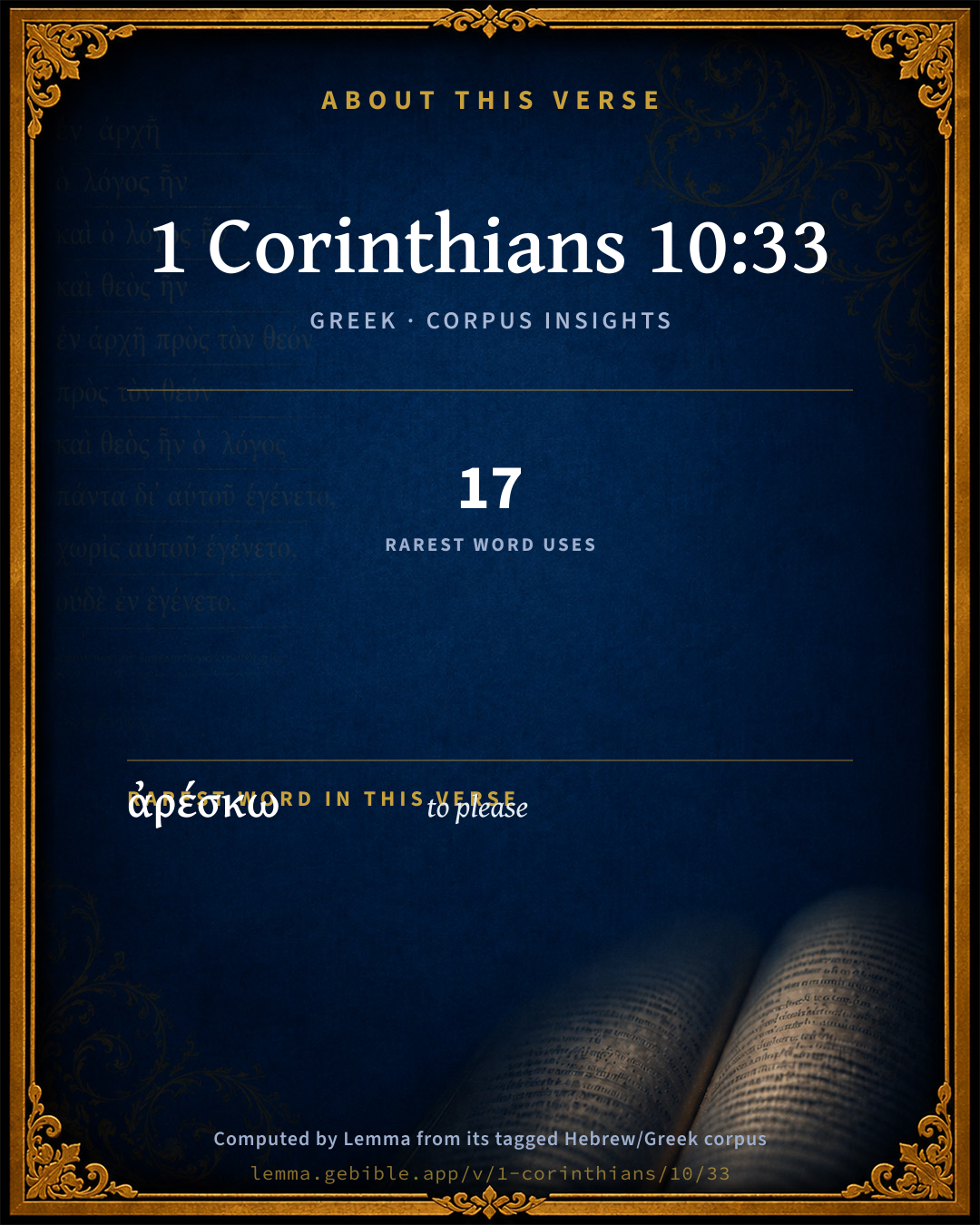
The rarest word here is ἀρέσκω to please G700 — appearing just 17 times in the whole Greek New Testament.

Shared distinctive vocabulary

ἀρέσκω to please G700 occurs in 16 verses of the Greek New Testament. Also found in:

Repetition

Words recur within this verse:

Cross-references

7

Topical passages linked to 1 Corinthians 10:33 in the Treasury of Scripture Knowledge — connected by theme and wording, ordered by reader-vote popularity; previews shown in the World English Bible.

  • Galatians 1:10 For am I now seeking the favor of men, or of God? Or am I striving to please men? For if I were still pleasing men, I wouldn't be a servant of Christ.
  • 1 Corinthians 10:24 Let no one seek his own, but each one his neighbor's good.
  • 1 Corinthians 9:19–23 For though I was free from all, I brought myself under bondage to all, that I might gain the more.
  • Romans 15:2–3 Let each one of us please his neighbor for that which is good, to be building him up.
  • Romans 11:14 if by any means I may provoke to jealousy those who are my flesh, and may save some of them.
  • 2 Corinthians 12:19 Again, do you think that we are excusing ourselves to you? In the sight of God we speak in Christ. But all things, beloved, are for your edifying.
  • 2 Corinthians 11:28–29 Besides those things that are outside, there is that which presses on me daily, anxiety for all the assemblies.

Cross-references courtesy of OpenBible.info (CC BY 4.0).

Commentary

Notes on 1 Corinthians 10:33 from classic Christian and Jewish commentators (each source and its license shown beneath its notes). The classic Christian expositions comment on the surrounding passage and are grouped to its opening verse, so a note may address several verses; the Jewish commentaries on the Tanakh (Rashi and others) are per-verse, so they appear only where the commentator wrote on this verse.

Lemma curates 59 commentaries, every one of them public domain or Creative Commons licensed, each selected and text-cleaned for this edition rather than reprinted as found. About our sources →

Bengel's Gnomon

Johann Albrecht Bengel

1Co 10:33. Πάντα) κατα πάντα, in all things.—πᾶσιν, all men) Jews, Greeks, Christians.—ἀρέσκω, I please) with respect to their consciences.—ἴνα σωθῶσι, that they may be saved) By this standard we must determine what is profitable.

Bengel's Gnomon of the New Testament — English translation (T&T Clark, Edinburgh, 1860) — public domain. Text from a community e-Sword module.

Meyer's Critical & Exegetical Commentary

Heinrich August Wilhelm Meyer

1Co_10:33. Πάντα πᾶσιν ἀρέσκω] See 1Co_9:19 ff. πάντα, in every respect, 1Co_9:25. ἀρέσκω, am at the service of. It denotes what takes place on the apostles side through his endeavour, namely, to be the servant of all, and to be all things to all men (1Co_9:19 ff.); not the result of his endeavour, as if he actually did please all (see on Gal_1:10); for πᾶσιν ἀρέσκειν τὸν συμβουλεύοντα καὶ τὰ κοινὰ πράττοντα ἀδύνατον, Dem. 1481. 4. Comp Rom_15:2; 1Th_2:4.

ΤῶΝ ΠΟΛΛῶΝ] of the many, the multitude, opposed to the unity of his own single person. Comp on 1Co_9:19; Rom_5:15; and on the idea, Clement, ad Cor. I. 48: ζητεῖν τὸ κοινωφελὲς πᾶσιν, καὶ μὴ τὸ ἑαυτοῦ.

ἵνα σωθῶσι] ultimate end, for the sake of which he sought their good: that they might be sharers in the Messianic salvation. Comp 1Co_9:22. Ex eo dijudicandum utile, Bengel.

Meyer — Critical and Exegetical Commentary on the New Testament — English translation by Peter Christie, edited by Frederick Crombie (T&T Clark, 1880) — public domain. Text from a community e-Sword module.

Expositor's Greek Testament

ed. W. Robertson Nicoll

1Co 10:33 ; 1Co 11:1 . Paul’s personal example played a large part in his argument (1Co 10:9 ); it is fitting he should refer to it in summing up. The negative ἀπρόσκοποι γίνεσθε , in 2nd person, now becomes the positive ἐγὼ πάντα πᾶσιν ἀρέσκω in the 1st: “As I also in all things please all.” ἀρέσκω is to comply with, accommodate oneself to , not give enjoyment to ( cf. Rom 15:1 ; Rom 15:3 ) no need to speak of a “conative present,” resembling ζητῶ ἀρέσκειν , Paul’s universal compliance is qualified by its purpose , ἵνα σωθῶσιν , in the light of which the verbal contradiction with Gal 1:10 , 1Th 2:4 , is removed; there is nothing in his power that P. will not do for any man, to help his salvation ( cf. 1Co 9:22 b ). Between the ἀρέσκω and its purpose lies the μὴ ζητῶν clause, in which the Ap. professes for himself the rule commended to the Cor [1589] in 1Co 10:27 . The “self-advantage” which P. sets aside, touches his highest welfare ( cf. Rom 9:3 ); P. sacrificed what seemed to be his spiritual as well as material gain spending, e.g ., weary hours in tent-making that might have been given to pious study to secure spiritual gain for others; thus “losing himself,” he “found himself unto life eternal.” “The many,” in contrast with the single self; cf. 1Co 10:17 , Rom 5:15 ff. Through his own pattern P. points the readers to that of his Master and theirs: “Show yourselves ( γίνεσθε , see 32, 1Co 7:23 ) imitators of me, as I also (am) of Christ”. P. does not point his readers backward to the historical model (“of Jesus,” or “Jesus Christ,” as in Eph 4:21 ), but upward to the actual “Christ,” whose existence is evermore devoted to God (Rom 6:10 f.) and to men His brethren (Rom 8:34 f., 1Co 1:30 ), “in” whom the Cor [1590] believers “are” (1Co 1:2 ; 1Co 1:30 ). Paul’s imitatio Christi turns on the great acts of Christ’s redeeming work (Eph 5:2 , Phi 2:5-11 ), rather than on the incidents of His earthly course.

[1589] Corinth, Corinthian or Corinthians.

[1590] Corinth, Corinthian or Corinthians.

The Expositor's Greek Testament, edited by W. Robertson Nicoll (1897–1910) — public domain. Text from a community e-Sword module.

Godet's Commentaries

Frédéric Louis Godet

Vv. 10:33-11:1. “even as I please all men in all things, not seeking mine own profit, but the profit of the many, that they may be saved. 1Co 11:1. Become imitators of me, as I am of Christ.”

In chap. 9 the apostle had developed at length the example of self-denial, which he was constantly giving to the Church by submitting to the necessity of earning a livelihood for himself, and in general, by becoming subject, when it was necessary, to the legal observances, from which he felt himself set free by faith in Christ. In concluding this whole passage, in which he has asked the Corinthians to make many sacrifices which are painful to them, he once more refers to his example, because he knows that we are not at liberty to ask sacrifices from others except in proportion to those which we make ourselves.

The phrase to please others may denote a vice or a virtue. That depends on the object proposed, whether to gain our neighbour’s good graces selfishly, or to gain the attachment of our neighbour so as to win him for God. These are the two cases Paul contrasts with one another in this verse, in order to exclude the first, in so far as his own conduct is concerned; comp. Gal 1:10. The: in all things, comprehends of course only the things which belong to the province of Christian liberty. — The many is opposed to Paul as an individual, and their salvation to his individual interest (ἐμαυτοῦ, of myself).

Vv. 1Co 11:1. Christ alone is the perfect model; each believer is a model to his brethren only in so far as he is a copy in relation to Christ.

Paul has in mind especially the absolute self-denial which was the basis of our Lord’s earthly life, Rom 15:1-3.

It is only the fact expressed in the second part of the verse which gives the apostle the right and liberty to write the first. To be quite exact, we must understand in the second proposition not the verb be, but the verb become, used in the first.

The imitation in question is not a slavish one. As Paul was not in circumstances identical with those of Christ, so the Corinthians were not in circumstances altogether analogous to those of Paul. What he asks of the Church is, that it allow itself to be guided by the spirit of self-denial which animates himself, as he is guided by the spirit of self-sacrifice which was the soul of Christ’s life.

We have already cast a glance over the course followed by the apostle in treating this delicate subject. It was needful to limit the use made of their liberty by many of the Corinthian Christians, and among them no doubt, by those who directed the opinion of the Church, without placing them again under the yoke of an external law, and while bringing them to understand themselves the necessity of the sacrifice. This sacrifice wounded their vanity as much as their love of pleasure. It is easy to see the extreme prudence with which the apostle required to conduct this discussion. He begins by stating the point about which all are agreed, the monotheism which excludes the reality of idols. He leaves aside for the moment the frequenting of idolatrous feasts, appealing only to charity for weak brethren. He encourages the strong by his example, deters them by that of the Israelites. After this preparation, he strikes the great blow. Then he concludes calmly with some simple and practical rules in regard to the eating of meats, rules which admirably establish harmony between the rights of liberty and the obligations of charity.

Justly does Rückert exclaim, as he closes the analysis of the passage: “Truly I could not conceive a more prudent or better calculated course; we have here a masterpiece of true eloquence.” Pity, only, that this eminent exegete does not stop there, but thinks he must ascribe to the apostle’s eloquence, in this case, a certain character of craftiness. Evidently in the course followed by the apostle we are bound to recognise the wisdom of the serpent; but it does not for a moment exclude the simplicity of the dove. For prudence is throughout ever in the service of the love of truth and of zeal for the good of individuals and of the Church.

Frédéric Louis Godet — Commentaries on Luke, John, Romans, and 1 Corinthians — English translation (T&T Clark, Edinburgh, 1870s–1890s) — public domain. Text from a community e-Sword module.

Hodge's Commentary on Romans, Ephesians & First Corinthians

Charles Hodge

1Co_10:33

Even as I please all (men) in an (things), not seeking mine own profit, but the (profit) of many, that they may be saved.

What he urged them to do, he himself did. His object was not his own advantage, but the benefit of others. He therefore, in all things allowable, accommodated himself to all men, that they might be saved. I am made all things to all men, that I might by all means save some. 1Co_9:22.

The principle which the apostle here avows, and which he so strenuously recommends in the preceding chapters, is one which has often been lamentably perverted. On the plea of becoming all things to all men, Christians are tempted into sinful conformity with the habits and amusements of the world. On the same plea the church of Rome adopted heathen festivals, ceremonies and rites, until the distinction between Paganism and Christianity was little more than nominal. Heathen temples were called churches; pagan gods were baptized as saints, and honored as before. Modern Rome, in the apprehension of the people, is almost as polytheistic as ancient Rome. In like manner Romish missionaries accommodate themselves to such a degree to heathen ideas and forms, that the difference between what they call Christianity and the religion of the country is almost lost. Even Protestant missionaries are often perplexed how to decide between what is to be tolerated and what prohibited of the previous usages and ceremonies of their converts. That the principle on which Paul and the other apostles acted in reference to this matter, is radically different from that adopted by the church of Rome, is apparent from their different results. Rome has become paganized. The apostle so acted as to preserve the church from every taint of either Paganism or Judaism. The rules which guided the apostles may be easily deduced from the conduct and epistles of Paul.

1. They accommodated themselves to Jewish or Gentile usages only in matters of indifference.

2. They abstained from all accommodation even in things indifferent, under circumstances which gave to those things a religious import. They allowed sacrifices to be eaten; but eating within a temple was forbidden.

3. They conceded when the concession was not demanded as a matter of necessity; but refused when it was so regarded. Paul said circumcision was nothing and uncircumcision was nothing; yet he resisted the circumcision of Titus when it was demanded by the Judaizers.

4. The object of their concessions was not to gain there nominal converts, nor to do away with the offense of the cross, Gal_4:11, but to save men. No concession therefore, whether to the manners of the world or to the prejudices of the ignorant, can plead the sanction of apostolic example, which has not that object honestly in view.

5. It is included in the above particulars that Paul, in becoming all things to all men, never compromised any truth or sanctioned any error.

Charles Hodge — Commentary on Romans (1835), First Corinthians (1857), and Ephesians (1856) — public domain. Text from a community e-Sword module.

Jamieson, Fausset & Brown

Robert Jamieson, A. R. Fausset & David Brown

I please--I try to please (Co1 9:19, Co1 9:22; Rom 15:2).

not seeking mine own-- (Co1 10:24).

many--rather as Greek, "THE many."

Next: 1 Corinthians Chapter 11

Jamieson, Fausset & Brown — Commentary Critical and Explanatory on the Whole Bible (1871) — public domain (CC PDM 1.0). Text via the HelloAO Bible API.

Adam Clarke's Commentary

Verse 33. Even as I please all men] Act as I do: forgetting myself, my own interests, convenience, ease, and comfort, I labour for the welfare of others; and particularly that they may be saved. How blessed and amiable was the spirit and conduct of this holy man!

THIS chapter has already presented the serious reader with a variety of maxims for his regulation.--

1. As to his own private walk;

2. His domestic duties; and

3. His connection with the Church of God.

Let us review some of the principal parts.

1. We should be on our guard against what are called little sins, and all occasions and excitements to sin. Take heed what company you frequent. One thing, apparently harmless, may lead by almost imperceptible links to sins of the deepest dye. See the example in this chapter: 1. The people sat down to eat and to drink. 2. They rose up to play, dance, and sing: and 3. They committed fornication, and brought upon themselves swift destruction.

2. However conscious we may be of our own sincerity and uprightness, we should ever distrust ourselves. God has made nothing independent of himself; the soul has no principle of self-dependence either in itself or its attainments: it is wise, powerful, and happy, only while it is depending on infinite wisdom, unlimited power, and endless mercy.

3. The Gentiles were in communion with demons by their idolatrous services. In what communion are those who feed themselves without fear, who eat with the glutton and drink with the drunkard? So they partake of the Lord Jesus who are under the influence of pride, self-will, hatred, censoriousness, c., and who carry their self-importance and worldly spirit even into the house and worship of God?

4. A spirit of curiosity too much indulged may, in an irreligious man, lead to covetousness and theft: in a godly man, to a troublesome and unscriptural scrupulosity of conscience, productive of nothing but uneasiness to itself, and disturbance to others. Simplicity of heart saves from this, and is an excellent gift.

5. In many actions we have a twofold rule-the testimony of God and charity: and in many things charity is the best interpreter of the testimony. The testimony often permits what charity forbids, because circumstances in time, place, c., may render a thing improper on one occasion that might be proper on another.

6. Pious Quesnel has well said: Every thing honours God when it is done for his sake every thing dishonours him when any ultimate end is proposed beside his glory. It is an unchangeable principle of the Christian morality that all comes from God by his love, and all should be returned to him by ours. This rule we should keep inviolate.

7. Though many of the advices given in this chapter appear to respect the Corinthians alone, yet there is none of them that is not applicable to Christians in general in certain circumstances. God has given no portion of his word to any people or age exclusively the whole is given to the Church universal in all ages of the world. In reading this epistle let us seriously consider what parts of it apply to ourselves; and if we are disposed to appropriate its promises, let us act conscientiously, and inquire how many of its reprehensions we may fairly appropriate also.

Adam Clarke's Commentary on the Bible (1810–1826) — public domain. Text from a community e-Sword/MySword module.

John Calvin's Commentaries

33. Even as I please all men in all this As he speaks in a general way, and without exception, some extend it by mistake to things that are unlawful, and at variance with the word of the Lord — as if it were allowable, for the sake of our neighbor, to venture farther than the Lord permits us. It is, however, more than certain, that Paul accommodated himself to men only in things indifferent, and in things lawful in themselves. Farther, the end must be carefully observed — that they may be saved Hence what is opposed to their salvation ought not to be conceded to them, but we must use prudence, and that of a spiritual kind.

John Calvin's Commentaries (1540-1563) — public domain. Text from the Calvin Translation Society English edition (1840s-50s) via the Christian Classics Ethereal Library (ccel.org). Calvin's coverage is partial (roughly two-thirds of the Bible); uncommented books and verses are honest gaps, never fabricated. The 19th-century editor's footnotes and remarks are omitted so the notes are faithfully Calvin's own voice.

Ellicott's Commentary for English Readers

(33) Even as I please all men . . .—Better, even as I in all things am seeking to please all men, not seeking my own profit, but that of the many—i.e., the whole great mass of men, and not, as the English seems to imply, merely “a great number.” This is the same idea as “I am made all things to all men.” (See 1Co_9:22.)

With the last verse of this chapter we must connect the first verse of 1 Corinthians 11, “Become imitators of me, even as I am of Christ.” This is the completion of the exhortation. The Apostle refers to his own example, but only to lead his readers up to Christ as the great example of One “who pleased not Himself” (Rom_15:3). His own example is valuable inasmuch as it is the example of one who is striving to conform to the image of his Lord. With the mention of the holiest Example and the most sacred Name, the whole of this argument and exhortation reaches its natural climax and conclusion.

A Bible Commentary for English Readers, edited by Charles John Ellicott (1878–1897) — public domain. Text from a community e-Sword module.

Trapp's Complete Commentary

John Trapp

33 Even as I please all men in all things, not seeking mine own profit, but the profit of many, that they may be saved.

Ver. 33. Not seeking mine own profit] This, saith Chrysostom, is the most perfect canon of Christianity, the top gallant of true religion.

John Trapp, A Commentary or Exposition upon All the Books of the Old and New Testament (1647–1656) — public domain. Text from a community e-Sword module.

Albert Barnes' Notes on the Bible

Even as I ... - Paul here proposes his own example as their guide. The example which he refers to is that which he had exhibited as described in this and the preceding chapters. His main object had been to please all people; that is, not to alarm their prejudices, or needlessly to excite their opposition (see the note at 1Co 9:19-23), while he made known to them the truth, and sought their salvation - It is well when a minister can without ostentation appeal to his own example, and urge others to a life of self-denial and holiness, by his own manner of living, and by what he is himself in his daily walk and conversation.

Albert Barnes' Notes on the Bible (1834–1885) — public domain. Text from a community e-Sword/MySword module.

Matthew Poole's English Annotations

Even as I please all men in all things; that is, in all things wherein the law of God hath left me a liberty; for Paul pleased no man, either in the omission of any thing which God had commanded him to do, or in the doing of any thing which God had forbidden him to do.

Not seeking mine own profit, but the profit of many, that they may be saved; not seeking my own advantage, either the satisfaction of my own mind or humour, or my own gain, but the advantage of others, especially in matters that may any way affect them as to their eternal salvation. Thus Paul, like a good shepherd, goeth out before the sheep, and leadeth them, and, as every true minister should be, is himself an example to the flock of Christ. And this is a third rule to be observed by Christians, as to the use of the liberty which God’s law hath left them as to any particular actions; notwithstanding that liberty, yet they ought to have respect to the spiritual good and salvation of others, and to do that part which their judgments inform them will be, as least to the spiritual damage and detriment, so most to the spiritual good and profit, of the souls of others with whom they converse.

Matthew Poole's English Annotations on the Holy Bible (1683–1685) — public domain. Text from a community e-Sword/MySword module.

Whedon's Commentary on the Bible

Daniel D. Whedon

33. Please all—That is, in purpose and effort, whether with successful result or not.

Be saved—His compliances and subserviences were neither for flattery nor self-interest, but for the eternal good of his fellow-beings. In this direction he was the most complying of men; in all others the most independent. In all these things he would have the Corinthians, according to the first verse of the next chapter, (where see note,) his followers.

Daniel D. Whedon (gen. ed.), Commentary on the Old and New Testaments (1874–1909) — public domain. Text from a community e-Sword module.

The Pulpit Commentary

That they may be saved. All the sympathy, tolerance, forbearance, which I try to practise has this one supreme object.

Benevolence.

Paul recommended to the Corinthians that course of conduct which he followed himself. As a religious teacher, he practised what he taught. And the lessons of his lips and of his pen were enforced with a tenfold power by the actions of his life. In nothing was this more observable and undeniable than in his devotion to the welfare of others, and his habit of adapting himself to all men, in order that he might win some for Christ.

I THE CONDUCT ABJURED. Paul sought not his own profit; and he dissuades Christians generally from doing so. By this we are to understand that our own profit is not to be the one ruling principle of our life. Certainly it is not wrong to seek our own spiritual welfare and eternal salvation; for this we are responsible, to this we are called. But having found Christ ourselves, we are not to make our personal advantage our one and only concern. They who seek such an end always fail; none are more stunted in spiritual growth than those whose only thought is how they may obtain abundant nourishment for themselves. Christians must be prepared to sacrifice religious advantages and enjoyments, when such a sacrifice is demanded in the interests of their fellow men.

II THE RULE ADOPTED. Paul"s rule, which he commends to us, was to "please all men." This might easily be misunderstood, for nothing is baser than a habit of pandering to the passions and courting the favour and humouring the prejudices of all we meet with. But there is a pliancy and adaptation of character and demeanour, which flows from and expresses sympathy, and which is a sure road to most men"s hearts. It is no degradation to condescend to the simple and illiterate, to enter into the thoughts and pursuits of the scholarly, to talk the languages of the foreigner, to share the ways and the life of any man, in innocence and without duplicity. It was by this habit, carried to excess, that the Jesuits gained their hold upon individual natures and upon general society. And it is by this habit, rather than by great powers of thought or of speech, that successful servants of Christ usually achieve their success.

III THE AIM SOUGHT.

1. It respects "the many." This is just like the large heart of Paul, who in this was a true follower of Christ himself. The Lord"s purpose is to draw "all men" unto himself; his prediction, that "many" shall come and sit down in his kingdom; and his commission: "Preach the gospel to every creature." He gave his life a ransom "for many;" his blood was shed for "many;" he bare the sins of "many.

2. It is their immediate "profit" or advantage. What he concerned himself not about, as far as he himself was concerned, he anxiously sought for others.

3. The final aim is the salvation of mankind; a purpose and hope which may well justify, and indeed all but compel, self denial and effort; for salvation includes all blessings of which human nature is capable, and the prolongation, the perpetuation, of those blessings throughout a glorious eternity. T.

The Pulpit Commentary (1880–1919), ed. H.D.M. Spence-Jones & Joseph S. Exell — public domain. Text from a community e-Sword module.

John Wesley's Explanatory Notes

Even as I, as much as lieth in me, please all men.

John Wesley, Explanatory Notes Upon the Whole Bible (1754–1765) — public domain. Text via the GEBible commentary corpus.

Scofield Reference Notes

C. I. Scofield

saved

(See Scofield "Rom 1:16").

The Scofield Reference Bible (1917 edition), notes by C. I. Scofield — public domain. Text from a community e-Sword module.

Burkitt's Expository Notes on the New Testament

William Burkitt

The last rule which the apostle lays down, is his own practice and example, who in indifferent things accommodated himself to all men. I please all men; that is, I seek and endeavour to please all men, and in all things: that is, in all lawful things, and in all other things wherein the law of God has left me at liberty; for neither in the omission of any thing which God commanded, nor in the commission of aught which he had forbidden, would St. Paul please any man in the world.

And when he did please all men, it was for their profit and advantage, not his own: to promote their eternal salvation, not his own temporal interest: I please all men, that they may be saved.

Learn hence, 1. That no men must be pleased by sin, nor pleasured in their sins. The smallest duty must be preferred before the pleasing of all the men in the world.

Learn, 2. We may and ought to seek the pleasing of men, with subserviency and in subordination to the pleasing of Almighty God.

Learn, 3. That inordinate man-pleasing is fruitless, needless, and endless: when you have endeavoured to please most, how many will be displeased when you have done your best? God himself, Jesus Christ, his holy prophets, apostles, saints, and servants, could never please the world; and can any of us expect to do it? St. Paul, though he became all things to all men, yet could save but some.

The world hates godliness, and godly persons, and will never be pleased with that which they hate: let pleasing of God be our great business, and, in subordination to him, endeavour to please all men for their profit, that they may be saved.

William Burkitt's Expository Notes on the New Testament (1700–1703) — public domain. Text from a community e-Sword module.

Godbey's Commentary on the New Testament

William B. Godbey

33. “As I indeed please all in all things, seeking not my own profit, but that of the many in order that they may be saved.” God help us to live in the daily appreciation and application of this plain, beautiful apostolic precept.

The Jews and Gentiles differed more widely in their religious, socialistic and manneristic peculiarities than any denominations now in America. Yet they were united in all the gospel churches, enjoying ample provisions of grace to live together in perfect fraternity and Christian fellowship.

William B. Godbey, Commentary on the New Testament (1896–1900) — public domain. Text from a community e-Sword module.

McGarvey & Pendleton's Commentaries

J. W. McGarvey

even as I also please all men in all things [indifferent or permissible], not seeking mine own profit, but the profit of the many, that they may be saved .

J. W. McGarvey (with Philip Y. Pendleton), Commentaries on the New Testament (The Fourfold Gospel, 1914; Acts; and the epistles) — public domain. Text from a community e-Sword/MySword module.

The People's New Testament

B. W. Johnson

33. Even as I please all men in all things. See notes on 9:20–23.

B. W. Johnson's The People's New Testament with Notes (1889–1891) — public domain. Electronic text from the Christian Classics Ethereal Library (CCEL) ThML edition.

Cambridge Greek Testament for Schools and Colleges

33. σύμφορον אABC. συμφέρον rec. with DEFG.

Cambridge Greek Testament for Schools and Colleges (Cambridge University Press, 1896; 21 vols, various authors incl. Carr, Maclear, Plummer, Farrar, Lumby, Moule, M. R. James, Simcox) — public domain. Text from a community e-Sword module.

Alford’s Greek Testament

Henry Alford

33.] His own course of conduct:—As I in all things (accus. of that on which the subject acts, or over which the quality predicated extends, as in ἀλγῶ τὴν κεφαλήν;—so τοῦ πάντʼ εὐδαίμονος ὄλβου, Soph. Œd. Tyr. 1197. See Kühner, ii. 222. 4) please (‘am pleasing:’ as Meyer well remarks, not the result, but the practice on Paul’s part; for πᾶσιν ἀρέσκειν τὸν συμβουλεύοντα κ. τὰ κοινὰ πράττοντα ἀδύνατον, Demosth. 1481. 4).

ἐμαυτοῦ and τῶν πολλῶν are opposed: see ver. 24.

ἵνα σωθ., his great aim and end;—so ch. 9:22.

Henry Alford, The Greek Testament (1849–1861) — public domain. Text from a community e-Sword module.

International Critical Commentary

33. καθὼς κἀγὼ … ἀρέσκω. ‘Just as I also am ready to render service to all men in all things.’ The rendering ‘please’ for ἀρέσκω is somewhat misleading, for it seems to mean that the Apostle habitually curried favour with every one and tried to be liked by all. Cf. Gal 1:10. ‘Please’ is used from his own point of view of what ought to please.† Ἀρέσκειν is sometimes almost ‘to be a benefactor to.’ “In monumental inscriptions the words ἀρέσαντες τῇ πόλει, τῇ πατρίδι, etc. are used to describe those who have proved themselves of use to the commonwealth, as in O. G. I. S. 646, 12, ἀρέσαντα τῇ τε αὐτῇ βουλῇ καὶ τῳ δήμͅ” (Milligan on 1Th 2:4). What follows shows that his aim was not popularity.

μὴ ζητῶν τὸ ἐμαυτοῦ σύμφορον. The conclusion shows what kind of σύφορον is meant, viz. spiritual profit. The saving of his own soul is not his main object in life; that would be a refined kind of selfishness. He seeks his own salvation through the salvation of others. The unity of the Church as the Body of Christ is such that the spiritual gain of one member is to be sought in the spiritual gain of the whole (v. 17, 12:12, 25, 26). It is for this reason that he prefers inspired preaching to speaking in a Tongue (14:4, 19). It is a commonplace among philosophers that the man who seeks his own happiness does not find it: it is in seeking the happiness of others that each man finds his own. See Php 2:4; Rom 15:1. Josephus (B.J. IV. v. 2) praises Ananus as πρὸ τῶν ἰδίων λυσιτελῶν τὸ κοινῇ συμφέρον τιθέμενος.

ἵνα σωθῶσιν. As in 9:22. This effort must be to the glory of God, for it is carrying on His work (Col 1:13, Col 1:14). Cf. 1:21; 1Th 2:16; 1Ti 2:4. This shows what πᾶσιν ἀρέσκω means.

As in 7:35, σύμθορον (א* A B C) is to be preferred to συμφέρον א3 D E F G K L P). Nowhere else in N.T. does σύμφορος occur; in LXX only 2 Mal 4:5. Hence the change to a more familiar word. In 12:7, συμφέρον is right: συμφέρειν is frequent.

* The ‘Moreover’ of AV. is from a false reading δέ(א3 K L, Syrr.); the evidence for γάρ is overwhelming. It introduce further justification of his demand that they should lmitate him in his forbearance and Entsagung. The οὐ θ. ὑμᾶς ἁγν. (12:1; 2Co 1:8; Rom 1:13; 1Th 4:13) implies no reproach: contrast οὐκ οἴδατε (3:16, 5:6, 4:2, etc.).

* Onkelos paraphrases Deu 33:3; “With power He brought them out of Egypt, they were led under Thy cloud; they journeyed according to Thy word.” Onkelos is said to have been, like St Paul, a disciple of Gamaliel. Cf. Psa 105:39.

B B (Fourth century.) The Vatican MS.

K K (Ninth century). Codex S. Synod. xcviii. Lacks 1:1-6:13 ταύτην καί: 8:7 τινὲς δὲ—8:11 ἀπέθανεν.

L L (Ninth century). Codex Angelicus; At Rome.

P P (Ninth century). Porfirianus Chiovensis. A palimpsest acquired in the East by Porphyrius Bishop of Kiew. Lacks 7:15 ὑμᾶς ὁ θεός-17 περιπάτει: 12:23 τοῦ σώματος-13:5 οὐ λογί-: 14:23 τὸ λαλεῖν μή. A good type of text in St Paul’s Epistles.

אԠא (Fourth century.) The Sinaitic MS., now at St Petersburg, the only MS. containing the whole N.T.

A A (Fifth century.) The Codex Alexandrinus; now at the British Museum.

C C (Fifth century). The Codex Ephraem, a Palimpsest; now at Paris. Lacks 7:18 ἐν ἀκροβυστίᾳ-9:6 τοῦ μὴ ἐργάζεσθαι: 13:8 παύσονται-14:40 ἀλλὰ ἕτερα.

D D (Sixth century.) Codex Clarmontanus; now at Paris. A Graeco-Latin MS. 14:13 διο͂ ὁ λαλῶν-22 σημεῖον ἐστίν is supplied by a later but ancient hand. Many subsequent hands (sixth to ninth centuries) have corrected the MS. (See Gregory, Prolegomena , pp. 418-422).

E E (Ninth century). At Petrograd. A copy of D, and unimportant

F F (Late ninth century). Codex Augiensis (from Reichenau); now at Trin. Coll. Cambr. Probably a copy of G in any case, secondary to G, from which it very rarely varies (see Gregory, p. 429).

G G (Late ninth century). Codex Boernerianus; at Dresden. Interlined with the Latin (in minluscules). Lacks 1Co 3:8-16, 1Co 6:7-14 (F).

* This would imply that the Corinthians were predestined to fall as the Israelites did.

* Aristoph. Ran. 450, τὸν ἡμέτερον τρόπον τὸν καλλιχορώτατον παίζοντες. The verb is found nowhere else in N.T. In LXX it is frequent.

† But in Num_25. we have two different stories combined and somewhat confused: vv. 1-5 come from one source, vv. 6-18 from another. The locality in one case is Shittim, in the other Peor; the god in one case is presumably Kemosh the God of Moab, but he is called in both cases the Baal of Peor; the punishment in one case is execution by the judges, in the other plagues sent by God; the cause of the evil in one case is Moabite, in the other Midianite. See Gray, Numbers, pp. 380 f., and cf. the interchange of Ishmaelite with Midianite, Gen 37:25-36.

* The μιᾷ ἡμέρᾳ increases the horror: omnia ademit Una dies infesta tibi tot praemia vitae (Lucr. 3:911); cf. Rev 18:8.

17 17. (Ev. 33, Act_13. Ninth century.) At Paris (Nat. Gr. 14). See Westcott and Hort., Introd. §§ 211, 212.

* The murmuring against the report of the spies can hardly be meant, for that was punished by the murmurers dying off in the wilderness, not by any special destruction (Num 14:1, Num 14:2, Num 14:29).

† It is perhaps for this reason that he changes from καθώς to καθάπερ, which implies the very closest resemblance, ‘exactly as’.

* The education of the Gentiles went on side by side with the education of the Jews, and both streams met in the Christian Church. “The Church is the heir of the spiritual training of manking” (Findlay). The temptation to make τὰ τ. τῶν αὶ. singular produced corruptions; in quos finis sacculorum devenit (Iren. 4. 14: 3), in quos finis seculorum obvenit Aug. De cat. rud. 3). Tert. preserves the plural; at nos commonendos, in quos fines aevorum decucurreunt (Marc. v. 7); also Vulg.; ad correptionem nostram, in quos fines secutorum devenerunt.

* J. H. Moulton (Gr. 1. p. 217) prefers to call this use of τοῦ c. infin. ‘epexegetic’, and thinks that ‘when Paul wishes to express purpose he uses other means”. Bachmann makes τοῦ δύνασθαι the genitive of the substantival infinitive, dependent on ἔκβασιν, ‘the escape of being able to bear it’; i.e. the ἔκβασις consists in the power to endure.

* Ellicott says that this distinction between μετέχειν and κοινωνεῖν “cannot be substantiated. All that can properly be said is that κοινωνεῖν implies more distinctly the idea of a community with others”: and that is sufficient. See Cremer, p. 363. Lightfoot points out the caprice of AV. in translating κοινωνοί first ‘partakers’ and then ‘have fellowship,’ while κοινωνία is ‘communion,’ and μετέχειν is ‘to be partakers’ (On Revision, p. 39).

* Quoniam unus est panis, unum corpus nor, qui multi sumus (Beza). Weil Ein Brod es ist das wir brechen, sind Ein Leib wir, die Vielen (Schmiedel).

H H (Sixth century). Coisl. 202. At Paris (the part containing 10:22-29, 11:9-16. An important witness, but unhappily seldom available. The MS. is scattered in seven different libraries, having been employed for bindings.

* See Origen (Cels. viii. 21 sub init.) where he says that Celsus would call ἱερόθυτα what are properly called εὶδωλόθυτα, or, still better, δαιμονιόθυτα. There is no improbability in a ‘weak’ Christian accepting the invitation of a heathen. There would be plenty of food that had never been sacrificed: and he might avoid the word εἰδωλόθυτον out of consideration for his entertainer.

* Epictetus (Arr. Dis. ii. 19) says; “I have this purpose, to make you free from constraint, compulsion, hindrance, to make you free, prosperous, happy, looking to God in everything small and great,” εἰς Θεὸν ἀφορῶντας ἐν παντὶ μικρῷ και μεγάλῳ.

* There is no “harsh note of ecclesiasticism” here. It is the glory of God that is put in the first place, and, after that, the good of others.

† Ignatius recalls these words and 4:1, when he writes (Trall. 2), δεῖ δὲ καὶ τοὺς διακόνους ὄντας μυστηρίων Ἰ. Χριστοῦ κατὰ πάντα τρόπον πᾶσιν ἀρέσκειν.

International Critical Commentary — older volumes (1896–1929), various authors — public domain. Text from a community e-Sword module.

Lesson kit

Teaching starters — assembled from the data on this page, not authored interpretation. Every prompt links to the verse data it draws on. Edit before teaching.

1 Corinthians, in the Pauline Epistles, opens this verse with 16 words (13 distinct Greek lemmas). Its most distinctive word is aréskō (“to please”). A historical commentator’s framing appears above. Read the whole chapter for the surrounding context.

Discussion questions

  1. The word aréskō carries the sense “to please.” How does it shape the verse?
  2. Matthew 14:6 shares the word «to please» with this verse. How do the two illuminate each other?
  3. “all” occurs 2× in this one verse. What is the effect of the repetition?
  4. These translations render this verse differently. What is at stake in choosing one wording over another?
  5. Reading how Bengel's Gnomon and Meyer's Critical & Exegetical Commentary read this verse, where do the two commentators agree and where do they part?

Things to notice

Reading settings

Reading text

Shown beneath each verse's original-language words.

Old Testament
Old Testament edition

Read the OT as the Masoretic Hebrew (MT) or the Greek Septuagint (LXX).

English shown for the Greek Septuagint (in the Hebrew ↔ Greek comparison).

Comparing translations? Open the Compare panel on any verse page to stack up to four side by side.