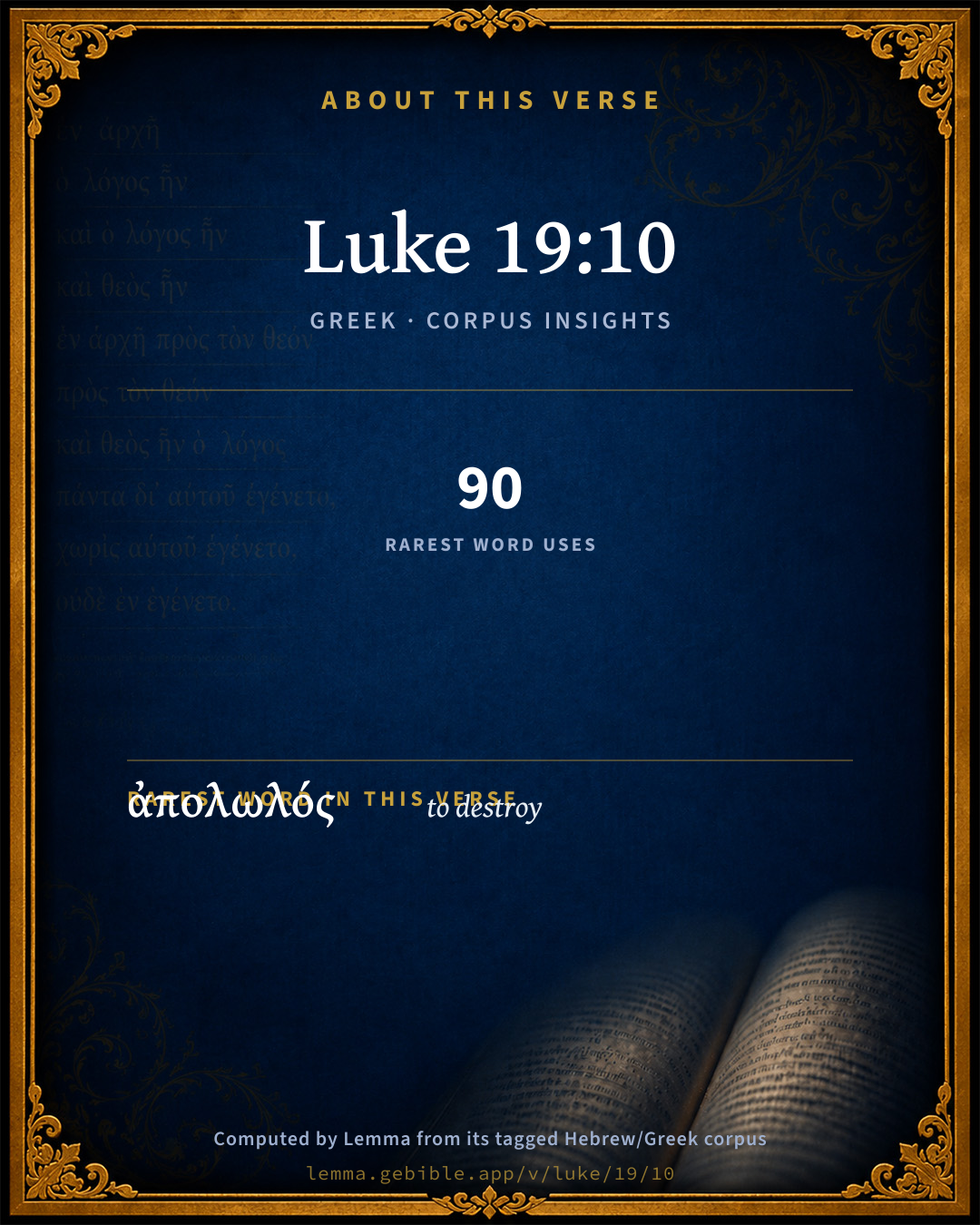
Luke 19:10

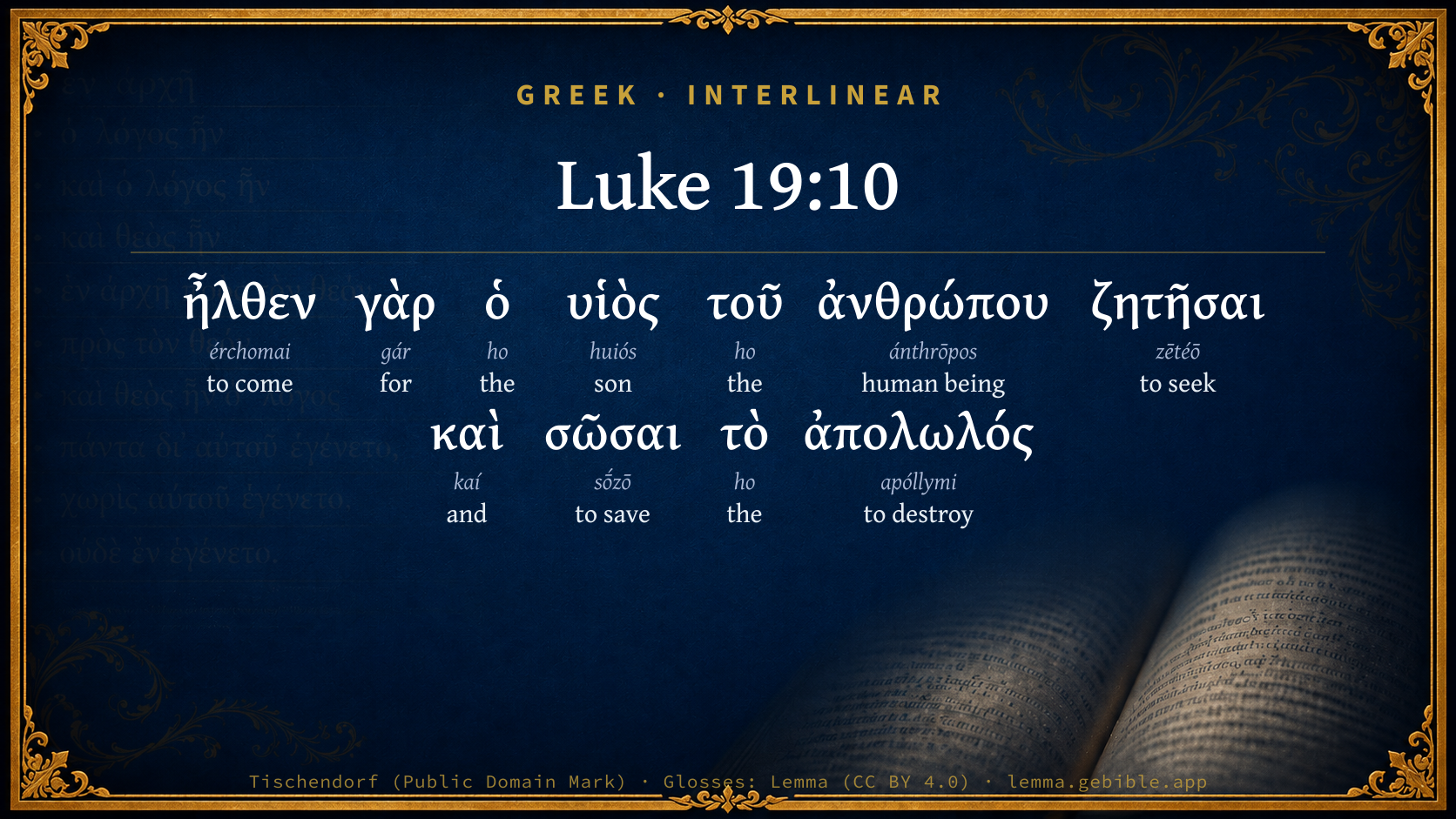
Greek (Tischendorf 8th ed.) Luke 19:10 appears in the Greek New Testament. The text above is from the Tischendorf 8th edition. Each word links to its Strong’s number and a concise gloss. Click any word for its full Thayer’s Greek Lexicon entry.
Download image
Cite this verse

Luke 19:10 (World English Bible). Public Domain. Lemma interlinear Bible study tool, https://lemma.gebible.app/v/luke/19/10.

Show BibTeX & RIS
BibTeX
RIS
English Translation
For the Son of Man came to seek and to save that which was lost."
World English Bible · Public Domain
Download a study sheet

One document with this verse’s original text, its word-by-word gloss line, the meaning frame, cross-references with their text, attributed commentary, and full source and license credits — printable, and it pastes into notes with its structure intact.

This verse Autodidact and up

Study sheet (.html) Plain text (.txt)

A passage Seminary Student

Up to 50 verses in one chapter. A passage sheet keeps up to 6 commentary sources and 12 cross-references per verse, in the order this page ranks them, and says so on the sheet whenever that leaves anything out. Ask for a single verse and you get the Autodidact verse sheet above.

Everything on this page stays free to read, with no account — the sheet is a download of what is already on screen, not access to it.

Want to remove ads? Support Godless Engineer
Compare translations 3

The same verse in 3 English versions, stacked beneath the original-language interlinear above. Click any original word for its lexicon entry.

Each is an independent rendering of the whole verse — the interlinear is not word-aligned to these translations.

Highlighted words mark where these versions differ — a whole-verse word diff, not a word-by-word alignment.

  • World English Bible Public Domain
    For the Son of Man came to seek and to save that which was lost."
  • King James Version Public Domain
    For the Son of man is come to seek and to save that which was lost.
  • unfoldingWord Literal Text CC BY-SA 4.0
    For the Son of Man came to seek and to save the one that has been lost.”

unfoldingWord Literal Text — © unfoldingWord, licensed CC BY-SA 4.0. Word-aligned USFM3 via Door43 (git.door43.org/unfoldingWord/en_ult).

Versions to compare (up to 4)

3 of 4 selected

Show all 19 translations

Every available English version of this verse, each an independent rendering of the whole verse.

  • World English Bible Public Domain
    For the Son of Man came to seek and to save that which was lost."
  • Berean Standard Bible Public Domain
    For the Son of Man came to seek and to save the lost.”
  • Majority Standard Bible Public Domain
    For the Son of Man came to seek and to save the lost.”
  • King James Version Public Domain
    For the Son of man is come to seek and to save that which was lost.
  • American Standard Version (1901) Public Domain
    For the Son of man came to seek and to save that which was lost.
  • Revised Version (1885) Public Domain
    For the Son of man came to seek and to save that which was lost.
  • Geneva Bible (1599) Public Domain
    For the Sonne of man is come to seeke, and to saue that which was lost.
  • Douay-Rheims (1899) Public Domain
    For the Son of man is come to seek and to save that which was lost.
  • Young's Literal Translation Public Domain
    for the Son of Man came to seek and to save the lost.'
  • Literal Standard Version CC BY-SA 4.0
    for the Son of Man came to seek and to save the lost.”
  • Unlocked Literal Bible CC BY-SA 4.0
    For the Son of Man came to seek and to save the people who are lost.”
  • unfoldingWord Literal Text CC BY-SA 4.0
    For the Son of Man came to seek and to save the one that has been lost.”
  • Darby Bible Public Domain
    for the Son of man has come to seek and to save that which is lost.
  • World Messianic Bible Public Domain
    For the Son of Man came to seek and to save that which was lost.”
  • Webster's Bible Public Domain
    For the Son of man is come to seek and to save that which was lost.
  • Free Bible Version CC BY-SA 4.0
    For the Son of man came to search for and save those who are lost.”
  • Bible in Basic English Public Domain
    For the Son of man came to make search for those who are wandering from the way, and to be their Saviour.
  • Text-Critical English NT CC BY 4.0
    For the Son of Man came to seek and save the lost.”
  • Tyndale New Testament (1534) Public Domain
    For the sonne of man is come to seke and to save that which was looste.

Literal Standard Version (2020), Covenant Press — licensed CC BY-SA 4.0. Text via the HelloAO Bible API (eBible.org). Unlocked Literal Bible (unfoldingWord) — licensed CC BY-SA 4.0. Text via the HelloAO Bible API (eBible.org). unfoldingWord Literal Text — © unfoldingWord, licensed CC BY-SA 4.0. Word-aligned USFM3 via Door43 (git.door43.org/unfoldingWord/en_ult). Free Bible Version, Dr. Jonathan Gallagher — licensed CC BY-SA 4.0. Text via the HelloAO Bible API (eBible.org).

Word by word

More ways to search: Search by grammar → Find every occurrence → Compare this word →

Practice this passage: Drill this verse → Learn its vocabulary →

ἀπολωλός
apóllymi
G622
“to destroy”
Verb, Perfect, Active, Participle, Accusative, Singular, Neuter
Part of Speech
Verb
Tense
Perfect
Voice
Active
Mood
Participle
Case
Accusative
Number
Singular
Gender
Neuter
Full Thayer's Definition

Origin: from G575 and the base of G3639

TDNT: 07:34,7

1. to destroy a. to put out of the way entirely, abolish, put an end to ruin b. render useless c. to kill d. to declare that one must be put to death e. metaph. to devote or give over to eternal misery in hell f. to perish, to be lost, ruined, destroyed 2. to destroy a. to lose
  1. ἦλθεν érchomai G2064 “to come” Verb, Aorist, Active, Indicative, 3rd person, Singular
  2. γὰρ gár G1063 “for” Conjunction
  3. ὁ ho G3588 “the” Article, Nominative, Singular, Masculine
  4. υἱὸς huiós G5207 “son” Noun, Nominative, Singular, Masculine
  5. τοῦ ho G3588 “the” Article, Genitive, Singular, Masculine
  6. ἀνθρώπου ánthrōpos G444 “human being” Noun, Genitive, Singular, Masculine
  7. ζητῆσαι zētéō G2212 “to seek” Verb, Aorist, Active, Infinitive
  8. καὶ kaí G2532 “and” Conjunction
  9. σῶσαι sṓzō G4982 “to save” Verb, Aorist, Active, Infinitive
  10. τὸ ho G3588 “the” Article, Accusative, Singular, Neuter

About this verse

These counts appear in no published source. They are computed here, from the morphology-tagged text and Lemma’s own curated glosses. What Lemma adds →

11
words
9
distinct lemmas
Gospels
section

Repetition

A word recurs within this verse:

Cross-references

13

Topical passages linked to Luke 19:10 in the Treasury of Scripture Knowledge — connected by theme and wording, ordered by reader-vote popularity; previews shown in the World English Bible.

  • Ezekiel 34:16 I will seek that which was lost, and will bring back that which was driven away, and will bind up that which was broken, and will strengthen that which was sick: but the fat and the strong I will destroy; I will feed them in justice.
  • Matthew 1:21 She shall bring forth a son. You shall call his name Jesus, for it is he who shall save his people from their sins."
  • 1 Timothy 1:13–16 although I was before a blasphemer, a persecutor, and insolent. However, I obtained mercy, because I did it ignorantly in unbelief.
  • Luke 5:31–32 Jesus answered them, "Those who are healthy have no need for a physician, but those who are sick do.
  • Luke 15:4–7 "Which of you men, if you had one hundred sheep, and lost one of them, wouldn't leave the ninety-nine in the wilderness, and go after the one that was lost, until he found it?
  • Matthew 9:12–13 When Jesus heard it, he said to them, "Those who are healthy have no need for a physician, but those who are sick do.
  • Romans 5:6 For while we were yet weak, at the right time Christ died for the ungodly.
  • Matthew 15:24 But he answered, "I wasn't sent to anyone but the lost sheep of the house of Israel."
  • Luke 15:32 But it was appropriate to celebrate and be glad, for this, your brother, was dead, and is alive again. He was lost, and is found.'"
  • Hebrews 7:25 Therefore he is also able to save to the uttermost those who draw near to God through him, seeing he ever lives to make intercession for them.
  • Matthew 10:6 Rather, go to the lost sheep of the house of Israel.
  • 1 John 4:9–14 By this was God's love revealed in us, that God has sent his one and only Son into the world that we might live through him.
  • Matthew 18:10 See that you don't despise one of these little ones, for I tell you that in heaven their angels always see the face of my Father who is in heaven.

Cross-references courtesy of OpenBible.info (CC BY 4.0).

Commentary

Notes on Luke 19:10 from classic Christian and Jewish commentators (each source and its license shown beneath its notes). The classic Christian expositions comment on the surrounding passage and are grouped to its opening verse, so a note may address several verses; the Jewish commentaries on the Tanakh (Rashi and others) are per-verse, so they appear only where the commentator wrote on this verse.

Lemma curates 59 commentaries, every one of them public domain or Creative Commons licensed, each selected and text-cleaned for this edition rather than reprinted as found. About our sources →

Tyndale Open Study Notes

Tyndale Open Resources

19:10 to seek and save those who are lost: The Lord is a shepherd who seeks lost sheep (see Ps 23:1; Isa 53:6; Jer 13:17; Ezek 34; Zech 10:3; 13:7).

Tyndale Open Study Notes — © Tyndale Open Resources, licensed CC BY-SA 4.0. Text via the HelloAO Bible API.

Bengel's Gnomon

Johann Albrecht Bengel

Luk 19:10. Τὸ ἀπολωλὸς, that which was lost) viz. which had been lost (undone), both in the way of a loss negatively (‘amissionem,’ a losing by carelessness or inadvertence) and in the way of positive destruction (‘interitum,’ death, ruin). For the participle ἀπολωλὸς [that which was both lost and destroyed] corresponds to the two verbs, ζητῆσαι καὶ σῶσαι, to seek and to save. It was for this purpose that the Saviour came to the sinner, to his house.

Bengel's Gnomon of the New Testament — English translation (T&T Clark, Edinburgh, 1860) — public domain. Text from a community e-Sword module.

Expositor's Greek Testament

ed. W. Robertson Nicoll

Luk 19:10 . A great key-word to Christ’s idea of His own mission a Saviour. τὸ ἀπολωλός , the lost, a pathetic name for the objects of Christ’s quest; its shades of meaning to be learned from the parables in Luke 15 : lost as a sheep, a coin, a foolish son may be lost. Here the term points to the social degradation and isolation of the publicans. They were social lepers. With reference to the conduct of Jesus in this case Euthy. Zig. remarks: “It is necessary to despise the little scandal when a great salvation comes to any one and not to lose the great on account of the little” ( χρὴ γὰρ τοῦ μικροῦ σκανδάλου καταφρονεῖν , ἔνθα μεγάλη σωτηρία τινὶ προσγίνεται , καὶ μὴ διὰ τὸ μικρὸν ἀπόλλειν ( sic ) τὸ μέγα ). The significance of Christ choosing a publican for His host in a town where many priests dwelt has been remarked on. Art. “Publican” in Smith’s Dictionary of the Bible .

The Expositor's Greek Testament, edited by W. Robertson Nicoll (1897–1910) — public domain. Text from a community e-Sword module.

Jamieson, Fausset & Brown

Robert Jamieson, A. R. Fausset & David Brown

lost--and such "lost" ones as this Zaccheus. (See on Luk 15:32.) What encouragement is there in this narrative to hope for unexpected conversions?

Jamieson, Fausset & Brown — Commentary Critical and Explanatory on the Whole Bible (1871) — public domain (CC PDM 1.0). Text via the HelloAO Bible API.

Ellicott's Commentary for English Readers

(10) The Son of man is come to seek and to save that which was lost.—Like words had been spoken once before, under circumstances that presented a very striking contrast to those now before us. Then the loving purpose of the Christ had for its object the “little child,” as yet untouched by the world’s offences (Mat_18:2; Mat_18:11): now it rested on the publican, whose manhood had been marred by them. The same law of work is reproduced in a more emphatic form. There it had been that He “came to save:” here it is that He came to “seek” as well.

A Bible Commentary for English Readers, edited by Charles John Ellicott (1878–1897) — public domain. Text from a community e-Sword module.

The Cambridge Bible for Schools and Colleges

gen. ed. J. J. S. Perowne

10. that which was lost] See Luk_15:1-32; Mat_18:11; 1Ti_1:15; Eze_34:11-16.

The Cambridge Bible for Schools and Colleges (gen. ed. J. J. S. Perowne; Cambridge University Press, 1878–1918) — public domain. Text from a community e-Sword module.

John Gill's Exposition

And as they heard these things,.... What Zacchaeus said to Christ, and what Christ said to Zacchaeus; particularly, that salvation, or the Saviour was then come to his house, and that he was come to save lost persons:

he added, and spake a parable; that is, as the Syriac version renders it, "he added a parable to the word", or to what he had said:

because he was nigh to Jerusalem: within ten "parsas", or large miles; for at such a distance was Jerusalem from Jericho (f), where Christ now was, according to the Jewish writers; but according to Josephus (g), it was a hundred and fifty furlongs, which must be eighteen or twenty miles, and this may be said to be nigh; and not long after this, we hear of Christ at the Mount of Olives, which was about a mile from Jerusalem, Luk 19:29.

And because they thought that the kingdom of God should immediately appear: or be revealed, or made manifest: the phrase is Jewish; so Sol 2:12 "the time of the singing of birds is come", is interpreted (h), the time that the "kingdom of heaven", "shall be revealed", is come, and elsewhere (i),

"say to the cities of the house of Judah, , "the kingdom of your God is revealed;"''

meaning in both places, as here, the kingdom of the Messiah: what induced the disciples of Christ, or the multitude, or both, to imagine that the temporal kingdom of the Messiah, which they were expecting, would quickly be set up, might be what he had said to Zacchaeus, that salvation was that day come to his house, he being a son of Abraham; which they understanding of a temporal salvation, took it as a hint, that the outward prosperity of the seed of Abraham was at hand; as also what he had said, concerning his coming to seek and save that which is lost; which they were willing to interpret, of the civil state of Judea, and that he was come to restore its lost liberties and privileges; and partly, because he was now not a great way from Jerusalem, and was on his journey thither, in order to make his entrance in a very public manner; which was the metropolis of their nation, and the ancient seat of their kings, David, Solomon, and others: now the scope and design of the following parable, is to refute the notion of a temporal kingdom, and its near approach; by showing, that his kingdom lay a great way off, and was not of this world; and that his servants and disciples had a great deal of business to transact for him, and must not think of pomp and grandeur, but of labour and service; and that the Jews were so far from receiving any advantages by his kingdom, that they would not submit to his government, and would be treated as enemies, and utterly destroyed; even their nation, city, and temple.

(f) Bartenora in Misn. Tamid, c. 3, sect. 8. (g) De Bello Jud. l. 4. c. 27. (h) Shirhashirim Rabba, fol. 11. 4. (i) Targum in Isa. xl. 9.

John Gill's Exposition of the Whole Bible (1746–1763) — public domain (CC PDM 1.0). Text via the HelloAO Bible API.

Trapp's Complete Commentary

John Trapp

10 For the Son of man is come to seek and to save that which was lost.

Ver. 10. See Mat 18:11.

John Trapp, A Commentary or Exposition upon All the Books of the Old and New Testament (1647–1656) — public domain. Text from a community e-Sword module.

Albert Barnes' Notes on the Bible

See the notes at Mat 18:11.

Albert Barnes' Notes on the Bible (1834–1885) — public domain. Text from a community e-Sword/MySword module.

Whedon's Commentary on the Bible

Daniel D. Whedon

10. That which was lost—Lost in sin, as doubtless Zaccheus was. And these are the solemn words with which Jesus closes his mission to the publicans of the Jordan, and his defence of the mercy that inspired it.

Daniel D. Whedon (gen. ed.), Commentary on the Old and New Testaments (1874–1909) — public domain. Text from a community e-Sword module.

The Pulpit Commentary

For the Son of man is come to seek and to save that which was lost. A quiet rebuke to the Pharisees and priests and their followers, who would limit the redeemed. Surely the "publicans" and the great tempted mass of mankind needed him more than the happy privileged class. It was for the sake of these poor wandering sheep that he left his home of grandeur and peace. But there was a vein of sad irony running through these words of the Master. Between the lines we seem to read some such thoughts as these: "You know, O priests and Pharisees, you do not want me. You think you are safe already. But these poor despised ones, they want, they welcome me, like this Zacchaeus." This, too, was a lesson for all time. This scene probably took place the evening of the Lord"s arrival at Zacchaeus"s house at Jericho, after the evening meal, when the room arid court of the house were filled with guests and curious spectators. Dean Plumptre has an interesting suggestion that Zacchaeus the publican was one and the same with the publican of Luk_18:10-14, who in the temple "smote upon his breast, saying, God be merciful to me a sinner! Is it too bold a conjecture that he who saw Nathanael under the fig tree (Joh_1:48) had seen Zacchaeus in the temple, and that the figure in the parable of Luk_18:14 was in fact a portrait?

The great purpose of Christ.

Mankind had lost its way utterly, its way from the home of God, from the fields of truth, from the path of holiness, from the fountains of joy; was wandering, blind and miserable, in forbidden ways; was stumbling on the dark mountains of error and sin. And the Son of man came to seek this erring and lost race, to lead it back again, to restore it to its heritage in wisdom, in righteousness, in God. This great and most beneficent purpose is enough of itself to explain such action as he took on this occasion; it covers the propriety of the conduct which seemed at the time so inexplicable to the good people of his day. For on what more fitting errand could the Saviour be engaged than on that of saving another human soul from its sin and its shame, and lifting it up into the light and liberty of the truth? But there are three reasons which we gain from the words or the actions of our Lord which perfectly justified him (and would justify us) in seeking out and saving a lost human soul.

I AN APPEAL TO OUR FINER AND NOBLER INSTINCTS. If you have a hundred sheep, and of these all but one are safely sheltered from the cold and protected from every peril, but that one is shut out, is away shivering in the blast, is exposed to the attack of the wild beast, is nearing the deadly precipice, your heart prompts you to, leave those that are safe, and to go and seek and rescue the one that is lost. Christ"s heart prompts him to find that human soul which is lost in the mazes of error, or caught in the meshes of vice, or starving on the barren plains of unbelief. The most generous instincts of our nature will help us to understand his action when he went to the house of the publican, or suffered the daughter of shame to come in penitence to his feet.

II AN APPEAL TO OUR HIGHER INTERESTS. We should put forth that labour in the field of sacred usefulness which is most remunerative. But which answers best attention to the pretentious Pharisee, or to the shamefaced publican? To forgive fifty shillings to him who will first dispute the claim and then think nothing of your readiness to forego it will not be so satisfactory as to forgive five hundred pounds to him who is constrained to acknowledge the indebtedness, and is filled with gratitude to you for cancelling it. To endeavour to convince the scribe and the Pharisee of sin would have proved vain and fruitless work; but to lead some guilty ones to penitence and purity was to earn unbounded gratitude, and to unloose streams of devoted love that should refresh the parched and thirsty soil.

III AN APPEAL TO OUR SENSE OF DUTY. The physician has several patients; some of them are not very ill, and these have the idea that they know what ails them and what remedies will do them good; but there are two or three that are dangerously, perhaps desperately ill, who do not know what they should do for recovery, and who will gladly take his advice and adopt his measures. To whom should he go but to those who need him most and will receive him best?

1. Let us enter more into the pitifulness of spiritual degradation. Sin is to be condemned, and strong indignation is often a duty and even a grace. But it is also very pitiful. Whether we find it in publican or harlot, in the covetous man or in the degraded woman, it is a thing to grieve over, even as Christ our Lord did, with a generous compassion; to affect our hearts with a pure and even deep distress. And it" we should feel thus as we contemplate the condition of one lost human being, what should our emotion be in view of the multitudes who are sunk in superstition, in wrongdoing, in utter hopelessness and helplessness! When we "see these multitudes," should we not, like the Master, be "moved with compassion for them, because they are as sheep without a shepherd"? May we not well exclaim"My God, I feel the mournful scene, And my heart bleeds for dying men, While fain my pity would reclaim And snatch the firebrands from the flame"!

2. Let us avail ourselves of every means for seeking and saving the lost: whether it be individual effort, or action in combination with others, or liberal contribution to the missionary institution, let every opportunity be taken to follow in the path of love once trodden by "those sacred feet. C.

Saving the lost.

It has been questioned whether there can be mentioned one word which is more pathetic than any other. It might be well maintained that this word would be found in our text. What truly and profoundly pathetic pictures are called up before us by the sound of the word, "lost"! It speaks to us of the vessel far out of its track and drifting toward the rocks where it will find its ruin; it speaks of the traveller lost among the mountains, moving toward the precipice over which he is bound to fall and perish; it speaks of the firm whose affairs have been growing serious and have now become desperate, before which there is no other prospect than the closed door and a place in the gazette; and it speaks of the sad story, old as sin but young as yesterday, of one that has been deceived and led astray, over whose character and over whose future the darkest shadows rest. But our text reminds us of

I THE LOST WORLD WHICH CHRIST CAME TO SAVE.

1. There was a day in the history of heaven when it was announced that anew world was lost; that a race created in its Divine Maker"s image was lost, had departed from the truth and wisdom of God, had left its home in his love, and had wandered away in guilt and wrong.

2. Only God himself could comprehend what that meant; what evil, what sorrow, what error, what darkness of soul, what wretchedness of life, what degradation of character, what deathfulness.

3. But the Son of God determined to restore it; ordered everything in his holy providence that would prepare for his own personal intervention; in due time manifested himself in the flesh, spake, wrought, lived, suffered, died, arose, reascended; left behind him the great work of redemption in all its fulness and fitness the gospel of the grace of God.

II THE LOST SOUL WHICH HE IS EVER SEEKING AND SAVING.

1. The sense in which each sinful human soul is lost.

(1) It has lost its way; it is a traveller going in the wrong direction, away from his home toward the perilous precipice.

(2) It has lost its treasure, its heritage; for it has lost its peace, its harmony, its accordance with all those beings to whom it is most nearly and vitally related; it has lost its hopes.

(3) It has lost its worth, its likeness to the Holy One; it has been brought down to folly, to that which is unbeautiful and unworthy.

2. The fact that Christ is seeking it.

(1) He is tenderly interested in every human soul. At all stages in its history. When it is in the far country he is regarding it with infinite compassion and Divine yearning; when the first thought of returning is kindled in the heart and the beginnings of penitence are seen; when there is earnestness which makes toward, but does not amount to, actual repentance; (see Mar_10:21) when the soul is seeking its Saviour

(2) He is endeavouring to win it. He is coming to it various approaches, laying a loving hand upon it at many points, addressing it in many tones, returning again and again to it in patient solicitude. "Behold, he stands at the door, and knocks.

(3) Our only possible response. Not, indeed, that we cannot reject and refuse him; we can; it is open to us to do that. But, then, how can we? If we would not be shamefully and guiltily ungrateful, if we would not make his dying and ever-living love to be of no avail to us, if we have any regard for our own present and immortal blessedness, if we would win the prize and enjoy the heritage of eternal life, the only possible response we can make to the seeking Saviour is to open wide the door of our hearts and bid him enter and take full possession of our grateful and loving spirit. C.

The Pulpit Commentary (1880–1919), ed. H.D.M. Spence-Jones & Joseph S. Exell — public domain. Text from a community e-Sword module.

John Wesley's Explanatory Notes

Matt. xviii, 11.

John Wesley, Explanatory Notes Upon the Whole Bible (1754–1765) — public domain. Text via the GEBible commentary corpus.

Scofield Reference Notes

C. I. Scofield

Son of man

(See Scofield "Mat 8:20").

The Scofield Reference Bible (1917 edition), notes by C. I. Scofield — public domain. Text from a community e-Sword module.

Burkitt's Expository Notes on the New Testament

William Burkitt

Observe,

1. A description of man’s deplorable state, and undone condition: he is lost.

2. The care of Christ to seek and recover man out of that lost state: The Son of man is come to seek and to save that which is lost.

Learn,

1. That man’s condition is a lost condition, and every unregenerated man is a lost man; he has lost his God, his soul, his happiness, his excellency, his liberty, his ability.

2. The great errand that Christ came into the world upon, it was to seek and to save lost sinners: this he does by his blood, by his word, by his Spirit, and by his rod.

William Burkitt's Expository Notes on the New Testament (1700–1703) — public domain. Text from a community e-Sword module.

The People's New Testament

B. W. Johnson

10. The Son of man is come to seek, etc. Therefore he went to lodge with the publicans and the sinner in order to save.

B. W. Johnson's The People's New Testament with Notes (1889–1891) — public domain. Electronic text from the Christian Classics Ethereal Library (CCEL) ThML edition.

Cambridge Greek Testament for Schools and Colleges

10. τὸ ἀπολωλός. See Luk 15:1-32; Mat 18:11; 1Ti 1:15; Eze 34:11-16.

Cambridge Greek Testament for Schools and Colleges (Cambridge University Press, 1896; 21 vols, various authors incl. Carr, Maclear, Plummer, Farrar, Lumby, Moule, M. R. James, Simcox) — public domain. Text from a community e-Sword module.

Alford’s Greek Testament

Henry Alford

10.] For, the greater sinner he may have been, the more does he come under the description of those (sheep) whom the good Shepherd came to seek and save (Mat 15:24).

Henry Alford, The Greek Testament (1849–1861) — public domain. Text from a community e-Sword module.

International Critical Commentary

10. ἦλθεν. First with emphasis: “He came for this very purpose.” The γάρ explains σωτηρία ἐγένετο: salvation to such as Z. is the object of His Epiphany. For the neut. of a collective whole, τὸ ἀπολωλός, comp. Joh 6:37, Joh 6:17:2, Joh 6:24; and for the thought, Luk 15:6, Luk 15:9, Luk 15:32; Eze 34:16. The expression is no evidence that Zacchæus was a heathen. Comp. τὰ ἀπολωλότα οἴκου Ἰσραήλ (Mat 10:6, Mat 15:24).

International Critical Commentary — older volumes (1896–1929), various authors — public domain. Text from a community e-Sword module.

Lesson kit

Teaching starters — assembled from the data on this page, not authored interpretation. Every prompt links to the verse data it draws on. Edit before teaching.

Luke, in the Gospels, opens this verse with 11 words (9 distinct Greek lemmas). Its most distinctive word is apóllymi (“to destroy”). A historical commentator’s framing appears above. Read the whole chapter for the surrounding context.

Discussion questions

  1. How does “to destroy” (apóllymi) shape what this verse is saying?
  2. Ezekiel 34:16 shares this passage’s theme. How do the two illuminate each other?
  3. “the” occurs 3× in this one verse. What is the effect of the repetition?
  4. These translations render this verse differently. What is at stake in choosing one wording over another?
  5. Reading how Tyndale Open Study Notes and Bengel's Gnomon read this verse, where do the two commentators agree and where do they part?

Things to notice

  • These translations choose different wording for 6 words in this verse.
  • “the” occurs 3× in this single verse.
  • 9 distinct Greek lemmas span 11 words in this verse.

Reading settings

Reading text

Shown beneath each verse's original-language words.

Old Testament
Old Testament edition

Read the OT as the Masoretic Hebrew (MT) or the Greek Septuagint (LXX).

English shown for the Greek Septuagint (in the Hebrew ↔ Greek comparison).

Comparing translations? Open the Compare panel on any verse page to stack up to four side by side.