1 Timothy 2:15

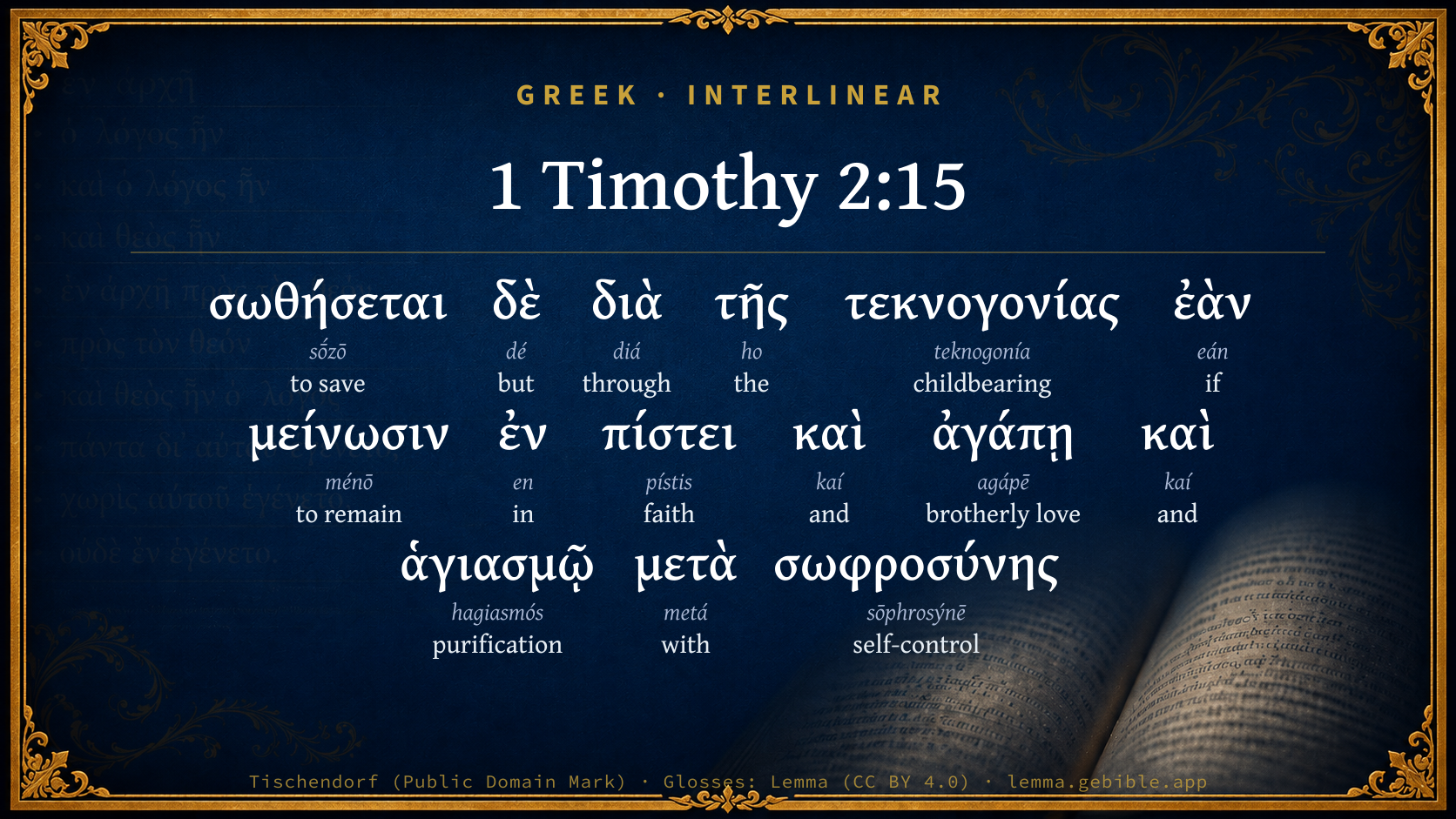
Greek (Tischendorf 8th ed.) 1 Timothy 2:15 appears in the Greek New Testament. The text above is from the Tischendorf 8th edition. Each word links to its Strong’s number and a concise gloss. Click any word for its full Thayer’s Greek Lexicon entry.
Download image
Cite this verse

1 Timothy 2:15 (World English Bible). Public Domain. Lemma interlinear Bible study tool, https://lemma.gebible.app/v/1-timothy/2/15.

Show BibTeX & RIS
BibTeX
RIS
English Translation
but she will be saved through her child-bearing, if they continue in faith, love, and sanctification with sobriety.
World English Bible · Public Domain
Highlights
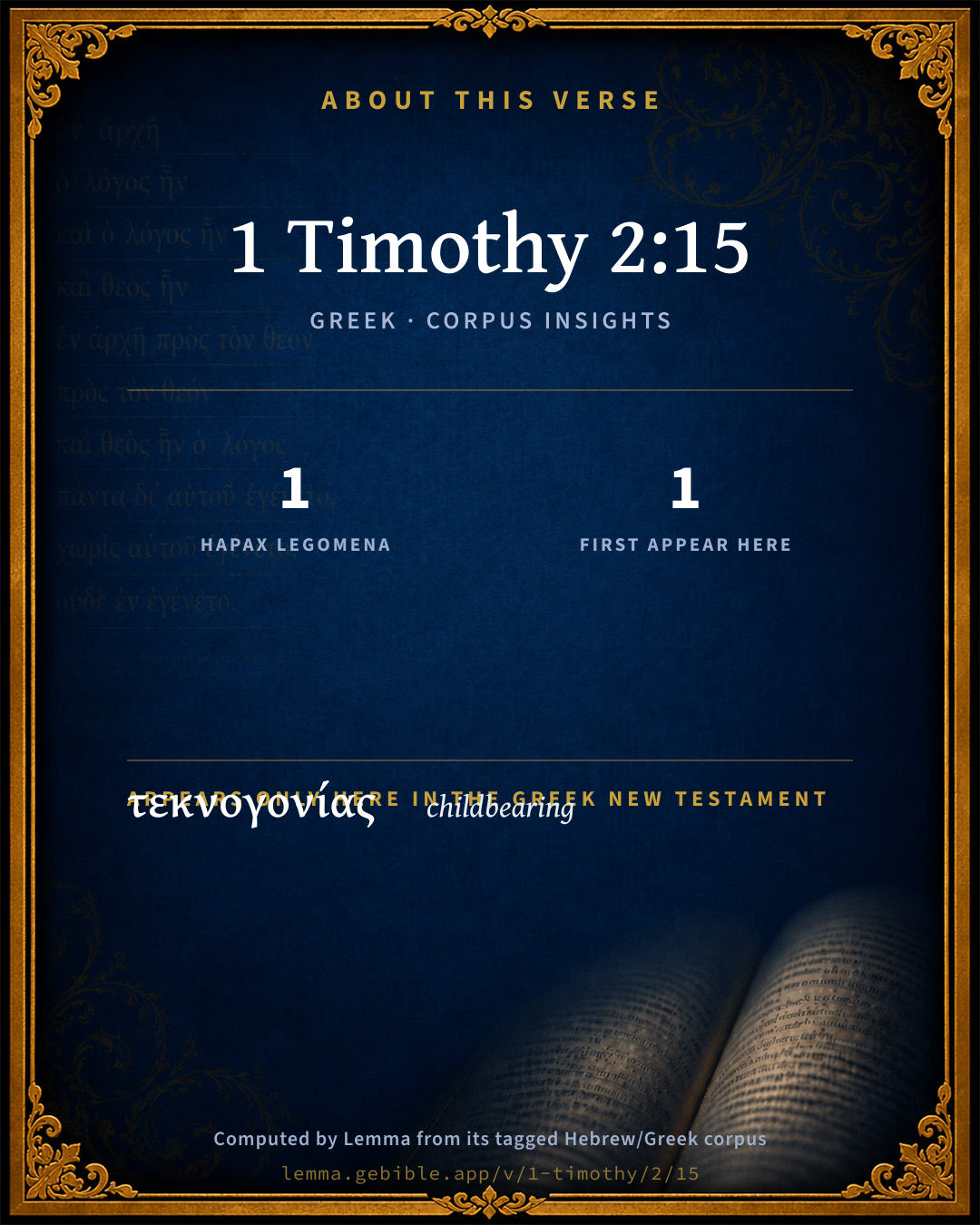
  • 1 hapax legomenon — only here in the Greek New Testament
  • 1 first appearance in the Greek New Testament
Full analysis ↓
Download a study sheet

One document with this verse’s original text, its word-by-word gloss line, the meaning frame, cross-references with their text, attributed commentary, and full source and license credits — printable, and it pastes into notes with its structure intact.

This verse Autodidact and up

Study sheet (.html) Plain text (.txt)

A passage Seminary Student

Up to 50 verses in one chapter. A passage sheet keeps up to 6 commentary sources and 12 cross-references per verse, in the order this page ranks them, and says so on the sheet whenever that leaves anything out. Ask for a single verse and you get the Autodidact verse sheet above.

Everything on this page stays free to read, with no account — the sheet is a download of what is already on screen, not access to it.

Want to remove ads? Support Godless Engineer
Compare translations 3

The same verse in 3 English versions, stacked beneath the original-language interlinear above. Click any original word for its lexicon entry.

Each is an independent rendering of the whole verse — the interlinear is not word-aligned to these translations.

Highlighted words mark where these versions differ — a whole-verse word diff, not a word-by-word alignment.

  • World English Bible Public Domain
    but she will be saved through her child-bearing, if they continue in faith, love, and sanctification with sobriety.
  • King James Version Public Domain
    Notwithstanding she shall be saved in childbearing, if they continue in faith and charity and holiness with sobriety.
  • unfoldingWord Literal Text CC BY-SA 4.0
    But she will be saved through childbearing if they remain in faith and love and holiness with self-control.

unfoldingWord Literal Text — © unfoldingWord, licensed CC BY-SA 4.0. Word-aligned USFM3 via Door43 (git.door43.org/unfoldingWord/en_ult).

Versions to compare (up to 4)

3 of 4 selected

Show all 19 translations

Every available English version of this verse, each an independent rendering of the whole verse.

  • World English Bible Public Domain
    but she will be saved through her child-bearing, if they continue in faith, love, and sanctification with sobriety.
  • Berean Standard Bible Public Domain
    Women, however, will be saved through childbearing, if they continue in faith, love, and holiness, with self-control.
  • Majority Standard Bible Public Domain
    Women, however, will be saved through childbearing, if they continue in faith, love, and holiness, with self-control.
  • King James Version Public Domain
    Notwithstanding she shall be saved in childbearing, if they continue in faith and charity and holiness with sobriety.
  • American Standard Version (1901) Public Domain
    but she shall be saved through her child-bearing, if they continue in faith and love and sanctification with sobriety.
  • Revised Version (1885) Public Domain
    but she shall be saved through the childbearing, if they continue in faith and love and sanctification with sobriety.
  • Geneva Bible (1599) Public Domain
    Notwithstanding, through bearing of children she shalbe saued if they continue in faith, and loue, and holines with modestie.
  • Douay-Rheims (1899) Public Domain
    Yet she shall be saved through childbearing; if she continue in faith, and love, and sanctification, with sobriety.
  • Young's Literal Translation Public Domain
    and she shall be saved through the child-bearing, if they remain in faith, and love, and sanctification, with sobriety.
  • Literal Standard Version CC BY-SA 4.0
    and she will be saved through the childbearing, if they remain in faith, and love, and sanctification, with sobriety.
  • Unlocked Literal Bible CC BY-SA 4.0
    However, she will be saved through bearing children, if they continue in faith and love and sanctification with soundness of mind.
  • unfoldingWord Literal Text CC BY-SA 4.0
    But she will be saved through childbearing if they remain in faith and love and holiness with self-control.
  • Darby Bible Public Domain
    But she shall be preserved in childbearing, if they continue in faith and love and holiness with discretion.
  • World Messianic Bible Public Domain
    but she will be saved through her childbearing, if they continue in faith, love, and holiness with sobriety.
  • Webster's Bible Public Domain
    Notwithstanding, she will be saved in child-bearing, if they continue in faith, and charity, and holiness, with sobriety.
  • Free Bible Version CC BY-SA 4.0
    However, women will be saved through becoming mothers, as long as they continue to trust and love, and to live holy, sensible lives.
  • Bible in Basic English Public Domain
    But if they go on in faith and love and holy self-control, she will be kept safe at the time of childbirth.
  • Text-Critical English NT CC BY 4.0
    Nevertheless, women will be saved through childbearing, if they continue in faith, love, and holiness, with self-control.
  • Tyndale New Testament (1534) Public Domain
    Notwithstondynge thorow bearinge of chyldre they shalbe saved so they continue in fayth love and holynes with discrecion.

Literal Standard Version (2020), Covenant Press — licensed CC BY-SA 4.0. Text via the HelloAO Bible API (eBible.org). Unlocked Literal Bible (unfoldingWord) — licensed CC BY-SA 4.0. Text via the HelloAO Bible API (eBible.org). unfoldingWord Literal Text — © unfoldingWord, licensed CC BY-SA 4.0. Word-aligned USFM3 via Door43 (git.door43.org/unfoldingWord/en_ult). Free Bible Version, Dr. Jonathan Gallagher — licensed CC BY-SA 4.0. Text via the HelloAO Bible API (eBible.org).

Word by word

More ways to search: Search by grammar → Find every occurrence → Compare this word →

Practice this passage: Drill this verse → Learn its vocabulary →

About this verse

These counts appear in no published source. They are computed here, from the morphology-tagged text and Lemma’s own curated glosses. What Lemma adds →

15
words
14
distinct lemmas
Pauline Epistles
section

Notable vocabulary

1 hapax legomenon — a word that appears only here in the entire Greek New Testament:

  • τεκνογονίας childbearing G5042

First appearance in Scripture

This word makes its first canonical appearance in the Greek New Testament here:

  • τεκνογονίας childbearing G5042

Shared distinctive vocabulary

σωφροσύνης self-control G4997 occurs in 3 verses of the Greek New Testament. Also found in:

Repetition

A word recurs within this verse:

Cross-references

12

Topical passages linked to 1 Timothy 2:15 in the Treasury of Scripture Knowledge — connected by theme and wording, ordered by reader-vote popularity; previews shown in the World English Bible.

  • Titus 2:12 instructing us to the intent that, denying ungodliness and worldly lusts, we would live soberly, righteously, and godly in this present world;
  • Genesis 3:15–16 I will put enmity between you and the woman, and between your offspring and her offspring. He will bruise your head, and you will bruise his heel."
  • 1 Peter 4:7 But the end of all things is near. Therefore be of sound mind, self-controlled, and sober in prayer.
  • 1 Timothy 1:5 but the end of the charge is love, out of a pure heart and a good conscience and unfeigned faith;
  • 1 Timothy 2:9 In the same way, that women also adorn themselves in decent clothing, with modesty and propriety; not just with braided hair, gold, pearls, or expensive clothing;
  • Isaiah 9:6 For to us a child is born, to us a son is given; and the government shall be on his shoulder: and his name shall be called Wonderful, Counselor, Mighty God, Everlasting Father, Prince of Peace.
  • Luke 2:10–11 The angel said to them, "Don't be afraid, for behold, I bring you good news of great joy which will be to all the people.
  • Isaiah 7:14 Therefore the Lord himself will give you a sign. Behold, the virgin will conceive, and bear a son, and shall call his name Immanuel.
  • Matthew 1:21–25 She shall bring forth a son. You shall call his name Jesus, for it is he who shall save his people from their sins."
  • Luke 2:7 She brought forth her firstborn son, and she wrapped him in bands of cloth, and laid him in a feeding trough, because there was no room for them in the inn.
  • Jeremiah 31:22 How long will you go here and there, you backsliding daughter? for Yahweh has created a new thing in the earth: a woman shall encompass a man.
  • Galatians 4:4–5 But when the fullness of the time came, God sent out his Son, born to a woman, born under the law,

Cross-references courtesy of OpenBible.info (CC BY 4.0).

Commentary

Notes on 1 Timothy 2:15 from classic Christian and Jewish commentators (each source and its license shown beneath its notes). The classic Christian expositions comment on the surrounding passage and are grouped to its opening verse, so a note may address several verses; the Jewish commentaries on the Tanakh (Rashi and others) are per-verse, so they appear only where the commentator wrote on this verse.

Lemma curates 59 commentaries, every one of them public domain or Creative Commons licensed, each selected and text-cleaned for this edition rather than reprinted as found. About our sources →

Joseph Benson's Commentary

1Ti 2:15. Notwithstanding, she shall be saved in child-bearing — That is, says Locke, she shall be carried safely through child-bearing; a sense which Dr. Whitby illustrates at large, and which Dr. Benson seems partly to adopt, observing, “The apostle having intimated that the man was superior by creation, and the subjection of the woman increased by the fall, he here declares, that if the Christian women continued in holiness and charity, the curse pronounced upon the fall would be removed or mitigated.” To the same purpose also Baxter paraphrases the words: “Though her sin had brought her low, and even under a curse, in the pain and peril of child-bearing, she is, even in that low and sad condition, under God’s merciful protection, and saving covenant of grace, which contains the promise of this life and that to come, if she continue in faith, charity, and purity, with sobriety.” He adds another interpretation, as follows: “Though sin and sorrow in travail came in by the woman, yet by a woman’s child-bearing a Saviour came into the world, (which is some reparation of the honour of the sex,) and so the women may be saved as well as the men by Christ.” This latter sense is nearly that adopted by Macknight, who thus paraphrases on the verse: “However, though Eve was first in transgression, and brought death on herself, her husband, and her posterity, the female sex shall be saved equally with the male; through child-bearing; through bringing forth the Saviour; if they live in faith, and love, and chastity, with that sobriety which I have been recommending.” He adds, by way of note, “The word σωθησεται, saved, in this verse, refers to η γυνη, the woman, in the foregoing verse, who is certainly Eve. But the apostle did not mean to say that she alone was to be saved through child-bearing; but that all her posterity, whether male or female, are to be saved through the childbearing of a woman; as is evident from his adding, If they live in faith, and love, and holiness, with sobriety. For safety in child-bearing doth not depend on that condition, since many pious women die in child-bearing; while others of a contrary character are preserved. The salvation of the human race through child-bearing, was intimated in the sentence passed on the serpent, Gen 3:15; I will put enmity between thee and the woman, and between thy seed and her seed; it shall bruise thy head. Accordingly, the Saviour being conceived in the womb of his mother by the power of the Holy Ghost, he is truly the seed of the woman who was to bruise the head of the serpent. And a woman, by bringing him forth, hath been the occasion of our salvation. If they continue in faith — The change in the number of the verb from the singular to the plural, which is introduced here, was designed by the apostle to show that he does not speak of Eve, nor of any particular woman, [merely,] but of the whole sex.”

Joseph Benson's Commentary on the Old and New Testaments (1811–1818) — public domain. Text from a community e-Sword module.

Tyndale Open Study Notes

Tyndale Open Resources

2:15 will be saved through childbearing (or will be saved by accepting their role as mothers, or will be saved by the birth of the Child): The most likely explanation for this statement is that the false teachers had stirred up trouble in households (see 1 Timothy Book Introduction, “Setting”), and Paul was calling these women back to proper relations within their homes, in keeping with the truth of the Good News (see 1:4-5; 4:1-5). In so doing they would be saved in the ultimate sense (see 4:16; cp. 3:13). This verse might allude to Gen 3:15-16, suggesting a reversal of the curse, either through normal childbirth or the birth of the Messiah.

Tyndale Open Study Notes — © Tyndale Open Resources, licensed CC BY-SA 4.0. Text via the HelloAO Bible API.

Bengel's Gnomon

Johann Albrecht Bengel

1Ti 2:15. Σωθήσεται δὲ, but she shall be saved) She shall be rescued from that offence (and from its consequences).—διὰ τῆς τεκνογονίας, in child-bearing) The part of the woman is here described, in antithesis to the duty of teaching and governing: τεκνογονία, bringing forth and training children. He is not speaking here as to the properly-called cause of salvation; for many who bring forth children nevertheless perish: many, who do not bear children, are saved; but the state or condition is denoted, in which a woman may be likely to obtain salvation, although she be not mixed up with the duty that belongs to the man. Wherefore the if has a stronger force here than διὰ, in: and the continuing takes for granted the standing in faith, etc.—μείνωσιν, if they continue) Namely, the women. A Syllepsis[19] of the number. For sobriety, which is presently praised, is competent for (a grace peculiarly becoming in) women: comp. 1Ti 2:9. Let them remain within these bounds.—πίστει καὶ ἀγάπῃ, in faith and love) General divisions.—ἁγιασμῷ μετὰ σωφροσύνης) in holiness with sobriety. A special part of sanctification is modesty or moderation, a grace which regulates man in respect of himself, as faith in respect of God, love in respect of our neighbour: ἁγιασμὸς, holiness, especially chastity: σωφροσύνη, moderation, self-control, 1Ti 2:9; 1Ti 2:11

[19] A figure whereby ἡ γυνὴ, the singular, is here expressed, whilst the plural is meant. And accordingly the plural verb μείνωσιν is put, agreeing with γυναῖκες, women, understood.—ED.

—————

Bengel's Gnomon of the New Testament — English translation (T&T Clark, Edinburgh, 1860) — public domain. Text from a community e-Sword module.

Meyer's Critical & Exegetical Commentary

Heinrich August Wilhelm Meyer

1Ti_2:15. Σωθήσεται δὲ διὰ τῆς τεκνογονίας] σωθήσεται δέ is in opposition to the previous ἐν παραβάσει γέγονε. Still this sentence is not intended merely to moderate the judgment pronounced in 1Ti_2:14 (Matthies); after the apostle has forbidden to the woman any activity in church assemblies as unbecoming to her, he now points to the destiny assigned her by God, the fulfilment of which brings salvation to her. The subject of σωθήσεται is ἡ γυνή, to be supplied from the preceding words; but, of course, it applies collectively to the whole sex, while referring specially to Eve.[108]

σωθήσεται is to be taken here in the sense which it continually has in the N. T. (not then equivalent to she will win for herself merit and reward, de Wette). Every reason to the contrary falls to the ground, if only we consider that ΤΕΚΝΟΓΟΝΊΑ is regarded as the destiny assigned to the woman by God, and that to the woman ΣΩΤΗΡΊΑ is assured by it under the condition given in the words following: ἘᾺΝ Κ.Τ.Λ. It is to be noted also, that though faith is the only source of salvation, the believer must not fail in fulfilling his duties in faith, if he is to partake in the ΣΩΤΗΡΊΑ.

ΔΙΆ is taken by several expositors (also Wiesinger) in the sense of in;[109] but this is wrong, for either this signification in passes over into the signification by means of, or it has much the same force as notwithstanding, in spite of (Rom_2:27; see Meyer on the passage); διά, however, cannot be used in this sense, since τεκνογονία would in that case have been regarded as a hindrance to the attainment of the σωτηρία. This militates also against Hofmanns view, that σώζεσθαι διά τινος has the same meaning here as in 1Co_3:15, to be saved as through something; this explanation also makes the τεκνογονία appear to be something through which the womans σώζεσθαι is endangered.[110]

τεκνογονία, a word which occurs only here in the N. T. (as also ΤΕΚΝΟΓΟΝΈΩ only in chap. 1Ti_5:14, and ΤΕΚΝΟΤΡΟΦΈΩ only in chap. 1Ti_5:10), can have here nothing but its etymological meaning. Some, quite wrongly, have taken it as a term for the marriage state, and others have made it synonymous with ΤΕΚΝΟΤΡΟΦΊΑ. This latter view is found in the oldest expositors; thus Theophylact remarks, not without wit: Οὐ ΓΕΝΝῆΣΑΙ ΜΌΝΟΝ ΔΕῖ, ἈΛΛᾺ ΚΑῚ ΠΑΙΔΕῦΣΑΙ· ΤΟῦΤΟ ΓᾺΡ ὌΝΤΩς ΤΕΚΝΟΓΟΝΊΑ, ΕἸ ΔῈ Οὐ, ΟὐΚ ἘΣΤῚ ΤΕΚΝΟΓΟΝΊΑ, ἈΛΛᾺ ΤΕΚΝΟΦΘΟΡΊΑ ἜΣΤΑΙ ΤΑῖς ΓΥΝΑΙΞΊ.

The question, how the ΤΕΚΝΟΓΟΝΊΑ contributes to the ΣΩΤΗΡΊΑ, is answered by most by supplying[111] with the one or the other something of which there is no hint in the words of the apostle, and by which the thought is more or less altered. This much may be granted, that Paul, by laying stress on the ΤΕΚΝΟΓΟΝΊΑ (the occasion for which was probably the ΚΩΛΎΩΝ ΓΑΜΕῖΝ on the part of the heretics, chap. 1Ti_4:3), assigns to the woman, who has to conduct herself as passive in the assemblies, the domestic life as the sphere in whichespecially in regard to the childrenshe has to exercise her activity (comp. 1Ti_5:14).

In order not to be misunderstood, as if he had said that the ΤΕΚΝΟΓΟΝΊΑ as a purely external fact affects ΣΩΤΗΡΊΑ, he adds the following words: ἘᾺΝ ΜΕΊΝΩΣΙΝ ἘΝ ΠΊΣΤΕΙ Κ.Τ.Λ. The subject of ΜΕΊΝΩΣΙΝ is the collective idea ΓΥΝΉ (see Winer, pp. 481, 586 [E. T. pp. 648, 787]), and not, as many older (Chrysostom and others) and later (Schleiermacher, Mack, Leo, Plitt) expositors think: the children. This latter might indeed be supplied from ΤΕΚΝΟΓΟΝΊΑ, but it would give a wrong idea.

It is quite arbitrary, with Heydenreich, to supply man and wife.

Paul uses the expressions ἘΝ ΠΊΣΤΕΙ Κ.Τ.Λ. to denote the Christian life in its various aspects. They are not to be limited to the relation of married life, ΠΊΣΤΙς denoting conjugal fidelity; ἈΓΆΠΗ, conjugal love; ἉΓΙΑΣΜΌς, conjugal chastity; and ΣΩΦΡΟΣΎΝΗ, living in regular marriage. ΣΩΦΡΟΣΎΝΗ is named along with the preceding cardinal virtues of the Christian life, because it peculiarly becomes the thoughts of a woman (comp. 1Ti_2:9), not because a woman is apt to lose control of herself through her excitable temperament (Hofmann). There is in the context no hint of a reference to female weakness.[112]

[108] Even Theophylact declared against the curious view, that Mary is to be taken here as subject. Clearly also Eve cannot here be meant.

[109] Van Oosterzee translates διά by by means of, and then says: it simply indicates a condition in which the woman becomes a partaker of blessedness, leaving it uncertain in what relation the apostle places τεκνογονία to σώζεσθαι.

[110] Hofmann says in explanation: If it is appointed to the woman to bear children in pain, she might succumb under such a burden of life; but, in reply, it is to be observed that τεκνογονία does not mean to bear children with pain.

[111] Most think of the faithful fulfilment of maternal duty in the education of children. Chrysostom: τικνογονίαν, φησι, τὸ μὴ μόνον τεκεῖν, ἀλλὰ καὶ κατὰ Θεὸν ἀναγαγεῖν.According to Heinrichs, Paul means here to say: mulier jam hoc in mundo peccatorum poenas luit, διὰ τῆς τεκνογ. eo, quod cum dolore parturit, adeoque haec τεκνογ. eam quasi σώζειν putanda est, et ipsa σώζεσθαι διὰ τῆς τεκνογονίας. The passage quoted by Heinrichs, Gen_3:16, does not denote the τεκνογονία as such, but the pains connected with it as a punishment of transgression. According to Plitt, the τεκνογ. serves to farther the womans σωτηρία; on the one hand, because by the fulfilment of her wish gratitude is aroused within her; on the other hand, because of her care for her children she is preserved from many frivolities.

[112] De Wette asserts too much when he says that this passage is in contradiction with 1Co_7:7 ff., 1Co_7:25 ff., 1Co_7:38 ff. The truth is rather that the matter is regarded from various points of view. In 1 Corinthians the apostle is delivering his judgment, while he considers the difficult position of Christians amid the hostility of the world, without for a moment denying that τεκνογονία is an ordinance of God. Here, however, he is considering only the latter point, without entering into every detail.

Meyer — Critical and Exegetical Commentary on the New Testament — English translation by Peter Christie, edited by Frederick Crombie (T&T Clark, 1880) — public domain. Text from a community e-Sword module.

Expositor's Greek Testament

ed. W. Robertson Nicoll

1Ti 2:15 . σωθήσεται δὲ διὰ τῆς τεκνογονίας : The penalty for transgression, so far as woman is concerned, was expressed in the words, “I will greatly multiply thy sorrow and thy conception; in sorrow thou shalt bring forth children” (Gen 3:16 ). But just as in the case of man, the world being as it is, the sentence has proved a blessing, so it is in the case of woman. “In the sweat of thy face shalt thou eat bread” expresses man’s necessity, duty, privilege, dignity. If the necessity of work be “a stumbling-block,” man can “make it a stepping-stone” (Browning, The Ring and the Book, The Pope , 413), Nay, it is the only stepping-stone available to him. If St. Paul’s argument had led him to emphasise the man’s part in the first transgression, he might have said, “He shall be saved in his toil,” his overcoming the obstacles of nature.

So St. Paul, taking the common-sense view that childbearing, rather than public teaching or the direction of affairs, is woman’s primary function duty, privilege and dignity, reminds Timothy and his readers that there was another aspect of the story in Genesis besides that of woman’s taking the initiative in transgression: the pains of childbirth were her sentence, yet in undergoing these she finds her salvation. She shall be saved in her childbearing (R.V. m. nearly). That is her normal and natural duty; and in the discharge of our normal and natural duties we all, men and women alike, as far as our individual efforts can contribute to it, “work out our own salvation”.

This explanation gives an adequate force to σωθήσεται , and preserves the natural and obvious meaning of τεκνογονία , and gives its force to τῆς . διά here has hardly an instrumental force (as Vulg. per filiorum generationem ); it is rather the διά of accompanying circumstances, as in 1Co 3:15 . σωθήσεται … διὰ πυρός . It remains to note three other explanations:

(1) She shall be “preserved in the great danger of child-birth”.

(2) Women shall be saved if they bring up their children well, as if τεκνογονία = τεκνοτροφία . So Chrys.

(3) She shall be saved by means of the Childbearing “of Mary, which gave to the world the Author of our Salvation” (Liddon). “The peculiar function of her sex (from its relation to her Saviour) shall be the medium of her salvation” (Ellicott). The R.V., saved through the childbearing , is possibly patient of this interpretation. No doubt it was the privilege of woman alone to be the medium of the Incarnation. This miraculous fact justifies us perhaps in pressing the language of Gen 3:15 , “thy seed,” and in finding an allusion (though this is uncertain) in Gal 4:4 , γενόμενον ἐκ γυναικός ; but woman cannot be said to be saved by means of a historic privilege, even with the added qualification, “if they continue,” etc. See Luk 11:27-28 , “Blessed is the womb that bare thee.… Yea, rather, blessed are they that hear the word of God,” etc.

ἐὰν μείνωσιν : This use of μένειν with ἐν and an abstract noun is chiefly Johannine, as the reff. show.

The subject of μείνωσιν is usually taken to be γυναῖκες ; but inasmuch as St. Paul has been speaking of women in the marriage relation, it seems better to understand the plural of the woman and her husband. Compare 1Co 7:36 where γαμείτωσαν refers to the παρθένος and her betrothed, whose existence is implied in the question of her marriage. If this view be accepted, then πίστις , ἀγάπη , and ἁγιασμός refer respectively to the duties of the man and wife to God, to society, and to each other: faith towards God, love to the community, and sanctification in their marital relations. See chap. 1Ti 4:12 where these three virtues are again combined. See 1Ti 2:9 for σωφροσύνη .

The Expositor's Greek Testament, edited by W. Robertson Nicoll (1897–1910) — public domain. Text from a community e-Sword module.

Geneva Bible (1599)

Geneva Bible translators

He addeth a comfort by the way, that their subjection hindereth not but that women may be saved as well as men, if they behave themselves in those burdens of marriage holily and modestly, with faith and charity.

Geneva Bible (1599) marginal notes — public domain. Text via Bolls.life.

Jamieson, Fausset & Brown

Robert Jamieson, A. R. Fausset & David Brown

be saved in childbearing--Greek, "in (literally, 'through') (her, literally, 'the') child-bearing." Through, or by, is often so used to express not the means of her salvation, but the circumstances AMIDST which it has place. Thus Co1 3:15, "He . . . shall be saved: yet so as by (literally, 'through,' that is, amidst) fire": in spite of the fiery ordeal which he has necessarily to pass through, he shall be saved. So here, "In spite of the trial of childbearing which she passes through (as her portion of the curse, Gen 3:16, 'in sorrow shalt thou bring forth children'), she shall be saved." Moreover, I think it is implied indirectly that the very curse will be turned into a condition favorable to her salvation, by her faithfully performing her part in doing and suffering what God has assigned to her, namely, child-bearing and home duties, her sphere, as distinguished from public teaching, which is not hers, but man's (Ti1 2:11-12). In this home sphere, not ordinarily in one of active duty for advancing the kingdom of God, which contradicts the position assigned to her by God, she will be saved on the same terms as all others, namely, by living faith. Some think that there is a reference to the Incarnation "through THE child-bearing" (Greek), the bearing of the child Jesus. Doubtless this is the ground of women's child-bearing in general becoming to them a blessing, instead of a curse; just as in the original prophecy (Gen 3:15-16) the promise of "the Seed of the woman" (the Saviour) stands in closest connection with the woman's being doomed to "sorrow" in "bringing forth children," her very child-bearing, though in sorrow, being the function assigned to her by God whereby the Saviour was born. This may be an ulterior reference of the Holy Spirit in this verse; but the primary reference required by the context is the one above given. "She shall be saved ([though] with childbearing)," that is, though suffering her part of the primeval curse in childbearing; just as a man shall be saved, though having to bear his part, namely, the sweat of the brow.

if they, &c.--"if the women (plural, taken out of 'the woman,' Ti1 2:14, which is put for the whole sex) continue," or more literally, "shall (be found at the judgment to) have continued."

faith and charity--the essential way to salvation (Ti1 1:5). Faith is in relation to God. Charity, to our fellow man. Sobriety, to one's self.

sobriety--"sober-mindedness" (see on Ti1 2:9, as contrasted with the unseemly forwardness reproved in Ti1 2:11). Mental receptivity and activity in family life were recognized in Christianity as the destiny of woman. One reason alleged here by Paul, is the greater danger of self-deception in the weaker sex, and the spread of errors arising from it, especially in a class of addresses in which sober reflectiveness is least in exercise [NEANDER]. The case (Act 21:9) was doubtless in private, not in public.

Next: 1 Timothy Chapter 3

Jamieson, Fausset & Brown — Commentary Critical and Explanatory on the Whole Bible (1871) — public domain (CC PDM 1.0). Text via the HelloAO Bible API.

Adam Clarke's Commentary

Verse 15. She shalt be saved in child-bearing] Σωθησεται δε δια της τεκνογονιας· She shall be saved through child-bearing - she shall be saved by means, or through the instrumentality, of child-bearing or of bringing forth a child. Amidst the different opinions given of the meaning of this very singular text, that of Dr. Macknight appears to me the most probable, which I shall give in his paraphrase and note.

"However, though Eve was first in the transgression, and brought death on herself, her husband, and all her posterity, the female sex shall be saved (equally with the male) through child-bearing - through bringing forth the Saviour, if they live in faith, and love, and chastity, with that sobriety which I have been recommending.

"The word σωθησεται, saved, in this verse refers to η γυνη, the woman, in the foregoing verse, which is certainly EVE. But the apostle did not mean to say that she alone was to be saved through child-bearing, but that all her posterity, whether male or female, are to be saved through the child-bearing of a woman; as is evident from his adding, If they live in faith and love and holiness, with sobriety. For safety in child-bearing does not depend on that condition at all; since many pious women die in child-bearing, while others of a contrary character are preserved. The salvation of the human race, through child-bearing, was intimated in the sentence passed on the serpent, Ge 3:15: I will put enmity between thee and the woman, and between thy seed and her seed. It shall bruise thy head. Accordingly, the Saviour being conceived in the womb of his mother by the power of the Holy Ghost, he is truly the seed of the woman who was to bruise the head of the serpent; and a woman, by bringing him forth, has been the occasion of our salvation." This is the most consistent sense, for in the way in which it is commonly understood it does not apply. There are innumerable instances of women dying in child-bed who have lived in faith and charity and holiness, with sobriety; and equally numerous instances of worthless women, slaves to different kinds of vices, who have not only been saved in child-bearing, but have passed through their travail with comparatively little pain; hence that is not the sense in which we should understand the apostle. Yet it must be a matter of great consolation and support, to all pious women labouring of child, to consider that, by the holy virgin's child-bearing, salvation is provided for them and the whole human race; and that, whether they die or live, though their own child-bearing can contribute nothing to their salvation, yet he who was born of a woman has purchased them and the whole human race by his blood.

If they continue] εαν μεινωσιν is rightly translated, if they live; for so it signifies in other passages, particularly Php 1:25. The change in the number of the verb from the singular to the plural, which is introduced here, was designed by the apostle to show that he does not speak of Eve; nor of any particular woman, but of the whole sex. See Macknight.

Without faith it is impossible to please God, or to be saved; and without love it will be impossible to obey. FAITH and LOVE are essentially necessary to holiness and sobriety; and unless both men and women live in these, they cannot, scripturally, expect to dwell with God for ever. Some foolish women have supposed, from this verse, that the very act of bringing forth children shall entitle them to salvation; and that all who die in childbed infallibly go to glory! Nothing can be more unfounded than this; faith, love, holiness, and sobriety, are as absolutely requisite for the salvation of every daughter of Eve, as they are for the salvation of every son of Adam. Pain and suffering neither purify nor make atonement. On the mercy of God, in Christ, dispensing remission of sins and holiness, both men and women may confidently rely for salvation; but on nothing else. Let her that readeth understand.

On the subject of dress I will conclude in the words of a late writer: "What harm does it do to adorn ourselves with gold, or pearls, or costly array, suppose we can afford it? The first harm it does is, it engenders pride; and, where it is already, increases it. Nothing is more natural than to think ourselves better because we are dressed in better clothes. One of the old heathens was so well apprised of this, that when he had a spite to a poor man, and had a mind to turn his head; he made him a present of a suit of fine clothes.

Eutrapelus cuicunque nocere volebat,

Vestimenta dabat pretiosa.

He could not then but imagine himself to be as much better, as he was finer, than his neighbour; inferring the superior value of his person from the value of his clothes." - Rev. J. Wesley's Sermons.

Adam Clarke's Commentary on the Bible (1810–1826) — public domain. Text from a community e-Sword/MySword module.

John Calvin's Commentaries

15 But she shall be saved The weakness of the sex renders women more suspicious and timid, and the preceding statement might greatly terrify and alarm the strongest minds. For these reasons he modifies what he had said by adding a consolation; for the Spirit of God does not accuse or reproach us, in order to triumph over us, when we are covered with shame, but, when we have been cast down, immediately raises us up. It might have the effect (as I have already said) of striking terror into the minds of women, when they were informed that the destruction of the whole human race was attributed to them; for what will be this condemnation? Especially when their subjection, as a testimony of the wrath of God, is constantly placed before their eyes. Accordingly, Paul, in order to comfort them and render their condition tolerable, informs them that they continue to enjoy the hope of salvation, though they suffer a temporal punishment. It is proper to observe that the good effect of this consolation is twofold. First, by the hope of salvation held out to them, they are prevented from falling into despair through alarm at the mention of their guilt. Secondly, they become accustomed to endure calmly and patiently the necessity of servitude, so as to submit willingly to their husbands, when they are informed that this kind of obedience is both profitable to themselves and acceptable to God. If this passage be tortured, as Papists are wont to do, to support the righteousness of works, the answer is easy. The Apostle does not argue here about the cause of salvation, and therefore we cannot and must not infer from these words what works deserve; but they only shew in what way God conducts us to salvation, to which he has appointed us through his grace.

Through child-bearing To censorious men it might appear absurd, for an Apostle of Christ not only to exhort women to give attention to the birth of offspring, but to press this work as religious and holy to such an extent as to represent it in the light of the means of procuring salvation. Nay, we even see with what reproaches the conjugal bed has been slandered by hypocrites, who wished to be thought more holy than all other men. But there is no difficulty in replying to these sneers of the ungodly. First, here the Apostle does not speak merely about having children, but about enduring all the distresses, which are manifold and severe, both in the birth and in the rearing of children. Secondly, whatever hypocrites or wise men of the world may think of it, when a woman, considering to what she has been called, submits to the condition which God has assigned to her, and does not refuse to endure the pains, or rather the fearful anguish, of parturition, or anxiety about her offspring, or anything else that belongs to her duty, God values this obedience more highly than if, in some other manner, she made a great display of heroic virtues, while she refused to obey the calling of God. To this must be added, that no consolation could be more appropriate or more efficacious then to shew that the very means (so to speak) of procuring salvation are found in the punishment itself.

If they continue in faith In consequence of the old translation having used the expression, “the birth of children,” it has been commonly thought that this clause refers to the children. But the term used by Paul to denote “child-bearing” is a single word, τεκνογονία, and therefore it must refer to the women. As to the verb being plural, and the noun singular, this involves no difficulty; for an indefinite noun, at least when it denotes a multitude, has the force of a collective noun, and therefore easily admits a change from the singular to the plural number.

Besides, that he might not represent all the virtue of women as included in the duties of marriage, immediately afterwards he adds greater virtues, in which it is proper that godly women should excel, that they may differ from irreligious women. Even “child-bearing” is obedience acceptable to God, only so far as it proceeds from faith and love To these two he adds sanctification, which includes all the purity of life which becomes Christian women. Lastly follows sobriety, which he formerly mentioned, while he was speaking about dress; but now he extends it more widely to the other parts of life.

John Calvin's Commentaries (1540-1563) — public domain. Text from the Calvin Translation Society English edition (1840s-50s) via the Christian Classics Ethereal Library (ccel.org). Calvin's coverage is partial (roughly two-thirds of the Bible); uncommented books and verses are honest gaps, never fabricated. The 19th-century editor's footnotes and remarks are omitted so the notes are faithfully Calvin's own voice.

Ellicott's Commentary for English Readers

(15) Notwithstanding she shall be saved in childbearing.—The last words are more accurately and forcibly rendered—through the childbearing. With that tender and winning courtesy to which, no doubt, humanly speaking, the great missionary owes so much of his vast influence over human hearts, St. Paul, now anxious lest he had wounded with his severe words and stern precepts his Ephesian sisters in Christ, closes his charge to women with a few touching words, bright with the glorious promise they contained. Though their life duties must be different from those of men—yet for them, too, as for men, there was one glorious goal; but for them—the women of Christ—the only road to the goal was the faithful, true carrying out of the quiet home duties he had just sketched out for them. In other words, women will win the great salvation; but if they would win it, they must fulfil their destiny; they must acquiesce in all the conditions of a woman’s life—in the forefront of which St. Paul places the all-important functions and duties of a mother.

This is apparently the obvious meaning of the Apostle’s words—all this lies on the surface—but beneath all this the reverent reader can hardly fail to see another and deeper reference (the presence of the article, “through the childbearing,” gives us the clue)—“she shall be saved by THE childbearing” (the Incarnation) by the relation in which woman stood to the Messiah, in consequence of the primal prophecy that her seed (not man’s) should bruise the serpent’s head (Gen_3:15), the peculiar function of her sex, from its relation to her Saviour, “shall be the medium of her salvation.” (See Bishop Ellicott, in loco.)

If they continue in faith and charity and holiness with sobriety.—But let no one think that the true saintly woman, painted with such matchless skill by St. Paul, satisfies the conditions of her life by merely fulfilling the duties of a mother.

She must besides, if she would win her crown, hold fast to the Master’s well-known teaching, which enjoins on all His own disciples, men as well as women, faith and love, holiness and modesty. The last word, “modesty,” or discretion, or sobriety (all poor renderings of the Greek sophrosune, which includes, besides, the idea of a fight with and a victory over self), brings back the thoughts to the beautiful Pauline conception of a true woman, who wins her sweet and weighty power in the world by self-effacement.

A Bible Commentary for English Readers, edited by Charles John Ellicott (1878–1897) — public domain. Text from a community e-Sword module.

The Cambridge Bible for Schools and Colleges

gen. ed. J. J. S. Perowne

15. in childbearing] R.V. gives the exact force of the Greek through the childbearing, and leaves unsettled which particular interpretation is correct (1) the A.V. ‘in childbearing,’ the preposition rendering merely the circumstances, cf. Rom_4:11 ‘in uncircumcision’;

or (2) the margin of R.V. ‘through her childbearing’: ‘her child-bearing which is her curse may be her highest blessing, as with man’s doom, labour; her domestic life and duties, the sphere of woman’s mission, St Paul lays great stress on good works, the performance of the common duties of life, in opposition to the irregularities of the times; and yet adds the necessary previous condition “if they abide in faith” ’; so Conybeare;

or (3) ‘through the Childbearing—the Incarnation of Christ,’ an early interpretation quoted by Theophylact, and also given in the Ancient Catena recently recovered and published by Dr Cramer, and supported by Hammond, Ellicott and Wordsworth, on the grounds (a) that the parallel passage in 1Co_11:8-12 closes with a reference to the Incarnation, (b) that in speaking of the transgression and sentence it was in itself natural and appropriate to speak of the sustaining prophecy, (c) that ‘saved’ and ‘through’ both gain in fulness of force.

On the whole (2) seems most probable, this ‘childbearing’ being singled out from among the ‘good works’ of 1Ti_2:10. Compare ch. 1Ti_5:13-14, where the younger widows are urged not to be ‘idle’ (lit. ‘workless’) or ‘busybodies’ (lit. ‘prying into the work of others’) but to ‘marry, bear children, rule the household’; and note that the verb there and the noun here for childbearing occur nowhere else in N.T. This thought of ‘work’—woman’s proper work—lasts on then to the end of the chapter, and gives the natural transition to other work, the ‘good work’ of a bishop in chap. 3.

if they continue] i.e. women, from ‘the woman’ of 1Ti_2:14; the aorist tense implies ‘continue stedfastly.’

faith and charity and holiness] Rather as R.V. love and sanctification, the form of the latter word implying a process of repeated acts: so ‘doubting’ above, the harbouring of doubt upon doubt. The fundamental idea of the Greek noun is ‘separation and, so to speak, consecration and devotion to the service of the Deity’; Trench, N. T. Syn., p. 316. Cf. 2Ti_1:9, ‘called us with a holy calling.’ ‘But the thought lies very near that what is set apart from the world and to God should separate itself from the world s defilements and should share in God’s purity.’ Hence the appropriateness of its being linked here with ‘sobriety’ so as to recal the feminine modesty and purity of 1Ti_2:9. Cf. Westcott, Heb_10:10 ‘the initial consecration and the progressive hallowing.’

The Cambridge Bible for Schools and Colleges (gen. ed. J. J. S. Perowne; Cambridge University Press, 1878–1918) — public domain. Text from a community e-Sword module.

Trapp's Complete Commentary

John Trapp

15 Notwithstanding she shall be saved in childbearing, if they continue in faith and charity and holiness with sobriety.

Ver. 15. Saved in childbearing] δια for εν, ut Rom 11:28. Not by it, as by a cause; but notwithstanding the cross laid upon all childbearing women, Gen 3:16, they shall have free entrance into heaven, if they continue in faith and charity, &c.

John Trapp, A Commentary or Exposition upon All the Books of the Old and New Testament (1647–1656) — public domain. Text from a community e-Sword module.

Albert Barnes' Notes on the Bible

Notwithstanding she shall be saved - The promise in this verse is designed to alleviate the apparent severity of the remarks just made about the condition of woman, and of the allusion to the painful facts of her early history. What the apostle had just said would carry the mind back to the period in which woman introduced sin into the world, and by an obvious and easy association, to the sentence which had been passed on her in consequence of her transgression, and to the burden of sorrows which she was doomed to bear. By the remark in this verse, however, Paul shows that it was not his intention to overwhelm her with anguish. He did not design to harrow up her feelings by an unkind allusion to a melancholy fact in her history. It was necessary for him to state, and for her to know, that her place was secondary and subordinate, and he wished this truth ever to be kept in memory among Christians. It was not unkind or improper also to state the reasons for this opinion, and to show that her own history had demonstrated that she was not designed for headship.

But she was not to be regarded as degraded and abandoned. She was not to be overwhelmed by the recollection of what “the mother of all living” had done. There were consolations in her case. There was a special divine interposition which she might look for, evincing tender care on the part of God in those deep sorrows which had come upon her in consequence of her transgression; and instead of being crushed and broken-hearted on account of her condition, she should remember that the everlasting arms of God would sustain her in her condition of sorrow and pain. Paul, then, would speak to her the language of consolation, and while he would have her occupy her proper place, he would have her feel that “God was her Friend.” In regard to the nature of the consolation referred to here, there has been a considerable variety of opinion. Some have held, that by the expression “she shall be saved in child-bearing,” the apostle designs to include all the duties of the maternal relation, meaning that she should be saved through the faithful performance of her duties as a mother.

Robinson, Lexicon. Rosenmuller regards the words rendered “child-bearing” (τεκνογονία teknogonia), as synonymous with education, and supposes that the meaning is, that a woman, by the proper training of her children, can obtain salvation as well as her husband, and that her appropriate duty is not public teaching, but the training of her family. Wetstein supposes that it means “she shall be saved from the arts of impostors, and from the luxury and vice of the age, if, instead of wandering about, she remains at home, cultivates modesty, is subject to her husband, and engages carefully in the training of her children.” This sense agrees well with the connection. Calvin supposes that the apostle designs to console the woman by the assurance that, if she bears the trials of her condition of sorrow with a proper spirit, abiding in faith and holiness, she will be saved. She is not to regard herself as cut off from the hope of heaven. Doddridge, Macknight, Clarke, and others suppose that it refers to the promise in Gen 3:15, and means that the woman shall be saved through, or by means of bearing a child, to wit, the Messiah; and that the apostle means to sustain the woman in her sorrows, and in her state of subordination and inferiority, by referring to the honor which has been put upon her by the fact that a woman gave birth to the Messiah. It is supposed also that he means to say that special honor is thus conferred on her over the man, inasmuch as the Messiah had no human father. Doddridge. The objections to this interpretation, however, though it is sustained by most respectable names, seem to me to be insuperable. They are such as these:

(1) The interpretation is too refined and abstruse. It is not that which is obvious. It depends for its point on the fact that the Messiah had no human father, and in the apostle had intended to refer to that, and to build an argument on it it may be doubted whether he would have done it in so obscure a manner. But it may reasonably be questioned whether he would have made that fact a point on which his argument would turn. There would be a species of refinement about such an argument, such as we should not look for in the writings of Paul.

(2) It is not the obvious meaning of the word “child-bearing.” There is nothing in the word which requires that it should have any reference to the birth of the Messiah. The word is of a general character, and properly refers to child-hearing in general.

(3) It is not true that woman would be “saved” merely by having given birth to the Messiah. She will be saved, as man will be, as a consequence of his having been born; but there is no evidence that the mere fact that woman gave birth to him, and that he had no human father, did anything to save Mary herself, or any one else of her sex. If, therefore, the word refers to the “bearing” of the Messiah, or to the fact that he was born, it would be no more proper to say that this was connected with the salvation of woman than that of man. The true meaning, it seems to me, has been suggested by Calvin, and may be seen by the following remarks:

(1) The apostle designed to comfort woman, or to alleviate the sadness of the picture which he had drawn respecting her condition.

(2) He had referred, incidentally, as a proof of the subordinate character of her station, to the first apostasy. This naturally suggested the sentence which was passed on her, and the condition of sorrow to which she was doomed, particularly in child-birth. That was the standing demonstration of her guilt; that the condition in which she suffered most; that the situation in which she was in greatest peril.

(3) Paul assures her, therefore, that though she must thus suffer, yet that she ought not to regard herself in her deep sorrows and dangers, though on account of sin, as necessarily under the divine displeasure, or as excluded from the hope of heaven. The way of salvation was open to her as well as to men, and was to be entered in the same manner. If she had faith and holiness, even in her condition of sorrow brought on by guilt, she might as well hope for eternal life as man. The object of the apostle seems to be to guard against a possible construction which might be put on his words, that he did not regard the woman as in circumstances as favorable for salvation as those of man, or as if he thought that salvation for her was more difficult, or perhaps that she could not be saved at all. The general sentiments of the Jews in regard to the salvation of the female sex, and their exclusion from the religious privileges which men enjoy; the views of the Muslims in reference to the inferiority of the sex; and the prevalent feelings in the pagan world, degrading the sex and making their condition, in regard to salvation, far inferior to that of man, show the propriety of what the apostle here says, and the fitness that he should so guard himself that his language could not possibly be construed so as to give countenance to such a sentiment.

According to the interpretation of the passage here proposed, the apostle does not mean to teach that a Christian female would be certainly saved from death in child-birth - for this would not be true, and the proper construction of the passage does not require us to understand him as affirming this. Religion is not designed to make any immediate and direct change in the laws of our physical being. It does not of itself guard us from the pestilence; it does not arrest the progress of disease; it does not save us from death; and, as a matter of fact, woman, by the highest degree of piety, is not necessarily saved from the perils of that condition to which she has been subjected in consequence of the apostasy. The apostle means to show this - that in all her pain and sorrow; amidst all the evidence of apostasy, and all that reminds her that she was “first” in the transgression, she may look up to God as her Friend and strength, and may hope for acceptance and salvation.

If they continue - If woman continues - it being not uncommon to change the singular form to the plural, especially if the subject spoken of have the character of a noun of multitude. Many have understood this of children, as teaching that if the mother were faithful, so that her children continued in faith, she would be saved. But this is not a necessary or probable interpretation. The apostle says nothing of children, and it is not reasonable to suppose that he would make the prospect of her salvation depend on their being pious. This would be to add a hard condition of salvation, and one nowhere else suggested in the New Testament. The object of the apostle evidently is, to show that woman must continue in the faithful service of God if she would be saved - a doctrine everywhere insisted on in the New Testament in reference to all persons. She must not imitate the example of the mother of mankind, but she must faithfully yield obedience to the laws of God until death.

Faith - Faith in the Redeemer and in divine truth, or a life of fidelity in the service of God.

Charity - Love to all; compare notes on 1 Cor. 13.

Holiness - She must be truly righteous.

With sobriety - All these things must he united with a becoming soberness or seriousness of deportment; notes, 1Ti 2:9. In such a life, woman may look to a world where she will be forever free from all the sadnesses and sorrows of her condition here; where, by unequalled pain, she will be no more reminded of the time when.

- “Her rash hand in evil hour.

Forth reaching to the fruit, she pluck’d, she.

Ate;”

And when before the throne she shall be admitted to full equality with all the redeemed of the Lord. Religion meets all the sadnesses of her condition here; pours consolation into the cup of her many woes; speaks kindly to her in her distresses; utters the language of forgiveness to her heart when crushed with the remembrance of sin - for “she loves much” Luk 7:37-48; and conducts her to immortal glory in that world where all sorrow shall be unknown.

Albert Barnes' Notes on the Bible (1834–1885) — public domain. Text from a community e-Sword/MySword module.

Haydock's Catholic Bible Commentary

She shall be saved by bearing children, &c. and performing other duties of a wife, with a due submission to her husband, taking care to serve God, and bring up her children in the faith of Christ, in piety, &c. (Witham) --- This would perhaps be more properly rendered, from the Greek, by the bringing up of her children in faith, charity, and holiness. This is the duty of the woman; upon the faithful discharge or neglect of which she must expect her salvation, or reprobation, to hang. Thus repairing the evil which the first of all women brought upon man, by seducing him to evil. (Bible de Vence)

George Leo Haydock (1774–1849), Haydock's Catholic Family Bible and Commentary, 1859 edition — public domain. Excludes Psalms (Douay-Rheims chapter numbering differs from Protestant) and Deuterocanonical books (Catholic canon only).

Matthew Poole's English Annotations

Though the woman was so unhappy as to be deceived by the serpent, and to be the first in taking the forbidden fruit, and an instrument to entice her husband to do the like, which may give all of that sex a cause of humiliation, and show them the reasonableness of God’s order in putting them in subjection to man, and prohibiting them to break God’s order in usurping authority over the man; yet through the gracious interposition of the Mediator, (afterward born of a woman), she hath no reason to despair, either of a temporal salvation, from the peril and danger of child-birth, or, much less, of an eternal salvation, for

she shall be saved; she stands upon equal ground with the man as to eternal salvation, who cannot be saved without faith and holiness, and a discharge of the duties incumbent upon him, and patient enduring the crosses and trials God exerciseth him with; and the woman also shall be saved, by faithful performance of her duty, and patiently enduring her crosses and trials, in the pains and peril of

child-bearing; notwithstanding they are the sensible marks of God’s displeasure for sin, yet the sufferings of Christ has taken away the said bitterness.

If they continue in faith and charity and holiness with sobriety; if she also liveth in the exercise of faith in Christ, and love to God, and her husband, and all saints, and in all exercises of holiness with sobriety. Some refer the pronoun they to the children, because the apostle had been before speaking of the woman in the singular number; but there is nothing more ordinary than that change of the number, especially where collective words are used, that signify a whole species or sex; and it is unreasonable to think the apostle should suspend the salvation of the mother upon the faith and holiness of the child, and to interpret it of the mother’s endeavours towards it, seemeth hardly a sufficient interpretation of the term continue.

Matthew Poole's English Annotations on the Holy Bible (1683–1685) — public domain. Text from a community e-Sword/MySword module.

Whedon's Commentary on the Bible

Daniel D. Whedon

15. Be saved in childbearing—Rather, through childbearing. It may signify that she shall be saved through or by childbearing as a means or instrument: or throughout the process of childbearing as an endurance. In the former meaning it is plausibly applied by some able commentators to the bearing by woman of the Messiah. Thus she who brought death brought life. Paul’s allusion would then be to Gen_3:15, the prophecy that the seed of the woman would bruise the head of the serpent. Woman shall be saved through that wondrous birth.

If they—There is here a sudden change from she, woman, to they, women; from the collective sex to its individual members. And thus most remarkably is it expressed that the whole sex may be saved by Christ if its individuals continue in faith. Yet the immediate application of Paul’s words is to the women of the Churches for whom he is laying down regulations of behaviour. The second meaning is, that through even the sorrow of childbearing, imposed by the fall, the sex may be finally saved by the faith of its members, exemplified by the correspondent virtues.

Daniel D. Whedon (gen. ed.), Commentary on the Old and New Testaments (1874–1909) — public domain. Text from a community e-Sword module.

The Pulpit Commentary

But for notwithstanding, A.V; through the child-bearing for in child-bearing, A.V; love for charity, A.V; sanctification for holiness, A.V. She shall be saved; i.e. the woman generically. The transition from the personal Eve to the generic woman is further marked by the transition from the singular to the plural, "if they continue," etc. The natural and simple explanation of the passage is that the special temporal punishment pronounced against the woman, immediately after her sin, "In sorrow shalt thou bring forth children" (Gen_3:16) (to which St. Paul here evidently alludes) and endured by all women ever since, was a set-off, so to speak, to the special guilt of Eve in yielding to the guile of the serpent; so that now the woman might attain salvation as well as the man (although she was not suffered to teach) if she continued in faith and charity. The child-bearing (thv teknogoniav); here only; but the verb teknogonew, which occurs in 1Ti_5:14, is found (though very rarely) in classical Greek. The equivalent, both in the LXX and in classical Greek, is teknopoiew. The reference to the birth of Christ the Seed of the woman which some commentators Hammond, Peile, Wordsworth, Ellicott, etc.; not Bengel, Alford. or the German school generally) see here, is rather strained, and anyhow cannot be proved without an inspired interpreter. The stress which is laid by some of the above on the use of the definite article here has no justification. (see e.g. 2Pe_1:5-7, where even the R.V does not think of translating "the virtue," "the knowledge," the temperance," etc.) Nor is the meaning of dia, which Alford and others press, through," i.e. "in spite of," like diav inv; 1Co_3:15, at all probable from the context. Sanctification (ajgiasmo Rom_6:19; 1Th_4:3, etc.) Sobriety (swfrosunh); as in ver. 9. It only occurs besides in Act_26:25.

The Pulpit Commentary (1880–1919), ed. H.D.M. Spence-Jones & Joseph S. Exell — public domain. Text from a community e-Sword module.

John Wesley's Explanatory Notes

Yet she - That is, women in general, who were all involved with Eve in the sentence pronounced, Gen. iii, 16. Shall be saved in childbearing - Carried safe through the pain and danger which that sentence entails upon them for the transgression; yea, and finally saved, if they continue in loving faith and holy wisdom.

John Wesley, Explanatory Notes Upon the Whole Bible (1754–1765) — public domain. Text via the GEBible commentary corpus.

Fairbairn on Ezekiel, Jonah & the Pastoral Epistles

Patrick Fairbairn

Ver. 15. But she shall he saved through the child-bearing, if they abide in faith, and love, and holiness, with discretion. It is clear from the structure of the passage, that while Eve was formally before the eye of the apostle, it was she as the representative of her sex, womankind: hence, she shall be, not she has been saved; and to render still more plain how the general was contemplated in the particular, it is added, if they abide. Viewing womankind as personated in Eve, the apostle had shown how, through one grievous mistake, leading to a departure from her proper place and calling, not a rise, as had been imagined, but a fall, had taken place,—a fall involving in its consequences her partner, along with herself, in present ruin, which also, but for the interposition of divine mercy, would have been irremediable. By reason of this interposition, however, a way of escape was opened to her, in connection, too, with that part of her destination which was in an especial manner to bear the impress of the fatal step which she had taken. She was still, in pursuance of her original appointment, to give birth to offspring—to be the mother, indeed, of all living; but trouble was henceforth to weigh heavily upon this portion of her lot: in travail she was to bring forth children; yet at the same time in hope, for it was precisely through the seed thus to be given her that the lost ground was to be recovered, that the doom of evil should be reversed, and the serpent’s head, in relation to humanity, should be bruised. It is this complex destination as to child-bearing pronounced over woman at the fall—mournful enough in one respect, but fraught with consolation and hope in another—to which the apostle here briefly alludes. Salvation lay for her through this one channel; and if it was her condemnation to have been so directly concerned in the guilt which required its appointment, and the pains and perils through which it must be made good, it should also be her peculiar honour, even through such a troubled experience, to be the more immediate instrument of accomplishing for herself and others the destined good. Do we, then, say that the child-bearing here spoken of has direct respect to the birth of Christ, through whom the work of salvation was really secured? We are certainly not inclined, with some commentators (Hammond, for instance), to fix the meaning down simply and exclusively to that. Undoubtedly it is the prime and essential thing,—that without which the woman’s child-bearing could have wrought no deliverance, and the prospect of which was like the hidden germ which from the first lay enfolded in the promise of a seed of blessing,—yet not without regard, at the same time, to the collective seed associated in the divine purpose with the One. The apostle, in his brief allusion, abstains from details; he merely points to the original word, and the prominent place assigned to woman in connection with its fulfilment, as indicating her proper glory in relation to the plan of salvation. Let her be content, he virtually says, with this, that through her as the mother of a seed, given by the God of grace and blessing, she herself, as well as others, are to find salvation. But lest women should imagine that, by their participation in the simply natural part of the process, they should attain also to the higher good in question, he couples certain spiritual qualifications as indispensable to the result: if they abide in faith, and love, and holiness, with discretion (or sober-mindedness). In short; they must fall in here (as Eve should have done in Paradise, but did not) with the spiritual provisions and requirements of the plan of God: in faith, implicitly resting upon God’s word of promise; in love, yielding themselves heartily to the duties of their special calling, as well as consenting to live and act within its appointed limits; in holiness, wakeful, and striving against occasions of sin; and all tempered and controlled by that spirit of meek and wise discretion which instinctively shrinks from whatever is unbecoming, heady, or high-minded.

The view now given, it is scarcely necessary to add, implies that women, as a rule, though admitting of occasional exceptions, should keep within their proper sphere, and give themselves to the family and domestic affairs especially connected with it—which is all that some would find in the passage; but it includes also a great deal more. Alford, who appears to think he had discovered the only tenable interpretation, represents the τεκνογονία as that in which the curse finds its operation (an extravagant statement to begin with, since death was plainly set forth as for both man and woman the proper embodiment of the curse), then that she was to be exempted from this curse m its worst and heaviest effects (of which, however, nothing is said in the original word), and that, besides, she should be saved through—that is, passing through the curse of her child-bearing trials—saved, notwithstanding the danger and distress connected with these! Surely a most unnatural and forced explanation, and ending in a very lame and impotent conclusion! The peculiar passage of 1Co 3:16, where the apostle speaks of certain parties being saved, yet so as through fire, which is chiefly leant upon, cannot be fairly applied here: for fire is there figuratively represented as the saving element, since it is that which tests every one; and the parties in question, who had along with the sterling gold at bottom many combustible materials about them, were just saved, and nothing more—escaped, as it were, only with their lives. There is no proper parallel between such a style of representation and the one before us. Ellicott, though very brief, and adhering perhaps somewhat too closely to Hammond, comes nearer the point, and justly lays stress on “the high probability that the apostle, in speaking of woman’s transgression, would not fail to specify the sustaining prophecy which even preceded her sentence,” also “the satisfactory meaning which the preposition (διὰ) thus bears,” “the uncircumscribed reference of the σωθήσεται, and the force of the article [τῆς τεκνογ., the child-bearing,—that, namely, so prominently exhibited from the first].” Indeed, it seems only necessary to present the view which takes all these into account in a judicious manner, not pressing it too much in one direction or another, to commend it to general acceptance.

Patrick Fairbairn — An Exposition of Ezekiel (1851), Jonah (1849), and The Pastoral Epistles (1874) — public domain. Text from a community e-Sword module.

Burkitt's Expository Notes on the New Testament

William Burkitt

Our apostle having, in the preceding verse, acquainted us with the woman’s sin, that she was in the transgression, and first in the transgression; in this verse he informs the woman of a part of her punishment for that her transgression; and that is, the severe pain and extreme peril of child-bearing.

He acquaints her, 2. With her comfort and support under that punishment; and that is, a hope of salvation: She shall be saved in child-bearing.

3. With the condition upon which that hope of salvation is grounded and bottomed: If she continue in faith and charity, and holiness with sobriety.

Learn, 1. That pain in child-bearing is a part of that punishment which was inflicted by God upon the woman for her first sin; and accordingly the woman’s sorrow and sensible feeling of the pains of child-birth ought to bring to her remembrance her original and first transgression. Surely when the woman feels the original punishment, it ought to remind her of her original sin, as a child ought to remember his fault at that very instant when he is under his father’s rod.

Learn, 2. That the infliction of this punishment, (the pains of child-bearing,) even unto death, is and shall be no hinderance of the woman’s eternal salvation, if there be found with her those holy qualifications and gracious conditions which the gospel requires; partly in regard to the relation which God stands in to her, partly in regard of the covenant which God has made with her. A child is as much a child under the rod as in the bosom; neither the father’s stroke nor the child’s grief can dissolve that relation.

Learn, 3. That faith and charity, holiness and sobriety, with a perseverance therein, are the great conditions of the gospel, upon which the woman’s eternal salvation in that hazardous condition doth depend. She shall be saved in child-bearing, if she continue in faith and charity, and holiness with sobriety.

The words may also refer to the woman’s temporal deliverance in the time of travail; and the sense runs thus: "She shall be saved in child-bearing, that is, she shall go through the pains of child-birth with safety, if she continue in faith, putting her trust in God for deliverance, in charity exercising compassion to those in the like condition; and in the exercise of temperance, sobriety, and chastity, according to her matrimonial vow."

William Burkitt's Expository Notes on the New Testament (1700–1703) — public domain. Text from a community e-Sword module.

The People's New Testament

B. W. Johnson

15. Notwithstanding she shall be saved in childbearing. Rather, through childbearing. Work was laid upon the fallen man; the pains of childbearing on the fallen woman. The apostle means here, that women will be saved in the line of their duties, and that those duties are domestic rather than public. There surely is no recommendation of the celibacy of monasticism. Possibly, too, another thought still may be alluded to. The first woman was assured that her seed should bruise the serpent's head. It was woman's glory that one of her sex was chosen to be the mother of our Lord. Thus through childbearing the Savior of all men comes into the world. If they continue. Domestic duties will not save unless to these are added the graces of a holy life.

B. W. Johnson's The People's New Testament with Notes (1889–1891) — public domain. Electronic text from the Christian Classics Ethereal Library (CCEL) ThML edition.

Cambridge Greek Testament for Schools and Colleges

15. σωθήσεται κ.τ.λ. The connexion of thought is as follows. The woman fell into transgression, and the judgement pronounced on her for all time was ἐν λύπαις τέξῃ τέκνα (Gen 3:16): the fulfilment of her proper duty shall be accompanied with pain. But yet shall she be safely brought through her τεκνογονία, if she abide in faith and love &c. That which may be her curse may also be her highest blessing if she use it aright. St Paul has been deprecating the assumption by woman of duties, such as that of public teaching, which have not been assigned to her in the Providence of God; he ends with a word of encouragement to her if she confine herself to her own sphere; σωθήσεται she shall be saved not only in her body, but in the highest sense of all[522].

[522] The cases of man and woman are exactly parallel. For man there is pronounced the doom of labour (Gen 3:17); yet labour is discipline through which he may win his way to God. ‘Laborare est orare.’ For woman it is ordained, ‘In sorrow she shall bring forth’ (Gen 3:16). Yet by it and by the duties involved, she is trained for the kingdom of Heaven.

The construction σωθήσεται διά has a strict parallel in 1Co 3:15: αὐτὸς δὲ σωθήσεται, οὕτως δὲ ὡς διὰ πυρός. τεκνογονία is not the meritorious cause of woman’s salvation; it is the sphere, being her natural duty, in which she may hope to find it. The emphasis laid in these Epistles on good works, especially on the performance of the common duties of life, has already been remarked (see on 1Ti 2:10 above).

Two other interpretations have been proposed: (1) that of Chrysostom, who regards τεκνογονία as identical here with τεκνοτροφία, the Christian education of children, and supposes an implied τέκνα to be the subject of μείνωσιν. But τεκνογονία cannot be thus explained; τεκνογονεῖν is used in this very Epistle (1Ti 5:14) in its ordinary sense of bearing children. And further such an interpretation does not harmonise with the context. (2) Many modern commentators lay stress on the article τῆς and interpret διὰ τῆς τεκνογονίας as through the Child-Bearing, sc. of the Blessed Virgin, the τεκνογονία in the Apostle’s mind being the Saviour’s Birth, foreshadowed in Gen 3:16. But it is impossible to suppose that St Paul would have spoken of the Nativity of Christ as ἡ τεκνογονία without any further explanation. The interpretation must be counted among those pious and ingenious flights of fancy, which so often mislead the commentator on Holy Scripture. The Latin versions give the sense correctly, per filiorum generationem.

μείνωσιν. The promise is given to woman (ἡ γυνή); its fulfilment is for such women as continue in faith, &c. Hence the plural, and likewise the aorist, specifying to these what was given generally. The thought of the whole passage may be illustrated by 1Co 7:20: ἕκαστος ἐν τῇ κλήσει ᾗ ἐκλήθη ἐν ταύτῃ μενέτω.

ἐν πίστει καὶ ἀγάπῃ καὶ ἁγιασμῷ. Faith and love will issue in holiness. Cp. ch. 1Ti 1:14.

μετὰ σωφροσύνης. σωφροσύνη has already been spoken of as a grace specially to be commended to Christian women. See on 1Ti 2:9 above.

Cambridge Greek Testament for Schools and Colleges (Cambridge University Press, 1896; 21 vols, various authors incl. Carr, Maclear, Plummer, Farrar, Lumby, Moule, M. R. James, Simcox) — public domain. Text from a community e-Sword module.

Alford’s Greek Testament

Henry Alford

15.] But (contrast to this her great and original defect) she (general) shall be saved through (brought safely through, but in the higher, which is with St. Paul the only sense of σώζω, see below) her child-bearing (in order to understand the fulness of the meaning of σωθήσεται here, we must bear in mind the history itself, to which is the constant allusion. The curse on the woman for her παράβασις was, ἐν λύπαις τέξῃ τέκνα (Gen 3:16). Her τεκνογονία is that in which the curse finds its operation. What then is here promised her? Not only exemption from that curse in its worst and heaviest effects: not merely that she shall safely bear children: but the Apostle uses the word σωθήσεται purposely for its higher meaning, and the construction of the sentence is precisely as ref. 1 Cor.—αὐτὸς δὲ σωθήσεται, οὕτως δὲ ὡς διὰ πυρός. Just as that man should be saved through, as passing through, fire which is his trial, his hindrance in his way, in spite of which he escapes,—so she shall be saved, through, as passing through, her child-bearing, which is her trial, her curse, her (not means of salvation, but) hindrance in the way of it.

The other renderings which have been given seem to me both irrelevant and ungrammatical. Chrys., Thl., al., for instance, would press τεκνογονία to mean the Christian education of children: Heinrichs, strangely enough, holds that her τεκνογ. is the punishment of her sin, and that being undergone, she shall be saved διὰ τῆς τ., i.e. by having paid it. Conyb. gives it ‘women will be saved by the bearing of children,’ i.e., as he explains it in his note, “are to be kept in the path of safety (?) by the performance of the peculiar functions which God has assigned to their sex.” Some, in their anxiety to give διὰ the instrumental meaning, would understand διὰ τῆς τεκνογ, ‘by means of the Child-bearing,’ i.e. ‘the Incarnation:’ a rendering which needs no refutation. I see that Ellicott maintains this latter interpretation: still I find no reason to qualify what I have above written. 1Co 3:15 seems to me so complete a key of Pauline usage of σώζεσθαι διὰ, that I cannot abandon the path opened by it, till far stronger reason has been shewn than he here alleges. In his second edition he has not in any way strengthened his argument, nor has he taken any notice of the Pauline usage which I allege. After all, it is mainly a question of exegetical tact: and I own I am surprised that any scholar can believe it possible that St. Paul can have expressed the Incarnation by the bare word ἡ τεκνογονία. He himself in this same Epistle, 5:14, uses the cognate verb, of the ordinary bearing of children: and these are the only places where the compound occurs in the N. T.), if they (generic plural as before singular) have remained (shall be found in that day to have remained—a further proof of the higher meaning of σωθήσεται) in faith and love and holiness (see reff., where the word is used in the same reference, of holy chastity) with self-restraint (see above on ver. 9).

Henry Alford, The Greek Testament (1849–1861) — public domain. Text from a community e-Sword module.

Vincent's Word Studies in the New Testament

Marvin R. Vincent

She shall be saved in childbearing [σωθησεται δια της τεκνογονιας] . Better, "through the childbearing."

(1) Saved is used in the ordinary N. T. sense.

(2) She shall be saved is set over against hath fallen into transgression.

(3) It is difficult to see what is the peculiar saving virtue of childbearing.

(4) The subject of swqhsetai shall be saved is the same as that of ejn parabasei gegonen hath fallen into transgression.

A common explanation is that gunh is to be taken in its generic sense as referring to all Christian mothers, who will be saved in fulfilling their proper destiny and acquiescing in all the conditions of a Christian woman 's life, instead of attempting to take an active part as teachers or otherwise in public religious assemblies. On the other hand, the woman, Eve, may be regarded as including all the Christian mothers. Notice the change to the plural,; ' if they continue. "She, though she fell into transgression, shall be saved by the childbearing" (Gen 3:15); that is, by the relation in which the woman stood to the Messiah. This seems to be the better explanation. Teknogonia child bearing, N. T. o. o LXX, o Class. Comp. teknogonein to bear children, 1Ti 5:14. The expression is utterly un - Pauline.

If they continue [εαν μεινωσιν] . They, the woman regarded collectively or as including her descendants. Tho promise does not exempt them from the cultivation of Christian virtues and the discharge of Christian duties. Sanctification [αγιασμω] . A Pauline word; but the triad, faith, love, sanctification, is unique in N. T.

Marvin R. Vincent, Word Studies in the New Testament (1887–1900) — public domain. Text from a community e-Sword/MySword module.

Lesson kit

Teaching starters — assembled from the data on this page, not authored interpretation. Every prompt links to the verse data it draws on. Edit before teaching.

1 Timothy, in the Pauline Epistles, opens this verse with 15 words (14 distinct Greek lemmas). Its most distinctive word is teknogonía (“childbearing”). A historical commentator’s framing appears above. Read the whole chapter for the surrounding context.

Discussion questions

  1. The word teknogonía carries the sense “childbearing.” How does it shape the verse?
  2. 1 word here appears nowhere else in the Greek New Testament. Why might the author reach for such rare wording?
  3. This is the first place “childbearing” appears in Scripture (first appears here). What does its debut here establish?
  4. How does Acts 26:25, which shares the word «self-control», read alongside this verse?
  5. What does the repetition of “and” (2× in this one verse) do in this verse?
  6. The translations on this page render this verse differently — a whole-verse word diff, not a word-by-word alignment. What might account for the different wordings?
  7. Compare how Joseph Benson's Commentary and Tyndale Open Study Notes read this verse. Where do they agree or differ?

Things to notice

  • 1 word in this verse appears nowhere else in the Greek New Testament.
  • 1 word makes its first canonical appearance in Scripture here.
  • These translations choose different wording for 14 words in this verse.
  • “and” occurs 2× in this single verse.
  • 14 distinct Greek lemmas span 15 words in this verse.

Reading settings

Reading text

Shown beneath each verse's original-language words.

Old Testament
Old Testament edition

Read the OT as the Masoretic Hebrew (MT) or the Greek Septuagint (LXX).

English shown for the Greek Septuagint (in the Hebrew ↔ Greek comparison).

Comparing translations? Open the Compare panel on any verse page to stack up to four side by side.