
1 Kings 13:31

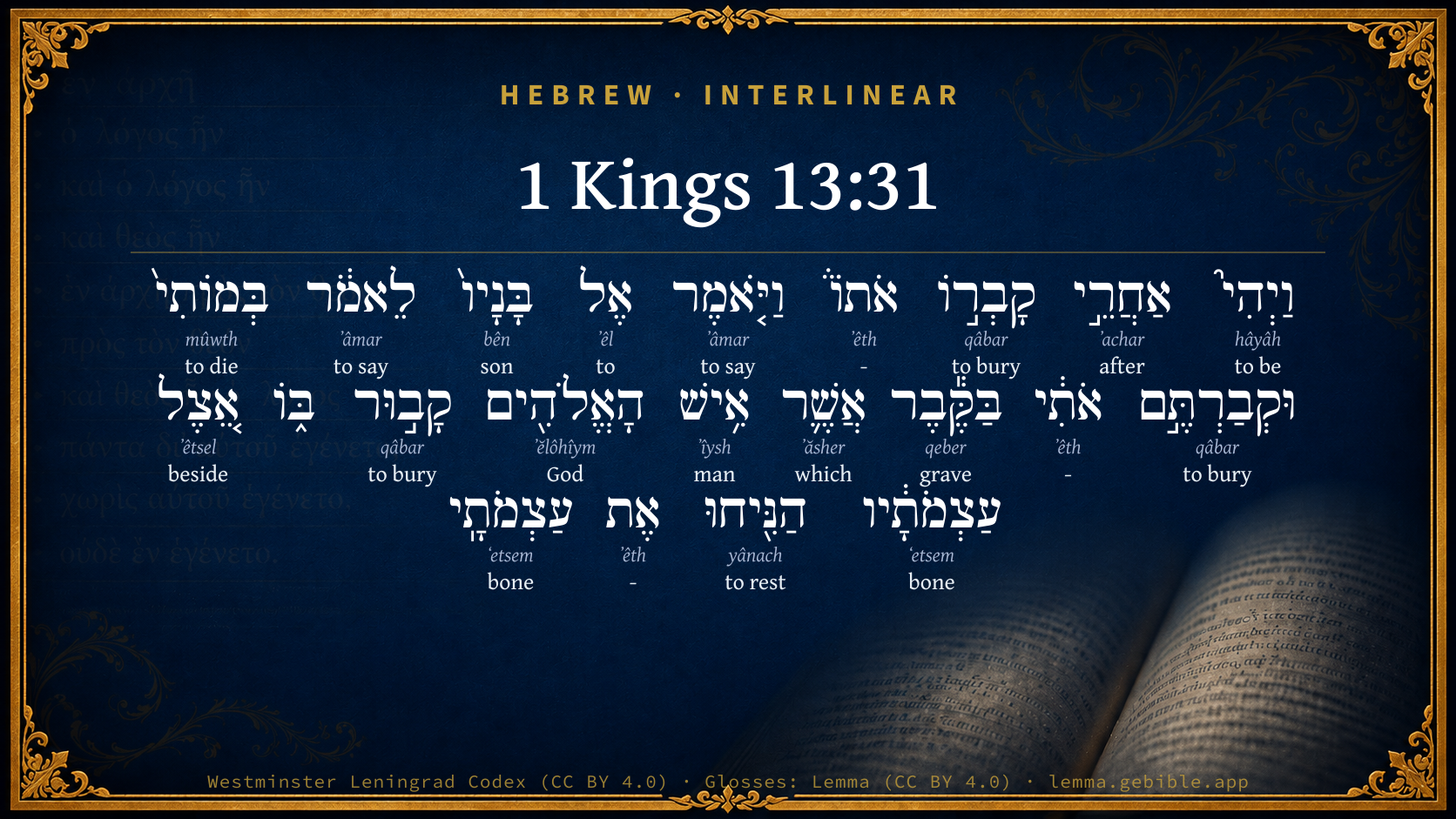
Hebrew (Westminster Leningrad Codex) 1 Kings 13:31 appears in the Hebrew Old Testament. The text above is from the Westminster Leningrad Codex. Each word links to its Strong’s number, a concise gloss, and parsing drawn from the Open Scriptures Hebrew Bible morphology. Click any word for its full Brown-Driver-Briggs (BDB) entry.
Download image
Cite this verse

1 Kings 13:31 (World English Bible). Public Domain. Lemma interlinear Bible study tool, https://lemma.gebible.app/v/1-kings/13/31.

Show BibTeX & RIS
BibTeX
RIS
English Translation
It happened, after he had buried him, that he spoke to his sons, saying, When I am dead, then bury me in the tomb in which the man of God is buried; lay my bones beside his bones.
World English Bible · Public Domain
Download a study sheet

One document with this verse’s original text, its word-by-word gloss line, the meaning frame, cross-references with their text, attributed commentary, and full source and license credits — printable, and it pastes into notes with its structure intact.

This verse Autodidact and up

Study sheet (.html) Plain text (.txt)

A passage Seminary Student

Up to 50 verses in one chapter. A passage sheet keeps up to 6 commentary sources and 12 cross-references per verse, in the order this page ranks them, and says so on the sheet whenever that leaves anything out. Ask for a single verse and you get the Autodidact verse sheet above.

Everything on this page stays free to read, with no account — the sheet is a download of what is already on screen, not access to it.

Want to remove ads? Support Godless Engineer
Compare translations 3

The same verse in 3 English versions, stacked beneath the original-language interlinear above. Click any original word for its lexicon entry.

Each is an independent rendering of the whole verse — the interlinear is not word-aligned to these translations.

Highlighted words mark where these versions differ — a whole-verse word diff, not a word-by-word alignment.

  • World English Bible Public Domain
    It happened, after he had buried him, that he spoke to his sons, saying, When I am dead, then bury me in the tomb in which the man of God is buried; lay my bones beside his bones.
  • King James Version Public Domain
    And it came to pass, after he had buried him, that he spake to his sons, saying, When I am dead, then bury me in the sepulchre wherein the man of God is buried; lay my bones beside his bones:
  • unfoldingWord Literal Text CC BY-SA 4.0
    And it happened after his burying him that he spoke to his sons, saying, “When I die, then you shall bury me in the grave in which the man of God is buried. Lay my bones beside his bones.

unfoldingWord Literal Text — © unfoldingWord, licensed CC BY-SA 4.0. Word-aligned USFM3 via Door43 (git.door43.org/unfoldingWord/en_ult).

Versions to compare (up to 4)

3 of 4 selected

Show all 18 translations

Every available English version of this verse, each an independent rendering of the whole verse.

  • World English Bible Public Domain
    It happened, after he had buried him, that he spoke to his sons, saying, When I am dead, then bury me in the tomb in which the man of God is buried; lay my bones beside his bones.
  • Berean Standard Bible Public Domain
    After he had buried him, the prophet said to his sons, “When I die, you must bury me in the tomb where the man of God is buried. Lay my bones beside his bones,
  • Majority Standard Bible Public Domain
    After he had buried him, the prophet said to his sons, “When I die, you must bury me in the tomb where the man of God is buried. Lay my bones beside his bones,
  • King James Version Public Domain
    And it came to pass, after he had buried him, that he spake to his sons, saying, When I am dead, then bury me in the sepulchre wherein the man of God is buried; lay my bones beside his bones:
  • American Standard Version (1901) Public Domain
    And it came to pass, after he had buried him, that he spake to his sons, saying, When I am dead, then bury me in the sepulchre wherein the man of God is buried; lay my bones beside his bones.
  • Revised Version (1885) Public Domain
    And it came to pass, after he had buried him, that he spake to his sons, saying, When I am dead, then bury me in the sepulchre wherein the man of God is buried; lay my bones beside his bones.
  • Geneva Bible (1599) Public Domain
    And when he had buried him, hee spake to his sonnes, saying, When I am dead, burie ye mee also in the sepulchre, wherein the man of God is buried: lay my bones beside his bones.
  • Douay-Rheims (1899) Public Domain
    And when they had mourned over him, he said to his sons: When I am dead, bury me in the sepulchre wherein the man of God is buried: lay my bones beside his bones.
  • Young's Literal Translation Public Domain
    And it cometh to pass, after his burying him, that he speaketh unto his sons, saying, `At my death -- ye have buried me in the burying-place in which the man of God is buried; near his bones place my bones;
  • Literal Standard Version CC BY-SA 4.0
    And it comes to pass, after his burying him, that he speaks to his sons, saying, “At my death—you have buried me in the burying-place in which the man of God is buried; place my bones near his bones;
  • Unlocked Literal Bible CC BY-SA 4.0
    Then after he had buried him, the old prophet spoke to his sons, saying, “When I am dead, bury me in the tomb in which the man of God is buried. Lay my bones beside his bones.
  • unfoldingWord Literal Text CC BY-SA 4.0
    And it happened after his burying him that he spoke to his sons, saying, “When I die, then you shall bury me in the grave in which the man of God is buried. Lay my bones beside his bones.
  • Darby Bible Public Domain
    And it came to pass after he had buried him, that he spoke to his sons saying, When I am dead, bury me in the sepulchre in which the man of God is buried; lay my bones beside his bones.
  • World Messianic Bible Public Domain
    After he had buried him, he spoke to his sons, saying, “When I am dead, bury me in the tomb in which the man of God is buried. Lay my bones beside his bones.
  • Webster's Bible Public Domain
    And it came to pass, after he had buried him, that he spoke to his sons, saying, When I am dead, then bury me in the sepulcher in which the man of God is buried; lay my bones beside his bones:
  • Free Bible Version CC BY-SA 4.0
    After he'd buried him, he told his sons, “When I die, bury me in the grave where the man of God is buried. Lay my bones beside his bones.
  • Bible in Basic English Public Domain
    And when he had put it to rest, he said to his sons, When I am dead, then you are to put my body into the earth with the body of this man of God, and put me by his bones so that my bones may be kept safe with his bones.
  • JPS Tanakh (1917) Public Domain
    And it came to pass, after he had buried him, that he spoke to his sons, saying: 'When I am dead, then bury me in the sepulchre wherein the man of God is buried; lay my bones beside his bones.

Literal Standard Version (2020), Covenant Press — licensed CC BY-SA 4.0. Text via the HelloAO Bible API (eBible.org). Unlocked Literal Bible (unfoldingWord) — licensed CC BY-SA 4.0. Text via the HelloAO Bible API (eBible.org). unfoldingWord Literal Text — © unfoldingWord, licensed CC BY-SA 4.0. Word-aligned USFM3 via Door43 (git.door43.org/unfoldingWord/en_ult). Free Bible Version, Dr. Jonathan Gallagher — licensed CC BY-SA 4.0. Text via the HelloAO Bible API (eBible.org).

Word by word

More ways to search: Search by grammar → Find every occurrence → Compare this word →

Practice this passage: Drill this verse → Learn its vocabulary →

אֵ֚צֶל
ʼêtsel
H681
“beside”
Preposition
Part of Speech
Preposition
Full BDB Definition

Origin: from H680 (in the sense of joining)

TWOT: 153a

beside, by, near, nearness, joining, proximity - (BDB) (substantive) - conjunction, proximity - beside, in proximity, contiguous to, from beside
  1. וַיְהִי֮ hâyâh H1961 “and · to be” Conjunction + Verb, Qal, Sequential Imperfect, 3rd Person, Masculine, Singular
  2. אַחֲרֵ֣י ʼachar H310 “after” Preposition
  3. קָבְר֣וֹ qâbar H6912 “to bury · him” Verb, Qal, Infinitive Construct + Suffix, Personal, 3rd Person, Masculine, Singular
  4. אֹתוֹ֒ ʼêth H853 “- · him” Particle, Direct Object + Suffix, Personal, 3rd Person, Masculine, Singular
  5. וַיֹּ֤אמֶר ʼâmar H559 “and · to say” Conjunction + Verb, Qal, Sequential Imperfect, 3rd Person, Masculine, Singular
  6. אֶל ʼêl H413 “to” Preposition
  7. בָּנָיו֙ bên H1121 “sons · his” Noun, Common, Masculine, Plural, Construct + Suffix, Personal, 3rd Person, Masculine, Singular
  8. לֵאמֹ֔ר ʼâmar H559 “to say” Preposition + Verb, Qal, Infinitive Construct
  9. בְּמוֹתִי֙ mûwth H4191 “in/at · to die · me” Preposition + Verb, Qal, Infinitive Construct + Suffix, Personal, 1st Person, Common, Singular
  10. וּקְבַרְתֶּ֣ם qâbar H6912 “and · to bury” Conjunction + Verb, Qal, Perfect, 2nd Person, Masculine, Plural
  11. אֹתִ֔י ʼêth H853 “- · me” Particle, Direct Object + Suffix, Personal, 1st Person, Common, Singular
  12. בַּקֶּ֕בֶר qeber H6913 “in/at the · grave” Preposition, Determined + Noun, Common, Masculine, Singular, Absolute
  13. אֲשֶׁ֛ר ʼăsher H834 “which” Particle, Relative
  14. אִ֥ישׁ ʼîysh H376 “man of” Noun, Common, Masculine, Singular, Construct
  15. הָאֱלֹהִ֖ים ʼĕlôhîym H430 “the · God(s)” Particle, Definite Article + Noun, Common, Masculine, Plural, Absolute
  16. קָב֣וּר qâbar H6912 “buried” Verb, Qal, Participle Passive, Masculine, Singular, Absolute
  17. עַצְמֹתָ֔יו ʻetsem H6106 “bones · his” Noun, Common, Feminine, Plural, Construct + Suffix, Personal, 3rd Person, Masculine, Singular
  18. הַנִּ֖יחוּ yânach H3240 “rest” Verb, Hiphil, Imperative, 2nd Person, Masculine, Plural
  19. אֶת ʼêth H853 “-” Particle, Direct Object
  20. עַצְמֹתָֽי ʻetsem H6106 “bones · my” Noun, Common, Feminine, Plural, Construct + Suffix, Personal, 1st Person, Common, Singular

About this verse

These counts appear in no published source. They are computed here, from the morphology-tagged text and Lemma’s own curated glosses. What Lemma adds →

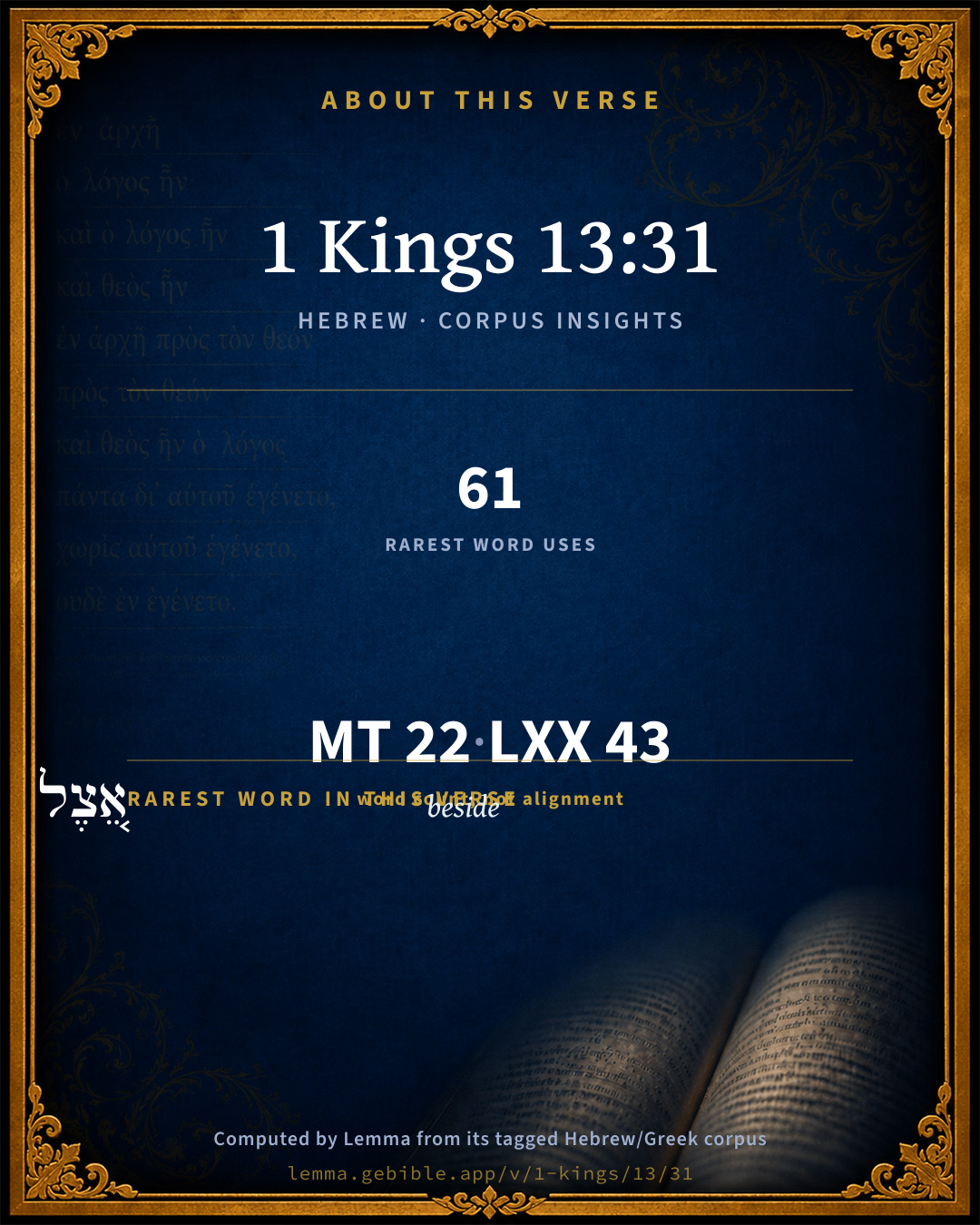
22
words
15
distinct lemmas
Historical
section

Grammatical profile

  • 8 verbs
  • 6 nouns
  • 4 prepositions
  • 4 particles

Verb forms

  • וַיְהִי֮ Qal · Sequential Imperfect
  • קָבְר֣וֹ Qal · Infinitive Construct
  • וַיֹּ֤אמֶר Qal · Sequential Imperfect
  • לֵאמֹ֔ר Qal · Infinitive Construct
  • בְּמוֹתִי֙ Qal · Infinitive Construct
  • וּקְבַרְתֶּ֣ם Qal · Perfect
  • קָב֣וּר Qal · Participle Passive
  • הַנִּ֖יחוּ Hiphil · Imperative

Repetition

Words recur within this verse — often emphatic in Hebrew:

  • קָבְר֣וֹ to bury H6912 ×3
  • וַיֹּ֤אמֶר to say H559 ×2
  • עַצְמֹתָ֔יו bone H6106 ×2

Hebrew & Septuagint length

In English translation the verse runs 38 words from the Hebrew and 46 from the Septuagint (LXX English) — closely comparable.

A rough comparison of the two English renderings, which tokenize alike — not a word-level alignment.

Word counts can differ between the Hebrew and the Greek without any difference in meaning — e.g. the Hebrew direct-object marker אֵת has no separate Greek word, and Greek often adds the article ὁ.

In the original languages it is 22 Hebrew tokens and 43 Greek tokens — but the two are counted differently (Hebrew bundles its prefixes and suffixes into one token; the Greek is in lemma form), so that isn’t a like-for-like length.

Cross-references

5

Topical passages linked to 1 Kings 13:31 in the Treasury of Scripture Knowledge — connected by theme and wording, ordered by reader-vote popularity; previews shown in the World English Bible.

  • 2 Kings 23:17–18 Then he said, What monument is that which I see? The men of the city told him, It is the tomb of the man of God, who came from Judah, and proclaimed these things that you have done against the altar of Bethel.
  • Numbers 23:10 Who can count the dust of Jacob, Or number the fourth part of Israel? Let me die the death of the righteous, Let my last end be like his!
  • Psalms 26:9 Don't gather my soul with sinners, Nor my life with bloodthirsty men;
  • Ecclesiastes 8:10 So I saw the wicked buried. Indeed they came also from holiness. They went and were forgotten in the city where they did this. This also is vanity.
  • Luke 16:22–23 It happened that the beggar died, and that he was carried away by the angels to Abraham's bosom. The rich man also died, and was buried.

Cross-references courtesy of OpenBible.info (CC BY 4.0).

Hebrew and Greek witnesses Masoretic Hebrew ↔ Greek Septuagint

The same verse in the two great witnesses to the Old Testament, shown verse-for-verse.

These are two independent witnesses, not word-aligned to each other, and the Septuagint is shown in lemma (dictionary) form.

Hebrew 1 Kings 13:31 Masoretic · Westminster Leningrad Codex

וַיְהִי֮ אַחֲרֵ֣י קָבְר֣וֹ אֹתוֹ֒ וַיֹּ֤אמֶר אֶל בָּנָיו֙ לֵאמֹ֔ר בְּמוֹתִי֙ וּקְבַרְתֶּ֣ם אֹתִ֔י בַּקֶּ֕בֶר אֲשֶׁ֛ר אִ֥ישׁ הָאֱלֹהִ֖ים קָב֣וּר בּ֑וֹ אֵ֚צֶל עַצְמֹתָ֔יו הַנִּ֖יחוּ אֶת עַצְמֹתָֽי

It happened, after he had buried him, that he spoke to his sons, saying, When I am dead, then bury me in the tomb in which the man of God is buried; lay my bones beside his bones.

World English Bible · Public Domain

Greek LXX 1 Kings 13:31 Septuagint · lemma form

καί γίγνομαι μετά ὁ κόπτω αὐτός καί εἶπον ὁ υἱός αὐτός λέγω ἐάν ἀποθνήσκω θάπτω ἐγώ ἐν ὁ τάφος οὗτος ὅς ὁ ἄνθρωπος ὁ θεός θάπτω ἐν αὐτός παρά ὁ ὀστέον αὐτός τίθημι ἐγώ ἵνα σώζω ὁ ὀστέον ἐγώ μετά ὁ ὀστέον αὐτός

And it came to pass after he had lamented him, that he spoke to his sons, saying, Whenever I die, bury me in this tomb wherein the man of God is buried; lay me by his bones, that my bones may be preserved with his bones.

LXX2012 (modern English Septuagint) · Public Domain

On this verse, The Cambridge Bible for Schools and Colleges discusses the Septuagint’s reading. Read the note in Commentary ↓

Hebrew: Westminster Leningrad Codex (CC BY 4.0). Greek: Septuagint (public domain); English from LXX2012 (modern English Septuagint) (Public Domain). How the Septuagint differs from the Hebrew →

Targum (Aramaic paraphrase)

1

The Targum is the ancient Jewish Aramaic paraphrase of the Hebrew Scriptures — an interpretive translation, not the Hebrew text itself. Onkelos (literal) and Pseudo-Jonathan (expansive) render the Torah, and Jonathan the Prophets. Coverage is partial: where no permissively-licensed English translation exists for a verse, only the Aramaic is shown. This is verse-level text, not a word-by-word alignment to the Hebrew.

  1. Targum Jonathan Prophets (Joshua–Malachi)
    וַהֲוָה בָּתַר דִקְבָרוּ יָתֵיהּ וַאֲמַר לִבְנוֹהִי לְמֵימָר כַּד אֵימוּת וְתִקְבְּרוּן יָתִי בְּקִבְרָא דִנְבִיָא דַייָ קְבִיר בֵּיהּ בִּסְטַר גַרְמוֹהִי אֲחִיתוּ יַת גַרְמִי:

    (no public-domain English translation for this verse)

    Targum Jonathan — Aramaic: “Mikraot Gedolot” (public domain). English: “Sefaria Community Translation” (CC0 1.0 (public-domain dedication)); “London "Chaldee Paraphrase," 1871” (public domain). Text via Sefaria.

Commentary

Notes on 1 Kings 13:31 from classic Christian and Jewish commentators (each source and its license shown beneath its notes). The classic Christian expositions comment on the surrounding passage and are grouped to its opening verse, so a note may address several verses; the Jewish commentaries on the Tanakh (Rashi and others) are per-verse, so they appear only where the commentator wrote on this verse.

Lemma curates 59 commentaries, every one of them public domain or Creative Commons licensed, each selected and text-cleaned for this edition rather than reprinted as found. About our sources →

Trapp's Complete Commentary

John Trapp

1Ki 13:31 And it came to pass, after he had buried him, that he spake to his sons, saying, When I am dead, then bury me in the sepulchre wherein the man of God [is] buried; lay my bones beside his bones:

Ver. 31. Lay my bones beside his bones.] So David Pareus would be buried in the same sepulchre wherein were laid up the bones of his master Hier. Zanchius, A.D. 1591. {a}

{a} Parei vita operibus praefixa.

John Trapp, A Commentary or Exposition upon All the Books of the Old and New Testament (1647–1656) — public domain. Text from a community e-Sword module.

Joseph Benson's Commentary

1Ki 13:31-32. When I am dead, &c. — Though he was a lying prophet, yet he desired to die the death of a true prophet. Gather not my soul with the sinners of Beth-el, but with this man of God: because, what he cried against the altar of Beth-el shall surely come to pass — Which he might easily conclude, both from the miracles wrought by the prophet of Judah, and from the wonderful particulars of his death. And against all the high places which are in the cities of Samaria — That is, of the kingdom of Samaria, as it was called, though not when this fact was done, yet before these books were written. Samaria was properly the name of one city; but, as it became the capital of the kingdom of Israel, that whole kingdom was so called from it. The prophet of Judah had not indeed threatened as much as the prophet of Beth-el here mentions, (unless he said more than is related 1Ki 13:2,) but it might easily be inferred from what he had predicted. Thus, by the mouth of two witnesses, was it established, if possible, to convince Jeroboam.

Joseph Benson's Commentary on the Old and New Testaments (1811–1818) — public domain. Text from a community e-Sword module.

Jamieson, Fausset & Brown

Robert Jamieson, A. R. Fausset & David Brown

bury me in the sepulchre wherein the man of God is buried--His motive in making this request was either that his remains might not be disturbed when the predicted events took place (see Kg2 23:18), or he had some superstitious hope of being benefited at the resurrection by being in the same cave with a man of God.

Next: 1 Kings Chapter 14

Jamieson, Fausset & Brown — Commentary Critical and Explanatory on the Whole Bible (1871) — public domain (CC PDM 1.0). Text via the HelloAO Bible API.

Adam Clarke's Commentary

Verse 31. Lay my bones beside his bones] This argues a strong conviction in the mind of the old prophet, that the deceased was a good and holy man of God; and he is willing to have place with him in the general resurrection.

Adam Clarke's Commentary on the Bible (1810–1826) — public domain. Text from a community e-Sword/MySword module.

The Cambridge Bible for Schools and Colleges

gen. ed. J. J. S. Perowne

31. lay my bones beside his bones] Here the LXX. adds ‘in order that my bones may be preserved along with his bones.’ And Josephus expands this idea thus: “for he would not be outraged after his death if he were buried along with him, for the bones would not be recognized.” After which he adds to the story: “And having buried the prophet and given this charge to his sons, being wicked and impious he goes to Jeroboam and says: ‘Why wast thou troubled by the words of that foolish man?’ And when the king related what had happened to the altar and to his own hand, calling the man a truly divine and excellent prophet, he began to efface this opinion of him by calumnious words and by using misleading language about the things which had occurred, to weaken their real import. For he tried to persuade him that his hand had become numb through fatigue in lifting the victims, and that when relieved it had returned to its natural state; and that the altar being new and having so many large victims put on it was broken and fell to pieces by the weight of its load. He also pointed to the death of him who had foretold these signs, how he was slain by the lion.”

The Cambridge Bible for Schools and Colleges (gen. ed. J. J. S. Perowne; Cambridge University Press, 1878–1918) — public domain. Text from a community e-Sword module.

John Gill's Exposition

And this thing became sin unto the house of Jeroboam,.... All the above things were sins in themselves, as building high places, and putting priests in them, whoever would; but the sense is, that these were the causes of punishment, or of evil things being inflicted on Jeroboam's family; sin is put for the punishment of sin, as it often is:

even to cut it off, and to destroy it from off the face of the earth; so that it become utterly extinct; and the next thing we hear of is the sickness and death of his son.

Next: 1 Kings Chapter 14

John Gill's Exposition of the Whole Bible (1746–1763) — public domain (CC PDM 1.0). Text via the HelloAO Bible API.

Haydock's Catholic Bible Commentary

Bones. Septuagint add, "that my bones may be saved along with his." The conduct and faith of this man would lead us to conclude that he had done wrong, without any malicious design, ver. 18. (Haydock)

George Leo Haydock (1774–1849), Haydock's Catholic Family Bible and Commentary, 1859 edition — public domain. Excludes Psalms (Douay-Rheims chapter numbering differs from Protestant) and Deuterocanonical books (Catholic canon only).

Matthew Poole's English Annotations

That I may be secured from that judgment threatened 1Ki 13:2.

Matthew Poole's English Annotations on the Holy Bible (1683–1685) — public domain. Text from a community e-Sword/MySword module.

Whedon's Commentary on the Bible

Daniel D. Whedon

31. My bones beside his bones — The old prophet perceived that when his fallen brother’s words came to be fulfilled, the bones of the neighbouring tombs would probably be used to burn upon the altar, and so he took this way to secure his own bones from desecration. Compare 2Ki_23:18.

Daniel D. Whedon (gen. ed.), Commentary on the Old and New Testaments (1874–1909) — public domain. Text from a community e-Sword module.

The Pulpit Commentary

And it came to pass, after he had buried him, that he spake to his sons, saying, When I am dead, then bury me in the sepulchre Palestine, being of limestone formation, has a large number of caves. These, enlarged and adapted, were everywhere used for interments. ("The whole cliffs on its southern side Hinnom are honeycombed with tombs," Porter). In three sides of the cave vaults (loculi), each large enough to hold a body, were recessed in the rock, the entrance being closed by a slab of stone (see Conder, pp. 85, 96, 118, etc.) In the so called "tombs of the kings" and "prophets" we have such sepulchres on a large scale. A Paper on the Tombs of Palestine will be found in the Quarterly Statement of the Palestine Exploration Fund, p. 66 sqq. It appears from 2Ki_23:17 that a pillar was erected to mark this prophet"s resting place wherein the man of God is buried; lay my bones beside his bones. That is to say, "Bury me in the cell next to his" (Rawlinson). But it is not absolutely certain that this arrangement (of loculi) obtained at this early period. The bodies may have been in much closer contact. See 2Ki_13:21. The LXX adds here, "That my bones may be saved with his bones;" an obvious gloss, founded on 2Ki_23:18. This request throws some light on the yearning desire of the modern Jew to rest as near as possible to the bodies of the saints. See Porter, 1. p. 145.

The Pulpit Commentary (1880–1919), ed. H.D.M. Spence-Jones & Joseph S. Exell — public domain. Text from a community e-Sword module.

John Wesley's Explanatory Notes

When I am dead,&c. - Tho' he was a lying prophet, yet he desired to die the death of a true prophet. Gather not my Soul with the sinners of Beth-el, but with this man of God: Because what he cried against the altar of Beth-el, shall surely come to pass. Thus by the mouth of two witnesses was it established, if possible to convince Jeroboam.

John Wesley, Explanatory Notes Upon the Whole Bible (1754–1765) — public domain. Text via the GEBible commentary corpus.

unfoldingWord translationNotes

Door43 World Missions Community

he had buried him

Here the word "he" refers to the old prophet and the word "him" refers to the man of God.

Lay my bones beside his bones

Here "my bones" represents his entire body. AT: "Lay my dead body beside his bones" (See: Synecdoche)

houses on the high places

The implied information is that these were houses of worship. AT: "houses of worship on the high places" (See: Assumed Knowledge and Implicit Information)

translationWords

die

God

altar

Bethel

high place

Samaria

unfoldingWord translationNotes — © Distant Shores Media and the Door43 World Missions Community, licensed CC BY-SA 4.0. Source: git.door43.org/Door43/en_tn.

Lesson kit

Teaching starters — assembled from the data on this page, not authored interpretation. Every prompt links to the verse data it draws on. Edit before teaching.

1 Kings, in the Historical, opens this verse with 22 words (15 distinct Hebrew lemmas). Its most distinctive word is ʼêtsel (“beside”). A historical commentator’s framing appears above. Read the whole chapter for the surrounding context.

Discussion questions

  1. How does “beside” (ʼêtsel) shape what this verse is saying?
  2. How does 2 Kings 23:17–18, which shares this passage’s theme, read alongside this verse?
  3. What does the repetition of “to bury” (3× in this one verse) do in this verse?
  4. These translations render this verse differently. What is at stake in choosing one wording over another?
  5. «וַיְהִי֮» is a Qal Sequential Imperfect verb. How does that grammatical form shape the action described?
  6. Compare how Trapp's Complete Commentary and Joseph Benson's Commentary read this verse. Where do they agree or differ?

Things to notice

Reading settings

Reading text

Shown beneath each verse's original-language words.

Old Testament
Old Testament edition

Read the OT as the Masoretic Hebrew (MT) or the Greek Septuagint (LXX).

English shown for the Greek Septuagint (in the Hebrew ↔ Greek comparison).

Comparing translations? Open the Compare panel on any verse page to stack up to four side by side.