
1 Samuel 19:12

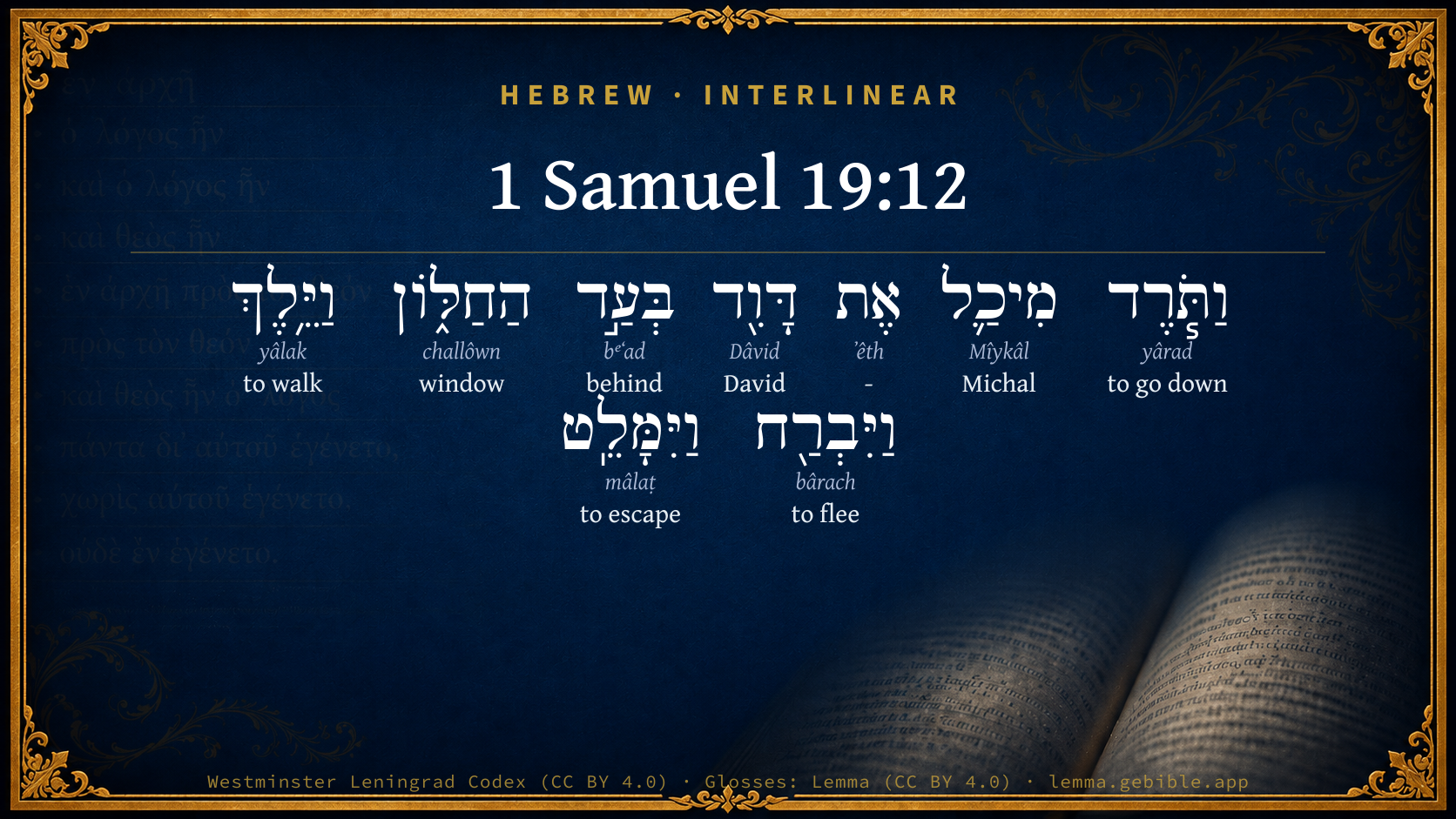
Hebrew (Westminster Leningrad Codex) 1 Samuel 19:12 appears in the Hebrew Old Testament. The text above is from the Westminster Leningrad Codex. Each word links to its Strong’s number, a concise gloss, and parsing drawn from the Open Scriptures Hebrew Bible morphology. Click any word for its full Brown-Driver-Briggs (BDB) entry.
Download image
Cite this verse

1 Samuel 19:12 (World English Bible). Public Domain. Lemma interlinear Bible study tool, https://lemma.gebible.app/v/1-samuel/19/12.

Show BibTeX & RIS
BibTeX
RIS
English Translation
So Michal let David down through the window: and he went, and fled, and escaped.
World English Bible · Public Domain
Download a study sheet

One document with this verse’s original text, its word-by-word gloss line, the meaning frame, cross-references with their text, attributed commentary, and full source and license credits — printable, and it pastes into notes with its structure intact.

This verse Autodidact and up

Study sheet (.html) Plain text (.txt)

A passage Seminary Student

Up to 50 verses in one chapter. A passage sheet keeps up to 6 commentary sources and 12 cross-references per verse, in the order this page ranks them, and says so on the sheet whenever that leaves anything out. Ask for a single verse and you get the Autodidact verse sheet above.

Everything on this page stays free to read, with no account — the sheet is a download of what is already on screen, not access to it.

Want to remove ads? Support Godless Engineer
Compare translations 3

The same verse in 3 English versions, stacked beneath the original-language interlinear above. Click any original word for its lexicon entry.

Each is an independent rendering of the whole verse — the interlinear is not word-aligned to these translations.

Highlighted words mark where these versions differ — a whole-verse word diff, not a word-by-word alignment.

  • World English Bible Public Domain
    So Michal let David down through the window: and he went, and fled, and escaped.
  • King James Version Public Domain
    So Michal let David down through a window: and he went, and fled, and escaped.
  • unfoldingWord Literal Text CC BY-SA 4.0
    And Michal lowered David through the window. And he went and fled and rescued himself.

unfoldingWord Literal Text — © unfoldingWord, licensed CC BY-SA 4.0. Word-aligned USFM3 via Door43 (git.door43.org/unfoldingWord/en_ult).

Versions to compare (up to 4)

3 of 4 selected

Show all 18 translations

Every available English version of this verse, each an independent rendering of the whole verse.

  • World English Bible Public Domain
    So Michal let David down through the window: and he went, and fled, and escaped.
  • Berean Standard Bible Public Domain
    So Michal lowered David from the window, and he ran away and escaped.
  • Majority Standard Bible Public Domain
    So Michal lowered David from the window, and he ran away and escaped.
  • King James Version Public Domain
    So Michal let David down through a window: and he went, and fled, and escaped.
  • American Standard Version (1901) Public Domain
    So Michal let David down through the window: and he went, and fled, and escaped.
  • Revised Version (1885) Public Domain
    So Michal let David down through the window: and he went, and fled, and escaped;
  • Geneva Bible (1599) Public Domain
    So Michal let Dauid downe through a window: and he went, and fled, and escaped.
  • Douay-Rheims (1899) Public Domain
    She let him down through a window. And he went and fled away and escaped.
  • Young's Literal Translation Public Domain
    And Michal causeth David to go down through the window, and he goeth on, and fleeth, and escapeth;
  • Literal Standard Version CC BY-SA 4.0
    And Michal causes David to go down through the window, and he goes on, and flees, and escapes;
  • Unlocked Literal Bible CC BY-SA 4.0
    So Michal let David down through the window. He went and fled, and escaped.
  • unfoldingWord Literal Text CC BY-SA 4.0
    And Michal lowered David through the window. And he went and fled and rescued himself.
  • Darby Bible Public Domain
    And Michal let David down through a window; and he went, and fled and escaped.
  • World Messianic Bible Public Domain
    So Michal let David down through the window. He went away, fled, and escaped.
  • Webster's Bible Public Domain
    So Michal let David down through a window: and he went, and fled, and escaped.
  • Free Bible Version CC BY-SA 4.0
    Michal lowered David down from a window, and he ran off, managing to escape.
  • Bible in Basic English Public Domain
    So Michal let David down through the window, and he went in flight and got away.
  • JPS Tanakh (1917) Public Domain
    So Michal let David down through the window; and he went, and fled, and escaped.

Literal Standard Version (2020), Covenant Press — licensed CC BY-SA 4.0. Text via the HelloAO Bible API (eBible.org). Unlocked Literal Bible (unfoldingWord) — licensed CC BY-SA 4.0. Text via the HelloAO Bible API (eBible.org). unfoldingWord Literal Text — © unfoldingWord, licensed CC BY-SA 4.0. Word-aligned USFM3 via Door43 (git.door43.org/unfoldingWord/en_ult). Free Bible Version, Dr. Jonathan Gallagher — licensed CC BY-SA 4.0. Text via the HelloAO Bible API (eBible.org).

Word by word

More ways to search: Search by grammar → Find every occurrence → Compare this word →

Practice this passage: Drill this verse → Learn its vocabulary →

מִיכַ֛ל
Mîykâl
H4324
“Michal”
Noun, Proper
Part of Speech
Noun
Type
Proper
Full BDB Definition

Origin: apparently the same as H4323

TWOT: None

Michal = "who is like God" - daughter of king Saul, sister of Jonathan, wife of king David, and mother of five; given to David as wife for the bride price of 100 Philistine foreskins; while still married to David, her father gave her in marriage to another, Phaltiel; at the death of Saul, David forced her to return
  1. וַתֹּ֧רֶד yârad H3381 “and · to go down” Conjunction + Verb, Hiphil, Sequential Imperfect, 3rd Person, Feminine, Singular
  2. אֶת ʼêth H853 “-” Particle, Direct Object
  3. דָּוִ֖ד Dâvid H1732 “David” Noun, Proper
  4. בְּעַ֣ד bᵉʻad H1157 “behind” Preposition
  5. הַחַלּ֑וֹן challôwn H2474 “the · window” Particle, Definite Article + Noun, Common, Both, Singular, Absolute
  6. וַיֵּ֥לֶךְ yâlak H3212 “and · to walk” Conjunction + Verb, Qal, Sequential Imperfect, 3rd Person, Masculine, Singular
  7. וַיִּבְרַ֖ח bârach H1272 “and · to flee” Conjunction + Verb, Qal, Sequential Imperfect, 3rd Person, Masculine, Singular
  8. וַיִּמָּלֵֽט mâlaṭ H4422 “and · to escape” Conjunction + Verb, Niphal, Sequential Imperfect, 3rd Person, Masculine, Singular

About this verse

These counts appear in no published source. They are computed here, from the morphology-tagged text and Lemma’s own curated glosses. What Lemma adds →

9
words
9
distinct lemmas
Historical
section

Notable vocabulary

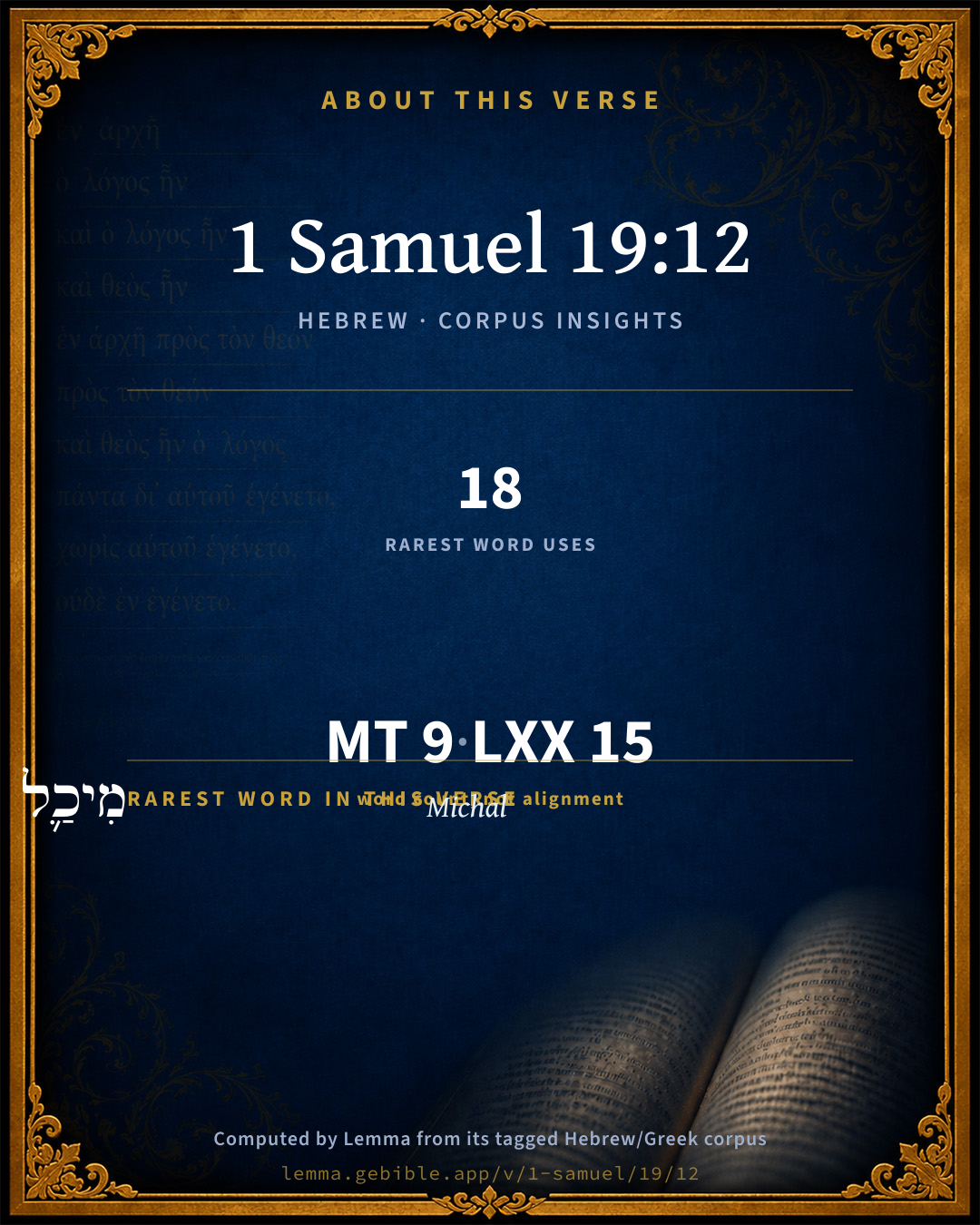
The rarest word here is מִיכַ֛ל Michal H4324 — appearing just 18 times in the whole Hebrew Bible.

Shared distinctive vocabulary

מִיכַ֛ל Michal H4324 occurs in 17 verses of the Hebrew Bible. Also found in:

Grammatical profile

  • 4 verbs
  • 3 nouns
  • 1 preposition
  • 1 particle

Verb forms

  • וַתֹּ֧רֶד Hiphil · Sequential Imperfect
  • וַיֵּ֥לֶךְ Qal · Sequential Imperfect
  • וַיִּבְרַ֖ח Qal · Sequential Imperfect
  • וַיִּמָּלֵֽט Niphal · Sequential Imperfect

Hebrew & Septuagint length

In English translation the verse runs 15 words from the Hebrew and 15 from the Septuagint (LXX English) — the same length.

A rough comparison of the two English renderings, which tokenize alike — not a word-level alignment.

Word counts can differ between the Hebrew and the Greek without any difference in meaning — e.g. the Hebrew direct-object marker אֵת has no separate Greek word, and Greek often adds the article ὁ.

In the original languages it is 9 Hebrew tokens and 15 Greek tokens — but the two are counted differently (Hebrew bundles its prefixes and suffixes into one token; the Greek is in lemma form), so that isn’t a like-for-like length.

Cross-references

4

Topical passages linked to 1 Samuel 19:12 in the Treasury of Scripture Knowledge — connected by theme and wording, ordered by reader-vote popularity; previews shown in the World English Bible.

  • Joshua 2:15 Then she let them down by a cord through the window: for her house was on the side of the wall, and she lived on the wall.
  • Acts 9:24–25 but their plot became known to Saul. They watched the gates both day and night that they might kill him,
  • 2 Corinthians 11:32–33 In Damascus the governor under Aretas the king guarded the city of the Damascenes desiring to arrest me.
  • Psalms 34:19 Many are the afflictions of the righteous, But Yahweh delivers him out of them all.

Cross-references courtesy of OpenBible.info (CC BY 4.0).

Hebrew and Greek witnesses Masoretic Hebrew ↔ Greek Septuagint

The same verse in the two great witnesses to the Old Testament, shown verse-for-verse.

These are two independent witnesses, not word-aligned to each other, and the Septuagint is shown in lemma (dictionary) form.

Hebrew 1 Samuel 19:12 Masoretic · Westminster Leningrad Codex

וַתֹּ֧רֶד מִיכַ֛ל אֶת דָּוִ֖ד בְּעַ֣ד הַחַלּ֑וֹן וַיֵּ֥לֶךְ וַיִּבְרַ֖ח וַיִּמָּלֵֽט

So Michal let David down through the window: and he went, and fled, and escaped.

World English Bible · Public Domain

Greek LXX 1 Samuel 19:12 Septuagint · lemma form

καί καταἄγω ὁ μελχολ ὁ δαυίδ διά ὁ θυρίς καί ἀποἔρχομαι καί φεύγω καί σώζω

So Melchol lets David down by the window, and he departed, and fled, and escaped.

LXX2012 (modern English Septuagint) · Public Domain

Hebrew: Westminster Leningrad Codex (CC BY 4.0). Greek: Septuagint (public domain); English from LXX2012 (modern English Septuagint) (Public Domain). How the Septuagint differs from the Hebrew →

Targum (Aramaic paraphrase)

1

The Targum is the ancient Jewish Aramaic paraphrase of the Hebrew Scriptures — an interpretive translation, not the Hebrew text itself. Onkelos (literal) and Pseudo-Jonathan (expansive) render the Torah, and Jonathan the Prophets. Coverage is partial: where no permissively-licensed English translation exists for a verse, only the Aramaic is shown. This is verse-level text, not a word-by-word alignment to the Hebrew.

  1. Targum Jonathan Prophets (Joshua–Malachi)
    וְשַׁלְשִׁלַת מִיכַל יַת דָוִד מִן חֲרַכָּא וַאֲזַל וַעֲרַק וְאִשְׁתֵּיזֵיב:

    (no public-domain English translation for this verse)

    Targum Jonathan — Aramaic: “Mikraot Gedolot” (public domain). English: “Sefaria Community Translation” (CC0 1.0 (public-domain dedication)); “London "Chaldee Paraphrase," 1871” (public domain). Text via Sefaria.

Commentary

Notes on 1 Samuel 19:12 from classic Christian and Jewish commentators (each source and its license shown beneath its notes). The classic Christian expositions comment on the surrounding passage and are grouped to its opening verse, so a note may address several verses; the Jewish commentaries on the Tanakh (Rashi and others) are per-verse, so they appear only where the commentator wrote on this verse.

Lemma curates 59 commentaries, every one of them public domain or Creative Commons licensed, each selected and text-cleaned for this edition rather than reprinted as found. About our sources →

Trapp's Complete Commentary

John Trapp

1Sa 19:12 So Michal let David down through a window: and he went, and fled, and escaped.

Ver. 12. So Michal let down David through a window.] She bestirred her every way; love is laborious. Antiochus the Great gave Cleopatra his daughter to Ptolomy Epiphanes, king of Egypt, thinking to use her as an instrument to destroy him; but she, contrary to his expectation, clave to her husband, according as Daniel had before prophesied of her, "She shall not stand on his side." {Dan 11:17}

John Trapp, A Commentary or Exposition upon All the Books of the Old and New Testament (1647–1656) — public domain. Text from a community e-Sword module.

The Biblical Illustrator

Joseph S. Exell

1Sa_19:12

So Michal let David down through a window; and he went, and fled, and escaped.

David a fugitive

In this passage there is a minute account of an appalling danger to which David was exposed.

I. Gods servants are frequently exposed to alarming dangers.

1. This danger came at an unexpected time. David was now the kings son-in-law, a great hero in the eyes of the nation, and beloved by all the people, and yet Saul thirsted for his blood.

2. This danger proceeded from a powerful enemy. Saul was himself a formidable antagonist, but he also had many servants, watching to do his bidding.

3. The danger assumed an alarming aspect. The kings assassins had tracked Davids steps to Gibeah, and surrounded the palace, and apparently guarded every way of escape. The dangers to which David was exposed are typical of the dangers that beset Gods servants now. We are surrounded by dangers ovary moment. Many dangers arise from natural onuses. Many dangers arise from spiritual influences: personal habits, social engagements, and Satanic agency.

II. Gods servants are frequently warned of approaching danger. Before God destroyed the old world He warned Noah, and commanded him to prepare an ark for himself and family. Before God destroyed Sodom and Gomorrah He revealed His purpose to Abraham, and warned Lot of the impending danger. Before Herod sent forth to day all the children that wars in Bethlehem God warned Joseph in a dream, not to return to his own country. Before Saul had completed his plan far the murder of David, Michal, his wife, told him saying: If thou save not thy life tonight, tomorrow thou shalt be slain.

1. Davids warning came from different sources. Jonathan and Michal warned David. Intimation of approaching danger comes in many ways. By dreams, suggestions, and Divine impulses. God speaks clearly by His word, earnestly by His son, and constantly by His Spirit.

2. Davids warning demanded immediate attention.

3. Davids warning led to decisive action. He listened to his wife and saved his life. Our safety depends upon decisive action.

III. Gods servants are frequently delivered from impending dangers. The context shows that God delivers His servants in four ways.

1. By friendly mediation. Jonathans prudent and persuasive intercession softened the kings obduracy. God can touch the hearts of our bitterest enemies.

2. By personal watchfulness. Saul had made the most solemn profession of reconciliation; but David kept his eye upon Sauls javelin, while his fingers were upon his own harp. The enemy of our souls never slumbers; whether we watch or not, he watches.

3. By conjugal fidelity. Saul gave David Michal to be a snare to him, but she proved a protector. The devil is sometimes outshot with his own bow.

4. By Divine interposition. The path marked out for David was dark and dangerous, but God saw him, led him, and defended him. (J. T. Woodhouse.)

The Biblical Illustrator, edited by Joseph S. Exell (c. 1880s–1900s) — public domain. Text from a community e-Sword module.

Joseph Benson's Commentary

1Sa 19:12. He fled and escaped — It seems likely that a considerable part of the eighteenth Psalm, namely, from the 1st to the 29th verse, refers to this escape of David. The 29th verse seems entirely descriptive of it, and applicable to no other event of David’s life that we read of. “By thee I have run through a troop, and by my God have I leaped over a wall.” Saul’s messengers, that were sent to slay him in the morning, undoubtedly surrounded his house, and were upon the watch, and therefore David had reason to look upon his escaping them to be a wonderful deliverance, in which the providence of God was concerned.

Joseph Benson's Commentary on the Old and New Testaments (1811–1818) — public domain. Text from a community e-Sword module.

Geneva Bible (1599)

Geneva Bible translators

Thus God moved both the son and daughter of this tyrant to favor David against their father.

Geneva Bible (1599) marginal notes — public domain. Text via Bolls.life.

Adam Clarke's Commentary

Verse 12. Let David down through a window] As Saul's messengers were sent to David's house to watch him, they would naturally guard the gate, or lie in wait in that place by which David would come out. Michal, seeing this let him down to the ground through a window probably at the back part of the house; and there being neither entrance nor issue that way, the liers in wait were easily eluded.

Adam Clarke's Commentary on the Bible (1810–1826) — public domain. Text from a community e-Sword/MySword module.

Ellicott's Commentary for English Readers

(12) So Michal let David down.—The princess, his wife, knew well her father’s character, and conscious, now that the veil of his dark design was publicly lifted, that there was no hope for her husband any longer save in his instant flight, she “let David down through a window,” because the king’s guards were watching the door. With this desperate flight began those long weary wanderings, those perpetual risks of his life, which went on until the death of King Saul released David from his deadly enemy.

A Bible Commentary for English Readers, edited by Charles John Ellicott (1878–1897) — public domain. Text from a community e-Sword module.

The Cambridge Bible for Schools and Colleges

gen. ed. J. J. S. Perowne

12–17. David’s escape by the aid of Michal

12. through a window] Compare the escape of the spies from Jericho (Jos_2:15), and St Paul from Damascus (2Co_11:33). If David’s house, like Rahab’s, was upon the town wall, it would be easy for him to escape thus though the door was watched by Saul’s men.

fled, and escaped] Thus began that fugitive life of hardship and peril, which was to form a new element in the education of the future king. See Introd. p. 40.

The Cambridge Bible for Schools and Colleges (gen. ed. J. J. S. Perowne; Cambridge University Press, 1878–1918) — public domain. Text from a community e-Sword module.

John Gill's Exposition

So Michal let David down through a window,.... In like manner as Rahab let down the spies from her house in Jericho, when the king's messengers were in quest of them, Jos 2:15; and as the disciples let down the Apostle Paul at Damascus, to preserve him from the designs of the Jews upon him:

and he went, and fled, and escaped; he departed from his house, and ran with all the haste he could, and escaped the messengers that had beset the house, and were waiting for him.

John Gill's Exposition of the Whole Bible (1746–1763) — public domain (CC PDM 1.0). Text via the HelloAO Bible API.

Matthew Poole's English Annotations

Michal let David down through a window; because they lay in wait for him at the doors of the house, whensoever he should come forth there.

Matthew Poole's English Annotations on the Holy Bible (1683–1685) — public domain. Text from a community e-Sword/MySword module.

unfoldingWord translationNotes

Door43 World Missions Community

General Information:

Michal helps David escape King Saul. She uses a household idol to make David's bed look like he is sleeping in it.

she put a pillow of goats' hair at its head, and covered it with the clothes

Possible meanings are 1) the head of the idol was lying on the goat's hair pillow and Michal dressed the idol in David's clothes or 2) Michal used David's clothes as a blanket to completely cover the idol and made the "pillow" of goat's hair look like David's hair sticking out from under the blanket of clothes.

translationWords

false god

goat

unfoldingWord translationNotes — © Distant Shores Media and the Door43 World Missions Community, licensed CC BY-SA 4.0. Source: git.door43.org/Door43/en_tn.

Lesson kit

Teaching starters — assembled from the data on this page, not authored interpretation. Every prompt links to the verse data it draws on. Edit before teaching.

1 Samuel, in the Historical, opens this verse with 9 words (9 distinct Hebrew lemmas). Its most distinctive word is Mîykâl (“Michal”). A historical commentator’s framing appears above. Read the whole chapter for the surrounding context.

Discussion questions

  1. What does “Michal” (Mîykâl) contribute to the verse as a whole?
  2. How does 1 Samuel 14:49, which shares the word «Michal», read alongside this verse?
  3. The translations on this page render this verse differently — a whole-verse word diff, not a word-by-word alignment. What might account for the different wordings?
  4. «וַתֹּ֧רֶד» is a Hiphil Sequential Imperfect verb. How does that grammatical form shape the action described?
  5. Compare how Trapp's Complete Commentary and The Biblical Illustrator read this verse. Where do they agree or differ?

Things to notice

Reading settings

Reading text

Shown beneath each verse's original-language words.

Old Testament
Old Testament edition

Read the OT as the Masoretic Hebrew (MT) or the Greek Septuagint (LXX).

English shown for the Greek Septuagint (in the Hebrew ↔ Greek comparison).

Comparing translations? Open the Compare panel on any verse page to stack up to four side by side.