Mark 14:27

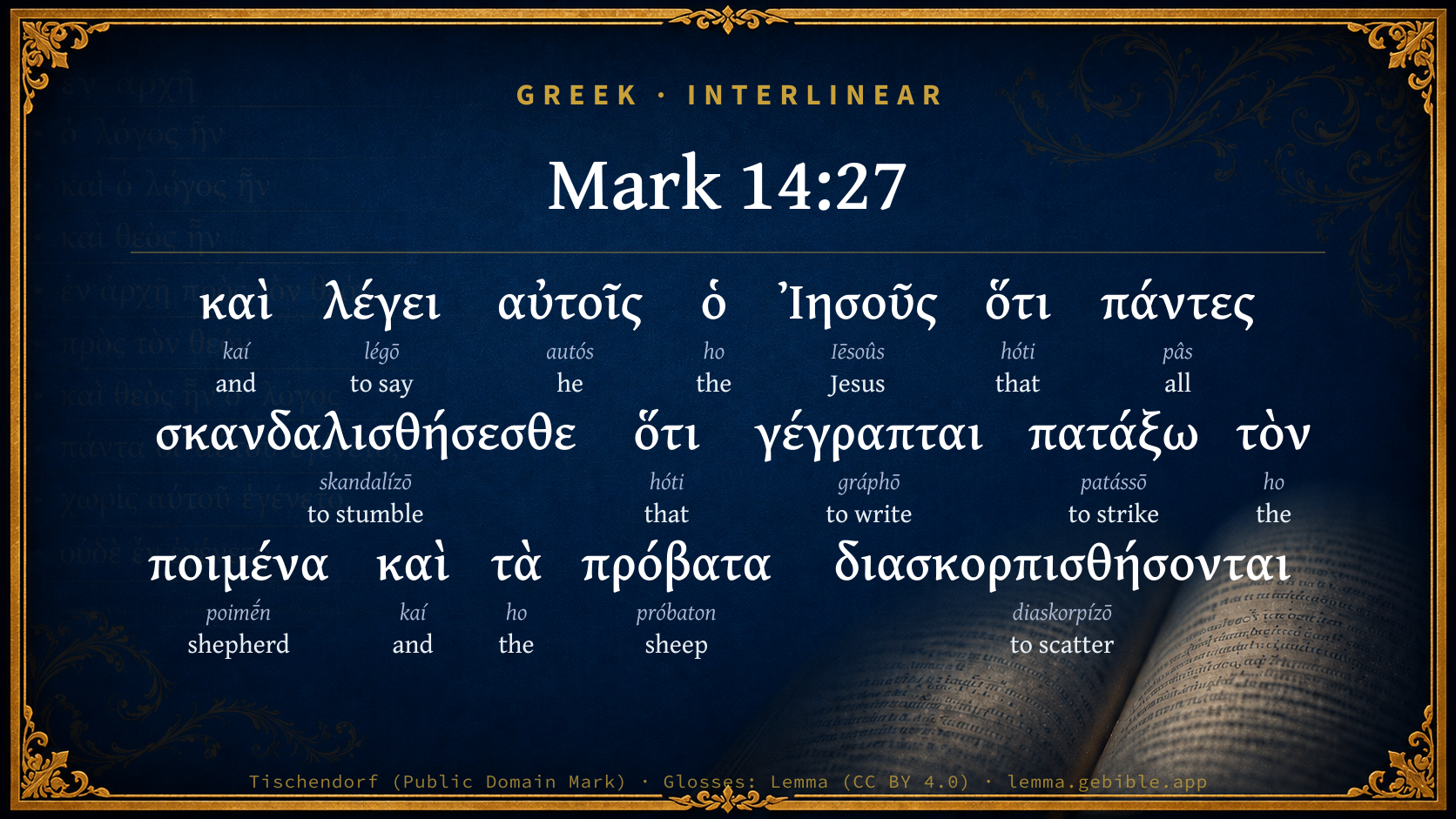
Greek (Tischendorf 8th ed.) Mark 14:27 appears in the Greek New Testament. The text above is from the Tischendorf 8th edition. Each word links to its Strong’s number and a concise gloss. Click any word for its full Thayer’s Greek Lexicon entry.
Download image
Cite this verse

Mark 14:27 (World English Bible). Public Domain. Lemma interlinear Bible study tool, https://lemma.gebible.app/v/mark/14/27.

Show BibTeX & RIS
BibTeX
RIS
English Translation
Jesus said to them, "All of you will be made to stumble because of me tonight, for it is written, 'I will strike the shepherd, and the sheep will be scattered.'
World English Bible · Public Domain
Download a study sheet

One document with this verse’s original text, its word-by-word gloss line, the meaning frame, cross-references with their text, attributed commentary, and full source and license credits — printable, and it pastes into notes with its structure intact.

This verse Autodidact and up

Study sheet (.html) Plain text (.txt)

A passage Seminary Student

Up to 50 verses in one chapter. A passage sheet keeps up to 6 commentary sources and 12 cross-references per verse, in the order this page ranks them, and says so on the sheet whenever that leaves anything out. Ask for a single verse and you get the Autodidact verse sheet above.

Everything on this page stays free to read, with no account — the sheet is a download of what is already on screen, not access to it.

Want to remove ads? Support Godless Engineer
Compare translations 3

The same verse in 3 English versions, stacked beneath the original-language interlinear above. Click any original word for its lexicon entry.

Each is an independent rendering of the whole verse — the interlinear is not word-aligned to these translations.

Highlighted words mark where these versions differ — a whole-verse word diff, not a word-by-word alignment.

  • World English Bible Public Domain
    Jesus said to them, "All of you will be made to stumble because of me tonight, for it is written, 'I will strike the shepherd, and the sheep will be scattered.'
  • King James Version Public Domain
    And Jesus saith unto them, All ye shall be offended because of me this night: for it is written, I will smite the shepherd, and the sheep shall be scattered.
  • unfoldingWord Literal Text CC BY-SA 4.0
    And Jesus says to them, “You all will be caused to stumble, for it is written, ‘I will strike the shepherd, and the sheep will be scattered.’

unfoldingWord Literal Text — © unfoldingWord, licensed CC BY-SA 4.0. Word-aligned USFM3 via Door43 (git.door43.org/unfoldingWord/en_ult).

Versions to compare (up to 4)

3 of 4 selected

Show all 19 translations

Every available English version of this verse, each an independent rendering of the whole verse.

  • World English Bible Public Domain
    Jesus said to them, "All of you will be made to stumble because of me tonight, for it is written, 'I will strike the shepherd, and the sheep will be scattered.'
  • Berean Standard Bible Public Domain
    Then Jesus said to them, “You will all fall away, for it is written: ‘I will strike the Shepherd, and the sheep will be scattered.’
  • Majority Standard Bible Public Domain
    Then Jesus said to them, “You will all fall away on account of Me this night, for it is written: ‘I will strike the Shepherd, and the sheep will be scattered.’
  • King James Version Public Domain
    And Jesus saith unto them, All ye shall be offended because of me this night: for it is written, I will smite the shepherd, and the sheep shall be scattered.
  • American Standard Version (1901) Public Domain
    And Jesus saith unto them, All ye shall be offended: for it is written, I will smite the shepherd, and the sheep shall be scattered abroad.
  • Revised Version (1885) Public Domain
    And Jesus saith unto them, All ye shall be offended: for it is written, I will smite the shepherd, and the sheep shall be scattered abroad.
  • Geneva Bible (1599) Public Domain
    Then Iesus said vnto them, Al ye shall be offended by mee this night: for it is written, I will smite the shepheard, and the sheepe shall be scattered.
  • Douay-Rheims (1899) Public Domain
    And Jesus saith to them: You will all be scandalized in my regard this night; for it is written, I will strike the shepherd, and the sheep shall be dispersed.
  • Young's Literal Translation Public Domain
    and Jesus saith to them -- `All ye shall be stumbled at me this night, because it hath been written, I will smite the shepherd, and the sheep shall be scattered abroad,
  • Literal Standard Version CC BY-SA 4.0
    and Jesus says to them, “All of you will be stumbled at Me this night, because it has been written: I will strike the Shepherd, and the sheep will be scattered abroad;
  • Unlocked Literal Bible CC BY-SA 4.0
    Jesus said to them, “All of you will fall away, for it is written, 'I will strike the shepherd and the sheep will be scattered.'
  • unfoldingWord Literal Text CC BY-SA 4.0
    And Jesus says to them, “You all will be caused to stumble, for it is written, ‘I will strike the shepherd, and the sheep will be scattered.’
  • Darby Bible Public Domain
    And Jesus says to them, All ye shall be offended, for it is written, I will smite the shepherd, and the sheep shall be scattered abroad.
  • World Messianic Bible Public Domain
    Yeshua said to them, “All of you will be made to stumble because of me tonight, for it is written, ‘I will strike the shepherd, and the sheep will be scattered.’
  • Webster's Bible Public Domain
    And Jesus saith to them, All ye will be offended because of me this night: for it is written, I will smite the shepherd, and the sheep shall be scattered.
  • Free Bible Version CC BY-SA 4.0
    “All of you will abandon me,” Jesus told them. “For as the Scriptures say, ‘I will attack the shepherd, and the sheep will be completely scattered.’
  • Bible in Basic English Public Domain
    And Jesus said to them, You will all be turned away from me: for it is in the Writings, I will put the keeper of the sheep to death, and the sheep will be put to flight.
  • Text-Critical English NT CC BY 4.0
    Then Jesus said to them, “All of you will fall away because of me this night. For it is written, ‘I will strike the shepherd, and the sheep will be scattered.’
  • Tyndale New Testament (1534) Public Domain
    And Iesus sayde vnto them: All ye shalbe offended thorow me this nyght. For it is wrytte: I will smyte the shepeherd and the shepe shalbe scattered.

Literal Standard Version (2020), Covenant Press — licensed CC BY-SA 4.0. Text via the HelloAO Bible API (eBible.org). Unlocked Literal Bible (unfoldingWord) — licensed CC BY-SA 4.0. Text via the HelloAO Bible API (eBible.org). unfoldingWord Literal Text — © unfoldingWord, licensed CC BY-SA 4.0. Word-aligned USFM3 via Door43 (git.door43.org/unfoldingWord/en_ult). Free Bible Version, Dr. Jonathan Gallagher — licensed CC BY-SA 4.0. Text via the HelloAO Bible API (eBible.org).

Word by word

More ways to search: Search by grammar → Find every occurrence → Compare this word →

Practice this passage: Drill this verse → Learn its vocabulary →

διασκορπισθήσονται
diaskorpízō
G1287
“to scatter”
Verb, Future, Passive, Indicative, 3rd person, Plural
Part of Speech
Verb
Tense
Future
Voice
Passive
Mood
Indicative
Person
3rd person
Number
Plural
Full Thayer's Definition

Origin: from G1223 and G4650

TDNT: 13:58,1

1. to scatter abroad, disperse, to winnow a. to throw the grain a considerable distance, or up into the air, that it may be separated from the chaff b. to gather the wheat, freed from the chaff into the granary c. to winnow grain
  1. καὶ kaí G2532 “and” Conjunction
  2. λέγει légō G3004 “to say” Verb, Present, Active, Indicative, 3rd person, Singular
  3. αὐτοῖς autós G846 “he” Personal pronoun, Dative, Plural, Masculine
  4. ὁ ho G3588 “the” Article, Nominative, Singular, Masculine
  5. Ἰησοῦς Iēsoûs G2424 “Jesus” Noun, Nominative, Singular, Masculine
  6. ὅτι hóti G3754 “that” Conjunction
  7. πάντες pâs G3956 “all” Adjective, Nominative, Plural, Masculine
  8. σκανδαλισθήσεσθε skandalízō G4624 “to stumble” Verb, Future, Passive, Indicative, 2nd person, Plural
  9. ὅτι hóti G3754 “that” Conjunction
  10. γέγραπται gráphō G1125 “to write” Verb, Perfect, Passive, Indicative, 3rd person, Singular
  11. πατάξω patássō G3960 “to strike” Verb, Future, Active, Indicative, 1st person, Singular
  12. τὸν ho G3588 “the” Article, Accusative, Singular, Masculine
  13. ποιμένα poimḗn G4166 “shepherd” Noun, Accusative, Singular, Masculine
  14. καὶ kaí G2532 “and” Conjunction
  15. τὰ ho G3588 “the” Article, Nominative, Plural, Neuter
  16. πρόβατα próbaton G4263 “sheep” Noun, Nominative, Plural, Neuter

About this verse

These counts appear in no published source. They are computed here, from the morphology-tagged text and Lemma’s own curated glosses. What Lemma adds →

17
words
13
distinct lemmas
Gospels
section

Notable vocabulary

The rarest word here is διασκορπισθήσονται to scatter G1287 — appearing just 9 times in the whole Greek New Testament.

Shared distinctive vocabulary

διασκορπισθήσονται to scatter G1287 occurs in 9 verses of the Greek New Testament. Also found in:

Repetition

Words recur within this verse:

Cross-references

6

Topical passages linked to Mark 14:27 in the Treasury of Scripture Knowledge — connected by theme and wording, ordered by reader-vote popularity; previews shown in the World English Bible.

  • Zechariah 13:7 "Awake, sword, against my shepherd, And against the man who is close to me," says Yahweh of Hosts. Strike the shepherd, and the sheep will be scattered; And I will turn my hand against the little ones.
  • John 16:32 Behold, the time is coming, yes, and has now come, that you will be scattered, everyone to his own place, and you will leave me alone. Yet I am not alone, because the Father is with me.
  • Matthew 26:31 Then Jesus said to them, "All of you will be made to stumble because of me tonight, for it is written, 'I will strike the shepherd, and the sheep of the flock will be scattered.'
  • John 16:1 "These things have I spoken to you, so that you wouldn't be caused to stumble.
  • 2 Timothy 4:16 At my first defense, no one came to help me, but all left me. May it not be held against them.
  • Luke 22:31–32 The Lord said, "Simon, Simon, behold, Satan asked to have you, that he might sift you as wheat,

Cross-references courtesy of OpenBible.info (CC BY 4.0).

Where the printed editions differ

1 variant

Places in this verse where the major printed Greek editions disagree on the wording in a way that affects the translation — a comparison of editions, not a manuscript-by-manuscript collation. The editions are the modern critical texts (Nestlé-Aland 28/27, SBL, Westcott-Hort, Tregelles, Tyndale House) and the traditional texts behind the KJV (the Textus Receptus and the Byzantine/Majority text). It is not a claim about which reading is original.

  1. Extra text
    ἐν ἐμοὶ ἐν τῇ νυκτὶ ταύτῃ,

    “in to me myself in <the> night this”

    In TRByz Not in NA28NA27TynSBLWHTreg

    ἐν ἐμοὶ ἐν τῇ νυκτὶ ταύτῃ, (en emoi en tēa nukti tautē) 'in to me myself in night this' is only in traditional manuscripts (TR+Byz)

Textual data: Translators Amalgamated Greek New Testament (STEPBible TAGNT) · CC BY 4.0.

Commentary

Notes on Mark 14:27 from classic Christian and Jewish commentators (each source and its license shown beneath its notes). The classic Christian expositions comment on the surrounding passage and are grouped to its opening verse, so a note may address several verses; the Jewish commentaries on the Tanakh (Rashi and others) are per-verse, so they appear only where the commentator wrote on this verse.

Lemma curates 59 commentaries, every one of them public domain or Creative Commons licensed, each selected and text-cleaned for this edition rather than reprinted as found. About our sources →

The Biblical Illustrator

Joseph S. Exell

Mar_14:27

I will smite the shepherd.

Why Christ is called a Shepherd

1. As descending from ancient patriarchs who were shepherds. They were types of Him.

2. He knows His sheep, and marks them for His own (Joh_10:3; Joh_10:14). God sets His seal on them (2Ti_2:19).

3. He feeds their souls and bodies in green pastures (Psa_23:1-6) and drives them to the sweet streams and waters of comfort, by the paths of grace and righteousness.

4. He defends them from the wolf and enemies; they being timorous, simple, weak, shiftless creatures, unable to fly, resist, or save themselves.

5. He nourishes the young and tender lambs.

6. He seeks them when they go astray, and rejoices to find them.

7. He brings them to the fold.

(1) The fold of grace.

(2) The fold of glory. (Dr. Thomas Taylor.)

Comfort in Christ, our Shepherd

In that Christ is our Shepherd, we may comfort ourselves in-

1. His love. More love is included in the title Shepherd, than if He should call Himself our father, brother, kinsman. The good Shepherd gives His life for the sheep, which every father or brother will not do.

2. His care. The sheep need care for nothing but the Shepherds presence (Psa_23:1). (Dr. Thomas Taylor.)

Christ smitten, an example to us

In that Christ was smitten with the sword, let us learn patience in affliction of every kind.

1. He suffered for no necessity or desert, but by voluntary humility, whereas we deserve fiery trials.

2. He suffered not for His own cause, but ours; and shall not we for His?

3. He despised the shame; and why should not we?

4. The end of His cross was the exaltation at Gods right hand; and we expect the same. (Dr. Thomas Taylor.)

Comfort because God is the smiter

Though Christ was smitten, it was not by chance, fortune, or altogether by malice of wicked men; but all by the counsel and decree of God. If thou art smitten, comfort thyself.

1. It is Gods hand.

2. God intends by this means to bring about some good purpose in thee.

3. God not only sends thy trouble, but also regulates and checks it. (Dr. Thomas Taylor.)

The scattering

Why were the disciples thus scattered?

1. Their own weakness and carnal fear made them fly to save themselves. They had not counted the cost of their profession. Nor had they yet received the Holy Spirit, which afterwards kept them strong and stedfast.

2. God in His wisdom would have Christ deserted, because He was to be known to tread the winepress of Gods wrath alone.

3. Thus it behoved the Scripture to be fulfilled, in regard of Christ Himself, who voluntarily undertaking the grievous burden of our sin, must be forsaken by all for the time.

4. To teach us, that all our safety depends on our relation to the chief Shepherd. Without Christ we lie dispersed, ungathered, and forlorn. (Dr. Thomas Taylor.)

The Biblical Illustrator, edited by Joseph S. Exell (c. 1880s–1900s) — public domain. Text from a community e-Sword module.

Godbey's Commentary on the New Testament

William B. Godbey

JESUS PREDICTS THE FALL OF PETER AND THE DISPERSION OF THE APOSTLES

Mat 26:31-35; Mar 14:27-31; Luk 22:31-38;Joh 13:36-38. N.B. — They are all still at the supper-table except Judas, who, at nightfall, went away alone — and not alone, for Satan went with him. “Simon Peter says to Him, Lord, whither art Thou going? Jesus responded to him, Whither I go, thou art not able to follow Me now; but shall follow Me hereafter. Peter says to Him, Lord, wherefore am I not able to follow Thee now? I will lay down my life for Thee.” Peter absolutely and sincerely meant all he said, and yet in a few hours denied Him, illustrating the horrific instability of unsanctified humanity. After Peter received the fiery baptism, he was more than a match for earth and hell, living a hero and dying a martyr. What an admonition is Peter’s case to all to get sanctified!

Mat 26:31. “Then Jesus says to them, All you will be offended in Me this night. For it has been written, I will smite the shepherd, and the sheep of the flock shall be scattered.” (Zec 13:7) The application of this is very plain and simple, as it was fulfilled in Gethsemane about three hours after this utterance. “And after I am risen, I will go before you into Galilee.” Jesus had repeatedly predicted to them that He would meet them in Galilee, His native land and that of most of His apostles, whither they all went soon after His resurrection, and He met them on the bank of the Galilean Sea, after a night of toil in dragging their nets through the waters; but then, to their unutterable surprise, pursuant to His mandate, casting the net on the right side of the ship, they caught one hundred and fifty-three large fish. He also met them on one of the mountains of Galilee, not named.

“Peter, responding, said to Him, If all shall be offended in Thee, I will never be offended.” Peter was no hypocrite. He meant all he said; yet before the crowing of the cock that very night, he denied that he knew Him.

Luk 22:31. “The Lord said, Simon, Simon, behold, Satan sought after you, to sift you like wheat.” Here the pronoun “you” is humas, the plural number, including not only Peter, but all of the apostles. All the depravity in human nature belongs to Satan, because he put it there in the fall. All sin is the crop of Satan’s own sowing. So long as there is anything in you which Satan can sift out, you are not ready for heaven. Satan could not sift Jesus, because when he came to Him, he found nothing in Him belonging to him. After the apostles were all sanctified at Pentecost, Satan’s sifting was fruitless toil, as the celestial flame had consumed all the chaff, straw, cheat, cockle, and trash, leaving nothing but the pure wheat, ready for the Lord’s mill. “But I prayed for you, that your faith may not fail.” “You” is in the singular number, meaning Peter alone, as the especial subject of the Savior’s prayer in this case, lest he might be gobbled up by Satan. Jesus here tells them, “You will all be offended in Me this night.” This word is from scandalon, “a stumbling-block,” showing that they all ran over a great stumbling-block, which jostled them exceedingly, and Peter, the most sanguine of all, became more seriously upset than any of his comrades. This word, however, does not convey the idea of a total apostasy, but a stumbling and temporary backsliding, the prayer of Jesus prevailing, so that the faith, though terribly tried, did not utterly let go. “And you, having turned, then strengthen your brethren.” “When thou art converted,” E. V., is too strong a rendering of epistrepsas, which simply means “having turned,” being in the active voice; i. e., “Having turned from your backsliding, strengthen your brethren.” Peter was the senior apostle, his house in Capernaum being headquarters of Jesus during the two and a half years of His ministry in Galilee. Therefore he wielded a very potent influence over his brethren, who, of course, being jostled by his backsliding, would need confirmation by his confession and testimony. “And he said to Him, Lord, I am ready to go with Thee to prison, and to death.” Mar 14:30 : “And Jesus says to him, Truly I say unto thee, that this night, before the cock crows twice, thou shall deny Me thrice. And he continued to say the more positively, If it may be necessary for me to die along with Thee, I will not deny Thee. And all the others said likewise.” You see how sanguine Peter was, feeling perfectly sure; and yet when the emergency came he failed. A significant illustration of the bold utterances of unsanctified Christians, believing indubitably that they will do just what they say; but signally failing, because they have an indwelling enemy stronger than they.

Luk 22:35-38. “And He said to them, When I sent you out without purse, valise, and sandals, did you lack anything? And they said, Nothing. Then He said to them, But now, let the one having purse take it, likewise also valise; and let every one not having a sword, sell his cloak and purchase one. For I say unto you, that it behooveth that which has been written yet to be fulfilled in Me, And He was numbered with the transgressors [Isa 53:12]; and those things concerning Me have an end. And they said, Lord, behold, here are two swords. And He said to them, It is sufficient.” While our Savior was with them on the earth, He miraculously fed, clothed, and protected them when it was necessary. Consequently they could go without these provisions, incident to human life, indiscriminately. But now that He is going away to leave them, they must take heed and give the necessary attention to the temporalities essential to their physical support and protection. The Orientals wear two garments — the cheiton, interior, and the himation, exterior. The outer garment they frequently carried while traveling and laid aside when at labor, keeping it for night and storms. Jesus here tells them, if necessary, to sell the himation and buy a sword. I never could understand why He told them to take a sword till I traveled in that country and saw the necessity of carrying weapons. I did not carry any, as I did not know how to use them; but a sanctified preacher in our company carried a revolver, our dragman also being armed with a revolver and a dagger. In some places we were compelled to hire an armed escort to keep the robbers off. “Why were you compelled to do it?” Our guide refused to go without the armed escort. Going round in Jerusalem, men, as a rule, had no visible weapons; but traveling through the country, all we met were armed with guns, swords, or huge clubs, almost as large as an American rifle, and convenient to kill a man with a single stroke. The guide-books advise all travelers to go armed, but not to use their weapons, their utility being that of intimidation, as robbers abound everywhere, who do not content themselves by simply taking your money, but take everything you possess, leaving you utterly destitute of clothing, baggage, etc. In that day there were no firearms, the sword being the most common weapon of defense; also regarded as a badge of itinerancy. You see, when they pointed out these two swords, He said they were sufficient. The presumption is that the sword was a prudential, peace, and safety provision, for the intimidation of robbers and for personal security in case of emergency, as persons openly avowing the absence of all protecting weapons in their peregrinations would soon fall a prey to the robbers. Along the road from Jerusalem down to Jericho, where the traveler (Luke 10) was attacked by the robbers, the Roman Government had a garrison of armed men to protect the travelers, as the robbers were so troublesome.

William B. Godbey, Commentary on the New Testament (1896–1900) — public domain. Text from a community e-Sword module.

Bengel's Gnomon

Johann Albrecht Bengel

Mar 14:27. Γέγραπται, it is written) Comp. Mat 26:31, note.

Bengel's Gnomon of the New Testament — English translation (T&T Clark, Edinburgh, 1860) — public domain. Text from a community e-Sword module.

Expositor's Greek Testament

ed. W. Robertson Nicoll

Mar 14:27 . πάντες σκανδαλισθήσεσθε , ye all shall be made to stumble; absolutely, without the addition of ἐν ἐμοὶ ἐν τῇ νυκτὶ ταύτῃ imported into the text from Mt. in T.R. It was a startling announcement in broad general terms that the disciple-circle was about to experience a moral breakdown. The announcement was made not by way of reproach, but rather as a preface to a more cheering prophecy of an early reunion.

The Expositor's Greek Testament, edited by W. Robertson Nicoll (1897–1910) — public domain. Text from a community e-Sword module.

Geneva Bible (1599)

Geneva Bible translators

Christ foretelleth how he shall be forsaken of his, but yet that he will never forsake them.

Geneva Bible (1599) marginal notes — public domain. Text via Bolls.life.

The Cambridge Bible for Schools and Colleges

gen. ed. J. J. S. Perowne

27. And Jesus saith unto them] These words really were uttered as they sat at the table just after the institution of the Holy Eucharist.

for it is written] The words are taken from Zec_13:7. The Good Shepherd quotes the allusion to Himself in His truest character (Joh_10:4).

The Cambridge Bible for Schools and Colleges (gen. ed. J. J. S. Perowne; Cambridge University Press, 1878–1918) — public domain. Text from a community e-Sword module.

John Gill's Exposition

But after that I am risen,.... From the dead, which, for their comfort, he assures them of; though they would be offended and discouraged at the seizing, and condemning, and crucifixion of him:

I will go before you into Galilee; the place of their nativity, and where he had often conversed with them; See Gill on Mat 26:32.

John Gill's Exposition of the Whole Bible (1746–1763) — public domain (CC PDM 1.0). Text via the HelloAO Bible API.

Haydock's Catholic Bible Commentary

Christ permitted his disciples to fall, that they might learn not to trust in themselves. To strengthen his prediction, he adduces the testimony of Zacharias the prophet, (xiii. 7.) I will strike the shepherd, and the sheep shall be dispersed. (Theophylactus) ... This text is expressed in other words, being there spoken in the person of the prophet: Strike the pastor, and the sheep shall be dispersed. (Ven. Bede) --- By these words, the prophet prays for the passion of the Lord. The Almighty Father answers his prayer: I will strike the shepherd. The Son is sent by the Father, and is stricken by becoming incarnate and suffering death. (St. Jerome)

George Leo Haydock (1774–1849), Haydock's Catholic Family Bible and Commentary, 1859 edition — public domain. Excludes Psalms (Douay-Rheims chapter numbering differs from Protestant) and Deuterocanonical books (Catholic canon only).

Matthew Poole's English Annotations

See Poole on "Mat 26:31", and following verses to Mat 26:35, on all the discourse.

Matthew Poole's English Annotations on the Holy Bible (1683–1685) — public domain. Text from a community e-Sword/MySword module.

The Pulpit Commentary

All ye shall be offended. The words which follow in the Authorized Version, "because of me this night," are not to be found in the best manuscripts and versions. They appear to have been imported from St. Matthew. Shall be offended (skandalisyhsesye); literally, shall be caused to stumble. Our Lord was to prove "a stone of stumbling" to many, not excluding his own disciples. Even they, under the influence of terror, would for a time lose confidence and hope in him. For it is written, I will smite the shepherd, and the sheep shall be scattered abroad. This is a quotation from Zechariah, (Zec_13:7) "Awake, O sword, against my Shepherd, and against the man that is my Fellow, saith the Lord of hosts: smite the Shepherd." This passage brings out in a remarkable manner the Divine agency in the death of Christ. The sheep shall be scattered abroad. The disciples all forsook him and fled, when they saw him actually in the hands of his enemies. They felt doubtful for the moment whether he was indeed the Son of God. "They trusted that it was he who should redeem Israel;" but now their hopes gave way to fear and doubt. They fled hither and thither like frightened sheep. But God gathered them together again, so that when our Lord rose from the dead, he found them all in the same place; and then he revived their faith and courage. Our Lord and his disciples had no settled home or friends in Jerusalem; so they had no other place to flee to than that upper chamber, where, not long before, Christ had kept the Passover with them. The owner of that house was a friend; so thither they went, and there Christ appeared to them after his resurrection.

Vers. 27-31. Anticipation.

Long before had our Lord clearly realized what would be the end of his ministry of benevolence and self-denial. The prospect of ungrateful violence leading to a cruel death had not deterred him from efforts for the good of those whom he loved and pitied. And now that the blow was just about to fall upon him, his mind was no less steadfast, although his heart was saddened.

I JESUS ANTICIPATES HIS OWN SUFFERINGS, AND THE RESURRECTION WHICH SHOULD FOLLOW HIS DEATH.

1. He foresaw that, as the Good Shepherd, he should be smitten. He was to lay down his life for the sheep, that they might be saved and live.

2. He foretold that he should rise, and should be found in Galilee in an appointed place. This assurance gives us an insight into the considerate kindness of the Redeemer, who not only resolved to triumph for mankind, but took care for his own friends that their solicitude might be relieved, and that his intimacy with them might be renewed.

II JESUS ANTICIPATES THE CONFUSION AND UNFAITHFULNESS OF HIS DISCIPLES. Sorely as this prospect must have distressed his heart, he was not by it to be deterred from his purpose. He foretold to his friends how they were about to act, that they might learn a lesson of their own frailty and dependence upon unseen aid.

1. Offence and scattering were foretold concerning all. This, as the record informs us, came to pass; for in the hour of his apprehension "they all forsook him, and fled.

2. The denial of the foremost and the boldest of the twelve was also foretold. Peter loved Christ, had displayed a remarkable insight into Christ"s nature, and now professed, in the ardor of his attachment, a readiness to die for his Lord. It was as though nothing that could distress the Divine Savior should be wanting to his sufferings and sacrifice; he consented even to be denied by the foremost of the select and beloved band.

3. Jesus knew the hearts of his disciples better than they knew their own. They vehemently asserted their attachment, their devotedness, their unswerving fidelity. But he knew the underlying nature which afforded at present no foundation for their resolutions and protestations. And he was evidently prepared for what actually happened; it did not take him by surprise. Only after his ascension, and the baptism with the Spirit, could the apostles withstand the onset of the foe, the rage of the persecutor.

PRACTICAL LESSONS.

1. Learn the frailty and feebleness of human nature.

2. Learn the steadfastness and the love of the Savior.

3. Learn the necessity of dependence upon Divine grace to keep from falling.

Vers. 27-31. Peter"s denial foretold.

Christ"s thoughts dwelt constantly upon the prophecies that foretold the sufferings and death of the Son of man. They were passing through his spiritual consciousness, voluntarily adopted as the expression of his own inward life, and consequently wrought out in external actions. He now quotes Zec_13:7. It taught him how absolutely solitary his position would be in judgment and death, as other passages had done; and suggested to him the reason for it.

I THE UNIVERSAL DEFECTION OF THE DISCIPLES BEFORE CHRIST"S DEATH WAS A SPIRITUAL NECESSITY. They could not understand or allow it. It seemed so unnatural and unlikely. But their Master felt, by gauging his own spirit, how much would be required to enable them to be steadfast, and how wanting they were in the higher principles of spiritual life. He accepted the situation, and sought beforehand to prepare his disciples for the revelation of their own weakness, that when it took place it might not destroy all hope or desire to return to their fidelity. It was, then, at once in expression of his own inward Messianic consciousness, and in order to their warning and instruction, that he quoted the prophecy. How was this desertion of their Master a necessary experience? Because the realization of absolute oneness with Christ in the spirit of self-denial, or rather of love, would only be possible after his own sacrifice, as its ground or condition. They were, meanwhile, still in a state of pupilage or infancy. They could not understand the reason of his strange path, so unlike what they had anticipated. Had they been able to stand by the Lord when he was delivered up, they might have been their own saviors, and his work would not have been requisite.

II SELF-CONFIDENCE IN ASSERTING ITS SUPERIORITY TO THIS LAW WOULD ONLY THE MORE SIGNALLY ILLUSTRATE IT. Peter, the representative of theoretic faith, was strong in his contradiction to this statement. It was he who had said, "Lord to whom can we go?" etc., and who had heard the approving response, "Blessed art thou, Simon Bar-Jona: for flesh and blood hath not revealed it unto thee, but my Father which is in heaven"; (Mat_16:17) and who had been called the rock. He therefore goes forward in the strength of his own convictions, and courts the disaster he sought to avoid, and that in an exaggerated form. (The seeming discrepancy between the evangelists as to the crowing and crowing twice is easily explained.) That very day, nay, that night, ere the dawning, he should deny his Lord thrice, i.e. absolutely and utterly; and, that he might test his Master"s faithfulness and his own failure, the sign was given the cock crow twice." His bold self-confidence and resolute endeavor to be with Christ were shown in his penetrating the hall of justice, and mingling in the very crowd amidst which the Savior stood. But this only provoked the challenge before which all his manhood quailed. The others did not orally deny Christ, because they had fled beforehand.

III BUT WITH THE WARNING A WORD OF HOPE AND COMFORT WAS UTTERED. The Shepherd would reassemble his scattered flock, when he went before them into Galilee. But they could not receive the saying upon which that depended I am raised up." It was to be lodged in their consciousness, nevertheless, to be recalled again when its fulfillment took place, and to be put on record as another evidence of the faith. Then they would no longer be told, "Whither I go ye cannot come," as he would give his Spirit to them. M.

Vers. 27-31, 66-72. Peter"s fall.

The painful declaration that the words of the prophet, "I will smite the shepherd, and the sheep shall be scattered abroad," would find their fulfillment in them, and in "All ye shall be offended," roused Peter"s spirit, and with a bold but mistaken estimate of his own courage and devotion, he fearlessly, even presumptuously, affirmed, "Although all shall be offended, yet will not I" St. Luke has preserved for us words which throw much light upon the incident of Peter"s fall, and upon the position which Peter held amongst the disciples: "Simon, Simon, behold, Satan asked to have you, that he might sift you as wheat: but I made supplication for thee, that thy faith fail not: and do thou, when once thou hast turned again, stablish thy brethren." So Satan, the enemy of man, the agent for testing his religious character, has made demand to put all the disciples into his sieve. Men sift wheat to reveal and separate the useless from among the valuable the bad from the good. Such is the good end of temptation. Brought to bear upon the great Master himself, it was powerless. He could say, "The prince of the world cometh: and he hath nothing in me." There was no chaff mingled with that pure grain. Assailing Judas alas! how little of any thing but husk! In Peter how strange a mixture! In each of us? Peter, warned by the first prophetic admonition, by the parabolic words of Jesus, and by the yet more definite assurance that ere "the cock crow twice thou shalt deny me thrice," repeats his boast of fidelity with an emphasis, "If I must die with thee, I will not deny thee." The sieve is ready. Peter is accosted by a woman, "one of the maids of the high priest." "Thou also wast with the Nazarene, even Jesus." The story is well known, and needs not to be repeated. The word of Jesus found its exact fulfillment. "Thrice" did he deny, "and straightway the second time the cock crew." "And the Lord turned, and looked upon Peter." It was enough; with broken heart he "went out, and wept bitterly?

Let us learn:

1. Our constant liability to be tempted to evil. Go where we will, temptation assails us. Amidst the blessedness of Eden or the sanctities of the temple, the tempter hides. The felicities of home, the marts of trade, the seclusions of contemplation, are all as open to the evil presence as to the air of heaven. Our steps are dogged, our life assailed. Surely for this for such an exposure of the precious life-a sufficient justification can be adduced.

2. One end of temptation is to search out existing evil for its exposure and destruction. On the elevated plateau, over the hardened and smooth floor, the wheat is shaken from the sieve. The gentle winds blow aside the chaff, for which the consuming fire is prepared, and the pure grain falls to the ground. Peter little knew that cowardice and fear lay lurking beneath the folds of his dress; but temptation revealed them. As men pass the magnet through the metal dust to discover and separate the particles of iron from more precious metals, and those particles respond, leaping up to the attractive force; and as men test the strength of iron beams by means of heavy weights or blows; so the wily temptation tests the purity of our hearts and the strength of our principles, and draws forth the lurking evil, that, being exposed, it may be separated ere it ruins the whole life.

3. If by temptation a weakness or flaw is discovered, our wisdom is, by penitence and contrition, to return for recovery and healing. We may be sadder and humbler, but we shall be wiser. Happy for us if we have strength so to do, and not, Judas-like, in blank self-despair and self-disgust, sink to rise no more.

4. But a further lesson is to guard against those evils which are the especial cause of danger to our spiritual life. Each has his own especial liability. Peter"s was not covetousness; Judas was not in danger from pride of power. Our danger is always as the amount of alloy in our character the amount of chaff amongst the wheat.

5. Again, let us seek the removal of our own peculiar faults by the winnowing fan and purging fire of the Spirit, that we may not be exposed to the destructive surprises of sudden temptation.

6. An additional lessen is so to guard our spiritual life that the current of our thoughts be pure. How often a colored stream, or one holding earthy salts in solution, gives its own tint to the banks, or determines the growths on either side! Well also is it for us to separate from those habits of life which are condemned by any conviction of right.

7. The great lesson, on the surface of this incident, is the necessity for humility that we beast not of our religion, that we presume not on our power; but, in lowly dependence on the strength of Divine grace, walk warily, watching lest we enter into temptation. G.

The Pulpit Commentary (1880–1919), ed. H.D.M. Spence-Jones & Joseph S. Exell — public domain. Text from a community e-Sword module.

John Wesley's Explanatory Notes

This night - The Jews in reckoning their days began with the evening, according to the Mosaic computation, which called the evening and the morning the first day, Gen. i, 5. And so that which after sunset is here called this night is, ver. 30, called today. The expression there is peculiarly significant. Verily I say to thee, that thou thyself, confident as thou art, today, even within four and twenty hours; yea, this night, or ever the sun be risen, nay, before the cock crow twice, before three in the morning, wilt deny me thrice. Our Lord doubtless spoke so determinately, as knowing a cock would crow once before the usual time of cock crowing. By chap. xiii, 35, it appears, that the third watch of the night, ending at three in the morning, was commonly styled the cock crowing. Zech. xiii, 7.

John Wesley, Explanatory Notes Upon the Whole Bible (1754–1765) — public domain. Text via the GEBible commentary corpus.

Burkitt's Expository Notes on the New Testament

William Burkitt

Observe here, 1. The warning that our Saviour gives his disciples of their forsaking of him in the the time of his sufferings; All ye shall be offended because of me this night.

Learn, That Christ’s dearest friends forsook and left him alone, in the midst of his greatest distress and danger.

Observe, 2. What was the cause of their flight; it was their fear, the weakness of their faith, and the prevalency of their fear.

O! how sad and dangerous is it for the best of men to be left under the power of their own fears in the day of temptation!

Observe, 3. Notwithstanding our Saviour’s prediction, St. Peter’s presumption of his own strength and standing; Though all men forsake thee, yet will not I.

Learn thence, That self-confidence, and presumptuous opinion, of their own strength, is a sin very incident to the holiest and best of men. This good man resolved honestly, no doubt; what a feather he should be in the wind of temptation, if once left to the power and prevalency of his own fears. None are so near falling, as those who are the most confident of their own standing; if ever we stand in the day of trail, it is the fear of falling that must enable us to stand.

William Burkitt's Expository Notes on the New Testament (1700–1703) — public domain. Text from a community e-Sword module.

The People's New Testament

B. W. Johnson

27–31. All ye shall be offended. See notes on Matt. 26:31–35. Compare Luke 22:31–38.

B. W. Johnson's The People's New Testament with Notes (1889–1891) — public domain. Electronic text from the Christian Classics Ethereal Library (CCEL) ThML edition.

Cambridge Greek Testament for Schools and Colleges

27. [3139][3140][3141][3142][3143][3144][3145][3146][3147] omit ἐν ἐμοὶ … ταύτῃ.

[3139] Codex Sinaiticus. 4th cent. Discovered by Tischendorf in 1859 at the Monastery of St Katharine on Mount Sinai. Now at St Petersburg. The whole Gospel, ending at Mar 16:8. Photographic facsimile, 1911.

[3140] Codex Vaticanus. 4th cent., but perhaps a little later than א. In the Vatican Library almost since its foundation by Pope Nicolas V., and one of its greatest treasures. The whole Gospel, ending at Mar 16:8. Photographic facsimile, 1889.

[3141] Codex Ephraemi. 5th cent. A palimpsest: the original writing has been partially rubbed out, and the works of Ephraem the Syrian have been written over it; but a great deal of the original writing has been recovered; of Mark we have Mar 1:17 to Mar 6:31, Mar 8:5 to Mar 12:29, Mar 13:19 to Mar 16:20. In the National Library at Paris.

[3142] Codex Bezae. 6th cent. Has a Latin translation (d) side by side with the Greek text, and the two do not quite always agree. Presented by Beza to the University Library of Cambridge in 1581. Remarkable for its frequent divergences from other texts. Contains Mark, except Mar 16:15-20, which has been added by a later hand. Photographic facsimile, 1899.

[3143] Codex Regius. 8th cent. An important witness. At Paris. Contains Mar 1:1 to Mar 10:15; Mar 10:30 to Mar 15:1; Mar 15:20 to Mar 16:20, but the shorter ending is inserted between Mar 16:8 and Mar 16:9, showing that the scribe preferred it to the longer one.

[3144] Codex Monacensis. 10th cent. Contains Mar 6:47 to Mar 16:20. Many verses in 14, 15, 16 are defective.

[3145] Codex Oxoniensis. 9th cent. Contains Mark, except Mar 3:35 to Mar 6:20.

[3146] Codex Sangallensis. 9th or 10th cent. Contains the Gospels nearly complete, with an interlinear Latin translation. The text of Mark is specially good, agreeing often with CL. At St Gall.

[3147] Codex Athous Laurae. 8th cent. Like N and Σ, it is written in silver letters on purple vellum. Contains Mar 9:5 to Mar 16:20, and, as in L, the shorter ending is inserted between Mar 16:8 and Mar 16:9. As in Δ, the text of Mark is specially good.

27. Πάντες. There will be no exception; not one will stand the shock of the arrest and execution of the Master.

Πατάξω τ. ποιμένα. This quotation differs from both [3325] and [3326] texts of LXX. and also from the Heb. See on Zec 13:7 and also Swete, Intr. to O.T. in Greek, p. 393. The quotation is made by Christ, not by Mk, and the truth of the saying has often been verified in history. The change from the imperat. (πατάξατε or πάταξον in LXX.) to the future (Mk, Mt.) makes the saying more suitable to the context, for it is God who will smite the Shepherd. The saying may have been a proverb before Zechariah used it, and it may have existed in both forms. In Zech. the sheep are the members of the Jewish Church; here they are primarily the Apostles (Mar 14:50), but other followers may be included.

[3325] Codex Alexandrinus. 5th cent. Brought by Cyril Lucar, Patriarch of Constantinople, from Alexandria, and afterwards presented by him to King Charles I. in 1628. In the British Museum. The whole Gospel. Photographic facsimile, 1879.

[3326] Codex Vaticanus. 4th cent., but perhaps a little later than א. In the Vatican Library almost since its foundation by Pope Nicolas V., and one of its greatest treasures. The whole Gospel, ending at Mar 16:8. Photographic facsimile, 1889.

Cambridge Greek Testament for Schools and Colleges (Cambridge University Press, 1896; 21 vols, various authors incl. Carr, Maclear, Plummer, Farrar, Lumby, Moule, M. R. James, Simcox) — public domain. Text from a community e-Sword module.

International Critical Commentary

27. Ὅτι πάντες σκανδαλίσεσθ·1 ὅτι γέγραπται, Πατάξω τὸν ποιμένα, καὶ τὰ πρόβατα διασκορπισθήσονται—All of you will fall away. For it is written, I will smite the shepherd, and the sheep will be scattered. The quotation is from Zec_13. In the original, it reads, smite the shepherd. But since it is Jehovah who invokes the sword against the shepherd in the original, this πατάξω renders the sense of the passage. The whole passage in the original is involved in obscurity, but there is the same indication as in all the O.T. prophecies of the application to an immediate, and not a remote future; cf. v. 8. The application to this event in the life of Jesus is because the relation between shepherd and sheep leads to the same result in both cases. Probably the shepherd in Zech. is the king, and the sheep are the people.

Omit ἐν ἐμοὶ, because of me, after σκανδαλίσεσθε, Tisch. Treg. WH. RV. א BC* DHLSVWb X ΓΔΠ2, two mss. Lat. Vet. Memph.edd. Omit ἐν τῇ νυκτὶ ταύτῃ, this night, about the same. διασκορπισθήσονται, instead of-σεται, Tisch. Treg. WH. א ABCDFGKLN Δ.

International Critical Commentary — older volumes (1896–1929), various authors — public domain. Text from a community e-Sword module.

Lesson kit

Teaching starters — assembled from the data on this page, not authored interpretation. Every prompt links to the verse data it draws on. Edit before teaching.

Mark, in the Gospels, opens this verse with 17 words (13 distinct Greek lemmas). Its most distinctive word is diaskorpízō (“to scatter”). A historical commentator’s framing appears above. Read the whole chapter for the surrounding context.

Discussion questions

  1. What does “to scatter” (diaskorpízō) contribute to the verse as a whole?
  2. How does Matthew 25:24, which shares the word «to scatter», read alongside this verse?
  3. What does the repetition of “the” (3× in this one verse) do in this verse?
  4. The translations on this page render this verse differently — a whole-verse word diff, not a word-by-word alignment. What might account for the different wordings?
  5. Compare how The Biblical Illustrator and Godbey's Commentary on the New Testament read this verse. Where do they agree or differ?

Things to notice

Reading settings

Reading text

Shown beneath each verse's original-language words.

Old Testament
Old Testament edition

Read the OT as the Masoretic Hebrew (MT) or the Greek Septuagint (LXX).

English shown for the Greek Septuagint (in the Hebrew ↔ Greek comparison).

Comparing translations? Open the Compare panel on any verse page to stack up to four side by side.