3 John 1:11

Greek (Tischendorf 8th ed.) 3 John 1:11 appears in the Greek New Testament. The text above is from the Tischendorf 8th edition. Each word links to its Strong’s number and a concise gloss. Click any word for its full Thayer’s Greek Lexicon entry.
Download image
Cite this verse

3 John 1:11 (World English Bible). Public Domain. Lemma interlinear Bible study tool, https://lemma.gebible.app/v/3-john/1/11.

Show BibTeX & RIS
BibTeX
RIS
English Translation
Beloved, don't imitate that which is evil, but that which is good. He who does good is of God. He who does evil hasn't seen God.
World English Bible · Public Domain
Download a study sheet

One document with this verse’s original text, its word-by-word gloss line, the meaning frame, cross-references with their text, attributed commentary, and full source and license credits — printable, and it pastes into notes with its structure intact.

This verse Autodidact and up

Study sheet (.html) Plain text (.txt)

A passage Seminary Student

Up to 50 verses in one chapter. A passage sheet keeps up to 6 commentary sources and 12 cross-references per verse, in the order this page ranks them, and says so on the sheet whenever that leaves anything out. Ask for a single verse and you get the Autodidact verse sheet above.

Everything on this page stays free to read, with no account — the sheet is a download of what is already on screen, not access to it.

Want to remove ads? Support Godless Engineer
Compare translations 3

The same verse in 3 English versions, stacked beneath the original-language interlinear above. Click any original word for its lexicon entry.

Each is an independent rendering of the whole verse — the interlinear is not word-aligned to these translations.

Highlighted words mark where these versions differ — a whole-verse word diff, not a word-by-word alignment.

  • World English Bible Public Domain
    Beloved, don't imitate that which is evil, but that which is good. He who does good is of God. He who does evil hasn't seen God.
  • King James Version Public Domain
    Beloved, follow not that which is evil, but that which is good. He that doeth good is of God: but he that doeth evil hath not seen God.
  • unfoldingWord Literal Text CC BY-SA 4.0
    Beloved, do not imitate the evil, but the good. The one doing good is from God; the one doing evil has not seen God.

unfoldingWord Literal Text — © unfoldingWord, licensed CC BY-SA 4.0. Word-aligned USFM3 via Door43 (git.door43.org/unfoldingWord/en_ult).

Versions to compare (up to 4)

3 of 4 selected

Show all 19 translations

Every available English version of this verse, each an independent rendering of the whole verse.

  • World English Bible Public Domain
    Beloved, don't imitate that which is evil, but that which is good. He who does good is of God. He who does evil hasn't seen God.
  • Berean Standard Bible Public Domain
    Beloved, do not imitate what is evil, but what is good. The one who does good is of God; the one who does evil has not seen God.
  • Majority Standard Bible Public Domain
    Beloved, do not imitate what is evil, but what is good. The one who does good is of God; the one who does evil has not seen God.
  • King James Version Public Domain
    Beloved, follow not that which is evil, but that which is good. He that doeth good is of God: but he that doeth evil hath not seen God.
  • American Standard Version (1901) Public Domain
    Beloved, imitate not that which is evil, but that which is good. He that doeth good is of God: he that doeth evil hath not seen God.
  • Revised Version (1885) Public Domain
    Beloved, imitate not that which is evil, but that which is good. He that doeth good is of God: he that doeth evil hath not seen God.
  • Geneva Bible (1599) Public Domain
    Beloued, follow not that which is euill, but that which is good: he that doeth well, is of God: but he that doeth euill, hath not seene God.
  • Douay-Rheims (1899) Public Domain
    Dearly beloved, follow not that which is evil, but that which is good. He that doth good, is of God: he that doth evil, hath not seen God.
  • Young's Literal Translation Public Domain
    Beloved, be not thou following that which is evil, but that which is good; he who is doing good, of God he is, and he who is doing evil hath not seen God;
  • Literal Standard Version CC BY-SA 4.0
    Beloved, do not be following that which is evil, but that which is good; he who is doing good, he is of God, [but] he who is doing evil has not seen God;
  • Unlocked Literal Bible CC BY-SA 4.0
    Beloved, do not imitate what is evil but what is good. The one who does good is of God; the one who does evil has not seen God.
  • unfoldingWord Literal Text CC BY-SA 4.0
    Beloved, do not imitate the evil, but the good. The one doing good is from God; the one doing evil has not seen God.
  • Darby Bible Public Domain
    Beloved, do not imitate what is evil, but what is good. He that does good is of God. He that does evil has not seen God.
  • World Messianic Bible Public Domain
    Beloved, don’t imitate that which is evil, but that which is good. He who does good is of God. He who does evil hasn’t seen God.
  • Webster's Bible Public Domain
    Beloved, follow not that which is evil, but that which is good. He that doeth good is of God: but he that doeth evil hath not seen God.
  • Free Bible Version CC BY-SA 4.0
    My friend, don't imitate what is evil, but what is good. Those who do what's good belong to God; those who do evil don't know God.
  • Bible in Basic English Public Domain
    My loved one, do not be copying what is evil, but what is good. He who does good is of God: he who does evil has not seen God.
  • Text-Critical English NT CC BY 4.0
    Beloved, do not imitate what is evil, but what is good. Whoever does good is of God; whoever does evil has not seen God.
  • Tyndale New Testament (1534) Public Domain
    Beloved folowe not that which is evyll but that which is good. He that doeth well is of God: but he that doeth evyll seith not God.

Literal Standard Version (2020), Covenant Press — licensed CC BY-SA 4.0. Text via the HelloAO Bible API (eBible.org). Unlocked Literal Bible (unfoldingWord) — licensed CC BY-SA 4.0. Text via the HelloAO Bible API (eBible.org). unfoldingWord Literal Text — © unfoldingWord, licensed CC BY-SA 4.0. Word-aligned USFM3 via Door43 (git.door43.org/unfoldingWord/en_ult). Free Bible Version, Dr. Jonathan Gallagher — licensed CC BY-SA 4.0. Text via the HelloAO Bible API (eBible.org).

Word by word

More ways to search: Search by grammar → Find every occurrence → Compare this word →

Practice this passage: Drill this verse → Learn its vocabulary →

μιμοῦ
miméomai
G3401
“to imitate”
Verb, Present, Middle or Passive deponent, Imperative, 2nd person, Singular
Part of Speech
Verb
Tense
Present
Voice
Middle or Passive deponent
Mood
Imperative
Person
2nd person
Number
Singular
Full Thayer's Definition

Origin: "middle voice from mimos (a "mimic")"

TDNT: 14:59,6

1. to imitate: any one
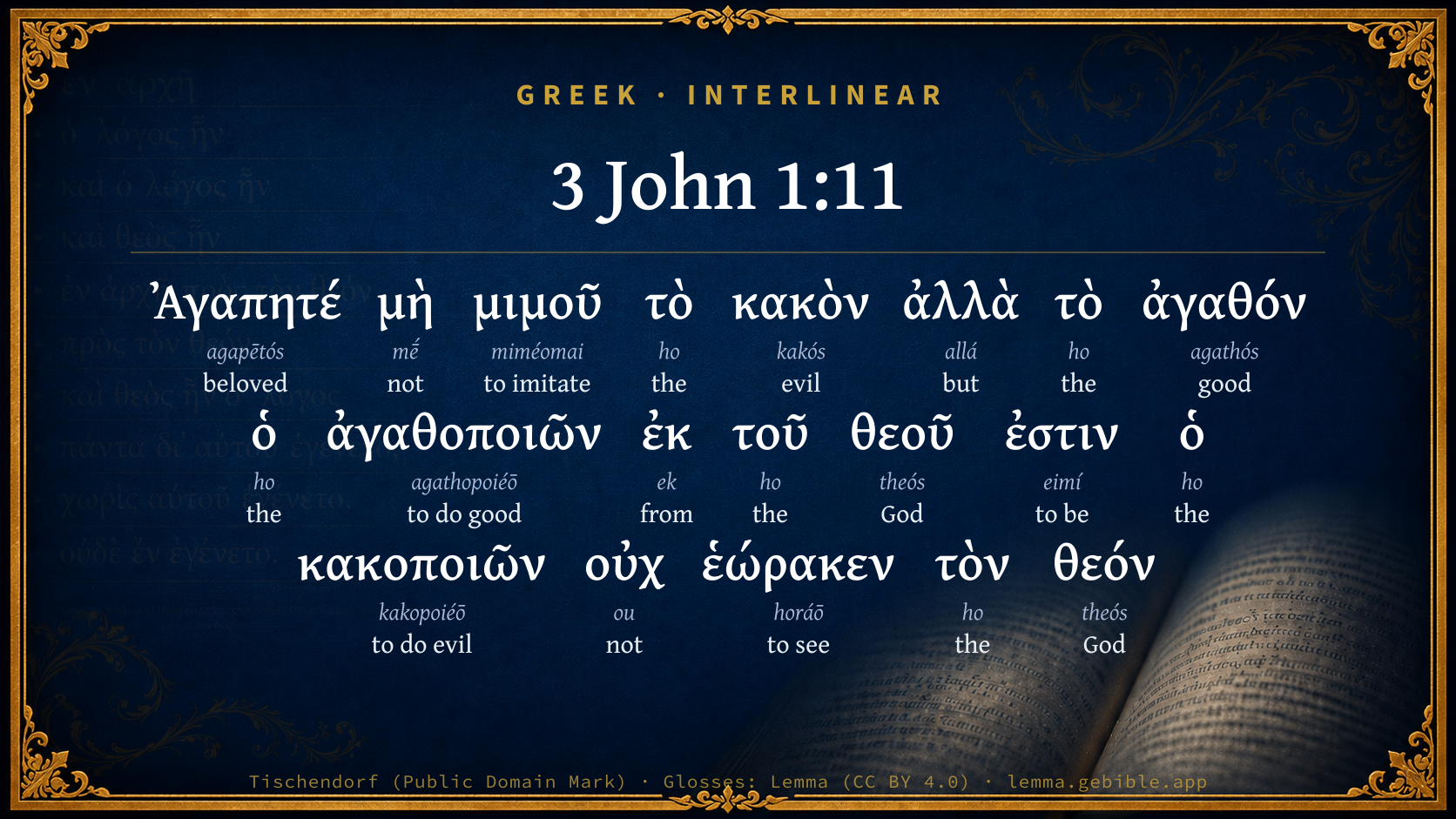
  1. Ἀγαπητέ agapētós G27 “beloved” Adjective, Vocative, Singular, Masculine
  2. μὴ mḗ G3361 “not” Particle, Negative
  3. τὸ ho G3588 “the” Article, Accusative, Singular, Neuter
  4. κακὸν kakós G2556 “evil” Adjective, Accusative, Singular, Neuter
  5. ἀλλὰ allá G235 “but” Conjunction
  6. τὸ ho G3588 “the” Article, Accusative, Singular, Neuter
  7. ἀγαθόν agathós G18 “good” Adjective, Accusative, Singular, Neuter
  8. ὁ ho G3588 “the” Article, Nominative, Singular, Masculine
  9. ἀγαθοποιῶν agathopoiéō G15 “to do good” Verb, Present, Active, Participle, Nominative, Singular, Masculine
  10. ἐκ ek G1537 “from” Preposition
  11. τοῦ ho G3588 “the” Article, Genitive, Singular, Masculine
  12. θεοῦ theós G2316 “God” Noun, Genitive, Singular, Masculine
  13. ἐστιν eimí G1510 “to be” Verb, Present, Active, Indicative, 3rd person, Singular
  14. ὁ ho G3588 “the” Article, Nominative, Singular, Masculine
  15. κακοποιῶν kakopoiéō G2554 “to do evil” Verb, Present, Active, Participle, Nominative, Singular, Masculine
  16. οὐχ ou G3756 “not” Particle, Negative
  17. ἑώρακεν horáō G3708 “to see” Verb, Perfect, Active, Indicative, 3rd person, Singular, Attic form
  18. τὸν ho G3588 “the” Article, Accusative, Singular, Masculine
  19. θεόν theós G2316 “God” Noun, Accusative, Singular, Masculine

About this verse

These counts appear in no published source. They are computed here, from the morphology-tagged text and Lemma’s own curated glosses. What Lemma adds →

20
words
14
distinct lemmas
General Epistles
section

Notable vocabulary

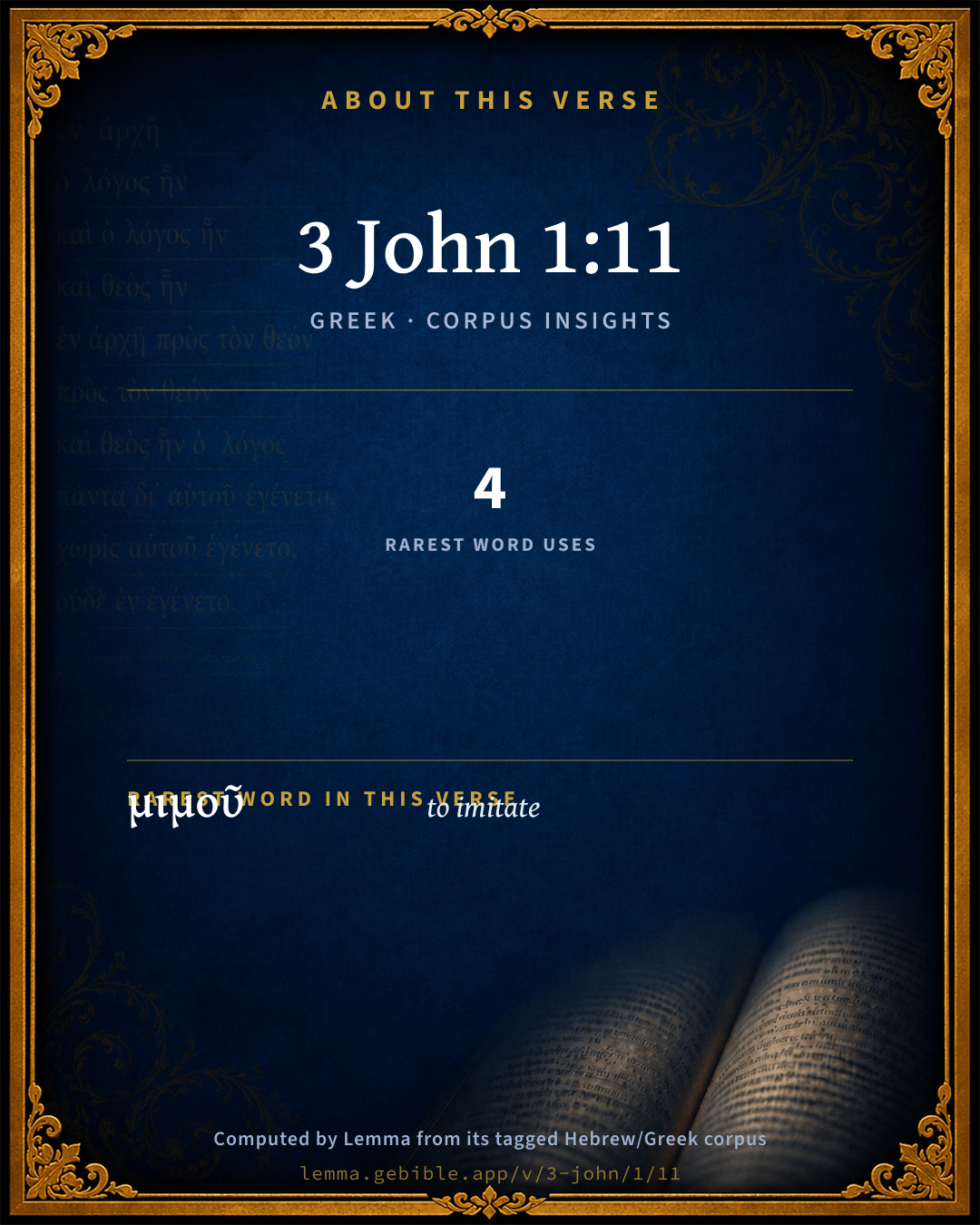
The rarest word here is μιμοῦ to imitate G3401 — appearing just 4 times in the whole Greek New Testament.

Shared distinctive vocabulary

μιμοῦ to imitate G3401 occurs in 4 verses of the Greek New Testament. Also found in:

Repetition

Words recur within this verse:

Cross-references

20

Topical passages linked to 3 John 1:11 in the Treasury of Scripture Knowledge — connected by theme and wording, ordered by reader-vote popularity; previews shown in the World English Bible.

  • Isaiah 1:16–17 Wash yourselves, make yourself clean. Put away the evil of your doings from before my eyes; Cease to do evil.
  • Psalms 37:27 Depart from evil, and do good; Live securely forever.
  • Ephesians 5:1 Be therefore imitators of God, as beloved children.
  • 1 Peter 3:11 Let him turn away from evil, and do good. Let him seek peace, and pursue it.
  • John 3:20 For everyone who does evil hates the light, and doesn't come to the light, lest his works would be exposed.
  • 1 Peter 3:13 Now who is he who will harm you, if you become imitators of that which is good?
  • Psalms 34:14 Depart from evil, and do good. Seek peace, and pursue it.
  • 1 John 3:6–9 Whoever remains in him doesn't sin. Whoever sins hasn't seen him, neither knows him.
  • 2 Timothy 3:10 But you did follow my teaching, conduct, purpose, faith, patience, love, steadfastness,
  • 1 John 2:29 If you know that he is righteous, you know that everyone who practices righteousness is born of him.
  • Exodus 23:2 You shall not follow a crowd to do evil; neither shall you testify in court to side with a multitude to pervert justice;
  • John 10:27 My sheep hear my voice, and I know them, and they follow me.
  • John 12:26 If anyone serves me, let him follow me. Where I am, there will my servant also be. If anyone serves me, the Father will honor him.
  • 1 Thessalonians 1:6 You became imitators of us, and of the Lord, having received the word in much affliction, with joy of the Holy Spirit,
  • 1 Thessalonians 2:14 For you, brothers, became imitators of the assemblies of God which are in Judea in Christ Jesus; for you also suffered the same things from your own countrymen, even as they did from the Jews;
  • Hebrews 6:12 that you won't be sluggish, but imitators of those who through faith and patience inherited the promises.
  • Proverbs 12:11 He who tills his land shall have plenty of bread, But he who chases fantasies is void of understanding.
  • 1 Corinthians 4:16 I beg you therefore, be imitators of me.
  • 1 Corinthians 11:1 Be imitators of me, even as I also am of Christ.
  • Philippians 3:17 Brothers, be imitators together of me, and note those who walk this way, even as you have us for an example.

Cross-references courtesy of OpenBible.info (CC BY 4.0).

Commentary

Notes on 3 John 1:11 from classic Christian and Jewish commentators (each source and its license shown beneath its notes). The classic Christian expositions comment on the surrounding passage and are grouped to its opening verse, so a note may address several verses; the Jewish commentaries on the Tanakh (Rashi and others) are per-verse, so they appear only where the commentator wrote on this verse.

Lemma curates 59 commentaries, every one of them public domain or Creative Commons licensed, each selected and text-cleaned for this edition rather than reprinted as found. About our sources →

The Biblical Illustrator

Joseph S. Exell

3Jn_1:11

Beloved, follow not that which is evil, but that which is good.

Evil not to be imitated

Evil is soon imitated, especially in great persons; they are a countenance to it; their actions seem to be laws. Such a great man swears profanely. Why may not I swear too? No; follow not that which is evil in any--no, not in good men.

1. Evil is agreeable to our nature; it is soon followed; a little persuading will serve the turn; therefore we had need to beware of it.

2. There be many instigators to that which is evil, the devil and his instruments to thrust us forward.

3. Evil is common, a weed that grows everywhere; goodness is a flower that grows in few gardens (Mat_7:13-14).

4. Evil, since the fall, is of greatest antiquity. There was a Cain before an Abel; therefore we had need to watch over ourselves, else we shall follow evil ere we be aware.

5. Whither doth evil lead us? Even to hell, follow her not; let her go alone for all us; yet she hath too many followers, even in the light of the gospel. (W. Jones, D. D.)

He that doeth good is of God: but he that doeth evil hath not seen God.

Godliness

Follow the faith of Abraham, the zeal of Phinehas, the sincerity of Nathaniel, the liberality of Zaccheus and Cornelius; listen to the admonition of St. Paul (Php_4:8). But let us come to St. Johns reason.

1. For goodness. He that doeth good is of God, not by propagation, but by imitation; he is full of goodness; be you so, too, in some measure.

2. He doeth that which is acceptable to God; he is of His family; he serves and obeys Him, therefore God will reward him for it. On the other side, he that doeth evil hath not seen God. Why? Then none hath seen Him, for all do evil. The meaning is, that doth accustom himself to do evil. The godly man doeth evil, but it is upon weakness; the wicked do it upon wilfulness; the one accidentally, the other properly and naturally. He that walketh in the dark cannot see; wicked men walk in the darkness of sin and ignorance, therefore they cannot see God. Therefore let us abhor that which is evil; it will blind our eyes, and keep us from seeing of God. (W. Jones, D. D.)

Sin injurious to spiritual sight

1. He that doeth evil--willingly doeth it--cannot have seen God in the sense of having seen and felt the claims and the force of His commandments. Diotrephes could not have seen God in the commandments, or he would not have forced his way to the pre-eminence, withheld kindly hospitalities, or spoken untrustful things of the apostle.

2. He that doeth evil--willingly doeth evil--cannot have seen God in the example of His Son.

3. He that doeth evil--willingly doeth evil--cannot have seen God in the illuminations of the Divine will through the Holy Ghost. All evil resists His in-workings. Or, to use the figure of our text, all evil blinds us to His presence, and leaves us to grope our way in the darkness of our self-seeking. (The Weekly Pulpit.)

The Biblical Illustrator, edited by Joseph S. Exell (c. 1880s–1900s) — public domain. Text from a community e-Sword module.

The Expositor's Bible

Chapter 21

3 John

THE QUIETNESS OF TRUE RELIGION

3Jn_1:11

THE mere analysis of this note must necessarily present a meagre outline. There is a brief expression of pleasure at the tidings of the sweet and gracious hospitality of Gaius which was brought by certain missionary brethren to Ephesus, coupled with the assurance of the truth and consistency of his whole walk. The haughty rejection of Apostolic letters of communion by Diotrephes is mentioned with a burst of indignation. A contrast to Diotrephes is found in Demetrius, with the threefold witness to a life so worthy of imitation. A brief greeting-and we have done with the last written words of St. John which the Church possesses.

I Let us first see whether, without passing over the bounds of historical probability, we can fill up this bare outline with some colouring of circumstance.

To two of the three individuals named in this Epistle we seem to have some clue.

The Gaius addressed is, of course, Caius in Latin, a very common praenomen, no doubt.

Three persons of the name appear in the New Testament-unless we suppose St. Johns Caius to be a fourth. But the generous and beautiful hospitality adverted to in this note is entirely of a piece with the character of him of whom St. Paul had written, "Gaius, mine host, and of the whole Church." We know further, from one of the most ancient and authentic documents of Christian literature, that the Church of Corinth (to which this Caius belonged) was, just at the period when St. John wrote, in a lamentable state of schismatic confusion. Diotrephes may, at such a period, have been aspiring to put forward his claim at Corinth; and may, in his ambitious proceedings, have rejected from communion the brethren whom St. John had sent to Caius. A yet more interesting reflection is suggested by a writing of considerable authority. The writer of the "Synopsis of Holy Scripture," which stands amongst the Works of Athanasius, says-"the Gospel according to John was both dictated by John the Apostle and beloved when in exile at Patmos, and by him was published in Ephesus, through Caius the beloved and friend of the Apostles, of whom Paul also writing to the Romans saith, Caius mine host, and of the whole Church." This would give a very marked significance to one touch in this Third Epistle of St. John. The phrase here "and we bear witness also, and ye know that our witness is true"- clearly points back to the closing attestation of the Gospel-"and we know that his witness is true." He counts upon a quick recognition of a common memory. Demetrius is, of course, a name redolent of the worship of Demeter the Earth-Mother, and of Ephesian surroundings. No reader of the New Testament needs to be reminded of the riot at Ephesus, which is told at such length in the history of St. Pauls voyages by St. Luke. The conjecture that the agitator of the turbulent guild of silversmiths who made silver shrines of Diana may have become the Demetrius, the object of St. Johns lofty commendation, is by no means improbable. There is a peculiar fulness, in the narrative of the Acts, and an amplitude and exactness in the reports of the speeches of Demetrius and of the town clerk which betray both unusually detailed information, and a feeling on the part of the writer that the subject was one of much interest for many readers, The very words of Demetrius about Paul evince that uneasy sense of the powers of fascination possessed by the Apostle which is often the first timid witness of reluctant conviction. The whole story would be of thrilling interest to those who, knowing well what Demetrius had become, were here told what he once had been. In a very ancient document (the so called "Apostolic Constitutions") (7:46) we read that "Demetrius was appointed Bishop of Philadelphia by me," i.e., by the Apostle John. To the Bishop of that city, so often shaken by the earthquakes of that volcanic city, came the commendation-"I know thy works that thou didst keep My word"; and the assuring promise that he should, when the victory was won, have the solidity and permanence of "a pillar" in a "temple" {Rev_3:7-8; Rev_3:12} that no convulsion could shake down. The witness, then, which stands on record for the Bishop of Philadelphia, is threefold; the threefold witness of the First Epistle on a reduced scale-the witness of the world; the witness of the Truth itself, even of Jesus; the witness of the Church-including John.

II We may now advert to the contents and general style of this letter.

1. As to its contents: It supplies us with a valuable test of Christian life, in what may be called the Christian instinct of missionary affection, possessed in such full measure by Caius. {3Jn_1:5-7}

This, indeed, is an ingredient of Christian character. Do we admire and feel attracted by missionaries? They are knight errants of the Faith; leaders of the "forlorn hope" of Christs cause; bearers of the flag of the cross through the storms of battle. Do we wish to honour and to help them, and feel ennobled by doing so? He who has no almost enthusiastic regard for missionaries has not the spirit of primitive Christianity within his breast.

The Church is beset with different dangers from very different quarters. The Second Epistle of St. John has its bold unmistakable warning of danger from the philosophical atmosphere which is not only round the Church, but necessarily finds its way within. Those who assume to be leaders of intellectual and even of spiritual progress sometimes lead away from Christ. The test of scientific truth is accordance with the proposition which embodies the last discovery; the test of religious truth is accordance with the proposition which embodies the first discovery, i.e., " the doctrine of Christ." Progress outside this is regress; it is desertion first of Christ, ultimately of God. {2Jn_1:9} As the Second Epistle warns the Church of peril from speculative ambition, so the third Epistle marks a danger from personal ambition, {3Jn_1:9-10} arrogating to itself undue authority within the Church. Diotrephes in all probability was a bishop. At Rome there has been a permanent Diotrephes in the office of the Papacy; how much this has had to say to the dislocation of Christendom, God knows. But there are other smaller and more vulgar continuators of Diotrephes, who occupy no Vatican. Priests! But there are priests in different senses. The priest who stands to minister in holy things, the true Leitourgos, is rightly so called. But there is an arrogant priestship which would do violence to conscience, and interpose rudely between God and the soul. Priests in this sense are called by different names. They are clad in different dresses-some in chasubles, some in frock coats, some in petticoats. "Down with priestcraft," is even the cry of many of them. The priest who stands to offer sacrifice may or may not be a priest in the evil sense; the priest (who abjures the name) who is a master of religious small talk of the popular kind, and winds people to his own ends round his little finger by using them deftly, is often the modern edition of Diotrephes.

This brief Epistle contains one of those apparently mere spiritual truisms, which make St. John the most powerful and comprehensive of all spiritual teachers. He had suggested a warning to Caius, which serves as the link to connect the example of Diotrephes which he has denounced, with that of Demetrius which he is about to commend. "Beloved!" he cries "imitate not that which is evil, but that which is good." A glorious little "Imitation of Christ," a compression of his own Gospel, the record of the Great Example in three words! Then follows this absolutely exhaustive division, which covers the whole moral and spiritual world. "He that doeth good" (the whole principle of whose moral life is this) "is of," has his origin from, "God"; "He that doeth evil hath not seen God," sees him not as a consequence of having spiritually looked upon Him. Here, at last, we have the flight of the eagles wing, the glance of the eagles eye. Especially valuable are these words, almost at the close of the Apostolic age and of the New Testament Scripture. They help us to keep the delicate balance of truth; they guard us against all abuse of the precious doctrines of grace. Several texts are mutilated; more are conveniently dropped out. How seldom does one see the whole context quoted, in tracts and sheets, of that most blessed passage-"if we walk in the light, as He is in the light, the blood of Jesus, His Son, cleanseth us from all sin?" How often do we see these words at all-"he that doeth good is of God, but he that doeth evil hath not seen God?" Perhaps it may be a lingering suspicion that a text which comes out of a very short Epistle is worth very little. Perhaps doctrinalism an outrance considers that the sentiment "savours of works." But, at all events, there is terrible decisiveness about these antithetic propositions. For each life is described in section and in plan by one or other of the two. The whole complicated series of thought, actions, habits, purposes, summed up in the words life and character, is a continuous stream issuing from the man who does every moment of his existence. The stream is either pure, bright, cleansing, gladdening, capable of being tracked by a thread of emerald wherever it flows; or it carries with it on its course, blackness, bitterness, and barrenness. Men must be plainly dealt with. They may hold any creed, or follow any round of religious practices. There are creeds which are nobly true, others which are false and feeble- practices which are beautiful and elevating, others which are petty and unprofitable. They may repeat the shibboleth ever so accurately; and follow the observances ever so closely. They may sing hymns until their throats are hoarse, and beat drums until their wrists are sore.

But St. Johns propositions ring out, loud and clear, and syllable themselves in questions, which one day or other the conscience will put to us with terrible distinctness. Are you one who is ever doing good; or one who is not doing good? "God be merciful to me a sinner!" may well rush to our lips. But that, when opportunity is given, must be followed by another prayer. Not only-"wash away my sins." Something more. "Fill and purify me with Thy Spirit, that, pardoned and renewed, I may become good, and be doing good." It is sometimes said that the Church is full of souls "dying of their morality." Is it not at least equally true to say that the Church is full of souls dying of their spirituality? That is-souls dying in one case of unreal morality; in the other of unreal spirituality, which juggles with spiritual words, making a sham out of them. Morality which is not spiritual is imperfect; spirituality which is not moralised through and through is of the spirit of evil.

It is a great thing in these last sentences, written with a trembling hand, which shrank from the labour of pen and ink, the Apostle should have lifted a word (probably current in the social atmosphere of Ephesus among spiritualists and astrologers) from the low associations with which it was undeservedly associated; and should have rung out high and clear the Gospels everlasting justification, the final harmony of the teaching of grace - "he that doeth good is of God."

2. The style of the Third Epistle of St. John is certainly that of an old man. It is reserved in language and in doctrine. God is thrice and thrice only mentioned. Jesus is not once expressly uttered. But

"They are not empty-hearted whose low sound reverbs no hollowness."

In religion, as in everything else, we are earnest, not by aiming at earnestness, but by aiming at an object. Religious language should be deep and real, rather than demonstrative. It is not safe to play with sacred names. To pronounce them at random for the purpose of being effective and impressive is to take them in vain. What a wealth of reverential love there is in that-"for the sake of the Name!" Old copyists some times thought to improve upon the impressiveness of Apostles by cramming in sacred names. They only maimed what they touched with clumsy hand. A deeper sense of the Sacramental Presence is in the hushed, awful, reverence of "not discerning the Body," than in the interpolated "not discerning of the Lords Body." Even so "The Name," perhaps, speaks more to the heart, and implies more than "His Name." It is, indeed, the "beautiful Name," by the which we are called. And sometimes in sermons, or in Eucharistic "Gloria in Excelsis," or in hymns that have come from such as St. Bernard, or in sick rooms, it shall go up with our sweetest music, and waken our tenderest thoughts, and be "as ointment poured forth." But what an underlying Gospel, what an intense suppressed flame there is behind these quiet words! This letter says nothing of rapture, of prophecy, of miracle. It lives in the atmosphere of the Church, as we find it even now. It has a word for friendship. It seeks to individualise its benediction. A hush of evening rests upon the note. May such an evening close upon our old age!

William Robertson Nicoll, ed., The Expositor's Bible (London: Hodder & Stoughton, 1887–1910) — public domain. 65 of 66 books (1 Corinthians is not separately keyed, as that volume carries no machine-parseable verse references); section-level commentary keyed to the opening verse. Introductory and overview sections not keyed to a specific passage are excluded.

Tyndale Open Study Notes

Tyndale Open Resources

1:11 those who do evil: Diotrephes was condemned for his failure to live by the Christian rule of love (1 Jn 3:10-14). This was how Gaius could be sure that Diotrephes was not living according to the truth. This applies to all who refuse to accept the apostolic teaching about Jesus Christ and refuse to live in fellowship with others who do.

Tyndale Open Study Notes — © Tyndale Open Resources, licensed CC BY-SA 4.0. Text via the HelloAO Bible API.

Bengel's Gnomon

Johann Albrecht Bengel

3Jn 1:11. Τὸ κακὸν, that which is evil) in Diotrephes.—τὸ ἀγαθὸν, that which is good) in Demetrius.—ἐκ τοῦ Θεοῦ, from God) who is good.—ἔστιν, is) as born from Him.

Bengel's Gnomon of the New Testament — English translation (T&T Clark, Edinburgh, 1860) — public domain. Text from a community e-Sword module.

Meyer's Critical & Exegetical Commentary

Heinrich August Wilhelm Meyer

3Jn_1:11. From the special case the apostle deduces an exhortation of general import.

μὴ μιμοῦ τὸ κακόν, ἀλλὰ τὸ ἀγαθόν] On μιμεῖσθαι, comp. especially Heb_13:7.

The expressions: τὸ κακόν and τὸ ἀγαθόν, can so much the less be regarded as un-Johannean (de Wette) as in Joh_5:29 the corresponding antithesis: τὰ ἀγαθά and τὰ φαῦλα, is found, and in Joh_18:23 the neuter singular τὸ κακόν. The additional sentence: ὁ ἀγαθοποιῶν … τὸν Θεόν, expresses the same thought that frequently appears in the First Epistle of John, especially in chap. 3:6.

The ideas: ἀγαθοποιεῖν and κακοποιεῖν, are to be taken quite generally, and must not be limited to the special virtue of benevolence (a Lapide, Lorinus, Grotius, Paulus); comp. 1Pe_2:14-15; 1Pe_2:20; 1Pe_3:6; 1Pe_3:17.

The corresponding expressions: ἐκ τοῦ Θεοῦ εἶναι and ἑωρακέναι τὸν Θεόν, are used also in the First Epistle of John; but why the Johannean: οὐκ ἔγνω τὸν Θεόν (1Jn_4:8), should be more conformable to the style of John than the equally Johannean: οὐχ ἑώρακε τὸν Θεόν (1Jn_3:6), as Lücke and de Wette think, is not quite perceptible.

Meyer — Critical and Exegetical Commentary on the New Testament — English translation by Peter Christie, edited by Frederick Crombie (T&T Clark, 1880) — public domain. Text from a community e-Sword module.

Expositor's Greek Testament

ed. W. Robertson Nicoll

3Jn 1:11-12 . Testimony to Demetrius. “Beloved, do not imitate what is bad but what is good. He that doeth what is good is of God; he that doeth what is bad hath not seen God. To Demetrius testimony hath been borne by all and by the Truth itself; yea, and we testify, and thou knowest that our testimony is true.”

3Jn 1:11 . A warning against evil example. The pres. participles ἀγαθοποιῶν , κακοποιῶν denote continuance in and practice of good or bad. See note on 1Jn 3:6 . ἐκ τοῦ Θεοῦ , “a child of God” ( cf. 1Jn 3:10 ). Observe the gentleness of the Apostle: the natural antithesis of ἐκ τοῦ Θεοῦ would be ἐκ τοῦ διαβόλου (1Jn 3:8 ), but he says οὐχ ἑώρακεν τὸν Θεόν .

The Expositor's Greek Testament, edited by W. Robertson Nicoll (1897–1910) — public domain. Text from a community e-Sword module.

Geneva Bible (1599)

Geneva Bible translators

Hath not known God.

Geneva Bible (1599) marginal notes — public domain. Text via Bolls.life.

Jamieson, Fausset & Brown

Robert Jamieson, A. R. Fausset & David Brown

follow not that which is evil--as manifested in Diotrephes (Jo3 1:9-10).

but . . . good--as manifested in Demetrius (Jo3 1:12).

is of God--is born of God, who is good.

hath not seen God--spiritually, not literally.

Jamieson, Fausset & Brown — Commentary Critical and Explanatory on the Whole Bible (1871) — public domain (CC PDM 1.0). Text via the HelloAO Bible API.

Adam Clarke's Commentary

Verse 11. Follow not that which is evil] Μμ μιμου το κακον· Do not imitate that wicked man, i.e., the conduct of Diotrephes; be merciful, loving, and kind. For whatever profession any man may make, it will ever appear that he who doeth good is of God - he alone is the person who uses rightly the grace received from God, and he alone shall enjoy the Divine approbation;

While he that doeth evil] He who is unfeeling, unmerciful, unkind, hath not seen God - has no proper knowledge of that God whose NAME is mercy, and whose NATURE is love.

Adam Clarke's Commentary on the Bible (1810–1826) — public domain. Text from a community e-Sword/MySword module.

The Cambridge Bible for Schools and Colleges

gen. ed. J. J. S. Perowne

11. Beloved] The address again marks transition to a new subject, but without any abrupt change. The behaviour of Diotrephes will at least serve as a warning.

follow not that which is evil, but that which is good] More simply, imitate not the ill, but the good. The word for ‘evil’ or ‘ill’ is not that used in the previous verse (πονηρός), but a word, which, though one of the most common in the Greek language to express the idea of ‘bad,’ is rarely used by S. John (κακός). Elsewhere only Joh_18:23; Rev_2:2; Rev_16:2 : in Rev_16:2 both words occur. Perhaps ‘ill’ is hardly strong enough here, and the ‘evil’ of A.V. had better be retained. Nothing turns on the change of word, so that it is not absolutely necessary to mark it. For ‘imitate’ comp. 2Th_3:7; 2Th_3:9; Heb_13:7 : the word occurs nowhere else in N.T.

He that doeth good is of God] He has God as the source (ἐκ) of his moral and spiritual life; he is a child of God. In its highest sense this is true only of Him who ‘went about doing good; but it is true in a lower sense of every earnest Christian. See on 1Jn_2:16; 1Jn_2:29; 1Jn_3:8-9; 1Jn_4:4; 1Jn_4:6-7.

hath not seen God] See on 1Jn_3:6. Of course doing good and doing evil are to be understood in a wide sense: the particular cases of granting and refusing hospitality to missionary brethren are no longer specially in question.

11, 12. The Moral

11, 12. This is the main portion of the Epistle. In it the Apostle bids Gaius beware of imitating such conduct. And if an example of Christian conduct is needed there is Demetrius.

The Cambridge Bible for Schools and Colleges (gen. ed. J. J. S. Perowne; Cambridge University Press, 1878–1918) — public domain. Text from a community e-Sword module.

John Gill's Exposition

Beloved, follow not that which is evil,.... Follow not evil in general, it being hateful to God, contrary to his nature and will, and bad in itself, as well as pernicious in its consequences; and particularly follow not, or do not imitate the particular evil or evils in Diotrephes; as his pride, ambition, love of preeminence, and tyrannical government in the church, and especially his hard heartedness, cruelty, and inhospitality to the poor saints; and so the Arabic version reads, "do not imitate him in evil"; the examples of persons in office and authority have great influence, especially in cases of charity, when men can be excused thereby, and save their money, or be freed from an expense:

but that which is good; follow and imitate that, be a follower of God, imitate him in acts of kindness and beneficence, be merciful as he is; copy the deeds of Jesus Christ, who went about doing good, and declared it to be more blessed to give than to receive; and tread in the steps of those good men, who have shown love to the name of Christ, by ministering to his saints; for though the apostle may mean everything that is good, which is to be followed and imitated in any, yet he chiefly designs acts of kindness and beneficence to poor saints and ministers: to which he encourages by the following,

he that doeth good is of God; he is a child of God, he appears to be so, in that he is like to his heavenly Father, who is kind and merciful; he is born of God, he is passed from death to life, which his love to the brethren shows; he has the grace of God, and strength from Christ, and the assistance of the Spirit, without either of which he could not do that which is good:

but he that doeth evil hath not seen God; has had no spiritual saving sight of God in Christ; for if he had, he would abhor that which is evil, and, with Job, abhor himself for it, and reckon himself, with Isaiah, as undone, Job 42:6, for such effects has the sight of God on the souls of men; such an one knows not God, nor what it is to have communion with him: for those who live in sin, in whom it is a governing principle, cannot have fellowship with God; nor has such an one ever felt the love of God in his soul, or been made a partaker of his grace, which would teach and constrain him to act otherwise. Compare this text with Jo1 3:10, which shows the Apostle John to be the writer of this epistle. The Ethiopic version reads, "shall not see God"; that is, hereafter, in the world to come.

John Gill's Exposition of the Whole Bible (1746–1763) — public domain (CC PDM 1.0). Text via the HelloAO Bible API.

Trapp's Complete Commentary

John Trapp

11 Beloved, follow not that which is evil, but that which is good. He that doeth good is of God: but he that doeth evil hath not seen God.

Ver. 11. Follow not] Make not such a man as Diotrephes your pattern for imitation; though he ruffle it among you, and will needs be the only man.

Hath not seen God] sc. With the eyes of his mind, whatever he may boast of visions or revelations; believe him not.

John Trapp, A Commentary or Exposition upon All the Books of the Old and New Testament (1647–1656) — public domain. Text from a community e-Sword module.

Albert Barnes' Notes on the Bible

Beloved, follow not that which is evil, but that which is good - There can be no doubt that in this exhortation the writer had Diotrephes particularly in his eye, and that he means to exhort Gaius not to imitate his example. He was a man of influence in the church, and though Gaius had shown that he was disposed to act in an independent manner, yet it was not improper to exhort him not to be influenced by the example of any one who did wrong. John wished to excite him to acts of liberal and generous hospitality.

He that doeth good is of God - He shows that he resembles God, for God continually does good. See the sentiment explained in the notes at 1Jo 3:7.

He that doeth evil hath not seen God - See the notes at 1Jo 3:8-10.

Albert Barnes' Notes on the Bible (1834–1885) — public domain. Text from a community e-Sword/MySword module.

Matthew Poole's English Annotations

Follow not; Mη μιμου by following here he means imitation, i.e. the deformity of evil appearing in the practice of some, and the beauty of true goodness in others, (examples being given of both sorts, 3Jo 1:9, and 3Jo 1:12), he exhorts to decline the former, and imitate the other; and enforces the exhortation by the weightiest arguments.

He that doeth good; a doer of good, one made up of kindness and benignity (as the contest draws the sense to that special kind of goodness); αγαθοποιων and ο κακοποιων, signify doing well or ill, from a fixed, prevailing habit, 1Jo 3:7,8.

Is of God; is allied to heaven, born of God, his offspring.

But he that doeth evil hath not seen God; an evil-doer, on the other hand, such a one as is a composition of spite, envy, and malice, is a mere stranger to him, hath not been, or known, or had to do with him.

Matthew Poole's English Annotations on the Holy Bible (1683–1685) — public domain. Text from a community e-Sword/MySword module.

Whedon's Commentary on the Bible

Daniel D. Whedon

11. Beloved—Repeated from 3Jn_1:2; 3Jn_1:5, as now furnishing a monitory lesson from the narrative of Diotrephes’s conduct.

Evil… good—The difference between Diotrephes and the apostle was not a mere question of party, or even of non-essential doctrine, but of intrinsic goodness and badness, of holiness and wickedness.

Doeth good—Not the falsely regenerate in evil-doing, but he that doeth good is of God. This clearly implies that Diotrephes held to a Nicolaitan regeneration, allowing of a doing evil and yet being of God. This was a total depravation and falsification of Christianity.

Seen God—As he is, the truly pure God, seen by the spiritual eye of true faith. The holiness of the Christian is at one with the holiness of the truly holy God.

Daniel D. Whedon (gen. ed.), Commentary on the Old and New Testaments (1874–1909) — public domain. Text from a community e-Sword module.

The Pulpit Commentary

This is the moral to which St. John has been leading up. Diotrephes will at least serve as a warning. A Christian gentleman will note such behaviour in order to avoid it. Strengthened by his own previous walk in the truth (verse 3), and encouraged by the apostle (verses 5-8), with Diotrephes as a warning on the one hand, and Demetrius as an example on the other, he ought not to fail in proving his heavenly birth by doing good and avoiding evil. (see on 1Jn_3:6)

Vers. 11, 12.

Imitating the good.

follow not that which is evil," etc. This exhortation occurs here very naturally after the mention of Diotrephes. "Beloved, imitate not that which is evil;" do not copy Diotrephes; regard him not as an example, but as a beacon. But imitate the good; take Demetrius as a pattern; copy his conduct.

I MAN IMITATES. It is implied here that Gaius would imitate either the good or the evil either Demetrius or Diotrephes. The propensity to imitation is one of the strongest in human nature. It is this which makes example so much mightier than precept. This propensity is one of the earliest to be called into exercise in human life. The tender infant is stirred by it almost before it knows anything. Very frequently we imitate others unconsciously. The extent of our conscious and intentional imitation is very small as compared with our unconscious and unintentional imitation. This tendency plays a most important part in human education. Without intentional imitation instruction would be impossible, as in reading, writing, etc. And unintentional imitation has great influence in the growth of habit and the formation of character. A very important thing is this tendency to imitation.

II MAN SHOULD IMITATE ONLY THE GOOD. "Beloved, imitate not that which is evil, but that which is good," etc. Many and forcible reasons may be assigned for this; e.g., that the opposite course must inevitably lead to ruin; that this course ennobles and blesses him who pursues it. But let us confine ourselves to the reasons assigned in the text.

1. Because the good-doer is of God. "He that doeth good is of God;" i.e., he that doeth good truly and naturally, in whom well-doing is not the exception, but the rule of life, is of God. He is "begotten of God". (1Jn_3:9) He proves that he is a child of God by his likeness to his Father in character and conduct. He is inspired by God both as to his inner life and as to his outward practice. Notice how practical is the apostle"s idea of true personal religion. The godly man is the man who does good; his good works are the evidence of his godliness. We should imitate the good because of their intimate and blessed relation to God.

2. Because the evil-doer has no true knowledge of God. "He that doeth evil hath not seen God," By doing evil we must understand not an occasional and exceptional action, but the general tenor of life and conduct. He that doeth evil is one the general characteristic of whose works is evil. Such a one has not seen God. The beholding of God is spiritual. And the vision of God and the doing of evil are incompatible; because:

(1) Purity of heart is essential to the seeing of God, and, where purity of heart is, sin cannot be the general characteristic of the conduct. "Holiness, without which no man shall see the Lord." "Blessed are the pure in heart: for they shall see God.

(2) When a man has seen the Lord, he cannot live in the practice of sin. He who has seen and appreciated the highest beauty cannot live in constant and willing fellowship with extreme deformity. And he whose soul has seen anything of the supremely Perfect and the infinitely Beautiful cannot look upon sin with approval; it must appear loathsome unto him. This consideration tends to strengthen faith in the full and final salvation of every regenerate man. He who has tasted the high joys of Divine vision and communion can never be content with the pleasures of sin or satisfied with the things of this world. Do not imitate the evil; for the practice of it darkens and destroys the vision of the soul; it excludes from the highest and divinest knowledge, even the knowledge which is the soul"s life. "This is life eternal, that they should know thee, the only true God," etc.

III GOOD EXAMPLES ARE GENERALLY AVAILABLE. It is very seldom that we are unable to point to some known example well worthy of imitation. To such a one St. John calls attention. "Demetrius hath the witness of all, and of the truth itself; yea, we also bear witness; and thou knowest that our witness is true." Diotrephes was a beacon to be shunned; Demetrius, an example to be imitated. He was probably a member of the same Church as Gains, and well known to him; and therefore the apostle does not state what his chief excellences were, but from his being named here we infer that they were those which Diotrephes had not. Where the latter was wanting, Demetrius excelled. Good character is not always accompanied by good reputation, but in the case of Demetrius it was. He had a good reputation of:

(1) St. John: "We also bear witness.

(2) Gains: "Thou knowest that our witness is true.

(3) All who knew him; or, perhaps, of all the brethren mentioned in verses 3, 5, 10: "Demetrius hath the witness of all.

(4) "And of the truth itself." Alford says, "The objective truth of God, which is the Divine rule of the walk of all believers, gives a good testimony to him who really walks in the truth. This witness lies in the accordance of his walk with the requirement of God"s truth." That truth, like a "mirror, seemed to place in a clear light his Christian virtue and uprightness, and thus to bear witness to him." The most precious testimony is that of the truth itself. When that is in our favour, we may thankfully rejoice. So manifold and excellent was the testimony borne of Demetrius. In most places and societies there are some who are worth imitating. Let us imitate them in so far as they embody the truth. There are seasons in our experience when good human examples are specially valuable. Sometimes the Perfect Example seems to tower far above our imitation, and we despair of ever copying that with success. In such moods the excellent human example is peculiarly precious. It is not so very much higher than our own level of attainment; it encourages us; and, when our despondency has passed away, we are able to aspire once more for conformity to the Supreme Exemplar. W. J.

The Pulpit Commentary (1880–1919), ed. H.D.M. Spence-Jones & Joseph S. Exell — public domain. Text from a community e-Sword module.

John Wesley's Explanatory Notes

Follow not that which is evil - In Diotrephes. But that which is good - In Demetrius. He hath not seen God - Is a stranger to him.

John Wesley, Explanatory Notes Upon the Whole Bible (1754–1765) — public domain. Text via the GEBible commentary corpus.

Burkitt's Expository Notes on the New Testament

William Burkitt

Here St. John advises his beloved Gaius, and those with him, not to imitate and follow this evil example of Diotrephes, (who not only refused charity towards the Christian Jews that wanted it, himself, but would not permit the Gentile Christians to receive them or relieve them,) but to follow the example of God, who is good to all; and, accordingly, he that is merciful is born of God, but he that is malicious hath no true knowledge of God, but is a mere stranger to him. Behold here the euology and high commendation which the Spirit of God gives to charitable and good men: He that doeth good is of God, he is allied to heaven, born of God, and his offspring: but the uncharitable evil man is a composition of spite, envy, and malice, born from beneath, and the devil’s offspring.

William Burkitt's Expository Notes on the New Testament (1700–1703) — public domain. Text from a community e-Sword module.

The People's New Testament

B. W. Johnson

11. Follow not that which is evil. The wicked example of one like Diotrephes.

B. W. Johnson's The People's New Testament with Notes (1889–1891) — public domain. Electronic text from the Christian Classics Ethereal Library (CCEL) ThML edition.

unfoldingWord translationNotes

Door43 World Missions Community

General Information:

Here "we" refers to John and those with him and does not include Gaius. (See: Exclusive and Inclusive "We")

Beloved

Here this is used as a term of endearment for fellow believers. See how you translated this in 3 John 1:5.

do not imitate what is evil

"do not copy the evil things that people do"

but what is good

There are words left out but they are understood. AT: "but imitate the good things that people do" (See: Ellipsis)

is of God

"belongs to God"

has not seen God

"does not belong to God" or "does not believe in God"

Demetrius is borne witness to by all

This can be stated in active form. AT: "All who know Demetrius bear witness of him" or "Every believer who knows Demetrius speaks well of him" (See: Active or Passive)

Demetrius

This is probably a man whom John wants Gaius and the congregation to welcome when he comes to visit. (See: How to Translate Names)

by the truth itself

"the truth itself speaks well of him." Here "truth" is described as a person speaking. AT: "everyone who knows the truth knows he is a good person" (See: Personification and Assumed Knowledge and Implicit Information and Reflexive Pronouns)

We also bear witness

What John is confirming is implied and can be made specific here. AT: "We also speak well of Demetrius" (See: Ellipsis)

translationWords

beloved

imitate

evil

good

God

testimony

true

testimony

unfoldingWord translationNotes — © Distant Shores Media and the Door43 World Missions Community, licensed CC BY-SA 4.0. Source: git.door43.org/Door43/en_tn.

Cambridge Greek Testament for Schools and Colleges

11, 12. THE MORAL

11, 12. This is the main portion of the Epistle. In it the Apostle bids Gaius beware of imitating such conduct. And if an example of Christian conduct is needed there is Demetrius.

11. Before κακοποιῶν omit δέ with [987][988][989][990][991] against [992].

[987] 4th century. Discovered by Tischendorf in 1859 at the monastery of S. Catherine on Mount Sinai, and now at Petersburg. All three Epistles.

[988] 5th century. Brought by Cyril Lucar, Patriarch of Constantinople, from Alexandria, and afterwards presented by him to Charles I. in 1628. In the British Museum. All three Epistles.

[989] 4th century. Brought to Rome about 1460. It is entered in the earliest catalogue of the Vatican Library, 1475. All three Epistles.

[990] 5th century. A palimpsest: the original writing has been partially rubbed out and the works of Ephraem the Syrian have been written over it. In the National Library at Paris. Part of the First and Third Epistles; 1Jn 1:1 to 1Jn 4:2; 3Jn 1:3-14. Of the whole N.T. the only Books entirely missing are 2 John and 2 Thessalonians.

[991] 9th century. All three Epistles.

[992] 9th century. All three Epistles.

11. ἀγαπητέ. The address again marks transition to a new subject, but without any abrupt change. The behaviour of Diotrephes will at least serve as a warning.

μὴ μιμοῦ τ. κακὸν ἀ. τ. ἀγ. Imitate not the ill, but the good. Κακός, though one of the most common words in the Greek language to express the idea of ‘bad,’ is rarely used by S. John. Elsewhere only Joh 18:23; Rev 2:2; Rev 16:2: in Rev 16:2 both words occur. Perhaps ‘ill’ is hardly strong enough here, and the ‘evil’ of A.V. had better be retained. Nothing turns on the change of word from πονηρός in 3Jn 1:10, so that it is not absolutely necessary to mark it. For μιμεῖσθαι comp. 2Th 3:7; 2Th 3:9; Heb 13:7; the word occurs nowhere else in N.T.

ἐκ τοῦ Θεοῦ ἐστίν. He has God as the source (ἐκ) of his moral and spiritual life; he is a child of God. In its highest sense this is true only of Him who ‘went about doing good’; but it is true in a lower sense of every earnest Christian. See on 1Jn 2:16; 1Jn 2:29; 1Jn 3:8-9; 1Jn 4:4; 1Jn 4:6-7.

οὐχ ἑώρακεν τὸν Θεόν. See on 1Jn 3:6. Of course doing good and doing evil are to be understood in a wide sense: the particular cases of granting and refusing hospitality to missionary brethren are no longer specially in question.

Cambridge Greek Testament for Schools and Colleges (Cambridge University Press, 1896; 21 vols, various authors incl. Carr, Maclear, Plummer, Farrar, Lumby, Moule, M. R. James, Simcox) — public domain. Text from a community e-Sword module.

Alford’s Greek Testament

Henry Alford

11.] Upon occasion of the hostility just mentioned, St. John exhorts Caius to imitate not the evil but the good,—probably as shewn in the praises of Demetrius which follow. Beloved, imitate not evil (τὸ κακόν, abstract), but good (abstract also). He that doeth good, is from God (is born of God, and has his mission and power from Him: as so often in the first Epistle): he that doeth evil, hath not seen God (so in ref., πᾶς ὁ ἁμαρτάνων οὐχ ἑώρακεν αὐτόν, where see note. And yet this expression is called by Lücke and De Wette “unjohanneisch,” and 1Jn 4:20, adduced to prove it, where the word ἑώρακεν is used in its literal physical sense).

Henry Alford, The Greek Testament (1849–1861) — public domain. Text from a community e-Sword module.

International Critical Commentary

11. ἀγαπητέ] Cf. note on ver. 2.

μὴ μιμοῦ τὸ κακόν] Cf. Heb 13:7; 2Th 3:7, 2Th 3:9. The use of φαῦλον is more frequent in this writer, but κακόν is found in Joh 18:23 (εἰ κακῶς ἐλάλησα μαρτύρησον περὶ τοῦ κακοῦ). It is not necessary to limit the writer’s meaning to the examples of evil and good afforded by Diotrephes and Demetrius, especially as the conduct of the latter would seem to have needed apology. If two special examples are intended, they must be the action of Diotrephes, and that of Gaius and his friends who wished to show hospitality. But the writer’s object is rather to set two courses of action in the sharpest possible contrast, and to help forward a right decision by showing the true character of the point at issue in all its simplicity. Viewed rightly, it is simply a matter of refusing the evil and choosing the good. There are times when the simplest platitude in the mouth of authority is the expression of the truest wisdom; cf. Mar 3:4 (= Luk 6:9).

ὁ ἀγαθοποιῶν ἐκ τοῦ θεοῦ ἐστίν] Cf. 1Jn 3:9, 1Jn 3:10. He who “does good” shows by his conduct that the inspiration which dominates his life and work comes from God. He who “does evil” shows similarly that he has not made even the first step towards union with God; cf. 1Jn 3:6, πᾶς ὁ ἁμαρτάνων οὐχ ἑώρακεν αὐτόν (Dr. Westcott’s note); Joh 3:3, Joh 3:5.For the use of ἀγαθοποιεῖν, κακοποεῖν, and cognate words, cf. 1P. 3:17, 2:15, 20, 3:6, 4:19, 2:12, 14, 4:15. Several points of connection between 2 and 3 John and 1 Peter have been noticed by Dom Chapman in his articles on the historical setting of these Epistles.

ο2o א A B C K P h. al. longe. plu. cat. d vg. boh-codd. sah. syrp] +δε L 31 ascr al. mu. tol. boh-ed. arm. aeth. Did. Dam. Thphyl. Oec.

International Critical Commentary — older volumes (1896–1929), various authors — public domain. Text from a community e-Sword module.

Vincent's Word Studies in the New Testament

Marvin R. Vincent

Follow [μιμου] . More correctly, as Rev., imitate. Elsewhere only 2Th 3:7, 9; Heb 13:7. The kindred word mimhthv imitator, uniformly rendered follower in A. V., occurs 1Co 4:16; 1Co 11:1; Eph 5:1. Hence our word mimic; also pantomime. Mimov means both an actor and a kind of prose drama, intended as a familiar representation of life and character, and without any distinct plot. That which is evil - that which is good [το κακον - το αγαθον] . Compare ta ajgaqa good, ta faula evil, Joh 5:29.

Marvin R. Vincent, Word Studies in the New Testament (1887–1900) — public domain. Text from a community e-Sword/MySword module.

Westcott on Hebrews & the Epistles of John

Brooke Foss Westcott

the Truth itself, so far as the ideal of Christianity was seen to be realised by

ICR

Goer

salute thee: salute the friends by name.

Brooke Foss Westcott (1825–1901), The Epistle to the Hebrews (1889) and The Epistles of St John (1883) — public domain (pre-1929). Text recovered from Internet Archive / Google Books OCR scans. Westcott’s Gospel of John commentary is not included (its OCR lost the chapter running-heads required for reliable verse-keying). Some Greek quoted in the Hebrews volume is imperfectly rendered by the OCR.

Lesson kit

Teaching starters — assembled from the data on this page, not authored interpretation. Every prompt links to the verse data it draws on. Edit before teaching.

3 John, in the General Epistles, opens this verse with 20 words (14 distinct Greek lemmas). Its most distinctive word is miméomai (“to imitate”). A historical commentator’s framing appears above. Read the whole chapter for the surrounding context.

Discussion questions

  1. The word miméomai carries the sense “to imitate.” How does it shape the verse?
  2. How does 2 Thessalonians 3:7, which shares the word «to imitate», read alongside this verse?
  3. What does the repetition of “God” (2× in this one verse) do in this verse?
  4. The translations on this page render this verse differently — a whole-verse word diff, not a word-by-word alignment. What might account for the different wordings?
  5. Compare how The Biblical Illustrator and The Expositor's Bible read this verse. Where do they agree or differ?

Things to notice

Reading settings

Reading text

Shown beneath each verse's original-language words.

Old Testament
Old Testament edition

Read the OT as the Masoretic Hebrew (MT) or the Greek Septuagint (LXX).

English shown for the Greek Septuagint (in the Hebrew ↔ Greek comparison).

Comparing translations? Open the Compare panel on any verse page to stack up to four side by side.