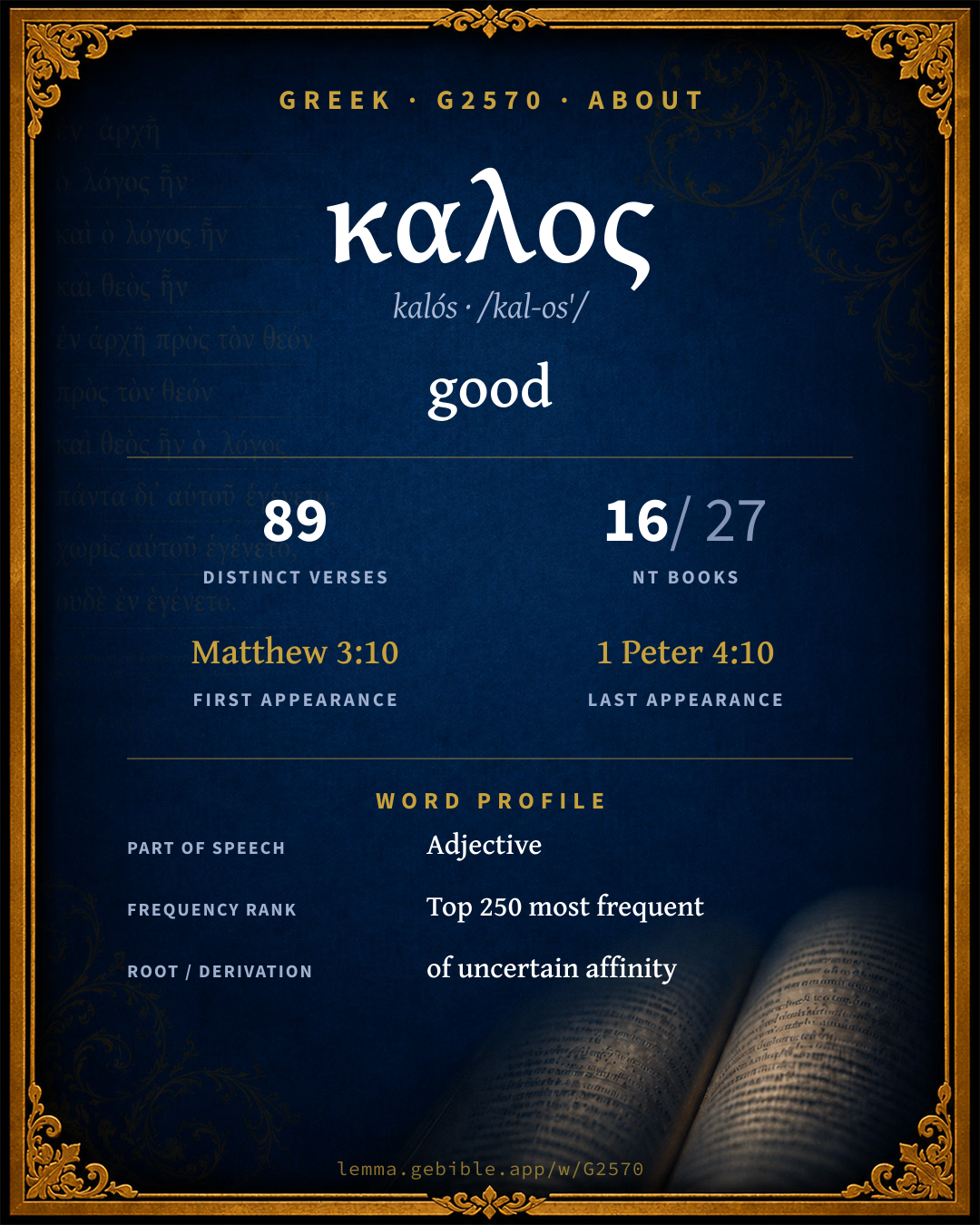
καλός
good
Full lexicon entry — Thayer's Greek Lexicon
From Thayer's Greek Lexicon
Where this word appears
See every Accusative-case word in the Greek New Testament →
Grammar key — what these labels mean
Part of speech
- Adjective
- A word that describes or qualifies a noun.
Case
- Nominative
- The case of the subject (and the predicate nominative).
- Accusative
- The case of the direct object and of extent.
- Genitive
- The case of source, possession, or “of” — answers “whose / from what.”
- Dative
- The case of the indirect object, means, or location — “to / for / with / in.”
Gender
- Neuter
- Grammatically neuter.
- Masculine
- Grammatically masculine.
- Feminine
- Grammatically feminine.
Number
- Singular
- One.
- Plural
- More than one.
Grammatical forms 16 distinct
- Adjective, Nominative, Singular, Neuter 26 times (26%)
- Adjective, Accusative, Singular, Neuter 15 times (15%)
- Adjective, Accusative, Singular, Masculine 12 times (12%)
- Adjective, Accusative, Singular, Feminine 11 times (11%)
- Adjective, Nominative, Singular, Masculine 7 times (7%)
- Adjective, Genitive, Plural, Neuter 6 times (6%)
- Adjective, Accusative, Plural, Neuter 5 times (5%)
- Adjective, Accusative, Plural, Masculine 4 times (4%)
+8 more forms (14 occurrences)
Parsed forms decoded from the imported morphology (Robinson–Tischendorf, public domain), counted across 100 parsed occurrences — not distinct verses.
Every verse where G2570 appears — 89 distinct verses across 16 books. Click any verse to open its interlinear word-by-word view. Verse text shown in the World English Bible for context — . Each verse’s Greek form is shown with its reference; the English is not keyword-highlighted, since the data carries no word-level English alignment. Use “Compare translations” on any verse to read it across multiple English versions. This concordance covers the Greek New Testament; Septuagint (Greek Old Testament) occurrences of this word are not indexed here.
Matthew 19 verses
- Matthew 3:10 καλὸν adj acc sg masc "Even now the axe lies at the root of the trees. Therefore, every tree that doesn't bring forth good fruit is cut down, and cast into the fire.
- Matthew 5:16 καλὰ adj acc pl neut Even so, let your light shine before men; that they may see your good works, and glorify your Father who is in heaven.
- Matthew 7:17 καλοὺς adj acc pl masc Even so, every good tree produces good fruit; but the corrupt tree produces evil fruit.
- Matthew 7:18 καλοὺς adj acc pl masc A good tree can't produce evil fruit, neither can a corrupt tree produce good fruit.
- Matthew 7:19 καλὸν adj acc sg masc Every tree that doesn't grow good fruit is cut down, and thrown into the fire.
- Matthew 12:33 καλὸν καλόν adj acc sg neut adj acc sg masc "Either make the tree good, and its fruit good, or make the tree corrupt, and its fruit corrupt; for the tree is known by its fruit.
- Matthew 13:8 καλὴν adj acc sg fem and others fell on good soil, and yielded fruit: some one hundred times as much, some sixty, and some thirty.
- Matthew 13:23 καλὴν adj acc sg fem What was sown on the good ground, this is he who hears the word, and understands it, who most assuredly bears fruit, and brings forth, some one hundred times as much, some sixty, and some thirty."
- Matthew 13:24 καλὸν adj acc sg neut He set another parable before them, saying, "The Kingdom of Heaven is like a man who sowed good seed in his field,
- Matthew 13:27 καλὸν adj acc sg neut The servants of the householder came and said to him, 'Sir, didn't you sow good seed in your field? Where did this darnel come from?'
- Matthew 13:37 καλὸν adj acc sg neut He answered them, "He who sows the good seed is the Son of Man,
- Matthew 13:38 καλὸν adj nom sg neut the field is the world; and the good seed, these are the children of the Kingdom; and the darnel are the children of the evil one.
- Matthew 13:45 καλοὺς adj acc pl masc "Again, the Kingdom of Heaven is like a man who is a merchant seeking fine pearls,
- Matthew 13:48 καλὰ adj acc pl neut which, when it was filled, they drew up on the beach. They sat down, and gathered the good into containers, but the bad they threw away.
- Matthew 17:4 καλόν adj nom sg neut Peter answered, and said to Jesus, "Lord, it is good for us to be here. If you want, let's make three tents here: one for you, one for Moses, and one for Elijah."
- Matthew 18:8 καλόν adj nom sg neut If your hand or your foot causes you to stumble, cut it off, and cast it from you. It is better for you to enter into life maimed or crippled, rather than having two hands or two feet to be cast into the eternal fire.
- Matthew 18:9 καλόν adj nom sg neut If your eye causes you to stumble, pluck it out, and cast it from you. It is better for you to enter into life with one eye, rather than having two eyes to be cast into the Gehenna of fire.
- Matthew 26:10 καλὸν adj acc sg neut But Jesus, knowing this, said to them, "Why do you trouble the woman? Because she has done a good work for me.
- Matthew 26:24 καλὸν adj nom sg neut The Son of Man goes, even as it is written of him, but woe to that man through whom the Son of Man is betrayed! It would be better for that man if he had not been born."
Mark 11 verses
- Mark 4:8 καλήν adj acc sg fem Others fell into the good ground, and yielded fruit, growing up and increasing. Some brought forth thirty times, some sixty times, and some one hundred times as much."
- Mark 4:20 καλὴν adj acc sg fem These are those which were sown on the good ground: such as hear the word, and accept it, and bear fruit, some thirty times, some sixty times, and some one hundred times."
- Mark 7:27 καλὸν adj nom sg neut But Jesus said to her, "Let the children be filled first, for it is not appropriate to take the children's bread and throw it to the dogs."
- Mark 9:5 καλόν adj nom sg neut Peter answered Jesus, "Rabbi, it is good for us to be here. Let's make three tents: one for you, one for Moses, and one for Elijah."
- Mark 9:42 καλόν adj nom sg neut Whoever will cause one of these little ones who believe in me to stumble, it would be better for him if he was thrown into the sea with a millstone hung around his neck.
- Mark 9:43 καλόν adj nom sg neut If your hand causes you to stumble, cut it off. It is better for you to enter into life maimed, rather than having your two hands to go into Gehenna, into the unquenchable fire,
- Mark 9:45 καλόν adj nom sg neut If your foot causes you to stumble, cut it off. It is better for you to enter into life lame, rather than having your two feet to be cast into Gehenna, into the fire that will never be quenched--
- Mark 9:47 καλόν adj nom sg neut If your eye causes you to stumble, cast it out. It is better for you to enter into the Kingdom of God with one eye, rather than having two eyes to be cast into the Gehenna of fire,
- Mark 9:50 καλὸν adj nom sg neut Salt is good, but if the salt has lost its saltiness, with what will you season it? Have salt in yourselves, and be at peace with one another."
- Mark 14:6 καλὸν adj acc sg neut But Jesus said, "Leave her alone. Why do you trouble her? She has done a good work for me.
- Mark 14:21 καλὸν adj nom sg neut For the Son of Man goes, even as it is written about him, but woe to that man by whom the Son of Man is betrayed! It would be better for that man if he had not been born."
Luke 7 verses
- Luke 3:9 καλὸν adj acc sg masc Even now the axe also lies at the root of the trees. Every tree therefore that doesn't bring forth good fruit is cut down, and thrown into the fire."
- Luke 6:38 καλὸν adj acc sg neut "Give, and it will be given to you: good measure, pressed down, shaken together, and running over, will be given to you. For with the same measure you measure it will be measured back to you."
- Luke 6:43 καλὸν καλόν adj nom sg neut adj acc sg masc For there is no good tree that brings forth rotten fruit; nor again a rotten tree that brings forth good fruit.
- Luke 8:15 καλῇ καλῇ adj dat sg fem adj dat sg fem That in the good ground, these are such as in an honest and good heart, having heard the word, hold it tightly, and bring forth fruit with patience.
- Luke 9:33 καλόν adj nom sg neut It happened, as they were parting from him, that Peter said to Jesus, "Master, it is good for us to be here. Let's make three tents: one for you, and one for Moses, and one for Elijah," not knowing what he said.
- Luke 14:34 Καλὸν adj nom sg neut Salt is good, but if the salt becomes flat and tasteless, with what do you season it?
- Luke 21:5 καλοῖς adj dat pl masc As some were talking about the temple and how it was decorated with beautiful stones and gifts, he said,
John 5 verses
- John 2:10 καλὸν καλὸν adj acc sg masc adj acc sg masc and said to him, "Everyone serves the good wine first, and when the guests have drunk freely, then that which is worse. You have kept the good wine until now!"
- John 10:11 καλός καλὸς adj nom sg masc adj nom sg masc I am the good shepherd. The good shepherd lays down his life for the sheep.
- John 10:14 καλός adj nom sg masc I am the good shepherd. I know my own, and I'm known by my own;
- John 10:32 καλὰ adj acc pl neut Jesus answered them, "I have shown you many good works from my Father. For which of those works do you stone me?"
- John 10:33 καλοῦ adj gen sg neut The Jews answered him, "We don't stone you for a good work, but for blasphemy: because you, being a man, make yourself God."
Acts 1 verse
Romans 5 verses
- Romans 7:16 καλός adj nom sg masc But if what I don't desire, that I do, I consent to the law that it is good.
- Romans 7:18 καλὸν adj acc sg neut For I know that in me, that is, in my flesh, dwells no good thing. For desire is present with me, but I don't find it doing that which is good.
- Romans 7:21 καλὸν adj acc sg neut I find then the law, that, to me, while I desire to do good, evil is present.
- Romans 12:17 καλὰ adj acc pl neut Repay no one evil for evil. Respect what is honorable in the sight of all men.
- Romans 14:21 καλὸν adj nom sg neut It is good to not eat meat, drink wine, nor do anything by which your brother stumbles, is offended, or is made weak.
1 Corinthians 5 verses
- 1 Corinthians 5:6 καλὸν adj nom sg neut Your boasting is not good. Don't you know that a little yeast leavens the whole lump?
- 1 Corinthians 7:1 καλὸν adj nom sg neut Now concerning the things about which you wrote to me: it is good for a man not to touch a woman.
- 1 Corinthians 7:8 καλὸν adj nom sg neut But I say to the unmarried and to widows, it is good for them if they remain even as I am.
- 1 Corinthians 7:26 καλὸν καλὸν adj acc sg neut adj nom sg neut I think that it is good therefore, because of the distress that is on us, that it is good for a man to be as he is.
- 1 Corinthians 9:15 καλὸν adj nom sg neut But I have used none of these things, and I don't write these things that it may be done so in my case; for I would rather die, than that anyone should make my boasting void.
2 Corinthians 2 verses
- 2 Corinthians 8:21 καλὰ adj acc pl neut Having regard for honorable things, not only in the sight of the Lord, but also in the sight of men.
- 2 Corinthians 13:7 καλὸν adj acc sg neut Now I pray to God that you do no evil; not that we may appear approved, but that you may do that which is honorable, though we are as reprobate.
Galatians 2 verses
1 Thessalonians 1 verse
1 Timothy 14 verses
- 1 Timothy 1:8 καλὸς adj nom sg masc But we know that the law is good, if a man uses it lawfully,
- 1 Timothy 1:18 καλὴν adj acc sg fem This charge I commit to you, my child Timothy, according to the prophecies which led the way to you, that by them you may wage the good warfare;
- 1 Timothy 2:3 καλὸν adj nom sg neut For this is good and acceptable in the sight of God our Savior;
- 1 Timothy 3:1 καλοῦ adj gen sg neut This is a faithful saying: if a man seeks the office of an overseer, he desires a good work.
- 1 Timothy 3:7 καλὴν adj acc sg fem Moreover he must have good testimony from those who are outside, to avoid falling into reproach and the snare of the devil.
- 1 Timothy 3:13 καλὸν adj acc sg masc For those who have served well as deacons gain to themselves a good standing, and great boldness in the faith which is in Christ Jesus.
- 1 Timothy 4:4 καλόν adj nom sg neut For every creature of God is good, and nothing is to be rejected, if it is received with thanksgiving.
- 1 Timothy 4:6 καλὸς καλῆς adj nom sg masc adj gen sg fem If you instruct the brothers of these things, you will be a good servant of Christ Jesus, nourished in the words of the faith, and of the good doctrine which you have followed.
- 1 Timothy 5:10 καλοῖς adj dat pl neut being approved by good works, if she has brought up children, if she has been hospitable to strangers, if she has washed the saints' feet, if she has relieved the afflicted, and if she has diligently followed every good work.
- 1 Timothy 5:25 καλὰ adj nom pl neut In the same way also there are good works that are obvious, and those that are otherwise can't be hidden.
- 1 Timothy 6:12 καλὸν καλὴν adj acc sg masc adj acc sg fem Fight the good fight of faith. Lay hold of the eternal life to which you were called, and you confessed the good confession in the sight of many witnesses.
- 1 Timothy 6:13 καλὴν adj acc sg fem I charge you before God, who gives life to all things, and before Christ Jesus, who before Pontius Pilate testified the good confession,
- 1 Timothy 6:18 καλοῖς adj dat pl neut that they do good, that they be rich in good works, that they be ready to distribute, willing to communicate;
- 1 Timothy 6:19 καλὸν adj acc sg masc laying up in store for themselves a good foundation against the time to come, that they may lay hold of eternal life.
2 Timothy 3 verses
- 2 Timothy 1:14 καλὴν adj acc sg fem That good thing which was committed to you, guard through the Holy Spirit who dwells in us.
- 2 Timothy 2:3 καλὸς adj nom sg masc You therefore must endure hardship, as a good soldier of Christ Jesus.
- 2 Timothy 4:7 καλὸν adj acc sg masc I have fought the good fight. I have finished the course. I have kept the faith.
Titus 4 verses
- Titus 2:7 καλῶν adj gen pl neut in all things showing yourself an example of good works; in your teaching showing integrity, seriousness, incorruptibility,
- Titus 2:14 καλῶν adj gen pl neut who gave himself for us, that he might redeem us from all iniquity, and purify for himself a people for his own possession, zealous for good works.
- Titus 3:8 καλῶν καλὰ adj gen pl neut adj nom pl neut This saying is faithful, and concerning these things I desire that you affirm confidently, so that those who have believed God may be careful to maintain good works. These things are good and profitable to men;
- Titus 3:14 καλῶν adj gen pl neut Let our people also learn to maintain good works for necessary uses, that they may not be unfruitful.
Hebrews 5 verses
- Hebrews 5:14 καλοῦ adj gen sg neut But solid food is for those who are full grown, who by reason of use have their senses exercised to discern good and evil.
- Hebrews 6:5 καλὸν adj acc sg neut and tasted the good word of God, and the powers of the age to come,
- Hebrews 10:24 καλῶν adj gen pl neut Let us consider how to provoke one another to love and good works,
- Hebrews 13:9 καλὸν adj nom sg neut Don't be carried away by various and strange teachings, for it is good that the heart be established by grace, not by food, through which those who were so occupied were not benefited.
- Hebrews 13:18 καλὴν adj acc sg fem Pray for us, for we are persuaded that we have a good conscience, desiring to live honorably in all things.
James 3 verses
- James 2:7 καλὸν adj acc sg neut Don't they blaspheme the honorable name by which you are called?
- James 3:13 καλῆς adj gen sg fem Who is wise and understanding among you? Let him show by his good conduct that his deeds are done in gentleness of wisdom.
- James 4:17 καλὸν adj acc sg masc To him therefore who knows to do good, and doesn't do it, to him it is sin.
1 Peter 2 verses
- 1 Peter 2:12 καλήν καλῶν adj acc sg fem adj gen pl neut having good behavior among the nations, so in that which they speak against you as evil-doers, they may by your good works, which they see, glorify God in the day of visitation.
- 1 Peter 4:10 καλοὶ adj nom pl masc According as each has received a gift, be ministering it among yourselves, as good stewards of the grace of God in its various forms.
About this entry
At a glance — auto-summarized from this page’s data, not written by a person. Every figure links to its source below. This summary describes the numbers; it doesn’t interpret them.
καλος — transliterated kalós — is a Greek adjective carrying the sense “good.” It first appears in Matthew 3:10. With 89 verses in 16 books, it is a moderately common word in the Greek New Testament. From the same root come καλλιον, καλοδιδασκαλος and καλοποιεω. Each statement above links to its evidence; the full detail follows below.
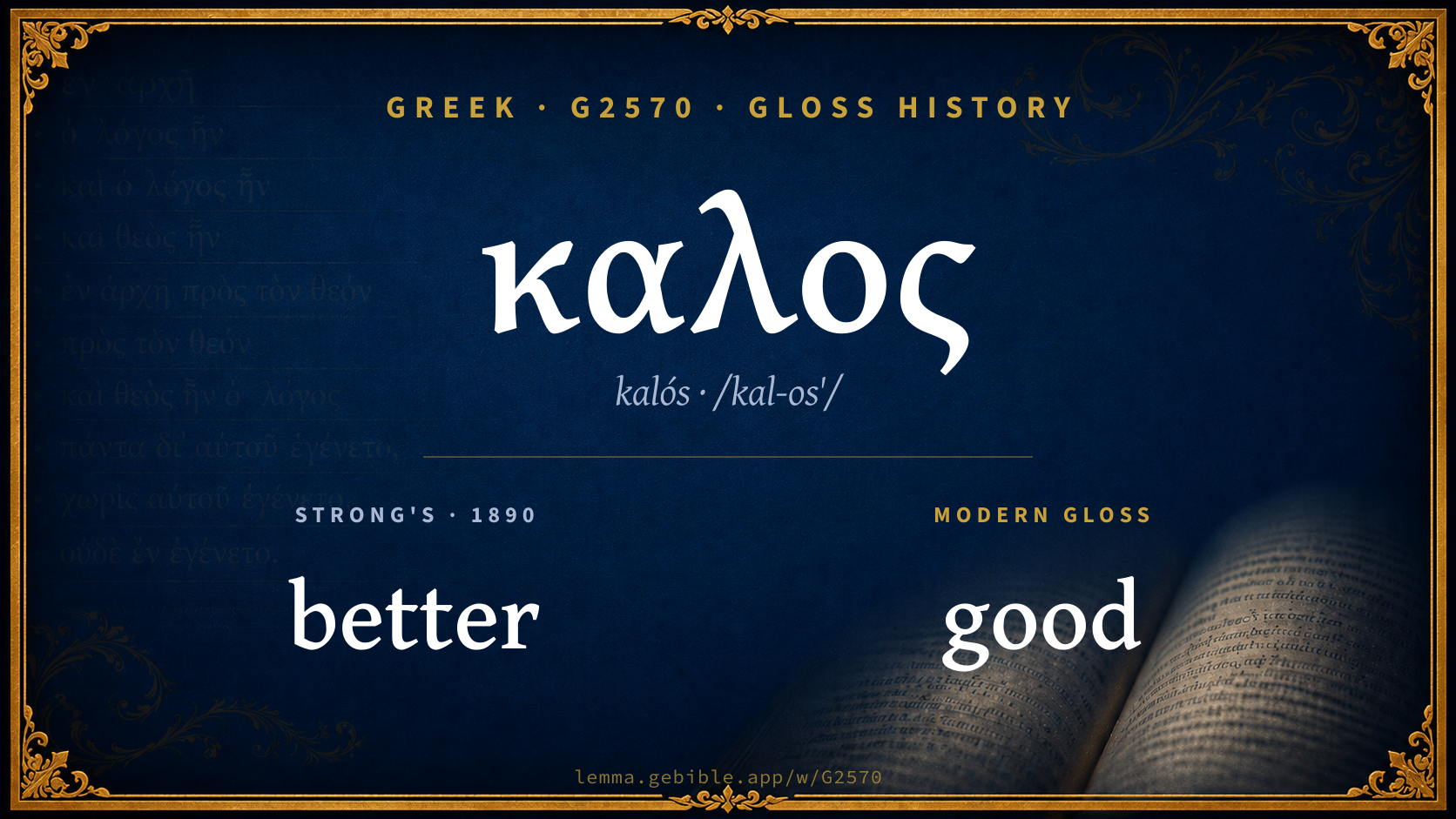
Gloss history
Strong's 1890 vs modern scholarship
About this word
Strong's G2570 catalogs a Greek word from the Greek New Testament.
These counts are not copied from any lexicon or concordance. They are computed here, from the morphology-tagged Greek New Testament. What Lemma adds →
- 89
- distinct verses
- The word appears in 89 distinct verses.
- 16 / 27
- NT books
- The word appears in 16 of 27 New Testament books.
- #165
- by frequency
- Top 250 most frequent Greek words (rank 165 of 5,347 Greek words by occurrence).
View all 89 occurrences in the concordance →
By section of the New Testament
By traditional corpus
Conventional, traditional groupings — biblical authorship is debated, so this is a traditional corpus grouping, not an authorship claim. Some books belong to more than one corpus (Luke is in both the Gospels and the Lukan corpus, and so on), so these shares overlap and need not total 100%. Each figure is a share of the word’s 89 distinct verses.
- Gospels 42 verses · 47%
- Pauline corpus 36 verses · 40%
- Lukan (Luke–Acts) 8 verses · 9%
- Johannine 5 verses · 6%
- Hebrews 5 verses · 6%
- General (Catholic) Epistles 5 verses · 6%
How translations render this word
Counts come from each version’s own published word-to-Strong’s tagging or interlinear alignment — an approximate guide to how each version renders this word, not a word-level alignment the data otherwise carries. Because each total is that version’s own tagged count, the per-version totals vary from one another and need not match the appearance or distinct-verse counts above. These counts may also differ from a printed concordance because Lemma counts each distinctly tagged rendering and does not collapse phrase taggings into a single head-word total. This is a fixed set of word-tagged versions (KJV, ASV, BSB, ULT) and does not change with the reading translation you choose elsewhere. Each version’s license is shown beside its name below (and on Sources).
- King James Version: Good 69×, Is good 12×, Better 6×
- American Standard Version: Good 72×, Is good 11×, Goodly 2×
- Berean Standard Bible: Good 64×, Better 9×, Noble 4×
- unfoldingWord Literal Text: Good 75×, Is good 13×, Better 6×
King James Version Public Domain
Renders G2570 across 101 tagged occurrences — most commonly:
Plus 8 renderings that appear only once — usually multi-word phrases or single function words the recovered tagging swept in, not distinct renderings. Not rendered by a distinct English word in 1 further occurrence.
American Standard Version Public Domain
Renders G2570 across 98 tagged occurrences — most commonly:
Plus 11 renderings that appear only once — usually multi-word phrases or single function words the recovered tagging swept in, not distinct renderings. Not rendered by a distinct English word in 1 further occurrence.
Berean Standard Bible Public Domain
Renders G2570 across 99 tagged occurrences — most commonly:
Plus 11 renderings that appear only once — usually multi-word phrases or single function words the recovered tagging swept in, not distinct renderings. Not rendered by a distinct English word in 2 further occurrences.
unfoldingWord Literal Text CC BY-SA 4.0
Renders G2570 across 104 tagged occurrences — most commonly:
Plus 6 renderings that appear only once — usually multi-word phrases or single function words the recovered tagging swept in, not distinct renderings.
Senses in Thayer's
The 1 sense Thayer's distinguishes for this word, in lexicon order (not ranked by frequency or importance). The full entry — with sub-senses — is in the Lexicon Entry tab.
- beautiful, handsome, excellent, eminent, choice, surpassing, precious, useful, suitable, commendable, admirable
Word origin
Origin: of uncertain affinity
Of uncertain affinity; properly beautiful but chiefly (figuratively) good (literally or morally) that is valuable or virtuous (for appearance or use and thus distinguished from G18 which is properly intrinsic ): - X better fair good (-ly) honest meet well worthy.
— Strong’s Exhaustive Concordance (1890), public domain.
Forms in the corpus
The 17 distinct written forms G2570 takes in the Greek New Testament, most frequent first — each parse links to that case’s occurrences in the concordance.
Same root — word family
Other Thayer's entries built from the same root as G2570, grouped by Strong’s listed origin. These share a root / origin per the lexicon — not necessarily a shared meaning. Each links to that word’s own entry.
Derived from this word
- καλλιον kallíon G2566 better
- καλοδιδασκαλος kalodidáskalos G2567 teacher of good
- καλοποιεω kalopoiéō G2569 to do well
- καλως kalōs G2573 well
Proper names from this root
People and places named from this root — a name, not an additional meaning of the word.
Compare all same-root words → Showing 4 of 6 — not the complete family. 1 of the same-root words is a proper name (a person or place). They share a root, not necessarily a meaning.
Septuagint usage
The same Greek word καλος appears 170 times in the Greek Old Testament (Septuagint), across 163 verses in 29 books.
- 170
- LXX occurrences
- Tagged occurrences of this Greek word in the Septuagint.
- 163
- verses
- Distinct Septuagint verses containing this word.
- 29 / 39
- OT books
- The word appears in 29 of the 39 Old Testament books.
Sample Septuagint occurrences
- Genesis 1:4 καλός
- Leviticus 27:10 καλός
- Numbers 3:37 καλός
- Deuteronomy 1:14 καλός
- Joshua 7:21 καλός
- 1 Samuel 25:3 καλός
- 2 Samuel 11:2 καλός
- 1 Kings 1:3 καλός
- 1 Chronicles 29:28 καλός
- 2 Chronicles 14:1 καλός
- Esther 1:11 καλός
- Job 10:3 καλός
Septuagint occurrences (same lexeme)
Every verse where the same Strong’s number (G2570) appears in the Greek Septuagint — showing the first 50 of 163. Verse text shown in the World English Bible for context; the Greek form is the matched word — the English is not keyword-highlighted.
- Genesis 1:4 καλός God saw the light, and saw that it was good. God divided the light from the darkness.
- Genesis 1:8 καλός God called the expanse sky. There was evening and there was morning, a second day.
- Genesis 1:10 καλός God called the dry land Earth, and the gathering together of the waters he called Seas. God saw that it was good.
- Genesis 1:12 καλός The earth brought forth grass, herbs yielding seed after their kind, and trees bearing fruit, with its seed in it, after their kind: and God saw that it was good.
- Genesis 1:18 καλός and to rule over the day and over the night, and to divide the light from the darkness. God saw that it was good.
- Genesis 1:21 καλός God created the large sea creatures, and every living creature that moves, with which the waters swarmed, after their kind, and every winged bird after its kind. God saw that it was good.
- Genesis 1:25 καλός God made the animals of the earth after their kind, and the cattle after their kind, and everything that creeps on the ground after its kind. God saw that it was good.
- Genesis 1:31 καλός God saw everything that he had made, and, behold, it was very good. There was evening and there was morning, the sixth day.
- Genesis 2:9 καλός Out of the ground Yahweh God made every tree to grow that is pleasant to the sight, and good for food; the tree of life also in the midst of the garden, and the tree of the knowledge of good and evil.
- Genesis 2:12 καλός and the gold of that land is good. There is aromatic resin and the onyx stone.
- Genesis 2:17 καλός but of the tree of the knowledge of good and evil, you shall not eat of it: for in the day that you eat of it you will surely die."
- Genesis 2:18 καλός Yahweh God said, "It is not good that the man should be alone; I will make him a helper suitable for him."
- Genesis 3:5 καλός for God knows that in the day you eat it, your eyes will be opened, and you will be like God, knowing good and evil."
- Genesis 3:6 καλός When the woman saw that the tree was good for food, and that it was a delight to the eyes, and that the tree was to be desired to make one wise, she took of the fruit of it, and ate; and she gave some to her husband with her, and he ate.
- Genesis 3:22 καλός Yahweh God said, "Behold, the man has become like one of us, knowing good and evil. Now, lest he put forth his hand, and also take of the tree of life, and eat, and live forever..."
- Genesis 6:2 καλός that God's sons saw that men's daughters were beautiful, and they took for themselves wives of all that they chose.
- Genesis 12:14 καλός It happened that when Abram had come into Egypt, the Egyptians saw that the woman was very beautiful.
- Genesis 15:15 καλός But you will go to your fathers in peace. You will be buried in a good old age.
- Genesis 18:7 καλός Abraham ran to the herd, and fetched a tender and good calf, and gave it to the servant. He hurried to dress it.
- Genesis 24:16 καλός The young lady was very beautiful to look at, a virgin, neither had any man known her. She went down to the spring, filled her pitcher, and came up.
- Genesis 24:50 καλός Then Laban and Bethuel answered, "The thing proceeds from Yahweh. We can't speak to you bad or good.
- Genesis 25:8 καλός Abraham gave up the spirit, and died in a good old age, an old man, and full of years, and was gathered to his people.
- Genesis 27:9 καλός Go now to the flock, and get me from there two good kids of the goats. I will make them savory food for your father, such as he loves.
- Genesis 27:15 καλός Rebekah took the good clothes of Esau, her elder son, which were with her in the house, and put them on Jacob, her younger son.
- Genesis 29:17 καλός Leah's eyes were weak, but Rachel was beautiful and well favored.
- Genesis 30:20 καλός Leah said, "God has endowed me with a good dowry. Now my husband will live with me, because I have borne him six sons." She named him Zebulun.
- Genesis 39:6 καλός He left all that he had in Joseph's hand. He didn't concern himself with anything, except for the food which he ate. Joseph was well-built and handsome.
- Genesis 41:2 καλός Behold, there came up out of the river seven cattle, well-favored and fat-fleshed, and they fed in the reed-grass.
- Genesis 41:4 καλός The ill-favored and lean-fleshed cattle ate up the seven well-favored and fat cattle. So Pharaoh awoke.
- Genesis 41:5 καλός He slept and dreamed a second time: and, behold, seven heads of grain came up on one stalk, healthy and good.
- Genesis 41:18 καλός and, behold, there came up out of the river seven cattle, fat-fleshed and well-favored. They fed in the reed-grass,
- Genesis 41:20 καλός The lean and ill-favored cattle ate up the first seven fat cattle,
- Genesis 41:22 καλός I saw in my dream, and, behold, seven heads of grain came up on one stalk, full and good:
- Genesis 41:24 καλός The thin heads of grain swallowed up the seven good heads of grain. I told it to the magicians; but there was no one who could explain it to me."
- Genesis 41:26 καλός The seven good cattle are seven years; and the seven good heads of grain are seven years. The dream is one.
- Genesis 41:35 καλός Let them gather all the food of these good years that come, and lay up grain under the hand of Pharaoh for food in the cities, and let them keep it.
- Genesis 44:4 καλός When they had gone out of the city, and were not yet far off, Joseph said to his steward, "Up, follow after the men. When you overtake them, ask them, 'Why have you rewarded evil for good?
- Genesis 49:14 καλός "Issachar is a strong donkey, Lying down between the saddlebags.
- Genesis 49:15 καλός He saw a resting-place, that it was good, The land, that it was pleasant; He bows his shoulder to the burden, And becomes a servant doing forced labor.
- Leviticus 27:10 καλός He shall not alter it, nor change it, a good for a bad, or a bad for a good: and if he shall at all change animal for animal, then both it and that for which it is changed shall be holy.
- Leviticus 27:12 καλός and the priest shall value it, whether it is good or bad. As you the priest values it, so shall it be.
- Leviticus 27:14 καλός "'When a man dedicates his house to be holy to Yahweh, then the priest shall evaluate it, whether it is good or bad: as the priest shall evaluate it, so shall it stand.
- Leviticus 27:33 καλός He shall not search whether it is good or bad, neither shall he change it: and if he changes it at all, then both it and that for which it is changed shall be holy. It shall not be redeemed.'"
- Numbers 3:37 καλός the pillars of the court around it, their sockets, their pins, and their cords.
- Numbers 4:32 καλός and the pillars of the court around it, and their sockets, and their pins, and their cords, with all their instruments, and with all their service: and by name you shall appoint the instruments of the charge of their burden.
- Numbers 10:29 καλός Moses said to Hobab, the son of Reuel the Midianite, Moses' father-in-law, We are journeying to the place of which Yahweh said, I will give it you: come you with us, and we will do you good; for Yahweh has spoken good concerning Israel.
- Numbers 11:18 καλός Say you to the people, Sanctify yourselves against tomorrow, and you shall eat flesh; for you have wept in the ears of Yahweh, saying, Who shall give us flesh to eat? for it was well with us in Egypt: therefore Yahweh will give you flesh, and you shall eat.
- Numbers 13:19 καλός and what the land is that they dwell in, whether it is good or bad; and what cities they are that they dwell in, whether in camps, or in strongholds;
- Numbers 24:1 καλός When Balaam saw that it pleased Yahweh to bless Israel, he didn't go, as at the other times, to meet with enchantments, but he set his face toward the wilderness.
- Numbers 24:5 καλός How goodly are your tents, Jacob, Your tents, Israel!
These are occurrences of the same Greek lexeme (G2570) in the Septuagint — not a translation of any one Hebrew word. The store carries no word-level Hebrew↔Greek alignment, so no Hebrew original is asserted here. Counts come from the recovered LXX Strong's tagging — high-frequency vocabulary is well covered, while rare or late forms may be untagged — so they reflect tagged occurrences and may slightly undercount.