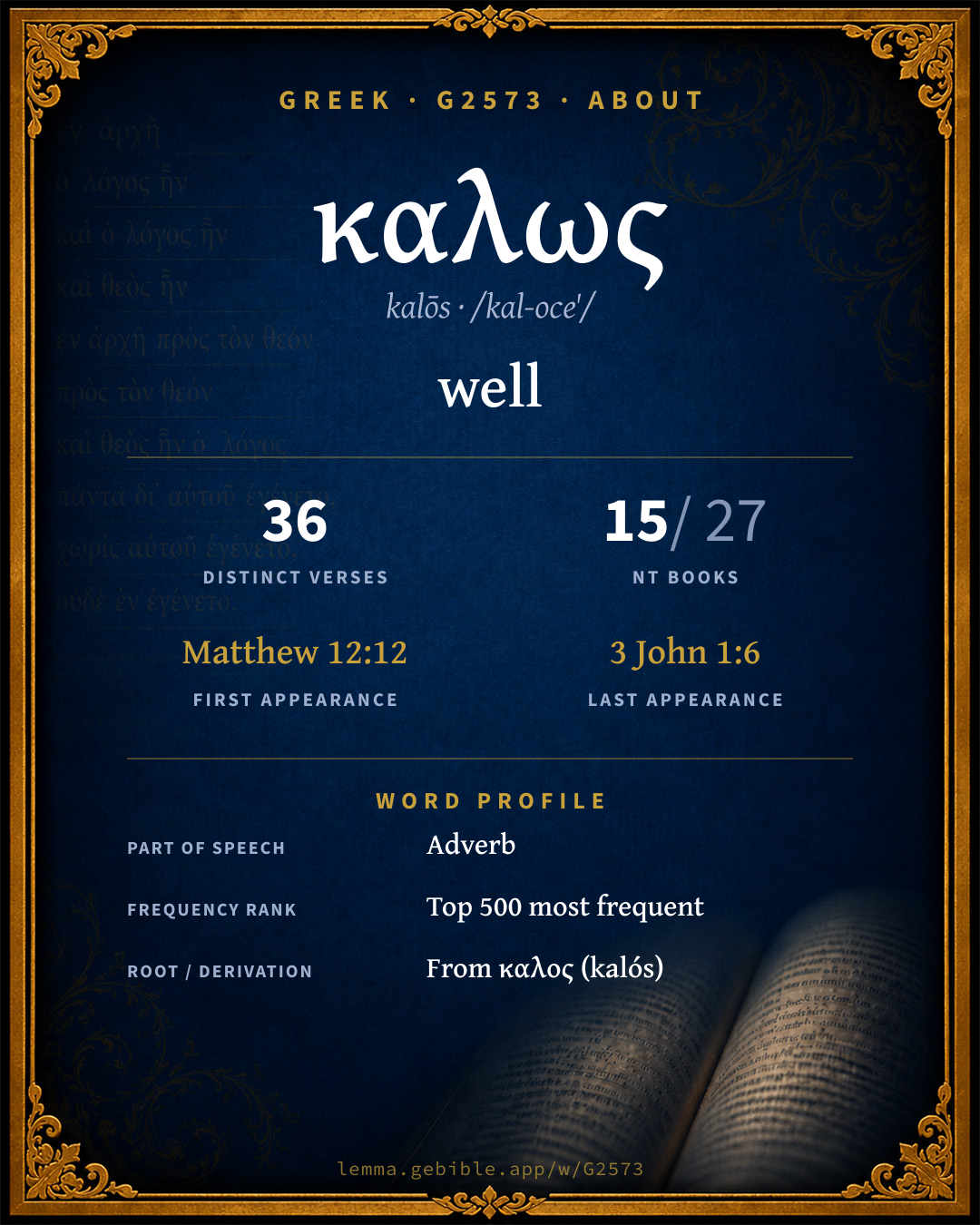
καλῶς
well
Full lexicon entry — Thayer's Greek Lexicon
From Thayer's Greek Lexicon
Where this word appears
Grammar key — what these labels mean
Part of speech
- Adverb
- A word that modifies a verb, adjective, or other adverb.
Every verse where G2573 appears — 36 distinct verses across 15 books. Click any verse to open its interlinear word-by-word view. Verse text shown in the World English Bible for context — . Each verse’s Greek form is shown with its reference; the English is not keyword-highlighted, since the data carries no word-level English alignment. Use “Compare translations” on any verse to read it across multiple English versions. This concordance covers the Greek New Testament; Septuagint (Greek Old Testament) occurrences of this word are not indexed here.
Matthew 2 verses
Mark 6 verses
- Mark 7:6 καλῶς adv He answered them, "Well did Isaiah prophesy of you hypocrites, as it is written, 'This people honors me with their lips, But their heart is far from me.
- Mark 7:9 καλῶς adv He said to them, "Full well do you reject the commandment of God, that you may keep your tradition.
- Mark 7:37 καλῶς adv They were astonished beyond measure, saying, "He has done all things well. He makes even the deaf hear, and the mute speak!"
- Mark 12:28 καλῶς adv One of the scribes came, and heard them questioning together. Knowing that he had answered them well, asked him, "Which commandment is the greatest of all?"
- Mark 12:32 καλῶς adv The scribe said to him, "Truly, teacher, you have said well that he is one, and there is none other but he,
- Mark 16:18 καλῶς adv they will take up serpents; and if they drink any deadly thing, it will in no way hurt them; they will lay hands on the sick, and they will recover."
Luke 4 verses
- Luke 6:26 καλῶς adv Woe, when men speak well of you! For their fathers did the same thing to the false prophets.
- Luke 6:27 καλῶς adv "But I tell you who hear: love your enemies, do good to those who hate you,
- Luke 6:48 καλῶς adv He is like a man building a house, who dug and went deep, and laid a foundation on the rock. When a flood arose, the stream broke against that house, and could not shake it, because it was founded on the rock.
- Luke 20:39 καλῶς adv Some of the scribes answered, "Teacher, you speak well."
John 4 verses
- John 4:17 καλῶς adv The woman answered, "I have no husband." Jesus said to her, "You said well, 'I have no husband,'
- John 8:48 καλῶς adv Then the Jews answered him, "Don't we say well that you are a Samaritan, and have a demon?"
- John 13:13 καλῶς adv You call me, 'Teacher' and 'Lord.' You say so correctly, for so I am.
- John 18:23 καλῶς adv Jesus answered him, "If I have spoken evil, testify of the evil; but if well, why do you beat me?"
Acts 2 verses
- Acts 10:33 καλῶς adv Therefore I sent to you at once, and it was good of you to come. Now therefore we are all here present in the sight of God to hear all things that have been commanded you by God."
- Acts 28:25 καλῶς adv When they didn't agree among themselves, they departed after Paul had spoken one word, "The Holy Spirit spoke rightly through Isaiah, the prophet, to our fathers,
Romans 1 verse
1 Corinthians 3 verses
- 1 Corinthians 7:37 καλῶς adv But he who stands steadfast in his heart, having no necessity, but has power over his own heart, to keep his own virgin, does well.
- 1 Corinthians 7:38 καλῶς adv So then both he who gives his own virgin in marriage does well, and he who doesn't give her in marriage does better.
- 1 Corinthians 14:17 καλῶς adv For you most assuredly give thanks well, but the other person is not built up.
2 Corinthians 1 verse
Galatians 2 verses
Philippians 1 verse
1 Timothy 4 verses
- 1 Timothy 3:4 καλῶς adv one who rules his own house well, having children in subjection with all reverence;
- 1 Timothy 3:12 καλῶς adv Let deacons be husbands of one wife, ruling their children and their own houses well.
- 1 Timothy 3:13 καλῶς adv For those who have served well as deacons gain to themselves a good standing, and great boldness in the faith which is in Christ Jesus.
- 1 Timothy 5:17 καλῶς adv Let the elders who rule well be counted worthy of double honor, especially those who labor in the word and in teaching.
Hebrews 1 verse
James 3 verses
- James 2:3 καλῶς adv and you pay special attention to him who wears the fine clothing, and say, "Sit here in a good place;" and you tell the poor man, "Stand there," or "Sit by my footstool;"
- James 2:8 καλῶς adv However, if you fulfill the royal law, according to the Scripture, "You shall love your neighbor as yourself," you do well.
- James 2:19 καλῶς adv You believe that God is one. You do well. The demons also believe, and shudder.
2 Peter 1 verse
3 John 1 verse
About this entry
At a glance — auto-summarized from this page’s data, not written by a person. Every figure links to its source below. This summary describes the numbers; it doesn’t interpret them.
At its core, καλως (kalōs) means “well.” It first appears in Matthew 12:12. Spanning 36 verses in 15 books, it ranks among the moderately common words of the Greek New Testament. Sharing its root, it stands alongside καλος, καλλιον and καλοδιδασκαλος. Each statement above links to its evidence; the full detail follows below.
Gloss history
Strong's 1890 vs modern scholarship

About this word
Strong's G2573 catalogs a Greek word from the Greek New Testament.
These counts are not copied from any lexicon or concordance. They are computed here, from the morphology-tagged Greek New Testament. What Lemma adds →
- 36
- distinct verses
- The word appears in 36 distinct verses.
- 15 / 27
- NT books
- The word appears in 15 of 27 New Testament books.
- #406
- by frequency
- Top 500 most frequent Greek words (rank 406 of 5,347 Greek words by occurrence).
View all 36 occurrences in the concordance →
By section of the New Testament
By traditional corpus
Conventional, traditional groupings — biblical authorship is debated, so this is a traditional corpus grouping, not an authorship claim. Some books belong to more than one corpus (Luke is in both the Gospels and the Lukan corpus, and so on), so these shares overlap and need not total 100%. Each figure is a share of the word’s 36 distinct verses.
- Gospels 16 verses · 44%
- Pauline corpus 12 verses · 33%
- Lukan (Luke–Acts) 6 verses · 17%
- Johannine 5 verses · 14%
- General (Catholic) Epistles 5 verses · 14%
- Hebrews 1 verse · 3%
How translations render this word
Counts come from each version’s own published word-to-Strong’s tagging or interlinear alignment — an approximate guide to how each version renders this word, not a word-level alignment the data otherwise carries. Because each total is that version’s own tagged count, the per-version totals vary from one another and need not match the appearance or distinct-verse counts above. These counts may also differ from a printed concordance because Lemma counts each distinctly tagged rendering and does not collapse phrase taggings into a single head-word total. This is a fixed set of word-tagged versions (KJV, ASV, BSB, ULT) and does not change with the reading translation you choose elsewhere. Each version’s license is shown beside its name below (and on Sources).
- King James Version: Well 27×, Good 2×
- American Standard Version: Well 25×, Good 3×
- Berean Standard Bible: Well 13×, Good 4×, Correctly 3×
- unfoldingWord Literal Text: Well 27×, Rightly 4×, Good 2×
King James Version Public Domain
Renders G2573 across 36 tagged occurrences — most commonly:
Plus 7 renderings that appear only once — usually multi-word phrases or single function words the recovered tagging swept in, not distinct renderings.
American Standard Version Public Domain
Renders G2573 across 34 tagged occurrences — most commonly:
Plus 6 renderings that appear only once — usually multi-word phrases or single function words the recovered tagging swept in, not distinct renderings.
Berean Standard Bible Public Domain
Renders G2573 across 34 tagged occurrences — most commonly:
Plus 12 renderings that appear only once — usually multi-word phrases or single function words the recovered tagging swept in, not distinct renderings. Not rendered by a distinct English word in 1 further occurrence.
unfoldingWord Literal Text CC BY-SA 4.0
Renders G2573 across 36 tagged occurrences — most commonly:
Plus 3 renderings that appear only once — usually multi-word phrases or single function words the recovered tagging swept in, not distinct renderings.
Senses in Thayer's
The 1 sense Thayer's distinguishes for this word, in lexicon order (not ranked by frequency or importance). The full entry — with sub-senses — is in the Lexicon Entry tab.
- beautifully, finely, excellently, well
Word origin
Derived from καλος (kalós) (G2570) — good.
Adverb from G2570 ; well (usually morally): - (in a) good (place) honestly + recover (full) well.
— Strong’s Exhaustive Concordance (1890), public domain.
Same root — word family
Other Thayer's entries built from the same root as G2573, grouped by Strong’s listed origin. These share a root / origin per the lexicon — not necessarily a shared meaning. Each links to that word’s own entry.
Derives from
Shares the same root
- καλλιον kallíon G2566 better
- καλοδιδασκαλος kalodidáskalos G2567 teacher of good
- καλοποιεω kalopoiéō G2569 to do well
Proper names from this root
People and places named from this root — a name, not an additional meaning of the word.
Compare all same-root words → Showing 4 of 6 — not the complete family. 1 of the same-root words is a proper name (a person or place). They share a root, not necessarily a meaning.
Septuagint usage
The same Greek word καλως appears 19 times in the Greek Old Testament (Septuagint), across 19 verses in 15 books.
- 19
- LXX occurrences
- Tagged occurrences of this Greek word in the Septuagint.
- 19
- verses
- Distinct Septuagint verses containing this word.
- 15 / 39
- OT books
- The word appears in 15 of the 39 Old Testament books.
Sample Septuagint occurrences
- Genesis 26:29 καλῶς
- Leviticus 5:4 καλῶς
- 2 Samuel 3:13 καλῶς
- 1 Kings 2:18 καλῶς
- 2 Kings 25:24 καλῶς
- 2 Chronicles 6:8 καλῶς
- Esther 2:9 καλῶς
- Psalms 127:2 καλῶς
- Proverbs 23:24 καλῶς
- Isaiah 23:16 καλῶς
- Jeremiah 1:12 καλῶς
- Hosea 2:9 καλῶς
Septuagint occurrences (same lexeme)
Every verse where the same Strong’s number (G2573) appears in the Greek Septuagint. Verse text shown in the World English Bible for context; the Greek form is the matched word — the English is not keyword-highlighted.
- Genesis 26:29 καλῶς that you will do us no harm, as we have not touched you, and as we have done to you nothing but good, and have sent you away in peace.' You are now the blessed of Yahweh."
- Genesis 32:13 καλῶς He lodged there that night, and took from that which he had with him, a present for Esau, his brother:
- Leviticus 5:4 καλῶς "'Or if anyone swears rashly with his lips to do evil, or to do good, whatever it is that a man might utter rashly with an oath, and it is hidden from him; when he knows of it, then he shall be guilty of one of these.
- 2 Samuel 3:13 καλῶς He said, Well; I will make a league with you; but one thing I require of you: that is, you shall not see my face, except you first bring Michal, Saul's daughter, when you come to see my face.
- 1 Kings 2:18 καλῶς Bathsheba said, Well; I will speak for you to the king.
- 1 Kings 8:18 καλῶς But Yahweh said to David my father, Whereas it was in your heart to build a house for my name, you did well that it was in your heart:
- 2 Kings 25:24 καλῶς Gedaliah swore to them and to their men, and said to them, Don't be afraid because of the servants of the Chaldeans: dwell in the land, and serve the king of Babylon, and it shall be well with you.
- 2 Chronicles 6:8 καλῶς But Yahweh said to David my father, Whereas it was in your heart to build a house for my name, you did well that it was in your heart:
- Esther 2:9 καλῶς The maiden pleased him, and she obtained kindness of him; and he speedily gave her things for her purification, with her portions, and the seven maidens who were meet to be given her out of the king's house: and he removed her and her maidens to the best place of the house of the women.
- Psalms 127:2 καλῶς It is vain for you to rise up early, To stay up late, Eating the bread of toil; For he gives sleep to his loved ones.
- Proverbs 23:24 καλῶς The father of the righteous has great joy. Whoever fathers a wise child delights in him.
- Proverbs 30:29 καλῶς "There are three things which are stately in their march, Four which are stately in going:
- Isaiah 23:16 καλῶς Take a harp, go about the city, you prostitute that has been forgotten; make sweet melody, sing many songs, that you may be remembered.
- Jeremiah 1:12 καλῶς Then said Yahweh to me, You have well seen: for I watch over my word to perform it.
- Jeremiah 4:22 καλῶς For my people are foolish, they don't know me; they are foolish children, and they have no understanding; they are wise to do evil, but to do good they have no knowledge.
- Hosea 2:9 καλῶς Therefore I will take back my grain in its time, And my new wine in its season, And will pluck away my wool and my flax which should have covered her nakedness.
- Micah 1:11 καλῶς Pass on, inhabitant of Shaphir, in nakedness and shame. The inhabitant of Zaanan won't come out. The wailing of Beth Ezel will take from you his protection.
- Zephaniah 3:20 καλῶς At that time will I bring you in, and at that time will I gather you; for I will give you honor and praise among all the peoples of the earth, when I bring back your captivity before your eyes, says Yahweh.
- Zechariah 8:15 καλῶς so again have I thought in these days to do good to Jerusalem and to the house of Judah. Don't be afraid.
These are occurrences of the same Greek lexeme (G2573) in the Septuagint — not a translation of any one Hebrew word. The store carries no word-level Hebrew↔Greek alignment, so no Hebrew original is asserted here. Counts come from the recovered LXX Strong's tagging — high-frequency vocabulary is well covered, while rare or late forms may be untagged — so they reflect tagged occurrences and may slightly undercount.