
1 Timothy 3:13

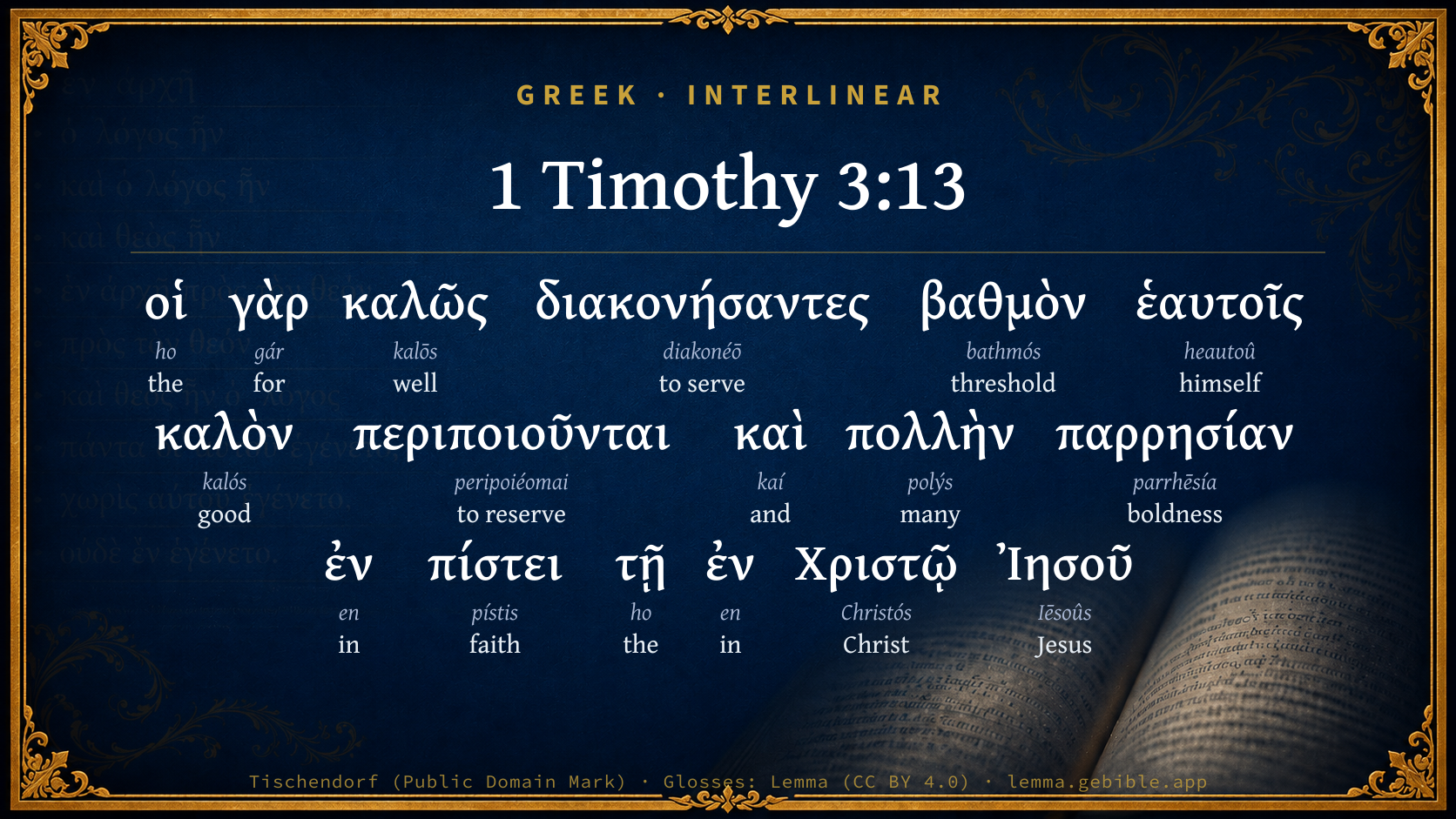
Greek (Tischendorf 8th ed.) 1 Timothy 3:13 appears in the Greek New Testament. The text above is from the Tischendorf 8th edition. Each word links to its Strong’s number and a concise gloss. Click any word for its full Thayer’s Greek Lexicon entry.
Download image
Cite this verse

1 Timothy 3:13 (World English Bible). Public Domain. Lemma interlinear Bible study tool, https://lemma.gebible.app/v/1-timothy/3/13.

Show BibTeX & RIS
BibTeX
RIS
English Translation
For those who have served well as deacons gain to themselves a good standing, and great boldness in the faith which is in Christ Jesus.
World English Bible · Public Domain
Highlights
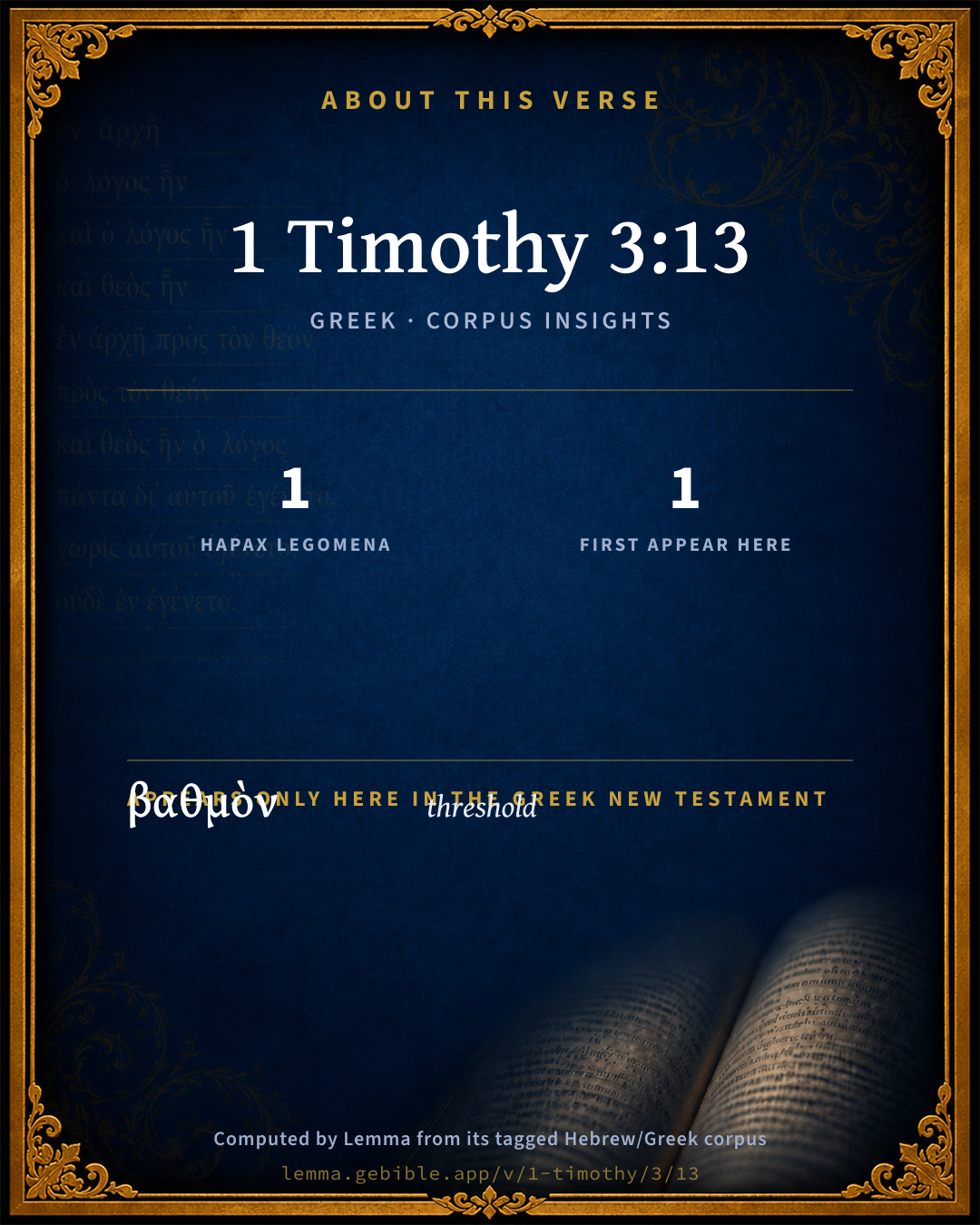
  • 1 hapax legomenon — only here in the Greek New Testament
  • 1 first appearance in the Greek New Testament
Full analysis ↓
Download a study sheet

One document with this verse’s original text, its word-by-word gloss line, the meaning frame, cross-references with their text, attributed commentary, and full source and license credits — printable, and it pastes into notes with its structure intact.

This verse Autodidact and up

Study sheet (.html) Plain text (.txt)

A passage Seminary Student

Up to 50 verses in one chapter. A passage sheet keeps up to 6 commentary sources and 12 cross-references per verse, in the order this page ranks them, and says so on the sheet whenever that leaves anything out. Ask for a single verse and you get the Autodidact verse sheet above.

Everything on this page stays free to read, with no account — the sheet is a download of what is already on screen, not access to it.

Want to remove ads? Support Godless Engineer
Compare translations 3

The same verse in 3 English versions, stacked beneath the original-language interlinear above. Click any original word for its lexicon entry.

Each is an independent rendering of the whole verse — the interlinear is not word-aligned to these translations.

Highlighted words mark where these versions differ — a whole-verse word diff, not a word-by-word alignment.

  • World English Bible Public Domain
    For those who have served well as deacons gain to themselves a good standing, and great boldness in the faith which is in Christ Jesus.
  • King James Version Public Domain
    For they that have used the office of a deacon well purchase to themselves a good degree, and great boldness in the faith which is in Christ Jesus.
  • unfoldingWord Literal Text CC BY-SA 4.0
    For the ones having served well acquire for themselves good standing and much confidence in the faith in Christ Jesus.

unfoldingWord Literal Text — © unfoldingWord, licensed CC BY-SA 4.0. Word-aligned USFM3 via Door43 (git.door43.org/unfoldingWord/en_ult).

Versions to compare (up to 4)

3 of 4 selected

Show all 19 translations

Every available English version of this verse, each an independent rendering of the whole verse.

  • World English Bible Public Domain
    For those who have served well as deacons gain to themselves a good standing, and great boldness in the faith which is in Christ Jesus.
  • Berean Standard Bible Public Domain
    For those who have served well as deacons acquire for themselves a high standing and great confidence in the faith that is in Christ Jesus.
  • Majority Standard Bible Public Domain
    For those who have served well as deacons acquire for themselves a high standing and great confidence in the faith that is in Christ Jesus.
  • King James Version Public Domain
    For they that have used the office of a deacon well purchase to themselves a good degree, and great boldness in the faith which is in Christ Jesus.
  • American Standard Version (1901) Public Domain
    For they that have served well as deacons gain to themselves a good standing, and great boldness in the faith which is in Christ Jesus.
  • Revised Version (1885) Public Domain
    For they that have served well as deacons gain to themselves a good standing, and great boldness in the faith which is in Christ Jesus.
  • Geneva Bible (1599) Public Domain
    For they that haue ministred well, get them selues a good degree, and great libertie in the faith, which is in Christ Iesus.
  • Douay-Rheims (1899) Public Domain
    For they that have ministered well, shall purchase to themselves a good degree, and much confidence in the faith which is in Christ Jesus.
  • Young's Literal Translation Public Domain
    for those who did minister well a good step to themselves do acquire, and much boldness in faith that `is' in Christ Jesus.
  • Literal Standard Version CC BY-SA 4.0
    for those who ministered well acquire a good step to themselves, and much boldness in faith that [is] in Christ Jesus.
  • Unlocked Literal Bible CC BY-SA 4.0
    For those who have served well acquire for themselves a good standing and great confidence in the faith that is in Christ Jesus.
  • unfoldingWord Literal Text CC BY-SA 4.0
    For the ones having served well acquire for themselves good standing and much confidence in the faith in Christ Jesus.
  • Darby Bible Public Domain
    for those who shall have ministered well obtain for themselves a good degree, and much boldness in faith which [is] in Christ Jesus.
  • World Messianic Bible Public Domain
    For those who have served well gain for themselves a good standing and great boldness in the faith which is in Messiah Yeshua.
  • Webster's Bible Public Domain
    For they that have used the office of a deacon well, purchase to themselves a good degree, and great boldness in the faith, which is in Christ Jesus.
  • Free Bible Version CC BY-SA 4.0
    Those who serve well as deacons gain a good reputation and much confidence in their trust in Christ Jesus.
  • Bible in Basic English Public Domain
    For those who have done good work as Deacons get for themselves a good position and become free from fear in the faith which is in Christ Jesus.
  • Text-Critical English NT CC BY 4.0
    For those who have served well as deacons obtain a good standing for themselves along with great boldness in the faith that is in Christ Jesus.
  • Tyndale New Testament (1534) Public Domain
    For they that minister well get them selves good degre and greate libertie in the fayth which is in Christ Iesu.

Literal Standard Version (2020), Covenant Press — licensed CC BY-SA 4.0. Text via the HelloAO Bible API (eBible.org). Unlocked Literal Bible (unfoldingWord) — licensed CC BY-SA 4.0. Text via the HelloAO Bible API (eBible.org). unfoldingWord Literal Text — © unfoldingWord, licensed CC BY-SA 4.0. Word-aligned USFM3 via Door43 (git.door43.org/unfoldingWord/en_ult). Free Bible Version, Dr. Jonathan Gallagher — licensed CC BY-SA 4.0. Text via the HelloAO Bible API (eBible.org).

Word by word

More ways to search: Search by grammar → Find every occurrence → Compare this word →

Practice this passage: Drill this verse → Learn its vocabulary →

βαθμὸν
bathmós
G898
“threshold”
Noun, Accusative, Singular, Masculine
Part of Speech
Noun
Case
Accusative
Number
Singular
Gender
Masculine
Full Thayer's Definition

Origin: from the same as G899

TDNT: None

1. threshold, step a. of a grade of dignity and wholesome influence in the church
  1. οἱ ho G3588 “the” Article, Nominative, Plural, Masculine
  2. γὰρ gár G1063 “for” Conjunction
  3. καλῶς kalōs G2573 “well” Adverb
  4. διακονήσαντες diakonéō G1247 “to serve” Verb, Aorist, Active, Participle, Nominative, Plural, Masculine
  5. ἑαυτοῖς heautoû G1438 “himself” Reflexive pronoun, 3rd person, Dative, Plural, Masculine
  6. καλὸν kalós G2570 “good” Adjective, Accusative, Singular, Masculine
  7. περιποιοῦνται peripoiéomai G4046 “to reserve” Verb, Present, Middle, Indicative, 3rd person, Plural
  8. καὶ kaí G2532 “and” Conjunction
  9. πολλὴν polýs G4183 “many” Adjective, Accusative, Singular, Feminine
  10. παρρησίαν parrhēsía G3954 “boldness” Noun, Accusative, Singular, Feminine
  11. ἐν en G1722 “in” Preposition
  12. πίστει pístis G4102 “faith” Noun, Dative, Singular, Feminine
  13. τῇ ho G3588 “the” Article, Dative, Singular, Feminine
  14. ἐν en G1722 “in” Preposition
  15. Χριστῷ Christós G5547 “Christ” Noun, Dative, Singular, Masculine
  16. Ἰησοῦ Iēsoûs G2424 “Jesus” Noun, Dative, Singular, Masculine

About this verse

These counts appear in no published source. They are computed here, from the morphology-tagged text and Lemma’s own curated glosses. What Lemma adds →

17
words
15
distinct lemmas
Pauline Epistles
section

Notable vocabulary

1 hapax legomenon — a word that appears only here in the entire Greek New Testament:

  • βαθμὸν threshold G898

First appearance in Scripture

This word makes its first canonical appearance in the Greek New Testament here:

  • βαθμὸν threshold G898

Shared distinctive vocabulary

περιποιοῦνται to reserve G4046 occurs in 3 verses of the Greek New Testament. Also found in:
Repetition

Words recur within this verse:

Cross-references

15

Topical passages linked to 1 Timothy 3:13 in the Treasury of Scripture Knowledge — connected by theme and wording, ordered by reader-vote popularity; previews shown in the World English Bible.

  • Matthew 25:21 "His lord said to him, 'Well done, good and faithful servant. You have been faithful over a few things, I will set you over many things. Enter into the joy of your lord.'
  • Hebrews 6:10 For God is not unrighteous, so as to forget your work and the labor of love which you showed toward his name, in that you served the saints, and still do serve them.
  • Matthew 20:28 even as the Son of Man came not to be served, but to serve, and to give his life as a ransom for many."
  • Luke 16:10–12 He who is faithful in a very little is faithful also in much. He who is dishonest in a very little is also dishonest in much.
  • Luke 19:17 "He said to him, 'Well done, you good servant! Because you were found faithful with very little, you shall have authority over ten cities.'
  • Acts 6:5 These words pleased the whole multitude. They chose Stephen, a man full of faith and of the Holy Spirit, Philip, Prochorus, Nicanor, Timon, Parmenas, and Nicolaus, a proselyte of Antioch;
  • Acts 6:8 Stephen, full of faith and power, performed great wonders and signs among the people.
  • Acts 6:15–7:53 All who sat in the council, fastening their eyes on him, saw his face like it was the face of an angel.
  • Acts 21:35 When he came to the stairs, it happened that he was carried by the soldiers because of the violence of the crowd;
  • Romans 12:7–8 or service, let us give ourselves to service; or he who teaches, to his teaching;
  • 1 Corinthians 16:15 Now I beg you, brothers (you know the house of Stephanas, that it is the first fruits of Achaia, and that they have set themselves to minister to the saints),
  • Philippians 1:14 and that most of the brothers in the Lord, being confident through my bonds, are more abundantly bold to speak the word of God without fear.
  • 1 Thessalonians 2:2 but having suffered before and been shamefully treated, as you know, at Philippi, we grew bold in our God to tell you the Gospel of God in much conflict.
  • 2 Timothy 2:1 You therefore, my child, be strengthened in the grace that is in Christ Jesus.
  • 1 Peter 4:10–11 According as each has received a gift, be ministering it among yourselves, as good stewards of the grace of God in its various forms.

Cross-references courtesy of OpenBible.info (CC BY 4.0).

Commentary

Notes on 1 Timothy 3:13 from classic Christian and Jewish commentators (each source and its license shown beneath its notes). The classic Christian expositions comment on the surrounding passage and are grouped to its opening verse, so a note may address several verses; the Jewish commentaries on the Tanakh (Rashi and others) are per-verse, so they appear only where the commentator wrote on this verse.

Lemma curates 59 commentaries, every one of them public domain or Creative Commons licensed, each selected and text-cleaned for this edition rather than reprinted as found. About our sources →

Jamieson, Fausset & Brown

Robert Jamieson, A. R. Fausset & David Brown

purchase to themselves a good degree--literally, "are acquiring . . . a . . . step." Understood by many as "a higher step," that is, promotion to the higher office of presbyter. But ambition of rising seems hardly the motive to faithfulness which the apostle would urge; besides, it would require the comparative, "a better degree." Then the past aorist participle, "they that used the office of deacon well," implies that the present verb, "are acquiring to themselves boldness," is the result of the completed action of using the diaconate well. Also, Paul would not probably hold out to every deacon the prospect of promotion to the presbytery in reward of his service. The idea of moving upwards in Church offices was as yet unknown (compare Rom 12:7, &c.; Co1 12:4-11). Moreover, there seems little connection between reference to a higher Church rank and the words "great boldness." Therefore, what those who have faithfully discharged the diaconate acquire for themselves is "a good standing-place" [ALFORD] (a well-grounded hope of salvation) against the day of judgment, Ti1 6:19; Co1 3:13-14 (the figurative meaning of "degree" or "step," being the degree of worth which one has obtained in the eye of God [WIESINGER]); and boldness (resting on that standing-place"), as well for preaching and admonishing others now (Eph 6:19; a firm standing forth for the truth against error), as also especially in relation to God their coming Judge, before whom they may be boldly confident (Act 24:16; Jo1 2:28; Jo1 3:21; Jo1 4:17; Heb 4:16).

in the faith--rather as Greek, "in faith," that is, boldness resting on their own faith.

which is in Christ Jesus--resting in Christ Jesus.

Jamieson, Fausset & Brown — Commentary Critical and Explanatory on the Whole Bible (1871) — public domain (CC PDM 1.0). Text via the HelloAO Bible API.

Bengel's Gnomon

Johann Albrecht Bengel

1Ti 3:13. Βαθμὸν) a degree, from the humble deaconship to the higher offices in the church. He who is faithful in an inferior degree, is promoted to a higher station.—ἑαυτοῖς, to themselves) They do not merely promote the interests of others.—πολλὴν παῤῥησίαν) great boldness with regard to God and man, from being well exercised.—ἐν πίστει, in the faith) that they may perceive that they are made most richly partakers of His faith and benefits.

Bengel's Gnomon of the New Testament — English translation (T&T Clark, Edinburgh, 1860) — public domain. Text from a community e-Sword module.

Meyer's Critical & Exegetical Commentary

Heinrich August Wilhelm Meyer

1Ti_3:13. To these instructions he adds in this verse a reason: οἱ γὰρ καλῶς διακονήσαντες (διακονεῖν is here and in 1Ti_3:10 used in the official sense) βαθμὸν ἑαυτοῖς καλὸν περιποιοῦνται.[130] The word ΒΑΘΜΌς, which occurs only here, denotes, like gradus, in the figurative sense, a degree of honour. As to what is to be understood by this, expositors are not agreed; but we may reject at once all explanations in which a comparative is put in place of the positive καλόν. This objection applies to the view that ΒΑΘΜΌς denotes here the higher ecclesiastical office, the office of bishop (Jerome: bonum hic pro gradu majori posuit; sunt enim minores [diaconi]; Bengel: gradum ab humilitate diaconiae ad majora munera, in ecclesia. Qui in minore gradu fidelis est, ad majora promovetur; so, too, Theophylact, Erasmus, Beza, Grotius, Heumann, Heydenreich, Baur, Plitt, and others), which view, moreover, presupposes a regulation of rank altogether foreign to the apostolic age. The same objection applies to the view that ΒΑΘΜῸς ΚΑΛΌς is a higher stage of the life of faith, i.e. an increase in Christian perfection. The expositors who hold by the positive καλός, interpret the idea, some of the future, others of the present life. The former understand by it a higher stage of blessedness; so Theodoret (τὸν τίμιον τοῦτον βαθμὸν ἐν τῷ μέλλοντι λήψονται βίῳ), Flatt, and others; the latter explain the expression as applying to respect in the church; so Calvin, Planck, Wegscheider, Leo, Matthies, and others.

Heinrich, de Wette, and Wiesinger agree with the view of the former, only modifying it to mean not a stage of holiness, but the expectancy of it. This modification is, however, unwarrantable, since the idea of expectancy or claim is imported. βαθμός means a stage; it cannot at the same time mean the claim to a stage; and if ΒΑΘΜΌς must mean the claim to something, then there is nothing to indicate what the claim refers to.

The decision between the two interpretations depends on the explanation of the words that follow: ΚΑῚ ΠΟΛΛῊΝ ΠΑῤῬΗΣΊΑΝ ἘΝ ΠΊΣΤΕΙ Τῇ ἘΝ ΧΡΙΣΤῷ ἸΗΣΟῦ] ΠΑῤῬΗΣΊΑ means, in the first place, candour in speech; then more generally, bold courage in action, synonymous with ἌΔΕΙΑ (Hesychius); and lastly, firm confidence in something; thus in reference to men, 2Co_7:4 (ΠΟΛΛΉ ΜΟΙ ΠΑῤῬΗΣΊΑ ΠΡῸς ὙΜᾶς), or to God, viz. the confidence which the Christian in faith has in the saving grace of God; so in the Epistle to the Hebrews and in the First Epistle of John.[131] If βαθμός is to be referred to future blessedness, then παῤῥησία here, as in 1Jn_3:21, Heb_4:16, is confidence toward God. But in 1Jn_3:21 we have πρὸς τὸν Θεόν along with παῤῥησία, and in Heb_4:16 μετὰ παῤῥησίας is added to define more precisely the clause: προσερχώμεθα τῷ θρόνῳ τῆς χάριτος; as to the parallel passage in 1Ti_6:19, to which de Wette likewise appeals, the reference to the future life is distinctly expressed by the words εἰς τὸ μέλλον. Of all this there is nothing here; there is nothing, either here or with καλὸν βαθμόν, to direct us to the future life, nothing to indicate that with παῤῥησία we should supply πρὸς τὸν Θεόν, or the like. Hence it is more natural to refer these ideas to the sphere in which the διακονεῖν takes place, and to understand by βαθμός, respect in the church;[132] by ΠΑῤῬΗΣΊΑ, confidence in their official labours. These two things stand in closest relation to one another, since only he can possess right confidence in his office who is open to no just reproach, who is honoured for conducting himself well in the matters with which his office is concerned. Wiesinger, against this view, maintains that the aorist (διακονήσαντες) makes the ΒΑΘΜῸΝ ἙΑΥΤ. ΚΑΛ. ΠΕΡΙΠ. appear to be the final result of the official labour;[133] but if that were the case, the present ΠΕΡΙΠΟΙΟῦΝΤΑΙ should not have been used, but the perfect; for the acquisition does not take place after the official labour, but during it.

Certainly the aorist is somewhat strange; but it may mean that the βαθμὸς κ.τ.λ. is always the result of good service.[134]

The verb περιποιεῖσθαι, in the N. T. only here and in Act_20:28, has even in classical writers the meaning gain for oneself. The dative ἙΑΥΤΟῖς is added to show clearly that he is speaking of the gain to the deacons themselves, and not to the congregation.

ἘΝ ΠΊΣΤΕΙ Τῇ ἘΝ ΧΡΙΣΤῷ ἸΗΣΟῦ] is not to be joined with ΒΑΘΜΌΝ and ΠΑῤῬΗΣΊΑΝ (van Oosterzee), but only with ΠΑῤῬΗΣΊΑΝ.[135] It is not the sphere in which, nor the object in regard to which, there is παῤῥησία (Heumann: the boldness to teach the Christian faith even in public; Wegscheider: free activity for Christianity, or a greater sphere for the spread of Christianity); but it denotes the παῤῥησία as Christian, as rooted in Christian faith. The construction of πίστις with ἐν following it, is found also in 2Ti_3:15; Gal_3:26; Eph_1:15; Col_1:4 (only that in these passages there is no article before ἐν, while there is one before πίστις; on the other hand, comp. Act_20:21; Act_26:18). This construction may be explained to mean that Christ is the object of faith already apprehended; the believer not only has Christ before him, but he lives in communion with Him.

[130] Hofmann thinks that ver. 13 is connected only with ver. 12; because a man might fill the office of deacon well, though he lacked the qualities named in vv. 810, but not if his house were badly managed. But that is not the case. Those qualities, not less than the one given in ver. 12, are the necessary conditions for filling the office of deacon well.

[131] Regarding Luthers translation of παῤῥησία by joyfulness, see my Comment. on the Epistles of John , 3 d ed., on 1Jn_4:17.

[132] Van Oosterzees opinion is manifestly wrong, that βαθμός is a beautiful stage of the spiritual life, and also of eternal blessedness.

[133] The other grounds apply only to the exposition of Matthies, who understands by βαθμὸς καλός the influential post; by παῤῥησία, the free play of thought and speech, a wide open field of spiritual activity. In this he certainly exceeds the meaning which may be assigned to these words.

[134] Hofmanns explanation of βαθμός and παῤῥησία agrees in substance with that given here. He is wrong, however, in asserting that the deacons do not acquire both during, but only after their tenure of office. If the latter were the case, the means by which it takes place would not be given.

[135] Hofmann, indeed, holds even this connection of ideas to be unsuitable; but we do not see why the παῤῥησία may not be marked as Christian, as rooted in faith in Christ. To connect it with what follows, would be to suppose that the apostle lays emphasis on a point, which to Timothy would be self-evident.

Meyer — Critical and Exegetical Commentary on the New Testament — English translation by Peter Christie, edited by Frederick Crombie (T&T Clark, 1880) — public domain. Text from a community e-Sword module.

Expositor's Greek Testament

ed. W. Robertson Nicoll

1Ti 3:13 . From what has been noted above on St. Paul’s teaching in relation to men’s lawful aspirations, it will appear that it is not necessary to explain away the obvious meaning of this clause in accordance with a false spirituality which affects to depreciate the inducements of earthly rewards. The parable of the talents (Mat 25:21 ), implies Christ’s approval of reasonable ambition. Nor is this to be answered by a statement that “the recompense of reward” to which we are permitted to look is heavenly and spiritual. For the Christian, there can be no gulf fixed between the earthly and the heavenly; at least in the category of things which are open to him, as a Christian, to desire. The drawing of such distinctions is akin to the Manichaean disparagement of matter.

The βαθμὸν καλόν which the man may acquire who has served well as a deacon is advancement to the presbyterate or episcopate. So Chrys. The R.V., gain to themselves a good standing , does not necessarily imply an advance in rank, but an assured position in the esteem of their fellow-Christians. We know that among the many who possess the same rank, whether in church or state, some from their character and abilities gain a standing that others do not.

Some modern commentators follow Theodoret in giving a purely spiritual force to βαθμόν , i.e. , ἐν τῷ μέλλοντι βίῳ , “a good standing place, viz. , at the Great Day” (Alf.); “the step or degree which a faithful discharge of the διακονία would gain in the eyes of God” (Ell.). Alf. lays emphasis on the aor. part. as viewing the διακονία from the standpoint of the Day of Judgment; but it is equally suitable if the standpoint be that of the day on which they receive their advancement. There is more force in his emphasis on the present, περιποιοῦνται , they are acquiring . This interpretation does not seem to be in harmony with the context. The qualifications that are noted in 1Ti 3:12 have relation to the effectual administration of the Church on earth. It would be harsh to affirm that one who was a digamist and who could not keep his household in order would suffer for it in the Day of Judgment, however unsuitable he might be for office in the church.

πολλὴν παρρησίαν : a Pauline phrase. See reff. In these passages παρρ . means confidence , without reference to speech .

Although Ell. renders the clause “great boldness in the faith that is in Christ Jesus,” he explains the boldness as resting on faith in Christ Jesus, and as descriptive of the believer’s attitude in regard to, and at, the Day of Judgment. See 1Jn 4:17 . If we reject his explanation of βαθμόν , it would be natural to interpret παρρ ., κ . τ . λ ., of a confident public expression of the faith, such as would belong to an experienced Christian who had gained a good standing, and had, in consequence, no temptation to be δίλογος . Von Soden connects ἐν πίστει with περιποιοῦνται , cf. 2Ti 1:13 .

The Expositor's Greek Testament, edited by W. Robertson Nicoll (1897–1910) — public domain. Text from a community e-Sword module.

Geneva Bible (1599)

Geneva Bible translators

Honor and estimation.

Bold and assured confidence without fear.

Geneva Bible (1599) marginal notes — public domain. Text via Bolls.life.

Adam Clarke's Commentary

Verse 13. That have used the office of a deacon well] They who, having been tried or proved, 1Ti 3:10, have shown by their steadiness, activity, and zeal, that they might be raised to a higher office, are here said to have purchased to themselves a good degree, βαθμον καλον. for, instead of having to administer to the bodies and bodily wants of the poor, the faithful deacons were raised to minister in holy things; and, instead of ministering the bread that perisheth, they were raised to the presbyterate or episcopate, to minister the bread of life to immortal souls. And hence the apostle adds; And great boldness in the faith; πολλην παρῥησιαν, great liberty of speech; i.e. in teaching the doctrines of Christianity, and in expounding the Scriptures, and preaching. It seems to have been a practice dictated by common sense, that the most grave and steady of the believers should be employed as deacons; the most experienced and zealous of the deacons should be raised to the rank of elders; and the most able and pious of the elders be consecrated bishops. As to a bishop of bishops, that age did not know such. The pope of Rome was the first who took this title. The same office, but not with the same powers nor abuse, is found in the patriarch of the Greek Church, and the archbishop of the Protestant Church. As the deacon had many private members under his care, so the presbyter or elder had several deacons under his care; the bishop, several presbyters; and the archbishop, several bishops. But I speak now more of the modern than of the ancient Church. The distinction in some of these offices is not so apparent in ancient times; and some of the offices themselves are modern, or comparatively so. But deacon, presbyter, and bishop, existed in the apostolic Church, and may therefore be considered of Divine origin.

Adam Clarke's Commentary on the Bible (1810–1826) — public domain. Text from a community e-Sword/MySword module.

John Calvin's Commentaries

13. For they who have served well Owing to a practice which came into use one or two centuries after the death of the apostles, of choosing presbyters from the order of deacons, this passage has been commonly interpreted as describing elevation to a higher rank, as if the Apostle called to the honor of being presbyters those who had faithfully discharged the office of a deacon. For my own part, though I do not deny that the order of deacons might sometimes be the nursery out of which presbyters were taken, yet I take Paul’s words as meaning, more simply, that they who have discharged this ministry in a proper manner are worthy of no small honor; because it is not a mean employment, but a highly honorable office. Now by this expression he intimates how much it is for the advantage of the Church to have this office discharged by choice men; because the holy discharge of it procures esteem and reverence.

How absurd is it for Papists to maintain that, in making deacons, they do what Paul enjoins! First, why do they make deacons but to carry the cup in a procession, and to feed the eyes of the ignorant with I know not what ridiculous exhibitions? Besides, they do not even observe this; for not a single deacon has been made, during the last five hundred years, except that, after taking this step, he may immediately rise to the priesthood. What impudence is it, to boast of elevating to a higher rank those who have ministered well, when they confer their priesthood on none but those who have never touched a single part of the former office!

And much liberty in the faith. With good reason does he add this; for there is nothing that tends so much to produce liberty as a good conscience and a life free from crime and reproach; as, on the contrary, timidity must be the lot of those who have a bad conscience. And if they sometimes make a valiant boast of liberty, yet it is not uniform and constant, nor has it any weight. For this reason he describes also the kind of liberty. “In the faith,” says he, which is in Christ; that is, that they may serve — Christ with greater boldness; as, on the other hand, they who have acted basely in the discharge of their office may be said to have their mouth shut and their hands tied, and are unfit for doing good; because no reliance — no authority is given to them.

John Calvin's Commentaries (1540-1563) — public domain. Text from the Calvin Translation Society English edition (1840s-50s) via the Christian Classics Ethereal Library (ccel.org). Calvin's coverage is partial (roughly two-thirds of the Bible); uncommented books and verses are honest gaps, never fabricated. The 19th-century editor's footnotes and remarks are omitted so the notes are faithfully Calvin's own voice.

Ellicott's Commentary for English Readers

(13) For they that have used the office of a deacon well.—Better rendered, for they that have served well as deacons. It was with good reason that the Apostle laid great stress on the many and varied qualifications necessary for one undertaking the duties of a deacon of the Church—for very great indeed was the reward reserved for the true, loyal deacon when his work was over and done (and if for the man who had performed well his work in the lower office, à fortiori for the one who should faithfully fulfil the yet higher duties of an elder or overseer in the Church).

Purchase to themselves a good degree.—Some scholars have suggested as a better rendering, “are acquiring (or gaining) to themselves a good standing. The old translation perhaps is best. Alford writes strikingly on the change of tense: “They that have used are acquiring or purchasing.” The Apostle having begun by placing himself at the great day of retribution, now shifts the scene and deals with their present conduct. “Those who shall then be found to have served well, &c. . . . are now, &c.”

The “good degree” they are now purchasing by earnest, patient work may refer to advancement to the higher ministries of the Church, but, more probably, has reference to their future position in the blessed life to come. This is one of the passages not unfrequent in St. Paul’s Epistles, where degrees of glory among the redeemed are clearly spoken of. The plain words of St. Paul and his Master teach the people of God that although the great act of redemption alone belongs to Christ, that through His merits only men obtain salvation, still His own, will in a great measure determine, by their works and days on earth, the position they will occupy in His kingdom.

And great boldness.—The true and faithful deacons not only will in the life to come win the great reward, but here the result of their loyal, earnest service would be, that before men they would do their work with serene, fearless confidence, and would at the same time be encouraged to approach that heavenly Father at all times with the loving trustfulness of children.

In the faith which is in Christ Jesus.—Faith was the foundation of the “great boldness,” and the faith rested on Jesus Christ.

A Bible Commentary for English Readers, edited by Charles John Ellicott (1878–1897) — public domain. Text from a community e-Sword module.

The Cambridge Bible for Schools and Colleges

gen. ed. J. J. S. Perowne

13. purchase to themselves a good degree] The word for ‘degree’ occurs only here in N.T., having been used in LXX. for a ‘step’ or ‘threshold,’ e.g. 1Sa_5:5, ‘the threshold of Dagon in Ashdod.’ It may be compared with 1Ti_6:19, ‘a good foundation,’ and may, from the drift of that phrase, be interpreted so as to combine something of all the three most general explanations, (a) a better degree or post, promotion to the priesthood; (b) esteem and regard from the Church for good service; (c) honour and promotion from God in the final day of reckoning. In 1Ti_6:19 the right use of wealth by the wealthy is the best basis for the whole of the life ‘which is life indeed’ to be gradually built up on, in the days yet to come on earth, and the unending day after: no spiritual life can be sound that is not built in and upon the faithful doing of our duty in that state of life to which it may please God to call us. An illustration of the metaphor may be taken from the building of Smeaton’s Eddystone Lighthouse and all lighthouses of the kind since. ‘All the lower courses of stone were joggled and morticed into the rock, hewn for that purpose into a series of six steplike courses. The lower portion of the building was solid throughout, and from its peculiar dovetailing practically but one stone with the rock upon which it was raised.’ So we may translate here with R.V. they that have served well as deacons gain to themselves a good standing, and interpret ‘good standing’ not to mean a higher post but good solid work done by them as deacons, leading (a) to ‘boldness of speech in the faith,’ the acceptable performance of functions such as St Stephen and St Philip, though deacons, were privileged to perform. We then gain a force for ‘to themselves’ in accordance with (b), adopting Theodore’s comment ‘though second in rank to presbyters, they will themselves have an esteem second to none,’ and (we may add) real ‘freedom in speaking’ too, from the consciousness of their people’s sympathy and support. Finally the life now is part only of the whole life; and ‘life is the use of the gifts of God according to the will of God’; hence good deacon’s work now is the basis (c) for a joyous expectation of the Master’s smile of approval, ‘ye have done it unto Me,’ a joyous acceptance of His seal of approval, ‘Be thou ruler over many things.’ See Appendix, K.

the faith which is in Christ Jesus] Here, like ‘the faith of the Gospel’ in Php_1:27; Gal_3:23 (see Bp Lightfoot), objective; the doctrine and scheme of ‘Christianity.’ Compare Jas_2:1, ‘the faith of our Lord Jesus Christ’; Judges 3, ‘the faith once for all delivered unto the saints.’

The Cambridge Bible for Schools and Colleges (gen. ed. J. J. S. Perowne; Cambridge University Press, 1878–1918) — public domain. Text from a community e-Sword module.

John Gill's Exposition

For they that have used the office of a deacon well,.... With diligence and faithfulness, with simplicity and cheerfulness; taking good care of the minister and poor, and of the discipline of God's house:

purchase to themselves a good degree; not an higher office, as that of presbytery or episcopacy, which is a sense calculated to serve a hierarchy; nor a degree in glory and happiness hereafter; but rather an increase of gifts and grace; or a degree of respect and honour in the church: or the sense is, they possess and enjoy, which is the meaning of the word rendered "purchase", a very honourable office in the church; and which is so to them, they using it well, and discharging it in an honourable manner; unless the apostle should design what the Jews called , "a degree of faith": (b) but that is expressed in the next clause:

and great boldness in the faith, which is in Christ Jesus: either in the exercise of the grace of faith at the throne of grace; or in asserting the doctrine of faith before men; and in reproving either for error or immorality: all which may be boldly done by those who use this office well.

(b) Zohar in Exod. fol. 36. 3.

John Gill's Exposition of the Whole Bible (1746–1763) — public domain (CC PDM 1.0). Text via the HelloAO Bible API.

Trapp's Complete Commentary

John Trapp

13 For they that have used the office of a deacon well purchase to themselves a good degree, and great boldness in the faith which is in Christ Jesus.

Ver. 13. A good degree] Or a fair step to a higher order, i.e. to a bishopric or presbytership.

And great boldness in the faith] The peace of a good conscience and the plerophory of faith. This those that are faithful in the ministry shall be sure of; the former preferment they may possibly fail in. In a similar manner, when the twins strove in Rebecca’s womb, the worst came forth first, and had the best place, Gen 25:25; so the unworthiest are often exalted, Psa 12:8, but the best have that which is better.

John Trapp, A Commentary or Exposition upon All the Books of the Old and New Testament (1647–1656) — public domain. Text from a community e-Sword module.

Albert Barnes' Notes on the Bible

For they that have used the office of a deacon well - Margin, “ministered.” The Greek word is the same as deacon, meaning ministering, or serving in this office. The sense would be well expressed by the phrase, “deaconizing well.” The “word” implies nothing as to the exact nature of the office.

Purchase to themselves - Procure for themselves; see this word explained in the notes on Act 20:28.

A good degree - The word here used (βαθμός bathmos) occurs nowhere else in the New Testament. It means, properly, “a step,” as of a stair; and the fair meaning is that of going up higher, or taking an additional step of dignity, honor, or standing. So far as the “word” is concerned, it may mean either an advance in office, in dignity, in respectability, or in influence. It cannot certainly be inferred that the apostle referred to a higher grade of “office;” for all that the word essentially conveys is, that, by exercising this office well, a deacon would secure additional respectability and influence in the church. Still, it is possible that those who had performed the duties of this office well were appointed to be preachers. They may have shown so much piety, prudence, good sense, and ability to preside over the church, that it was judged proper that they should be advanced to the office of bishops or pastors of the churches. Such a course would not be unnatural. This is, however, far from teaching that the office of a deacon is a subordinate office, “with a view” to an ascent to a higher grade.

And great boldness in the faith - The word here rendered “boldness” properly refers to boldness “in speaking;” see it explained in the Act 4:13 note; 2Co 3:12 note; Phi 1:20 note. But the word is commonly used to denote boldness of any kind - openness, frankness, confidence, assurance; Joh 8:13, Joh 8:26; Mar 8:32; 2Co 7:4. As it is here connected with “faith” - “boldness in the faith” - it means, evidently, not so much public speaking, as a manly and independent exercise of faith in Christ. The sense is, that by the faithful performance of the duties of the office of a deacon, and by the kind of experience which a man would have in that office, he would establish a character of firmness in the faith, which would show that he was a decided Christian. This passage, therefore, cannot be fairly used to prove that the deacon was “a preacher,” or that he belonged to a grade of ministerial office from which he was regularly to rise to that of a presbyter.

Albert Barnes' Notes on the Bible (1834–1885) — public domain. Text from a community e-Sword/MySword module.

Matthew Poole's English Annotations

Purchase to themselves a good degree; a good degree of honour, so that none hath reason to decline or to despise that office. This seems rather to be the sense, than what pleaseth some better, viz. that they purchase to themselves a higher degree in the ministry of the church; for though it be very probably true, and but rational, that the primitive church did out of their deacons choose their higher officers for the church, yet neither was this done universally as to all persons chosen into those high employments, nor as to all those that used the office of a deacon well, there doubtless being many who had done so, who yet were not διδακτικοι, fitted with an ability sufficient to be preachers, without which fitness the primitive church would not choose any to such employment.

And great boldness in the faith which is in Christ Jesus; by the well performance also of the office of a deacon, many obtained a great liberty, or freedom of speech, παρρησιαν, as to the doctrine of the faith of Christ. For by the exercise of the deacon’s office, they had much converse both with the pastors and members of the church; which converse did not only improve their knowledge in the doctrine of faith, but took off that excessive bashfulness which possesseth many till they come to be fully acquainted with the thing of which, and the persons before which, they are to speak, which we see by daily experience. Or, the apostle intends that courage that arises from a good conscience. Those that are careless and unfaithful in the discharge of their duty, guilt makes them timorous; but the good and faithful servant of God enjoys that liberty and courage which faith in the Lord Jesus gives, and without fear discharges all the parts of his office.

Matthew Poole's English Annotations on the Holy Bible (1683–1685) — public domain. Text from a community e-Sword/MySword module.

Whedon's Commentary on the Bible

Daniel D. Whedon

13. A good degree—An honourable step. The word is well defined in Robinson’s Lexicon New Testament, a step, namely, “of a stair, or door,”

etc.; derived from βαινω, to walk, or advance. Hence unquestionably, we think, Grotius gives the true meaning: “They make for themselves an honourable step, namely, to the presbyterate. For so was the custom of those ages; from the most excellent of the Christian people to select the deacons, and from the most excellent deacons, the presbyters, and from the most excellent presbyters, the president. In the Clementine Constitutions are prayers for the deacon in which we read the words: “Render worthy him who has performed the deaconship to him committed, inflexibly, blamelessly, unimpeachably, to be exalted to a higher step.”

The connexion shows this to be the meaning. The previous verse shadows the qualifications of the eldership as the model for the deacon. The clause following these words promises a greater freedom of exercise as belonging to the next step. The most natural construction, certainly, should view the step as belonging to the sphere of the deaconship. So Wesley, “They purchase a good degree, or step to some higher office.” To the objection that this would be placing an objectionable motive before the deacon, Wordsworth properly replies, that St. Paul is not addressing the deacon at all, but Timothy, the superintendent. Just so he directs Timothy (1Ti_5:17) to put a double value upon the best elders.

Great boldness—Or freedom of speech; an advance step in liberty of exercise well becoming a higher office.

Daniel D. Whedon (gen. ed.), Commentary on the Old and New Testaments (1874–1909) — public domain. Text from a community e-Sword module.

The Pulpit Commentary

Served well as deacons for used the office of a deacon well, A.V; gain to themselves a good standing for purchase to themselves a good degree, A.V Served as deacons (diakonhsantev); as in ver. 10. In this technical sense only found in these two passages; which well agrees with the late date of this Epistle, when the technical sense of diakonov was established. Gain to themselves a good standing. The sense of the passage depends a good deal upon the exact meaning of baqmov. Inv 1Sa_5:4, 1Sa_5:5, in the LXX, baqmo is the rendering of Tpmi (rendered aiqrion in, Eze_9:3 Eze_10:4) a somewhat unusual word for a "threshold." Inm, 2Ki_20:9, 2Ki_20:10, 2Ki_20:11, it is the rendering of hl "a degree on the sun-dial." This latter seems to suit better the verb peripoiountai, they gain or acquire, which suggests the idea of advancement. It does not follow that St. Paul had in his mind their advancement from the inferior office" to the higher ministries in the Church" (Ordination Service); he may merely have meant to say that the discharge of the duties of a deacon in an efficient and exemplary manner raised a man to high estimation in the Church, and so gave him confidence in confessing the faith of Jesus Christ both by word and deed. Gain to themselves (peripoiountai); acquire by purchase or otherwise. Frequent in the LXX; but only elsewhere in the New Testament inan); Act_20:28. Boldness (parrhsi) very common in the New Testament (comp. Act_4:13, Act_4:29, Act_4:31; Eph_6:19; Php_1:20, etc.) where it is especially applied to boldness in preaching the gospel of Christ. This seems to imply that St. Paul contemplated preaching as a part of the deacon"s work. We know that Philip the deacon and Stephen the deacon were both preachers.

The Pulpit Commentary (1880–1919), ed. H.D.M. Spence-Jones & Joseph S. Exell — public domain. Text from a community e-Sword module.

John Wesley's Explanatory Notes

They purchase a good degree - Or step, toward some higher office. And much boldness - From the testimony of a good conscience.

John Wesley, Explanatory Notes Upon the Whole Bible (1754–1765) — public domain. Text via the GEBible commentary corpus.

Fairbairn on Ezekiel, Jonah & the Pastoral Epistles

Patrick Fairbairn

Ver. 13. Here follows a reason for exacting such qualifications of deacons, as requisite for the safe and efficient discharge of the trust committed to them; the yap, for, coupling this to the whole of the preceding instructions on the subject: for those who have done the work of a deacon well obtain for themselves a good degree, and much boldness in the faith which is in Christ Jesus (ἐν πίστει τῇ ἐν Χ. Ἰησοῦ, lit. in faith, that which is in Christ Jesus: fide, eâque in Ch. J. collocatâ—Fritzsche on Rom 3:25). There is a certain indefiniteness in the apostle’s language here, which has given occasion to a considerable variety in the interpretations that have been adopted. The step or degree (βαθμὸν) mentioned has by some been understood of ecclesiastical advancement—the higher office of the pastorate; by others, of the consideration and honour awarded by the members of the church to such as have faithfully acquitted themselves of any sacred trust devolved on them; by others, again, of a subjective elevation—the rise made in faith and the several graces of a Christian life, as the result of continuous and active employment in the divine service; by others, still again, of the place of honour and distinction that will accrue in the great day of final reckoning to those who have served the Lord diligently in His church on earth—their own measure of fidelity and love here shall be meted back to them by the great householder—“a measure full and running over.” It is this last reference which is now most commonly adopted by the better class of commentators, and is undoubtedly the one that should mainly be pressed, although I see no reason why at least the two immediately preceding it should not also be included. There can be no doubt that the faithful discharge of the duties of the diaconal office would tend to secure for the individuals giving it a growth in the attainments and virtues of a Christian life,—grace properly used leading to larger endowments of grace; and, as a matter of course, they would at the close of their service occupy a higher place in the esteem and confidence of their brethren than they could possibly do at the commencement. But such things, however true and good, are still inadequate; they fall greatly short of what we may justly conceive the apostle to have had mainly in view, and can only be regarded as among the incidental and temporary grounds of encouragement, which may be looked for by the true servant of the Lord: the degree by way of eminence, the grand stage of honour and enlargement which lies before him, is the recompense of glory which shall be conferred on him at that day by the exalted Redeemer. It is surely but natural to suppose that the apostle, when pointing to only one ground of encouragement for fidelity in diaconal work, wishing to fix the eye on a specific prospect of future advancement, would shoot beyond the earthly sphere, and make special account of that which in its worth immensely overshadows all. It also accords best with what immediately follows,—namely, great boldness in the faith which is in Christ Jesus, as conscious, from what is granted to him by the Master Himself, that he does really stand in the faith, and cannot need to be ashamed. It may be added, as a still further confirmation of this view, that the word designating the diaconal service (διακονήσαντες) is in the indefinite past, and appears to contemplate the work as a finished totality. No doubt this might be done in respect to an immediate past, as contrasted with a future still in this life, to which it formed the introduction (so that the use of the aorist cannot of itself, with Alford, be held to be conclusive evidence of a regard simply to the day of judgment). Still, it may most fitly be taken to contemplate the diaconate as a thing lying altogether in the past, with the one great future of the day of recompense before it. It is scarcely necessary to add that the doctrine of rewards implied in this view of the passage is in perfect accordance with what is stated on the subject in other parts of Scripture; in our Lord’s parables, for instance, of the pounds, the talents, and the judgment day, Matthew 25, Luk 19:11-27; and in the apostle’s own writings, as at Rom 2:6-10, 2Co 4:10, 2Ti 4:7-8. But see at 1Ti 6:19.

Patrick Fairbairn — An Exposition of Ezekiel (1851), Jonah (1849), and The Pastoral Epistles (1874) — public domain. Text from a community e-Sword module.

Burkitt's Expository Notes on the New Testament

William Burkitt

That is, "Although the deacons be as servants to the bishops, yet such as use that office well, according to the foregoing rules, by so doing do purchase to themselves a good degree above the vulgar, and also have farther hopes of being advanced in the church to higher offices; and when they preach the word (as did Philip and Stephen) they might do it with great boldness, and with expectation of success, living suitably to the qualification of their function, and walking according to the rule of the gospel, which they professed and taught."

William Burkitt's Expository Notes on the New Testament (1700–1703) — public domain. Text from a community e-Sword module.

The People's New Testament

B. W. Johnson

13. For they that, etc. These demands for the office are high, for those who exercise it well purchase a good degree. Secure a high position in the church and in God's favor. And great boldness in the faith. To fill these duties well gives strength, and often fits for higher duties. Stephen and Philip became evangelists.

B. W. Johnson's The People's New Testament with Notes (1889–1891) — public domain. Electronic text from the Christian Classics Ethereal Library (CCEL) ThML edition.

Cambridge Greek Testament for Schools and Colleges

13. The meaning of βαθυὸν καλόν is the key to this verse. βαθμός (ἅπ. λεγ. in the N.T.) means primarily a ‘step,’ and it has been interpreted often of (a) a step in the ministry, the gradus presbyteratus; the meaning of the verse being, then, that those who have served the office of deacon well are rewarded by being raised to the presbyterate (or the episcopate). But this is not in harmony with the context, and savours of a later period than that of the Epistle. The regular promotion of deacons was, apparently, not known in the Apostolic or sub-Apostolic age. But (b) βαθμός may well mean ‘standing’ or ‘position’; and thus the passage speaks of the ‘vantage-ground’ in respect of the Christian community which will be gained by a deacon who has honourably discharged his duties. The reputation he has acquired may become the means of further and wider usefulness. Another interpretation (c) is that of ‘a good standing’ in respect, not of men, but of God, the reference being to the spiritual growth of the διάκονοι; in this view, ἀποθησαυρίζοντας ἑαυτοῖς θεμέλιον καλὸν εἰς τὸ μέλλον of 1Ti 6:19 would be a close parallel. But such an interpretation robs γάρ of its force, and ignores the connexion it implies between 1Ti 3:12-13. Bearing in mind the point of the injunction that the διάκονοι should be μιᾶς γυναικὸς ἄνδρες, viz. that they should be without reproach in the eyes of the Christian community, we see that a transition to any comment on their spiritual progress here or their final destiny hereafter would be out of place, while an observation in reference to their good repute among the faithful would be entirely apposite. On these grounds we decide in favour of (b); the ‘good standing’ acquired by the διάκονος is his position of greater trust among those to whom he ministers, in itself a great reward, because of the larger opportunities which it gives.

περιποιοῦνται, acquire. The verb περιποιεῖσθαι does not appear elsewhere in St Paul’s Epistles; but cp. Act 20:28 and 1Th 5:9 &c. The translation of the A.V., purchase, has come to suggest an idea of traffic which the word does not contain.

πολλὴν παρρησίαν. In accordance with the view taken above of βαθμὸν καλόν, this phrase finds a parallel in 2Co 7:4; the ‘boldness’ acquired by the καλῶς διακονήσαντες is boldness in respect of men, not in respect of God. This latter is a familiar N.T. idea (e.g. 1Jn 3:21), but is not here prominent.

ἐν πίστει τῇ ἐν Χρ. Ἰ. This is the sphere in which the παρρησία is exhibited, and the source from which it ultimately springs. Cp. Col 1:4.

Cambridge Greek Testament for Schools and Colleges (Cambridge University Press, 1896; 21 vols, various authors incl. Carr, Maclear, Plummer, Farrar, Lumby, Moule, M. R. James, Simcox) — public domain. Text from a community e-Sword module.

Alford’s Greek Testament

Henry Alford

13.] The importance of true and faithful service in the diaconate. For those who served well the office of deacon (the aor. participle, not the perf., because the standing-point of the sentence is at first the great day, when their διακονία has passed by. In fact this aor. participle decides between the interpretations: see below) are acquiring (the Apostle having begun by placing himself at the great day of retribution, and consequently used the aor. participle, now shifts, so to speak, the scene, and deals with their present conduct: q. d., ‘Those who shall then be found to have served well, &c.… are now, &c.’ On περιποιέω and περιποίησις, see notes, Eph 1:14: 1Th 5:9) for themselves (emphatic—besides the service they are rendering to the church) a good standing-place (viz. at the great day: cf. ch. 6:19, ἀποθησαυρίζοντας ἑαυτοῖς θεμέλιον καλὸν εἰς τὸ μέλλον, ἵνα ἐπιλάβωνται τῆς ὄντως ζωῆς:—and Dan 12:3 (Heb. and E. V.), where however the metaphor is different.

The interpretations of βαθμόν, a step, or place to stand on (in LXX, the threshold, or step, before a door; see reff.), have been very various. (1) Ambr., Jer., Pel., Thl., Erasm., Bull, Beza, Corn.-a-lap., Est., Grot., Lightf., Beng., Wolf, Mosh., Schöttg., Wordsw., al., understand it of a degree of ecclesiastical preferment, scil. from the office of deacon to that of presbyter, and take καλόν for a comparative. Against this is (a) the forcing of καλόν; (b) the improbability that such a rise upwards through the ecclesiastical offices was known in the Apostle’s time: (c) the still greater unlikelihood, even if it were known, that he would propose as a motive to a deacon to fulfil his office well, the ambitious desire to rise out of it. (2) Mack, Matth., Olsh., Huther, al., following Calv. and Luther, understand by it a high place of honour in the esteem of the church (see on παῤῥησία below): “qui probe funeti fuerint hoc ministerio, non parvo honore dignos esse.” Calv. Against this is (a) that there is not a more distinct reference made to the estimation of the church; indeed that the emphatic ἑαυτοῖς (see above) is altogether against such reference: (b) that thus again an unworthy motive would be set before tha deacons: (c) that again (see below) παῤῥησία will not on this interpretation, bear any legitimate rendering. (d) the aor. part. διακονήσαντες, as before. (3) Musc., al., take it spiritually, as meaning progress in the faith. Chrys. is claimed for this view, but this is somewhat doubtful. His words are, τουτέστι, προκοπὴν καὶ παῤῥησίαν πολλὴν τὴν ἐν πίστει χρ. Ἰησοῦ· ὡσεὶ ἔλεγεν, οἱ ἐν τοῖς κάτω δείξαντες ἑαυτοὺς διεγηγερμένους, ταχέως καὶ πρὸς ἐκεῖνα ἀνελεύσονται: where, notwithstanding that προκοπήν would seem to mean subjective progress, Thl.’s explanation of ἐκεῖνα,—τὰ ἀνώτερα, the higher office, seems best to fit the sentence: and thus προκοπή must be objective,—preferment. But (a) the whole (especially βαθμὸν περιποιοῦνται) is of too objective a character thus to be interpreted of a merely subjective process—besides that (b) thus also the present περιποιοῦνται would require a present participle διακονοῦντες. (4) Thdrt. (below), Croc., Flatt, Heinrichs (modified: see below), De W., Wiesinger, understand it nearly as above—of the station or standing-place which the faithful deacon acquires before God, with reference to his own salvation. The opinions of these Commentators are, however, somewhat various as to the exact time to which the standing on this βαθμός is to be referred. Thdrt. says: εἰ καὶ ἐλάττονα, φησί, τιμὴν ἔχουσι κατὺ τόνδε τὸν βίον, ἀλλʼ οὖν εἰδέναι προσήκει, ὡς τὴν ἐγχειρισθεῖσαν πεπληρωκότες διακονιαν, τὸν τιμιώτατον βαθμὸν ἐν τῷ μέλλοντι λήψονται βίῳ, καὶ τῆς πρὸς τὸν δεσπότην χριστὸν ἀπολαύσονται παῤῥησίας. Heinrichs, with whom De W. and Wiesinger are disposed to agree, understands that they procure to themselves a good expectation of salvation: a βαθμός i.e. in this life, with reference to the future one. I believe, from the form of the sentence, that the truth will be found by combining the two views. The διακονήσαντες, as above stated, is used with reference to their finished course at that day. The περιποιοῦνται transfers the scene to the present time. The βαθμός is that which they are now securing for themselves, and will be found standing on at that day: belonging therefore in part to both periods, and not necessarily involving the idea of different degrees of blessedness, though that idea (cf. 1Co 3:15) is familiar to St. Paul,—but merely predicating the soundness of the ground on which these διάκονοι will themselves stand) and much confidence (this also is variously understood, according as βαθμός is interpreted. Those who think of ecclesiastical preferment, render παῤῥησία ‘freedom of speech as regards the faith (obj.),’ i.e. in teaching (‘majore fiducia aliis Evangelium prædicabunt,’ Grot.), or in resisting error,—or, ‘libertas ingenue agendi,’ as Est.: or ‘a wide field for spiritual action,’ as Matthies. To these there might be no objection, but for the adjunct to παῤῥησία, ἐν πίστει τῇ ἐν χριστῷ Ἰησοῦ. Thus defined, παῤῥησία must necessarily have a subjective reference,—i.e. to the confidence towards God possessed by those who have made good advance in faith in Christ, as in reff. And so Thdrt. (above), Ambr., Croc., Cocc., Flatt, Calv., Beza (these two understand it more generally, of the confidence wrought by a good conscience), Bengel, Wies., De W., Ellic., al.) in (the) faith (subjective, from what follows) which is in (see reff. ἐν denotes more the repose of faith in, εἰς the reliance of faith on, Christ) Christ Jesus,

Henry Alford, The Greek Testament (1849–1861) — public domain. Text from a community e-Sword module.

International Critical Commentary

13. βαθμόν (here only in N.T.), lit. “a step” (so in LXX, 1 S 5:5, Ecclus 6:36, 2 K 20:9); then “a standing,” “position”. This may be thought of as—

(a) Moral: a vantage ground for influence, analogous to πολλὴν παρρησίαν: cf. Clem. Rom. 1:54, ἑαυτῷ μέγα κλέος ἐν Χριστῷ περιποιήσεται: Herm. M. iv. 4, περισσοτέραν ἑαυτῷ τιμὴν καὶ μεγάλην δόξαν περιποιεῖται πρὸς τὸν Κύριον: Poimandres, p. 343, ὁ βαθμὸς οὗτος, ὦ τέκνον, δικαιοσύνης ἐστιν ἕδρασμα: Inscr. at Mitylene, I.G. ii. 243, τοῖς τὰς ἀξίας βασμοῖς (MM. s.v.). Parry quotes Clem. Alex. Str. ii. 9. 45, βαθμὸν τοῦτον πρῶτον τῆς ἐπέκεινα γνωσέως ὑποτιθέμενος.

(b) Ecclesiastical: a higher grade, an honourable rank; cf. Ap. K. O. 22, οἱ γὰρ καλῶς διακονήσαντες τόπον ἑαυτοῖς περιποιοῦνται τὸν ποιμένικον. Apost. Const. viii. 22, ἄξιον μείζονος βαθμοῦ διὰ Χριστοῦ. This is common in later eccles. writers; cf. the prayer for the deacons, ἄσπιλον αὐτῶν τῆν διακονίαν φύλαξον καὶ βαθμοὺς ἀγαθοὺς περιποίησαι, “Lit. of S. James,” Brightman, E. and W. L., p. 55, and is probable here from the use of the aorist διακονήσαντες, and from the analogy of βαθμὸν καλόν to καλοῦ ἔργου 1, and of ἑαυτοῖς περιποιοῦνται to ἐπιθυμεῖ. But such eccles. promotion will include all that was implied in (a). It is used of promotion in the army; cf. Harrison, p. 165, who quotes from Hadriani Sententiæ, ἐὰν καλὸς στρατιώτης γενῇ, τρίτῳ βαθμῷ δυνήσῃ εἰς πραιτώριον μεταβῆναι.

πολλὴν παρῥησίαν] Certainly man-ward, cf. Phm 1:8; perhaps also God-ward, cf. Eph 3:12.

With the whole verse contrast Herm. S. ix. 25, where dishonest deacons are compared to reptiles and wild beasts that destroy men, οἱ μὲν τοὺς σπίλους ἔχοντες διάκονοί εἰσι κακῶς διακονήσαντες καὶ διαρπάσαντες χηρῶν καὶ ὀρφανῶν τὴν ζωὴν καὶ ἑαυτοῖς περιποιησάμενοι ἐκ τῆς διακονίας ἧς ἔλαβον διακονῆσαι, perhaps a conscious parody of this verse.

International Critical Commentary — older volumes (1896–1929), various authors — public domain. Text from a community e-Sword module.

Vincent's Word Studies in the New Testament

Marvin R. Vincent

Purchase [περιποιουνται] . Only here, Luk 17:33, and Act 20:28 On which see note. Purchase is unfortunate from the point of modern usage; but it is employed in its original sense of to win, acquire, without any idea of a bargain. So Bacon, Ess 4:14 : "There is no man doth a wrong for the wrong's sake; but thereby to purchase himself profit, or pleasure, or honor, or the like." And Shakespeare :

"Then, as my gift and thine own acquisition Worthily purchased, take my daughter." Temp 4 1, 14

Rend. acquire or obtain for themselves.

A good degree [βαθμον καλον] . Baqmov, N. T. o. Primarily, a step. In LXX, 1Sa 5:5; Sir. 6 36, a threshold : 2Ki 20:9, a degree on the dial. In ecclesiastical writers, order, grade, rank : see, for instance, Eusebius, H. E. 7 15. Also degree of relationship or affinity. Here the word apparently means a position of trust and influence in the church; possibly a promotion from the diaconate to the episcopate. Others (as De Wette, Eillicott, Pfleiderer) refer it to a high grade in the future life, which Holtzmann sarcastically describes as a ladder - round in heaven (eine Staffel im Himmel). John the Scholar, known as Climacus, a monk of the latter half of the sixth century, and Abbot of the Sinai Convent, wrote a mystical work entitled Klimax tou Paradeisou the Ladder of Paradise. The ladder, according to him, had thirty rounds.

Boldness [παρρησιαν] . Primarily, free and bold speaking; speaking out every word [παν, ρημα] . Its dominant idea is boldness, confidence, as opposed to fear, ambiguity, or reserve. The idea of publicity is sometimes attached to it, but as secondary. Only here in the Pastorals : several times in Paul, as 2Co 3:12; 2Co 7:4; Phi 1:20. The phrase pollh parrhsia much boldness is also Pauline. An assured position and blameless reputation in the church, with a pure conscience, would assure boldness of speech and of attitude in the Christian community and elsewhere.

In faith. Connect with boldness only. It designates the boldness as distinctively Christian, founded on faith in Christ

Marvin R. Vincent, Word Studies in the New Testament (1887–1900) — public domain. Text from a community e-Sword/MySword module.

Lesson kit

Teaching starters — assembled from the data on this page, not authored interpretation. Every prompt links to the verse data it draws on. Edit before teaching.

1 Timothy, in the Pauline Epistles, opens this verse with 17 words (15 distinct Greek lemmas). Its most distinctive word is bathmós (“threshold”). A historical commentator’s framing appears above. Read the whole chapter for the surrounding context.

Discussion questions

  1. The word bathmós carries the sense “threshold.” How does it shape the verse?
  2. This verse holds 1 word here found nowhere else in the Greek New Testament. What might the rare word draw attention to?
  3. The word “threshold” first appears here in Scripture. What is being introduced at this debut?
  4. Luke 17:33 shares the word «to reserve» with this verse. How do the two illuminate each other?
  5. “the” occurs 2× in this one verse. What is the effect of the repetition?
  6. These translations render this verse differently. What is at stake in choosing one wording over another?
  7. Reading how Jamieson, Fausset & Brown and Bengel's Gnomon read this verse, where do the two commentators agree and where do they part?

Things to notice

  • 1 word in this verse appears nowhere else in the Greek New Testament.
  • 1 word makes its first canonical appearance in Scripture here.
  • These translations choose different wording for 19 words in this verse.
  • “the” occurs 2× in this single verse.
  • 15 distinct Greek lemmas span 17 words in this verse.

Reading settings

Reading text

Shown beneath each verse's original-language words.

Old Testament
Old Testament edition

Read the OT as the Masoretic Hebrew (MT) or the Greek Septuagint (LXX).

English shown for the Greek Septuagint (in the Hebrew ↔ Greek comparison).

Comparing translations? Open the Compare panel on any verse page to stack up to four side by side.