
1 Samuel 25:3

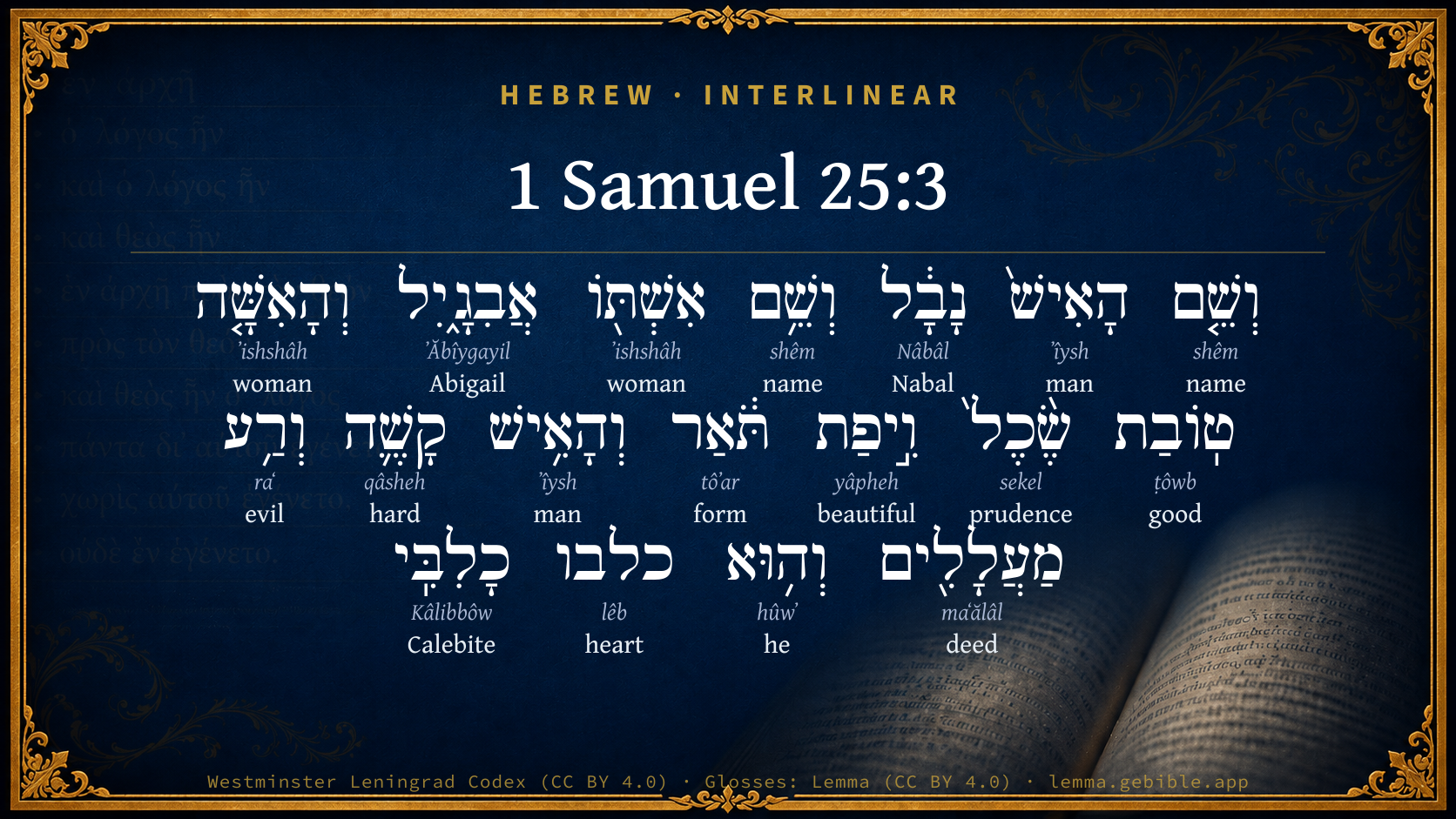
Hebrew (Westminster Leningrad Codex) 1 Samuel 25:3 appears in the Hebrew Old Testament. The text above is from the Westminster Leningrad Codex. Each word links to its Strong’s number, a concise gloss, and parsing drawn from the Open Scriptures Hebrew Bible morphology. Click any word for its full Brown-Driver-Briggs (BDB) entry.
Download image
Cite this verse

1 Samuel 25:3 (World English Bible). Public Domain. Lemma interlinear Bible study tool, https://lemma.gebible.app/v/1-samuel/25/3.

Show BibTeX & RIS
BibTeX
RIS
English Translation
Now the name of the man was Nabal; and the name of his wife Abigail; and the woman was of good understanding, and of a beautiful face: but the man was churlish and evil in his doings; and he was of the house of Caleb.
World English Bible · Public Domain
Highlights
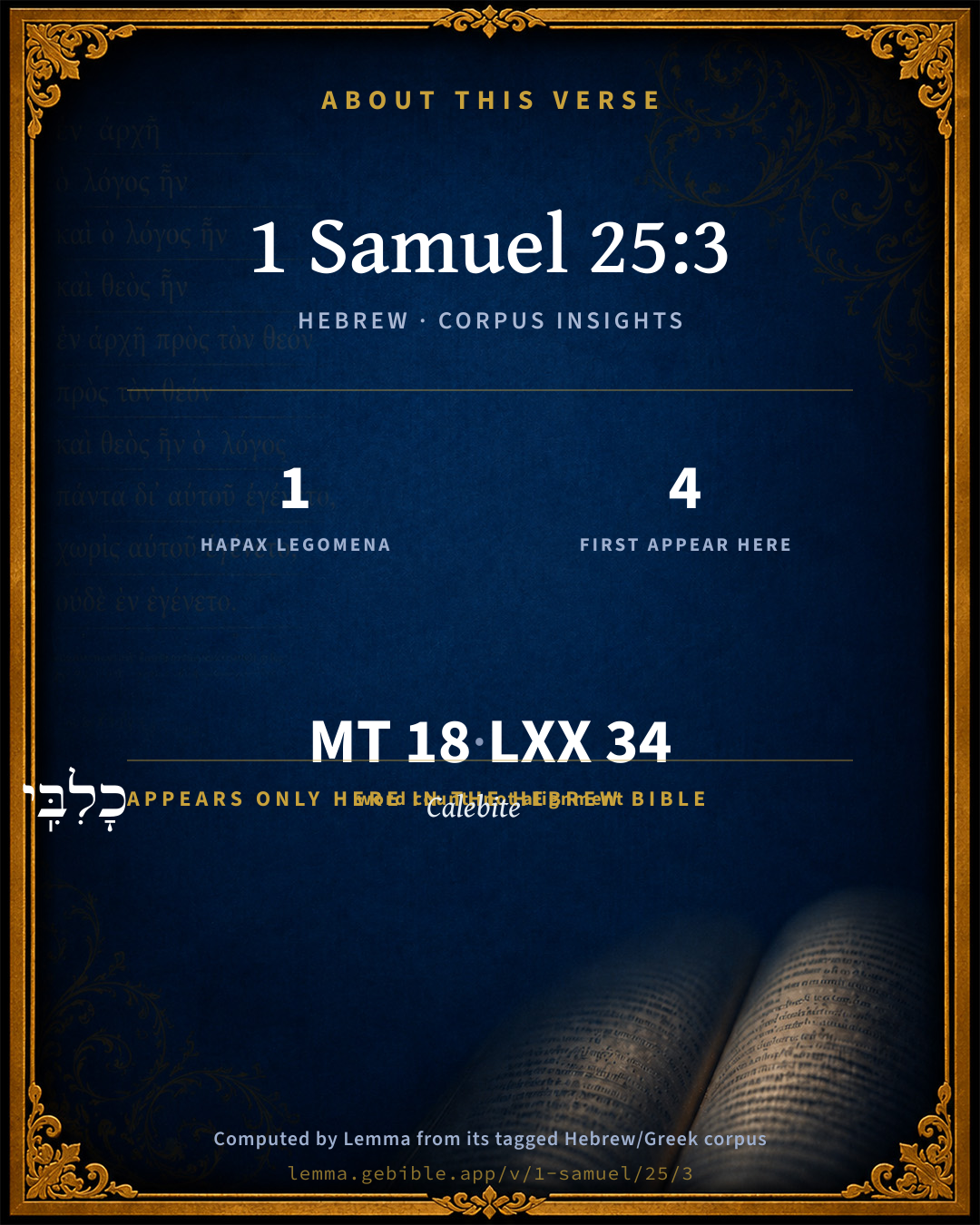
  • 1 hapax legomenon — only here in the Hebrew Bible
  • 4 first appearances in the Hebrew Bible
Full analysis ↓
Download a study sheet

One document with this verse’s original text, its word-by-word gloss line, the meaning frame, cross-references with their text, attributed commentary, and full source and license credits — printable, and it pastes into notes with its structure intact.

This verse Autodidact and up

Study sheet (.html) Plain text (.txt)

A passage Seminary Student

Up to 50 verses in one chapter. A passage sheet keeps up to 6 commentary sources and 12 cross-references per verse, in the order this page ranks them, and says so on the sheet whenever that leaves anything out. Ask for a single verse and you get the Autodidact verse sheet above.

Everything on this page stays free to read, with no account — the sheet is a download of what is already on screen, not access to it.

Want to remove ads? Support Godless Engineer
Compare translations 3

The same verse in 3 English versions, stacked beneath the original-language interlinear above. Click any original word for its lexicon entry.

Each is an independent rendering of the whole verse — the interlinear is not word-aligned to these translations.

Highlighted words mark where these versions differ — a whole-verse word diff, not a word-by-word alignment.

  • World English Bible Public Domain
    Now the name of the man was Nabal; and the name of his wife Abigail; and the woman was of good understanding, and of a beautiful face: but the man was churlish and evil in his doings; and he was of the house of Caleb.
  • King James Version Public Domain
    Now the name of the man was Nabal; and the name of his wife Abigail: and she was a woman of good understanding, and of a beautiful countenance: but the man was churlish and evil in his doings; and he was of the house of Caleb.
  • unfoldingWord Literal Text CC BY-SA 4.0
    And the name of the man Nabal, and the name of his wife Abigail. Now the woman good of insight and beautiful of appearance. But the man harsh and evil of deeds, and he a Calebite.

unfoldingWord Literal Text — © unfoldingWord, licensed CC BY-SA 4.0. Word-aligned USFM3 via Door43 (git.door43.org/unfoldingWord/en_ult).

Versions to compare (up to 4)

3 of 4 selected

Show all 18 translations

Every available English version of this verse, each an independent rendering of the whole verse.

  • World English Bible Public Domain
    Now the name of the man was Nabal; and the name of his wife Abigail; and the woman was of good understanding, and of a beautiful face: but the man was churlish and evil in his doings; and he was of the house of Caleb.
  • Berean Standard Bible Public Domain
    His name was Nabal, and his wife’s name was Abigail. She was an intelligent and beautiful woman, but her husband, a Calebite, was harsh and evil in his dealings.
  • Majority Standard Bible Public Domain
    His name was Nabal, and his wife’s name was Abigail. She was an intelligent and beautiful woman, but her husband, a Calebite, was harsh and evil in his dealings.
  • King James Version Public Domain
    Now the name of the man was Nabal; and the name of his wife Abigail: and she was a woman of good understanding, and of a beautiful countenance: but the man was churlish and evil in his doings; and he was of the house of Caleb.
  • American Standard Version (1901) Public Domain
    Now the name of the man was Nabal; and the name of his wife Abigail; and the woman was of good understanding, and of a beautiful countenance: but the man was churlish and evil in his doings; and he was of the house of Caleb.
  • Revised Version (1885) Public Domain
    Now the name of the man was Nabal; and the name of his wife Abigail: and the woman was of good understanding, and of a beautiful countenance: but the man was churlish and evil in his doings; and he was of the house of Caleb.
  • Geneva Bible (1599) Public Domain
    The name also of the man was Nabal, and the name of his wife Abigail, and she was a woman of singular wisdome, and beautifull, but the man was churlish, and euil conditioned, and was of the familie of Caleb.
  • Douay-Rheims (1899) Public Domain
    Now the name of the man was Nabal: and the name of his wife was Abigail. And she was a prudent and very comely woman, but her husband was churlish, and very bad and ill natured: and he was of the house of Caleb.
  • Young's Literal Translation Public Domain
    And the name of the man `is' Nabal, and the name of his wife Abigail, and the woman `is' of good understanding, and of fair form, and the man `is' hard and evil `in' doings; and he `is' a Calebite.
  • Literal Standard Version CC BY-SA 4.0
    And the name of the man [is] Nabal, and the name of his wife [is] Abigail, and the woman [is] of good understanding, and of beautiful form, and the man [is] hard and evil [in his] doings; and he [is] a Calebite.
  • Unlocked Literal Bible CC BY-SA 4.0
    The man's name was Nabal, and the name of his wife was Abigail. The woman was intelligent and beautiful in appearance. But the man was harsh and evil in his dealings. He was a descendant of the house of Caleb.
  • unfoldingWord Literal Text CC BY-SA 4.0
    And the name of the man Nabal, and the name of his wife Abigail. Now the woman good of insight and beautiful of appearance. But the man harsh and evil of deeds, and he a Calebite.
  • Darby Bible Public Domain
    And the name of the man was Nabal, and the name of his wife Abigail; and the woman was of good understanding, and of a beautiful countenance; but the man was churlish and evil in his doings; and he was a Calebite.
  • World Messianic Bible Public Domain
    Now the name of the man was Nabal; and the name of his wife Abigail. This woman was intelligent and had a beautiful face; but the man was surly and evil in his doings. He was of the house of Caleb.
  • Webster's Bible Public Domain
    Now the name of the man was Nabal; and the name of his wife Abigail: and she was a woman of good understanding, and of a beautiful countenance: but the man was churlish and evil in his doings; and he was of the house of Caleb.
  • Free Bible Version CC BY-SA 4.0
    The man's name was Nabal, and his wife's name was Abigail. She was a wise and beautiful woman, but her husband was cruel and treated people badly. He was a descendant of Caleb.
  • Bible in Basic English Public Domain
    Now this man was named Nabal, and his wife's name was Abigail: she was a woman of good sense and pleasing looks: but the man was cruel and evil in his ways; he was of the family of Caleb.
  • JPS Tanakh (1917) Public Domain
    Now the name of the man was Nabal; and the name of his wife Abigail; and the woman was of good understanding, and of a beautiful form; but the man was churlish and evil in his doings; and he was of the house of Caleb.

Literal Standard Version (2020), Covenant Press — licensed CC BY-SA 4.0. Text via the HelloAO Bible API (eBible.org). Unlocked Literal Bible (unfoldingWord) — licensed CC BY-SA 4.0. Text via the HelloAO Bible API (eBible.org). unfoldingWord Literal Text — © unfoldingWord, licensed CC BY-SA 4.0. Word-aligned USFM3 via Door43 (git.door43.org/unfoldingWord/en_ult). Free Bible Version, Dr. Jonathan Gallagher — licensed CC BY-SA 4.0. Text via the HelloAO Bible API (eBible.org).

Word by word

More ways to search: Search by grammar → Find every occurrence → Compare this word →

Practice this passage: Drill this verse → Learn its vocabulary →

כָלִבִּֽי
Kâlibbôw
H3614
“Calebite”
Noun, Gentilic, Masculine, Singular, Absolute
Part of Speech
Noun
Type
Gentilic
Gender
Masculine
Number
Singular
State
Absolute
Full BDB Definition

Origin: probably by erroneous transcription for Kalebiy kaw-lay-bee'

TWOT: patronymically from 03612

Calebite = see Caleb " dog" - a descendant of Caleb
  1. וְשֵׁ֤ם shêm H8034 “and · name of” Conjunction + Noun, Common, Masculine, Singular, Construct
  2. הָאִישׁ֙ ʼîysh H376 “the · man” Particle, Definite Article + Noun, Common, Masculine, Singular, Absolute
  3. נָבָ֔ל Nâbâl H5037 “Nabal” Noun, Proper
  4. וְשֵׁ֥ם shêm H8034 “and · name of” Conjunction + Noun, Common, Masculine, Singular, Construct
  5. אִשְׁתּ֖וֹ ʼishshâh H802 “woman · his” Noun, Common, Feminine, Singular, Construct + Suffix, Personal, 3rd Person, Masculine, Singular
  6. אֲבִגָ֑יִל ʼĂbîygayil H26 “Abigail” Noun, Proper
  7. וְהָאִשָּׁ֤ה ʼishshâh H802 “and · the · woman” Conjunction + Particle, Definite Article + Noun, Common, Feminine, Singular, Absolute
  8. טֽוֹבַת ṭôwb H2896 “good of” Adjective, Adjective, Feminine, Singular, Construct
  9. שֶׂ֨כֶל֙ sekel H7922 “prudence” Noun, Common, Masculine, Singular, Absolute
  10. וִ֣יפַת yâpheh H3303 “and · beautiful of” Conjunction + Adjective, Adjective, Feminine, Singular, Construct
  11. תֹּ֔אַר tôʼar H8389 “form” Noun, Common, Masculine, Singular, Absolute
  12. וְהָאִ֥ישׁ ʼîysh H376 “and · the · man” Conjunction + Particle, Definite Article + Noun, Common, Masculine, Singular, Absolute
  13. קָשֶׁ֛ה qâsheh H7186 “hard” Adjective, Adjective, Masculine, Singular, Absolute
  14. וְרַ֥ע raʻ H7451 “and · evil of” Conjunction + Adjective, Adjective, Masculine, Singular, Construct
  15. מַעֲלָלִ֖ים maʻălâl H4611 “deeds” Noun, Common, Masculine, Plural, Absolute
  16. וְה֥וּא hûwʼ H1931 “and · he” Conjunction + Pronoun, Personal, 3rd Person, Masculine, Singular
  17. כלבו lêb H3820 “like/as · heart · his” Preposition + Noun, Common, Masculine, Singular, Construct + Suffix, Personal, 3rd Person, Masculine, Singular

About this verse

These counts appear in no published source. They are computed here, from the morphology-tagged text and Lemma’s own curated glosses. What Lemma adds →

18
words
15
distinct lemmas
Historical
section

Notable vocabulary

1 hapax legomenon — a word that appears only here in the entire Hebrew Bible:

  • כָלִבִּֽי Calebite H3614

First appearance in Scripture

These words make their first canonical appearance in the Hebrew Bible here:

  • נָבָ֔ל Nabal H5037
  • אֲבִגָ֑יִל Abigail H26
  • שֶׂ֨כֶל֙ prudence H7922
  • כָלִבִּֽי Calebite H3614

Shared distinctive vocabulary

תֹּ֔אַר form H8389 occurs in 15 verses of the Hebrew Bible. Also found in:

Grammatical profile

  • 13 nouns
  • 4 adjectives
  • 1 pronoun

Repetition

Words recur within this verse — often emphatic in Hebrew:

  • וְשֵׁ֤ם name H8034 ×2
  • הָאִישׁ֙ man H376 ×2
  • אִשְׁתּ֖וֹ woman H802 ×2

Hebrew & Septuagint length

In English translation the verse runs 45 words from the Hebrew and 39 from the Septuagint (LXX English) — closely comparable.

A rough comparison of the two English renderings, which tokenize alike — not a word-level alignment.

Word counts can differ between the Hebrew and the Greek without any difference in meaning — e.g. the Hebrew direct-object marker אֵת has no separate Greek word, and Greek often adds the article ὁ.

In the original languages it is 18 Hebrew tokens and 34 Greek tokens — but the two are counted differently (Hebrew bundles its prefixes and suffixes into one token; the Greek is in lemma form), so that isn’t a like-for-like length.

Cross-references

9

Topical passages linked to 1 Samuel 25:3 in the Treasury of Scripture Knowledge — connected by theme and wording, ordered by reader-vote popularity; previews shown in the World English Bible.

  • Proverbs 14:1 Every wise woman builds her house, But the foolish one tears it down with her own hands.
  • Proverbs 31:10 Who can find a worthy woman? For her price is far above rubies.
  • Isaiah 32:5–7 The fool shall be no more called noble, nor the scoundrel be highly respected.
  • Psalms 10:3 For the wicked boasts of his heart's cravings, He blesses the greedy, and condemns Yahweh.
  • Proverbs 31:30–31 Charm is deceitful, and beauty is vain; But a woman who fears Yahweh, she shall be praised.
  • 1 Samuel 25:17 Now therefore know and consider what you will do; for evil is determined against our master, and against all his house: for he is such a worthless fellow that one can't speak to him.
  • Proverbs 31:26 She opens her mouth with wisdom. Faithful instruction is on her tongue.
  • 1 Samuel 25:10–11 Nabal answered David's servants, and said, Who is David? and who is the son of Jesse? there are many servants now-a-days who break away every man from his master.
  • 1 Samuel 30:14 We made a raid on the South of the Cherethites, and on that which belongs to Judah, and on the South of Caleb; and we burned Ziklag with fire.

Cross-references courtesy of OpenBible.info (CC BY 4.0).

Hebrew and Greek witnesses Masoretic Hebrew ↔ Greek Septuagint

The same verse in the two great witnesses to the Old Testament, shown verse-for-verse.

These are two independent witnesses, not word-aligned to each other, and the Septuagint is shown in lemma (dictionary) form.

Hebrew 1 Samuel 25:3 Masoretic · Westminster Leningrad Codex

וְשֵׁ֤ם הָאִישׁ֙ נָבָ֔ל וְשֵׁ֥ם אִשְׁתּ֖וֹ אֲבִגָ֑יִל וְהָאִשָּׁ֤ה טֽוֹבַת שֶׂ֨כֶל֙ וִ֣יפַת תֹּ֔אַר וְהָאִ֥ישׁ קָשֶׁ֛ה וְרַ֥ע מַעֲלָלִ֖ים וְה֥וּא כלבו כָלִבִּֽי

Now the name of the man was Nabal; and the name of his wife Abigail; and the woman was of good understanding, and of a beautiful face: but the man was churlish and evil in his doings; and he was of the house of Caleb.

World English Bible · Public Domain

Greek LXX 1 Samuel 25:3 Septuagint · lemma form

καί ὄνομα ὁ ἄνθρωπος ναβαλ καί ὄνομα ὁ γυνή αὐτός αβιγαια καί ὁ γυνή αὐτός ἀγαθός σύνεσις καί καλός ὁ εἶδος σφόδρα καί ὁ ἄνθρωπος σκληρός καί πονηρός ἐν ἐπιτήδευμα καί ὁ ἄνθρωπος κυνικός

And the man's name was Nabal, and his wife's name was Abigaia: and his wife was of good understanding and very beautiful in person: but the man was harsh, and evil in his doings, and the man was churlish.

LXX2012 (modern English Septuagint) · Public Domain

On this verse, Adam Clarke's Commentary discusses the Septuagint’s reading. Read the note in Commentary ↓

Hebrew: Westminster Leningrad Codex (CC BY 4.0). Greek: Septuagint (public domain); English from LXX2012 (modern English Septuagint) (Public Domain). How the Septuagint differs from the Hebrew →

Targum (Aramaic paraphrase)

1

The Targum is the ancient Jewish Aramaic paraphrase of the Hebrew Scriptures — an interpretive translation, not the Hebrew text itself. Onkelos (literal) and Pseudo-Jonathan (expansive) render the Torah, and Jonathan the Prophets. Coverage is partial: where no permissively-licensed English translation exists for a verse, only the Aramaic is shown. This is verse-level text, not a word-by-word alignment to the Hebrew.

  1. Targum Jonathan Prophets (Joshua–Malachi)
    וְשׁוּם גַבְרָא נָבָל וְשׁוּם אִתְּתֵיהּ אֲבִיגָיִל וְאִתְּתָא חֲכִּימַת מַדַע וְשַׁפִּירַת רֵיווּ וְגַבְרָא קָשֵׁי וּבִישׁ עוֹבְדִין וְהוּא מִדְבֵית כָּלֵב:

    (no public-domain English translation for this verse)

    Targum Jonathan — Aramaic: “Mikraot Gedolot” (public domain). English: “Sefaria Community Translation” (CC0 1.0 (public-domain dedication)); “London "Chaldee Paraphrase," 1871” (public domain). Text via Sefaria.

Commentary

Notes on 1 Samuel 25:3 from classic Christian and Jewish commentators (each source and its license shown beneath its notes). The classic Christian expositions comment on the surrounding passage and are grouped to its opening verse, so a note may address several verses; the Jewish commentaries on the Tanakh (Rashi and others) are per-verse, so they appear only where the commentator wrote on this verse.

Lemma curates 59 commentaries, every one of them public domain or Creative Commons licensed, each selected and text-cleaned for this edition rather than reprinted as found. About our sources →

Trapp's Complete Commentary

John Trapp

1Sa 25:3 Now the name of the man [was] Nabal; and the name of his wife Abigail: and [she was] a woman of good understanding, and of a beautiful countenance: but the man [was] churlish and evil in his doings; and he [was] of the house of Caleb.

Ver. 3. Now the name of the man was Nabal.] Nebulo; a man in whom all grace and good nature is faded and dried up; a sapless fellow, not a natural fool, but worse; an Atheist, {Psa 14:1} a Mammonist. Conveniunt rebus nomina saepe suis, Nabal had not his name for naught.

And the name of his wife Abigail,] i.e., My father’s joy. But what meant her father to match her to such an ill-conditioned churl? It is likely he married her to the wealth, not to the man. Many a child is cast away upon riches.

Of good understanding, and of a beautiful countenance.] Not fair and foolish, but καλη και σοφη, as was Aspasia Milesia, {a} beautiful and wise; this was a sweet mixture.

But the man was churlish.] Durus, inhumanus, a hardhead, a miser.

And he was of the house of Caleb.] But nothing like him. Virtue is not, as lands, heritable.

{a} Aelian,

John Trapp, A Commentary or Exposition upon All the Books of the Old and New Testament (1647–1656) — public domain. Text from a community e-Sword module.

The Biblical Illustrator

Joseph S. Exell

1Sa_25:3

Now the name of the man was Nabal, and the name of his wife Abigail.

Nabal, the churl

I. Nabal, the churl. What an apt thumbnail sketch is given of the whole race of Nabals in the confidential remark passed between his servant and his wife, He is such a son of Belial that one cannot speak to him!

1. He was very great. There are four kinds of greatness; young men, choose the best for your life aim! It is little to be great in possessing; better to be great in doing; better still to conceive and promulgate great thoughts; but best to be great in character.

2. He was a fool, his wife said. He surely must have sat for the full length portrait of the fool in our Lords parable, who thought his soul could take its ease and be merry because a few big barns were full.

3. He was a man of Belial, his servant said. He seems to have had no compunction for his churlish speeches: no idea of the consequences they might involve. As soon as the words were spoken, they were forgotten; and in the evening of the day on which they were spoken we find him in his house, holding a feast, like the feast of a king, his heart merry with wine, and altogether so stupid that his wife told him nothing less or more till the morning light.

II. David, precipitate and passionate. One of the most characteristic features in Davids temper and behaviour through all these weary years was his self-control. But the rampart of self-restraint built by long habit went down, like a neglected sea wall, before the sudden paroxysm of passion which Nabals insulting words aroused. At this hour David was on the brink of committing a crime which would east a dark shadow on all his after years. In calmer, quieter, holier hours it would have been a grief to him. From this shame, sorrow, and disgrace he was saved by that sweet and noble woman, Abigail.

III. Abigail, the beautiful intercessor. She was a woman of good understanding and of a beautiful countenance--a fit combination. Her character had written its legend on her face. There are many beautiful women wholly destitute of good understanding; just as birds of rarest plumage are commonly deficient in the power of song. It is remarkable how many Abigails get married to Nabals. God-fearing women, tender and gentle in their sensibilities, high-minded and noble in their ideals, become tied in an indissoluble union with men for whom they can have no true affinity, even if they have not an unconquerable repugnance. To such an one there is but one advice--You must stay where you are. The dissimilarity in taste and temperament does not constitute a sufficient reason for leaving your husband to drift. It may be that some day your opportunity will come, as it came to Abigail. In the meantime do not allow your purer nature to be bespotted or besmeared. Nabals servants knew the quality of their mistress, and could trust her to act wisely in the emergency which was upon them; so they told her all. She immediately grasped the situation, despatched a small procession of provision bearers, along the way that David must come, and followed them immediately on her ass. She met the avenging warriors by the covert of the mountain, and the interview was as creditable to her womans wit as to her grace of heart. Frank and noble as he always was, he did not hesitate to acknowledge his deep indebtedness to this lovely woman, and to see in her intercession the gracious arrest of God. What a revelation this is of the ministries with which God seeks to avert us from our evil ways! They are sometimes very subtle and slender, very small and still. (F. B. Meyer, B. A.)

The Biblical Illustrator, edited by Joseph S. Exell (c. 1880s–1900s) — public domain. Text from a community e-Sword module.

Joseph Benson's Commentary

1Sa 25:3. The name of his wife was Abigail — That is, the joy of his father; yet he could not promise himself much joy of her, when he married her to such a husband; it seems, by inquiring (no unfrequent thing) more after his wealth than after his wisdom. He was of the house of Caleb — This is added to aggravate his crime, that he was a degenerate branch of that noble stock of Caleb, and consequently of the tribe of Judah, as David was.

Joseph Benson's Commentary on the Old and New Testaments (1811–1818) — public domain. Text from a community e-Sword module.

Tyndale Open Study Notes

Tyndale Open Resources

25:3 Nabal: See 25:25 for insight into the irony of his name. • Unlike her husband, Abigail was a sensible and wise person, as the narrative shows.

Tyndale Open Study Notes — © Tyndale Open Resources, licensed CC BY-SA 4.0. Text via the HelloAO Bible API.

Jamieson, Fausset & Brown

Robert Jamieson, A. R. Fausset & David Brown

he was of the house of Caleb--of course, of the same tribe with David himself; but many versions consider Caleb ("dog") not as a proper, but a common noun, and render it, "he was snappish as a dog."

Jamieson, Fausset & Brown — Commentary Critical and Explanatory on the Whole Bible (1871) — public domain (CC PDM 1.0). Text via the HelloAO Bible API.

Adam Clarke's Commentary

Verse 3. The name of the man was Nabal] The word נבל nabal signifies to be foolish, base, or villanous; and hence the Latin word nebulo, knave, is supposed to be derived.

The name of his wife Abigail] The joy or exultation of my father. A woman of sense and beauty, married to the boor mentioned above, probably because he was rich. Many women have been thus sacrificed.

Of the house of Caleb] והוא כלבי vehu Chalibbi, "he was a Calebite." But as the word caleb signifies a dog, the Septuagint have understood it as implying a man of a canine disposition, and translate it thus, και ὁ ανθρωπος κυνικος, he was a doggish man. It is understood in the same way by the Syriac and Arabic.

Adam Clarke's Commentary on the Bible (1810–1826) — public domain. Text from a community e-Sword/MySword module.

Ellicott's Commentary for English Readers

(3) Nabal.—The word “Nabal” means “fool,” connected with naval, to fade away. The name was probably a nickname given him on account of his well-known stubborn folly.

Abigail.—The famous beautiful woman who afterwards became David’s wife seems to have been, as Stanley calls her, “the good angel of the household” of the ill-starred, boorish southern chieftain. Her name, too, which signifies “whose father is joy,” was most likely given her by the villagers on her husband’s estate, as expressive of her sunny, gladness-bringing presence. Her early training, and the question respecting the sources whence she derived her wisdom and deep, far-sighted piety—apparently far in advance of her age—is discussed further on in the chapter.

The house of Caleb.—In the original Kalibi, i.e., of the house or family of Caleb. Thus the word is read in the Hebrew Bible. There is, however, an alternative reading—K’libi—with different vowel-points in the written text, which would be read “according to his heart.” Josephus, the LXX., and the Arabic and Syriac Versions understand it as derived from kelev, a dog, and render—“and he was a cynical man” (that is, “one of a dog-like character”—anthrôpos keunikos). The Chaldee “e domo Caleb,” and Vulgate “de genero Caleb,” follow the text which is read in the Hebrew Bible, and translated in our version, “of the house of Caleb,” which seems, on the whole, the preferable and most likely meaning.

A Bible Commentary for English Readers, edited by Charles John Ellicott (1878–1897) — public domain. Text from a community e-Sword module.

The Cambridge Bible for Schools and Colleges

gen. ed. J. J. S. Perowne

3. Nabal] The name means Fool. It is the word used in Psa_14:1; Pro_30:22; &c.

churlish] Lit. hard. Cp. Mat_25:24, where the same Greek word is used as in the Sept. here (σκληρός).

of the house of Caleb] Who settled at Hebron (Jos_15:13). Cp. “the south of Caleb” in ch. 1Sa_30:14. The Sept. rendering “dog-like” (κυνικός), referring to his character, is not to be followed.

The Cambridge Bible for Schools and Colleges (gen. ed. J. J. S. Perowne; Cambridge University Press, 1878–1918) — public domain. Text from a community e-Sword module.

John Gill's Exposition

Now the name of the man was Nabal,.... Which signifies a "fool"; one would think his parents should not give him this name, though it is a name proper enough to men in common; and Kimchi thinks this was a nickname, which men gave him agreeably to his genius and conduct, and which is not improbable:

and the name of his wife Abigail; which signifies "my father's joy", he delighting in her for her wit and beauty, as follows:

and she was a woman of good understanding, and of a beautiful countenance; she was not only of a good understanding in things natural, civil, and domestic, but in things spiritual, as her speech to David shows, and which, with her external form, completed her character, and greatly recommended her; which is the character Aelianus (u) gives of Aspasia, wise and fair:

but the man was churlish and evil in his doings; morose and ill natured in the temper and disposition of his mind, and wicked in his conversation, and fraudulent and oppressive in his dealings with men:

and he was of the house of Caleb; or he was a Calebite (w), a descendant of that great and good man Caleb the son of Jephunneh; which was an aggravation of his wickedness, that he should be the degenerate plant of such a noble vine: some interpret it, he was as his heart, as his heart was bad, so was he; some men, their outside is better than their inside; but this man was no hypocrite, he was as bad outwardly as he was inwardly: the word "Caleb" sometimes signifies a dog; hence the Septuagint version renders it, a doggish man, a cynic; and to the same purpose are the Syriac and Arabic versions; and so some Jewish writers interpret it; but the Targum, Jarchi, and Kimchi, supply it as we do, that he was of the house or family of Caleb, and so of the tribe of Judah, as David was.

(u) Var. Hist. l. 12. c. 1. (w) "keri" "Calibita", Pagninus, Montanus; "Calebita" Tigurine version, Junius & Tremcilius, Piscator.

John Gill's Exposition of the Whole Bible (1746–1763) — public domain (CC PDM 1.0). Text via the HelloAO Bible API.

Haydock's Catholic Bible Commentary

Caleb, the famous companion of Josue. His name means, "a dog;" whence the Septuagint, "he was a Cynic." Josephus, "he followed the manners of the Cynics," who were remarkable for their impudence, like dogs. Caleb was of the same tribe as David, and ought to have been more favourable to him on that account, ver. 6. (Haydock)

George Leo Haydock (1774–1849), Haydock's Catholic Family Bible and Commentary, 1859 edition — public domain. Excludes Psalms (Douay-Rheims chapter numbering differs from Protestant) and Deuterocanonical books (Catholic canon only).

Matthew Poole's English Annotations

This is added to aggravate his crime, that he was a degenerate branch of that noble stock of Caleb, and consequently of the tribe of Judah, as David was.

Matthew Poole's English Annotations on the Holy Bible (1683–1685) — public domain. Text from a community e-Sword/MySword module.

Whedon's Commentary on the Bible

Daniel D. Whedon

3. Churlish — Harsh, stern, cross, and surly.

Of the house of Caleb — Who inherited Hebron. Jos_14:13; Jos_15:13. The Septuagint renders כלבי, Calebite, by κυνικος, doggish.

Daniel D. Whedon (gen. ed.), Commentary on the Old and New Testaments (1874–1909) — public domain. Text from a community e-Sword module.

The Pulpit Commentary

Nabal, the word rendered fool in Psa_14:1; literally, "flat," "vapid." Abigail means "one who is the cause (father) of joy," i.e. one who gives joy. She, with her bright understanding and beautiful person (the Hebrew word takes in much more than the countenance; (see, 1Sa_16:18, where it is rendered comely person) is in contrast with the coarse, churlish man who was her husband. His name was either one which he had acquired by his conduct, or if given him by his parents shows that they were clownish people. He was of the house of Caleb. The written text has, "he was according to his heart," celibbo, i.e. a self-willed man, or one whose rude exterior answered to his inner nature; but there are linguistic difficulties in the way of this reading, and the Kri is probably right in correcting calibbi, a Calebite, a descendant of Caleb, who had large possessions assigned him in the neighbourhood of Hebron, (Jos_15:13-19) which is only ten miles northwest of Carmel. The versions support the Kri, though the Syriac and Septuagint render doglike one who, like a dog, though he has plenty, yet grudges others. The meaning of the name Caleb is literally "a dog."

The Pulpit Commentary (1880–1919), ed. H.D.M. Spence-Jones & Joseph S. Exell — public domain. Text from a community e-Sword module.

John Wesley's Explanatory Notes

Abigail - That is, the joy of his father: yet he could not promise himself much joy of her, when he married her to such an husband: it seems, in inquiring, (no unfrequent thing) more after his wealth, than after his wisdom. Caleb - This is added to aggravate his crime, that he was a degenerate branch of that noble stock of Caleb, and consequently of the tribe of Judah, as David was.

John Wesley, Explanatory Notes Upon the Whole Bible (1754–1765) — public domain. Text via the GEBible commentary corpus.

Rashi

Rabbi Shlomo Yitzchaki (Rashi)

A Calebite. Of the house of Caleiv.

Rashi on the Tanakh — English translations: “The Judaica Press complete Tanach with Rashi, translated by A. J. Rosenberg” (CC BY 4.0); “Pentateuch with Rashi's commentary by M. Rosenbaum and A.M. Silbermann, 1929-1934” (public domain); “The Metsudah Tanach series, Lakewood, N.J” (CC BY 4.0); and “The Book of Joshua, Metsudah Publications, 1997” (CC BY 4.0). Text via Sefaria.

Lesson kit

Teaching starters — assembled from the data on this page, not authored interpretation. Every prompt links to the verse data it draws on. Edit before teaching.

1 Samuel, in the Historical, opens this verse with 18 words (15 distinct Hebrew lemmas). Its most distinctive word is Kâlibbôw (“Calebite”). A historical commentator’s framing appears above. Read the whole chapter for the surrounding context.

Discussion questions

  1. How does “Calebite” (Kâlibbôw) shape what this verse is saying?
  2. This verse holds 1 word here found nowhere else in the Hebrew Bible. What might the rare word draw attention to?
  3. 4 words here appear for the first time in Scripture. What is being introduced at this debut?
  4. Genesis 29:17 shares the word «form» with this verse. How do the two illuminate each other?
  5. “name” occurs 2× in this one verse. What is the effect of the repetition?
  6. The translations on this page render this verse differently — a whole-verse word diff, not a word-by-word alignment. What might account for the different wordings?
  7. Reading how Trapp's Complete Commentary and The Biblical Illustrator read this verse, where do the two commentators agree and where do they part?

Things to notice

  • 1 word in this verse appears nowhere else in the Hebrew Bible.
  • 4 words make their first canonical appearance in Scripture here.
  • This verse counts 18 Hebrew ↔ 34 Greek words.
  • These translations choose different wording for 12 words in this verse.
  • “name” occurs 2× in this single verse.

Reading settings

Reading text

Shown beneath each verse's original-language words.

Old Testament
Old Testament edition

Read the OT as the Masoretic Hebrew (MT) or the Greek Septuagint (LXX).

English shown for the Greek Septuagint (in the Hebrew ↔ Greek comparison).

Comparing translations? Open the Compare panel on any verse page to stack up to four side by side.