

1 Timothy 6:19
Greek (Tischendorf 8th ed.) 1 Timothy 6:19 appears in the Greek New Testament. The text above is from the Tischendorf 8th edition. Each word links to its Strong’s number and a concise gloss. Click any word for its full Thayer’s Greek Lexicon entry.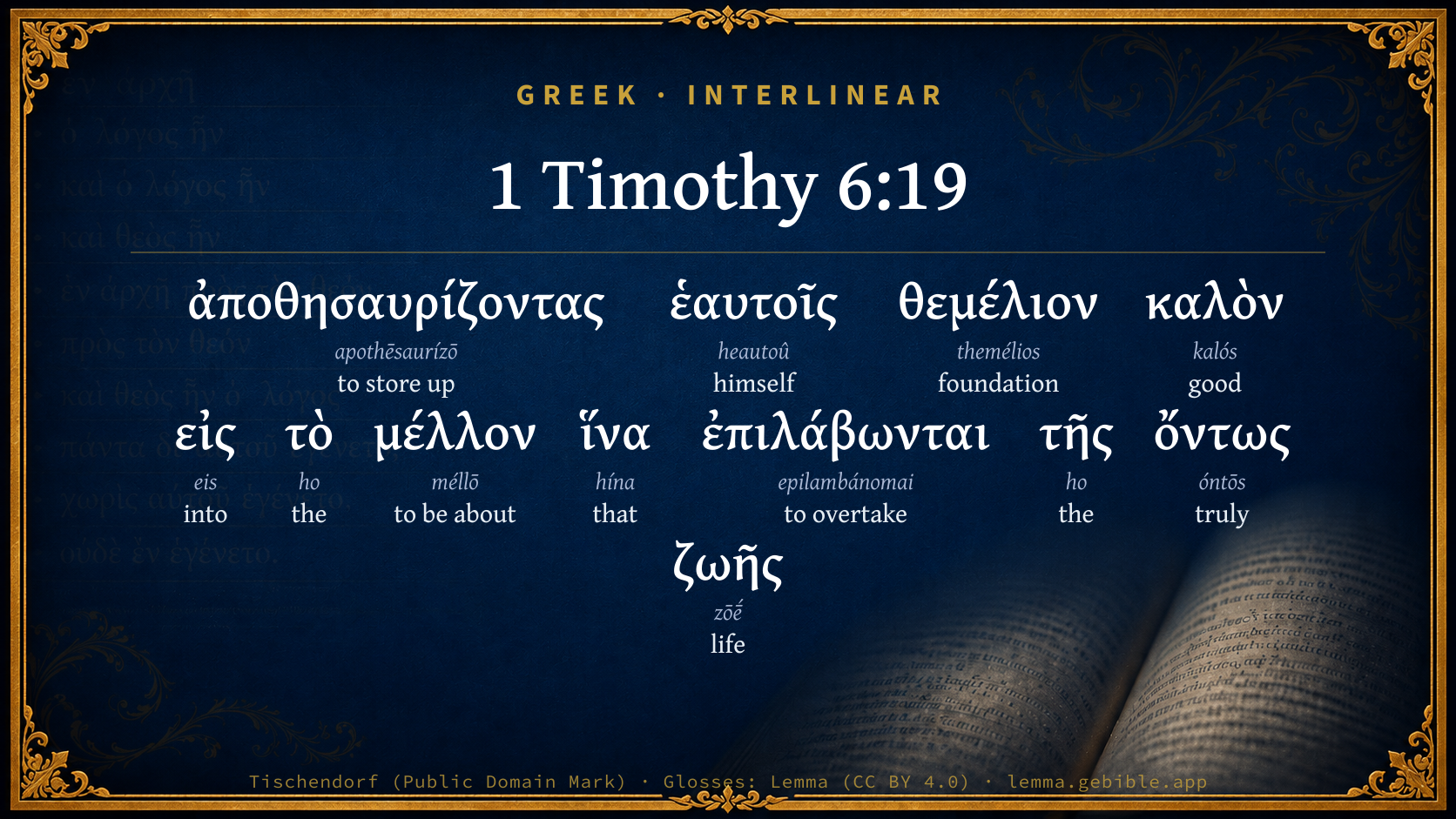
laying up in store for themselves a good foundation against the time to come, that they may lay hold of eternal life.
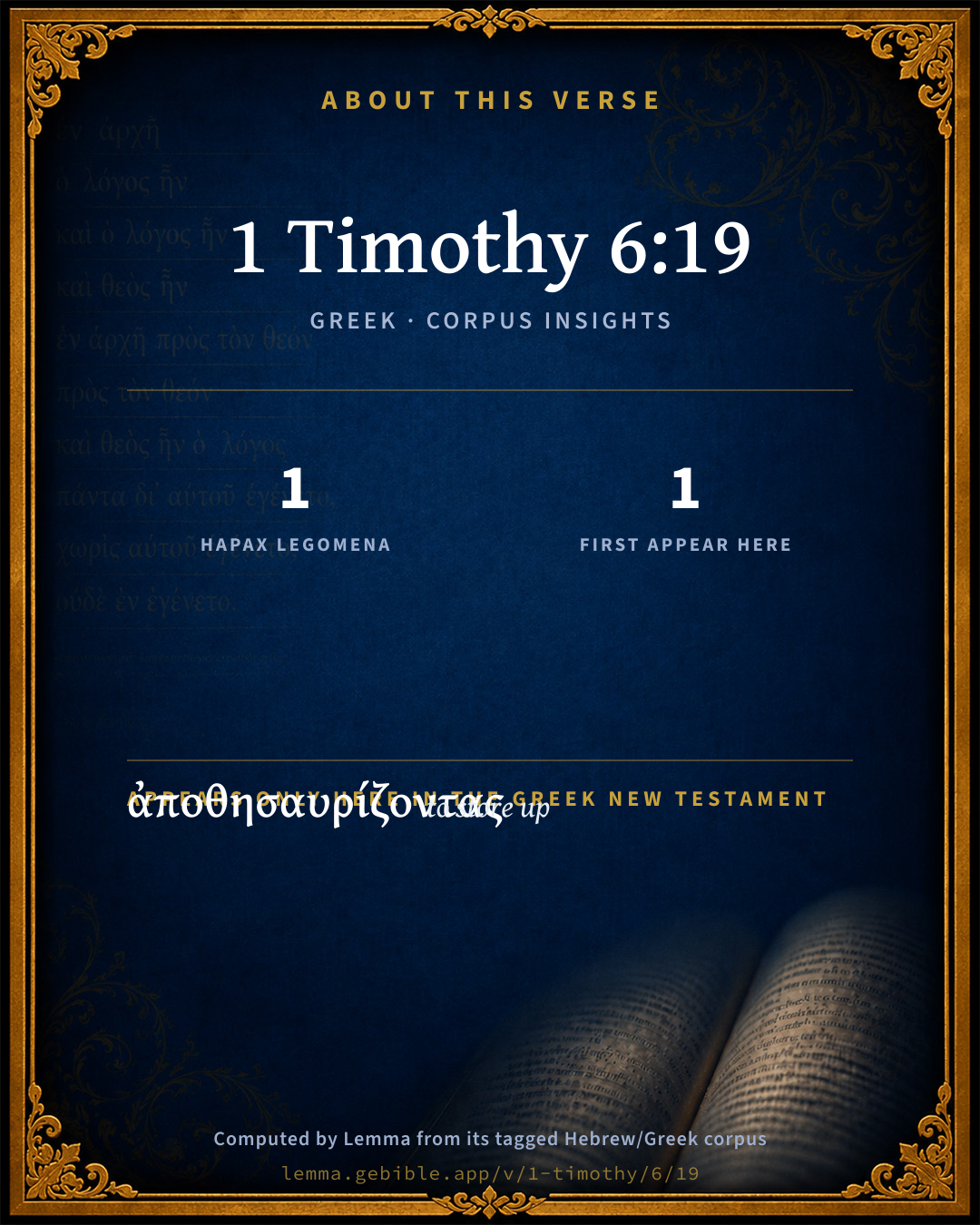
- 1 hapax legomenon — only here in the Greek New Testament
- 1 first appearance in the Greek New Testament
Download a study sheet
One document with this verse’s original text, its word-by-word gloss line, the meaning frame, cross-references with their text, attributed commentary, and full source and license credits — printable, and it pastes into notes with its structure intact.
This verse Autodidact and up
A passage Seminary Student
Up to 50 verses in one chapter. A passage sheet keeps up to 6 commentary sources and 12 cross-references per verse, in the order this page ranks them, and says so on the sheet whenever that leaves anything out. Ask for a single verse and you get the Autodidact verse sheet above.
Everything on this page stays free to read, with no account — the sheet is a download of what is already on screen, not access to it.
Compare translations 3
The same verse in 3 English versions, stacked beneath the original-language interlinear above. Click any original word for its lexicon entry.
Each is an independent rendering of the whole verse — the interlinear is not word-aligned to these translations.
Highlighted words mark where these versions differ — a whole-verse word diff, not a word-by-word alignment.
-
World English Bible Public Domain
laying up in store for themselves a good foundation against the time to come, that they may lay hold of eternal life.
-
King James Version Public Domain
Laying up in store for themselves a good foundation against the time to come, that they may lay hold on eternal life.
-
unfoldingWord Literal Text CC BY-SA 4.0
storing up for themselves a good foundation for what is coming, so that they may grasp the real life.
unfoldingWord Literal Text — © unfoldingWord, licensed CC BY-SA 4.0. Word-aligned USFM3 via Door43 (git.door43.org/unfoldingWord/en_ult).
Show all 19 translations
Every available English version of this verse, each an independent rendering of the whole verse.
-
World English Bible Public Domain
laying up in store for themselves a good foundation against the time to come, that they may lay hold of eternal life.
-
Berean Standard Bible Public Domain
treasuring up for themselves a firm foundation for the future, so that they may take hold of that which is truly life.
-
Majority Standard Bible Public Domain
treasuring up for themselves a firm foundation for the future, so that they may take hold of eternal life.
-
King James Version Public Domain
Laying up in store for themselves a good foundation against the time to come, that they may lay hold on eternal life.
-
American Standard Version (1901) Public Domain
laying up in store for themselves a good foundation against the time to come, that they may lay hold on the life which is `life' indeed.
-
Revised Version (1885) Public Domain
laying up in store for themselves a good foundation against the time to come, that they may lay hold on the life which is life indeed.
-
Geneva Bible (1599) Public Domain
Laying vp in store for themselues a good foundation against the time to come, that they may obteine eternall life.
-
Douay-Rheims (1899) Public Domain
To lay up in store for themselves a good foundation against the time to come, that they may lay hold on the true life.
-
Young's Literal Translation Public Domain
treasuring up to themselves a right foundation for the time to come, that they may lay hold on the life age-during.
-
Literal Standard Version CC BY-SA 4.0
treasuring up to themselves a right foundation for the time to come, that they may lay hold on [that which is] truly life.
-
Unlocked Literal Bible CC BY-SA 4.0
In that way, they will store up for themselves a good foundation for what is to come, so that they will take hold of real life.
-
unfoldingWord Literal Text CC BY-SA 4.0
storing up for themselves a good foundation for what is coming, so that they may grasp the real life.
-
Darby Bible Public Domain
laying by for themselves a good foundation for the future, that they may lay hold of [what is] really life.
-
World Messianic Bible Public Domain
laying up in store for themselves a good foundation against the time to come, that they may lay hold of eternal life.
-
Webster's Bible Public Domain
Laying up in store for themselves a good foundation against the time to come, that they may lay hold on eternal life.
-
Free Bible Version CC BY-SA 4.0
In this way they store up treasure that will provide a solid basis for the future, so that they can take hold of true life.
-
Bible in Basic English Public Domain
Making ready for themselves a safe place for the time to come, so that the true life may be theirs.
-
Text-Critical English NT CC BY 4.0
treasuring up for themselves a good foundation for the time to come, so that they may take hold of eternal life.
-
Tyndale New Testament (1534) Public Domain
layinge vp in store for them selves a good foundacion agaynst the tyme to come that they maye obteyne eternall lyfe
Literal Standard Version (2020), Covenant Press — licensed CC BY-SA 4.0. Text via the HelloAO Bible API (eBible.org). Unlocked Literal Bible (unfoldingWord) — licensed CC BY-SA 4.0. Text via the HelloAO Bible API (eBible.org). unfoldingWord Literal Text — © unfoldingWord, licensed CC BY-SA 4.0. Word-aligned USFM3 via Door43 (git.door43.org/unfoldingWord/en_ult). Free Bible Version, Dr. Jonathan Gallagher — licensed CC BY-SA 4.0. Text via the HelloAO Bible API (eBible.org).
Word by word
More ways to search: Search by grammar → Find every occurrence → Compare this word →
Practice this passage: Drill this verse → Learn its vocabulary →
- Appears 1× in the Greek New Testament
- First appears here
- Part of Speech
- Verb
- Tense
- Present
- Voice
- Active
- Mood
- Participle
- Case
- Accusative
- Number
- Plural
- Gender
- Masculine
Full Thayer's Definition
- ἀποθησαυρίζοντας apothēsaurízō G597 “to store up” Verb, Present, Active, Participle, Accusative, Plural, Masculine
- ἑαυτοῖς heautoû G1438 “himself” Reflexive pronoun, 3rd person, Dative, Plural, Masculine
- θεμέλιον themélios G2310 “foundation” Noun, Accusative, Singular, Masculine
- καλὸν kalós G2570 “good” Adjective, Accusative, Singular, Masculine
- εἰς eis G1519 “into” Preposition
- τὸ ho G3588 “the” Article, Accusative, Singular, Neuter
- μέλλον méllō G3195 “to be about” Verb, Present, Active, Participle, Accusative, Singular, Neuter
- ἵνα hína G2443 “that” Conjunction
- ἐπιλάβωνται epilambánomai G1949 “to overtake” Verb, Aorist, Middle deponent, Subjunctive, 3rd person, Plural
- τῆς ho G3588 “the” Article, Genitive, Singular, Feminine
- ὄντως óntōs G3689 “truly” Adverb
- ζωῆς zōḗ G2222 “life” Noun, Genitive, Singular, Feminine
About this verse
These counts appear in no published source. They are computed here, from the morphology-tagged text and Lemma’s own curated glosses. What Lemma adds →
- 12
- words
- 11
- distinct lemmas
- Pauline Epistles
- section
Notable vocabulary
1 hapax legomenon — a word that appears only here in the entire Greek New Testament:
- ἀποθησαυρίζοντας to store up G597
First appearance in Scripture
This word makes its first canonical appearance in the Greek New Testament here:
- ἀποθησαυρίζοντας to store up G597
Shared distinctive vocabulary
ὄντως truly G3689 occurs in 10 verses of the Greek New Testament. Also found in:
Repetition
A word recurs within this verse:
- τὸ the G3588 ×2
Cross-references
20Topical passages linked to 1 Timothy 6:19 in the Treasury of Scripture Knowledge — connected by theme and wording, ordered by reader-vote popularity; previews shown in the World English Bible.
- Matthew 6:19–21 "Don't lay up treasures for yourselves on the earth, where moth and rust consume, and where thieves break through and steal;
- 1 Timothy 6:12 Fight the good fight of faith. Lay hold of the eternal life to which you were called, and you confessed the good confession in the sight of many witnesses.
- 2 Timothy 2:19 However God's firm foundation stands, having this seal, "The Lord knows those who are his," and, "Let every one who names the name of the Lord depart from unrighteousness."
- Luke 16:9 I tell you, make for yourselves friends by means of unrighteous mammon, so that when you fail, they may receive you into the eternal tents.
- Proverbs 31:25 Strength and dignity are her clothing. She laughs at the time to come.
- Galatians 6:8–9 For he who sows to his own flesh will from the flesh reap corruption. But he who sows to the Spirit will from the Spirit reap eternal life.
- 1 Peter 1:4 to an incorruptible and undefiled inheritance that doesn't fade away, reserved in heaven for you,
- Matthew 19:21 Jesus said to him, "If you want to be perfect, go, sell what you have, and give to the poor, and you will have treasure in heaven; and come, follow me."
- Ephesians 3:17 that Christ may dwell in your hearts through faith; to the end that you, being rooted and grounded in love,
- Philippians 3:14 I press on toward the goal for the prize of the high calling of God in Christ Jesus.
- Matthew 10:41–42 He who receives a prophet in the name of a prophet will receive a prophet's reward: and he who receives a righteous man in the name of a righteous man will receive a righteous man's reward.
- Luke 6:48–49 He is like a man building a house, who dug and went deep, and laid a foundation on the rock. When a flood arose, the stream broke against that house, and could not shake it, because it was founded on the rock.
- Luke 12:33 Sell that which you have, and give gifts to the needy. Make for yourselves purses which don't grow old, a treasure in the heavens that doesn't fail, where no thief approaches, neither moth destroys.
- Luke 18:22 When Jesus heard these things, he said to him, "You still lack one thing. Sell all that you have, and distribute it to the poor. You will have treasure in heaven. Come, follow me."
- Psalms 17:14 From men by your hand, Yahweh, From men of the world, whose portion is in this life. You fill the belly of your cherished ones. Your sons have plenty, And they store up wealth for their children.
- Proverbs 10:25 When the whirlwind passes, the wicked is no more; But the righteous stand firm forever.
- Matthew 25:34–40 Then the King will tell those on his right hand, 'Come, blessed of my Father, inherit the Kingdom prepared for you from the foundation of the world;
- Luke 16:25 "But Abraham said, 'Son, remember that you, in your lifetime, received your good things, and Lazarus, in like manner, bad things. But now here he is comforted and you are in anguish.
- Luke 18:2 saying, "There was a judge in a certain city who didn't fear God, and didn't respect man.
- Galatians 5:6 For in Christ Jesus neither circumcision amounts to anything, nor uncircumcision, but faith working through love.
Cross-references courtesy of OpenBible.info (CC BY 4.0).
Where the printed editions differ
1 variantPlaces in this verse where the major printed Greek editions disagree on the wording in a way that affects the translation — a comparison of editions, not a manuscript-by-manuscript collation. The editions are the modern critical texts (Nestlé-Aland 28/27, SBL, Westcott-Hort, Tregelles, Tyndale House) and the traditional texts behind the KJV (the Textus Receptus and the Byzantine/Majority text). It is not a claim about which reading is original.
-
Different wording
ὄντως
“[is] truly”
In NA28NA27TynSBLWHTreg Not in TRByzαἰωνιόυ (aiōniou) '[is] eternal' occurs in traditional manuscripts (TR+Byz) instead of ὄντως (ontōs) '[is] truly' in older manuscripts (NA28+NA27+Tyn+SBL+WH+Treg)
Textual data: Translators Amalgamated Greek New Testament (STEPBible TAGNT) · CC BY 4.0.
Lesson kit
Teaching starters — assembled from the data on this page, not authored interpretation. Every prompt links to the verse data it draws on. Edit before teaching.
1 Timothy, in the Pauline Epistles, opens this verse with 12 words (11 distinct Greek lemmas). Its most distinctive word is apothēsaurízō (“to store up”). A historical commentator’s framing appears above. Read the whole chapter for the surrounding context.
Discussion questions
- What does “to store up” (apothēsaurízō) contribute to the verse as a whole?
- 1 word here appears nowhere else in the Greek New Testament. Why might the author reach for such rare wording?
- This is the first place “to store up” appears in Scripture (first appears here). What does its debut here establish?
- How does Mark 11:32, which shares the word «truly», read alongside this verse?
- What does the repetition of “the” (2× in this one verse) do in this verse?
- These translations render this verse differently; the difference is in the English rendering, not the original. What questions does that raise?
- Compare how Jamieson, Fausset & Brown and John Gill's Exposition read this verse. Where do they agree or differ?
Things to notice
- 1 word in this verse appears nowhere else in the Greek New Testament.
- 1 word makes its first canonical appearance in Scripture here.
- These translations choose different wording for 13 words in this verse.
- “the” occurs 2× in this single verse.
- 11 distinct Greek lemmas span 12 words in this verse.
Commentary
Notes on 1 Timothy 6:19 from classic Christian and Jewish commentators (each source and its license shown beneath its notes). The classic Christian expositions comment on the surrounding passage and are grouped to its opening verse, so a note may address several verses; the Jewish commentaries on the Tanakh (Rashi and others) are per-verse, so they appear only where the commentator wrote on this verse.
Lemma curates 59 commentaries, every one of them public domain or Creative Commons licensed, each selected and text-cleaned for this edition rather than reprinted as found. About our sources →
Jamieson, Fausset & Brown
Robert Jamieson, A. R. Fausset & David Brown
Jamieson, Fausset & Brown — Commentary Critical and Explanatory on the Whole Bible (1871) — public domain (CC PDM 1.0). Text via the HelloAO Bible API.
John Gill's Exposition
John Gill's Exposition of the Whole Bible (1746–1763) — public domain (CC PDM 1.0). Text via the HelloAO Bible API.
The Biblical Illustrator
Joseph S. Exell
The Biblical Illustrator, edited by Joseph S. Exell (c. 1880s–1900s) — public domain. Text from a community e-Sword module.
MacLaren's Expositions of Holy Scripture
Alexander MacLaren
Alexander MacLaren, Expositions of Holy Scripture (1904–1910) — public domain. Text from a community e-Sword module.
Bengel's Gnomon
Johann Albrecht Bengel
Bengel's Gnomon of the New Testament — English translation (T&T Clark, Edinburgh, 1860) — public domain. Text from a community e-Sword module.
Meyer's Critical & Exegetical Commentary
Heinrich August Wilhelm Meyer
Meyer — Critical and Exegetical Commentary on the New Testament — English translation by Peter Christie, edited by Frederick Crombie (T&T Clark, 1880) — public domain. Text from a community e-Sword module.
Expositor's Greek Testament
ed. W. Robertson Nicoll
The Expositor's Greek Testament, edited by W. Robertson Nicoll (1897–1910) — public domain. Text from a community e-Sword module.
Geneva Bible (1599)
Geneva Bible translators
Geneva Bible (1599) marginal notes — public domain. Text via Bolls.life.
Adam Clarke's Commentary
Adam Clarke's Commentary on the Bible (1810–1826) — public domain. Text from a community e-Sword/MySword module.
John Calvin's Commentaries
John Calvin's Commentaries (1540-1563) — public domain. Text from the Calvin Translation Society English edition (1840s-50s) via the Christian Classics Ethereal Library (ccel.org). Calvin's coverage is partial (roughly two-thirds of the Bible); uncommented books and verses are honest gaps, never fabricated. The 19th-century editor's footnotes and remarks are omitted so the notes are faithfully Calvin's own voice.
Ellicott's Commentary for English Readers
A Bible Commentary for English Readers, edited by Charles John Ellicott (1878–1897) — public domain. Text from a community e-Sword module.
The Cambridge Bible for Schools and Colleges
gen. ed. J. J. S. Perowne
The Cambridge Bible for Schools and Colleges (gen. ed. J. J. S. Perowne; Cambridge University Press, 1878–1918) — public domain. Text from a community e-Sword module.
Trapp's Complete Commentary
John Trapp
John Trapp, A Commentary or Exposition upon All the Books of the Old and New Testament (1647–1656) — public domain. Text from a community e-Sword module.
Albert Barnes' Notes on the Bible
Albert Barnes' Notes on the Bible (1834–1885) — public domain. Text from a community e-Sword/MySword module.
Matthew Poole's English Annotations
Matthew Poole's English Annotations on the Holy Bible (1683–1685) — public domain. Text from a community e-Sword/MySword module.
Whedon's Commentary on the Bible
Daniel D. Whedon
Daniel D. Whedon (gen. ed.), Commentary on the Old and New Testaments (1874–1909) — public domain. Text from a community e-Sword module.
The Pulpit Commentary
The Pulpit Commentary (1880–1919), ed. H.D.M. Spence-Jones & Joseph S. Exell — public domain. Text from a community e-Sword module.
John Wesley's Explanatory Notes
John Wesley, Explanatory Notes Upon the Whole Bible (1754–1765) — public domain. Text via the GEBible commentary corpus.
Fairbairn on Ezekiel, Jonah & the Pastoral Epistles
Patrick Fairbairn
Patrick Fairbairn — An Exposition of Ezekiel (1851), Jonah (1849), and The Pastoral Epistles (1874) — public domain. Text from a community e-Sword module.
The People's New Testament
B. W. Johnson
B. W. Johnson's The People's New Testament with Notes (1889–1891) — public domain. Electronic text from the Christian Classics Ethereal Library (CCEL) ThML edition.
Cambridge Greek Testament for Schools and Colleges
Cambridge Greek Testament for Schools and Colleges (Cambridge University Press, 1896; 21 vols, various authors incl. Carr, Maclear, Plummer, Farrar, Lumby, Moule, M. R. James, Simcox) — public domain. Text from a community e-Sword module.
International Critical Commentary
International Critical Commentary — older volumes (1896–1929), various authors — public domain. Text from a community e-Sword module.
Vincent's Word Studies in the New Testament
Marvin R. Vincent
Marvin R. Vincent, Word Studies in the New Testament (1887–1900) — public domain. Text from a community e-Sword/MySword module.